

- Market Size (2026)
- USD 1.3 Bn
- Forecast (2036)
- USD 2.0 Bn
- CAGR (2026 to 2036)
- 4.7%
How big is Solvent Extraction Diluents Market in 2026?
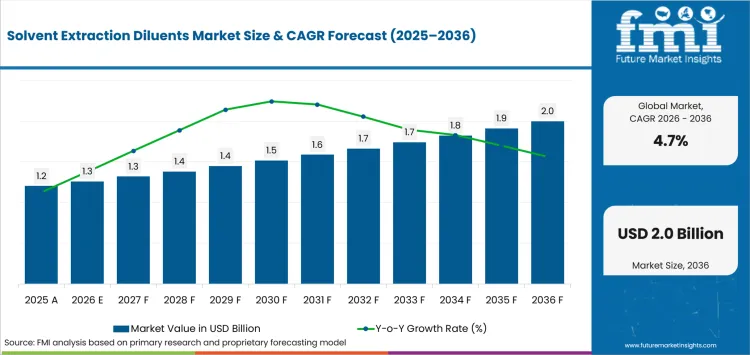
USD 1.3 Billion in 2026 and USD 2.0 Billion by 2036 at a 4.7% CAGR.
Demand for solvent extraction diluents is projected to expand at 4.7% CAGR between 2026 and 2036, lifting valuation from USD 1.3 billion in 2026 to USD 2.0 billion by 2036. Demand advances because the diluent is a working part of the organic phase rather than a passive carrier. Viscosity and evaporation rate affect reagent losses. Phase disengagement behavior and extractant compatibility also determine circuit stability. A June 2025 Journal of Sustainable Metallurgy study on Shell GTL Fluid G80 noted that solvent extraction-electrowinning accounted for about one-fifth of primary copper production as of April 2025. The same study showed why buyers test loading and stripping before a grade change. Phase separation and evaporation are tested as well. That operating sensitivity supports recurring top-up demand at established copper plants and technical qualification at new critical-mineral circuits. As capacity is added, purchasing shifts from spot solvent availability toward contracted supply with reproducible specifications and site-level performance support.
Country conversion conditions differ materially. Peru and Chile have deep copper-processing ecosystems, so mine operators place high weight on continuity of supply and compatibility with established SX-EW practices. Mexico combines a large copper base in Sonora with a stronger need for regional inventory and reliable delivery across mine locations. The USA is building pilot-scale critical-mineral processing capacity, where new separation routes create room for specialty diluents but require proof at demonstration scale before long-term procurement. Australia is encouraging more domestic critical-mineral processing and explicitly treats reagents as an eligible processing expense under its production tax incentive framework. Across these markets, interest becomes an order only after the fluid passes circuit qualification and the supplier can support dependable replenishment.
Key Takeaways
- Recurring solvent-extraction losses create base demand in operating SX-EW circuits, while new critical-mineral projects add a separate qualification pipeline for diluent performance.
- Aliphatic hydrocarbons hold a 31.0% share in 2026 because their performance envelope matches the most common buyer requirements for stable hydrometallurgical operation.
- Copper SX holds a 42.0% share in 2026 because its installed SX-EW base creates both continuous top-up consumption and repeat qualification demand.
- Standard flash point holds a 34.0% share in 2026 because established plants favor a known balance between handling controls and viscosity. Solvency and delivered cost remain part of the decision.
- Hydrometallurgy plants hold a 39.0% share in 2026 because they combine high fluid consumption with continuous metallurgical oversight and repeat replenishment.
- Direct refinery supply holds a 42.0% share in 2026 because large hydrometallurgy sites value traceable specifications and secure bulk replenishment for a process-sensitive fluid.
- Requalification can be slow because phase separation and extractant compatibility affect circuit economics, but lower-aromatic and tightly specified grades can earn value where safety, loss rate or recycled-feed complexity matters.
- Hydrocarbon-fluid and distribution participants include ExxonMobil Chemical, Shell Chemicals, Chevron Phillips Chemical, TotalEnergies Fluids, Idemitsu Kosan, Univar Solutions, and Brenntag.
Analyst Perspective
“Diluent price is only one line in the circuit cost. Operators watch entrainment, evaporation, disengagement and extractant behavior because a cheaper fluid can become more expensive when losses rise or phase performance deteriorates.”
- Nikhil Kaitwade, Principal Consultant, Future Market Insights
How is the Solvent Extraction Diluents Market segmented?
The market is segmented by Diluent Type, Metal Circuit, Flash Point, End Use, and Sales Channel.
Diluent Type separates petroleum-derived and synthetic fluids by hydrocarbon composition and the balance between solvency, odor, volatility, and aromatic content. Metal Circuit distinguishes where the organic phase is used, with copper representing the most established commercial SX application. Flash Point captures the trade-off between handling conditions and operating performance. End Use separates integrated hydrometallurgy sites from dedicated SX-EW plants, battery-metal refineries, and reagent blenders. Sales Channel reflects how strongly buyers value direct technical accountability, distributor stocking, specialist mining-reagent support, or regional depot access.
Why do Aliphatic hydrocarbons lead the Diluent Type category?
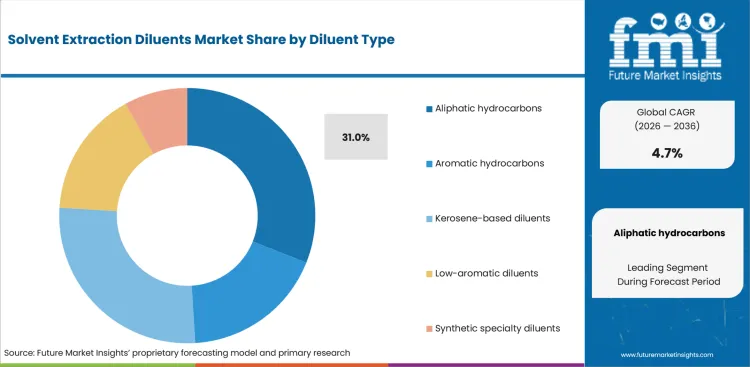
Aliphatic hydrocarbons fit the operating profile of mainstream metal SX because buyers seek low viscosity and controlled evaporation. They also need dependable phase disengagement with low aromatic exposure. They also support a broad range of oxime and other extractant systems without forcing a plant to accept the odor profile of more aromatic solvent grades. The commercial advantage is not chemical purity by itself. It is the ability to maintain stable organic-phase properties through long operating cycles while limiting top-up losses. This makes aliphatic grades a practical reference point for both existing copper circuits and newer critical-mineral separation plants. Diluent procurement sits within a wider mining chemicals budget where reagent stability and logistics affect plant continuity.
- Aliphatic hydrocarbons hold a 31.0% share in 2026 because their performance envelope matches the most common buyer requirements for stable hydrometallurgical operation.
- In June 2025, a Journal of Sustainable Metallurgy study reported that Shell GTL Fluid G80 combined ultra-low aromatic content with low viscosity. It also reported an 84 degrees C flash point and lower evaporation than benchmark mineral-oil diluents.
Why does Copper SX lead the Metal Circuit category?
Copper SX has a mature installed base and recurring organic-phase replenishment. Its extractant-diluent operating windows are also well established. Each running circuit must preserve phase separation and copper transfer. It must also control aqueous entrainment, evaporation, and crud formation. That creates recurring demand even when a mine does not add new SX capacity. It also lowers the commercial risk of supplying an application with known qualification protocols and operating benchmarks. Cobalt and nickel circuits add growth diversity. Uranium and rare-earth circuits do the same, but their chemistry and scale are more fragmented. Copper therefore remains the core circuit around which specialist mining diluent portfolios and technical service models are built. Copper and critical-mineral circuits link diluent demand to new mineral processing capacity as projects move from pilot to operating scale.
- Copper SX holds a 42.0% share in 2026 because its installed SX-EW base creates both continuous top-up consumption and repeat qualification demand.
- COCHILCO continued to report SX-EW cathodes as a distinct copper production category in its June 2026 monthly bulletin, showing the enduring operating footprint of this route in Chile.
Why does Standard flash point lead the Flash Point category?
Standard flash point grades remain the volume center because many plants need a workable balance rather than the highest possible safety specification. Higher flash points can lower fire and vapor concerns, but viscosity and boiling range still need to support rapid mass transfer and phase disengagement. Buyers also compare storage conditions and site temperatures before moving to a premium grade. Transport classification and evaporation loss matter as well. Standard products meet familiar operating procedures at established sites and usually carry less requalification burden. High flash point, low odor, and low VOC grades gain where site policy or worker-exposure requirements justify a tighter specification. Mine-development cycles also influence the installed base of surface mining operations feeding solvent-extraction plants.
- Standard flash point holds a 34.0% share in 2026 because established plants favor a known balance between handling controls and viscosity. Solvency and delivered cost remain part of the decision.
- The June 2025 Shell G80 study treated flash point and vapor pressure as linked selection criteria. It also tested viscosity and evaporation, reinforcing why buyers assess safety and circuit behavior together rather than in isolation.
Why do Hydrometallurgy plants lead the End Use category?
Hydrometallurgy plants lead because diluent selection sits inside a broader metallurgical control loop. Plant teams monitor feed chemistry and extractant condition. They also track phase separation, organic losses, and downstream electrowinning performance. A diluent purchase therefore affects more than inventory. It can change reagent balance and operating stability across multiple unit operations. Integrated plants also have the technical staff and laboratory routines needed to qualify alternate fluids when mine chemistry changes. Dedicated SX-EW copper sites remain major users, while battery-metal refineries are expanding the addressable base. Reagent blending facilities serve as formulation and distribution nodes rather than the ultimate consumption center. Remote-site supply planning has parallels with mining lubricants because stockouts can disrupt continuous production.
- Hydrometallurgy plants hold a 39.0% share in 2026 because they combine high fluid consumption with continuous metallurgical oversight and repeat replenishment.
- In May 2025, BASF said it was decentralizing solvent extraction and electrowinning technical and analytical capabilities closer to mining customers, underscoring the value plants place on site-level hydrometallurgy support.
Why does Direct refinery supply lead the Sales Channel category?
Direct refinery supply is favored when the fluid is process-critical and a specification change can disrupt the organic phase. Large plants prefer clear accountability for product consistency and technical documentation. Bulk logistics and corrective support are part of the same supply relationship. Direct contracting also improves planning for top-up volumes and reduces the risk that a mine receives a substitute grade during a supply interruption. Distributors remain important for smaller orders and broad geographic coverage. Mining reagent suppliers can bundle technical support around the organic phase, while regional depots reduce lead times in remote areas. The direct route leads where continuous consumption justifies contracted volumes and close supplier involvement. Lower-aromatic and synthetic grades compete as specialty chemicals when operating or safety requirements justify qualification effort.
- Direct refinery supply holds a 42.0% share in 2026 because large hydrometallurgy sites value traceable specifications and secure bulk replenishment for a process-sensitive fluid.
- Solvay cited security of supply as a reason for its June 2023 expansion of copper SX reagent capacity in Tennessee, illustrating the broader importance of dependable direct supply in hydrometallurgical reagent procurement.
What are the drivers, restraints and opportunities in the Solvent Extraction Diluents Market?
Copper and critical-mineral processing sustain demand, while circuit requalification and logistics slow switching, and battery recycling opens a path for lower-aromatic specialty fluids.
- Driver: Expansion and sustained operation of SX circuits increase organic-phase replenishment and qualification demand.
- Restraint: A diluent change can alter phase separation and loss rates, so buyers require technical validation before switching.
- Opportunity: Battery recycling and new critical-mineral circuits create demand for low-aromatic, high-flash-point, and synthetic specialty grades.
The most pronounced demand mechanism is the combination of existing copper SX-EW operation and new critical-mineral processing investment. The International Energy Agency reported in May 2025 that supply chains for copper and nickel remain central to energy and industrial security. It also highlighted cobalt and rare earths. More processing does not translate one-for-one into diluent sales, but every liquid-liquid SX circuit needs an organic phase and periodic replenishment. Existing copper sites create repeat consumption as evaporation and entrainment remove fluid. New projects add a qualification cycle before steady-state purchasing begins. This mix supports growth without requiring every new mineral project to use the same separation chemistry.
The main restraint appears at the switching and qualification stage. A June 2025 peer-reviewed study of a new Shell diluent evaluated viscosity and evaporation. It also tested loading and phase disengagement, then examined extraction and stripping kinetics. Selectivity and third-phase behavior were assessed as well. That test list explains why procurement teams do not treat mining diluents as interchangeable commodity solvents. A lower-cost alternative can become more expensive if it slows phase separation or increases organic losses. Remote-site inventory adds another barrier because a failed transition can interrupt a continuous process. Suppliers must therefore fund technical trials and provide consistent batches before buyers will replace a proven grade.
The clearest opportunity is specialty fluid demand outside conventional copper oxide circuits. TotalEnergies Fluids introduced Elixore BioLife EV 205 in September 2023 for solvent extraction in electric-vehicle battery recycling. The product was positioned as an aliphatic diluent made from circular-economy feedstocks. The USA and Canada are also funding demonstration work for critical-mineral separation routes. These markets reward fluids that combine low aromatic content with predictable mass transfer and safer handling, but they also require metal-specific validation. Suppliers with application laboratories and flexible product ranges are best placed to convert pilot activity into commercial orders once circuit economics are proven.
Which country CAGRs are profiled in the Solvent Extraction Diluents Market?
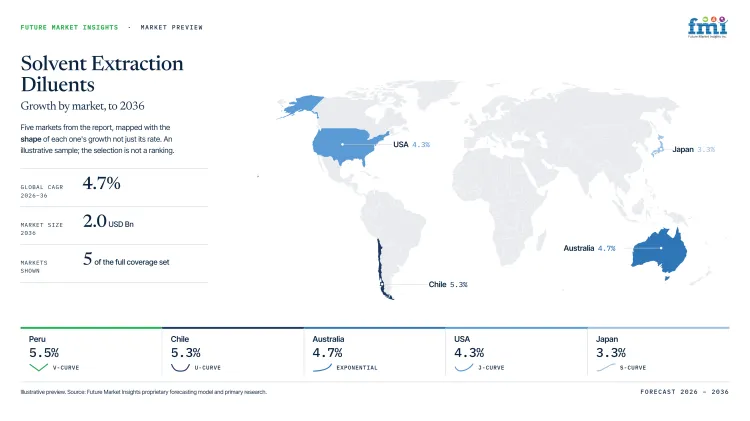
| Country | CAGR |
|---|---|
| Peru | 5.5% |
| USA | 4.3% |
| Japan | 3.3% |
| Chile | 5.3% |
| Australia | 4.7% |
| Canada | 4.4% |
| Mexico | 4.8% |
How do country-level CAGRs compare in the Solvent Extraction Diluents Market?
The profiled growth rates span 2.2 percentage points from Peru at 5.5% CAGR to Japan at 3.3% CAGR from 2026 to 2036. Peru and Chile form the top band because copper remains central to their mining and hydrometallurgy systems. Mexico and Australia sit near the overall market rate, but for different reasons: Mexico is anchored in copper production while Australia is building downstream critical-mineral processing. Canada and the USA form a middle band shaped by project qualification and domestic supply-chain investment. Japan is slower as strategic mineral programs still need full separation and refining economics to translate into recurring reagent demand.
- At 5.5% CAGR, Peru remains commercially distinct. Peruvian buyers tie diluent procurement to mine plans and the readiness of leach-SX infrastructure, with direct supply favored for large operating sites.
- USA is forecast at 4.3% CAGR. USA buyers increasingly evaluate diluents inside pilot and demonstration programs for critical-mineral separation, where performance evidence is required before scale-up.
- Japanese procurement emphasizes feed security, technical purity, and proof that a separation route can operate economically at scale. In Japan, that operating setting accompanies a 3.3% CAGR through 2036.
- A 5.3% CAGR places Chile within the profiled set, but purchasing hinges on a specific condition: Chilean operators purchase against a mature copper SX-EW base, so supply continuity and organic-phase stability carry more weight than novelty alone.
- Australia's 4.7% outlook is shaped by execution conditions. Australian buyers are increasingly evaluating hydrometallurgical reagents within projects designed to process critical minerals domestically rather than export only mined feed.
- For Canada, the forecast reaches 4.4% CAGR. Canadian buyers combine mine development with government-backed processing demonstrations, creating a market where technical qualification often precedes steady bulk demand.
- Mexican demand is concentrated around established mining regions, so distributor coverage and dependable delivery can matter as much as nominal product availability. That gives Mexico a distinct Solvent Extraction Diluents path within its 4.8% CAGR forecast.
CAGR alone does not establish absolute market size or supplier priority. A mature copper producer can consume large recurring volumes at a moderate growth rate, while a smaller emerging circuit can grow quickly from a low base. Channel structure and plant scale therefore need to be assessed alongside growth. Qualification cycles and local inventory costs matter as well. The broader regional coverage also captures markets where individual projects can create concentrated reagent demand even when a country is not among the seven profiled growth cases.
Country-wise Analysis
- Peru: Peruvian buyers tie diluent procurement to mine plans and the readiness of leach-SX infrastructure, with direct supply favored for large operating sites. Between 2026 and 2036, sales of Solvent Extraction Diluents in Peru are expected to rise at 5.5% CAGR. On October 26, 2025, Peru's Ministry of Energy and Mines published a mining investment portfolio containing 67 projects across 19 departments. Project execution does not guarantee SX demand, but copper-heavy development sustains the addressable processing base. Remote logistics and site qualification remain the main frictions. Commercial suppliers need reliable inventory, bulk-delivery planning, and circuit-specific trial support to turn project activity into recurring sales.
- USA: USA buyers increasingly evaluate diluents inside pilot and demonstration programs for critical-mineral separation, where performance evidence is required before scale-up. The Solvent Extraction Diluents outlook for USA points to a 4.3% CAGR from 2026 to 2036. On May 19, 2026, the USA Department of Energy announced USD 45.7 million for 19 critical-mineral projects, including work that will demonstrate solvent extraction technology for rare earth processing. The main commercial hurdle is the transition from pilot chemistry to continuous commercial operation. Suppliers should provide small-volume technical support first, then secure scalable domestic supply once a circuit passes validation.
- Japan: Japanese procurement emphasizes feed security, technical purity, and proof that a separation route can operate economically at scale. For Japan, the Solvent Extraction Diluents market is projected to advance at 3.3% CAGR through 2036. At a February 3, 2026 press conference, Japan's Ministry of Economy Trade and Industry discussed successful test mining of rare-earth mud near Minamitorishima. The ministry also said the full chain from mining through separation and refining must demonstrate economic feasibility. A practical constraint is therefore not reagent availability alone. Providers need high-specification fluids, detailed compatibility data, and patient qualification support for selective strategic-mineral projects.
- Chile: Chilean operators purchase against a mature copper SX-EW base, so supply continuity and organic-phase stability carry more weight than novelty alone. Solvent Extraction Diluents sales in Chile are expected to grow at 5.3% CAGR over 2026 to 2036. COCHILCO's June 2026 monthly bulletin continued to report SX-EW cathodes as a distinct production category, confirming the route's ongoing operational relevance. A key friction is maintaining economics as ore characteristics change and plants work to control water, energy, and reagent intensity. Suppliers can win by reducing evaporation losses, supporting fast phase disengagement, and maintaining local inventory close to major mining districts.
- Australia: Australian buyers are increasingly evaluating hydrometallurgical reagents within projects designed to process critical minerals domestically rather than export only mined feed. A 4.7% CAGR is projected for Solvent Extraction Diluents in Australia between 2026 and 2036. On August 18, 2026 the Australian Department of Industry Science and Resources published guidance for the Critical Minerals Production Tax Incentive. The guidance identifies reagents as eligible processing expenditure and sets a 10% tax offset for eligible costs. One persistent challenge is project timing and qualification before the incentive begins in 2027. Suppliers should align technical trials, regulatory documentation, and local storage with project commissioning schedules.
- Canada: Canadian buyers combine mine development with government-backed processing demonstrations, creating a market where technical qualification often precedes steady bulk demand. Through 2036, the market for Solvent Extraction Diluents in Canada is set to register a 4.4% CAGR. Natural Resources Canada updated its Critical Minerals Research Development and Demonstration Program on May 4, 2026. The program lists clean-extraction separation work for copper and nickel. It also covers cobalt and heavy-rare-earth solvent extraction. The central purchase barrier is moving these routes from demonstration into bankable throughput. Suppliers should support flexible trial volumes, cold-climate logistics where relevant, and scale-up data that connect fluid performance to total process cost.
- Mexico: Mexican demand is concentrated around established mining regions, so distributor coverage and dependable delivery can matter as much as nominal product availability. Growth in Solvent Extraction Diluents across Mexico is projected at 4.8% CAGR from 2026 to 2036. On June 13, 2026, the Government of Sonora said the state generated more than 80% of Mexico's copper output while promoting additional international mining investment. What slows conversion is serving geographically dispersed operations with consistent specification and manageable lead times. Qualified suppliers need regional stocking, strong mine-reagent distribution relationships, and direct technical support for plants that consider switching diluent grades.
Who are the notable companies in the Solvent Extraction Diluents Market?
ExxonMobil Chemical, Shell Chemicals, Chevron Phillips Chemical, TotalEnergies Fluids, Idemitsu Kosan, Univar Solutions, and Brenntag.
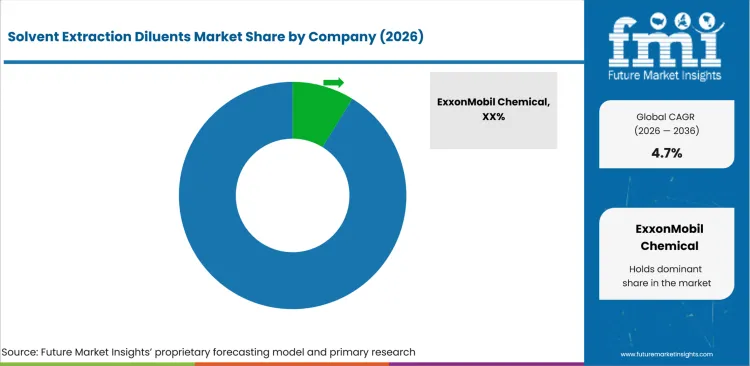
The competitive structure separates primary hydrocarbon-fluid producers from distributors that keep qualified grades available near remote operating sites. ExxonMobil Chemical, Shell Chemicals, Chevron Phillips Chemical, TotalEnergies Fluids and Idemitsu Kosan bring refinery or specialty-fluid production capability. Univar Solutions and Brenntag compete through regional inventory, logistics and industrial-solvent access. Extractant-only suppliers sit outside diluent revenue unless they also sell an eligible carrier fluid.
- Primary hydrocarbon-fluid producers: ExxonMobil Chemical, Shell Chemicals, Chevron Phillips Chemical, TotalEnergies Fluids and Idemitsu Kosan compete through consistent hydrocarbon-fluid supply and specification control.
- Distribution and inventory networks: Univar Solutions and Brenntag add storage, regional availability and delivery support for qualified process solvents.
- Qualification logic: Supplier choice is shaped by repeatable fluid properties and the ability to maintain supply after a circuit has qualified a grade.
Competitive Benchmarking: Solvent Extraction Diluents Market
| Company | Commercial Role | Diluent Relevance | Service / Channel Model | Geographic Reach |
|---|---|---|---|---|
| ExxonMobil Chemical | Hydrocarbon-fluid producer | High-purity hydrocarbon process fluids | Direct and industrial channels | Global |
| Shell Chemicals | Hydrocarbon-fluid producer | Paraffinic and aliphatic process fluids | Direct and distributor routes | Global |
| Chevron Phillips Chemical | Hydrocarbon producer | Hydrocarbon process-fluid capability | Bulk and direct supply | Americas, Europe and Asia |
| TotalEnergies Fluids | Specialty-fluid producer | Hydrocarbon solvent and diluent grades | Direct and distributor routes | Global |
| Idemitsu Kosan | Petrochemical producer | Hydrocarbon solvent and process-fluid capability | Direct and regional supply | Asia and selected international markets |
| Univar Solutions | Chemical distributor | Bulk specialty-solvent access | Distribution and logistics | North America and international |
| Brenntag | Chemical distributor | Process-solvent supply and inventory | Distribution and logistics | Global |
Benchmarking distinguishes fluid manufacturing from distribution, then compares specification control, qualified-solvent availability, logistics and reach into hydrometallurgical operating sites.
Key Developments in the Solvent Extraction Diluents Market
- In June 2025, a peer-reviewed study evaluated Shell GTL Fluid G80 as a synthetic aliphatic diluent for copper solvent extraction. The study reported low vapor pressure and an 84 degrees C flash point. It also reported low viscosity, strong phase disengagement, and lower evaporation than the compared commercial diluents. The result gives copper operators a technical reference for assessing synthetic low-aromatic fluids without assuming performance will transfer automatically to other metal circuits.
- In May 2025, BASF announced a strategic shift in copper hydrometallurgy research and customer support. It relocated global leaching research activities from Tucson to Houston and said solvent extraction and electrowinning technical capabilities would be decentralized closer to customers. The change strengthens technical support around extractant-diluent compatibility and raises buyer expectations for site-specific troubleshooting.
Key Players in the Solvent Extraction Diluents Market
Hydrocarbon Fluid Producers
- ExxonMobil Chemical
- Shell Chemicals
- Chevron Phillips Chemical
- TotalEnergies Fluids
- Idemitsu Kosan
Distribution and Logistics
- Univar Solutions
- Brenntag
Solvent Extraction Diluents Market - Report Scope
| Coverage field | Report scope |
|---|---|
| Market breakdown | Diluent Type, Metal Circuit, Flash Point, End Use, and Sales Channel |
| Quantitative Units | USD Billion |
| Market Definition | Revenue includes hydrocarbon and specialty diluent fluids sold for liquid-liquid solvent extraction within the defined metal circuits and end uses. It excludes separately sold extractants, downstream finished-metal revenue, and solvents sold into unrelated or substitute applications. |
| Regions Covered | North America; Latin America; Western Europe; Eastern Europe; East Asia; South Asia and Pacific; Middle East and Africa |
| Countries Covered | Peru, USA, Japan, Chile, Australia, Canada, Mexico, and more than twenty-five additional countries in the full report |
| Key Companies Profiled | ExxonMobil Chemical; Shell Chemicals; Chevron Phillips Chemical; TotalEnergies Fluids; Idemitsu Kosan; Univar Solutions; Brenntag |
| Forecast Period | 2026 to 2036 |
| Approach | FMI uses a hybrid bottom-up and top-down approach that reconciles supplier activity, plant-level consumption drivers, metal-circuit exposure, and country operating conditions. |
Solvent Extraction Diluents Market - Research Methodology
| Method | Approach |
|---|---|
| Primary Research | Structured discussions with diluent manufacturers, petrochemical distributors, mining-reagent suppliers, hydrometallurgy operators, procurement teams, and technical specialists focus on product qualification, operating losses, channel behavior, switching frictions, and purchasing criteria. No interview or respondent counts are presented. |
| Desk Research | Review covers mining ministry and regulator publications, mineral-processing statistics, peer-reviewed technical literature, company product documentation, safety information, and dated corporate announcements. Sources are retained only when they support the defined revenue boundary or a clearly identified operating mechanism. |
| Market Sizing and Forecasting | Sizing reconciles supplier activity with the operating base of relevant SX circuits, expected top-up consumption, project commissioning, metal-processing exposure, channel structure, and country-level adoption conditions. Forecast assumptions distinguish recurring demand from new-project qualification and exclude downstream metal value. |
| Data Validation | Findings are cross-checked across supplier evidence, technical literature, official mining information, and operating logic. Validation removes duplicate channel revenue, separately sold extractants, downstream finished-product value, unsupported company-share claims, and adjacent solvent uses outside solvent extraction. |
Solvent Extraction Diluents Market by Segments
Solvent Extraction Diluents Market segmented by Diluent Type:
- Aliphatic hydrocarbons
- Aromatic hydrocarbons
- Kerosene-based diluents
- Low-aromatic diluents
- Synthetic specialty diluents
Solvent Extraction Diluents Market segmented by Metal Circuit:
- Copper SX
- Cobalt SX
- Nickel SX
- Uranium SX
- Rare earth SX
Solvent Extraction Diluents Market segmented by Flash Point:
- Standard flash point
- High flash point
- Low odor
- Low VOC
Solvent Extraction Diluents Market segmented by End Use:
- Hydrometallurgy plants
- SX-EW copper plants
- Battery metal refineries
- Reagent blending facilities
Solvent Extraction Diluents Market segmented by Sales Channel:
- Direct refinery supply
- Petrochemical distributors
- Mining reagent suppliers
- Regional storage depots
Solvent Extraction Diluents Market by Region:
- North America
- USA
- Canada
- Latin America
- Brazil
- Mexico
- Argentina
- Chile
- Western Europe
- Germany
- France
- United Kingdom
- Italy
- Spain
- Benelux
- Nordics
- Eastern Europe
- Poland
- Czech Republic
- Romania
- Hungary
- East Asia
- China
- Japan
- South Korea
- South Asia and Pacific
- India
- ASEAN
- Australia and New Zealand
- Middle East and Africa
- GCC Countries
- South Africa
- Türkiye
- Israel
Research Sources and Bibliography
- International Energy Agency (2025, May 21). Global Critical Minerals Outlook 2025.
- Li, X., Rivera-Torrente, M., Deferm, C., Jones, P. T., and Binnemans, K. (2025, June 26). Shell GTL Fluid G80: A New Synthetic Aliphatic Diluent for Solvent Extraction of Copper. Journal of Sustainable Metallurgy.
- USA Department of Energy (2026, May 19). DOE's Office of Critical Minerals and Energy Innovation Announces Over $45 Million To Support Reliable and Affordable Domestic Critical Mineral and Material Supply Chains.
- Natural Resources Canada (2026, May 4). Critical Minerals Research, Development and Demonstration Program.
- Ministry of Economy, Trade and Industry of Japan (2026, February 3). Press Conference by Minister Akazawa (Excerpt).
- Ministry of Energy and Mines of Peru (2025, October 26). Cartera de Proyectos de Inversión Minera 2025.
- Chilean Copper Commission (2026, June). Boletín Mensual Electrónico: Producción Chilena de Cobre por Productos - Anual y Mensual.
- Australian Department of Industry, Science and Resources (2026, August 18). Critical Minerals Production Tax Incentive.
- Government of Sonora (2026, June 13). Gobernador Durazo fortalece alianzas internacionales para inversión minera en Sonora.
- BASF (2025, May 20). BASF mining solutions strengthens commitment to copper hydrometallurgy and flotation research and development.
- TotalEnergies Fluids (2023, September 6). TotalEnergies' Special Fluids Division at the ICBR trade fair.
- Solvay (2023, June 7). Solvay completes US capacity expansion to meet growing demand for copper in e-mobility and clean energy.
- ExxonMobil Product Solutions (n.d.; accessed 2026, August 18). Solvent extraction of metals.
- Chevron Phillips Chemical (n.d.; accessed 2026, August 18). Orfom SX-12 Diluent.
- Brenntag (n.d.; accessed 2026, August 18). Mining.
This Report Answers
- How is demand for the Solvent Extraction Diluents Market expected to evolve through 2036?
- Which copper and critical-mineral processing pressures support demand for solvent extraction diluents?
- Why do Aliphatic hydrocarbons lead the Diluent Type category in 2026?
- How does Copper SX influence recurring diluent demand and supplier qualification?
- Why does Standard flash point hold the leading position in the Flash Point category?
- How do growth rates differ across Peru, USA, Japan, Chile, Australia, Canada, and Mexico from 2026 to 2036?
- How do solvent manufacturers, hydrometallurgy chemistry specialists, and distributors compete in this market?
- Why do circuit qualification, organic losses, and remote logistics restrain switching?
- What should plant procurement and metallurgical teams evaluate before approving a diluent supplier?
Frequently Asked Questions
What is driving growth in the Solvent Extraction Diluents Market?
Growth is driven by recurring top-up demand in established SX-EW circuits and by qualification of new critical-mineral separation projects. Copper remains the leading operating base, while battery recycling and rare-earth processing broaden the range of circuits that can require specialty diluents.
Who are the key players in the Solvent Extraction Diluents Market?
Key players include ExxonMobil Chemical, Shell Chemicals, Chevron Phillips Chemical, TotalEnergies Fluids, Idemitsu Kosan, Univar Solutions and Brenntag. Producers compete through fluid consistency, while distributors add local inventory and logistics support.
What notable restraint affects the Solvent Extraction Diluents Market?
The main restraint is the qualification burden created by process sensitivity to viscosity and phase disengagement. Evaporation and extractant compatibility also matter, so plants can delay switching when a cheaper fluid could raise total operating cost or destabilize separation performance.
Why should executives track the Solvent Extraction Diluents Market?
The market connects hydrocarbon supply with copper production and emerging critical-mineral processing, so changes in circuit design can shift reagent specifications quickly. Executives should track where new capacity becomes continuous operation because that is when technical trials convert into repeat procurement.
What business problem does the Solvent Extraction Diluents Market address?
Solvent extraction diluents provide the liquid carrier that allows an extractant to move target metals between aqueous and organic phases under controlled conditions. The business problem is to sustain metal transfer while limiting evaporation and entrainment; handling risk and disruption to downstream processing must also remain controlled.
What should plant procurement and metallurgical teams evaluate in the Solvent Extraction Diluents Market?
Teams should evaluate solvency and viscosity; flash point and aromatic content; evaporation and phase disengagement; extractant compatibility and supply reliability. They should also compare trial performance with delivered cost because the lowest purchase price can be offset by higher reagent losses.
What limits return on investment in the Solvent Extraction Diluents Market?
Return on investment is reduced when a fluid needs excessive top-up or causes slower phase separation; unplanned operating intervention can also reduce returns. Remote freight and storage requirements can erase apparent savings; requalification work and switching inventory can do the same.
What supports long-term commercial confidence in the Solvent Extraction Diluents Market?
Long-term confidence comes from the durable installed base of copper SX-EW and the broader move toward hydrometallurgical separation of critical minerals. Commercial confidence is most pronounced for suppliers that can document stable circuit performance and maintain consistent regional supply after qualification.
Preview the report firsthand - request a free sample
Get SampleGet the brochure for pricing and purchase details.
Get PDFTable of Content
- Key Takeaways
- Market Size and CAGR
- Top Growth Driver
- Fastest Growing Segment
- Leading Region
- Key Companies
- Emerging Opportunities
- Executive Summary
- Global Market Outlook
- Demand-side Trends
- Supply-side Trends
- Technology Roadmap Analysis
- Analysis and Recommendations
- Analyst Perspective (What is happening? Why now? What should investors know?)
- Key Questions Answered
- How large is the market?
- What is the CAGR?
- What are key trends?
- Which region dominates?
- Who are the leaders?
- Market Overview
- Market Coverage / Taxonomy
- Market Definition / Scope / Limitations
- Research Methodology
- Chapter Orientation
- Analytical Lens and Working Hypotheses
- Market Structure, Signals, and Trend Drivers
- Benchmarking and Cross-market Comparability
- Market Sizing, Forecasting, and Opportunity Mapping
- Research Design and Evidence Framework
- Desk Research Programme (Secondary Evidence)
- Expert Input and Fieldwork (Primary Evidence)
- Tooling, Models, and Reference Databases
- Data Engineering and Model Build
- Quality Assurance and Audit Trail
- Market Background
- Market Dynamics (Drivers, Restraints, Opportunity, Trends)
- Scenario Forecast (Optimistic, Likely, Conservative)
- Impact Analysis
- AI Impact
- Sustainability Impact
- Regulatory Impact
- Technology Impact
- Consumer / Buyer Analysis
- Purchase Drivers
- Adoption Barriers
- Buyer Journey
- Opportunity Map Analysis
- Product Life Cycle Analysis
- Supply Chain Analysis
- Investment Feasibility Matrix
- Value Chain Analysis
- PESTLE and Porter's Analysis
- Regulatory Landscape
- Regional Parent Market Outlook
- Production and Consumption Statistics
- Import and Export Statistics
- Global Market Analysis and Forecast, 2021 to 2036
- Historical Market Size Value (USD Billion) Analysis, 2021 to 2025
- Current and Future Market Size Value (USD Billion) Projections, 2026 to 2036
- Y-o-Y Growth Trend Analysis
- Absolute $ Opportunity Analysis
- Global Market Pricing Analysis, 2021 to 2036
- Global Market Analysis and Forecast, By Diluent Type, 2021 to 2036
- Introduction / Key Findings
- Historical Market Size Value (USD Billion) Analysis By Diluent Type, 2021 to 2025
- Current and Future Market Size Value (USD Billion) Analysis and Forecast By Diluent Type, 2026 to 2036
- Aliphatic hydrocarbons
- Aromatic hydrocarbons
- Kerosene-based diluents
- Low-aromatic diluents
- Synthetic specialty diluents
- Aliphatic hydrocarbons
- Y-o-Y Growth Trend Analysis By Diluent Type, 2021 to 2025
- Absolute $ Opportunity Analysis By Diluent Type, 2026 to 2036
- Global Market Analysis and Forecast, By Metal Circuit, 2021 to 2036
- Introduction / Key Findings
- Historical Market Size Value (USD Billion) Analysis By Metal Circuit, 2021 to 2025
- Current and Future Market Size Value (USD Billion) Analysis and Forecast By Metal Circuit, 2026 to 2036
- Copper SX
- Cobalt SX
- Nickel SX
- Uranium SX
- Rare earth SX
- Copper SX
- Y-o-Y Growth Trend Analysis By Metal Circuit, 2021 to 2025
- Absolute $ Opportunity Analysis By Metal Circuit, 2026 to 2036
- Global Market Analysis and Forecast, By Flash Point, 2021 to 2036
- Introduction / Key Findings
- Historical Market Size Value (USD Billion) Analysis By Flash Point, 2021 to 2025
- Current and Future Market Size Value (USD Billion) Analysis and Forecast By Flash Point, 2026 to 2036
- Standard flash point
- High flash point
- Low odor
- Low VOC
- Standard flash point
- Y-o-Y Growth Trend Analysis By Flash Point, 2021 to 2025
- Absolute $ Opportunity Analysis By Flash Point, 2026 to 2036
- Global Market Analysis and Forecast, By End Use, 2021 to 2036
- Introduction / Key Findings
- Historical Market Size Value (USD Billion) Analysis By End Use, 2021 to 2025
- Current and Future Market Size Value (USD Billion) Analysis and Forecast By End Use, 2026 to 2036
- Hydrometallurgy plants
- SX-EW copper plants
- Battery metal refineries
- Reagent blending facilities
- Hydrometallurgy plants
- Y-o-Y Growth Trend Analysis By End Use, 2021 to 2025
- Absolute $ Opportunity Analysis By End Use, 2026 to 2036
- Global Market Analysis and Forecast, By Sales Channel, 2021 to 2036
- Introduction / Key Findings
- Historical Market Size Value (USD Billion) Analysis By Sales Channel, 2021 to 2025
- Current and Future Market Size Value (USD Billion) Analysis and Forecast By Sales Channel, 2026 to 2036
- Direct refinery supply
- Petrochemical distributors
- Mining reagent suppliers
- Regional storage depots
- Direct refinery supply
- Y-o-Y Growth Trend Analysis By Sales Channel, 2021 to 2025
- Absolute $ Opportunity Analysis By Sales Channel, 2026 to 2036
- Global Market Analysis and Forecast, By Region, 2021 to 2036
- Introduction
- Historical Market Size Value (USD Billion) Analysis By Region, 2021 to 2025
- Current Market Size Value (USD Billion) Analysis and Forecast By Region, 2026 to 2036
- North America
- Latin America
- Western Europe
- Eastern Europe
- East Asia
- South Asia and Pacific
- Middle East & Africa
- Market Attractiveness Analysis By Region
- North America Market Analysis and Forecast, By Country, 2021 to 2036
- Historical Market Size Value (USD Billion) Trend Analysis By Market Taxonomy, 2021 to 2025
- Market Size Value (USD Billion) Forecast By Market Taxonomy, 2026 to 2036
- By Country
- USA
- Canada
- By Diluent Type
- By Metal Circuit
- By Flash Point
- By End Use
- By Sales Channel
- By Country
- Market Attractiveness Analysis
- By Country
- By Diluent Type
- By Metal Circuit
- By Flash Point
- By End Use
- By Sales Channel
- Key Takeaways
- Latin America Market Analysis and Forecast, By Country
- Historical Market Size Value (USD Billion) Trend Analysis By Market Taxonomy, 2021 to 2025
- Market Size Value (USD Billion) Forecast By Market Taxonomy, 2026 to 2036
- By Country
- Brazil
- Mexico
- Chile
- Rest of Latin America
- By Diluent Type
- By Metal Circuit
- By Flash Point
- By End Use
- By Sales Channel
- By Country
- Market Attractiveness Analysis
- By Country
- By Diluent Type
- By Metal Circuit
- By Flash Point
- By End Use
- By Sales Channel
- Key Takeaways
- Western Europe Market Analysis and Forecast, By Country
- Historical Market Size Value (USD Billion) Trend Analysis By Market Taxonomy, 2021 to 2025
- Market Size Value (USD Billion) Forecast By Market Taxonomy, 2026 to 2036
- By Country
- Germany
- UK
- Italy
- Spain
- France
- Nordic
- BENELUX
- Rest of Western Europe
- By Diluent Type
- By Metal Circuit
- By Flash Point
- By End Use
- By Sales Channel
- By Country
- Market Attractiveness Analysis
- By Country
- By Diluent Type
- By Metal Circuit
- By Flash Point
- By End Use
- By Sales Channel
- Key Takeaways
- Eastern Europe Market Analysis and Forecast, By Country
- Historical Market Size Value (USD Billion) Trend Analysis By Market Taxonomy, 2021 to 2025
- Market Size Value (USD Billion) Forecast By Market Taxonomy, 2026 to 2036
- By Country
- Russia
- Poland
- Hungary
- Balkan & Baltic
- Rest of Eastern Europe
- By Diluent Type
- By Metal Circuit
- By Flash Point
- By End Use
- By Sales Channel
- By Country
- Market Attractiveness Analysis
- By Country
- By Diluent Type
- By Metal Circuit
- By Flash Point
- By End Use
- By Sales Channel
- Key Takeaways
- East Asia Market Analysis and Forecast, By Country
- Historical Market Size Value (USD Billion) Trend Analysis By Market Taxonomy, 2021 to 2025
- Market Size Value (USD Billion) Forecast By Market Taxonomy, 2026 to 2036
- By Country
- China
- Japan
- South Korea
- By Diluent Type
- By Metal Circuit
- By Flash Point
- By End Use
- By Sales Channel
- By Country
- Market Attractiveness Analysis
- By Country
- By Diluent Type
- By Metal Circuit
- By Flash Point
- By End Use
- By Sales Channel
- Key Takeaways
- South Asia and Pacific Market Analysis and Forecast, By Country
- Historical Market Size Value (USD Billion) Trend Analysis By Market Taxonomy, 2021 to 2025
- Market Size Value (USD Billion) Forecast By Market Taxonomy, 2026 to 2036
- By Country
- India
- ASEAN
- Australia & New Zealand
- Rest of South Asia and Pacific
- By Diluent Type
- By Metal Circuit
- By Flash Point
- By End Use
- By Sales Channel
- By Country
- Market Attractiveness Analysis
- By Country
- By Diluent Type
- By Metal Circuit
- By Flash Point
- By End Use
- By Sales Channel
- Key Takeaways
- Middle East & Africa Market Analysis and Forecast, By Country
- Historical Market Size Value (USD Billion) Trend Analysis By Market Taxonomy, 2021 to 2025
- Market Size Value (USD Billion) Forecast By Market Taxonomy, 2026 to 2036
- By Country
- Kingdom of Saudi Arabia
- Other GCC Countries
- Türkiye
- South Africa
- Other African Union
- Rest of Middle East & Africa
- By Diluent Type
- By Metal Circuit
- By Flash Point
- By End Use
- By Sales Channel
- By Country
- Market Attractiveness Analysis
- By Country
- By Diluent Type
- By Metal Circuit
- By Flash Point
- By End Use
- By Sales Channel
- Key Takeaways
- Key Countries Market Analysis
- USA
- Pricing Analysis
- Market Share Analysis, 2025
- By Diluent Type
- By Metal Circuit
- By Flash Point
- By End Use
- By Sales Channel
- Canada
- Pricing Analysis
- Market Share Analysis, 2025
- By Diluent Type
- By Metal Circuit
- By Flash Point
- By End Use
- By Sales Channel
- Mexico
- Pricing Analysis
- Market Share Analysis, 2025
- By Diluent Type
- By Metal Circuit
- By Flash Point
- By End Use
- By Sales Channel
- Brazil
- Pricing Analysis
- Market Share Analysis, 2025
- By Diluent Type
- By Metal Circuit
- By Flash Point
- By End Use
- By Sales Channel
- Chile
- Pricing Analysis
- Market Share Analysis, 2025
- By Diluent Type
- By Metal Circuit
- By Flash Point
- By End Use
- By Sales Channel
- Germany
- Pricing Analysis
- Market Share Analysis, 2025
- By Diluent Type
- By Metal Circuit
- By Flash Point
- By End Use
- By Sales Channel
- UK
- Pricing Analysis
- Market Share Analysis, 2025
- By Diluent Type
- By Metal Circuit
- By Flash Point
- By End Use
- By Sales Channel
- Italy
- Pricing Analysis
- Market Share Analysis, 2025
- By Diluent Type
- By Metal Circuit
- By Flash Point
- By End Use
- By Sales Channel
- Spain
- Pricing Analysis
- Market Share Analysis, 2025
- By Diluent Type
- By Metal Circuit
- By Flash Point
- By End Use
- By Sales Channel
- France
- Pricing Analysis
- Market Share Analysis, 2025
- By Diluent Type
- By Metal Circuit
- By Flash Point
- By End Use
- By Sales Channel
- India
- Pricing Analysis
- Market Share Analysis, 2025
- By Diluent Type
- By Metal Circuit
- By Flash Point
- By End Use
- By Sales Channel
- ASEAN
- Pricing Analysis
- Market Share Analysis, 2025
- By Diluent Type
- By Metal Circuit
- By Flash Point
- By End Use
- By Sales Channel
- Australia & New Zealand
- Pricing Analysis
- Market Share Analysis, 2025
- By Diluent Type
- By Metal Circuit
- By Flash Point
- By End Use
- By Sales Channel
- China
- Pricing Analysis
- Market Share Analysis, 2025
- By Diluent Type
- By Metal Circuit
- By Flash Point
- By End Use
- By Sales Channel
- Japan
- Pricing Analysis
- Market Share Analysis, 2025
- By Diluent Type
- By Metal Circuit
- By Flash Point
- By End Use
- By Sales Channel
- South Korea
- Pricing Analysis
- Market Share Analysis, 2025
- By Diluent Type
- By Metal Circuit
- By Flash Point
- By End Use
- By Sales Channel
- Russia
- Pricing Analysis
- Market Share Analysis, 2025
- By Diluent Type
- By Metal Circuit
- By Flash Point
- By End Use
- By Sales Channel
- Poland
- Pricing Analysis
- Market Share Analysis, 2025
- By Diluent Type
- By Metal Circuit
- By Flash Point
- By End Use
- By Sales Channel
- Hungary
- Pricing Analysis
- Market Share Analysis, 2025
- By Diluent Type
- By Metal Circuit
- By Flash Point
- By End Use
- By Sales Channel
- Kingdom of Saudi Arabia
- Pricing Analysis
- Market Share Analysis, 2025
- By Diluent Type
- By Metal Circuit
- By Flash Point
- By End Use
- By Sales Channel
- Türkiye
- Pricing Analysis
- Market Share Analysis, 2025
- By Diluent Type
- By Metal Circuit
- By Flash Point
- By End Use
- By Sales Channel
- South Africa
- Pricing Analysis
- Market Share Analysis, 2025
- By Diluent Type
- By Metal Circuit
- By Flash Point
- By End Use
- By Sales Channel
- USA
- Market Structure Analysis
- Competition Dashboard
- Competition Benchmarking
- Market Share Analysis of Top Players
- By Regional
- By Diluent Type
- By Metal Circuit
- By Flash Point
- By End Use
- By Sales Channel
- Emerging Startups
- Innovation Benchmarking
- Competition Analysis
- Competition Deep Dive
- ExxonMobil Chemical
- Overview
- Product Portfolio
- Profitability by Market Segments
- Sales Footprint
- Strategy Overview
- Marketing Strategy
- Product Strategy
- Channel Strategy
- Shell Chemicals
- Chevron Phillips Chemical
- TotalEnergies Fluids
- Idemitsu Kosan
- Gulf Chemicals
- BASF
- Solvay
- Univar Solutions
- Brenntag
- ExxonMobil Chemical
- Case Studies
- Success Stories
- Recent Developments
- Competition Deep Dive
- Assumptions & Acronyms Used


