

- Industry Size (2026)
- USD 1.3 Bn
- Forecast (2036)
- USD 2.4 Bn
- CAGR (2026 to 2036)
- 6.31%
Solvent Free Reactive Diluents Market Size, Market Forecast and Outlook By FMI
The solvent-free reactive diluents market was valued at USD 1.2 billion in 2025. The sector is poised to reach USD 1.3 billion in 2026, growing at a CAGR of 6.31% over the forecast period. The cumulative buildup lifts the valuation to USD 2.4 billion through 2036 as formulators eliminate volatile organic compounds to meet environmental thresholds without sacrificing the crosslinking density and mechanical strength of their core resin systems.
Polymer chemists are currently deciding whether to reformulate legacy solvent-borne systems entirely or attempt drop-in substitutions that risk altering curing kinetics. Adopting 100% solid systems forces manufacturers to manage severe viscosity-pot life trade-offs. If a formulation cures too rapidly due to excessive diluent reactivity, large-scale structural layups become impossible before the resin hardens. Epoxy resin formulations are particularly sensitive to these exothermic spikes. Buyers who delay this transition face complete exclusion from municipal and indoor procurement contracts where strict emission ceilings are now non-negotiable.
Summary of Solvent Free Reactive Diluents Market
- Solvent Free Reactive Diluents Market Definition
- Solvent free reactive diluents are non-volatile viscosity modifiers that covalently bond into a curing polymer matrix. They enable the formulation of 100% solid thermoset systems by replacing evaporative solvents while maintaining necessary processing characteristics and final mechanical properties.
- Demand Drivers in the Market
- Indoor air quality mandates force architectural coating formulators to replace volatile thinners with reactive alternatives to maintain acceptable application viscosities.
- High-throughput automotive assembly rhythms compel manufacturing engineers to specify 100% solid systems that cure without solvent-flash-off delays.
- Heavy infrastructure expansion pushes civil contractors to utilize structural epoxies that require extreme penetration capabilities in dense concrete without leaching toxic byproducts.
- Key Segments Analyzed in the FMI Report
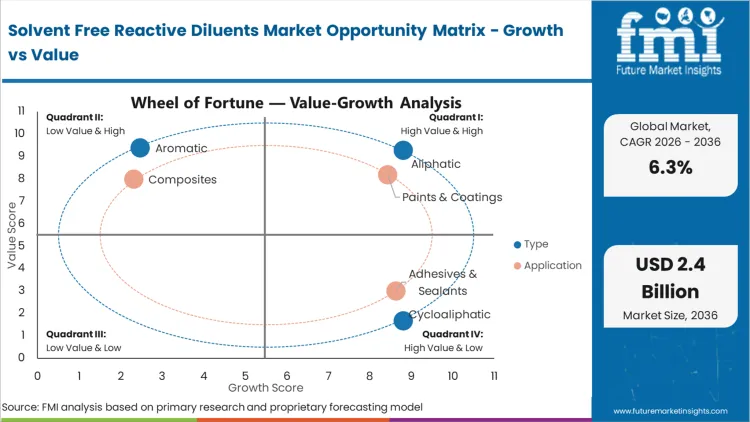
- Aliphatic: Aliphatic is poised to hold 45.2% share in 2026, driven by its superior resistance to ultraviolet degradation and yellowing in exterior applications.
- Paints & Coatings: Paints & Coatings is expected to grab 52.4% share in 2026, as environmental compliance strictures disproportionately target large-surface-area liquid applications.
- Construction: Construction is anticipated to garner 38.7% share in 2026, driven by massive consumption of heavy-duty concrete primers and flooring resins.
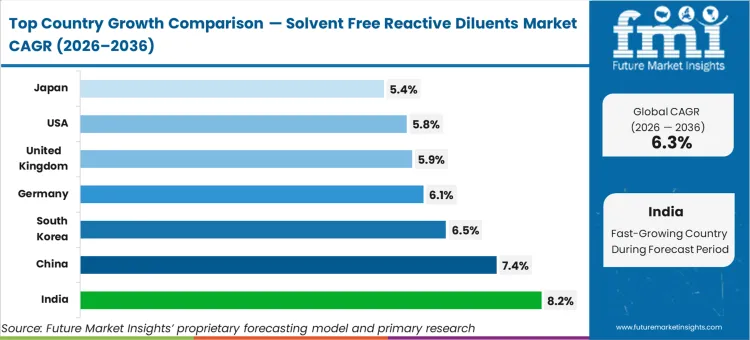
- India: 8.2% compound growth, anchored by aggressive infrastructure capital deployment requiring rapid-cure structural reinforcements.
- Analyst Opinion at FMI
- Nikhil Kaitwade, Principal Analyst, Chemicals, at FMI, opines, "Standard industry metrics treat VOC reduction as a pure compliance play. What that measurement entirely misses is the thermal penalty inside the formulation. When you replace a passive solvent with a reactive diluent, you introduce a massive new source of exothermic heat during curing. Formulators aren't just trying to pass an emissions test; they are trying to prevent a 100-gallon batch of 100% solid epoxy from physically catching fire in the mixing vat before it can be applied."
- Strategic Implications / Executive Takeaways
- Base resin manufacturers must vertically integrate specialty diluent synthesis to control the entire curing kinetic profile of their commercial systems.
- Automotive composites engineers should qualify cycloaliphatic grades to balance the conflicting demands of low injection viscosity and high final glass transition temperatures.
- Technical procurement directors face a structural supply bottleneck in bio-based epichlorohydrin, requiring early lock-in of raw material supplier contracts.
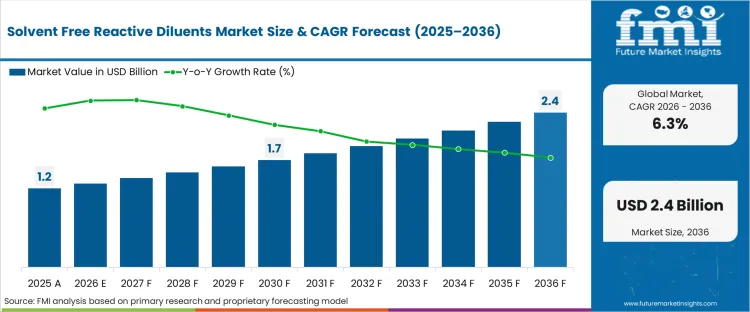
Once bio-based aliphatic variants achieve cost-parity with their petroleum-derived equivalents, growth becomes self-reinforcing. Resin formulators trigger this inflection by qualifying multi-functional diluents that serve simultaneously as viscosity reducers and primary structural backbones, rather than simple passive additives. The boundary between diluent and core polymer dissolves completely.
India advances at 8.2%, followed by China at 7.4% and South Korea tracking at 6.5%. Germany expands at 6.1%, while the United Kingdom is estimated to register 5.9%. The United States follows at 5.8%, with Japan growing at 5.4%. The divergence stems directly from local infrastructure rhythms, where rapid concrete curing requirements in humid Asian climates demand entirely different diluent reactivity profiles than precision automotive tooling applications in Western manufacturing hubs.
Solvent Free Reactive Diluents Market Key Takeaways
| Metric | Details |
|---|---|
| Industry Size (2026) | USD 1.3 billion |
| Industry Value (2036) | USD 2.4 billion |
| CAGR (2026–2036) | 6.31% |
Solvent Free Reactive Diluents Market Definition
Solvent free reactive diluents are low-viscosity, non-volatile chemical compounds that reduce the viscosity of base resins while chemically reacting and permanently bonding into the final polymer network during the curing process. Unlike conventional solvents that evaporate and release volatile organic compounds, these diluents become integral structural components of the crosslinked matrix.
Solvent Free Reactive Diluents Market Inclusions
The scope includes mono-, bi-, and poly-functional aliphatic, cycloaliphatic, and aromatic diluents that contain zero evaporative solvents. It covers materials used explicitly to modify viscosity, improve wetting, and alter the flexibility or chemical resistance of epoxy, polyurethane, and other thermosetting systems. This includes both petroleum-derived and bio-based standard reactive diluents that meet the zero-VOC operational threshold.
Solvent Free Reactive Diluents Market Exclusions
The scope explicitly excludes non-reactive diluents, plasticizers, and traditional volatile solvents like xylene or toluene. These materials do not form covalent bonds with the polymer matrix and eventually migrate or evaporate, disqualifying them from 100% solid, emission-free formulations. Waterborne diluents are also excluded, as their phase-inversion curing mechanisms fundamentally differ from the direct crosslinking chemistry tracked in this analysis.
Solvent Free Reactive Diluents Market Research Methodology
- Primary Research: Chief formulation chemists, raw material procurement directors, and technical sales managers at tier-1 resin manufacturing firms.
- Desk Research: Chemical compliance registries, technical safety data sheets (SDS) from primary chemical producers, and environmental standard publications governing indoor air quality metrics.
- Market-Sizing and Forecasting: Baseline anchored to regional bulk production volumes of base epoxy and polyurethane resins, adjusted by average diluent loading ratios required for 100% solid applications.
- Data Validation and Update Cycle: Forecasts triangulated against bulk chemical feedstock pricing indices and capital expenditure disclosures from major thermoset resin producers.
Segmental Analysis
Solvent Free Reactive Diluents Market Analysis by Type
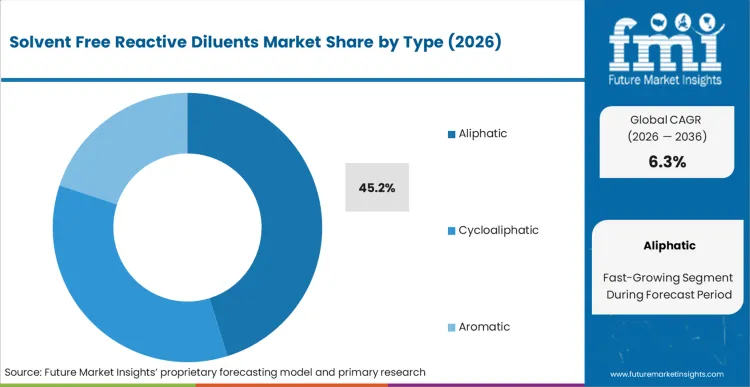
The reason the aliphatic segment commands 45.2% of the market is structural: aromatic diluents undergo photo-oxidative degradation when exposed to sunlight. Formulators of exterior protective coatings cannot absorb the commercial risk of a heavy-duty bridge coating turning visibly yellow within six months of application.
According to FMI's estimates, this chemical limitation functionally disqualifies aromatic variants from nearly all premium topcoat applications. Aliphatic structures provide the necessary ultraviolet stability while effectively dropping the base resin viscosity. Buyers who compromise on this chemistry to save initial material costs routinely face catastrophic warranty claims when architectural elements discolour prematurely. Wide-scale aliphatic compound adoption eliminates this failure mode entirely.
- Delamination prevention: Proper aliphatic chain lengths ensure the curing matrix remains flexible enough to absorb thermal expansion. Coating contractors who ignore this specific flexibility metric experience widespread microscopic cracking during freeze-thaw cycles.
- Exotherm control: Mono-functional aliphatic variants react slower than base resins. Formulation chemists use this property to intentionally slow down the heat generation in thick-casting applications.
- Chemical resistance: Long-chain aliphatic diluents increase the hydrophobicity of the final network. Facility managers must implement these specific grades to protect industrial flooring from harsh acidic wash-downs.
Solvent Free Reactive Diluents Market Analysis by Application
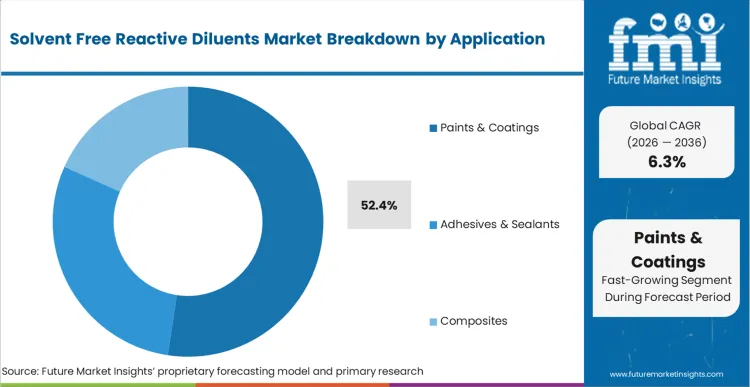
Coating formulation chemists face a binary decision: transition to 100% solid systems or abandon the indoor architectural sector entirely. The paints and coatings segment holds 52.4% share because liquid coatings represent the largest surface-area exposure for evaporative emissions. heavy-duty protective coatings require massive volume applications where traditional solvents are no longer legally viable in enclosed spaces.
In FMI's view, the buyer's focus shifts entirely from basic viscosity reduction to mastering the flow and levelling characteristics of the reactive system. Without evaporating solvents to aid surface levelling, 100% solid coatings tend to leave visible brush marks or roller stipple. Formulators who fail to dial in the exact reactive diluent ratio lose their contractor client base, as painters refuse to work with materials that require excessive manual finishing.
- Initial specification: Industrial buyers specify zero-VOC systems strictly to qualify for indoor environmental certifications. Procurement teams anchor their entire vendor selection on this single threshold.
- Application validation: Contractors validate the choice by measuring the pot-life and sprayability through standard airless equipment. If the diluent causes the system to gel inside the spray hoses, the formulation is immediately disqualified.
- Lifecycle renewal: Asset owners renew contracts based on the long-term corrosion resistance of the cured film. The reactive diluent must prove it hasn't compromised the crosslink density that provides structural protection.
Solvent Free Reactive Diluents Market Analysis by End-use
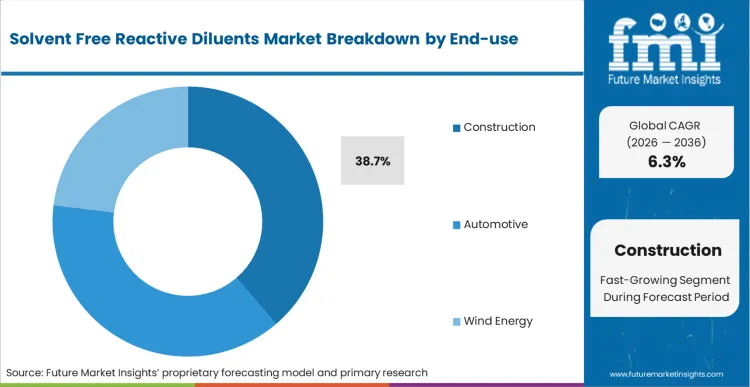
The sheer volume of heavy civil infrastructure creates a non-negotiable demand for high-strength, non-shrinking adhesives, driving the construction segment to a 38.7% share. When pouring thousands of gallons of deep-penetration concrete primer, the absence of volatile evaporation means zero volumetric shrinkage as the material cures.
Based on FMI's assessment, civil engineers rely on this exact physical property to ensure structural anchor bolts remain permanently locked into concrete substrates. specialty construction chemicals utilize bi-functional diluents to maintain high mechanical load ratings while keeping the liquid thin enough to flow into microscopic concrete pores. If an operations director specifies a standard resin without adequate reactive thinning, the material simply sits on the surface, failing to create the mechanical interlock required for structural integrity.
- Material procurement: The initial cost premium of reactive diluents is easily justified by the elimination of solvent waste disposal fees. Site managers capture these operational savings immediately upon project commencement.
- Labor utilization: 100% solid systems allow for thicker single-coat applications. Painting contractors cut their labor costs in half by avoiding the multi-coat build-ups required with solvent-borne alternatives.
- Asset downtime: Rapid-curing solid formulations allow facilities to return to service within hours rather than days. Plant operators eliminate massive hidden costs associated with prolonged production shutdowns.
Solvent Free Reactive Diluents Market Drivers, Restraints, and Opportunities
Occupational safety mandates compel factory operations managers to eradicate inhalation hazards from their enclosed production lines. This regulatory pressure forces automotive and aerospace composites manufacturers to entirely abandon legacy wet-layup processes that emit styrene or solvent vapors. The shift requires procurement directors to qualify 100% solid, diluent-modified resins that maintain the exact same infusion viscosities as the banned materials. A facility that fails to complete this material transition risks immediate operational shutdowns under tightening industrial hygiene audits.
The primary structural friction is the inevitable compromise of the cured polymer's thermal properties. Adding low-molecular-weight reactive diluents inherently lowers the glass transition temperature (Tg) of the final crosslinked matrix. Aerospace engineers cannot accept a composite wing structure that begins to soften at high operating temperatures. While formulators are developing multi-functional cycloaliphatic diluents to bridge this performance gap, these specialized molecules require complex synthesis routes, severely limiting their bulk availability for cost-sensitive applications.
Opportunities in the Solvent Free Reactive Diluents Market
- Bio-based precursor integration: Advancements in green chemistry allow the synthesis of epichlorohydrin from glycerol rather than propylene. Resin manufacturers capture premium pricing from consumer brands aggressively pursuing scope 3 emission reductions through bio-based polymer platforms.
- Automated infusion compatibility: The rise of high-speed resin transfer molding (RTM) demands ultra-low viscosity fluids. Automotive tier-1 suppliers utilize hyper-reactive diluents to achieve sub-minute injection times, locking in high-volume vehicle platform contracts.
- Extreme-cold curing: Specialized aliphatic chain structures remain liquid at freezing temperatures. Offshore construction firms leverage these specific grades to conduct structural repairs during winter months, eliminating seasonal project delays.
Regional Analysis
Based on the regional analysis, the Solvent Free Reactive Diluents market is segmented into North America, Europe, Asia Pacific, and other key regions across 40 plus countries.
.webp "Top Country Growth Comparison Solvent Free Reactive Diluents Market Cagr (2026 2036)")
| Country | CAGR (2026 to 2036) |
|---|---|
| India | 8.2% |
| China | 7.4% |
| South Korea | 6.5% |
| Germany | 6.1% |
| United Kingdom | 5.9% |
| United States | 5.8% |
| Japan | 5.4% |
Asia Pacific Solvent Free Reactive Diluents Market Analysis
Heavy industrial capital expenditure dictates the material demands across the region, pulling the focus entirely toward bulk infrastructure and marine applications rather than niche architectural finishes. FMI analysts opine that formulation requirements here are dominated by the need to combat severe humidity and high ambient temperatures during outdoor application. Formulators require diluents that thin the resin without accelerating an already heat-stressed curing reaction. The regional scale of civil engineering projects creates a massive baseline demand for structural adhesives and wind turbine composites.
- India: FMI estimates the market in India to expand at an annual growth rate of 8.2%. India's aggressive port and coastal infrastructure modernization forces civil contractors to procure marine-grade epoxies that cure effectively underwater. Mono-functional diluents lower the resin's surface tension, allowing it to displace water from concrete pilings. Formulators who master these moisture-tolerant diluent packages secure exclusive, multi-year government supply contracts.
- China: The consolidation of domestic chemical manufacturing parks under stricter ecological red lines restricts the localised production of traditional solvents. A CAGR of 7.4% is expected for solvent-free reactive diluents in China over the forecast period. Purchasing managers are actively rewiring their supply chains toward 100% solid resin systems to maintain continuous factory operations. The market shifts structurally from import-dependence to domestic synthesis of high-purity cycloaliphatic grades by 2036.
- South Korea: South Korea's industry is projected to witness growth at a CAGR of 6.5%. Extreme concentration in global shipbuilding requires hull coatings that can be applied in single, ultra-thick layers. Shipyard operations directors mandate reactive diluent systems to eliminate the solvent entrapment that causes traditional thick paints to fail. The transition permanently alters shipyard scheduling, reducing standard hull painting times by nearly forty percent.
- Japan: Stringent seismic reinforcement standards for aging commercial real estate demand low-viscosity structural epoxies capable of penetrating microscopic concrete fractures. Civil engineers rely on bi-functional diluents to achieve this penetration without compromising the final shear strength of the repair. The market for solvent free reactive diluents in Japan is forecast to register a CAGR of 5.4%. Chemical producers providing these ultra-low viscosity grades capture a highly lucrative, recession-resistant infrastructure maintenance sector.
The FMI report highlights the rise of new manufacturing hubs across Southeast Asia, where the swift shift of electronics production to Vietnam and Thailand is fuelling a strong increase in demand for high‑purity, zero‑outgassing potting compounds.
Europe Solvent Free Reactive Diluents Market Analysis
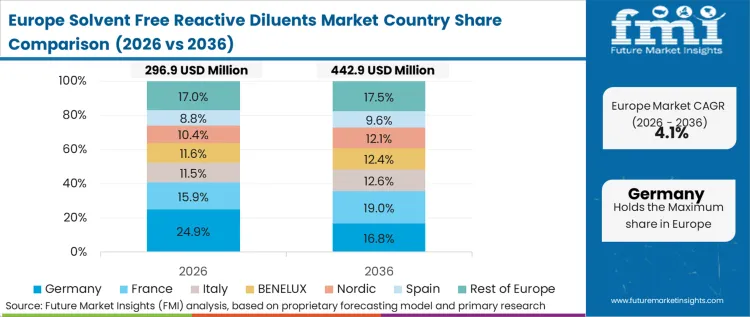
The European regulatory apparatus fundamentally redefines reactive diluents from performance additives to legal necessities. Under REACH compliance frameworks, occupational exposure limits for volatile aromatics have functionally outlawed legacy solvent-borne heavy-duty coatings in enclosed spaces.
In FMI's view, this policy environment removes price parity as a primary purchasing consideration; buyers must absorb the premium of polyurethane coating systems formulated with 100% solid reactive chemistry or cease operations.
- Germany: Germany's high-density automotive ecosystem demands adhesive formulations capable of joining dissimilar materials like aluminum and carbon fiber without thermal distortion. Demand for solvent free reactive diluents in Germany is estimated to expand at a CAGR of 6.1%. Assembly line engineers specify rubber-modified epoxies thinned with reactive diluents to manage the precise robotic dispensing parameters. The integration of these materials allows tier-1 suppliers to run cold-joining processes, stripping massive energy costs from the manufacturing floor.
- United Kingdom: The rapid expansion of offshore wind installations in the North Sea requires rotor blade composites that can withstand extreme cyclic fatigue. Composite engineers specify bi-functional diluents to ensure complete resin wet-out of dense fibreglass fabrics without dropping the blade's thermal tolerance. Sales of products in the United Kingdom are on track to record a CAGR of 5.9%. Resins that pass these gruelling marine qualification protocols establish dominant market shares that are nearly impossible for challengers to disrupt.
FMI's report includes secondary industrial markets in Eastern Europe. Facilities in Poland and the Czech Republic are rapidly upgrading their factory floor coatings to 100% solid systems to pass the safety audits required by Western European manufacturing clients.
North America Solvent Free Reactive Diluents Market Analysis
Capital availability and end-product performance specifications govern adoption patterns in this geography. Asset owners across the oil, gas, and chemical processing sectors evaluate coating choices strictly through lifecycle cost calculations. As per FMI's projection, the upfront material premium of reactive diluent formulations is easily offset by the drastic reduction in facility downtime during maintenance cycles. Buyers here operate at massive scale, requiring industrial coating applications that guarantee decades of corrosion resistance.
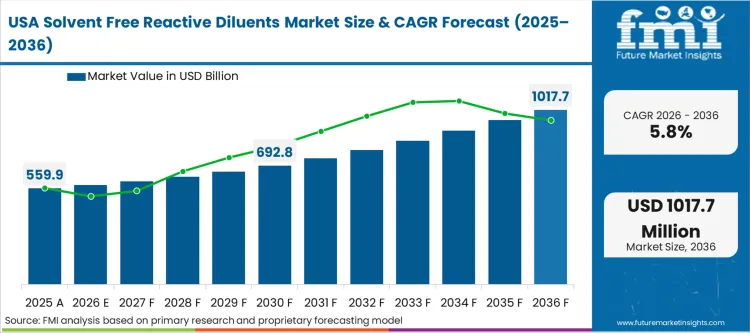
- United States: The United States market is projected to grow at a steady pace, posting a compound annual growth rate of 5.8%. The ageing municipal water and wastewater infrastructure across the country requires internal pipe rehabilitation using plural-component epoxy systems. Utility directors mandate 100% solid, solvent-free materials to eliminate the risk of volatile chemicals leaching into potable water supplies or creating explosion hazards in confined sewer spaces. By the end of the decade, non-reactive solvent formulations will be entirely written out of federal municipal repair specifications.
FMI’s report also covers the Canadian provincial markets, where harsh and rapidly shifting temperatures require the use of highly flexible diluent formulations to keep coatings from becoming brittle during winter cycles.
Competitive Aligners for Market Players
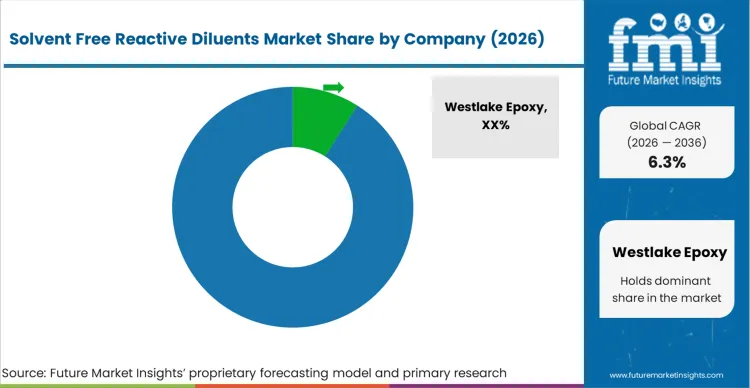
The specialized chemical engineering required to synthesize high-purity reactive diluents naturally concentrates market power among a few tier-1 global chemical firms. Synthesis involves handling hazardous precursors like epichlorohydrin under extreme safety controls, creating an immense capital barrier for new entrants. Formulators from Westlake Epoxy, Huntsman, and Evonik dominate because they possess the fractional distillation capabilities necessary to strip residual unreacted precursors from the final product. Procurement directors at large paint and adhesive companies use this residual purity metric to immediately disqualify low-cost regional vendors, as impurities ruin the shelf-life of their final retail products.
Incumbents maintain their advantage by tightly controlling the intellectual property around multi-functional and cycloaliphatic specialty grades. These complex molecular structures preserve the high glass transition temperature of the cured resin while still providing the necessary viscosity drop. A challenger attempting to break into the premium composites sector must build this exact catalytic synthesis capability. Producing simple mono-functional aliphatic diluents is no longer sufficient; the competitive baseline has moved toward designing diluents that actively enhance the thermal and mechanical properties of the base resin.
Large industrial buyers actively resist this consolidation by formulating blends of standard diluents rather than relying on a single, highly patented speciality molecule. They intentionally design their epoxy and polyurethane systems to accept raw materials from multiple approved vendors, preventing supplier lock-in. As environmental regulations force a complete transition to 100% solid systems by 2036, the reliance on advanced, ultra-low-viscosity diluents will likely force buyers back into the hands of the dominant speciality chemical producers capable of innovating at the molecular level.
Key Players in Solvent Free Reactive Diluents Market
- Westlake Epoxy
- Huntsman International LLC
- Aditya Birla Chemicals
- Evonik Industries AG
- Olin Corporation
- BASF SE
- Kukdo Chemical Co., Ltd.
- Atul Ltd.
Scope of the Report
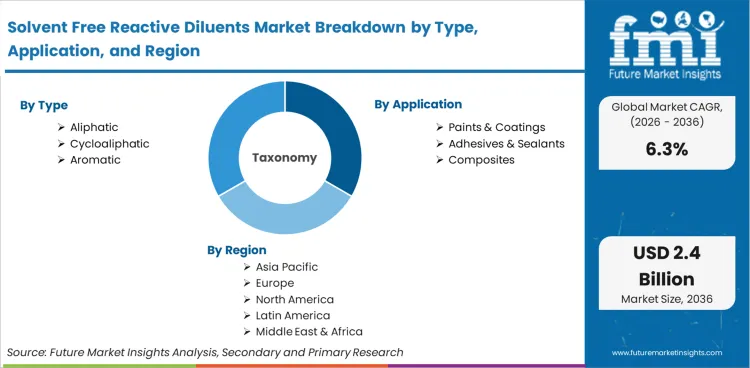
| Metric | Value |
|---|---|
| Quantitative Units | USD 1.3 billion to USD 2.4 billion, at a CAGR of 6.31% |
| Market Definition | Non-volatile, reactive chemical compounds that reduce base resin viscosity and covalently bond into the final crosslinked polymer matrix, enabling 100% solid thermoset formulations. |
| Type Segmentation | Aliphatic, Cycloaliphatic, Aromatic |
| Application Segmentation | Paints & Coatings, Adhesives & Sealants, Composites, Others |
| End-use Segmentation | Construction, Automotive, Wind Energy, Electronics |
| Regions Covered | North America, Europe, Asia Pacific |
| Countries Covered | India, China, South Korea, Germany, United Kingdom, United States, Japan, and 40 plus countries |
| Key Companies Profiled | Westlake Epoxy, Huntsman International LLC, Aditya Birla Chemicals, Evonik Industries AG, Olin Corporation, BASF SE, Kukdo Chemical Co., Ltd., Atul Ltd. |
| Forecast Period | 2026 to 2036 |
| Approach | Primary interviews with formulation chemists define actual diluent loading ratios. Baseline quantitative data anchors to global bulk thermoset resin production volumes. Forecasts are validated against regulatory phase-out timelines for volatile organic compounds. |
Solvent Free Reactive Diluents Market Analysis by Segments
-
Type:
- Aliphatic
- Cycloaliphatic
- Aromatic
-
Application:
- Paints & Coatings
- Adhesives & Sealants
- Composites
- Others
-
End-use:
- Construction
- Automotive
- Wind Energy
- Electronics
-
Region:
- North America
- United States
- Europe
- Germany
- United Kingdom
- Asia Pacific
- India
- China
- South Korea
- Japan
- North America
Bibliography
- Centers for Disease Control and Prevention, National Institute for Occupational Safety and Health. (2024, April 3). About epoxies and resins and reproductive health.
- New Jersey Department of Environmental Protection. (2024, June). Surface coatings SOTA manual.
- Beiter, P., Pérez, P., Baranowski, R., Reber, G., & Spitsen, P. (2024). Offshore wind market report: 2024 edition executive summary (NREL/TP-5000-90921). National Renewable Energy Laboratory.
- Yolo-Solano Air Quality Management District. (2024, May 8). Rule 2.14: Architectural coatings.
- Wang, Y., & Mertiny, P. (2024). Mechanical and thermal properties of epoxy resin upon addition of low-viscosity modifier. Polymers, 16(17), 2403.
- Apostolidis, D., Dyer, W. E., Dransfeld, C. A., & Kumru, B. (2024). An algae-derived partially renewable epoxy resin formulation for glass fibre-reinforced sustainable polymer composites. RSC Applied Polymers, 2, 149–154.
- Wang, H., Wang, F., Sun, R.-Y., Song, F., & Wang, Y.-Z. (2024). Solvent-free epoxy coatings with enhanced cross-linking networks towards highly-efficient flame retardancy, water resistance and anticorrosion. Progress in Organic Coatings, 197, 108835.
- Zhu, J., Fan, H., & Wan, J. (2024). Solvent-free and UV-cured epoxy silicone coating with excellent wear resistance and antismudge properties. ACS Applied Materials & Interfaces, 16(27), 35494–35504.
This bibliography is provided for reader reference. The full FMI report contains the complete reference list with primary source documentation.
This Report Addresses
- Market intelligence to support strategic decision making across aliphatic and cycloaliphatic reactive diluent categories
- Market size estimation and 10-year revenue forecasts from 2026 to 2036, supported by bulk resin production indexing
- Growth opportunity mapping across adhesives and composites dimensions with emphasis on achieving bio-based cost parity
- Segment and regional revenue forecasts covering 100% solid paint formulations across strict European indoor air quality regulatory environments
- Competition strategy assessment including fractional distillation purity, cycloaliphatic patent control, and multi-functional performance limits
- Capability development tracking including high-speed resin transfer molding protocols and extreme-cold curing requirements
- Market access analysis covering REACH compliance pathways and municipal zero-VOC procurement mandates
- Market report delivery in PDF, Excel, PPT, and interactive dashboard formats for executive strategy, raw material procurement planning, and operational benchmarking use
Frequently Asked Questions
How large is the Solvent Free Reactive Diluents in 2026?
The market reaches USD 1.3 billion in 2026. This valuation signals that zero-VOC formulation is no longer a niche environmental premium, but the mandatory operational baseline for major chemical producers.
What will it be valued at by 2036?
The valuation builds to USD 2.4 billion by the end of the forecast period. This near-doubling reflects the complete capitalization of heavy industry moving away from legacy evaporative solvents toward fully reactive polymer systems.
What CAGR is projected?
The sector advances at a 6.31% compound annual growth rate. This specific pace tracks the capital expenditure cycles of civil contractors and shipyards upgrading their spray infrastructure to handle 100% solid materials.
Which Type segment leads?
Aliphatic compounds hold the dominant position. Formulators prioritize aliphatic structures to guarantee ultraviolet stability in exterior applications, preventing the catastrophic yellowing failures associated with aromatic alternatives.
Which Application segment leads?
Paints & coatings capture the majority share. The immense surface area involved in industrial coating forces operations directors to specify zero-solvent systems simply to pass localized air quality emissions audits.
Which End-use segment leads?
Construction commands the largest footprint. Civil engineering applications consume massive volumes of concrete primers and structural adhesives that require non-shrinking, deep-penetrating properties without toxic outgassing.
What drives rapid growth?
Occupational safety audits fundamentally push the transition. Facility managers are eradicating inhalation hazards from their factory floors, forcing composite and adhesive suppliers to reformulate entirely without volatile thinners.
What is the primary restraint?
The thermal penalty of low-molecular-weight additives limits broad adoption. Highly reactive diluents inevitably lower the cured matrix's glass transition temperature, making them unsuitable for extreme-heat aerospace applications without complex molecular engineering.
Which country grows fastest?
India's 8.2% expansion outpaces China's 7.4% trajectory. While China focuses on stabilizing domestic chemical production zones, India's growth is driven by raw, immediate infrastructure expansion requiring marine-grade epoxies that cure under severe moisture conditions.
How do European VOC mandates alter buyer behavior?
Stringent REACH exposure limits functionally eliminate price negotiations for legacy solvents. Procurement directors in Germany and the UK must absorb the premium of reactive diluent systems because older formulations are legally barred from indoor manufacturing floors.
Why are bio-based diluents gaining traction?
Consumer brands demand aggressive scope 3 emission reductions across their supply chains. Substituting propylene-derived epichlorohydrin with glycerol-based alternatives allows resin manufacturers to offer certified green formulations without altering the final curing mechanics.
How does distillation purity affect competitive positioning?
Residual unreacted precursors ruin the shelf-life and safety profile of retail adhesives. Tier-1 chemical firms dominate the market precisely because they possess the massive capital equipment required to fractionally distil diluents to near-perfect purity.
Why are cycloaliphatic grades critical for automotive applications?
High-speed resin transfer molding requires fluids as thin as water that cure into rigid, heat-resistant parts. Cycloaliphatic molecules bridge this gap, providing the necessary initial viscosity drop while retaining the structural stiffness required for vehicle frames.
What specific challenge do heavy-duty marine coatings present?
Shipyards require hull coatings applied in massive, single-layer builds. Formulators must engineer reactive diluents that allow the thick film to level perfectly without generating an exothermic reaction hot enough to physically blister the paint.
How do offshore wind installations impact formulation chemistry?
Rotor blades face relentless cyclic fatigue and saltwater exposure. Composite engineers specify bi-functional diluents that crosslink tightly into the resin matrix, preventing microscopic water ingress without making the blade too brittle.
Why do civil engineers specify reactive diluents for concrete repair?
Standard resins cannot penetrate the microscopic pores of damaged concrete. Specialized ultra-low-viscosity diluents lower the surface tension, allowing the adhesive to wick deeply into the substrate and create a permanent mechanical interlock.
What operational risk do formulators face when substituting diluents?
Replacing a passive solvent with a reactive molecule fundamentally changes the formulation's curing exotherm. Chemists must precisely balance the reactivity to prevent a bulk batch of resin from flash-curing and hardening inside the mixing vat.
How do Japanese seismic requirements influence market demand?
Earthquake retrofitting demands adhesives that flex under sheer stress. Formulators use long-chain aliphatic diluents to intentionally introduce flexibility into the rigid epoxy matrix, meeting strict building code safety margins.
Why is supplier lock-in a major concern for industrial buyers?
Highly specialized, patented cycloaliphatic diluents often tie a manufacturer to a single chemical vendor. Operations directors actively formulate blends using standard diluents to maintain supply chain redundancy and leverage in price negotiations.
What structural boundary separates this market from traditional solvents?
True reactive diluents form permanent covalent bonds with the curing polymer. If a chemical merely thins the liquid and later evaporates or migrates out of the solid plastic, it is explicitly excluded from this structural analysis.
How does the market sizing methodology validate its forecasts?
The baseline demand is physically anchored to global production volumes of bulk epoxy and polyurethane. Analysts apply specific 100% solid loading ratios to these bulk volumes, cross verifying the resulting demand against regulatory phase-out timelines.
What fundamentally changes in this market by 2036?
The conceptual distinction between a base resin and an additive diluent will disappear. Multi-functional diluents will become the primary structural backbones of polymer systems, entirely replacing high-viscosity legacy resins in advanced composites.
Preview the report firsthand - request a free sample
Get SampleGet the brochure for pricing and purchase details.
Get PDFTable of Content
- Executive Summary
- Global Market Outlook
- Demand-side Trends
- Supply-side Trends
- Technology Roadmap Analysis
- Analysis and Recommendations
- Market Overview
- Market Coverage / Taxonomy
- Market Definition / Scope / Limitations
- Research Methodology
- Chapter Orientation
- Analytical Lens and Working Hypotheses
- Market Structure, Signals, and Trend Drivers
- Benchmarking and Cross-market Comparability
- Market Sizing, Forecasting, and Opportunity Mapping
- Research Design and Evidence Framework
- Desk Research Programme (Secondary Evidence)
- Company Annual and Sustainability Reports
- Peer-reviewed Journals and Academic Literature
- Corporate Websites, Product Literature, and Technical Notes
- Earnings Decks and Investor Briefings
- Statutory Filings and Regulatory Disclosures
- Technical White Papers and Standards Notes
- Trade Journals, Industry Magazines, and Analyst Briefs
- Conference Proceedings, Webinars, and Seminar Materials
- Sector Databases and Reference Repositories
- FMI Internal Proprietary Databases and Historical Market Datasets
- Subscription Datasets and Paid Sources
- Social Channels, Communities, and Digital Listening Inputs
- Additional Desk Sources
- Expert Input and Fieldwork (Primary Evidence)
- Primary Modes
- Qualitative Interviews and Expert Elicitation
- Quantitative Surveys and Structured Data Capture
- Blended Approach
- Why Primary Evidence is Used
- Field Techniques
- Interviews
- Surveys
- Focus Groups
- Observational and In-context Research
- Social and Community Interactions
- Stakeholder Universe Engaged
- C-suite Leaders
- Board Members
- Presidents and Vice Presidents
- R&D and Innovation Heads
- Technical Specialists
- Domain Subject-matter Experts
- Scientists
- Physicians and Other Healthcare Professionals
- Governance, Ethics, and Data Stewardship
- Research Ethics
- Data Integrity and Handling
- Primary Modes
- Tooling, Models, and Reference Databases
- Desk Research Programme (Secondary Evidence)
- Data Engineering and Model Build
- Data Acquisition and Ingestion
- Cleaning, Normalisation, and Verification
- Synthesis, Triangulation, and Analysis
- Quality Assurance and Audit Trail
- Market Background
- Market Dynamics
- Drivers
- Restraints
- Opportunity
- Trends
- Scenario Forecast
- Demand in Optimistic Scenario
- Demand in Likely Scenario
- Demand in Conservative Scenario
- Opportunity Map Analysis
- Product Life Cycle Analysis
- Supply Chain Analysis
- Investment Feasibility Matrix
- Value Chain Analysis
- PESTLE and Porter’s Analysis
- Regulatory Landscape
- Regional Parent Market Outlook
- Production and Consumption Statistics
- Import and Export Statistics
- Market Dynamics
- Global Market Analysis 2021 to 2025 and Forecast, 2026 to 2036
- Historical Market Size Value (USD Million) Analysis, 2021 to 2025
- Current and Future Market Size Value (USD Million) Projections, 2026 to 2036
- Y-o-Y Growth Trend Analysis
- Absolute $ Opportunity Analysis
- Global Market Pricing Analysis 2021 to 2025 and Forecast 2026 to 2036
- Global Market Analysis 2021 to 2025 and Forecast 2026 to 2036, By Type
- Introduction / Key Findings
- Historical Market Size Value (USD Million) Analysis By Type , 2021 to 2025
- Current and Future Market Size Value (USD Million) Analysis and Forecast By Type , 2026 to 2036
- Aliphatic
- Cycloaliphatic
- Aromatic
- Aliphatic
- Y-o-Y Growth Trend Analysis By Type , 2021 to 2025
- Absolute $ Opportunity Analysis By Type , 2026 to 2036
- Global Market Analysis 2021 to 2025 and Forecast 2026 to 2036, By Application
- Introduction / Key Findings
- Historical Market Size Value (USD Million) Analysis By Application, 2021 to 2025
- Current and Future Market Size Value (USD Million) Analysis and Forecast By Application, 2026 to 2036
- Paints & Coatings
- Adhesives & Sealants
- Composites
- Paints & Coatings
- Y-o-Y Growth Trend Analysis By Application, 2021 to 2025
- Absolute $ Opportunity Analysis By Application, 2026 to 2036
- Global Market Analysis 2021 to 2025 and Forecast 2026 to 2036, By End-use
- Introduction / Key Findings
- Historical Market Size Value (USD Million) Analysis By End-use, 2021 to 2025
- Current and Future Market Size Value (USD Million) Analysis and Forecast By End-use, 2026 to 2036
- Construction
- Automotive
- Wind Energy
- Construction
- Y-o-Y Growth Trend Analysis By End-use, 2021 to 2025
- Absolute $ Opportunity Analysis By End-use, 2026 to 2036
- Global Market Analysis 2021 to 2025 and Forecast 2026 to 2036, By Region
- Introduction
- Historical Market Size Value (USD Million) Analysis By Region, 2021 to 2025
- Current Market Size Value (USD Million) Analysis and Forecast By Region, 2026 to 2036
- North America
- Latin America
- Western Europe
- Eastern Europe
- East Asia
- South Asia and Pacific
- Middle East & Africa
- Market Attractiveness Analysis By Region
- North America Market Analysis 2021 to 2025 and Forecast 2026 to 2036, By Country
- Historical Market Size Value (USD Million) Trend Analysis By Market Taxonomy, 2021 to 2025
- Market Size Value (USD Million) Forecast By Market Taxonomy, 2026 to 2036
- By Country
- USA
- Canada
- Mexico
- By Type
- By Application
- By End-use
- By Country
- Market Attractiveness Analysis
- By Country
- By Type
- By Application
- By End-use
- Key Takeaways
- Latin America Market Analysis 2021 to 2025 and Forecast 2026 to 2036, By Country
- Historical Market Size Value (USD Million) Trend Analysis By Market Taxonomy, 2021 to 2025
- Market Size Value (USD Million) Forecast By Market Taxonomy, 2026 to 2036
- By Country
- Brazil
- Chile
- Rest of Latin America
- By Type
- By Application
- By End-use
- By Country
- Market Attractiveness Analysis
- By Country
- By Type
- By Application
- By End-use
- Key Takeaways
- Western Europe Market Analysis 2021 to 2025 and Forecast 2026 to 2036, By Country
- Historical Market Size Value (USD Million) Trend Analysis By Market Taxonomy, 2021 to 2025
- Market Size Value (USD Million) Forecast By Market Taxonomy, 2026 to 2036
- By Country
- Germany
- UK
- Italy
- Spain
- France
- Nordic
- BENELUX
- Rest of Western Europe
- By Type
- By Application
- By End-use
- By Country
- Market Attractiveness Analysis
- By Country
- By Type
- By Application
- By End-use
- Key Takeaways
- Eastern Europe Market Analysis 2021 to 2025 and Forecast 2026 to 2036, By Country
- Historical Market Size Value (USD Million) Trend Analysis By Market Taxonomy, 2021 to 2025
- Market Size Value (USD Million) Forecast By Market Taxonomy, 2026 to 2036
- By Country
- Russia
- Poland
- Hungary
- Balkan & Baltic
- Rest of Eastern Europe
- By Type
- By Application
- By End-use
- By Country
- Market Attractiveness Analysis
- By Country
- By Type
- By Application
- By End-use
- Key Takeaways
- East Asia Market Analysis 2021 to 2025 and Forecast 2026 to 2036, By Country
- Historical Market Size Value (USD Million) Trend Analysis By Market Taxonomy, 2021 to 2025
- Market Size Value (USD Million) Forecast By Market Taxonomy, 2026 to 2036
- By Country
- China
- Japan
- South Korea
- By Type
- By Application
- By End-use
- By Country
- Market Attractiveness Analysis
- By Country
- By Type
- By Application
- By End-use
- Key Takeaways
- South Asia and Pacific Market Analysis 2021 to 2025 and Forecast 2026 to 2036, By Country
- Historical Market Size Value (USD Million) Trend Analysis By Market Taxonomy, 2021 to 2025
- Market Size Value (USD Million) Forecast By Market Taxonomy, 2026 to 2036
- By Country
- India
- ASEAN
- Australia & New Zealand
- Rest of South Asia and Pacific
- By Type
- By Application
- By End-use
- By Country
- Market Attractiveness Analysis
- By Country
- By Type
- By Application
- By End-use
- Key Takeaways
- Middle East & Africa Market Analysis 2021 to 2025 and Forecast 2026 to 2036, By Country
- Historical Market Size Value (USD Million) Trend Analysis By Market Taxonomy, 2021 to 2025
- Market Size Value (USD Million) Forecast By Market Taxonomy, 2026 to 2036
- By Country
- Kingdom of Saudi Arabia
- Other GCC Countries
- Turkiye
- South Africa
- Other African Union
- Rest of Middle East & Africa
- By Type
- By Application
- By End-use
- By Country
- Market Attractiveness Analysis
- By Country
- By Type
- By Application
- By End-use
- Key Takeaways
- Key Countries Market Analysis
- USA
- Pricing Analysis
- Market Share Analysis, 2025
- By Type
- By Application
- By End-use
- Canada
- Pricing Analysis
- Market Share Analysis, 2025
- By Type
- By Application
- By End-use
- Mexico
- Pricing Analysis
- Market Share Analysis, 2025
- By Type
- By Application
- By End-use
- Brazil
- Pricing Analysis
- Market Share Analysis, 2025
- By Type
- By Application
- By End-use
- Chile
- Pricing Analysis
- Market Share Analysis, 2025
- By Type
- By Application
- By End-use
- Germany
- Pricing Analysis
- Market Share Analysis, 2025
- By Type
- By Application
- By End-use
- UK
- Pricing Analysis
- Market Share Analysis, 2025
- By Type
- By Application
- By End-use
- Italy
- Pricing Analysis
- Market Share Analysis, 2025
- By Type
- By Application
- By End-use
- Spain
- Pricing Analysis
- Market Share Analysis, 2025
- By Type
- By Application
- By End-use
- France
- Pricing Analysis
- Market Share Analysis, 2025
- By Type
- By Application
- By End-use
- India
- Pricing Analysis
- Market Share Analysis, 2025
- By Type
- By Application
- By End-use
- ASEAN
- Pricing Analysis
- Market Share Analysis, 2025
- By Type
- By Application
- By End-use
- Australia & New Zealand
- Pricing Analysis
- Market Share Analysis, 2025
- By Type
- By Application
- By End-use
- China
- Pricing Analysis
- Market Share Analysis, 2025
- By Type
- By Application
- By End-use
- Japan
- Pricing Analysis
- Market Share Analysis, 2025
- By Type
- By Application
- By End-use
- South Korea
- Pricing Analysis
- Market Share Analysis, 2025
- By Type
- By Application
- By End-use
- Russia
- Pricing Analysis
- Market Share Analysis, 2025
- By Type
- By Application
- By End-use
- Poland
- Pricing Analysis
- Market Share Analysis, 2025
- By Type
- By Application
- By End-use
- Hungary
- Pricing Analysis
- Market Share Analysis, 2025
- By Type
- By Application
- By End-use
- Kingdom of Saudi Arabia
- Pricing Analysis
- Market Share Analysis, 2025
- By Type
- By Application
- By End-use
- Turkiye
- Pricing Analysis
- Market Share Analysis, 2025
- By Type
- By Application
- By End-use
- South Africa
- Pricing Analysis
- Market Share Analysis, 2025
- By Type
- By Application
- By End-use
- USA
- Market Structure Analysis
- Competition Dashboard
- Competition Benchmarking
- Market Share Analysis of Top Players
- By Regional
- By Type
- By Application
- By End-use
- Competition Analysis
- Competition Deep Dive
- Westlake Epoxy
- Overview
- Product Portfolio
- Profitability by Market Segments (Product/Age /Sales Channel/Region)
- Sales Footprint
- Strategy Overview
- Marketing Strategy
- Product Strategy
- Channel Strategy
- Huntsman International LLC
- Aditya Birla Chemicals
- Evonik Industries AG
- Olin Corporation
- BASF SE
- Kukdo Chemical Co., Ltd.
- Westlake Epoxy
- Competition Deep Dive
- Assumptions & Acronyms Used


