

- Industry Size (2026)
- USD 1.9 Bn
- Forecast (2036)
- USD 3.0 Bn
- CAGR (2026 to 2036)
- 4.50%
Epoxy Reactive Diluents Market Forecast and Outlook 2026 to 2036
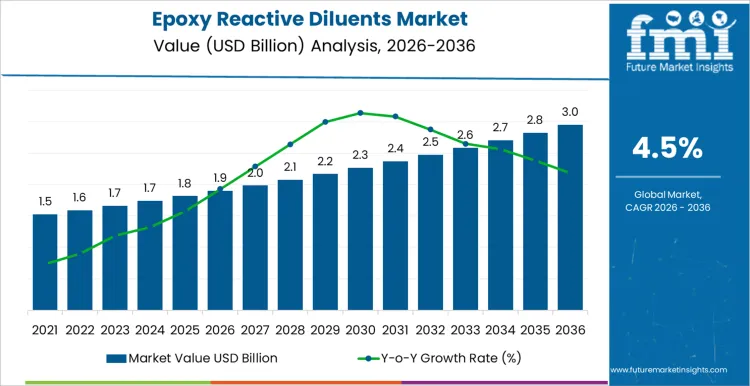
The epoxy reactive diluents market is expected to expand from USD 1.9 billion in 2026 to USD 3.0 billion by 2036, registering a CAGR of 4.5% over the forecast period. Growth quality in this market is shaped less by headline volume expansion and more by where reactive diluents are structurally embedded within epoxy consumption. Demand is concentrated in coatings, flooring, adhesives, and composites, where viscosity control directly affects application efficiency, labor productivity, and defect rates. This creates relatively stable, repeat-use demand tied to ongoing maintenance cycles, infrastructure activity, and industrial production rather than discretionary end markets.
Coatings and paints anchor baseline volumes, while composites and specialty adhesives add value-driven upside through formulation-specific selection. End-use dependency is diversified across construction, energy, transportation, and industrial maintenance, reducing volatility but limiting rapid acceleration. As a result, growth remains steady and predictable, with suppliers benefiting from long-term formulation lock-ins rather than short-term swings in epoxy resin demand.
Quick Stats for Epoxy Reactive Diluents Market
- Epoxy Reactive Diluents Market Value (2026): USD 1.9 Billion
- Epoxy Reactive Diluents Market Forecast Value (2036): USD 3.0 Billion
- Epoxy Reactive Diluents Market Forecast CAGR 2026 to 2036: 4.50%
- Leading Chemistry in Epoxy Reactive Diluents Market: Glycidyl Ethers (46% share)
- Key Growth Regions in Epoxy Reactive Diluents Market: Asia Pacific, Europe, North America, Latin America, Middle East & Africa
- Top Key Players in Epoxy Reactive Diluents Market: Hexion Inc., Huntsman Corporation, Olin Corporation, BASF SE, Evonik Industries AG, Cardolite Corporation, Atul Ltd., Aditya Birla Chemicals, KUKDO Chemical, Mitsubishi Chemical Group
Epoxy Reactive Diluents Market Key Takeaways
| Metric | Value |
|---|---|
| Epoxy Reactive Diluents Market Value (2026) | USD 1.9 Billion |
| Epoxy Reactive Diluents Market Forecast Value (2036) | USD 3.0 Billion |
| Epoxy Reactive Diluents Market Forecast CAGR 2026 to 2036 | 4.50% |
How Are Processing Efficiency and Formulation Flexibility Driving the Epoxy Reactive Diluents Market?
The epoxy reactive diluents market is expanding as formulators seek precise control over viscosity and flow without compromising cured-network performance. Reactive diluents reduce formulation viscosity, enabling easier processing in coatings, composites, and adhesives while becoming chemically incorporated into the epoxy matrix during cure. For manufacturers, this allows higher filler loading, improved wet-out of fibers, and compatibility with automated application methods such as spraying, infusion, and filament winding.
Formulation trade-offs and cure behavior are central to purchasing decisions. Epoxy producers evaluate reactive diluents based on functionality (mono- vs multifunctional), impact on glass transition temperature, mechanical strength, and chemical resistance. Selecting the right diluent enables formulators to balance pot life, cure speed, and final properties for specific applications from protective coatings and industrial flooring to structural composites. Suppliers that offer a broad portfolio of aliphatic, aromatic, and glycidyl-based diluents, along with formulation guidance, help customers shorten development cycles and reduce requalification risk.
Cost control and regulatory alignment are further shaping market demand. Reactive diluents provide a cost-effective alternative to solvent thinning, supporting low-VOC formulations and compliance with tightening environmental regulations. Growth in infrastructure, renewable energy, and industrial maintenance is sustaining steady demand, particularly for systems that combine ease of application with long-term durability. For suppliers, competitive advantage increasingly depends on chemistry versatility, consistent quality, and technical service depth-positioning epoxy reactive diluents as a stable, performance-enabling component of modern epoxy systems.
How is the Epoxy Reactive Diluents Market Structured by Chemistry and Application?
The epoxy reactive diluents market is segmented by chemistry and application, reflecting how viscosity control, curing behavior, and end-use performance guide formulation choices. By chemistry, glycidyl ethers represent the leading segment, as they effectively reduce resin viscosity while participating in the curing reaction. Other chemistries include aliphatic and cycloaliphatic reactive diluents and other specialty diluents designed for tailored flexibility or reactivity. By application, coatings and paints account for the largest demand, followed by adhesives and sealants, composites and flooring, and other uses where processability and performance must be balanced.
Why Do Glycidyl Ethers Lead Chemistry Adoption in the Epoxy Reactive Diluents Market?
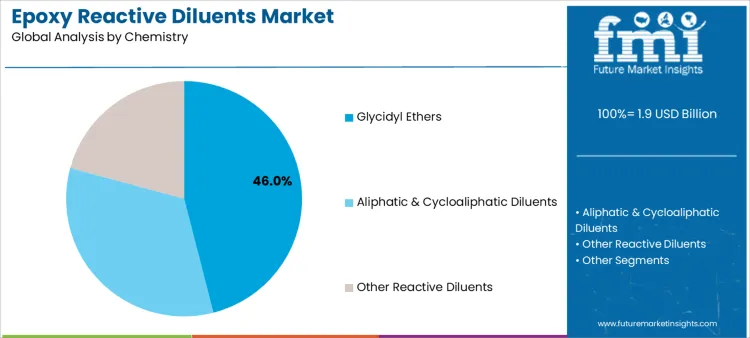
Glycidyl ethers account for 46% share of the epoxy reactive diluents market because they reduce resin viscosity effectively while remaining fully reactive within the epoxy network. This allows formulators to improve flow and application without sacrificing crosslink density, mechanical strength, or chemical resistance. Glycidyl ethers are compatible with a wide range of epoxy resins and curing agents, enabling flexible formulation across coatings, adhesives, and composite systems. Their predictable reaction kinetics support uniform curing and consistent surface finish, which is critical for industrial-scale processing. Broad commercial availability and ease of incorporation into existing formulations further strengthen adoption, making glycidyl ethers the preferred chemistry.
Why Do Coatings And Paints Dominate Application Demand In The Epoxy Reactive Diluents Market?
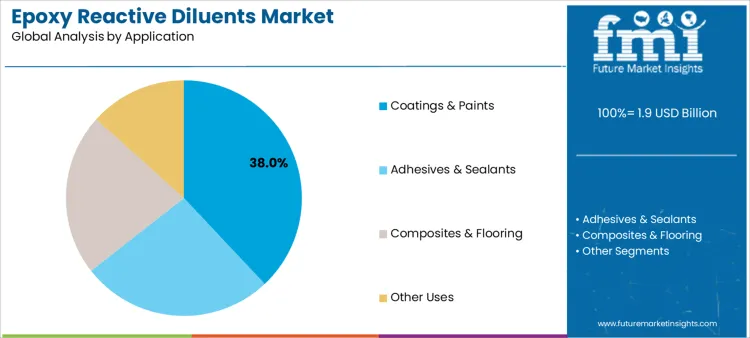
Coatings and paints hold 38% share of the epoxy reactive diluents market because these applications require low-viscosity formulations to ensure smooth application, proper leveling, and uniform film build. Reactive diluents enable high-solids epoxy coatings that maintain durability while meeting application efficiency requirements. Epoxy-based coatings are widely used in industrial, protective, and decorative applications due to their strong adhesion and corrosion resistance. Large surface coverage, continuous production schedules, and recurring maintenance demand drive steady material consumption. These high-volume usage patterns and performance-critical requirements explain why coatings and paints remain the dominant application segment.
What are the Key Dynamics of the Epoxy Reactive Diluents Market?
The epoxy reactive diluents market is driven by demand for materials that modify viscosity, processing characteristics, and cured performance of epoxy resin systems used in coatings, adhesives, composites, and electronic encapsulants. Reactive diluents reduce formulation viscosity without compromising crosslink density, helping improve flow, wetting, and cure behavior while becoming part of the polymer network. For chemical suppliers and formulators, reactive diluent compatibility with base resins, impact on mechanical and thermal properties, processing ease, and regulatory compliance (e.g., VOC and toxicity limits) are key factors that influence selection and long-term adoption in industrial applications.
How do Industry Trends and Application Demands Shape This Market?
Industry trends and application demands shape the epoxy reactive diluents market through growth in sectors such as automotive composites, wind energy blades, marine structures, electronics encapsulation, and industrial protective coatings. Lightweighting objectives in transportation and energy markets drive formulators to balance low-viscosity processing with high-performance cured properties, a requirement well served by advanced reactive diluents. In electronics, diluents that support low-stress cure and high thermal stability are preferred for underfill and encapsulation applications. Regulatory and performance trends toward lower emissions and improved durability foster development of tailored reactive diluents that enable formulators to meet both processing and end-use requirements.
Why do Regulatory, Compatibility, and Performance Challenges Restrain Market Growth?
Regulatory, compatibility, and performance challenges restrain the epoxy reactive diluents market because diluents must meet stringent safety, emissions, and performance criteria without undermining overall epoxy system properties. Some reactive diluents may introduce odor, skin sensitization risk, or higher reactivity that complicates processing and workplace handling, leading formulators to limit their use or require engineering controls. Ensuring compatibility with diverse resin formulations and multifunctional additives (fillers, pigments, catalysts) can require extensive formulation and testing work, increasing time and cost. Achieving the balance between reduced viscosity and maintained mechanical, thermal, and chemical resistance further complicates integration into high-performance systems.
How is the Epoxy Reactive Diluents Market Growing across Key Countries?
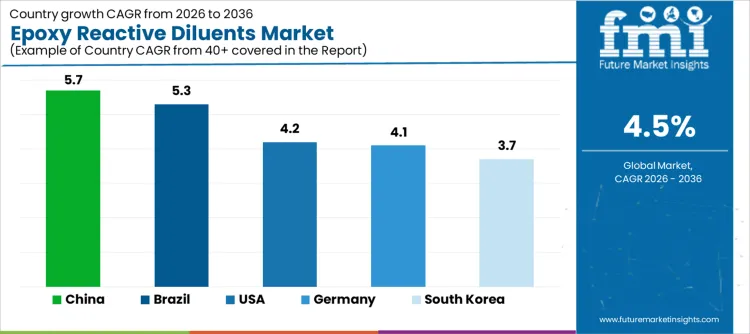
The epoxy reactive diluents market is expanding steadily as epoxy formulators seek improved flow, lower viscosity, and better processing efficiency without compromising mechanical and chemical performance. Reactive diluents are widely used in coatings, adhesives, composites, and flooring systems to enhance workability and enable higher filler loading or lower application temperatures. Country-wise growth varies based on construction activity, industrial coatings demand, and adoption of advanced epoxy systems. High-growth markets benefit from infrastructure expansion and industrial manufacturing, while mature regions emphasize formulation optimization, performance stability, and compliance-driven demand.
| Country | CAGR (%) |
|---|---|
| China | 5.7 |
| Brazil | 5.3 |
| United States | 4.2 |
| Germany | 4.1 |
| South Korea | 3.7 |
Why is China Leading the Epoxy Reactive Diluents Market?
China’s epoxy reactive diluents market is expanding at a CAGR of 5.7% during 2026 to 2036, driven by strong demand from construction coatings, industrial flooring, infrastructure protection, and composite manufacturing. Large-scale infrastructure projects and rapid industrialization continue to support high consumption of epoxy-based systems, where reactive diluents play a key role in improving application ease and curing efficiency. Chinese formulators prioritize reactive diluents that provide viscosity reduction, good compatibility with standard epoxy resins, and minimal impact on final mechanical properties. Domestic chemical producers benefit from integrated supply chains and the ability to deliver cost-effective solutions for high-volume applications. Adoption is strong in flooring coatings, marine coatings, wind energy composites, and heavy-duty industrial linings. Procurement decisions emphasize cost efficiency, supply reliability, and batch consistency. As export-oriented manufacturers align with international coating and composite standards, demand is rising for reactive diluents with predictable performance characteristics.
Why Is Brazil Seeing Steady Growth in Epoxy Reactive Diluents Demand?
Brazil’s epoxy reactive diluents market is growing at a CAGR of 5.3% during 2026 to 2036, supported by expansion in construction activity, infrastructure maintenance, and industrial coatings usage. Reactive diluents are increasingly used to improve flow and workability of epoxy formulations applied in flooring systems, protective coatings, and adhesives. Brazilian buyers value reactive diluents that enhance performance under high humidity and temperature conditions while maintaining acceptable curing profiles. Adoption is strongest in industrial floors, bridges, pipelines, and general construction coatings. Growth remains gradual, reflecting price sensitivity and the need for formulation validation across multiple applications. Procurement decisions often favor suppliers offering technical formulation support, regional availability, and compatibility with commonly used epoxy systems. As industrial and infrastructure projects continue to expand, demand for epoxy reactive diluents is expected to increase steadily across Brazil’s coatings and composites markets.
What Is Driving Demand for Epoxy Reactive Diluents in the United States?
The United States epoxy reactive diluents market is expanding at a CAGR of 4.2% during 2026 to 2036, driven by demand from industrial maintenance coatings, flooring systems, adhesives, and composite manufacturing. Reactive diluents are widely used to fine-tune viscosity and application characteristics in high-performance epoxy formulations. USA buyers emphasize predictable curing behavior, mechanical strength retention, and compatibility with advanced epoxy chemistries. Demand is strongest in industrial flooring, transportation infrastructure coatings, wind energy composites, and specialty adhesives. Adoption is performance-driven and focused on value-added applications rather than volume growth. Procurement decisions prioritize supplier reliability, technical documentation, and consistent product quality. Market growth is shaped by renovation activity, infrastructure maintenance, and continued use of epoxy systems in demanding industrial environments.
How Is Germany Supporting Demand for Epoxy Reactive Diluents?
Germany’s epoxy reactive diluents market is growing at a CAGR of 4.1% during 2026 to 2036, supported by demand from industrial coatings, automotive components, and advanced composite applications. German manufacturers emphasize formulation precision, mechanical reliability, and long service life, supporting steady use of reactive diluents to optimize epoxy systems. Buyers prioritize diluents that offer controlled viscosity reduction without compromising thermal or chemical resistance. Applications include industrial machinery coatings, structural adhesives, and engineered composite parts. Adoption is driven by performance optimization rather than cost considerations. Procurement decisions favor suppliers with robust quality systems, detailed technical data, and the ability to support customized formulations. Market growth is reinforced by Germany’s focus on engineering quality and advanced materials usage.
How is South Korea Expanding Use of Epoxy Reactive Diluents?
South Korea’s epoxy reactive diluents market is expanding at a CAGR of 3.7% during 2026 to 2036, driven by demand from electronics manufacturing, automotive components, and industrial coatings. Reactive diluents are increasingly used where precise viscosity control and consistent curing behavior are required. Buyers emphasize compatibility with high-performance epoxy systems, stable processing behavior, and suitability for automated manufacturing environments. Adoption is strongest in export-oriented manufacturing and advanced industrial applications. Procurement decisions are influenced by supplier technical capability, consistent supply quality, and alignment with global material standards. Market growth is supported by steady industrial activity and continued demand for high-quality epoxy-based formulations.
How Are Companies Competing in the Epoxy Reactive Diluents Market?
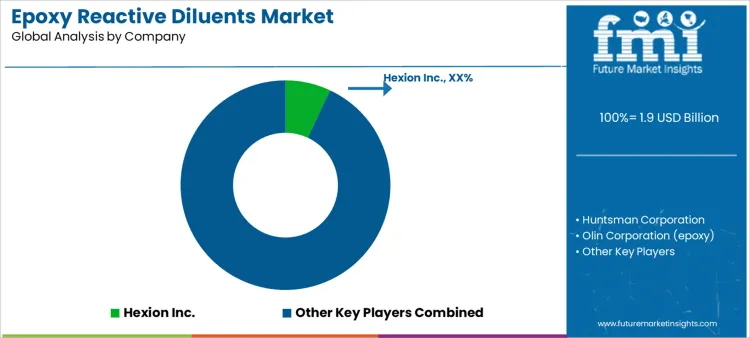
Competition in the epoxy reactive diluents market is driven by formulation flexibility, viscosity reduction efficiency, and cured network performance that matter to coatings, adhesives, composites, and electrical encapsulation formulators. Reactive diluents must lower system viscosity for processability while maintaining or improving mechanical strength, chemical resistance, and cure speed. Hexion Inc. anchors the market with a broad reactive diluent portfolio tailored to diverse epoxy systems. Its materials emphasize balanced reactivity, reduced VOC impact, and predictable integration with standard hardeners, supporting industrial coatings and composite applications.
Major chemical producers broaden competition through tailored performance and global supply. Huntsman Corporation competes by offering reactive diluents engineered for enhanced toughness and adhesion across multi-substrate systems, with product literature highlighting low shrinkage and improved glass transition temperatures. Olin Corporation and BASF SE position reactive diluents within broader epoxy portfolios, emphasizing consistent lot quality and compatibility with high-performance thermoset resins.
Specialty and regional players add competitive breadth through unique chemistries and customization options. Evonik Industries AG and Cardolite Corporation differentiate with bio-based or hybrid reactive diluents designed for flexibility and adhesion. Atul Ltd., Aditya Birla Chemicals, and KUKDO Chemical compete with cost-effective reactive diluents suited to regional coating and adhesive markets. Mitsubishi Chemical Group rounds out competition with high-purity reactive diluents engineered for specialized applications such as electronics and advanced composites. Across the market, competitive advantage is defined by cure performance, formulation support, and compatibility with regulatory VOC limits rather than diluent pricing alone.
Key Players in Epoxy Reactive Diluents Market
- Hexion Inc.
- Huntsman Corporation
- Olin Corporation (epoxy)
- BASF SE
- Evonik Industries AG
- Cardolite Corporation
- Atul Ltd.
- Aditya Birla Chemicals
- KUKDO Chemical
- Mitsubishi Chemical Group
Scope of Report
| Attribute | Details |
|---|---|
| Market Size Unit | USD Million |
| Chemistry Covered | Glycidyl Ethers, Aliphatic Reactive Diluents, Cycloaliphatic Reactive Diluents, Other Epoxy-Compatible Reactive Diluents |
| Application Covered | Coatings & Paints, Adhesives & Sealants, Composites & Flooring Systems, Other Industrial and Specialty Epoxy Applications |
| Countries Covered | China, Japan, South Korea, India, Australia & New Zealand, ASEAN, Rest of Asia Pacific, Germany, United Kingdom, France, Italy, Spain, Nordic, BENELUX, Rest of Europe, United States, Canada, Mexico, Brazil, Chile, Rest of Latin America, Kingdom of Saudi Arabia, Other GCC Countries, Turkey, South Africa, Other African Union, Rest of Middle East & Africa |
| Regions Covered | Asia Pacific, Europe, North America, Latin America, Middle East & Africa |
| Key Companies Profiled | Hexion Inc., Huntsman Corporation, Olin Corporation, BASF SE, Evonik Industries AG, Cardolite Corporation, Atul Ltd., Aditya Birla Chemicals, KUKDO Chemical, Mitsubishi Chemical Group |
| Additional Attributes | Dollar sales by chemistry and application are evaluated across coatings, adhesives, and composite systems. The scope analyzes viscosity reduction efficiency, reactivity balance, VOC compliance, and cured-network performance. Country-level assessment reflects construction activity, composite manufacturing growth, epoxy formulation trends, and regulatory pressure on low-VOC and high-performance epoxy systems. |
Epoxy Reactive Diluents Market by Key Segments
Chemistry
- Glycidyl Ethers
- Aliphatic & Cycloaliphatic Diluents
- Other Reactive Diluents
Application
- Coatings & Paints
- Adhesives & Sealants
- Composites & Flooring
- Other Uses
Region:
- Asia Pacific
- China
- Japan
- South Korea
- India
- Australia & New Zealand
- ASEAN
- Rest of Asia Pacific
- Europe
- Germany
- United Kingdom
- France
- Italy
- Spain
- Nordic
- BENELUX
- Rest of Europe
- North America
- United States
- Canada
- Mexico
- Latin America
- Brazil
- Chile
- Rest of Latin America
- Middle East & Africa
- Kingdom of Saudi Arabia
- Other GCC Countries
- Turkey
- South Africa
- Other African Union
- Rest of Middle East & Africa
Bibliography
- International Organization for Standardization. (2024). ISO 11357‑1: Plastics-Differential scanning calorimetry (DSC)-General principles. ISO.
- United Nations Industrial Development Organization. (2024). Advanced polymer systems for infrastructure, coatings, and composites. UNIDO.
- National Institute of Standards and Technology. (2024). Measurement and control of viscosity and cure behavior in epoxy‑based systems. NIST.
- United Nations Environment Programme. (2024). Chemical safety, emissions control, and sustainability considerations in epoxy resin systems. UNEP.
- German Federal Institute for Materials Research and Testing. (2023). Mechanical and thermal performance testing of modified epoxy polymers.
Frequently Asked Questions
How big is the epoxy reactive diluents market in 2026?
The global epoxy reactive diluents market is estimated to be valued at USD 1.9 billion in 2026.
What will be the size of epoxy reactive diluents market in 2036?
The market size for the epoxy reactive diluents market is projected to reach USD 3.0 billion by 2036.
How much will be the epoxy reactive diluents market growth between 2026 and 2036?
The epoxy reactive diluents market is expected to grow at a 4.5% CAGR between 2026 and 2036.
What are the key product types in the epoxy reactive diluents market?
The key product types in epoxy reactive diluents market are glycidyl ethers, aliphatic & cycloaliphatic diluents and other reactive diluents.
Which application segment to contribute significant share in the epoxy reactive diluents market in 2026?
In terms of application, coatings & paints segment to command 38.0% share in the epoxy reactive diluents market in 2026.
Preview the report firsthand - request a free sample
Get SampleGet the brochure for pricing and purchase details.
Get PDFTable of Content
- Executive Summary
- Global Market Outlook
- Demand-side Trends
- Supply-side Trends
- Technology Roadmap Analysis
- Analysis and Recommendations
- Market Overview
- Market Coverage / Taxonomy
- Market Definition / Scope / Limitations
- Market Background
- Market Dynamics
- Drivers
- Restraints
- Opportunity
- Trends
- Scenario Forecast
- Demand in Optimistic Scenario
- Demand in Likely Scenario
- Demand in Conservative Scenario
- Opportunity Map Analysis
- Product Life Cycle Analysis
- Supply Chain Analysis
- Investment Feasibility Matrix
- Value Chain Analysis
- PESTLE and Porter’s Analysis
- Regulatory Landscape
- Regional Parent Market Outlook
- Production and Consumption Statistics
- Import and Export Statistics
- Market Dynamics
- Global Market Analysis 2021 to 2025 and Forecast, 2026 to 2036
- Historical Market Size Value (USD Million) Analysis, 2021 to 2025
- Current and Future Market Size Value (USD Million) Projections, 2026 to 2036
- Y-o-Y Growth Trend Analysis
- Absolute $ Opportunity Analysis
- Global Market Pricing Analysis 2021 to 2025 and Forecast 2026 to 2036
- Global Market Analysis 2021 to 2025 and Forecast 2026 to 2036, By Chemistry
- Introduction / Key Findings
- Historical Market Size Value (USD Million) Analysis By Chemistry , 2021 to 2025
- Current and Future Market Size Value (USD Million) Analysis and Forecast By Chemistry , 2026 to 2036
- Glycidyl Ethers
- Aliphatic & Cycloaliphatic Diluents
- Other Reactive Diluents
- Glycidyl Ethers
- Y-o-Y Growth Trend Analysis By Chemistry , 2021 to 2025
- Absolute $ Opportunity Analysis By Chemistry , 2026 to 2036
- Global Market Analysis 2021 to 2025 and Forecast 2026 to 2036, By Application
- Introduction / Key Findings
- Historical Market Size Value (USD Million) Analysis By Application, 2021 to 2025
- Current and Future Market Size Value (USD Million) Analysis and Forecast By Application, 2026 to 2036
- Coatings & Paints
- Adhesives & Sealants
- Composites & Flooring
- Other Uses
- Coatings & Paints
- Y-o-Y Growth Trend Analysis By Application, 2021 to 2025
- Absolute $ Opportunity Analysis By Application, 2026 to 2036
- Global Market Analysis 2021 to 2025 and Forecast 2026 to 2036, By Region
- Introduction
- Historical Market Size Value (USD Million) Analysis By Region, 2021 to 2025
- Current Market Size Value (USD Million) Analysis and Forecast By Region, 2026 to 2036
- North America
- Latin America
- Western Europe
- Eastern Europe
- East Asia
- South Asia and Pacific
- Middle East & Africa
- Market Attractiveness Analysis By Region
- North America Market Analysis 2021 to 2025 and Forecast 2026 to 2036, By Country
- Historical Market Size Value (USD Million) Trend Analysis By Market Taxonomy, 2021 to 2025
- Market Size Value (USD Million) Forecast By Market Taxonomy, 2026 to 2036
- By Country
- USA
- Canada
- Mexico
- By Chemistry
- By Application
- By Country
- Market Attractiveness Analysis
- By Country
- By Chemistry
- By Application
- Key Takeaways
- Latin America Market Analysis 2021 to 2025 and Forecast 2026 to 2036, By Country
- Historical Market Size Value (USD Million) Trend Analysis By Market Taxonomy, 2021 to 2025
- Market Size Value (USD Million) Forecast By Market Taxonomy, 2026 to 2036
- By Country
- Brazil
- Chile
- Rest of Latin America
- By Chemistry
- By Application
- By Country
- Market Attractiveness Analysis
- By Country
- By Chemistry
- By Application
- Key Takeaways
- Western Europe Market Analysis 2021 to 2025 and Forecast 2026 to 2036, By Country
- Historical Market Size Value (USD Million) Trend Analysis By Market Taxonomy, 2021 to 2025
- Market Size Value (USD Million) Forecast By Market Taxonomy, 2026 to 2036
- By Country
- Germany
- UK
- Italy
- Spain
- France
- Nordic
- BENELUX
- Rest of Western Europe
- By Chemistry
- By Application
- By Country
- Market Attractiveness Analysis
- By Country
- By Chemistry
- By Application
- Key Takeaways
- Eastern Europe Market Analysis 2021 to 2025 and Forecast 2026 to 2036, By Country
- Historical Market Size Value (USD Million) Trend Analysis By Market Taxonomy, 2021 to 2025
- Market Size Value (USD Million) Forecast By Market Taxonomy, 2026 to 2036
- By Country
- Russia
- Poland
- Hungary
- Balkan & Baltic
- Rest of Eastern Europe
- By Chemistry
- By Application
- By Country
- Market Attractiveness Analysis
- By Country
- By Chemistry
- By Application
- Key Takeaways
- East Asia Market Analysis 2021 to 2025 and Forecast 2026 to 2036, By Country
- Historical Market Size Value (USD Million) Trend Analysis By Market Taxonomy, 2021 to 2025
- Market Size Value (USD Million) Forecast By Market Taxonomy, 2026 to 2036
- By Country
- China
- Japan
- South Korea
- By Chemistry
- By Application
- By Country
- Market Attractiveness Analysis
- By Country
- By Chemistry
- By Application
- Key Takeaways
- South Asia and Pacific Market Analysis 2021 to 2025 and Forecast 2026 to 2036, By Country
- Historical Market Size Value (USD Million) Trend Analysis By Market Taxonomy, 2021 to 2025
- Market Size Value (USD Million) Forecast By Market Taxonomy, 2026 to 2036
- By Country
- India
- ASEAN
- Australia & New Zealand
- Rest of South Asia and Pacific
- By Chemistry
- By Application
- By Country
- Market Attractiveness Analysis
- By Country
- By Chemistry
- By Application
- Key Takeaways
- Middle East & Africa Market Analysis 2021 to 2025 and Forecast 2026 to 2036, By Country
- Historical Market Size Value (USD Million) Trend Analysis By Market Taxonomy, 2021 to 2025
- Market Size Value (USD Million) Forecast By Market Taxonomy, 2026 to 2036
- By Country
- Kingdom of Saudi Arabia
- Other GCC Countries
- Turkiye
- South Africa
- Other African Union
- Rest of Middle East & Africa
- By Chemistry
- By Application
- By Country
- Market Attractiveness Analysis
- By Country
- By Chemistry
- By Application
- Key Takeaways
- Key Countries Market Analysis
- USA
- Pricing Analysis
- Market Share Analysis, 2025
- By Chemistry
- By Application
- Canada
- Pricing Analysis
- Market Share Analysis, 2025
- By Chemistry
- By Application
- Mexico
- Pricing Analysis
- Market Share Analysis, 2025
- By Chemistry
- By Application
- Brazil
- Pricing Analysis
- Market Share Analysis, 2025
- By Chemistry
- By Application
- Chile
- Pricing Analysis
- Market Share Analysis, 2025
- By Chemistry
- By Application
- Germany
- Pricing Analysis
- Market Share Analysis, 2025
- By Chemistry
- By Application
- UK
- Pricing Analysis
- Market Share Analysis, 2025
- By Chemistry
- By Application
- Italy
- Pricing Analysis
- Market Share Analysis, 2025
- By Chemistry
- By Application
- Spain
- Pricing Analysis
- Market Share Analysis, 2025
- By Chemistry
- By Application
- France
- Pricing Analysis
- Market Share Analysis, 2025
- By Chemistry
- By Application
- India
- Pricing Analysis
- Market Share Analysis, 2025
- By Chemistry
- By Application
- ASEAN
- Pricing Analysis
- Market Share Analysis, 2025
- By Chemistry
- By Application
- Australia & New Zealand
- Pricing Analysis
- Market Share Analysis, 2025
- By Chemistry
- By Application
- China
- Pricing Analysis
- Market Share Analysis, 2025
- By Chemistry
- By Application
- Japan
- Pricing Analysis
- Market Share Analysis, 2025
- By Chemistry
- By Application
- South Korea
- Pricing Analysis
- Market Share Analysis, 2025
- By Chemistry
- By Application
- Russia
- Pricing Analysis
- Market Share Analysis, 2025
- By Chemistry
- By Application
- Poland
- Pricing Analysis
- Market Share Analysis, 2025
- By Chemistry
- By Application
- Hungary
- Pricing Analysis
- Market Share Analysis, 2025
- By Chemistry
- By Application
- Kingdom of Saudi Arabia
- Pricing Analysis
- Market Share Analysis, 2025
- By Chemistry
- By Application
- Turkiye
- Pricing Analysis
- Market Share Analysis, 2025
- By Chemistry
- By Application
- South Africa
- Pricing Analysis
- Market Share Analysis, 2025
- By Chemistry
- By Application
- USA
- Market Structure Analysis
- Competition Dashboard
- Competition Benchmarking
- Market Share Analysis of Top Players
- By Regional
- By Chemistry
- By Application
- Competition Analysis
- Competition Deep Dive
- Hexion Inc.
- Overview
- Product Portfolio
- Profitability by Market Segments (Product/Age /Sales Channel/Region)
- Sales Footprint
- Strategy Overview
- Marketing Strategy
- Product Strategy
- Channel Strategy
- Huntsman Corporation
- Olin Corporation (epoxy)
- BASF SE
- Evonik Industries AG
- Cardolite Corporation
- Atul Ltd.
- Aditya Birla Chemicals
- KUKDO Chemical
- Mitsubishi Chemical Group
- Hexion Inc.
- Competition Deep Dive
- Assumptions & Acronyms Used
- Research Methodology


