

- Industry Size (2026)
- USD 53.4 Bn
- Forecast (2036)
- USD 88.7 Bn
- CAGR (2026 to 2036)
- 5.2%
Construction Chemical Market Size, Market Forecast and Outlook By FMI
In 2025, the construction chemical market was valued at USD 50.8 billion. Based on Future Market Insights' analysis, demand for construction chemicals is estimated to grow to USD 53.4 billion in 2026 and USD 88.7 billion by 2036. FMI projects a CAGR of 5.2% during the forecast period. This represents steady, capacity-linked expansion rather than a sudden volume surge, anchored in infrastructure upgrades, urban housing demand, and mandatory performance standards for concrete durability. Growth remains moderated by raw material price volatility in polymers and cement-linked inputs, which tempers margin expansion even as volumes rise.
A transformative trend defining the 2026-2036 period is the transition from passive protective barriers to active, stimuli-responsive chemical systems. Traditionally, waterproofing and repair involved passive membranes that degrade over time. The market is now pivoting toward crystalline admixtures and microbial-induced calcite precipitation (MICP).
Summary of Construction Chemical Market
- Market Definition
- The construction chemical market comprises performance-enhancing additives and formulations used in concrete, mortar, and structural substrates to improve durability, strength, and lifecycle performance across residential and infrastructure projects.
- Demand Drivers
- Rapid urban housing development in Asia is increasing procurement of concrete admixtures to meet faster setting times and higher load-bearing standards in high-rise construction.
- Public infrastructure renewal in North America and Europe is driving demand for repair mortars, grouts, and protective coatings to extend the life of ageing bridges, tunnels, and transport corridors.
- Stricter building codes on water resistance and durability are prompting contractors to adopt waterproofing compounds and corrosion inhibitors to meet compliance thresholds.
- Key Segments Analyzed
- By Product Type: Concrete admixtures lead the market, accounting for approximately 63% share in 2026 due to their essential role in modern concrete performance optimization.
- By Application: Residential construction holds nearly 42% of total demand, reflecting sustained housing development and refurbishment cycles.
- By Geography: China and India remain the fastest-expanding markets, while the United States and Germany generate replacement-driven demand with lower but stable growth rates.
- Analyst Opinion at FMI
- Nikhil Kaitwade, Principal Consultant for Chemicals & Materials at Future Market Insights, opines, “The construction chemicals industry is undergoing a fundamental shift. What was once a cost‑driven procurement category has become a strategic lever of performance, resilience, and long‑term value creation. Today, project owners and contractors are no longer selecting suppliers based on price alone; they are prioritizing solutions that enhance durability, extend asset lifecycles, and reduce total cost of ownership. This evolution toward performance‑led specification marks a structural transition, one where chemistry, not commodity pricing, defines competitive advantage.”
- Strategic Implications/Executive Takeaways
- Manufacturers should align portfolios with infrastructure-grade durability standards, especially in high-growth Asian markets where urban density raises structural performance requirements.
- Vertical integration into polymer inputs can reduce exposure to raw material price volatility and protect margins across the forecast period.
- Expanding technical advisory services for contractors can strengthen long-term supply agreements in specification-driven projects.
- Methodology
- Market estimates are based on triangulation of company revenue disclosures, construction spending data, and primary interviews with contractors and distributors.
- A hybrid bottom-up and top-down forecasting model was used to project demand from 2026 to 2036 at a CAGR of 5.2%.
- Data validation includes cross-checking regional growth assumptions against national infrastructure budgets and residential construction approvals.
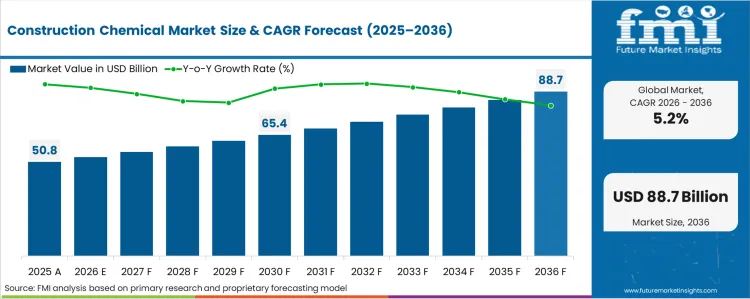
| Metric | Value |
|---|---|
| Estimated Value (2026E) | USD 53.4 billion |
| Forecast Value (2036F) | USD 88.7 billion |
| CAGR (2026 to 2036) | 5.2% |
Source: FMI analysis based on primary research and proprietary forecasting model
Construction chemicals like admixtures, waterproofing, and repair mortars are essential for durable infrastructure amid urbanization booms, with local production key to scaling supply for mega-projects and cost-sensitive markets. On inaugurating a new 25,000 MT facility for these products, Dr. Boris Gorella (CEO and Chairman, Master Builders Solutions) states: “This investment marks a significant milestone in our expansion journey. It reinforces our long-term commitment to the region and to delivering innovative, high-performance solutions that meet the rapid growth and infrastructure needs of the Indian construction industry. [1]”
These self-healing chemicals lie dormant within the concrete matrix and reactivate only when a crack forms and moisture enters. Upon activation, the chemicals trigger a reaction that grows insoluble crystals or limestone to seal the breach. This shift is becoming a baseline requirement for smart infrastructure in coastal cities facing rising sea levels, as it significantly extends the maintenance-free lifecycle of high-value assets like tunnels and marine foundations.
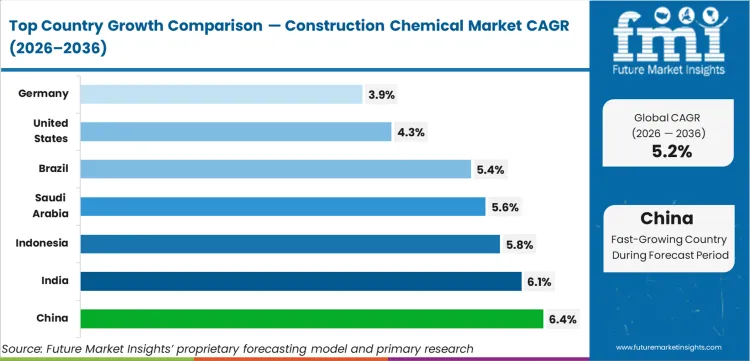
China is projected to expand at a CAGR of 6.4% through 2036, supported by ongoing urban redevelopment and large-scale public infrastructure renewal programmes. India is expected to grow at a CAGR of 6.1%, driven by highway construction, metro rail expansion, and government-backed housing schemes that raise demand for concrete admixtures and waterproofing chemicals. Indonesia is forecast to register a CAGR of 5.8%, underpinned by new capital city development and sustained commercial real estate construction. Brazil is anticipated to record a CAGR of 5.4%, reflecting infrastructure concessions and residential recovery in major metropolitan corridors.
The United States and Germany are projected to grow at CAGRs of 4.3% and 3.9%, respectively; these mature markets generate primarily replacement and refurbishment demand rather than fresh capacity expansion. For this group, strict environmental compliance costs and slower permitting cycles act as structural constraints on new construction intensity.
Construction Chemical Market Definition
The construction chemical market covers specialty chemical products added to cement, concrete, mortar, and building substrates to improve strength, durability, workability, and resistance to water or chemicals. These products include concrete admixtures, waterproofing compounds, repair mortars, sealants, grouts, and protective coatings used during construction or rehabilitation. Their primary industrial function is to enhance the performance life of structures by modifying setting time, improving bonding, reducing permeability, or increasing load-bearing capacity. The largest end use lies in residential and infrastructure construction, where builders purchase these chemicals to meet structural codes, extend service life, and control lifecycle maintenance costs.
Market Inclusions
The report covers global and regional market size estimates for 2025, 2026, and 2036, with a forecast period from 2026 to 2036. It provides segment-wise analysis by product type, including concrete admixtures and related formulations, and by application such as residential and infrastructure construction. The study also includes pricing trends, input cost assessment for polymer and cement-linked chemicals, and trade flow analysis for major producing and consuming regions.
Market Exclusions
The scope excludes bulk construction materials such as cement, aggregates, structural steel, and ready-mix concrete unless specialty chemicals are integrated as formulated additives. It also omits downstream finished construction assets such as prefabricated panels, completed buildings, and turnkey infrastructure projects. Niche laboratory reagents, decorative paints not formulated as structural construction chemicals, and consumer-grade DIY repair kits are outside the study unless used in commercial construction applications.
Research Methodology
- Primary Research: FMI analysts conducted interviews with chemical manufacturers, construction contractors, distributors, and procurement managers across residential and infrastructure segments to validate demand patterns and pricing structures.
- Desk Research: Public company annual reports, investor presentations, government construction statistics, infrastructure pipeline disclosures, and trade association publications were reviewed to establish baseline market volumes and revenue trends.
- Market-sizing and Forecasting: A hybrid model combining bottom-up aggregation of company revenues with top-down validation against construction spending data was used to estimate market size and project growth through 2036.
- Data validation and Update Cycle: All projections were cross-checked through triangulation between primary interviews, financial disclosures, and macroeconomic construction indicators, with periodic updates aligned to new infrastructure spending announcements and regulatory changes.
Segmental Analysis
Construction Chemical Market Analysis by Product Type
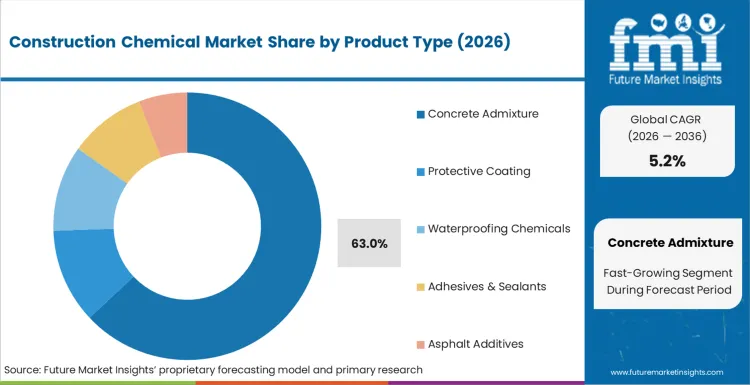
Based on FMI's construction chemical market report, concrete admixtures are estimated to hold a 63% share in 2026. This dominance reflects how admixtures let ready-mix producers hit strength and workability targets while reducing cement intensity, which lowers cost per cubic meter and helps meet durability specifications on fast-cycle projects.
- Capacity build: Sika opened a new production facility in Ust-Kamenogorsk (Kazakhstan) with concrete admixture lines and a laboratory, adding regional capacity aligned with local project pipelines. [1]
- Low-carbon mixes: Saint-Gobain’s Chryso launched EnviroMix®C-Clay admixtures to address higher water demand in newer low-carbon cement systems, protecting performance as binder chemistry shifts. [2]
- Local availability: Sika’s June 2025 manufacturing investments across China, Brazil, and Morocco underline how suppliers shorten lead times and stabilize supply by producing closer to consumption hubs. [3]
Construction Chemical Market Analysis by Application
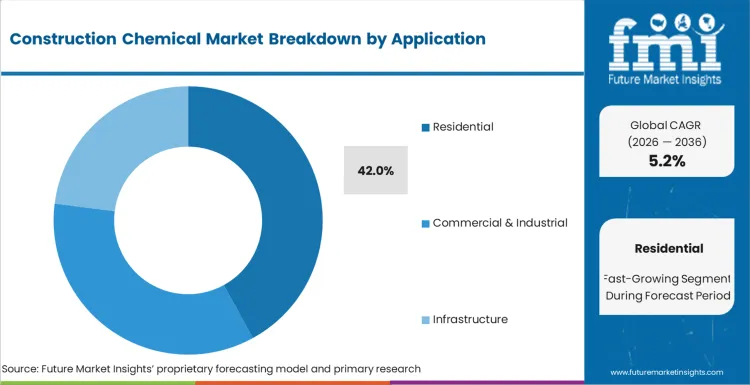
Residential applications are estimated to account for a 42% share in 2026, since homebuilders repeatedly purchase waterproofing, adhesives, and repair products to control leakage risk and meet handover quality benchmarks across high-volume housing.
- Plant investment: Fosroc India inaugurated an integrated construction chemicals plant in Hyderabad to extend coverage across South and Central India, improving service levels for housing and contractor networks. [4]
- Product rollout: Mapei highlighted Monolastic Turbo Zero and Mapelastic AquaDefense Zero at BAU 2025, targeting wet-area waterproofing needs where installation speed and low-impact formulations influence contractor choice. [5]
- Supply footprint: Sika’s nine-month 2025 results presentation points to multiple new plants and expansions, including sites producing tile adhesives and cementitious waterproofing, reflecting the need for regionally stocked portfolios in residential channels. [6]
Construction Chemical Market Drivers, Restraints, and Opportunities
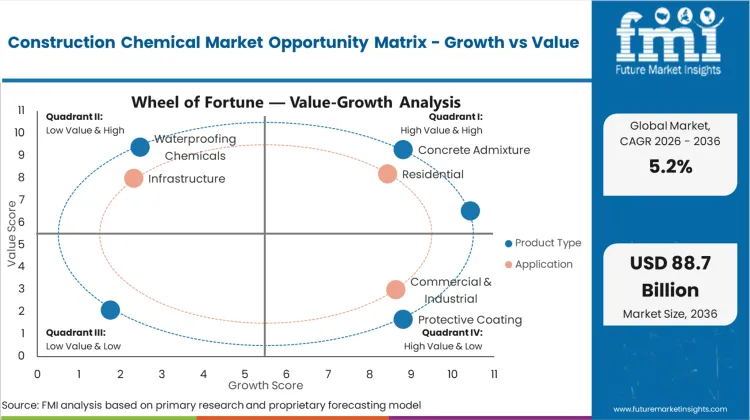
The construction chemical market has evolved in line with changes in building codes, contractor risk management, and asset lifecycle economics. Its current valuation of USD 53.4 billion in 2026 reflects the embedding of performance additives into standard construction specifications rather than discretionary upgrades.
Over the past decade, durability norms for bridges, tunnels, basements, and high-rise foundations have tightened, pushing admixtures, waterproofing systems, and repair mortars into baseline procurement. The structural reality is that these products are now specification-driven inputs linked directly to compliance with structural and environmental codes.
The core shift underway is the move from commodity-grade formulations toward performance-certified and low-emission systems. Standard plasticizers and basic cementitious waterproofing products are losing share in regulated markets where carbon intensity disclosure and environmental product declarations influence tenders.
Advanced admixtures and polymer-modified systems carry higher unit prices, but contractors use them in optimized dosages or in targeted applications, which moderates volume growth while lifting revenue per project.
- Low-carbon specifications: Public infrastructure tenders increasingly reference Environmental Product Declarations aligned with ISO 14025 and EN 15804, pushing suppliers to document embodied carbon. Admixtures that enable clinker reduction or supplementary cementitious material compatibility gain preference in projects where lifecycle carbon reporting is mandatory.
- Infrastructure rehabilitation cycle: In North America and Western Europe, a large share of demand comes from structural repair and corrosion mitigation in ageing assets. Programmes such as the USA Infrastructure Investment and Jobs Act channel funding into bridge and roadway upgrades, increasing use of repair mortars, corrosion inhibitors, and protective coatings rather than greenfield volumes.
- Raw material volatility: Polymer dispersions and specialty surfactants derived from petrochemical chains expose manufacturers to feedstock price swings. Margin stability depends on contractual pass-through clauses and localized production footprints, which influence how suppliers price long-term supply agreements with major contractors.
Regional Analysis
Based on the regional analysis, the construction chemicals market is assessed across East Asia, South Asia & Pacific, North America, Latin America, Europe, and the Middle East & Africa. Country-level demand patterns and local compliance drivers that shape formulation choices assess the market. The regional view compares how regulation, manufacturing footprints, and refurbishment cycles influence additive intensity, and the full report includes market attractiveness analysis by region and country.
.webp "Top Country Growth Comparison Construction Chemical Market Cagr (2026 2036)")
Country CAGR (2026 to 2036)
| Country | CAGR (2026 to 2036) |
|---|---|
| China | 6.4% |
| India | 6.1% |
| Indonesia | 5.8% |
| Saudi Arabia | 5.6% |
| Brazil | 5.4% |
| United States | 4.3% |
| Germany | 3.9% |
Source: Future Market Insights (FMI) analysis, based on proprietary forecasting model and primary research
East Asia Market Analysis
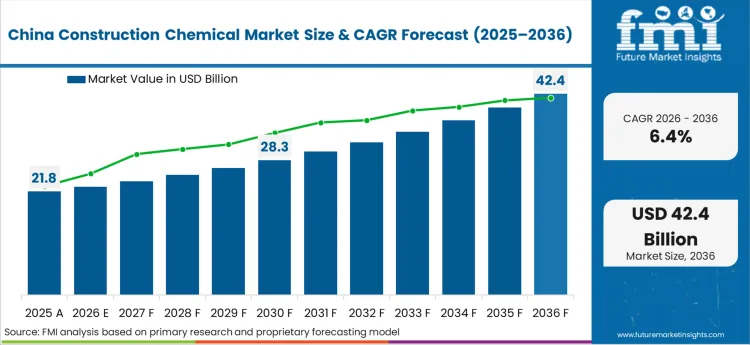
East Asia acts as the scale-and-standards engine, where large urban renewal pipelines translate into repeat procurement of admixtures, repair mortars, and waterproofing systems. Sika and Saint-Gobain through Chryso compete strongly on admixture performance and low-carbon compatibility, while MBCC Group has an established footprint in major infrastructure specifications. Demand is shaped by city-level renovation budgets, durability standards for public works, and tight delivery windows that reward suppliers with local batching support.
- China: The market for construction chemicals in China is forecast to register a CAGR of 6.4% through 2036. Renovation of ageing residential stock is a direct volume driver for waterproofing, repair mortars, sealants, and admixtures used in structural upgrades. In December 2024, the Ministry of Housing and Urban-Rural Development reiterated the target to complete renovation of old urban residential communities built before end-2000 by 2025, keeping municipal project pipelines active. [7] A second demand lever is fiscal support for urban renewal systems and model projects. In April 2025, the Ministry of Finance stated it would continue central support for urban renewal, with funding tied to addressing infrastructure gaps and improving urban service quality. [8] These programmes support stable pull for admixtures and repair systems used in drainage upgrades, façade rehabilitation, and basement water protection. To navigate the highly competitive tendering landscape, leading chemical suppliers are establishing localized technical centers to co-develop customized, ultra-high-performance concrete (UHPC) admixtures directly with municipal contractors.
The FMI report gets in-depth into the East Asian landscape by analyzing regional cement chemistries, localized raw material sourcing, and the integration of green building codes. Beyond China, nations like Japan and South Korea remain incredibly lucrative hubs; Japan demands advanced seismic-retrofitting chemicals, while South Korea represents a massive market for high-purity sealants used in high-tech industrial park construction.
South Asia & Pacific Market Analysis
South Asia & Pacific is the volume-led housing and infrastructure arena, where contractor networks and distribution reach determine share as much as formulation performance. Players such as Fosroc and Sika compete by expanding plant capacity near high-growth construction corridors, while Mapei builds pull through with contractor-ready waterproofing and tiling systems. Formal housing programmes and metro and road buildouts that require consistent concrete performance at scale support demand.
- India: Construction chemicals sales in India are projected to rise at a 6.1% CAGR through 2036. Government-backed urban housing is a major demand anchor because it standardises quality requirements across high-volume projects, lifting baseline consumption of admixtures, waterproofing, and tile installation systems. In August 2024, the Government of India approved PMAY-U 2.0 with a target of 10 million urban houses, supporting multi-year residential construction and repeat procurement of building chemicals. [9] Supply-side expansion is also reshaping availability and service levels. In May 2024, Fosroc inaugurated an integrated construction chemicals plant in Hyderabad, improving response time and technical support across South and Central India. [10] Recognizing the variability in jobsite practices, tier-one manufacturers are heavily investing in mobile training academies and digital dosing applications to empower local contractors and guarantee application quality.
- Indonesia: The Indonesia construction chemicals sector is poised to expand at a CAGR of 5.8% through 2036. The Nusantara capital development is creating a concentrated pipeline for high-spec concrete and waterproofing systems used in government facilities and supporting infrastructure. In December 2024, Indonesia’s Public Works Minister signaled continued priority development in Nusantara, with tenders for key legislative assets expected to proceed as evaluation milestones clear. [11] To capitalize on the Nusantara mega-project, multinational suppliers are preemptively establishing localized blending facilities in East Kalimantan to eliminate logistical bottlenecks and ensure just-in-time delivery of moisture-sensitive formulations.
Through the FMI report, stakeholders gain an in-depth understanding of South Asia's monsoon-driven waterproofing demands, contractor distributor dynamics, and the pricing elasticity of essential admixtures. Countries such as Vietnam and the Philippines, are surfacing as highly lucrative hubs, driven by massive coastal infrastructure development and an aggressive boom in commercial real estate.
North America Market Analysis
North America is the rehabilitation and compliance market, where bridge, roadway, and public asset repair sustains steady consumption of protective coatings, corrosion inhibitors, grouts, and repair mortars. Sika, Saint-Gobain, and RPM International have strong positioning through specification relationships and contractor services.
- United States: Demand for construction chemicals in the United States is estimated to expand at a CAGR of 4.3% through 2036. The market is supported by repair and replacement demand in bridges and public works, which favours corrosion mitigation systems, protective coatings, grouts, and repair mortars more than pure new build volume. In October 2024, FHWA listed 2024 Bridge Investment Program grant recipients, with hundreds of millions of dollars allocated across multiple states for bridge projects, sustaining a pipeline of asset rehabilitation and replacement work. [15] The USA Department of Transportation also explains that the Infrastructure Investment and Jobs Act established the Bridge Investment Program with multi-year funding to improve bridge condition and safety, reinforcing continuity in public asset spending. [16] To streamline the rigorous public procurement cycles, top-tier manufacturers are heavily investing in digital lifecycle documentation and EPDs (Environmental Product Declarations) to fast-track their proprietary grouts and mortars into federal infrastructure specifications.
The FMI report delivers an in-depth assessment of the North American supply chain, breaking down regional distributor networks, localized pricing indices, and the financial impact of infrastructure tax credits. Outside the United States, Canada and Mexico represent highly lucrative hubs; Canada sees a steady pull from freeze-thaw resistant concrete additives, while Mexico is experiencing a sharp rise in construction chemical consumption driven by manufacturing nearshoring facilities.
Latin America Market Analysis
Latin America is an evolving landscape driven by urbanization, expanding public sanitation projects, and a highly active informal building sector. The region heavily relies on distributor-driven route-to-market structures, placing a premium on locally blended, cost-effective formulations.
- Brazil: Brazil's construction chemicals industry is expected to demonstrate a CAGR of 5.4% through 2036. Sanitation expansion is a practical pull-through driver because sewage and water projects use repair mortars, grouts, waterproofing, and corrosion protection across civil structures. In June 2025, the European Investment Bank described lending tied to rehabilitation, expansion, and construction of water and wastewater infrastructure and service expansion, reinforcing a multi-year build and upgrade cycle. [13] In housing, policy-linked demand supports steady chemical usage in waterproofing, tile adhesives, and concrete performance additives. In January 2026, Fastmarkets noted continuing support from housing programmes such as Minha Casa, Minha Vida, alongside Novo PAC allocations tied to sanitation and mobility, which sustain construction activity in key corridors. [14] To mitigate the volatility of public fiscal cycles, dominant regional players are aggressively diversifying their portfolios to target the booming private agro-industrial sector, supplying specialized protective coatings for vast silo and processing infrastructure.
The FMI report gets in-depth on the Latin American market by mapping out import dependencies, regional tariff barriers, and the competitive landscape of local versus multinational distributors. While Brazil anchors the market, countries like Chile and Colombia are surfacing as highly lucrative hubs, showing a steady rise in demand for specialized underground tunneling chemicals and advanced structural grouts linked to mountain infrastructure projects.
Europe Market Analysis
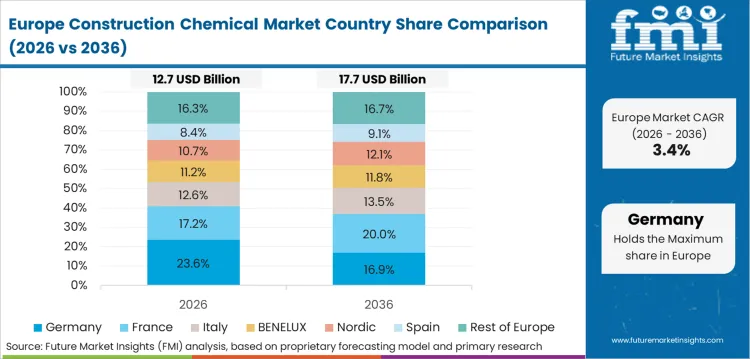
Europe functions as the carbon-accounting laboratory, where building renovation and decarbonization rules shape product selection in adhesives, waterproofing, and façade and repair systems. Sika and Saint-Gobain compete on low-emission portfolios, while Mapei differentiates through application-specific systems for refurbishment. Compliance costs and documentation requirements matter, and buyers increasingly expect emissions disclosure and long service-life performance.
- Germany: Construction chemicals revenue in Germany is anticipated to increase by a CAGR of 3.9% through 2036. Demand is dominated by refurbishment and building modernization, which sustains consumption of adhesives, sealants, waterproofing, and repair systems linked to energy upgrades and moisture management in existing stock. In January 2024, KfW indicated plans to resume promotion of new climate-friendly buildings at the start of 2024, supporting continued renovation and new-build activity tied to energy performance criteria. [17]
Through the FMI report, stakeholders gain an in-depth understanding of Europe's strict REACH chemical regulations, circular economy mandates, and the shift toward bio-based binding agents. Countries like the United Kingdom and France, remain highly lucrative hubs, characterized by a steady rise in demand for specialized heritage restoration mortars and rapid-curing flooring systems for commercial real estate.
Middle East & Africa Market Analysis
The Middle East and Africa (MEA) region is characterized by extreme climatic conditions and massive, state-funded giga-projects. The market places an incredibly high premium on high-performance superplasticizers, set-retarders, and curing compounds designed specifically to maintain concrete workability in hyper-arid environments.
- Saudi Arabia: FMI estimates the construction chemicals market in Saudi Arabia to expand at an annual growth rate of 5.6% through 2036. The construction landscape is entirely dominated by the execution phases of Vision 2030, with projects like NEOM, the Red Sea Project, and Qiddiya requiring unprecedented volumes of high-performance concrete. Due to extreme ambient temperatures, contractors rely heavily on advanced liquid chemical admixtures to prevent premature concrete setting and thermal cracking. To secure massive multi-year contracts, global chemical giants are establishing joint ventures with local petrochemical entities to domesticate the production of raw polymers, thereby circumventing maritime shipping delays and ensuring uninterrupted supply to critical giga-sites.
The FMI report provides an in-depth analysis of the MEA region by evaluating contractor procurement trends for giga-projects, the localization of supply chains, and the shift toward sustainable concrete in desert environments. Countries like United Arab Emirates and Egypt, are proving to be highly lucrative hubs; the UAE is driving a surge in demand for aesthetic architectural sealants, while Egypt's New Administrative Capital requires vast quantities of structural repair and foundation waterproofing systems.
Competitive Landscape for Market Players
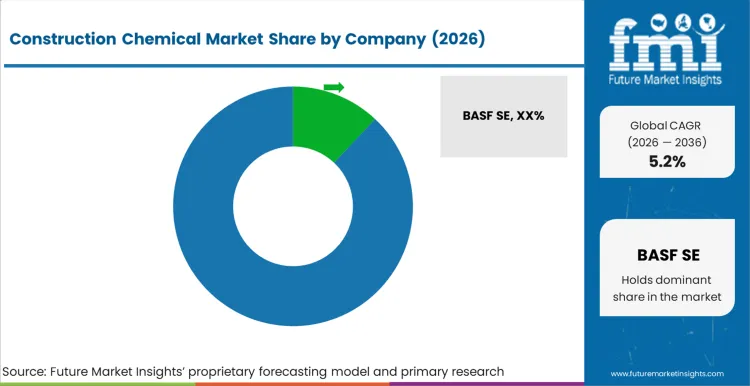
Competition in construction chemicals is moderately fragmented, with a small set of global brands competing against a long tail of regional formulators and local blenders. Share leadership is strongest where projects are specification-led, but the market does not behave like a winner-takes-all category because transport costs, fresh shelf-life constraints for some products, and contractor service needs keep demand local. The primary competitive variable is not only price per kilogram, it is the ability to lock in approvals through technical support, consistent batching performance, and documented compliance for project specifications.
Structural advantages sit with players that combine broad product portfolios with local manufacturing and on-site technical teams. Companies with dense plant networks can supply admixtures, waterproofing, sealants, and repair systems with shorter lead times, which matters when pours, grouting windows, or waterproofing sequences shift on site. Scale also helps in reformulating for lower-emission requirements and ensuring compatibility with changing cement chemistries, which reduces contractor risk and repeat rework.
Buyer behaviour is procurement-driven and risk-managed. Large contractors and ready-mix groups typically multi-source approved brands, split volumes across two to three suppliers, and use framework agreements that tie rebates and service levels to performance metrics. This limits supplier pricing power in standard grades, while enabling better margins in high-spec applications where switching costs rise due to re-approval cycles, QA documentation, and the need for jobsite troubleshooting.
Recent developments
- Sika, in June 2025, acquired Gulf Additive Factory LLC in Qatar to expand local production of construction chemical products and deepen its foothold in the Gulf market.
- In July 2025, Saint-Gobain announced bolt-on acquisitions to reinforce its construction chemicals platform through Chryso, adding Interstar, Isoltech, and Soquimic.
- Master Builders Solutions in September 2024 introduced MasterEase 5000, a water-reducing and conditioning admixture positioned around workability control and placement performance.
Key Players in Construction Chemical Market
- BASF SE
- Sika AG
- Fosroc International
- MAPEI S.p.A.
- GCP Applied Technologies
- RPM International Inc.
- Saint-Gobain S.A.
- Dow Inc.
- Wacker Chemie AG
- Arkema S.A.
- Evonik Industries AG
- 3M Company
- HB Fuller Company
- Henkel AG & Co. KGaA
- Pidilite Industries
- Chembond Chemicals Limited
- Sobute New Materials Co., Ltd.
- KZJ New Materials Group
- MYK Arment
- Don Construction Products
Scope of the Report
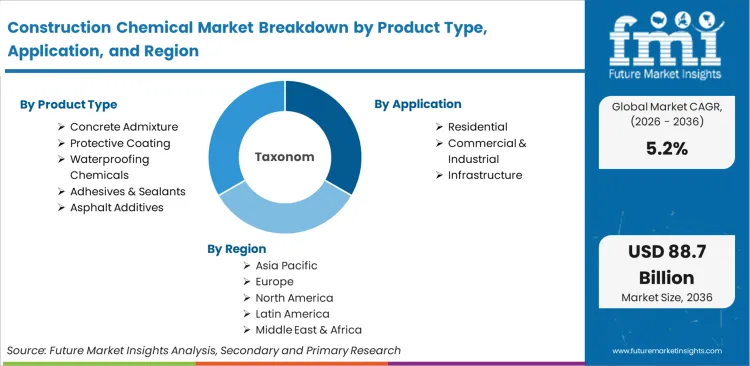
| Metric | Value |
|---|---|
| Quantitative Units | USD 53.4 billion (2026) to USD 88.7 billion (2036), at a CAGR of 5.2% |
| Market Definition | The construction chemical market comprises the global production, distribution, and application of specialty chemical formulations including concrete admixtures, waterproofing chemicals, protective coatings, adhesives and sealants, and asphalt additives used to enhance construction material properties. |
| Product Type Segmentation | Waterproofing Chemicals, Protective Coating, Concrete Admixture (63.0%), Adhesives & Sealants, Asphalt Additives |
| Application Segmentation | Residential (42.0%), Commercial & Industrial, Infrastructure |
| Regions Covered | North America, Latin America, Europe, Asia Pacific, Middle East and Africa |
| Countries Covered | United States, Canada, Mexico, Brazil, Germany, France, United Kingdom, Italy, Spain, China, India, Japan, South Korea, Indonesia, Australia, and 40 plus countries |
| Key Companies Profiled | BASF SE, Sika AG, Fosroc International, MAPEI S.p.A., GCP Applied Technologies, RPM International Inc., Saint-Gobain S.A., Dow Inc., Wacker Chemie AG, Arkema S.A., Evonik Industries AG, 3M Company, HB Fuller Company, Henkel AG & Co. KGaA, Pidilite Industries, Chembond Chemicals Limited, Sobute New Materials Co., Ltd., KZJ New Materials Group, MYK Arment, Don Construction Products |
| Forecast Period | 2026 to 2036 |
| Approach | Hybrid top-down and bottom-up market modeling validated through primary interviews with construction chemical manufacturers, contractors, and raw material suppliers, supported by construction spending data and trade statistics |
Construction Chemical Market Analysis by Segments
Product Type:
- Waterproofing Chemicals
- Protective Coating
- Concrete Admixture
- Adhesives & Sealants
- Asphalt Additives
Application:
- Residential
- Commercial & Industrial
- Infrastructure
Region:
- North America
- Latin America
- Europe
- Asia Pacific
- Middle East and Africa
Bibliography
- [1] Master Builders Solutions. (2025, September). MBT Construction Chemicals inaugurates new manufacturing plant in India [Press release].
- [2] Saint-Gobain. (December 2024). Chryso launches EnviroMix®C-Clay, a new range of admixtures aimed at reducing the concrete carbon footprint.
- [3] Sika. (June 2025). Sika strengthens global presence with strategic investments across all regions (media release PDF).
- [4] Fosroc. (May 2024). Fosroc India inaugurates state-of-the-art construction chemicals plant in Hyderabad.
- [5] Mapei. (January 2025). Press release: Mapei at BAU 2025, expands its Zero Line (Monolastic Turbo Zero, Mapelastic AquaDefense Zero) (PDF).
- [6] Sika. (2025). Resilient performance in first nine months 2025 (presentation PDF).
- [7] The State Council Information Office, The People’s Republic of China. (December 2024). China to advance urban renewal projects in 2025.
- [8] The State Council Information Office, The People’s Republic of China. (April 2025). China continues to support urban renewal projects in 2025.
- [9] Press Information Bureau, Government of India. (August 2024). Cabinet approves Pradhan Mantri Awas Yojana Urban 2.0 scheme.
- [10] Fosroc. (May 2024). Fosroc India inaugurates state-of-the-art construction chemicals plant in Hyderabad.
- [11] PwC Indonesia. (December 2024). New capital city IKN project ready to progress early next year.
- [12] PwC Indonesia. (June 2025). Rp63 trillion investment to enter the new capital city IKN.
- [13] European Investment Bank. (June 2025). BNDES Brazil water and sanitation project pipeline entry.
- [14] Fastmarkets. (January 2026). Brazil’s construction sector and housing programs support rates though risks persist.
- [15] Federal Highway Administration. (October 2024). 2024 Bridge Grant Award Recipients, Bridge Investment Program.
- [16] USA Department of Transportation. (September 2023). Bridge Investment Program, rural grant toolkit overview.
- [17] KfW. (December 2023). Important information on the climate-friendly construction promotion.
- [18] Energiewechsel, Federal Government of Germany information portal. (Version accessed 2026). Switch to climate-friendly heating with support from the Building Energy Act factsheet.
This bibliography is provided for reader reference and is not exhaustive. The full report contains the complete reference list and detailed citations.
This Report Addresses
- Market intelligence to enable structured strategic decision-making across mature and emerging construction chemical markets.
- Market size estimation and 10-year revenue forecasts from 2026 to 2036, supported by validated construction spending data and consumption benchmarks.
- Growth opportunity mapping across product types and applications, with emphasis on concrete admixtures and infrastructure projects.
- Segment and regional revenue forecasts covering residential, commercial, and infrastructure end markets.
- Competition strategy assessment including technology positioning, technical service capabilities, and regional manufacturing footprint.
- Technology roadmap tracking including polycarboxylate ether evolution, low-carbon formulations, and durability-enhancing innovations.
- Regulatory impact analysis covering building codes, green building standards, and environmental compliance requirements.
- Market report delivery in PDF, Excel, PPT, and interactive dashboard formats for executive and operational use.
Frequently Asked Questions
From a capital allocation standpoint, what was the size of the construction chemical market in the latest completed year?
In 2025, the construction chemical market was valued at USD 50.8 billion.
As we evaluate entry timing, where does the market stand in 2026?
Demand for construction chemicals is estimated to reach USD 53.4 billion in 2026.
Over a 10-year horizon, what revenue pool are we ultimately targeting?
The market is projected to expand to USD 88.7 billion by 2036.
What growth rate underpins the forecast through 2036?
FMI projects a CAGR of 5.2% during the forecast period from 2026 to 2036.
How much incremental value is expected to be created between 2026 and 2036?
The market expands from USD 53.4 billion in 2026 to USD 88.7 billion in 2036, creating an absolute increase of USD 35.3 billion.
Are we looking at explosive growth or steady expansion?
A CAGR of 5.2% indicates steady, specification-led expansion rather than short-term volume spikes.
Which product category currently commands the largest share of spending?
Concrete admixtures account for 63% share in 2026, making them the leading product segment.
How relevant is residential construction to overall demand?
Residential applications represent 42% of total demand in 2026.
What was the baseline revenue level before the forecast period began?
The market stood at USD 50.8 billion in 2025 before rising to USD 53.4 billion in 2026.
If we benchmark 2026 against 2036, how significant is the scale-up?
Revenue increases from USD 53.4 billion in 2026 to USD 88.7 billion by 2036 at a 5.2% CAGR.
Does this market rely more on new construction or ongoing structural upgrades?
With USD 53.4 billion in 2026 growing to USD 88.7 billion by 2036, the 5.2% CAGR reflects sustained demand from both new builds and rehabilitation cycles.
Are admixtures likely to remain dominant over the forecast window?
Yes, concrete admixtures hold 63% share in 2026 and remain structurally embedded in the USD 53.4 billion 2026 market expanding to USD 88.7 billion by 2036.
How central is housing to the revenue outlook?
Residential construction contributes 42% of demand in 2026 within a market valued at USD 53.4 billion that rises to USD 88.7 billion by 2036.
Is the growth rate resilient enough to justify long-term manufacturing investments?
A projected 5.2% CAGR through 2036, moving the market from USD 53.4 billion to USD 88.7 billion, supports measured capacity expansion decisions.
Does the 2036 valuation signal a structural shift in procurement practices?
The rise from USD 50.8 billion in 2025 to USD 88.7 billion in 2036 at 5.2% CAGR indicates chemicals are increasingly embedded in core construction specifications.
How does the size of the residential segment influence competitive strategy?
With 42% of 2026 demand tied to residential applications, suppliers compete intensely within a USD 53.4 billion market that scales to USD 88.7 billion by 2036.
Are we seeing pricing power or mainly volume-driven gains?
The 5.2% CAGR from USD 53.4 billion in 2026 to USD 88.7 billion in 2036 reflects balanced revenue growth supported by both specification upgrades and stable volume demand.
Does the projected growth materially change the industry’s scale?
Yes, expansion from USD 53.4 billion in 2026 to USD 88.7 billion by 2036 adds USD 35.3 billion in new revenue at a 5.2% CAGR.
Is the market large enough today to support portfolio diversification?
At USD 53.4 billion in 2026, with expansion to USD 88.7 billion by 2036, the 5.2% CAGR provides a broad revenue base for diversified product strategies.
What does the long-term outlook imply for capital planning cycles?
The progression from USD 50.8 billion in 2025 to USD 88.7 billion by 2036 at a 5.2% CAGR suggests predictable, mid-single-digit growth suited to phased investment planning.
Preview the report firsthand - request a free sample
Get SampleGet the brochure for pricing and purchase details.
Get PDFTable of Content
- Executive Summary
- Global Market Outlook
- Demand-side Trends
- Supply-side Trends
- Technology Roadmap Analysis
- Analysis and Recommendations
- Market Overview
- Market Coverage / Taxonomy
- Market Definition / Scope / Limitations
- Research Methodology
- Chapter Orientation
- Analytical Lens and Working Hypotheses
- Market Structure, Signals, and Trend Drivers
- Benchmarking and Cross-market Comparability
- Market Sizing, Forecasting, and Opportunity Mapping
- Research Design and Evidence Framework
- Desk Research Programme (Secondary Evidence)
- Company Annual and Sustainability Reports
- Peer-reviewed Journals and Academic Literature
- Corporate Websites, Product Literature, and Technical Notes
- Earnings Decks and Investor Briefings
- Statutory Filings and Regulatory Disclosures
- Technical White Papers and Standards Notes
- Trade Journals, Industry Magazines, and Analyst Briefs
- Conference Proceedings, Webinars, and Seminar Materials
- Government Statistics Portals and Public Data Releases
- Press Releases and Reputable Media Coverage
- Specialist Newsletters and Curated Briefings
- Sector Databases and Reference Repositories
- FMI Internal Proprietary Databases and Historical Market Datasets
- Subscription Datasets and Paid Sources
- Social Channels, Communities, and Digital Listening Inputs
- Additional Desk Sources
- Expert Input and Fieldwork (Primary Evidence)
- Primary Modes
- Qualitative Interviews and Expert Elicitation
- Quantitative Surveys and Structured Data Capture
- Blended Approach
- Why Primary Evidence is Used
- Field Techniques
- Interviews
- Surveys
- Focus Groups
- Observational and In-context Research
- Social and Community Interactions
- Stakeholder Universe Engaged
- C-suite Leaders
- Board Members
- Presidents and Vice Presidents
- R&D and Innovation Heads
- Technical Specialists
- Domain Subject-matter Experts
- Scientists
- Physicians and Other Healthcare Professionals
- Governance, Ethics, and Data Stewardship
- Research Ethics
- Data Integrity and Handling
- Primary Modes
- Tooling, Models, and Reference Databases
- Desk Research Programme (Secondary Evidence)
- Data Engineering and Model Build
- Data Acquisition and Ingestion
- Cleaning, Normalisation, and Verification
- Synthesis, Triangulation, and Analysis
- Quality Assurance and Audit Trail
- Market Background
- Market Dynamics
- Drivers
- Restraints
- Opportunity
- Trends
- Scenario Forecast
- Demand in Optimistic Scenario
- Demand in Likely Scenario
- Demand in Conservative Scenario
- Opportunity Map Analysis
- Product Life Cycle Analysis
- Supply Chain Analysis
- Investment Feasibility Matrix
- Value Chain Analysis
- PESTLE and Porter’s Analysis
- Regulatory Landscape
- Regional Parent Market Outlook
- Production and Consumption Statistics
- Import and Export Statistics
- Market Dynamics
- Global Market Analysis 2021 to 2025 and Forecast, 2026 to 2036
- Historical Market Size Value (USD Million) Analysis, 2021 to 2025
- Current and Future Market Size Value (USD Million) Projections, 2026 to 2036
- Y-o-Y Growth Trend Analysis
- Absolute $ Opportunity Analysis
- Global Market Pricing Analysis 2021 to 2025 and Forecast 2026 to 2036
- Global Market Analysis 2021 to 2025 and Forecast 2026 to 2036, By Product Type
- Introduction / Key Findings
- Historical Market Size Value (USD Million) Analysis By Product Type , 2021 to 2025
- Current and Future Market Size Value (USD Million) Analysis and Forecast By Product Type , 2026 to 2036
- Concrete Admixture
- Protective Coating
- Waterproofing Chemicals
- Adhesives & Sealants
- Asphalt Additives
- Concrete Admixture
- Y-o-Y Growth Trend Analysis By Product Type , 2021 to 2025
- Absolute $ Opportunity Analysis By Product Type , 2026 to 2036
- Global Market Analysis 2021 to 2025 and Forecast 2026 to 2036, By Application
- Introduction / Key Findings
- Historical Market Size Value (USD Million) Analysis By Application, 2021 to 2025
- Current and Future Market Size Value (USD Million) Analysis and Forecast By Application, 2026 to 2036
- Residential
- Commercial & Industrial
- Infrastructure
- Residential
- Y-o-Y Growth Trend Analysis By Application, 2021 to 2025
- Absolute $ Opportunity Analysis By Application, 2026 to 2036
- Global Market Analysis 2021 to 2025 and Forecast 2026 to 2036, By Region
- Introduction
- Historical Market Size Value (USD Million) Analysis By Region, 2021 to 2025
- Current Market Size Value (USD Million) Analysis and Forecast By Region, 2026 to 2036
- North America
- Latin America
- Western Europe
- Eastern Europe
- East Asia
- South Asia and Pacific
- Middle East & Africa
- Market Attractiveness Analysis By Region
- North America Market Analysis 2021 to 2025 and Forecast 2026 to 2036, By Country
- Historical Market Size Value (USD Million) Trend Analysis By Market Taxonomy, 2021 to 2025
- Market Size Value (USD Million) Forecast By Market Taxonomy, 2026 to 2036
- By Country
- USA
- Canada
- Mexico
- By Product Type
- By Application
- By Country
- Market Attractiveness Analysis
- By Country
- By Product Type
- By Application
- Key Takeaways
- Latin America Market Analysis 2021 to 2025 and Forecast 2026 to 2036, By Country
- Historical Market Size Value (USD Million) Trend Analysis By Market Taxonomy, 2021 to 2025
- Market Size Value (USD Million) Forecast By Market Taxonomy, 2026 to 2036
- By Country
- Brazil
- Chile
- Rest of Latin America
- By Product Type
- By Application
- By Country
- Market Attractiveness Analysis
- By Country
- By Product Type
- By Application
- Key Takeaways
- Western Europe Market Analysis 2021 to 2025 and Forecast 2026 to 2036, By Country
- Historical Market Size Value (USD Million) Trend Analysis By Market Taxonomy, 2021 to 2025
- Market Size Value (USD Million) Forecast By Market Taxonomy, 2026 to 2036
- By Country
- Germany
- UK
- Italy
- Spain
- France
- Nordic
- BENELUX
- Rest of Western Europe
- By Product Type
- By Application
- By Country
- Market Attractiveness Analysis
- By Country
- By Product Type
- By Application
- Key Takeaways
- Eastern Europe Market Analysis 2021 to 2025 and Forecast 2026 to 2036, By Country
- Historical Market Size Value (USD Million) Trend Analysis By Market Taxonomy, 2021 to 2025
- Market Size Value (USD Million) Forecast By Market Taxonomy, 2026 to 2036
- By Country
- Russia
- Poland
- Hungary
- Balkan & Baltic
- Rest of Eastern Europe
- By Product Type
- By Application
- By Country
- Market Attractiveness Analysis
- By Country
- By Product Type
- By Application
- Key Takeaways
- East Asia Market Analysis 2021 to 2025 and Forecast 2026 to 2036, By Country
- Historical Market Size Value (USD Million) Trend Analysis By Market Taxonomy, 2021 to 2025
- Market Size Value (USD Million) Forecast By Market Taxonomy, 2026 to 2036
- By Country
- China
- Japan
- South Korea
- By Product Type
- By Application
- By Country
- Market Attractiveness Analysis
- By Country
- By Product Type
- By Application
- Key Takeaways
- South Asia and Pacific Market Analysis 2021 to 2025 and Forecast 2026 to 2036, By Country
- Historical Market Size Value (USD Million) Trend Analysis By Market Taxonomy, 2021 to 2025
- Market Size Value (USD Million) Forecast By Market Taxonomy, 2026 to 2036
- By Country
- India
- ASEAN
- Australia & New Zealand
- Rest of South Asia and Pacific
- By Product Type
- By Application
- By Country
- Market Attractiveness Analysis
- By Country
- By Product Type
- By Application
- Key Takeaways
- Middle East & Africa Market Analysis 2021 to 2025 and Forecast 2026 to 2036, By Country
- Historical Market Size Value (USD Million) Trend Analysis By Market Taxonomy, 2021 to 2025
- Market Size Value (USD Million) Forecast By Market Taxonomy, 2026 to 2036
- By Country
- Kingdom of Saudi Arabia
- Other GCC Countries
- Turkiye
- South Africa
- Other African Union
- Rest of Middle East & Africa
- By Product Type
- By Application
- By Country
- Market Attractiveness Analysis
- By Country
- By Product Type
- By Application
- Key Takeaways
- Key Countries Market Analysis
- USA
- Pricing Analysis
- Market Share Analysis, 2025
- By Product Type
- By Application
- Canada
- Pricing Analysis
- Market Share Analysis, 2025
- By Product Type
- By Application
- Mexico
- Pricing Analysis
- Market Share Analysis, 2025
- By Product Type
- By Application
- Brazil
- Pricing Analysis
- Market Share Analysis, 2025
- By Product Type
- By Application
- Chile
- Pricing Analysis
- Market Share Analysis, 2025
- By Product Type
- By Application
- Germany
- Pricing Analysis
- Market Share Analysis, 2025
- By Product Type
- By Application
- UK
- Pricing Analysis
- Market Share Analysis, 2025
- By Product Type
- By Application
- Italy
- Pricing Analysis
- Market Share Analysis, 2025
- By Product Type
- By Application
- Spain
- Pricing Analysis
- Market Share Analysis, 2025
- By Product Type
- By Application
- France
- Pricing Analysis
- Market Share Analysis, 2025
- By Product Type
- By Application
- India
- Pricing Analysis
- Market Share Analysis, 2025
- By Product Type
- By Application
- ASEAN
- Pricing Analysis
- Market Share Analysis, 2025
- By Product Type
- By Application
- Australia & New Zealand
- Pricing Analysis
- Market Share Analysis, 2025
- By Product Type
- By Application
- China
- Pricing Analysis
- Market Share Analysis, 2025
- By Product Type
- By Application
- Japan
- Pricing Analysis
- Market Share Analysis, 2025
- By Product Type
- By Application
- South Korea
- Pricing Analysis
- Market Share Analysis, 2025
- By Product Type
- By Application
- Russia
- Pricing Analysis
- Market Share Analysis, 2025
- By Product Type
- By Application
- Poland
- Pricing Analysis
- Market Share Analysis, 2025
- By Product Type
- By Application
- Hungary
- Pricing Analysis
- Market Share Analysis, 2025
- By Product Type
- By Application
- Kingdom of Saudi Arabia
- Pricing Analysis
- Market Share Analysis, 2025
- By Product Type
- By Application
- Turkiye
- Pricing Analysis
- Market Share Analysis, 2025
- By Product Type
- By Application
- South Africa
- Pricing Analysis
- Market Share Analysis, 2025
- By Product Type
- By Application
- USA
- Market Structure Analysis
- Competition Dashboard
- Competition Benchmarking
- Market Share Analysis of Top Players
- By Regional
- By Product Type
- By Application
- Competition Analysis
- Competition Deep Dive
- BASF SE
- Overview
- Product Portfolio
- Profitability by Market Segments (Product/Age /Sales Channel/Region)
- Sales Footprint
- Strategy Overview
- Marketing Strategy
- Product Strategy
- Channel Strategy
- Sika AG
- Fosroc International
- MAPEI S.p.A.
- GCP Applied Technologies
- RPM International Inc.
- Saint-Gobain S.A.
- BASF SE
- Competition Deep Dive
- Assumptions & Acronyms Used


