

- Industry Size (2025)
- USD 3.5 Bn
- Forecast (2035)
- USD 5.6 Bn
- CAGR (2025 to 2035)
- 4.9%
Construction Material Testing Equipment Market Outlook from 2025 to 2035
The construction material testing equipment market is experiencing steady growth, driven by rising global infrastructure investments, stricter building code enforcement, and growing emphasis on structural integrity and quality assurance. Government initiatives supporting urban development and smart city projects have accelerated construction activity across residential and commercial sectors, increasing demand for reliable testing technologies.
Industry reports and press releases from equipment manufacturers have underlined the integration of digital sensors, automation, and real-time data collection in testing devices, improving efficiency and compliance accuracy. Additionally, climate resilience considerations and sustainability mandates have placed greater scrutiny on the mechanical properties of construction materials, reinforcing the role of testing equipment in project workflows.
Regulatory standards across developed and emerging economies now require standardized material verification, especially for concrete, asphalt, and steel structures. Looking ahead, continued technological innovation, coupled with an expanding global construction pipeline and increased investment in public infrastructure, is expected to support further market expansion. Segmental growth is being LED by concrete testing equipment, residential application, and R&D laboratories, reflecting both regulatory requirements and technical advancements.
Quick Stats for Construction Material Testing Equipment Market
- Construction Material Testing Equipment Market Industry Value (2025): USD 3.5 billion
- Construction Material Testing Equipment Market Forecast Value (2035): USD 5.6 billion
- Construction Material Testing Equipment Market Forecast CAGR: 4.9%
- Leading Segment in Construction Material Testing Equipment Market in 2025: Concrete Testing Equipment (37.6%)
- Key Growth Region in Construction Material Testing Equipment Market: North America, Asia-Pacific, Europe
- Top Key Players in Construction Material Testing Equipment Market: Humboldt Mfg. Co, Controls S.p.A, Qualitest International Inc., Cooper Research Technology Ltd, EIE Instruments, Utest, Aimil Ltd, NL Scientific Instruments SDN BHD, Matest
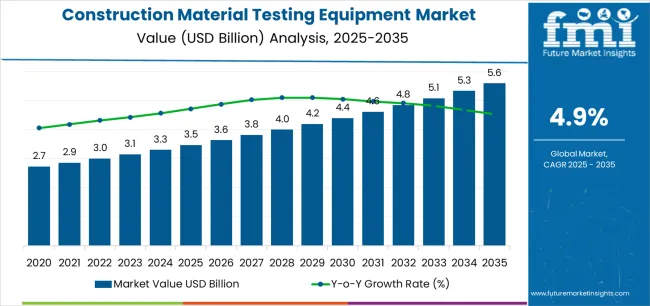
| Metric | Value |
|---|---|
| Construction Material Testing Equipment Market Estimated Value in (2025 E) | USD 3.5 billion |
| Construction Material Testing Equipment Market Forecast Value in (2035 F) | USD 5.6 billion |
| Forecast CAGR (2025 to 2035) | 4.9% |
Segmental Analysis
The market is segmented by Product Type, Application, and End Use and region. By Product Type, the market is divided into Concrete Testing Equipment, Soil Testing Equipment, Aggregate Testing Equipment, and Others. In terms of Application, the market is classified into Residential, Commercial, Transport, and Others. Based on End Use, the market is segmented into Research And Development Laboratories, On-site, and Educational Institutes. Regionally, the market is classified into North America, Latin America, Western Europe, Eastern Europe, Balkan & Baltic Countries, Russia & Belarus, Central Asia, East Asia, South Asia & Pacific, and the Middle East & Africa.
Insights into the Product Type Segment: Concrete Testing Equipment
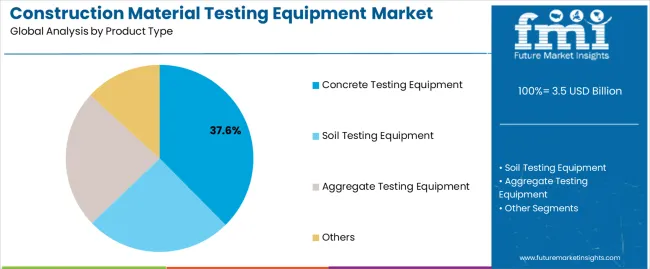
The Concrete Testing Equipment segment is projected to contribute 37.6% of the construction material testing equipment market revenue in 2025, leading the product landscape. This segment’s growth has been driven by the widespread use of concrete in both load-bearing and non-load-bearing structural applications, necessitating frequent quality checks for durability, compressive strength, and consistency.
Construction guidelines have increasingly mandated standardized concrete testing protocols to ensure structural safety and long-term performance. Equipment manufacturers have responded with innovations in non-destructive testing methods and portable devices that allow for on-site testing with minimal disruption.
Industry updates have highlighted growing adoption of automated concrete testing systems in quality control processes, especially in large-scale residential and infrastructure projects. Additionally, increasing global investments in bridge construction, high-rise buildings, and precast concrete segments have further boosted the segment’s relevance. With safety compliance and cost-effective construction remaining top priorities, the Concrete Testing Equipment segment is expected to retain its dominant position.
Insights into the Application Segment: Residential
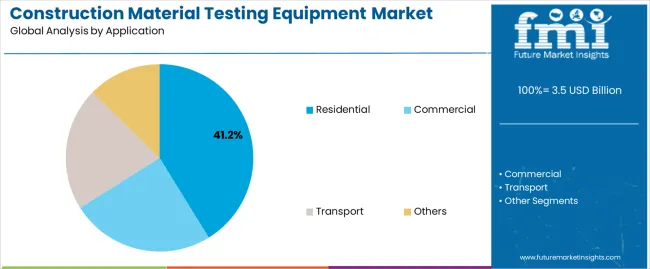
The Residential segment is projected to hold 41.2% of the construction material testing equipment market revenue in 2025, maintaining its position as the leading application segment. This segment’s expansion has been supported by rapid urbanization, growing housing demand, and the rise in government-backed affordable housing schemes.
Regulatory bodies have increasingly required rigorous material testing in residential construction to ensure adherence to seismic, wind, and thermal performance standards. Construction firms have integrated advanced testing technologies in residential projects to minimize defects, extend material lifespan, and optimize resource use.
Industry briefings have emphasized the rise in mid- and high-rise residential buildings, which necessitate precise testing of concrete, aggregates, steel reinforcements, and soil composition. Furthermore, the adoption of green building certifications has driven the demand for sustainable material validation, further contributing to segment growth. As global housing initiatives accelerate and smart home infrastructure becomes more prevalent, the Residential segment is expected to continue leading in application-based demand for material testing solutions.
Insights into the End Use Segment: Research and Development Laboratories
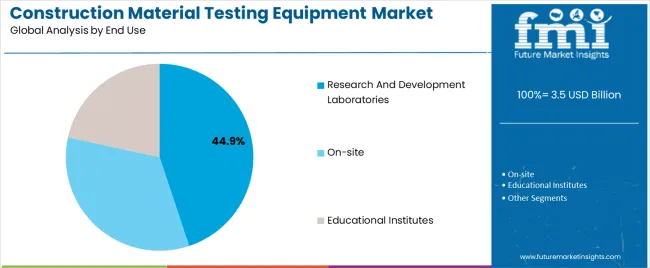
The Research and Development Laboratories segment is projected to account for 44.9% of the construction material testing equipment market revenue in 2025, emerging as the top end-use segment. Growth in this segment has been driven by the need for innovative materials that meet evolving performance, sustainability, and safety benchmarks.
R&D institutions, including public research bodies, university labs, and corporate innovation centers, have intensified efforts to develop eco-friendly concrete mixtures, high-performance asphalt, and corrosion-resistant reinforcements. These efforts rely heavily on precision testing equipment capable of evaluating new material formulations under diverse environmental and mechanical stress conditions.
Equipment manufacturers have introduced advanced systems with programmable test parameters and real-time analytics tailored to laboratory workflows. Additionally, increased collaboration between academia, government agencies, and construction companies has boosted research funding and laboratory testing volumes. As construction practices become more technology-driven and sustainability-focused, the role of Research and Development Laboratories in validating next-generation materials is expected to drive continued demand for high-end testing equipment.
Key Industry Highlights
Innovations in Construction Material Testing Tools to Surge Demand
Non-destructive testing equipment is gaining popularity in the construction sector for its ability to assess material properties without causing damage. Methods like ultrasonic testing, radiography, and electromagnetic testing are increasingly used. Portable and handheld testing devices are in high demand for on-site applications, allowing construction professionals to conduct tests quickly and efficiently, reducing downtime and costs.
Advances in Soil Testing Technology to Bolster Sales
Demand for CMTE that accurately assesses material properties and adheres to safety standards is on the rise due to the increasing emphasis on quality assurance and compliance with regulations. The CMTE market is experiencing consolidation due to mergers and strategic partnerships among leading companies.
Booming Construction Sector to Flourish Sales
Emerging economies are fueling demand for construction material testing equipment due to infrastructure development projects, transportation, energy, and urban development projects. This demand is driven by the need for CMTE to be capable of testing sustainable materials like recycled aggregates, fly ash, and eco-friendly additives.
Technological Advancements in Construction Testing Machinery to Push Demand
Automation and digitization have revolutionized construction material testing equipment, integrating IoT, AI, and ML for more accurate and efficient testing processes. Construction companies are prioritizing project quality and safety, investing in advanced testing equipment to ensure the durability and integrity of structures in various sectors.
High Initial Cost of Construction Material Testing Equipment to Hinder Growth
The high initial cost of purchasing construction material testing equipment, particularly advanced technologies, is set to deter small and medium-sized enterprises from entering the business. Construction material testing is often seen as an additional cost, particularly in small-scale projects or regions with weak regulatory enforcement, limiting demand and growth opportunities for manufacturers and suppliers.
2020 to 2024 Global Construction Material Testing Equipment Sales Analysis Compared to Demand Forecast for 2025 to 2035
The construction material testing equipment sector grew at a CAGR of 2% from 2020 and 2025.5. The industry reached USD 3.5 billion in 2025.5. The construction material testing (CMTE) market has seen a trend towards standardization, ensuring consistency, reliability, and comparability of test results across different projects and regions.
Technological advancements, such as automation, digitalization, sensor technology, and data analysis, have enhanced the capabilities of construction material testing equipment. Regulatory changes have also driven the adoption of advanced testing equipment to ensure compliance with quality assurance, safety, and environmental protection requirements.
Globalization has LED to increased competition, extended opportunities, and the exchange of technological know-how among companies worldwide. The focus on quality assurance and control has increased due to growing customer expectations, regulatory requirements, and project risk minimization.
Demand for sustainable solutions has driven the development of testing methods and equipment tailored to assess the properties of sustainable materials like recycled aggregates, fly ash, and environmentally friendly additives. Furthermore, non-destructive testing (NDT) methods, such as ultrasonic testing, radiography, and electromagnetic testing, have also gained traction in the construction sector.
Industry growth is fueled by consolidation, as leading companies merge, acquire, and partner to expand product offerings, global reach, and technological prowess. Over the forecast period, the sector is poised to exhibit healthy growth, reaching USD 5.6 billion by 203.54.
Market Concentration
Tier 1 companies are globally recognized for extensive product offerings, considerable manufacturing capabilities, and strict adherence to legal regulations. Tier 1 encompasses renowned firms like Controls Group and Humboldt Mfg. Co., ELE International, Matest S.p.A., and Aimil Ltd.
Tier 2 companies, renowned for foreign business expertise, significantly impact regional economies by ensuring regulatory compliance and integrating the latest technologies into manufacturing procedures. Prominent companies in the Tier 2 segment include Gilson Company, Inc., Cooper Research Technology, ZwickRoell, Lloyd Instruments (Ametek), and Humboldt Scientific.
Tier 3 comprises small-scale enterprises with a moderate share, operating locally and catering to specific industries. These brands need to be more structured and formalized than Tier 1 and Tier 2 organizations. Tier 3 companies include Tinius Olsen, Test Mark Industries, James Instruments Inc., Impact Test Equipment Ltd., and Kehui Group.
Country-wise Insights
The section provides the segmentation of leading countries. It examines the trends, opportunities, and restraints of the countries that are poised to have a significant sector. By examining the country-wide industry individually, businesses will gain valuable insights into the emerging regional trends, opportunities, and challenges.
India is projected to dominate the sector from 2025 to 2035 with a predicted CAGR of 7.3%. China, South Korea, and Germany are set to follow closely behind with CAGRs of 5.5%, 2.2%, and 2.3%, respectively. Understanding country-wise sector statistics enables companies to efficiently tailor strategies, product offerings, and marketing initiatives to meet local consumer preferences and requirements.
| Countries | CAGR 2025 to 2035 |
|---|---|
| United States | 2.7% |
| Germany | 2.3% |
| China | 5.5% |
| South Korea | 2.2% |
| India | 7.3% |
Rapid Modernization to Create Opportunities for Innovation in the United States
The United States government's focus on infrastructure development has LED to a surge in demand for construction material testing equipment (CMTE) to ensure the quality and safety of construction projects. Technological advancements, such as automation, digitalization, and advanced sensor technologies, have improved the accuracy and efficiency of testing equipment. Regulatory compliance is also a fueling factor, with companies developing testing solutions that meet the latest standards.
Rising Focus on Eco-friendly Solutions in Germany to Boost Growth
The construction sector is increasingly prioritizing sustainability, leading to a demand for CMTEs capable of assessing the environmental impact of construction materials. Adoption of digital platforms, cloud-based solutions, and mobile technologies for data management, analysis, and reporting, fuel demand. This digital transformation is streamlining testing processes, improving stakeholder collaboration, and enhancing decision-making capabilities.
Quality assurance and control are also vital in the industry, leading to increased demand for CMTE that accurately assesses construction material quality. Leading companies based in Germany are investing in advanced testing equipment to ensure compliance with quality standards. Consolidation in the industry through mergers, acquisitions, and partnerships among key players enhances product ranges, global reach, and technological strength, fostering competitiveness.
Surging Urbanization and Infrastructure Development Propelling Sales in China
China's rapid urbanization and infrastructure development are fueling demand for construction material testing equipment. The country's massive construction projects, including roads, bridges, railways, and high-rise buildings, require rigorous testing to ensure quality, safety, and compliance with regulations.
Quality assurance and safety have become top priorities in the construction sector, leading to a growing demand for CMTE that accurately assesses construction material quality and integrity. Leading companies are investing in research and development to address business challenges, improve testing capabilities, and enhance competitiveness in the global landscape. CMTE manufacturers are seeking opportunities for international collaboration and growth, forming partnerships, establishing joint ventures, and growing presence in overseas markets.
Category-wise Insights
The section below offers investors essential data and analysis of two leading categories of the target industry, thereby helping to strengthen position in the sector. This segmentation of different categories would enable businesses to obtain a strong analysis of the trends, drivers, and constraints in the industry.
Concrete testing equipment is currently dominating the category based on product type, with a value share of 45.3% in 2025. Based on end-use, on-site is leading the industry with a value share of 66.6% in 2025.
Concrete Testing Equipment to Gain Momentum Worldwide
| Segment | Concrete Testing Equipment (Product Type) |
|---|---|
| Value Share (2025) | 45.3% |
Concrete testing equipment is vital for infrastructure development projects, ensuring the quality and durability of concrete structures. This equipment plays a key role in ensuring regulatory compliance by accurately assessing key properties like compressive strength, slump, air content, and density.
Quality assurance is essential in the construction industry to minimize structural failures and safety hazards. Technological advancements in concrete testing equipment have LED to more accurate, efficient, and user-friendly solutions, including automation, digitalization, and IoT capabilities.
Non-destructive testing (NDT) methods are increasingly used to assess concrete structures without causing damage, spurring demand for cost-effective and non-invasive testing solutions. Concrete testing equipment is essential for evaluating the performance and environmental impact of sustainable concrete materials, supporting the adoption of green building practices.
On-site End-use to Exhibit Significant Demand in the Industry
| Segment | On-site (End-use) |
|---|---|
| Value Share (2025) | 66.6% |
On-site location capabilities in construction material testing (CMTE) enable real-time assessment of material properties and quality, reducing costs and time delays. The need for immediate feedback on material suitability, compliance with specifications, and quality standards is set to drive demand.
Growth in construction activity, particularly in remote or inaccessible locations, fuels demand for on-site testing solutions. Regulatory compliance requirements also require on-site testing to demonstrate compliance.
Emerging technologies, such as portable devices and cloud-based data management systems, facilitate on-site location capabilities. These capabilities support quality assurance initiatives, enabling timely corrective actions in remote or challenging environments. Convenience and customer demand for reliable testing solutions further differentiate construction companies in the sector.
Competition Outlook
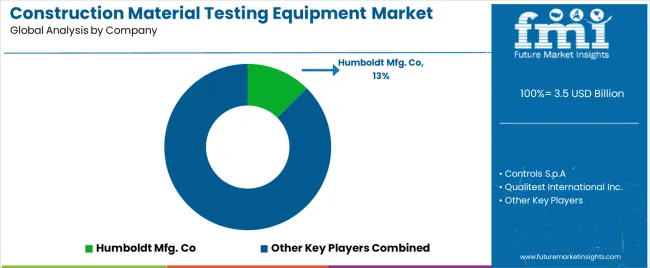
Humboldt Mfg. Co, Controls S.p.A, Qualitest International Inc., Cooper Research Technology Ltd, and EIE Instruments are the leading companies in the material testing equipment market. Construction material testing equipment manufacturers are focusing on developing advanced technology products and software through partnerships or acquisitions.
Leading companies are investing in research and development to broaden and develop product lines and to gain a competitive edge. Key manufacturers are also increasing global presence through new products, contracts, merger and acquisition transactions, increased investment, and cooperation with other enterprises. To survive in a competitive landscape, manufacturers and leading companies provide reasonably priced goods in the market.
Local manufacturing is a key business strategy for manufacturers to reduce operating expenses and help customers develop the segment. The industry has provided significant benefits to medicine in recent years, and key companies are actively engaging in research and development to boost demand.
Industry Updates
- In 2025, NVIDIA, headquartered in the United States, introduced a cloud service that enables researchers and developers to discover quantum computing in key scientific fields like chemistry, biology, and materials science.
- In 2025, EY, a United Kingdom-based company, partnered with IBM to introduce an artificial intelligence (AI) solution aimed at enhancing productivity and enhancing HR efficiency.
- In 2025, Vertiv, a United States-based manufacturer of digital infrastructure solutions, introduced a modular wooden data center concept to assist organizations in reducing carbon footprint.
Leading Construction Material Testing Equipment Brands
- Humboldt Mfg. Co
- Controls S.p.A
- Qualitest International Inc.
- Cooper Research Technology Ltd
- EIE Instruments
- Latest
- Aimil Ltd
- NL SCIENTIFIC INSTRUMENTS SDN BHD
- Matest
Key Segments of Market Report
By End-use:
As per end-use, the industry has been categorized into on-site, research and development laboratories, and educational institutes.
By Application:
Based on application, the sector is segmented into residential, commercial, transport, and other applications.
By Product Type:
By product type, the sector is split into soil testing equipment, aggregate testing equipment, concrete testing equipment, and others.
By Region:
Industry analysis has been carried out in key countries of North America, Latin America, Western Europe, Eastern Europe, South Asia, East Asia, and the Middle East and Africa.
Frequently Asked Questions
How big is the construction material testing equipment market in 2025?
The global construction material testing equipment market is estimated to be valued at USD 3.5 billion in 2025.
What will be the size of construction material testing equipment market in 2035?
The market size for the construction material testing equipment market is projected to reach USD 5.6 billion by 2035.
How much will be the construction material testing equipment market growth between 2025 and 2035?
The construction material testing equipment market is expected to grow at a 4.9% CAGR between 2025 and 2035.
What are the key product types in the construction material testing equipment market?
The key product types in construction material testing equipment market are concrete testing equipment, soil testing equipment, aggregate testing equipment and others.
Which application segment to contribute significant share in the construction material testing equipment market in 2025?
In terms of application, residential segment to command 41.2% share in the construction material testing equipment market in 2025.
Preview the report firsthand - request a free sample
Get SampleGet the brochure for pricing and purchase details.
Get PDFTable of Content
- Executive Summary
- Global Market Outlook
- Demand-side Trends
- Supply-side Trends
- Technology Roadmap Analysis
- Analysis and Recommendations
- Market Overview
- Market Coverage / Taxonomy
- Market Definition / Scope / Limitations
- Market Background
- Market Dynamics
- Drivers
- Restraints
- Opportunity
- Trends
- Scenario Forecast
- Demand in Optimistic Scenario
- Demand in Likely Scenario
- Demand in Conservative Scenario
- Opportunity Map Analysis
- Product Life Cycle Analysis
- Supply Chain Analysis
- Investment Feasibility Matrix
- Value Chain Analysis
- PESTLE and Porter’s Analysis
- Regulatory Landscape
- Regional Parent Market Outlook
- Production and Consumption Statistics
- Import and Export Statistics
- Market Dynamics
- Global Market Analysis 2020 to 2025 and Forecast, 2025 to 2035
- Historical Market Size Value (USD Million) Analysis, 2020 to 2025
- Current and Future Market Size Value (USD Million) Projections, 2025 to 2035
- Y-o-Y Growth Trend Analysis
- Absolute $ Opportunity Analysis
- Global Market Pricing Analysis 2020 to 2025 and Forecast 2025 to 2035
- Global Market Analysis 2020 to 2025 and Forecast 2025 to 2035, By Product Type
- Introduction / Key Findings
- Historical Market Size Value (USD Million) Analysis By Product Type , 2020 to 2025
- Current and Future Market Size Value (USD Million) Analysis and Forecast By Product Type , 2025 to 2035
- Concrete Testing Equipment
- Soil Testing Equipment
- Aggregate Testing Equipment
- Others
- Y-o-Y Growth Trend Analysis By Product Type , 2020 to 2025
- Absolute $ Opportunity Analysis By Product Type , 2025 to 2035
- Global Market Analysis 2020 to 2025 and Forecast 2025 to 2035, By Application
- Introduction / Key Findings
- Historical Market Size Value (USD Million) Analysis By Application, 2020 to 2025
- Current and Future Market Size Value (USD Million) Analysis and Forecast By Application, 2025 to 2035
- Residential
- Commercial
- Transport
- Others
- Y-o-Y Growth Trend Analysis By Application, 2020 to 2025
- Absolute $ Opportunity Analysis By Application, 2025 to 2035
- Global Market Analysis 2020 to 2025 and Forecast 2025 to 2035, By End Use
- Introduction / Key Findings
- Historical Market Size Value (USD Million) Analysis By End Use, 2020 to 2025
- Current and Future Market Size Value (USD Million) Analysis and Forecast By End Use, 2025 to 2035
- Research And Development Laboratories
- On-site
- Educational Institutes
- Y-o-Y Growth Trend Analysis By End Use, 2020 to 2025
- Absolute $ Opportunity Analysis By End Use, 2025 to 2035
- Global Market Analysis 2020 to 2025 and Forecast 2025 to 2035, By Region
- Introduction
- Historical Market Size Value (USD Million) Analysis By Region, 2020 to 2025
- Current Market Size Value (USD Million) Analysis and Forecast By Region, 2025 to 2035
- North America
- Latin America
- Western Europe
- Eastern Europe
- East Asia
- South Asia and Pacific
- Middle East & Africa
- Market Attractiveness Analysis By Region
- North America Market Analysis 2020 to 2025 and Forecast 2025 to 2035, By Country
- Historical Market Size Value (USD Million) Trend Analysis By Market Taxonomy, 2020 to 2025
- Market Size Value (USD Million) Forecast By Market Taxonomy, 2025 to 2035
- By Country
- USA
- Canada
- Mexico
- By Product Type
- By Application
- By End Use
- By Country
- Market Attractiveness Analysis
- By Country
- By Product Type
- By Application
- By End Use
- Key Takeaways
- Latin America Market Analysis 2020 to 2025 and Forecast 2025 to 2035, By Country
- Historical Market Size Value (USD Million) Trend Analysis By Market Taxonomy, 2020 to 2025
- Market Size Value (USD Million) Forecast By Market Taxonomy, 2025 to 2035
- By Country
- Brazil
- Chile
- Rest of Latin America
- By Product Type
- By Application
- By End Use
- By Country
- Market Attractiveness Analysis
- By Country
- By Product Type
- By Application
- By End Use
- Key Takeaways
- Western Europe Market Analysis 2020 to 2025 and Forecast 2025 to 2035, By Country
- Historical Market Size Value (USD Million) Trend Analysis By Market Taxonomy, 2020 to 2025
- Market Size Value (USD Million) Forecast By Market Taxonomy, 2025 to 2035
- By Country
- Germany
- UK
- Italy
- Spain
- France
- Nordic
- BENELUX
- Rest of Western Europe
- By Product Type
- By Application
- By End Use
- By Country
- Market Attractiveness Analysis
- By Country
- By Product Type
- By Application
- By End Use
- Key Takeaways
- Eastern Europe Market Analysis 2020 to 2025 and Forecast 2025 to 2035, By Country
- Historical Market Size Value (USD Million) Trend Analysis By Market Taxonomy, 2020 to 2025
- Market Size Value (USD Million) Forecast By Market Taxonomy, 2025 to 2035
- By Country
- Russia
- Poland
- Hungary
- Balkan & Baltic
- Rest of Eastern Europe
- By Product Type
- By Application
- By End Use
- By Country
- Market Attractiveness Analysis
- By Country
- By Product Type
- By Application
- By End Use
- Key Takeaways
- East Asia Market Analysis 2020 to 2025 and Forecast 2025 to 2035, By Country
- Historical Market Size Value (USD Million) Trend Analysis By Market Taxonomy, 2020 to 2025
- Market Size Value (USD Million) Forecast By Market Taxonomy, 2025 to 2035
- By Country
- China
- Japan
- South Korea
- By Product Type
- By Application
- By End Use
- By Country
- Market Attractiveness Analysis
- By Country
- By Product Type
- By Application
- By End Use
- Key Takeaways
- South Asia and Pacific Market Analysis 2020 to 2025 and Forecast 2025 to 2035, By Country
- Historical Market Size Value (USD Million) Trend Analysis By Market Taxonomy, 2020 to 2025
- Market Size Value (USD Million) Forecast By Market Taxonomy, 2025 to 2035
- By Country
- India
- ASEAN
- Australia & New Zealand
- Rest of South Asia and Pacific
- By Product Type
- By Application
- By End Use
- By Country
- Market Attractiveness Analysis
- By Country
- By Product Type
- By Application
- By End Use
- Key Takeaways
- Middle East & Africa Market Analysis 2020 to 2025 and Forecast 2025 to 2035, By Country
- Historical Market Size Value (USD Million) Trend Analysis By Market Taxonomy, 2020 to 2025
- Market Size Value (USD Million) Forecast By Market Taxonomy, 2025 to 2035
- By Country
- Kingdom of Saudi Arabia
- Other GCC Countries
- Turkiye
- South Africa
- Other African Union
- Rest of Middle East & Africa
- By Product Type
- By Application
- By End Use
- By Country
- Market Attractiveness Analysis
- By Country
- By Product Type
- By Application
- By End Use
- Key Takeaways
- Key Countries Market Analysis
- USA
- Pricing Analysis
- Market Share Analysis, 2025
- By Product Type
- By Application
- By End Use
- Canada
- Pricing Analysis
- Market Share Analysis, 2025
- By Product Type
- By Application
- By End Use
- Mexico
- Pricing Analysis
- Market Share Analysis, 2025
- By Product Type
- By Application
- By End Use
- Brazil
- Pricing Analysis
- Market Share Analysis, 2025
- By Product Type
- By Application
- By End Use
- Chile
- Pricing Analysis
- Market Share Analysis, 2025
- By Product Type
- By Application
- By End Use
- Germany
- Pricing Analysis
- Market Share Analysis, 2025
- By Product Type
- By Application
- By End Use
- UK
- Pricing Analysis
- Market Share Analysis, 2025
- By Product Type
- By Application
- By End Use
- Italy
- Pricing Analysis
- Market Share Analysis, 2025
- By Product Type
- By Application
- By End Use
- Spain
- Pricing Analysis
- Market Share Analysis, 2025
- By Product Type
- By Application
- By End Use
- France
- Pricing Analysis
- Market Share Analysis, 2025
- By Product Type
- By Application
- By End Use
- India
- Pricing Analysis
- Market Share Analysis, 2025
- By Product Type
- By Application
- By End Use
- ASEAN
- Pricing Analysis
- Market Share Analysis, 2025
- By Product Type
- By Application
- By End Use
- Australia & New Zealand
- Pricing Analysis
- Market Share Analysis, 2025
- By Product Type
- By Application
- By End Use
- China
- Pricing Analysis
- Market Share Analysis, 2025
- By Product Type
- By Application
- By End Use
- Japan
- Pricing Analysis
- Market Share Analysis, 2025
- By Product Type
- By Application
- By End Use
- South Korea
- Pricing Analysis
- Market Share Analysis, 2025
- By Product Type
- By Application
- By End Use
- Russia
- Pricing Analysis
- Market Share Analysis, 2025
- By Product Type
- By Application
- By End Use
- Poland
- Pricing Analysis
- Market Share Analysis, 2025
- By Product Type
- By Application
- By End Use
- Hungary
- Pricing Analysis
- Market Share Analysis, 2025
- By Product Type
- By Application
- By End Use
- Kingdom of Saudi Arabia
- Pricing Analysis
- Market Share Analysis, 2025
- By Product Type
- By Application
- By End Use
- Turkiye
- Pricing Analysis
- Market Share Analysis, 2025
- By Product Type
- By Application
- By End Use
- South Africa
- Pricing Analysis
- Market Share Analysis, 2025
- By Product Type
- By Application
- By End Use
- USA
- Market Structure Analysis
- Competition Dashboard
- Competition Benchmarking
- Market Share Analysis of Top Players
- By Regional
- By Product Type
- By Application
- By End Use
- Competition Analysis
- Competition Deep Dive
- Humboldt Mfg. Co
- Overview
- Product Portfolio
- Profitability by Market Segments (Product/Age /Sales Channel/Region)
- Sales Footprint
- Strategy Overview
- Marketing Strategy
- Product Strategy
- Channel Strategy
- Controls S.p.A
- Qualitest International Inc.
- Cooper Research Technology Ltd
- EIE Instruments
- Utest
- Aimil Ltd
- NL Scientific Instruments SDN BHD
- Matest
- Humboldt Mfg. Co
- Competition Deep Dive
- Assumptions & Acronyms Used
- Research Methodology


