

- Industry Size (2026)
- USD 1.42 Bn
- Forecast (2036)
- USD 3.61 Bn
- CAGR (2026 to 2036)
- 9.5%
Epoxy Putty and Construction Chemicals Market Size, Market Forecast and Outlook By FMI
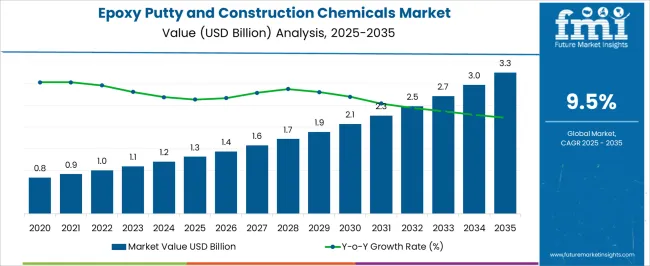
In 2025, the global epoxy putty and construction chemicals market was valued at USD 1.3 billion. Based on Future Market Insights' analysis, demand for epoxy putty and construction chemicals is estimated to grow to USD 1.42 billion in 2026 and USD 3.61 billion by 2036. FMI projects a CAGR of 9.5% during the forecast period.
Absolute dollar growth of USD 2.19 billion over the decade signals robust expansion tied to global infrastructure renewal programs, industrial maintenance spending, and the proliferation of DIY repair culture in mature economies. Despite the fragmented nature of the market and competition from mechanical fasteners and alternative adhesive technologies, leading epoxy putty manufacturers maintain margins through proprietary formulations targeting specific substrate and curing condition requirements.
Summary of Epoxy Putty and Construction Chemicals Market
- Market Definition
- The industry covers two-part epoxy putty formulations and complementary construction chemicals designed for bonding, filling, sealing, and surface repair in building, industrial, and infrastructure applications.
- Demand Drivers in the Market
- Aging infrastructure in North America and Europe requiring continuous maintenance and repair investment.
- Rapid urbanization and construction activity in Asia-Pacific creating demand for on-site repair and finishing materials.
- Expansion of DIY retail channels and consumer familiarity with epoxy-based repair products.
- Key Segments Analyzed in the FMI Report
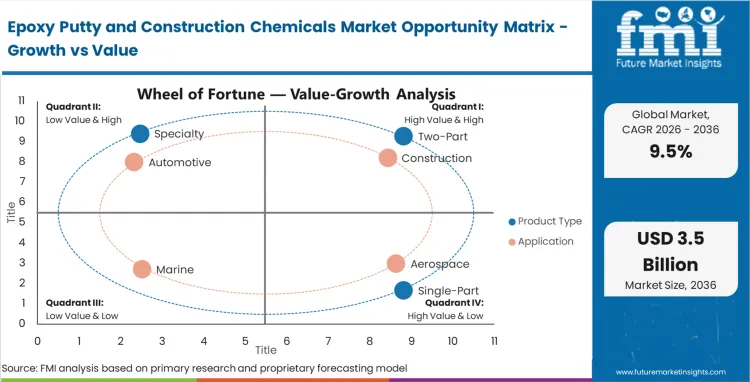
- Product Type: Two-Part Epoxy Putty accounts for 43.6% of market value in 2026 due to its superior adhesion, strength, and chemical resistance for demanding applications.
- Application: Construction represents the dominant application at 32.6% share in 2026, reflecting the material's essential role in concrete repair, anchoring, and surface preparation.
- Curing Type: Room Temperature Curing holds 57.9% of market value in 2026, driven by convenience and energy savings versus heat-cured alternatives.
- Analyst Opinion at FMI
- Nikhil Kaitwade, principal consultant for Chemicals and Materials at Future Market Insights, states, "In the updated Epoxy Putty and Construction Chemicals Market Report, CXOs will see that formulation specificity now dictates pricing power more than brand recognition, with products engineered for underwater cure or high-temperature service commanding 300% premiums over general-purpose equivalents. My assessment points to the industrial maintenance segment as the most resilient growth channel, where unplanned equipment downtime costs justify premium material selection regardless of broader construction cycles."
- Strategic Implications/Executive Takeaways
- Portfolio strategies must balance high-volume general-purpose putties with specialty formulations targeting marine, aerospace, and high-temperature industrial applications where pricing is inelastic.
- Distribution channel partnerships with industrial supply houses and hardware retail chains are essential for capturing both professional contractor and DIY consumer segments.
- Registration and compliance capabilities for low-VOC formulations now constitute a competitive advantage in regulated markets such as California and Western Europe.
- Methodology
- The market view is grounded in primary input from contractors, facility managers, and formulators, and in trade and regulatory data sources, avoiding reliance on secondary market research reports from competing providers.
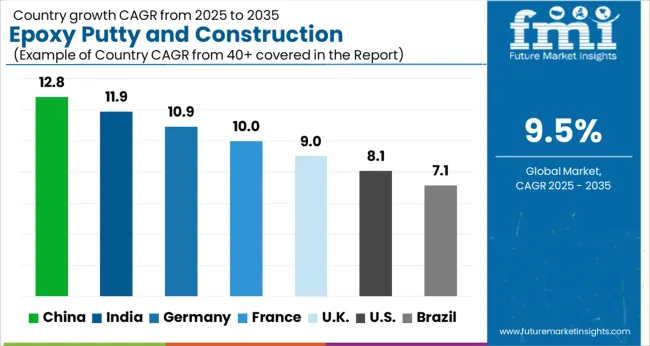
China (12.8% CAGR) and India (11.9% CAGR) anchor growth through massive urban infrastructure pipelines and expanding industrial bases requiring on-site repair solutions . Germany (10.9% CAGR) and France (10.0% CAGR) contribute via precision manufacturing and automotive repair sectors that demand high-strength, temperature-resistant formulations. The United States (8.1% CAGR) generates steady replacement demand through aging infrastructure maintenance and the strong DIY consumer segment, while Brazil (7.1% CAGR) benefits from offshore oil and gas maintenance activity.
Epoxy Putty and Construction Chemicals Market Definition
Epoxy putty is a two-part adhesive system consisting of epoxy resin and hardener that, when mixed, cures to form a rigid, high-strength material for bonding, filling, and repair applications. Construction chemicals encompass a broader category of specialty chemical formulations including bonding agents, crack fillers, grouts, and protective coatings used in concrete repair, waterproofing, and surface preparation. The epoxy putty and construction chemicals market comprises the global production, formulation, and distribution of these materials for use in residential, commercial, and infrastructure construction, as well as industrial maintenance and DIY applications.
Epoxy Putty and Construction Chemicals Market Inclusions
The report provides a comprehensive analysis of the epoxy putty and construction chemicals market, covering global and regional market sizes in value terms and a 10-year forecast from 2026 to 2036. It includes segmental breakdowns by product type, application, curing type, end-user industry, and features across core regions including North America, Latin America, Europe, East Asia, South Asia, Oceania, and the Middle East & Africa.
Epoxy Putty and Construction Chemicals Market Exclusions
The scope excludes commodity construction materials such as cement, aggregates, and untreated lumber. It also omits mechanical fasteners, non-epoxy adhesive technologies, and application equipment. Very low-volume specialty formulations for laboratory or artisanal uses are likewise outside the quantified scope unless they represent a distinct technology pathway with broader market implications.
Epoxy Putty and Construction Chemicals Market Research Methodology
- Primary research: Structured interviews were conducted with formulators, distributors, and contractors across key construction and industrial maintenance markets. Facility maintenance managers provided context on repair material selection criteria and switching costs between epoxy putty and alternative repair methods.
- Desk research: Material safety data sheets, technical data sheets, and product registration documents were assessed alongside trade data from UN Comtrade to benchmark formulation trends and price realizations by product type and feature set.
- Market-sizing and forecasting: A hybrid top-down and bottom-up modeling framework was applied, reconstructing epoxy putty demand from construction spending by sector, industrial maintenance expenditure, and DIY retail sales data, then validating outputs against production statistics from industry associations and company-reported volume data.
- Data validation and update cycle: Model outputs undergo consistency checks across regions, application sectors, and formulation types, with iterative calibration using new product introductions, raw material price trends, and emerging building code requirements.
Segmental Analysis
Epoxy Putty and Construction Chemicals Market Analysis by Product Type
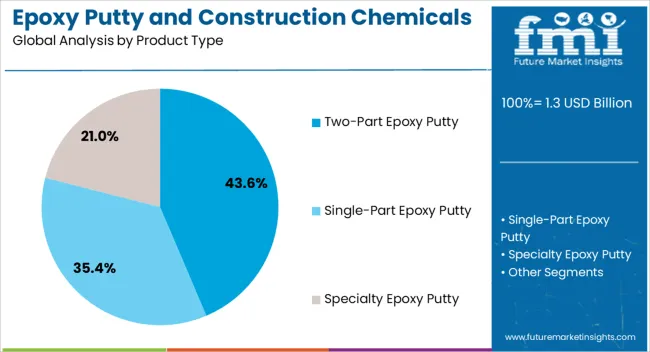
Based on FMI's epoxy putty market assessment, Two-Part Epoxy Putty constitutes approximately 43.6% of global market value in 2026, underscoring its position as the preferred formulation for demanding repair and assembly applications .
This persistent market share reflects the fundamental chemistry of two-part systems, which separate reactive components until the moment of application, enabling precise control over working time, curing rate, and final mechanical properties. The mix-and-apply feature allows contractors to tailor consistency for vertical surface applications versus gap-filling requirements, while the cured material delivers compressive strength exceeding 10,000 psi in premium formulations . Two-part systems dominate industrial and marine applications where bond integrity directly impacts safety and equipment life.
Single-part epoxy putties capture a smaller but growing share of the market, particularly in DIY consumer applications where convenience outweighs the performance ceiling of one-part formulations. These products trade some mechanical strength for ease of use, requiring no measuring or mixing, which appeals to homeowners and light-duty repair contexts.
Specialty epoxy putties, including underwater-curing formulations and electrically conductive grades, serve niche applications where standard products cannot perform. Underwater-curing putties have seen 18% annual growth in marine construction and bridge repair applications, as these formulations enable in-situ repairs without dewatering or cofferdams .
Epoxy Putty and Construction Chemicals Market Analysis by Application
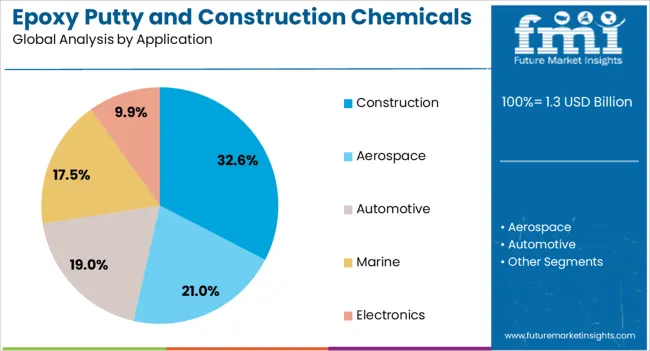
Construction applications account for 32.6% of epoxy putty market value in 2026, reflecting the material's essential role in concrete repair, crack injection, anchoring systems, and surface leveling . The US construction industry's projected value exceeding USD 1.8 trillion in 2025 generates sustained demand for repair and finishing materials across residential, commercial, and infrastructure segments .
Industrial maintenance represents the highest-value application segment, with specialized formulations commanding premium pricing based on performance requirements. Industrial-grade epoxy putty usage is growing at 18% annually in facility maintenance applications, driven by the cost equation where unplanned downtime can cost facilities thousands of dollars per hour, making premium repair materials economically justified .
Automotive and marine applications together account for significant volume, with the average age of vehicles in the US exceeding 12 years creating sustained demand for body repair products . Marine formulations must withstand constant water immersion and thermal cycling, driving adoption of specialized products with enhanced corrosion resistance.
Epoxy Putty and Construction Chemicals Market Analysis by Curing Type
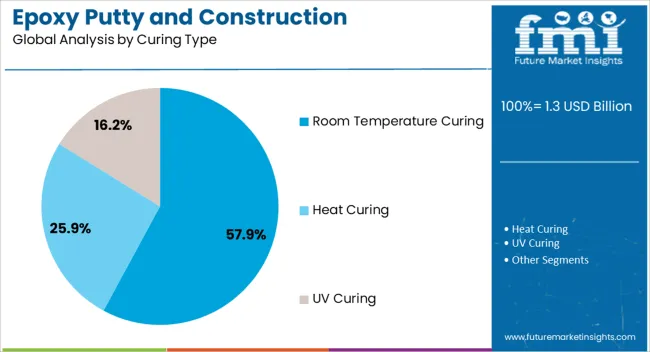
Room temperature curing epoxy putties hold 57.9% of global market value in 2026, reflecting the practical realities of on-site construction and repair where access to ovens or heat lamps is impractical . These formulations cure through exothermic chemical reaction at ambient temperatures, typically achieving handling strength within one to 24 hours depending on formulation and ambient conditions.
Heat curing systems capture industrial applications where controlled ovens enable faster production cycles and optimized mechanical properties. Aerospace and high-performance automotive applications often specify heat-cured formulations to achieve maximum glass transition temperatures and structural performance.
UV curing epoxy putties represent an emerging segment with rapid cure times measured in seconds rather than hours, though current formulations are limited to transparent substrates and thin sections. Adoption is growing in electronics assembly and optical bonding applications where speed and precision justify higher material costs.
Epoxy Putty and Construction Chemicals Market Drivers, Restraints, Opportunities and Trends
Drivers
Aging infrastructure driving maintenance and repair expenditure
The American Society of Civil Engineers estimates that over 45% of US roads are in poor or mediocre condition, requiring extensive repair solutions where epoxy putties play a critical role. Bridge decks, parking structures, and concrete pavements develop cracks and spalls that require immediate repair to prevent progressive deterioration and safety hazards.
Epoxy injection systems restore structural integrity to cracked concrete, while epoxy mortars rebuild spalled edges and corners. This maintenance backlog, combined with similar infrastructure age profiles across Western Europe and Japan, creates sustained demand regardless of new construction cycles.
Industrial facility maintenance as a non-discretionary spending category
Manufacturing facilities, power plants, and processing operations cannot suspend production for extended repair windows, making rapid-cure epoxy putties essential maintenance tools. A single hour of unplanned downtime in automotive assembly can cost USD 1 million or more, while petrochemical facility outages can exceed USD 100,000 per hour.
Epoxy putties that cure in under 30 minutes and achieve service strength within hours enable repairs during scheduled maintenance windows or brief production pauses, preventing catastrophic failures and extended shutdowns. This economic equation makes industrial-grade epoxy putties relatively price-insensitive, supporting premium pricing and consistent margins.
Restraints
Raw material price volatility impacting profitability
Epoxy resins and hardeners derive from petroleum feedstocks and bisphenol A, both subject to significant price fluctuations based on crude oil markets and supply-demand balances. Since 2023, key raw material prices have shown 25-40% volatility, forcing manufacturers to either absorb margin erosion or implement price increases that risk customer defection to alternative repair methods . Smaller manufacturers without long-term supplier contracts or hedging capabilities are particularly vulnerable to these fluctuations, potentially leading to market consolidation.
Competition from alternative repair technologies
UV-cure adhesives, structural foams, and mechanical repair systems compete with epoxy putty in specific applications, each offering advantages in cure speed, weight, or ease of application. UV-cure products achieved 17% year-over-year growth in the consumer segment, compared to 7% growth for traditional epoxy putties, as DIY users prioritize speed over ultimate bond strength. In automotive body repair, polyester fillers remain competitive on cost and sandability despite lower ultimate strength compared to epoxies.
Opportunities
Eco-friendly formulations opening new market segments
Sales of eco-friendly epoxy putties increased by 28% in 2024, far outpacing traditional product growth, as green building certification programs and consumer preferences shift toward low-emission materials .
Manufacturers investing in USDA BioPreferred certification and LEED-compliant formulations are well-positioned to capture specification-driven demand in institutional and commercial construction. Products using plant-derived resins and recycled fillers are gaining traction in Europe and California, where VOC regulations increasingly constrain traditional solvent-based formulations.
Advanced dispensing systems improving application consistency
Dual-cartridge applicators that automatically mix components saw 40% adoption growth in professional channels during 2024, reducing waste and improving application consistency compared to hand-mixed putties .
These systems ensure proper mix ratios, eliminate measuring errors, and enable precise application in tight spaces. Manufacturers investing in user-friendly packaging with extended shelf life and integrated dispensing nozzles can differentiate products in crowded distribution channels while commanding premium pricing based on convenience and reliability.
Regional Analysis
.webp "Top Country Growth Comparison Epoxy Putty And Construction Chemicals Market Cagr (2026 2036)")
| Countries | Value CAGR (2026 to 2036) |
|---|---|
| China | 12.8% |
| India | 11.9% |
| Germany | 10.9% |
| France | 10.0% |
| UK | 9.0% |
| USA | 8.1% |
| Brazil | 7.1% |
Source: Future Market Insights analysis, supported by a proprietary forecasting model and primary research
China
China's epoxy putty and construction chemicals market is projected to grow at a 12.8% CAGR between 2026 and 2036, underpinned by continued urbanization and massive infrastructure investment programs. The country's construction sector remains the world's largest by volume, with ongoing investment in high-speed rail, urban transit, and residential development creating sustained demand for construction chemicals and repair materials. Chinese manufacturers simultaneously serve domestic demand and export cost-competitive products to global markets, leveraging scale economies in raw material procurement.
India
India's market is expected to grow at an 11.9% CAGR from 2026 to 2036, reflecting the government's focus on infrastructure development through programs such as the National Infrastructure Pipeline. Rapid urbanization and the expansion of the formal retail sector are increasing availability of branded epoxy putty products to both professional contractors and DIY consumers. The marine and automotive repair sectors are also expanding with economic growth, creating additional demand channels.
Germany
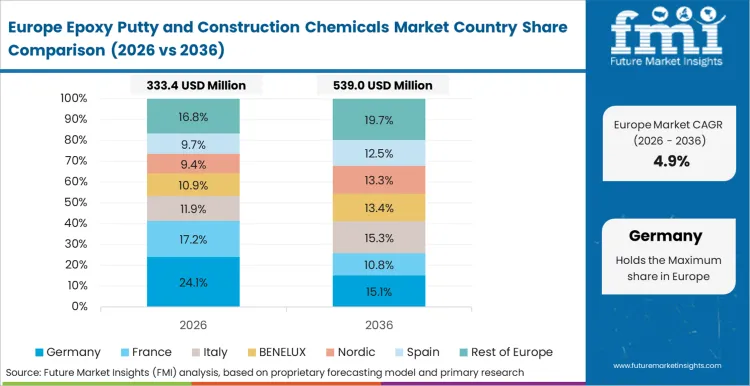
Germany's epoxy putty market is forecast to expand at a 10.9% CAGR from 2026 to 2036, supported by the country's precision manufacturing base and rigorous building standards. German industry places premium value on documented performance specifications and material certifications, favoring established brands with comprehensive technical documentation. The automotive repair sector, serving both domestic production and the extensive vehicle parc, generates consistent demand for high-temperature and crash-durable formulations.
France
France's market growth of 10.0% CAGR reflects the country's mature construction sector and strong DIY retail channels. French consumers demonstrate high engagement with home improvement projects, supported by the extensive network of hardware retailers and specialty construction supply houses. The marine sector along the Atlantic and Mediterranean coasts generates specialized demand for underwater-curing and saltwater-resistant formulations.
United Kingdom
The UK market projects 9.0% CAGR through 2036, driven by building stock age and the concentration of industrial activity. Much of the UK's housing stock predates modern construction standards, creating ongoing demand for repair and retrofit materials. Industrial maintenance in manufacturing and energy sectors provides consistent demand for high-performance formulations.
United States
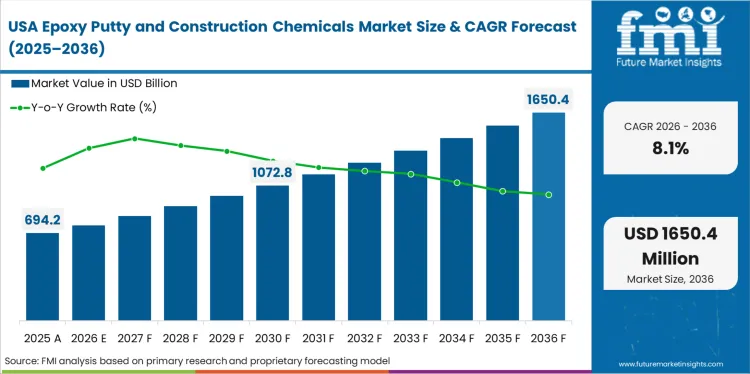
The United States market is projected to grow at an 8.1% CAGR between 2026 and 2036, supported by infrastructure reinvestment, an aging building stock, and the world's largest DIY consumer market. J-B Weld maintains its leadership position with 22% of the domestic market share through comprehensive product lines spanning industrial-grade formulations to consumer-friendly DIY solutions . The US EPA's Chemical Data Reporting requirements for bisphenol A and other epoxy components have prompted formulation changes that affect product performance characteristics, favoring manufacturers with strong R&D capabilities.
Brazil
Brazil's market growth of 7.1% CAGR reflects the country's offshore oil and gas industry, which requires specialized maintenance materials for marine and subsea applications. The Brazilian construction sector, while cyclical, generates sustained demand for repair materials in the country's extensive urban infrastructure. Local formulation and packaging capabilities enable competitive pricing for standard products while imported specialty formulations serve demanding applications.
Competitive Landscape
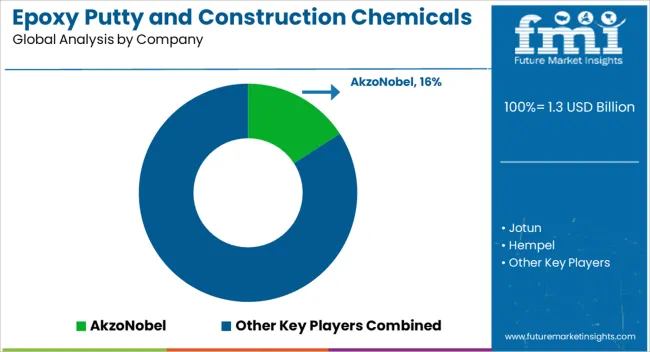
The epoxy putty and construction chemicals market exhibits a bifurcated structure, with global specialty chemical companies competing alongside regional formulators and niche product specialists. In the US market, J-B Weld maintains leadership, followed by Loctite (Henkel Corporation) and Gorilla Glue. These companies leverage brand equity established in adjacent adhesive categories to drive epoxy putty adoption through retail distribution.
From a strategic perspective, differentiation is moving beyond basic performance specifications toward application-specific formulations and dispensing system innovation. Recent product launches emphasize faster cure times, with some formulations achieving handling strength in under five minutes, and improved temperature resistance up to 400°F for engine compartment repairs. Manufacturers are also developing color-changing indicators that show complete curing, now featured in 30% of premium products.
The competitive intensity is increasing as players diversify product offerings in response to tightening environmental regulations. In 2024, DAP Products introduced a line of bio-based epoxy putties with 30% lower VOC content, responding to regulatory pressure and consumer preference for sustainable products . Private label products from major home improvement retailers now account for 12% of total epoxy putty sales, applying downward price pressure on branded products.
Recent Developments
- In March 2024, Devcon launched three new fast-curing epoxy putty variants designed specifically for automotive repair applications, with cure times under 20 minutes and temperature resistance to 300°F .
Key Players Profiled
- AkzoNobel N.V.
- Jotun A/S
- Hempel A/S
- PPG Industries, Inc.
- Kansai Paint Co., Ltd.
- Chugoku Marine Paints, Ltd.
- Sherwin-Williams Company
- BASF SE
- Nippon Paint Holdings Co., Ltd.
- DuPont de Nemours, Inc.
- 3M Company
- Henkel AG & Co. KGaA
- Sika AG
- RPM International Inc.
- Fosroc International Ltd.
Scope of the Report
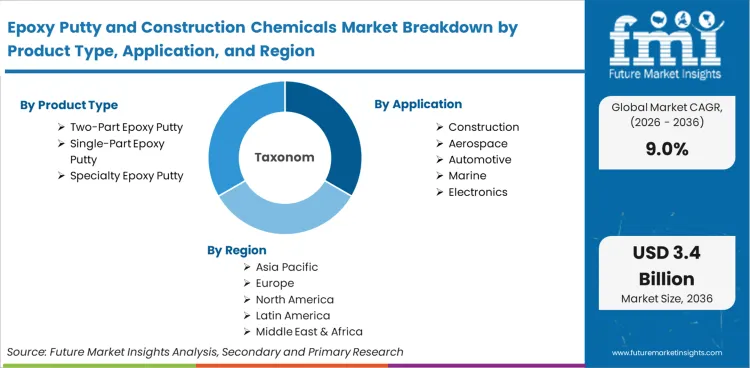
| Metric | Value |
|---|---|
| Quantitative Units | USD 1.42 billion (2026) to USD 3.61 billion (2036), at a CAGR of 9.5%, with 2025 historic value of USD 1.3 billion |
| Market Definition | The epoxy putty and construction chemicals market comprises the global production, formulation, and distribution of two-part epoxy putty systems and complementary chemical products for bonding, filling, sealing, and surface repair in construction and industrial applications. |
| Product Type Segmentation | Two-Part Epoxy Putty, Single-Part Epoxy Putty, Specialty Epoxy Putty |
| Application Segmentation | Construction, Aerospace, Automotive, Marine, Electronics |
| Curing Type Segmentation | Room Temperature Curing, Heat Curing, UV Curing |
| End-User Industry Segmentation | Industrial, DIY/Home Improvement, Arts and Crafts, Electronics, Medical |
| Features Segmentation | Water-Resistant, Fast-Setting, High-Temperature Resistance, Flexible, Non-toxic |
| Regions Covered | North America, Latin America, Europe, East Asia, South Asia, Oceania, Middle East & Africa |
| Countries Covered | United States, Canada, Mexico, Brazil, Argentina, Germany, France, United Kingdom, Italy, Spain, China, India, Japan, South Korea, Australia, and 40 plus countries |
| Key Companies Profiled | AkzoNobel, Jotun, Hempel, PPG Industries, Kansai, Chugoku Marine Paints, Sherwin-Williams, BASF, Nippon Paint, Dupont, 3M, Henkel, Sika, RPM International, Fosroc International |
| Forecast Period | 2026 to 2036 |
| Approach | Hybrid top-down and bottom-up market modeling validated through primary interviews with contractors, facility managers, and formulators, supported by trade data benchmarking and construction spending analysis |
Epoxy Putty and Construction Chemicals Market Analysis by Segments
Product Type
- Two-Part Epoxy Putty
- Single-Part Epoxy Putty
- Specialty Epoxy Putty
Application
- Construction
- Aerospace
- Automotive
- Marine
- Electronics
Curing Type
- Room Temperature Curing
- Heat Curing
- UV Curing
End-User Industry
- Industrial
- DIY/Home Improvement
- Arts and Crafts
- Electronics
- Medical
Features
- Water-Resistant
- Fast-Setting
- High-Temperature Resistance
- Flexible
- Non-toxic
Region
- North America
- Latin America
- Europe
- East Asia
- South Asia
- Oceania
- Middle East & Africa
Bibliography
- United States Geological Survey. (2025). Mineral Commodity Summaries: Cement and Construction Aggregates. USGS Publications.
- American Society of Civil Engineers. (2025). Report Card for America's Infrastructure: Roads and Bridges. ASCE Infrastructure Report.
- Henkel AG & Co. KGaA. (2025). Loctite Epoxy Product Family Technical Data Sheets. Henkel Adhesive Technologies.
- J-B Weld Company. (2025). J-B Weld Product Catalog and Application Guide. J-B Weld Corporate Publications.
- United States Environmental Protection Agency. (2024). Chemical Data Reporting: Bisphenol A and Epoxy Resin Systems. EPA CDR Database.
- Permatex. (2024). Permatex Marine Epoxy Formulations Facility Investment. Permatex Corporate Communications.
- Devcon. (2024). Fast-Curing Epoxy Putty Variants for Automotive Repair. Devcon Product Launch Documentation.
- DAP Products. (2024). Bio-Based Epoxy Putty Line with Reduced VOC Content. DAP Products Press Release.
This Report Addresses
- Market intelligence to enable structured strategic decision-making across mature and emerging construction and industrial maintenance economies.
- Market size estimation and 10-year revenue forecasts from 2026 to 2036, supported by validated construction spending and industrial maintenance benchmarks.
- Growth opportunity mapping across product types, applications, and curing types with emphasis on specialty formulations commanding premium pricing.
- Segment and regional revenue forecasts covering construction, industrial, automotive, marine, and electronics applications.
- Competition strategy assessment including formulation capability, distribution channel strength, and regulatory compliance benchmarking.
- Regulatory impact analysis covering EPA, European Chemicals Agency, and regional VOC limits.
- Market report delivery in PDF, Excel, PPT, and interactive dashboard formats for executive and operational use.
Frequently Asked Questions
How large is the demand for Epoxy Putty and Construction Chemicals in the global market in 2026?
Demand for Epoxy Putty and Construction Chemicals in the global market is estimated to be valued at USD 1.42 billion in 2026.
What will be the market size of Epoxy Putty and Construction Chemicals in the global market by 2036?
Market size for Epoxy Putty and Construction Chemicals is projected to reach USD 3.61 billion by 2036.
What is the expected demand growth for Epoxy Putty and Construction Chemicals in the global market between 2026 and 2036?
Demand for Epoxy Putty and Construction Chemicals in the global market is expected to grow at a CAGR of 9.5% between 2026 and 2036.
Which Product Type segment is poised to lead global sales by 2026?
Two-Part Epoxy Putty is expected to be the dominant product type, capturing approximately 43.6% of global market share in 2026 due to its superior adhesion, strength, and chemical resistance for demanding repair and assembly applications.
How significant is the role of the Construction application in driving Epoxy Putty adoption in 2026?
Construction represents the dominant application at 32.6% share in 2026, reflecting the material's essential role in concrete repair, crack injection, anchoring systems, and surface leveling across residential, commercial, and infrastructure projects.
What is driving Epoxy Putty demand in China?
Massive infrastructure investment programs, continued urbanization, and the world's largest construction sector by volume are driving demand for construction chemicals and repair materials in China, with projected 12.8% CAGR.
What compliance standards are referenced for the United States?
EPA's Chemical Data Reporting requirements for bisphenol A and state-level volatile organic compound (VOC) limits are referenced as key regulatory factors influencing formulation strategies.
What is the United States growth outlook in this report?
The United States is projected to grow at a CAGR of 8.1% during 2026 to 2036, supported by infrastructure reinvestment, aging building stock, and the world's largest DIY consumer market.
Why is Europe described as a premium market in this report?
European markets demand documented performance specifications, material certifications, and low-VOC formulations, creating preference for established brands with comprehensive technical documentation and regulatory compliance.
What type of demand dominates in Germany?
Precision manufacturing requirements and rigorous building standards drive demand for high-temperature and crash-durable formulations, with the automotive repair sector generating consistent volume.
What is Germany growth outlook in this report?
Germany is projected to expand at a CAGR of 10.9% during 2026 to 2036.
Does the report cover Japan in its regional analysis?
Japan is included within East Asia under the regional scope of analysis.
What are the sources referred to for analyzing the market in Japan?
Official statistics published by Japan's Ministry of Land, Infrastructure, Transport and Tourism and trade data from UN Comtrade covering construction chemical imports are cited as primary reference sources.
What is the main demand theme linked to Japan in Asia coverage?
Japan represents a mature market focused on high-performance formulations for earthquake-resistant construction and precision manufacturing applications, with emphasis on documented performance specifications.
Does the report cover South Korea in its regional analysis?
South Korea is included within East Asia under the regional coverage framework.
What is the main Korea-related demand theme in Asia coverage?
Steady demand from shipbuilding and electronics manufacturing sectors, with emphasis on specialty formulations for marine and high-temperature applications.
Which product features are strategically important for industrial applications?
High-temperature resistance up to 400°F, rapid cure times under 30 minutes, and chemical resistance are prioritized for industrial maintenance applications where unplanned downtime costs justify premium material selection.
What is Epoxy Putty and what is it mainly used for?
Epoxy putty is a two-part adhesive system consisting of epoxy resin and hardener that cures to form a rigid, high-strength material for bonding, filling, and repair applications in construction, industrial maintenance, automotive, and marine sectors.
What does Epoxy Putty and Construction Chemicals Market mean in this report?
The market refers to global production, formulation, and distribution of two-part epoxy putty systems and complementary chemical products for bonding, filling, sealing, and surface repair.
What is included in the scope of this Epoxy Putty and Construction Chemicals Market Report?
Scope covers products by type, application, curing method, end-user industry, and features, with analysis of key applications in construction, industrial maintenance, automotive, marine, and electronics.
What is excluded from the scope of this report?
Commodity construction materials such as cement and aggregates, mechanical fasteners, non-epoxy adhesive technologies, and application equipment are excluded.
What does market forecast mean on this page?
Market forecast represents a model-based projection built on defined assumptions for strategic planning purposes.
How does FMI build and validate the Epoxy Putty and Construction Chemicals Market forecast?
Forecast is developed using hybrid top-down and bottom-up modeling validated through construction spending data, industrial maintenance expenditure analysis, retail sales tracking, and primary interviews with contractors, facility managers, and formulators.
What does zero reliance on speculative third-party market research mean here?
Primary interviews, regulatory dossiers, trade data from UN Comtrade, technical data sheets from manufacturers, and construction spending statistics from government sources are used instead of unverified syndicated market estimates.
Preview the report firsthand - request a free sample
Get SampleGet the brochure for pricing and purchase details.
Get PDFTable of Content
- Executive Summary
- Global Market Outlook
- Demand-side Trends
- Supply-side Trends
- Technology Roadmap Analysis
- Analysis and Recommendations
- Market Overview
- Market Coverage / Taxonomy
- Market Definition / Scope / Limitations
- Research Methodology
- Chapter Orientation
- Analytical Lens and Working Hypotheses
- Market Structure, Signals, and Trend Drivers
- Benchmarking and Cross-market Comparability
- Market Sizing, Forecasting, and Opportunity Mapping
- Research Design and Evidence Framework
- Desk Research Programme (Secondary Evidence)
- Company Annual and Sustainability Reports
- Peer-reviewed Journals and Academic Literature
- Corporate Websites, Product Literature, and Technical Notes
- Earnings Decks and Investor Briefings
- Statutory Filings and Regulatory Disclosures
- Technical White Papers and Standards Notes
- Trade Journals, Industry Magazines, and Analyst Briefs
- Conference Proceedings, Webinars, and Seminar Materials
- Government Statistics Portals and Public Data Releases
- Press Releases and Reputable Media Coverage
- Specialist Newsletters and Curated Briefings
- Sector Databases and Reference Repositories
- FMI Internal Proprietary Databases and Historical Market Datasets
- Subscription Datasets and Paid Sources
- Social Channels, Communities, and Digital Listening Inputs
- Additional Desk Sources
- Expert Input and Fieldwork (Primary Evidence)
- Primary Modes
- Qualitative Interviews and Expert Elicitation
- Quantitative Surveys and Structured Data Capture
- Blended Approach
- Why Primary Evidence is Used
- Field Techniques
- Interviews
- Surveys
- Focus Groups
- Observational and In-context Research
- Social and Community Interactions
- Stakeholder Universe Engaged
- C-suite Leaders
- Board Members
- Presidents and Vice Presidents
- R&D and Innovation Heads
- Technical Specialists
- Domain Subject-matter Experts
- Scientists
- Physicians and Other Healthcare Professionals
- Governance, Ethics, and Data Stewardship
- Research Ethics
- Data Integrity and Handling
- Primary Modes
- Tooling, Models, and Reference Databases
- Desk Research Programme (Secondary Evidence)
- Data Engineering and Model Build
- Data Acquisition and Ingestion
- Cleaning, Normalisation, and Verification
- Synthesis, Triangulation, and Analysis
- Quality Assurance and Audit Trail
- Market Background
- Market Dynamics
- Drivers
- Restraints
- Opportunity
- Trends
- Scenario Forecast
- Demand in Optimistic Scenario
- Demand in Likely Scenario
- Demand in Conservative Scenario
- Opportunity Map Analysis
- Product Life Cycle Analysis
- Supply Chain Analysis
- Investment Feasibility Matrix
- Value Chain Analysis
- PESTLE and Porter’s Analysis
- Regulatory Landscape
- Regional Parent Market Outlook
- Production and Consumption Statistics
- Import and Export Statistics
- Market Dynamics
- Global Market Analysis 2021 to 2025 and Forecast, 2026 to 2036
- Historical Market Size Value (USD Million) Analysis, 2021 to 2025
- Current and Future Market Size Value (USD Million) Projections, 2026 to 2036
- Y-o-Y Growth Trend Analysis
- Absolute $ Opportunity Analysis
- Global Market Pricing Analysis 2021 to 2025 and Forecast 2026 to 2036
- Global Market Analysis 2021 to 2025 and Forecast 2026 to 2036, By Product Type
- Introduction / Key Findings
- Historical Market Size Value (USD Million) Analysis By Product Type , 2021 to 2025
- Current and Future Market Size Value (USD Million) Analysis and Forecast By Product Type , 2026 to 2036
- Two-Part
- Single-Part
- Specialty
- Two-Part
- Y-o-Y Growth Trend Analysis By Product Type , 2021 to 2025
- Absolute $ Opportunity Analysis By Product Type , 2026 to 2036
- Global Market Analysis 2021 to 2025 and Forecast 2026 to 2036, By Application
- Introduction / Key Findings
- Historical Market Size Value (USD Million) Analysis By Application, 2021 to 2025
- Current and Future Market Size Value (USD Million) Analysis and Forecast By Application, 2026 to 2036
- Construction
- Aerospace
- Automotive
- Marine
- Construction
- Y-o-Y Growth Trend Analysis By Application, 2021 to 2025
- Absolute $ Opportunity Analysis By Application, 2026 to 2036
- Global Market Analysis 2021 to 2025 and Forecast 2026 to 2036, By Curing Type
- Introduction / Key Findings
- Historical Market Size Value (USD Million) Analysis By Curing Type, 2021 to 2025
- Current and Future Market Size Value (USD Million) Analysis and Forecast By Curing Type, 2026 to 2036
- Room Temperature Curing
- Heat Curing
- UV Curing
- Room Temperature Curing
- Y-o-Y Growth Trend Analysis By Curing Type, 2021 to 2025
- Absolute $ Opportunity Analysis By Curing Type, 2026 to 2036
- Global Market Analysis 2021 to 2025 and Forecast 2026 to 2036, By Region
- Introduction
- Historical Market Size Value (USD Million) Analysis By Region, 2021 to 2025
- Current Market Size Value (USD Million) Analysis and Forecast By Region, 2026 to 2036
- North America
- Latin America
- Western Europe
- Eastern Europe
- East Asia
- South Asia and Pacific
- Middle East & Africa
- Market Attractiveness Analysis By Region
- North America Market Analysis 2021 to 2025 and Forecast 2026 to 2036, By Country
- Historical Market Size Value (USD Million) Trend Analysis By Market Taxonomy, 2021 to 2025
- Market Size Value (USD Million) Forecast By Market Taxonomy, 2026 to 2036
- By Country
- USA
- Canada
- Mexico
- By Product Type
- By Application
- By Curing Type
- By Country
- Market Attractiveness Analysis
- By Country
- By Product Type
- By Application
- By Curing Type
- Key Takeaways
- Latin America Market Analysis 2021 to 2025 and Forecast 2026 to 2036, By Country
- Historical Market Size Value (USD Million) Trend Analysis By Market Taxonomy, 2021 to 2025
- Market Size Value (USD Million) Forecast By Market Taxonomy, 2026 to 2036
- By Country
- Brazil
- Chile
- Rest of Latin America
- By Product Type
- By Application
- By Curing Type
- By Country
- Market Attractiveness Analysis
- By Country
- By Product Type
- By Application
- By Curing Type
- Key Takeaways
- Western Europe Market Analysis 2021 to 2025 and Forecast 2026 to 2036, By Country
- Historical Market Size Value (USD Million) Trend Analysis By Market Taxonomy, 2021 to 2025
- Market Size Value (USD Million) Forecast By Market Taxonomy, 2026 to 2036
- By Country
- Germany
- UK
- Italy
- Spain
- France
- Nordic
- BENELUX
- Rest of Western Europe
- By Product Type
- By Application
- By Curing Type
- By Country
- Market Attractiveness Analysis
- By Country
- By Product Type
- By Application
- By Curing Type
- Key Takeaways
- Eastern Europe Market Analysis 2021 to 2025 and Forecast 2026 to 2036, By Country
- Historical Market Size Value (USD Million) Trend Analysis By Market Taxonomy, 2021 to 2025
- Market Size Value (USD Million) Forecast By Market Taxonomy, 2026 to 2036
- By Country
- Russia
- Poland
- Hungary
- Balkan & Baltic
- Rest of Eastern Europe
- By Product Type
- By Application
- By Curing Type
- By Country
- Market Attractiveness Analysis
- By Country
- By Product Type
- By Application
- By Curing Type
- Key Takeaways
- East Asia Market Analysis 2021 to 2025 and Forecast 2026 to 2036, By Country
- Historical Market Size Value (USD Million) Trend Analysis By Market Taxonomy, 2021 to 2025
- Market Size Value (USD Million) Forecast By Market Taxonomy, 2026 to 2036
- By Country
- China
- Japan
- South Korea
- By Product Type
- By Application
- By Curing Type
- By Country
- Market Attractiveness Analysis
- By Country
- By Product Type
- By Application
- By Curing Type
- Key Takeaways
- South Asia and Pacific Market Analysis 2021 to 2025 and Forecast 2026 to 2036, By Country
- Historical Market Size Value (USD Million) Trend Analysis By Market Taxonomy, 2021 to 2025
- Market Size Value (USD Million) Forecast By Market Taxonomy, 2026 to 2036
- By Country
- India
- ASEAN
- Australia & New Zealand
- Rest of South Asia and Pacific
- By Product Type
- By Application
- By Curing Type
- By Country
- Market Attractiveness Analysis
- By Country
- By Product Type
- By Application
- By Curing Type
- Key Takeaways
- Middle East & Africa Market Analysis 2021 to 2025 and Forecast 2026 to 2036, By Country
- Historical Market Size Value (USD Million) Trend Analysis By Market Taxonomy, 2021 to 2025
- Market Size Value (USD Million) Forecast By Market Taxonomy, 2026 to 2036
- By Country
- Kingdom of Saudi Arabia
- Other GCC Countries
- Turkiye
- South Africa
- Other African Union
- Rest of Middle East & Africa
- By Product Type
- By Application
- By Curing Type
- By Country
- Market Attractiveness Analysis
- By Country
- By Product Type
- By Application
- By Curing Type
- Key Takeaways
- Key Countries Market Analysis
- USA
- Pricing Analysis
- Market Share Analysis, 2025
- By Product Type
- By Application
- By Curing Type
- Canada
- Pricing Analysis
- Market Share Analysis, 2025
- By Product Type
- By Application
- By Curing Type
- Mexico
- Pricing Analysis
- Market Share Analysis, 2025
- By Product Type
- By Application
- By Curing Type
- Brazil
- Pricing Analysis
- Market Share Analysis, 2025
- By Product Type
- By Application
- By Curing Type
- Chile
- Pricing Analysis
- Market Share Analysis, 2025
- By Product Type
- By Application
- By Curing Type
- Germany
- Pricing Analysis
- Market Share Analysis, 2025
- By Product Type
- By Application
- By Curing Type
- UK
- Pricing Analysis
- Market Share Analysis, 2025
- By Product Type
- By Application
- By Curing Type
- Italy
- Pricing Analysis
- Market Share Analysis, 2025
- By Product Type
- By Application
- By Curing Type
- Spain
- Pricing Analysis
- Market Share Analysis, 2025
- By Product Type
- By Application
- By Curing Type
- France
- Pricing Analysis
- Market Share Analysis, 2025
- By Product Type
- By Application
- By Curing Type
- India
- Pricing Analysis
- Market Share Analysis, 2025
- By Product Type
- By Application
- By Curing Type
- ASEAN
- Pricing Analysis
- Market Share Analysis, 2025
- By Product Type
- By Application
- By Curing Type
- Australia & New Zealand
- Pricing Analysis
- Market Share Analysis, 2025
- By Product Type
- By Application
- By Curing Type
- China
- Pricing Analysis
- Market Share Analysis, 2025
- By Product Type
- By Application
- By Curing Type
- Japan
- Pricing Analysis
- Market Share Analysis, 2025
- By Product Type
- By Application
- By Curing Type
- South Korea
- Pricing Analysis
- Market Share Analysis, 2025
- By Product Type
- By Application
- By Curing Type
- Russia
- Pricing Analysis
- Market Share Analysis, 2025
- By Product Type
- By Application
- By Curing Type
- Poland
- Pricing Analysis
- Market Share Analysis, 2025
- By Product Type
- By Application
- By Curing Type
- Hungary
- Pricing Analysis
- Market Share Analysis, 2025
- By Product Type
- By Application
- By Curing Type
- Kingdom of Saudi Arabia
- Pricing Analysis
- Market Share Analysis, 2025
- By Product Type
- By Application
- By Curing Type
- Turkiye
- Pricing Analysis
- Market Share Analysis, 2025
- By Product Type
- By Application
- By Curing Type
- South Africa
- Pricing Analysis
- Market Share Analysis, 2025
- By Product Type
- By Application
- By Curing Type
- USA
- Market Structure Analysis
- Competition Dashboard
- Competition Benchmarking
- Market Share Analysis of Top Players
- By Regional
- By Product Type
- By Application
- By Curing Type
- Competition Analysis
- Competition Deep Dive
- AkzoNobel N.V.
- Overview
- Product Portfolio
- Profitability by Market Segments (Product/Age /Sales Channel/Region)
- Sales Footprint
- Strategy Overview
- Marketing Strategy
- Product Strategy
- Channel Strategy
- Jotun A/S
- Hempel A/S
- PPG Industries, Inc.
- Kansai Paint Co., Ltd.
- Chugoku Marine Paints, Ltd.
- AkzoNobel N.V.
- Competition Deep Dive
- Assumptions & Acronyms Used


