

- Industry Size (2026)
- USD 5.5 Bn
- Forecast (2036)
- USD 14.27 Bn
- CAGR (2026 to 2036)
- 10%
Construction Wearable Technology Market Size, Market Forecast and Outlook By FMI
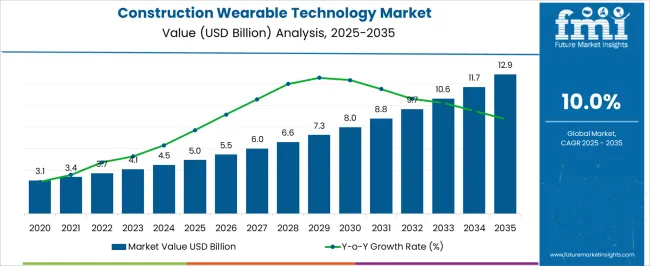
The construction wearable technology market was valued at USD 5 billion in 2025, projected to reach USD 5.5 billion in 2026, and is forecast to expand to USD 14.27 billion by 2036 at a 10% CAGR. Demand is driven by construction firms adopting wearable devices to address persistent worker safety challenges, productivity visibility gaps, and regulatory compliance documentation requirements on active project sites.
Summary of Construction Wearable Technology Market
- Market Overview
- The construction wearable technology market is valued at USD 5 billion in 2025 and is projected to reach USD 14.27 billion by 2036.
- The industry is expected to grow at a 10% CAGR from 2026 to 2036, creating an incremental opportunity of USD 8.77 billion.
- The market is a construction technology category where adoption is driven by worker safety regulation compliance, injury rate reduction targets, and the integration of real-time monitoring into construction site operations management.
- Demand and Growth Drivers
- Demand is driven by construction firms adopting wearable devices to address persistent worker safety challenges and regulatory compliance requirements.
- Body wear and vest devices lead as they integrate multiple sensors for proximity, fall alert, and environmental monitoring without separate handheld equipment.
- Worker safety applications anchor the largest share as firms invest in real-time hazard detection to reduce injury rates and insurance costs.
- Among key countries, China at 13.5%, India at 12.5%, Germany at 11.5%, France at 10.5%, UK at 9.5%, USA at 8.5%, Brazil at 7.5%.
- Product and Segment View
- The market covers wearable devices including body vests, smart watches, smart boots, smart helmets, smart glasses, and exoskeletons designed for construction site deployment.
- These devices serve worker safety, productivity monitoring, communication, health monitoring, and training applications via Bluetooth, Wi-Fi, 4G/5G, and RFID/NFC connectivity.
- Body wear/vest leads by Product with 29.4% share in 2026, driven by multi-sensor integration for proximity, fall, and environmental hazard detection.
- Worker safety leads by Application with 38.6% share in 2026.
- The scope includes construction-specific wearable technology, excluding consumer fitness trackers, medical monitoring devices, and military wearable systems.
- Geography and Competitive Outlook
- China and India are the fastest-growing markets due to large-scale construction safety mandates and infrastructure project workforce monitoring requirements.
- Germany and USA sustain demand through occupational safety regulations, OSHA compliance, and insurance-driven technology adoption.
- Competition is shaped by sensor integration, ruggedness certification, battery life, and construction platform compatibility, with key players including Honeywell International Inc., ARM Limited, Ekso Bionics, Garmin, German Bionic Systems GmbH, Kenzen, Panasonic.
- Analyst Opinion at FMI
- Sudip Saha, Principal Consultant at Future Market Insights, opines: 'As per FMI analysis, the construction wearable technology market is entering a phase where regulatory compliance, specification precision, and lifecycle cost evaluation define procurement decisions. Operations teams that delay standardization risk exclusion from major contract cycles where pre-qualification thresholds tighten progressively.'
- Strategic Implications / Executive Takeaways
- Device manufacturers must achieve IP67 or higher ingress protection ratings and drop-test certifications to qualify for construction site deployment specifications.
- Construction safety directors should evaluate wearable platform data integration capability with existing construction management systems before committing to enterprise deployment.
- Insurance providers should explore usage-based premium models tied to wearable safety data to incentivize construction firm technology adoption and reduce claim frequencies.
Construction Wearable Technology Market Key Takeaways
| Metric | Details |
|---|---|
| Industry Size (2026) | USD 5.5 billion |
| Industry Value (2036) | USD 14.27 billion |
| CAGR (2026-2036) | 10% |
Source: Future Market Insights, 2026
Body wear and vest devices hold the leading product share as they integrate multiple sensor types for proximity detection, fall alert, and environmental monitoring without requiring workers to carry separate handheld devices. Bluetooth maintains the leading connectivity share due to its low power consumption, compatibility with smartphone-based data collection, and adequate range for construction site geofencing applications. Worker safety applications anchor the largest share as construction firms invest in real-time hazard detection systems to reduce injury rates and workers compensation costs.
All major markets reflect construction safety regulation enforcement and technology adoption maturity. China leads at 13.5% CAGR as large-scale infrastructure projects deploy wearable safety systems to manage worker proximity and fatigue monitoring across sprawling construction zones. India follows at 12.5% driven by government construction safety mandates and metro project workforce monitoring requirements. Germany maintains 11.5% growth anchored by occupational safety regulations and Industry 4.0 construction site digitization programs. France at 10.5% and UK at 9.5% sustain demand through construction safety legislation and general contractor technology mandates. USA maintains a 8.5% pace through OSHA compliance requirements and insurance-driven safety technology adoption. Brazil at 7.5% is driven by mining and infrastructure construction safety enforcement.
Construction Wearable Technology Market Definition
Construction Wearable Technology Market encompasses sensor-equipped wearable devices designed for construction site deployment to monitor worker safety, productivity, health, and communication. Product categories include smart vests, watches, boots, helmets, glasses, and exoskeletons connected via Bluetooth, Wi-Fi, 4G/5G, and RFID/NFC protocols. Procurement is tied to construction safety regulation compliance, general contractor technology mandates, and insurance-driven injury reduction targets.
Construction Wearable Technology Market Inclusions
Market scope includes construction-specific wearable devices across body wear, watch, boot, helmet, glasses, and exoskeleton product types with Bluetooth, Wi-Fi, 4G/5G, and RFID/NFC connectivity for safety, productivity, communication, health, and training applications. Coverage spans global and regional market sizes, the 2026 to 2036 forecast period, and segment breakdowns by product type, technology, application, and region.
Construction Wearable Technology Market Exclusions
The scope excludes consumer fitness trackers, medical monitoring wearables, military tactical wearable systems, and industrial manufacturing wearables not designed for construction site conditions. It also omits backend data analytics platform revenue not bundled with device procurement.
Construction Wearable Technology Market Research Methodology
- Primary Research: Analysts conducted structured interviews with procurement directors, site managers, and industry specialists to map decision gates and specification requirements in the construction wearable technology market.
- Desk Research: Data collection aggregated regulatory filings, industry standards, trade association reports, and publicly available corporate disclosures relevant to the construction wearable technology sector.
- Market-Sizing and Forecasting: Baseline values derive from a bottom-up aggregation of procurement volumes and contract values, applying region-specific adoption curves to project future demand trajectories.
- Data Validation and Update Cycle: Projections are tested against publicly reported expenditure guidance and procurement records from major end-use operators and industry participants.
Why is the Construction Wearable Technology Market Growing?
The construction wearable technology market is witnessing significant momentum due to the rising demand for real-time workforce monitoring, site safety, and productivity optimization. Employers are increasingly integrating wearables into workflows to reduce accident rates, ensure compliance with safety protocols, and gain analytics-driven insights into worker performance.
The availability of rugged, industry-specific devices and the growing interoperability of wearables with existing site management platforms have further enhanced adoption. Additionally, supportive regulatory mandates and investments in smart construction technologies are encouraging large-scale deployments across both developed and emerging markets.
The shift toward digitized construction ecosystems will continue to accelerate the uptake of wearable innovations in the years ahead.
Segmental Analysis
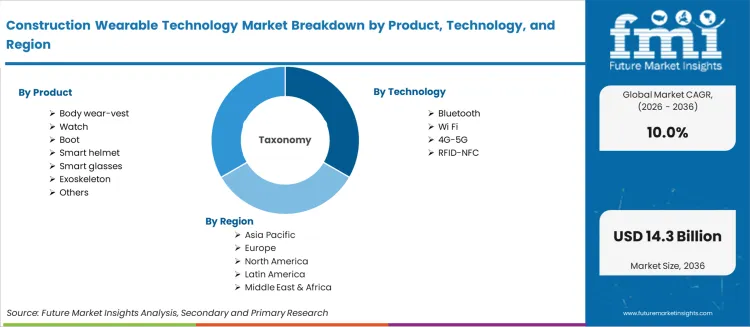
The construction wearable technology market is segmented by product, connectivity technology, application, end user, and geographic regions. By product, construction wearable technology market is divided into Body wear/vest, Watch, Boot, Smart helmet, Smart glasses, Exoskeleton, and Others. In terms of connectivity technology, construction wearable technology market is classified into Bluetooth, Wi Fi, 4G/5G, and RFID/NFC. Based on application, construction wearable technology market is segmented into Worker safety, Productivity monitoring, Communication, Health monitoring, and Training & simulation.
By end user, construction wearable technology market is segmented into Industrial, Residential, Commercial, Infrastructure, and Others. Regionally, the construction wearable technology industry is classified into North America, Latin America, Western Europe, Eastern Europe, Balkan & Baltic Countries, Russia & Belarus, Central Asia, East Asia, South Asia & Pacific, and the Middle East & Africa.
Insights into the Body Wear/Vest Product Segment
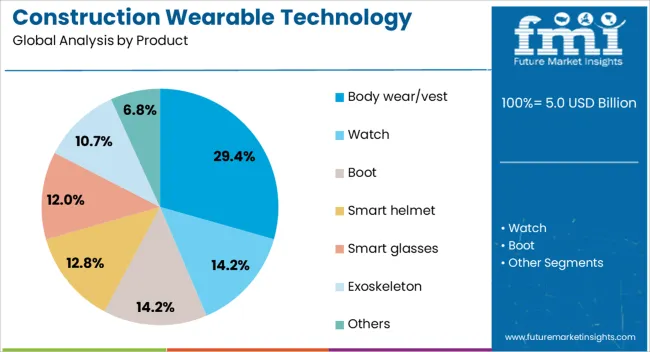
The body wear/vest segment is expected to lead the product category with 29.40% share in 2026. This growth is driven by increasing demand for integrated safety solutions such as sensor-embedded vests that monitor vital signs, detect hazardous exposure, and provide real-time alerts.
These vests support ergonomics and worker comfort while housing advanced technologies like GPS, motion sensors, and thermal monitoring. With construction sites becoming increasingly digitized, body wear/vest solutions are seen as essential tools for risk mitigation and operational efficiency.
Their compatibility with enterprise platforms and data analytics systems further enhances their value proposition for large-scale contractors and infrastructure firms.
Insights into the Bluetooth Connectivity Technology Segment
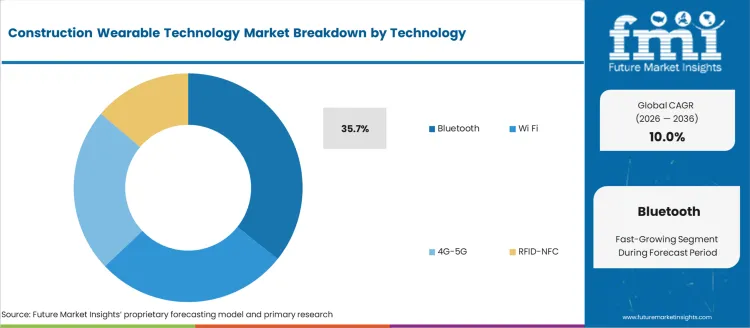
Bluetooth connectivity is projected to account for 35.70% of the market in 2026, making it the dominant technology in this space. Its widespread compatibility with mobile devices, low power consumption, and stable short-range communication make it ideal for on-site applications.
Bluetooth enables real-time data transmission from wearables to supervisors, enabling continuous health and safety monitoring. Furthermore, Bluetooth-based solutions are cost-effective, easy to integrate, and increasingly reliable in complex job site environments.
As construction operations prioritize seamless communication and worker tracking without relying on extensive infrastructure, Bluetooth continues to be the preferred choice.
Insights into the Worker Safety Application Segment
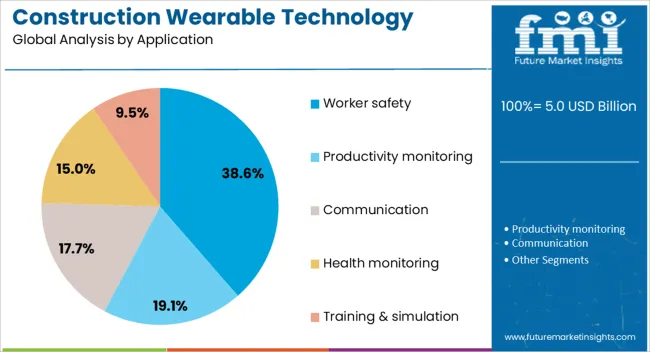
Worker safety will remain the largest application area, representing 38.60% of the total market in 2026. The prominence of this segment is underpinned by the industry’s emphasis on reducing fatalities and injuries on site.
Wearables focused on safety provide critical functions such as fall detection, geofencing, fatigue monitoring, and environmental hazard alerts. Insurance firms and regulators are also incentivizing the adoption of such technologies to reduce claims and enforce standards.
As safety becomes a competitive differentiator and a regulatory requirement, the demand for wearable tech with robust safety features is expected to intensify across large and mid-scale construction firms globally.
What are the Drivers, Restraints, and Key Trends of the Construction Wearable Technology Market?
The construction wearable technology market is expanding as companies adopt digital solutions to enhance safety, productivity, and operational efficiency on construction sites. Wearable devices such as smart helmets, vests, gloves, and augmented reality glasses enable real-time monitoring of worker health, location, and environmental conditions. Rising concerns about workplace safety, regulatory compliance, and the need for productivity optimization are driving adoption.
Integration with IoT platforms, cloud analytics, and AI-based monitoring allows construction managers to track performance, prevent accidents, and optimize resource allocation. Companies offering durable, easy-to-use, and data-enabled wearable solutions are well-positioned to capitalize on growth in large-scale construction, infrastructure development, and industrial projects worldwide.
High Costs, Adoption Resistance, and Data Security
The market faces challenges related to high device costs, adoption resistance, and data security concerns. Wearable technologies often require significant upfront investment, including hardware, software, and integration with site management systems. Construction workers may resist adoption due to comfort, usability, or privacy concerns. Capturing and transmitting sensitive health and location data raises cybersecurity and regulatory compliance issues, particularly in regions with strict labor or data protection laws. Ensuring device durability under harsh construction site conditions, including dust, vibration, and extreme temperatures, adds further complexity. Companies must provide cost-effective, reliable, and secure wearable solutions, along with training and support programs, to overcome these challenges and ensure successful deployment on construction sites.
IoT Integration, Real-Time Monitoring, and Augmented Reality
The market is trending toward IoT integration, real-time monitoring, and augmented reality-enabled wearables. Smart helmets, vests, and glasses now provide live data on worker biometrics, fatigue, environmental hazards, and equipment usage. AR-enabled devices assist with on-site visualization, remote collaboration, and digital blueprints, reducing errors and enhancing decision-making. Wearables are increasingly integrated with site management software and predictive analytics platforms to improve resource allocation, safety compliance, and operational efficiency. Lightweight, ergonomic, and ruggedized designs are improving worker comfort and adoption rates. These trends highlight the focus on combining safety, productivity, and digital intelligence to create smarter, more connected construction sites.
Large-Scale Projects, Safety Regulations, and Workforce Efficiency
The market offers opportunities in large-scale construction projects, safety regulation compliance, and workforce efficiency enhancement. Rapid urbanization, infrastructure expansion, and industrial facility construction are driving demand for wearable technologies to monitor worker health and prevent accidents. Regulatory authorities are increasingly mandating safety compliance, providing an incentive for companies to deploy wearable solutions. Wearables help track productivity, reduce downtime, and improve overall workforce management. Integration with training programs, preventive maintenance, and equipment monitoring creates additional value. Companies that provide scalable, durable, and analytics-enabled wearable solutions can benefit from the growing emphasis on construction safety, operational efficiency, and digital transformation in both emerging and developed markets.
Technical Challenges, Interoperability, and Maintenance
Market growth is restrained by technical challenges, interoperability issues, and maintenance requirements. Wearable devices must withstand harsh construction environments, including exposure to dust, moisture, vibration, and extreme temperatures, which can reduce device lifespan. Interoperability with diverse site management platforms, IoT devices, and safety protocols can be challenging, slowing deployment. Regular maintenance, software updates, and battery management are required to ensure continuous operation. Additionally, concerns about worker privacy, data ownership, and resistance to technological change can limit adoption. Until ruggedized, standardized, and user-friendly wearable solutions become widely available, market penetration may remain limited to larger construction companies and technologically advanced projects.
Analysis of Construction Wearable Technology Market By Key Countries
.webp "Top Country Growth Comparison Construction Wearable Technology Market Cagr (2026 2036)")
| Country | CAGR |
|---|---|
| China | 13.5% |
| India | 12.5% |
| Germany | 11.5% |
| France | 10.5% |
| UK | 9.5% |
| USA | 8.5% |
| Brazil | 7.5% |
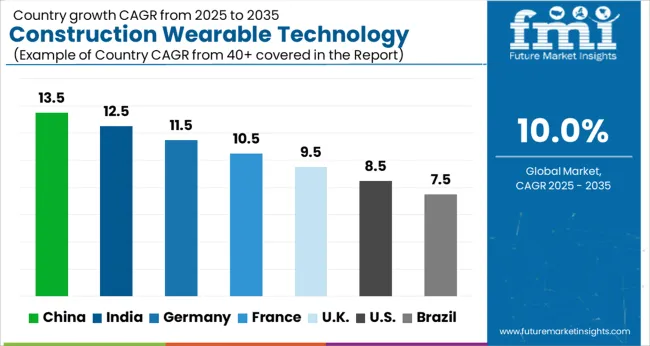
The global construction wearable technology market is projected to grow at a CAGR of 10.0% through 2036, supported by increasing demand across worker safety, site monitoring, and productivity tracking applications. Among BRICS nations, China has been recorded with 13.5% growth, driven by large-scale adoption of smart helmets, wearable sensors, and connected devices on construction sites, while India has been observed at 12.5%, supported by rising implementation in worker safety programs and real-time monitoring systems. In the OECD region, Germany has been measured at 11.5%, where production and deployment of wearable safety gear and site monitoring devices have been steadily maintained. The United Kingdom has been noted at 9.5%, reflecting consistent use in construction safety and operational tracking, while the USA has been recorded at 8.5%, with production and utilization across commercial and residential construction projects being steadily increased. This report includes insights on 40+ countries; the top five markets are shown here for reference.
Construction Wearable Technology Market Development in China
China is emerging as a leader in construction wearable technology, growing at a CAGR of 13.5%, driven by large-scale infrastructure projects and increasing emphasis on worker safety. Manufacturers are introducing smart helmets, sensor-enabled vests, and wristbands capable of monitoring vital signs, environmental hazards, and worker location. Government initiatives promoting occupational safety, urban development, and smart city projects are accelerating adoption. Pilot deployments on mega construction sites have demonstrated benefits including accident reduction, improved labor productivity, and real-time site monitoring. Collaborations between domestic technology providers, construction companies, and research institutes are advancing device durability, connectivity, and integration with digital construction platforms. Rising adoption of automation and smart construction management continues to fuel China’s market.
- Large infrastructure projects drove adoption
- R&D enhanced sensor accuracy, connectivity, and durability
- Government programs promoted safety and smart construction
Construction Wearable Technology Market Expansion in India
Construction wearable technology market in India is expanding at a CAGR of 12.5%, supported by rapid urbanization, industrial growth, and strict labor safety initiatives. Manufacturers are supplying smart helmets, wearable sensors, and exoskeletons for real-time monitoring of worker health, fatigue, and environmental hazards. Government programs promoting construction modernization, occupational safety, and smart city development are encouraging adoption. Pilot implementations in residential, commercial, and infrastructure projects demonstrate operational benefits such as accident prevention, optimized workflow, and enhanced site supervision. Partnerships between domestic technology firms, construction companies, and international solution providers are improving integration, reliability, and sensor performance. India’s increasing focus on worker safety and digital construction management continues to drive growth in wearable adoption.
- Urban infrastructure projects and safety regulations drove adoption
- R&D improved integration, durability, and monitoring precision
- Government programs promoted construction modernization and safety
Construction Wearable Technology Market Trends in Germany
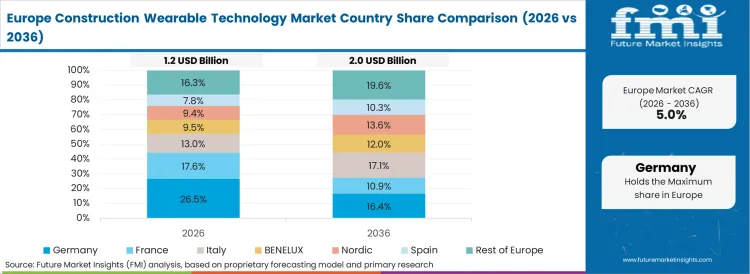
Construction wearable technology market in Germany is recording a CAGR of 11.5%, supported by stringent safety regulations, advanced construction practices, and industry digitization. Manufacturers are providing smart helmets, sensor-enabled vests, and wearable exoskeletons for worker monitoring, fatigue detection, and hazard alerts. Government initiatives promoting workplace safety, sustainable construction, and automation drive market adoption. Pilot projects in industrial, commercial, and infrastructure sites show benefits such as reduced accidents, increased productivity, and data-driven site management. Collaborations between technology providers, construction companies, and research institutes are enhancing sensor precision, device ergonomics, and connectivity. Germany’s commitment to safety, automation, and digital construction continues to propel wearable technology adoption.
- Industrial and infrastructure sites drove adoption
- R&D focused on sensor precision, ergonomics, and connectivity
- Government programs promoted safety and digital construction
Construction Wearable Technology Market Progress in the United Kingdom
The United Kingdom is experiencing a CAGR of 9.5% in construction wearable technology, fueled by rising safety standards, urban development projects, and digital construction adoption. Manufacturers are producing smart helmets, wearable sensors, and safety vests that track environmental hazards, worker location, and health indicators. Government programs promoting occupational safety, smart construction, and labor compliance are supporting market growth. Pilot deployments in commercial and infrastructure projects show benefits such as accident reduction, improved labor efficiency, and better site monitoring. Partnerships between domestic technology providers, construction firms, and research institutions enhance device reliability, connectivity, and software integration. Growing adoption of automation and digital construction management continues to support the UK market.
- Urban infrastructure and safety compliance drove adoption
- R&D improved device connectivity, reliability, and monitoring features
- Government programs promoted smart construction and occupational safety
Construction Wearable Technology Market Insights in the United States
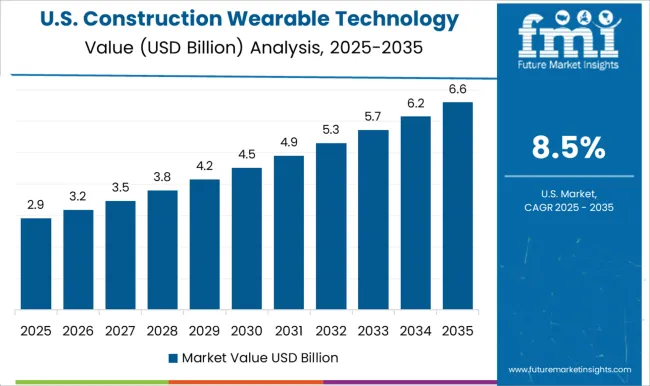
The United States construction wearable technology market is growing at a CAGR of 8.5%, supported by increasing safety regulations, labor efficiency programs, and the adoption of digital construction tools. Manufacturers are developing wearable devices such as helmets, vests, wristbands, and exoskeletons for real-time monitoring of worker health, fatigue, and environmental hazards. Government initiatives promoting occupational safety, construction modernization, and industrial digitization are encouraging adoption. Pilot projects in large commercial and infrastructure sites demonstrate operational benefits including reduced accidents, enhanced workflow, and real-time site analytics. Collaborations between technology providers, construction companies, and research institutes are improving sensor accuracy, device durability, and integration with construction management software. Focus on safety and workforce productivity continues to drive market growth in the USA
- Safety compliance and labor efficiency drove adoption
- R&D enhanced sensor accuracy, durability, and integration
- Government programs promoted digital construction and occupational safety
Competitive Landscape of Construction Wearable Technology Market
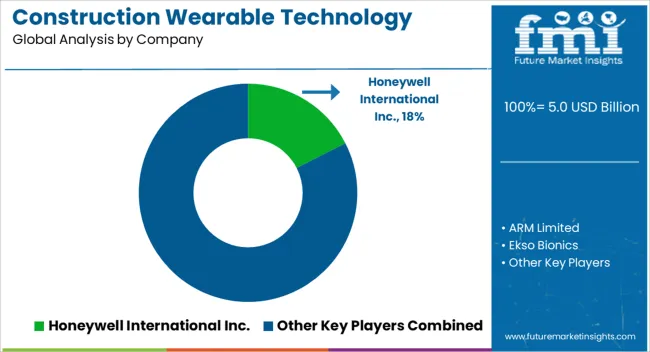
Wearable devices for construction environments are being adopted to improve worker safety, monitoring, and operational efficiency, with suppliers competing on sensor accuracy, ergonomics, and durability. Honeywell International Inc. is positioned as a leading provider, with brochures highlighting smart helmets, wearable gas detectors, and real-time location monitoring, along with technical specifications for battery life, environmental tolerance, and alert thresholds. ARM Limited supplies embedded processors and IoT modules, with literature detailing power consumption, connectivity options, and integration guidance for wearable devices. Ekso Bionics focuses on exoskeletons, with brochures emphasizing load-bearing capacity, joint articulation range, and safety certifications.
Garmin and German Bionic Systems GmbH provide sensor-integrated wearable devices, with technical literature covering GPS tracking, motion sensors, and data transmission reliability. Kenzen emphasizes physiological monitoring for heat stress and fatigue, while Panasonic and RealWear Inc. deliver head-mounted displays and voice-controlled devices, with brochures presenting operating ranges, ruggedized casing specifications, and compatibility with communication systems. Siemens and Trimble Inc. offer connected wearable platforms for site management and workflow integration, with brochures detailing device interoperability, software interfaces, and real-time reporting. XREAL, Inc. provides AR-enabled wearables for visualization tasks, with literature highlighting display specifications, weight, and user comfort. Other regional suppliers compete by offering low-cost, modular, or specialized devices for niche construction applications. Adoption strategies are focused on accuracy, device robustness, and system interoperability.
Key Players in the Construction Wearable Technology Market
- Honeywell International Inc.
- ARM Limited
- Ekso Bionics
- Garmin
- German Bionic Systems GmbH
- Kenzen
- Panasonic
- RealWear Inc.
- Siemens
- Trimble Inc.
- XREAL, Inc.
Scope of the Report
| Metric | Value |
|---|---|
| Quantitative Units | USD 5.5 billion to USD 14.27 billion, at a CAGR of 10% |
| Market Definition | Construction wearable technology covers sensor-equipped devices including smart vests, watches, helmets, glasses, and exoskeletons deployed on construction sites for safety, productivity, and health monitoring. |
| Segmentation | Product: Body wear/vest, Watch, Boot, Smart helmet, Smart glasses, Exoskeleton, Others; Technology: Bluetooth, Wi Fi, 4G/5G, RFID/NFC; Application: Worker safety, Productivity monitoring, Communication, Health monitoring, Training & simulation |
| Regions Covered | North America, Latin America, Europe, East Asia, South Asia, Oceania, Middle East & Africa |
| Countries Covered | China, India, Germany, France, UK, USA, Brazil, and 40 plus countries |
| Key Companies Profiled | Honeywell International Inc., ARM Limited, Ekso Bionics, Garmin, German Bionic Systems GmbH, Kenzen, Panasonic, RealWear Inc. |
| Forecast Period | 2026 to 2036 |
| Approach | Forecasting models apply a bottom-up methodology starting with regional activity metrics and cross-validate projections against industry data and corporate disclosures. |
Construction Wearable Technology Market by Segments
Product:
- Body wear/vest
- Watch
- Boot
- Smart helmet
- Smart glasses
- Exoskeleton
- Others
Connectivity Technology:
- Bluetooth
- Wi Fi
- 4G/5G
- RFID/NFC
Application:
- Worker safety
- Productivity monitoring
- Communication
- Health monitoring
- Training & simulation
End User:
- Industrial
- Residential
- Commercial
- Infrastructure
- Others
Region:
- North America
- USA
- Canada
- Mexico
- Latin America
- Brazil
- Chile
- Rest of Latin America
- Western Europe
- Germany
- UK
- Italy
- Spain
- France
- Nordic
- BENELUX
- Rest of Western Europe
- Eastern Europe
- Russia
- Poland
- Hungary
- Balkan & Baltic
- Rest of Eastern Europe
- East Asia
- China
- Japan
- South Korea
- South Asia and Pacific
- India
- ASEAN
- Australia & New Zealand
- Rest of South Asia and Pacific
- Middle East & Africa
- Kingdom of Saudi Arabia
- Other GCC Countries
- Turkiye
- South Africa
- Other African Union
- Rest of Middle East & Africa
Bibliography
- 1. Occupational Safety and Health Administration. (2025). Construction Industry Wearable Technology Guidance. OSHA.
- 2. European Agency for Safety and Health at Work. (2024). Smart Personal Protective Equipment for Construction. EU-OSHA.
- 3. International Organization for Standardization. (2024). ISO 13482: Robots and Robotic Devices, Safety Requirements for Personal Care Robots (Exoskeletons). ISO.
- 4. Organisation for Economic Co-operation and Development. (2025). Digital Transformation in Construction Safety. OECD.
- 5. World Health Organization. (2024). Occupational Health and Wearable Monitoring in Construction. WHO.
This bibliography is provided for reader reference. The full Future Market Insights report contains the complete reference list with primary research documentation.
Frequently Asked Questions
How large is the demand for Construction Wearable Technology in the global market in 2026?
Demand for Construction Wearable Technology in the global market is estimated to be valued at USD 5.5 billion in 2026.
What will be the market size of Construction Wearable Technology in the global market by 2036?
Market size for Construction Wearable Technology is projected to reach USD 14.27 billion by 2036.
What is the expected demand growth for Construction Wearable Technology between 2026 and 2036?
Demand for Construction Wearable Technology is expected to grow at a CAGR of 10% between 2026 and 2036.
Which Product is poised to lead global sales by 2026?
Body wear/vest accounts for 29.4% share in 2026 based on FMI analysis.
How is the role of Worker safety in driving Construction Wearable Technology adoption in 2026?
Worker safety represents 38.6% of segment share in 2026 as per FMI's construction wearable technology market report.
What is the fastest-growing country market in this report?
China is projected to grow at a CAGR of 13.5% during 2026 to 2036.
What is Construction Wearable Technology and what is it mainly used for?
Construction wearable technology covers sensor-equipped devices including smart vests, watches, helmets, glasses, and exoskeletons deployed on construction sites for safety, productivity, and health monitoring.
What is included in the scope of this Construction Wearable Technology report?
The market covers smart vests, watches, boots, helmets, glasses, and exoskeletons with Bluetooth, Wi-Fi, 4G/5G, and RFID/NFC for construction safety, productivity, and health applications.
Preview the report firsthand - request a free sample
Get SampleGet the brochure for pricing and purchase details.
Get PDFTable of Content
- Executive Summary
- Global Market Outlook
- Demand-side Trends
- Supply-side Trends
- Technology Roadmap Analysis
- Analysis and Recommendations
- Market Overview
- Market Coverage / Taxonomy
- Market Definition / Scope / Limitations
- Research Methodology
- Chapter Orientation
- Analytical Lens and Working Hypotheses
- Market Structure, Signals, and Trend Drivers
- Benchmarking and Cross-market Comparability
- Market Sizing, Forecasting, and Opportunity Mapping
- Research Design and Evidence Framework
- Desk Research Programme (Secondary Evidence)
- Company Annual and Sustainability Reports
- Peer-reviewed Journals and Academic Literature
- Corporate Websites, Product Literature, and Technical Notes
- Earnings Decks and Investor Briefings
- Statutory Filings and Regulatory Disclosures
- Technical White Papers and Standards Notes
- Trade Journals, Industry Magazines, and Analyst Briefs
- Conference Proceedings, Webinars, and Seminar Materials
- Government Statistics Portals and Public Data Releases
- Press Releases and Reputable Media Coverage
- Specialist Newsletters and Curated Briefings
- Sector Databases and Reference Repositories
- FMI Internal Proprietary Databases and Historical Market Datasets
- Subscription Datasets and Paid Sources
- Social Channels, Communities, and Digital Listening Inputs
- Additional Desk Sources
- Expert Input and Fieldwork (Primary Evidence)
- Primary Modes
- Qualitative Interviews and Expert Elicitation
- Quantitative Surveys and Structured Data Capture
- Blended Approach
- Why Primary Evidence is Used
- Field Techniques
- Interviews
- Surveys
- Focus Groups
- Observational and In-context Research
- Social and Community Interactions
- Stakeholder Universe Engaged
- C-suite Leaders
- Board Members
- Presidents and Vice Presidents
- R&D and Innovation Heads
- Technical Specialists
- Domain Subject-matter Experts
- Scientists
- Physicians and Other Healthcare Professionals
- Governance, Ethics, and Data Stewardship
- Research Ethics
- Data Integrity and Handling
- Primary Modes
- Tooling, Models, and Reference Databases
- Desk Research Programme (Secondary Evidence)
- Data Engineering and Model Build
- Data Acquisition and Ingestion
- Cleaning, Normalisation, and Verification
- Synthesis, Triangulation, and Analysis
- Quality Assurance and Audit Trail
- Market Background
- Market Dynamics
- Drivers
- Restraints
- Opportunity
- Trends
- Scenario Forecast
- Demand in Optimistic Scenario
- Demand in Likely Scenario
- Demand in Conservative Scenario
- Opportunity Map Analysis
- Product Life Cycle Analysis
- Supply Chain Analysis
- Investment Feasibility Matrix
- Value Chain Analysis
- PESTLE and Porter’s Analysis
- Regulatory Landscape
- Regional Parent Market Outlook
- Production and Consumption Statistics
- Import and Export Statistics
- Market Dynamics
- Global Market Analysis 2021 to 2025 and Forecast, 2026 to 2036
- Historical Market Size Value (USD Million) Analysis, 2021 to 2025
- Current and Future Market Size Value (USD Million) Projections, 2026 to 2036
- Y-o-Y Growth Trend Analysis
- Absolute $ Opportunity Analysis
- Global Market Pricing Analysis 2021 to 2025 and Forecast 2026 to 2036
- Global Market Analysis 2021 to 2025 and Forecast 2026 to 2036, By Product
- Introduction / Key Findings
- Historical Market Size Value (USD Million) Analysis By Product , 2021 to 2025
- Current and Future Market Size Value (USD Million) Analysis and Forecast By Product , 2026 to 2036
- Body wear/vest
- Watch
- Boot
- Smart helmet
- Smart glasses
- Exoskeleton
- Others
- Body wear/vest
- Y-o-Y Growth Trend Analysis By Product , 2021 to 2025
- Absolute $ Opportunity Analysis By Product , 2026 to 2036
- Global Market Analysis 2021 to 2025 and Forecast 2026 to 2036, By Technology
- Introduction / Key Findings
- Historical Market Size Value (USD Million) Analysis By Technology, 2021 to 2025
- Current and Future Market Size Value (USD Million) Analysis and Forecast By Technology, 2026 to 2036
- Bluetooth
- Wi Fi
- 4G/5G
- RFID/NFC
- Bluetooth
- Y-o-Y Growth Trend Analysis By Technology, 2021 to 2025
- Absolute $ Opportunity Analysis By Technology, 2026 to 2036
- Global Market Analysis 2021 to 2025 and Forecast 2026 to 2036, By Application
- Introduction / Key Findings
- Historical Market Size Value (USD Million) Analysis By Application, 2021 to 2025
- Current and Future Market Size Value (USD Million) Analysis and Forecast By Application, 2026 to 2036
- Worker safety
- Productivity monitoring
- Communication
- Health monitoring
- Training & simulation
- Worker safety
- Y-o-Y Growth Trend Analysis By Application, 2021 to 2025
- Absolute $ Opportunity Analysis By Application, 2026 to 2036
- Global Market Analysis 2021 to 2025 and Forecast 2026 to 2036, By Region
- Introduction
- Historical Market Size Value (USD Million) Analysis By Region, 2021 to 2025
- Current Market Size Value (USD Million) Analysis and Forecast By Region, 2026 to 2036
- North America
- Latin America
- Western Europe
- Eastern Europe
- East Asia
- South Asia and Pacific
- Middle East & Africa
- Market Attractiveness Analysis By Region
- North America Market Analysis 2021 to 2025 and Forecast 2026 to 2036, By Country
- Historical Market Size Value (USD Million) Trend Analysis By Market Taxonomy, 2021 to 2025
- Market Size Value (USD Million) Forecast By Market Taxonomy, 2026 to 2036
- By Country
- USA
- Canada
- Mexico
- By Product
- By Technology
- By Application
- By Country
- Market Attractiveness Analysis
- By Country
- By Product
- By Technology
- By Application
- Key Takeaways
- Latin America Market Analysis 2021 to 2025 and Forecast 2026 to 2036, By Country
- Historical Market Size Value (USD Million) Trend Analysis By Market Taxonomy, 2021 to 2025
- Market Size Value (USD Million) Forecast By Market Taxonomy, 2026 to 2036
- By Country
- Brazil
- Chile
- Rest of Latin America
- By Product
- By Technology
- By Application
- By Country
- Market Attractiveness Analysis
- By Country
- By Product
- By Technology
- By Application
- Key Takeaways
- Western Europe Market Analysis 2021 to 2025 and Forecast 2026 to 2036, By Country
- Historical Market Size Value (USD Million) Trend Analysis By Market Taxonomy, 2021 to 2025
- Market Size Value (USD Million) Forecast By Market Taxonomy, 2026 to 2036
- By Country
- Germany
- UK
- Italy
- Spain
- France
- Nordic
- BENELUX
- Rest of Western Europe
- By Product
- By Technology
- By Application
- By Country
- Market Attractiveness Analysis
- By Country
- By Product
- By Technology
- By Application
- Key Takeaways
- Eastern Europe Market Analysis 2021 to 2025 and Forecast 2026 to 2036, By Country
- Historical Market Size Value (USD Million) Trend Analysis By Market Taxonomy, 2021 to 2025
- Market Size Value (USD Million) Forecast By Market Taxonomy, 2026 to 2036
- By Country
- Russia
- Poland
- Hungary
- Balkan & Baltic
- Rest of Eastern Europe
- By Product
- By Technology
- By Application
- By Country
- Market Attractiveness Analysis
- By Country
- By Product
- By Technology
- By Application
- Key Takeaways
- East Asia Market Analysis 2021 to 2025 and Forecast 2026 to 2036, By Country
- Historical Market Size Value (USD Million) Trend Analysis By Market Taxonomy, 2021 to 2025
- Market Size Value (USD Million) Forecast By Market Taxonomy, 2026 to 2036
- By Country
- China
- Japan
- South Korea
- By Product
- By Technology
- By Application
- By Country
- Market Attractiveness Analysis
- By Country
- By Product
- By Technology
- By Application
- Key Takeaways
- South Asia and Pacific Market Analysis 2021 to 2025 and Forecast 2026 to 2036, By Country
- Historical Market Size Value (USD Million) Trend Analysis By Market Taxonomy, 2021 to 2025
- Market Size Value (USD Million) Forecast By Market Taxonomy, 2026 to 2036
- By Country
- India
- ASEAN
- Australia & New Zealand
- Rest of South Asia and Pacific
- By Product
- By Technology
- By Application
- By Country
- Market Attractiveness Analysis
- By Country
- By Product
- By Technology
- By Application
- Key Takeaways
- Middle East & Africa Market Analysis 2021 to 2025 and Forecast 2026 to 2036, By Country
- Historical Market Size Value (USD Million) Trend Analysis By Market Taxonomy, 2021 to 2025
- Market Size Value (USD Million) Forecast By Market Taxonomy, 2026 to 2036
- By Country
- Kingdom of Saudi Arabia
- Other GCC Countries
- Turkiye
- South Africa
- Other African Union
- Rest of Middle East & Africa
- By Product
- By Technology
- By Application
- By Country
- Market Attractiveness Analysis
- By Country
- By Product
- By Technology
- By Application
- Key Takeaways
- Key Countries Market Analysis
- USA
- Pricing Analysis
- Market Share Analysis, 2025
- By Product
- By Technology
- By Application
- Canada
- Pricing Analysis
- Market Share Analysis, 2025
- By Product
- By Technology
- By Application
- Mexico
- Pricing Analysis
- Market Share Analysis, 2025
- By Product
- By Technology
- By Application
- Brazil
- Pricing Analysis
- Market Share Analysis, 2025
- By Product
- By Technology
- By Application
- Chile
- Pricing Analysis
- Market Share Analysis, 2025
- By Product
- By Technology
- By Application
- Germany
- Pricing Analysis
- Market Share Analysis, 2025
- By Product
- By Technology
- By Application
- UK
- Pricing Analysis
- Market Share Analysis, 2025
- By Product
- By Technology
- By Application
- Italy
- Pricing Analysis
- Market Share Analysis, 2025
- By Product
- By Technology
- By Application
- Spain
- Pricing Analysis
- Market Share Analysis, 2025
- By Product
- By Technology
- By Application
- France
- Pricing Analysis
- Market Share Analysis, 2025
- By Product
- By Technology
- By Application
- India
- Pricing Analysis
- Market Share Analysis, 2025
- By Product
- By Technology
- By Application
- ASEAN
- Pricing Analysis
- Market Share Analysis, 2025
- By Product
- By Technology
- By Application
- Australia & New Zealand
- Pricing Analysis
- Market Share Analysis, 2025
- By Product
- By Technology
- By Application
- China
- Pricing Analysis
- Market Share Analysis, 2025
- By Product
- By Technology
- By Application
- Japan
- Pricing Analysis
- Market Share Analysis, 2025
- By Product
- By Technology
- By Application
- South Korea
- Pricing Analysis
- Market Share Analysis, 2025
- By Product
- By Technology
- By Application
- Russia
- Pricing Analysis
- Market Share Analysis, 2025
- By Product
- By Technology
- By Application
- Poland
- Pricing Analysis
- Market Share Analysis, 2025
- By Product
- By Technology
- By Application
- Hungary
- Pricing Analysis
- Market Share Analysis, 2025
- By Product
- By Technology
- By Application
- Kingdom of Saudi Arabia
- Pricing Analysis
- Market Share Analysis, 2025
- By Product
- By Technology
- By Application
- Turkiye
- Pricing Analysis
- Market Share Analysis, 2025
- By Product
- By Technology
- By Application
- South Africa
- Pricing Analysis
- Market Share Analysis, 2025
- By Product
- By Technology
- By Application
- USA
- Market Structure Analysis
- Competition Dashboard
- Competition Benchmarking
- Market Share Analysis of Top Players
- By Regional
- By Product
- By Technology
- By Application
- Competition Analysis
- Competition Deep Dive
- Honeywell International Inc.
- Overview
- Product Portfolio
- Profitability by Market Segments (Product/Age /Sales Channel/Region)
- Sales Footprint
- Strategy Overview
- Marketing Strategy
- Product Strategy
- Channel Strategy
- ARM Limited
- Ekso Bionics
- Garmin
- German Bionic Systems GmbH
- Kenzen
- Panasonic
- RealWear Inc.
- Siemens
- Trimble Inc.
- XREAL, Inc.
- Honeywell International Inc.
- Competition Deep Dive
- Assumptions & Acronyms Used


