

- Market Size (2026)
- USD 55.0 Mn
- Forecast (2036)
- USD 120.0 Mn
- CAGR (2026 to 2036)
- 8.1%
EV Battery Cell Thermal Sensor Modules Market Size, Market Forecast and Outlook By FMI
USD 55.0 million in 2026 and USD 120.0 million by 2036 at an 8.1% CAGR.
The EV Battery Cell Thermal Sensor Modules industry value is forecast to grow from USD 50.9 million in 2025 to USD 120.0 million by 2036 at 8.1% CAGR as battery packs require denser temperature sensing, stronger connector sealing, and earlier safety diagnostics. Battery electric propulsion is expected to represent 68.0% share in 2026 because full traction packs carry the highest cell-area sensing load. OEM channels are projected to secure 62.0% share in 2026, led by pack-line integration and supplier qualification before vehicle launch.
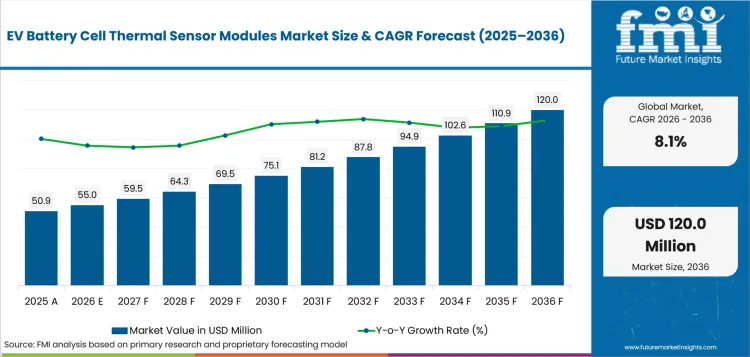
EV Battery Cell Thermal Sensor Modules Market Overview: Size and Forecast
- 2026 Market Size: USD 55.0 million
- 2036 Market Size: USD 120.0 million
- Forecast CAGR: 8.1% from 2026 to 2036
- Leading Propulsion: Battery Electric
- Battery Electric Share in 2026: 68.0%
- Leading Sales Channel: OEM
- OEM Share in 2026: 62.0%
- Fastest-growing Country: India
- India CAGR: 9.3% by 2036
Summary of the EV Battery Cell Thermal Sensor Modules Market
- Demand and Growth Drivers
- Battery pack teams are adding more cell-area temperature inputs to identify localized heat rise before pack-level derating is required.
- Vehicle manufacturers are specifying sensor assemblies earlier in pack development to reduce wiring errors and validation delays.
- High-voltage battery programs are increasing demand for sealed signal paths that can withstand vibration, coolant exposure, and service stress.
- Product and Segment View
- Battery electric propulsion is forecast to represent 68.0% share in 2026, led by full-size traction packs requiring dense thermal sensing.
- OEM channels are projected to hold 62.0% share in 2026, influenced by factory-fit integration and launch-stage supplier qualification.
- Passenger cars are expected to secure 57.0% share in 2026, supported by repeated EV crossover and sedan platform programs.
- Geography and Competitive Outlook
- India is projected to record 9.3% CAGR by 2036, backed by rising local EV platforms and hot-climate battery safety needs.
- China is expected to expand at 9.0% CAGR by 2036 through high EV output and localized battery supply chains.
- Bosch, Denso, and Continental compete through BMS, thermal control, and vehicle electronics integration.
- Sensata Technologies, TE Connectivity, Molex, Amphenol Advanced Sensors, Vishay, and TDK compete around sensing accuracy, sealed connectors, and automotive-grade components.
- Analyst Opinion
- Nikhil Kaitwade, Associate Vice President at Future Market Insights, observes, “EV battery cell thermal sensor modules are no longer simple temperature-reading parts. They are becoming battery qualification tools that help automakers prove signal stability, thermal warning capability, and service traceability. Suppliers that combine sensing, connector design, and BMS compatibility should gain stronger program positions as battery packs become denser and charging rates increase.”
Market outlook is being shaped by EV scale, high-voltage safety rules, and pack-level diagnostics. The International Energy Agency reported in May 2026 that global electric car sales exceeded 20 million in 2025 and reached 25% of new car sales worldwide. The same report stated that battery electric cars accounted for 65% of electric car sales in 2025, increasing the number of large packs requiring validated module sensing. NHTSA’s December 2024 FMVSS No. 305a final rule applies to light and heavy electric-powered vehicles and covers propulsion battery performance requirements. Suppliers with sealed sensors, stable calibration, and BMS-ready signals are expected to gain stronger program access.
Which factors support expansion in the EV Battery Cell Thermal Sensor Modules Market?
Finished sensor-module revenue and validated pack integration support market value across battery electric vehicle platforms.
- Market value is supported by pre-qualified sensor modules before pack assembly, warranty diagnostics, and service tools add incremental demand.
- Supplier pricing reflects sensing accuracy, connector sealing, and calibration evidence before software linkage influences premium positioning.
- Revenue improves as OEMs move from loose thermistor sourcing toward module assemblies with documented installation and traceability.
- Buyer confidence rises when suppliers prove thermal signal stability under vibration, heat exposure, and coolant-interface conditions.
Why is the EV Battery Cell Thermal Sensor Modules Market growing?
Battery electric vehicle scale is raising demand for thermal sensing closer to cell groups, coolant interfaces, and module junctions.
Growth outlook has become more structured as EV pack designs move from basic temperature checks toward early thermal risk detection. The International Energy Agency stated in May 2026 that electric car sales are expected to reach 23 million in 2026, representing close to 30% of total car sales worldwide. That larger vehicle base increases repeat demand for battery modules, BMS-linked diagnostics, and thermal safety components. Pack engineers need more reliable signal inputs because one pack-average temperature cannot identify every localized cell event. Automotive-grade sensor modules therefore gain value when they reduce harness complexity and support safety documentation.
How is the EV Battery Cell Thermal Sensor Modules Market segmented?
The EV Battery Cell Thermal Sensor Modules industry is segmented by component type, vehicle type, propulsion, sales channel, and region.
- Battery electric propulsion is anticipated to hold 68.0% share in 2026, supported by large traction packs needing higher sensing density and stronger thermal propagation monitoring.
- OEM channels are forecast to represent 62.0% share in 2026, guided by early pack design approval and long supplier validation cycles.
- Passenger cars are projected to account for 57.0% share in 2026, led by high EV platform volumes across sedans, crossovers, and compact SUVs.
- East Asia is expected to secure 43.0% share in 2026, reflected by China, Japan, and South Korea anchoring battery cell and pack supply chains.
- Module assemblies are estimated to capture 34.0% share in 2026, supported by buyer preference for pre-wired and pre-qualified sensing units.
Why does battery electric propulsion dominate the EV Battery Cell Thermal Sensor Modules Market?
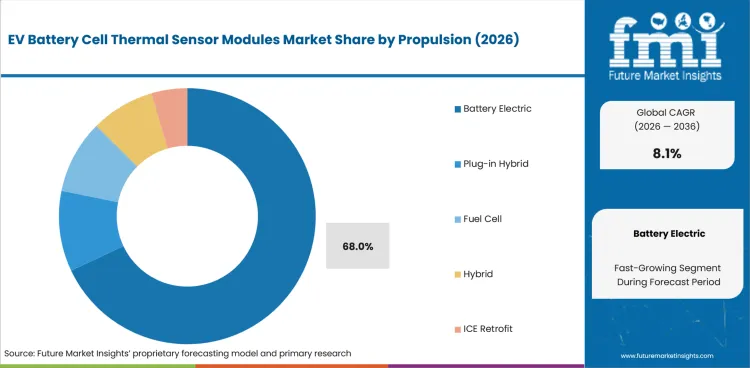
- Battery electric propulsion is projected to account for 68.0% share in 2026, influenced by larger battery packs and greater need for cell-group thermal visibility.
- Plug-in hybrid platforms use fewer sensing points per vehicle, although tighter packaging keeps module-level monitoring relevant for compact layouts.
Which sales channel leads the EV Battery Cell Thermal Sensor Modules Market?
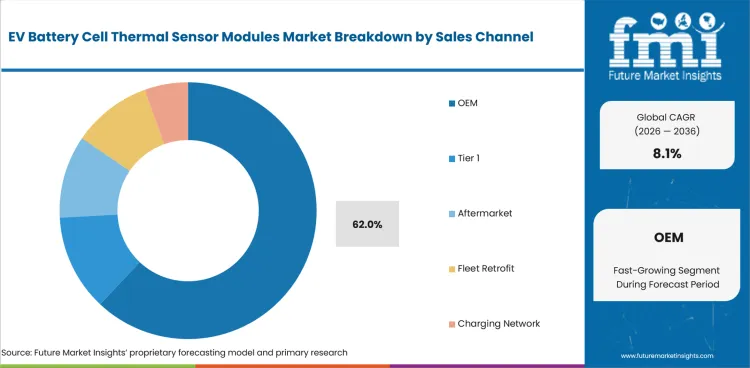
- OEM channels are expected to represent 62.0% share in 2026, driven by sensor placement decisions being locked before battery pack production begins.
- Tier 1 channels gain importance where BMS integrators bundle thermal sensors, connectors, software calibration, and pack electronics into larger system awards.
Which vehicle type leads the EV Battery Cell Thermal Sensor Modules Market?
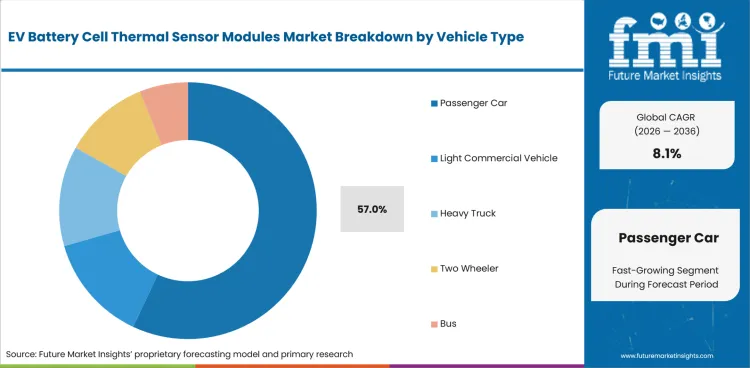
- Passenger cars are forecast to hold 57.0% share in 2026, reflected by high EV production volumes and repeated platform use across global model families.
- Heavy trucks require higher durability and thermal-risk monitoring, although lower production volumes keep their share below passenger vehicles.
Which region leads the EV Battery Cell Thermal Sensor Modules Market?
- East Asia is projected to account for 43.0% share in 2026, led by local battery manufacturing depth and shorter feedback loops between cell makers and OEMs.
- Europe gains value through vehicle approval pressure, fleet electrification programs, and premium EV platforms requiring validated sensor documentation.
Which component type leads the EV Battery Cell Thermal Sensor Modules Market?
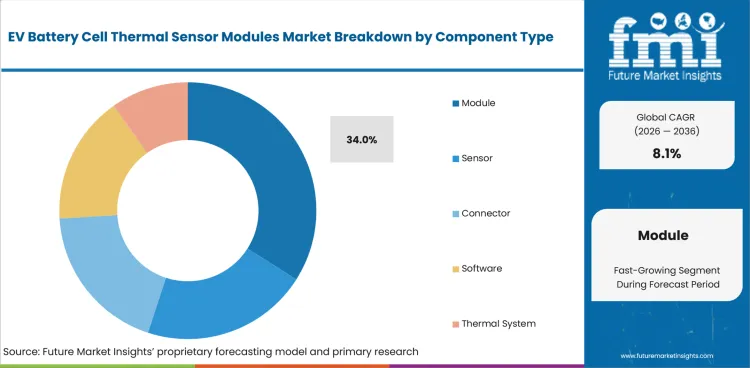
- Module assemblies are anticipated to capture 34.0% share in 2026, supported by pre-routed sensors, sealed connectors, and installation-ready pack integration.
- Sensors remain widely used as individual components, but loose thermistor sourcing faces pricing pressure and more limited differentiation.
What are the driver, restraints, and opportunities in the EV Battery Cell Thermal Sensor Modules Market?
Safety validation and dense battery design support demand while cost pressure limits margins for basic sensing assemblies.
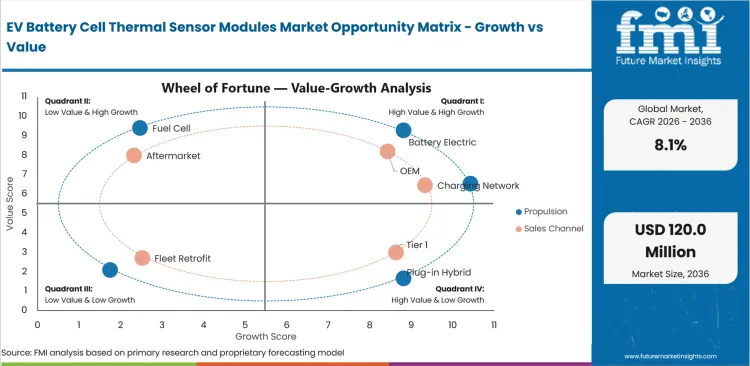
- Driver: Thermal propagation tests push OEMs to document sensor placement and detection timing within battery packs.
- Restraint: High-volume passenger car programs place strong price pressure on standard thermistor and harness assemblies.
- Opportunity: Software-enabled diagnostics create value where thermal sensors support warranty, service, and fleet monitoring decisions.
Thermal Propagation Evidence
Safety validation is becoming a direct demand trigger for EV battery thermal sensor modules. NHTSA’s December 2024 FMVSS No. 305a final rule covers electric-powered vehicle safety and includes propulsion battery performance requirements for light and heavy vehicles. This does not name thermal sensor modules as mandatory components, yet it raises the practical need for stronger pack evidence. OEMs must show that battery electrical and thermal risks are controlled under normal use, charging, and post-crash conditions. Suppliers with documented sensing accuracy and failure-mode evidence gain stronger positions during battery pack design review.
Pack Cost and Qualification Restraint
Cost pressure remains a restraint because high-volume EV programs need lower bill-of-material costs while also asking for higher validation quality. The USA EPA reported in February 2026 that average new vehicle real-world fuel economy reached a record 27.2 mpg in model year 2024, showing ongoing efficiency pressure across vehicle platforms. Automakers are therefore forced to improve efficiency and safety without allowing every component cost to rise. Thermal sensor module suppliers must reduce wiring complexity, improve installation repeatability, and avoid over-engineering basic sensor assemblies.
Diagnostic Software Opportunity
The strongest opportunity lies in combining sensor modules with BMS diagnostics and service data. NREL’s 2026 battery safety work notes that combining signals provides a better view of lithium-ion battery safety state than relying on one sensor type. That supports module suppliers able to connect temperature, pressure, voltage, or circuit evidence into useful pack-level warning logic. Software-linked diagnostics can also support warranty triage, fleet uptime, and service decisions. This moves supplier value beyond hardware and into repeat platform support.
Which countries are growing fastest in the EV Battery Cell Thermal Sensor Modules Market?
India 9.3% CAGR, China 9.0% CAGR, South Korea 8.7% CAGR, United Kingdom 8.4% CAGR, Germany 7.9% CAGR, France 7.6% CAGR, United States 7.2% CAGR, and Japan 6.4% CAGR through 2036.
.webp "Top Country Growth Comparison Ev Battery Cell Thermal Sensor Modules Market Cagr (2026 2036)")
| Country | CAGR |
|---|---|
| India | 9.3% |
| China | 9.0% |
| South Korea | 8.7% |
| United Kingdom | 8.4% |
| Germany | 7.9% |
| France | 7.6% |
| United States | 7.2% |
| Japan | 6.4% |
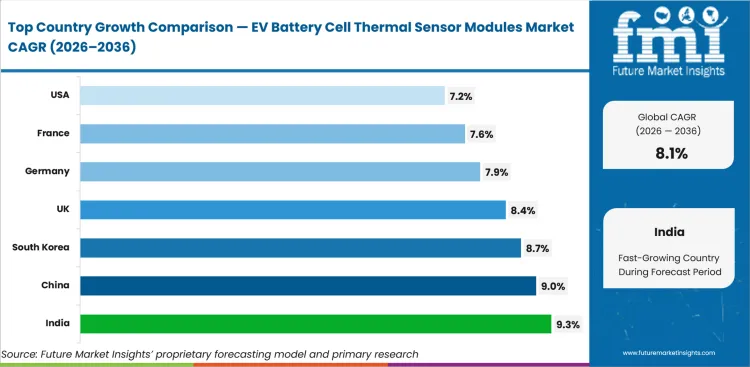
Source: Future Market Insights, 2026.
How do country-level CAGRs compare in the EV Battery Cell Thermal Sensor Modules Market?
India leads country growth while Japan records the most cautious expansion outlook among profiled markets.
- India is forecast to record 9.3% CAGR by 2036 as local electric car platforms scale from a smaller base.
- China is expected to expand at 9.0% CAGR from 2026 to 2036 due to high EV output and domestic battery supply depth.
- South Korea is projected to grow at 8.7% CAGR through 2036 as local battery makers raise pack safety specifications.
- The United Kingdom is estimated to rise at 8.4% CAGR by 2036 with ZEV rules shaping OEM model availability.
- Germany is expected to advance at 7.9% CAGR over the forecast period as premium EV engineering supports validated sensing.
- France is forecast to grow at 7.6% CAGR through 2036 as compact BEV programs need scalable module packaging.
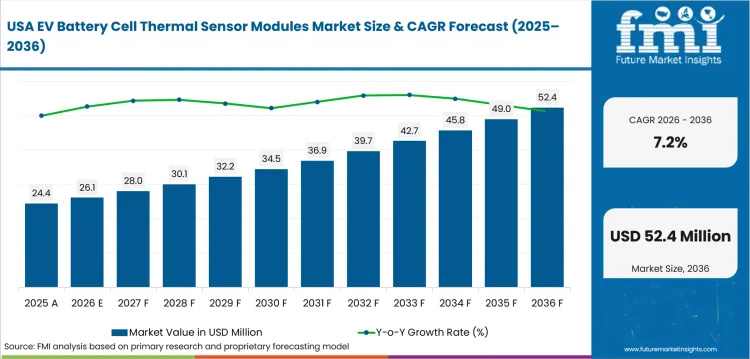
- The United States is projected to post 7.2% CAGR by 2036 as large EV battery packs raise thermal monitoring needs.
- Japan is expected to record 6.4% CAGR by 2036 as cautious BEV adoption limits near-term domestic volume.
How fast is the EV Battery Cell Thermal Sensor Modules Market growing in India?
A 9.3% CAGR through 2036 reflects rising local EV platforms and battery safety needs in hot operating conditions.
Country Market Snapshot Table
| Parameter | Value |
|---|---|
| Market Size in 2025 (Value) | USD 1.4 million |
| Market Size in 2026 (Value) | USD 1.5 million |
| Market Forecast in 2036 (Value) | USD 3.7 million |
| CAGR (2026 to 2036) | 9.3% |
| Years Considered | 2021 to 2036 |
| Base Year | 2025 |
| Forecast Period | 2026 to 2036 |
| Units Considered | Value (USD million) |
| Leading Sub-Region | Western and southern EV manufacturing corridors |
India EV Battery Cell Thermal Sensor Modules Market Outlook
India demand is shaped by rising EV adoption from a smaller car base and difficult operating conditions for battery packs. Local OEMs need rugged thermal sensing that can withstand heat, dust, vibration, and service variability.
Battery module suppliers can gain early traction by working with domestic passenger vehicle, electric bus, and two-wheeler platforms. Pack-level service feedback is expected to become important as fleets push for lower downtime.
Key Growth Drivers
- India’s electric car sales increased 75% year on year to reach about 165,000 units, creating more pack platforms that need localized thermal sensing.
- The PM E-DRIVE scheme carries an outlay of Rs.10,900 crore, supporting EV adoption, charging infrastructure, and testing-agency modernization.
- Domestic passenger EV platforms create a clearer path for local sourcing because battery modules can be qualified near vehicle assembly and service teams.
- Hot operating conditions raise the practical value of reliable cell-area sensing because thermal stress can appear earlier in dense urban use.
Key Restraints
- SIAM reported passenger vehicle sales of 11,62,560 units during the latest January-to-March quarter, showing a broad car market where EVs still form a smaller penetration base.
- Entry EV price sensitivity restricts premium sensor content because OEMs must protect affordability while improving battery safety.
- Local validation capacity is still developing outside major engineering centers, slowing supplier approval for new module architectures.
What makes India unique
India is unique due to hot-climate battery stress, price-sensitive EV platforms, and rising local sourcing requirements.
Key Companies
- Tata Motors
- Mahindra & Mahindra
- Bosch India
- Denso India
- Sensata Technologies
- TE Connectivity India
- Amphenol Advanced Sensors
Sales & Marketing Channels
- Local OEM sourcing teams
- Tier 1 battery electronics programs
- Authorized electronics distributors
- Fleet and bus procurement channels
- Battery pack integrators
- Service diagnostic partnerships
Country Segment Breakdown Table
| Segment | Sub-Segments |
|---|---|
| By Component Type | Sensor · Module · Connector · Software · Thermal System |
| By Vehicle Type | Passenger Car · Light Commercial Vehicle · Heavy Truck · Two Wheeler · Bus |
| By Propulsion | Battery Electric · Plug-in Hybrid · Fuel Cell · Hybrid · ICE Retrofit |
| By Sales Channel | OEM · Tier 1 · Aftermarket · Fleet Retrofit · Charging Network |
| By Region | North America · Europe · East Asia · South Asia · Latin America |
| Key Sub-Regions Covered, EV Manufacturing and Fleet Corridors | Maharashtra · Tamil Nadu · Karnataka · Gujarat · Delhi NCR · Telangana |
Market Taxonomy and Sub-Regions Covered
Frequently Asked Questions
How fast is India EV Battery Cell Thermal Sensor Modules Market growing?
India is expected to grow at 9.3% CAGR from 2026 to 2036 through country-specific EV battery pack demand.
Who leads India EV Battery Cell Thermal Sensor Modules Market?
Tata Motors, Mahindra & Mahindra, Bosch India, Denso India, Sensata Technologies compete through local OEM, electronics, and battery pack supply channels.
What is driving adoption in India EV Battery Cell Thermal Sensor Modules Market?
Battery pack validation, thermal safety requirements, and OEM qualification needs are supporting module-level thermal sensing.
What is the EV Battery Cell Thermal Sensor Modules Market outlook in China?
A 9.0% CAGR through 2036 is supported by high EV output and deep battery supply chains.
Country Market Snapshot Table
| Parameter | Value |
|---|---|
| Market Size in 2025 (Value) | USD 16.5 million |
| Market Size in 2026 (Value) | USD 18.0 million |
| Market Forecast in 2036 (Value) | USD 42.6 million |
| CAGR (2026 to 2036) | 9.0% |
| Years Considered | 2021 to 2036 |
| Base Year | 2025 |
| Forecast Period | 2026 to 2036 |
| Units Considered | Value (USD million) |
| Leading Sub-Region | Yangtze River Delta and southern battery clusters |
China EV Battery Cell Thermal Sensor Modules Market Outlook
China demand is shaped by large EV production volumes and intense pack cost competition. Local sourcing, fast engineering changes, and short launch cycles influence supplier selection.
Sensor module buyers prioritize low unit cost with repeatable quality evidence. Suppliers that localize assembly and support fast validation should gain stronger access to Chinese OEM programs.
Key Growth Drivers
- China sold more than 13 million electric cars, giving battery module suppliers the world’s largest repeat platform base.
- Applications for China’s auto trade-in subsidies exceeded 10 million, supporting replacement-led EV demand and pack sourcing activity.
- Domestic cell and pack supply chains reduce design-to-production time for thermal sensor module programs.
- Large OEMs push suppliers to localize sensor, connector, and harness assembly close to battery pack plants.
Key Restraints
- China accounted for 60% of global EV battery deployment, intensifying cost benchmarks for suppliers serving high-volume pack lines.
- Intense price competition lowers margins for standard thermistor modules and pushes suppliers toward cost-down engineering.
- Local suppliers can replace global brands when qualification evidence, delivery speed, and price discipline meet OEM expectations.
What makes China unique
China is unique because it sets the global cost and scale benchmark for EV battery thermal sensor module manufacturing.
Key Companies
- BYD
- CATL-linked pack ecosystems
- Bosch China
- Continental China
- TE Connectivity China
- Molex China
- Sensata Technologies China
Sales & Marketing Channels
- Local OEM sourcing offices
- Battery pack integrator programs
- Tier 1 electronics awards
- Domestic distributor networks
- Joint engineering centers
- Battery cell maker qualification
Country Segment Breakdown Table
| Segment | Sub-Segments |
|---|---|
| By Component Type | Sensor · Module · Connector · Software · Thermal System |
| By Vehicle Type | Passenger Car · Light Commercial Vehicle · Heavy Truck · Two Wheeler · Bus |
| By Propulsion | Battery Electric · Plug-in Hybrid · Fuel Cell · Hybrid · ICE Retrofit |
| By Sales Channel | OEM · Tier 1 · Aftermarket · Fleet Retrofit · Charging Network |
| By Region | North America · Europe · East Asia · South Asia · Latin America |
| Key Sub-Regions Covered, EV Manufacturing and Fleet Corridors | Shanghai · Jiangsu · Zhejiang · Guangdong · Chongqing · Anhui |
Market Taxonomy and Sub-Regions Covered
Frequently Asked Questions
How fast is China EV Battery Cell Thermal Sensor Modules Market growing?
China is expected to grow at 9.0% CAGR from 2026 to 2036 through country-specific EV battery pack demand.
Who leads China EV Battery Cell Thermal Sensor Modules Market?
BYD, CATL-linked pack ecosystems, Bosch China, Continental China, TE Connectivity China compete through local OEM, electronics, and battery pack supply channels.
What is driving adoption in China EV Battery Cell Thermal Sensor Modules Market?
Battery pack validation, thermal safety requirements, and OEM qualification needs are supporting module-level thermal sensing.
What is driving EV Battery Cell Thermal Sensor Modules growth in South Korea?
An 8.7% CAGR through 2036 is supported by battery maker influence and export platform specifications.
Country Market Snapshot Table
| Parameter | Value |
|---|---|
| Market Size in 2025 (Value) | USD 3.4 million |
| Market Size in 2026 (Value) | USD 3.7 million |
| Market Forecast in 2036 (Value) | USD 8.5 million |
| CAGR (2026 to 2036) | 8.7% |
| Years Considered | 2021 to 2036 |
| Base Year | 2025 |
| Forecast Period | 2026 to 2036 |
| Units Considered | Value (USD million) |
| Leading Sub-Region | Seoul, Ulsan, and battery manufacturing corridors |
South Korea EV Battery Cell Thermal Sensor Modules Market Outlook
South Korea’s role is larger than domestic vehicle sales suggest because local battery makers influence global pack specifications. Thermal sensor modules must meet both vehicle OEM and cell maker validation needs.
The market favors suppliers that can prove quality systems, signal stability, and export-ready traceability. Battery makers can transfer domestic validation preferences into global EV programs.
Key Growth Drivers
- Korean electric car sales increased by around 65%, giving local validation teams a stronger domestic data base for battery pack sensing.
- The national EV policy budget includes KRW 780 billion for electric passenger vehicles, supporting local demand signals for electrified platforms.
- Korean battery makers export pack standards into global EV programs, increasing demand for qualified thermal sensing components.
- Advanced cell chemistries require stronger thermal monitoring because localized heat rise can affect pack safety evidence.
Key Restraints
- The same policy database lists KRW 572.72 billion for electric trucks, showing that funding is spread across vehicle classes rather than concentrated only in passenger cars.
- Large battery firms prefer proven suppliers with global quality systems, limiting access for smaller sensor module entrants.
- Export program dependence creates longer approval paths because modules must satisfy both domestic and overseas OEM requirements.
What makes South Korea unique
South Korea is unique because its cell makers export battery pack specifications across several global EV programs.
Key Companies
- LG Energy Solution
- Samsung SDI
- SK On
- Hyundai Mobis
- Bosch Korea
- Denso Korea
- TE Connectivity Korea
Sales & Marketing Channels
- Battery cell maker qualification
- OEM platform sourcing
- Tier 1 BMS programs
- Electronics distributor support
- Joint validation labs
- Export platform sourcing
Country Segment Breakdown Table
| Segment | Sub-Segments |
|---|---|
| By Component Type | Sensor · Module · Connector · Software · Thermal System |
| By Vehicle Type | Passenger Car · Light Commercial Vehicle · Heavy Truck · Two Wheeler · Bus |
| By Propulsion | Battery Electric · Plug-in Hybrid · Fuel Cell · Hybrid · ICE Retrofit |
| By Sales Channel | OEM · Tier 1 · Aftermarket · Fleet Retrofit · Charging Network |
| By Region | North America · Europe · East Asia · South Asia · Latin America |
| Key Sub-Regions Covered, EV Manufacturing and Fleet Corridors | Seoul · Ulsan · Gyeonggi · Chungcheong · Daegu · Busan |
Market Taxonomy and Sub-Regions Covered
Frequently Asked Questions
How fast is South Korea EV Battery Cell Thermal Sensor Modules Market growing?
South Korea is expected to grow at 8.7% CAGR from 2026 to 2036 through country-specific EV battery pack demand.
Who leads South Korea EV Battery Cell Thermal Sensor Modules Market?
LG Energy Solution, Samsung SDI, SK On, Hyundai Mobis, Bosch Korea compete through local OEM, electronics, and battery pack supply channels.
What is driving adoption in South Korea EV Battery Cell Thermal Sensor Modules Market?
Battery pack validation, thermal safety requirements, and OEM qualification needs are supporting module-level thermal sensing.
How is the EV Battery Cell Thermal Sensor Modules Market performing in the United Kingdom?
An 8.4% CAGR through 2036 reflects ZEV policy pressure and fleet-led battery electric demand.
Country Market Snapshot Table
| Parameter | Value |
|---|---|
| Market Size in 2025 (Value) | USD 2.4 million |
| Market Size in 2026 (Value) | USD 2.6 million |
| Market Forecast in 2036 (Value) | USD 5.8 million |
| CAGR (2026 to 2036) | 8.4% |
| Years Considered | 2021 to 2036 |
| Base Year | 2025 |
| Forecast Period | 2026 to 2036 |
| Units Considered | Value (USD million) |
| Leading Sub-Region | Midlands and national fleet procurement networks |
United Kingdom EV Battery Cell Thermal Sensor Modules Market Outlook
United Kingdom demand is policy-shaped and highly dependent on fleet ordering behavior. Battery electric car sales create a stronger need for validated sensor modules across global platforms imported into the market.
Suppliers benefit when modules are already approved in European OEM programs. Fleet buyers value diagnostics that reduce downtime and support battery warranty decisions.
Key Growth Drivers
- Zero-emission cars accounted for 23% of new car registrations, creating a larger installed base for battery diagnostics.
- The Electric Car Grant provides up to GBP 3,750 on eligible cars, encouraging model availability within price-sensitive EV categories.
- Fleet and company-car channels support sensor module demand because reliability data influences operating cost and downtime decisions.
- European homologation pathways support early thermal-safety design review for vehicles sold into the United Kingdom.
Key Restraints
- The car ZEV target was 28%, leaving a gap between policy ambition and battery electric registration share.
- Consumer price sensitivity limits fast adoption of higher-cost EV trims that may carry more advanced sensor and diagnostic content.
- Import dependence exposes thermal sensor module demand to currency, tariff, and logistics pressure across European supply chains.
What makes United Kingdom unique
The United Kingdom is unique because regulatory pressure converts quickly into fleet buying behavior and OEM platform planning.
Key Companies
- Sensata Technologies UK
- Bosch UK
- TE Connectivity UK
- Molex
- Aptiv
- Continental
- Amphenol Advanced Sensors
Sales & Marketing Channels
- Fleet leasing relationships
- OEM platform sourcing
- Tier 1 electronics integration
- Distributor-backed engineering support
- Battery service diagnostic tools
- Pack integrator qualification
Country Segment Breakdown Table
| Segment | Sub-Segments |
|---|---|
| By Component Type | Sensor · Module · Connector · Software · Thermal System |
| By Vehicle Type | Passenger Car · Light Commercial Vehicle · Heavy Truck · Two Wheeler · Bus |
| By Propulsion | Battery Electric · Plug-in Hybrid · Fuel Cell · Hybrid · ICE Retrofit |
| By Sales Channel | OEM · Tier 1 · Aftermarket · Fleet Retrofit · Charging Network |
| By Region | North America · Europe · East Asia · South Asia · Latin America |
| Key Sub-Regions Covered, EV Manufacturing and Fleet Corridors | West Midlands · London · Oxfordshire · Sunderland · Manchester · Bristol |
Market Taxonomy and Sub-Regions Covered
Frequently Asked Questions
How fast is United Kingdom EV Battery Cell Thermal Sensor Modules Market growing?
United Kingdom is expected to grow at 8.4% CAGR from 2026 to 2036 through country-specific EV battery pack demand.
Who leads United Kingdom EV Battery Cell Thermal Sensor Modules Market?
Sensata Technologies UK, Bosch UK, TE Connectivity UK, Molex, Aptiv compete through local OEM, electronics, and battery pack supply channels.
What is driving adoption in United Kingdom EV Battery Cell Thermal Sensor Modules Market?
Battery pack validation, thermal safety requirements, and OEM qualification needs are supporting module-level thermal sensing.
What is the EV Battery Cell Thermal Sensor Modules Market forecast for Germany?
A 7.9% CAGR through 2036 reflects premium EV engineering and strict validation requirements.
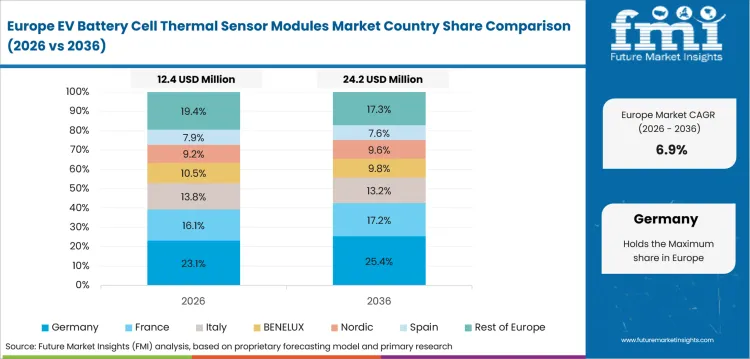
Country Market Snapshot Table
| Parameter | Value |
|---|---|
| Market Size in 2025 (Value) | USD 4.4 million |
| Market Size in 2026 (Value) | USD 4.8 million |
| Market Forecast in 2036 (Value) | USD 10.3 million |
| CAGR (2026 to 2036) | 7.9% |
| Years Considered | 2021 to 2036 |
| Base Year | 2025 |
| Forecast Period | 2026 to 2036 |
| Units Considered | Value (USD million) |
| Leading Sub-Region | Bavaria, Baden-Wurttemberg, and Lower Saxony OEM clusters |
Germany EV Battery Cell Thermal Sensor Modules Market Outlook
Germany is a design-driven market where sensor traceability, calibration evidence, and supplier quality systems carry strong weight. Premium EV platforms need high-confidence thermal data under fast charging and high-speed use.
Cost-down pressure is increasing as more affordable BEVs enter the market. Suppliers must reduce pack-line complexity without weakening validation evidence.
Key Growth Drivers
- German electric car sales increased by 50% to reach a record 850,000 units, expanding the platform base for battery sensing.
- EU standards require new cars and vans to emit 15% less CO2 against the applicable reference target, sustaining EV launch pressure.
- German engineering teams value sensor traceability and validation records during battery pack sourcing decisions.
- Premium EV platforms require accurate temperature data under repeated fast charging and higher driving loads.
Key Restraints
- Average BEV prices in Germany fell by around 6%, intensifying cost pressure on standard sensor modules.
- Long qualification cycles slow supplier replacement once battery pack platforms are frozen.
- Pack-cost reduction programs can limit pricing power for module suppliers that cannot prove integration savings.
What makes Germany unique
Germany is unique because premium EV engineering is paired with strict cost-down discipline after platform launch.
Key Companies
- Bosch
- Continental
- TE Connectivity
- Molex
- Sensata Technologies
- Vishay
- TDK
Sales & Marketing Channels
- Direct OEM technical sales
- Tier 1 co-development programs
- Battery pack engineering workshops
- Approved vendor lists
- Automotive electronics distributors
- Validation laboratory partnerships
Country Segment Breakdown Table
| Segment | Sub-Segments |
|---|---|
| By Component Type | Sensor · Module · Connector · Software · Thermal System |
| By Vehicle Type | Passenger Car · Light Commercial Vehicle · Heavy Truck · Two Wheeler · Bus |
| By Propulsion | Battery Electric · Plug-in Hybrid · Fuel Cell · Hybrid · ICE Retrofit |
| By Sales Channel | OEM · Tier 1 · Aftermarket · Fleet Retrofit · Charging Network |
| By Region | North America · Europe · East Asia · South Asia · Latin America |
| Key Sub-Regions Covered, EV Manufacturing and Fleet Corridors | Bavaria · Baden-Wurttemberg · Lower Saxony · Saxony · North Rhine-Westphalia · Hesse |
Market Taxonomy and Sub-Regions Covered
Frequently Asked Questions
How fast is Germany EV Battery Cell Thermal Sensor Modules Market growing?
Germany is expected to grow at 7.9% CAGR from 2026 to 2036 through country-specific EV battery pack demand.
Who leads Germany EV Battery Cell Thermal Sensor Modules Market?
Bosch, Continental, TE Connectivity, Molex, Sensata Technologies compete through local OEM, electronics, and battery pack supply channels.
What is driving adoption in Germany EV Battery Cell Thermal Sensor Modules Market?
Battery pack validation, thermal safety requirements, and OEM qualification needs are supporting module-level thermal sensing.
What is the EV Battery Cell Thermal Sensor Modules Market outlook in France?
A 7.6% CAGR through 2036 is supported by compact BEV programs and European platform sourcing.
Country Market Snapshot Table
| Parameter | Value |
|---|---|
| Market Size in 2025 (Value) | USD 2.2 million |
| Market Size in 2026 (Value) | USD 2.4 million |
| Market Forecast in 2036 (Value) | USD 5.0 million |
| CAGR (2026 to 2036) | 7.6% |
| Years Considered | 2021 to 2036 |
| Base Year | 2025 |
| Forecast Period | 2026 to 2036 |
| Units Considered | Value (USD million) |
| Leading Sub-Region | Northern and western automotive corridors |
France EV Battery Cell Thermal Sensor Modules Market Outlook
France demand is tied to compact and mid-size BEV programs where cost, packaging, and repeatability are central. Thermal sensor modules must be compact enough for smaller packs while retaining validation quality.
The market benefits from European emissions pressure and improving BEV mix. Suppliers with scalable connector and module packaging should gain stronger positions in French platform sourcing.
Key Growth Drivers
- Battery electric car sales in France increased by almost 15%, raising sensor value per electrified vehicle.
- France’s ecological bonus can reach EUR 4,000 for eligible households, supporting affordable BEV demand and compact platform planning.
- French compact EV programs require scalable modules that limit wiring work and protect pack assembly time.
- European platform sourcing supports repeat module use when suppliers meet shared OEM quality standards.
Key Restraints
- Plug-in hybrid sales decreased by 25%, narrowing sensing opportunities outside full battery electric platforms.
- Small-car affordability limits use of high-cost sensing architectures in lower-priced EV platforms.
- Battery module sourcing often follows wider European platform decisions, reducing direct influence from local component teams.
What makes France unique
France is unique because compact BEV programs place equal pressure on sensor packaging, cost, and repeatable assembly quality.
Key Companies
- Valeo
- Bosch
- Continental
- TE Connectivity
- Molex
- Sensata Technologies
- Amphenol Advanced Sensors
Sales & Marketing Channels
- OEM platform sourcing
- Tier 1 thermal-system programs
- Pack module co-design
- European distributor support
- After-sales diagnostic partnerships
- Battery engineering workshops
Country Segment Breakdown Table
| Segment | Sub-Segments |
|---|---|
| By Component Type | Sensor · Module · Connector · Software · Thermal System |
| By Vehicle Type | Passenger Car · Light Commercial Vehicle · Heavy Truck · Two Wheeler · Bus |
| By Propulsion | Battery Electric · Plug-in Hybrid · Fuel Cell · Hybrid · ICE Retrofit |
| By Sales Channel | OEM · Tier 1 · Aftermarket · Fleet Retrofit · Charging Network |
| By Region | North America · Europe · East Asia · South Asia · Latin America |
| Key Sub-Regions Covered, EV Manufacturing and Fleet Corridors | Hauts-de-France · Ile-de-France · Grand Est · Auvergne-Rhone-Alpes · Normandy · Occitanie |
Market Taxonomy and Sub-Regions Covered
Frequently Asked Questions
How fast is France EV Battery Cell Thermal Sensor Modules Market growing?
France is expected to grow at 7.6% CAGR from 2026 to 2036 through country-specific EV battery pack demand.
Who leads France EV Battery Cell Thermal Sensor Modules Market?
Valeo, Bosch, Continental, TE Connectivity, Molex compete through local OEM, electronics, and battery pack supply channels.
What is driving adoption in France EV Battery Cell Thermal Sensor Modules Market?
Battery pack validation, thermal safety requirements, and OEM qualification needs are supporting module-level thermal sensing.
How fast is the EV Battery Cell Thermal Sensor Modules Market growing in the United States?
A 7.2% CAGR through 2036 reflects large battery pack formats and service warranty exposure.
Country Market Snapshot Table
| Parameter | Value |
|---|---|
| Market Size in 2025 (Value) | USD 7.1 million |
| Market Size in 2026 (Value) | USD 7.6 million |
| Market Forecast in 2036 (Value) | USD 15.2 million |
| CAGR (2026 to 2036) | 7.2% |
| Years Considered | 2021 to 2036 |
| Base Year | 2025 |
| Forecast Period | 2026 to 2036 |
| Units Considered | Value (USD million) |
| Leading Sub-Region | Great Lakes, Southeast, and western EV platform corridors |
United States EV Battery Cell Thermal Sensor Modules Market Outlook
United States demand is shaped by large battery packs, pickup-style EVs, and cautious OEM platform timing. Thermal sensor module demand depends on pack redesign, safety validation, and warranty exposure rather than EV volume alone.
Local engineering support remains important because OEMs need suppliers that can troubleshoot pack-line assembly and field diagnostic issues. Large packs raise the value of accurate cell-area monitoring.
Key Growth Drivers
- Argonne reported over 1.5 million EVs sold, keeping a large pack-service base active for thermal diagnostic components.
- DOE’s battery manufacturing and recycling grants program carries USD 3 billion in funding, supporting domestic battery capability.
- Large SUVs and pickup-style EVs increase thermal monitoring needs because higher pack capacity expands warranty exposure.
- Domestic battery investments support local module qualification work and shorten engineering communication between OEMs and suppliers.
Key Restraints
- New U.S. electric car sales in the fourth quarter were 45% lower than the comparable prior-year quarter, creating uneven platform planning.
- High labor costs raise pressure to simplify sensor harness routing and reduce manual pack assembly steps.
- Policy shifts can delay vehicle launch timing and make sensor module sourcing less predictable for new platforms.
What makes United States unique
The United States is unique due to large EV pack formats and high warranty exposure across SUV and pickup programs.
Key Companies
- Bosch
- Sensata Technologies
- TE Connectivity
- Molex
- Amphenol Advanced Sensors
- Vishay
- Aptiv
Sales & Marketing Channels
- Direct OEM engineering sales
- Tier 1 battery electronics programs
- Pack integrator qualification cycles
- Authorized electronics distributors
- Fleet service diagnostic channels
- Battery safety validation programs
Country Segment Breakdown Table
| Segment | Sub-Segment |
|---|---|
| By Component Type | Sensor · Module · Connector · Software · Thermal System |
| By Vehicle Type | Passenger Car · Light Commercial Vehicle · Heavy Truck · Two Wheeler · Bus |
| By Propulsion | Battery Electric · Plug-in Hybrid · Fuel Cell · Hybrid · ICE Retrofit |
| By Sales Channel | OEM · Tier 1 · Aftermarket · Fleet Retrofit · Charging Network |
| By Region | North America · Europe · East Asia · South Asia · Latin America |
| Key Sub-Regions Covered, EV Manufacturing and Fleet Corridors | Michigan · Ohio · Tennessee · Georgia · Texas · California |
Market Taxonomy and Sub-Regions Covered
Frequently Asked Questions
How fast is United States EV Battery Cell Thermal Sensor Modules Market growing?
United States is expected to grow at 7.2% CAGR from 2026 to 2036 through country-specific EV battery pack demand.
Who leads United States EV Battery Cell Thermal Sensor Modules Market?
Bosch, Sensata Technologies, TE Connectivity, Molex, Amphenol Advanced Sensors compete through local OEM, electronics, and battery pack supply channels.
What is driving adoption in United States EV Battery Cell Thermal Sensor Modules Market?
Battery pack validation, thermal safety requirements, and OEM qualification needs are supporting module-level thermal sensing.
What is the EV Battery Cell Thermal Sensor Modules Market forecast for Japan?
A 6.4% CAGR through 2036 reflects cautious BEV ramp and strong automotive electronics capability.
Country Market Snapshot Table
| Parameter | Value |
|---|---|
| Market Size in 2025 (Value) | USD 2.6 million |
| Market Size in 2026 (Value) | USD 2.8 million |
| Market Forecast in 2036 (Value) | USD 5.2 million |
| CAGR (2026 to 2036) | 6.4% |
| Years Considered | 2021 to 2036 |
| Base Year | 2025 |
| Forecast Period | 2026 to 2036 |
| Units Considered | Value (USD million) |
| Leading Sub-Region | Chubu and Kanto automotive electronics corridors |
Japan EV Battery Cell Thermal Sensor Modules Market Outlook
Japan is a technology-specification market before it becomes a high-volume BEV market. Domestic supplier relationships favor long validation cycles, high reliability, and stable signal performance.
Thermal sensor modules gain value through hybrid, plug-in hybrid, and export EV programs. Suppliers must prove automotive quality and long service life before winning larger programs.
Key Growth Drivers
- Japan’s electric car sales stayed just above 100,000 units, giving a measured but stable base for battery sensing.
- Conventional hybrids accounted for around one-third of Japanese car sales, supporting compact pack sensing requirements across electrified platforms.
- Japanese OEMs value stable signal behavior, long-life components, and AEC-Q200-qualified sensing parts.
- Export EV platforms can carry Japanese sensor specifications into other regional battery pack programs.
Key Restraints
- Electric cars accounted for less than 3% of Japanese car sales, limiting near-term domestic module volume.
- Conservative supplier approval cycles slow new entrant access and favor long-standing automotive electronics partners.
- Hybrid strength keeps average pack size smaller than BEV-heavy markets, reducing sensor count per domestic vehicle.
What makes Japan unique
Japan is unique due to high reliability expectations and strong electronics capability despite cautious battery electric adoption.
Key Companies
- Denso
- TDK
- Panasonic Industry
- Bosch Japan
- Continental Japan
- Murata Manufacturing
- Amphenol Advanced Sensors
Sales & Marketing Channels
- Keiretsu-style supplier relationships
- OEM engineering approval routes
- Tier 1 BMS integration
- Electronics component distributors
- Export platform sourcing
- Reliability validation programs
Country Segment Breakdown Table
| Segment | Sub-Segments |
|---|---|
| By Component Type | Sensor · Module · Connector · Software · Thermal System |
| By Vehicle Type | Passenger Car · Light Commercial Vehicle · Heavy Truck · Two Wheeler · Bus |
| By Propulsion | Battery Electric · Plug-in Hybrid · Fuel Cell · Hybrid · ICE Retrofit |
| By Sales Channel | OEM · Tier 1 · Aftermarket · Fleet Retrofit · Charging Network |
| By Region | North America · Europe · East Asia · South Asia · Latin America |
| Key Sub-Regions Covered, EV Manufacturing and Fleet Corridors | Aichi · Shizuoka · Kanagawa · Tokyo · Osaka · Fukuoka |
Market Taxonomy and Sub-Regions Covered
Frequently Asked Questions
How fast is Japan EV Battery Cell Thermal Sensor Modules Market growing?
Japan is expected to grow at 6.4% CAGR from 2026 to 2036 through country-specific EV battery pack demand.
Who leads Japan EV Battery Cell Thermal Sensor Modules Market?
Denso, TDK, Panasonic Industry, Bosch Japan, Continental Japan compete through local OEM, electronics, and battery pack supply channels.
What is driving adoption in Japan EV Battery Cell Thermal Sensor Modules Market?
Battery pack validation, thermal safety requirements, and OEM qualification needs are supporting module-level thermal sensing.
Who are the leading companies in the EV Battery Cell Thermal Sensor Modules Market?
Bosch, Denso, Continental, Sensata Technologies, TE Connectivity, and Molex.
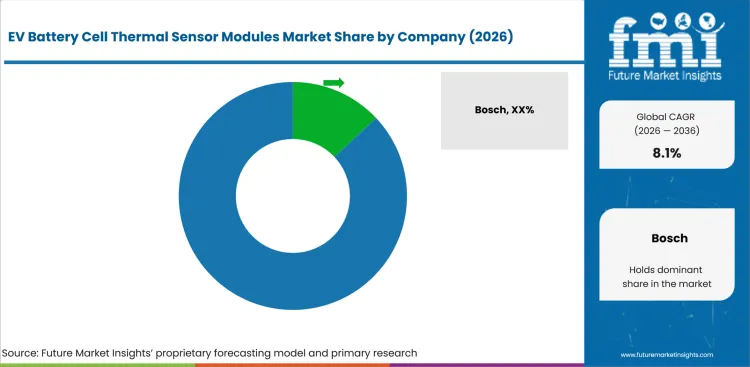
- Established Tier 1 suppliers hold an advantage through BMS integration, vehicle electronics depth, and long OEM qualification histories.
- Sensor specialists gain program access by proving temperature accuracy, operating range, package stability, and automotive-grade reliability.
- Connectivity suppliers gain value where battery packs need compact, sealed, and vibration-resistant signal routes.
- Component makers support module builders with smaller thermistors and qualified sensing parts for dense battery electronics.
Competition is centered on pack-level proof rather than component availability. Bosch and Denso hold strong positions because their battery electronics and vehicle control capabilities reduce integration risk for automakers. Continental also benefits from thermal, electronics, and safety-system familiarity across vehicle platforms. Buyers prefer suppliers that can support validation files, quality records, and engineering changes across more than one region.
Connectivity is the next competitive separator as EV packs move toward dense electronics and cleaner routing. TE Connectivity introduced an inside-device connectivity portfolio in September 2025 for automotive ECUs and battery systems. Molex’s MX-DaSH portfolio combines power, data, and signal options for compact automotive architectures. These moves are relevant because thermal sensor modules must survive vibration, moisture, and repeated assembly stress without losing signal quality.
Specialist component suppliers compete where precision and package size decide module design. Vishay introduced an AEC-Q200 glass-protected NTC thermistor in December 2025 with a 0402 case and precise tolerance options. TDK launched high-reliability automotive NTC thermistors in February 2026 rated up to +175 °C. Companies that combine component reliability, sealed connection, and pack-level validation are best placed to win repeat EV battery programs.
How do top EV Battery Cell Thermal Sensor Modules companies compare?
Bosch and Denso score strongest on system integration while TE Connectivity and Molex lead sealed connector depth.
| Company | Relevance to Market Title | Battery Pack Sensing Fit | Sealed Connector Integration | BMS Diagnostic Linkage | Channel Reach | Geographic Footprint |
|---|---|---|---|---|---|---|
| Bosch | Very High | Very Strong | Strong | Very Strong | Very Strong | Global |
| Denso | Very High | Very Strong | Strong | Strong | Very Strong | Global |
| Continental | High | Strong | Strong | Strong | Strong | Global |
| Sensata Technologies | High | Strong | Moderate | Strong | Strong | Global |
| TE Connectivity | High | Moderate | Very Strong | Strong | Very Strong | Global |
| Molex | High | Moderate | Very Strong | Moderate | Strong | Global |
| Amphenol Advanced Sensors | High | Very Strong | Strong | Moderate | Strong | Global |
| Vishay | Moderate to High | Strong | Moderate | Low to Moderate | Strong | Global |
| TDK | Moderate to High | Strong | Moderate | Low to Moderate | Strong | Japan, Europe, North America, China |
| Aptiv | High | Moderate | Very Strong | Strong | Strong | Global |
Source: Future Market Insights competitive analysis, 2026.
Who are the key players in the EV Battery Cell Thermal Sensor Modules Market?
Bosch, Denso, Continental, Sensata Technologies, TE Connectivity, and Molex are listed with Amphenol Advanced Sensors, Vishay, TDK, and Aptiv among other suppliers.
Key global companies leading the EV Battery Cell Thermal Sensor Modules Market include:
- Bosch
- Denso
- Continental
- Sensata Technologies
- TE Connectivity
- Molex
- Amphenol Advanced Sensors
- Vishay
- TDK
- Aptiv
Key Developments in EV Battery Cell Thermal Sensor Modules Market
- In May 2024, Molex launched the MX-DaSH data-signal hybrid connector portfolio for next-generation automotive architectures.
- In September 2025, TE Connectivity introduced an inside-device connectivity portfolio for automotive ECUs and battery systems.
- In February 2026, TDK launched high-reliability automotive NTC thermistors rated for +175 °C operation.
Key Players in the EV Battery Cell Thermal Sensor Modules Market
System Integrators
- Bosch
- Denso
- Continental
Sensor and Protection Specialists
- Sensata Technologies
- Amphenol Advanced Sensors
- Vishay
- TDK
Connectivity Specialists
- TE Connectivity
- Molex
- Aptiv
EV Battery Cell Thermal Sensor Modules Market - Report Scope
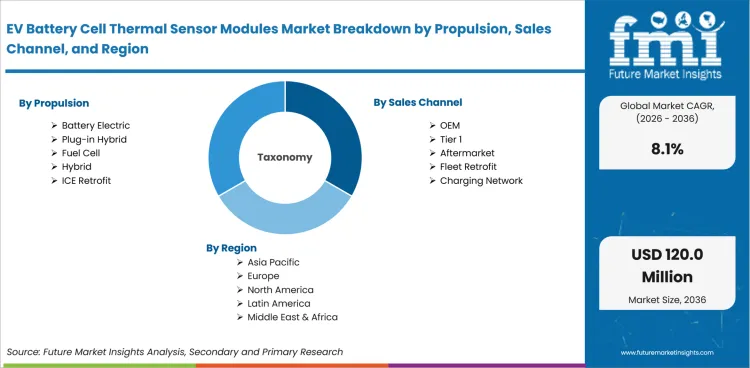
| Item | Value |
|---|---|
| Market size by 2036 | USD 120.0 million |
| Growth rate | 8.1% CAGR from 2026 to 2036 |
| Forecast period | 2026 to 2036 |
| Base year value (2025) | USD 50.9 million |
| By component type | Sensor, module, connector, software, thermal system |
| By vehicle type | Passenger car, light commercial vehicle, heavy truck, two wheeler, bus |
| By propulsion | Battery electric, plug-in hybrid, fuel cell, hybrid, ICE retrofit |
| By sales channel | OEM, Tier 1, aftermarket, fleet retrofit, charging network |
| Regions covered | North America, Latin America, Europe, East Asia, South Asia and Pacific, Middle East and Africa |
| Countries covered | United States, United Kingdom, Germany, France, Japan, China, South Korea, India |
| Key companies profiled | Bosch, Denso, Continental, Sensata Technologies, TE Connectivity, Molex, Amphenol Advanced Sensors, Vishay, TDK, Aptiv |
| Approach | Hybrid bottom-up and top-down approach using EV production, pack design, sensor-module value, and country-level adoption rates |
Source: Future Market Insights, 2026.
EV Battery Cell Thermal Sensor Modules Market - Scope & Definition
| Attribute | Detail |
|---|---|
| Market Definition | Sensor assemblies used to detect, monitor, and transmit temperature or thermal-risk signals around EV battery cells, modules, pack interfaces, coolant paths, and battery management systems |
| Functions Covered | Cell-area temperature detection, thermal runaway warning, battery management support, coolant-interface monitoring, signal transmission, diagnostic data capture, warranty and service support |
| Applications Covered | Battery cell monitoring, module-level thermal sensing, pack interface sensing, BMS-linked diagnostics, coolant loop monitoring, thermal propagation detection, EV service diagnostics |
| End-Use Industries | Electric vehicle industry, automotive electronics industry, battery management system industry, EV battery pack manufacturing, Tier 1 automotive systems, fleet electrification |
| Grades Covered | Automotive-grade thermistors, resistance temperature devices, sealed sensor modules, connector-integrated modules, software-linked diagnostic modules, high-temperature thermal sensing formats |
| Inclusions | All commercially available EV battery cell thermal sensor modules across component type, vehicle type, propulsion, sales channel, and region, including sensors, modules, connectors, software, and thermal systems used inside EV battery packs |
| Exclusions | Generic cabin HVAC sensors, industrial battery energy storage sensors, charging-station sensors, standalone semiconductor temperature devices sold outside EV battery pack use, thermal interface materials without sensing functions, and non-EV automotive temperature sensors |
EV Battery Cell Thermal Sensor Modules Market - Research Methodology
| Method | Description |
|---|---|
| Primary Research | FMI analyst interviews with EV battery pack engineers, BMS integrators, Tier 1 electronics teams, and sensor module suppliers across key markets. |
| Desk Research | Review of EV sales data, battery safety rules, thermal runaway literature, regulatory sources, and official company product information. |
| Market Sizing & Forecasting | Hybrid bottom-up and top-down model using EV production outlook, battery pack penetration, sensor-module value, sales-channel mix, and country-level adoption rates. |
| Data Validation | Cross-verification using EV battery deployment, BMS component use, supplier product portfolios, regulatory evidence, and pack safety qualification maturity. |
EV Battery Cell Thermal Sensor Modules Market Breakdown by Component Type, Vehicle Type, Propulsion, Sales Channel, and Region
EV Battery Cell Thermal Sensor Modules Market Segmented by Component Type
- Sensor
- Module
- Connector
- Software
- Thermal System
EV Battery Cell Thermal Sensor Modules Market Segmented by Vehicle Type
- Passenger Car
- Light Commercial Vehicle
- Heavy Truck
- Two Wheeler
- Bus
EV Battery Cell Thermal Sensor Modules Market Segmented by Propulsion
- Battery Electric
- Plug-in Hybrid
- Fuel Cell
- Hybrid
- ICE Retrofit
EV Battery Cell Thermal Sensor Modules Market Segmented by Sales Channel
- OEM
- Tier 1
- Aftermarket
- Fleet Retrofit
- Charging Network
EV Battery Cell Thermal Sensor Modules Market Segmented by Region
- North America
- Europe
- East Asia
- South Asia
- Latin America
EV Battery Cell Thermal Sensor Modules Market by Region
- North America
- United States
- Canada
- Mexico
- Latin America
- Brazil
- Chile
- Rest of Latin America
- Western Europe
- Germany
- United Kingdom
- Italy
- Spain
- France
- Nordic
- BENELUX
- Rest of Western Europe
- Eastern Europe
- Poland
- Hungary
- Balkan and Baltic Countries
- Rest of Eastern Europe
- East Asia
- China
- Japan
- South Korea
- South Asia and Pacific
- India
- ASEAN
- Australia and New Zealand
- Rest of South Asia and Pacific
- Middle East and Africa
- Kingdom of Saudi Arabia
- Other GCC Countries
- Turkiye
- South Africa
- Other African Union
- Rest of Middle East and Africa
Research Sources and Bibliography
- International Energy Agency. (2026, May 20). Trends in electric cars - Global EV Outlook 2026. International Energy Agency.
- International Energy Agency. (2026, May 20). Electric vehicle batteries - Global EV Outlook 2026. International Energy Agency.
- International Energy Agency. (2026, May 20). Global EV Policy Explorer. International Energy Agency.
- National Highway Traffic Safety Administration. (2024, December). Federal Motor Vehicle Safety Standards; FMVSS No. 305a, Electric-powered vehicles: Electric powertrain integrity. USA Department of Transportation.
- National Renewable Energy Laboratory. (2026, March). Defining the State of Safety for Lithium-Ion Batteries in EVs: A Discussion. USA Department of Energy.
- USA Environmental Protection Agency. (2026, February 19). Highlights of the Automotive Trends Report. USA Environmental Protection Agency.
- Argonne National Laboratory. (2026). EV model availability and sales. Argonne National Laboratory.
- USA Department of Energy. (2026, March). Battery manufacturing and recycling grants. USA Department of Energy.
- Department for Transport. (2026, April 29). Vehicle licensing statistics, United Kingdom: 2025. GOV.UK.
- Department for Transport. (2025, August 28). Drivers to save up to GBP 3,750 as electric car models are added to government grant scheme. GOV.UK.
- Department for Transport. (2025, October 17). Updates to the Vehicle Emissions Trading Schemes Order 2023. GOV.UK.
- European Commission. (2026). Cars and vans: CO2 emission performance standards. European Commission.
- Service-Public.fr. (2025, July 3; updated September 26). What is the follow-up to the ecological bonus? Directorate of Legal and Administrative Information, Prime Minister.
- Government of China. (2025, May). Applications for auto trade-in subsidies exceed 10 million in China. State Council of the People’s Republic of China.
- Ministry of Heavy Industries. (2025, April 1). PM E-DRIVE scheme. Press Information Bureau, Government of India.
- Society of Indian Automobile Manufacturers. (2025, April). Auto industry performance, March 2025. SIAM.
- Molex. (2024, May 7). Molex combines high-speed data, signal and power in MX-DaSH data-signal hybrid connector portfolio. Molex.
- TE Connectivity. (2025, September 29). TE Connectivity launches new product portfolio for automotive ECUs to accelerate SDV and E/E architectural transformation. TE Connectivity.
- Vishay Intertechnology. (2025, December 10). Vishay Intertechnology introduces new AEC-Q200 qualified, glass protected NTC thermistor in 0402 case size. Vishay Intertechnology.
- TDK Corporation. (2026, February 17). TDK launches high-reliability automotive NTC thermistors rated for +175 C. TDK Corporation.
This bibliography is provided for reader reference and is not exhaustive. The full report contains the complete reference list and detailed citations.
This Report Answers
- Market size estimates for 2026 and forecasts through 2036 for the EV Battery Cell Thermal Sensor Modules Market.
- Insights across major regional and country-level markets.
- Analysis of demand drivers, pack safety requirements, battery architecture trends, and purchasing behavior.
- Evaluation of segments including component type, vehicle type, propulsion, and sales channel.
- Assessment of regulatory pressure, battery safety validation, and OEM qualification requirements.
- Identification of opportunities across module assemblies, sealed connectors, and diagnostic software linkage.
- Evaluation of competitive positioning across system integrators, sensor specialists, and connector suppliers.
- Country-level growth analysis covering India, China, South Korea, United Kingdom, Germany, France, United States, and Japan.
- Regional outlooks across North America, Europe, East Asia, South Asia, and Latin America.
- Delivery of market data, forecasts, and supporting analysis in PDF and Excel formats.
Frequently Asked Questions
What is the EV Battery Cell Thermal Sensor Modules Market size in 2026?
The EV Battery Cell Thermal Sensor Modules Market size is anticipated to reach USD 55.0 million in 2026.
What is the EV Battery Cell Thermal Sensor Modules Market forecast for 2036?
The industry revenue is predicted to reach USD 120.0 million by 2036 as pack safety content increases.
What is the EV Battery Cell Thermal Sensor Modules Market CAGR?
The market is projected to expand at 8.1% CAGR from 2026 to 2036.
What segment leads the EV Battery Cell Thermal Sensor Modules Market?
Battery electric propulsion is likely to capture 68.0% share in 2026 due to high sensing density in full traction packs.
Which sales channel leads the EV Battery Cell Thermal Sensor Modules Market?
OEM channels are expected to hold 62.0% share in 2026 because sensor modules are designed into battery packs before launch.
Which country grows fastest in the EV Battery Cell Thermal Sensor Modules Market?
India is set to record 9.3% CAGR by 2036, driven by rising local EV platforms and hot-climate battery safety needs.
Preview the report firsthand - request a free sample
Get SampleGet the brochure for pricing and purchase details.
Get PDFTable of Content
- Executive Summary
- Global Market Outlook
- Demand to side Trends
- Supply to side Trends
- Technology Roadmap Analysis
- Analysis and Recommendations
- Market Overview
- Market Coverage / Taxonomy
- Market Definition / Scope / Limitations
- Research Methodology
- Chapter Orientation
- Analytical Lens and Working Hypotheses
- Market Structure, Signals, and Trend Drivers
- Benchmarking and Cross-market Comparability
- Market Sizing, Forecasting, and Opportunity Mapping
- Research Design and Evidence Framework
- Desk Research Programme (Secondary Evidence)
- Company Annual and Sustainability Reports
- Peer-reviewed Journals and Academic Literature
- Corporate Websites, Product Literature, and Technical Notes
- Earnings Decks and Investor Briefings
- Statutory Filings and Regulatory Disclosures
- Technical White Papers and Standards Notes
- Trade Journals, Industry Magazines, and Analyst Briefs
- Conference Proceedings, Webinars, and Seminar Materials
- Government Statistics Portals and Public Data Releases
- Press Releases and Reputable Media Coverage
- Specialist Newsletters and Curated Briefings
- Sector Databases and Reference Repositories
- FMI Internal Proprietary Databases and Historical Market Datasets
- Subscription Datasets and Paid Sources
- Social Channels, Communities, and Digital Listening Inputs
- Additional Desk Sources
- Expert Input and Fieldwork (Primary Evidence)
- Primary Modes
- Qualitative Interviews and Expert Elicitation
- Quantitative Surveys and Structured Data Capture
- Blended Approach
- Why Primary Evidence is Used
- Field Techniques
- Interviews
- Surveys
- Focus Groups
- Observational and In-context Research
- Social and Community Interactions
- Stakeholder Universe Engaged
- C-suite Leaders
- Board Members
- Presidents and Vice Presidents
- R&D and Innovation Heads
- Technical Specialists
- Domain Subject-matter Experts
- Scientists
- Physicians and Other Healthcare Professionals
- Governance, Ethics, and Data Stewardship
- Research Ethics
- Data Integrity and Handling
- Primary Modes
- Tooling, Models, and Reference Databases
- Desk Research Programme (Secondary Evidence)
- Data Engineering and Model Build
- Data Acquisition and Ingestion
- Cleaning, Normalisation, and Verification
- Synthesis, Triangulation, and Analysis
- Quality Assurance and Audit Trail
- Market Background
- Market Dynamics
- Drivers
- Restraints
- Opportunity
- Trends
- Scenario Forecast
- Demand in Optimistic Scenario
- Demand in Likely Scenario
- Demand in Conservative Scenario
- Opportunity Map Analysis
- Product Life Cycle Analysis
- Supply Chain Analysis
- Investment Feasibility Matrix
- Value Chain Analysis
- PESTLE and Porter’s Analysis
- Regulatory Landscape
- Regional Parent Market Outlook
- Production and Consumption Statistics
- Import and Export Statistics
- Market Dynamics
- Global Market Analysis 2021 to 2025 and Forecast, 2026 to 2036
- Historical Market Size Value (USD Million) Analysis, 2021 to 2025
- Current and Future Market Size Value (USD Million) Projections, 2026 to 2036
- Y to o to Y Growth Trend Analysis
- Absolute $ Opportunity Analysis
- Global Market Pricing Analysis 2021 to 2025 and Forecast 2026 to 2036
- Global Market Analysis 2021 to 2025 and Forecast 2026 to 2036, By Propulsion
- Introduction / Key Findings
- Historical Market Size Value (USD Million) Analysis By Propulsion , 2021 to 2025
- Current and Future Market Size Value (USD Million) Analysis and Forecast By Propulsion , 2026 to 2036
- Battery Electric
- Plug-in Hybrid
- Fuel Cell
- Hybrid
- ICE Retrofit
- Battery Electric
- Y to o to Y Growth Trend Analysis By Propulsion , 2021 to 2025
- Absolute $ Opportunity Analysis By Propulsion , 2026 to 2036
- Global Market Analysis 2021 to 2025 and Forecast 2026 to 2036, By Sales Channel
- Introduction / Key Findings
- Historical Market Size Value (USD Million) Analysis By Sales Channel, 2021 to 2025
- Current and Future Market Size Value (USD Million) Analysis and Forecast By Sales Channel, 2026 to 2036
- OEM
- Tier 1
- Aftermarket
- Fleet Retrofit
- Charging Network
- OEM
- Y to o to Y Growth Trend Analysis By Sales Channel, 2021 to 2025
- Absolute $ Opportunity Analysis By Sales Channel, 2026 to 2036
- Global Market Analysis 2021 to 2025 and Forecast 2026 to 2036, By Vehicle Type
- Introduction / Key Findings
- Historical Market Size Value (USD Million) Analysis By Vehicle Type, 2021 to 2025
- Current and Future Market Size Value (USD Million) Analysis and Forecast By Vehicle Type, 2026 to 2036
- Passenger Car
- Light Commercial Vehicle
- Heavy Truck
- Two Wheeler
- Bus
- Passenger Car
- Y to o to Y Growth Trend Analysis By Vehicle Type, 2021 to 2025
- Absolute $ Opportunity Analysis By Vehicle Type, 2026 to 2036
- Global Market Analysis 2021 to 2025 and Forecast 2026 to 2036, By Component Type
- Introduction / Key Findings
- Historical Market Size Value (USD Million) Analysis By Component Type, 2021 to 2025
- Current and Future Market Size Value (USD Million) Analysis and Forecast By Component Type, 2026 to 2036
- Module
- Sensor
- Connector
- Software
- Thermal System
- Module
- Y to o to Y Growth Trend Analysis By Component Type, 2021 to 2025
- Absolute $ Opportunity Analysis By Component Type, 2026 to 2036
- Global Market Analysis 2021 to 2025 and Forecast 2026 to 2036, By Region
- Introduction
- Historical Market Size Value (USD Million) Analysis By Region, 2021 to 2025
- Current Market Size Value (USD Million) Analysis and Forecast By Region, 2026 to 2036
- North America
- Latin America
- Western Europe
- Eastern Europe
- East Asia
- South Asia and Pacific
- Middle East & Africa
- Market Attractiveness Analysis By Region
- North America Market Analysis 2021 to 2025 and Forecast 2026 to 2036, By Country
- Historical Market Size Value (USD Million) Trend Analysis By Market Taxonomy, 2021 to 2025
- Market Size Value (USD Million) Forecast By Market Taxonomy, 2026 to 2036
- By Country
- USA
- Canada
- Mexico
- By Propulsion
- By Sales Channel
- By Vehicle Type
- By Component Type
- By Country
- Market Attractiveness Analysis
- By Country
- By Propulsion
- By Sales Channel
- By Vehicle Type
- By Component Type
- Key Takeaways
- Latin America Market Analysis 2021 to 2025 and Forecast 2026 to 2036, By Country
- Historical Market Size Value (USD Million) Trend Analysis By Market Taxonomy, 2021 to 2025
- Market Size Value (USD Million) Forecast By Market Taxonomy, 2026 to 2036
- By Country
- Brazil
- Chile
- Rest of Latin America
- By Propulsion
- By Sales Channel
- By Vehicle Type
- By Component Type
- By Country
- Market Attractiveness Analysis
- By Country
- By Propulsion
- By Sales Channel
- By Vehicle Type
- By Component Type
- Key Takeaways
- Western Europe Market Analysis 2021 to 2025 and Forecast 2026 to 2036, By Country
- Historical Market Size Value (USD Million) Trend Analysis By Market Taxonomy, 2021 to 2025
- Market Size Value (USD Million) Forecast By Market Taxonomy, 2026 to 2036
- By Country
- Germany
- UK
- Italy
- Spain
- France
- Nordic
- BENELUX
- Rest of Western Europe
- By Propulsion
- By Sales Channel
- By Vehicle Type
- By Component Type
- By Country
- Market Attractiveness Analysis
- By Country
- By Propulsion
- By Sales Channel
- By Vehicle Type
- By Component Type
- Key Takeaways
- Eastern Europe Market Analysis 2021 to 2025 and Forecast 2026 to 2036, By Country
- Historical Market Size Value (USD Million) Trend Analysis By Market Taxonomy, 2021 to 2025
- Market Size Value (USD Million) Forecast By Market Taxonomy, 2026 to 2036
- By Country
- Russia
- Poland
- Hungary
- Balkan & Baltic
- Rest of Eastern Europe
- By Propulsion
- By Sales Channel
- By Vehicle Type
- By Component Type
- By Country
- Market Attractiveness Analysis
- By Country
- By Propulsion
- By Sales Channel
- By Vehicle Type
- By Component Type
- Key Takeaways
- East Asia Market Analysis 2021 to 2025 and Forecast 2026 to 2036, By Country
- Historical Market Size Value (USD Million) Trend Analysis By Market Taxonomy, 2021 to 2025
- Market Size Value (USD Million) Forecast By Market Taxonomy, 2026 to 2036
- By Country
- China
- Japan
- South Korea
- By Propulsion
- By Sales Channel
- By Vehicle Type
- By Component Type
- By Country
- Market Attractiveness Analysis
- By Country
- By Propulsion
- By Sales Channel
- By Vehicle Type
- By Component Type
- Key Takeaways
- South Asia and Pacific Market Analysis 2021 to 2025 and Forecast 2026 to 2036, By Country
- Historical Market Size Value (USD Million) Trend Analysis By Market Taxonomy, 2021 to 2025
- Market Size Value (USD Million) Forecast By Market Taxonomy, 2026 to 2036
- By Country
- India
- ASEAN
- Australia & New Zealand
- Rest of South Asia and Pacific
- By Propulsion
- By Sales Channel
- By Vehicle Type
- By Component Type
- By Country
- Market Attractiveness Analysis
- By Country
- By Propulsion
- By Sales Channel
- By Vehicle Type
- By Component Type
- Key Takeaways
- Middle East & Africa Market Analysis 2021 to 2025 and Forecast 2026 to 2036, By Country
- Historical Market Size Value (USD Million) Trend Analysis By Market Taxonomy, 2021 to 2025
- Market Size Value (USD Million) Forecast By Market Taxonomy, 2026 to 2036
- By Country
- Kingdom of Saudi Arabia
- Other GCC Countries
- Turkiye
- South Africa
- Other African Union
- Rest of Middle East & Africa
- By Propulsion
- By Sales Channel
- By Vehicle Type
- By Component Type
- By Country
- Market Attractiveness Analysis
- By Country
- By Propulsion
- By Sales Channel
- By Vehicle Type
- By Component Type
- Key Takeaways
- Key Countries Market Analysis
- USA
- Pricing Analysis
- Market Share Analysis, 2025
- By Propulsion
- By Sales Channel
- By Vehicle Type
- By Component Type
- Canada
- Pricing Analysis
- Market Share Analysis, 2025
- By Propulsion
- By Sales Channel
- By Vehicle Type
- By Component Type
- Mexico
- Pricing Analysis
- Market Share Analysis, 2025
- By Propulsion
- By Sales Channel
- By Vehicle Type
- By Component Type
- Brazil
- Pricing Analysis
- Market Share Analysis, 2025
- By Propulsion
- By Sales Channel
- By Vehicle Type
- By Component Type
- Chile
- Pricing Analysis
- Market Share Analysis, 2025
- By Propulsion
- By Sales Channel
- By Vehicle Type
- By Component Type
- Germany
- Pricing Analysis
- Market Share Analysis, 2025
- By Propulsion
- By Sales Channel
- By Vehicle Type
- By Component Type
- UK
- Pricing Analysis
- Market Share Analysis, 2025
- By Propulsion
- By Sales Channel
- By Vehicle Type
- By Component Type
- Italy
- Pricing Analysis
- Market Share Analysis, 2025
- By Propulsion
- By Sales Channel
- By Vehicle Type
- By Component Type
- Spain
- Pricing Analysis
- Market Share Analysis, 2025
- By Propulsion
- By Sales Channel
- By Vehicle Type
- By Component Type
- France
- Pricing Analysis
- Market Share Analysis, 2025
- By Propulsion
- By Sales Channel
- By Vehicle Type
- By Component Type
- India
- Pricing Analysis
- Market Share Analysis, 2025
- By Propulsion
- By Sales Channel
- By Vehicle Type
- By Component Type
- ASEAN
- Pricing Analysis
- Market Share Analysis, 2025
- By Propulsion
- By Sales Channel
- By Vehicle Type
- By Component Type
- Australia & New Zealand
- Pricing Analysis
- Market Share Analysis, 2025
- By Propulsion
- By Sales Channel
- By Vehicle Type
- By Component Type
- China
- Pricing Analysis
- Market Share Analysis, 2025
- By Propulsion
- By Sales Channel
- By Vehicle Type
- By Component Type
- Japan
- Pricing Analysis
- Market Share Analysis, 2025
- By Propulsion
- By Sales Channel
- By Vehicle Type
- By Component Type
- South Korea
- Pricing Analysis
- Market Share Analysis, 2025
- By Propulsion
- By Sales Channel
- By Vehicle Type
- By Component Type
- Russia
- Pricing Analysis
- Market Share Analysis, 2025
- By Propulsion
- By Sales Channel
- By Vehicle Type
- By Component Type
- Poland
- Pricing Analysis
- Market Share Analysis, 2025
- By Propulsion
- By Sales Channel
- By Vehicle Type
- By Component Type
- Hungary
- Pricing Analysis
- Market Share Analysis, 2025
- By Propulsion
- By Sales Channel
- By Vehicle Type
- By Component Type
- Kingdom of Saudi Arabia
- Pricing Analysis
- Market Share Analysis, 2025
- By Propulsion
- By Sales Channel
- By Vehicle Type
- By Component Type
- Turkiye
- Pricing Analysis
- Market Share Analysis, 2025
- By Propulsion
- By Sales Channel
- By Vehicle Type
- By Component Type
- South Africa
- Pricing Analysis
- Market Share Analysis, 2025
- By Propulsion
- By Sales Channel
- By Vehicle Type
- By Component Type
- USA
- Market Structure Analysis
- Competition Dashboard
- Competition Benchmarking
- Market Share Analysis of Top Players
- By Regional
- By Propulsion
- By Sales Channel
- By Vehicle Type
- By Component Type
- Competition Analysis
- Competition Deep Dive
- Bosch
- Overview
- Product Portfolio
- Profitability by Market Segments (Product/Age /Sales Channel/Region)
- Sales Footprint
- Strategy Overview
- Marketing Strategy
- Product Strategy
- Channel Strategy
- Denso
- Continental
- Sensata Technologies
- TE Connectivity
- Molex
- Amphenol Advanced Sensors
- Vishay
- TDK
- Bosch
- Competition Deep Dive
- Assumptions & Acronyms Used


