

- Market Size (2026)
- USD 2.14 Bn
- Forecast (2036)
- USD 4.09 Bn
- CAGR (2026 to 2036)
- 6.7%
Intrinsically Safe Lighting Market Size, Forecast, and Outlook By FMI
Summary of the Intrinsically Safe Lighting Market
- Demand and Growth Drivers
- Oil and gas operators need certified lighting that limits ignition risk in vapor-prone process areas.
- Chemical plants are replacing older fixtures as safety teams tighten inspection records and area classification maps.
- Mining and marine users buy portable task lights that can move across changing work fronts.
- Product and Segment View
- Fixed hazardous-area luminaires are projected to capture 49.0% of product type in 2026.
- Zone 2 units are forecast to account for 44.0% in 2026.
- Oil and gas is expected to represent 38.0% of end-use demand in 2026.
- ATEX IECEx certified products are projected to hold 47.0% of certification segment in 2026.
- Geography and Competitive Outlook
- Brazil is expected to record 8.9% CAGR as offshore production keeps hazardous work areas active.
- Saudi Arabia is projected to expand at 8.3% CAGR as refinery and gas infrastructure need certified fixtures.
- Suppliers with certification depth and local service partners are expected to win larger plant contracts.
- Analyst Opinion
- Nikhil Kaitwade, Principal Consultant of Automotive at FMI, says, “Intrinsically safe lighting is now driven primarily by compliance. Buyers demand clear evidence that every fixture aligns precisely with the required zone classification and gas group. Suppliers that provide certified products along with well‑organized documentation can significantly speed up plant‑level approval processes.”
- Intrinsically Safe Lighting Market Value Analysis
- The market is moving from fixture-by-fixture replacement into site-wide industrial and workplace safety lighting planning.
- Hazardous area maps are shaping fixture selection across process plants and offshore assets.
- LED upgrades lower heat output and power use in classified locations.
- Certification paperwork is becoming a purchase gate for contractors and plant safety teams.
Key Takeaways, Market Size, and Forecast
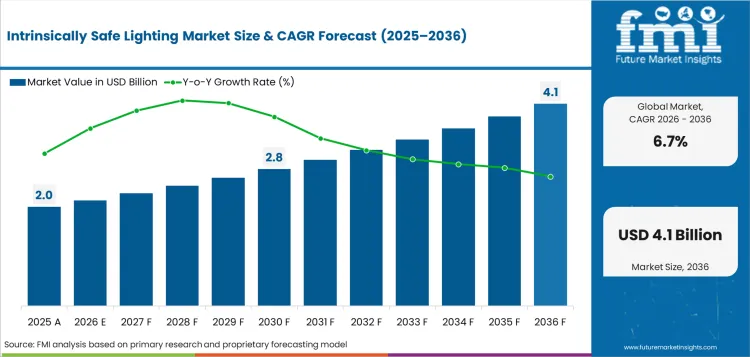
- The intrinsically safe lighting market was valued at USD 2.01 billion in 2025.
- By 2036, the intrinsically safe lighting market is expected to be worth USD 4.09 billion.
- From 2026 to 2036, the market is projected to expand at a 6.7% CAGR.
- The market is projected to create an incremental opportunity of USD 1.95 billion between 2026 and 2036.
- Fixed hazardous-area luminaires are projected to account for 49.0% of product type demand in 2026.
- LED lighting is projected to account for 74.0% of light source demand in 2026.
- Brazil at 8.9% and Saudi Arabia at 8.3% are expected to grow faster than the global pace.
The sizing uses the user-provided 2026 and 2036 anchors. The 2025 value was calculated by discounting the 2026 value at the stated CAGR. All values are shown in USD billion because the 2026 and 2036 figures exceed USD 1,000 million. The forecast was checked against safety regulation coverage and hazardous industry activity. Confidence is medium because public product-level trade data does not isolate intrinsically safe lighting from broader hazardous-area electrical equipment.
Confined maintenance work in refineries and chemical plants is raising the value of certified portable lighting. Wolf Safety states that the WL-80 and WL-85 Worklite™ delivers up to 3,100 lumens and up to 40 hours runtime. That output supports fewer lighting placements during tank work and shutdown inspection. IECEx published OD 017 Ed. 7.0 in February 2024 and required component information for intrinsic-safety compliance under IEC 60079-11. Certification files therefore become a real supplier advantage because buyers need traceable safety evidence. UL Solutions stated in January 2024 that hazardous-location LED retrofit kits are certified under UL 1598C and UL 844. Retrofit pathways make replacement projects easier for plants that already own certified fixtures. India’s Government e-Marketplace specification in January 2025 also listed intrinsically safe torch lights with Nightstick XPR-5522 GMX or equivalent. Public tenders are likely to favor suppliers with matched certifications and clear product equivalency.
Intrinsically Safe Lighting Market Definition
The Intrinsically Safe Lighting Market includes lighting fixtures and portable lamps designed for areas with flammable gases and combustible dust. Products include fixed hazardous-area luminaires and LED light formats. Scope covers headlamps and emergency lighting for classified industrial zones. The market excludes ordinary industrial lighting used in non-classified areas.
Intrinsically Safe Lighting Market Inclusions
Market scope covers product type and hazard zone. Scope also covers end use and certification. Light source and power mode complete the sizing structure. Stakeholders include lighting manufacturers and explosion-proof electrical distributors. Engineering contractors and refinery owners form the main buyer group. Mine operators and shipyards add project demand. Chemical producers and certification labs influence approval needs.
Intrinsically Safe Lighting Market Exclusions
Scope does not include standard commercial lighting and consumer flashlights. Non-certified work lights and ordinary warehouse fixtures are excluded. Vehicle lamps used outside classified industrial areas are outside scope.
Intrinsically Safe Lighting Market Research Methodology
- Primary research: FMI analysts reviewed buyer needs across oil sites and chemical plants. Mining operations and marine facilities were checked separately.
- Desk research: The model used safety codes and certification rules. Company product portfolios and national industrial indicators were checked separately.
- Market sizing and forecasting: The forecast combined product replacement rates and hazardous-area coverage by end-use sector.
- Data validation: The values were checked against certification needs and public energy data. Company activity in hazardous lighting was used as a cross-check.
Why is the Intrinsically Safe Lighting Market Growing?
- Classified work zones raise demand for approved fixtures that can operate near flammable gases and dust.
- LED retrofits reduce heat and power load in plants that run lighting for long operating shifts.
- Portable certified lights gain use as maintenance teams move between tanks and confined spaces.
Safety rules create a direct purchase need for certified lighting. The European Commission states that ATEX Directive 2014/34/EU covers equipment and protective systems for use in potentially explosive atmospheres. That rule keeps lighting selection tied to approved construction and clear product marking. Buyers in hazardous area equipment tend to favor suppliers that can match fixture type with zone rating. The result is a market in which paperwork and product design move together.
Industrial users are upgrading older fixtures as hazardous work areas become more tightly audited. The Occupational Safety and Health Administration states that electric equipment in classified locations must be approved for the class and properties of the hazard. This makes ordinary industrial lighting unsuitable in many plant areas. LED-based explosion-proof lighting benefits from lower heat and longer life in these spaces. Suppliers that offer clear labels and installation support reduce buyer risk during inspection.
Market Segmentation Analysis
- Fixed hazardous-area luminaires are forecast to account for 49.0% of product type demand as permanent plant areas need fixed lighting.
- Zone 2 equipment is projected to capture 44.0% of hazard zone demand as many industrial spaces face intermittent exposure.
- Oil and gas is expected to represent 38.0% of end-use demand as drilling sites and terminals keep large classified areas.
- ATEX IECEx certified products are projected to hold 47.0% of certification demand due to broad global acceptance.
- LED is forecast to account for 74.0% of light source demand as lower heat output fits hazardous lighting needs.
- Hardwired systems are projected to capture 52.0% of power mode demand in 2026 due to permanent plant installations.
The market is divided into six primary segment groups based on product type and hazard zone. End use and certification define the buying route. Light source and power mode show how fixtures perform inside each classified area. Product type includes fixed luminaires and portable task lights. Hazard zone covers Zone 1 and Zone 2 applications. End use covers oil and gas plus chemicals. Certification covers ATEX IECEx and NEC UL pathways.
Insights into the Fixed Hazardous-Area Luminaires Product Type Segment
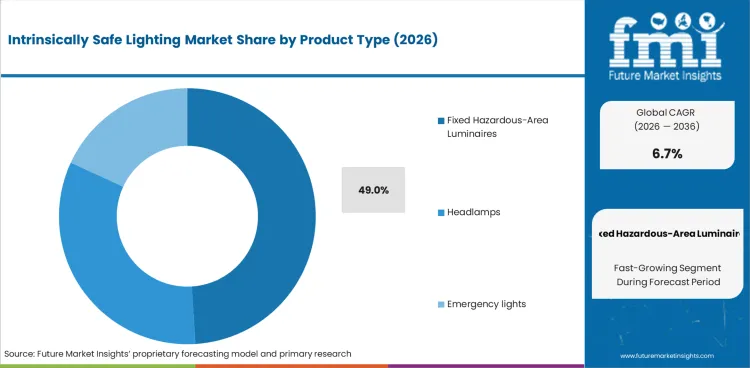
- Fixed hazardous-area luminaires are projected to account for 49.0% of product type demand in 2026. Their position reflects repeat need in refineries and metallurgical lighting applications.
- Fixed hazardous-area luminaires retain strong adoption because upgrades in refineries and metallurgical lighting sites prioritize durable, permanently installed fixtures that reduce maintenance exposure in classified zones.
Insights into the Zone 2 Hazard Zone Segment
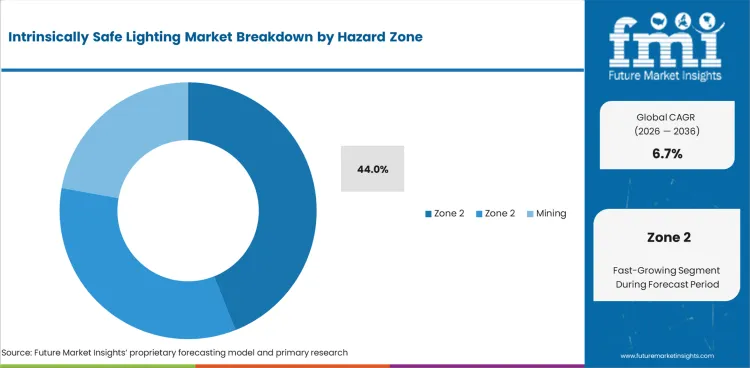
- Zone 2 equipment is forecast to account for 44.0% of hazard zone demand in 2026. This reflects plant areas with occasional gas exposure during normal work.
- Demand also rises in Zone 2 as operators expand classification to adjacent skids and utility areas, increasing the count of intermittently exposed spaces that still require approved equipment.
Insights into the Oil and Gas End Use Segment
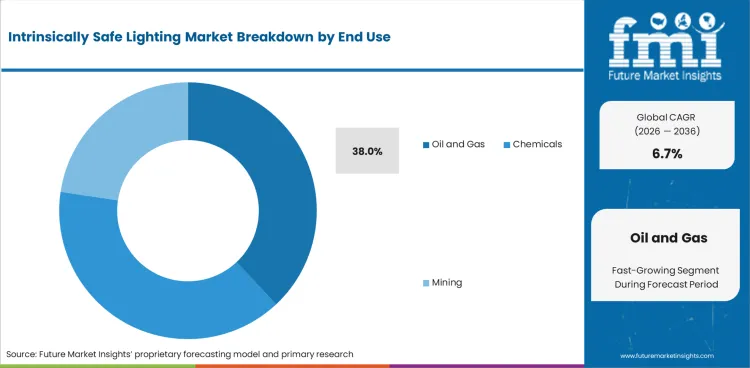
- Oil and gas is expected to represent 38.0% in 2026. Drilling sites and terminals need lighting across wide classified areas.
- Oil and gas demand stays resilient as LNG terminals and offshore assets schedule turnarounds that trigger replacement and retrofit purchases for certified fixtures.
Insights into the ATEX IECEx Certification Segment
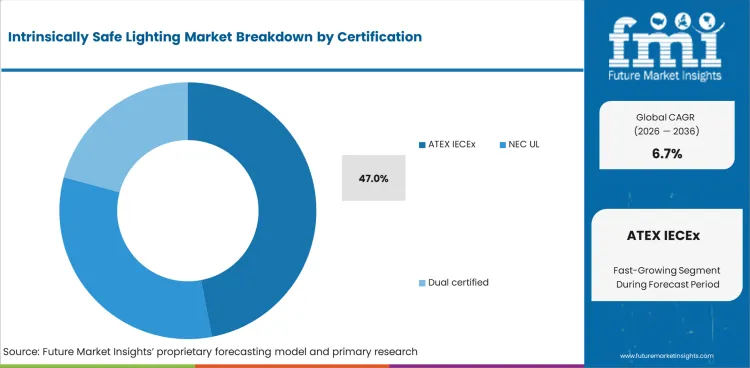
- ATEX IECEx certified products are projected to hold 47.0% of certification demand in 2026. Global plant owners prefer approvals that travel across regions.
- ATEX IECEx adoption is also supported by multinational EPCs that standardize specs across project locations, reducing re-approval risk when the same fixture family is deployed across multiple sites.
Insights into the LED Light Source Segment
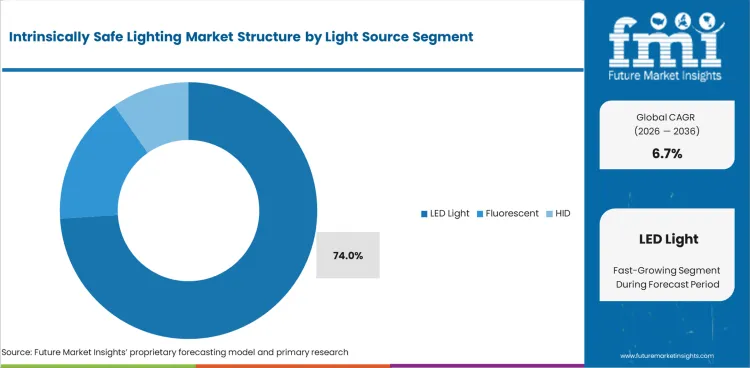
- LED lighting is projected to account for 74.0% of light source demand in 2026. Lower heat output and long life support use in risky zones.
- LED penetration continues to rise as improvements in LED modules and light engines deliver more stable output and longer service life, supporting retrofit-driven replacement cycles in hazardous facilities.
Insights into the Hardwired Power Mode Segment
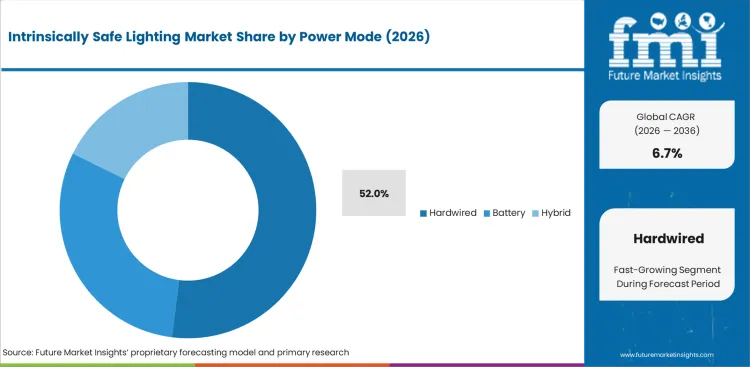
- Hardwired systems are forecast to account for 52.0% of power mode demand in 2026. Permanent process areas need lighting tied to plant power.
- Hardwired adoption is reinforced in new-build and brownfield projects because fixed wiring supports continuous-use areas and simplifies integration with centralized emergency systems and emergency venting systems during shutdown and restart procedures.
Intrinsically Safe Lighting Market Drivers Restraints and Opportunities
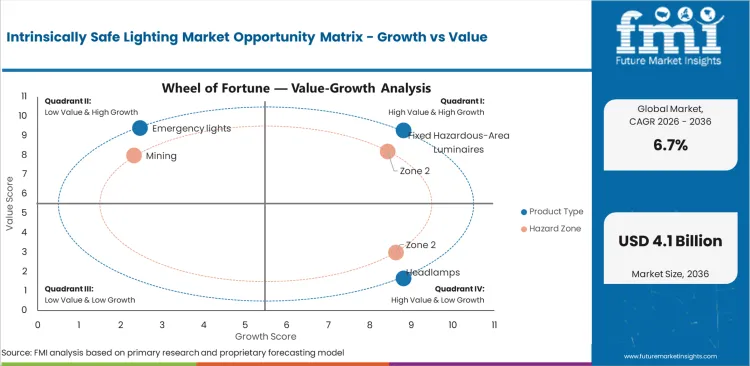
- Zone classification creates a steady replacement need for approved luminaires in refineries and chemical units.
- Certification cost and long approval cycles can slow product refresh for smaller regional suppliers.
- Portable inspection lighting opens opportunity as shutdown teams need certified task lights in confined spaces.
Demand grows where safety teams cannot treat lighting as a standard electrical purchase. The International Electrotechnical Commission certification system lists more than 60 approved certification bodies across over 35 countries. That network gives multinational buyers a common way to compare certified products. It also pushes suppliers to maintain test files and product marking discipline. The opportunity is strongest for companies that can serve flameproof equipment buyers with fixtures and compatible accessories.
One of the primary restraint in the industry is approval cost and documentation time. Certified lighting must match the exact class and area rating before installation teams can use it. Temporary safe staging areas may use mobile light tower equipment outside classified zones. That slows low-cost imports that lack accepted paperwork. Demand for industrial safety products is rising as plants combine lighting with broader safety upgrades. Suppliers that reduce approval delay can defend price better than those selling only a fixture.
Zone Mapping Is Shaping Orders
Hazard mapping changes lighting selection before price talks begin. The Occupational Safety and Health Administration says each room and area must be considered individually for classification. That makes plant layout a direct input into lighting orders. Contractors need fixtures that align with gas group and dust risk. This shifts order value toward suppliers with specification help and clearer installation records.
LED Heat Control Is Raising Replacement
LED conversion is changing the economics of hazardous-area lighting. Older lamps can create heat and maintenance concerns in hard-to-access plant zones. LED fixtures reduce replacement frequency and improve work visibility. Fire and explosion proof lights demand shows why certified lighting is moving toward longer-life systems. Buyers treat lower maintenance trips as a safety gain and a cost benefit.
Analysis of Intrinsically Safe Lighting Market By Key Countries
.webp "Top Country Growth Comparison Intrinsically Safe Lighting Market Cagr (2026 2036)")
| Country | CAGR |
|---|---|
| Brazil | 8.9% |
| Saudi Arabia | 8.3% |
| UK | 7.6% |
| Germany | 7.0% |
| India | 6.1% |
| China | 5.8% |
| USA | 5.3% |
Source: Future Market Insights, 2026.
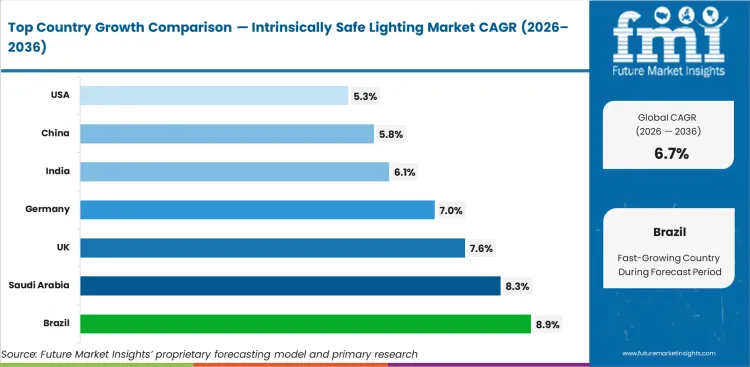
Intrinsically Safe Lighting Market CAGR Analysis By Country
- Brazil is expected to record the fastest country CAGR at 8.9% during the assessment period due to offshore oil output.
- Saudi Arabia is projected to expand at 8.3% CAGR as refinery and gas projects need certified lighting.
- The UK is forecast to grow at 7.6% CAGR as offshore emission work sustains certified lighting replacement.
- Germany is expected to advance at 7.0% CAGR as chemical production sites need approved area lighting.
- India is projected at 6.1% CAGR as refining capacity and chemical output support classified-zone equipment.
- China is expected to post 5.8% CAGR as petrochemical production scale keeps hazardous-area demand broad.
- The United States is forecast at 5.3% CAGR with mature rules and a large installed refinery network.
Global demand for intrinsically safe lighting is forecast to rise at 6.7% CAGR from 2026 to 2036. Brazil and Saudi Arabia are forecast above the global pace due to oil and gas asset activity. Germany and the UK are expected to grow near or above the global rate due to mature safety rules. China and the United States track below the global pace as large markets grow from mature replacement cycles.
Demand Outlook for Intrinsically Safe Lighting Market in Brazil
Brazil is expected to record a 8.9% CAGR by 2036 as offshore oil and gas work keeps classified areas active. Agência Brasil reported that national oil and gas output reached 4.897 million barrels of oil equivalent per day in 2025. That production level keeps lighting needs high across platforms and processing sites. Offshore operators need certified fixtures that can handle salt exposure and explosive atmospheres. A small shift toward deeper offshore maintenance would lift replacement demand for portable inspection lighting and LED mobile light tower.
- Pre-salt fields in the Santos Basin support demand for corrosion-resistant certified fixtures used on platforms and floating production units.
- Rio de Janeiro offshore service yards need portable certified lights during planned shutdowns and vessel repair work.
- Brazilian National Agency of Petroleum rules keep oil operators focused on safe equipment choices in classified work zones.
Sales Analysis of Intrinsically Safe Lighting Market in Saudi Arabia
Saudi Arabia is projected to expand at 8.3% CAGR by 2036 as oil processing and gas infrastructure stay central to capital spending. Gulf producers exported 3.3 million barrels per day of refined products in 2025 according to the International Energy Agency. Large refining and petrochemical assets need fixed lights that meet accepted hazardous-area rules. Saudi projects often prefer suppliers with global certification and flame proof lighting support. Better local assembly or repair access would shorten project handover time for contractors.
- Jubail industrial city creates steady need for certified luminaires across petrochemical units and tank farms.
- Ras Tanura refinery operations keep lighting replacement tied to hazardous area inspection and maintenance schedules.
- Saudi Aramco project standards raise the value of suppliers with accepted certification files and Gulf service support.
Demand Analysis of Intrinsically Safe Lighting Market in the UK
The UK is forecast to grow at 7.6% CAGR by 2036 as offshore platforms focus on safer and lower-emission operations. The North Sea Transition Authority reported a 34.0% reduction in production emissions between 2018 and 2024. Platform upgrades often include lighting changes in hazardous work spaces and escape routes. Buyers need certified fixtures that reduce maintenance trips and fit offshore inspection needs. Stronger emission checks can lift demand for efficient fixed luminaires across mature North Sea assets.
- North Sea platforms need certified outdoor LED lighting that handles salt spray and deck vibration.
- Aberdeen service companies use portable task lights during offshore maintenance and turnaround work.
- The North Sea Transition Authority’s emissions review keeps operators focused on equipment changes that lower site power use.
Opportunity Analysis of Intrinsically Safe Lighting Market in Germany
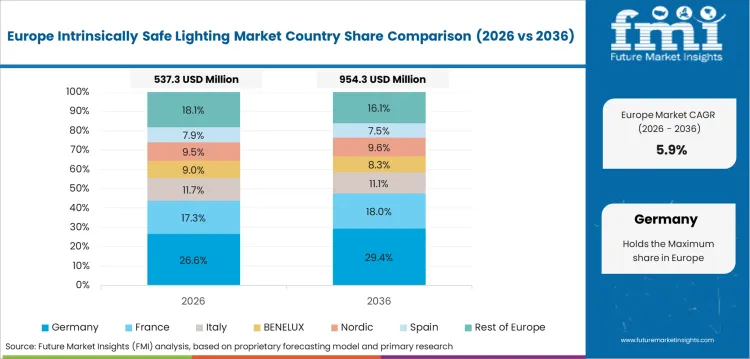
Intrinsically Safe Lighting Market Country Value Analysis
Germany is expected to advance at 7.0% CAGR by 2036 as chemical production sites keep hazardous electrical safety high on maintenance plans. The Association of the German Chemical Industry reported 72.5% chemical plant capacity use in the fourth quarter of 2025. Lower utilization does not remove safety lighting needs in active plants. It can push buyers toward targeted replacement rather than full site renewals. Suppliers that support plant engineers with clear ATEX documents can defend replacement work even in slower production cycles.
- North Rhine-Westphalia chemical parks need certified fixed luminaires across solvent handling and packaging zones.
- Ludwigshafen production areas create demand for emergency emergency lighting in classified corridors.
- German chemical firms often require ATEX files before maintenance contractors can approve equipment placement.
Future Outlook for Intrinsically Safe Lighting Market in India
India is projected to rise at 6.1% CAGR by 2036 as refining and chemical capacity support hazardous-area equipment orders. India’s Petroleum Planning and Analysis Cell listed national refinery capacity at 258.116 million tonnes per year as of April 2025. This scale creates lighting demand across process units and tank farms. Domestic buyers often balance certification needs with project cost pressure. Local stocking and fast documentation can help suppliers serve shutdown windows without delaying contractor schedules.
- Jamnagar refinery operations create large fixed lighting needs across tank farms and processing units.
- Dahej chemical and petrochemical users need certified fixtures for vapor-prone zones near process lines.
- India’s Petroleum and Explosives Safety Organisation influences hazardous electrical approvals used by plant teams.
Demand Outlook for Intrinsically Safe Lighting Market in China
China is expected to expand at 5.8% CAGR by 2036 as petrochemical and energy output keeps hazardous lighting demand broad. China’s National Bureau of Statistics reported 122.63 million tonnes of crude oil processing in January to February 2026. Large processing scale creates many classified work areas that need approved fixtures. Domestic suppliers compete on price and project access. Global suppliers hold an edge where export plants need IECEx or ATEX acceptance for multinational operations.
- Dalian and Ningbo petrochemical sites need fixed luminaires for process units and storage zones.
- Inner Mongolia coal and chemical projects support demand for dust-rated lighting and certified portable lamps.
- China’s National Bureau of Statistics shows chemical output expansion that supports LED light tower demand near work zones.
In-depth Analysis of Intrinsically Safe Lighting Market in the United States
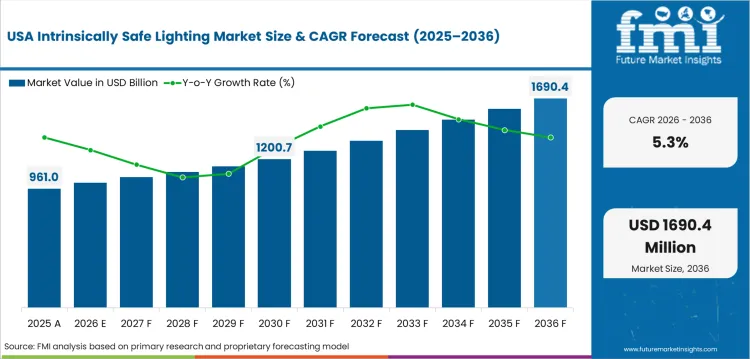
The United States is forecast at 5.3% CAGR by 2036 as mature safety rules keep replacement demand steady. The USA Energy Information Administration reported liquefied natural gas exports near 18 billion cubic feet per day in March 2026. Export terminals and refineries use classified-zone lighting across loading areas and process equipment. Buyers often select products through National Electrical Code and UL pathways. A wider shift to LED replacements can raise demand even when new plant construction is selective.
- Texas Gulf Coast liquefied natural gas terminals need certified fixtures near loading arms and compression equipment.
- Louisiana chemical corridors require lighting suited to vapor-prone zones and outdoor process areas.
- The Occupational Safety and Health Administration requires approved electrical equipment in classified locations across USA workplaces.
Competitive Landscape and Strategic Positioning
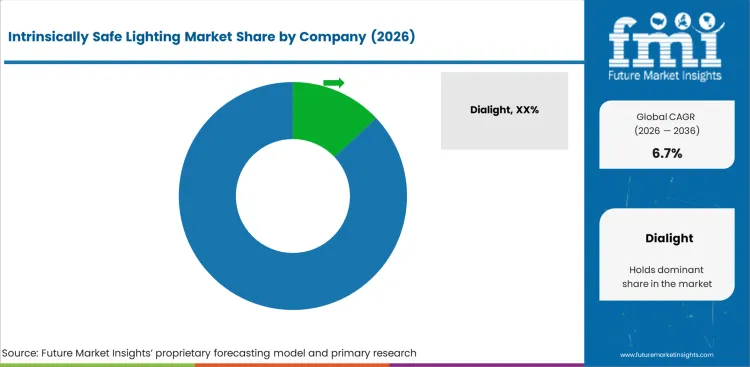
- Dialight and R. STAHL hold strong positions in certified hazardous-area LED lighting.
- Eaton Crouse-Hinds and Emerson Appleton gain buyers through broad hazardous electrical portfolios.
- Warom and WEG serve price-sensitive projects where local supply and certification access influence selection.
Competition is shaped by certification range and ability to support plant approval files. Dialight focuses on LED fixtures for heavy industrial and hazardous locations. Eaton Crouse-Hinds and Emerson Appleton bring wider electrical product portfolios around lighting. R. STAHL and Warom compete with broad explosion protection lines. Buyers often choose suppliers that can cover fixtures and compatible cable entry hardware. This gives integrated hazardous electrical suppliers an advantage in explosion-proof equipment projects.
Regional players can win when they shorten lead times and provide local documentation support. Large oil and chemical buyers rarely accept lighting without clear zone marking and third-party approval. Companies with portable and fixed product coverage can address shutdown work and permanent plant needs together. Adjacent lighting as a service models may gain in mature plants when buyers want lower upfront spending. Certification discipline will keep the market less price-led than standard industrial lighting.
Key Companies in the Intrinsically Safe Lighting Market
- Dialight and Eaton Crouse-Hinds serve global hazardous-area lighting demand with certified fixed products. Emerson Appleton adds broad process industry coverage.
- R. STAHL and Warom compete across explosion protection portfolios. WEG supports industrial electrical channels in key regions.
- Glamox and Phoenix Lighting serve marine and heavy-duty LED displays lighting and fixtures applications. Hubbell Killark and Chalmit support plant lighting needs.
Competitive Benchmarking: Intrinsically Safe Lighting Market
| Company | Zone Coverage | Certification Depth | Marine Fit | Footprint |
|---|---|---|---|---|
| Dialight | High | Strong | High | Global hazardous-area LED footprint across oil and chemical users |
| Eaton Crouse-Hinds | High | Strong | High | North America centered with global industrial electrical reach |
| Emerson Appleton | High | Strong | High | Strong hazardous electrical portfolio across process industries |
| R. STAHL | High | Strong | Medium | Europe centered with global explosion protection access |
| Warom | Medium | Strong | Medium | China centered with export activity across hazardous electrical products |
| WEG | Medium | Medium | Medium | Latin America strength with wider industrial electrical presence |
| Glamox | Medium | Medium | High | Marine and offshore strength across Europe and global fleets |
| Phoenix Lighting | Medium | Medium | High | Heavy-duty and marine positions in North America |
| Hubbell Killark | Medium | Strong | Medium | North America hazardous electrical portfolio coverage |
| Chalmit ABB | Medium | Strong | Medium | UK heritage with ABB-linked industrial channel access |
Source: Future Market Insights, 2026.
Key Developments in Intrinsically Safe Lighting Market
- In October 2025, Dialight launched its High Output LED Area Light for North America. The product targets heavy industrial and hazardous-area applications.
- In July 2025, Dialight introduced a ProSite streetlight battery backup option with up to 180 minutes of emergency operation.
- In September 2025, R. STAHL expanded its Series 6141 hand lamp range with Zone 0 approval and a head torch option.
- In May 2025, R. STAHL opened a facility at Sriperumbudur near Chennai to support explosion protection supply in India.
- In September 2025, Warom co-organized the International Industrial Explosion-Proof Technology Forum in Shanghai.
- In May 2025, Warom participated in the IECEx symposium in Penang and highlighted certification exchange for explosion-proof products.
Key Players in the Intrinsically Safe Lighting Market
Major Global Players:
- Dialight
- Eaton Crouse-Hinds
- Emerson Appleton
- R. STAHL
- Warom
- WEG
- Glamox
Specialist Players:
- Phoenix Lighting
- Hubbell Killark
- Chalmit ABB
Report Scope and Coverage
| Parameter | Details |
|---|---|
| Quantitative Units | USD 2.14 billion to USD 4.09 billion, at a 6.7% CAGR |
| Market Definition | Certified lighting used in flammable gas and combustible dust environments |
| Product Type | Fixed luminaires, Portable task lights, Headlamps, Emergency lights |
| Hazard Zone | Zone 1, Zone 2, Mining |
| End Use | Oil and gas, Chemicals, Mining, Marine and ports |
| Certification | ATEX IECEx, NEC UL, Dual certified |
| Light Source | LED, Fluorescent, HID, Other |
| Power Mode | Hardwired, Battery, Hybrid |
| Regions Covered | North America, Latin America, Europe, East Asia, South Asia and Pacific, Middle East and Africa |
| Countries Covered | United States, China, India, Germany, UK, Saudi Arabia, Brazil, and over 30 additional countries |
| Key Companies Profiled | Dialight, Eaton Crouse-Hinds, Emerson Appleton, R. STAHL, Warom, WEG, Glamox |
| Forecast Period | 2026 to 2036 |
| Approach | Hybrid bottom-up and top-down method starting with hazardous-area lighting demand and verified industrial activity |
Source: Future Market Insights, 2026.
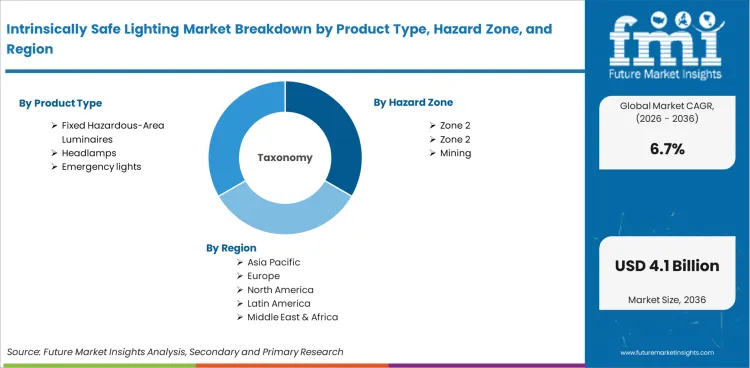
Intrinsically Safe Lighting Market Breakdown by Product Type, Hazard Zone, End Use, Certification, Light Source, Power Mode, and Region
Intrinsically Safe Lighting Market Segmented by Product Type:
- Fixed luminaires
- Portable task lights
- Headlamps
- Emergency lights
Intrinsically Safe Lighting Market Segmented by Hazard Zone:
- Zone 1
- Zone 2
- Mining
Intrinsically Safe Lighting Market Segmented by End Use:
- Oil and gas
- Chemicals
- Mining
- Marine and ports
Intrinsically Safe Lighting Market Segmented by Certification:
- ATEX IECEx
- NEC UL
- Dual certified
Intrinsically Safe Lighting Market Segmented by Light Source:
- LED
- Fluorescent
- HID
- Other
Intrinsically Safe Lighting Market Segmented by Power Mode:
- Hardwired
- Battery
- Hybrid
Intrinsically Safe Lighting Market by Region:
- North America
- United States
- Canada
- Mexico
- Latin America
- Brazil
- Chile
- Rest of Latin America
- Europe
- Germany
- UK
- France
- Italy
- Spain
- Rest of Europe
- East Asia
- China
- Japan
- South Korea
- South Asia and Pacific
- India
- ASEAN
- Australia and New Zealand
- Rest of South Asia and Pacific
- Middle East and Africa
- Saudi Arabia
- Other GCC Countries
- South Africa
- Rest of Middle East and Africa
Research Sources and Bibliography
- Agência Brasil. (2026, February). Oil and gas production closes 2025 with a new record.
- Association of the German Chemical Industry. (2026, March). Quarterly report 4.2025.
- Association of the German Chemical Industry. (2026, May). The chemical industry in figures.
- European Commission. (2026, January). ATEX equipment directive.
- Eurostat. (2025, October). Chemical production and trade in the EU.
- International Electrotechnical Commission System for Certification to Standards Relating to Equipment for Use in Explosive Atmospheres. (2026). About IECEx.
- National Bureau of Statistics of China. (2026, March). Industrial production operation from January to February 2026.
- National Bureau of Statistics of China. (2026, March). Energy production from January to February 2026.
- North Sea Transition Authority. (2025, November). Review of industry emissions performance.
- Occupational Safety and Health Administration. (2025). 29 CFR 1910.307 hazardous classified locations.
- Occupational Safety and Health Administration. (2025). 29 CFR 1926.407 hazardous classified locations.
- Petroleum Planning and Analysis Cell. (2026, May). Installed capacity of refineries.
- USA Energy Information Administration. (2026, May). Short-Term Energy Outlook.
- Dialight. (2025, October). Dialight unveils new High Output LED Area Light.
- R. STAHL. (2025, September). Product news and explosion protection updates.
Frequently Asked Questions
What is the projected value of the Intrinsically Safe Lighting Market by 2036?
The Intrinsically Safe Lighting Market is projected to reach USD 4.09 billion by 2036 from USD 2.14 billion in 2026.
What CAGR is expected for the Intrinsically Safe Lighting Market?
The Intrinsically Safe Lighting Market is expected to expand at a 6.7% CAGR from 2026 to 2036.
Which product type leads the Intrinsically Safe Lighting Market?
Fixed hazardous-area luminaires are projected to account for 49.0% of product type demand in 2026 due to permanent plant use.
Which end use is largest in the Intrinsically Safe Lighting Market?
Oil and gas is expected to represent 38.0% of end-use demand in 2026 as classified work areas stay extensive.
Which country grows fastest in the Intrinsically Safe Lighting Market?
Brazil is expected to record the fastest country pace at 8.9% CAGR through 2036 due to offshore activity.
How does intrinsically safe lighting work in hazardous locations?
Intrinsically safe lighting limits ignition risk by controlling electrical energy and surface heat inside areas with flammable gas or dust.
How do buyers compare certified lighting products?
Buyers compare zone rating and gas group fit before price becomes the final issue. Certification mark and installation records complete the review.
What affects payback for intrinsically safe LED lighting?
Payback depends on lamp life and maintenance access across each classified area. Power cost and shutdown frequency shape the final case.
Preview the report firsthand - request a free sample
Get SampleGet the brochure for pricing and purchase details.
Get PDFTable of Content
- Executive Summary
- Global Market Outlook
- Demand-side Trends
- Supply-side Trends
- Technology Roadmap Analysis
- Analysis and Recommendations
- Market Overview
- Market Coverage / Taxonomy
- Market Definition / Scope / Limitations
- Research Methodology
- Chapter Orientation
- Analytical Lens and Working Hypotheses
- Market Structure, Signals, and Trend Drivers
- Benchmarking and Cross-market Comparability
- Market Sizing, Forecasting, and Opportunity Mapping
- Research Design and Evidence Framework
- Desk Research Programme (Secondary Evidence)
- Company Annual and Sustainability Reports
- Peer-reviewed Journals and Academic Literature
- Corporate Websites, Product Literature, and Technical Notes
- Earnings Decks and Investor Briefings
- Statutory Filings and Regulatory Disclosures
- Technical White Papers and Standards Notes
- Trade Journals, Industry Magazines, and Analyst Briefs
- Conference Proceedings, Webinars, and Seminar Materials
- Government Statistics Portals and Public Data Releases
- Press Releases and Reputable Media Coverage
- Specialist Newsletters and Curated Briefings
- Sector Databases and Reference Repositories
- FMI Internal Proprietary Databases and Historical Market Datasets
- Subscription Datasets and Paid Sources
- Social Channels, Communities, and Digital Listening Inputs
- Additional Desk Sources
- Expert Input and Fieldwork (Primary Evidence)
- Primary Modes
- Qualitative Interviews and Expert Elicitation
- Quantitative Surveys and Structured Data Capture
- Blended Approach
- Why Primary Evidence is Used
- Field Techniques
- Interviews
- Surveys
- Focus Groups
- Observational and In-context Research
- Social and Community Interactions
- Stakeholder Universe Engaged
- C-suite Leaders
- Board Members
- Presidents and Vice Presidents
- R&D and Innovation Heads
- Technical Specialists
- Domain Subject-matter Experts
- Scientists
- Physicians and Other Healthcare Professionals
- Governance, Ethics, and Data Stewardship
- Research Ethics
- Data Integrity and Handling
- Primary Modes
- Tooling, Models, and Reference Databases
- Desk Research Programme (Secondary Evidence)
- Data Engineering and Model Build
- Data Acquisition and Ingestion
- Cleaning, Normalisation, and Verification
- Synthesis, Triangulation, and Analysis
- Quality Assurance and Audit Trail
- Market Background
- Market Dynamics
- Drivers
- Restraints
- Opportunity
- Trends
- Scenario Forecast
- Demand in Optimistic Scenario
- Demand in Likely Scenario
- Demand in Conservative Scenario
- Opportunity Map Analysis
- Product Life Cycle Analysis
- Supply Chain Analysis
- Investment Feasibility Matrix
- Value Chain Analysis
- PESTLE and Porter’s Analysis
- Regulatory Landscape
- Regional Parent Market Outlook
- Production and Consumption Statistics
- Import and Export Statistics
- Market Dynamics
- Global Market Analysis 2021 to 2025 and Forecast, 2026 to 2036
- Historical Market Size Value (USD Million) Analysis, 2021 to 2025
- Current and Future Market Size Value (USD Million) Projections, 2026 to 2036
- Y-o-Y Growth Trend Analysis
- Absolute $ Opportunity Analysis
- Global Market Pricing Analysis 2021 to 2025 and Forecast 2026 to 2036
- Global Market Analysis 2021 to 2025 and Forecast 2026 to 2036, By Product Type
- Introduction / Key Findings
- Historical Market Size Value (USD Million) Analysis By Product Type , 2021 to 2025
- Current and Future Market Size Value (USD Million) Analysis and Forecast By Product Type , 2026 to 2036
- Fixed Hazardous-Area Luminaires
- Headlamps
- Emergency lights
- Fixed Hazardous-Area Luminaires
- Y-o-Y Growth Trend Analysis By Product Type , 2021 to 2025
- Absolute $ Opportunity Analysis By Product Type , 2026 to 2036
- Global Market Analysis 2021 to 2025 and Forecast 2026 to 2036, By Hazard Zone
- Introduction / Key Findings
- Historical Market Size Value (USD Million) Analysis By Hazard Zone, 2021 to 2025
- Current and Future Market Size Value (USD Million) Analysis and Forecast By Hazard Zone, 2026 to 2036
- Zone 2
- Zone 2
- Mining
- Zone 2
- Y-o-Y Growth Trend Analysis By Hazard Zone, 2021 to 2025
- Absolute $ Opportunity Analysis By Hazard Zone, 2026 to 2036
- Global Market Analysis 2021 to 2025 and Forecast 2026 to 2036, By End Use
- Introduction / Key Findings
- Historical Market Size Value (USD Million) Analysis By End Use, 2021 to 2025
- Current and Future Market Size Value (USD Million) Analysis and Forecast By End Use, 2026 to 2036
- Oil and Gas
- Chemicals
- Mining
- Oil and Gas
- Y-o-Y Growth Trend Analysis By End Use, 2021 to 2025
- Absolute $ Opportunity Analysis By End Use, 2026 to 2036
- Global Market Analysis 2021 to 2025 and Forecast 2026 to 2036, By Certification
- Introduction / Key Findings
- Historical Market Size Value (USD Million) Analysis By Certification, 2021 to 2025
- Current and Future Market Size Value (USD Million) Analysis and Forecast By Certification, 2026 to 2036
- ATEX IECEx
- NEC UL
- Dual certified
- ATEX IECEx
- Y-o-Y Growth Trend Analysis By Certification, 2021 to 2025
- Absolute $ Opportunity Analysis By Certification, 2026 to 2036
- Global Market Analysis 2021 to 2025 and Forecast 2026 to 2036, By Light Source
- Introduction / Key Findings
- Historical Market Size Value (USD Million) Analysis By Light Source, 2021 to 2025
- Current and Future Market Size Value (USD Million) Analysis and Forecast By Light Source, 2026 to 2036
- LED Light
- Fluorescent
- HID
- LED Light
- Y-o-Y Growth Trend Analysis By Light Source, 2021 to 2025
- Absolute $ Opportunity Analysis By Light Source, 2026 to 2036
- Global Market Analysis 2021 to 2025 and Forecast 2026 to 2036, By Power Mode
- Introduction / Key Findings
- Historical Market Size Value (USD Million) Analysis By Power Mode, 2021 to 2025
- Current and Future Market Size Value (USD Million) Analysis and Forecast By Power Mode, 2026 to 2036
- Hardwired
- Battery
- Hybrid
- Hardwired
- Y-o-Y Growth Trend Analysis By Power Mode, 2021 to 2025
- Absolute $ Opportunity Analysis By Power Mode, 2026 to 2036
- Global Market Analysis 2021 to 2025 and Forecast 2026 to 2036, By Region
- Introduction
- Historical Market Size Value (USD Million) Analysis By Region, 2021 to 2025
- Current Market Size Value (USD Million) Analysis and Forecast By Region, 2026 to 2036
- North America
- Latin America
- Western Europe
- Eastern Europe
- East Asia
- South Asia and Pacific
- Middle East & Africa
- Market Attractiveness Analysis By Region
- North America Market Analysis 2021 to 2025 and Forecast 2026 to 2036, By Country
- Historical Market Size Value (USD Million) Trend Analysis By Market Taxonomy, 2021 to 2025
- Market Size Value (USD Million) Forecast By Market Taxonomy, 2026 to 2036
- By Country
- USA
- Canada
- Mexico
- By Product Type
- By Hazard Zone
- By End Use
- By Certification
- By Light Source
- By Power Mode
- By Country
- Market Attractiveness Analysis
- By Country
- By Product Type
- By Hazard Zone
- By End Use
- By Certification
- By Light Source
- By Power Mode
- Key Takeaways
- Latin America Market Analysis 2021 to 2025 and Forecast 2026 to 2036, By Country
- Historical Market Size Value (USD Million) Trend Analysis By Market Taxonomy, 2021 to 2025
- Market Size Value (USD Million) Forecast By Market Taxonomy, 2026 to 2036
- By Country
- Brazil
- Chile
- Rest of Latin America
- By Product Type
- By Hazard Zone
- By End Use
- By Certification
- By Light Source
- By Power Mode
- By Country
- Market Attractiveness Analysis
- By Country
- By Product Type
- By Hazard Zone
- By End Use
- By Certification
- By Light Source
- By Power Mode
- Key Takeaways
- Western Europe Market Analysis 2021 to 2025 and Forecast 2026 to 2036, By Country
- Historical Market Size Value (USD Million) Trend Analysis By Market Taxonomy, 2021 to 2025
- Market Size Value (USD Million) Forecast By Market Taxonomy, 2026 to 2036
- By Country
- Germany
- UK
- Italy
- Spain
- France
- Nordic
- BENELUX
- Rest of Western Europe
- By Product Type
- By Hazard Zone
- By End Use
- By Certification
- By Light Source
- By Power Mode
- By Country
- Market Attractiveness Analysis
- By Country
- By Product Type
- By Hazard Zone
- By End Use
- By Certification
- By Light Source
- By Power Mode
- Key Takeaways
- Eastern Europe Market Analysis 2021 to 2025 and Forecast 2026 to 2036, By Country
- Historical Market Size Value (USD Million) Trend Analysis By Market Taxonomy, 2021 to 2025
- Market Size Value (USD Million) Forecast By Market Taxonomy, 2026 to 2036
- By Country
- Russia
- Poland
- Hungary
- Balkan & Baltic
- Rest of Eastern Europe
- By Product Type
- By Hazard Zone
- By End Use
- By Certification
- By Light Source
- By Power Mode
- By Country
- Market Attractiveness Analysis
- By Country
- By Product Type
- By Hazard Zone
- By End Use
- By Certification
- By Light Source
- By Power Mode
- Key Takeaways
- East Asia Market Analysis 2021 to 2025 and Forecast 2026 to 2036, By Country
- Historical Market Size Value (USD Million) Trend Analysis By Market Taxonomy, 2021 to 2025
- Market Size Value (USD Million) Forecast By Market Taxonomy, 2026 to 2036
- By Country
- China
- Japan
- South Korea
- By Product Type
- By Hazard Zone
- By End Use
- By Certification
- By Light Source
- By Power Mode
- By Country
- Market Attractiveness Analysis
- By Country
- By Product Type
- By Hazard Zone
- By End Use
- By Certification
- By Light Source
- By Power Mode
- Key Takeaways
- South Asia and Pacific Market Analysis 2021 to 2025 and Forecast 2026 to 2036, By Country
- Historical Market Size Value (USD Million) Trend Analysis By Market Taxonomy, 2021 to 2025
- Market Size Value (USD Million) Forecast By Market Taxonomy, 2026 to 2036
- By Country
- India
- ASEAN
- Australia & New Zealand
- Rest of South Asia and Pacific
- By Product Type
- By Hazard Zone
- By End Use
- By Certification
- By Light Source
- By Power Mode
- By Country
- Market Attractiveness Analysis
- By Country
- By Product Type
- By Hazard Zone
- By End Use
- By Certification
- By Light Source
- By Power Mode
- Key Takeaways
- Middle East & Africa Market Analysis 2021 to 2025 and Forecast 2026 to 2036, By Country
- Historical Market Size Value (USD Million) Trend Analysis By Market Taxonomy, 2021 to 2025
- Market Size Value (USD Million) Forecast By Market Taxonomy, 2026 to 2036
- By Country
- Kingdom of Saudi Arabia
- Other GCC Countries
- Turkiye
- South Africa
- Other African Union
- Rest of Middle East & Africa
- By Product Type
- By Hazard Zone
- By End Use
- By Certification
- By Light Source
- By Power Mode
- By Country
- Market Attractiveness Analysis
- By Country
- By Product Type
- By Hazard Zone
- By End Use
- By Certification
- By Light Source
- By Power Mode
- Key Takeaways
- Key Countries Market Analysis
- USA
- Pricing Analysis
- Market Share Analysis, 2025
- By Product Type
- By Hazard Zone
- By End Use
- By Certification
- By Light Source
- By Power Mode
- Canada
- Pricing Analysis
- Market Share Analysis, 2025
- By Product Type
- By Hazard Zone
- By End Use
- By Certification
- By Light Source
- By Power Mode
- Mexico
- Pricing Analysis
- Market Share Analysis, 2025
- By Product Type
- By Hazard Zone
- By End Use
- By Certification
- By Light Source
- By Power Mode
- Brazil
- Pricing Analysis
- Market Share Analysis, 2025
- By Product Type
- By Hazard Zone
- By End Use
- By Certification
- By Light Source
- By Power Mode
- Chile
- Pricing Analysis
- Market Share Analysis, 2025
- By Product Type
- By Hazard Zone
- By End Use
- By Certification
- By Light Source
- By Power Mode
- Germany
- Pricing Analysis
- Market Share Analysis, 2025
- By Product Type
- By Hazard Zone
- By End Use
- By Certification
- By Light Source
- By Power Mode
- UK
- Pricing Analysis
- Market Share Analysis, 2025
- By Product Type
- By Hazard Zone
- By End Use
- By Certification
- By Light Source
- By Power Mode
- Italy
- Pricing Analysis
- Market Share Analysis, 2025
- By Product Type
- By Hazard Zone
- By End Use
- By Certification
- By Light Source
- By Power Mode
- Spain
- Pricing Analysis
- Market Share Analysis, 2025
- By Product Type
- By Hazard Zone
- By End Use
- By Certification
- By Light Source
- By Power Mode
- France
- Pricing Analysis
- Market Share Analysis, 2025
- By Product Type
- By Hazard Zone
- By End Use
- By Certification
- By Light Source
- By Power Mode
- India
- Pricing Analysis
- Market Share Analysis, 2025
- By Product Type
- By Hazard Zone
- By End Use
- By Certification
- By Light Source
- By Power Mode
- ASEAN
- Pricing Analysis
- Market Share Analysis, 2025
- By Product Type
- By Hazard Zone
- By End Use
- By Certification
- By Light Source
- By Power Mode
- Australia & New Zealand
- Pricing Analysis
- Market Share Analysis, 2025
- By Product Type
- By Hazard Zone
- By End Use
- By Certification
- By Light Source
- By Power Mode
- China
- Pricing Analysis
- Market Share Analysis, 2025
- By Product Type
- By Hazard Zone
- By End Use
- By Certification
- By Light Source
- By Power Mode
- Japan
- Pricing Analysis
- Market Share Analysis, 2025
- By Product Type
- By Hazard Zone
- By End Use
- By Certification
- By Light Source
- By Power Mode
- South Korea
- Pricing Analysis
- Market Share Analysis, 2025
- By Product Type
- By Hazard Zone
- By End Use
- By Certification
- By Light Source
- By Power Mode
- Russia
- Pricing Analysis
- Market Share Analysis, 2025
- By Product Type
- By Hazard Zone
- By End Use
- By Certification
- By Light Source
- By Power Mode
- Poland
- Pricing Analysis
- Market Share Analysis, 2025
- By Product Type
- By Hazard Zone
- By End Use
- By Certification
- By Light Source
- By Power Mode
- Hungary
- Pricing Analysis
- Market Share Analysis, 2025
- By Product Type
- By Hazard Zone
- By End Use
- By Certification
- By Light Source
- By Power Mode
- Kingdom of Saudi Arabia
- Pricing Analysis
- Market Share Analysis, 2025
- By Product Type
- By Hazard Zone
- By End Use
- By Certification
- By Light Source
- By Power Mode
- Turkiye
- Pricing Analysis
- Market Share Analysis, 2025
- By Product Type
- By Hazard Zone
- By End Use
- By Certification
- By Light Source
- By Power Mode
- South Africa
- Pricing Analysis
- Market Share Analysis, 2025
- By Product Type
- By Hazard Zone
- By End Use
- By Certification
- By Light Source
- By Power Mode
- USA
- Market Structure Analysis
- Competition Dashboard
- Competition Benchmarking
- Market Share Analysis of Top Players
- By Regional
- By Product Type
- By Hazard Zone
- By End Use
- By Certification
- By Light Source
- By Power Mode
- Competition Analysis
- Competition Deep Dive
- Dialight
- Overview
- Product Portfolio
- Profitability by Market Segments (Product/Age /Sales Channel/Region)
- Sales Footprint
- Strategy Overview
- Marketing Strategy
- Product Strategy
- Channel Strategy
- Eaton Crouse-Hinds
- Emerson Appleton
- R. STAHL
- Warom
- WEG
- Dialight
- Competition Deep Dive
- Assumptions & Acronyms Used


