

- Industry Size (2026)
- USD 860 Mn
- Forecast (2036)
- USD 1680 Mn
- CAGR (2026 to 2036)
- 6.9%
Safety Cans Market Forecast and Outlook 2026 to 2036
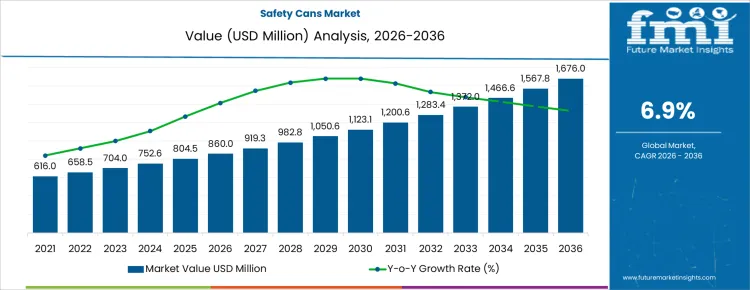
The global safety cans market is experiencing steady growth, projected to reach USD 1.68 billion by 2036 from USD 860 million in 2026, at a CAGR of 6.9%. The market is driven by stringent workplace safety regulations and growing awareness about the importance of safe handling and storage of hazardous materials like flammable liquids. Industrial & lab safety leads the market with a 45% share, followed by chemical handling and manufacturing plants. The demand for flame-arrestor safety cans, which prevent fire hazards, dominates with a 50% share, reflecting the critical role these cans play in industries like chemicals, automotive, and manufacturing.
Quick Stats for Safety Cans Market
- Safety Cans Market Value (2026): USD 860 million
- Safety Cans Market Forecast Value (2036): USD 1,680 million
- Safety Cans Market Forecast CAGR: 6.9%
- Leading End-Use in Safety Cans Market: Industrial & lab safety
- Top Can Type in Safety Cans Market: Flame-arrestor safety cans
- Key Growth Regions in Safety Cans Market: Asia Pacific
- Key Players in Safety Cans Market: Justrite, Eagle Manufacturing, Denios, Zhejiang Safety Tech, Nilkamal Safety, TRUSCO Nakayama
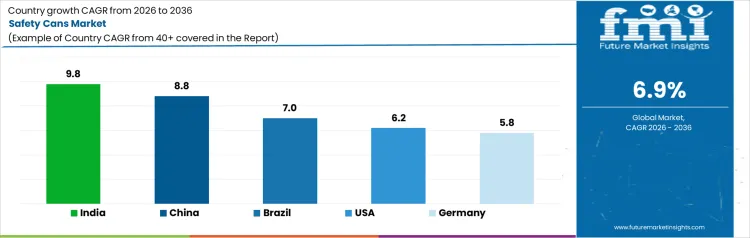
In terms of regional growth, India leads with a 9.8% CAGR, fueled by industrial expansion and increasing focus on safety, particularly in chemicals and pharmaceuticals. China follows with 8.8% growth, driven by its massive manufacturing base and regulatory pressure for safer storage solutions. The USA market grows at 6.2%, supported by stringent safety regulations and a rising demand for compliant equipment in industries such as pharmaceuticals and chemicals. Germany sees steady growth at 5.8%, driven by strict safety standards and environmental regulations. Brazil grows at 7%, supported by industrial development and improved safety regulations. The overall trend highlights growing global demand for safety cans to meet regulatory and safety standards in hazardous industries.
Safety Cans Market Key Takeaways
| Metric | Value |
|---|---|
| Industry Value (2026) | USD 860 million |
| Forecast Value (2036) | USD 1,680 million |
| Forecast CAGR (2026 to 2036) | 6.9% |
How is the Global Safety Cans Sector Advancing?
The global safety cans market is growing steadily as industries and facilities place greater emphasis on risk management, occupational safety, and regulatory compliance. Safety cans are specially designed containers used to store and transport flammable and combustible liquids safely, minimizing the risk of spills, fires, and accidental exposures. Traditional storage methods often involved makeshift containers or inadequate packaging that increased hazard potential. In contrast, safety cans are engineered with features such as flame-arresting screens, self-closing lids, and durable construction to meet stringent safety standards in sectors including chemicals, oil and gas, manufacturing, and maintenance services.
Demand for safety cans is driven by stricter workplace health and safety regulations worldwide, as well as growing awareness among facility managers and safety officers about the importance of proper hazardous material handling. Industries with high volumes of flammable liquids-such as automotive, aerospace, and construction-are adopting safety cans not only to protect employees and equipment but also to reduce liability and avoid costly downtime from incidents. Advances in materials and design, including corrosion-resistant metals and ergonomic features, have further enhanced the effectiveness and usability of safety cans for everyday operations.
Challenges such as balancing upfront equipment costs with budget constraints and ensuring consistent training on proper use may influence adoption rates. The emphasis on creating safer workplaces and preventing hazardous incidents will sustain demand for safety cans across industries worldwide.
What is the Segment-Wise Analysis for the Global Safety Cans Market?
The global safety cans market is segmented by end-use and can type. Industrial & lab safety leads the market with a 45% share, followed by chemical handling, manufacturing plants, and workshops & labs. In terms of can type, flame-arrestor safety cans dominate the market with a 50% share, as they are essential for preventing ignition and ensuring safe storage of flammable liquids. Other types include Type I & Type II cans, fuel & solvent cans, and small safety cans. This segmentation reflects the growing demand for reliable, fire-resistant storage solutions in industries dealing with hazardous materials.
Why Do Industrial & Lab Safety Lead the Global Safety Cans Market?
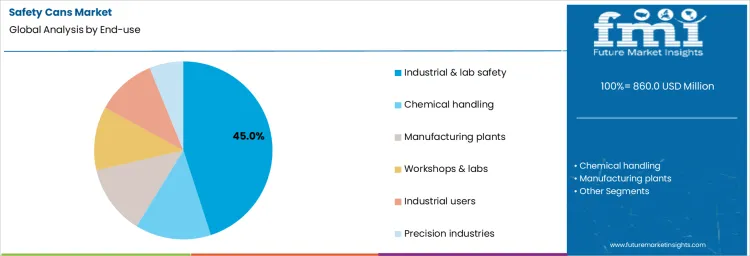
Industrial & lab safety leads the global safety cans market with a 45% share due to the increasing demand for secure and reliable storage solutions for hazardous materials in various work environments. Safety cans are essential in laboratories, industrial facilities, and chemical plants, where the proper containment of flammable liquids and chemicals is critical to preventing accidents, spills, or exposure to harmful substances. With an increasing focus on safety regulations and risk management in workplaces, industries are turning to safety cans to comply with strict standards. The growing need for safety in handling dangerous materials, along with stricter regulatory requirements, continues to drive the demand for safety cans, ensuring their market dominance.
Why Do Flame-Arrestor Safety Cans Hold the Largest Market Share in the Global Safety Cans Market?
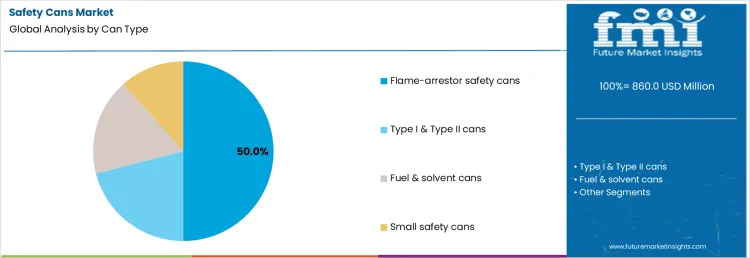
Flame-arrestor safety cans hold the largest share of 50% in the global safety cans market due to their essential role in preventing fire hazards in industries that store flammable liquids. These cans incorporate flame-arresting technology to ensure that any ignition source inside the container does not result in fire or explosion, making them critical for safe storage in chemical handling, manufacturing plants, and workshops. The demand for enhanced safety features, especially in high-risk environments, has led to increased adoption of flame-arrestor safety cans. Their ability to mitigate fire hazards and comply with safety regulations in hazardous workplaces ensures their leading position in the market.
What are the Key Dynamics in the Safety Cans Market?
The safety cans market is expanding as industries prioritize safe handling and storage of flammable and combustible liquids. Safety cans made from durable materials with flame-arresting features, self-closing lids, and spill-resistant designs help reduce fire hazards, regulatory non-compliance, and workplace accidents. Growth in manufacturing, oil & gas, automotive, laboratories, and construction increases demand for compliant storage solutions. Stricter global safety standards (OSHA, NFPA, EPA), rising insurance requirements, and corporate emphasis on risk mitigation further drive adoption.
What Are the Key Drivers for the Safety Cans Market?
The safety cans market is driven by regulatory enforcement and workplace safety compliance requirements. Agencies like OSHA and NFPA mandate safe storage and handling of flammable liquids, prompting businesses to invest in certified safety cans to avoid fines, shutdowns, and liability. Growth in industrial sectors including manufacturing, chemicals, and energy raises the volume of hazardous liquids that must be managed safely. Increasing focus on employee safety and accident prevention programs encourages adoption. Rising awareness of environmental protection spurs demand for designs that prevent spills, leaks, and vapor emissions, aligning with ESG and sustainability initiatives.
What Are the Main Restraints Impacting the Safety Cans Market?
The safety cans market faces challenges related to cost and awareness. High-quality safety cans with flame arrestors, leak-proof closures, and certification tags are more expensive than basic containers, which can deter small and medium-sized operations with limited safety budgets. In some regions, lack of awareness of regulatory requirements or inadequate enforcement reduces urgency to adopt compliant safety containers. Variability in global standards and labeling complicates procurement for multinational firms. Perceived complexity in selecting the right size, material, and certification especially in facilities with diverse liquid types can slow decision-making and adoption.
What Key Trends Are Shaping the Safety Cans Market?
Key trends include innovation in materials and ergonomic design that improve durability, portability, and user convenience. Manufacturers are developing high-strength polyethylene and corrosion-resistant metal cans with improved sealing technology and impact-resistant construction. There is growing integration of smart labeling and traceability, such as QR codes linking to inspection records and compliance data. Sustainability is influencing demand for recyclable and refillable safety cans. Customizable solutions tailored to specific industry needs like explosion-proof versions for hazardous zones and color-coded systems for different liquid classes are gaining traction. Increased training and digital safety platforms also promote adoption by enhancing awareness and proper use.
What is the Growth Outlook for the Safety Cans Market by Country?
| Country | CAGR (%) |
|---|---|
| USA | 6.2% |
| Germany | 5.8% |
| China | 8.8% |
| India | 9.8% |
| Brazil | 7% |
The safety cans market is experiencing steady growth, with India leading at a 9.8% CAGR, driven by the country’s increasing industrialization and heightened focus on safety in chemical handling and storage. China follows closely at 8.8%, supported by the growing demand for safe, compliant storage solutions in various manufacturing sectors. The USA’s market grows at 6.2%, fueled by the strict regulatory framework around hazardous materials and growing demand for safety equipment. Germany’s market grows at 5.8%, driven by a strong focus on safety and environmental regulations. Brazil’s market grows at 7%, backed by the increasing industrial activity and a rising awareness of safety standards.
Why is India Leading in the Safety Cans Market?
India’s safety cans market is growing at 9.8%, driven by the rapid industrialization and a growing need for safe storage solutions, particularly in the chemicals, pharmaceuticals, and automotive sectors. As India’s manufacturing and chemical industries expand, there is a rising demand for compliant and safe storage options for hazardous materials. Safety cans are crucial in preventing leaks and spills, ensuring workplace safety, and meeting regulatory standards. The government’s increasing focus on safety regulations and industrial compliance is further driving this trend. As awareness around workplace safety rises, businesses are more focused on adopting high-quality safety equipment, fueling market growth. With the continued growth of industrial sectors in India, the safety cans market is expected to expand, making India a leader in this segment.
What is Driving the Growth of the Safety Cans Market in China?
China’s safety cans market is growing at 8.8%, supported by the country’s large-scale industrial production and an increased focus on safety and environmental protection. As China’s manufacturing base expands, the demand for compliant and efficient storage solutions for chemicals, solvents, and hazardous materials is rising. Safety cans are essential in meeting environmental regulations and maintaining safety standards in industries like chemicals, pharmaceuticals, and electronics. The government’s emphasis on reducing industrial accidents and improving worker safety is accelerating the adoption of safety cans. With China’s industrial and manufacturing sectors continuing to grow rapidly, the market for safety cans is expected to expand, driven by increasing regulatory pressure and the need for secure, compliant storage solutions.
How is the Safety Cans Market Expanding in the USA?
The USA’s safety cans market is growing at 6.2%, driven by stringent regulations and increasing awareness around safety in industries such as chemicals, manufacturing, and pharmaceuticals. The USA has a well-established regulatory framework around hazardous materials, making safety cans a crucial part of compliance. These cans are used to store flammable liquids, chemicals, and other hazardous substances, reducing the risk of leaks, spills, and accidents. As workplace safety continues to be a priority for businesses, the demand for safety cans is rising. The market is also supported by industries’ need to ensure that their products meet safety standards. With ongoing regulatory developments and a focus on workplace safety, the market for safety cans in the USA is expected to grow steadily.
What is Contributing to the Growth of the Safety Cans Market in Germany?
Germany’s safety cans market is growing at 5.8%, supported by the country’s strong industrial base and strict environmental and safety regulations. As Germany’s manufacturing and chemical sectors continue to expand, the need for safe and compliant storage solutions for hazardous materials is increasing. Safety cans are essential to meeting regulatory requirements and ensuring that hazardous substances are stored securely. Germany’s well-established safety culture, combined with its rigorous environmental laws, is fueling the demand for safety cans. As businesses in Germany prioritize employee safety and environmental protection, the adoption of safety cans continues to grow. With Germany’s continued focus on sustainability and safety standards, the market for safety cans is expected to expand steadily.
What is Driving the Growth of the Safety Cans Market in Brazil?
Brazil’s safety cans market is growing at 7%, driven by the country’s expanding industrial sectors, particularly chemicals, mining, and agriculture. As Brazil’s manufacturing base continues to grow, the demand for safe storage solutions for hazardous materials is rising. Safety cans are critical for ensuring compliance with safety regulations and preventing hazardous spills and leaks. As industries in Brazil face increasing scrutiny regarding safety standards, the adoption of safety cans is becoming more prevalent. The government’s focus on improving workplace safety and reducing environmental risks is driving the demand for such products. As Brazil continues to modernize its industrial infrastructure and improve its regulatory environment, the market for safety cans is expected to grow, with a focus on safety and compliance in industries handling hazardous materials.
How Are Companies Competing in the Safety Cans Market?
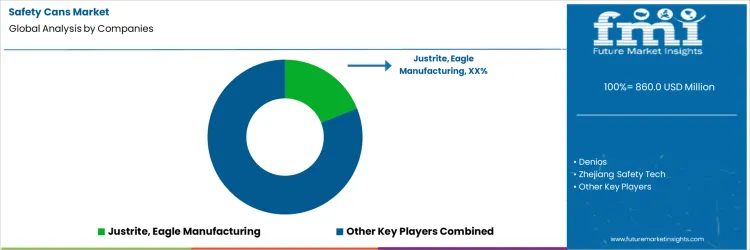
In the safety cans market Justrite, Eagle Manufacturing, Denios, Zhejiang Safety Tech, Nilkamal Safety, local manufacturers, and TRUSCO Nakayama are positioned with product brochures that emphasize secure hazardous liquid storage, compliance with safety standards, and ease of use. Justrite materials present a wide range of liquid safety cans engineered for flammable and combustible fluids. Specifications on capacity, flame-mitigating features, and ergonomic design are included to help safety officers select appropriate cans for workshops, labs, and industrial sites. Detailed use instructions and regulatory alignment are highlighted to support compliance. Eagle Manufacturing brochures focus on rugged steel and polyethylene cans with dependable leak resistance and clearly marked labeling. Performance charts and configuration options are shown to aid selection for diverse applications.
Denios collateral showcases safety cans designed with integrated features such as self-closing lids and corrosion-resistant coatings. Product briefs include clear diagrams and handling guidance. Zhejiang Safety Tech materials present cost-competitive safety cans with specifications on build quality, material grades, and CAPACITY options. Quick reference tables and recommended usage scenarios help buyers determine the right match for their requirements. Nilkamal Safety brochures describe durable, user-friendly cans suited to regional safety needs, with visuals and maintenance tips that simplify adoption. Local manufacturers are featured with customizable safety can solutions and shorter lead times that appeal to nearby industries needing fast fulfillment. TRUSCO Nakayama literature focuses on compact and reliable cans engineered for workshop and industrial environments, with clear performance data and usage notes.
Key Players in Safety Cans Market
- Justrite, Eagle Manufacturing
- Denios
- Zhejiang Safety Tech
- Nilkamal Safety
- Local manufacturers
- TRUSCO Nakayama
Scope of Report
| Items | Values |
|---|---|
| Quantitative Units (2026) | USD million |
| End-use Application | Industrial & lab safety, Chemical handling, Manufacturing plants, Workshops & labs, Industrial users, Precision industries |
| Can Type | Flame-arrestor safety cans, Type I & Type II cans, Fuel & solvent cans, Small safety cans |
| Regions Covered | Asia Pacific, Europe, North America, Latin America, Middle East & Africa |
| Countries Covered | USA, China, Japan, South Korea, India, Australia & New Zealand, ASEAN, Germany, UK, France, Italy, Spain, Nordic, BENELUX, Brazil, Chile, Mexico, Saudi Arabia, Other GCC Countries, Turkey, South Africa, Other African Union |
| Key Companies Profiled | Justrite, Eagle Manufacturing, Denios, Zhejiang Safety Tech, Nilkamal Safety, TRUSCO Nakayama |
| Additional Attributes | Dollar sales by end-use, can type, and region; regional CAGR and growth outlook; distribution channels including logistics providers; regulatory framework and compliance certifications; market positioning of global vs regional suppliers. |
Safety Cans Market by Segments
End-use
- Industrial & lab safety
- Chemical handling
- Manufacturing plants
- Workshops & labs
- Industrial users
- Precision industries
Can Type
- Flame-arrestor safety cans
- Type I & Type II cans
- Fuel & solvent cans
- Small safety cans
Region:
- Asia Pacific
- China
- Japan
- South Korea
- India
- Australia & New Zealand
- ASEAN
- Rest of Asia Pacific
- Europe
- Germany
- United Kingdom
- France
- Italy
- Spain
- Nordic
- BENELUX
- Rest of Europe
- North America
- United States
- Canada
- Mexico
- Latin America
- Brazil
- Chile
- Rest of Latin America
- Middle East & Africa
- Kingdom of Saudi Arabia
- Other GCC Countries
- Turkey
- South Africa
- Other African Union
- Rest of Middle East & Africa
Frequently Asked Questions
How big is the safety cans market in 2026?
The global safety cans market is estimated to be valued at USD 860.0 million in 2026.
What will be the size of safety cans market in 2036?
The market size for the safety cans market is projected to reach USD 1,676.0 million by 2036.
How much will be the safety cans market growth between 2026 and 2036?
The safety cans market is expected to grow at a 6.9% CAGR between 2026 and 2036.
What are the key product types in the safety cans market?
The key product types in safety cans market are industrial & lab safety, chemical handling, manufacturing plants, workshops & labs, industrial users and precision industries.
Which can type segment to contribute significant share in the safety cans market in 2026?
In terms of can type, flame-arrestor safety cans segment to command 50.0% share in the safety cans market in 2026.
Preview the report firsthand - request a free sample
Get SampleGet the brochure for pricing and purchase details.
Get PDFTable of Content
- Executive Summary
- Global Market Outlook
- Demand-side Trends
- Supply-side Trends
- Technology Roadmap Analysis
- Analysis and Recommendations
- Market Overview
- Market Coverage / Taxonomy
- Market Definition / Scope / Limitations
- Market Background
- Market Dynamics
- Drivers
- Restraints
- Opportunity
- Trends
- Scenario Forecast
- Demand in Optimistic Scenario
- Demand in Likely Scenario
- Demand in Conservative Scenario
- Opportunity Map Analysis
- Product Life Cycle Analysis
- Supply Chain Analysis
- Investment Feasibility Matrix
- Value Chain Analysis
- PESTLE and Porter’s Analysis
- Regulatory Landscape
- Regional Parent Market Outlook
- Production and Consumption Statistics
- Import and Export Statistics
- Market Dynamics
- Global Market Analysis 2021 to 2025 and Forecast, 2026 to 2036
- Historical Market Size Value (USD Million) Analysis, 2021 to 2025
- Current and Future Market Size Value (USD Million) Projections, 2026 to 2036
- Y-o-Y Growth Trend Analysis
- Absolute $ Opportunity Analysis
- Global Market Pricing Analysis 2021 to 2025 and Forecast 2026 to 2036
- Global Market Analysis 2021 to 2025 and Forecast 2026 to 2036, By End-use
- Introduction / Key Findings
- Historical Market Size Value (USD Million) Analysis By End-use , 2021 to 2025
- Current and Future Market Size Value (USD Million) Analysis and Forecast By End-use , 2026 to 2036
- Industrial & lab safety
- Chemical handling
- Manufacturing plants
- Workshops & labs
- Industrial users
- Precision industries
- Y-o-Y Growth Trend Analysis By End-use , 2021 to 2025
- Absolute $ Opportunity Analysis By End-use , 2026 to 2036
- Global Market Analysis 2021 to 2025 and Forecast 2026 to 2036, By Can Type
- Introduction / Key Findings
- Historical Market Size Value (USD Million) Analysis By Can Type, 2021 to 2025
- Current and Future Market Size Value (USD Million) Analysis and Forecast By Can Type, 2026 to 2036
- Flame-arrestor safety cans
- Type I & Type II cans
- Fuel & solvent cans
- Small safety cans
- Y-o-Y Growth Trend Analysis By Can Type, 2021 to 2025
- Absolute $ Opportunity Analysis By Can Type, 2026 to 2036
- Global Market Analysis 2021 to 2025 and Forecast 2026 to 2036, By Region
- Introduction
- Historical Market Size Value (USD Million) Analysis By Region, 2021 to 2025
- Current Market Size Value (USD Million) Analysis and Forecast By Region, 2026 to 2036
- North America
- Latin America
- Western Europe
- Eastern Europe
- East Asia
- South Asia and Pacific
- Middle East & Africa
- Market Attractiveness Analysis By Region
- North America Market Analysis 2021 to 2025 and Forecast 2026 to 2036, By Country
- Historical Market Size Value (USD Million) Trend Analysis By Market Taxonomy, 2021 to 2025
- Market Size Value (USD Million) Forecast By Market Taxonomy, 2026 to 2036
- By Country
- USA
- Canada
- Mexico
- By End-use
- By Can Type
- By Country
- Market Attractiveness Analysis
- By Country
- By End-use
- By Can Type
- Key Takeaways
- Latin America Market Analysis 2021 to 2025 and Forecast 2026 to 2036, By Country
- Historical Market Size Value (USD Million) Trend Analysis By Market Taxonomy, 2021 to 2025
- Market Size Value (USD Million) Forecast By Market Taxonomy, 2026 to 2036
- By Country
- Brazil
- Chile
- Rest of Latin America
- By End-use
- By Can Type
- By Country
- Market Attractiveness Analysis
- By Country
- By End-use
- By Can Type
- Key Takeaways
- Western Europe Market Analysis 2021 to 2025 and Forecast 2026 to 2036, By Country
- Historical Market Size Value (USD Million) Trend Analysis By Market Taxonomy, 2021 to 2025
- Market Size Value (USD Million) Forecast By Market Taxonomy, 2026 to 2036
- By Country
- Germany
- UK
- Italy
- Spain
- France
- Nordic
- BENELUX
- Rest of Western Europe
- By End-use
- By Can Type
- By Country
- Market Attractiveness Analysis
- By Country
- By End-use
- By Can Type
- Key Takeaways
- Eastern Europe Market Analysis 2021 to 2025 and Forecast 2026 to 2036, By Country
- Historical Market Size Value (USD Million) Trend Analysis By Market Taxonomy, 2021 to 2025
- Market Size Value (USD Million) Forecast By Market Taxonomy, 2026 to 2036
- By Country
- Russia
- Poland
- Hungary
- Balkan & Baltic
- Rest of Eastern Europe
- By End-use
- By Can Type
- By Country
- Market Attractiveness Analysis
- By Country
- By End-use
- By Can Type
- Key Takeaways
- East Asia Market Analysis 2021 to 2025 and Forecast 2026 to 2036, By Country
- Historical Market Size Value (USD Million) Trend Analysis By Market Taxonomy, 2021 to 2025
- Market Size Value (USD Million) Forecast By Market Taxonomy, 2026 to 2036
- By Country
- China
- Japan
- South Korea
- By End-use
- By Can Type
- By Country
- Market Attractiveness Analysis
- By Country
- By End-use
- By Can Type
- Key Takeaways
- South Asia and Pacific Market Analysis 2021 to 2025 and Forecast 2026 to 2036, By Country
- Historical Market Size Value (USD Million) Trend Analysis By Market Taxonomy, 2021 to 2025
- Market Size Value (USD Million) Forecast By Market Taxonomy, 2026 to 2036
- By Country
- India
- ASEAN
- Australia & New Zealand
- Rest of South Asia and Pacific
- By End-use
- By Can Type
- By Country
- Market Attractiveness Analysis
- By Country
- By End-use
- By Can Type
- Key Takeaways
- Middle East & Africa Market Analysis 2021 to 2025 and Forecast 2026 to 2036, By Country
- Historical Market Size Value (USD Million) Trend Analysis By Market Taxonomy, 2021 to 2025
- Market Size Value (USD Million) Forecast By Market Taxonomy, 2026 to 2036
- By Country
- Kingdom of Saudi Arabia
- Other GCC Countries
- Turkiye
- South Africa
- Other African Union
- Rest of Middle East & Africa
- By End-use
- By Can Type
- By Country
- Market Attractiveness Analysis
- By Country
- By End-use
- By Can Type
- Key Takeaways
- Key Countries Market Analysis
- USA
- Pricing Analysis
- Market Share Analysis, 2025
- By End-use
- By Can Type
- Canada
- Pricing Analysis
- Market Share Analysis, 2025
- By End-use
- By Can Type
- Mexico
- Pricing Analysis
- Market Share Analysis, 2025
- By End-use
- By Can Type
- Brazil
- Pricing Analysis
- Market Share Analysis, 2025
- By End-use
- By Can Type
- Chile
- Pricing Analysis
- Market Share Analysis, 2025
- By End-use
- By Can Type
- Germany
- Pricing Analysis
- Market Share Analysis, 2025
- By End-use
- By Can Type
- UK
- Pricing Analysis
- Market Share Analysis, 2025
- By End-use
- By Can Type
- Italy
- Pricing Analysis
- Market Share Analysis, 2025
- By End-use
- By Can Type
- Spain
- Pricing Analysis
- Market Share Analysis, 2025
- By End-use
- By Can Type
- France
- Pricing Analysis
- Market Share Analysis, 2025
- By End-use
- By Can Type
- India
- Pricing Analysis
- Market Share Analysis, 2025
- By End-use
- By Can Type
- ASEAN
- Pricing Analysis
- Market Share Analysis, 2025
- By End-use
- By Can Type
- Australia & New Zealand
- Pricing Analysis
- Market Share Analysis, 2025
- By End-use
- By Can Type
- China
- Pricing Analysis
- Market Share Analysis, 2025
- By End-use
- By Can Type
- Japan
- Pricing Analysis
- Market Share Analysis, 2025
- By End-use
- By Can Type
- South Korea
- Pricing Analysis
- Market Share Analysis, 2025
- By End-use
- By Can Type
- Russia
- Pricing Analysis
- Market Share Analysis, 2025
- By End-use
- By Can Type
- Poland
- Pricing Analysis
- Market Share Analysis, 2025
- By End-use
- By Can Type
- Hungary
- Pricing Analysis
- Market Share Analysis, 2025
- By End-use
- By Can Type
- Kingdom of Saudi Arabia
- Pricing Analysis
- Market Share Analysis, 2025
- By End-use
- By Can Type
- Turkiye
- Pricing Analysis
- Market Share Analysis, 2025
- By End-use
- By Can Type
- South Africa
- Pricing Analysis
- Market Share Analysis, 2025
- By End-use
- By Can Type
- USA
- Market Structure Analysis
- Competition Dashboard
- Competition Benchmarking
- Market Share Analysis of Top Players
- By Regional
- By End-use
- By Can Type
- Competition Analysis
- Competition Deep Dive
- Justrite, Eagle Manufacturing
- Overview
- Product Portfolio
- Profitability by Market Segments (Product/Age /Sales Channel/Region)
- Sales Footprint
- Strategy Overview
- Marketing Strategy
- Product Strategy
- Channel Strategy
- Denios
- Zhejiang Safety Tech
- Nilkamal Safety
- Local manufacturers
- TRUSCO Nakayama
- Justrite, Eagle Manufacturing
- Competition Deep Dive
- Assumptions & Acronyms Used
- Research Methodology


