

- Market Size (2026)
- USD 3.9 Bn
- Forecast (2036)
- USD 9.0 Bn
- CAGR (2026 to 2036)
- 8.8%
How big is Marine Battery Packs Market in 2026?
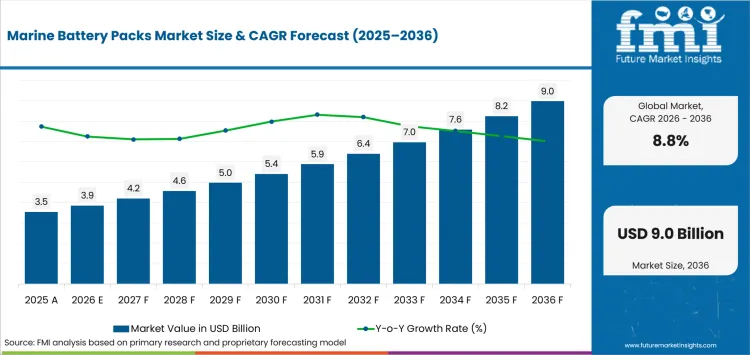
USD 3.9 billion in 2026 and USD 9.0 billion by 2036 at an 8.8% CAGR.
Demand for marine battery packs is projected to rise at an 8.8% CAGR between 2026 and 2036, increasing valuation from USD 3.9 billion to USD 9.0 billion. Demonstrated vessel performance reduces technology-risk concerns for owners, as EVE Energy reported in March 2025 that marine-battery shipments exceeded 526 MWh on more than 1,300 vessels, giving shipyards operating evidence for repeat designs.
Large-scale adoption often depends on access to capital and project funding. Funding programs therefore play a critical role in converting technical validation into fleet deployment. US project funding determines how quickly marine battery technology becomes a funded vessel program. In August 2026, the Federal Transit Administration selected 23 ferry projects in 14 states and the US Virgin Islands, including five Low-No Ferry selections for electric or low-emission vessels and related infrastructure
Key Takeaways
- Demand rises where vessel owners can match pack capacity with repeatable routes and dependable access to shore charging.
- LFP battery packs are estimated to hold 38.0% of chemistry demand in 2026 owing to cycle life and thermal stability in energy-oriented marine service.
- Below 50 kWh systems are expected to represent 24.0% of capacity demand in 2026 because small craft impose a lighter integration burden.
- Ferries are projected to account for 26.0% of vessel-type demand in 2026 driven by fixed routes and regular terminal access.
- Fire-safety controls and shore-power timing restrain adoption because battery installation must progress with class approval and terminal construction.
- Some of the key players in this market include Corvus Energy, EST-Floattech, Echandia, Lehmann Marine, MG Energy Systems, CATL, ePropulsion, Torqeedo, XING Mobility, and Sunwoda.
Analyst Perspective
"Marine battery bids should be compared on delivered vessel availability instead of pack price alone because class documentation and charging interfaces determine commissioning risk. Commercial value rises when system manufacturers can keep a common battery architecture in service as fleets add vessels and revise charging schedules."
- Nikhil Kaitwade, Principal Consultant, Future Market Insights
How is the marine battery packs market segmented?
The market is segmented by chemistry, capacity, vessel type, certification, sales channel, and region.
Chemistry covers LFP battery packs, NMC battery packs, LTO battery packs, solid-state ready premium packs, and hybrid supercapacitor packs. Capacity covers below 50 kWh, 50-250 kWh, 250 kWh-1 MWh, and above 1 MWh. Vessel type includes ferries, workboats, yachts, recreational boats, and offshore support vessels. Certification covers DNV-type approved, class society approved, IEC - marine certified, and custom project qualified systems. Sales channels comprise shipyard project supply, battery system integrators, boat OEMs, and retrofit electrification projects.
Why do LFP battery packs hold 38.0% of the chemistry category in 2026?
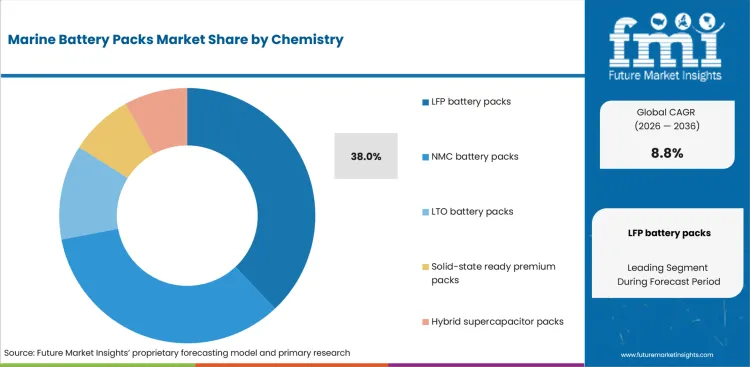
LFP systems fit vessels that value repeated deep cycling and thermal stability over maximum cell-level energy density. Lithium iron phosphate batteries also give marine integrators a cobalt-free chemistry option that can be packaged around fixed route energy requirements.
- By chemistry, LFP battery packs are estimated to hold 38.0% in 2026 owing to long-cycle operation and a stable thermal profile in energy-oriented vessel service.
- Corvus Energy introduced Blue Whale NxtGen Power in August 2026 as a high-power LFP marine battery system for tugs and workboats plus offshore vessels and ferries requiring rapid charge-discharge cycles.
Why does Below 50 kWh hold 24.0% of the capacity category in 2026?
Below 50 kWh systems serve small craft and auxiliary loads where weight and enclosure space constrain battery-room design. Compact installations still require battery management systems that control state of charge and fault isolation without adding excessive integration work.
- The below 50 kWh segment is expected to represent 24.0% in 2026 supported by a broad small-vessel base and lower installed integration requirements.
- ePropulsion introduced the 5.12 kWh E100 marine LFP battery in February 2026 for compact 48-volt installations where restricted equipment space favors standardized battery packaging.
Why do Ferries hold 26.0% of the vessel type category in 2026?
Ferries repeat fixed routes and terminal calls often enough to size batteries against known distance and dwell time. Predictable timetables make electric ships commercially practical because charging windows can be defined before the battery system is selected.
- Ferries are projected to account for 26.0% of vessel-type demand in 2026 driven by predictable route energy and regular terminal access.
- Corvus Energy secured a 40 MWh order in August 2026 for four BC Ferries hybrid-electric vessels, with 10 MWh of installed battery capacity specified for each ferry.
Why does DNV-type approved hold 29.0% of the certification category in 2026?
Marine certification reduces repeated equipment-level review before a pack enters vessel engineering and class documentation. Shipyards specifying large lithium-ion batteries therefore value an approval baseline that already addresses electrical protection and battery safety before project-specific interfaces are reviewed.
- DNV-type approved systems are forecast to represent 29.0% in 2026 attributable to lower qualification uncertainty during shipyard engineering and class review.
- EST-Floattech received DNV Type Approval for its Octopus LFP system in June 2026, giving shipowners and yards a class-verified battery platform for commercial vessel engineering.
Why does Shipyard project supply hold 34.0% of the sales channel category in 2026?
Shipyards control the point where battery rooms and electrical interfaces are fixed into the vessel design. Battery selection therefore needs to align with marine propulsion engines and control systems before late design changes become schedule delays or expensive rework.
- Shipyard project supply is projected to hold 34.0% in 2026 supported by direct coordination of installation interfaces and class documentation during construction.
- Echandia signed an April 2026 agreement to supply a 780 kWh battery system for Gotlandsbolaget’s new Austal-built hybrid catamaran, linking battery selection directly with shipyard integration.
What are the drivers, restraints and opportunities in the Marine Battery Packs Market?
Maritime emissions rules support battery adoption while safety qualification and charging readiness can slow project schedules and raise installed engineering work.
- Driver: Emissions policy and public fleet programs are moving electric and hybrid propulsion into funded vessel decisions with defined delivery schedules.
- Restraint: Battery safety requirements and terminal-power availability can delay otherwise viable installations because both conditions must match the vessel duty cycle.
- Opportunity: Standardized marine battery platforms can convert repeat vessel programs into multi-ship orders with less redesign between sister vessels.
Emissions Rules Move Battery Systems Into Vessel Planning
Marine decarbonization policy increasingly affects propulsion choices before shipyards freeze new vessel specifications during design. The IMO approved draft net-zero measures in April 2025 that pair a marine fuel standard with greenhouse-gas pricing for large ocean-going ships. The proposal does not prescribe batteries but it raises the value of marine power battery systems where hybrid operation can lower fuel use or enable zero-emission port movements.
Safety and Shore Power Keep Integration Risk High
Battery safety remains a project constraint because vessel approval must address electrical faults and thermal propagation before commissioning. IMO agreed a battery-safety workplan in January 2026 covering lithium-ion systems and swappable traction battery containers. Shore-to-ship power supply becomes a second dependency for high-utilization vessels because the required charging power must be available at the terminal without disrupting scheduled service.
Repeat Vessel Programs Reward Standardized Battery Platforms
Repeat ferry construction lets battery suppliers reuse engineering for sister vessels instead of restarting every interface decision. In February 2026 Lehmann Marine disclosed a 3.8 MWh CUBE order for three fully electric HADAG ferries, showing how one modular platform can serve a multi-vessel program with shared system architecture.
Which country CAGRs are profiled in the Marine Battery Packs Market?
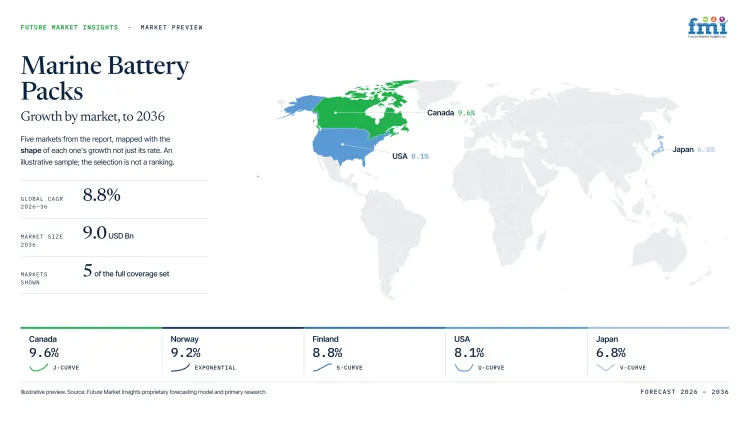
| Country | CAGR |
|---|---|
| Canada | 9.6% |
| Norway | 9.2% |
| Finland | 8.8% |
| Netherlands | 8.5% |
| Australia | 8.4% |
| USA | 8.1% |
| Japan | 6.8% |
How do country-level CAGRs compare in the Marine Battery Packs Market?
The seven forecasts form a narrow middle cluster between Finland at 8.8% and the USA at 8.1%, while Canada and Norway occupy the upper band. Japan forms the lower end of the comparison at 6.8% within the supplied country forecast set. The spread reflects fleet renewal and charging access plus vessel rules and project funding, not current market size alone.
- Canada links clean-vessel demonstrations with charging investment, giving projects a national route from technical trial toward fleet purchasing.
- Norway converts ferry-service requirements into vessel specifications, but route economics still determine whether full electrification is practical.
- Finland ties Baltic vessel renewal to alternative-fuel infrastructure planning, with winter reliability remaining a central engineering constraint.
- The Netherlands pairs seagoing battery support with eligible charging equipment, reducing the split between onboard and berth-side investment decisions.
- Australia is clarifying survey treatment for lithium battery-electric vessels, which can reduce uncertainty during domestic commercial-vessel approval.
- The USA relies on project grants for ferries and terminals, so funding schedules can determine when otherwise viable battery projects proceed.
- Japan supports propulsion batteries together with shore-power equipment, making vessel and terminal readiness part of the same qualification decision.
Comparable CAGRs can still produce different order timing because vessel classes and charging access interact with approval routes and public funding in each country. The full report provides country-level CAGR analysis across North America, Latin America, Europe, East Asia, South Asia, Oceania and the Middle East and Africa.
Country-wise Analysis
- Canadian marine electrification is moving through national programs that fund clean-vessel studies and charging infrastructure within the same policy framework. Marine battery pack demand in Canada is forecast to expand at 9.6% CAGR over the forecast period driven by fleet renewal and corridor investment. Transport Canada reported in its 2024-25 departmental results that 14 Clean Vessel Demonstration projects covered technologies including battery-electric propulsion. The same program supports port infrastructure that can serve electric boats and larger commercial vessels. Manufacturers still need Canadian service coverage because vessel commissioning can stall if charging design and grid work fall behind the shipyard schedule.
- Norwegian ferry purchasing ties low-emission requirements to public service contracts and route feasibility before operators commit to battery capacity. Marine battery pack demand in Norway is projected to grow at 9.2% CAGR through 2036. The 2026 budget recorded 29 of 44 ferry vessels expected to use batteries or hydrogen by 2025, but winter service and route economics limit full electrification.
- Finnish operators evaluate battery retrofits against winter reliability and shore-power availability on short Baltic routes. Marine battery pack sales in Finland are predicted to advance at 8.8% CAGR through 2036 supported by ferry renewal and port electrification. Finland updated its national alternative-fuels infrastructure program in June 2026 and retained water transport within plans for charging and shore-power development. Existing marine engines can remain available during winter peaks while batteries cover lower-load or port operations. Berth power must also fit short turnaround windows because ice-season timetables leave little tolerance for charging delays.
- Dutch operators can pair vessel batteries with charging equipment under one national support route for seagoing projects. Marine battery pack demand in the Netherlands is projected to grow at 8.5% CAGR. The April 2026 subsidy covers eligible battery packages plus charging equipment and can reduce schedule risk for funded retrofits.
- Australian domestic commercial vessels are adopting battery propulsion faster than older survey rules were designed to handle. The Australian market is projected to record 8.4% CAGR during the assessment period attributable to small commercial craft and new low-emission vessel programs. AMSA’s 2026 Marine Order 503 consultation proposed clearer survey treatment for novel vessels including lithium battery-electric designs. Recognized organizations will need suitable technical specifications before electric marine motors and battery packages can enter surveyed service under the proposed approach. Manufacturers need local survey support and complete installation records because late changes to space or charging interfaces increase retrofit cost.
- Marine battery pack demand in the USA is forecast to rise at 8.1% CAGR during the forecast period. US marine electrification remains project-based because federal programs fund individual ferries and related terminal infrastructure. The Federal Transit Administration recorded 14 eligible Low-No Ferry proposals and six selections for fiscal 2024. Battery suppliers need shipyard and power-system coordination so charging construction does not trail vessel delivery.
- Marine battery pack sales in Japan are forecast to expand at 6.8% CAGR by 2036. Japanese operators emphasize class acceptance and operating reliability before battery propulsion enters repeated coastal service. The August 2026 national support program covers propulsion batteries plus shore-power equipment for qualifying zero-emission ships. Overseas suppliers need local shipbuilder and classification relationships because charging layouts remain project-specific despite public funding.
Who are the notable companies in the Marine Battery Packs Market?
Corvus Energy, EST-Floattech, Echandia, Lehmann Marine, MG Energy Systems, CATL, ePropulsion, Torqeedo, XING Mobility, and Sunwoda are notable companies serving this market.
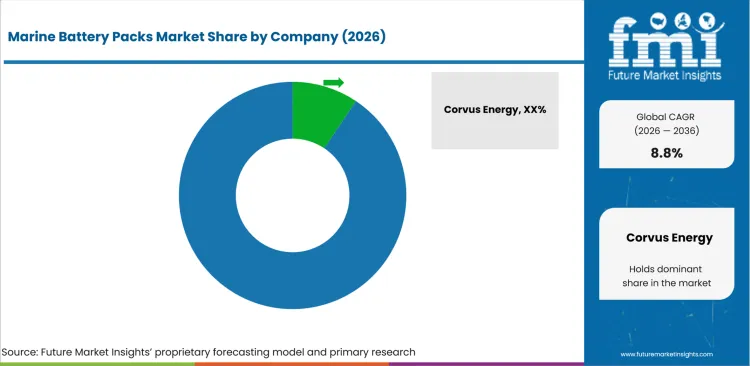
Competition separates dedicated maritime energy-storage specialists from diversified battery manufacturers and electric-propulsion companies that package batteries with vessel systems. Entry depends on marine qualification records and integration support plus service coverage, not corporate scale alone.
- Corvus Energy and EST-Floattech join Echandia plus Lehmann Marine and MG Energy Systems in serving dedicated marine battery programs.
- CATL and ePropulsion join Torqeedo on broader battery or marine-electrification platforms that include current vessel battery applications.
- XING Mobility and Sunwoda are entering marine battery programs with newer liquid-cooled or dedicated vessel-system architectures.
Competitive Benchmarking: Marine Battery Packs Market
| Company | Marine Battery Participation | Integration and Service Depth | Vessel Application Breadth | Geographic Reach |
|---|---|---|---|---|
| Corvus Energy | High | High | High | Global |
| EST-Floattech | High | High | High | Europe and international projects |
| Echandia | High | High | High | Europe, North America, and Asia |
| Lehmann Marine | High | High | Medium | Europe and international projects |
| MG Energy Systems | High | High | High | Europe and international projects |
| CATL | Medium | Medium | Medium | China marine projects |
| ePropulsion | Medium | High | Medium | Global recreational and light-commercial marine |
| Torqeedo | Medium | High | Medium | Global recreational and light-commercial marine |
| XING Mobility | Medium | Medium | Medium | Asia and international marine launch |
| Sunwoda | Medium | Medium | Medium | China marine programs |
Scoring basis: High participation requires dedicated current marine systems plus documented vessel activity, while Medium indicates a narrower current route. High integration requires integrated controls plus documented commissioning or lifecycle support for operating commercial vessels. High vessel breadth requires three documented vessel groups, and geographic reach records verified marine activity.
Key Developments in the Marine Battery Packs Market
- In June 2026, Echandia was selected to supply its Core battery system for a new 78-meter hybrid catamaran under construction at Incat Tasmania and add a current commercial-vessel deployment for the platform.
- In April 2026, ePropulsion supplied a 23.5 kWh G230 battery with an X20 electric propulsion system for a Maine commercial-fishing workboat demonstration and extended integrated battery use into working craft.
- In February 2026, Corvus Energy was selected by ABB to supply battery systems for two Washington State Ferries hybrid-electric vessels and tie marine storage directly to a funded fleet-renewal program.
Key Players in the Marine Battery Packs Market
Dedicated Marine Energy Storage Specialists
- Corvus Energy
- EST-Floattech
- Echandia
- Lehmann Marine
- MG Energy Systems
Battery and Marine Electrification Platforms
- CATL
- ePropulsion
- Torqeedo
Emerging Marine Battery System Suppliers
- XING Mobility
- Sunwoda
Marine Battery Packs Market - Report Scope
| Coverage field | Report scope |
|---|---|
| Market breakdown | By chemistry, capacity, vessel type, certification, sales channel, and region. |
| Quantitative Units | USD billion. |
| Market Definition | Marine-qualified battery packs and integrated energy storage systems used for propulsion, hybrid load management, and vessel auxiliary power. |
| Regions Covered | North America, Latin America, Western Europe, Eastern Europe, East Asia, South Asia and Pacific, and Middle East and Africa. |
| Countries Covered | Canada, Norway, Finland, the Netherlands, Australia, the USA, Japan, and 30+ countries included in the full report. |
| Key Companies Profiled | Corvus Energy, EST-Floattech, Echandia, Lehmann Marine, MG Energy Systems, CATL, ePropulsion, Torqeedo, XING Mobility, and Sunwoda. |
| Forecast Period | 2026 to 2036. |
| Approach | Primary and secondary research with market triangulation. |
Marine Battery Packs Market - Research Methodology
| Method | Approach |
|---|---|
| Primary Research | FMI analysts gathered input from manufacturers, service providers, technology developers, distributors, end users, procurement teams, and subject-matter experts. Interviews examined purchasing decisions, product or service evaluation, adoption barriers, approval requirements, pricing considerations, and expectations for technical or commercial support. Respondents were also asked what evidence is required before a trial, pilot, or initial order develops into regular purchasing. |
| Desk Research | Desk research covered government statistics, regulatory publications, trade data, industry associations, technical literature, standards, company filings, product information, and official corporate announcements. Sources were reviewed for relevance, publication date, geographic coverage, and consistency with the defined market scope. Claims relating to performance, applications, approvals, capacity, investment, and commercial activity were retained only when supported by credible public evidence. |
| Market Sizing and Forecasting | The market model combined the baseline value with historical performance, segment structure, pricing and volume indicators, adoption levels, company participation, and country-level demand conditions. Forecast assumptions considered economic activity, investment trends, regulatory developments, technology adoption, purchasing cycles, supply availability, and barriers to wider market use. Segment and regional estimates were reconciled before the final market total was calculated. |
| Data Validation | Estimates were checked against multiple independent indicators, including public data, company activity, trade patterns, industry developments, and findings from primary interviews. Validation also tested whether products, services, applications, and company revenues fell within the defined market boundaries. Adjacent categories, unsupported claims, overlapping revenues, and activities without direct market relevance were excluded to reduce double counting and maintain consistency across segments and countries. |
Marine Battery Packs Market by Segments
Marine Battery Packs Market segmented by Chemistry:
- LFP battery packs
- NMC battery packs
- LTO battery packs
- Solid-state ready premium packs
- Hybrid supercapacitor packs
Marine Battery Packs Market segmented by Capacity:
- Below 50 kWh
- 50-250 kWh
- 250 kWh-1 MWh
- Above 1 MWh
Marine Battery Packs Market segmented by Vessel Type:
- Ferries
- Workboats
- Yachts
- Recreational boats
- Offshore support vessels
Marine Battery Packs Market segmented by Certification:
- DNV-type approved
- Class society approved
- IEC - marine certified
- Custom project qualified
Marine Battery Packs Market segmented by Sales Channel:
- Shipyard project supply
- Battery system integrators
- Boat OEMs
- Retrofit electrification projects
Marine Battery Packs Market by Region:
- North America
- United States
- Canada
- Latin America
- Brazil
- Mexico
- Argentina
- Chile
- Western Europe
- Germany
- France
- United Kingdom
- Italy
- Spain
- Benelux
- Nordics
- Eastern Europe
- Poland
- Czech Republic
- Romania
- Hungary
- East Asia
- China
- Japan
- South Korea
- South Asia and Pacific
- India
- ASEAN
- Australia and New Zealand
- Middle East and Africa
- GCC Countries
- South Africa
- Türkiye
- Israel
Research Sources and Bibliography
- EVE Energy Storage Co., Ltd. (2025, March 31). EVE Energy Shines at Sea Asia 2025 in Singapore, Boosting Sustainable Development in the Maritime Industry.
- Federal Transit Administration. (2026, August 21). FTA Ferry Programs.
- Corvus Energy. (2026, August 27). Corvus Energy Expands LFP Portfolio with Blue Whale NxtGen Power.
- ePropulsion. (2026, February 12). ePropulsion Debuts E100 High-Performance Battery To Support Award-Winning Electric Propulsion Platforms.
- Corvus Energy. (2026, August 11). Corvus Energy Secures 40MWh Landmark Battery Contract for BC Ferries New Major Vessels Program.
- EST-Floattech. (2026, June 17). EST-Floattech Receives DNV Type Approval for Octopus LFP Battery System.
- Echandia. (2026, April 9). Echandia to supply battery system for Gotlandsbolaget’s new hybrid vessel.
- International Maritime Organization. (2025, April 11). IMO approves net-zero regulations for global shipping.
- International Maritime Organization. (2026, January 29). Draft workplan agreed on safety rules for battery, wind and nuclear-powered ships.
- Lehmann Marine. (2026, February 10). 3.8 MWh CUBE for 3 ferries.
- Transport Canada. (2025). 2024-25 Departmental Results Report.
- Norwegian Government. (2025). Prop. 1 S (2025-2026).
- Ministry of Transport and Communications, Finland. (2026, June 25). Kansallinen liikenteen vaihtoehtoisten käyttövoimien jakeluinfraohjelma.
- Ministry of Infrastructure and Water Management. (2026, April 21). Tijdelijke subsidieregeling batterij-elektrisch varen zeehavens 2026-2029.
- Australian Maritime Safety Authority. (2026, February 23). Proposed changes to certificate of survey requirements.
- Federal Transit Administration. (2026, April 6). FY 2026 Notice of Funding Opportunity: Passenger Ferry Program, Electric or Low-Emitting Ferry Pilot Program, and Ferry Service for Rural Communities Program.
- Ministry of Land, Infrastructure, Transport and Tourism. (2026, August 24). Zero-emission vessel introduction support program.
- Echandia. (2026, June 17). Echandia to supply battery system for Incat’s new 78-meter hybrid ferry.
- ePropulsion. (2026, April 30). Island Institute Partners with ePropulsion to Highlight Electric Propulsion Technology Use in Commercial Fishing.
- Corvus Energy. (2026, February 23). Corvus Energy battery systems selected by ABB for Washington State Ferries.
- MG Energy Systems. (2026, August 18). The MG Story of PK Waterbouw.
- Echandia. (2026, June 2). Echandia launches new battery system - Echandia Core.
- Corvus Energy. (2026, June 18). Scylla Shipping sets course for a more sustainable future with battery systems from Corvus Energy.
- Echandia. (2026, March 12). Echandia launches the next generation of Echandia Ultra.
- ePropulsion. (2026, June 22). ePropulsion Enters Powered Kayak Fishing Market with Innovative kLite Electric Outboard.
- MG Energy Systems. (2026, March 17). The MG Story of Rederij Doeksen.
- Corvus Energy. (2026, April 30). Corvus Energy Achieves DNV Cybersecurity Type Approval for Dolphin NxtGen, Strengthening Leadership in Secure Maritime Energy Storage.
- EST-Floattech. (2026, September 2). Van Tiem Elektro selects EST-Floattech to supply Octopus High Energy battery systems for 15 new river cruise vessels.
- Echandia. (2026, July 3). Echandia strengthens India position with battery systems for two new electric tugs.
- Lehmann Marine. (2026, September 8). Scaled-up Production Capacity.
- MG Energy Systems. (2026, February 17). The MG Story of Bluewater Yachts.
- CATL. (2026, August 1). CATL Signs a Strategic Cooperation Agreement with Pinglu Canal Group.
- ePropulsion. (2026, July 21). ePropulsion’s kMax Battery Earns ICAST 2026 Best of Show Honors in Energy Category.
- Torqeedo. (2026, January 16). Premiere in Germany: Torqeedo Presents New Electric Leisure Outboard Motors at boot Düsseldorf 2026.
- XING Mobility. (2026, June 11). XING Mobility Launches Immersion-cooled Battery System for Advanced Electric Vessels.
- Sunwoda. (2026, May 18). Sunwoda Unveils Full Marine Battery Portfolio: From Proven Cells to Scalable Electrification Solutions.
This bibliography is provided for reader reference and is not exhaustive. The full report contains the complete reference list and detailed citations
This Report Answers
- How will marine battery pack revenue change between 2026 and 2036?
- Which chemistry and capacity categories hold the stated 2026 shares?
- How do ferry duty cycles affect battery sizing and terminal charging?
- Which certification routes reduce shipyard qualification work for battery systems?
- How do national ferry programs alter marine battery order timing?
- Which infrastructure constraints can delay otherwise viable marine battery projects?
- How do marine battery companies differ in approvals and vessel coverage?
- Which 2026 company actions indicate investment in marine battery systems?
Frequently Asked Questions
How big is the marine battery packs market in 2026?
The marine battery packs market is valued at USD 3.9 billion in 2026 and is projected to reach USD 9.0 billion by 2036. Vessel electrification and repeat ferry programs support expansion where charging can be coordinated with fixed operating schedules.
What is the CAGR of the marine battery packs market from 2026 to 2036?
The marine battery packs market is projected to grow at a CAGR of 8.8% between 2026 and 2036. Fleet renewal and maritime emissions rules bring electric or hybrid propulsion into vessel planning before newbuild specifications are frozen.
Which chemistry leads the marine battery packs market?
The LFP battery packs segment is expected to hold 38.0% of chemistry demand in 2026, attributable to long-cycle operation and thermal stability. Energy-oriented vessels use LFP where predictable cycling and stable thermal behavior outweigh maximum cell-level energy density.
Which vessel type leads the marine battery packs market?
The ferries segment is projected to hold 26.0% of vessel-type demand in 2026, driven by repeatable routes and regular terminal access. Predictable schedules let operators size usable energy and charging power before commercial service begins.
Which companies are active in the marine battery packs market?
Key companies in the marine battery packs market include Corvus Energy, EST-Floattech, Echandia, Lehmann Marine, MG Energy Systems, CATL, ePropulsion, Torqeedo, XING Mobility, and Sunwoda. Their documented positions range from class-approved commercial systems to compact marine batteries and newer high-voltage vessel platforms.
Preview the report firsthand - request a free sample
Get SampleGet the brochure for pricing and purchase details.
Get PDFTable of Content
- Key Takeaways
- Market Size and CAGR
- Top Growth Driver
- Fastest Growing Segment
- Leading Region
- Key Companies
- Emerging Opportunities
- Executive Summary
- Global Market Outlook
- Demand-side Trends
- Supply-side Trends
- Technology Roadmap Analysis
- Analysis and Recommendations
- Analyst Perspective (What is happening? Why now? What should investors know?)
- Key Questions Answered
- How large is the market?
- What is the CAGR?
- What are key trends?
- Which region dominates?
- Who are the leaders?
- Market Overview
- Market Coverage / Taxonomy
- Market Definition / Scope / Limitations
- Research Methodology
- Chapter Orientation
- Analytical Lens and Working Hypotheses
- Market Structure, Signals, and Trend Drivers
- Benchmarking and Cross-market Comparability
- Market Sizing, Forecasting, and Opportunity Mapping
- Research Design and Evidence Framework
- Desk Research Programme (Secondary Evidence)
- Expert Input and Fieldwork (Primary Evidence)
- Tooling, Models, and Reference Databases
- Data Engineering and Model Build
- Quality Assurance and Audit Trail
- Market Background
- Market Dynamics (Drivers, Restraints, Opportunity, Trends)
- Scenario Forecast (Optimistic, Likely, Conservative)
- Impact Analysis
- AI Impact
- Sustainability Impact
- Regulatory Impact
- Technology Impact
- Consumer / Buyer Analysis
- Purchase Drivers
- Adoption Barriers
- Buyer Journey
- Opportunity Map Analysis
- Product Life Cycle Analysis
- Supply Chain Analysis
- Investment Feasibility Matrix
- Value Chain Analysis
- PESTLE and Porter's Analysis
- Regulatory Landscape
- Regional Parent Market Outlook
- Production and Consumption Statistics
- Import and Export Statistics
- Global Market Analysis and Forecast, 2021 to 2036
- Historical Market Size Value (USD Billion) Analysis, 2021 to 2025
- Current and Future Market Size Value (USD Billion) Projections, 2026 to 2036
- Y-o-Y Growth Trend Analysis
- Absolute $ Opportunity Analysis
- Global Market Pricing Analysis, 2021 to 2036
- Global Market Analysis and Forecast, By Chemistry, 2021 to 2036
- Introduction / Key Findings
- Historical Market Size Value (USD Billion) Analysis By Chemistry, 2021 to 2025
- Current and Future Market Size Value (USD Billion) Analysis and Forecast By Chemistry, 2026 to 2036
- LFP battery packs
- NMC battery packs
- LTO battery packs
- Solid-state ready premium packs
- Hybrid supercapacitor packs
- LFP battery packs
- Y-o-Y Growth Trend Analysis By Chemistry, 2021 to 2025
- Absolute $ Opportunity Analysis By Chemistry, 2026 to 2036
- Global Market Analysis and Forecast, By Capacity, 2021 to 2036
- Introduction / Key Findings
- Historical Market Size Value (USD Billion) Analysis By Capacity, 2021 to 2025
- Current and Future Market Size Value (USD Billion) Analysis and Forecast By Capacity, 2026 to 2036
- Below 50 kWh
- 50-250 kWh
- 250 kWh-1 MWh
- Above 1 MWh
- Below 50 kWh
- Y-o-Y Growth Trend Analysis By Capacity, 2021 to 2025
- Absolute $ Opportunity Analysis By Capacity, 2026 to 2036
- Global Market Analysis and Forecast, By Vessel Type, 2021 to 2036
- Introduction / Key Findings
- Historical Market Size Value (USD Billion) Analysis By Vessel Type, 2021 to 2025
- Current and Future Market Size Value (USD Billion) Analysis and Forecast By Vessel Type, 2026 to 2036
- Ferries
- Workboats
- Yachts
- Recreational boats
- Offshore support vessels
- Ferries
- Y-o-Y Growth Trend Analysis By Vessel Type, 2021 to 2025
- Absolute $ Opportunity Analysis By Vessel Type, 2026 to 2036
- Global Market Analysis and Forecast, By Certification, 2021 to 2036
- Introduction / Key Findings
- Historical Market Size Value (USD Billion) Analysis By Certification, 2021 to 2025
- Current and Future Market Size Value (USD Billion) Analysis and Forecast By Certification, 2026 to 2036
- DNV-type approved
- Class society approved
- IEC / marine certified
- Custom project qualified
- DNV-type approved
- Y-o-Y Growth Trend Analysis By Certification, 2021 to 2025
- Absolute $ Opportunity Analysis By Certification, 2026 to 2036
- Global Market Analysis and Forecast, By Sales Channel, 2021 to 2036
- Introduction / Key Findings
- Historical Market Size Value (USD Billion) Analysis By Sales Channel, 2021 to 2025
- Current and Future Market Size Value (USD Billion) Analysis and Forecast By Sales Channel, 2026 to 2036
- Shipyard project supply
- Battery system integrators
- Boat OEMs
- Retrofit electrification projects
- Shipyard project supply
- Y-o-Y Growth Trend Analysis By Sales Channel, 2021 to 2025
- Absolute $ Opportunity Analysis By Sales Channel, 2026 to 2036
- Global Market Analysis and Forecast, By Region, 2021 to 2036
- Introduction
- Historical Market Size Value (USD Billion) Analysis By Region, 2021 to 2025
- Current Market Size Value (USD Billion) Analysis and Forecast By Region, 2026 to 2036
- North America
- Latin America
- Western Europe
- Eastern Europe
- East Asia
- South Asia and Pacific
- Middle East & Africa
- Market Attractiveness Analysis By Region
- North America Market Analysis and Forecast, By Country, 2021 to 2036
- Historical Market Size Value (USD Billion) Trend Analysis By Market Taxonomy, 2021 to 2025
- Market Size Value (USD Billion) Forecast By Market Taxonomy, 2026 to 2036
- By Country
- USA
- Canada
- By Chemistry
- By Capacity
- By Vessel Type
- By Certification
- By Sales Channel
- By Country
- Market Attractiveness Analysis
- By Country
- By Chemistry
- By Capacity
- By Vessel Type
- By Certification
- By Sales Channel
- Key Takeaways
- Latin America Market Analysis and Forecast, By Country
- Historical Market Size Value (USD Billion) Trend Analysis By Market Taxonomy, 2021 to 2025
- Market Size Value (USD Billion) Forecast By Market Taxonomy, 2026 to 2036
- By Country
- Brazil
- Mexico
- Chile
- Rest of Latin America
- By Chemistry
- By Capacity
- By Vessel Type
- By Certification
- By Sales Channel
- By Country
- Market Attractiveness Analysis
- By Country
- By Chemistry
- By Capacity
- By Vessel Type
- By Certification
- By Sales Channel
- Key Takeaways
- Western Europe Market Analysis and Forecast, By Country
- Historical Market Size Value (USD Billion) Trend Analysis By Market Taxonomy, 2021 to 2025
- Market Size Value (USD Billion) Forecast By Market Taxonomy, 2026 to 2036
- By Country
- Germany
- UK
- Italy
- Spain
- France
- Nordic
- BENELUX
- Rest of Western Europe
- By Chemistry
- By Capacity
- By Vessel Type
- By Certification
- By Sales Channel
- By Country
- Market Attractiveness Analysis
- By Country
- By Chemistry
- By Capacity
- By Vessel Type
- By Certification
- By Sales Channel
- Key Takeaways
- Eastern Europe Market Analysis and Forecast, By Country
- Historical Market Size Value (USD Billion) Trend Analysis By Market Taxonomy, 2021 to 2025
- Market Size Value (USD Billion) Forecast By Market Taxonomy, 2026 to 2036
- By Country
- Russia
- Poland
- Hungary
- Balkan & Baltic
- Rest of Eastern Europe
- By Chemistry
- By Capacity
- By Vessel Type
- By Certification
- By Sales Channel
- By Country
- Market Attractiveness Analysis
- By Country
- By Chemistry
- By Capacity
- By Vessel Type
- By Certification
- By Sales Channel
- Key Takeaways
- East Asia Market Analysis and Forecast, By Country
- Historical Market Size Value (USD Billion) Trend Analysis By Market Taxonomy, 2021 to 2025
- Market Size Value (USD Billion) Forecast By Market Taxonomy, 2026 to 2036
- By Country
- China
- Japan
- South Korea
- By Chemistry
- By Capacity
- By Vessel Type
- By Certification
- By Sales Channel
- By Country
- Market Attractiveness Analysis
- By Country
- By Chemistry
- By Capacity
- By Vessel Type
- By Certification
- By Sales Channel
- Key Takeaways
- South Asia and Pacific Market Analysis and Forecast, By Country
- Historical Market Size Value (USD Billion) Trend Analysis By Market Taxonomy, 2021 to 2025
- Market Size Value (USD Billion) Forecast By Market Taxonomy, 2026 to 2036
- By Country
- India
- ASEAN
- Australia & New Zealand
- Rest of South Asia and Pacific
- By Chemistry
- By Capacity
- By Vessel Type
- By Certification
- By Sales Channel
- By Country
- Market Attractiveness Analysis
- By Country
- By Chemistry
- By Capacity
- By Vessel Type
- By Certification
- By Sales Channel
- Key Takeaways
- Middle East & Africa Market Analysis and Forecast, By Country
- Historical Market Size Value (USD Billion) Trend Analysis By Market Taxonomy, 2021 to 2025
- Market Size Value (USD Billion) Forecast By Market Taxonomy, 2026 to 2036
- By Country
- Kingdom of Saudi Arabia
- Other GCC Countries
- Türkiye
- South Africa
- Other African Union
- Rest of Middle East & Africa
- By Chemistry
- By Capacity
- By Vessel Type
- By Certification
- By Sales Channel
- By Country
- Market Attractiveness Analysis
- By Country
- By Chemistry
- By Capacity
- By Vessel Type
- By Certification
- By Sales Channel
- Key Takeaways
- Key Countries Market Analysis
- USA
- Pricing Analysis
- Market Share Analysis, 2025
- By Chemistry
- By Capacity
- By Vessel Type
- By Certification
- By Sales Channel
- Canada
- Pricing Analysis
- Market Share Analysis, 2025
- By Chemistry
- By Capacity
- By Vessel Type
- By Certification
- By Sales Channel
- Mexico
- Pricing Analysis
- Market Share Analysis, 2025
- By Chemistry
- By Capacity
- By Vessel Type
- By Certification
- By Sales Channel
- Brazil
- Pricing Analysis
- Market Share Analysis, 2025
- By Chemistry
- By Capacity
- By Vessel Type
- By Certification
- By Sales Channel
- Chile
- Pricing Analysis
- Market Share Analysis, 2025
- By Chemistry
- By Capacity
- By Vessel Type
- By Certification
- By Sales Channel
- Germany
- Pricing Analysis
- Market Share Analysis, 2025
- By Chemistry
- By Capacity
- By Vessel Type
- By Certification
- By Sales Channel
- UK
- Pricing Analysis
- Market Share Analysis, 2025
- By Chemistry
- By Capacity
- By Vessel Type
- By Certification
- By Sales Channel
- Italy
- Pricing Analysis
- Market Share Analysis, 2025
- By Chemistry
- By Capacity
- By Vessel Type
- By Certification
- By Sales Channel
- Spain
- Pricing Analysis
- Market Share Analysis, 2025
- By Chemistry
- By Capacity
- By Vessel Type
- By Certification
- By Sales Channel
- France
- Pricing Analysis
- Market Share Analysis, 2025
- By Chemistry
- By Capacity
- By Vessel Type
- By Certification
- By Sales Channel
- India
- Pricing Analysis
- Market Share Analysis, 2025
- By Chemistry
- By Capacity
- By Vessel Type
- By Certification
- By Sales Channel
- ASEAN
- Pricing Analysis
- Market Share Analysis, 2025
- By Chemistry
- By Capacity
- By Vessel Type
- By Certification
- By Sales Channel
- Australia & New Zealand
- Pricing Analysis
- Market Share Analysis, 2025
- By Chemistry
- By Capacity
- By Vessel Type
- By Certification
- By Sales Channel
- China
- Pricing Analysis
- Market Share Analysis, 2025
- By Chemistry
- By Capacity
- By Vessel Type
- By Certification
- By Sales Channel
- Japan
- Pricing Analysis
- Market Share Analysis, 2025
- By Chemistry
- By Capacity
- By Vessel Type
- By Certification
- By Sales Channel
- South Korea
- Pricing Analysis
- Market Share Analysis, 2025
- By Chemistry
- By Capacity
- By Vessel Type
- By Certification
- By Sales Channel
- Russia
- Pricing Analysis
- Market Share Analysis, 2025
- By Chemistry
- By Capacity
- By Vessel Type
- By Certification
- By Sales Channel
- Poland
- Pricing Analysis
- Market Share Analysis, 2025
- By Chemistry
- By Capacity
- By Vessel Type
- By Certification
- By Sales Channel
- Hungary
- Pricing Analysis
- Market Share Analysis, 2025
- By Chemistry
- By Capacity
- By Vessel Type
- By Certification
- By Sales Channel
- Kingdom of Saudi Arabia
- Pricing Analysis
- Market Share Analysis, 2025
- By Chemistry
- By Capacity
- By Vessel Type
- By Certification
- By Sales Channel
- Türkiye
- Pricing Analysis
- Market Share Analysis, 2025
- By Chemistry
- By Capacity
- By Vessel Type
- By Certification
- By Sales Channel
- South Africa
- Pricing Analysis
- Market Share Analysis, 2025
- By Chemistry
- By Capacity
- By Vessel Type
- By Certification
- By Sales Channel
- USA
- Market Structure Analysis
- Competition Dashboard
- Competition Benchmarking
- Market Share Analysis of Top Players
- By Regional
- By Chemistry
- By Capacity
- By Vessel Type
- By Certification
- By Sales Channel
- Emerging Startups
- Innovation Benchmarking
- Competition Analysis
- Competition Deep Dive
- Corvus Energy
- Overview
- Product Portfolio
- Profitability by Market Segments
- Sales Footprint
- Strategy Overview
- Marketing Strategy
- Product Strategy
- Channel Strategy
- Leclanché
- EST-Floattech
- Spear Power Systems
- Forsee Power
- Akasol / BorgWarner
- Echandia
- Shift Clean Energy
- Kokam / SolarEdge
- XALT Energy
- Corvus Energy
- Case Studies
- Success Stories
- Recent Developments
- Competition Deep Dive
- Assumptions & Acronyms Used


