

- Market Size (2026)
- USD 860.7 Mn
- Forecast (2036)
- USD 1858.2 Mn
- CAGR (2026 to 2036)
- 8.0%
How big is Marine Battery Enclosures Market in 2026?
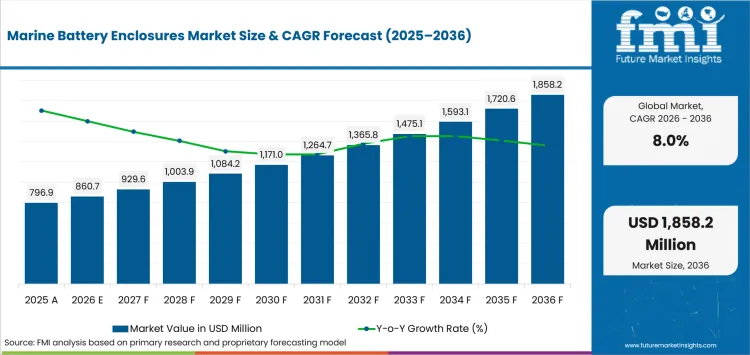
USD 860.7 million in 2026 and USD 1,858.2 million by 2036 at an 8.0% CAGR.
Marine battery enclosure demand is projected to rise from USD 860.7 million in 2026 to USD 1,858.2 million by 2036 at an 8.0% CAGR. Vessel electrification moves enclosure design into the battery safety case because housings must preserve ventilation and thermal containment. DNV documented in July 2025 that lithium-ion installations require controls for thermal runaway and fire hazards before class approval can close.
Country demand diverges because national ferry programs reach different stages of electrification and charging readiness. Statens vegvesen documented in February 2025 that nearly 90 electric ferries were operating in Norway. Norway's installed base supports module replacement and capacity expansion while newer ferry markets depend more heavily on charging infrastructure before enclosure orders convert.
Key Takeaways
- Marine battery enclosure demand rises as shipyards place battery housings inside class review for fire protection and vessel integration.
- By enclosure type, rack enclosures are estimated to hold 27.0% in 2026 owing to repeatable module mounting and service access.
- Aluminum is set to lead the material category with 34.0% share in 2026 due to lower mass and configurable fabrication for vessel layouts.
- IP67 - IP68 sealed designs are projected to hold 28.0% share in 2026 owing to routine exposure to moisture and saline air.
- Vessel-specific geometry and approval requirements limit standardization because cable routes and cooling interfaces change between ship classes.
- Some of the key players in this market include Corvus Energy, EST-Floattech, Leclanché, Echandia, CATL, CALB, Racern Technology, WATTALPS, Sunwoda, and XING Mobility.
Analyst Perspective
"Marine battery enclosures should be evaluated by the engineering work they remove before a vessel reaches class approval. Commercial value rises when one housing platform preserves service access and safety interfaces through battery capacity changes."
- Nikhil Kaitwade, Principal Consultant, Future Market Insights
How is the marine battery enclosures market segmented?
The marine battery enclosures market is segmented by enclosure type, material, protection, application, sales channel, and region.
Market taxonomy covers enclosure type, material, protection, application, sales channel and region. Enclosure types include rack, waterproof pack, containerized, fire-rated and modular aluminum formats. Materials include aluminum, stainless steel, composite, coated steel and fire-resistant polymers. Protection covers IP67 - IP68 sealing, thermal-runaway containment, explosion relief, EMI shielding and corrosion control. Applications include packs, racks, containerized ESS, auxiliary power modules and retrofit battery rooms. Sales channels include battery-system OEMs, marine fabricators, shipyards and custom specialists.
Why do rack enclosures lead demand within the enclosure type category?
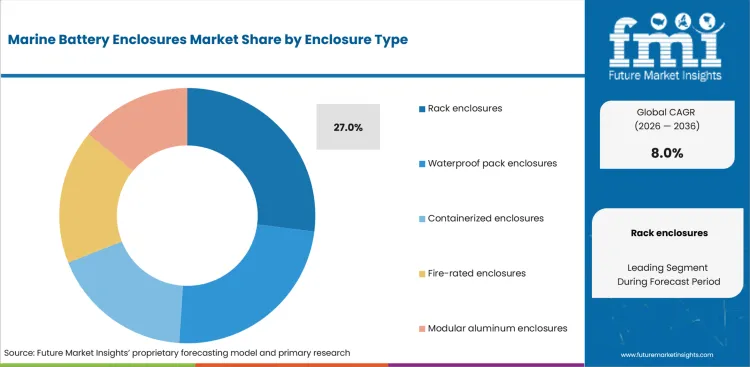
Rack enclosures scale stored energy by repeating certified module positions instead of redesigning each pack boundary. A stable rack keeps cable routes and cooling interfaces accessible as shipyards adapt outer geometry to machinery-space limits. Adjacent marine power battery systems use the same modular logic to preserve certified internal geometry between vessel programs.
- By enclosure type, rack enclosures are estimated to hold 27.0% in 2026 owing to repeatable module mounting and service access.
- Leclanché’s June 2025 launch of serial production for its Navius MRS-3 marine rack system followed completion of design work and class certification, demonstrating how a standardized, approved rack platform can move directly into repeat vessel programs while reducing redesign work for shipyards.
Why does aluminum lead demand within the material category?
Aluminum cuts structural mass while retaining machining flexibility for doors and cable interfaces on marine housings. Battery projects also borrow fabrication practices from aluminum profile enclosures because dimensional repeatability supports configured electronics packaging. Marine service still requires coatings and galvanic isolation because salt exposure can damage poorly controlled material interfaces.
- Aluminum is forecast to represent 34.0% of material demand in 2026 attributable to lower mass and configurable fabrication for vessel layouts.
- Echandia documented in March 2026 that a marine battery rack is the metallic enclosure that houses battery modules and supports structural integration inside the vessel, highlighting the importance of durable and lightweight materials such as aluminum in enclosure construction..
Why do IP67 - IP68 sealed designs lead demand within the protection category?
Marine battery housings face spray and condensation before operators consider fire or pressure-control features. Electrical enclosure platforms offer useful sealing practice only if cable entries and service points preserve the required ingress barrier. Corrosion protection must also tolerate routine maintenance without damaging seals or exposing conductive hardware.
- By protection, IP67 - IP68 sealed designs are estimated to hold 28.0% in 2026 owing to routine exposure to moisture and saline air.
- ABS issued an August 2026 Product Design Assessment for Fleetzero’s Leviathan marine battery system with IP67 protection and a modular containerized design, underscoring the industry's emphasis on sealed enclosures that safeguard battery systems from moisture and harsh marine environments..
Why do battery packs lead demand within the application category?
Pack-level housings sit closest to cells and provide the first physical barrier against impact and environmental exposure. Larger battery energy storage systems offer integration lessons where thermal control and isolation must remain serviceable inside constrained enclosures. Pack boundaries change more often than battery rooms because module formats and capacity targets vary between vessel programs.
- Battery packs are projected to account for 34.0% of application demand in 2026 driven by direct responsibility for protection and serviceability.
- Corvus Energy stated in February 2026 that ABB selected its Dolphin NxtGen ESS for two Washington State hybrid-electric ferries, reflecting continued investment in advanced battery pack solutions that combine protection, thermal management, and serviceability at the cell level.
Why do battery system OEMs lead demand within the sales channel category?
Battery system OEMs define module geometry and thermal interfaces before shipyards complete detailed vessel installation plans. Their control of battery management systems keeps enclosure revisions tied to sensors and electrical isolation requirements. Direct OEM sourcing reduces handoffs between rack design and safety documentation during class review.
- Battery system OEMs are expected to hold 38.0% of sales-channel demand in 2026 because they control core battery geometry and approval interfaces.
- Echandia stated in January 2026 that a competitive tender selected its 4.4 MWh battery system for India’s first fully electric tug at Kandla Port, illustrating how OEM-led battery projects influence enclosure specifications and vessel integration from the earliest design stages.
What are the drivers, restraints and opportunities in the Marine Battery Enclosures Market?
Class-driven battery safety increases enclosure requirements, while vessel-specific approval slows standardization and modular documented platforms support repeatable deployment.
- Driver: Higher onboard battery capacity makes enclosure containment and thermal interfaces part of the vessel safety approval package.
- Restraint: Ship-specific geometry can reopen ventilation and cable-routing decisions even after the enclosure platform has already been technically qualified.
- Opportunity: Configurable housings can reduce repeated engineering when materials and protection options arrive with documentation suitable for class review.
Marine battery capacity places more stored energy beside propulsion equipment and makes enclosure interfaces part of onboard safety engineering. IMO published a January 2026 workplan covering safety rules for lithium-ion batteries and swappable traction battery containers on ships. Projects using electric marine motors therefore need housings that keep isolation and cooling provisions consistent with the vessel safety arrangement.
Qualification slows when a housing must be revised for one vessel even though the core battery system has already passed technical testing. ClassNK amended accumulator-battery requirements in June 2025 with clearer compartment and fire-integrity provisions for relevant new construction. The extra drawing work also affects marine electronics integration because cable routing and control equipment share the same constrained machinery spaces.
Modular enclosure families offer value when manufacturers separate repeatable safety interfaces from ship-specific mounting and service details. ABS reported in September 2025 that advanced maritime batteries require deliberate fire prevention and thermal-runaway response strategies. Comparable battery thermal management services show why accessible cooling interfaces can preserve maintenance options without reopening the complete housing design.
Which country CAGRs are profiled in the Marine Battery Enclosures Market?
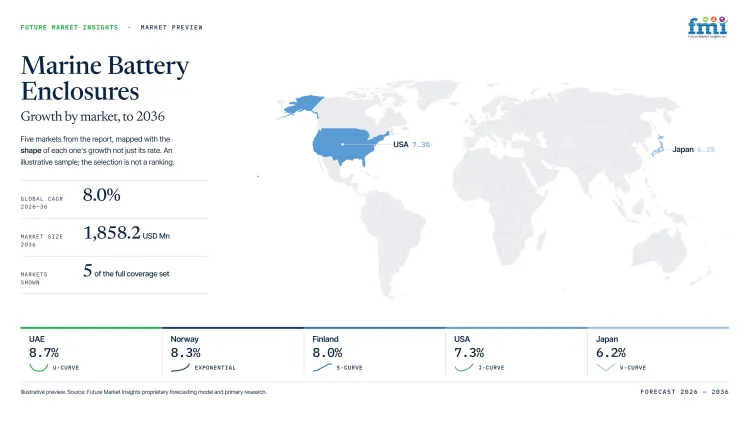
| Country | CAGR |
|---|---|
| UAE | 8.7% |
| Norway | 8.3% |
| Finland | 8.0% |
| Canada | 7.7% |
| USA | 7.3% |
| Germany | 7.0% |
| Japan | 6.2% |
How do country-level CAGRs compare in the Marine Battery Enclosures Market?
The country CAGRs span 2.5 percentage points between the UAE at 8.7% and Japan at 6.2%. UAE and Norway form the upper group while Finland and Canada track the overall market pace. USA and Germany form a lower band before Japan and the ranking describes forecast speed instead of current revenue.
- UAE growth concentrates in coastal passenger craft where compact installations convert vessel programs into annual enclosure orders.
- Norway stays near the upper group as replacement work accompanies deliveries within its electrified ferry fleet.
- Finland tracks the global rate because route economics limit battery sizing for ferries with scheduled charging.
- Canada advances through public ferry programs whose long construction schedules concentrate enclosure orders into project cycles.
- The USA is witnessing expansion as ferry modernization advances at different speeds among public vessel fleets.
- Germany notes moderate pace with inland-vessel projects constrained by retrofit economics for smaller operating fleets.
- Japan is estimated to record 6.2% CAGR as battery systems enter planned shipbuilding programs with longer approval cycles.
Comparable CAGRs can produce different order timing because fleet age and class practice vary nationally. The full report provides country-level CAGR analysis across North America, Latin America, Western Europe, Eastern Europe, East Asia, South Asia and Pacific, and Middle East and Africa.
Country-wise Analysis
- UAE marine projects operate in hot coastal service where sealed electronics and thermal interfaces must tolerate heat without expanding the enclosure footprint. Marine battery enclosure demand in the UAE is forecast to expand at 8.7% CAGR through 2036 with growth tied to low-emission vessel modernization. The Ministry of Energy and Infrastructure stated in May 2025 that the UAE aims to cut emissions at national ports by 70% by 2030. Operators evaluating electric boats therefore favor corrosion-resistant housings that preserve cooling access during routine vessel maintenance. Local projects still face integration friction because compact passenger craft leave little room for added ventilation or maintenance clearance.
- Norwegian ferry operators work from a mature battery-electric fleet where enclosure changes must fit established charging schedules and maintenance routines. Norway’s first Biennial Transparency Report records a national zero-emission requirement for all public tender ferries from 2025. Marine battery enclosure demand in Norway is projected to record 8.3% CAGR during the assessment period owing to continued public-ferry electrification. Norwegian shipyards and marine integrators already have practical experience installing and servicing battery-electric vessel systems in routine service. Route-specific power needs remain a friction because larger energy systems can reopen rack spacing and cooling decisions before each public ferry contract reaches class approval.
- Finnish ferry projects favor route-specific battery sizing because short commuter and road-ferry services can operate within practical charging windows. Adoption of marine battery enclosures in Finland is estimated to expand at 8.0% CAGR through 2036 owing to national alternative-fuel infrastructure planning. The Ministry of Transport and Communications published its national program in February 2025 covering future infrastructure for water transport nationwide. Cold-weather operation increases the value of sealed housings and serviceable thermal interfaces during winter ferry duty. The principal friction is matching battery capacity with shore charging without adding unnecessary vessel mass or consuming machinery space needed for other systems.
- Canadian marine electrification now has a national funding route instead of relying on isolated ferry replacements. Transport Canada stated in February 2026 that the Green Shipping Corridor Program is national in scope and includes funding for clean-vessel demonstration projects. Marine battery enclosure demand in Canada is forecast to rise at 7.7% CAGR over the forecast period owing to vessel modernization and demonstration activity. The marine propulsion engine sector also influences how hybrid machinery is packaged beside batteries during refits and newbuilds. Long vessel lives make service access and later battery expansion part of the enclosure decision before construction is complete.
- US ferry projects often move through public funding programs that tie battery equipment to vessel replacement and charging infrastructure. Marine battery enclosure demand in the USA is forecast to rise at 7.3% CAGR through 2036 as ferry electrification and hybrid-vessel renewal advance. FTA reported in August 2026 that 23 ferry projects were selected across 14 states and the US Virgin Islands. Five selections came through the Low or No Emitting Ferry Program for cleaner vessel investment. Federal funding gives shipyards a national route for electric and low-emitting ferry investment that can convert into battery-system specifications. Installation schedules still depend on class review and charging readiness before construction reaches final equipment placement.
- German marine projects span inland passenger transport and shipyard work where compact battery packaging competes with existing machinery and terminal constraints. Marine battery enclosure demand in Germany is predicted to advance at 7.0% CAGR through 2036 with growth tied to zero-emission inland-vessel programs. The Federal Ministry for Transport announced in August 2026 a funding call for emission-free inland ships serving regional passenger and freight transport. German vessel operators can use the federal program to fund regional passenger and freight projects with emission-free propulsion. Retrofit space and charging windows remain limiting conditions which reward modular housings that preserve maintenance access without enlarging the machinery footprint.
- Japanese shipbuilders work in a class-intensive production system where enclosure geometry must be settled before battery equipment reaches final installation planning. Japan’s transport ministry opened a September 2025 program supporting production equipment for zero-emission ships that can use batteries as eligible propulsion energy. Marine battery enclosure demand in Japan is anticipated to advance at 6.2% CAGR over the assessment period attributable to domestic shipbuilding investment. Domestic shipbuilding capacity gives enclosure manufacturers a practical route into advanced zero-emission vessel programs. Detailed approval work remains the friction because compartment layout and fire-protection decisions can force enclosure revisions late in design.
Who are the notable companies in the Marine Battery Enclosures Market?
Corvus Energy, EST-Floattech, Leclanché, Echandia, CATL, CALB, Racern Technology, WATTALPS, Sunwoda, and XING Mobility.
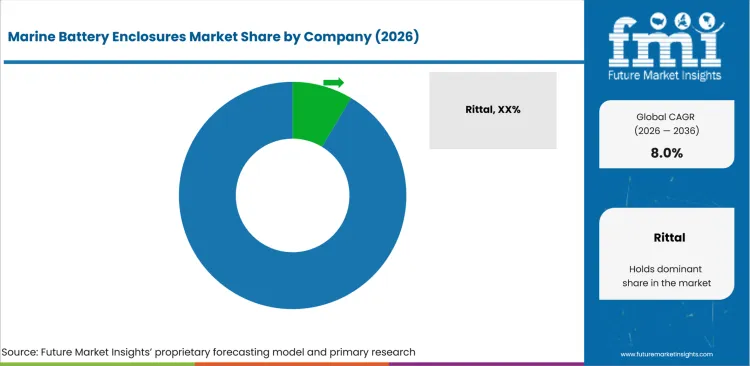
Competition is concentrated among suppliers whose protected rack and thermal-control work remains inside the vessel battery purchase. Corvus Energy and EST-Floattech supply complete marine ESS platforms alongside Leclanché and Echandia for commercial vessel projects. CATL and CALB document marine battery deployments for commercial vessels and public-service craft across Asian markets. Racern Technology and WATTALPS compete through certified systems while Sunwoda and XING Mobility add purpose-built marine architectures.
- Corvus Energy and EST-Floattech supply marine ESS platforms with documented class-ready safety architecture for vessel projects. Leclanché adds a certified marine rack system that fixes module geometry before shipyard installation.
- Echandia and CATL document vessel battery programs that place battery protection inside the integrated marine system. CALB and Racern Technology add current marine certifications and vessel deployments across Asian markets.
- WATTALPS and Sunwoda document marine battery programs that combine battery packaging with thermal and safety controls. XING Mobility adds immersion-cooled marine systems aimed at space-constrained electric vessels with compact machinery spaces.
Competitive Benchmarking: Marine Battery Enclosures Market
| Company | Marine Battery Integration | Sealed & Corrosion-Resistant Enclosures | Thermal & Safety Integration | Geographic Reach |
|---|---|---|---|---|
| Corvus Energy | High | Medium | High | Global marine projects |
| EST-Floattech | High | Medium | High | International maritime projects |
| Leclanché | High | Medium | Medium | Europe; international marine projects |
| Echandia | High | Medium | High | Europe; North America; Asia-Pacific |
| CATL | High | Medium | Medium | China; international marine projects |
| CALB | High | Medium | Medium | Asia; international certifications |
| Racern Technology | High | High | High | Asia; international certifications |
| WATTALPS | High | Medium | High | Europe; international maritime projects |
| Sunwoda | High | Medium | High | China; international development |
| XING Mobility | High | Medium | High | Asia; Europe |
Scoring basis: Marine battery integration scores High for a documented complete marine battery or rack platform and Medium for a directly adjacent certified battery architecture. Low marks evidence limited to one marine component without a complete system pathway for vessel integration. Enclosure protection scores High when evidence names a protected rack or disclosed ingress rating and Medium when marine qualification is documented without a housing rating. Low marks only generic protection evidence without documented marine qualification for shipboard battery use.
Key Developments in the Marine Battery Enclosures Market
- In August 2026, Corvus Energy secured a 40 MWh battery contract for four BC Ferries vessels with interface bases sized for later capacity expansion.
- In September 2026, EST-Floattech won an order to supply Octopus High Energy systems for fifteen river cruise vessels totaling 9.7 MWh of battery capacity.
- In June 2026, Echandia won its first Echandia Core order from Incat for a 78-meter hybrid ferry supporting electric and hybrid operation.
Key Players in the Marine Battery Enclosures Market
Certified Marine ESS Platforms
- Corvus Energy
- EST-Floattech
- Leclanché
Marine Battery System Manufacturers
- Echandia
- CATL
- CALB
- Racern Technology
Specialized Marine Battery Systems
- WATTALPS
- Sunwoda
- XING Mobility
Marine Battery Enclosures Market - Report Scope
| Coverage field | Report scope |
|---|---|
| Market breakdown | By enclosure type, material, protection, application, sales channel and region. |
| Quantitative Units | USD million. |
| Market Definition | Revenue from purpose-built or configured physical enclosures, racks, sealed pack housings, fire-rated housings, modular aluminum enclosures and containerized battery housing structures sold for marine battery installations. Battery cells, BMS equipment, charging infrastructure, vessel revenue and generic electrical enclosures outside marine battery use are excluded. |
| Regions Covered | North America, Latin America, Western Europe, Eastern Europe, East Asia, South Asia and Pacific, and Middle East and Africa. |
| Countries Covered | UAE, Norway, Finland, Canada, USA, Germany, Japan, and 20+ countries included in the full report. |
| Key Companies Profiled | Corvus Energy, EST-Floattech, Leclanché, Echandia, CATL, CALB, Racern Technology, WATTALPS, Sunwoda, and XING Mobility. |
| Forecast Period | 2026 to 2036. |
| Approach | Primary and secondary research with market triangulation. |
Marine Battery Enclosures Market - Research Methodology
| Method | Approach |
|---|---|
| Primary Research | FMI analysts gathered input from manufacturers, service providers, technology developers, distributors, end users, procurement teams, and subject-matter experts. Interviews examined purchasing decisions, product or service evaluation, adoption barriers, approval requirements, pricing considerations, and expectations for technical or commercial support. Respondents were also asked what evidence is required before a trial, pilot, or initial order develops into regular purchasing. |
| Desk Research | Desk research covered government statistics, regulatory publications, trade data, industry associations, technical literature, standards, company filings, product information, and official corporate announcements. Sources were reviewed for relevance, publication date, geographic coverage, and consistency with the defined market scope. Claims relating to performance, applications, approvals, capacity, investment, and commercial activity were retained only when supported by credible public evidence. |
| Market Sizing and Forecasting | The market model combined the baseline value with historical performance, segment structure, pricing and volume indicators, adoption levels, company participation, and country-level demand conditions. Forecast assumptions considered economic activity, investment trends, regulatory developments, technology adoption, purchasing cycles, supply availability, and barriers to wider market use. Segment and regional estimates were reconciled before the final market total was calculated. |
| Data Validation | Estimates were checked against multiple independent indicators, including public data, company activity, trade patterns, industry developments, and findings from primary interviews. Validation also tested whether products, services, applications, and company revenues fell within the defined market boundaries. Adjacent categories, unsupported claims, overlapping revenues, and activities without direct market relevance were excluded to reduce double counting and maintain consistency across segments and countries. |
Marine Battery Enclosures Market by Segments
Marine Battery Enclosures Market segmented by Enclosure Type:
- Rack enclosures
- Waterproof pack enclosures
- Containerized enclosures
- Fire-rated enclosures
- Modular aluminum enclosures
Marine Battery Enclosures Market segmented by Material:
- Aluminum
- Stainless steel
- Composite
- Coated steel
- Fire-resistant polymer
Marine Battery Enclosures Market segmented by Protection:
- IP67 - IP68 sealed
- Thermal runaway containment
- Explosion relief
- EMI shielding
- Corrosion protection
Marine Battery Enclosures Market segmented by Application:
- Battery packs
- Battery racks
- Containerized ESS
- Auxiliary power modules
- Retrofit battery rooms
Marine Battery Enclosures Market segmented by Sales Channel:
- Battery system OEMs
- Marine fabricators
- Shipyard supply
- Custom enclosure specialists
Marine Battery Enclosures Market by Region:
- North America
- USA
- Canada
- Latin America
- Brazil
- Mexico
- Argentina
- Chile
- Western Europe
- Germany
- France
- United Kingdom
- Italy
- Spain
- Benelux
- Nordics
- Eastern Europe
- Poland
- Czech Republic
- Romania
- Hungary
- East Asia
- China
- Japan
- South Korea
- South Asia and Pacific
- India
- ASEAN
- Australia and New Zealand
- Middle East and Africa
- GCC Countries
- South Africa
- Türkiye
- Israel
Research Sources and Bibliography
- DNV. (2025, July 23). Safe implementation of decarbonization technologies.
- Statens vegvesen. (2025, February 17). Feirer 10-årsdagen for grønn revolusjon til havs.
- Leclanché. (2026, January 5). Leclanché restarts M3 module production line following incident.
- Echandia. (2026, March 31). Battery system terminology: A practical reference.
- American Bureau of Shipping. (2026, August 11). ABS Issues Product Design Assessment to Fleetzero’s Leviathan™ Battery Energy Storage System.
- Corvus Energy. (2026, February 23). Corvus Energy battery systems selected by ABB for Washington State Ferries.
- Echandia. (2026, January 13). Echandia to deliver battery system for India’s first fully electric tugboat at Kandla Port.
- International Maritime Organization. (2026, January 29). Draft workplan agreed on safety rules for battery, wind and nuclear-powered ships.
- ClassNK. (2025, June 20). Requirements for Accumulator Battery Systems.
- American Bureau of Shipping. (2025, September 2). Advanced Battery Technologies Can Support Integration of Alternative Fuels, Enhanced Operational Efficiency and Reduced Fuel Costs Says ABS Research.
- UAE Ministry of Energy and Infrastructure. (2025, May 18). UAE Participates in BRICS Transport Ministers’ Meeting in Brazil.
- Government of Norway. (2025, February 4). Norway’s first Biennial Transparency Report under the Paris Agreement.
- Ministry of Transport and Communications of Finland. (2025, February 3). National programme for alternative transport fuels infrastructure.
- Transport Canada. (2026, February 23). 16. PIC - Green Shipping Corridor Program.
- Federal Transit Administration. (2026, August 21). FTA Ferry Programs.
- Federal Ministry for Transport of Germany. (2026, August 21). Bilger: 14 Millionen Euro für emissionsfreie Binnenschiffe - regionale Verkehre aufs Wasser verlagern.
- Ministry of Land, Infrastructure, Transport and Tourism of Japan. (2025, September 11). 令和7年度「ゼロエミッション船等の建造促進事業」の二次公募開始.
- Corvus Energy. (2026, August 11). Corvus Energy Secures 40MWh Landmark Battery Contract for BC Ferries’ New Major Vessels Program.
- EST-Floattech. (2026, September 2). Van Tiem Elektro selects EST-Floattech to supply Octopus High Energy battery systems for 15 new river cruise vessels.
- Echandia. (2026, June 17). Echandia to supply battery system for Incat’s new 78-meter hybrid ferry.
- Corvus Energy. (2026, June 18). Scylla Shipping sets course for a more sustainable future with battery systems from Corvus Energy.
- EST-Floattech. (2026, June 19). EST-Floattech Receives DNV Type Approval for Octopus LFP Battery System.
- Echandia. (2026, July 3). Echandia strengthens India position with battery systems for two new electric tugs.
- CATL. (2026, August 1). CATL Signs a Strategic Cooperation Agreement with Pinglu Canal Group.
- CALB. (2026, March 27). CALB presents Zhiyuan marine battery series at APM 2026.
- Racern Technology. (2026, February 25). Major Milestone | RS-J317 Series Marine Li-ion Battery System Earns DNV Type Approval.
- WATTALPS. (2026, February 2). Meet us at Euromaritime 2026 in Marseille.
- Sunwoda. (2026, May 18). Sunwoda presents integrated marine battery system portfolio.
- XING Mobility. (2026, June 11). XING Mobility Launches Immersion-cooled Battery System for Advanced Electric Vessels.
- Corvus Energy. (2026, August 27). Corvus Energy expands LFP portfolio with Blue Whale NxtGen Power.
- Echandia. (2026, June 2). Echandia launches new battery system - Echandia Core.
- CATL. (2026, March 28). CATL and COSL Join Hands to Build a Benchmark OSV Project.
- Sunwoda. (2026, April 7). Sunwoda Partners with a Marine Technology Company to Advance Marine Electrification.
- CALB. (2026, March 19). CALB Zhiyuan marine battery powers delivery of carbon-fiber electric public-service vessel.
- Racern Technology. (2026, April 29). Racern Technology Shines at SEA JAPAN 2026, Awarded ClassNK Type Approval & Launches New Products.
- Leclanché. (2025, June 16). Leclanché Receives Lloyds Register and Bureau Veritas Type Approvals for Navius MRS-3 Marine Rack System.
- Leclanché. (2025, June 18). Leclanché Commences Serial Production of Navius MRS-3 Marine Rack Systems - Meeting Surging Demand for Zero-Emissions Marine Solutions.
This bibliography is provided for reader reference and is not exhaustive. The full report contains the complete reference list and detailed citations
This Report Answers
- What is the projected value of the global Marine Battery Enclosures market by 2036?
- How do classification society requirements, marine safety standards, and certification rules affect battery enclosure design and qualification?
- Why do rack-mounted battery enclosures hold the dominant share of the market?
- Why does aluminum account for the leading share of material demand in marine battery enclosure manufacturing?
- Why do sealed enclosure designs dominate demand for battery protection in marine environments?
- Which leading companies supply marine battery enclosure systems and integrated marine battery solutions?
- What technical, regulatory, testing, and certification challenges limit repeatable qualification of marine battery enclosures?
Frequently Asked Questions
How big is the marine battery enclosures market in 2026?
The marine battery enclosures market is valued at USD 860.7 million in 2026 and projected to reach USD 1,858.2 million by 2036. Vessel electrification moves enclosure design into battery-safety and class-approval work before shipyard installation begins.
What is the CAGR of the marine battery enclosures market from 2026 to 2036?
The marine battery enclosures market is projected to grow at an 8.0% CAGR between 2026 and 2036. Ferry electrification increases enclosure work because class review checks containment and service access before vessel installation begins.
Which enclosure type leads the marine battery enclosures market?
Rack enclosures are expected to hold 27.0% of 2026 demand because repeatable module mounting simplifies service access across vessel installations. Repeatable rack geometry reduces redesign work as shipyards adapt certified battery modules to different vessel spaces.
Which material leads the marine battery enclosures market?
The aluminum segment is expected to hold 34.0% of the marine battery enclosures market in 2026, attributable to low mass and configurable fabrication. Marine housings still need corrosion control because salt exposure can damage poorly isolated material interfaces during service.
Which companies are active in the marine battery enclosures market?
Corvus Energy and EST-Floattech appear with Leclanché and Echandia among the direct marine ESS suppliers. CATL and CALB join Racern Technology and WATTALPS alongside Sunwoda and XING Mobility in the broader marine battery set.
Preview the report firsthand - request a free sample
Get SampleGet the brochure for pricing and purchase details.
Get PDFTable of Content
- Key Takeaways
- Market Size and CAGR
- Top Growth Driver
- Fastest Growing Segment
- Leading Region
- Key Companies
- Emerging Opportunities
- Executive Summary
- Global Market Outlook
- Demand-side Trends
- Supply-side Trends
- Technology Roadmap Analysis
- Analysis and Recommendations
- Analyst Perspective (What is happening? Why now? What should investors know?)
- Key Questions Answered
- How large is the market?
- What is the CAGR?
- What are key trends?
- Which region dominates?
- Who are the leaders?
- Market Overview
- Market Coverage / Taxonomy
- Market Definition / Scope / Limitations
- Research Methodology
- Chapter Orientation
- Analytical Lens and Working Hypotheses
- Market Structure, Signals, and Trend Drivers
- Benchmarking and Cross-market Comparability
- Market Sizing, Forecasting, and Opportunity Mapping
- Research Design and Evidence Framework
- Desk Research Programme (Secondary Evidence)
- Expert Input and Fieldwork (Primary Evidence)
- Tooling, Models, and Reference Databases
- Data Engineering and Model Build
- Quality Assurance and Audit Trail
- Market Background
- Market Dynamics (Drivers, Restraints, Opportunity, Trends)
- Scenario Forecast (Optimistic, Likely, Conservative)
- Impact Analysis
- AI Impact
- Sustainability Impact
- Regulatory Impact
- Technology Impact
- Consumer / Buyer Analysis
- Purchase Drivers
- Adoption Barriers
- Buyer Journey
- Opportunity Map Analysis
- Product Life Cycle Analysis
- Supply Chain Analysis
- Investment Feasibility Matrix
- Value Chain Analysis
- PESTLE and Porter's Analysis
- Regulatory Landscape
- Regional Parent Market Outlook
- Production and Consumption Statistics
- Import and Export Statistics
- Global Market Analysis and Forecast, 2021 to 2036
- Historical Market Size Value (USD Million) Analysis, 2021 to 2025
- Current and Future Market Size Value (USD Million) Projections, 2026 to 2036
- Y-o-Y Growth Trend Analysis
- Absolute $ Opportunity Analysis
- Global Market Pricing Analysis, 2021 to 2036
- Global Market Analysis and Forecast, By Enclosure Type, 2021 to 2036
- Introduction / Key Findings
- Historical Market Size Value (USD Million) Analysis By Enclosure Type, 2021 to 2025
- Current and Future Market Size Value (USD Million) Analysis and Forecast By Enclosure Type, 2026 to 2036
- Rack enclosures
- Waterproof pack enclosures
- Containerized enclosures
- Fire-rated enclosures
- Modular aluminum enclosures
- Rack enclosures
- Y-o-Y Growth Trend Analysis By Enclosure Type, 2021 to 2025
- Absolute $ Opportunity Analysis By Enclosure Type, 2026 to 2036
- Global Market Analysis and Forecast, By Material, 2021 to 2036
- Introduction / Key Findings
- Historical Market Size Value (USD Million) Analysis By Material, 2021 to 2025
- Current and Future Market Size Value (USD Million) Analysis and Forecast By Material, 2026 to 2036
- Aluminum
- Stainless steel
- Composite
- Coated steel
- Fire-resistant polymer
- Aluminum
- Y-o-Y Growth Trend Analysis By Material, 2021 to 2025
- Absolute $ Opportunity Analysis By Material, 2026 to 2036
- Global Market Analysis and Forecast, By Protection, 2021 to 2036
- Introduction / Key Findings
- Historical Market Size Value (USD Million) Analysis By Protection, 2021 to 2025
- Current and Future Market Size Value (USD Million) Analysis and Forecast By Protection, 2026 to 2036
- IP67 / IP68 sealed
- Thermal runaway containment
- Explosion relief
- EMI shielding
- Corrosion protection
- IP67 / IP68 sealed
- Y-o-Y Growth Trend Analysis By Protection, 2021 to 2025
- Absolute $ Opportunity Analysis By Protection, 2026 to 2036
- Global Market Analysis and Forecast, By Application, 2021 to 2036
- Introduction / Key Findings
- Historical Market Size Value (USD Million) Analysis By Application, 2021 to 2025
- Current and Future Market Size Value (USD Million) Analysis and Forecast By Application, 2026 to 2036
- Battery packs
- Battery racks
- Containerized ESS
- Auxiliary power modules
- Retrofit battery rooms
- Battery packs
- Y-o-Y Growth Trend Analysis By Application, 2021 to 2025
- Absolute $ Opportunity Analysis By Application, 2026 to 2036
- Global Market Analysis and Forecast, By Sales Channel, 2021 to 2036
- Introduction / Key Findings
- Historical Market Size Value (USD Million) Analysis By Sales Channel, 2021 to 2025
- Current and Future Market Size Value (USD Million) Analysis and Forecast By Sales Channel, 2026 to 2036
- Battery system OEMs
- Marine fabricators
- Shipyard supply
- Custom enclosure specialists
- Battery system OEMs
- Y-o-Y Growth Trend Analysis By Sales Channel, 2021 to 2025
- Absolute $ Opportunity Analysis By Sales Channel, 2026 to 2036
- Global Market Analysis and Forecast, By Region, 2021 to 2036
- Introduction
- Historical Market Size Value (USD Million) Analysis By Region, 2021 to 2025
- Current Market Size Value (USD Million) Analysis and Forecast By Region, 2026 to 2036
- North America
- Latin America
- Western Europe
- Eastern Europe
- East Asia
- South Asia and Pacific
- Middle East & Africa
- Market Attractiveness Analysis By Region
- North America Market Analysis and Forecast, By Country, 2021 to 2036
- Historical Market Size Value (USD Million) Trend Analysis By Market Taxonomy, 2021 to 2025
- Market Size Value (USD Million) Forecast By Market Taxonomy, 2026 to 2036
- By Country
- USA
- Canada
- By Enclosure Type
- By Material
- By Protection
- By Application
- By Sales Channel
- By Country
- Market Attractiveness Analysis
- By Country
- By Enclosure Type
- By Material
- By Protection
- By Application
- By Sales Channel
- Key Takeaways
- Latin America Market Analysis and Forecast, By Country
- Historical Market Size Value (USD Million) Trend Analysis By Market Taxonomy, 2021 to 2025
- Market Size Value (USD Million) Forecast By Market Taxonomy, 2026 to 2036
- By Country
- Brazil
- Mexico
- Chile
- Rest of Latin America
- By Enclosure Type
- By Material
- By Protection
- By Application
- By Sales Channel
- By Country
- Market Attractiveness Analysis
- By Country
- By Enclosure Type
- By Material
- By Protection
- By Application
- By Sales Channel
- Key Takeaways
- Western Europe Market Analysis and Forecast, By Country
- Historical Market Size Value (USD Million) Trend Analysis By Market Taxonomy, 2021 to 2025
- Market Size Value (USD Million) Forecast By Market Taxonomy, 2026 to 2036
- By Country
- Germany
- UK
- Italy
- Spain
- France
- Nordic
- BENELUX
- Rest of Western Europe
- By Enclosure Type
- By Material
- By Protection
- By Application
- By Sales Channel
- By Country
- Market Attractiveness Analysis
- By Country
- By Enclosure Type
- By Material
- By Protection
- By Application
- By Sales Channel
- Key Takeaways
- Eastern Europe Market Analysis and Forecast, By Country
- Historical Market Size Value (USD Million) Trend Analysis By Market Taxonomy, 2021 to 2025
- Market Size Value (USD Million) Forecast By Market Taxonomy, 2026 to 2036
- By Country
- Russia
- Poland
- Hungary
- Balkan & Baltic
- Rest of Eastern Europe
- By Enclosure Type
- By Material
- By Protection
- By Application
- By Sales Channel
- By Country
- Market Attractiveness Analysis
- By Country
- By Enclosure Type
- By Material
- By Protection
- By Application
- By Sales Channel
- Key Takeaways
- East Asia Market Analysis and Forecast, By Country
- Historical Market Size Value (USD Million) Trend Analysis By Market Taxonomy, 2021 to 2025
- Market Size Value (USD Million) Forecast By Market Taxonomy, 2026 to 2036
- By Country
- China
- Japan
- South Korea
- By Enclosure Type
- By Material
- By Protection
- By Application
- By Sales Channel
- By Country
- Market Attractiveness Analysis
- By Country
- By Enclosure Type
- By Material
- By Protection
- By Application
- By Sales Channel
- Key Takeaways
- South Asia and Pacific Market Analysis and Forecast, By Country
- Historical Market Size Value (USD Million) Trend Analysis By Market Taxonomy, 2021 to 2025
- Market Size Value (USD Million) Forecast By Market Taxonomy, 2026 to 2036
- By Country
- India
- ASEAN
- Australia & New Zealand
- Rest of South Asia and Pacific
- By Enclosure Type
- By Material
- By Protection
- By Application
- By Sales Channel
- By Country
- Market Attractiveness Analysis
- By Country
- By Enclosure Type
- By Material
- By Protection
- By Application
- By Sales Channel
- Key Takeaways
- Middle East & Africa Market Analysis and Forecast, By Country
- Historical Market Size Value (USD Million) Trend Analysis By Market Taxonomy, 2021 to 2025
- Market Size Value (USD Million) Forecast By Market Taxonomy, 2026 to 2036
- By Country
- Kingdom of Saudi Arabia
- Other GCC Countries
- Türkiye
- South Africa
- Other African Union
- Rest of Middle East & Africa
- By Enclosure Type
- By Material
- By Protection
- By Application
- By Sales Channel
- By Country
- Market Attractiveness Analysis
- By Country
- By Enclosure Type
- By Material
- By Protection
- By Application
- By Sales Channel
- Key Takeaways
- Key Countries Market Analysis
- USA
- Pricing Analysis
- Market Share Analysis, 2025
- By Enclosure Type
- By Material
- By Protection
- By Application
- By Sales Channel
- Canada
- Pricing Analysis
- Market Share Analysis, 2025
- By Enclosure Type
- By Material
- By Protection
- By Application
- By Sales Channel
- Mexico
- Pricing Analysis
- Market Share Analysis, 2025
- By Enclosure Type
- By Material
- By Protection
- By Application
- By Sales Channel
- Brazil
- Pricing Analysis
- Market Share Analysis, 2025
- By Enclosure Type
- By Material
- By Protection
- By Application
- By Sales Channel
- Chile
- Pricing Analysis
- Market Share Analysis, 2025
- By Enclosure Type
- By Material
- By Protection
- By Application
- By Sales Channel
- Germany
- Pricing Analysis
- Market Share Analysis, 2025
- By Enclosure Type
- By Material
- By Protection
- By Application
- By Sales Channel
- UK
- Pricing Analysis
- Market Share Analysis, 2025
- By Enclosure Type
- By Material
- By Protection
- By Application
- By Sales Channel
- Italy
- Pricing Analysis
- Market Share Analysis, 2025
- By Enclosure Type
- By Material
- By Protection
- By Application
- By Sales Channel
- Spain
- Pricing Analysis
- Market Share Analysis, 2025
- By Enclosure Type
- By Material
- By Protection
- By Application
- By Sales Channel
- France
- Pricing Analysis
- Market Share Analysis, 2025
- By Enclosure Type
- By Material
- By Protection
- By Application
- By Sales Channel
- India
- Pricing Analysis
- Market Share Analysis, 2025
- By Enclosure Type
- By Material
- By Protection
- By Application
- By Sales Channel
- ASEAN
- Pricing Analysis
- Market Share Analysis, 2025
- By Enclosure Type
- By Material
- By Protection
- By Application
- By Sales Channel
- Australia & New Zealand
- Pricing Analysis
- Market Share Analysis, 2025
- By Enclosure Type
- By Material
- By Protection
- By Application
- By Sales Channel
- China
- Pricing Analysis
- Market Share Analysis, 2025
- By Enclosure Type
- By Material
- By Protection
- By Application
- By Sales Channel
- Japan
- Pricing Analysis
- Market Share Analysis, 2025
- By Enclosure Type
- By Material
- By Protection
- By Application
- By Sales Channel
- South Korea
- Pricing Analysis
- Market Share Analysis, 2025
- By Enclosure Type
- By Material
- By Protection
- By Application
- By Sales Channel
- Russia
- Pricing Analysis
- Market Share Analysis, 2025
- By Enclosure Type
- By Material
- By Protection
- By Application
- By Sales Channel
- Poland
- Pricing Analysis
- Market Share Analysis, 2025
- By Enclosure Type
- By Material
- By Protection
- By Application
- By Sales Channel
- Hungary
- Pricing Analysis
- Market Share Analysis, 2025
- By Enclosure Type
- By Material
- By Protection
- By Application
- By Sales Channel
- Kingdom of Saudi Arabia
- Pricing Analysis
- Market Share Analysis, 2025
- By Enclosure Type
- By Material
- By Protection
- By Application
- By Sales Channel
- Türkiye
- Pricing Analysis
- Market Share Analysis, 2025
- By Enclosure Type
- By Material
- By Protection
- By Application
- By Sales Channel
- South Africa
- Pricing Analysis
- Market Share Analysis, 2025
- By Enclosure Type
- By Material
- By Protection
- By Application
- By Sales Channel
- USA
- Market Structure Analysis
- Competition Dashboard
- Competition Benchmarking
- Market Share Analysis of Top Players
- By Regional
- By Enclosure Type
- By Material
- By Protection
- By Application
- By Sales Channel
- Emerging Startups
- Innovation Benchmarking
- Competition Analysis
- Competition Deep Dive
- Rittal
- Overview
- Product Portfolio
- Profitability by Market Segments
- Sales Footprint
- Strategy Overview
- Marketing Strategy
- Product Strategy
- Channel Strategy
- nVent
- Eaton
- Schneider Electric
- Hammond Manufacturing
- Rolec Enclosures
- Pfannenberg
- Corvus Energy
- EST-Floattech
- Leclanché
- Rittal
- Case Studies
- Success Stories
- Recent Developments
- Competition Deep Dive
- Assumptions & Acronyms Used


