

- Market Size (2026)
- USD 2.5 Bn
- Forecast (2036)
- USD 5.4 Bn
- CAGR (2026 to 2036)
- 8.2%
How big is Battery Disconnect Units (BDUs) Market in 2026?
USD 2.5 billion in 2026 and USD 5.4 billion by 2036 at an 8.2% CAGR.
Sales of battery disconnect units are estimated to rise at 8.2% CAGR through 2036, from USD 2.5 billion in 2026 to USD 5.4 billion by 2036. Each traction-battery program needs controlled high-voltage isolation hardware before normal-operation and fault-response validation begins. The IEA counted over 20 million electric-car sales in 2025, expanding the vehicle base carrying this switching requirement.
Vehicle launch calendars and incentive policies differ by country, producing uneven European BDU demand. EAFO reported June 2026 battery-electric registration growth of 92.1% in France and 78.0% in Germany. The gap changes qualification urgency between national programs even inside the same vehicle cycle.
-market-value-analysis.webp "Battery Disconnect Units (bdus) Market Value Analysis")
Key Takeaways of Battery Disconnect Units (BDUs) Market
- Electric-vehicle platform expansion increases the traction-battery base that requires controlled isolation during charging and fault events.
- Based on BDU type, high-voltage BDUs are projected to account for 34.0% in 2026 due to their core battery-isolation role.
- By voltage class, 400-800 V units are forecast to represent 43.0% in 2026 driven by vehicle architectures spanning established 400 V and newer 800 V systems.
- Battery electric cars are set to lead the vehicle type category with 42.0% share in 2026 due to full traction-energy flow through the disconnect and protection assembly.
- High DC fault energy and vehicle-specific validation requirements lengthen design-in cycles and make late changes expensive for vehicle manufacturers.
- Some of the key players in this market include TE Connectivity, Sensata Technologies, Littelfuse, Eaton, Aptiv, Amphenol, Mersen, BorgWarner, TDK, and Molex.
Analyst Perspective
"BDU bids should be compared on fault-clearing behavior and contactor life under the target vehicle duty cycle. Sensing accuracy and package integration determine whether one assembly can cover several voltage classes without repeating the safety case for each vehicle line."
- Nikhil Kaitwade, Principal Consultant, Future Market Insights
How is the Battery Disconnect Units (BDUs) Market segmented?
The battery disconnect units (BDUs) market is segmented by BDU type, voltage class, vehicle type, component, sales channel, and region.
BDU type includes high-voltage, smart, pyro-fuse integrated, modular, and liquid-cooled assemblies. Voltage class distinguishes 400-800 V systems from lower and higher architectures and vehicle type with sales channel capture specification routes.
What makes high-voltage BDUs central to the BDU type category?
-market-analysis-by-bdu-type.webp "Battery Disconnect Units (bdus) Market Analysis By Bdu Type")
High-voltage BDUs give an electric vehicle battery one controlled point for traction-power connection and fault response. The assembly can carry contactors and pre-charge hardware while allowing program-specific sensing or pyro-fuse content.
- Based on BDU type, high-voltage BDUs are projected to account for 34.0% in 2026 due to their baseline isolation role in traction batteries.
- Sensata Technologies launched STEV contactors in January 2026 with current ratings from 150 A to 600 A. The range gives BDU designers one contactor family for passenger and heavy-duty battery platforms without changing the core switching concept.
Why does 400-800 V hold the stated share in the voltage class category?
Passenger vehicle programs need a disconnect architecture that can cover mature 400 V designs and newer 800 V charging systems. That requirement ties the BDU to voltage migration inside the broader EV powertrain instead of a fixed single-voltage design.
- By voltage class, 400-800 V units are estimated to hold 43.0% in 2026 owing to their use in two widely deployed passenger-EV architectures.
- Sensata Technologies launched its High Efficiency Contactor (HEC) in July 2025, enabling seamless 400V/800V battery reconfiguration in a single assembly. The design reduced component count by more than 50% compared with traditional battery switching systems and tightened integration inside higher-voltage distribution assemblies.
How do battery electric cars shape the vehicle type category?
Battery electric cars place the full traction-energy path behind the BDU, so the assembly carries repeated switching and isolation duties during vehicle operation. Their battery management systems also depend on reliable current-state information before contactors open or close.
- Battery electric cars are set to lead the vehicle type category with 42.0% share in 2026 due to full traction-energy flow through the disconnect assembly.
- Battery-electric vehicle production enlarges the addressable BDU base because every traction battery needs a controlled isolation path. Eurostat recorded 1.89 million new battery-electric passenger-car registrations in the EU during 2025, up 29.7% from 2024.
What supports contactors in the component category?
Contactors perform the commanded switching that repeatedly links or isolates the traction pack from the vehicle high-voltage bus. BDU engineering therefore treats automotive relays and fuses as complementary protection content rather than substitutes for normal switching duty.
- The contactor segment is likely to capture 28.0% share in 2026 attributable to repeated high-voltage switching during normal vehicle operation.
- TDK introduced the HVC27 series in December 2025 for 1,000 V high-voltage contactor applications. Its 300 A to 500 A ratings fit BDU switching duties that need compact packaging and documented mirror-contact behavior.
Why does OEM direct hold the stated sales channel share?
BDUs are specified early because the assembly interfaces with pack structure and vehicle power distribution. Direct sourcing lets automakers align BDU validation with the same power distribution modules and electrical-architecture decisions used at vehicle platform level before design freeze.
- By sales channel, OEM direct is forecast to represent 51.0% in 2026 driven by automaker control of safety cases and platform-interface approval.
- Mersen announced in July 2026 that Ford selected its EVpack fuse for a US hybrid battery disconnect module. The program demonstrates how OEM-direct sourcing can place protection hardware inside an approved battery isolation assembly before vehicle launch.
What are the drivers, restraints and opportunities in the Battery Disconnect Units (BDUs) Market?
Electric-vehicle production expands BDU demand, high-voltage safety validation slows design changes, and integrated battery power distribution broadens supplier value per platform.
- Driver: More battery-electric vehicle programs increase the number of traction packs requiring controlled high-voltage connection and isolation.
- Restraint: Higher fault energy and vehicle-specific safety evidence make late BDU substitutions difficult after platform validation begins.
- Opportunity: Integrated controllers and protection hardware can place more battery power-distribution content inside one qualified assembly.
Electric-vehicle production expands the installed isolation base
Battery disconnect demand follows vehicle programs because every traction pack needs a controlled high-voltage isolation path. ACEA recorded battery-electric cars at 17.4% of European Union new-car registrations in 2025 versus 13.6% in 2024. More electrified platforms also increase demand for automotive sensors that inform current and fault decisions inside battery power distribution.
High-voltage safety evidence slows late architecture changes
Vehicle manufacturers cannot treat a BDU as a late commodity substitution once fault behavior and battery safety are validated. The USA Department of Transportation made FMVSS No. 305a effective on March 20, 2025 for electric-powered vehicles and propulsion batteries. Compliance work also intersects with EV thermal systems because current load and temperature influence the safety margin of high-voltage switching assemblies.
Integrated power protection broadens the qualified content opportunity
Suppliers can capture more content by pairing BDU hardware with battery-control electronics that share vehicle validation requirements. Eaton and Munich Electrification signed a May 2026 preferred-supplier arrangement for next-generation BDUs plus battery management systems and charge-box controllers. That collaboration also gives automotive connectors a defined interface role as high-power assemblies consolidate inside the battery electrical architecture.
Which country CAGRs are covered in the Battery Disconnect Units (BDUs) Market?
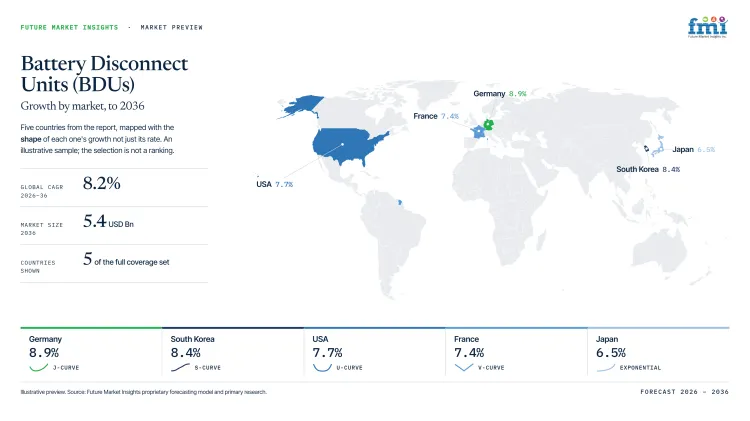
| Country | CAGR |
|---|---|
| Germany | 8.9% |
| South Korea | 8.4% |
| Mexico | 8.1% |
| USA | 7.7% |
| France | 7.4% |
| Canada | 7.1% |
| Japan | 6.5% |
How do country-level CAGRs compare in the Battery Disconnect Units (BDUs) Market?
Germany and South Korea join Mexico in the upper growth band above 8.0% CAGR. USA leads the middle group with France and Canada before Japan separates at 6.5%. The 2.4-point spread reflects different vehicle-platform mixes and program timing rather than one regional adoption curve. The grouping describes forecast pace and does not rank current market size or installed vehicle-production capacity.
- Germany runs parallel 400 V and 800 V vehicle programs that widen BDU qualification demand.
- South Korean premium EV programs raise current-handling requirements as charging power increases on new platforms.
- Mexico's light-truck production base favors disconnect designs that scale efficiently into higher-current vehicle variants.
- United States launches span vertically integrated EV makers and legacy automakers with different sourcing models.
- French corporate-fleet electrification places BDU volume into vehicles where warranty evidence influences platform approval.
- Canadian winter duty raises thermal and contact-resistance scrutiny during repeated high-current switching validation cycles.
- Japan's compact-car mix keeps enclosure volume and switching losses central to high-voltage component selection.
Comparable CAGRs still produce different qualification loads and order timing. The full report analyzes these conditions in North America, Latin America, Western Europe, Eastern Europe, East Asia, South Asia and Pacific, and the Middle East and Africa.
Country-wise Analysis
- German vehicle programs use dense engineering networks and repeated platform renewals that keep high-voltage protection work close to OEM development centers. Germany's battery disconnect units outlook is anticipated to advance at 8.9% CAGR over the assessment period, driven by rising battery-electric registrations and continuing platform electrification. Federal Ministry data published in January 2026 recorded 545,142 battery-electric registrations during 2025 and a 19.1% share of new registrations. Local engineering access shortens problem resolution, although validation cost still rises when a BDU must support several voltage architectures. Companies with German application teams can reuse approved switching and protection content more efficiently between successive vehicle programs. EV charging stations expansion supports vehicle deployment without reducing BDU qualification work inside each traction-battery program.
- Domestic OEMs and cell manufacturers engineer major pack systems locally, so South Korean vehicle programs place unusual weight on battery safety functions. Battery disconnect unit demand in South Korea is forecast to rise at 8.4% CAGR over the forecast period, supported by integrated battery manufacturing and active vehicle electrification programs. Korea's Ministry of Environment published revised EV subsidy rules in January 2025 that added incentives for safer batteries and abnormal-charging detection. The policy rewards safety features without removing cost pressure on locally sourced electrical components. Program schedules move quickly once a battery design is frozen, so entrants need documented fault behavior and rapid local engineering response.
- Mexican assembly plants increasingly receive electrified vehicle programs for North American distribution, so BDU demand depends on export allocations and local high-voltage content. Mexico is estimated to post 8.1% CAGR over the forecast period, reflecting new electrified model production and continued regional vehicle integration. AMIA reported 10,881 electric and plug-in hybrid vehicle sales during January 2025 with 35.6% annual growth. Local vehicle assembly provides a direct route into series programs, though model mix can change faster than component qualification cycles. Companies that support Mexican plants with already approved regional components can limit duplicate validation and respond faster to shifting export schedules.
- United States BDU programs span passenger cars plus pickups and commercial platforms that impose different current levels and pack layouts. Battery disconnect unit sales in the USA are forecast to expand at 7.7% CAGR by 2036, underpinned by a broad electrified vehicle base and domestic manufacturing activity. EPA data for model year 2025 show battery-electric and plug-in hybrid vehicles represented 12% of production. Regulatory change and shifting incentive policy can alter program timing even after engineering resources are committed. Companies with qualified local production can protect launch schedules by limiting redesign work as regional vehicle volume or sourcing plans change.
- French passenger-car programs place BDU content into compact and mid-size battery-electric vehicles where package space and cost discipline stay tightly controlled. Adoption of battery disconnect units in France is estimated to expand at 7.4% CAGR through 2036, driven by continued battery-electric penetration in new-car registrations. SDES recorded 331,200 battery-electric registrations in 2025 and a 19.9% share of new passenger cars. The installed program base supports repeat BDU sourcing even as weaker total new-car volumes pressure annual platform quantities. Companies that reduce contactor losses and enclosure size without changing the safety concept can protect content per vehicle during a softer registration cycle.
- Canadian BDU demand follows North American vehicle programs, but national electric-vehicle volumes respond quickly to purchase-incentive changes and provincial policy differences. Statistics Canada reported in March 2026 that zero-emission registrations fell 34.7% during 2025 and their new-vehicle share declined to 9.5%. Canada's battery disconnect units outlook is anticipated to advance at 7.1% CAGR over the assessment period, linked to cross-border vehicle production and continued battery investment. Local program volumes can reset faster than component qualification cycles, making capacity planning difficult. Companies can reduce exposure by serving Canadian platforms from regional plants that already support the same approved BDU content in the United States.
- Japanese automakers retain a hybrid-heavy electrification mix, which favors compact and dependable battery switching over rapid migration to full-BEV volumes. The Japan battery disconnect units sector is projected to record 6.5% CAGR during the assessment period, supported by gradual charging expansion and continuing electrified vehicle programs. METI reported in June 2025 that Japan had about 68,000 charging plugs at the end of fiscal 2024 and targets 300,000 by 2030. Long validation cycles reward stable local engineering support despite the slower near-term full-BEV volume mix. Growth in EV charging cables does not remove vehicle-side qualification for contactors and fuses before production release.
Who are the notable companies in the Battery Disconnect Units (BDUs) Market?
TE Connectivity, Sensata Technologies, Littelfuse, Eaton, Aptiv, Amphenol, Mersen, BorgWarner, TDK and Molex are the notable companies in this market.
-market-analysis-by-company.webp "Battery Disconnect Units (bdus) Market Analysis By Company")
Competition separates integrated battery power-distribution companies from automotive protection specialists and high-voltage interconnect makers. Vehicle manufacturers compare fault behavior and platform evidence before accepting new BDU content into production programs. New entrants need automotive qualification and manufacturing support that follows approved electrical architectures into regional plants.
- Sensata Technologies and Eaton join Aptiv and BorgWarner among companies with documented integrated battery power-distribution or control activity.
- Littelfuse and Mersen join TDK in protection and switching and TE Connectivity supplies high-voltage automotive interfaces with switching content.
- High-voltage interconnect specialists include Amphenol and Molex, which participate through connector and interface content surrounding battery power distribution assemblies.
Competitive Benchmarking: Battery Disconnect Units (BDUs) Market
Benchmark ratings compare BDU content breadth with assembly integration and series vehicle-program evidence for each company. High requires several verified BDU functions or direct series-program evidence in electrified vehicles. Medium covers one BDU-critical function or adjacent integration role while Low marks a verified narrower high-voltage interface.
| Company | BDU-Relevant Content Breadth | Assembly Integration Evidence | Vehicle Program Evidence | Geographic Reach |
|---|---|---|---|---|
| TE Connectivity | Medium | Medium | High | Global automotive programs in North America, Europe and Asia |
| Sensata Technologies | High | High | High | North America, Europe and Asia |
| Littelfuse | High | Medium | Medium | Global electrical protection coverage with automotive programs |
| Eaton | High | High | High | North America, Europe and Asia |
| Aptiv | High | High | High | Global automotive programs with regional manufacturing |
| Amphenol | Medium | Low | Medium | North America, Europe and Asia |
| Mersen | High | Medium | High | Europe, North America and Asia automotive programs |
| BorgWarner | High | High | High | North America, Europe and Asia automotive programs |
| TDK | High | Medium | Medium | Europe, Asia and North America |
| Molex | Medium | Low | Medium | Global automotive connectivity coverage |
Key Developments in the Battery Disconnect Units (BDUs) Market
- In April 2025, Eaton launched a dual-trigger pyro fuse incorporating a stand-alone backup trigger that enables high-voltage circuit separation without requiring an external command, providing a passive safety layer in addition to the standard BMS-activated path.
- In April 2025, TDK introduced the HVC50 contactor for high-power systems with continuous current ratings up to 750 A at 1500 V.
- In October 2025, BorgWarner won a HOLON shuttle battery-system program whose battery packs include a replaceable contactor box for high-voltage isolation.
Key Players in the Battery Disconnect Units (BDUs) Market
Integrated battery power distribution and control
- Sensata Technologies
- Eaton
- Aptiv
- BorgWarner
High-voltage switching and circuit protection
- TE Connectivity
- Littelfuse
- Mersen
- TDK
High-voltage interconnect and packaging
- Amphenol
- Molex
Battery Disconnect Units (BDUs) Market - Report Scope
| Coverage field | Report scope |
|---|---|
| Market breakdown | BDU type, voltage class, vehicle type, component, sales channel and region. |
| Quantitative Units | USD billion. |
| Market Definition | Revenue includes battery disconnect units plus BDU-specific switching, protection, sensing, pre-charge, housing and connector content sold within the defined product boundary. |
| Regions Covered | North America; Latin America; Western Europe; Eastern Europe; East Asia; South Asia and Pacific; Middle East and Africa. |
| Countries Covered | Germany, South Korea, Mexico, USA, France, Canada, Japan and more than twenty-five additional countries in the full report. |
| Key Companies | TE Connectivity, Sensata Technologies, Littelfuse, Eaton, Aptiv, Amphenol, Mersen, BorgWarner, TDK, Molex. |
| Forecast Period | 2026 to 2036. |
| Approach | Primary and secondary research with market triangulation plus company, vehicle-platform, country and segment reconciliation. |
Battery Disconnect Units (BDUs) Market - Research Methodology
| Method | Approach |
|---|---|
| Primary Research | FMI analysts gathered input from manufacturers, service providers, technology developers, distributors, end users, procurement teams, and subject-matter experts. Interviews examined purchasing decisions, product or service evaluation, adoption barriers, approval requirements, pricing considerations, and expectations for technical or commercial support. Respondents were also asked what evidence is required before a trial, pilot, or initial order develops into regular purchasing. |
| Desk Research | Desk research covered government statistics, regulatory publications, trade data, industry associations, technical literature, standards, company filings, product information, and official corporate announcements. Sources were reviewed for relevance, publication date, geographic coverage, and consistency with the defined market scope. Claims relating to performance, applications, approvals, capacity, investment, and commercial activity were retained only when supported by credible public evidence. |
| Market Sizing and Forecasting | The market model combined the baseline value with historical performance, segment structure, pricing and volume indicators, adoption levels, company participation, and country-level demand conditions. Forecast assumptions considered economic activity, investment trends, regulatory developments, technology adoption, purchasing cycles, supply availability, and barriers to wider market use. Segment and regional estimates were reconciled before the final market total was calculated. |
| Data Validation | Estimates were checked against multiple independent indicators, including public data, company activity, trade patterns, industry developments, and findings from primary interviews. Validation also tested whether products, services, applications, and company revenues fell within the defined market boundaries. Adjacent categories, unsupported claims, overlapping revenues, and activities without direct market relevance were excluded to reduce double counting and maintain consistency across segments and countries. |
Battery Disconnect Units (BDUs) Market by Segments
BDU Type
- High-voltage BDUs
- Smart BDUs
- Pyro-fuse integrated BDUs
- Modular BDUs
- Liquid-cooled BDUs
Voltage Class
- 400-800 V
- Below 400 V
- Above 800 V
- Commercial vehicle high-voltage
Vehicle Type
- Battery electric cars
- Plug-in hybrids
- Electric buses
- Electric trucks
- Off-highway EVs
Component
- Contactors
- Fuses
- Current sensors
- Pre-charge circuits
- Housing/connectors
Sales Channel
- OEM direct
- Battery pack suppliers
- Tier-1 module suppliers
- Aftermarket/service
Battery Disconnect Units (BDUs) Market by Region:
- North America
- United States
- Canada
- Latin America
- Brazil
- Mexico
- Argentina
- Chile
- Western Europe
- Germany
- France
- United Kingdom
- Italy
- Spain
- Benelux
- Nordics
- Eastern Europe
- Poland
- Czech Republic
- Romania
- Hungary
- East Asia
- China
- Japan
- South Korea
- South Asia and Pacific
- India
- ASEAN
- Australia and New Zealand
- Middle East and Africa
- GCC Countries
- South Africa
- Türkiye
- Israel
Research Sources and Bibliography
- International Energy Agency. (2026, May 20). Global EV Outlook 2026: Trends in electric cars.
- European Alternative Fuels Observatory. (2026, July 22). EAFO Data Update & News Flash July 2026.
- Sensata Technologies. (2026, January 14). Sensata Technologies Launches STEV Series High-Voltage Contactors for Battery Electric and Plug-in Hybrid Vehicles.
- Sensata Technologies. (2025, July 17). Sensata Technologies launches High Efficiency Contactor to enable seamless 400V/800V EV charging compatibility.
- Eurostat. (2026, July 31). New battery-only electric cars up 30% in 2025.
- TDK Corporation. (2025, December 17). TDK adds a mirror contact to the HVC27 series to support functional safety.
- Mersen. (2026, July 20). Mersen selected to supply fuses for EV.
- European Automobile Manufacturers’ Association. (2026, January 27). New car registrations: +1.8% in 2025; battery-electric 17.4% market share.
- USA Department of Transportation. (2025, February 18). Federal Motor Vehicle Safety Standards No. 305a; electric-powered vehicles: electric powertrain integrity; extension of effective date.
- Eaton. (2026, May 28). Eaton and Munich Electrification form strategic collaboration to advance software-defined power protection for electric vehicles.
- Federal Ministry for Economic Affairs and Energy. (2026, January). Gute Aussichten fürs Herumstromern.
- Ministry of Environment, Republic of Korea. (2025, January 2). 2025 Electric Vehicle Purchase Subsidy Reform... Enhancing Performance and Safety, and Reducing Purchase Burden.
- Mexican Automotive Industry Association. (2025, February 13). Reporte de venta de vehículos híbridos y eléctricos a enero 2025.
- USA Environmental Protection Agency. (2026, February). The 2025 EPA Automotive Trends Report.
- Service des données et études statistiques. (2026, February 11). Immatriculations de voitures en 2025: le marché du neuf baisse, celui de l’occasion résiste.
- Statistics Canada. (2026, March 12). New motor vehicle registrations, fourth quarter 2025.
- Ministry of Economy, Trade and Industry, Japan. (2025, June 5). 充電インフラ整備促進に関する取組.
- Eaton. (2025, April 15). Eaton’s new dual-trigger pyro fuse enhances EV circuit protection and safety.
- TDK Corporation. (2025, April 22). TDK presents HVC50 for high-power systems with up to 750 A at 1500 V.
- BorgWarner. (2025, October 30). BorgWarner battery system to power HOLON’s autonomous shuttle.
- TE Connectivity. (2026, February 28). TE Connectivity acquires EV charging inlet assets from Phoenix Contact.
- Sensata Technologies. (2025, March 24). Sensata launches next-gen SIM200 insulation monitoring device designed to deliver advanced safety monitoring in high-voltage systems.
- Littelfuse, Inc. (2026, February 19). Annual report for the fiscal year ended December 27, 2025 (Form 10-K).
- Eaton. (2025, September 18). Eaton’s new battery and EV fuses to be on display at The Battery Show North America.
- Aptiv PLC. (2025, January 22). Aptiv announces intention to separate its Electrical Distribution Systems business.
- Amphenol Industrial Operations. (2026, July 21). Amphenol Industrial Operations expands ePower-Lite Series with new Mini X high-voltage connector.
- Mersen. (2025, November 13). Mersen selected by CATL to supply advanced fuses for battery systems.
- BorgWarner. (2026, April 21). BorgWarner extends controller business with world-leading off-highway manufacturer.
- TDK Corporation. (2025, January 28). TDK presents HVC43MC with an integrated mirror contact and HVC45 for short-circuit currents up to 12 kA.
- Molex. (2025, November 12). Molex Extends eHV High-Voltage Connector Portfolio to Ensure Safe, Reliable and Efficient Electrical Connections in Electric and Hybrid Vehicles.
- Amphenol Communications Solutions. (2025, January 22). Amphenol Communications Solutions Pioneers Innovation: Launches Two Made-in-India Tech Solutions at Bharat Mobility Global Expo 2025.
- Sensata Technologies. (2026, March 4). Sensata Technologies Launches FaultBreak™ Contactor to Advance EV Safety and Reliability.
- Sensata Technologies. (2025, April 23). Sensata Technologies Launches High Voltage Distribution Unit (HVDU) Technology for Heavy-Duty Vehicles.
- BorgWarner. (2026, February 11). BorgWarner expands series-production battery management system program with a global OEM.
- TE Connectivity. (2025, October 2). TE Connectivity launches new product portfolio for automotive ECUs to accelerate SDV and E/E architectural transformation.
This Report Answers
- What is the battery disconnect units (BDUs) market size through 2036?
- What increases traction-battery isolation requirements as electric-vehicle platforms expand?
- Which BDU type holds 34.0% share in 2026?
- Why does the 400-800 V class hold 43.0% share in 2026?
- How do country CAGRs differ from Germany through Japan?
- Which companies supply integrated BDUs, protection content, or high-voltage interconnects?
- Why are late battery-disconnect substitutions expensive after vehicle validation?
- Where can integrated battery control increase per-vehicle content?
Frequently Asked Questions
How big is the Battery Disconnect Units (BDUs) Market in 2026?
The battery disconnect units (BDUs) market is valued at USD 2.5 billion in 2026 and is projected to reach USD 5.4 billion by 2036. Electric-vehicle platform growth increases the vehicle base requiring controlled high-voltage battery isolation.
What is the CAGR of the Battery Disconnect Units (BDUs) Market from 2026 to 2036?
The battery disconnect units (BDUs) market is projected to grow at a CAGR of 8.2% between 2026 and 2036. Expansion follows higher electric-vehicle production and switching requirements in higher-voltage traction-battery systems.
Which BDU type leads the Battery Disconnect Units (BDUs) Market?
The high-voltage BDU segment is expected to hold 34.0% of the battery disconnect units (BDUs) market in 2026, attributable to its traction-battery isolation role. Vehicle programs can integrate sensing or pyro-fuse functions without changing that central safety function.
Which voltage class leads the Battery Disconnect Units (BDUs) Market?
The 400-800 V segment is expected to hold 43.0% of the battery disconnect units (BDUs) market in 2026, driven by programs spanning 400 V and 800 V architectures. Qualified isolation concepts can transfer into new voltage programs without rebuilding the complete battery architecture.
Which companies are active in the Battery Disconnect Units (BDUs) Market?
Key companies in the battery disconnect units (BDUs) market include TE Connectivity, Sensata Technologies, Littelfuse, Eaton, Aptiv, Amphenol, Mersen, BorgWarner, TDK, and Molex. They compete through integrated power distribution plus switching, circuit protection, sensing and interconnect content for electrified vehicle platforms.
Preview the report firsthand - request a free sample
Get SampleGet the brochure for pricing and purchase details.
Get PDFTable of Content
- Key Takeaways
- Market Size and CAGR
- Top Growth Driver
- Fastest Growing Segment
- Leading Region
- Key Companies
- Emerging Opportunities
- Executive Summary
- Global Market Outlook
- Demand-side Trends
- Supply-side Trends
- Technology Roadmap Analysis
- Analysis and Recommendations
- Analyst Perspective (What is happening? Why now? What should investors know?)
- Key Questions Answered
- How large is the market?
- What is the CAGR?
- What are key trends?
- Which region dominates?
- Who are the leaders?
- Market Overview
- Market Coverage / Taxonomy
- Market Definition / Scope / Limitations
- Research Methodology
- Chapter Orientation
- Analytical Lens and Working Hypotheses
- Market Structure, Signals, and Trend Drivers
- Benchmarking and Cross-market Comparability
- Market Sizing, Forecasting, and Opportunity Mapping
- Research Design and Evidence Framework
- Desk Research Programme (Secondary Evidence)
- Expert Input and Fieldwork (Primary Evidence)
- Tooling, Models, and Reference Databases
- Data Engineering and Model Build
- Quality Assurance and Audit Trail
- Market Background
- Market Dynamics (Drivers, Restraints, Opportunity, Trends)
- Scenario Forecast (Optimistic, Likely, Conservative)
- Impact Analysis
- AI Impact
- Sustainability Impact
- Regulatory Impact
- Technology Impact
- Consumer / Buyer Analysis
- Purchase Drivers
- Adoption Barriers
- Buyer Journey
- Opportunity Map Analysis
- Product Life Cycle Analysis
- Supply Chain Analysis
- Investment Feasibility Matrix
- Value Chain Analysis
- PESTLE and Porter's Analysis
- Regulatory Landscape
- Regional Parent Market Outlook
- Production and Consumption Statistics
- Import and Export Statistics
- Global Market Analysis and Forecast, 2021 to 2036
- Historical Market Size Value (USD Billion) Analysis, 2021 to 2025
- Current and Future Market Size Value (USD Billion) Projections, 2026 to 2036
- Y-o-Y Growth Trend Analysis
- Absolute $ Opportunity Analysis
- Global Market Pricing Analysis, 2021 to 2036
- Global Market Analysis and Forecast, By BDU Type, 2021 to 2036
- Introduction / Key Findings
- Historical Market Size Value (USD Billion) Analysis By BDU Type, 2021 to 2025
- Current and Future Market Size Value (USD Billion) Analysis and Forecast By BDU Type, 2026 to 2036
- High-voltage BDUs
- Smart BDUs
- Pyro-fuse integrated BDUs
- Modular BDUs
- Liquid-cooled BDUs
- High-voltage BDUs
- Y-o-Y Growth Trend Analysis By BDU Type, 2021 to 2025
- Absolute $ Opportunity Analysis By BDU Type, 2026 to 2036
- Global Market Analysis and Forecast, By Voltage Class, 2021 to 2036
- Introduction / Key Findings
- Historical Market Size Value (USD Billion) Analysis By Voltage Class, 2021 to 2025
- Current and Future Market Size Value (USD Billion) Analysis and Forecast By Voltage Class, 2026 to 2036
- 400-800 V
- Below 400 V
- Above 800 V
- Commercial vehicle high-voltage
- 400-800 V
- Y-o-Y Growth Trend Analysis By Voltage Class, 2021 to 2025
- Absolute $ Opportunity Analysis By Voltage Class, 2026 to 2036
- Global Market Analysis and Forecast, By Vehicle Type, 2021 to 2036
- Introduction / Key Findings
- Historical Market Size Value (USD Billion) Analysis By Vehicle Type, 2021 to 2025
- Current and Future Market Size Value (USD Billion) Analysis and Forecast By Vehicle Type, 2026 to 2036
- Battery electric cars
- Plug-in hybrids
- Electric buses
- Electric trucks
- Off-highway EVs
- Battery electric cars
- Y-o-Y Growth Trend Analysis By Vehicle Type, 2021 to 2025
- Absolute $ Opportunity Analysis By Vehicle Type, 2026 to 2036
- Global Market Analysis and Forecast, By Component, 2021 to 2036
- Introduction / Key Findings
- Historical Market Size Value (USD Billion) Analysis By Component, 2021 to 2025
- Current and Future Market Size Value (USD Billion) Analysis and Forecast By Component, 2026 to 2036
- Contactors
- Fuses
- Current sensors
- Pre-charge circuits
- Housing/connectors
- Contactors
- Y-o-Y Growth Trend Analysis By Component, 2021 to 2025
- Absolute $ Opportunity Analysis By Component, 2026 to 2036
- Global Market Analysis and Forecast, By Sales Channel, 2021 to 2036
- Introduction / Key Findings
- Historical Market Size Value (USD Billion) Analysis By Sales Channel, 2021 to 2025
- Current and Future Market Size Value (USD Billion) Analysis and Forecast By Sales Channel, 2026 to 2036
- OEM direct
- Battery pack suppliers
- Tier-1 module suppliers
- Aftermarket/service
- OEM direct
- Y-o-Y Growth Trend Analysis By Sales Channel, 2021 to 2025
- Absolute $ Opportunity Analysis By Sales Channel, 2026 to 2036
- Global Market Analysis and Forecast, By Region, 2021 to 2036
- Introduction
- Historical Market Size Value (USD Billion) Analysis By Region, 2021 to 2025
- Current Market Size Value (USD Billion) Analysis and Forecast By Region, 2026 to 2036
- North America
- Latin America
- Western Europe
- Eastern Europe
- East Asia
- South Asia and Pacific
- Middle East & Africa
- Market Attractiveness Analysis By Region
- North America Market Analysis and Forecast, By Country, 2021 to 2036
- Historical Market Size Value (USD Billion) Trend Analysis By Market Taxonomy, 2021 to 2025
- Market Size Value (USD Billion) Forecast By Market Taxonomy, 2026 to 2036
- By Country
- USA
- Canada
- By BDU Type
- By Voltage Class
- By Vehicle Type
- By Component
- By Sales Channel
- By Country
- Market Attractiveness Analysis
- By Country
- By BDU Type
- By Voltage Class
- By Vehicle Type
- By Component
- By Sales Channel
- Key Takeaways
- Latin America Market Analysis and Forecast, By Country
- Historical Market Size Value (USD Billion) Trend Analysis By Market Taxonomy, 2021 to 2025
- Market Size Value (USD Billion) Forecast By Market Taxonomy, 2026 to 2036
- By Country
- Brazil
- Mexico
- Chile
- Rest of Latin America
- By BDU Type
- By Voltage Class
- By Vehicle Type
- By Component
- By Sales Channel
- By Country
- Market Attractiveness Analysis
- By Country
- By BDU Type
- By Voltage Class
- By Vehicle Type
- By Component
- By Sales Channel
- Key Takeaways
- Western Europe Market Analysis and Forecast, By Country
- Historical Market Size Value (USD Billion) Trend Analysis By Market Taxonomy, 2021 to 2025
- Market Size Value (USD Billion) Forecast By Market Taxonomy, 2026 to 2036
- By Country
- Germany
- UK
- Italy
- Spain
- France
- Nordic
- BENELUX
- Rest of Western Europe
- By BDU Type
- By Voltage Class
- By Vehicle Type
- By Component
- By Sales Channel
- By Country
- Market Attractiveness Analysis
- By Country
- By BDU Type
- By Voltage Class
- By Vehicle Type
- By Component
- By Sales Channel
- Key Takeaways
- Eastern Europe Market Analysis and Forecast, By Country
- Historical Market Size Value (USD Billion) Trend Analysis By Market Taxonomy, 2021 to 2025
- Market Size Value (USD Billion) Forecast By Market Taxonomy, 2026 to 2036
- By Country
- Russia
- Poland
- Hungary
- Balkan & Baltic
- Rest of Eastern Europe
- By BDU Type
- By Voltage Class
- By Vehicle Type
- By Component
- By Sales Channel
- By Country
- Market Attractiveness Analysis
- By Country
- By BDU Type
- By Voltage Class
- By Vehicle Type
- By Component
- By Sales Channel
- Key Takeaways
- East Asia Market Analysis and Forecast, By Country
- Historical Market Size Value (USD Billion) Trend Analysis By Market Taxonomy, 2021 to 2025
- Market Size Value (USD Billion) Forecast By Market Taxonomy, 2026 to 2036
- By Country
- China
- Japan
- South Korea
- By BDU Type
- By Voltage Class
- By Vehicle Type
- By Component
- By Sales Channel
- By Country
- Market Attractiveness Analysis
- By Country
- By BDU Type
- By Voltage Class
- By Vehicle Type
- By Component
- By Sales Channel
- Key Takeaways
- South Asia and Pacific Market Analysis and Forecast, By Country
- Historical Market Size Value (USD Billion) Trend Analysis By Market Taxonomy, 2021 to 2025
- Market Size Value (USD Billion) Forecast By Market Taxonomy, 2026 to 2036
- By Country
- India
- ASEAN
- Australia & New Zealand
- Rest of South Asia and Pacific
- By BDU Type
- By Voltage Class
- By Vehicle Type
- By Component
- By Sales Channel
- By Country
- Market Attractiveness Analysis
- By Country
- By BDU Type
- By Voltage Class
- By Vehicle Type
- By Component
- By Sales Channel
- Key Takeaways
- Middle East & Africa Market Analysis and Forecast, By Country
- Historical Market Size Value (USD Billion) Trend Analysis By Market Taxonomy, 2021 to 2025
- Market Size Value (USD Billion) Forecast By Market Taxonomy, 2026 to 2036
- By Country
- Kingdom of Saudi Arabia
- Other GCC Countries
- Türkiye
- South Africa
- Other African Union
- Rest of Middle East & Africa
- By BDU Type
- By Voltage Class
- By Vehicle Type
- By Component
- By Sales Channel
- By Country
- Market Attractiveness Analysis
- By Country
- By BDU Type
- By Voltage Class
- By Vehicle Type
- By Component
- By Sales Channel
- Key Takeaways
- Key Countries Market Analysis
- USA
- Pricing Analysis
- Market Share Analysis, 2025
- By BDU Type
- By Voltage Class
- By Vehicle Type
- By Component
- By Sales Channel
- Canada
- Pricing Analysis
- Market Share Analysis, 2025
- By BDU Type
- By Voltage Class
- By Vehicle Type
- By Component
- By Sales Channel
- Mexico
- Pricing Analysis
- Market Share Analysis, 2025
- By BDU Type
- By Voltage Class
- By Vehicle Type
- By Component
- By Sales Channel
- Brazil
- Pricing Analysis
- Market Share Analysis, 2025
- By BDU Type
- By Voltage Class
- By Vehicle Type
- By Component
- By Sales Channel
- Chile
- Pricing Analysis
- Market Share Analysis, 2025
- By BDU Type
- By Voltage Class
- By Vehicle Type
- By Component
- By Sales Channel
- Germany
- Pricing Analysis
- Market Share Analysis, 2025
- By BDU Type
- By Voltage Class
- By Vehicle Type
- By Component
- By Sales Channel
- UK
- Pricing Analysis
- Market Share Analysis, 2025
- By BDU Type
- By Voltage Class
- By Vehicle Type
- By Component
- By Sales Channel
- Italy
- Pricing Analysis
- Market Share Analysis, 2025
- By BDU Type
- By Voltage Class
- By Vehicle Type
- By Component
- By Sales Channel
- Spain
- Pricing Analysis
- Market Share Analysis, 2025
- By BDU Type
- By Voltage Class
- By Vehicle Type
- By Component
- By Sales Channel
- France
- Pricing Analysis
- Market Share Analysis, 2025
- By BDU Type
- By Voltage Class
- By Vehicle Type
- By Component
- By Sales Channel
- India
- Pricing Analysis
- Market Share Analysis, 2025
- By BDU Type
- By Voltage Class
- By Vehicle Type
- By Component
- By Sales Channel
- ASEAN
- Pricing Analysis
- Market Share Analysis, 2025
- By BDU Type
- By Voltage Class
- By Vehicle Type
- By Component
- By Sales Channel
- Australia & New Zealand
- Pricing Analysis
- Market Share Analysis, 2025
- By BDU Type
- By Voltage Class
- By Vehicle Type
- By Component
- By Sales Channel
- China
- Pricing Analysis
- Market Share Analysis, 2025
- By BDU Type
- By Voltage Class
- By Vehicle Type
- By Component
- By Sales Channel
- Japan
- Pricing Analysis
- Market Share Analysis, 2025
- By BDU Type
- By Voltage Class
- By Vehicle Type
- By Component
- By Sales Channel
- South Korea
- Pricing Analysis
- Market Share Analysis, 2025
- By BDU Type
- By Voltage Class
- By Vehicle Type
- By Component
- By Sales Channel
- Russia
- Pricing Analysis
- Market Share Analysis, 2025
- By BDU Type
- By Voltage Class
- By Vehicle Type
- By Component
- By Sales Channel
- Poland
- Pricing Analysis
- Market Share Analysis, 2025
- By BDU Type
- By Voltage Class
- By Vehicle Type
- By Component
- By Sales Channel
- Hungary
- Pricing Analysis
- Market Share Analysis, 2025
- By BDU Type
- By Voltage Class
- By Vehicle Type
- By Component
- By Sales Channel
- Kingdom of Saudi Arabia
- Pricing Analysis
- Market Share Analysis, 2025
- By BDU Type
- By Voltage Class
- By Vehicle Type
- By Component
- By Sales Channel
- Türkiye
- Pricing Analysis
- Market Share Analysis, 2025
- By BDU Type
- By Voltage Class
- By Vehicle Type
- By Component
- By Sales Channel
- South Africa
- Pricing Analysis
- Market Share Analysis, 2025
- By BDU Type
- By Voltage Class
- By Vehicle Type
- By Component
- By Sales Channel
- USA
- Market Structure Analysis
- Competition Dashboard
- Competition Benchmarking
- Market Share Analysis of Top Players
- By Regional
- By BDU Type
- By Voltage Class
- By Vehicle Type
- By Component
- By Sales Channel
- Emerging Startups
- Innovation Benchmarking
- Competition Analysis
- Competition Deep Dive
- TE Connectivity
- Overview
- Product Portfolio
- Profitability by Market Segments
- Sales Footprint
- Strategy Overview
- Marketing Strategy
- Product Strategy
- Channel Strategy
- Sensata Technologies
- Littelfuse
- Eaton
- Aptiv
- Amphenol
- Mersen
- BorgWarner
- TDK
- Molex
- TE Connectivity
- Case Studies
- Success Stories
- Recent Developments
- Competition Deep Dive
- Assumptions & Acronyms Used


