

- Market Size (2026)
- USD 197.6 Mn
- Forecast (2036)
- USD 354.3 Mn
- CAGR (2026 to 2036)
- 6.0%
Battery-Powered Rescue and Emergency Cutting Tools Market Size, Market Forecast and Outlook By FMI
USD 197.6 million in 2026 and USD 354.3 million by 2036 at a 6.0% CAGR.
The battery-powered rescue and emergency cutting tools industry value is forecast to grow from USD 186.4 million in 2025 to USD 354.3 million by 2036 at a 6.0% CAGR. Battery cutters are projected to represent 36.0% of product type demand in 2026 because vehicle extrication and forcible entry remain core rescue tasks. 18V systems are expected to hold 34.0% of power platform demand in 2026 as shared packs reduce stocking burden across emergency fleets.
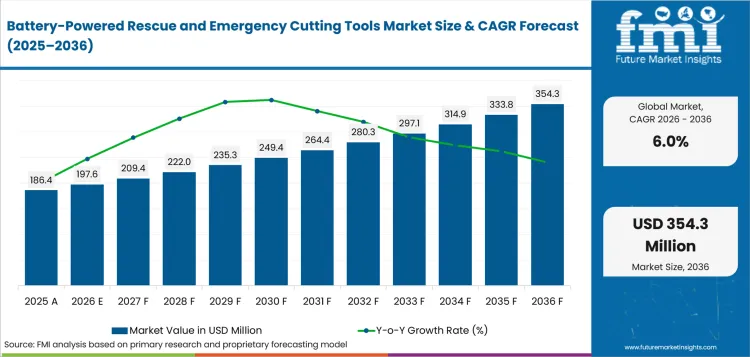
Battery-Powered Rescue and Emergency Cutting Tools Market Overview: Size and Forecast
- 2026 Market Size: USD 197.6 million
- 2036 Market Size: USD 354.3 million
- Forecast CAGR: 6.0% from 2026 to 2036
- Leading Product Type: Battery Cutters
- Battery Cutters Share in 2026: 36.0%
- Leading Power Platform: 18V Systems
- 18V Systems Share in 2026: 34.0%
- Leading Sales Channel: Public Tender
- Public Tender Share in 2026: 46.0%
- Fastest-growing Country: India
- India CAGR: 7.5% by 2036
What are the key takeaways for the battery-powered rescue and emergency cutting tools market?
Battery cutters lead at 36.0% share with public tender at 46.0% and India fastest at 7.5%.
- Demand and Growth Drivers
- Battery-powered rescue tools are projected to grow at 6.0% CAGR as fire teams seek cordless tools for confined spaces and indoor rescue work.
- Public tender demand is expected to account for 46.0% of 2026 sales as municipal fleets buy certified tools in multi-year cycles.
- India is projected at 7.5% CAGR as public safety investment creates demand for portable tools suited to dense urban rescue settings.
- Product and Segment View
- Battery cutters are projected to lead the product type segment with 36.0% share as vehicle extrication needs high blade force and fast setup.
- 18V systems are expected to lead the power platform segment with 34.0% share since shared packs reduce stocking burden for mixed rescue fleets.
- Fire rescue is projected to lead the application segment with 54.0% share as municipal fire departments remain the largest buyer group.
- Geography and Competitive Outlook
- China is forecast to expand at 7.0% CAGR through 2036 as provincial emergency agencies upgrade portable rescue equipment.
- The United States is expected to post 5.8% CAGR through 2036 as NFPA-led tenders support premium certified tools.
- Holmatro, LUKAS, WEBER RESCUE SYSTEMS, AMKUS, STIHL, Husqvarna Construction, Milwaukee Tool, and Hilti form the verified benchmark group.
- Specialist rescue brands lead cutter ratings and service training. Power-tool brands push battery saws into emergency channels.
- Analyst Opinion
- Nikhil Kaitwade, Associate Vice President at FMI, says, “Battery rescue tools are now judged by workflow speed rather than tool power alone. Fire crews value cordless systems when they cut the time between arrival and first access. The best-positioned suppliers will prove cut rating, runtime, battery continuity, and service turnaround before a tender closes. Buyers should track the line between rescue-grade hydraulic battery tools and professional cut-off saws because the first group wins crash rescue tenders while the second group wins enclosed cutting tasks.”
Battery rescue tools are moving from specialty extrication purchases into standard rescue-kit equipment because departments now evaluate cordless systems against road-crash exposure and mixed-scene mobility. In April 2026, NHTSA estimated 36.6 thousand USA traffic fatalities for 2025 with a fatality rate of 1.10 per 100 million vehicle miles traveled. NFPA 1960 gives procurement teams a current technical reference because the 2024 standard covers powered rescue tools alongside fire hose and ground ladders. AMKUS’s October 2025 Heavy Rescue Series launch is a stronger market signal than a generic battery claim because the tools use DeWalt FLEXVOLT 60V batteries and carry UL third-party testing to NFPA 1960 certification. Buyers are therefore moving toward suppliers that can prove cut rating and battery interchangeability before price.
What supports value in the battery-powered rescue and emergency cutting tools market?
Battery cutters, public tenders, rescue saws, and battery service support market value across emergency response channels.
- Battery cutters add value when fire teams need first-access cuts without a pump unit or hose reel.
- Indoor-capable cut-off saws raise the addressable market as departments shift some concrete and metal cutting away from petrol tools.
- Public tender cycles support recurring replacement demand as rescue tools face training use, battery aging, and certification checks.
- Tool pricing is rising with higher blade force, smart battery diagnostics, and third-party testing requirements.
Why is the battery-powered rescue and emergency cutting tools market growing?
Fire crews are shifting toward hose-free tools that shorten setup time during crash rescue and enclosed rescue work.
The strongest growth driver is the move from tool power to response speed. In the United States, the National Fire Incident Reporting System recorded 22,582 fire departments and over 33.3 million responses in 2024. This scale turns minutes saved at setup into a real buying reason across large department networks. A battery cutter does not replace every hydraulic set. It gives first crews a faster access option and supports steady kit-expansion demand during the forecast period.
A second driver comes from enclosed and mixed-material rescue work. Husqvarna lists the K 1 PACE Rescue as a battery cutter with up to 145 mm cutting depth and a magnesium blade guard visible in smoke and water spray. That feature set speaks directly to fireground use rather than normal construction cutting. Buyers compare weight, blade visibility, and brake function when they assess emergency saws. This pushes suppliers to design tools around rescue scenes rather than adapting standard contractor products.
How is the battery-powered rescue and emergency cutting tools market segmented?
The battery-powered rescue and emergency cutting tools industry is segmented by product type, power platform, application, function, and sales channel.
- Battery cutters are projected to account for 36.0% of product type demand in 2026 as extrication teams prioritize blade force and fast access.
- 18V systems are expected to lead power platforms with an estimated 34.0% share in 2026 as shared packs simplify charging and spares.
- Fire rescue buyers are projected to represent 54.0% of application demand in 2026 due to municipal responsibility for crashes and trapped-person calls.
- Cutting functions are anticipated to hold 42.0% of functional demand in 2026 since vehicle posts, door hinges, and barriers form common rescue targets.
- Public tender is expected to direct 46.0% of channel demand in 2026 as agencies buy certified sets through formal purchasing rules.
Why do battery cutters lead the battery-powered rescue and emergency cutting tools market?
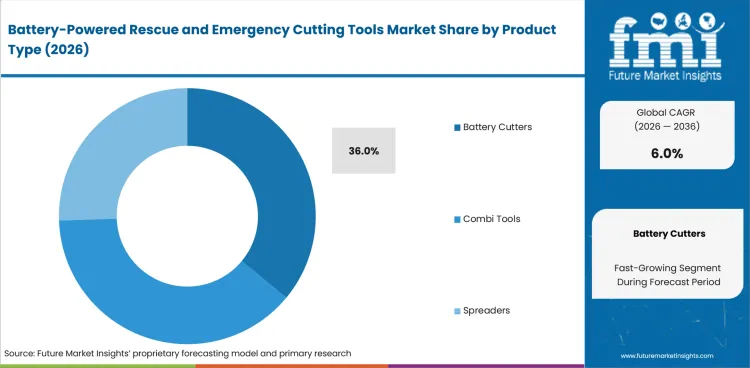
- Battery cutters are projected to account for 36.0% of product type demand in 2026 as extrication teams need high cutting force for posts, pedals, hinges, and crash-damaged vehicle structures.
- Cutter selection depends on certified cut rating and blade geometry. AMKUS published NFPA 1960 cutter ratings for battery ION tools in 2024.
Which power platform leads the battery-powered rescue and emergency cutting tools market?
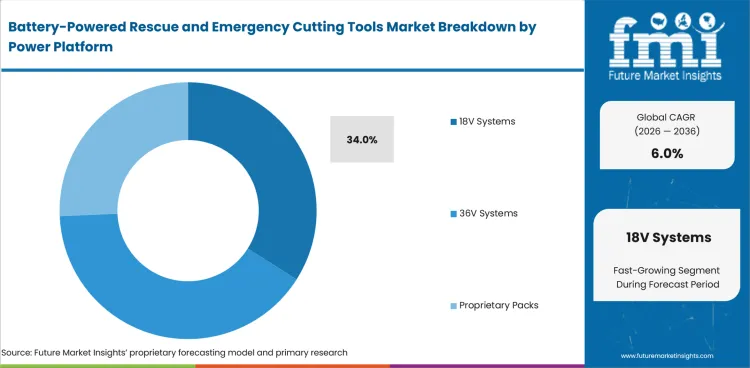
- 18V systems are expected to account for 34.0% of power platform demand in 2026 as emergency teams prefer battery packs that fit drills, lights, saws, and smaller rescue tools.
- Milwaukee’s M18 cut-off saw uses REDLITHIUM packs and ONE-KEY tracking. This gives fleet managers a way to manage batteries across tool classes.
Which application leads the battery-powered rescue and emergency cutting tools market?
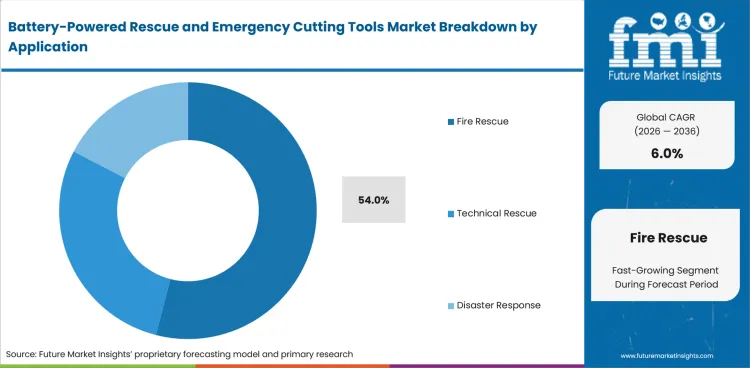
- Fire rescue is anticipated to represent 54.0% of application demand in 2026 as municipal departments handle crash extrication, trapped-person calls, forcible entry, and smoke-affected cutting.
- In England, fire and rescue services responded to 600,185 incidents in the year cited by the National Fire Chiefs Council in June 2025. This workload supports tool standardization across stations.
Which function leads the battery-powered rescue and emergency cutting tools market?
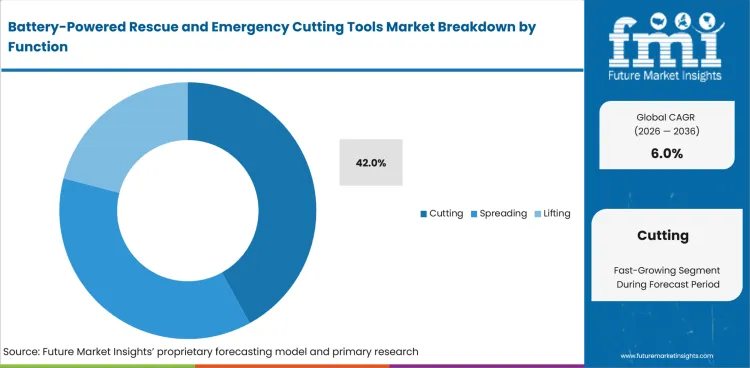
- Cutting is projected to hold 42.0% of functional demand in 2026 as crews need battery tools for metal, masonry, laminated glass, panels, and door hardware.
- Hilti’s DSH 900-22 battery saw is listed for up to 6 inches of concrete cutting with a 14-inch blade. Cut depth therefore remains a core saw-selection factor.
Which sales channel leads the battery-powered rescue and emergency cutting tools market?
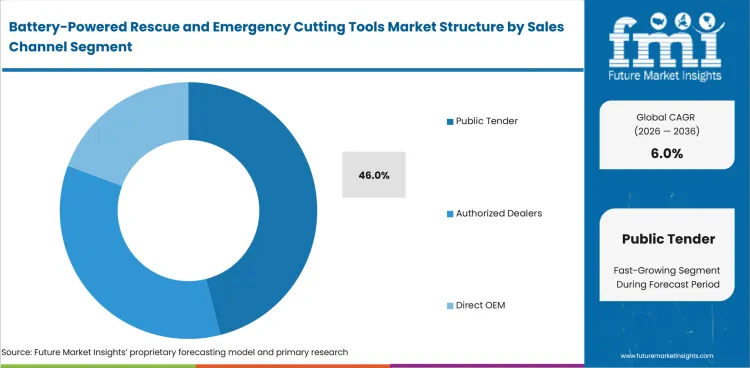
- Public tender is expected to account for 46.0% of sales channel demand in 2026 as cities and agencies buy rescue sets through bid documents.
- India’s public specification for a battery-operated combination cutter names NFPA 1936 or EN 13204 as acceptable compliance routes. Tender wording can therefore lock standards into the purchase.
What are the drivers, restraints, and opportunities in the battery-powered rescue and emergency cutting tools market?
Hose-free extrication supports adoption while battery platform sprawl and certification burden shape supplier selection.
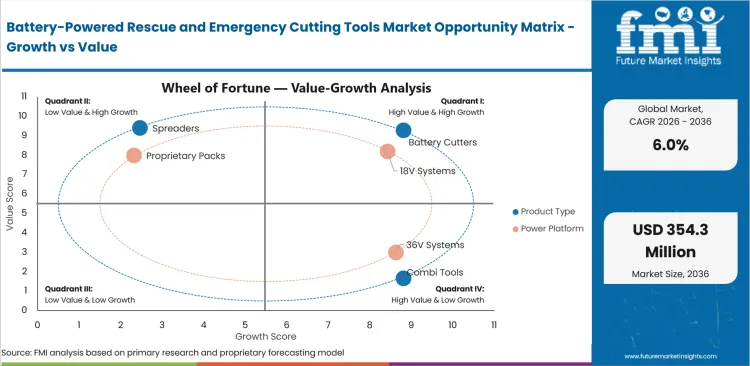
- Driver: Hose-free extrication drives demand as battery cutters reduce setup steps during crash rescue and confined-space rescue.
- Restraint: Battery platform sprawl restrains purchases when departments already use separate chargers and packs across existing tool fleets.
- Opportunity: Certified rescue-tool documentation creates opportunity for suppliers with NFPA 1960 and EN 13204 test evidence.
Rescue teams buy battery tools when the first tool off the truck must work before a full hydraulic setup is placed. NFPA states that its powered rescue tool standard covers performance requirements for tools used by emergency services personnel. This gives buyers a common way to compare cutters, spreaders, rams, and combi tools. The practical result is a stronger value case for first-response kits and rapid intervention vehicles. Vendors that combine tested performance with battery continuity and service support gain stronger tender footing.
Who buys battery-powered rescue and emergency cutting tools?
Municipal fire departments, disaster agencies, industrial emergency teams, and military rescue units form the main buyer base.
Buyer segmentation is expected to center on public rescue organizations that need certified tools for vehicle extrication and trapped-person response. Fire departments remain the core users because they handle crash rescue and confined-space access. Disaster response agencies buy battery combi tools and saws where portability matters more than full hydraulic capacity. Industrial emergency teams add cordless saws and cutters where plant access or indoor cutting limits petrol tools.
What influences battery-powered rescue and emergency cutting tools purchase decisions?
Cut rating, runtime, battery compatibility, certification evidence, and service coverage shape purchase decisions across public tenders.
Procurement decisions are expected to depend more on documented readiness than headline power. Buyers compare NFPA 1960 or EN 13204 evidence before reviewing accessories and price. Battery interchangeability matters because mixed-brand fleets create separate charging routines and spare pack inventories. Service support is a second filter because fire departments need tools that remain usable after storage, training cycles, and field repair requests.
Which countries are growing fastest in the battery-powered rescue and emergency cutting tools market?
India leads country growth at 7.5% CAGR followed by China at 7.0% through 2036.
.webp "Top Country Growth Comparison Battery Powered Rescue And Emergency Cutting Tools Market Cagr (2026 2036)")
| Country | CAGR |
|---|---|
| United States | 5.8% |
| United Kingdom | 5.2% |
| Germany | 5.6% |
| France | 5.0% |
| Japan | 4.7% |
| China | 7.0% |
| South Korea | 6.3% |
| India | 7.5% |
Source: Future Market Insights, 2026.
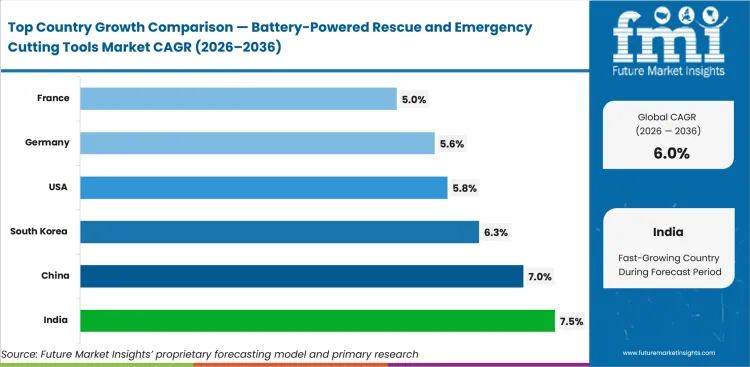
How do country-level CAGRs compare in the battery-powered rescue and emergency cutting tools market?
India and China lead country expansion while Japan records the most cautious growth outlook among profiled markets.
- India is forecast to record 7.5% CAGR by 2036 as fire-service modernization funding supports certified rescue-tool procurement.
- China is projected to expand at 7.0% CAGR through 2036 with provincial emergency agencies upgrading portable rescue equipment.
- South Korea is anticipated to grow at 6.3% CAGR by 2036 owing to industrial emergency readiness and dense urban response needs.
- The United States is expected to post 5.8% CAGR through 2036 as NFPA-led tenders support premium certified tools.
- Germany is forecast to rise at 5.6% CAGR by 2036 with local rescue-tool brands and EN-linked buying discipline.
- The United Kingdom is estimated to expand at 5.2% CAGR through 2036 due to framework-style fire service procurement.
- France is projected to advance at 5.0% CAGR by 2036 as departmental fire services replace selected rescue tools.
- Japan is expected to grow at 4.7% CAGR through 2036 because mature municipal fleets refresh tools cautiously.
What is the battery-powered rescue and emergency cutting tools market outlook in the United States?
A 5.8% CAGR through 2036 reflects NFPA-led procurement and large municipal rescue workloads.
Country Market Snapshot Table
| Parameter | Value |
|---|---|
| Market Size in 2025 (Value) | USD 54.8 million |
| Market Size in 2026 (Value) | USD 58.0 million |
| Market Forecast in 2036 (Value) | USD 101.9 million |
| CAGR (2026 to 2036) | 5.8% |
| Years Considered | 2021 to 2036 |
| Base Year | 2025 |
| Forecast Period | 2026 to 2036 |
| Units Considered | Value (USD million) |
| Leading Sub-Region | South Atlantic and national municipal rescue networks |
United States Battery-Powered Rescue and Emergency Cutting Tools Market Outlook
United States demand is shaped by fire department scale and standards-based tendering. Departments compare cut rating, battery continuity and service support before adding cordless rescue tools to first-access kits. Battery cutters and saws gain priority where crews need fast access without hose setup. Public buyers are expected to keep NFPA 1960 evidence central to bid language.
Key Growth Drivers
- Fire department response scale supports first-access battery kits. The USA Fire Administration recorded over 33.3 million responses from participating departments in 2024.
- Crash rescue needs keep cutters commercially relevant. NHTSA reported 39,254 people died in USA traffic crashes in 2024.
- NFPA 1960 references give public buyers a clear route for comparing cutters, spreaders and combi tools.
- Dealer demonstrations and cooperative purchasing programs help departments compare runtime, cut rating and service support before bid awards.
Key Restraints
- Volunteer-heavy service structure limits rapid premium kit replacement. The USA Fire Administration registry showed 70.0% of registered fire departments were volunteer departments in January 2024.
- Separate chargers and proprietary packs raise fleet costs where departments already use mixed tool platforms.
- Battery rescue tools must prove winter storage, field runtime and spare battery availability before full hydraulic replacement.
What makes United States unique
The United States is unique because NFPA wording shapes product comparison and municipal tender qualification.
Key Companies
- Holmatro
- LUKAS Hydraulik
- AMKUS Rescue Systems
- Milwaukee Tool
- Husqvarna Construction
- Hilti North America
Sales & Marketing Channels
- Municipal public tenders
- Authorized rescue-tool dealers
- Fire apparatus equipment suppliers
- Department demonstrations
- Cooperative purchasing programs
- Online catalog requests
Country Segment Breakdown Table
| Segment | Sub-Segments |
|---|---|
| By Product Type | Battery Cutters · Combi Tools · Spreaders · Rescue Saws · Rescue Rams |
| By Power Platform | 18V Systems · 36V Systems · Proprietary Packs · Dual Battery |
| By Application | Fire Rescue · Technical Rescue · Disaster Response · Military Rescue · Industrial Emergency |
| By Function | Cutting · Spreading · Lifting · Forcible Entry · Demolition |
| By Sales Channel | Public Tender · Authorized Dealers · Direct OEM · Rental Service · Online Catalog |
| Key Sub-Regions Covered, Emergency Procurement Areas | South Atlantic · Midwest · Texas · California · New York · Pacific Northwest |
Market Taxonomy and Sub-Regions Covered
Frequently Asked Questions
How fast is United States battery-powered rescue and emergency cutting tools market growing?
United States demand is projected to expand at 5.8% CAGR from 2026 to 2036 through NFPA-led procurement.
Who leads United States battery-powered rescue and emergency cutting tools market?
Holmatro, LUKAS, AMKUS, Milwaukee Tool, Husqvarna Construction and Hilti compete through rescue and cutting-tool channels.
What is driving adoption in United States battery-powered rescue and emergency cutting tools market?
NFPA 1960 tender wording and large fire-service response loads are supporting battery rescue tool adoption.
How is the battery-powered rescue and emergency cutting tools market performing in the United Kingdom?
A 5.2% CAGR through 2036 reflects disciplined fire-service procurement and road traffic collision response needs.
Country Market Snapshot Table
| Parameter | Value |
|---|---|
| Market Size in 2025 (Value) | USD 12.4 million |
| Market Size in 2026 (Value) | USD 13.0 million |
| Market Forecast in 2036 (Value) | USD 21.6 million |
| CAGR (2026 to 2036) | 5.2% |
| Years Considered | 2021 to 2036 |
| Base Year | 2025 |
| Forecast Period | 2026 to 2036 |
| Units Considered | Value (USD million) |
| Leading Sub-Region | London and regional fire service procurement corridors |
United Kingdom Battery-Powered Rescue and Emergency Cutting Tools Market Outlook
United Kingdom demand is shaped by service-level budgets and framework-style procurement. Fire and rescue services need tools that reduce setup time without disrupting training routines.
Battery cutters gain attention for road traffic collisions and confined-space access. Buyers are expected to weigh whole-life cost as heavily as rated tool power.
Key Growth Drivers
- Incident volume supports broad rescue-tool coverage. England fire and rescue services attended 603,942 incidents in the year ending March 2025.
- Road traffic collision work keeps cutters and combi tools in active procurement. Fire and rescue services attended 32,078 road traffic collisions in the year ending March 2025.
- Framework-style purchasing rewards suppliers that combine training, maintenance and compliance files in one bid package.
- Indoor cutting needs support battery saw use in transport stations, building incidents and enclosed rescue scenes.
Key Restraints
- Crash-casualty decline can moderate replacement urgency. Great Britain recorded 128,272 road casualties of all severities in 2024, down 4.0% from 2023.
- Fire service capital limits can slow full kit replacement across several stations.
- Regional service differences reduce the speed of national standardization for battery platforms.
What makes United Kingdom unique
The United Kingdom is unique because whole-life cost and framework compliance weigh alongside tool power.
Key Companies
- Holmatro UK
- LUKAS Hydraulik
- WEBER RESCUE SYSTEMS
- Husqvarna Construction
- Milwaukee Tool
- Hilti Great Britain
Sales & Marketing Channels
- Fire service procurement frameworks
- Rescue-equipment dealers
- Training center demonstrations
- National equipment catalogues
- Apparatus supplier partnerships
- Online public procurement portals
Country Segment Breakdown Table
| Segment | Sub-Segments |
|---|---|
| By Product Type | Battery Cutters · Combi Tools · Spreaders · Rescue Saws · Rescue Rams |
| By Power Platform | 18V Systems · 36V Systems · Proprietary Packs · Dual Battery |
| By Application | Fire Rescue · Technical Rescue · Disaster Response · Military Rescue · Industrial Emergency |
| By Function | Cutting · Spreading · Lifting · Forcible Entry · Demolition |
| By Sales Channel | Public Tender · Authorized Dealers · Direct OEM · Rental Service · Online Catalog |
| Key Sub-Regions Covered, Emergency Procurement Areas | London · Manchester · Birmingham · Leeds · Glasgow · Bristol |
Market Taxonomy and Sub-Regions Covered
Frequently Asked Questions
How fast is United Kingdom battery-powered rescue and emergency cutting tools market growing?
United Kingdom demand is expected to rise at 5.2% CAGR from 2026 to 2036 through measured kit refresh cycles.
Who leads United Kingdom battery-powered rescue and emergency cutting tools market?
Holmatro UK, LUKAS, WEBER RESCUE, Husqvarna Construction and Milwaukee Tool are visible through UK emergency channels.
What is driving adoption in United Kingdom battery-powered rescue and emergency cutting tools market?
Road traffic collision response and framework-based purchasing are supporting battery cutter and combi-tool demand.
What is the battery-powered rescue and emergency cutting tools market outlook in Germany?
A 5.6% CAGR through 2036 reflects local rescue-tool manufacturing and standards-conscious municipal buying.
Country Market Snapshot Table
| Parameter | Value |
|---|---|
| Market Size in 2025 (Value) | USD 17.0 million |
| Market Size in 2026 (Value) | USD 18.0 million |
| Market Forecast in 2036 (Value) | USD 31.0 million |
| CAGR (2026 to 2036) | 5.6% |
| Years Considered | 2021 to 2036 |
| Base Year | 2025 |
| Forecast Period | 2026 to 2036 |
| Units Considered | Value (USD million) |
| Leading Sub-Region | North Rhine-Westphalia and southern municipal rescue clusters |
Germany Battery-Powered Rescue and Emergency Cutting Tools Market Outlook
Germany remains a premium engineering market for battery rescue tools. Fire departments compare blade geometry, service continuity and EN 13204 evidence before purchase.
Local specialist suppliers strengthen buyer confidence. Battery tools are expected to enter replacement cycles where crews want faster setup across volunteer and technical assistance vehicles.
Key Growth Drivers
- Road rescue readiness remains a procurement driver. Germany recorded 2,770 road traffic deaths in 2024 according to federal transport data.
- Vehicle engineering depth supports demanding extrication requirements. Destatis reported that Germany exported about 3.4 million new cars in 2024.
- Local rescue-tool manufacturing supports trust in service response, spare parts and field training.
- EN 13204 references keep test documentation central to municipal and state-level tenders.
Key Restraints
- Lower road fatalities can slow crash-led urgency. Germany’s road traffic deaths decreased by 2.0% in 2024 compared with 2023.
- Existing hydraulic fleets reduce the need for immediate total replacement in well-equipped municipalities.
- Municipal budget cycles can delay premium battery-tool purchases when legacy equipment remains serviceable.
What makes Germany unique
Germany is unique because domestic rescue-tool specialists compete in a standards-driven fire service environment.
Key Companies
- LUKAS Hydraulik
- WEBER RESCUE SYSTEMS
- Holmatro
- STIHL
- Hilti Deutschland
- Husqvarna Construction
Sales & Marketing Channels
- Municipal fire service tenders
- State-level procurement portals
- Dealer-led training demonstrations
- Fire service exhibitions
- Apparatus builder partnerships
- Technical rescue academies
Country Segment Breakdown Table
| Segment | Sub-Segments |
|---|---|
| By Product Type | Battery Cutters · Combi Tools · Spreaders · Rescue Saws · Rescue Rams |
| By Power Platform | 18V Systems · 36V Systems · Proprietary Packs · Dual Battery |
| By Application | Fire Rescue · Technical Rescue · Disaster Response · Military Rescue · Industrial Emergency |
| By Function | Cutting · Spreading · Lifting · Forcible Entry · Demolition |
| By Sales Channel | Public Tender · Authorized Dealers · Direct OEM · Rental Service · Online Catalog |
| Key Sub-Regions Covered, Emergency Procurement Areas | North Rhine-Westphalia · Bavaria · Baden-Württemberg · Berlin · Hamburg · Hesse |
Market Taxonomy and Sub-Regions Covered
Frequently Asked Questions
How fast is Germany battery-powered rescue and emergency cutting tools market growing?
Germany is forecast to expand at 5.6% CAGR from 2026 to 2036 through technical rescue replacement cycles.
Who leads Germany battery-powered rescue and emergency cutting tools market?
LUKAS Hydraulik and WEBER RESCUE SYSTEMS lead local relevance while Holmatro, STIHL and Hilti compete through European channels.
What is driving adoption in Germany battery-powered rescue and emergency cutting tools market?
Local manufacturing credibility and EN 13204 procurement evidence are supporting battery rescue tool adoption.
How is the battery-powered rescue and emergency cutting tools market performing in France?
A 5.0% CAGR through 2036 reflects departmental fire-service buying and steady road accident rescue demand.
Country Market Snapshot Table
| Parameter | Value |
|---|---|
| Market Size in 2025 (Value) | USD 11.4 million |
| Market Size in 2026 (Value) | USD 12.0 million |
| Market Forecast in 2036 (Value) | USD 19.5 million |
| CAGR (2026 to 2036) | 5.0% |
| Years Considered | 2021 to 2036 |
| Base Year | 2025 |
| Forecast Period | 2026 to 2036 |
| Units Considered | Value (USD million) |
| Leading Sub-Region | Ile-de-France and departmental fire service procurement areas |
France Battery-Powered Rescue and Emergency Cutting Tools Market Outlook
France demand is built around departmental fire and rescue services. Battery rescue tools fit the need for rapid access and lower setup burden during road and building incidents.
Procurement is expected to favor certified products with training and maintenance support. Regional service coverage remains important because departments buy through public rules.
Key Growth Drivers
- Firefighter intervention volume supports rescue-tool replacement. French civil security data recorded 4,754,800 firefighter interventions in 2024.
- Road accident emergency work keeps cutters and spreaders relevant. French civil security data recorded 303,781 road accident emergency responses in 2024.
- Departmental procurement creates repeatable bid routes for certified rescue tools.
- European standards keep test documentation important during supplier evaluation and tool demonstrations.
Key Restraints
- Funding pressure can affect replacement timing. France’s Interior Ministry stated in February 2025 that the civil security budget was EUR 6.7 billion and would not be sufficient in future.
- Department-level budget differences can slow replacement across rural and urban service areas.
- Existing petrol saw fleets can delay battery rescue saw conversion where outdoor cutting remains common.
What makes France unique
France is unique because high intervention volume combines with departmental procurement and regional service coverage needs.
Key Companies
- Holmatro
- LUKAS Hydraulik
- WEBER RESCUE SYSTEMS
- Husqvarna Construction
- STIHL France
- Hilti France
Sales & Marketing Channels
- Departmental public tenders
- Rescue-equipment dealers
- Fire service congress demonstrations
- Apparatus supplier bundles
- Training center trials
- Public procurement portals
Country Segment Breakdown Table
| Segment | Sub-Segments |
|---|---|
| By Product Type | Battery Cutters · Combi Tools · Spreaders · Rescue Saws · Rescue Rams |
| By Power Platform | 18V Systems · 36V Systems · Proprietary Packs · Dual Battery |
| By Application | Fire Rescue · Technical Rescue · Disaster Response · Military Rescue · Industrial Emergency |
| By Function | Cutting · Spreading · Lifting · Forcible Entry · Demolition |
| By Sales Channel | Public Tender · Authorized Dealers · Direct OEM · Rental Service · Online Catalog |
| Key Sub-Regions Covered, Emergency Procurement Areas | Ile-de-France · Auvergne-Rhône-Alpes · Provence-Alpes-Côte d’Azur · Nouvelle-Aquitaine · Occitanie · Hauts-de-France |
Market Taxonomy and Sub-Regions Covered
Frequently Asked Questions
How fast is France battery-powered rescue and emergency cutting tools market growing?
France is anticipated to advance at 5.0% CAGR from 2026 to 2036 through selected departmental replacement cycles.
Who leads France battery-powered rescue and emergency cutting tools market?
Holmatro, LUKAS, WEBER RESCUE, Husqvarna Construction, STIHL France and Hilti France compete through European product channels.
What is driving adoption in France battery-powered rescue and emergency cutting tools market?
Road accident rescue volume and departmental tenders are supporting demand for certified battery cutters and spreaders.
What is the battery-powered rescue and emergency cutting tools market forecast for Japan?
A 4.7% CAGR through 2036 reflects disaster readiness and cautious municipal fleet replacement.
Country Market Snapshot Table
| Parameter | Value |
|---|---|
| Market Size in 2025 (Value) | USD 10.0 million |
| Market Size in 2026 (Value) | USD 10.5 million |
| Market Forecast in 2036 (Value) | USD 16.6 million |
| CAGR (2026 to 2036) | 4.7% |
| Years Considered | 2021 to 2036 |
| Base Year | 2025 |
| Forecast Period | 2026 to 2036 |
| Units Considered | Value (USD million) |
| Leading Sub-Region | Tokyo and disaster-preparedness procurement corridors |
Japan Battery-Powered Rescue and Emergency Cutting Tools Market Outlook
Japan demand is shaped by disaster readiness and compact urban response. Municipal fire departments value low-vibration tools that support narrow access and disciplined station routines.
Battery rescue tools are expected to grow through cautious replacement rather than rapid fleet conversion. Suppliers need clear safety evidence and dependable import support.
Key Growth Drivers
- Earthquake response keeps portable cutting tools relevant. Japan’s 2024 fire service white paper cited 138,884 damaged buildings from the Noto Peninsula earthquake.
- Traffic rescue remains part of municipal preparedness. Japan’s National Police Agency reported 2,547 traffic accident fatalities in 2025.
- FDMA preparedness programs support compact rescue vehicles and high-spec equipment for severe storms, floods and landslides.
- Dense urban fire departments need battery tools suited to narrow access points and controlled indoor work.
Key Restraints
- Crash-driven urgency can be measured because Japan’s National Police Agency reported traffic accidents and injured persons declining for two consecutive years in 2025.
- Mature rescue fleets reduce fast first-time adoption where existing platforms remain trusted.
- Imported rescue tools need strong training and service support before municipalities change battery platforms.
What makes Japan unique
Japan is unique because disaster-readiness culture favors compact tools but procurement changes remain cautious.
Key Companies
- Holmatro
- LUKAS Hydraulik
- WEBER RESCUE SYSTEMS
- Husqvarna Construction
- Hilti Japan
- STIHL Japan
Sales & Marketing Channels
- Municipal fire department tenders
- Disaster preparedness procurement
- Authorized industrial safety dealers
- Training-based demonstrations
- Import distributor networks
- Public safety catalogues
Country Segment Breakdown Table
| Segment | Sub-Segments |
|---|---|
| By Product Type | Battery Cutters · Combi Tools · Spreaders · Rescue Saws · Rescue Rams |
| By Power Platform | 18V Systems · 36V Systems · Proprietary Packs · Dual Battery |
| By Application | Fire Rescue · Technical Rescue · Disaster Response · Military Rescue · Industrial Emergency |
| By Function | Cutting · Spreading · Lifting · Forcible Entry · Demolition |
| By Sales Channel | Public Tender · Authorized Dealers · Direct OEM · Rental Service · Online Catalog |
| Key Sub-Regions Covered, Emergency Procurement Areas | Tokyo · Osaka · Yokohama · Nagoya · Fukuoka · Sapporo |
Market Taxonomy and Sub-Regions Covered
Frequently Asked Questions
How fast is Japan battery-powered rescue and emergency cutting tools market growing?
Japan is projected to grow at 4.7% CAGR from 2026 to 2036 through cautious municipal replacement cycles.
Who leads Japan battery-powered rescue and emergency cutting tools market?
Holmatro, LUKAS, WEBER RESCUE, Husqvarna Construction and Hilti Japan serve premium rescue and cutting-tool channels.
What is driving adoption in Japan battery-powered rescue and emergency cutting tools market?
Earthquake readiness and compact urban rescue needs are supporting selective battery rescue tool adoption.
What is driving battery-powered rescue and emergency cutting tools growth in China?
A 7.0% CAGR through 2036 reflects provincial procurement and industrial rescue modernization.
Country Market Snapshot Table
| Parameter | Value |
|---|---|
| Market Size in 2025 (Value) | USD 27.1 million |
| Market Size in 2026 (Value) | USD 29.0 million |
| Market Forecast in 2036 (Value) | USD 57.0 million |
| CAGR (2026 to 2036) | 7.0% |
| Years Considered | 2021 to 2036 |
| Base Year | 2025 |
| Forecast Period | 2026 to 2036 |
| Units Considered | Value (USD million) |
| Leading Sub-Region | Yangtze River Delta and provincial emergency procurement clusters |
China Battery-Powered Rescue and Emergency Cutting Tools Market Outlook
China demand is tied to the formal buildout of emergency response capacity. Provincial and municipal agencies are expected to use public tenders to add portable rescue tools.
Battery cutters and combi tools fit dense urban rescue and industrial response needs. Domestic suppliers compete on price while international brands compete on certification and service.
Key Growth Drivers
- Road rescue need remains visible. China’s National Bureau of Statistics reported a road traffic death toll of 1.25 people per 10,000 vehicles in 2025.
- Industrial emergency response supports cutting and demolition tools. China’s work-accident death toll reached 18,261 people in 2025.
- Provincial emergency agencies are expected to add portable tools where pump units and hoses restrict access.
- Domestic procurement favors suppliers that meet agency specifications and provide local service coverage.
Key Restraints
- Safety improvements can moderate incident-led urgency. China’s work-accident death toll decreased by 7.0% in 2025 from the previous year.
- Local price competition can pressure premium imported rescue-tool suppliers.
- Provincial specifications can fragment demand when agencies prioritize different battery and certification requirements.
What makes China unique
China is unique because national emergency-system buildout meets strong local procurement and price competition.
Key Companies
- Holmatro
- LUKAS Hydraulik
- WEBER RESCUE SYSTEMS
- Husqvarna Construction
- Hilti China
- STIHL China
Sales & Marketing Channels
- Provincial public tenders
- Municipal emergency procurement
- Industrial safety distributors
- Rescue-equipment importers
- Training demonstrations
- Online procurement platforms
Country Segment Breakdown Table
| Segment | Sub-Segments |
|---|---|
| By Product Type | Battery Cutters · Combi Tools · Spreaders · Rescue Saws · Rescue Rams |
| By Power Platform | 18V Systems · 36V Systems · Proprietary Packs · Dual Battery |
| By Application | Fire Rescue · Technical Rescue · Disaster Response · Military Rescue · Industrial Emergency |
| By Function | Cutting · Spreading · Lifting · Forcible Entry · Demolition |
| By Sales Channel | Public Tender · Authorized Dealers · Direct OEM · Rental Service · Online Catalog |
| Key Sub-Regions Covered, Emergency Procurement Areas | Yangtze River Delta · Pearl River Delta · Beijing-Tianjin-Hebei · Sichuan · Shandong · Guangdong |
Market Taxonomy and Sub-Regions Covered
Frequently Asked Questions
How fast is China battery-powered rescue and emergency cutting tools market growing?
China is forecast to grow at 7.0% CAGR from 2026 to 2036 through provincial emergency procurement.
Who leads China battery-powered rescue and emergency cutting tools market?
International rescue-tool brands compete with domestic suppliers through certification evidence and local service coverage.
What is driving adoption in China battery-powered rescue and emergency cutting tools market?
Industrial rescue needs and provincial tender activity are supporting demand for battery cutters and combi tools.
What is the battery-powered rescue and emergency cutting tools market outlook in South Korea?
A 6.3% CAGR through 2036 reflects dense urban response needs and industrial emergency preparedness.
Country Market Snapshot Table
| Parameter | Value |
|---|---|
| Market Size in 2025 (Value) | USD 7.5 million |
| Market Size in 2026 (Value) | USD 8.0 million |
| Market Forecast in 2036 (Value) | USD 14.7 million |
| CAGR (2026 to 2036) | 6.3% |
| Years Considered | 2021 to 2036 |
| Base Year | 2025 |
| Forecast Period | 2026 to 2036 |
| Units Considered | Value (USD million) |
| Leading Sub-Region | Seoul Capital Area and industrial emergency corridors |
South Korea Battery-Powered Rescue and Emergency Cutting Tools Market Outlook
South Korea demand is influenced by dense urban response and industrial risk management. Buyers value compact battery tools that can be carried quickly into building, transport and factory incidents.
Procurement is expected to favor suppliers with local documentation and demonstration support. Battery platform reliability matters because fire crews operate under tight response routines.
Key Growth Drivers
- Fire-safety industry scale supports local equipment procurement. South Korea’s National Fire Agency reported that 2024 fire-industry sales exceeded KRW 19.0 trillion.
- Industrial emergency demand is supported by manufacturing depth. Statistics Korea reported manufacturing value added at 26.6% of GDP in 2024.
- Seoul Capital Area response density favors compact cordless tools that reduce setup time in buildings and transit corridors.
- Local training programs support repeat purchases when rescue teams standardize tool handling and battery maintenance.
Key Restraints
- Energy and operating costs can affect municipal spending. Statistics Korea reported Korea’s energy intensity at 0.133 TOE per KRW 1.0 million in 2024.
- Smaller agencies may delay purchases when premium imported tools require separate service and battery support.
- Fast product turnover can make buyers cautious about battery platform continuity and spare-part availability.
What makes South Korea unique
South Korea is unique because industrial density and urban response needs create demand for compact rescue kits.
Key Companies
- Holmatro
- LUKAS Hydraulik
- WEBER RESCUE SYSTEMS
- Husqvarna Construction
- Hilti Korea
- Milwaukee Tool Korea
Sales & Marketing Channels
- National and municipal tenders
- Industrial safety distributors
- Fire service demonstrations
- Training academy trials
- Authorized equipment dealers
- Online public procurement
Country Segment Breakdown Table
| Segment | Sub-Segments |
|---|---|
| By Product Type | Battery Cutters · Combi Tools · Spreaders · Rescue Saws · Rescue Rams |
| By Power Platform | 18V Systems · 36V Systems · Proprietary Packs · Dual Battery |
| By Application | Fire Rescue · Technical Rescue · Disaster Response · Military Rescue · Industrial Emergency |
| By Function | Cutting · Spreading · Lifting · Forcible Entry · Demolition |
| By Sales Channel | Public Tender · Authorized Dealers · Direct OEM · Rental Service · Online Catalog |
| Key Sub-Regions Covered, Emergency Procurement Areas | Seoul Capital Area · Busan · Incheon · Daegu · Ulsan · Gyeonggi-do |
Market Taxonomy and Sub-Regions Covered
Frequently Asked Questions
How fast is South Korea battery-powered rescue and emergency cutting tools market growing?
South Korea is expected to expand at 6.3% CAGR from 2026 to 2036 through urban and industrial rescue demand.
Who leads South Korea battery-powered rescue and emergency cutting tools market?
Holmatro, LUKAS, WEBER RESCUE, Hilti Korea and Milwaukee Tool Korea compete through rescue and industrial safety channels.
What is driving adoption in South Korea battery-powered rescue and emergency cutting tools market?
Dense urban response needs and industrial emergency preparedness are supporting battery rescue tool adoption.
What is driving battery-powered rescue and emergency cutting tools growth in India?
A 7.5% CAGR through 2036 reflects fire-service modernization funding and dense urban rescue needs.
Country Market Snapshot Table
| Parameter | Value |
|---|---|
| Market Size in 2025 (Value) | USD 14.9 million |
| Market Size in 2026 (Value) | USD 16.0 million |
| Market Forecast in 2036 (Value) | USD 33.0 million |
| CAGR (2026 to 2036) | 7.5% |
| Years Considered | 2021 to 2036 |
| Base Year | 2025 |
| Forecast Period | 2026 to 2036 |
| Units Considered | Value (USD million) |
| Leading Sub-Region | National Disaster Response Force and state fire service modernization corridors |
India Battery-Powered Rescue and Emergency Cutting Tools Market Outlook
India is the fastest-growing profiled country because public safety modernization is moving into fire and disaster response equipment. Battery combi tools fit dense rescue scenes where portability matters.
State fire services and disaster agencies are expected to use tenders that cite certification routes. Suppliers with service training and bid documentation should gain stronger access.
Key Growth Drivers
- Fire-service modernization creates a direct procurement route. India’s Ministry of Home Affairs confirmed a total central outlay of Rs. 5,000 crore for state fire services.
- Crash rescue need remains large. India’s road accident report recorded 480,583 road accidents and 172,890 deaths in 2023.
- NDRF tender specifications support battery-operated combi tools that meet NFPA 1936, NFPA 1960 or EN 13204 requirements.
- Dense urban rescue conditions support cordless tools that reduce pump setup and improve first access in narrow lanes.
Key Restraints
- State contribution rules can slow adoption. India’s fire-service modernization scheme requires states to contribute 25.0% except North-Eastern and Himalayan states.
- Tender compliance raises entry barriers when buyers require international certification and local demonstration support.
- State-level budget gaps can delay uniform rollout across municipal fire stations and disaster response units.
What makes India unique
India is unique because national funding support meets dense urban rescue demand and formal certification-led tenders.
Key Companies
- Holmatro
- LUKAS Hydraulik
- WEBER RESCUE SYSTEMS
- STIHL India
- Hilti India
- Husqvarna Construction India
Sales & Marketing Channels
- State fire service tenders
- NDRF procurement
- Municipal public bids
- Authorized rescue-equipment dealers
- Training demonstrations
- Government e-marketplace bids
Country Segment Breakdown Table
| Segment | Sub-Segments |
|---|---|
| By Product Type | Battery Cutters · Combi Tools · Spreaders · Rescue Saws · Rescue Rams |
| By Power Platform | 18V Systems · 36V Systems · Proprietary Packs · Dual Battery |
| By Application | Fire Rescue · Technical Rescue · Disaster Response · Military Rescue · Industrial Emergency |
| By Function | Cutting · Spreading · Lifting · Forcible Entry · Demolition |
| By Sales Channel | Public Tender · Authorized Dealers · Direct OEM · Rental Service · Online Catalog |
| Key Sub-Regions Covered, Emergency Procurement Areas | Delhi NCR · Maharashtra · Karnataka · Tamil Nadu · Gujarat · Telangana |
Market Taxonomy and Sub-Regions Covered
Frequently Asked Questions
How fast is India battery-powered rescue and emergency cutting tools market growing?
India is projected to grow fastest at 7.5% CAGR from 2026 to 2036 through fire-service modernization funding.
Who leads India battery-powered rescue and emergency cutting tools market?
Holmatro, LUKAS, WEBER RESCUE, STIHL India, Hilti India and Husqvarna Construction India compete through rescue-equipment channels.
What is driving adoption in India battery-powered rescue and emergency cutting tools market?
Fire-service modernization funding and dense urban rescue needs are supporting battery-powered cutter and combi-tool demand.
Who are the leading companies in the battery-powered rescue and emergency cutting tools market?
Holmatro, LUKAS, WEBER RESCUE SYSTEMS, AMKUS, Husqvarna Construction, STIHL, Milwaukee Tool, and Hilti lead the competitive benchmark.
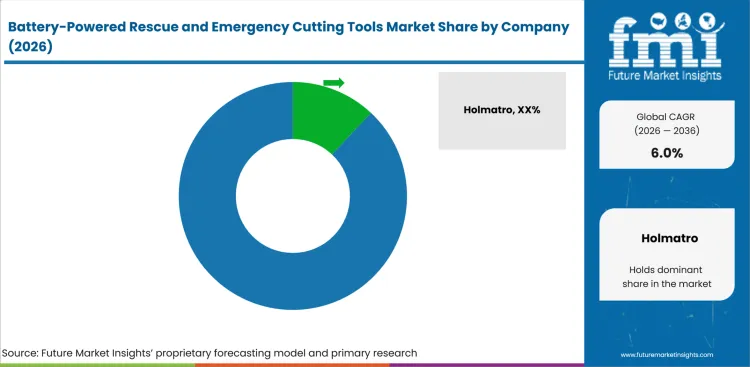
- Rescue-tool specialists hold stronger positions in certified cutters, spreaders, rams, and combi tools.
- Power-tool brands compete more directly in battery rescue saws and indoor-capable cut-off machines.
- Dealer networks influence public tenders through demonstrations, training, maintenance support, and spare battery planning.
- Suppliers with NFPA 1960 and EN 13204 evidence gain stronger credibility in formal procurement.
Competition is split between rescue-tool specialists and professional power-tool brands. IDEX states that its rescue businesses produce hydraulic, battery, gas, and electric-operated rescue equipment for public and private fire and rescue organizations. That gives LUKAS a clear fit in the core rescue-tool segment. Specialist brands stand out with cutters, rams, spreaders, and combi tools designed around extrication standards. Capability depth matters more than broad tool catalogs in high-risk rescue buying.
Battery saw competition works differently from hydraulic rescue tools. Husqvarna’s K 1 PACE Rescue is positioned as a high-power battery rescue cutter with smoke-visible blade guard and X-Halt brake function. Milwaukee and Hilti sell battery cut-off saws into construction and emergency-adjacent use cases. Their advantage is platform depth. Rescue specialists win where certified extrication performance is the main tender requirement.
Smaller suppliers compete by matching tender specifications and offering lower prices. The challenge is proof. NFPA 1960 and EN 13204 references require testing discipline. Public buyers also expect service support after purchase. AMKUS highlights NFPA 1960 compliance and USA assembly in its 2025 catalog. That shows how second-tier specialists use certification and local support to compete against larger global brands.
How do top battery-powered rescue and emergency cutting tools companies compare?
Holmatro, LUKAS, and WEBER RESCUE SYSTEMS score strongest on rescue certification depth and field service readiness.
| Company | Rescue Certification Depth | Battery Platform Breadth | Field Service Readiness | Geographic Footprint |
|---|---|---|---|---|
| Holmatro | High | Strong | High | Global |
| LUKAS | High | Strong | Strong | Global |
| WEBER RESCUE SYSTEMS | High | Strong | Strong | Europe and Global |
| AMKUS | High | Medium | Strong | North America |
| Husqvarna Construction | Medium | High | Strong | Global |
| STIHL | Medium | High | Strong | Global |
| Milwaukee Tool | Medium | High | Strong | Global |
| Hilti | Medium | High | Strong | Global |
Source: Future Market Insights competitive analysis, 2026.
Who are the key players in the battery-powered rescue and emergency cutting tools market?
Holmatro, LUKAS, WEBER RESCUE SYSTEMS, AMKUS, STIHL, Husqvarna Construction, Milwaukee Tool, and Hilti are listed among core suppliers.
Key global companies leading the battery-powered rescue and emergency cutting tools market include:
- Holmatro
- LUKAS
- WEBER RESCUE SYSTEMS
- AMKUS
- STIHL
- Husqvarna Construction
- Milwaukee Tool
- Hilti
Key Developments in Battery-Powered Rescue and Emergency Cutting Tools Market
- In January 2024, WEBER RESCUE presented tactical tools for special applications at ENFORCE TAC. The line included combi tools and door-opening products for quiet operation.
- In July 2024, NFPA 1960 became the current consolidated standard covering powered rescue tools. This matters because tender documents can reference a single updated standard.
- In May 2025, Hilti announced that DSH 600-22 ATC and DSH 700-22 ATC battery cut-off saws were recognized as 2025 Concrete Contractor Top Products.
- In October 2025, AMKUS published a catalog stating every tool is NFPA 1960 certified through third-party UL testing. This supports buyer confidence in formal rescue tenders.
- In February 2026, Holmatro published manuals covering Pentheon battery tools and on-tool charging guidance. This supports maintenance confidence for battery rescue fleets.
Key Players in the Battery-Powered Rescue and Emergency Cutting Tools Market
Rescue Tool Specialists
- Holmatro
- LUKAS
- WEBER RESCUE SYSTEMS
- AMKUS
Battery Saw and Cutter Brands
- STIHL
- Husqvarna Construction
- Milwaukee Tool
- Hilti
Channel and Service Enablers
- Authorized rescue-tool dealers
- Fire apparatus equipment suppliers
- Industrial safety distributors
- Public procurement integrators
Battery-Powered Rescue and Emergency Cutting Tools Market - Report Scope
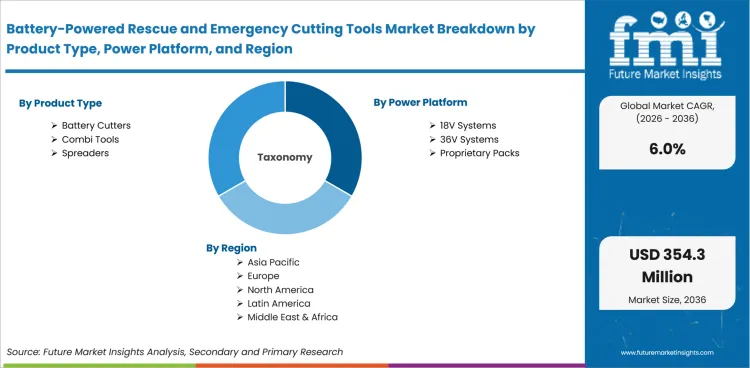
| Item | Value |
|---|---|
| Market size by 2036 | USD 354.3 million |
| Growth rate | 6.0% CAGR from 2026 to 2036 |
| Forecast period | 2026 to 2036 |
| Base year value (2025) | USD 186.4 million |
| By product type | Battery cutters, combi tools, spreaders, rescue saws, rescue rams |
| By power platform | 18V systems, 36V systems, proprietary packs, dual battery |
| By application | Fire rescue, technical rescue, disaster response, military rescue, industrial emergency |
| By function | Cutting, spreading, lifting, forcible entry, demolition |
| By sales channel | Public tender, authorized dealers, direct OEM, rental service, online catalog |
| Regions covered | North America, Latin America, Europe, East Asia, South Asia and Pacific, Middle East and Africa |
| Countries covered | United States, United Kingdom, Germany, France, Japan, China, South Korea, India |
| Key companies profiled | Holmatro, LUKAS, WEBER RESCUE SYSTEMS, STIHL, Husqvarna Construction, Milwaukee Tool, Hilti |
| Approach | Hybrid bottom-up and top-down model using emergency-service activity, public tender signals, tool pricing and country-level adoption |
Source: Future Market Insights, 2026.
Battery-Powered Rescue and Emergency Cutting Tools Market - Scope & Definition
| Attribute | Detail |
|---|---|
| Market Definition | Battery-powered cutters, combi tools, spreaders, rescue rams, rescue saws and cut-off machines used by emergency crews for rescue and emergency access work |
| Functions Covered | Cutting, spreading, lifting, forcible entry, demolition, crash rescue and emergency access |
| Applications Covered | Fire rescue, technical rescue, disaster response, military rescue and industrial emergency response |
| End-Use Industries | Fire services, disaster response agencies, military rescue units, industrial emergency teams and municipal safety departments |
| Grades Covered | 18V systems, 36V systems, proprietary battery packs and dual-battery platforms |
| Inclusions | Commercial battery rescue cutters, combi tools, spreaders, rams, saws, battery packs, chargers, blades, dealer sales, public tenders and rental support |
| Exclusions | Petrol saws, corded construction tools sold only for building trades, manual pry tools, air lifting bags, fire trucks, rescue boats and personal protective equipment |
Battery-Powered Rescue and Emergency Cutting Tools Market - Research Methodology
| Method | Description |
|---|---|
| Primary Research | FMI analyst interviews with fire departments, disaster response agencies, municipal procurement teams, rescue-tool dealers and emergency equipment distributors across key markets |
| Desk Research | Review of fire statistics, road safety data, public tender documents, NFPA 1960, EN 13204 references and official company product documentation |
| Market Sizing & Forecasting | Hybrid bottom-up model using estimated tool volumes, average selling prices, public tender demand, battery platform adoption and country emergency-service activity |
| Data Validation | Cross-verification using fire service incident loads, public modernization funding, product portfolios, certification requirements and regional procurement behavior |
Battery-Powered Rescue and Emergency Cutting Tools Market Breakdown by Product Type, Power Platform, Application, Function, Sales Channel, and Region
Battery-Powered Rescue and Emergency Cutting Tools Market Segmented by Product Type
- Battery Cutters
- Combi Tools
- Spreaders
- Rescue Saws
- Rescue Rams
Battery-Powered Rescue and Emergency Cutting Tools Market Segmented by Power Platform
- 18V Systems
- 36V Systems
- Proprietary Packs
- Dual Battery
Battery-Powered Rescue and Emergency Cutting Tools Market Segmented by Application
- Fire Rescue
- Technical Rescue
- Disaster Response
- Military Rescue
- Industrial Emergency
Battery-Powered Rescue and Emergency Cutting Tools Market Segmented by Function
- Cutting
- Spreading
- Lifting
- Forcible Entry
- Demolition
Battery-Powered Rescue and Emergency Cutting Tools Market Segmented by Sales Channel
- Public Tender
- Authorized Dealers
- Direct OEM
- Rental Service
- Online Catalog
Battery-Powered Rescue and Emergency Cutting Tools Market by Region
- North America
- Latin America
- Europe
- East Asia
- South Asia and Pacific
- Middle East and Africa
Research Sources and Bibliography
- USA Fire Administration. (2025). About NFIRS: 2024 NFIRS public data release facts. Federal Emergency Management Agency.
- USA Fire Administration. (2025). Annual report on firefighter fatalities in the United States. Federal Emergency Management Agency.
- National Fire Chiefs Council. (2025, June 4). Fire and rescue must not be the forgotten emergency service.
- Direction Générale de la Sécurité Civile et de la Gestion des Crises. (2025, December 3). Statistiques 2024 - DGSCGC. Ministère de l’Intérieur.
- Fire and Disaster Management Agency. (2025, April 1). Overview of the 2024 White Paper on Fire Service.
- Ministry of Home Affairs. (2024, December 4). Scheme for Expansion and Modernization of Fire Services in the States. Government of India.
- National Disaster Response Force. (2024). Technical specification of combination cutter with spreader battery operated. Government of India.
- National Fire Protection Association. (2024). NFPA 1960: Standard for fire hose connections, spray nozzles, manufacturer’s design of fire department ground ladders, fire hose, and powered rescue tools.
- Holmatro. (2025). Service: Holmatro Diagnostic Software for Pentheon rescue tools.
- Holmatro. (2026, February). Pentheon rescue tool operating manual.
- IDEX Corporation. (2024). Fire & Safety/Diversified Products.
- LUKAS Hydraulik. (2024). eDRAULIC cutter technical data.
- WEBER RESCUE SYSTEMS. (2024, January 22). WEBER RESCUE presents new solutions for special applications.
- WEBER RESCUE SYSTEMS. (2025). Operating instructions battery rescue tools E-FORCE3.
- Husqvarna Construction. (2026). K 1 PACE Rescue high power battery cutter.
- Milwaukee Tool. (2026). M18 FUEL 9-inch cut-off saw with ONE-KEY.
- Hilti. (2025, May 9). Hilti cut-off saws recognized as 2025 Concrete Contractor Top Products Award winners.
- Hilti. (2026). DSH 900-22 ATC 14-inch battery-powered cut-off saw.
- AMKUS Rescue Systems. (2025, March). 2025 catalog: Simple. Rugged. Reliable.
- AMKUS Rescue Systems. (2025, October). AMKUS catalog main 1025.
- Home Office. (2025, July 10). Fire and rescue incident statistics, year ending March 2025. GOV.UK.
- Department for Transport. (2025, June 26). Reported road casualties Great Britain, annual report: 2024. GOV.UK.
- National Highway Traffic Safety Administration. (2025). Traffic fatalities in 2024. USA Department of Transportation.
- Federal Statistical Office. (2025). Long term series: Road traffic accidents. Destatis.
- Federal Ministry of Transport. (2025). Road safety: What we do to save your life. Government of Germany.
- National Bureau of Statistics of China. (2026, February 28). Statistical communique on national economic and social development in 2025. Government of China.
- National Fire Agency. (2025). 2024 fire industry statistics. Republic of Korea.
- Statistics Korea. (2025). SDG indicators in the Republic of Korea.
- Ministry of Road Transport and Highways. (2025). Road accidents in India 2023. Government of India.
This bibliography is provided for reader reference and is not exhaustive. The full report contains the complete reference list and detailed citations.
This Report Answers
- What is the 2026 value and 2036 forecast for battery-powered rescue and emergency cutting tools market?
- Which product type is projected to hold the leading share during the forecast period?
- Which application segment is expected to account for the leading 2026 share?
- How do NFPA 1960 and EN 13204 affect public rescue-tool procurement?
- Which companies compete in battery-powered rescue and emergency cutting tools?
Frequently Asked Questions
What is the battery-powered rescue and emergency cutting tools market size in 2026?
The battery-powered rescue and emergency cutting tools market size is anticipated to reach USD 197.6 million in 2026.
What is the battery-powered rescue and emergency cutting tools market forecast for 2036?
The battery-powered rescue and emergency cutting tools industry revenue is predicted to reach USD 354.3 million by 2036 as fire and rescue agencies expand battery rescue kits.
What is the battery-powered rescue and emergency cutting tools market CAGR?
The battery-powered rescue and emergency cutting tools sector is projected to expand at 6.0% CAGR from 2026 to 2036.
What segment leads the battery-powered rescue and emergency cutting tools market?
Battery cutters are likely to capture 36.0% share in 2026 due to crash rescue and forcible entry use.
What country grows fastest in the battery-powered rescue and emergency cutting tools market?
India is set to record 7.5% CAGR by 2036, driven by fire-service modernization funding and dense urban rescue needs.
Preview the report firsthand - request a free sample
Get SampleGet the brochure for pricing and purchase details.
Get PDFTable of Content
- Executive Summary
- Global Market Outlook
- Demand to side Trends
- Supply to side Trends
- Technology Roadmap Analysis
- Analysis and Recommendations
- Market Overview
- Market Coverage / Taxonomy
- Market Definition / Scope / Limitations
- Research Methodology
- Chapter Orientation
- Analytical Lens and Working Hypotheses
- Market Structure, Signals, and Trend Drivers
- Benchmarking and Cross-market Comparability
- Market Sizing, Forecasting, and Opportunity Mapping
- Research Design and Evidence Framework
- Desk Research Programme (Secondary Evidence)
- Company Annual and Sustainability Reports
- Peer-reviewed Journals and Academic Literature
- Corporate Websites, Product Literature, and Technical Notes
- Earnings Decks and Investor Briefings
- Statutory Filings and Regulatory Disclosures
- Technical White Papers and Standards Notes
- Trade Journals, Industry Magazines, and Analyst Briefs
- Conference Proceedings, Webinars, and Seminar Materials
- Government Statistics Portals and Public Data Releases
- Press Releases and Reputable Media Coverage
- Specialist Newsletters and Curated Briefings
- Sector Databases and Reference Repositories
- FMI Internal Proprietary Databases and Historical Market Datasets
- Subscription Datasets and Paid Sources
- Social Channels, Communities, and Digital Listening Inputs
- Additional Desk Sources
- Expert Input and Fieldwork (Primary Evidence)
- Primary Modes
- Qualitative Interviews and Expert Elicitation
- Quantitative Surveys and Structured Data Capture
- Blended Approach
- Why Primary Evidence is Used
- Field Techniques
- Interviews
- Surveys
- Focus Groups
- Observational and In-context Research
- Social and Community Interactions
- Stakeholder Universe Engaged
- C-suite Leaders
- Board Members
- Presidents and Vice Presidents
- R&D and Innovation Heads
- Technical Specialists
- Domain Subject-matter Experts
- Scientists
- Physicians and Other Healthcare Professionals
- Governance, Ethics, and Data Stewardship
- Research Ethics
- Data Integrity and Handling
- Primary Modes
- Tooling, Models, and Reference Databases
- Desk Research Programme (Secondary Evidence)
- Data Engineering and Model Build
- Data Acquisition and Ingestion
- Cleaning, Normalisation, and Verification
- Synthesis, Triangulation, and Analysis
- Quality Assurance and Audit Trail
- Market Background
- Market Dynamics
- Drivers
- Restraints
- Opportunity
- Trends
- Scenario Forecast
- Demand in Optimistic Scenario
- Demand in Likely Scenario
- Demand in Conservative Scenario
- Opportunity Map Analysis
- Product Life Cycle Analysis
- Supply Chain Analysis
- Investment Feasibility Matrix
- Value Chain Analysis
- PESTLE and Porter’s Analysis
- Regulatory Landscape
- Regional Parent Market Outlook
- Production and Consumption Statistics
- Import and Export Statistics
- Market Dynamics
- Global Market Analysis 2021 to 2025 and Forecast, 2026 to 2036
- Historical Market Size Value (USD Million) Analysis, 2021 to 2025
- Current and Future Market Size Value (USD Million) Projections, 2026 to 2036
- Y to o to Y Growth Trend Analysis
- Absolute $ Opportunity Analysis
- Global Market Pricing Analysis 2021 to 2025 and Forecast 2026 to 2036
- Global Market Analysis 2021 to 2025 and Forecast 2026 to 2036, By Blade Size
- Introduction / Key Findings
- Historical Market Size Value (USD Million) Analysis By Blade Size , 2021 to 2025
- Current and Future Market Size Value (USD Million) Analysis and Forecast By Blade Size , 2026 to 2036
- 14 Inch
- 12 Inch
- 9 Inch
- 14 Inch
- Y to o to Y Growth Trend Analysis By Blade Size , 2021 to 2025
- Absolute $ Opportunity Analysis By Blade Size , 2026 to 2036
- Global Market Analysis 2021 to 2025 and Forecast 2026 to 2036, By Battery Architecture
- Introduction / Key Findings
- Historical Market Size Value (USD Million) Analysis By Battery Architecture, 2021 to 2025
- Current and Future Market Size Value (USD Million) Analysis and Forecast By Battery Architecture, 2026 to 2036
- Dual Battery
- Single Battery
- High Voltage
- Dual Battery
- Y to o to Y Growth Trend Analysis By Battery Architecture, 2021 to 2025
- Absolute $ Opportunity Analysis By Battery Architecture, 2026 to 2036
- Global Market Analysis 2021 to 2025 and Forecast 2026 to 2036, By Machine Format
- Introduction / Key Findings
- Historical Market Size Value (USD Million) Analysis By Machine Format, 2021 to 2025
- Current and Future Market Size Value (USD Million) Analysis and Forecast By Machine Format, 2026 to 2036
- Handheld
- Cart Mounted
- Rail Mounted
- Handheld
- Y to o to Y Growth Trend Analysis By Machine Format, 2021 to 2025
- Absolute $ Opportunity Analysis By Machine Format, 2026 to 2036
- Global Market Analysis 2021 to 2025 and Forecast 2026 to 2036, By End Use
- Introduction / Key Findings
- Historical Market Size Value (USD Million) Analysis By End Use, 2021 to 2025
- Current and Future Market Size Value (USD Million) Analysis and Forecast By End Use, 2026 to 2036
- Construction
- Rescue
- Rental
- Construction
- Y to o to Y Growth Trend Analysis By End Use, 2021 to 2025
- Absolute $ Opportunity Analysis By End Use, 2026 to 2036
- Global Market Analysis 2021 to 2025 and Forecast 2026 to 2036, By Sales Channel
- Introduction / Key Findings
- Historical Market Size Value (USD Million) Analysis By Sales Channel, 2021 to 2025
- Current and Future Market Size Value (USD Million) Analysis and Forecast By Sales Channel, 2026 to 2036
- Dealer Sales
- Direct Sales
- Rental Fleets
- Dealer Sales
- Y to o to Y Growth Trend Analysis By Sales Channel, 2021 to 2025
- Absolute $ Opportunity Analysis By Sales Channel, 2026 to 2036
- Global Market Analysis 2021 to 2025 and Forecast 2026 to 2036, By Region
- Introduction
- Historical Market Size Value (USD Million) Analysis By Region, 2021 to 2025
- Current Market Size Value (USD Million) Analysis and Forecast By Region, 2026 to 2036
- North America
- Latin America
- Western Europe
- Eastern Europe
- East Asia
- South Asia and Pacific
- Middle East & Africa
- Market Attractiveness Analysis By Region
- North America Market Analysis 2021 to 2025 and Forecast 2026 to 2036, By Country
- Historical Market Size Value (USD Million) Trend Analysis By Market Taxonomy, 2021 to 2025
- Market Size Value (USD Million) Forecast By Market Taxonomy, 2026 to 2036
- By Country
- USA
- Canada
- Mexico
- By Blade Size
- By Battery Architecture
- By Machine Format
- By End Use
- By Sales Channel
- By Country
- Market Attractiveness Analysis
- By Country
- By Blade Size
- By Battery Architecture
- By Machine Format
- By End Use
- By Sales Channel
- Key Takeaways
- Latin America Market Analysis 2021 to 2025 and Forecast 2026 to 2036, By Country
- Historical Market Size Value (USD Million) Trend Analysis By Market Taxonomy, 2021 to 2025
- Market Size Value (USD Million) Forecast By Market Taxonomy, 2026 to 2036
- By Country
- Brazil
- Chile
- Rest of Latin America
- By Blade Size
- By Battery Architecture
- By Machine Format
- By End Use
- By Sales Channel
- By Country
- Market Attractiveness Analysis
- By Country
- By Blade Size
- By Battery Architecture
- By Machine Format
- By End Use
- By Sales Channel
- Key Takeaways
- Western Europe Market Analysis 2021 to 2025 and Forecast 2026 to 2036, By Country
- Historical Market Size Value (USD Million) Trend Analysis By Market Taxonomy, 2021 to 2025
- Market Size Value (USD Million) Forecast By Market Taxonomy, 2026 to 2036
- By Country
- Germany
- UK
- Italy
- Spain
- France
- Nordic
- BENELUX
- Rest of Western Europe
- By Blade Size
- By Battery Architecture
- By Machine Format
- By End Use
- By Sales Channel
- By Country
- Market Attractiveness Analysis
- By Country
- By Blade Size
- By Battery Architecture
- By Machine Format
- By End Use
- By Sales Channel
- Key Takeaways
- Eastern Europe Market Analysis 2021 to 2025 and Forecast 2026 to 2036, By Country
- Historical Market Size Value (USD Million) Trend Analysis By Market Taxonomy, 2021 to 2025
- Market Size Value (USD Million) Forecast By Market Taxonomy, 2026 to 2036
- By Country
- Russia
- Poland
- Hungary
- Balkan & Baltic
- Rest of Eastern Europe
- By Blade Size
- By Battery Architecture
- By Machine Format
- By End Use
- By Sales Channel
- By Country
- Market Attractiveness Analysis
- By Country
- By Blade Size
- By Battery Architecture
- By Machine Format
- By End Use
- By Sales Channel
- Key Takeaways
- East Asia Market Analysis 2021 to 2025 and Forecast 2026 to 2036, By Country
- Historical Market Size Value (USD Million) Trend Analysis By Market Taxonomy, 2021 to 2025
- Market Size Value (USD Million) Forecast By Market Taxonomy, 2026 to 2036
- By Country
- China
- Japan
- South Korea
- By Blade Size
- By Battery Architecture
- By Machine Format
- By End Use
- By Sales Channel
- By Country
- Market Attractiveness Analysis
- By Country
- By Blade Size
- By Battery Architecture
- By Machine Format
- By End Use
- By Sales Channel
- Key Takeaways
- South Asia and Pacific Market Analysis 2021 to 2025 and Forecast 2026 to 2036, By Country
- Historical Market Size Value (USD Million) Trend Analysis By Market Taxonomy, 2021 to 2025
- Market Size Value (USD Million) Forecast By Market Taxonomy, 2026 to 2036
- By Country
- India
- ASEAN
- Australia & New Zealand
- Rest of South Asia and Pacific
- By Blade Size
- By Battery Architecture
- By Machine Format
- By End Use
- By Sales Channel
- By Country
- Market Attractiveness Analysis
- By Country
- By Blade Size
- By Battery Architecture
- By Machine Format
- By End Use
- By Sales Channel
- Key Takeaways
- Middle East & Africa Market Analysis 2021 to 2025 and Forecast 2026 to 2036, By Country
- Historical Market Size Value (USD Million) Trend Analysis By Market Taxonomy, 2021 to 2025
- Market Size Value (USD Million) Forecast By Market Taxonomy, 2026 to 2036
- By Country
- Kingdom of Saudi Arabia
- Other GCC Countries
- Turkiye
- South Africa
- Other African Union
- Rest of Middle East & Africa
- By Blade Size
- By Battery Architecture
- By Machine Format
- By End Use
- By Sales Channel
- By Country
- Market Attractiveness Analysis
- By Country
- By Blade Size
- By Battery Architecture
- By Machine Format
- By End Use
- By Sales Channel
- Key Takeaways
- Key Countries Market Analysis
- USA
- Pricing Analysis
- Market Share Analysis, 2025
- By Blade Size
- By Battery Architecture
- By Machine Format
- By End Use
- By Sales Channel
- Canada
- Pricing Analysis
- Market Share Analysis, 2025
- By Blade Size
- By Battery Architecture
- By Machine Format
- By End Use
- By Sales Channel
- Mexico
- Pricing Analysis
- Market Share Analysis, 2025
- By Blade Size
- By Battery Architecture
- By Machine Format
- By End Use
- By Sales Channel
- Brazil
- Pricing Analysis
- Market Share Analysis, 2025
- By Blade Size
- By Battery Architecture
- By Machine Format
- By End Use
- By Sales Channel
- Chile
- Pricing Analysis
- Market Share Analysis, 2025
- By Blade Size
- By Battery Architecture
- By Machine Format
- By End Use
- By Sales Channel
- Germany
- Pricing Analysis
- Market Share Analysis, 2025
- By Blade Size
- By Battery Architecture
- By Machine Format
- By End Use
- By Sales Channel
- UK
- Pricing Analysis
- Market Share Analysis, 2025
- By Blade Size
- By Battery Architecture
- By Machine Format
- By End Use
- By Sales Channel
- Italy
- Pricing Analysis
- Market Share Analysis, 2025
- By Blade Size
- By Battery Architecture
- By Machine Format
- By End Use
- By Sales Channel
- Spain
- Pricing Analysis
- Market Share Analysis, 2025
- By Blade Size
- By Battery Architecture
- By Machine Format
- By End Use
- By Sales Channel
- France
- Pricing Analysis
- Market Share Analysis, 2025
- By Blade Size
- By Battery Architecture
- By Machine Format
- By End Use
- By Sales Channel
- India
- Pricing Analysis
- Market Share Analysis, 2025
- By Blade Size
- By Battery Architecture
- By Machine Format
- By End Use
- By Sales Channel
- ASEAN
- Pricing Analysis
- Market Share Analysis, 2025
- By Blade Size
- By Battery Architecture
- By Machine Format
- By End Use
- By Sales Channel
- Australia & New Zealand
- Pricing Analysis
- Market Share Analysis, 2025
- By Blade Size
- By Battery Architecture
- By Machine Format
- By End Use
- By Sales Channel
- China
- Pricing Analysis
- Market Share Analysis, 2025
- By Blade Size
- By Battery Architecture
- By Machine Format
- By End Use
- By Sales Channel
- Japan
- Pricing Analysis
- Market Share Analysis, 2025
- By Blade Size
- By Battery Architecture
- By Machine Format
- By End Use
- By Sales Channel
- South Korea
- Pricing Analysis
- Market Share Analysis, 2025
- By Blade Size
- By Battery Architecture
- By Machine Format
- By End Use
- By Sales Channel
- Russia
- Pricing Analysis
- Market Share Analysis, 2025
- By Blade Size
- By Battery Architecture
- By Machine Format
- By End Use
- By Sales Channel
- Poland
- Pricing Analysis
- Market Share Analysis, 2025
- By Blade Size
- By Battery Architecture
- By Machine Format
- By End Use
- By Sales Channel
- Hungary
- Pricing Analysis
- Market Share Analysis, 2025
- By Blade Size
- By Battery Architecture
- By Machine Format
- By End Use
- By Sales Channel
- Kingdom of Saudi Arabia
- Pricing Analysis
- Market Share Analysis, 2025
- By Blade Size
- By Battery Architecture
- By Machine Format
- By End Use
- By Sales Channel
- Turkiye
- Pricing Analysis
- Market Share Analysis, 2025
- By Blade Size
- By Battery Architecture
- By Machine Format
- By End Use
- By Sales Channel
- South Africa
- Pricing Analysis
- Market Share Analysis, 2025
- By Blade Size
- By Battery Architecture
- By Machine Format
- By End Use
- By Sales Channel
- USA
- Market Structure Analysis
- Competition Dashboard
- Competition Benchmarking
- Market Share Analysis of Top Players
- By Regional
- By Blade Size
- By Battery Architecture
- By Machine Format
- By End Use
- By Sales Channel
- Competition Analysis
- Competition Deep Dive
- STIHL
- Overview
- Product Portfolio
- Profitability by Market Segments (Product/Age /Sales Channel/Region)
- Sales Footprint
- Strategy Overview
- Marketing Strategy
- Product Strategy
- Channel Strategy
- Husqvarna Construction
- Hilti
- Milwaukee Tool
- Makita
- DEWALT
- STIHL
- Competition Deep Dive
- Assumptions & Acronyms Used


