

- Market Size (2026)
- USD 2.1 Bn
- Forecast (2036)
- USD 3.6 Bn
- CAGR (2026 to 2036)
- 5.2%
How big is Emergency Stop Devices Market in 2026?
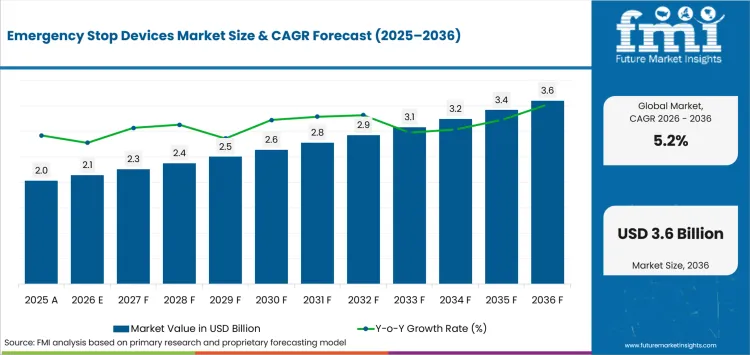
USD 2.1 billion in 2026 and USD 3.6 billion by 2036 at a 5.2% CAGR.
Sales in the emergency stop devices market is valued at USD 2.1 billion in 2026 and is forecast to reach USD 3.6 billion by 2036 at a 5.2% CAGR. Orders follow new machine builds and safety upgrades that require a deliberate stop command inside the wider machine safety architecture. IEC published IEC 60947-5-5:2026 on February 18, 2026, refreshing requirements for electrical emergency-stop control devices with mechanical latching.
Replacement demand also depends on the scale of installed automated equipment because each redesign or safety review can reopen actuator, wiring, and reset choices. The International Federation of Robotics counted 4,664,000 industrial robots in operational use worldwide during 2024 in its September 2025 data. The installed base does not measure emergency-stop revenue, but it enlarges the population of automated machinery that needs maintained safety switches and stop functions.
Key Takeaways
- Machine builders keep emergency-stop hardware in the base safety specification because risk assessments require an accessible manual stop path before commissioning.
- Based on device type, pushbutton e-stops are projected to account for 42.0% in 2026 due to their familiar manual actuation and broad panel fit.
- In 2026, twist release is expected to lead reset type with 45.0% share because it pairs latching with a deliberate manual reset action.
- By mounting, panel mount is forecast to represent 44.0% in 2026 driven by standardized cutouts and direct integration into machine operator stations.
- Retrofit work can slow purchasing because the actuator must fit existing safety circuits, restart logic, enclosure space, and the machine risk assessment.
- Some of the key players in this market include K.A. Schmersal GmbH & Co. KG, Pilz GmbH & Co. KG, EAO AG, LOVATO Electric S.p.A., Georg Schlegel GmbH & Co. KG, BERNSTEIN AG, Phoenix Contact GmbH & Co. KG, and SICK AG.
Analyst Perspective
"Emergency-stop selection should start with the required stop function and reset behavior, then test whether the device fits the machine's existing safety circuit and service routine. Commercial value is earned through familiar actuation, documented safety performance, and fast replacement that reduces validation work without weakening the wider machine-safety design."
- Nikhil Kaitwade, Principal Consultant, Future Market Insights
How is the emergency stop devices market segmented?
The emergency stop devices market is segmented by device type, reset type, mounting, end use, sales channel and region.
Market taxonomy covers device type, reset type, mounting, end use, sales channel, and region. Device types include pushbutton e-stops, rope pull switches, emergency stop stations, wireless e-stop devices, and illuminated e-stops. Reset types include twist release, key release, pull release, and guarded reset. Mounting covers panel mount, surface mount, DIN-rail interface, and portable pendant. End uses include factory automation, material handling, robotics, packaging machinery, and process industries. Sales channels include electrical distributors, automation distributors, direct OEM supply, and panel builders.
Why does factory automation lead demand within the end use category?
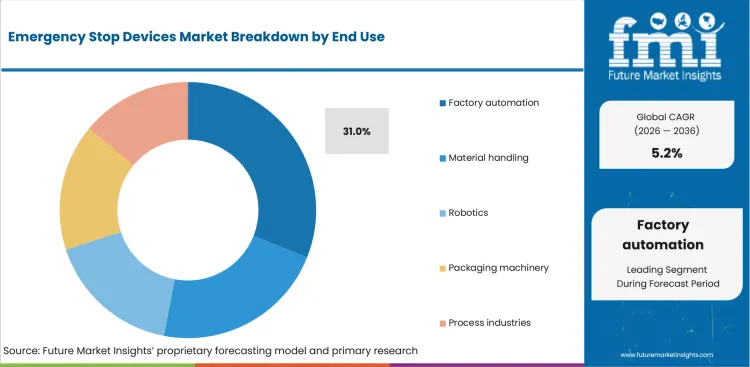
Factory automation concentrates motors, robots, conveyors, and guarded cells into systems that need several accessible stop points tied to one safety design. The requirement expands with industrial automation projects because each cell change can alter reach, access, and reset logic.
- Factory automation is set to lead the end use category with 31.0% share in 2026 due to dense machine layouts and frequent safeguarded access points.
- Pilz GmbH & Co. KG added PITgatebox IOLS to its IO-Link Safety system in October 2025, sending gate and operating status to the plant controller. The move gives automated cells faster fault location while keeping safety functions inside the machine control architecture.
Why do pushbutton e-stops lead demand within the device type category?
Pushbutton e-stops give operators a familiar mushroom-head interface at panels and stations where manual reach must be obvious during a hazard. Their value is strongest on machinery that needs a visible latching action without changing the surrounding safety interlock switches architecture.
- Based on device type, pushbutton e-stops are projected to account for 42.0% in 2026 due to familiar handling and standard panel integration.
- EAO AG launched its Series 46 EcoTouch line in November 2025 with 22 mm and 30 mm industrial controls that include emergency-stop switches. The launch extends a common panel format without forcing machine builders to redesign the entire operator station.
Why does twist release lead demand within the reset type category?
Reset choice determines what an operator must do after the hazard clears. Twist release requires an intentional rotary action, which fits restart procedures that separate emergency stopping from normal machine resumption.
- The twist release segment is likely to capture 45.0% share in 2026 attributable to the need for deliberate reset behavior after a latched emergency stop.
- Georg Schlegel GmbH & Co. KG expanded Shortron-connect in August 2026 with three M12 emergency-stop models that release by twisting left or right. Prewired M12 connection shortens installation while preserving the required manual reset action.
Why does panel mount lead demand within the mounting category?
Panel mount keeps the emergency-stop actuator at a fixed operator location and lets machine builders use familiar cutouts, enclosures, and wiring routes. It also fits standardized control cabinets that already carry safety limit switches and other machine-safety inputs.
- By mounting, panel mount is forecast to represent 44.0% in 2026 driven by standard cutouts and direct integration into operator panels.
- K.A. Schmersal GmbH & Co. KG introduced the BDF20 control panel in November 2025 with optional emergency stop and an M12 connection. The compact format gives machine builders a direct path to replace or add a panel-mounted stop point inside door-interlock systems.
What are the drivers, restraints and opportunities in the Emergency Stop Devices Market?
Automation investment increases specification volume, retrofit validation slows substitution, and connected safety controls give manufacturers a route to reduce wiring and fault-finding work.
- Driver: New automated cells require emergency-stop points that fit the machine risk assessment and safety-control architecture.
- Restraint: Legacy circuits and restart logic can turn a simple actuator replacement into a wider validation task.
- Opportunity: Configurable safety relays can monitor emergency-stop inputs with other safeguarded functions while keeping evidence for commissioning and maintenance.
Automation Expansion Keeps Emergency-Stop Functions in the Machine Specification
New automation projects specify emergency stopping before commissioning because each accessible operating position must fit the machine risk assessment and factory automation controls. The International Federation of Robotics recorded 542,000 industrial robot installations during 2024 in its September 2025 release. That volume does not equal emergency-stop sales, but it shows how many new automated assets entered factories with safety functions that must be designed and maintained.
Retrofit Validation Raises the Cost of a Simple Device Change
Retrofit projects become harder when older wiring, reset circuits, or guarding arrangements do not match a new actuator without engineering changes. OSHA renewed its manufacturing amputations emphasis program in June 2025 and directs inspections toward machine operation, servicing, maintenance, hazardous-energy control, and guarding. That enforcement focus keeps the emergency stop inside a larger safety function, so replacement choices must be validated against the machine rather than purchased as isolated hardware.
Connected Safety Components Reduce Wiring and Troubleshooting Work
Panel builders gain more value from an emergency-stop circuit when fault status can be diagnosed beside gates and other safeguards. LOVATO Electric S.p.A. introduced the SRC safety-relay series in June 2025 for emergency stops, access gates, interlocks, and related safety inputs. The relay does not replace the actuator, but it gives industrial ethernet projects a cleaner route to monitor several safety functions without duplicating control-cabinet hardware.
Which country CAGRs are profiled in the Emergency Stop Devices Market?
| Country | CAGR |
|---|---|
| Mexico | 6.0% |
| South Korea | 5.4% |
| Poland | 5.3% |
| Brazil | 5.2% |
| USA | 4.8% |
How do country-level CAGRs compare in the Emergency Stop Devices Market?
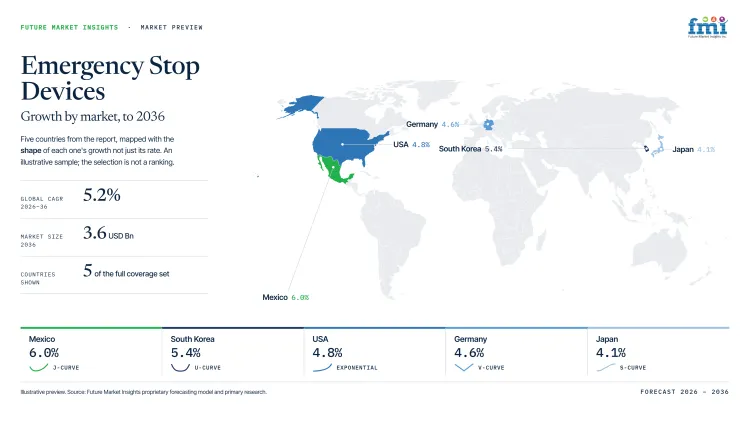
The forecasts span 1.2 percentage points, with Mexico at 6.0% and South Korea, Poland, and Brazil grouped between 5.2% and 5.4%. USA follows at 4.8%. The spacing points to different retrofit and automation cycles rather than a simple ranking of current market size.
- Mexico gains from export-plant replication that favors common operator-control footprints between production sites.
- South Korea compresses machine change cycles through dense electronics and automotive automation investment.
- Poland carries a large EU-oriented machinery base where retrofit fit can outweigh feature expansion.
- Brazil splits demand between new machinery and site-level remediation of older industrial equipment.
- USA demand leans more heavily on replacement depth and service continuity in installed machinery.
Comparable CAGRs can therefore produce different device mixes because automation density, retrofit depth, and distribution coverage vary by country. The full report provides country-level CAGR analysis North America, Latin America, Western Europe, Eastern Europe, East Asia, South Asia and Pacific, and the Middle East and Africa.
Country-wise Analysis
- Northern Mexican manufacturing plants frequently duplicate machinery platforms between export sites, so familiar 22 mm controls and local replacement availability reduce commissioning disruption. Mexico is projected to grow at 6.0% CAGR by 2036, propelled by a large export-manufacturing base that keeps machine-standardization work active. INEGI documented 5,211 manufacturing establishments in the IMMEX program for December 2025 in its February 2026 release. Local distributors can serve repeat plant builds, but imported specialty parts and cross-border lead times still penalize designs that depend on uncommon actuators or contact blocks.
- South Korean factories use dense automation in electronics and automotive production, which makes compact safety interfaces and fast diagnostics valuable during frequent line changes. The Ministry of SMEs and Startups announced support for 450 AI-based smart factory projects for 2026 in October 2025. Emergency stop device demand in South Korea is forecast to rise at 5.4% CAGR over the forecast period, tied to ongoing smart-manufacturing investment. Local engineering depth speeds integration, though suppliers still need Korean-language documentation and short service response because highly automated lines lose more production time when replacement components are delayed.
- Polish machinery plants serve domestic factories and wider European supply chains, so retrofit compatibility matters when older cabinets are upgraded without replacing complete lines. Poland is estimated to post 5.3% CAGR over the forecast period, given active machine-safety enforcement and continuing equipment modernization. In June 2026, Państwowa Inspekcja Pracy reported 214,100 occupational-safety decisions during 2025, including orders involving dangerous work and unsafe machinery. European component availability supports standard products, but projects slow when legacy wiring or machine documentation is incomplete. Vendors that can map replacements to existing circuits have a clearer route to recurring orders.
- Brazilian plants often mix newer automated cells with legacy machinery that has been kept in service for long periods, which makes retrofit scope uneven by facility. Local compliance work can require guarding, stopping, and hazardous-energy corrections before a simple control replacement is accepted. Brazil recorded 32,310 occupational safety and health inspection actions during 2025 in the Ministry of Labor and Employment 2025 management report. Emergency stop device sales in Brazil are forecast to expand at 5.2% CAGR by 2036, aided by ongoing enforcement and industrial modernization. The commercial opening is strongest for suppliers that pair standard components with practical application support for existing machines.
- US machine builders can source emergency-stop hardware through broad automation distribution, making replacement availability a stronger advantage than exotic feature depth in many plants. The International Federation of Robotics counted 38,000 industrial robot installations in the United States during 2025 in its June 2026 preliminary results. The USA emergency stop devices sector is positioned to record 4.8% CAGR over the assessment period because a large installed automation base sustains replacement and modification work. Mature distribution shortens routine replacements, though every line modification still has to preserve the safety circuit and documented restart behavior before production resumes.
Who are the notable companies in the Emergency Stop Devices Market?
K.A. Schmersal GmbH & Co. KG, Pilz GmbH & Co. KG, EAO AG, LOVATO Electric S.p.A., Georg Schlegel GmbH & Co. KG, BERNSTEIN AG, Phoenix Contact GmbH & Co. KG, and SICK AG.
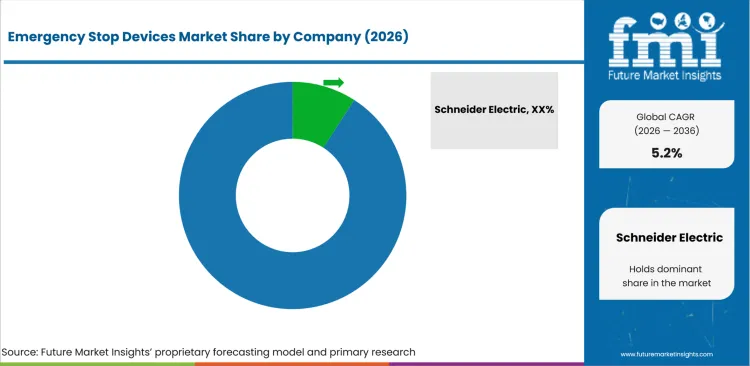
Competition divides between operator-control specialists, machine-safety firms, and automation groups that integrate the stop command with relays or controllers. Entry barriers come from standards evidence, tested contact architecture, application support, and service reach. The strongest positions therefore span direct emergency-stop hardware plus adjacent safety instrumentation systems rather than brand scale alone.
- K.A. Schmersal GmbH & Co. KG, Pilz GmbH & Co. KG, and SICK AG link emergency-stop functions with broader machine-safety control and diagnostics.
- EAO AG, Georg Schlegel GmbH & Co. KG, and BERNSTEIN AG concentrate more heavily on operator controls and dedicated safety-switching formats.
- LOVATO Electric S.p.A. and Phoenix Contact GmbH & Co. KG place emergency-stop monitoring inside wider control-cabinet and safety-relay portfolios.
Competitive Benchmarking: Emergency Stop Devices Market
| Company | Emergency-Stop Product Breadth | Machine-Safety Integration Depth | Diagnostic and Connectivity Depth | Geographic Reach |
|---|---|---|---|---|
| K.A. Schmersal GmbH & Co. KG | High | High | High | Global |
| Pilz GmbH & Co. KG | Medium | High | High | Global |
| EAO AG | High | Medium | Low | Global |
| LOVATO Electric S.p.A. | Medium | Medium | Low | Europe and international distribution |
| Georg Schlegel GmbH & Co. KG | Medium | Medium | Low | Europe and international sales |
| BERNSTEIN AG | High | High | Medium | Europe and international sales |
| Phoenix Contact GmbH & Co. KG | Medium | High | High | Global |
| SICK AG | Medium | High | High | Global |
Scoring basis: High product breadth requires multiple current emergency-stop formats, Medium requires one direct family plus adjacent operator controls, and Low indicates emergency-stop coverage mainly through monitoring. High integration requires system-level safety control or services, Medium requires direct relay or device integration, and Low reflects stand-alone hardware. High diagnostics requires current networked safety communication, Medium requires modular wired status functions, and Low reflects limited diagnostic depth.
Key Developments in the Emergency Stop Devices Market
- In November 2025, BERNSTEIN AG introduced the SLO electronic safety lock switch for its SMART Safety System, which can carry emergency-stop devices in the same daisy-chain architecture.
- In September 2025, EAO AG established EAO India Private Limited to shorten product availability and application support for machinery customers in the Indian market.
- In March 2025, K.A. Schmersal GmbH & Co. KG established Schmersal Korea Ltd. with local application engineering and machine-safety consulting in Seoul.
Key Players in the Emergency Stop Devices Market
Machine-Safety Systems and Controls
- K.A. Schmersal GmbH & Co. KG
- Pilz GmbH & Co. KG
- SICK AG
Operator-Control and Safety-Switch Specialists
- EAO AG
- Georg Schlegel GmbH & Co. KG
- BERNSTEIN AG
Control-Cabinet Safety Platforms
- LOVATO Electric S.p.A.
- Phoenix Contact GmbH & Co. KG
Emergency Stop Devices Market - Report Scope
| Coverage field | Report scope |
|---|---|
| Market breakdown | By device type, reset type, mounting, end use, sales channel and region. |
| Quantitative Units | USD billion. |
| Market Definition | Electrical emergency-stop command devices and related operator stations used to initiate a deliberate machine stop in industrial safety circuits. |
| Regions Covered | North America, Latin America, Western Europe, Eastern Europe, East Asia, South Asia and Pacific, and the Middle East and Africa. |
| Countries Covered | Mexico, South Korea, Poland, Brazil, USA, and 20+ countries included in the full report. |
| Key Companies Profiled | K.A. Schmersal GmbH & Co. KG, Pilz GmbH & Co. KG, EAO AG, LOVATO Electric S.p.A., Georg Schlegel GmbH & Co. KG, BERNSTEIN AG, Phoenix Contact GmbH & Co. KG, and SICK AG. |
| Forecast Period | 2026 to 2036. |
| Approach | Primary and secondary research with market triangulation. |
Emergency Stop Devices Market - Research Methodology
| Method | Approach |
|---|---|
| Primary Research | FMI analysts gathered input from manufacturers, service providers, technology developers, distributors, end users, procurement teams, and subject-matter experts. Interviews examined purchasing decisions, product or service evaluation, adoption barriers, approval requirements, pricing considerations, and expectations for technical or commercial support. Respondents were also asked what evidence is required before a trial, pilot, or initial order develops into regular purchasing. |
| Desk Research | Desk research covered government statistics, regulatory publications, trade data, industry associations, technical literature, standards, company filings, product information, and official corporate announcements. Sources were reviewed for relevance, publication date, geographic coverage, and consistency with the defined market scope. Claims relating to performance, applications, approvals, capacity, investment, and commercial activity were retained only when supported by credible public evidence. |
| Market Sizing and Forecasting | The market model combined the baseline value with historical performance, segment structure, pricing and volume indicators, adoption levels, company participation, and country-level demand conditions. Forecast assumptions considered economic activity, investment trends, regulatory developments, technology adoption, purchasing cycles, supply availability, and barriers to wider market use. Segment and regional estimates were reconciled before the final market total was calculated. |
| Data Validation | Estimates were checked against multiple independent indicators, including public data, company activity, trade patterns, industry developments, and findings from primary interviews. Validation also tested whether products, services, applications, and company revenues fell within the defined market boundaries. Adjacent categories, unsupported claims, overlapping revenues, and activities without direct market relevance were excluded to reduce double counting and maintain consistency across segments and countries. |
Emergency Stop Devices Market by Segments
Emergency Stop Devices Market segmented by Device Type:
- pushbutton e-stops
- rope pull switches
- emergency stop stations
- wireless e-stop devices
- illuminated e-stops
Emergency Stop Devices Market segmented by Reset Type:
- twist release
- key release
- pull release
- guarded reset
Emergency Stop Devices Market segmented by Mounting:
- panel mount
- surface mount
- DIN-rail interface
- portable pendant
Emergency Stop Devices Market segmented by End Use:
- factory automation
- material handling
- robotics
- packaging machinery
- process industries
Emergency Stop Devices Market segmented by Sales Channel:
- electrical distributors
- automation distributors
- direct OEM supply
- panel builders
Emergency Stop Devices Market by Region:
- North America
- USA
- Canada
- Latin America
- Brazil
- Mexico
- Argentina
- Chile
- Western Europe
- Germany
- France
- UK
- Italy
- Spain
- Benelux
- Nordics
- Eastern Europe
- Poland
- Czech Republic
- Romania
- Hungary
- East Asia
- China
- Japan
- South Korea
- South Asia and Pacific
- India
- ASEAN
- Australia and New Zealand
- Middle East and Africa
- GCC Countries
- South Africa
- Türkiye
- Israel
Research Sources and Bibliography
- International Electrotechnical Commission. (2026, February 18). IEC 60947-5-5:2026.
- International Federation of Robotics. (2025, September 25). World Robotics 2025 report - INDUSTRIAL ROBOTS - released by IFR: Global Robot Demand in Factories Doubles Over 10 Years.
- Occupational Safety and Health Administration. (2025, June 26). US Department of Labor renews national emphasis program to address amputations in manufacturing.
- EAO AG. (2025, November 27). New - EAO's Series 46 EcoTouch switches, pendant controllers and signal light towers.
- Georg Schlegel GmbH & Co. KG. (2026, August 13). New emergency-stops with M12 connection.
- K.A. Schmersal GmbH & Co. KG. (2025, November 25). Individual combination options: The new BDF20 control panel from Schmersal.
- Pilz GmbH & Co. KG. (2025, October 28). Control unit PITgatebox from Pilz now with IO-Link Safety connection - Greater efficiency and safety for safety gate systems.
- LOVATO Electric S.p.A. (2025, June 11). The new SRC series safety relays from LOVATO Electric.
- Instituto Nacional de Estadística y Geografía. (2026, February 23). Estadística del Programa de la Industria Manufacturera, Maquiladora y de Servicios de Exportación 2025, Datos al mes de diciembre.
- Ministry of SMEs and Startups, Republic of Korea. (2025, October 30). ‘26년도 지능형(스마트)제조혁신 지원사업 통합공고 실시.
- Państwowa Inspekcja Pracy. (2026, June 23). Inspekcja Pracy podsumowała 2025 rok.
- Ministério do Trabalho e Emprego. (2026). Relatório de Gestão Integrado 2025.
- International Federation of Robotics. (2026, June 18). US Robot Industry Returns to Double Digit Growth.
- BERNSTEIN AG. (2026, January 7). New electronic safety lock switch SLO.
- EAO AG. (2025, October 14). Foundation of EAO India Private Limited - a new Member of the EAO Group.
- K.A. Schmersal GmbH & Co. KG. (2025, March 20). Schmersal Group expands presence in Asia.
- Phoenix Contact GmbH & Co. KG. (2025, April 22). Multifunctional safety relays: two protective functions in one device.
- Pilz GmbH & Co. KG. (2025, April 29). Safety relay myPNOZ - Expanded function range with five new modules.
- Pilz GmbH & Co. KG. (2026, June 16). Machinery Regulation: Small controller PNOZmulti 2 now compliant.
- BERNSTEIN AG. (2026, January 12). More application flexibility.
- LOVATO Electric S.p.A. (2025, January 22). Control stations type LP4.
- EAO AG. (2026, April 16). EAO Launches Sealed, Ruggedized Pendant Control Stations.
- SICK AG. (2026, May 7). Flexi Compact FLX3-CPUC200, Data sheet.
- K.A. Schmersal GmbH & Co. KG. (2026, April 28). SRB201LC operating instructions and EU Declaration of conformity.
This bibliography is provided for reader reference and is not exhaustive. The full report contains the complete reference list and detailed citations.
This Report Answers
- What is the emergency stop devices market size in 2026 and what value is forecast for 2036?
- Which machine-safety and automation conditions support demand for emergency stop devices?
- Why do pushbutton e-stops hold the leading position within device type?
- Why does twist release lead reset type and panel mount lead mounting?
- How do country growth rates differ between Mexico, South Korea, Poland, Brazil, and USA?
- Which companies compete most directly in emergency stop devices and related machine-safety systems?
- Which retrofit conditions can delay emergency-stop device replacement?
- What should machine builders assess before approving an emergency-stop configuration?
Frequently Asked Questions
How big is the emergency stop devices market in 2026?
The emergency stop devices market is valued at USD 2.1 billion in 2026 and is projected to reach USD 3.6 billion by 2036. Growth follows automation projects and machine-safety upgrades that require accessible emergency stopping.
What is the CAGR of the emergency stop devices market from 2026 to 2036?
The emergency stop devices market is projected to grow at a CAGR of 5.2% between 2026 and 2036. Expansion is tied to new automated equipment, retrofit programs, and replacement demand within installed machinery.
Which device type leads the emergency stop devices market?
The pushbutton e-stops segment is expected to hold 42.0% of the emergency stop devices market in 2026, driven by familiar manual actuation and standard panel fit. Its format suits both new machines and replacement work.
Which reset type holds the largest share in the emergency stop devices market?
The twist release segment is expected to hold 45.0% of the emergency stop devices market in 2026, attributable to deliberate reset behavior after latching. The format separates emergency stopping from normal restart actions.
How much value will the emergency stop devices market add between 2026 and 2036?
The emergency stop devices market is expected to add USD 1.5 billion in value between 2026 and 2036. New machine builds and replacement cycles expand spending while retrofit validation can slow individual projects.
Which countries are projected to record the highest growth in the emergency stop devices market?
Mexico is projected to grow at 6.0% CAGR, followed by South Korea at 5.4% and Poland at 5.3% through 2036. The three markets differ in export manufacturing, smart-factory investment, and machinery retrofit conditions.
Which companies are active in the emergency stop devices market?
Key companies operating in the market include K.A. Schmersal GmbH & Co. KG, Pilz GmbH & Co. KG, EAO AG, LOVATO Electric S.p.A., Georg Schlegel GmbH & Co. KG, BERNSTEIN AG, Phoenix Contact GmbH & Co. KG, and SICK AG. These companies compete through emergency-stop breadth, machine-safety integration, diagnostics, and regional application support.
Preview the report firsthand - request a free sample
Get SampleGet the brochure for pricing and purchase details.
Get PDFTable of Content
- Key Takeaways
- Market Size and CAGR
- Top Growth Driver
- Fastest Growing Segment
- Leading Region
- Key Companies
- Emerging Opportunities
- Executive Summary
- Global Market Outlook
- Demand-side Trends
- Supply-side Trends
- Technology Roadmap Analysis
- Analysis and Recommendations
- Analyst Perspective (What is happening? Why now? What should investors know?)
- Key Questions Answered
- How large is the market?
- What is the CAGR?
- What are key trends?
- Which region dominates?
- Who are the leaders?
- Market Overview
- Market Coverage / Taxonomy
- Market Definition / Scope / Limitations
- Research Methodology
- Chapter Orientation
- Analytical Lens and Working Hypotheses
- Market Structure, Signals, and Trend Drivers
- Benchmarking and Cross-market Comparability
- Market Sizing, Forecasting, and Opportunity Mapping
- Research Design and Evidence Framework
- Desk Research Programme (Secondary Evidence)
- Expert Input and Fieldwork (Primary Evidence)
- Tooling, Models, and Reference Databases
- Data Engineering and Model Build
- Quality Assurance and Audit Trail
- Market Background
- Market Dynamics (Drivers, Restraints, Opportunity, Trends)
- Scenario Forecast (Optimistic, Likely, Conservative)
- Impact Analysis
- AI Impact
- Sustainability Impact
- Regulatory Impact
- Technology Impact
- Consumer / Buyer Analysis
- Purchase Drivers
- Adoption Barriers
- Buyer Journey
- Opportunity Map Analysis
- Product Life Cycle Analysis
- Supply Chain Analysis
- Investment Feasibility Matrix
- Value Chain Analysis
- PESTLE and Porter's Analysis
- Regulatory Landscape
- Regional Parent Market Outlook
- Production and Consumption Statistics
- Import and Export Statistics
- Global Market Analysis and Forecast, 2021 to 2036
- Historical Market Size Value (USD Billion) Analysis, 2021 to 2025
- Current and Future Market Size Value (USD Billion) Projections, 2026 to 2036
- Y-o-Y Growth Trend Analysis
- Absolute $ Opportunity Analysis
- Global Market Pricing Analysis, 2021 to 2036
- Global Market Analysis and Forecast, By Device Type, 2021 to 2036
- Introduction / Key Findings
- Historical Market Size Value (USD Billion) Analysis By Device Type, 2021 to 2025
- Current and Future Market Size Value (USD Billion) Analysis and Forecast By Device Type, 2026 to 2036
- Pushbutton E-stops
- Rope pull switches
- Emergency stop stations
- Wireless E-stop devices
- Illuminated E-stops
- Pushbutton E-stops
- Y-o-Y Growth Trend Analysis By Device Type, 2021 to 2025
- Absolute $ Opportunity Analysis By Device Type, 2026 to 2036
- Global Market Analysis and Forecast, By Reset Type, 2021 to 2036
- Introduction / Key Findings
- Historical Market Size Value (USD Billion) Analysis By Reset Type, 2021 to 2025
- Current and Future Market Size Value (USD Billion) Analysis and Forecast By Reset Type, 2026 to 2036
- Twist release
- Key release
- Pull release
- Guarded reset
- Twist release
- Y-o-Y Growth Trend Analysis By Reset Type, 2021 to 2025
- Absolute $ Opportunity Analysis By Reset Type, 2026 to 2036
- Global Market Analysis and Forecast, By Mounting, 2021 to 2036
- Introduction / Key Findings
- Historical Market Size Value (USD Billion) Analysis By Mounting, 2021 to 2025
- Current and Future Market Size Value (USD Billion) Analysis and Forecast By Mounting, 2026 to 2036
- Panel mount
- Surface mount
- DIN-rail interface
- Portable pendant
- Panel mount
- Y-o-Y Growth Trend Analysis By Mounting, 2021 to 2025
- Absolute $ Opportunity Analysis By Mounting, 2026 to 2036
- Global Market Analysis and Forecast, By End Use, 2021 to 2036
- Introduction / Key Findings
- Historical Market Size Value (USD Billion) Analysis By End Use, 2021 to 2025
- Current and Future Market Size Value (USD Billion) Analysis and Forecast By End Use, 2026 to 2036
- Factory automation
- Material handling
- Robotics
- Packaging machinery
- Process industries
- Factory automation
- Y-o-Y Growth Trend Analysis By End Use, 2021 to 2025
- Absolute $ Opportunity Analysis By End Use, 2026 to 2036
- Global Market Analysis and Forecast, By Sales Channel, 2021 to 2036
- Introduction / Key Findings
- Historical Market Size Value (USD Billion) Analysis By Sales Channel, 2021 to 2025
- Current and Future Market Size Value (USD Billion) Analysis and Forecast By Sales Channel, 2026 to 2036
- Electrical distributors
- Automation distributors
- Direct OEM supply
- Panel builders
- Electrical distributors
- Y-o-Y Growth Trend Analysis By Sales Channel, 2021 to 2025
- Absolute $ Opportunity Analysis By Sales Channel, 2026 to 2036
- Global Market Analysis and Forecast, By Region, 2021 to 2036
- Introduction
- Historical Market Size Value (USD Billion) Analysis By Region, 2021 to 2025
- Current Market Size Value (USD Billion) Analysis and Forecast By Region, 2026 to 2036
- North America
- Latin America
- Western Europe
- Eastern Europe
- East Asia
- South Asia and Pacific
- Middle East & Africa
- Market Attractiveness Analysis By Region
- North America Market Analysis and Forecast, By Country, 2021 to 2036
- Historical Market Size Value (USD Billion) Trend Analysis By Market Taxonomy, 2021 to 2025
- Market Size Value (USD Billion) Forecast By Market Taxonomy, 2026 to 2036
- By Country
- USA
- Canada
- By Device Type
- By Reset Type
- By Mounting
- By End Use
- By Sales Channel
- By Country
- Market Attractiveness Analysis
- By Country
- By Device Type
- By Reset Type
- By Mounting
- By End Use
- By Sales Channel
- Key Takeaways
- Latin America Market Analysis and Forecast, By Country
- Historical Market Size Value (USD Billion) Trend Analysis By Market Taxonomy, 2021 to 2025
- Market Size Value (USD Billion) Forecast By Market Taxonomy, 2026 to 2036
- By Country
- Brazil
- Mexico
- Chile
- Rest of Latin America
- By Device Type
- By Reset Type
- By Mounting
- By End Use
- By Sales Channel
- By Country
- Market Attractiveness Analysis
- By Country
- By Device Type
- By Reset Type
- By Mounting
- By End Use
- By Sales Channel
- Key Takeaways
- Western Europe Market Analysis and Forecast, By Country
- Historical Market Size Value (USD Billion) Trend Analysis By Market Taxonomy, 2021 to 2025
- Market Size Value (USD Billion) Forecast By Market Taxonomy, 2026 to 2036
- By Country
- Germany
- UK
- Italy
- Spain
- France
- Nordic
- BENELUX
- Rest of Western Europe
- By Device Type
- By Reset Type
- By Mounting
- By End Use
- By Sales Channel
- By Country
- Market Attractiveness Analysis
- By Country
- By Device Type
- By Reset Type
- By Mounting
- By End Use
- By Sales Channel
- Key Takeaways
- Eastern Europe Market Analysis and Forecast, By Country
- Historical Market Size Value (USD Billion) Trend Analysis By Market Taxonomy, 2021 to 2025
- Market Size Value (USD Billion) Forecast By Market Taxonomy, 2026 to 2036
- By Country
- Russia
- Poland
- Hungary
- Balkan & Baltic
- Rest of Eastern Europe
- By Device Type
- By Reset Type
- By Mounting
- By End Use
- By Sales Channel
- By Country
- Market Attractiveness Analysis
- By Country
- By Device Type
- By Reset Type
- By Mounting
- By End Use
- By Sales Channel
- Key Takeaways
- East Asia Market Analysis and Forecast, By Country
- Historical Market Size Value (USD Billion) Trend Analysis By Market Taxonomy, 2021 to 2025
- Market Size Value (USD Billion) Forecast By Market Taxonomy, 2026 to 2036
- By Country
- China
- Japan
- South Korea
- By Device Type
- By Reset Type
- By Mounting
- By End Use
- By Sales Channel
- By Country
- Market Attractiveness Analysis
- By Country
- By Device Type
- By Reset Type
- By Mounting
- By End Use
- By Sales Channel
- Key Takeaways
- South Asia and Pacific Market Analysis and Forecast, By Country
- Historical Market Size Value (USD Billion) Trend Analysis By Market Taxonomy, 2021 to 2025
- Market Size Value (USD Billion) Forecast By Market Taxonomy, 2026 to 2036
- By Country
- India
- ASEAN
- Australia & New Zealand
- Rest of South Asia and Pacific
- By Device Type
- By Reset Type
- By Mounting
- By End Use
- By Sales Channel
- By Country
- Market Attractiveness Analysis
- By Country
- By Device Type
- By Reset Type
- By Mounting
- By End Use
- By Sales Channel
- Key Takeaways
- Middle East & Africa Market Analysis and Forecast, By Country
- Historical Market Size Value (USD Billion) Trend Analysis By Market Taxonomy, 2021 to 2025
- Market Size Value (USD Billion) Forecast By Market Taxonomy, 2026 to 2036
- By Country
- Kingdom of Saudi Arabia
- Other GCC Countries
- Türkiye
- South Africa
- Other African Union
- Rest of Middle East & Africa
- By Device Type
- By Reset Type
- By Mounting
- By End Use
- By Sales Channel
- By Country
- Market Attractiveness Analysis
- By Country
- By Device Type
- By Reset Type
- By Mounting
- By End Use
- By Sales Channel
- Key Takeaways
- Key Countries Market Analysis
- USA
- Pricing Analysis
- Market Share Analysis, 2025
- By Device Type
- By Reset Type
- By Mounting
- By End Use
- By Sales Channel
- Canada
- Pricing Analysis
- Market Share Analysis, 2025
- By Device Type
- By Reset Type
- By Mounting
- By End Use
- By Sales Channel
- Mexico
- Pricing Analysis
- Market Share Analysis, 2025
- By Device Type
- By Reset Type
- By Mounting
- By End Use
- By Sales Channel
- Brazil
- Pricing Analysis
- Market Share Analysis, 2025
- By Device Type
- By Reset Type
- By Mounting
- By End Use
- By Sales Channel
- Chile
- Pricing Analysis
- Market Share Analysis, 2025
- By Device Type
- By Reset Type
- By Mounting
- By End Use
- By Sales Channel
- Germany
- Pricing Analysis
- Market Share Analysis, 2025
- By Device Type
- By Reset Type
- By Mounting
- By End Use
- By Sales Channel
- UK
- Pricing Analysis
- Market Share Analysis, 2025
- By Device Type
- By Reset Type
- By Mounting
- By End Use
- By Sales Channel
- Italy
- Pricing Analysis
- Market Share Analysis, 2025
- By Device Type
- By Reset Type
- By Mounting
- By End Use
- By Sales Channel
- Spain
- Pricing Analysis
- Market Share Analysis, 2025
- By Device Type
- By Reset Type
- By Mounting
- By End Use
- By Sales Channel
- France
- Pricing Analysis
- Market Share Analysis, 2025
- By Device Type
- By Reset Type
- By Mounting
- By End Use
- By Sales Channel
- India
- Pricing Analysis
- Market Share Analysis, 2025
- By Device Type
- By Reset Type
- By Mounting
- By End Use
- By Sales Channel
- ASEAN
- Pricing Analysis
- Market Share Analysis, 2025
- By Device Type
- By Reset Type
- By Mounting
- By End Use
- By Sales Channel
- Australia & New Zealand
- Pricing Analysis
- Market Share Analysis, 2025
- By Device Type
- By Reset Type
- By Mounting
- By End Use
- By Sales Channel
- China
- Pricing Analysis
- Market Share Analysis, 2025
- By Device Type
- By Reset Type
- By Mounting
- By End Use
- By Sales Channel
- Japan
- Pricing Analysis
- Market Share Analysis, 2025
- By Device Type
- By Reset Type
- By Mounting
- By End Use
- By Sales Channel
- South Korea
- Pricing Analysis
- Market Share Analysis, 2025
- By Device Type
- By Reset Type
- By Mounting
- By End Use
- By Sales Channel
- Russia
- Pricing Analysis
- Market Share Analysis, 2025
- By Device Type
- By Reset Type
- By Mounting
- By End Use
- By Sales Channel
- Poland
- Pricing Analysis
- Market Share Analysis, 2025
- By Device Type
- By Reset Type
- By Mounting
- By End Use
- By Sales Channel
- Hungary
- Pricing Analysis
- Market Share Analysis, 2025
- By Device Type
- By Reset Type
- By Mounting
- By End Use
- By Sales Channel
- Kingdom of Saudi Arabia
- Pricing Analysis
- Market Share Analysis, 2025
- By Device Type
- By Reset Type
- By Mounting
- By End Use
- By Sales Channel
- Türkiye
- Pricing Analysis
- Market Share Analysis, 2025
- By Device Type
- By Reset Type
- By Mounting
- By End Use
- By Sales Channel
- South Africa
- Pricing Analysis
- Market Share Analysis, 2025
- By Device Type
- By Reset Type
- By Mounting
- By End Use
- By Sales Channel
- USA
- Market Structure Analysis
- Competition Dashboard
- Competition Benchmarking
- Market Share Analysis of Top Players
- By Regional
- By Device Type
- By Reset Type
- By Mounting
- By End Use
- By Sales Channel
- Emerging Startups
- Innovation Benchmarking
- Competition Analysis
- Competition Deep Dive
- Schneider Electric
- Overview
- Product Portfolio
- Profitability by Market Segments
- Sales Footprint
- Strategy Overview
- Marketing Strategy
- Product Strategy
- Channel Strategy
- Siemens
- ABB
- Rockwell Automation
- Eaton
- Omron
- IDEC
- Banner Engineering
- Pilz
- SICK
- Schneider Electric
- Case Studies
- Success Stories
- Recent Developments
- Competition Deep Dive
- Assumptions & Acronyms Used


