

- Market Size (2026)
- USD 132.0 Mn
- Forecast (2036)
- USD 489.2 Mn
- CAGR (2026 to 2036)
- 14.0%
Battery-Powered Concrete Cut-Off Machines Market Size, Market Forecast and Outlook By FMI
USD 132.0 million in 2026 and USD 489.2 million by 2036 at a 14.0% CAGR.
The battery-powered concrete cut-off machines market was valued at USD 115.8 million in 2025. It is expected to reach USD 132.0 million in 2026 and USD 489.2 million by 2036. The market is projected to expand at 14.0% CAGR from 2026 to 2036. The 14 Inch blade size is projected to account for 52.8% share in 2026, while Dual Battery machines are estimated to represent 57.4% share in the same year.
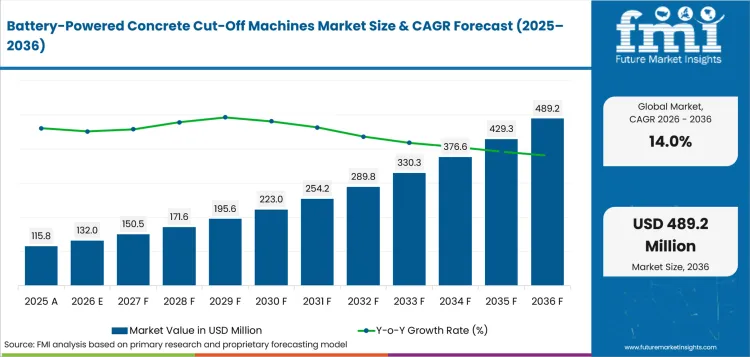
Battery-Powered Concrete Cut-Off Machines Market Overview: Size and Forecast
- 2026 Market Size: USD 132.0 million
- 2036 Market Size: USD 489.2 million
- Forecast CAGR: 14.0% from 2026 to 2036
- Leading Blade Size: 14 Inch
- 14 Inch Share in 2026: 52.8%
- Leading Battery Architecture: Dual Battery
- Dual Battery Share in 2026: 57.4%
- Fastest-growing Country: India
- India CAGR: 16.3% by 2036
Summary of the battery-powered concrete cut-off machines market
- Demand and Growth Drivers
- The market is projected to rise from USD 132.0 million in 2026 to USD 489.2 million by 2036 as job sites reduce petrol tool use indoors.
- India is expected to lead country growth at 16.3% CAGR as concrete repair and infrastructure work widen the buyer pool.
- The United States is projected to grow at 13.5% CAGR with silica compliance and rental fleet trials supporting cordless cutting.
- South Korea is forecast at 14.8% CAGR as construction orders and industrial job-site safety needs lift premium cordless tools.
- Product and Segment View
- The 14 Inch segment is projected to lead Blade Size with 52.8% share in 2026 as contractors need full-depth slab and curb cuts.
- Dual Battery machines are estimated to lead Battery Architecture with 57.4% share in 2026 with stronger output under wet-cutting loads.
- Handheld machines are expected to represent 81.6% share in 2026 since most work remains repair-driven and mobile.
- Construction is projected to account for 62.5% share in 2026 with concrete cutting centered on renovation and utility work.
- Dealer Sales are expected to hold 46.2% share in 2026 as tool demos and service support affect final brand choice.
- Geography and Competitive Outlook
- The United States and India form the two largest growth references with 13.5% and 16.3% projected country CAGRs.
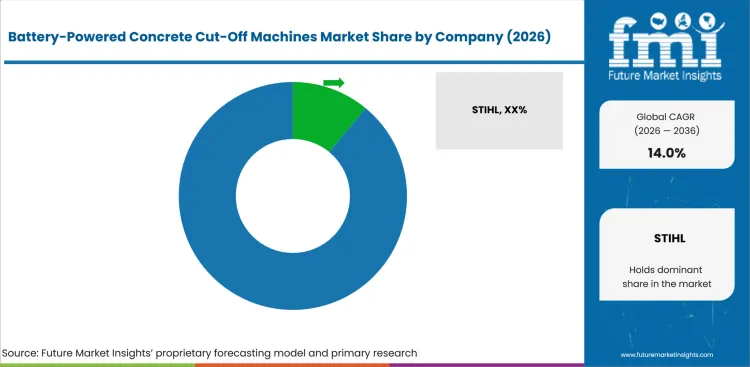
- STIHL is estimated to lead supplier share at 17.0% in 2026 with its TSA range and AP battery platform.
- Husqvarna Construction and Hilti compete on heavy concrete duty through 14-inch systems and dust-control fit.
- Milwaukee Tool and Makita use high-voltage battery platforms to target contractors already invested in cordless job-site equipment.
- Evolution Power Tools and DEWALT hold specialist positions in lighter cuts and price-sensitive cordless concrete applications.
- Analyst Opinion
- Nikhil Kaitwade, Principal Consultant at FMI says, “I see battery-powered cut-off machines as a fleet-change question first and a tool-change question second. Contractors are not buying these saws only to cut concrete. They are trying to remove petrol starts, reduce indoor exhaust, and keep silica controls easier to manage on small repair jobs. The commercial advantage goes to suppliers that prove three things in the field: blade speed under load, water-feed reliability, and battery availability across the wider tool fleet. Rental firms will watch abuse tolerance and service cost before they scale purchases. Contractors will watch whether a battery saw finishes the task without a second setup. The next five years will reward companies that sell a complete cutting system rather than a bare tool.”
Battery cut-off tools are moving from convenience substitutes into jobsite cutting systems because contractors now judge cordless platforms by depth, duty cycle and dust-control readiness. In June 2026, the U.S. Census Bureau estimated April 2026 construction spending at a seasonally adjusted annual rate of USD 2,172.4 billion. It also placed public highway construction at USD 149.6 billion, which ties cordless saw demand to roadwork and hardscape jobs where crews move between cuts. STIHL’s 2026 TSA 500 listing shows the professional step up because the 14-inch AP-system cutter uses two AP batteries, reaches 4.2 kW of mechanical output and runs 20 to 40 minutes with AP 500 S batteries.
Hilti’s DSH 900-22 adds depth and safety proof with 6-inch concrete cuts, 3D Active Torque Control that stops the tool within 1 second and a blade brake under 4 seconds. Makita’s January 2026 Power Cutter Cart for the GEC01 supports longer floor-cutting runs with its 80V max XGT 14-inch power cutter. Buyer preference is therefore shifting toward platforms that combine gas-class cut depth with lower maintenance, indoor-use flexibility and accessory systems that make cordless cutting viable across concrete saw and professional power-tool fleets.
What supports value in the battery-powered concrete cut-off machines market?
- 14-inch cordless depth is expected to raise unit value as buyers pay for deeper cuts and water-feed compatibility.
- Dual Battery systems are expected to lift kit value through higher output and lower mid-cut speed loss.
- Repair crews are expected to widen the buyer pool by using handheld saws across interiors and outdoor sites.
- Rental fleets are projected to add application volume as cordless saws reduce fuel handling and simplify user training.
- Battery kit cost remains the trade-off when small contractors compare full systems against petrol saws.
Why is the Battery-Powered Concrete Cut-Off Machines Market Growing?
- Indoor concrete cutting is shifting toward battery tools since exhaust control and start-stop work favor cordless machines.
- Silica dust rules support wet cutting and on-tool controls as buyers compare saw packages with water-feed systems.
- High-voltage battery packs are improving cutting duty cycles which means contractors can finish more repair cuts per charge.
- Rental fleets are testing cordless cut-off saws as training and maintenance costs differ from petrol saw operations.
- Rescue services are using battery machines in smoke and enclosed spaces where fuel exhaust creates operational risk.
Silica control is one of the clearest forces behind this market. The United Kingdom Health and Safety Executive updated construction dust guidance in November 2024 and named handheld cut-off saws with water suppression as a control method for paving blocks and kerbs. This guidance puts tool design inside the compliance discussion instead of treating dust control as a separate add-on. A battery saw with water feed and easier start-stop control gives contractors a cleaner way to manage short cuts. That supports replacement demand in renovation, utility repair, and interior concrete work. Battery power has moved closer to petrol saw duty on premium tools. Hilti states that its DSH 900-22 battery cut-off saw cuts up to 6 inches in concrete with a 14-inch blade, while its Active Torque Control stops the tool within one second after certain kickback events. That specification changes how buyers view cordless equipment for deeper concrete cutting. The machine is no longer positioned only for light trimming. Suppliers that combine depth, brake response, and dust-control accessories are expected to gain share in contractor and rental fleets.
How is the battery-powered concrete cut-off machines market segmented?
- With an estimated 52.8% share in 2026, 14 Inch machines are expected to lead Blade Size as buyers need full-depth cuts in slabs and curbs.
- Dual Battery systems are projected to account for 57.4% of Battery Architecture in 2026 with stronger output under wet-cutting load.
- Handheld formats are anticipated to represent 81.6% of Machine Format in 2026 as most contractors cut in tight repair zones.
- Construction buyers are expected to push Construction end use to 62.5% share in 2026 given the volume of repair and utility work.
- Dealer Sales are projected at 46.2% share in 2026 as demonstrations and blade advice shape purchases.
Segmentation in this market follows the way contractors actually specify the tool. A buyer first asks whether the saw will cut deep enough and then checks battery runtime under wet cutting. Evolution Power Tools reported in July 2025 that its EvoMax blade cut up to 60% faster and lasted four times longer than a general-purpose diamond blade on its cordless disc cutter. That claim shows why stone cutting saw blades and machine selection are linked in practice. Battery saw demand is therefore shaped by tool output and blade efficiency together.
Why do 14 Inch machines lead the battery-powered concrete cut-off machines market?
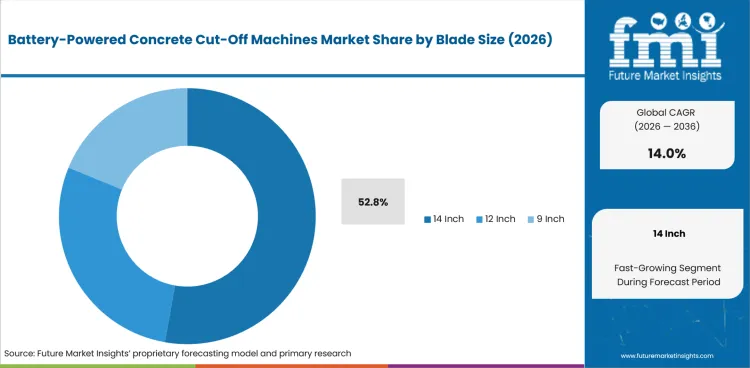
- The 14 Inch segment is projected to account for 52.8% of Blade Size demand in 2026 as deeper slab cuts make smaller wheels less useful for serious site work.
- Contractors buying 14-inch machines often test blade wear before saw comfort. This makes premium sawing and cutting tools part of the machine choice.
Which battery architecture leads the battery-powered concrete cut-off machines market?
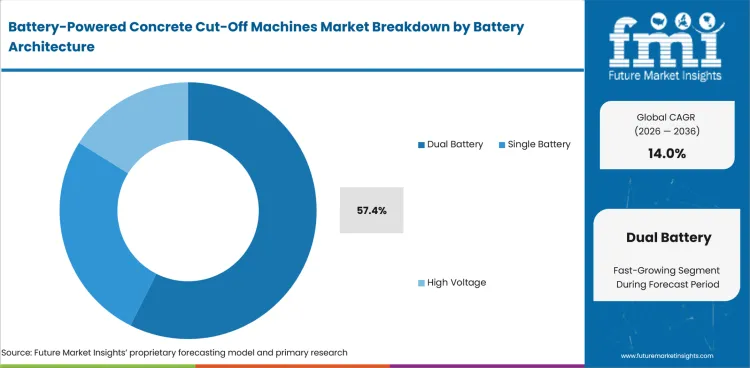
- Dual Battery machines are estimated to represent 57.4% of Battery Architecture demand in 2026 since higher combined pack output supports concrete cutting without petrol fuel.
- STIHL lists up to 40 minutes of TSA 500 runtime with two AP 500 S batteries. That changes buyer focus from peak power to useful work time.
Which machine format leads the battery-powered concrete cut-off machines market?
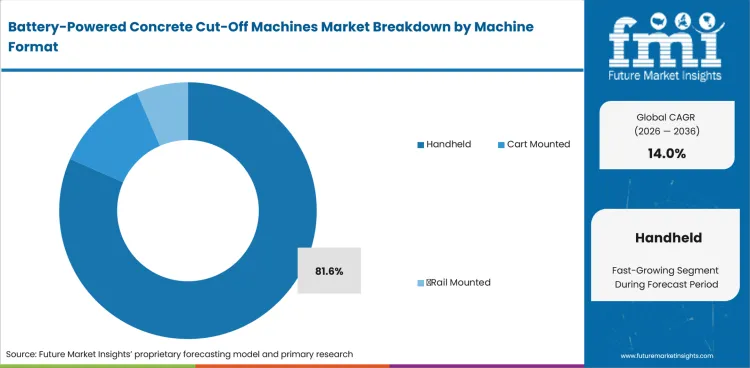
- Handheld machines are anticipated to hold 81.6% of Machine Format revenue in 2026 as repair crews need a saw that moves across stairs, roofs, and utility trenches.
- Rail Mounted demand stays smaller but technically valuable. Husqvarna lists the K 1 PACE Rail as a battery rail cutter with a 356 mm blade and 133 mm cutting depth.
Which end use leads the battery-powered concrete cut-off machines market?
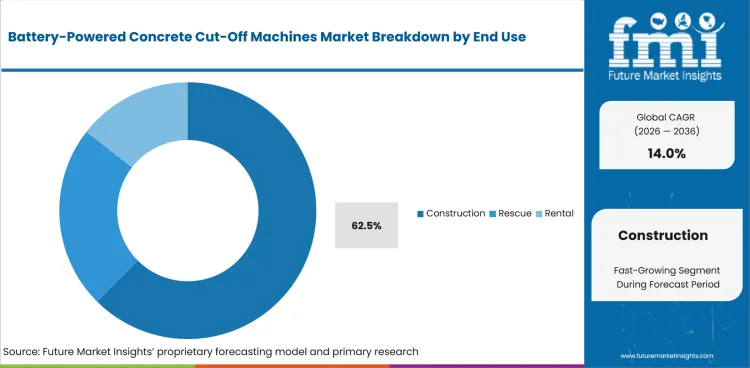
- Construction is expected to account for 62.5% of End Use demand in 2026 as renovation, road-edge repair, and utility trench work drive repeated concrete cuts.
- Rescue and rail users value battery tools for specific duty cycles. Husqvarna’s K 1 PACE Rescue uses a magnesium blade guard that improves visibility in smoke and water spray.
Which sales channel leads the battery-powered concrete cut-off machines market?
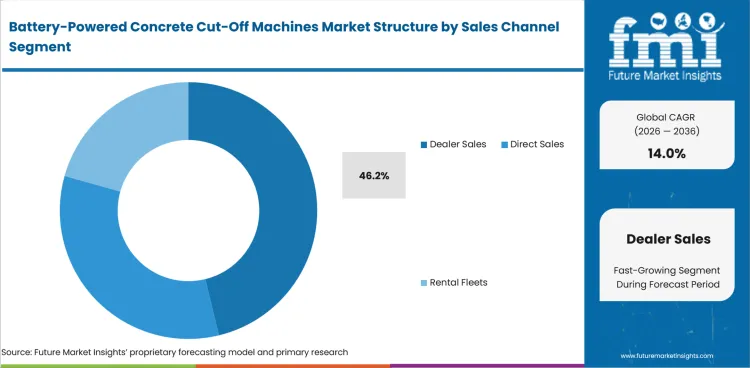
- Dealer Sales are projected to represent 46.2% of channel revenue in 2026 as contractors compare blades, batteries, carts, and water kits before buying.
- Rental fleets test abuse tolerance before bulk orders. This makes service records and construction fleet software relevant to battery saw rollouts.
Which countries are growing fastest in the battery-powered concrete cut-off machines market?
India reaches 16.3% CAGR followed by South Korea at 14.8% through 2036.
.webp "Top Country Growth Comparison Battery Powered Concrete Cut Off Machines Market Cagr (2026 2036)")
| Country | CAGR |
|---|---|
| India | 16.3% |
| South Korea | 14.8% |
| United States | 13.5% |
| United Kingdom | 12.6% |
| Germany | 12.2% |
| France | 11.8% |
| China | 11.0% |
| Japan | 10.9% |
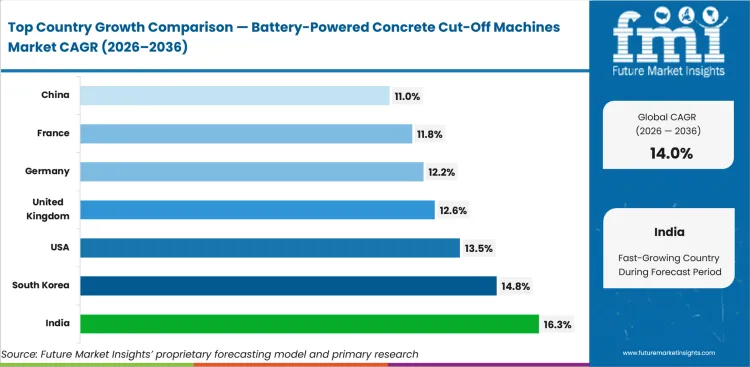
Source: Future Market Insights, 2026.
How do country-level CAGRs compare in the battery-powered concrete cut-off machines market?
India leads country growth while Japan records the most cautious expansion outlook among profiled markets.
- India is expected to record 16.3% CAGR by 2036 as infrastructure work widens the contractor buyer base.
- South Korea is projected to expand at 14.8% CAGR through 2036 because dense job sites favor low-exhaust tools.
- The United States is forecast to grow at 13.5% CAGR by 2036 with rental trials and silica controls supporting adoption.
- The United Kingdom is anticipated to rise at 12.6% CAGR through 2036 due to hire-channel testing and dust-control guidance.
- Germany is projected to post 12.2% CAGR by 2036 as premium dealers support high-voltage cordless systems.
- France is estimated to grow at 11.8% CAGR by 2036 with urban repair and rental validation shaping demand.
- China is forecast to expand at 11.0% CAGR through 2036 as local suppliers and imported brands compete across price tiers.
- Japan is expected to advance at 10.9% CAGR by 2036 as compact urban sites support selective cordless tool adoption.
How fast is the battery-powered concrete cut-off machines market growing in India?
A 16.3% CAGR through 2036 reflects infrastructure work and faster contractor tool modernization.
Country Market Snapshot Table
| Parameter | Value |
|---|---|
| Market Size in 2025 (Value) | USD 6.9 million |
| Market Size in 2026 (Value) | USD 8.0 million |
| Market Forecast in 2036 (Value) | USD 36.2 million |
| CAGR (2026 to 2036) | 16.3% |
| Years Considered | 2021 to 2036 |
| Base Year | 2025 |
| Forecast Period | 2026 to 2036 |
| Units Considered | Value (USD million) |
| Leading Sub-Region | Maharashtra and National Capital Region contractor corridors |
India Battery-Powered Concrete Cut-Off Machines Market Outlook
India demand is shaped by infrastructure work and a gradual shift from corded tools to portable cordless systems. Dealer support remains important because contractors want service access before adopting premium battery kits.
Battery-powered concrete cut-off machines are expected to gain first in metro works and indoor renovation. Wider adoption depends on charging access and spare battery availability across project sites.
Key Growth Drivers
- Infrastructure activity widens the professional contractor base. India reported 7.0% growth at constant prices for manufacturing and construction in FY 2025-26.
- Road work supports repeated concrete cutting demand. Indian authorities reported 22,590 km of Bharatmala roads completed by 31 March 2026.
- Dealer demos are expected to reduce buyer hesitation around high-voltage battery tools in premium contractor accounts.
- Indoor renovation is likely to support battery saw use where petrol exhaust makes short concrete cuts difficult.
Key Restraints
- Scattered highway work raises charging and service complexity. MoRTH stated that about 12,500 km of National Highway works were under construction under NH(O).
- High battery pack cost is expected to slow adoption among informal contractors that compare tools by upfront price.
- Charging access remains uneven on dispersed construction sites and limits longer outdoor cutting routines.
What makes India unique
India is unique because it combines the fastest growth outlook with high price sensitivity and a large contractor upgrade base.
Key Companies
- Bosch Limited
- Makita India
- Hilti India
- STIHL India
- DEWALT India
- Husqvarna India
- KPT Industries Limited
Sales & Marketing Channels
- Industrial tool dealers
- Construction equipment distributors
- Online professional marketplaces
- Direct contractor demonstrations
- Rental and hire networks
- Metro project procurement
Country Segment Breakdown Table
| Segment | Sub-Segments |
|---|---|
| By Blade Size | 9 Inch · 12 Inch · 14 Inch |
| By Battery Architecture | Single Battery · Dual Battery · High Voltage |
| By Machine Format | Handheld · Cart Mounted · Rail Mounted |
| By End Use | Construction · Rescue · Rental · Rail |
| By Sales Channel | Dealer Sales · Direct Sales · Rental Fleets · Online Sales |
| Key Sub-Regions Covered, Contractor and Rental Corridors | Maharashtra · Delhi NCR · Karnataka · Tamil Nadu · Gujarat · Telangana |
Market Taxonomy and Sub-Regions Covered
Frequently Asked Questions
How fast is India battery-powered concrete cut-off machines market growing?
Demand in India is expected to rise at 16.3% CAGR from 2026 to 2036 due to infrastructure work.
Who leads India battery-powered concrete cut-off machines market?
Bosch Limited, Makita India, Hilti India, STIHL India, and DEWALT India compete through dealer-led professional channels.
What is driving adoption in India battery-powered concrete cut-off machines market?
Metro work, highway construction, and dealer demonstrations are moving contractors toward portable cordless cutting systems.
What is the battery-powered concrete cut-off machines market outlook in South Korea?
A 14.8% CAGR through 2036 reflects dense job sites and premium contractor demand for low-exhaust tools.
Country Market Snapshot Table
| Parameter | Value |
|---|---|
| Market Size in 2025 (Value) | USD 5.7 million |
| Market Size in 2026 (Value) | USD 6.5 million |
| Market Forecast in 2036 (Value) | USD 25.8 million |
| CAGR (2026 to 2036) | 14.8% |
| Years Considered | 2021 to 2036 |
| Base Year | 2025 |
| Forecast Period | 2026 to 2036 |
| Units Considered | Value (USD million) |
| Leading Sub-Region | Seoul Capital Area and industrial maintenance corridors |
South Korea Battery-Powered Concrete Cut-Off Machines Market Outlook
South Korea demand is shaped by dense construction conditions and premium tool expectations. Contractors are expected to test cordless saws first in interior cuts and controlled-access sites.
Industrial facility maintenance can support clean cutting where fumes and fuel handling create operational friction. Suppliers must prove runtime and service speed before rental firms scale purchases.
Key Growth Drivers
- Forward construction work supports tool trials. South Korea reported construction orders received increased 18.7% year over year in December 2025.
- Equipment investment creates a mixed but active machinery channel. Domestic machinery orders received increased 6.9% year over year in December 2025.
- Dense urban sites are expected to make exhaust-free cutting more useful for indoor and occupied-area work.
- Industrial maintenance contractors are likely to value battery saws for clean cutting around active facilities.
Key Restraints
- Battery saw rollout faces project-cycle risk. Construction completed at constant prices decreased 4.2% year over year in December 2025.
- Runtime concerns are expected to slow use in continuous outdoor cutting on hard concrete.
- Battery replacement cost can affect rental-fleet economics when tools face rough user handling.
What makes South Korea unique
South Korea is unique because high-density construction sites create a strong test market for premium cordless cutting systems.
Key Companies
- Keyang Electric Machinery
- ES Industrial Systems
- Hilti Korea
- Milwaukee Tool Korea
- Makita Korea
- Husqvarna Korea
- STIHL Korea
Sales & Marketing Channels
- Professional tool dealers
- Rental companies
- Industrial maintenance suppliers
- Direct contractor demos
- Online professional channels
- Safety equipment distributors
Country Segment Breakdown Table
| Segments | Sub-Segments |
|---|---|
| By Blade Size | 9 Inch · 12 Inch · 14 Inch |
| By Battery Architecture | Single Battery · Dual Battery · High Voltage |
| By Machine Format | Handheld · Cart Mounted · Rail Mounted |
| By End Use | Construction · Rescue · Rental · Rail |
| By Sales Channel | Dealer Sales · Direct Sales · Rental Fleets · Online Sales |
| Key Sub-Regions Covered, Contractor and Rental Corridors | Seoul · Incheon · Gyeonggi · Busan · Ulsan · Daegu |
Market Taxonomy and Sub-Regions Covered
Frequently Asked Questions
How fast is South Korea battery-powered concrete cut-off machines market growing?
South Korea is projected to expand at 14.8% CAGR from 2026 to 2036 through premium cordless trials.
Who leads South Korea battery-powered concrete cut-off machines market?
Keyang, ES Industrial Systems, Hilti Korea, Milwaukee Tool Korea, and Makita Korea compete through professional channels.
What is driving adoption in South Korea battery-powered concrete cut-off machines market?
Dense job sites and industrial maintenance needs are supporting cordless cutting where low exhaust is useful.
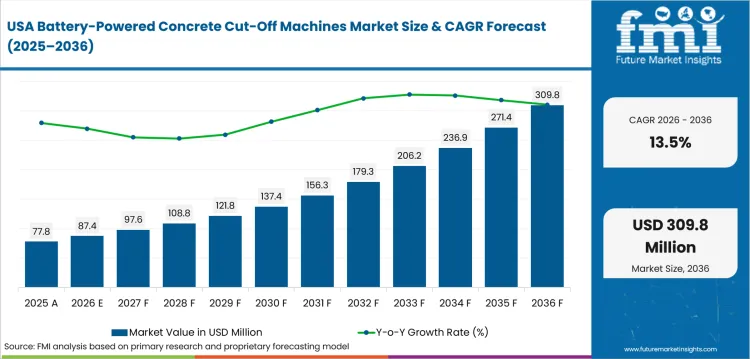
What is the battery-powered concrete cut-off machines market forecast for the United States?
A 13.5% CAGR through 2036 is supported by large construction spending and rental fleet trials.
Country Market Snapshot Table
| Parameter | Value |
|---|---|
| Market Size in 2025 (Value) | USD 31.7 million |
| Market Size in 2026 (Value) | USD 36.0 million |
| Market Forecast in 2036 (Value) | USD 127.7 million |
| CAGR (2026 to 2036) | 13.5% |
| Years Considered | 2021 to 2036 |
| Base Year | 2025 |
| Forecast Period | 2026 to 2036 |
| Units Considered | Value (USD million) |
| Leading Sub-Region | South Atlantic and national rental fleet networks |
United States Battery-Powered Concrete Cut-Off Machines Market Outlook
United States demand is led by contractors that cut concrete in active buildings and dense urban jobs. Rental fleets are expected to remain important because saw durability can be tested before wider ownership.
Silica control and indoor exhaust limits are expected to support premium battery saw packages. Buyers are likely to favor brands that combine water-feed fit with service coverage and shared battery platforms.
Key Growth Drivers
- Construction scale provides a large repair and renovation pool. The USA Census Bureau reported April 2026 construction spending at USD 2,172.4 billion annual rate.
- Public infrastructure work supports outdoor cutting demand. USA highway construction spending reached USD 149.6 billion annual rate in April 2026.
- OSHA silica compliance is expected to push contractors toward wet-cutting kits and integrated dust-control routines.
- Rental houses are likely to use cordless saws to reduce fuel handling and start-up complaints.
Key Restraints
- Input inflation can delay tool upgrades. The USA Producer Price Index for final demand rose 6.5% over the 12 months ended May 2026.
- Small contractors are expected to compare battery kits against petrol saws already available in the truck.
- Heavy road-cutting crews are likely to keep petrol and walk-behind saws for nonstop deep cuts.
What makes United States unique
The United States is unique because rental fleets can validate cordless cut-off saws before broad contractor adoption.
Key Companies
- STIHL USA
- Milwaukee Tool
- DEWALT
- Hilti North America
- Makita USAA.
- Husqvarna Construction North America
- Evolution Power Tools
Sales & Marketing Channels
- Tool dealer networks
- Rental fleet accounts
- Direct contractor demos
- Home center pro desks
- Safety-led procurement programs
- Online professional stores
Country Segment Breakdown Table
| Segment | Sub-Segments |
|---|---|
| By Blade Size | 9 Inch · 12 Inch · 14 Inch |
| By Battery Architecture | Single Battery · Dual Battery · High Voltage |
| By Machine Format | Handheld · Cart Mounted · Rail Mounted |
| By End Use | Construction · Rescue · Rental · Rail |
| By Sales Channel | Dealer Sales · Direct Sales · Rental Fleets · Online Sales |
| Key Sub-Regions Covered, Contractor and Rental Corridors | South Atlantic · Midwest · Texas · California · Northeast · Pacific Northwest |
Market Taxonomy and Sub-Regions Covered
Frequently Asked Questions
How fast is United States battery-powered concrete cut-off machines market growing?
The United States is forecast to grow at 13.5% CAGR from 2026 to 2036 through rental and compliance-led demand.
Who leads United States battery-powered concrete cut-off machines market?
STIHL USA, Milwaukee Tool, DEWALT, Hilti North America, and Makita USAA. compete through contractor channels.
What is driving adoption in United States battery-powered concrete cut-off machines market?
Silica-control routines and rental fleet trials are moving contractors toward battery-powered concrete cutting systems.
How is the battery-powered concrete cut-off machines market performing in the United Kingdom?
A 12.6% CAGR through 2036 reflects hire-channel testing and dust-control guidance.
Country Market Snapshot Table
| Parameter | Value |
|---|---|
| Market Size in 2025 (Value) | USD 8.4 million |
| Market Size in 2026 (Value) | USD 9.5 million |
| Market Forecast in 2036 (Value) | USD 31.1 million |
| CAGR (2026 to 2036) | 12.6% |
| Years Considered | 2021 to 2036 |
| Base Year | 2025 |
| Forecast Period | 2026 to 2036 |
| Units Considered | Value (USD million) |
| Leading Sub-Region | London and national hire-channel corridors |
United Kingdom Battery-Powered Concrete Cut-Off Machines Market Outlook
United Kingdom demand is closely tied to hire-channel testing and health-and-safety compliance. Builders’ merchants and tool-hire branches can introduce cordless saws to small contractors without immediate ownership.
Battery saw use is expected to develop across paving repair and indoor renovation. Hire firms will watch theft risk and battery replacement cost before expanding fleets.
Key Growth Drivers
- Construction activity supports replacement purchases. The Office for National Statistics reported annual construction output increased 1.8% in 2025.
- Repair and maintenance work supports short cutting jobs. ONS reported repair and maintenance output grew 0.8% in March 2026.
- HSE guidance gives buyers a clear reason to specify wet-cutting compatibility for paving and kerb work.
- Hire shops are expected to test cordless saws for short jobs where fuel storage is inconvenient.
Key Restraints
- Monthly volatility can limit fleet expansion. ONS reported construction output fell 0.5% in December 2025.
- Hire fleet operators are expected to face battery loss and charging discipline risks.
- Price-sensitive sole traders may extend petrol saw life before switching to battery systems.
What makes United Kingdom unique
The United Kingdom is unique because hire-channel acceptance can decide whether battery saws reach small contractors quickly.
Key Companies
- Evolution Power Tools
- STIHL GB
- Husqvarna Construction UK
- Hilti GB
- Makita UK
- Milwaukee Tool UK
- DEWALT UK
Sales & Marketing Channels
- Hire shops
- Builders’ merchants
- Specialist tool dealers
- Contractor safety managers
- Online professional tool stores
- Paving contractor networks
Country Segment Breakdown Table
| Segment | Sub-Segments |
|---|---|
| By Blade Size | 9 Inch · 12 Inch · 14 Inch |
| By Battery Architecture | Single Battery · Dual Battery · High Voltage |
| By Machine Format | Handheld · Cart Mounted · Rail Mounted |
| By End Use | Construction · Rescue · Rental · Rail |
| By Sales Channel | Dealer Sales · Direct Sales · Rental Fleets · Online Sales |
| Key Sub-Regions Covered, Contractor and Rental Corridors | London · Manchester · Birmingham · Leeds · Glasgow · Bristol |
Market Taxonomy and Sub-Regions Covered
Frequently Asked Questions
How fast is United Kingdom battery-powered concrete cut-off machines market growing?
The United Kingdom is expected to grow at 12.6% CAGR from 2026 to 2036 through hire-channel testing.
Who leads United Kingdom battery-powered concrete cut-off machines market?
Evolution, STIHL GB, Husqvarna Construction UK, Hilti GB, and Makita UK compete through hire and dealer routes.
What is driving adoption in United Kingdom battery-powered concrete cut-off machines market?
Dust-control guidance and hire-shop trials are supporting battery-powered cutters for paving and renovation work.
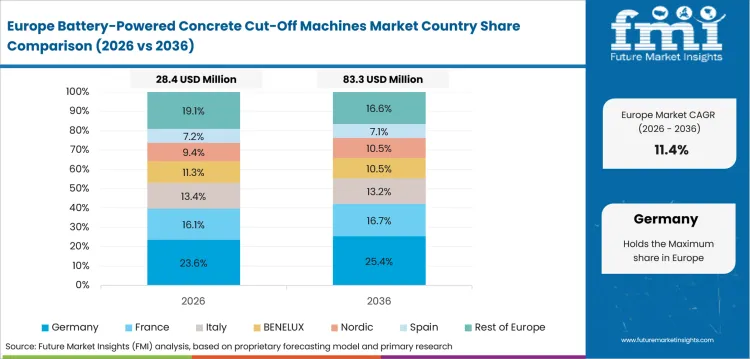
What is the battery-powered concrete cut-off machines market outlook in Germany?
A 12.2% CAGR through 2036 reflects premium dealer support and strict durability expectations.
Country Market Snapshot Table
| Parameter | Value |
|---|---|
| Market Size in 2025 (Value) | USD 9.8 million |
| Market Size in 2026 (Value) | USD 11.0 million |
| Market Forecast in 2036 (Value) | USD 34.8 million |
| CAGR (2026 to 2036) | 12.2% |
| Years Considered | 2021 to 2036 |
| Base Year | 2025 |
| Forecast Period | 2026 to 2036 |
| Units Considered | Value (USD million) |
| Leading Sub-Region | Bavaria and North Rhine-Westphalia trade corridors |
Germany Battery-Powered Concrete Cut-Off Machines Market Outlook
Germany demand is shaped by high service expectations and a strong professional tool channel. Buyers are expected to test battery saws carefully before replacing petrol machines in core fleets.
Renovation and infrastructure maintenance create repeated cutting needs in spaces where petrol fumes are unwelcome. Domestic brand familiarity can help premium battery systems gain credibility.
Key Growth Drivers
- Permit activity supports tool demand in building work. Destatis listed 17,605 dwellings in March 2026 permits for new residential and non-residential buildings.
- Short-term construction production showed positive activity. Destatis reported overall construction production increased 2.9% in January 2026.
- Dealer-led professional sales are expected to support premium tool demos and battery education.
- Municipal maintenance work is likely to favor low-emission tools for short cuts near occupied areas.
Key Restraints
- Higher construction prices can slow procurement. Destatis reported residential building construction prices rose 3.3% year over year in the first quarter of 2026.
- Petrol saw familiarity is expected to slow full replacement among heavy civil contractors.
- Higher kit prices require stronger lifecycle proof before procurement teams approve fleet purchases.
What makes Germany unique
Germany is unique because domestic supplier identity meets strict expectations for tool durability and service continuity.
Key Companies
- STIHL
- Hilti Deutschland
- Husqvarna Deutschland
- Makita Werkzeug
- Milwaukee Tool Deutschland
- Bosch Professional
- LISSMAC Maschinenbau GmbH
Sales & Marketing Channels
- Professional tool dealers
- Rental companies
- Direct enterprise sales
- Municipal maintenance tenders
- Trade fair demonstrations
- Industrial distributors
Country Segment Breakdown Table
| Segment | Sub-Segments |
|---|---|
| By Blade Size | 9 Inch · 12 Inch · 14 Inch |
| By Battery Architecture | Single Battery · Dual Battery · High Voltage |
| By Machine Format | Handheld · Cart Mounted · Rail Mounted |
| By End Use | Construction · Rescue · Rental · Rail |
| By Sales Channel | Dealer Sales · Direct Sales · Rental Fleets · Online Sales |
| Key Sub-Regions Covered, Contractor and Rental Corridors | Bavaria · North Rhine-Westphalia · Baden-Württemberg · Hesse · Berlin · Hamburg |
Market Taxonomy and Sub-Regions Covered
Frequently Asked Questions
How fast is Germany battery-powered concrete cut-off machines market growing?
Germany is projected to post 12.2% CAGR from 2026 to 2036 through dealer-led professional adoption.
Who leads Germany battery-powered concrete cut-off machines market?
STIHL, Hilti Deutschland, Husqvarna Deutschland, Makita Werkzeug, and Bosch Professional compete through trade channels.
What is driving adoption in Germany battery-powered concrete cut-off machines market?
Renovation work and municipal maintenance are moving premium contractors toward low-emission cordless cutting systems.
How is the battery-powered concrete cut-off machines market developing in France?
An 11.8% CAGR through 2036 reflects urban repair demand and rental validation.
Country Market Snapshot Table
| Parameter | Value |
|---|---|
| Market Size in 2025 (Value) | USD 7.2 million |
| Market Size in 2026 (Value) | USD 8.0 million |
| Market Forecast in 2036 (Value) | USD 24.4 million |
| CAGR (2026 to 2036) | 11.8% |
| Years Considered | 2021 to 2036 |
| Base Year | 2025 |
| Forecast Period | 2026 to 2036 |
| Units Considered | Value (USD million) |
| Leading Sub-Region | Paris and major urban renovation corridors |
France Battery-Powered Concrete Cut-Off Machines Market Outlook
France shows a selective adoption pattern with stronger fit in urban repair than in broad new-build demand. Rental networks can support early trials before contractors commit to ownership.
Battery saws are expected to gain where work happens near occupied buildings and public spaces. Softer construction conditions mean suppliers must prove practical job advantages.
Key Growth Drivers
- Civil engineering created a focused demand signal. INSEE reported civil engineering output bounced back 2.9% in March 2026.
- Construction sentiment improved slightly from a weak base. INSEE reported the building construction business climate indicator reached 97 in March 2026.
- Urban renovation is expected to favor low-fume cutting around occupied properties and public spaces.
- Rental firms are likely to test premium cordless tools before smaller contractors commit to ownership.
Key Restraints
- Softer construction output limits replacement budgets. INSEE reported first-quarter 2026 construction output was 2.8% lower than the same period of 2025.
- Battery charging logistics remain harder on dispersed outdoor sites and public works jobs.
- Price-sensitive contractors may prioritize blade replacement and tool repair over new battery kits.
What makes France unique
France is unique because battery saw adoption is tied to rental validation in urban repair rather than broad new-build growth.
Key Companies
- Hilti France
- STIHL France
- Husqvarna Construction France
- Makita France
- Milwaukee Tool France
- DIAM Industries
- SIDAMO
Sales & Marketing Channels
- Rental networks
- Tool dealers
- Public works contractors
- Distributor-led demos
- Online professional stores
- Urban renovation contractors
Country Segment Breakdown Table
| Segment | Sub-Segments |
|---|---|
| By Blade Size | 9 Inch · 12 Inch · 14 Inch |
| By Battery Architecture | Single Battery · Dual Battery · High Voltage |
| By Machine Format | Handheld · Cart Mounted · Rail Mounted |
| By End Use | Construction · Rescue · Rental · Rail |
| By Sales Channel | Dealer Sales · Direct Sales · Rental Fleets · Online Sales |
| Key Sub-Regions Covered, Contractor and Rental Corridors | Paris · Lyon · Marseille · Lille · Toulouse · Nantes |
Market Taxonomy and Sub-Regions Covered
Frequently Asked Questions
How fast is France battery-powered concrete cut-off machines market growing?
France is estimated to grow at 11.8% CAGR from 2026 to 2036 through urban repair and rental testing.
Who leads France battery-powered concrete cut-off machines market?
Hilti France, STIHL France, Husqvarna Construction France, Makita France, and DIAM Industries compete through professional channels.
What is driving adoption in France battery-powered concrete cut-off machines market?
Urban renovation and public works repair are supporting battery saw trials where low fumes are valued.
What is the battery-powered concrete cut-off machines market outlook in China?
An 11.0% CAGR through 2036 reflects large construction scale and strong price competition.
Country Market Snapshot Table
| Parameter | Value |
|---|---|
| Market Size in 2025 (Value) | USD 14.4 million |
| Market Size in 2026 (Value) | USD 16.0 million |
| Market Forecast in 2036 (Value) | USD 45.4 million |
| CAGR (2026 to 2036) | 11.0% |
| Years Considered | 2021 to 2036 |
| Base Year | 2025 |
| Forecast Period | 2026 to 2036 |
| Units Considered | Value (USD million) |
| Leading Sub-Region | Yangtze River Delta and urban renewal corridors |
China Battery-Powered Concrete Cut-Off Machines Market Outlook
China is a scale market with uneven premium-tool conversion. Battery cut-off machines are expected to gain faster in urban sites and indoor repair work.
Local suppliers and imported brands compete across price tiers. Broader adoption depends on battery durability and dealer training rather than construction scale alone.
Key Growth Drivers
- Construction scale supports concrete cutting demand. China reported construction enterprises generated CNY 8,642.5 billion in value added during 2025.
- Early 2026 fixed-asset investment remained active. China reported fixed-asset investment of CNY 10,270.8 billion from January to March 2026.
- Urban renewal is expected to create repeated short concrete cuts in occupied districts.
- Domestic power-tool production is likely to widen access to battery cutting at lower price points.
Key Restraints
- Premium brands face cost pressure from weaker private investment. China reported non-government fixed-asset investment decreased 2.2% year over year from January to March 2026.
- Price-led competition can reduce room for premium imported battery kits in mass contractor accounts.
- Heavy outdoor contractors often prefer petrol machines for long duty cycles and rough job-site use.
What makes China unique
China is unique because it tests whether battery cut-off machines can move beyond premium contractor niches at scale.
Key Companies
- Dongcheng Tools
- Positec Group
- Chervon
- Ken Holding
- Hilti China
- STIHL China
- Makita China
Sales & Marketing Channels
- Provincial dealers
- Online B2B platforms
- Rental fleets
- Direct contractor accounts
- Municipal procurement channels
- Industrial distributors
Country Segment Breakdown Table
| Segment | Sub-Segments |
|---|---|
| By Blade Size | 9 Inch · 12 Inch · 14 Inch |
| By Battery Architecture | Single Battery · Dual Battery · High Voltage |
| By Machine Format | Handheld · Cart Mounted · Rail Mounted |
| By End Use | Construction · Rescue · Rental · Rail |
| By Sales Channel | Dealer Sales · Direct Sales · Rental Fleets · Online Sales |
| Key Sub-Regions Covered, Contractor and Rental Corridors | Yangtze River Delta · Greater Bay Area · Beijing-Tianjin-Hebei · Chengdu-Chongqing · Shandong · Hubei |
Market Taxonomy and Sub-Regions Covered
Frequently Asked Questions
How fast is China battery-powered concrete cut-off machines market growing?
China is forecast to expand at 11.0% CAGR from 2026 to 2036 as local and imported brands compete.
Who leads China battery-powered concrete cut-off machines market?
Dongcheng Tools, Positec, Chervon, Hilti China, STIHL China, and Makita China compete across price tiers.
What is driving adoption in China battery-powered concrete cut-off machines market?
Urban renewal and local power-tool production are supporting battery saw access across contractor channels.
What is the battery-powered concrete cut-off machines market forecast for Japan?
A 10.9% CAGR through 2036 reflects compact urban work and cautious premium-tool replacement.
Country Market Snapshot Table
| Parameter | Value |
|---|---|
| Market Size in 2025 (Value) | USD 7.7 million |
| Market Size in 2026 (Value) | USD 8.5 million |
| Market Forecast in 2036 (Value) | USD 23.9 million |
| CAGR (2026 to 2036) | 10.9% |
| Years Considered | 2021 to 2036 |
| Base Year | 2025 |
| Forecast Period | 2026 to 2036 |
| Units Considered | Value (USD million) |
| Leading Sub-Region | Tokyo and Kansai contractor corridors |
Japan Battery-Powered Concrete Cut-Off Machines Market Outlook
Japan demand reflects compact site conditions and disciplined tool buying. Makita’s domestic cordless platform gives contractors a familiar route into battery concrete cutting.
Battery saw adoption is expected to remain selective because buyers value reliability and service continuity. Disaster response and indoor renovation can create early use cases.
Key Growth Drivers
- Construction investment gives the professional tool channel a steady base. MLIT materials indicated fiscal 2025 construction investment would reach about JPY 76 trillion.
- Cost data keeps runtime and blade efficiency important. MLIT construction cost deflator files showed construction-related index values near 129.9 in recent releases.
- Compact urban sites are expected to favor lower-noise battery saws for short concrete cuts.
- Domestic platform familiarity is likely to support buyer trust in high-voltage cordless tools.
Key Restraints
- High construction cost levels can slow premium tool replacement. MLIT deflator releases showed construction cost index readings above 128 in recent 2025 to 2026 periods.
- Conservative replacement cycles are expected to slow broad contractor switching from petrol saws.
- Premium battery kits face scrutiny where petrol saw service networks are established and familiar.
What makes Japan unique
Japan is unique because compact urban work combines with domestic cordless platform trust and cautious replacement behavior.
Key Companies
- Makita Corporation
- Yamabiko Corporation
- Koki Holdings
- Hilti Japan
- Husqvarna Zenoah
- STIHL Japan
- Bosch Japan
Sales & Marketing Channels
- Professional tool dealers
- Direct contractor sales
- Safety equipment distributors
- Rental firms
- Rescue equipment channels
- Home center professional counters
Country Segment Breakdown Table
| Segment | Sub-Segments |
|---|---|
| By Blade Size | 9 Inch · 12 Inch · 14 Inch |
| By Battery Architecture | Single Battery · Dual Battery · High Voltage |
| By Machine Format | Handheld · Cart Mounted · Rail Mounted |
| By End Use | Construction · Rescue · Rental · Rail |
| By Sales Channel | Dealer Sales · Direct Sales · Rental Fleets · Online Sales |
| Key Sub-Regions Covered, Contractor and Rental Corridors | Tokyo · Osaka · Nagoya · Yokohama · Fukuoka · Sapporo |
Market Taxonomy and Sub-Regions Covered
Frequently Asked Questions
How fast is Japan battery-powered concrete cut-off machines market growing?
Japan is expected to advance at 10.9% CAGR from 2026 to 2036 through selective cordless adoption.
Who leads Japan battery-powered concrete cut-off machines market?
Makita, Yamabiko, Koki Holdings, Hilti Japan, and STIHL Japan compete through domestic professional channels.
What is driving adoption in Japan battery-powered concrete cut-off machines market?
Compact urban job sites and domestic cordless platform familiarity are supporting battery-powered cutter trials.
How do top battery-powered concrete cut-off machine companies compare?
STIHL, Husqvarna, Hilti, Milwaukee Tool, and Makita score strongest on cutting depth and dealer reach.
| Company | Relevance to Market Title | Battery Platform Fit | Cutting Depth Fit | Safety and Water Fit | Channel Reach |
|---|---|---|---|---|---|
| STIHL | Very High | Very Strong | Very Strong | Strong | Very Strong |
| Husqvarna Construction | Very High | Strong | Very Strong | Very Strong | Very Strong |
| Hilti | Very High | Strong | Very Strong | Very Strong | Very Strong |
| Milwaukee Tool | High | Very Strong | Strong | Strong | Very Strong |
| Makita | High | Very Strong | Strong | Moderate to Strong | Very Strong |
| DEWALT | Moderate to High | Strong | Moderate | Moderate | Strong |
| Evolution Power Tools | Moderate to High | Moderate | Moderate | Moderate | Strong |
Source: Future Market Insights competitive analysis, 2026.
Key Companies in the Battery-Powered Concrete Cut-Off Machines Market
Global tool platforms lead the competitive structure through specialist concrete cutting portfolios.
- Global Leaders: STIHL, Husqvarna Construction, Hilti, Milwaukee Tool, Makita, and DEWALT compete through 14-inch cutting depth, battery platform scale, safety features, and dealer access. STIHL and Husqvarna carry strong cut-off machine heritage. Hilti focuses on contractor productivity and safety controls. Milwaukee and Makita use high-voltage cordless platforms to serve buyers already invested in battery ecosystems.
- Specialist and Value Players: Evolution Power Tools competes through compact cordless disc cutters and UK channel familiarity. Bosch Professional participates through cordless cutting and grinding tools that address concrete and metal work. These suppliers often gain buyers with price, compact formats, and easier online access. Their challenge is proving runtime and depth in heavy concrete cutting.
- Channel and Fleet Influencers: Rental firms, tool dealers, and construction safety managers influence brand choice even when they do not manufacture tools. Dealers shape blade and battery matching. Rental fleets test durability under rough use. Safety teams evaluate water-feed fit and brake systems. This means supplier strength depends on channel training and service speed as much as peak cutting power.
How do top battery-powered concrete cut-off machine companies compare?
| Company | 14-Inch Cutting Depth | Battery Platform Scale | Dust-Control Integration | Geographic Footprint |
|---|---|---|---|---|
| STIHL | High | Strong | Strong | Global |
| Husqvarna Construction | High | Strong | Strong | Global |
| Hilti | High | High | Strong | Global |
| Milwaukee Tool | High | High | Moderate | North America, Europe, Asia Pacific |
| Makita | High | High | Moderate | Global |
| DEWALT | Medium | High | Moderate | Global |
| Evolution Power Tools | Medium | Medium | Moderate | United Kingdom, Europe, North America |
| Bosch Professional | Medium | High | Moderate | Global |
Source: Future Market Insights competitive analysis, 2026. Ratings reflect relative positioning based on 14-inch cutting depth, battery platform scale, and dust-control integration.
Key Developments in Battery-Powered Concrete Cut-Off Machines Market
- In January 2026, Makita introduced a Power Cutter Cart for its 80V max XGT 14-inch Power Cutter. The cart expands cordless saw use into longer guided cuts.
- In 2026, STIHL listed the TSA 500 as a coming 14-inch battery cut-off machine with 5 kW power. The launch strengthens premium cordless concrete cutting.
- In April 2025, Evolution Power Tools launched the R260DCT-Li cordless disc cutter. The product gives hire and trade buyers a lower-cost battery cutting option.
- In 2026, Makita listed the GEC03T 14-inch XGT power cutter with up to 45% more power and up to 55% less vibration. The claim supports high-voltage cutter adoption.
- In 2026, Hilti positioned DSH battery saws with Active Torque Control and deeper concrete cutting capability. The feature set raises safety expectations for premium cordless tools.
Who are the key players in the battery-powered concrete cut-off machines market?
Global Leaders
- STIHL
- Husqvarna Construction
- Hilti
- Milwaukee Tool
- Makita
- DEWALT
Specialist and Value Players
- Evolution Power Tools
- Bosch Professional
- Channel and Fleet Influencers
- Tool rental companies
Specialist construction dealers
- Safety equipment distributors
- Contractor fleet managers
Battery-Powered Concrete Cut-Off Machines Market - Report Scope
| Item | Value |
|---|---|
| Market size by 2036 | USD 489.2 million |
| Growth rate | 14.0% CAGR from 2026 to 2036 |
| Forecast period | 2026 to 2036 |
| Base year value (2025) | USD 115.8 million |
| By blade size | 9 Inch, 12 Inch, 14 Inch |
| By battery architecture | Single Battery, Dual Battery, High Voltage |
| By machine format | Handheld, Cart Mounted, Rail Mounted |
| By end use | Construction, Rescue, Rental, Rail |
| By sales channel | Dealer Sales, Direct Sales, Rental Fleets, Online Sales |
| Regions covered | North America, Latin America, Europe, East Asia, South Asia and Pacific, Middle East and Africa |
| Countries covered | United States, United Kingdom, Germany, France, Japan, China, South Korea, India |
| Key companies profiled | STIHL, Husqvarna Construction, Milwaukee Tool, Hilti, Makita, DEWALT, Evolution Power Tools |
| Approach | Hybrid bottom-up and top-down methodology using tool volumes, pricing, construction activity, battery adoption, and verified product portfolios |
Source: Future Market Insights, 2026.
Battery-Powered Concrete Cut-Off Machines Market - Scope & Definition
| Attribute | Detail |
|---|---|
| Market Definition | Cordless battery-powered cut-off machines designed to cut concrete, masonry, asphalt, stone, and reinforced job-site materials |
| Functions Covered | Concrete cutting, masonry cutting, wet cutting, low-exhaust indoor cutting, rescue cutting, rail cutting, and guided cart cutting |
| Applications Covered | Slab cuts, curb cuts, paving block cuts, utility trench cuts, renovation cuts, rescue access cuts, and rail maintenance cuts |
| End-Use Industries | Construction, rescue services, rental fleets, rail maintenance, public works, and industrial facility maintenance |
| Formats Covered | Handheld machines, cart-mounted systems, rail-mounted cutters, batteries, chargers, water-feed kits, and cutting carts sold with the machine package |
| Inclusions | Commercially sold battery-powered cut-off machines across blade size, battery architecture, machine format, end use, sales channel, and region |
| Exclusions | Petrol cut-off saws, corded cut-off saws, walk-behind slab saws, wall saws, table masonry saws, demolition robots, and separate blade-only revenue |
Battery-Powered Concrete Cut-Off Machines Market - Research Methodology
| Method | Description |
|---|---|
| Primary Research | FMI analyst interviews with contractors, rental fleet buyers, tool dealers, rescue-equipment distributors, and masonry subcontractors across key markets |
| Desk Research | Review of official product data, silica-control guidance, construction output data, national statistics, company technical material, and safety regulator documents |
| Market Sizing & Forecasting | Hybrid bottom-up and top-down approach using tool volumes, average selling prices, battery attachment rates, construction activity, and adoption by blade size |
| Data Validation | Cross-verification using product portfolios, construction output signals, silica-control requirements, rental-channel checks, and battery platform readiness |
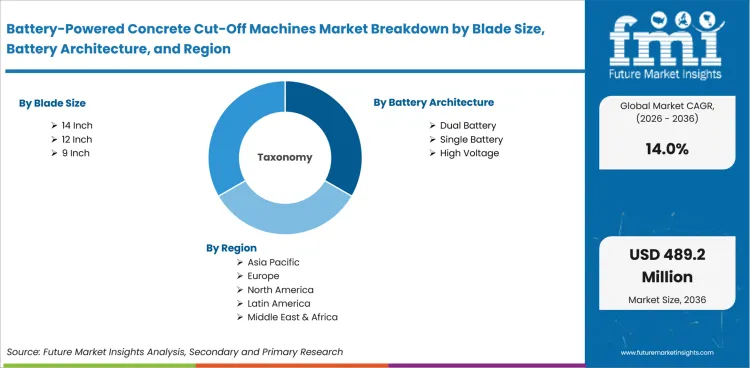
Battery-Powered Concrete Cut-Off Machines Market by Segments
Battery-Powered Concrete Cut-Off Machines Market Segmented by Blade Size:
- 9 Inch
- 12 Inch
- 14 Inch
Battery-Powered Concrete Cut-Off Machines Market Segmented by Battery Architecture:
- Single Battery
- Dual Battery
- High Voltage
Battery-Powered Concrete Cut-Off Machines Market Segmented by Machine Format:
- Handheld
- Cart Mounted
- Rail Mounted
Battery-Powered Concrete Cut-Off Machines Market Segmented by End Use:
- Construction
- Rescue
- Rental
- Rail
Battery-Powered Concrete Cut-Off Machines Market Segmented by Sales Channel:
- Dealer Sales
- Direct Sales
- Rental Fleets
- Online Sales
Battery-Powered Concrete Cut-Off Machines Market by Region:
- North America
- United States
- Canada
- Mexico
- Latin America
- Brazil
- Chile
- Rest of Latin America
- Western Europe
- Germany
- UK
- Italy
- Spain
- France
- Nordic
- BENELUX
- Rest of Western Europe
- Eastern Europe
- Russia
- Poland
- Hungary
- Balkan & Baltic
- Rest of Eastern Europe
- East Asia
- China
- Japan
- South Korea
- South Asia and Pacific
- India
- ASEAN
- Australia & New Zealand
- Rest of South Asia and Pacific
- Middle East & Africa
- Kingdom of Saudi Arabia
- Other GCC Countries
- Turkiye
- South Africa
- Other African Union
- Rest of Middle East & Africa
Research Sources and Bibliography
- 1. USA Census Bureau. (2026, June 1). Monthly construction spending, April 2026. USA Department of Commerce.
- 2. Office for National Statistics. (2026, February 12). Construction output in Great Britain: December 2025, new orders and Construction Output Price Indices, October to December 2025.
- 3. Health and Safety Executive. (2024, November 7). Construction dust: Cutting paving blocks, kerbs and flags.
- 4. California Department of Industrial Relations. (2024, May 21). Cal/OSHA respirable crystalline silica standards and resources.
- 5. WorkSafe New Zealand. (2024, February 13). Controlling dust with on-tool water suppression.
- 6. National Institute of Statistics and Economic Studies. (2026, May 6). In March 2026, manufacturing output increased by +1.2%.
- 7. Ministry of Land, Infrastructure, Transport and Tourism. (2026, April 3). Reference materials on construction investment [PDF].
- 8. National Bureau of Statistics of China. (2026, February 28). Statistical communiqué of the People’s Republic of China on the 2025 national economic and social development.
- 9. Ministry of Data and Statistics. (2026, January 30). Monthly industrial statistics, December 2025. Statistics Korea.
- 10. Ministry of Statistics and Programme Implementation. (2026, January 7). Press note on first advance estimates of gross domestic product for FY 2025-26. Government of India.
- 12. STIHL USA. (2026). AP 500 S lithium-ion battery.
- 13. Husqvarna Construction. (2026). K 1 PACE power cutter.
- 14. Milwaukee Tool. (2026). MX FUEL 14-inch cut-off saw with RAPIDSTOP.
- 16. Makita USAA. (2026, January 20). Makita announces 10+ new products and 20+ hands-on demos.
- 17. Makita India. (2026). CE001G 40Vmax X2 XGT power cutter.
- 18. Evolution Power Tools. (2025, April 28). Challenging the giants: The launch of Evolution’s R260DCT-Li cordless disc cutter.
- 20. Occupational Safety and Health Administration. (2026). 29 CFR 1926.1153 respirable crystalline silica.
- The bibliography is provided for reader reference and uses primary non-commercial government, regulatory, official company, or official trade sources.
- 21. Bureau of Labor Statistics. (2026, June 11). Producer price indexes, May 2026. USA Department of Labor.
- 22. Destatis. (2026). Building permits, construction of new buildings. German Federal Statistical Office.
- 23. Destatis. (2026). Construction price indices for residential buildings and non-residential buildings. German Federal Statistical Office.
- 24. INSEE. (2026, March 26). In March 2026, the business climate in building construction has slightly brightened.
- 25. INSEE. (2026). In March 2026, manufacturing output increased by +1.2%.
- 26. Press Information Bureau. (2026, January 7). First advance estimates of gross domestic product, 2025-26. Government of India.
- 27. Press Information Bureau. (2026, June 9). Infrastructure at the core of India’s development. Government of India.
- 28. Ministry of Data and Statistics. (2026, January 30). Monthly industrial statistics, December 2025. Republic of Korea.
- 29. National Bureau of Statistics of China. (2026, January 1). Purchasing managers’ index for December 2025.
- 30. National Bureau of Statistics of China. (2026, April 17). Investment in fixed assets from January to March 2026.
- 31. Ministry of Land, Infrastructure, Transport and Tourism. (2026). Construction cost deflators. Government of Japan.
This Report Answers
- What is the current and forecast value of the Battery-Powered Concrete Cut-Off Machines Market from 2026 to 2036?
- What CAGR is expected for battery-powered concrete cut-off machines during the forecast period?
- Which blade size is projected to lead battery-powered concrete cut-off machine demand in 2026?
- Which battery architecture is expected to gain the highest share in professional concrete cutting?
- Why are contractors replacing petrol cut-off saws with battery-powered concrete cutting machines?
- How do silica-control rules and wet-cutting needs affect cordless cut-off machine demand?
- Which countries are forecast to grow fastest in battery-powered concrete cut-off machine adoption?
- Which companies are most relevant in battery-powered concrete cut-off machines and related cutting systems?
- What products are included and excluded from the Battery-Powered Concrete Cut-Off Machines Market?
- How does FMI size and forecast this market across products, countries, and sales channels?
Frequently Asked Questions
What is the battery-powered concrete cut-off machines market size in 2026?
In 2026, the global Battery-Powered Concrete Cut-Off Machines Market is expected to be worth USD 132.0 million as 14-inch cordless tools scale.
What is the battery-powered concrete cut-off machines market forecast for 2036?
The market is projected to reach USD 489.2 million by 2036 as contractors and rental fleets expand battery saw use.
What is the battery-powered concrete cut-off machines market CAGR?
The Battery-Powered Concrete Cut-Off Machines Market is projected to grow at 14.0% CAGR from 2026 to 2036.
What segment leads the battery-powered concrete cut-off machines market?
The 14 Inch segment is projected to lead Blade Size with 52.8% share in 2026 due to deeper concrete cutting needs.
Which sales channel is expected to lead in 2026?
Dealer Sales are projected to hold 46.2% share in 2026 as buyers need saw demonstrations and blade guidance.
What country grows fastest in the battery-powered concrete cut-off machines market?
India is expected to record the fastest growth at 16.3% CAGR as infrastructure work and contractor tool upgrades widen demand.
What is included in the Battery-Powered Concrete Cut-Off Machines Market?
The market includes cordless cut-off machines for concrete, masonry, asphalt, and stone cutting across handheld, cart-mounted, and rail-mounted formats.
How is the market forecast built?
The forecast combines tool volumes, average prices, construction activity, battery adoption, product portfolios, and country-level channel strength.
Which battery-powered concrete cut-off machine is best for indoor concrete cutting?
A 12-inch or 14-inch dual-battery saw with water feed is best for indoor concrete cutting. Buyers should prioritize dust control, runtime, blade brake response, and service access.
How much does a battery-powered concrete cut-off machine cost?
Professional battery cut-off machines often cost more than petrol saws once batteries and chargers are included. STIHL lists the TSA 500 bare tool at USD 1,399.99.
What is the difference between a 9-inch and 14-inch battery cut-off machine?
A 9-inch machine suits shallow cuts and lighter repair work. A 14-inch machine supports deeper concrete and curb cuts but needs stronger batteries and higher-priced blades.
How long does a battery-powered concrete cut-off machine run?
Runtime depends on concrete hardness, blade type, water use, and battery size. STIHL lists up to 40 minutes for the TSA 500 with two AP 500 S batteries.
Are battery-powered concrete cut-off machines cheaper than petrol saws?
Battery machines usually cost more upfront when bought as a full kit. They reduce fuel handling, indoor exhaust issues, and some maintenance tasks for suitable cutting jobs.
Preview the report firsthand - request a free sample
Get SampleGet the brochure for pricing and purchase details.
Get PDFTable of Content
- Key Takeaways
- Market Size and CAGR
- Top Growth Driver
- Fastest Growing Segment
- Leading Region
- Key Companies
- Emerging Opportunities
- Executive Summary
- Global Market Outlook
- Demand-side Trends
- Supply-side Trends
- Technology Roadmap Analysis
- Analysis and Recommendations
- Analyst Perspective (What is happening? Why now? What should investors know?)
- Key Questions Answered
- How large is the market?
- What is the CAGR?
- What are key trends?
- Which region dominates?
- Who are the leaders?
- Market Overview
- Market Coverage / Taxonomy
- Market Definition / Scope / Limitations
- Research Methodology
- Chapter Orientation
- Analytical Lens and Working Hypotheses
- Market Structure, Signals, and Trend Drivers
- Benchmarking and Cross-market Comparability
- Market Sizing, Forecasting, and Opportunity Mapping
- Research Design and Evidence Framework
- Desk Research Programme (Secondary Evidence)
- Expert Input and Fieldwork (Primary Evidence)
- Tooling, Models, and Reference Databases
- Data Engineering and Model Build
- Quality Assurance and Audit Trail
- Market Background
- Market Dynamics (Drivers, Restraints, Opportunity, Trends)
- Scenario Forecast (Optimistic, Likely, Conservative)
- Impact Analysis
- AI Impact
- Sustainability Impact
- Regulatory Impact
- Technology Impact
- Consumer / Buyer Analysis
- Purchase Drivers
- Adoption Barriers
- Buyer Journey
- Opportunity Map Analysis
- Product Life Cycle Analysis
- Supply Chain Analysis
- Investment Feasibility Matrix
- Value Chain Analysis
- PESTLE and Porter's Analysis
- Regulatory Landscape
- Regional Parent Market Outlook
- Production and Consumption Statistics
- Import and Export Statistics
- Global Market Analysis and Forecast, 2021 to 2036
- Historical Market Size Value (USD Million) & Volume (Unit) Analysis, 2021 to 2025
- Current and Future Market Size Value (USD Million) & Volume (Unit) Projections, 2026 to 2036
- Y-o-Y Growth Trend Analysis
- Absolute $ Opportunity Analysis
- Global Market Pricing Analysis, 2021 to 2036
- Global Market Analysis and Forecast, By Blade Size, 2021 to 2036
- Introduction / Key Findings
- Historical Market Size Value (USD Million) & Volume (Unit) Analysis By Blade Size, 2021 to 2025
- Current and Future Market Size Value (USD Million) & Volume (Unit) Analysis and Forecast By Blade Size, 2026 to 2036
- 14 Inch
- 9 Inch
- 12 Inch
- 14 Inch
- Y-o-Y Growth Trend Analysis By Blade Size, 2021 to 2025
- Absolute $ Opportunity Analysis By Blade Size, 2026 to 2036
- Global Market Analysis and Forecast, By Battery Architecture, 2021 to 2036
- Introduction / Key Findings
- Historical Market Size Value (USD Million) & Volume (Unit) Analysis By Battery Architecture, 2021 to 2025
- Current and Future Market Size Value (USD Million) & Volume (Unit) Analysis and Forecast By Battery Architecture, 2026 to 2036
- Dual Battery
- Single Battery
- High Voltage
- Dual Battery
- Y-o-Y Growth Trend Analysis By Battery Architecture, 2021 to 2025
- Absolute $ Opportunity Analysis By Battery Architecture, 2026 to 2036
- Global Market Analysis and Forecast, By Machine Format, 2021 to 2036
- Introduction / Key Findings
- Historical Market Size Value (USD Million) & Volume (Unit) Analysis By Machine Format, 2021 to 2025
- Current and Future Market Size Value (USD Million) & Volume (Unit) Analysis and Forecast By Machine Format, 2026 to 2036
- Handheld
- Cart Mounted
- Rail Mounted
- Handheld
- Y-o-Y Growth Trend Analysis By Machine Format, 2021 to 2025
- Absolute $ Opportunity Analysis By Machine Format, 2026 to 2036
- Global Market Analysis and Forecast, By End Use, 2021 to 2036
- Introduction / Key Findings
- Historical Market Size Value (USD Million) & Volume (Unit) Analysis By End Use, 2021 to 2025
- Current and Future Market Size Value (USD Million) & Volume (Unit) Analysis and Forecast By End Use, 2026 to 2036
- Construction
- Rescue
- Rental
- Rail
- Construction
- Y-o-Y Growth Trend Analysis By End Use, 2021 to 2025
- Absolute $ Opportunity Analysis By End Use, 2026 to 2036
- Global Market Analysis and Forecast, By Sales Channel, 2021 to 2036
- Introduction / Key Findings
- Historical Market Size Value (USD Million) & Volume (Unit) Analysis By Sales Channel, 2021 to 2025
- Current and Future Market Size Value (USD Million) & Volume (Unit) Analysis and Forecast By Sales Channel, 2026 to 2036
- Dealer Sales
- Direct Sales
- Rental Fleets
- Online Sales
- Dealer Sales
- Y-o-Y Growth Trend Analysis By Sales Channel, 2021 to 2025
- Absolute $ Opportunity Analysis By Sales Channel, 2026 to 2036
- Global Market Analysis and Forecast, By Region, 2021 to 2036
- Introduction
- Historical Market Size Value (USD Million) & Volume (Unit) Analysis By Region, 2021 to 2025
- Current Market Size Value (USD Million) & Volume (Unit) Analysis and Forecast By Region, 2026 to 2036
- North America
- Latin America
- Western Europe
- Eastern Europe
- East Asia
- South Asia and Pacific
- Middle East & Africa
- Market Attractiveness Analysis By Region
- North America Market Analysis and Forecast, By Country, 2021 to 2036
- Historical Market Size Value (USD Million) & Volume (Unit) Trend Analysis By Market Taxonomy, 2021 to 2025
- Market Size Value (USD Million) & Volume (Unit) Forecast By Market Taxonomy, 2026 to 2036
- By Country
- USA
- Canada
- Mexico
- By Blade Size
- By Battery Architecture
- By Machine Format
- By End Use
- By Sales Channel
- By Country
- Market Attractiveness Analysis
- By Country
- By Blade Size
- By Battery Architecture
- By Machine Format
- By End Use
- By Sales Channel
- Key Takeaways
- Latin America Market Analysis and Forecast, By Country
- Historical Market Size Value (USD Million) & Volume (Unit) Trend Analysis By Market Taxonomy, 2021 to 2025
- Market Size Value (USD Million) & Volume (Unit) Forecast By Market Taxonomy, 2026 to 2036
- By Country
- Brazil
- Chile
- Rest of Latin America
- By Blade Size
- By Battery Architecture
- By Machine Format
- By End Use
- By Sales Channel
- By Country
- Market Attractiveness Analysis
- By Country
- By Blade Size
- By Battery Architecture
- By Machine Format
- By End Use
- By Sales Channel
- Key Takeaways
- Western Europe Market Analysis and Forecast, By Country
- Historical Market Size Value (USD Million) & Volume (Unit) Trend Analysis By Market Taxonomy, 2021 to 2025
- Market Size Value (USD Million) & Volume (Unit) Forecast By Market Taxonomy, 2026 to 2036
- By Country
- Germany
- UK
- Italy
- Spain
- France
- Nordic
- BENELUX
- Rest of Western Europe
- By Blade Size
- By Battery Architecture
- By Machine Format
- By End Use
- By Sales Channel
- By Country
- Market Attractiveness Analysis
- By Country
- By Blade Size
- By Battery Architecture
- By Machine Format
- By End Use
- By Sales Channel
- Key Takeaways
- Eastern Europe Market Analysis and Forecast, By Country
- Historical Market Size Value (USD Million) & Volume (Unit) Trend Analysis By Market Taxonomy, 2021 to 2025
- Market Size Value (USD Million) & Volume (Unit) Forecast By Market Taxonomy, 2026 to 2036
- By Country
- Russia
- Poland
- Hungary
- Balkan & Baltic
- Rest of Eastern Europe
- By Blade Size
- By Battery Architecture
- By Machine Format
- By End Use
- By Sales Channel
- By Country
- Market Attractiveness Analysis
- By Country
- By Blade Size
- By Battery Architecture
- By Machine Format
- By End Use
- By Sales Channel
- Key Takeaways
- East Asia Market Analysis and Forecast, By Country
- Historical Market Size Value (USD Million) & Volume (Unit) Trend Analysis By Market Taxonomy, 2021 to 2025
- Market Size Value (USD Million) & Volume (Unit) Forecast By Market Taxonomy, 2026 to 2036
- By Country
- China
- Japan
- South Korea
- By Blade Size
- By Battery Architecture
- By Machine Format
- By End Use
- By Sales Channel
- By Country
- Market Attractiveness Analysis
- By Country
- By Blade Size
- By Battery Architecture
- By Machine Format
- By End Use
- By Sales Channel
- Key Takeaways
- South Asia and Pacific Market Analysis and Forecast, By Country
- Historical Market Size Value (USD Million) & Volume (Unit) Trend Analysis By Market Taxonomy, 2021 to 2025
- Market Size Value (USD Million) & Volume (Unit) Forecast By Market Taxonomy, 2026 to 2036
- By Country
- India
- ASEAN
- Australia & New Zealand
- Rest of South Asia and Pacific
- By Blade Size
- By Battery Architecture
- By Machine Format
- By End Use
- By Sales Channel
- By Country
- Market Attractiveness Analysis
- By Country
- By Blade Size
- By Battery Architecture
- By Machine Format
- By End Use
- By Sales Channel
- Key Takeaways
- Middle East & Africa Market Analysis and Forecast, By Country
- Historical Market Size Value (USD Million) & Volume (Unit) Trend Analysis By Market Taxonomy, 2021 to 2025
- Market Size Value (USD Million) & Volume (Unit) Forecast By Market Taxonomy, 2026 to 2036
- By Country
- Kingdom of Saudi Arabia
- Other GCC Countries
- Türkiye
- South Africa
- Other African Union
- Rest of Middle East & Africa
- By Blade Size
- By Battery Architecture
- By Machine Format
- By End Use
- By Sales Channel
- By Country
- Market Attractiveness Analysis
- By Country
- By Blade Size
- By Battery Architecture
- By Machine Format
- By End Use
- By Sales Channel
- Key Takeaways
- Key Countries Market Analysis
- USA
- Pricing Analysis
- Market Share Analysis, 2025
- By Blade Size
- By Battery Architecture
- By Machine Format
- By End Use
- By Sales Channel
- Canada
- Pricing Analysis
- Market Share Analysis, 2025
- By Blade Size
- By Battery Architecture
- By Machine Format
- By End Use
- By Sales Channel
- Mexico
- Pricing Analysis
- Market Share Analysis, 2025
- By Blade Size
- By Battery Architecture
- By Machine Format
- By End Use
- By Sales Channel
- Brazil
- Pricing Analysis
- Market Share Analysis, 2025
- By Blade Size
- By Battery Architecture
- By Machine Format
- By End Use
- By Sales Channel
- Chile
- Pricing Analysis
- Market Share Analysis, 2025
- By Blade Size
- By Battery Architecture
- By Machine Format
- By End Use
- By Sales Channel
- Germany
- Pricing Analysis
- Market Share Analysis, 2025
- By Blade Size
- By Battery Architecture
- By Machine Format
- By End Use
- By Sales Channel
- UK
- Pricing Analysis
- Market Share Analysis, 2025
- By Blade Size
- By Battery Architecture
- By Machine Format
- By End Use
- By Sales Channel
- Italy
- Pricing Analysis
- Market Share Analysis, 2025
- By Blade Size
- By Battery Architecture
- By Machine Format
- By End Use
- By Sales Channel
- Spain
- Pricing Analysis
- Market Share Analysis, 2025
- By Blade Size
- By Battery Architecture
- By Machine Format
- By End Use
- By Sales Channel
- France
- Pricing Analysis
- Market Share Analysis, 2025
- By Blade Size
- By Battery Architecture
- By Machine Format
- By End Use
- By Sales Channel
- India
- Pricing Analysis
- Market Share Analysis, 2025
- By Blade Size
- By Battery Architecture
- By Machine Format
- By End Use
- By Sales Channel
- ASEAN
- Pricing Analysis
- Market Share Analysis, 2025
- By Blade Size
- By Battery Architecture
- By Machine Format
- By End Use
- By Sales Channel
- Australia & New Zealand
- Pricing Analysis
- Market Share Analysis, 2025
- By Blade Size
- By Battery Architecture
- By Machine Format
- By End Use
- By Sales Channel
- China
- Pricing Analysis
- Market Share Analysis, 2025
- By Blade Size
- By Battery Architecture
- By Machine Format
- By End Use
- By Sales Channel
- Japan
- Pricing Analysis
- Market Share Analysis, 2025
- By Blade Size
- By Battery Architecture
- By Machine Format
- By End Use
- By Sales Channel
- South Korea
- Pricing Analysis
- Market Share Analysis, 2025
- By Blade Size
- By Battery Architecture
- By Machine Format
- By End Use
- By Sales Channel
- Russia
- Pricing Analysis
- Market Share Analysis, 2025
- By Blade Size
- By Battery Architecture
- By Machine Format
- By End Use
- By Sales Channel
- Poland
- Pricing Analysis
- Market Share Analysis, 2025
- By Blade Size
- By Battery Architecture
- By Machine Format
- By End Use
- By Sales Channel
- Hungary
- Pricing Analysis
- Market Share Analysis, 2025
- By Blade Size
- By Battery Architecture
- By Machine Format
- By End Use
- By Sales Channel
- Kingdom of Saudi Arabia
- Pricing Analysis
- Market Share Analysis, 2025
- By Blade Size
- By Battery Architecture
- By Machine Format
- By End Use
- By Sales Channel
- Türkiye
- Pricing Analysis
- Market Share Analysis, 2025
- By Blade Size
- By Battery Architecture
- By Machine Format
- By End Use
- By Sales Channel
- South Africa
- Pricing Analysis
- Market Share Analysis, 2025
- By Blade Size
- By Battery Architecture
- By Machine Format
- By End Use
- By Sales Channel
- USA
- Market Structure Analysis
- Competition Dashboard
- Competition Benchmarking
- Market Share Analysis of Top Players
- By Regional
- By Blade Size
- By Battery Architecture
- By Machine Format
- By End Use
- By Sales Channel
- Emerging Startups
- Innovation Benchmarking
- Competition Analysis
- Competition Deep Dive
- STIHL
- Overview
- Product Portfolio
- Profitability by Market Segments (Product/Region/Sales Channel)
- Sales Footprint
- Strategy Overview
- Marketing Strategy
- Product Strategy
- Channel Strategy
- Husqvarna Construction
- Hilti
- Milwaukee Tool
- Makita
- DEWALT
- STIHL
- Case Studies
- Success Stories
- Recent Developments
- Competition Deep Dive
- Assumptions & Acronyms Used


