

- Market Size (2026)
- USD 3.2 Bn
- Forecast (2036)
- USD 7.0 Bn
- CAGR (2026 to 2036)
- 8.0%
How big is Electric Marine Motors Market in 2026?
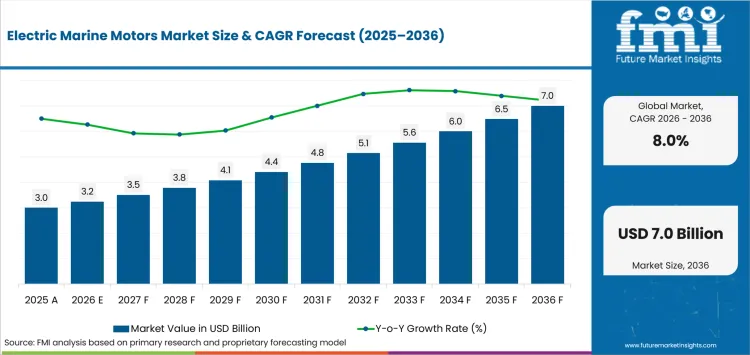
USD 3.2 billion in 2026 and USD 7.0 billion by 2036 at an 8.0% CAGR.
Demand for electric marine motors is projected to expand at 8.0% CAGR between 2026 and 2036, lifting valuation from USD 3.2 billion to USD 7.0 billion. Regulatory pressure is increasing attention on propulsion technologies that can lower vessel emissions and improve energy efficiency. FuelEU Maritime took effect on January 1, 2025 and changed compliance economics for ships calling at European Union ports. The European Commission requires ships above 5,000 gross tonnage to cut onboard energy greenhouse-gas intensity by 2% in 2025. Electric propulsion gains commercial weight where electric boats can return to charging without sacrificing payload or sailing time.
Norway already provides a clearer conversion path through an electric-ferry fleet operating at commercial scale. Statens vegvesen reported in February 2025 that nearly 90 electric ferries were sailing in Norway, compared with about 270 worldwide. That installed base gives local yards and operators more operating evidence for batteries, charging and marine propulsion systems. Other markets may show similar policy ambition yet convert orders more slowly until vessel schedules and shore power support the same operating confidence.
Key Takeaways
- Electric marine motor demand grows fastest on routes that can charge without disrupting scheduled vessel service.
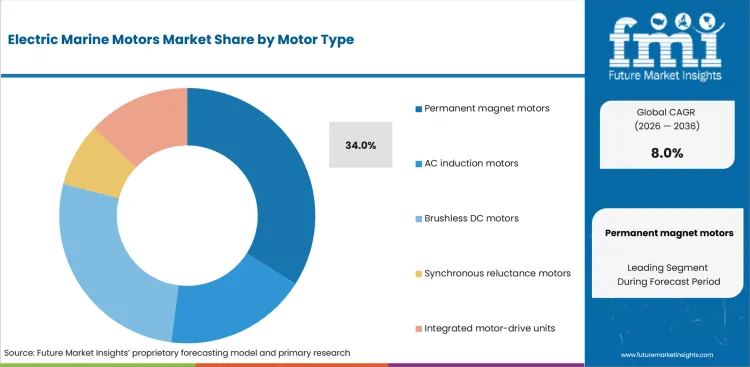
- Permanent magnet motors are projected to hold 34.0% of motor type demand in 2026 owing to compact torque density in space-limited propulsion layouts.
- By power rating, below 10 kW is estimated to hold 22.0% in 2026 due to smaller-craft duty cycles that avoid large battery packs.
- In 2026, recreational boats are expected to lead vessel type with 32.0% share because shorter trips allow predictable marina charging.
- Battery mass, charging power and service access can delay conversion on routes that require long endurance or rapid vessel turnaround.
- Key players in the electric marine motors market include Torqeedo, ePropulsion, Yamaha Motor, Evoy Vita, Molabo, Mercury Marine, TEMO, and Flux Marine.
Analyst Perspective
"Electric marine motors should be evaluated against the vessel duty cycle before rated power or purchase price. Commercial value is earned through verified range, charging compatibility, thermal control and service access that keep the vessel available for its planned work."
- Nikhil Kaitwade, Principal Consultant, Future Market Insights
How is the electric marine motors market segmented?
The electric marine motors market is segmented by motor type, power rating, vessel type, cooling, sales channel and region.
Market taxonomy covers motor type, power rating, vessel type, cooling and sales channel. Motor types range from permanent magnet and AC induction motors to brushless DC, synchronous reluctance and integrated motor-drive units. Power spans below 10 kW to above 200 kW. Vessel, cooling and sales-channel categories cover the remaining operating and commercial distinctions.
Why do permanent magnet motors lead the motor type category?
Permanent magnet motors suit hulls where machinery space and cooling capacity are limited. In May 2025 ePropulsion documented Bleu Seine, a 40-meter electric passenger vessel using three permanent magnet motors with redundant liquid-cooled power electronics. Motor selection is evaluated with the complete marine electronics and energy architecture during vessel integration.
- By motor type, permanent magnet motors are estimated to hold 34.0% in 2026 owing to compact torque delivery and efficient variable-speed operation.
- Commercial adoption depends on thermal design and inverter matching since continuous vessel duty can expose losses that short bench tests do not capture.
Why does below 10 kW lead the power rating category?
Below 10 kW systems address tenders, dinghies, auxiliary sailboats and smaller fishing craft that can operate with modest stored energy. TEMO published a June 2025 range test for its 1.1 kW TEMO·1000 outboard, giving boaters and yards operating data from a low-power installation under sailing conditions.
- In 2026, below 10 kW is expected to lead power rating with 22.0% share because battery mass and charging requirements stay manageable on small craft.
- Electric outboard engines in this band are easier to standardize, but installation quality still depends on propeller loading, cable sizing and local service access.
Why do recreational boats lead the vessel type category?
Recreational craft usually return to the same marina or berth, so battery sizing follows a known outing instead of continuous service. In October 2025 Flux Marine and Zodiac launched the all-electric Medline 6.8 with 115 HP continuous propulsion and 50 kW DC charging, placing both specifications in one boat package.
- Recreational boats are set to lead the vessel type category with 32.0% share in 2026 due to shorter trips and predictable marina charging.
- Lithium-ion batteries remain a major design constraint as additional range raises weight, cost and charging demand faster than motor power alone suggests.
Why do boat OEMs lead the sales channel category?
Boat OEMs control battery placement, cabling, cooling and helm integration before the hull design is frozen, reducing late-stage interface changes. Evoy Vita documented this route in October 2025 after Maine Ocean Farms took delivery of a Fogg’s Boatworks electric aquaculture craft using twin Evoy propulsion units and overnight dock charging.
- By sales channel, boat OEMs are forecast to represent 39.0% in 2026 driven by factory integration under one propulsion design authority.
- OEM programs give marine-engine service partners repeatable installation standards. Bespoke retrofits require more engineering for each hull.
What are the drivers, restraints and opportunities in the Electric Marine Motors Market?
Emissions-linked procurement increases electric propulsion specifications, charging availability limits route coverage, and integrated retrofit packages can convert suitable existing vessels.
- Driver: Shipping rules and public procurement increasingly attach operating cost or eligibility consequences to vessel emissions.
- Restraint: Shore-power availability and battery mass restrict routes that need long endurance or short turnaround times.
- Opportunity: Standardized motor, control and charging interfaces can reduce engineering work on suitable new-build and retrofit programs.
Emissions Compliance Moves Propulsion Into Procurement
Carbon cost now enters fleet planning ahead of propulsion hardware selection. The European Commission states that shipping companies must surrender allowances for 70% of 2025 emissions in 2026, rising to 100% from 2027. The ETS does not mandate electric motors, but routes with workable charging can compare electricity use directly with rising compliance exposure.
Shore Power Limits Which Routes Can Convert First
Shore-power coverage remains uneven even in ports pursuing cleaner vessel operations. In February 2026 the European Environment Agency reported shore-side electricity at 40% of core TEN-T ports, covering 461 berths, while comprehensive ports reached 8%. Routes without reliable berth power need larger batteries, hybrid operation or schedule changes ahead of motor procurement.
Retrofit Funding Can Pull Motors Into Existing Fleets
Public funding can pull propulsion packages into existing ferry fleets with defined routes and charging sites. In April 2026 the USA Federal Transit Administration opened USD 98 million for the Electric or Low-Emitting Ferry Pilot Program, including vessels and related infrastructure. That scope lets integrators price motors with controls and charging work under one project instead of separate engineering packages.
Which country CAGRs are profiled in the Electric Marine Motors Market?
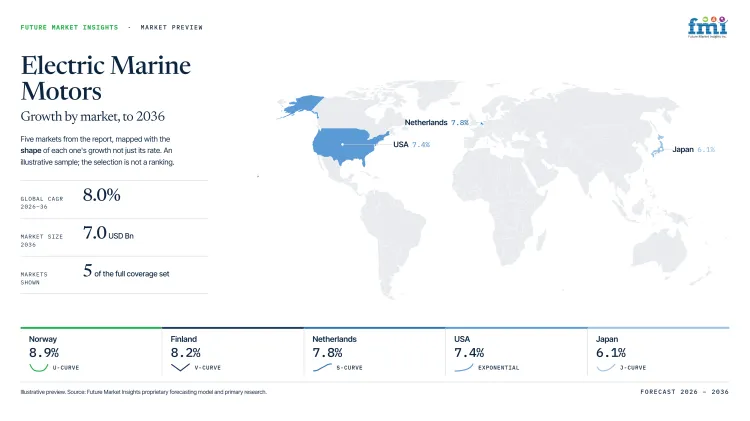
| Country | CAGR |
|---|---|
| Norway | 8.9% |
| Finland | 8.2% |
| Netherlands | 7.8% |
| Australia | 7.6% |
| USA | 7.4% |
How do country-level CAGRs compare in the Electric Marine Motors Market?
The countries occupy a narrow 1.5-point band, but the ranking separates mature ferry electrification from project-led conversion. Norway and Finland sit above 8.0% because scheduled routes already expose propulsion decisions to charging and emissions requirements. The Netherlands and Australia form the middle, while USA growth remains tied to funded fleet replacement.
- Norway converts fjord zero-emission rules through a mature electric-ferry operating base.
- Finland pairs fixed archipelago routes with weak grid capacity at remote berths.
- Dutch inland obligations favour retrofit packages that preserve cargo space and sailing schedules.
- Australia is testing locally built battery ferries ahead of wider public-fleet replication.
- USA growth follows grant-backed replacement, leaving shipyard execution as the conversion variable.
Comparable CAGRs conceal different procurement clocks, infrastructure exposure and installation risks. The full report provides country-level CAGR analysis across North America, Latin America, Western Europe, Eastern Europe, East Asia, South Asia and Pacific, and Middle East and Africa.
Country-wise Analysis
- Norwegian ferry operators already work with a large electric-ferry base, and protected fjord routes now impose tighter propulsion requirements than ordinary coastal service, especially on scheduled tourism services that return repeatedly to the same berth. The Norway electric marine motors outlook is projected to expand at 8.9% CAGR through 2036 because route-based procurement turns emissions rules into defined motor and charging specifications. In April 2025 the Norwegian Maritime Authority confirmed zero-emission rules from January 1, 2026 for passenger ships below 10,000 gross tonnage in World Heritage fjords, with shore power mandatory where available and route-endurance proof required at less-equipped ports.
- Finnish ferry operators work on fixed archipelago routes, but winter conditions and weak island-grid capacity complicate charging and maintenance planning at remote berths during each winter operating season. In October 2025 Traficom reported about 1,740,850 tonnes of CO2 from Finland-administered shipping companies under the EU ETS, equal to 10.7% of Finland's Union Registry total for the first full compliance year. Finland is positioned to record 8.2% CAGR through 2036 as predictable schedules support repeatable motor and battery sizing, although fleet standardization still depends on verified energy use, shore-power availability and service routines that remain workable through severe winter conditions.
- Dutch inland operators face a compliance schedule that tightens before many older vessels reach normal replacement age, raising interest in retrofit-ready propulsion for working cargo vessels because owners cannot sacrifice cargo space or long yard periods. The Netherlands is estimated to post 7.8% CAGR during the forecast period attributable to operators seeking lower-emission propulsion without surrendering cargo capacity or route flexibility. Staatsblad 2026 No. 117 set the inland-navigation chain-emission reduction obligation at 2.5% for 2026 and 14.5% for 2030, so older hull layouts and berth-power limits keep installation scope, downtime and cargo impact central to final commercial owner approval decisions.
- Australian ferry electrification is entering an operating-test stage where local shipbuilding and shore charging will determine whether one vessel becomes a repeatable fleet design for public operators and regional depots remain widely separated. The NSW Government confirmed in May 2026 that a 24-metre battery-electric ferry will be built locally and tested for twelve months from early 2028 with charging at Barangaroo Wharf. Electric marine motor demand in Australia is forecast to rise at 7.6% CAGR over the forecast period helped by public-fleet trials and domestic yards, but long service distances make local commissioning coverage necessary before wider fleet orders nationally.
- USA ferry electrification follows competitive grants and state vessel programs, so orders arrive as defined projects instead of one national conversion schedule for public operators under separate technical contracts. The USA is projected to grow at 7.4% CAGR during the assessment period given federal funding can pair vessel replacement with electrical infrastructure and give shipyards a financeable procurement route. In August 2026 the Federal Transit Administration awarded USD 68 million to replace Virginia’s Surry ferry under federal ferry programs, while differing project specifications keep commissioning local and reward yards that can reuse validated marine propulsion engines packages on later public bids.
Who are the notable companies in the Electric Marine Motors Market?
Torqeedo, ePropulsion, Yamaha Motor, Evoy Vita, Molabo, Mercury Marine, TEMO, and Flux Marine are the notable companies serving this market.
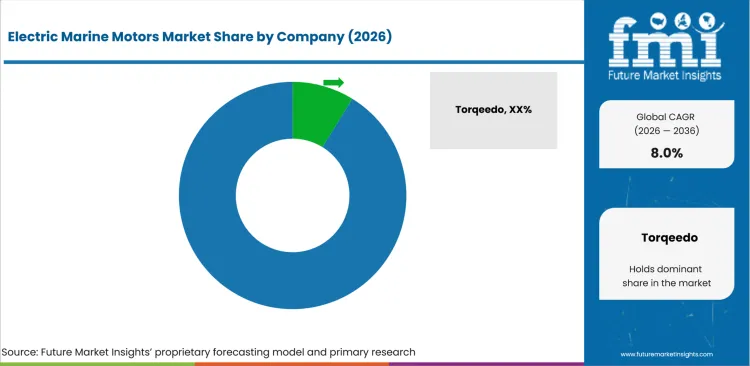
Competition divides between broad propulsion platforms, high-output specialists and outboard-focused manufacturers. Entry barriers include validation records and battery management systems that must work with propulsion controls and service procedures. Premium leisure orders reward quieter propulsion, but charging coverage and technical support still decide whether a vessel program can scale.
- Torqeedo, ePropulsion and Yamaha Motor cover broad recreational or commercial propulsion programs with established distribution and control-system integration.
- Evoy Vita and Molabo concentrate on higher-output or tightly integrated electric powertrains whose sale depends on vessel engineering.
- Mercury Marine, TEMO and Flux Marine extend electric propulsion through outboard channels with different power coverage, OEM relationships and service reach.
Competitive Benchmarking: Electric Marine Motors Market
| Company | Propulsion Power Breadth | Integration & Controls Depth | Deployment Breadth | Geographic Reach |
|---|---|---|---|---|
| Torqeedo | High | High | High | Global |
| ePropulsion | High | High | High | Global |
| Yamaha Motor | Medium | High | Medium | Global |
| Evoy Vita | High | High | High | Europe and North America |
| Molabo | Medium | High | Medium | Europe and selected international projects |
| Mercury Marine | Medium | High | Medium | Global dealer network |
| TEMO | Low | Low | Low | Europe and selected export markets |
| Flux Marine | Medium | High | Medium | North America and selected OEM programs |
Scoring basis: High propulsion breadth spans low-power through high-output or multiple propulsion forms. Medium covers several documented power classes and Low covers a narrow band. High integration includes controls plus battery, charging or energy-management interfaces. Medium documents partial energy integration and Low is motor-led. High deployment breadth covers commercial and recreational applications. Medium covers several vessel programs and Low identifies a narrow application set.
Key Developments in the Electric Marine Motors Market
- In January 2026, Molabo introduced the ARIES Jet Drive with Kaiser Bootsmanufaktur, delivering 50 kW continuous power through a 48-volt electric propulsion architecture.
- In March 2025, Yamaha Motor announced the next-generation HARMO boat control system for Japan, integrating electric propulsion with Helm Master EX and planning a June 2025 market launch.
- In March 2025, Evoy Vita and Frauscher strengthened their partnership around the 740 Mirage Air, with five electric boats already sold and the first delivery completed.
Key Players in the Electric Marine Motors Market
Broad Electric Propulsion Platforms
- Torqeedo
- ePropulsion
- Yamaha Motor
High-Output and Integrated Propulsion Specialists
- Evoy Vita
- Molabo
Outboard and OEM Propulsion Channels
- Mercury Marine
- TEMO
- Flux Marine
Electric Marine Motors Market - Report Scope
| Coverage field | Report scope |
|---|---|
| Market breakdown | By motor type, power rating, vessel type, cooling, sales channel and region. |
| Quantitative Units | USD billion. |
| Market Definition | Electric motors and integrated electric propulsion units used as primary or auxiliary propulsion in marine vessels. |
| Regions Covered | North America, Latin America, Western Europe, Eastern Europe, East Asia, South Asia and Pacific, and Middle East and Africa. |
| Countries Covered | Norway, Finland, Netherlands, Australia, USA, and 20+ countries included in the full report. |
| Key Companies Profiled | Torqeedo, ePropulsion, Yamaha Motor, Evoy Vita, Molabo, Mercury Marine, TEMO, Flux Marine. |
| Forecast Period | 2026 to 2036. |
| Approach | Primary and secondary research with market triangulation. |
Electric Marine Motors Market - Research Methodology
| Method | Approach |
|---|---|
| Primary Research | FMI analysts gathered input from manufacturers, service providers, technology developers, distributors, end users, procurement teams, and subject-matter experts. Interviews examined purchasing decisions, product or service evaluation, adoption barriers, approval requirements, pricing considerations, and expectations for technical or commercial support. Respondents were also asked what evidence is required before a trial, pilot, or initial order develops into regular purchasing. |
| Desk Research | Desk research covered government statistics, regulatory publications, trade data, industry associations, technical literature, standards, company filings, product information, and official corporate announcements. Sources were reviewed for relevance, publication date, geographic coverage, and consistency with the defined market scope. Claims relating to performance, applications, approvals, capacity, investment, and commercial activity were retained only when supported by credible public evidence. |
| Market Sizing and Forecasting | The market model combined the baseline value with historical performance, segment structure, pricing and volume indicators, adoption levels, company participation, and country-level demand conditions. Forecast assumptions considered economic activity, investment trends, regulatory developments, technology adoption, purchasing cycles, supply availability, and barriers to wider market use. Segment and regional estimates were reconciled before the final market total was calculated. |
| Data Validation | Estimates were checked against multiple independent indicators, including public data, company activity, trade patterns, industry developments, and findings from primary interviews. Validation also tested whether products, services, applications, and company revenues fell within the defined market boundaries. Adjacent categories, unsupported claims, overlapping revenues, and activities without direct market relevance were excluded to reduce double counting and maintain consistency across segments and countries. |
Electric Marine Motors Market by Segments
Electric Marine Motors Market segmented by Motor Type:
- Permanent magnet motors
- AC induction motors
- Brushless DC motors
- Synchronous reluctance motors
- Integrated motor-drive units
Electric Marine Motors Market segmented by Power Rating:
- Below 10 kW
- 10-50 kW
- 50-200 kW
- Above 200 kW
Electric Marine Motors Market segmented by Vessel Type:
- Recreational boats
- Workboats
- Ferries
- Fishing vessels
- Yachts
Electric Marine Motors Market segmented by Cooling:
- Air cooled
- Liquid cooled
- Seawater cooled
- Closed-loop cooled
Electric Marine Motors Market segmented by Sales Channel:
- Boat OEMs
- Propulsion integrators
- Aftermarket retrofit
- Marine distributors
Electric Marine Motors Market by Region:
- North America
- United States
- Canada
- Latin America
- Brazil
- Mexico
- Chile
- Rest of Latin America
- Western Europe
- Germany
- United Kingdom
- Italy
- Spain
- France
- Nordics
- Benelux
- Rest of Western Europe
- Eastern Europe
- Russia
- Poland
- Hungary
- Balkan and Baltic States
- Rest of Eastern Europe
- East Asia
- China
- Japan
- South Korea
- South Asia and Pacific
- India
- ASEAN
- Australia and New Zealand
- Rest of South Asia and Pacific
- Middle East and Africa
- Kingdom of Saudi Arabia
- Other GCC Countries
- Türkiye
- South Africa
- Other African Union Countries
- Rest of Middle East and Africa
Research Sources and Bibliography
- European Commission, Directorate-General for Mobility and Transport. (2025, January 10). New EU rules aiming to decarbonise the maritime sector take effect.
- Statens vegvesen. (2025, February 17). Feirer 10-årsdagen for grønn revolusjon til havs.
- ePropulsion. (2025, May 28). ePropulsion Powers France's First 40-Meter Fully Electric Catering Cruise Ship on the Seine.
- TEMO. (2025, June 13). TEMO 1000 electric outboard range test.
- Flux Marine. (2025, October 24). Introducing: Zodiac Powered by Flux Marine.
- Evoy Vita. (2025, October 30). Electric Innovation Hits the Working Waterfront in Maine.
- European Commission, Directorate-General for Climate Action. (2025, November 24). FAQ - Maritime transport in EU Emissions Trading System (ETS).
- European Environment Agency. (2026, February 10). Sustainability of Europe's mobility systems 2025: Energy infrastructure.
- USA Federal Transit Administration. (2026, April 6). FY 2026 Notice of Funding Opportunity: Passenger Ferry Program, Electric or Low-Emitting Ferry Pilot Program, and Ferry Service for Rural Communities Program.
- Norwegian Maritime Authority. (2025, April 15). Zero-emission requirements for the World Heritage fjords adopted.
- Finnish Transport and Communications Agency Traficom. (2025, October 28). Maritime transport's first year in the EU Emissions Trading System achieved its goals.
- Government of the Netherlands. (2026). Staatsblad 2026, 117.
- NSW Government. (2026, May 18). Green light to build first Aussie-made electric ferry.
- USA Federal Transit Administration. (2026, August 21). FTA Ferry Grant Program 2026 Selected Projects.
- Torqeedo. (2025, June 24). Torqeedo debuts Deep Blue 200i at Electric & Hybrid Marine Expo Europe.
- ePropulsion. (2025, June 18). ePropulsion Partners With Australia-Based Power Equipment To Meet Growing Electric Propulsion Demand.
- Yamaha Motor Co., Ltd. (2025, February 12). Outline of New Medium-Term Management Plan.
- Evoy Vita. (2025, April 3). Electric boats transform Fjord Tourism in Geiranger.
- Molabo. (2025, March 11). Molabo presents innovative drive technologies and new collaborations.
- Brunswick Corporation. (2025, May 7). Brunswick Corporation Wins Six Boating Industry 2025 Top Product Awards.
- TEMO. (2026, April 1). Underwater Engine Noise, Levels, and Impacts: The results of our study.
- Flux Marine. (2025, July 23). The Journey to Block Island.
- Molabo. (2026, January 18). Molabo Introduces ARIES Jet Drive in Partnership with Kaiser Bootsmanufaktur.
- Yamaha Motor Co., Ltd. (2025, March 13). Yamaha Motor to Introduce New Next-Generation HARMO Boat Control System to Japanese Market.
- Evoy Vita. (2025, March 6). Frauscher and Evoy Vita Strengthen Partnership.
- Torqeedo. (2025, January 10). Torqeedo electric outboards available from January 2025 through selected Yamaha dealers in Europe.
- Flux Marine. (2025, November 19). Flux Marine Secures $15M.
- ePropulsion. (2026, March 26). ePropulsion Opens South China's First CCS-Accredited Onshore Testing Platform for Green and Intelligent Vessels.
- Molabo. (2025, November 13). New Serial Hybrid System Featuring Integrated Fischer Panda Generators.
- TEMO. (2025, January 6). TEMO electric outboard motors certified with the Origine France Garantie label.
- Torqeedo. (2025, April 23). 20 Years of Electric Mobility: Torqeedo outboards now available at even more Yamaha dealers across Europe.
- Torqeedo. (2025, November 17). Premiere: Torqeedo unveils new outboard motors and system components at Metstrade 2025.
- ePropulsion. (2026, March 31). ePropulsion and SailGP Extend Longstanding Partnership Through 2027.
- Yamaha Motor Co., Ltd. (2026, July 23). Yamaha Motor to Join Proof of Concept Project with Finnish NPO Cefmof for Sauna Boat Utilizing Hydrogen Energy.
- Evoy Vita. (2025, November 18). Evoy Vita launches next-generation Breeze 120+ hp inboard.
- Molabo. (2026, July 6). Team Malizia's New IMOCA Launches with Molabo Hybrid System.
- Brunswick Corporation. (2025, June 9). Mercury Marine Sets Record at 2025 Venice Boat Show with Over 80% Share of Outboard Engines on Display.
- TEMO. (2026, May 26). TEMO·450: a highly repairable electric outboard according to the VRI index.
- Flux Marine. (2025, March 1). Stealth: Powered by Flux Marine.
This bibliography is provided for reader reference and is not exhaustive. The full report contains the complete reference list and detailed citations
This Report Answers
- How large is the electric marine motors market in 2026 and 2036?
- Which operating conditions convert emissions rules into electric propulsion orders?
- Why do permanent magnet motors account for 34.0% of motor type demand in 2026?
- Why does the below 10 kW band account for 22.0% of power rating demand in 2026?
- Why do recreational boats represent 32.0% of vessel type demand in 2026?
- How do the five profiled country growth rates differ from 2026 to 2036?
- Which integration constraints can delay otherwise suitable electric marine motor projects?
- Which companies compete through broad platforms, high-output systems and compact outboard channels?
Frequently Asked Questions
How big is the electric marine motors market in 2026?
The electric marine motors market is valued at USD 3.2 billion in 2026 and is projected to reach USD 7.0 billion by 2036. Growth follows zero-emission vessel procurement and duty cycles that can use dependable charging.
What is the CAGR of the electric marine motors market from 2026 to 2036?
The electric marine motors market is projected to grow at a CAGR of 8.0% between 2026 and 2036. Expansion is supported by ferry electrification, recreational applications and closer integration between propulsion controls and charging systems.
Which motor type leads the electric marine motors market?
The permanent magnet motors segment is expected to hold 34.0% of the electric marine motors market in 2026, attributable to compact torque delivery and efficient variable-speed operation. Commercial installations also benefit from inverter integration in space-limited propulsion rooms.
Which power rating leads the electric marine motors market?
The below 10 kW segment is expected to hold 22.0% of the electric marine motors market in 2026, driven by small-craft duty cycles with manageable battery mass. Tenders, dinghies and auxiliary sailboats provide practical entry points for standardized electric propulsion.
Which companies are active in the electric marine motors market?
Key companies operating in the electric marine motors market include Torqeedo, ePropulsion, Yamaha Motor, Evoy Vita, Molabo, Mercury Marine, TEMO, and Flux Marine. These companies compete through power coverage, control integration, OEM relationships and service reach.
Preview the report firsthand - request a free sample
Get SampleGet the brochure for pricing and purchase details.
Get PDFTable of Content
- Key Takeaways
- Market Size and CAGR
- Top Growth Driver
- Fastest Growing Segment
- Leading Region
- Key Companies
- Emerging Opportunities
- Executive Summary
- Global Market Outlook
- Demand-side Trends
- Supply-side Trends
- Technology Roadmap Analysis
- Analysis and Recommendations
- Analyst Perspective (What is happening? Why now? What should investors know?)
- Key Questions Answered
- How large is the market?
- What is the CAGR?
- What are key trends?
- Which region dominates?
- Who are the leaders?
- Market Overview
- Market Coverage / Taxonomy
- Market Definition / Scope / Limitations
- Research Methodology
- Chapter Orientation
- Analytical Lens and Working Hypotheses
- Market Structure, Signals, and Trend Drivers
- Benchmarking and Cross-market Comparability
- Market Sizing, Forecasting, and Opportunity Mapping
- Research Design and Evidence Framework
- Desk Research Programme (Secondary Evidence)
- Expert Input and Fieldwork (Primary Evidence)
- Tooling, Models, and Reference Databases
- Data Engineering and Model Build
- Quality Assurance and Audit Trail
- Market Background
- Market Dynamics (Drivers, Restraints, Opportunity, Trends)
- Scenario Forecast (Optimistic, Likely, Conservative)
- Impact Analysis
- AI Impact
- Sustainability Impact
- Regulatory Impact
- Technology Impact
- Consumer / Buyer Analysis
- Purchase Drivers
- Adoption Barriers
- Buyer Journey
- Opportunity Map Analysis
- Product Life Cycle Analysis
- Supply Chain Analysis
- Investment Feasibility Matrix
- Value Chain Analysis
- PESTLE and Porter's Analysis
- Regulatory Landscape
- Regional Parent Market Outlook
- Production and Consumption Statistics
- Import and Export Statistics
- Global Market Analysis and Forecast, 2021 to 2036
- Historical Market Size Value (USD Billion) Analysis, 2021 to 2025
- Current and Future Market Size Value (USD Billion) Projections, 2026 to 2036
- Y-o-Y Growth Trend Analysis
- Absolute $ Opportunity Analysis
- Global Market Pricing Analysis, 2021 to 2036
- Global Market Analysis and Forecast, By Motor Type, 2021 to 2036
- Introduction / Key Findings
- Historical Market Size Value (USD Billion) Analysis By Motor Type, 2021 to 2025
- Current and Future Market Size Value (USD Billion) Analysis and Forecast By Motor Type, 2026 to 2036
- Permanent magnet motors
- AC induction motors
- Brushless DC motors
- Synchronous reluctance motors
- Integrated motor-drive units
- Permanent magnet motors
- Y-o-Y Growth Trend Analysis By Motor Type, 2021 to 2025
- Absolute $ Opportunity Analysis By Motor Type, 2026 to 2036
- Global Market Analysis and Forecast, By Power Rating, 2021 to 2036
- Introduction / Key Findings
- Historical Market Size Value (USD Billion) Analysis By Power Rating, 2021 to 2025
- Current and Future Market Size Value (USD Billion) Analysis and Forecast By Power Rating, 2026 to 2036
- Below 10 kW
- 10–50 kW
- 50–200 kW
- Above 200 kW
- Below 10 kW
- Y-o-Y Growth Trend Analysis By Power Rating, 2021 to 2025
- Absolute $ Opportunity Analysis By Power Rating, 2026 to 2036
- Global Market Analysis and Forecast, By Vessel Type, 2021 to 2036
- Introduction / Key Findings
- Historical Market Size Value (USD Billion) Analysis By Vessel Type, 2021 to 2025
- Current and Future Market Size Value (USD Billion) Analysis and Forecast By Vessel Type, 2026 to 2036
- Recreational boats
- Workboats
- Ferries
- Fishing vessels
- Yachts
- Recreational boats
- Y-o-Y Growth Trend Analysis By Vessel Type, 2021 to 2025
- Absolute $ Opportunity Analysis By Vessel Type, 2026 to 2036
- Global Market Analysis and Forecast, By Cooling, 2021 to 2036
- Introduction / Key Findings
- Historical Market Size Value (USD Billion) Analysis By Cooling, 2021 to 2025
- Current and Future Market Size Value (USD Billion) Analysis and Forecast By Cooling, 2026 to 2036
- Air cooled
- Liquid cooled
- Seawater cooled
- Closed-loop cooled
- Air cooled
- Y-o-Y Growth Trend Analysis By Cooling, 2021 to 2025
- Absolute $ Opportunity Analysis By Cooling, 2026 to 2036
- Global Market Analysis and Forecast, By Sales Channel, 2021 to 2036
- Introduction / Key Findings
- Historical Market Size Value (USD Billion) Analysis By Sales Channel, 2021 to 2025
- Current and Future Market Size Value (USD Billion) Analysis and Forecast By Sales Channel, 2026 to 2036
- Boat OEMs
- Propulsion integrators
- Aftermarket retrofit
- Marine distributors
- Boat OEMs
- Y-o-Y Growth Trend Analysis By Sales Channel, 2021 to 2025
- Absolute $ Opportunity Analysis By Sales Channel, 2026 to 2036
- Global Market Analysis and Forecast, By Region, 2021 to 2036
- Introduction
- Historical Market Size Value (USD Billion) Analysis By Region, 2021 to 2025
- Current Market Size Value (USD Billion) Analysis and Forecast By Region, 2026 to 2036
- North America
- Latin America
- Western Europe
- Eastern Europe
- East Asia
- South Asia and Pacific
- Middle East & Africa
- Market Attractiveness Analysis By Region
- North America Market Analysis and Forecast, By Country, 2021 to 2036
- Historical Market Size Value (USD Billion) Trend Analysis By Market Taxonomy, 2021 to 2025
- Market Size Value (USD Billion) Forecast By Market Taxonomy, 2026 to 2036
- By Country
- USA
- Canada
- By Motor Type
- By Power Rating
- By Vessel Type
- By Cooling
- By Sales Channel
- By Country
- Market Attractiveness Analysis
- By Country
- By Motor Type
- By Power Rating
- By Vessel Type
- By Cooling
- By Sales Channel
- Key Takeaways
- Latin America Market Analysis and Forecast, By Country
- Historical Market Size Value (USD Billion) Trend Analysis By Market Taxonomy, 2021 to 2025
- Market Size Value (USD Billion) Forecast By Market Taxonomy, 2026 to 2036
- By Country
- Brazil
- Mexico
- Chile
- Rest of Latin America
- By Motor Type
- By Power Rating
- By Vessel Type
- By Cooling
- By Sales Channel
- By Country
- Market Attractiveness Analysis
- By Country
- By Motor Type
- By Power Rating
- By Vessel Type
- By Cooling
- By Sales Channel
- Key Takeaways
- Western Europe Market Analysis and Forecast, By Country
- Historical Market Size Value (USD Billion) Trend Analysis By Market Taxonomy, 2021 to 2025
- Market Size Value (USD Billion) Forecast By Market Taxonomy, 2026 to 2036
- By Country
- Germany
- UK
- Italy
- Spain
- France
- Nordic
- BENELUX
- Rest of Western Europe
- By Motor Type
- By Power Rating
- By Vessel Type
- By Cooling
- By Sales Channel
- By Country
- Market Attractiveness Analysis
- By Country
- By Motor Type
- By Power Rating
- By Vessel Type
- By Cooling
- By Sales Channel
- Key Takeaways
- Eastern Europe Market Analysis and Forecast, By Country
- Historical Market Size Value (USD Billion) Trend Analysis By Market Taxonomy, 2021 to 2025
- Market Size Value (USD Billion) Forecast By Market Taxonomy, 2026 to 2036
- By Country
- Russia
- Poland
- Hungary
- Balkan & Baltic
- Rest of Eastern Europe
- By Motor Type
- By Power Rating
- By Vessel Type
- By Cooling
- By Sales Channel
- By Country
- Market Attractiveness Analysis
- By Country
- By Motor Type
- By Power Rating
- By Vessel Type
- By Cooling
- By Sales Channel
- Key Takeaways
- East Asia Market Analysis and Forecast, By Country
- Historical Market Size Value (USD Billion) Trend Analysis By Market Taxonomy, 2021 to 2025
- Market Size Value (USD Billion) Forecast By Market Taxonomy, 2026 to 2036
- By Country
- China
- Japan
- South Korea
- By Motor Type
- By Power Rating
- By Vessel Type
- By Cooling
- By Sales Channel
- By Country
- Market Attractiveness Analysis
- By Country
- By Motor Type
- By Power Rating
- By Vessel Type
- By Cooling
- By Sales Channel
- Key Takeaways
- South Asia and Pacific Market Analysis and Forecast, By Country
- Historical Market Size Value (USD Billion) Trend Analysis By Market Taxonomy, 2021 to 2025
- Market Size Value (USD Billion) Forecast By Market Taxonomy, 2026 to 2036
- By Country
- India
- ASEAN
- Australia & New Zealand
- Rest of South Asia and Pacific
- By Motor Type
- By Power Rating
- By Vessel Type
- By Cooling
- By Sales Channel
- By Country
- Market Attractiveness Analysis
- By Country
- By Motor Type
- By Power Rating
- By Vessel Type
- By Cooling
- By Sales Channel
- Key Takeaways
- Middle East & Africa Market Analysis and Forecast, By Country
- Historical Market Size Value (USD Billion) Trend Analysis By Market Taxonomy, 2021 to 2025
- Market Size Value (USD Billion) Forecast By Market Taxonomy, 2026 to 2036
- By Country
- Kingdom of Saudi Arabia
- Other GCC Countries
- Türkiye
- South Africa
- Other African Union
- Rest of Middle East & Africa
- By Motor Type
- By Power Rating
- By Vessel Type
- By Cooling
- By Sales Channel
- By Country
- Market Attractiveness Analysis
- By Country
- By Motor Type
- By Power Rating
- By Vessel Type
- By Cooling
- By Sales Channel
- Key Takeaways
- Key Countries Market Analysis
- USA
- Pricing Analysis
- Market Share Analysis, 2025
- By Motor Type
- By Power Rating
- By Vessel Type
- By Cooling
- By Sales Channel
- Canada
- Pricing Analysis
- Market Share Analysis, 2025
- By Motor Type
- By Power Rating
- By Vessel Type
- By Cooling
- By Sales Channel
- Mexico
- Pricing Analysis
- Market Share Analysis, 2025
- By Motor Type
- By Power Rating
- By Vessel Type
- By Cooling
- By Sales Channel
- Brazil
- Pricing Analysis
- Market Share Analysis, 2025
- By Motor Type
- By Power Rating
- By Vessel Type
- By Cooling
- By Sales Channel
- Chile
- Pricing Analysis
- Market Share Analysis, 2025
- By Motor Type
- By Power Rating
- By Vessel Type
- By Cooling
- By Sales Channel
- Germany
- Pricing Analysis
- Market Share Analysis, 2025
- By Motor Type
- By Power Rating
- By Vessel Type
- By Cooling
- By Sales Channel
- UK
- Pricing Analysis
- Market Share Analysis, 2025
- By Motor Type
- By Power Rating
- By Vessel Type
- By Cooling
- By Sales Channel
- Italy
- Pricing Analysis
- Market Share Analysis, 2025
- By Motor Type
- By Power Rating
- By Vessel Type
- By Cooling
- By Sales Channel
- Spain
- Pricing Analysis
- Market Share Analysis, 2025
- By Motor Type
- By Power Rating
- By Vessel Type
- By Cooling
- By Sales Channel
- France
- Pricing Analysis
- Market Share Analysis, 2025
- By Motor Type
- By Power Rating
- By Vessel Type
- By Cooling
- By Sales Channel
- India
- Pricing Analysis
- Market Share Analysis, 2025
- By Motor Type
- By Power Rating
- By Vessel Type
- By Cooling
- By Sales Channel
- ASEAN
- Pricing Analysis
- Market Share Analysis, 2025
- By Motor Type
- By Power Rating
- By Vessel Type
- By Cooling
- By Sales Channel
- Australia & New Zealand
- Pricing Analysis
- Market Share Analysis, 2025
- By Motor Type
- By Power Rating
- By Vessel Type
- By Cooling
- By Sales Channel
- China
- Pricing Analysis
- Market Share Analysis, 2025
- By Motor Type
- By Power Rating
- By Vessel Type
- By Cooling
- By Sales Channel
- Japan
- Pricing Analysis
- Market Share Analysis, 2025
- By Motor Type
- By Power Rating
- By Vessel Type
- By Cooling
- By Sales Channel
- South Korea
- Pricing Analysis
- Market Share Analysis, 2025
- By Motor Type
- By Power Rating
- By Vessel Type
- By Cooling
- By Sales Channel
- Russia
- Pricing Analysis
- Market Share Analysis, 2025
- By Motor Type
- By Power Rating
- By Vessel Type
- By Cooling
- By Sales Channel
- Poland
- Pricing Analysis
- Market Share Analysis, 2025
- By Motor Type
- By Power Rating
- By Vessel Type
- By Cooling
- By Sales Channel
- Hungary
- Pricing Analysis
- Market Share Analysis, 2025
- By Motor Type
- By Power Rating
- By Vessel Type
- By Cooling
- By Sales Channel
- Kingdom of Saudi Arabia
- Pricing Analysis
- Market Share Analysis, 2025
- By Motor Type
- By Power Rating
- By Vessel Type
- By Cooling
- By Sales Channel
- Türkiye
- Pricing Analysis
- Market Share Analysis, 2025
- By Motor Type
- By Power Rating
- By Vessel Type
- By Cooling
- By Sales Channel
- South Africa
- Pricing Analysis
- Market Share Analysis, 2025
- By Motor Type
- By Power Rating
- By Vessel Type
- By Cooling
- By Sales Channel
- USA
- Market Structure Analysis
- Competition Dashboard
- Competition Benchmarking
- Market Share Analysis of Top Players
- By Regional
- By Motor Type
- By Power Rating
- By Vessel Type
- By Cooling
- By Sales Channel
- Emerging Startups
- Innovation Benchmarking
- Competition Analysis
- Competition Deep Dive
- Torqeedo
- Overview
- Product Portfolio
- Profitability by Market Segments
- Sales Footprint
- Strategy Overview
- Marketing Strategy
- Product Strategy
- Channel Strategy
- ePropulsion
- Kräutler Elektromaschinen
- Elco Motor Yachts
- Yamaha Motor
- Mercury Marine
- Evoy
- Molabo
- Oceanvolt
- TEMO
- Torqeedo
- Case Studies
- Success Stories
- Recent Developments
- Competition Deep Dive
- Assumptions & Acronyms Used


