

- Market Size (2026)
- USD 3.2 Bn
- Forecast (2036)
- USD 6.6 Bn
- CAGR (2026 to 2036)
- 7.4%
How big is Electric Brake Boosters Market in 2026?
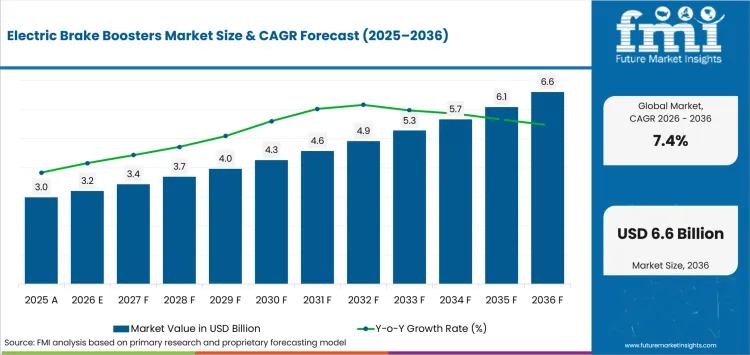
USD 3.2 billion in 2026 and USD 6.6 billion by 2036 at a 7.4% CAGR.
Demand for electric brake boosters is projected to expand at 7.4% CAGR between 2026 and 2036, increasing valuation from USD 3.2 billion to USD 6.6 billion. Electrified vehicles remove engine vacuum from many braking architectures and need regenerative braking systems that blend motor deceleration with friction pressure. The International Energy Agency recorded more than 17 million electric-car sales in 2024, exceeding one fifth of global car sales. That vehicle base widens the number of platforms where electronic pressure generation can replace conventional vacuum assistance.
Vehicle mix and platform timing change the adoption path even in regions with mature electronic braking. European Automobile Manufacturers’ Association data for the first five months of 2026 put battery-electric cars at 20.0% of EU registrations. That electrified mix increases calibration work in automotive brake systems because pressure control must blend regeneration with hydraulic fallback on each platform. Mixed powertrains favor electro-hydraulic architectures that reuse hydraulic wheel brakes during electrical-platform changes.
Key Takeaways
- Electrified powertrains and automated brake requests increase demand for vacuum-independent pressure generation with coordinated friction and regenerative braking.
- By booster type, electro-hydraulic boosters are estimated to hold 28.0% in 2026, owing to their use of mature hydraulic wheel brakes with electronic pressure control.
- Passenger cars are projected to account for 31.0% in 2026, driven by platform volumes that spread calibration and safety-validation cost over larger production runs.
- In 2026, 12 V systems are expected to lead the voltage category with 48.0% share, attributable to the established low-voltage control domain in light vehicles.
- Brake validation for fallback behavior, diagnostics and pedal feel can delay platform changes even if a new actuator improves packaging.
- Some of the key players in this market include Robert Bosch GmbH, AUMOVIO SE, ZF Friedrichshafen AG, Astemo, Ltd., Hyundai Mobis, ADVICS CO., LTD., Brembo N.V., and BWI Group.
Analyst Perspective
"Electric brake booster economics depend on platform reuse more than actuator price because OEMs must validate pedal feel, fallback behavior and software interfaces before launch. Suppliers earn more if one safety architecture can be calibrated for several powertrains without repeating full qualification."
- Nikhil Kaitwade, Principal Consultant, Future Market Insights
How is the electric brake boosters market segmented?
The electric brake boosters market is segmented by booster type, vehicle type, voltage, sales channel, application and region.
The electric brake boosters market is segmented by booster type, vehicle type, voltage, sales channel, application and region. Booster type covers electro-hydraulic, electromechanical, integrated control, vacuum-independent and brake-by-wire boosters. Vehicle type spans passenger cars, SUVs/crossovers, battery electric vehicles, hybrids and light commercial vehicles. Voltage includes 12 V, 48 V, 24 V and high-voltage-assisted designs. Sales channels include OEM direct supply, Tier-1 brake systems, replacement/service and platform co-development. Applications cover regenerative braking, ADAS brake assist, vacuum-free braking, ESC integration and autonomous-driving support.
What makes electro-hydraulic boosters central to the booster type category?
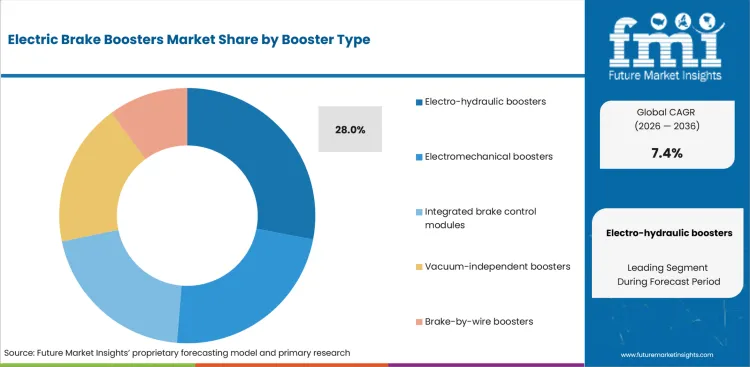
Electro-hydraulic boosters let OEMs decouple pedal input from pressure generation and retain proven hydraulic wheel brakes. That transition fits current by-wire HMI controllers because automakers can change boost and fallback logic without replacing every caliper. Bosch completed more than 3,300 kilometers of public-road testing with its hydraulic brake-by-wire system in January 2025 and planned market introduction from fall 2025.
- By booster type, electro-hydraulic boosters are estimated to hold 28.0% in 2026, owing to a lower migration burden than fully electromechanical wheel braking.
- The architecture gives chassis engineers electronic pressure control for regeneration and automated requests without abandoning familiar hydraulic wheel-end service.
Why do passenger cars lead the vehicle type category?
Passenger-car programs provide the volume needed to recover software calibration and functional-safety work over a large production run. The same core brake actuator can also serve internal-combustion, hybrid and battery-electric derivatives after vehicle-specific tuning. ADVICS announced in April 2025 that its cooperative regenerative braking system was adopted for Suzuki’s first mass-produced battery EV, the e VITARA, scheduled for sale in several regions.
- Passenger cars are projected to account for 31.0% in 2026, driven by repeated platform awards and the economics of shared brake hardware.
- Large passenger-vehicle ADAS programs also increase the value of fast autonomous pressure build and stable interaction with vehicle-dynamics controls.
How does OEM direct supply shape the sales channel category?
Electric brake boosters are designed into a vehicle before series production because pedal travel, diagnostics, fallback behavior and software interfaces are fixed during platform validation. ZF announced in January 2025 that a global OEM award would place electromechanical braking on nearly five million vehicles during the contract term. That contract scale makes OEM nomination more valuable than late replacement activity for safety-critical brake systems.
- OEM direct supply is forecast to represent 56.0% in 2026, attributable to early design-in and platform-specific safety approval.
- Direct sourcing also gives brake specialists earlier access to automotive brake components decisions that determine hydraulic layout, control software and production support.
What drives regenerative braking within the application category?
Regenerative braking requires the pressure actuator to cover the part of a stop that the traction motor cannot absorb. Battery state, temperature, road grip and vehicle speed change that split continuously. ADVICS stated in December 2025 that its new cooperative regenerative braking system for the Toyota RAV4 replaced a gear-pump pressure source with an electric cylinder and retained high control performance.
- Regenerative braking is estimated to hold 27.0% in 2026, supported by the need for predictable blending on electrified vehicles.
- The purchasing case also extends into energy recovery systems because smoother friction handover protects pedal consistency without sacrificing recoverable deceleration energy.
What are the drivers, restraints and opportunities in the Electric Brake Boosters Market?
Electrification raises demand for electronically commanded braking, safety validation extends nomination cycles, and localized by-wire platforms offer a route to larger system content.
- Driver: Integrated chassis software raises the value of brake actuators that can accept regenerative, driver-assistance and vehicle-motion commands from one control architecture.
- Restraint: Safety-critical qualification requires stable stopping performance and fallback behavior before an OEM can replace an incumbent electronic brake architecture.
- Opportunity: Local production and software adaptation can shorten the route from a global by-wire platform to region-specific OEM programs.
Brake actuation is becoming part of wider chassis control as OEMs separate steering and braking commands from mechanical linkages. Hyundai Mobis said in September 2025 that it had secured brake-by-wire and steer-by-wire technologies and was developing a single controller for vehicle-motion functions. That integration raises the value of electric boosters that expose predictable software interfaces to automotive ADAS and regenerative control without changing the driver’s requested deceleration.
Qualification slows supplier switching because electronic pressure generation cannot weaken stopping performance after a fault. In June 2026, NHTSA proposed removing manual brake-pedal requirements for ADS-only vehicles and preserving existing stopping-distance requirements. ADAS sensors can change how a brake request is generated, but the actuator still has to meet the applicable stopping standard after a fault during OEM validation programs.
Regional localization can turn a by-wire platform into a larger OEM opportunity once software, industrial support and vehicle integration are available close to the customer. Brembo and Ningbo Huaxiang signed joint-venture agreements in May 2026 to localize Sensify in China for large-scale application. That model gives brake-by-wire pedal simulators and related actuation software a clearer route into regional platforms than exporting a fixed hardware package with limited local engineering support.
Which country CAGRs are profiled in the Electric Brake Boosters Market?
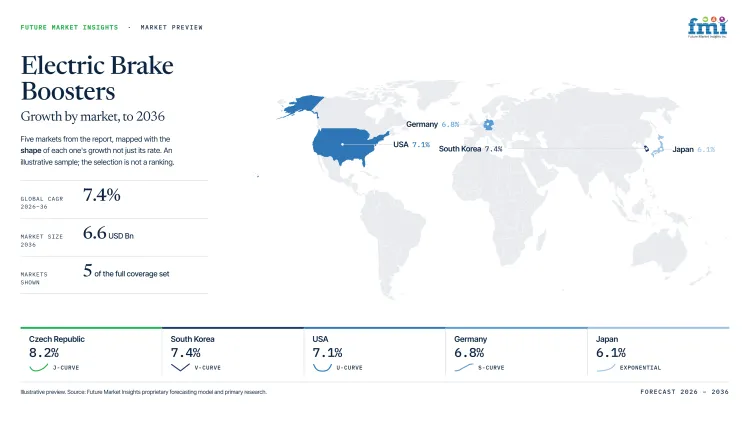
| Country | CAGR |
|---|---|
| Czech Republic | 8.2% |
| Mexico | 7.8% |
| South Korea | 7.4% |
| USA | 7.1% |
| Germany | 6.8% |
How do country-level CAGRs compare in the Electric Brake Boosters Market?
The profiled CAGRs cover a narrow 1.4-point range, with Czech Republic and Mexico forming the upper pair and Germany marking the lower boundary. South Korea and the USA occupy the middle band. The spacing reflects platform-conversion conditions more than present market scale, so similar growth rates can mask different nomination economics.
- Czech suppliers can cover nearby European programs from compact engineering networks.
- Mexico rewards brake platforms shared with USA-bound vehicle programs.
- South Korea places greater weight on controller integration during sourcing.
- USA regional engineering networks favor repeatable local validation support.
- Germany’s dense Tier-1 base raises incumbent competition during nominations.
Similar CAGRs therefore translate into different supplier entry conditions and design-win conversion rates. The full report provides country-level CAGR analysis across North America, Latin America, Western Europe, Eastern Europe, East Asia, South Asia and Pacific, and Middle East and Africa.
Country-wise Analysis
- Czech assembly plants operate as export hubs, so one brake nomination can feed several European vehicle programs built from the same platform family and justify nearby launch support through shared sourcing and launch programs. AutoSAP reported in January 2026 that electrified models represented 19.7% of Czech passenger-car production in 2025, which gives local engineering teams more electrified programs to calibrate during production ramp-up. Electric brake booster demand is forecast to rise at 8.2% CAGR over the forecast period, attributable to faster electrified output despite concentration in a few high-volume programs that can remove several years of expected volume after a missed nomination.
- Mexican brake programs serve high-volume North American assembly built around shared vehicle architectures, with light trucks imposing higher pressure and packaging demands than passenger-car-heavy mixes on those platforms during series launch at scale. Mexico is estimated to post 7.8% CAGR through 2036, driven by regional platform investment and USA-bound assembly, while local engineering near the main manufacturing corridor shortens launch support for brake calibration. INEGI reported in January 2026 that light trucks represented 77.2% of Mexico's 2025 light-vehicle production, a mix that raises durability and thermal requirements and penalizes companies without application teams near the main plants during local nomination.
- South Korean OEM groups develop braking and electrification systems close to domestic engineering centers, giving local Tier-1 teams direct access to platform validation and regenerative-blending calibration. KAMA's January 2026 data put electric-vehicle registration growth at 50.1% during 2025, giving domestic OEM programs a larger electrified base for brake calibration and validation. Adoption of electric brake boosters is projected to expand at 7.4% CAGR during the assessment period, tied to domestic electrification and export-platform development despite incumbent customer relationships that favor firms with local software calibration, production support and overseas compliance coverage for major export programs in Europe and North America.
- USA light-vehicle engineering must cover passenger cars, SUVs and trucks under one federal safety regime used by several major OEM groups, so brake systems need wide pressure capability and flexible packaging. The EPA's February 2026 Automotive Trends update said trucks accounted for 66% of model-year 2024 new-vehicle production under NHTSA definitions, which makes truck-focused calibration and local proving-ground support more relevant during nomination testing. Electric brake booster demand in the USA is forecast to advance at 7.1% CAGR by 2036, aided by electrified and automated chassis programs despite heavier vehicle classes extending thermal and deceleration validation before final nomination testing.
- German chassis programs place unusual weight on pedal feel, vehicle-dynamics integration and documented failure behavior on premium and high-speed vehicles before a new brake actuator receives a production nomination. Germany's electric brake boosters outlook is anticipated to advance at 6.8% CAGR over the assessment period, helped by local test capability that supports complex integration on premium vehicle platforms. In January 2026, the Federal Ministry for Economic Affairs and Energy recorded a 19.1% battery-electric share of German registrations in 2025, yet long qualification cycles protect incumbents and force new entrants to prove a clear technical advantage under demanding local validation programs.
Who are the notable companies in the Electric Brake Boosters Market?
Robert Bosch GmbH, AUMOVIO SE, ZF Friedrichshafen AG, Astemo, Ltd., Hyundai Mobis, ADVICS CO., LTD., Brembo N.V., and BWI Group are the notable companies serving this market.
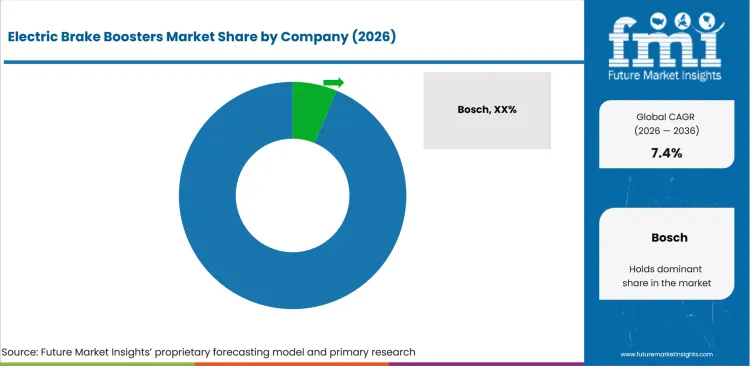
Competition centers on brake and chassis specialists with verified electronic actuation, vehicle-dynamics software and OEM launch support. Entry barriers come from validated safety architectures and platform engineering rather than component manufacturing alone. Several companies also serve adjacent automotive steering systems because OEMs increasingly source longitudinal and lateral control within shared software programs.
- Robert Bosch GmbH, AUMOVIO SE, ZF Friedrichshafen AG and Astemo, Ltd. cover integrated hydraulic or by-wire actuation with global OEM engineering support.
- Hyundai Mobis, ADVICS CO., LTD., Brembo N.V. and BWI Group compete in regenerative control, integrated chassis software or electromechanical braking routes.
Competitive Benchmarking: Electric Brake Boosters Market
| Company | Actuation Breadth | Regenerative / ADAS Control | Brake-by-Wire Readiness | Geographic Reach |
|---|---|---|---|---|
| Robert Bosch GmbH | High | High | High | Global |
| AUMOVIO SE | High | High | High | Global |
| ZF Friedrichshafen AG | High | High | High | Global |
| Astemo, Ltd. | Medium | High | Medium | Asia, Europe and North America |
| Hyundai Mobis | Medium | High | Medium | Asia, Europe and North America |
| ADVICS CO., LTD. | High | High | Medium | Asia, Europe and North America |
| Brembo N.V. | Medium | Medium | High | Global |
| BWI Group | High | High | High | North America, Europe and China |
Scoring basis: High actuation breadth requires at least three verified brake-control routes, Medium requires two and Low one. High regenerative/ADAS control requires blended braking plus automated or stability control, with Medium covering one function and Low lacking verified integration. High brake-by-wire readiness requires a production or customer-backed program, Medium requires validated development evidence and Low covers conventional electronic boosting. Geographic reach follows documented operating or customer regions.
Key Developments in the Electric Brake Boosters Market
- In July 2026, AUMOVIO SE and BMW Group entered a long-term supply and development agreement that extended use of the MK C2 integrated brake system into the mid-2030s.
- In May 2026, Brembo N.V. started series production of Sensify for a leading global vehicle manufacturer, moving its fluid-free by-wire platform into an industrial program.
- In April 2026, Robert Bosch GmbH disclosed hydraulic brake-by-wire supply contracts with five manufacturers and planned passenger-car volume production from mid-2026.
Key Players in the Electric Brake Boosters Market
Integrated brake and motion-control platforms
- Robert Bosch GmbH
- AUMOVIO SE
- ZF Friedrichshafen AG
Asian chassis and regenerative-control specialists
- Astemo, Ltd.
- Hyundai Mobis
- ADVICS CO., LTD.
Software-defined and performance braking specialists
- Brembo N.V.
- BWI Group
Electric Brake Boosters Market - Report Scope
| Coverage field | Report scope |
|---|---|
| Market breakdown | By booster type, vehicle type, voltage, sales channel, application and region. |
| Quantitative Units | USD billion. |
| Market Definition | Electric brake boosters and integrated electronic brake actuation modules that generate or control service-brake pressure without relying on engine vacuum, including electro-hydraulic and electromechanical architectures within the stated segmentation. |
| Regions Covered | North America, Latin America, Western Europe, Eastern Europe, East Asia, South Asia and Pacific, and Middle East and Africa. |
| Countries Covered | Czech Republic, Mexico, South Korea, USA, Germany, and 20+ countries included in the full report. |
| Key Companies Profiled | Robert Bosch GmbH, AUMOVIO SE, ZF Friedrichshafen AG, Astemo, Ltd., Hyundai Mobis, ADVICS CO., LTD., Brembo N.V., and BWI Group. |
| Forecast Period | 2026 to 2036. |
| Approach | Primary and secondary research with market triangulation. |
Electric Brake Boosters Market - Research Methodology
| Method | Approach |
|---|---|
| Primary Research | FMI analysts gathered input from manufacturers, service providers, technology developers, distributors, end users, procurement teams, and subject-matter experts. Interviews examined purchasing decisions, product or service evaluation, adoption barriers, approval requirements, pricing considerations, and expectations for technical or commercial support. Respondents were also asked what evidence is required before a trial, pilot, or initial order develops into regular purchasing. |
| Desk Research | Desk research covered government statistics, regulatory publications, trade data, industry associations, technical literature, standards, company filings, product information, and official corporate announcements. Sources were reviewed for relevance, publication date, geographic coverage, and consistency with the defined market scope. Claims relating to performance, applications, approvals, capacity, investment, and commercial activity were retained only when supported by credible public evidence. |
| Market Sizing and Forecasting | The market model combined the baseline value with historical performance, segment structure, pricing and volume indicators, adoption levels, company participation, and country-level demand conditions. Forecast assumptions considered economic activity, investment trends, regulatory developments, technology adoption, purchasing cycles, supply availability, and barriers to wider market use. Segment and regional estimates were reconciled before the final market total was calculated. |
| Data Validation | Estimates were checked against multiple independent indicators, including public data, company activity, trade patterns, industry developments, and findings from primary interviews. Validation also tested whether products, services, applications, and company revenues fell within the defined market boundaries. Adjacent categories, unsupported claims, overlapping revenues, and activities without direct market relevance were excluded to reduce double counting and maintain consistency across segments and countries. |
Electric Brake Boosters Market by Segments
Electric Brake Boosters Market segmented by Booster Type:
- Electro-hydraulic boosters
- Electromechanical boosters
- Integrated brake control modules
- Vacuum-independent boosters
- Brake-by-wire boosters
Electric Brake Boosters Market segmented by Vehicle Type:
- Passenger cars
- SUVs/crossovers
- Battery electric vehicles
- Hybrid vehicles
- Light commercial vehicles
Electric Brake Boosters Market segmented by Voltage:
- 12 V
- 48 V
- 24 V
- High-voltage assisted
Electric Brake Boosters Market segmented by Sales Channel:
- OEM direct supply
- Tier-1 brake systems
- Replacement/service channel
- Platform co-development
Electric Brake Boosters Market segmented by Application:
- Regenerative braking
- ADAS brake assist
- Vacuum-free braking
- ESC integration
- Autonomous driving support
Electric Brake Boosters Market by Region:
- North America
- United States
- Canada
- Latin America
- Brazil
- Mexico
- Chile
- Rest of Latin America
- Western Europe
- Germany
- United Kingdom
- Italy
- Spain
- France
- Nordics
- Benelux
- Rest of Western Europe
- Eastern Europe
- Russia
- Poland
- Hungary
- Balkan and Baltic States
- Rest of Eastern Europe
- East Asia
- China
- Japan
- South Korea
- South Asia and Pacific
- India
- ASEAN
- Australia and New Zealand
- Rest of South Asia and Pacific
- Middle East and Africa
- Kingdom of Saudi Arabia
- Other GCC Countries
- Türkiye
- South Africa
- Other African Union Countries
- Rest of Middle East and Africa
Research Sources and Bibliography
- International Energy Agency. (2025). Global EV Outlook 2025: Trends in electric car markets.
- European Automobile Manufacturers’ Association. (2026, June 23). New car registrations: +4% in May 2026 year-to-date; battery-electric 20% market share.
- Robert Bosch GmbH. (2025, January 28). With brake-by-wire from Bosch to the Arctic Circle.
- ADVICS CO., LTD. (2025, April 22). ADVICS brake products adopted for Suzuki’s first battery EV “e VITARA”.
- ZF Friedrichshafen AG. (2025, January 6). ZF secures substantial brake-by-wire technology business for light vehicles.
- ADVICS CO., LTD. (2025, December 24). ADVICS’ new Cooperative regenerative braking system adopted for Toyota RAV4.
- Hyundai Mobis. (2025, September 10). Hyundai Mobis Targets Global Top 3 with Electrification, Integration, and UX Innovation.
- National Highway Traffic Safety Administration. (2026, June 25). Transportation Department launches updates to brake pedal requirements for automated vehicles.
- Brembo N.V. (2026, May 22). Brembo and Ningbo Huaxiang Join Forces to Advance a New Era of Braking Technology.
- Automotive Industry Association of the Czech Republic. (2026, January 27). 2025: Second strongest year in passenger car production, record year for bus production.
- Instituto Nacional de Estadística y Geografía. (2026, January 9). Registro Administrativo de la Industria Automotriz de Vehículos Ligeros (RAIAVL).
- Korea Automobile & Mobility Association. (2026, January 20). 2025 domestic electric vehicle market rebounds 50.1% after two years of decline.
- USA Environmental Protection Agency. (2026, February 19). Highlights of the Automotive Trends Report.
- Federal Ministry for Economic Affairs and Energy, Germany. (2026, January 27). Gute Aussichten fürs Herumstromern.
- AUMOVIO SE. (2026, July 30). AUMOVIO and BMW Group expand partnership in electronics and brake technologies.
- Brembo N.V. (2026, May 4). The New Standard Begins: SENSIFY by Brembo Enters Production.
- Robert Bosch GmbH. (2026, April 23). Auto China: Bosch pushes ahead with Level 3 highly automated driving.
- Robert Bosch GmbH. (2026, April 20). Bosch by-wire brake actuator and ESP: Testing in Sweden.
- AUMOVIO SE. (2025, July 31). IAA Mobility 2025.
- AUMOVIO SE. (2026, February 2). Safety first: Leapmotor relies on AUMOVIO solutions for its most recent models.
- ZF Friedrichshafen AG. (2025, July 10). Braking Evolution: ZF brings to market a comprehensive Brake-by-Wire portfolio.
- ZF Friedrichshafen AG. (2025, September 8). Steering, braking, electrification: ZF presents technologies for software-defined chassis and e-mobility at the IAA Mobility 2025.
- Astemo, Ltd. (2025, June 11). Astemo showcases Smart Brake and advanced chassis technologies.
- Hyundai Mobis. (2025, December 9). Hyundai Mobis to Unveil 30+ New Technologies at CES 2026, Aiming to Strengthen Global OEM Partnerships.
- Astemo, Ltd. (2026, August 6). Astemo to absorb Astemo Ueda through merger to strengthen brake technology competitiveness.
- Hyundai Mobis. (2026, March 3). Hyundai Mobis Invites 10 Global Customers to Swedish Winter Testing Ground to Showcase Core Technologies in Extreme Cold Conditions.
- ADVICS CO., LTD. (2025, October 28). New Cooperative regenerative braking system to be exhibited for the first time at AISIN booth at Japan Mobility Show 2025.
- Brembo N.V. (2025, April 21). Brembo Inspiration Lab @ Shanghai.
- Brembo N.V. (2026, February 9). JAC Group and Brembo Sign Strategic Partnership to Drive Innovation for Future Mobility.
- BWI Group. (2026, July 24). Optimising brake pedal feel through software - iDBC (1-BOX).
This bibliography is provided for reader reference and is not exhaustive. The full report contains the complete reference list and detailed citations
This Report Answers
- How large is the electric brake boosters market in 2026 and 2036?
- What architecture changes increase demand for vacuum-independent brake actuation?
- Why do electro-hydraulic boosters lead booster type in 2026?
- How do passenger-car volumes affect qualification economics?
- Why does OEM direct supply lead the sales channel?
- How does regeneration change brake pressure-control requirements?
- Why do profiled country CAGRs differ?
- Which companies develop electronic actuation and brake-by-wire systems?
Frequently Asked Questions
How big is the electric brake boosters market in 2026?
The electric brake boosters market is valued at USD 3.2 billion in 2026 and is projected to reach USD 6.6 billion by 2036. Electrified platforms need vacuum-independent pressure control.
What is the CAGR of the electric brake boosters market from 2026 to 2036?
The electric brake boosters market is projected to grow at a CAGR of 7.4% between 2026 and 2036. Regenerative braking and automated brake requests require electronic pressure control.
Which booster type leads the electric brake boosters market?
The electro-hydraulic boosters segment is expected to hold 28.0% of the electric brake boosters market in 2026, attributable to electronic pressure control with proven hydraulic wheel brakes. Hydraulic wheel-end reuse limits platform migration risk.
Which sales channel leads the electric brake boosters market?
The OEM direct supply segment is projected to represent 56.0% of the electric brake boosters market in 2026, driven by early design-in and safety approval. Platform nomination fixes software interfaces before production.
Which countries are projected to record the highest growth in the electric brake boosters market?
Czech Republic is projected to grow at 8.2% CAGR, followed by Mexico at 7.8% and South Korea at 7.4% through 2036. Production scale and platform engineering shape growth.
Which companies are active in the electric brake boosters market?
Key companies operating in the electric brake boosters market include Robert Bosch GmbH, AUMOVIO SE, ZF Friedrichshafen AG, Astemo, Ltd., Hyundai Mobis, ADVICS CO., LTD., Brembo N.V., and BWI Group. Competition centers on electronic actuation and by-wire launch support.
Preview the report firsthand - request a free sample
Get SampleGet the brochure for pricing and purchase details.
Get PDFTable of Content
- Key Takeaways
- Market Size and CAGR
- Top Growth Driver
- Fastest Growing Segment
- Leading Region
- Key Companies
- Emerging Opportunities
- Executive Summary
- Global Market Outlook
- Demand-side Trends
- Supply-side Trends
- Technology Roadmap Analysis
- Analysis and Recommendations
- Analyst Perspective (What is happening? Why now? What should investors know?)
- Key Questions Answered
- How large is the market?
- What is the CAGR?
- What are key trends?
- Which region dominates?
- Who are the leaders?
- Market Overview
- Market Coverage / Taxonomy
- Market Definition / Scope / Limitations
- Research Methodology
- Chapter Orientation
- Analytical Lens and Working Hypotheses
- Market Structure, Signals, and Trend Drivers
- Benchmarking and Cross-market Comparability
- Market Sizing, Forecasting, and Opportunity Mapping
- Research Design and Evidence Framework
- Desk Research Programme (Secondary Evidence)
- Expert Input and Fieldwork (Primary Evidence)
- Tooling, Models, and Reference Databases
- Data Engineering and Model Build
- Quality Assurance and Audit Trail
- Market Background
- Market Dynamics (Drivers, Restraints, Opportunity, Trends)
- Scenario Forecast (Optimistic, Likely, Conservative)
- Impact Analysis
- AI Impact
- Sustainability Impact
- Regulatory Impact
- Technology Impact
- Consumer / Buyer Analysis
- Purchase Drivers
- Adoption Barriers
- Buyer Journey
- Opportunity Map Analysis
- Product Life Cycle Analysis
- Supply Chain Analysis
- Investment Feasibility Matrix
- Value Chain Analysis
- PESTLE and Porter's Analysis
- Regulatory Landscape
- Regional Parent Market Outlook
- Production and Consumption Statistics
- Import and Export Statistics
- Global Market Analysis and Forecast, 2021 to 2036
- Historical Market Size Value (USD Billion) Analysis, 2021 to 2025
- Current and Future Market Size Value (USD Billion) Projections, 2026 to 2036
- Y-o-Y Growth Trend Analysis
- Absolute $ Opportunity Analysis
- Global Market Pricing Analysis, 2021 to 2036
- Global Market Analysis and Forecast, By Booster Type, 2021 to 2036
- Introduction / Key Findings
- Historical Market Size Value (USD Billion) Analysis By Booster Type, 2021 to 2025
- Current and Future Market Size Value (USD Billion) Analysis and Forecast By Booster Type, 2026 to 2036
- Electro-hydraulic boosters
- Electromechanical boosters
- Integrated brake control modules
- Vacuum-independent boosters
- Brake-by-wire boosters
- Electro-hydraulic boosters
- Y-o-Y Growth Trend Analysis By Booster Type, 2021 to 2025
- Absolute $ Opportunity Analysis By Booster Type, 2026 to 2036
- Global Market Analysis and Forecast, By Vehicle Type, 2021 to 2036
- Introduction / Key Findings
- Historical Market Size Value (USD Billion) Analysis By Vehicle Type, 2021 to 2025
- Current and Future Market Size Value (USD Billion) Analysis and Forecast By Vehicle Type, 2026 to 2036
- Passenger cars
- SUVs/crossovers
- Battery electric vehicles
- Hybrid vehicles
- Light commercial vehicles
- Passenger cars
- Y-o-Y Growth Trend Analysis By Vehicle Type, 2021 to 2025
- Absolute $ Opportunity Analysis By Vehicle Type, 2026 to 2036
- Global Market Analysis and Forecast, By Voltage, 2021 to 2036
- Introduction / Key Findings
- Historical Market Size Value (USD Billion) Analysis By Voltage, 2021 to 2025
- Current and Future Market Size Value (USD Billion) Analysis and Forecast By Voltage, 2026 to 2036
- 12 V
- 48 V
- 24 V
- High-voltage assisted
- 12 V
- Y-o-Y Growth Trend Analysis By Voltage, 2021 to 2025
- Absolute $ Opportunity Analysis By Voltage, 2026 to 2036
- Global Market Analysis and Forecast, By Sales Channel, 2021 to 2036
- Introduction / Key Findings
- Historical Market Size Value (USD Billion) Analysis By Sales Channel, 2021 to 2025
- Current and Future Market Size Value (USD Billion) Analysis and Forecast By Sales Channel, 2026 to 2036
- OEM direct supply
- Tier-1 brake systems
- Replacement/service channel
- Platform co-development
- OEM direct supply
- Y-o-Y Growth Trend Analysis By Sales Channel, 2021 to 2025
- Absolute $ Opportunity Analysis By Sales Channel, 2026 to 2036
- Global Market Analysis and Forecast, By Application, 2021 to 2036
- Introduction / Key Findings
- Historical Market Size Value (USD Billion) Analysis By Application, 2021 to 2025
- Current and Future Market Size Value (USD Billion) Analysis and Forecast By Application, 2026 to 2036
- Regenerative braking
- ADAS brake assist
- Vacuum-free braking
- ESC integration
- Autonomous driving support
- Regenerative braking
- Y-o-Y Growth Trend Analysis By Application, 2021 to 2025
- Absolute $ Opportunity Analysis By Application, 2026 to 2036
- Global Market Analysis and Forecast, By Region, 2021 to 2036
- Introduction
- Historical Market Size Value (USD Billion) Analysis By Region, 2021 to 2025
- Current Market Size Value (USD Billion) Analysis and Forecast By Region, 2026 to 2036
- North America
- Latin America
- Western Europe
- Eastern Europe
- East Asia
- South Asia and Pacific
- Middle East & Africa
- Market Attractiveness Analysis By Region
- North America Market Analysis and Forecast, By Country, 2021 to 2036
- Historical Market Size Value (USD Billion) Trend Analysis By Market Taxonomy, 2021 to 2025
- Market Size Value (USD Billion) Forecast By Market Taxonomy, 2026 to 2036
- By Country
- USA
- Canada
- By Booster Type
- By Vehicle Type
- By Voltage
- By Sales Channel
- By Application
- By Country
- Market Attractiveness Analysis
- By Country
- By Booster Type
- By Vehicle Type
- By Voltage
- By Sales Channel
- By Application
- Key Takeaways
- Latin America Market Analysis and Forecast, By Country
- Historical Market Size Value (USD Billion) Trend Analysis By Market Taxonomy, 2021 to 2025
- Market Size Value (USD Billion) Forecast By Market Taxonomy, 2026 to 2036
- By Country
- Brazil
- Mexico
- Chile
- Rest of Latin America
- By Booster Type
- By Vehicle Type
- By Voltage
- By Sales Channel
- By Application
- By Country
- Market Attractiveness Analysis
- By Country
- By Booster Type
- By Vehicle Type
- By Voltage
- By Sales Channel
- By Application
- Key Takeaways
- Western Europe Market Analysis and Forecast, By Country
- Historical Market Size Value (USD Billion) Trend Analysis By Market Taxonomy, 2021 to 2025
- Market Size Value (USD Billion) Forecast By Market Taxonomy, 2026 to 2036
- By Country
- Germany
- UK
- Italy
- Spain
- France
- Nordic
- BENELUX
- Rest of Western Europe
- By Booster Type
- By Vehicle Type
- By Voltage
- By Sales Channel
- By Application
- By Country
- Market Attractiveness Analysis
- By Country
- By Booster Type
- By Vehicle Type
- By Voltage
- By Sales Channel
- By Application
- Key Takeaways
- Eastern Europe Market Analysis and Forecast, By Country
- Historical Market Size Value (USD Billion) Trend Analysis By Market Taxonomy, 2021 to 2025
- Market Size Value (USD Billion) Forecast By Market Taxonomy, 2026 to 2036
- By Country
- Russia
- Poland
- Hungary
- Balkan & Baltic
- Rest of Eastern Europe
- By Booster Type
- By Vehicle Type
- By Voltage
- By Sales Channel
- By Application
- By Country
- Market Attractiveness Analysis
- By Country
- By Booster Type
- By Vehicle Type
- By Voltage
- By Sales Channel
- By Application
- Key Takeaways
- East Asia Market Analysis and Forecast, By Country
- Historical Market Size Value (USD Billion) Trend Analysis By Market Taxonomy, 2021 to 2025
- Market Size Value (USD Billion) Forecast By Market Taxonomy, 2026 to 2036
- By Country
- China
- Japan
- South Korea
- By Booster Type
- By Vehicle Type
- By Voltage
- By Sales Channel
- By Application
- By Country
- Market Attractiveness Analysis
- By Country
- By Booster Type
- By Vehicle Type
- By Voltage
- By Sales Channel
- By Application
- Key Takeaways
- South Asia and Pacific Market Analysis and Forecast, By Country
- Historical Market Size Value (USD Billion) Trend Analysis By Market Taxonomy, 2021 to 2025
- Market Size Value (USD Billion) Forecast By Market Taxonomy, 2026 to 2036
- By Country
- India
- ASEAN
- Australia & New Zealand
- Rest of South Asia and Pacific
- By Booster Type
- By Vehicle Type
- By Voltage
- By Sales Channel
- By Application
- By Country
- Market Attractiveness Analysis
- By Country
- By Booster Type
- By Vehicle Type
- By Voltage
- By Sales Channel
- By Application
- Key Takeaways
- Middle East & Africa Market Analysis and Forecast, By Country
- Historical Market Size Value (USD Billion) Trend Analysis By Market Taxonomy, 2021 to 2025
- Market Size Value (USD Billion) Forecast By Market Taxonomy, 2026 to 2036
- By Country
- Kingdom of Saudi Arabia
- Other GCC Countries
- Türkiye
- South Africa
- Other African Union
- Rest of Middle East & Africa
- By Booster Type
- By Vehicle Type
- By Voltage
- By Sales Channel
- By Application
- By Country
- Market Attractiveness Analysis
- By Country
- By Booster Type
- By Vehicle Type
- By Voltage
- By Sales Channel
- By Application
- Key Takeaways
- Key Countries Market Analysis
- USA
- Pricing Analysis
- Market Share Analysis, 2025
- By Booster Type
- By Vehicle Type
- By Voltage
- By Sales Channel
- By Application
- Canada
- Pricing Analysis
- Market Share Analysis, 2025
- By Booster Type
- By Vehicle Type
- By Voltage
- By Sales Channel
- By Application
- Mexico
- Pricing Analysis
- Market Share Analysis, 2025
- By Booster Type
- By Vehicle Type
- By Voltage
- By Sales Channel
- By Application
- Brazil
- Pricing Analysis
- Market Share Analysis, 2025
- By Booster Type
- By Vehicle Type
- By Voltage
- By Sales Channel
- By Application
- Chile
- Pricing Analysis
- Market Share Analysis, 2025
- By Booster Type
- By Vehicle Type
- By Voltage
- By Sales Channel
- By Application
- Germany
- Pricing Analysis
- Market Share Analysis, 2025
- By Booster Type
- By Vehicle Type
- By Voltage
- By Sales Channel
- By Application
- UK
- Pricing Analysis
- Market Share Analysis, 2025
- By Booster Type
- By Vehicle Type
- By Voltage
- By Sales Channel
- By Application
- Italy
- Pricing Analysis
- Market Share Analysis, 2025
- By Booster Type
- By Vehicle Type
- By Voltage
- By Sales Channel
- By Application
- Spain
- Pricing Analysis
- Market Share Analysis, 2025
- By Booster Type
- By Vehicle Type
- By Voltage
- By Sales Channel
- By Application
- France
- Pricing Analysis
- Market Share Analysis, 2025
- By Booster Type
- By Vehicle Type
- By Voltage
- By Sales Channel
- By Application
- India
- Pricing Analysis
- Market Share Analysis, 2025
- By Booster Type
- By Vehicle Type
- By Voltage
- By Sales Channel
- By Application
- ASEAN
- Pricing Analysis
- Market Share Analysis, 2025
- By Booster Type
- By Vehicle Type
- By Voltage
- By Sales Channel
- By Application
- Australia & New Zealand
- Pricing Analysis
- Market Share Analysis, 2025
- By Booster Type
- By Vehicle Type
- By Voltage
- By Sales Channel
- By Application
- China
- Pricing Analysis
- Market Share Analysis, 2025
- By Booster Type
- By Vehicle Type
- By Voltage
- By Sales Channel
- By Application
- Japan
- Pricing Analysis
- Market Share Analysis, 2025
- By Booster Type
- By Vehicle Type
- By Voltage
- By Sales Channel
- By Application
- South Korea
- Pricing Analysis
- Market Share Analysis, 2025
- By Booster Type
- By Vehicle Type
- By Voltage
- By Sales Channel
- By Application
- Russia
- Pricing Analysis
- Market Share Analysis, 2025
- By Booster Type
- By Vehicle Type
- By Voltage
- By Sales Channel
- By Application
- Poland
- Pricing Analysis
- Market Share Analysis, 2025
- By Booster Type
- By Vehicle Type
- By Voltage
- By Sales Channel
- By Application
- Hungary
- Pricing Analysis
- Market Share Analysis, 2025
- By Booster Type
- By Vehicle Type
- By Voltage
- By Sales Channel
- By Application
- Kingdom of Saudi Arabia
- Pricing Analysis
- Market Share Analysis, 2025
- By Booster Type
- By Vehicle Type
- By Voltage
- By Sales Channel
- By Application
- Türkiye
- Pricing Analysis
- Market Share Analysis, 2025
- By Booster Type
- By Vehicle Type
- By Voltage
- By Sales Channel
- By Application
- South Africa
- Pricing Analysis
- Market Share Analysis, 2025
- By Booster Type
- By Vehicle Type
- By Voltage
- By Sales Channel
- By Application
- USA
- Market Structure Analysis
- Competition Dashboard
- Competition Benchmarking
- Market Share Analysis of Top Players
- By Regional
- By Booster Type
- By Vehicle Type
- By Voltage
- By Sales Channel
- By Application
- Emerging Startups
- Innovation Benchmarking
- Competition Analysis
- Competition Deep Dive
- Bosch
- Overview
- Product Portfolio
- Profitability by Market Segments
- Sales Footprint
- Strategy Overview
- Marketing Strategy
- Product Strategy
- Channel Strategy
- Continental
- ZF Friedrichshafen
- Hitachi Astemo
- Mando
- ADVICS
- Brembo
- Aisin
- Nissin Kogyo
- BWI Group
- Bosch
- Case Studies
- Success Stories
- Recent Developments
- Competition Deep Dive
- Assumptions & Acronyms Used


