

- Market Size (2026)
- USD 539.0 Mn
- Forecast (2036)
- USD 1290.0 Mn
- CAGR (2026 to 2036)
- 9.1%
How big is Electric Commercial Vehicle Thermal Management Systems Market size?
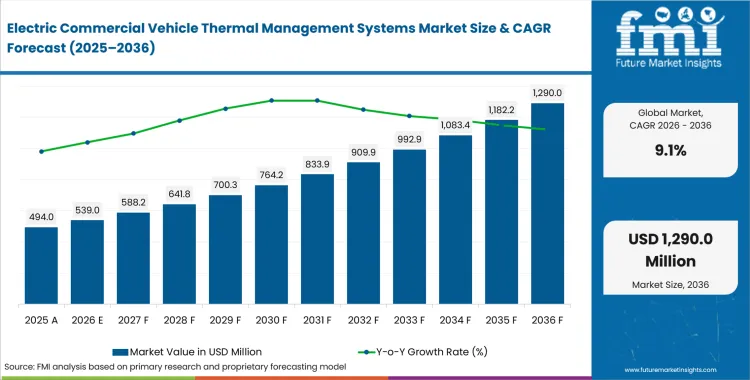
USD 539.0 million in 2026 and USD 1,290.0 million by 2036 at a 9.1% CAGR.
Demand for electric commercial vehicle thermal management systems is projected to expand at 9.1% CAGR between 2026 and 2036, increasing valuation from USD 539.0 million in 2026 to USD 1,290.0 million by 2036. Commercial fleets require well-coordinated battery cooling and cabin heating systems to handle long operating cycles and frequent charging. In August 2025, the European Automobile Manufacturers’ Association listed at least 45 zero-emission truck models. This growing variety of available models creates more opportunities and increases the demand for adaptable thermal management designs across specialized fleet applications.
Fleet operators present around the world, focus on different priorities on adopting such systems. Fleet programs in the United States and Germany prioritize dependable cold-weather performance and reliable ongoing service. Operators in China and India emphasize locally supported parts and faster installation schedules. In its January 2026 release, the European Automobile Manufacturers’ Association reported stating electrically chargeable trucks to have accounted for 4.2% of European Union registrations during 2025. It reflects the transition to electric vehicles happening at different speeds across established commercial fleets. Such regional differences increase the demand for customizable thermal systems backed by country-specific engineering and dependable local support.
Key Takeaways for the Electric Commercial Vehicle Thermal Management Systems Market
- Demand for electric commercial vehicle thermal management systems is driven by fleet electrification, as battery packs and cabins require coordinated temperature control across demanding duty cycles.
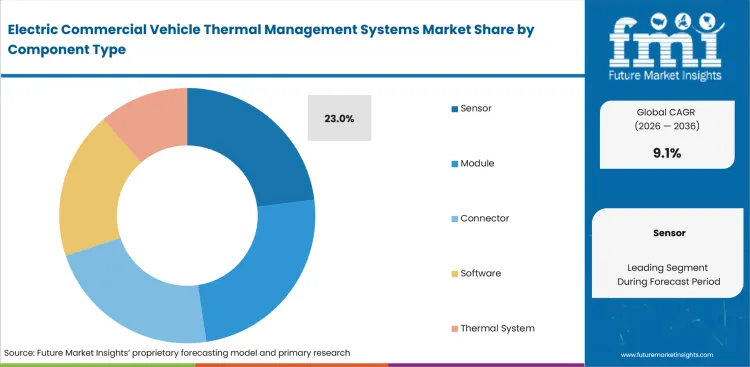
- Sensor is forecast to garner 23.0% share of component type in 2026, influenced by continuous temperature measurement and fault detection across integrated coolant circuits.
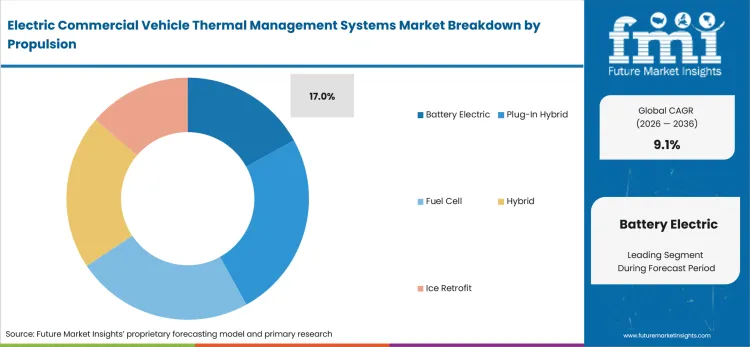
- Battery electric is estimated to lead propulsion with 17.0% share in 2026, guided by battery conditioning and heat-pump requirements across commercial platforms.
- Capital intensity and country-specific qualification processes restrain deployment across smaller fleets and regional operators.
- Competition focusses on DENSO Corporation, Valeo, MAHLE GmbH, Hanon Systems, Modine Manufacturing Company, BorgWarner Inc., Webasto Group, and Robert Bosch GmbH, with providers differentiating based on integrated thermal capabilities and commercial vehicle engineering support.
Analyst Perspective
“Thermal management is moving beyond a supporting engineering function and becoming a core measure of electric commercial vehicle performance. Fleet operators increasingly assess how effectively each system controls cabin conditions and limits energy loss across demanding routes. Suppliers combining responsive hardware with intelligent controls are able to extend component life and improve ownership economics. Long-term leadership are likely to come from solutions delivering consistent thermal stability across vehicle loads and operating schedules.”
- Nikhil Kaitwade, Principal Analyst for Automotive at Future Market Insights
How is Electric Commercial Vehicle Thermal Management Systems Market segmented?
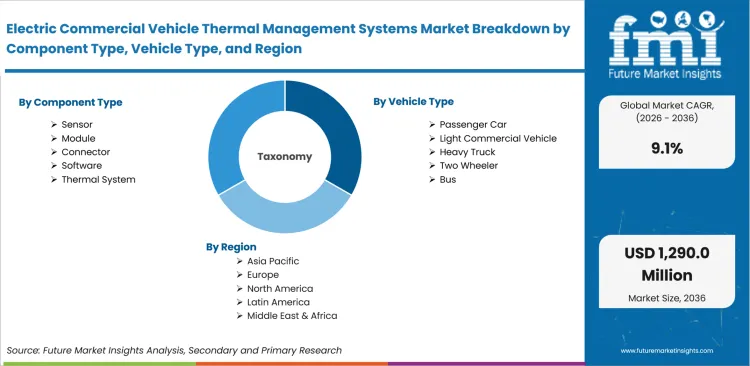
The electric commercial vehicle thermal management systems market is segmented by component type, vehicle type, propulsion, sales channel, and region.
The electric commercial vehicle thermal management systems industry is segmented by component type, vehicle type, propulsion, sales channel, and region. Component type covers sensors, modules, connectors, software, and thermal systems supporting temperature control and system coordination. Vehicle type analysis includes passenger cars, light commercial vehicles, heavy trucks, two-wheelers, and buses with different thermal loads. Propulsion categories compare battery electric, plug-in hybrid, fuel cell, hybrid, and ICE retrofit platforms across operating conditions. Sales channels distinguish OEM supply from aftermarket, fleet operator, distributor, and direct sales arrangements. Regional analysis examines adoption across North America, Latin America, Western Europe, Eastern Europe, East Asia, South Asia and Pacific, and the Middle East and Africa.
What makes sensor central to component type selection?
Sensor inputs govern battery temperature and coolant-flow control across integrated thermal systems during charging and route operation. Accurate thermal monitoring protects battery cells and power electronics from temperature excursions during sustained heavy-duty use. Hanon Systems reported a 16 kg integrated cooling entity in March 2026, combining pressure and temperature sensors inside one compact module. Integrated sensing reduces wiring complexity and coordinates battery circuits with cabin and power-electronics cooling functions.
- Sensor is predicted to represent 23.0% share of component type in 2026, driven by continuous measurement needs across battery packs and refrigerant circuits. Fleet programs assess diagnostic accuracy and calibration stability during extended duty-cycle tests across representative operating climates.
- Module and software options coordinate pumps with automotive heat exchanger units across integrated vehicle thermal architectures during daily operation. Connector and thermal system choices receive consideration based on packaging compatibility and accessible maintenance across fleet service networks.
Why does passenger car lead vehicle type demand?
Passenger car platforms provide high-volume validation routes for thermal components later adapted to commercial vehicles. Compact packaging and rapid charging expose cooling architecture to strict efficiency targets during high-load vehicle operation. DENSO Corporation reported 40.0% better cooling performance for its bZ4X inverter design in October 2025, demonstrating transferable engineering across electrified platforms. Shared component families reduce engineering effort across multiple vehicle classes and shorten later commercial-platform validation schedules.
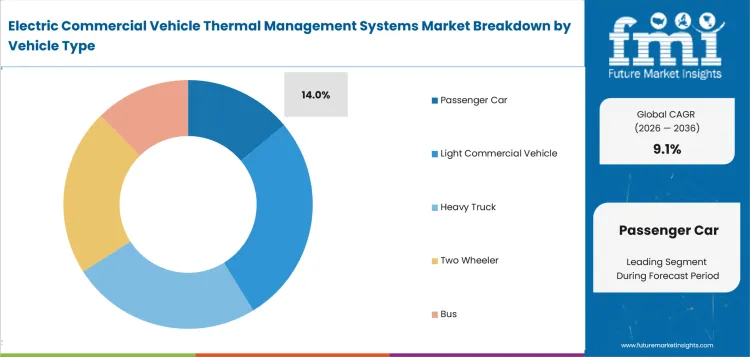
- Based on vehicle type, passenger car is estimated to account for 14.0% share in 2026 owing to cross-platform component reuse and established validation infrastructure. Supplier programs translate proven cooling designs into light commercial vehicle applications with revised capacity and durability.
- Heavy truck and electric bus demand emphasizes sustained thermal loads during long operating shifts and repeated depot charging. Two-wheeler applications require compact thermal components under strict packaging limits and constrained onboard energy availability.
Why does battery electric dominate propulsion demand?
Battery electric platforms require coordinated EV thermal system control across traction batteries and power electronics during commercial duty. Thermal efficiency directly affects charging speed and usable driving range across repetitive daily commercial duty cycles. MAHLE GmbH reported its intelligent thermal management system reduced electric-compressor power by 15.0% to 20.0% in May 2025, demonstrating energy savings from integrated control. Commercial platforms extend such energy savings across longer daily operating cycles and frequent depot charging events. Efficient automotive AC compressor operation reduces auxiliary loads during cabin conditioning across repetitive fleet routes under high ambient temperatures.
- Battery electric is anticipated to secure 17.0% share in 2026, guided by continuous cooling demand during charging and traction. Heat-pump integration supports cabin comfort without drawing waste heat from an engine during cold-weather fleet operation.
- Plug-in hybrid and hybrid platforms require precise coordination between combustion and electric thermal loops during changing load conditions. Fuel cell and ICE retrofit options create distinct heating and packaging requirements across specialized commercial vehicle applications.
Why does OEM hold a prominent position in sales channel demand?
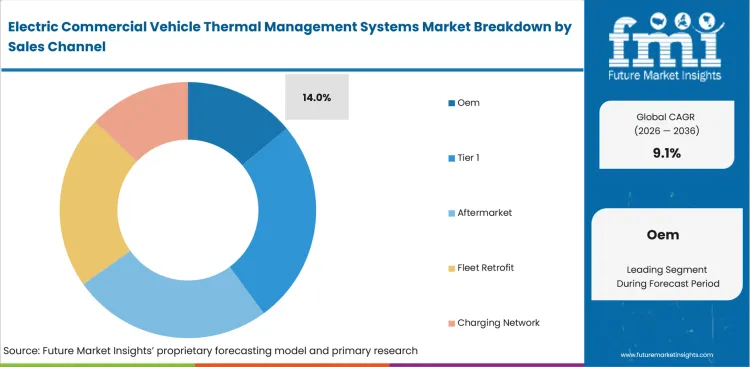
OEM selection begins during platform architecture and assigns responsibility for control software together with packaging and warranty performance. Early integration allows suppliers to size pumps and heat exchangers around certified duty cycles across representative commercial routes. BorgWarner Inc. announced a 400-volt coolant-heater contract delivering up to 10 kW in May 2025, illustrating platform-specific OEM awards for battery and cabin heating. Series production decisions secure recurring component demand across vehicle programs throughout contracted platform lifecycles and service periods.
- By sales channel, OEM is projected to capture 14.0% share in 2026 as it reflects early design integration and warranty control. Supplier selection emphasizes validated performance across climate chambers and vehicle-level testing under representative operating loads.
- Aftermarket and fleet operators focus on EV thermal management system MRO services access and service speed across operating depots. Distributors and direct sales support electric coolant pump replacement parts availability across dispersed fleets and specialist retrofit programs requiring technical guidance.
What are drivers, restraints, and opportunities in Electric Commercial Vehicle Thermal Management Systems Market?
Fleet electrification raises thermal demand across batteries and power electronics as commercial vehicles operate longer routes and frequent charging cycles. High system costs and complex validation requirements delay adoption among fleet operators with limited technical resources and constrained investment budgets.
- Driver: Long operating hours intensify cooling and heating requirements across electrified trucks and buses serving demanding schedules. Frequent depot charging also increases demand for precise temperature control protecting component durability and dependable vehicle availability.
- Restraint: Substantial vehicle prices and climate-specific validation requirements extend purchasing decisions for operators managing constrained technical budgets. Limited workshop expertise are likely to postpone deployment when fleets require specialized replacement parts and trained service personnel.
- Opportunity: Integrated heat pumps and replaceable thermal modules lower auxiliary energy consumption under changing loads and seasonal conditions. Standardized interfaces also influences easier platform adaptation and predictable maintenance planning across dispersed operating depots.
Electric truck deployment expands addressable demand for EV coolants and control software across factory-installed commercial platforms. International Energy Agency recorded more than 90,000 electric truck sales during 2024 in its May 2025 assessment. Factory-installed thermal content expands across medium-duty and heavy-duty platforms as vehicle programs enter series production. Expanded vehicle volumes support recurring system awards across urban and regional freight routes with intensive daily operation.
Fleet economics remain sensitive to energy loss and cold-weather performance across route-intensive duty cycles and seasonal operating conditions. Webasto Group reported new high-voltage heaters converting more than 95.0% of input energy into heat in February 2024. Published efficiency levels illustrate design targets needed to protect electric range during cold-weather commercial vehicle operation. Lower-performing designs increase auxiliary energy demand and weaken operator confidence across route-intensive commercial fleet programs.
Integrated systems create expansion potential across battery thermal plates and lifecycle service throughout commercial platform programs and regional service networks. International Energy Agency reported European Union electric-truck production exceeding 13,000 units during 2025 in its May 2026 analysis. Local production increases demand for modular thermal assemblies across regional truck programs using shared platform architectures. Regional manufacturing supports quicker engineering changes and parts response across commercial fleets with scheduled service requirements.
How are country CAGRs aligned in Electric Commercial Vehicle Thermal Management Systems Market?
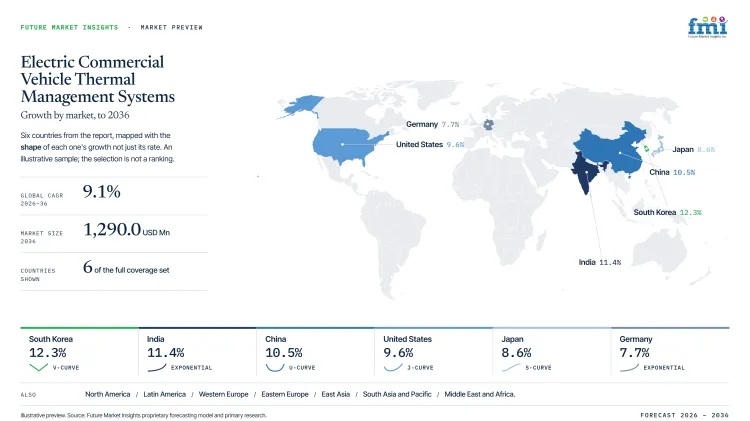
| Country or Market | CAGR |
|---|---|
| South Korea | 12.3% |
| India | 11.4% |
| China | 10.5% |
| United States | 9.6% |
| Japan | 8.6% |
| Germany | 7.7% |
Source: Future Market Insights analysis, 2026.
How do country-level CAGRs compare in Electric Commercial Vehicle Thermal Management Systems Market?
The country comparison shows a gradual step-down in growth across the markets covered. South Korea and India occupy the upper end of the range, followed by China and the United States in the middle tier. Japan and Germany record comparatively lower rates across the listed markets. The 4.6-point spread indicates that every profiled market maintains a positive expansion outlook, although individual positions reflect different levels of commercial momentum. Country rates describe the disclosed comparison and do not represent a universal ranking across every national market.
- South Korea and India lead the comparison and establish Asia as the notable development cluster among the markets shown.
- China and the United States follow with competitive rates, indicating that both markets maintain considerable momentum behind the leading group.
- Japan and Germany form the next development band and preserve a measured gap from the middle-tier markets.
- Germany records the slowest expansion among the listed countries, yet its forecast remains positive within the broader market context.
- The pattern resembles a gradual downward slope instead of a sharp separation between faster and slower national markets.
Markets carrying broadly similar CAGRs can present different entry conditions due to fleet electrification levels and thermal technology readiness. The full report provides country-level analysis across North America, Latin America, Western Europe, Eastern Europe, East Asia, South Asia and Pacific, and the Middle East and Africa.
Country-wise Analysis
- Electric commercial vehicle thermal management systems adoption in South Korea is anticipated to expand at 12.3% CAGR by 2036, influenced by prompt electric-truck deployment and domestic component engineering. South Korea’s climate ministry reported 26,000 electric trucks supplied by November 2025 and expanded fleet volumes create recurring demand for battery cooling and high-voltage heating. Local OEM programs shorten validation paths for integrated modules across severe seasonal conditions and established domestic supply relationships.
- Ministry of Heavy Industries reported support for 14,028 electric buses in February 2026, influencing an increase in system requirements for depot duty cycles and high-ambient operation. Route-intensive urban use favors serviceable cooling loops and locally available replacement modules across scheduled depot maintenance programs. Sector in India is projected to post 11.4% CAGR between 2026 and 2036, driven by public-fleet electrification and localized thermal-component programs.
- Sales in China are forecast to rise at 10.5% CAGR during the assessment period, led by extensive commercial vehicle production and short component-development cycles. China’s State Council reported plans for more than 700,000 additional new energy vehicles across public transport and logistics during September 2025, deepening integration needs for thermal controllers. Pilot-city programs favor localized modules supported by rapid engineering revisions and nearby component production capacity.
- The United States market is estimated to scale at 9.6% CAGR during the forecast period, driven by fleet replacement programs as vocational operators evaluate thermal durability across varied climates. United States Environmental Protection Agency listed more than 1,900 planned zero-emission vehicle replacements in June 2026, extending planned fleet awards need across school buses and vocational platforms. Multi-state operation raises service-network requirements for heaters and software calibration across different regional climate conditions.
- International Energy Agency reported electric buses represented 2.0% of sales during 2024 in its May 2025 outlook, leaving substantial scope for thermal-system integration across public fleets. Long service cycles favor maintainable modules and dependable parts availability across public fleet replacement programs. Industry in Japan is predicted to increase at 8.6% CAGR between 2026 and 2036, guided by long vehicle service lives and exacting supplier qualification.
- Germany is expected to record 7.7% CAGR during the study period, backed by electric-truck sales and formal vehicle integration requirements. International Energy Agency recorded 4,400 electric truck sales during 2025 in its May 2026 assessment, supporting the case for cold-weather heat pumps for cold-weather heat pumps and battery preconditioning. Regional freight duty favors validated system efficiency across long-haul routes and depot-based charging operations during winter service.
Who are notable companies in Electric Commercial Vehicle Thermal Management Systems Market?
DENSO Corporation and Valeo join MAHLE GmbH and Hanon Systems among notable companies shaping sector competition. Modine Manufacturing Company and BorgWarner join Webasto Group and Robert Bosch GmbH across profiled company coverage.
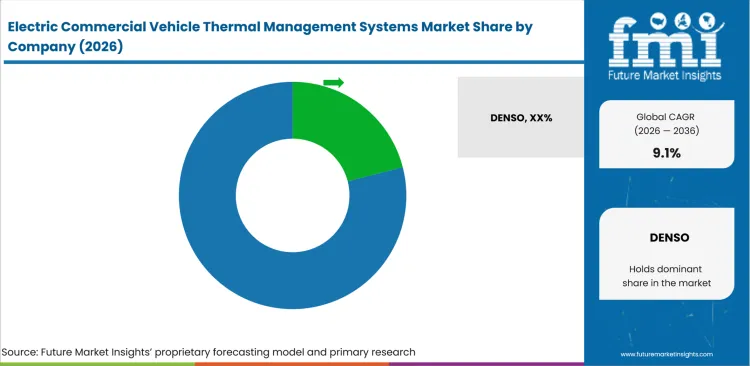
Competition centers on integrated architecture and vehicle-level validation across electrified commercial platforms under demanding duty cycles. Global suppliers combine compressors and pumps with control software across coordinated vehicle platforms and regional production programs. Independent thermal specialists emphasize application engineering and fleet service response across demanding commercial operating schedules. Buyer review covers duty-cycle evidence and replacement-part access during program selection and contracted service periods.
- DENSO Corporation and Valeo compete based on integrated thermal portfolios across electrified vehicle platforms and regional production programs. Customer teams assess engineering depth and validation support across regional vehicle programs under representative operating conditions.
- MAHLE GmbH and Hanon Systems focus on compact modules combining refrigerant and coolant functions within constrained vehicle architectures. Platform engineers compare energy efficiency and packaging requirements during architecture selection for commercial vehicle programs.
- Modine Manufacturing Company and BorgWarner address commercial vehicle thermal loads through modular hardware and integration support. Fleet programs examine durability records and service response across demanding routes with high daily utilization levels.
- Webasto Group and Robert Bosch GmbH support heating and control requirements across electric commercial platforms. Supplier choice reflects climate performance and parts access across operating regions with different seasonal service requirements.
Competitive Benchmarking: Electric Commercial Vehicle Thermal Management Systems Market
| Company | Technical Depth and Evidence | Delivery and Integration Support | Account and Channel Reach | Geographic Reach |
|---|---|---|---|---|
| DENSO Corporation | High | High | High | Global |
| Valeo | High | High | High | Global |
| MAHLE GmbH | High | High | Medium | Global |
| Hanon Systems | High | High | Medium | Global |
| Modine Manufacturing Company | High | High | Medium | Global |
| BorgWarner Inc. | High | High | High | Global |
| Webasto Group | High | High | Medium | Global |
| Robert Bosch GmbH | High | High | High | Global |
Source: Future Market Insights competitive analysis, 2026.
Key Developments in Electric Commercial Vehicle Thermal Management Systems Market
- In April 2025, BorgWarner presented its iM-575 drive module for Class 6 to 8 commercial vehicles with 412 kW continuous power. Integrated oil-water heat exchangers and a water pump reduce separate thermal hardware across heavy-duty electric platforms.
- In September 2025, MAHLE GmbH unveiled a production-ready thermal management module with an integrated heat pump and up to 20.0% electric-range improvement during low-temperature operation. Compact integration lowers packaging demand across future electric vehicle platforms using constrained underbody and cabin architectures.
- In April 2026, Valeo announced electric truck and bus thermal technologies for the Advanced Clean Transportation Expo. The portfolio included its EDC-120 electric compressor with integrated inverter and smart heat pumps for electrified commercial platforms.
Key Players in Electric Commercial Vehicle Thermal Management Systems Market
Integrated Thermal System Suppliers
- DENSO Corporation
- Valeo
- MAHLE GmbH
- Hanon Systems
Commercial Vehicle Thermal Specialists
- Modine Manufacturing Company
- BorgWarner Inc.
Heating and Control Technology Suppliers
- Webasto Group
- Robert Bosch GmbH
Electric Commercial Vehicle Thermal Management Systems Market Report Scope
| Coverage field | Report scope |
|---|---|
| Market breakdown | Electric commercial vehicle thermal management systems breakdown includes component type, vehicle type, propulsion, sales channel, and region. |
| Quantitative Units | Revenue in USD Million, CAGR in %. |
| Market Definition | Electric commercial vehicle thermal management systems regulate battery, cabin, power-electronics, and propulsion temperatures across electrified commercial platforms. Sensors, pumps, heat exchangers, heaters, control software, and integrated modules form defined coverage. Generic vehicle HVAC without electric propulsion thermal functions is excluded. |
| Regions Covered | North America, Latin America, Western Europe, Eastern Europe, East Asia, South Asia and Pacific, Middle East and Africa. |
| Countries Covered | South Korea, India, China, United States, Japan, Germany, and 30+ countries complete full report coverage. |
| Key Companies Profiled | DENSO Corporation, Valeo, MAHLE GmbH, Hanon Systems, Modine Manufacturing Company, BorgWarner Inc., Webasto Group, and Robert Bosch GmbH. |
| Forecast Period | 2026 to 2036 |
| Approach | Hybrid bottom-up and top-down methodology uses segment shares and country CAGRs. Company activity and fleet adoption support final market reconciliation. |
Source: Future Market Insights analysis, 2026.
Electric Commercial Vehicle Thermal Management Systems Market - Research Methodology
| Method | Approach |
|---|---|
| Primary Research | FMI analysts gathered input from manufacturers, service providers, technology developers, distributors, end users, procurement teams, and subject-matter experts. Interviews examined purchasing decisions, product or service evaluation, adoption barriers, approval requirements, pricing considerations, and expectations for technical or commercial support. Respondents were also asked what evidence is required before a trial, pilot, or initial order develops into regular purchasing. |
| Desk Research | Desk research covered government statistics, regulatory publications, trade data, industry associations, technical literature, standards, company filings, product information, and official corporate announcements. Sources were reviewed for relevance, publication date, geographic coverage, and consistency with the defined market scope. Claims relating to performance, applications, approvals, capacity, investment, and commercial activity were retained only when supported by credible public evidence. |
| Market Sizing and Forecasting | The market model combined the baseline value with historical performance, segment structure, pricing and volume indicators, adoption levels, company participation, and country-level demand conditions. Forecast assumptions considered economic activity, investment trends, regulatory developments, technology adoption, purchasing cycles, supply availability, and barriers to wider market use. Segment and regional estimates were reconciled before the final market total was calculated. |
| Data Validation | Estimates were checked against multiple independent indicators, including public data, company activity, trade patterns, industry developments, and findings from primary interviews. Validation also tested whether products, services, applications, and company revenues fell within the defined market boundaries. Adjacent categories, unsupported claims, overlapping revenues, and activities without direct market relevance were excluded to reduce double counting and maintain consistency across segments and countries. |
Source: Future Market Insights analysis, 2026.
Electric Commercial Vehicle Thermal Management Systems Market by Segments
Electric Commercial Vehicle Thermal Management Systems Market segmented by Component Type:
- Sensor
- Module
- Connector
- Software
- Thermal System
Electric Commercial Vehicle Thermal Management Systems Market segmented by Vehicle Type:
- Passenger Car
- Light Commercial Vehicle
- Heavy Truck
- Two Wheeler
- Bus
Electric Commercial Vehicle Thermal Management Systems Market segmented by Propulsion:
- Battery Electric
- Plug-in Hybrid
- Fuel Cell
- Hybrid
- ICE Retrofit
Electric Commercial Vehicle Thermal Management Systems Market segmented by Sales Channel:
- OEM
- Aftermarket
- Fleet Operators
- Distributors
- Direct Sales
Electric Commercial Vehicle Thermal Management Systems Market segmented by Region:
- North America
- United States
- Canada
- Latin America
- Brazil
- Mexico
- Argentina
- Chile
- Western Europe
- Germany
- France
- United Kingdom
- Italy
- Spain
- Benelux
- Nordics
- Eastern Europe
- Poland
- Czech Republic
- Romania
- Hungary
- East Asia
- China
- Japan
- South Korea
- South Asia and Pacific
- India
- ASEAN
- Australia and New Zealand
- Middle East and Africa
- GCC Countries
- South Africa
- Türkiye
- Israel
Research Sources and Bibliography
- European Automobile Manufacturers’ Association. (2025, August 29). Driving Europe’s green transition with zero-emission trucks and buses.
- European Automobile Manufacturers’ Association. (2026, January 29). New commercial vehicle registrations: vans -8.8%, trucks -6.2%, buses +7.5% in 2025.
- Hanon Systems. (2026, March 31). Hanon Systems supplies highly integrated cooling entity for electric vehicles.
- DENSO Corporation. (2025, October 10). DENSO’s electrification products adopted for Toyota’s new “bZ4X”.
- MAHLE GmbH. (2025, May 15). MAHLE India receives award for intelligent thermal management system.
- BorgWarner Inc. (2025, May 6). BorgWarner obtains high-voltage coolant heater contract with global OEM.
- International Energy Agency. (2025, May 14). Trends in heavy-duty electric vehicles - Global EV Outlook 2025.
- Valeo. (2026, April 29). Valeo to showcase future-ready trucking innovations at ACT Expo 2026.
- International Energy Agency. (2026, May 20). Manufacturing and trade - Global EV Outlook 2026.
- Ministry of Climate, Energy and Environment. (2025, November 16). Annual EV Supply Hits 200,000... Driving Mainstream Adoption Through Stronger Industry Competitiveness.
- Ministry of Heavy Industries. (2026, February 3). PM e-DRIVE SCHEME.
- State Council of the People’s Republic of China. (2025, September 13). China sets 2025 auto sales target at 32.3 mln units.
- United States Environmental Protection Agency. (2026, June 3). Clean Heavy-Duty Vehicles Grant Program Awards.
- International Energy Agency. (2025, May 14). Outlook for electric mobility - Global EV Outlook 2025.
- International Energy Agency. (2026, May 20). Trends in other EV modes - Global EV Outlook 2026.
- Webasto Group. (2025, April 8). New water heater from Webasto for commercial and specialty vehicles.
- BorgWarner Inc. (2025, April 21). BorgWarner showcases electric mobility technology for commercial vehicles at Advanced Clean Transportation Expo 2025.
- MAHLE GmbH. (2025, September 8). MAHLE is set for the future: Production-ready innovations for sustainable mobility.
This bibliography is provided for reader reference and is not exhaustive. The full report contains the complete reference list and detailed citations.
This Report Answers
- How do segments influence demand across component type, vehicle type, propulsion and sales channel coverage?
- What criteria guide fleet operators evaluating electric commercial vehicle thermal systems prior to full commercial deployment programs?
- Why do country CAGRs differ across profiled countries for electric commercial vehicle thermal management systems?
- What companies compete through integrated thermal engineering and commercial vehicle service capabilities across regional fleet programs?
- How are forecasts validated through bottom-up and top-down analysis using independent commercial and technical indicators?
- What evidence supports OEM review prior to vehicle-platform thermal system approval across representative duty cycles?
- Why do energy efficiency and climate performance influence supplier selection across electric commercial vehicle programs?
- How do service gaps limit return across fleet integration and scheduled electric commercial vehicle maintenance programs?
- How does thermal control influence battery protection across long commercial operation and repeated charging schedules?
- What company capabilities improve long-term customer confidence and recurring platform use across approved vehicle programs?
Frequently Asked Questions
What supports demand in electric commercial vehicle thermal management systems market?
Demand is likely to receive support from electric truck and bus programs requiring battery cooling across longer duty cycles. Fleet operators are expected to favor suppliers documenting climate performance and service access across operating regions.
Who are key players in electric commercial vehicle thermal management systems market?
Key companies are anticipated to include DENSO Corporation and Valeo among others. Competition is likely to reflect integrated thermal capabilities and technical support across established and developing electric commercial vehicle programs.
What restraint affects electric commercial vehicle thermal management systems market?
Smaller fleet programs face adoption limits from vehicle costs and fragmented qualification requirements under constrained engineering resources. Commercial confidence weakens if thermal performance lacks representative route and climate validation across planned operating conditions.
Why do executives track electric commercial vehicle thermal management systems market?
Executives are expected to track system demand as fleet electrification increases thermal content per vehicle. Platform decisions create engineering and warranty duties across several business functions throughout vehicle production and service lifecycles.
What business problem does electric commercial vehicle thermal management systems market address?
Electric commercial vehicle thermal systems regulate battery and cabin temperatures across demanding commercial operating cycles. Coordinated control supports energy efficiency and component protection across varied climate conditions and charging schedules.
What do fleet teams evaluate prior to selecting companies?
Fleet teams are likely to evaluate duty-cycle evidence and local service access during supplier review. Thermal efficiency and parts availability are expected to influence final company approval across regional fleet deployment programs.
What limits return on investment for purchasing teams?
Return weakens through high auxiliary energy use or repeated vehicle downtime across route-intensive commercial fleets. Poor parts access adds service delays across depot-based operations and extends scheduled maintenance interruptions across route-intensive fleet programs.
How do companies build long-term customer confidence?
Companies build confidence through repeatable thermal performance and dependable service across vehicle programs under representative climate conditions. Maintained components and documented vehicle testing support recurring use across approved fleet platforms and service networks.
Preview the report firsthand - request a free sample
Get SampleGet the brochure for pricing and purchase details.
Get PDFTable of Content
- Key Takeaways
- Market Size and CAGR
- Top Growth Driver
- Fastest Growing Segment
- Leading Region
- Key Companies
- Emerging Opportunities
- Executive Summary
- Global Market Outlook
- Demand-side Trends
- Supply-side Trends
- Technology Roadmap Analysis
- Analysis and Recommendations
- Analyst Perspective (What is happening? Why now? What should investors know?)
- Key Questions Answered
- How large is the market?
- What is the CAGR?
- What are key trends?
- Which region dominates?
- Who are the leaders?
- Market Overview
- Market Coverage / Taxonomy
- Market Definition / Scope / Limitations
- Research Methodology
- Chapter Orientation
- Analytical Lens and Working Hypotheses
- Market Structure, Signals, and Trend Drivers
- Benchmarking and Cross-market Comparability
- Market Sizing, Forecasting, and Opportunity Mapping
- Research Design and Evidence Framework
- Desk Research Programme (Secondary Evidence)
- Expert Input and Fieldwork (Primary Evidence)
- Tooling, Models, and Reference Databases
- Data Engineering and Model Build
- Quality Assurance and Audit Trail
- Market Background
- Market Dynamics (Drivers, Restraints, Opportunity, Trends)
- Scenario Forecast (Optimistic, Likely, Conservative)
- Impact Analysis
- AI Impact
- Sustainability Impact
- Regulatory Impact
- Technology Impact
- Consumer / Buyer Analysis
- Purchase Drivers
- Adoption Barriers
- Buyer Journey
- Opportunity Map Analysis
- Product Life Cycle Analysis
- Supply Chain Analysis
- Investment Feasibility Matrix
- Value Chain Analysis
- PESTLE and Porter's Analysis
- Regulatory Landscape
- Regional Parent Market Outlook
- Production and Consumption Statistics
- Import and Export Statistics
- Global Market Analysis and Forecast, 2021 to 2036
- Historical Market Size Value (USD Million) Analysis, 2021 to 2025
- Current and Future Market Size Value (USD Million) Projections, 2026 to 2036
- Y-o-Y Growth Trend Analysis
- Absolute $ Opportunity Analysis
- Global Market Pricing Analysis, 2021 to 2036
- Global Market Analysis and Forecast, By Component Type, 2021 to 2036
- Introduction / Key Findings
- Historical Market Size Value (USD Million) Analysis By Component Type, 2021 to 2025
- Current and Future Market Size Value (USD Million) Analysis and Forecast By Component Type, 2026 to 2036
- Sensor
- Module
- Connector
- Software
- Thermal System
- Sensor
- Y-o-Y Growth Trend Analysis By Component Type, 2021 to 2025
- Absolute $ Opportunity Analysis By Component Type, 2026 to 2036
- Global Market Analysis and Forecast, By Vehicle Type, 2021 to 2036
- Introduction / Key Findings
- Historical Market Size Value (USD Million) Analysis By Vehicle Type, 2021 to 2025
- Current and Future Market Size Value (USD Million) Analysis and Forecast By Vehicle Type, 2026 to 2036
- Passenger Car
- Light Commercial Vehicle
- Heavy Truck
- Two Wheeler
- Bus
- Passenger Car
- Y-o-Y Growth Trend Analysis By Vehicle Type, 2021 to 2025
- Absolute $ Opportunity Analysis By Vehicle Type, 2026 to 2036
- Global Market Analysis and Forecast, By Propulsion, 2021 to 2036
- Introduction / Key Findings
- Historical Market Size Value (USD Million) Analysis By Propulsion, 2021 to 2025
- Current and Future Market Size Value (USD Million) Analysis and Forecast By Propulsion, 2026 to 2036
- Battery Electric
- Plug-In Hybrid
- Fuel Cell
- Hybrid
- Ice Retrofit
- Battery Electric
- Y-o-Y Growth Trend Analysis By Propulsion, 2021 to 2025
- Absolute $ Opportunity Analysis By Propulsion, 2026 to 2036
- Global Market Analysis and Forecast, By Sales Channel, 2021 to 2036
- Introduction / Key Findings
- Historical Market Size Value (USD Million) Analysis By Sales Channel, 2021 to 2025
- Current and Future Market Size Value (USD Million) Analysis and Forecast By Sales Channel, 2026 to 2036
- Oem
- Tier 1
- Aftermarket
- Fleet Retrofit
- Charging Network
- Oem
- Y-o-Y Growth Trend Analysis By Sales Channel, 2021 to 2025
- Absolute $ Opportunity Analysis By Sales Channel, 2026 to 2036
- Global Market Analysis and Forecast, By Region, 2021 to 2036
- Introduction
- Historical Market Size Value (USD Million) Analysis By Region, 2021 to 2025
- Current Market Size Value (USD Million) Analysis and Forecast By Region, 2026 to 2036
- North America
- Latin America
- Western Europe
- Eastern Europe
- East Asia
- South Asia and Pacific
- Middle East & Africa
- Market Attractiveness Analysis By Region
- North America Market Analysis and Forecast, By Country, 2021 to 2036
- Historical Market Size Value (USD Million) Trend Analysis By Market Taxonomy, 2021 to 2025
- Market Size Value (USD Million) Forecast By Market Taxonomy, 2026 to 2036
- By Country
- USA
- Canada
- By Component Type
- By Vehicle Type
- By Propulsion
- By Sales Channel
- By Country
- Market Attractiveness Analysis
- By Country
- By Component Type
- By Vehicle Type
- By Propulsion
- By Sales Channel
- Key Takeaways
- Latin America Market Analysis and Forecast, By Country
- Historical Market Size Value (USD Million) Trend Analysis By Market Taxonomy, 2021 to 2025
- Market Size Value (USD Million) Forecast By Market Taxonomy, 2026 to 2036
- By Country
- Brazil
- Mexico
- Chile
- Rest of Latin America
- By Component Type
- By Vehicle Type
- By Propulsion
- By Sales Channel
- By Country
- Market Attractiveness Analysis
- By Country
- By Component Type
- By Vehicle Type
- By Propulsion
- By Sales Channel
- Key Takeaways
- Western Europe Market Analysis and Forecast, By Country
- Historical Market Size Value (USD Million) Trend Analysis By Market Taxonomy, 2021 to 2025
- Market Size Value (USD Million) Forecast By Market Taxonomy, 2026 to 2036
- By Country
- Germany
- UK
- Italy
- Spain
- France
- Nordic
- BENELUX
- Rest of Western Europe
- By Component Type
- By Vehicle Type
- By Propulsion
- By Sales Channel
- By Country
- Market Attractiveness Analysis
- By Country
- By Component Type
- By Vehicle Type
- By Propulsion
- By Sales Channel
- Key Takeaways
- Eastern Europe Market Analysis and Forecast, By Country
- Historical Market Size Value (USD Million) Trend Analysis By Market Taxonomy, 2021 to 2025
- Market Size Value (USD Million) Forecast By Market Taxonomy, 2026 to 2036
- By Country
- Russia
- Poland
- Hungary
- Balkan & Baltic
- Rest of Eastern Europe
- By Component Type
- By Vehicle Type
- By Propulsion
- By Sales Channel
- By Country
- Market Attractiveness Analysis
- By Country
- By Component Type
- By Vehicle Type
- By Propulsion
- By Sales Channel
- Key Takeaways
- East Asia Market Analysis and Forecast, By Country
- Historical Market Size Value (USD Million) Trend Analysis By Market Taxonomy, 2021 to 2025
- Market Size Value (USD Million) Forecast By Market Taxonomy, 2026 to 2036
- By Country
- China
- Japan
- South Korea
- By Component Type
- By Vehicle Type
- By Propulsion
- By Sales Channel
- By Country
- Market Attractiveness Analysis
- By Country
- By Component Type
- By Vehicle Type
- By Propulsion
- By Sales Channel
- Key Takeaways
- South Asia and Pacific Market Analysis and Forecast, By Country
- Historical Market Size Value (USD Million) Trend Analysis By Market Taxonomy, 2021 to 2025
- Market Size Value (USD Million) Forecast By Market Taxonomy, 2026 to 2036
- By Country
- India
- ASEAN
- Australia & New Zealand
- Rest of South Asia and Pacific
- By Component Type
- By Vehicle Type
- By Propulsion
- By Sales Channel
- By Country
- Market Attractiveness Analysis
- By Country
- By Component Type
- By Vehicle Type
- By Propulsion
- By Sales Channel
- Key Takeaways
- Middle East & Africa Market Analysis and Forecast, By Country
- Historical Market Size Value (USD Million) Trend Analysis By Market Taxonomy, 2021 to 2025
- Market Size Value (USD Million) Forecast By Market Taxonomy, 2026 to 2036
- By Country
- Kingdom of Saudi Arabia
- Other GCC Countries
- Türkiye
- South Africa
- Other African Union
- Rest of Middle East & Africa
- By Component Type
- By Vehicle Type
- By Propulsion
- By Sales Channel
- By Country
- Market Attractiveness Analysis
- By Country
- By Component Type
- By Vehicle Type
- By Propulsion
- By Sales Channel
- Key Takeaways
- Key Countries Market Analysis
- USA
- Pricing Analysis
- Market Share Analysis, 2025
- By Component Type
- By Vehicle Type
- By Propulsion
- By Sales Channel
- Canada
- Pricing Analysis
- Market Share Analysis, 2025
- By Component Type
- By Vehicle Type
- By Propulsion
- By Sales Channel
- Mexico
- Pricing Analysis
- Market Share Analysis, 2025
- By Component Type
- By Vehicle Type
- By Propulsion
- By Sales Channel
- Brazil
- Pricing Analysis
- Market Share Analysis, 2025
- By Component Type
- By Vehicle Type
- By Propulsion
- By Sales Channel
- Chile
- Pricing Analysis
- Market Share Analysis, 2025
- By Component Type
- By Vehicle Type
- By Propulsion
- By Sales Channel
- Germany
- Pricing Analysis
- Market Share Analysis, 2025
- By Component Type
- By Vehicle Type
- By Propulsion
- By Sales Channel
- UK
- Pricing Analysis
- Market Share Analysis, 2025
- By Component Type
- By Vehicle Type
- By Propulsion
- By Sales Channel
- Italy
- Pricing Analysis
- Market Share Analysis, 2025
- By Component Type
- By Vehicle Type
- By Propulsion
- By Sales Channel
- Spain
- Pricing Analysis
- Market Share Analysis, 2025
- By Component Type
- By Vehicle Type
- By Propulsion
- By Sales Channel
- France
- Pricing Analysis
- Market Share Analysis, 2025
- By Component Type
- By Vehicle Type
- By Propulsion
- By Sales Channel
- India
- Pricing Analysis
- Market Share Analysis, 2025
- By Component Type
- By Vehicle Type
- By Propulsion
- By Sales Channel
- ASEAN
- Pricing Analysis
- Market Share Analysis, 2025
- By Component Type
- By Vehicle Type
- By Propulsion
- By Sales Channel
- Australia & New Zealand
- Pricing Analysis
- Market Share Analysis, 2025
- By Component Type
- By Vehicle Type
- By Propulsion
- By Sales Channel
- China
- Pricing Analysis
- Market Share Analysis, 2025
- By Component Type
- By Vehicle Type
- By Propulsion
- By Sales Channel
- Japan
- Pricing Analysis
- Market Share Analysis, 2025
- By Component Type
- By Vehicle Type
- By Propulsion
- By Sales Channel
- South Korea
- Pricing Analysis
- Market Share Analysis, 2025
- By Component Type
- By Vehicle Type
- By Propulsion
- By Sales Channel
- Russia
- Pricing Analysis
- Market Share Analysis, 2025
- By Component Type
- By Vehicle Type
- By Propulsion
- By Sales Channel
- Poland
- Pricing Analysis
- Market Share Analysis, 2025
- By Component Type
- By Vehicle Type
- By Propulsion
- By Sales Channel
- Hungary
- Pricing Analysis
- Market Share Analysis, 2025
- By Component Type
- By Vehicle Type
- By Propulsion
- By Sales Channel
- Kingdom of Saudi Arabia
- Pricing Analysis
- Market Share Analysis, 2025
- By Component Type
- By Vehicle Type
- By Propulsion
- By Sales Channel
- Türkiye
- Pricing Analysis
- Market Share Analysis, 2025
- By Component Type
- By Vehicle Type
- By Propulsion
- By Sales Channel
- South Africa
- Pricing Analysis
- Market Share Analysis, 2025
- By Component Type
- By Vehicle Type
- By Propulsion
- By Sales Channel
- USA
- Market Structure Analysis
- Competition Dashboard
- Competition Benchmarking
- Market Share Analysis of Top Players
- By Regional
- By Component Type
- By Vehicle Type
- By Propulsion
- By Sales Channel
- Emerging Startups
- Innovation Benchmarking
- Competition Analysis
- Competition Deep Dive
- DENSO
- Overview
- Product Portfolio
- Profitability by Market Segments
- Sales Footprint
- Strategy Overview
- Marketing Strategy
- Product Strategy
- Channel Strategy
- Valeo
- MAHLE
- Hanon Systems
- Modine
- BorgWarner
- Webasto
- Bosch
- DENSO
- Case Studies
- Success Stories
- Recent Developments
- Competition Deep Dive
- Assumptions & Acronyms Used


