

- Market Size (2026)
- USD 620.7 Mn
- Forecast (2036)
- USD 973.2 Mn
- CAGR (2026 to 2036)
- 4.6%
How big is Marine Thrust Bearings Market in 2026?
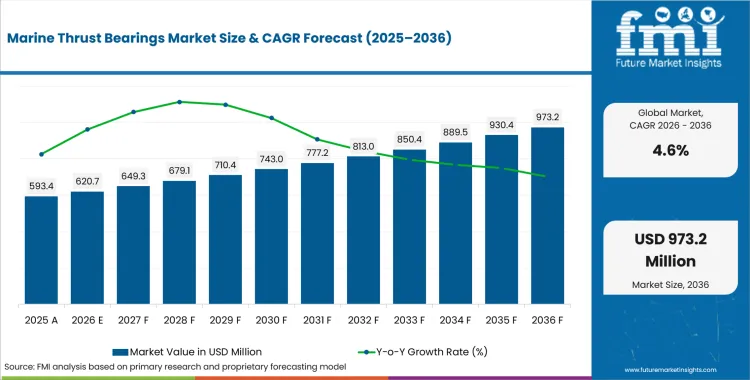
USD 620.7 million in 2026 and USD 973.2 million by 2036 at a 4.6% CAGR.
Demand for marine thrust bearings is projected to expand at 4.6% CAGR between 2026 and 2036, increasing valuation from USD 620.7 million to USD 973.2 million. Newbuild and repower programs reopen axial-load calculations during propulsion system design whenever speed or propeller duty changes materially. The IMO confirmed in October 2025 that adoption talks for its Net-Zero Framework were adjourned for one year. The pause leaves fuel and machinery choices unsettled on some newbuilds and can delay final shaftline specifications with related bearing selection.
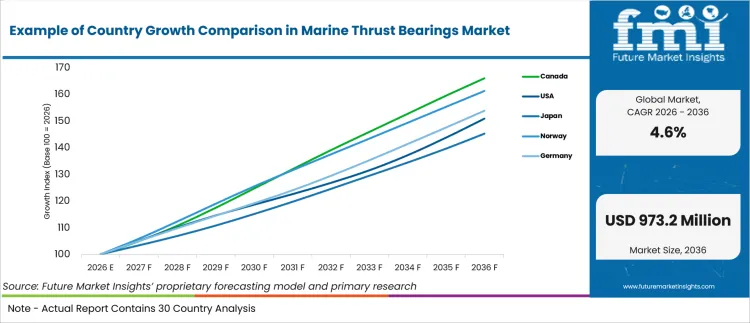
Canada carries a 5.9% CAGR compared with Germany at 4.6% as federal fleet renewal produces more early-stage marine bearing specifications. Canada's Department of National Defence documented in April 2026 that Coast Guard recapitalization includes two polar icebreakers and up to sixteen multi-purpose icebreakers. That forward construction pipeline gives bearing engineers more design-entry points than Germany's mature fleet normally produces from retrofit and overhaul work.
Key Takeaways of Marine Thrust Bearings Market
- Fleet renewal and propulsion redesign increase demand as major drivetrain changes require engineers to recalculate axial-load transfer before shipyard installation.
- Based on product type, hydrodynamic thrust bearings are projected to account for 29.0% in 2026 due to sustained axial-load duty in large marine rotating systems.
- By boat type, commercial vessels are estimated to hold 30.0% in 2026 owing to high operating hours and costly propulsion downtime.
- In 2026 oil lubricated designs are expected to lead material demand with 46.0% share because conventional shaftline systems retain familiar oil-film engineering practices.
- Shaft alignment verification and class documentation slow changes between bearing arrangements because replacement work must preserve the accepted load path within fixed yard schedules.
- Some of the key players in this market include Michell Bearings, Waukesha Bearings, Kingsbury, Inc., RENK Group AG, Thordon Bearings, Wärtsilä, The Timken Company, and Daido Metal Co., Ltd.
Analyst Perspective
"Marine thrust-bearing selection should start with the vessel load case and shaftline geometry instead of catalog price. Commercial value depends on proving alignment tolerance and service response early enough to protect the confirmed installation window."
- Nikhil Kaitwade, Principal Consultant, Future Market Insights
How is the Marine Thrust Bearings Market segmented?
The marine thrust bearings market is segmented by product type, boat type, material, sales channel, type and region.
The marine thrust bearings market is segmented by product type, boat type, material, sales channel, type and region. Product types include hydrodynamic, rolling element, tilting pad, composite-lined and integrated thrust blocks, while boat types cover commercial vessels, workboats, fishing vessels, offshore support vessels and yachts. Material routes include oil lubricated, water lubricated, grease lubricated and self-lubricating composite designs. Sales channels cover propulsion OEMs, MRO or repair yards, shipyards and bearing distributors, while type covers propulsion shafts, thrusters, gearbox assemblies and auxiliary drives.
What supports Propulsion OEMs as the leading Sales Channel?
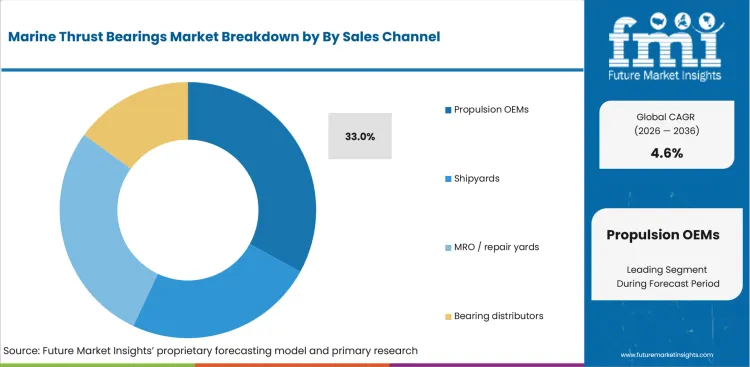
Propulsion OEMs resolve gearbox loads and shaft geometry before shipyard installation, giving them direct control over approved bearing dimensions and lubrication interfaces. Shipyards then receive marine gearbox packages with bearing interfaces already defined for installation.
- In 2026 propulsion OEMs are expected to lead the sales channel with 33.0% share owing to their control over drivetrain interfaces during specification.
- Wärtsilä stated in July 2026 that its Grimaldi Group newbuild scope includes gearboxes and shaft lines for three Finnlines vessels. The order places bearing interfaces inside a matched propulsion package before shipyard installation begins.
What makes Hydrodynamic thrust bearings central to the Product type category?
Fluid-film thrust bearings suit propulsion systems carrying sustained axial loads, while engineering teams also check alignment margin and oil-film temperature under the vessel duty case.
- Based on product type, hydrodynamic thrust bearings are projected to account for 29.0% in 2026 due to sustained axial-load duty in large marine rotating systems.
- British Engines documented in April 2025 that a Michell Bearings engineer tested a ship bearing cooler against a marine explosion scenario during R&D. The exercise confirms that shipboard qualification extends beyond bearing capacity to cooler integrity under defined casualty conditions.
Why do Commercial vessels lead demand within the Boat type category?
Commercial operators incur direct schedule costs from propulsion downtime, so bearing selection is tied to reliability and planned drydock work. Long voyage schedules also make unscheduled bearing replacement costly once commercial vessel newbuilds enter service.
- By boat type, commercial vessels are estimated to hold 30.0% in 2026 owing to high operating hours and costly propulsion downtime.
- Wärtsilä stated in January 2025 that Sallaum Lines selected propeller upgrades for three 183-metre PCTCs following vessel-specific analysis and modelling. Each retrofit reopens adjoining bearing calculations once propeller duty changes inside an existing shaftline.
How does Oil lubrication maintain leadership within the Material category?
Oil systems remain familiar inside metallic thrust blocks and gearboxes, with pressure and temperature monitored inside routine machinery maintenance schedules. Marine grease selection follows a separate maintenance route from oil-film thrust bearings.
- Oil lubricated designs are forecast to represent 46.0% of material demand in 2026 due to the installed base of conventional propulsion and gearbox lubrication systems.
- Thordon Bearings added SAI Engineering to its distributor network in August 2026 for water-lubricated bearing installations and retrofits. The expansion broadens an alternative lubrication route during reviews that compare oil-system maintenance with seawater-lubricated options for newbuild and retrofit shaftlines.
What are the drivers, restraints and opportunities in the Marine Thrust Bearings Market?
Fleet renewal and propulsion redesign increase specification activity while alignment approval slows switching and lifecycle engineering expands service-led revenue routes.
- Driver: Newbuild and propulsion-modernization programs reopen axial-load calculations and place thrust-bearing selection inside broader drivetrain engineering.
- Restraint: Shaft alignment and structural verification extend switching cycles because replacement bearings must preserve an accepted vessel load path.
- Opportunity: Lifecycle service agreements can convert inspection findings into planned bearing work before short drydock windows become urgent repair events.
Propulsion Changes Reopen Axial-Load Design
Fuel and emissions rules change the machinery combinations that naval architects evaluate before final shaftline design. The IMO approved draft fuel-intensity and emissions-pricing measures in April 2025 for large ocean-going ships above 5,000 gross tonnage. A change in marine fuel injection equipment can alter shaft speed and torque assumptions, requiring a fresh thrust-bearing load case.
Qualification Work Slows Supplier Switching
Propulsion retrofits can change shaft alignment assumptions and foundation loads, so a replacement bearing cannot be treated as a catalog substitution. Lloyd's Register documented in May 2025 that advanced-propeller retrofit assessments include shaft alignment and structural analysis. Shipyards prefer bearing changes whose calculations and installation tolerances are reconciled early enough to protect the ship repair services schedule during a fixed drydock window.
Lifecycle Agreements Extend Revenue Beyond Initial Supply
Fleet operators increasingly package maintenance for marine propulsion engines with technical support, extending service revenue beyond the initial bearing order. Wärtsilä signed an overhaul agreement with Erik Thun Group in April 2026 covering propulsion machinery and shaftline equipment for the fleet. The agreement gives marine engine fleets a planned route for component inspection and replacement under one service responsibility.
Which country CAGRs are profiled in the Marine Thrust Bearings Market?
| Country | CAGR |
|---|---|
| Canada | 5.9% |
| Norway | 5.6% |
| Australia | 5.2% |
| Brazil | 4.9% |
| Germany | 4.6% |
How do country-level CAGRs compare in the Marine Thrust Bearings Market?
Canada and Norway form the upper pair within a 1.3-point CAGR spread, while Australia and Brazil occupy the middle and Germany closes the group at 4.6%. Canada brings design work forward through fleet renewal. Norway places more weight on short-sea propulsion duty, while Germany converts demand from retrofit and overhaul programs.
- Canada's Arctic service distances raise the value of local propulsion repair coverage.
- Norwegian short-sea fleets place heavy manoeuvring hours on propulsion equipment and bearings.
- Australia's Henderson pipeline increases the value of nearby spares and engineering support.
- Brazilian offshore vessels link bearing work with dynamic positioning systems and thruster maintenance.
- Germany's propulsion OEM base influences qualification during mature-fleet retrofit projects and overhauls.
Similar growth rates therefore convert into different sales cycles and service economics. The full report provides country-level CAGR analysis across North America, Latin America, Europe, East Asia, South Asia, Oceania and the Middle East and Africa.
Country-wise Analysis
- Canada's federal fleet programs keep propulsion engineering active at nominated yards, with domestic participation affecting how bearing companies enter long naval contracts during early design and later sustainment work. Canada is projected to grow at 5.9% CAGR through 2036, propelled by repeated newbuild milestones that reopen bearing specifications during design reviews. Public Services and Procurement Canada recorded two large-vessel deliveries during 2025 plus significant construction progress on seven more vessels in its July 2026 review. Local engineering access shortens response during design changes, but defence qualification can delay orders until the bearing package matches approved shaftline records and program schedules.
- Running short coastal routes exposes Norwegian passenger vessels to repeated manoeuvring cycles that make low-speed shaft behaviour and propulsion efficiency visible during equipment selection. Zero-emission rules now change machinery choices for vessels serving five World Heritage fjords under the implementation schedule. Marine thrust-bearing demand in Norway is forecast to rise at 5.6% CAGR through 2036, aided by propulsion redesign for lower-emission coastal service. The Ministry of Climate and Environment confirmed in April 2025 that the rules began in January 2026 for passenger ships below 10,000 gross tons. Short conversion windows remain the constraint, so bearing companies need class-ready load calculations before yards commit equipment to a retrofit package.
- At Henderson in Western Australia, naval production concentrates component engineering and gives bearing companies a clear hub for local inventory planning. Australia is estimated to post 5.2% CAGR over the assessment period, supported by a continuous pipeline of landing-craft construction and sustainment work. The Australian Department of Defence stated in August 2025 that the planned program includes eighteen Landing Craft Medium vessels plus eight Landing Craft Heavy subject to approvals. Nearby technical support can shorten responses during build changes and acceptance work on propulsion packages. Distance from overseas factories remains the main friction, making local repair capacity more valuable during urgent shaftline work after vessels enter service.
- Itajaí's Tamandaré-class frigate program anchors local naval work while offshore-support activity gives southern Brazil a second source of propulsion maintenance. Import lead times and local-content expectations can slow replacement orders even where the operating need is already clear. Marine thrust-bearing sales in Brazil are anticipated to expand at 4.9% CAGR by 2036, tied to defence renewal and offshore vessel maintenance. Casa Civil documented in June 2026 that the third Tamandaré-class frigate had been launched within a four-ship national program. Brazilian technical partners improve service response, and stocked critical parts give bearing companies a stronger route into planned yard work than export-only coverage.
- A mature merchant fleet and dense maritime engineering base make retrofit expertise commercially important in Germany beside access to newbuild programs. Marine thrust-bearing demand in Germany is projected to record 4.6% CAGR during the assessment period, reinforced by a large installed fleet requiring propulsion overhaul. The Federal Ministry of Transport stated in August 2025 that 1,675 merchant ships above 100 gross tonnage remained under German ownership at the end of 2024. European engineering coverage gives bearing companies fast access to class records and shipyard teams during replacement planning. Strong incumbent relationships limit easy switching, leaving new entrants dependent on documented reliability and compatibility with existing shaftline maintenance practices.
Who are the notable companies in the Marine Thrust Bearings Market?
Michell Bearings, Waukesha Bearings, Kingsbury, Inc., RENK Group AG, Thordon Bearings, Wärtsilä, The Timken Company, and Daido Metal Co., Ltd.
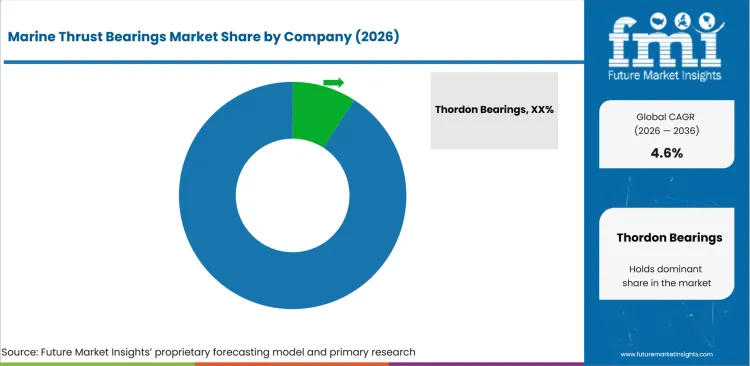
Competition separates specialist fluid-film bearing houses from propulsion groups and diversified bearing manufacturers. Entry barriers come from load-case engineering and service response because marine customers need a replacement route that fits existing shaftline geometry.
- Michell Bearings, Waukesha Bearings and Kingsbury, Inc. compete closest to the axial-load decision through documented fluid-film bearing engineering.
- RENK Group AG, Thordon Bearings and Wärtsilä enter through propulsion or shaftline integration that resolves bearing loads beside adjoining drivetrain components.
- The Timken Company and Daido Metal Co., Ltd. approach marine applications from broader bearing portfolios with different levels of direct thrust-bearing depth.
Competitive Benchmarking: Marine Thrust Bearings Market
| Company | Marine Thrust-Bearing Depth | Shaftline Integration | Lifecycle Engineering and Service | Geographic Reach |
|---|---|---|---|---|
| Michell Bearings | High | Medium | Medium | Europe, Asia, North America and global naval service |
| Waukesha Bearings | High | Medium | High | North America, Europe, Asia and Middle East |
| Kingsbury, Inc. | High | Low | Medium | North America with international marine customers |
| RENK Group AG | Low | High | High | Europe with global naval and civil marine operations |
| Thordon Bearings | Low | High | High | Canada-based with service in 100+ countries |
| Wärtsilä | Low | High | High | Global marine operations |
| The Timken Company | Low | Medium | High | Global |
| Daido Metal Co., Ltd. | Medium | Low | Medium | Asia, Europe and North America with global marine customers |
Scoring basis: High thrust-bearing depth requires multiple documented marine thrust-bearing routes. Medium requires one direct route and Low denotes a documented adjacent marine bearing position. High shaftline integration requires several propulsion interfaces while Medium covers one adjoining interface and Low records a bearing-focused role. High lifecycle support requires broad field service coverage while Medium denotes narrower repair support and Low identifies a limited documented service route.
Key Developments in the Marine Thrust Bearings Market
- In June 2026, Kingsbury, Inc. broke ground on a 120,000-square-foot precision-bearing manufacturing facility in Oshkosh, Wisconsin. The expansion increases manufacturing capacity for the company's fluid-film bearing operations that include marine applications.
- In May 2026, Thordon Bearings signed an MOU with Hanwha Ocean covering potential Canadian-made bearing supply and lifecycle support for the Canadian Patrol Submarine Program if the shipbuilder secures the project.
- In October 2025, RENK Group AG received an order for twelve NDSL-3600 double marine gear units serving six RoPax ferries. The ordered gear units will interface with methanol dual-fuel propulsion systems planned for the six ferry newbuilds.
Key Players in the Marine Thrust Bearings Market
Fluid-Film and Thrust-Bearing Specialists
- Michell Bearings
- Waukesha Bearings
- Kingsbury, Inc.
Propulsion and Shaftline Engineering Groups
- RENK Group AG
- Thordon Bearings
- Wärtsilä
Diversified Marine Bearing Manufacturers
- The Timken Company
- Daido Metal Co., Ltd.
Marine Thrust Bearings Market - Report Scope
| Coverage field | Report scope |
|---|---|
| Market breakdown | By product type, boat type, material, sales channel, type and region. |
| Quantitative Units | USD Million. |
| Market Definition | Engineered axial-load bearings and thrust blocks used in marine propulsion and auxiliary drivetrain systems. |
| Regions Covered | North America, Latin America, Europe, East Asia, South Asia and Pacific and Middle East and Africa. |
| Countries Covered | Canada, Norway, Australia, Brazil, Germany, and 30+ countries included in the full report. |
| Key Companies Profiled | Michell Bearings, Waukesha Bearings, Kingsbury, Inc., RENK Group AG, Thordon Bearings, Wärtsilä, The Timken Company, Daido Metal Co., Ltd. |
| Forecast Period | 2026 to 2036. |
| Approach | Primary and secondary research with market triangulation. |
Marine Thrust Bearings Market - Research Methodology
| Method | Approach |
|---|---|
| Primary Research | FMI analysts gathered input from manufacturers, service providers, technology developers, distributors, end users, procurement teams, and subject-matter experts. Interviews examined purchasing decisions, product or service evaluation, adoption barriers, approval requirements, pricing considerations, and expectations for technical or commercial support. Respondents were also asked what evidence is required before a trial, pilot, or initial order develops into regular purchasing. |
| Desk Research | Desk research covered government statistics, regulatory publications, trade data, industry associations, technical literature, standards, company filings, product information, and official corporate announcements. Sources were reviewed for relevance, publication date, geographic coverage, and consistency with the defined market scope. Claims relating to performance, applications, approvals, capacity, investment, and commercial activity were retained only when supported by credible public evidence. |
| Market Sizing and Forecasting | The market model combined the baseline value with historical performance, segment structure, pricing and volume indicators, adoption levels, company participation, and country-level demand conditions. Forecast assumptions considered economic activity, investment trends, regulatory developments, technology adoption, purchasing cycles, supply availability, and barriers to wider market use. Segment and regional estimates were reconciled before the final market total was calculated. |
| Data Validation | Estimates were checked against multiple independent indicators, including public data, company activity, trade patterns, industry developments, and findings from primary interviews. Validation also tested whether products, services, applications, and company revenues fell within the defined market boundaries. Adjacent categories, unsupported claims, overlapping revenues, and activities without direct market relevance were excluded to reduce double counting and maintain consistency across segments and countries. |
Marine Thrust Bearings Market by Segments
Marine Thrust Bearings Market segmented by Product Type:
- Hydrodynamic Thrust Bearings
- Rolling Element Thrust Bearings
- Tilting Pad Thrust Bearings
- Composite-Lined Thrust Bearings
- Integrated Thrust Blocks
Marine Thrust Bearings Market segmented by Boat Type:
- Commercial Vessels
- Workboats
- Fishing Vessels
- Offshore Support Vessels
- Yachts
Marine Thrust Bearings Market segmented by Material:
- Oil Lubricated
- Water Lubricated
- Grease Lubricated
- Self-Lubricating Composite
Marine Thrust Bearings Market segmented by Sales Channel:
- Propulsion OEMs
- MRO / Repair Yards
- Shipyards
- Bearing Distributors
Marine Thrust Bearings Market segmented by Type:
- Propulsion Shafts
- Thrusters
- Gearbox Assemblies
- Auxiliary Drives
Marine Thrust Bearings Market by Region:
- North America
- United States
- Canada
- Latin America
- Brazil
- Mexico
- Chile
- Rest of Latin America
- Western Europe
- Germany
- United Kingdom
- Italy
- Spain
- France
- Nordics
- Benelux
- Rest of Western Europe
- Eastern Europe
- Russia
- Poland
- Hungary
- Balkan and Baltic States
- Rest of Eastern Europe
- East Asia
- China
- Japan
- South Korea
- South Asia and Pacific
- India
- ASEAN
- Australia and New Zealand
- Rest of South Asia and Pacific
- Middle East and Africa
- Kingdom of Saudi Arabia
- Other GCC Countries
- Türkiye
- South Africa
- Other African Union Countries
- Rest of Middle East and Africa
Research Sources and Bibliography
- International Maritime Organization. (2025, October 17). IMO net-zero shipping talks to resume in 2026.
- Department of National Defence, Canada. (2026, April 27). Appearance Before the Standing Senate Committee on National Security, Defence and Veterans Affairs: Mandate, Priorities, and NATO 2% - 27 April 2026.
- Public Services and Procurement Canada. (2026, July 9). 2025 year in review: National Shipbuilding Strategy.
- British Engines. (2025, April 17). How Jamie, Joseph and Eliot are Shaping the Future of Michell Bearings.
- Wärtsilä. (2025, January 15). Sallaum Lines adds Wärtsilä solutions as part of its decarbonisation programme.
- Thordon Bearings. (2026, August 6). Thordon Bearings Adds SAI Engineering to Growing Global Distributor Network.
- Wärtsilä. (2026, July 7). Wärtsilä propulsion solutions selected for Grimaldi Group’s major newbuild programme.
- International Maritime Organization. (2025, April 11). IMO approves net-zero regulations for global shipping.
- Lloyd's Register. (2025, May 29). Energy saving devices retrofit report: Applying advanced propeller designs to ships.
- Wärtsilä. (2026, April 23). Wärtsilä and Erik Thun Group partnership to enhance reliability, sustainability and performance throughout the fleet.
- Ministry of Climate and Environment, Norway. (2025, April 22). Zero-Emission Requirements for Passenger Ships in World Heritage Fjords.
- Australian Department of Defence. (2025, August 5). Strategic shipbuilding agreement secures continuous pipeline of shipbuilding work for WA.
- Casa Civil, Government of Brazil. (2026, June 26). Novo PAC fortalece indústria naval com lançamento da Fragata Cunha Moreira.
- Federal Ministry of Transport, Germany. (2025, August 6). Schifffahrtsstandort Deutschland.
- RENK Group AG. (2025, October 29). RENK to supply 12 double marine gear units for six RoPax ferries operated by a major international customer.
- Thordon Bearings. (2026, May 7). Hanwha Ocean and Thordon Bearings Sign MOU for Royal Canadian Navy Submarine Project.
- Kingsbury, Inc. (2026, June). Kingsbury Announces New Manufacturing Facility in Oshkosh, Wisconsin.
- Dover Corporation. (2026, April 22). Waukesha Bearings Unveils Innovative NordAlign Bearing for Wind Turbine Main Shafts.
- The Timken Company. (2025, August 15). Lagersmit Service Engineering: Where Technical Know-How Meets Adventure.
- Daido Metal Co., Ltd. (2025, December 24). Integrated Report 2025.
- VULKAN Group. (2025, October). Strategic Expansion: VULKAN Española Opens New Service Workshop in Cádiz.
- ZF Friedrichshafen AG. (2025, September 10). Powered-Up Propulsion: ZF Marine Unveils new POD 4900.
- SCHOTTEL. (2026, June 3). 20 new ONEX escort/terminal tugs with SCHOTTEL.
- RENK Group AG. (2026, April 23). RENK supplies components for unmanned naval systems.
- KONGSBERG. (2026, March 30). KONGSBERG and Salt Ship Design to design Norway’s standardised vessels.
- Thordon Bearings. (2026, March 18). Message from the CEO - Anna Galoni.
- ABB. (2026, January 12). ABB chosen to supply technology for BC Ferries’ New Major Vessels.
- VULKAN Group. (2025, November). VULKAN UK Launches the First Fully Electric Sightseeing Vessel on the Thames.
- SCHOTTEL. (2025, November 20). SCHOTTEL to equip series of electric ferries for CMAL.
- Berg Propulsion. (2026, June 1). Berg Propulsion and Stone Marine formalise service and support agreement for the UK and Ireland.
- ZF Friedrichshafen AG. (2025, October 6). ZF Marine and Avikus sign MOU to advance Autonomous Marine Control Systems.
- Daido Metal Co., Ltd. (2025, October 6). Awarded ‘Gold Medal Supplier Award’ by CSSC Group for Second Year Running.
- Wärtsilä. (2026, July 20). Wärtsilä and Carnival Corporation extend long-standing collaboration with Lifecycle Agreement supporting LNG-powered cruise fleet performance.
This bibliography is provided for reader reference and is not exhaustive. The full report contains the complete reference list and detailed citations.
This Report Answers
- How large is the marine thrust bearings market in 2026 and 2036?
- Which vessel and propulsion changes reopen marine thrust-bearing specifications?
- Why do hydrodynamic thrust bearings hold the leading product type share in 2026?
- How does oil lubrication retain the leading material share in marine thrust bearings?
- How do Canada, Norway, Australia, Brazil and Germany differ in growth conditions?
- What engineering and qualification factors slow switching between bearing arrangements?
- Which companies compete in marine thrust bearings and adjacent shaftline engineering?
- How should operators compare lifecycle service against initial bearing purchase cost?
Frequently Asked Questions
How big is the Marine Thrust Bearings Market in 2026?
The marine thrust bearings market is valued at USD 620.7 million in 2026 and is projected to reach USD 973.2 million by 2036. Growth comes from newbuild programs and propulsion redesign that reopen axial-load specifications.
What is the CAGR of the Marine Thrust Bearings Market from 2026 to 2036?
The marine thrust bearings market is projected to grow at a CAGR of 4.6% between 2026 and 2036. Expansion is tied to fleet renewal and propulsion changes that require fresh bearing calculations during newbuild or retrofit work.
Which material leads the Marine Thrust Bearings Market?
The oil lubricated segment is anticipated to represent 46.0% of the marine thrust bearings market in 2026, owing to the installed base of conventional shaftline systems. Existing machinery routines also give engineering teams familiar oil-film monitoring practices during scheduled maintenance and overhaul.
Which companies are active in the Marine Thrust Bearings Market?
Key companies operating in the marine thrust bearings market include Michell Bearings, Waukesha Bearings, Kingsbury, Inc., RENK Group AG, Thordon Bearings, Wärtsilä, The Timken Company, and Daido Metal Co., Ltd. Their positions cover fluid-film bearing engineering and integrated shaftline service for marine drivetrain applications.
Which product type leads the Marine Thrust Bearings Market?
The hydrodynamic thrust bearings segment is expected to hold 29.0% of the marine thrust bearings market in 2026, driven by sustained axial-load duty. Fluid-film designs also suit large marine rotating systems that require serviceable bearing surfaces.
Preview the report firsthand - request a free sample
Get SampleGet the brochure for pricing and purchase details.
Get PDFTable of Content
- Key Takeaways
- Market Size and CAGR
- Top Growth Driver
- Fastest Growing Segment
- Leading Region
- Key Companies
- Emerging Opportunities
- Executive Summary
- Global Market Outlook
- Demand-side Trends
- Supply-side Trends
- Technology Roadmap Analysis
- Analysis and Recommendations
- Analyst Perspective (What is happening? Why now? What should investors know?)
- Key Questions Answered
- How large is the market?
- What is the CAGR?
- What are key trends?
- Which region dominates?
- Who are the leaders?
- Market Overview
- Market Coverage / Taxonomy
- Market Definition / Scope / Limitations
- Research Methodology
- Chapter Orientation
- Analytical Lens and Working Hypotheses
- Market Structure, Signals, and Trend Drivers
- Benchmarking and Cross-market Comparability
- Market Sizing, Forecasting, and Opportunity Mapping
- Research Design and Evidence Framework
- Desk Research Programme (Secondary Evidence)
- Expert Input and Fieldwork (Primary Evidence)
- Tooling, Models, and Reference Databases
- Data Engineering and Model Build
- Quality Assurance and Audit Trail
- Market Background
- Market Dynamics (Drivers, Restraints, Opportunity, Trends)
- Scenario Forecast (Optimistic, Likely, Conservative)
- Impact Analysis
- AI Impact
- Sustainability Impact
- Regulatory Impact
- Technology Impact
- Consumer / Buyer Analysis
- Purchase Drivers
- Adoption Barriers
- Buyer Journey
- Opportunity Map Analysis
- Product Life Cycle Analysis
- Supply Chain Analysis
- Investment Feasibility Matrix
- Value Chain Analysis
- PESTLE and Porter's Analysis
- Regulatory Landscape
- Regional Parent Market Outlook
- Production and Consumption Statistics
- Import and Export Statistics
- Global Market Analysis and Forecast, 2021 to 2036
- Historical Market Size Value (USD Million) Analysis, 2021 to 2025
- Current and Future Market Size Value (USD Million) Projections, 2026 to 2036
- Y-o-Y Growth Trend Analysis
- Absolute $ Opportunity Analysis
- Global Market Pricing Analysis, 2021 to 2036
- Global Market Analysis and Forecast, By Bearing Type, 2021 to 2036
- Introduction / Key Findings
- Historical Market Size Value (USD Million) Analysis By Bearing Type, 2021 to 2025
- Current and Future Market Size Value (USD Million) Analysis and Forecast By Bearing Type, 2026 to 2036
- Hydrodynamic thrust bearings
- Rolling element thrust bearings
- Tilting pad thrust bearings
- Composite-lined thrust bearings
- Integrated thrust blocks
- Hydrodynamic thrust bearings
- Y-o-Y Growth Trend Analysis By Bearing Type, 2021 to 2025
- Absolute $ Opportunity Analysis By Bearing Type, 2026 to 2036
- Global Market Analysis and Forecast, By Vessel Type, 2021 to 2036
- Introduction / Key Findings
- Historical Market Size Value (USD Million) Analysis By Vessel Type, 2021 to 2025
- Current and Future Market Size Value (USD Million) Analysis and Forecast By Vessel Type, 2026 to 2036
- Commercial vessels
- Offshore support vessels
- Workboats
- Fishing vessels
- Yachts
- Commercial vessels
- Y-o-Y Growth Trend Analysis By Vessel Type, 2021 to 2025
- Absolute $ Opportunity Analysis By Vessel Type, 2026 to 2036
- Global Market Analysis and Forecast, By Lubrication, 2021 to 2036
- Introduction / Key Findings
- Historical Market Size Value (USD Million) Analysis By Lubrication, 2021 to 2025
- Current and Future Market Size Value (USD Million) Analysis and Forecast By Lubrication, 2026 to 2036
- Oil lubricated
- Water lubricated
- Grease lubricated
- Self-lubricating composite
- Oil lubricated
- Y-o-Y Growth Trend Analysis By Lubrication, 2021 to 2025
- Absolute $ Opportunity Analysis By Lubrication, 2026 to 2036
- Global Market Analysis and Forecast, By Sales Channel, 2021 to 2036
- Introduction / Key Findings
- Historical Market Size Value (USD Million) Analysis By Sales Channel, 2021 to 2025
- Current and Future Market Size Value (USD Million) Analysis and Forecast By Sales Channel, 2026 to 2036
- Propulsion OEMs
- Shipyards
- MRO / repair yards
- Bearing distributors
- Propulsion OEMs
- Y-o-Y Growth Trend Analysis By Sales Channel, 2021 to 2025
- Absolute $ Opportunity Analysis By Sales Channel, 2026 to 2036
- Global Market Analysis and Forecast, By Application, 2021 to 2036
- Introduction / Key Findings
- Historical Market Size Value (USD Million) Analysis By Application, 2021 to 2025
- Current and Future Market Size Value (USD Million) Analysis and Forecast By Application, 2026 to 2036
- Propulsion shafts
- Thrusters
- Gearbox assemblies
- Auxiliary drives
- Propulsion shafts
- Y-o-Y Growth Trend Analysis By Application, 2021 to 2025
- Absolute $ Opportunity Analysis By Application, 2026 to 2036
- Global Market Analysis and Forecast, By Region, 2021 to 2036
- Introduction
- Historical Market Size Value (USD Million) Analysis By Region, 2021 to 2025
- Current Market Size Value (USD Million) Analysis and Forecast By Region, 2026 to 2036
- North America
- Latin America
- Western Europe
- Eastern Europe
- East Asia
- South Asia and Pacific
- Middle East & Africa
- Market Attractiveness Analysis By Region
- North America Market Analysis and Forecast, By Country, 2021 to 2036
- Historical Market Size Value (USD Million) Trend Analysis By Market Taxonomy, 2021 to 2025
- Market Size Value (USD Million) Forecast By Market Taxonomy, 2026 to 2036
- By Country
- USA
- Canada
- By Bearing Type
- By Vessel Type
- By Lubrication
- By Sales Channel
- By Application
- By Country
- Market Attractiveness Analysis
- By Country
- By Bearing Type
- By Vessel Type
- By Lubrication
- By Sales Channel
- By Application
- Key Takeaways
- Latin America Market Analysis and Forecast, By Country
- Historical Market Size Value (USD Million) Trend Analysis By Market Taxonomy, 2021 to 2025
- Market Size Value (USD Million) Forecast By Market Taxonomy, 2026 to 2036
- By Country
- Brazil
- Mexico
- Chile
- Rest of Latin America
- By Bearing Type
- By Vessel Type
- By Lubrication
- By Sales Channel
- By Application
- By Country
- Market Attractiveness Analysis
- By Country
- By Bearing Type
- By Vessel Type
- By Lubrication
- By Sales Channel
- By Application
- Key Takeaways
- Western Europe Market Analysis and Forecast, By Country
- Historical Market Size Value (USD Million) Trend Analysis By Market Taxonomy, 2021 to 2025
- Market Size Value (USD Million) Forecast By Market Taxonomy, 2026 to 2036
- By Country
- Germany
- UK
- Italy
- Spain
- France
- Nordic
- BENELUX
- Rest of Western Europe
- By Bearing Type
- By Vessel Type
- By Lubrication
- By Sales Channel
- By Application
- By Country
- Market Attractiveness Analysis
- By Country
- By Bearing Type
- By Vessel Type
- By Lubrication
- By Sales Channel
- By Application
- Key Takeaways
- Eastern Europe Market Analysis and Forecast, By Country
- Historical Market Size Value (USD Million) Trend Analysis By Market Taxonomy, 2021 to 2025
- Market Size Value (USD Million) Forecast By Market Taxonomy, 2026 to 2036
- By Country
- Russia
- Poland
- Hungary
- Balkan & Baltic
- Rest of Eastern Europe
- By Bearing Type
- By Vessel Type
- By Lubrication
- By Sales Channel
- By Application
- By Country
- Market Attractiveness Analysis
- By Country
- By Bearing Type
- By Vessel Type
- By Lubrication
- By Sales Channel
- By Application
- Key Takeaways
- East Asia Market Analysis and Forecast, By Country
- Historical Market Size Value (USD Million) Trend Analysis By Market Taxonomy, 2021 to 2025
- Market Size Value (USD Million) Forecast By Market Taxonomy, 2026 to 2036
- By Country
- China
- Japan
- South Korea
- By Bearing Type
- By Vessel Type
- By Lubrication
- By Sales Channel
- By Application
- By Country
- Market Attractiveness Analysis
- By Country
- By Bearing Type
- By Vessel Type
- By Lubrication
- By Sales Channel
- By Application
- Key Takeaways
- South Asia and Pacific Market Analysis and Forecast, By Country
- Historical Market Size Value (USD Million) Trend Analysis By Market Taxonomy, 2021 to 2025
- Market Size Value (USD Million) Forecast By Market Taxonomy, 2026 to 2036
- By Country
- India
- ASEAN
- Australia & New Zealand
- Rest of South Asia and Pacific
- By Bearing Type
- By Vessel Type
- By Lubrication
- By Sales Channel
- By Application
- By Country
- Market Attractiveness Analysis
- By Country
- By Bearing Type
- By Vessel Type
- By Lubrication
- By Sales Channel
- By Application
- Key Takeaways
- Middle East & Africa Market Analysis and Forecast, By Country
- Historical Market Size Value (USD Million) Trend Analysis By Market Taxonomy, 2021 to 2025
- Market Size Value (USD Million) Forecast By Market Taxonomy, 2026 to 2036
- By Country
- Kingdom of Saudi Arabia
- Other GCC Countries
- Türkiye
- South Africa
- Other African Union
- Rest of Middle East & Africa
- By Bearing Type
- By Vessel Type
- By Lubrication
- By Sales Channel
- By Application
- By Country
- Market Attractiveness Analysis
- By Country
- By Bearing Type
- By Vessel Type
- By Lubrication
- By Sales Channel
- By Application
- Key Takeaways
- Key Countries Market Analysis
- USA
- Pricing Analysis
- Market Share Analysis, 2025
- By Bearing Type
- By Vessel Type
- By Lubrication
- By Sales Channel
- By Application
- Canada
- Pricing Analysis
- Market Share Analysis, 2025
- By Bearing Type
- By Vessel Type
- By Lubrication
- By Sales Channel
- By Application
- Mexico
- Pricing Analysis
- Market Share Analysis, 2025
- By Bearing Type
- By Vessel Type
- By Lubrication
- By Sales Channel
- By Application
- Brazil
- Pricing Analysis
- Market Share Analysis, 2025
- By Bearing Type
- By Vessel Type
- By Lubrication
- By Sales Channel
- By Application
- Chile
- Pricing Analysis
- Market Share Analysis, 2025
- By Bearing Type
- By Vessel Type
- By Lubrication
- By Sales Channel
- By Application
- Germany
- Pricing Analysis
- Market Share Analysis, 2025
- By Bearing Type
- By Vessel Type
- By Lubrication
- By Sales Channel
- By Application
- UK
- Pricing Analysis
- Market Share Analysis, 2025
- By Bearing Type
- By Vessel Type
- By Lubrication
- By Sales Channel
- By Application
- Italy
- Pricing Analysis
- Market Share Analysis, 2025
- By Bearing Type
- By Vessel Type
- By Lubrication
- By Sales Channel
- By Application
- Spain
- Pricing Analysis
- Market Share Analysis, 2025
- By Bearing Type
- By Vessel Type
- By Lubrication
- By Sales Channel
- By Application
- France
- Pricing Analysis
- Market Share Analysis, 2025
- By Bearing Type
- By Vessel Type
- By Lubrication
- By Sales Channel
- By Application
- India
- Pricing Analysis
- Market Share Analysis, 2025
- By Bearing Type
- By Vessel Type
- By Lubrication
- By Sales Channel
- By Application
- ASEAN
- Pricing Analysis
- Market Share Analysis, 2025
- By Bearing Type
- By Vessel Type
- By Lubrication
- By Sales Channel
- By Application
- Australia & New Zealand
- Pricing Analysis
- Market Share Analysis, 2025
- By Bearing Type
- By Vessel Type
- By Lubrication
- By Sales Channel
- By Application
- China
- Pricing Analysis
- Market Share Analysis, 2025
- By Bearing Type
- By Vessel Type
- By Lubrication
- By Sales Channel
- By Application
- Japan
- Pricing Analysis
- Market Share Analysis, 2025
- By Bearing Type
- By Vessel Type
- By Lubrication
- By Sales Channel
- By Application
- South Korea
- Pricing Analysis
- Market Share Analysis, 2025
- By Bearing Type
- By Vessel Type
- By Lubrication
- By Sales Channel
- By Application
- Russia
- Pricing Analysis
- Market Share Analysis, 2025
- By Bearing Type
- By Vessel Type
- By Lubrication
- By Sales Channel
- By Application
- Poland
- Pricing Analysis
- Market Share Analysis, 2025
- By Bearing Type
- By Vessel Type
- By Lubrication
- By Sales Channel
- By Application
- Hungary
- Pricing Analysis
- Market Share Analysis, 2025
- By Bearing Type
- By Vessel Type
- By Lubrication
- By Sales Channel
- By Application
- Kingdom of Saudi Arabia
- Pricing Analysis
- Market Share Analysis, 2025
- By Bearing Type
- By Vessel Type
- By Lubrication
- By Sales Channel
- By Application
- Türkiye
- Pricing Analysis
- Market Share Analysis, 2025
- By Bearing Type
- By Vessel Type
- By Lubrication
- By Sales Channel
- By Application
- South Africa
- Pricing Analysis
- Market Share Analysis, 2025
- By Bearing Type
- By Vessel Type
- By Lubrication
- By Sales Channel
- By Application
- USA
- Market Structure Analysis
- Competition Dashboard
- Competition Benchmarking
- Market Share Analysis of Top Players
- By Regional
- By Bearing Type
- By Vessel Type
- By Lubrication
- By Sales Channel
- By Application
- Emerging Startups
- Innovation Benchmarking
- Competition Analysis
- Competition Deep Dive
- Thordon Bearings
- Overview
- Product Portfolio
- Profitability by Market Segments
- Sales Footprint
- Strategy Overview
- Marketing Strategy
- Product Strategy
- Channel Strategy
- Timken
- Waukesha Bearings
- Schaeffler
- Michell Bearings
- RENK
- Vulkan
- Trelleborg Marine Systems
- Kobelt Manufacturing
- Thordon Bearings
- Case Studies
- Success Stories
- Recent Developments
- Competition Deep Dive
- Assumptions & Acronyms Used


