

- Market Size (2026)
- USD 720.6 Mn
- Forecast (2036)
- USD 1185.0 Mn
- CAGR (2026 to 2036)
- 5.1%
How big is Marine Coolant Hoses Market in 2026?
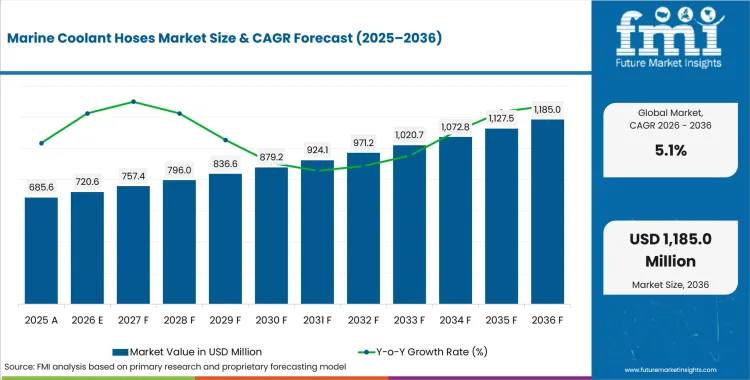
USD 720.6 million in 2026 and USD 1,185.0 million by 2036 at a 5.1% CAGR.
Sales of marine coolant hose is projected to rise from USD 720.6 million in 2026 to USD 1,185.0 million by 2036 at 5.1% CAGR. First-fit demand grows as new marine engines require several liquid-cooling connections between propulsion units and heat exchangers. The Australian Maritime Safety Authority recorded 1,445 newly certified domestic commercial vessels in its June 2025 fleet review. Each first fit enters a service base that later returns to yards for hose inspection and replacement.
Service distance changes replacement economics because an incorrect hose selection can strand work far from stocked inventory. Statistics Norway counted 1,498 merchant vessels above 100 gross tonnes in 2025 in its January 2026 release. The fleet makes exact coolant hose systems commercially important along a long coastline with dispersed service points. Local dimensional depth can therefore influence return-to-service timing more than a small difference in hose price.
Key Takeaways of Marine Coolant Hoses Market
- Installed-vessel maintenance and new construction sustain marine coolant hose demand because heat and vibration gradually reduce confidence in serviceable engine connections.
- By product type, molded coolant hoses are estimated to hold 29.0% in 2026 owing to fixed geometry that controls tight engine-room bends.
- In 2026, EPDM rubber is expected to lead material with 42.0% share because reinforced grades cover conventional water and coolant duty economically.
- Inboard diesel is projected to hold 31.0% share in 2026 attributable to multiple coolant and raw-water connections on sustained-duty engines.
- Exact diameter and bend geometry restrain casual substitution because reinforcement and temperature limits must match the circuit before a low-cost hose is trusted.
- Key players in the marine coolant hoses market include Parker Hannifin Corporation, Continental AG, Gates Corporation, Trelleborg AB, VETUS B.V., Kuriyama of America, Inc., The Novaflex Group, and Flexfab, LLC.
Analyst Perspective
“Marine coolant hose margin is won at the fitment decision because one wrong bend or material choice can keep a vessel in the yard. Boat yards and distributors protect installation time by pairing exact geometry with documented temperature limits and locally stocked replacement sizes.”
- Nikhil Kaitwade, Principal Consultant, Future Market Insights
How is the Marine Coolant Hoses Market segmented?
The marine coolant hoses market is segmented by product type, material, fuel type, boat type, sales channel, and region.
Product type covers molded coolant hoses, straight coolant hoses, raw water hoses, heater hoses, and heavy-duty reinforced hoses. Material covers EPDM rubber, silicone, nitrile blends, reinforced thermoplastic, and fluoroelastomer-lined constructions. Fuel type covers inboard diesel, outboard engines, inboard gasoline, generator sets, and auxiliary engines. Boat type covers recreational boats, commercial workboats, yachts, fishing vessels, and patrol / rescue craft. Sales channel covers aftermarket distributors, OEM supply, boat yards, and marine service dealers.
What makes Molded coolant hoses central to the Product type category?
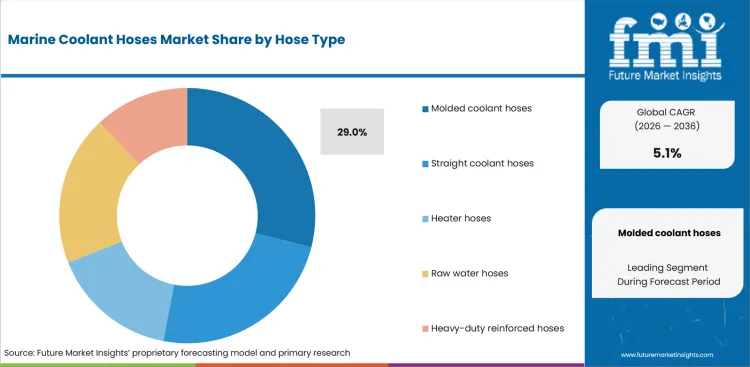
Fixed geometry is most useful where pumps and heat exchangers leave too little room for a natural bend in straight hose. Viper Performance announced a dedicated marine silicone-hose range in July 2026 with extra reinforcement for cooling systems. The launch keeps engineered hose construction focused on heat and route control while adjacent radiator hose designs face the same kink risk.
- By product type, molded coolant hoses are estimated to hold 29.0% in 2026 owing to repeatable geometry that reduces improvised joints near compact machinery.
- Boatbuilders and repair yards can follow an established route with fewer fittings so installation time falls without changing the surrounding cooling layout.
Why does EPDM Rubber lead the Material category?
EPDM remains the practical baseline for conventional marine water and coolant circuits because operators balance heat tolerance against replacement cost. VETUS signed a conformity declaration in September 2025 for its MWHOSE cooling-water hose under ISO 13363 after assessment by RINA Services. The record keeps hose selection tied to documented marine service instead of a generic elastomer label.
- In 2026, EPDM rubber is expected to lead material with 42.0% share because reinforced grades cover common fresh-water and coolant duties economically.
- Silicone takes hotter positions while EPDM retains volume where standard engine temperatures and broad replacement availability decide the service choice.
How does Inboard Diesel shape the Fuel type category?
Marine propulsion systems built for inboard diesels use separate connections for closed-loop coolant and raw-water heat rejection. Wärtsilä announced in January 2025 that eight new LNG-operated container vessels would use its 34DF constant-speed engine configuration. Each new engine package enlarges the installed marine diesel engine base that later requires scheduled cooling-circuit inspection.
- Inboard diesel is projected to hold 31.0% share in 2026 owing to several cooling and raw-water connections on sustained-duty propulsion systems.
- Commercial operators select reinforced routing for long engine hours since a failed coolant or seawater connection can remove revenue-generating propulsion from service.
What drives Aftermarket Distributors in the Sales Channel category?
Aftermarket orders reach distributors after a technician identifies an existing route and a short repair window instead of specifying a new system. VETUS Maxwell expanded its North American applications and customer-support team in January 2026 to serve OEMs, dealers and installers. The move reinforces a marine service model in which technical access and nearby inventory turn industrial hose assemblies into faster repairs.
- By sales channel, aftermarket distributors are forecast to represent 36.0% in 2026 driven by mixed vessel ages and fragmented replacement specifications.
- Distributors win urgent work by confirming construction quickly then supplying the correct diameter before the repair window extends into vessel downtime.
What are the drivers, restraints and opportunities in the Marine Coolant Hoses Market?
Installed-vessel maintenance supports repeat demand, exact fitment limits substitution, and higher-value constructions expand revenue where routing or heat exposure is difficult.
- Driver: Vessel maintenance and engine service create repeat replacement demand as heat and vibration gradually age flexible cooling connections.
- Restraint: Geometry and material limits slow brand switching because an incorrect hose can kink or leak under operating pressure.
- Opportunity: Molded and higher-temperature constructions earn premiums in tight machinery spaces where repeated installation work carries measurable yard cost.
Installed fleets generate repeat orders during planned engine work because heat and vibration age flexible cooling connections before visible failure becomes acceptable. Fisheries and Oceans Canada counted 16,073 registered fishing vessels in its 2025 Fast Facts publication using 2024 fleet data. The figure is not hose volume yet it defines a large service population whose propulsion systems and onboard marine gensets require renewed cooling connections.
Fitment complexity restrains substitution because inside diameter does not establish pressure duty or temperature suitability for a cooling circuit. The USA Coast Guard’s July 2025 boating report kept machinery failure among the five leading primary factors in reported 2024 recreational accidents. The record does not isolate hoses yet it explains why yards avoid unqualified mechanical replacements that could disable propulsion.
Higher-value hose earns its premium if local technical support prevents repeated installation work in confined machinery spaces. VETUS designated C2 Marine as a VETUS Centre in March 2026 with sales and maintenance support for southern France. The service route gives molded or high-temperature hose a clearer revenue path because local technicians can resolve fitment questions during the original yard visit.
Which country CAGRs are profiled in the Marine Coolant Hoses Market?
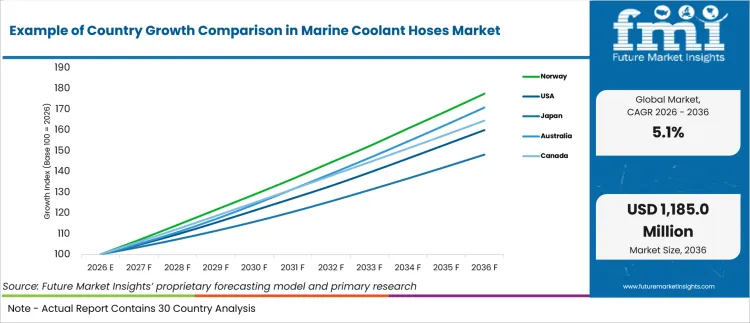
| Country | CAGR |
|---|---|
| Norway | 6.3% |
| Australia | 5.9% |
| Brazil | 5.6% |
| Canada | 5.2% |
| USA | 4.9% |
How do country-level CAGRs compare in the Marine Coolant Hoses Market?
The five country forecasts occupy a narrow 1.4-point corridor between Norway at 6.3% and the USA at 4.9%. Norway and Australia form the upper group because commercial fleet duty puts more cooling connections into intensive service. Brazil and Canada form the middle pair while the USA grows more slowly from a much larger replacement base.
- Norway’s working-vessel mix keeps cooling-hose specifications exacting during dispersed coastal service.
- Australia’s specialized domestic craft sustain varied first-fit requirements for commercial boatbuilders.
- Brazil’s fishing fleet concentrates replacement opportunities at ports during formal regularization work.
- Canada’s Atlantic fisheries compress engine maintenance into short seasonal service windows.
- The USA combines slower growth with a very large recreational replacement base.
Similar forecast rates produce different revenue patterns because stock location and vessel duty change order conversion. The full report provides country-level CAGR analysis across North America, Latin America, Europe, East Asia, South Asia, Oceania and the Middle East and Africa.
Country-wise Analysis
- Norwegian commercial operators schedule propulsion work along a long coastline where winter temperatures and distant yards make an incorrect coolant-hose specification expensive during tightly planned maintenance windows. Marine coolant hose demand in Norway is forecast to expand at 6.3% CAGR through 2036 reflecting high-duty passenger and offshore fleets that return repeatedly for engine service in regional ports. The Norwegian Maritime Authority’s April 2026 annual report recorded 648 unannounced inspections of Norwegian inspection-liable vessels, which favors distributors holding cold-weather grades and exact diameters near coastal yards because long replenishment distances can postpone planned work and force another technician visit locally.
- Australian commercial craft work long days in high ambient temperatures and often return to service points separated by large coastal distances that magnify a wrong hose choice. AMSA reported in March 2026 that it completed 2,481 initial inspections on domestic commercial vessels during 2025, giving builders and yards frequent compliance touchpoints while exposing parts delays in thinner regional stock. Australia is estimated to post 5.9% CAGR through 2036 attributable to continued commercial-vessel activity and diverse newbuilds, yet long supply lanes limit how quickly first-fit demand converts into later replacement revenue outside the largest coastal service centers and remote ports.
- Brazil’s fishing-vessel regularization is bringing deferred mechanical work into scheduled port calls before crews return to distant fishing grounds and lose another operating window. The Ministry of Fisheries and Aquaculture’s March 2026 management report recorded 6,000 PROPESC vessel inspections completed during 2025 so service yards gained more opportunities to identify cooling-system work during formal checks. Marine coolant hose sales in Brazil are projected to grow at 5.6% CAGR through 2036 given more regular inspection touchpoints, with later order conversion improving if distributors place common diameters near ports scheduled for subsequent public inspection rounds and regional maintenance visits.
- Canadian yards prepare fishing vessels and workboats for concentrated operating seasons, so one missing cooling part can consume a disproportionate share of the available maintenance window. Transport Canada’s May 2025 inspection pilot lets eligible lower-risk small commercial vessels seek a one-year certificate extension after open deficiencies are cleared and no high-risk deficiency remains. Canada’s marine coolant hose outlook is anticipated to advance at 5.2% CAGR through 2036 supported by repeat fleet service, yet coast-to-coast logistics keep inventory placement a structural constraint even as inspection timing becomes more flexible for qualified vessels during spring recommissioning periods.
- United States replacement purchasing runs through boat yards and dealers that support many engine vintages plus owner-maintained vessels with different cooling layouts. Marine coolant hose demand in the USA is forecast to rise at 4.9% CAGR through 2036 tied to a large replacement base, with USA Coast Guard statistics counting 11,674,073 registered recreational vessels in 2024. National dealer coverage shortens sourcing time in major boating states but varied engine ages make fitment data more valuable than a narrow low-price assortment, so manufacturers with exact cross-references and stocked molded shapes hold a practical advantage in replacement work.
Who are the notable companies in the Marine Coolant Hoses Market?
Parker Hannifin Corporation, Continental AG, Gates Corporation, Trelleborg AB, VETUS B.V., Kuriyama of America, Inc., The Novaflex Group, and Flexfab, LLC are the notable companies profiled in this market.
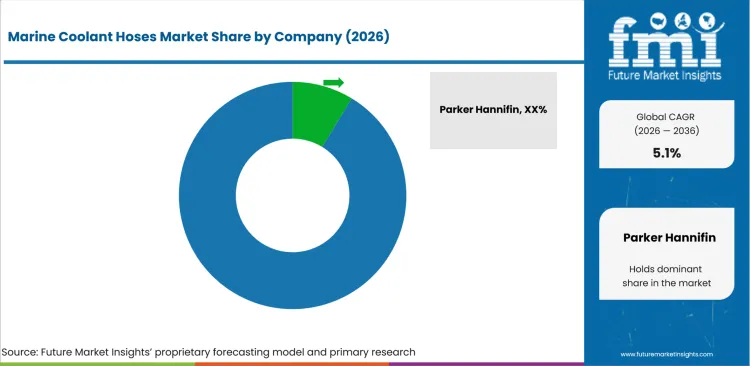
Company position depends on how closely each manufacturer reaches the fitment and replacement decision instead of total hose volume. Parker Hannifin Corporation, Continental AG, Gates Corporation and Trelleborg AB bring broad polymer or fluid-transfer engineering with international manufacturing reach. VETUS B.V. and Kuriyama of America, Inc. operate nearer service channels while The Novaflex Group and Flexfab, LLC bring specialist hose depth. Access to marine propulsion engines and yacht refits increases the value of fitment support and stocked replacement sizes.
- Broad fluid-transfer groups: Parker Hannifin Corporation, Continental AG, Gates Corporation, and Trelleborg AB differentiate through polymer engineering and multi-industry manufacturing depth.
- Marine and replacement specialists: VETUS B.V., Kuriyama of America, Inc., The Novaflex Group, and Flexfab, LLC compete on channel access and hose-focused application support.
Competitive Benchmarking: Marine Coolant Hoses Market
| Company | Marine Cooling Relevance | Hose Construction Breadth | Channel Support Depth | Geographic Reach |
|---|---|---|---|---|
| Parker Hannifin Corporation | High | High | High | Global |
| Continental AG | Medium | High | High | Global |
| Gates Corporation | High | High | High | Global |
| Trelleborg AB | High | High | High | Global |
| VETUS B.V. | High | Medium | High | Europe, North America and Oceania |
| Kuriyama of America, Inc. | Medium | High | High | North America and international distribution |
| The Novaflex Group | High | High | Medium | North America and international distributors |
| Flexfab, LLC | Medium | High | Medium | North America and international OEM channels |
Scoring basis: High marine cooling relevance requires documented coolant or marine water hose scope, Medium requires direct adjacent marine fluid-transfer scope, and Low identifies limited direct scope. High construction breadth requires three or more documented hose constructions, Medium requires two, and Low identifies one. High channel support requires multiple documented service or distribution routes, Medium requires a narrower route, and Low identifies limited regional support.
Key Developments in the Marine Coolant Hoses Market
- In December 2025, VETUS B.V. extended an NMEA 2000 PGN to include waterlock temperature so compatible displays can show cooling-water and exhaust-mixture temperature data.
- In June 2025, Continental AG introduced a multi-purpose marine hose for fuel-filler and vent duties plus wet-exhaust service to simplify vessel-maintenance inventories.
- In May 2025, Trelleborg AB completed the Sico acquisition and expanded extruded plus molded silicone-rubber manufacturing within Trelleborg Industrial Solutions.
Key Players in the Marine Coolant Hoses Market
Diversified Fluid-Transfer and Polymer Groups
- Parker Hannifin Corporation
- Continental AG
- Gates Corporation
- Trelleborg AB
Marine Systems and Distribution Specialists
- VETUS B.V.
- Kuriyama of America, Inc.
Specialist Hose Manufacturers
- The Novaflex Group
- Flexfab, LLC
Marine Coolant Hoses Market - Report Scope
| Coverage field | Report scope |
|---|---|
| Market breakdown | By product type, material, fuel type, boat type, sales channel and region. |
| Quantitative Units | USD Million. |
| Market Definition | Marine hoses used to carry engine coolant or cooling water within vessel propulsion, generator, heater, and related onboard cooling circuits. |
| Regions Covered | North America, Latin America, Europe, East Asia, South Asia and Pacific, and Middle East and Africa. |
| Countries Covered | Norway, Australia, Brazil, Canada, USA, and 20+ countries included in the full report. |
| Key Companies Profiled | Parker Hannifin Corporation, Continental AG, Gates Corporation, Trelleborg AB, VETUS B.V., Kuriyama of America, Inc., The Novaflex Group, and Flexfab, LLC. |
| Forecast Period | 2026 to 2036. |
| Approach | Primary and secondary research with market triangulation. |
Marine Coolant Hoses Market - Research Methodology
| Method | Approach |
|---|---|
| Primary Research | FMI analysts gathered input from manufacturers, service providers, technology developers, distributors, end users, procurement teams, and subject-matter experts. Interviews examined purchasing decisions, product or service evaluation, adoption barriers, approval requirements, pricing considerations, and expectations for technical or commercial support. Respondents were also asked what evidence is required before a trial, pilot, or initial order develops into regular purchasing. |
| Desk Research | Desk research covered government statistics, regulatory publications, trade data, industry associations, technical literature, standards, company filings, product information, and official corporate announcements. Sources were reviewed for relevance, publication date, geographic coverage, and consistency with the defined market scope. Claims relating to performance, applications, approvals, capacity, investment, and commercial activity were retained only when supported by credible public evidence. |
| Market Sizing and Forecasting | The market model combined the baseline value with historical performance, segment structure, pricing and volume indicators, adoption levels, company participation, and country-level demand conditions. Forecast assumptions considered economic activity, investment trends, regulatory developments, technology adoption, purchasing cycles, supply availability, and barriers to wider market use. Segment and regional estimates were reconciled before the final market total was calculated. |
| Data Validation | Estimates were checked against multiple independent indicators, including public data, company activity, trade patterns, industry developments, and findings from primary interviews. Validation also tested whether products, services, applications, and company revenues fell within the defined market boundaries. Adjacent categories, unsupported claims, overlapping revenues, and activities without direct market relevance were excluded to reduce double counting and maintain consistency across segments and countries. |
Marine Coolant Hoses Market by Segments
Marine Coolant Hoses Market segmented by Product Type:
- Molded coolant hoses
- Straight coolant hoses
- Raw water hoses
- Heater hoses
- Heavy-duty reinforced hoses
Marine Coolant Hoses Market segmented by Material:
- EPDM rubber
- Silicone
- Nitrile blends
- Reinforced thermoplastic
- Fluoroelastomer-lined
Marine Coolant Hoses Market segmented by Fuel Type:
- Inboard diesel
- Outboard engines
- Inboard gasoline
- Generator sets
- Auxiliary engines
Marine Coolant Hoses Market segmented by Boat Type:
- Recreational boats
- Commercial workboats
- Yachts
- Fishing vessels
- Patrol / rescue craft
Marine Coolant Hoses Market segmented by Sales Channel:
- Aftermarket distributors
- OEM supply
- Boat yards
- Marine service dealers
Marine Coolant Hoses Market by Region:
- North America
- USA
- Canada
- Latin America
- Brazil
- Mexico
- Chile
- Rest of Latin America
- Western Europe
- Germany
- UK
- Italy
- Spain
- France
- Nordics
- Benelux
- Rest of Western Europe
- Eastern Europe
- Russia
- Poland
- Hungary
- Balkan and Baltic States
- Rest of Eastern Europe
- East Asia
- China
- Japan
- South Korea
- South Asia and Pacific
- India
- ASEAN
- Australia and New Zealand
- Rest of South Asia and Pacific
- Middle East and Africa
- Kingdom of Saudi Arabia
- Other GCC Countries
- Türkiye
- South Africa
- Other African Union Countries
- Rest of Middle East and Africa
Research Sources and Bibliography
- Australian Maritime Safety Authority. (2025, June 10). Australia’s domestic fleet: 2024 New build trends report.
- Statistics Norway. (2026, January 23). The Norwegian Merchant Fleet.
- Viper Performance. (2026, July 20). Our New Marine Hoses Are Coming Soon!.
- VETUS B.V. (2025, September 10). Declaration of Conformity: Cooling water hose MWHOSE.
- Wärtsilä Corporation. (2025, January 21). CMA CGM to reduce methane emissions with newly released EnviroPac feature for Wärtsilä 34DF engine.
- VETUS B.V. (2026, January 9). VETUS MAXWELL expands team to strengthen customer support and service.
- Fisheries and Oceans Canada. (2025). Canada's fisheries fast facts 2025.
- United States Coast Guard. (2025, July 1). Coast Guard reports fewest boating fatalities in more than 50 years.
- VETUS B.V. (2026, March 24). VETUS France welcome C2 Marine as VETUS CENTRE.
- Norwegian Maritime Authority. (2026, April). Årsrapport 2025.
- Australian Maritime Safety Authority. (2026, March 26). Safer vessels, safer waters: Inspections annual report 2025.
- Ministério da Pesca e Aquicultura. (2026, March). Relatório de Gestão - 2025.
- Transport Canada. (2025, May 20). Pilot project on the inspection periodicity for small certificated domestic vessels - SSB No.: 07/2025.
- United States Coast Guard. (2025). 2024 Recreational Boating Statistics.
- Parker-Hannifin Corporation. (2025, September 18). Parker Completes Curtis Instruments Acquisition.
- RINA Brasil Serviços Técnicos Ltda. (2025). Flexfab Brazil ISO 9001:2015 certificate.
- Kuriyama Holdings Corporation. (2025, April 15). Mitoyo became a member of the Kuriyama Group.
- Continental AG. (2025, June 17). Continental Introduces Multi-Purpose Marine Hose to Streamline Vessel Maintenance and Reduce Complexity.
- VETUS B.V. (2025, December 2). In cooperation with NMEA, VETUS extends existing NMEA 2000 PGN to include waterlock temperature.
- Trelleborg Group. (2026). Acquisitions and divestments.
- VETUS B.V. (2026, January 5). Power, Precision and Planet-Friendly Performance; the New VETUS E-LINE 22 kW.
- Continental AG. (2025, November 11). Continental Launches Vantage Hoses Built for Reliable Everyday Performance.
- Semperit AG Holding. (2026). Annual Report 2025.
- Danfoss A/S. (2026, July 9). Danfoss to create a leading global player in Fluid Conveyance.
- Gates Corporation. (2026, May 11). Gates Introduces 3-inch and 4-inch Data Master MegaFlex Hoses to Unlock Higher-Capacity Cooling for Data Centers.
- SPX Technologies, Inc. (2026, February 6). SPX Technologies Completes Acquisition of Crawford United.
- Continental AG. (2025, April 14). Continental Launches Premium Data Cooling Hoses to Maintain Stable Cooling Cycles in Data Centers.
- Hutchinson. (2025, October 28). Hutchinson showcases solutions for data centers and energy storage.
- Cooper Standard. (2025, April 25). Cooper Standard Receives 2025 Automotive News PACE Pilot Recognition.
- Kuriyama Holdings Corporation. (2025, April 1). Kuriyama of America relocates and expands Northeast branch warehouse.
- The Novaflex Group. (2025). Novaflex Rubber & Plastics Product Guide.
This bibliography is provided for reader reference and is not exhaustive. The full report contains the complete reference list and detailed citations
This Report Answers
- How large is the marine coolant hoses market in 2026 and what value is projected for 2036?
- Which operating conditions create repeat replacement demand for marine coolant hoses?
- Why do molded coolant hoses and EPDM rubber retain strong positions in their respective categories?
- How does inboard diesel architecture affect hose count and replacement requirements?
- Why do aftermarket distributors capture a large share of replacement-focused sales?
- Which five countries show the strongest approved growth rates within the profiled set?
- How do the eight profiled companies differ on marine relevance, construction breadth, and channel support?
- Which recent company actions are changing ownership, tooling, and service coverage in the competitive field?
- What commercial conditions should manufacturers address before expanding stocked marine coolant hose ranges?
Frequently Asked Questions
How big is the marine coolant hoses market in 2026?
The marine coolant hoses market is valued at USD 720.6 million in 2026 and is projected to reach USD 1,185.0 million by 2036. Growth is driven by new vessel installation and repeat replacement work on propulsion and auxiliary cooling circuits.
What is the CAGR of the marine coolant hoses market from 2026 to 2036?
The marine coolant hoses market is projected to grow at a CAGR of 5.1% between 2026 and 2036. Expansion is supported by scheduled vessel maintenance and newbuild activity that puts additional cooling connections into service.
Which product type leads the marine coolant hoses market?
The molded coolant hoses segment is expected to hold 29.0% of the marine coolant hoses market in 2026, driven by fixed geometry that controls difficult bends. The routing advantage reduces improvised joints and installation compromises inside compact engine spaces.
Which material holds the largest current share in the marine coolant hoses market?
The EPDM rubber segment is expected to hold 42.0% of the marine coolant hoses market in 2026, attributable to economical reinforced constructions for conventional water and coolant duty. Silicone serves hotter positions where the added material cost has a specific operating purpose.
How much value will the marine coolant hoses market add between 2026 and 2036?
The marine coolant hoses market is expected to add USD 464.4 million in value between 2026 and 2036. The increase reflects replacement work on installed vessels plus first-fit demand from new propulsion and auxiliary cooling systems.
Which countries are projected to record the highest growth in the marine coolant hoses market?
Norway is projected to grow at 6.3% CAGR followed by Australia at 5.9% and Brazil at 5.6% through 2036. Their growth paths differ because commercial-vessel duty and parts access change replacement timing.
Which companies are active in the marine coolant hoses market?
Key companies operating in the marine coolant hoses market include Parker Hannifin Corporation, Continental AG, Gates Corporation, Trelleborg AB, VETUS B.V., Kuriyama of America, Inc., The Novaflex Group, and Flexfab, LLC. Their positions differ through hose engineering and marine specialization plus replacement-channel reach.
Preview the report firsthand - request a free sample
Get SampleGet the brochure for pricing and purchase details.
Get PDFTable of Content
- Key Takeaways
- Market Size and CAGR
- Top Growth Driver
- Fastest Growing Segment
- Leading Region
- Key Companies
- Emerging Opportunities
- Executive Summary
- Global Market Outlook
- Demand-side Trends
- Supply-side Trends
- Technology Roadmap Analysis
- Analysis and Recommendations
- Analyst Perspective (What is happening? Why now? What should investors know?)
- Key Questions Answered
- How large is the market?
- What is the CAGR?
- What are key trends?
- Which region dominates?
- Who are the leaders?
- Market Overview
- Market Coverage / Taxonomy
- Market Definition / Scope / Limitations
- Research Methodology
- Chapter Orientation
- Analytical Lens and Working Hypotheses
- Market Structure, Signals, and Trend Drivers
- Benchmarking and Cross-market Comparability
- Market Sizing, Forecasting, and Opportunity Mapping
- Research Design and Evidence Framework
- Desk Research Programme (Secondary Evidence)
- Expert Input and Fieldwork (Primary Evidence)
- Tooling, Models, and Reference Databases
- Data Engineering and Model Build
- Quality Assurance and Audit Trail
- Market Background
- Market Dynamics (Drivers, Restraints, Opportunity, Trends)
- Scenario Forecast (Optimistic, Likely, Conservative)
- Impact Analysis
- AI Impact
- Sustainability Impact
- Regulatory Impact
- Technology Impact
- Consumer / Buyer Analysis
- Purchase Drivers
- Adoption Barriers
- Buyer Journey
- Opportunity Map Analysis
- Product Life Cycle Analysis
- Supply Chain Analysis
- Investment Feasibility Matrix
- Value Chain Analysis
- PESTLE and Porter's Analysis
- Regulatory Landscape
- Regional Parent Market Outlook
- Production and Consumption Statistics
- Import and Export Statistics
- Global Market Analysis and Forecast, 2021 to 2036
- Historical Market Size Value (USD Million) Analysis, 2021 to 2025
- Current and Future Market Size Value (USD Million) Projections, 2026 to 2036
- Y-o-Y Growth Trend Analysis
- Absolute $ Opportunity Analysis
- Global Market Pricing Analysis, 2021 to 2036
- Global Market Analysis and Forecast, By Hose Type, 2021 to 2036
- Introduction / Key Findings
- Historical Market Size Value (USD Million) Analysis By Hose Type, 2021 to 2025
- Current and Future Market Size Value (USD Million) Analysis and Forecast By Hose Type, 2026 to 2036
- Molded coolant hoses
- Straight coolant hoses
- Heater hoses
- Raw water hoses
- Heavy-duty reinforced hoses
- Molded coolant hoses
- Y-o-Y Growth Trend Analysis By Hose Type, 2021 to 2025
- Absolute $ Opportunity Analysis By Hose Type, 2026 to 2036
- Global Market Analysis and Forecast, By Material, 2021 to 2036
- Introduction / Key Findings
- Historical Market Size Value (USD Million) Analysis By Material, 2021 to 2025
- Current and Future Market Size Value (USD Million) Analysis and Forecast By Material, 2026 to 2036
- EPDM rubber
- Silicone
- Nitrile blends
- Reinforced thermoplastic
- Fluoroelastomer-lined
- EPDM rubber
- Y-o-Y Growth Trend Analysis By Material, 2021 to 2025
- Absolute $ Opportunity Analysis By Material, 2026 to 2036
- Global Market Analysis and Forecast, By Engine Type, 2021 to 2036
- Introduction / Key Findings
- Historical Market Size Value (USD Million) Analysis By Engine Type, 2021 to 2025
- Current and Future Market Size Value (USD Million) Analysis and Forecast By Engine Type, 2026 to 2036
- Inboard diesel
- Inboard gasoline
- Outboard engines
- Generator sets
- Auxiliary engines
- Inboard diesel
- Y-o-Y Growth Trend Analysis By Engine Type, 2021 to 2025
- Absolute $ Opportunity Analysis By Engine Type, 2026 to 2036
- Global Market Analysis and Forecast, By Vessel Type, 2021 to 2036
- Introduction / Key Findings
- Historical Market Size Value (USD Million) Analysis By Vessel Type, 2021 to 2025
- Current and Future Market Size Value (USD Million) Analysis and Forecast By Vessel Type, 2026 to 2036
- Recreational boats
- Commercial workboats
- Yachts
- Fishing vessels
- Patrol / rescue craft
- Recreational boats
- Y-o-Y Growth Trend Analysis By Vessel Type, 2021 to 2025
- Absolute $ Opportunity Analysis By Vessel Type, 2026 to 2036
- Global Market Analysis and Forecast, By Sales Channel, 2021 to 2036
- Introduction / Key Findings
- Historical Market Size Value (USD Million) Analysis By Sales Channel, 2021 to 2025
- Current and Future Market Size Value (USD Million) Analysis and Forecast By Sales Channel, 2026 to 2036
- OEM supply
- Aftermarket distributors
- Boat yards
- Marine service dealers
- OEM supply
- Y-o-Y Growth Trend Analysis By Sales Channel, 2021 to 2025
- Absolute $ Opportunity Analysis By Sales Channel, 2026 to 2036
- Global Market Analysis and Forecast, By Region, 2021 to 2036
- Introduction
- Historical Market Size Value (USD Million) Analysis By Region, 2021 to 2025
- Current Market Size Value (USD Million) Analysis and Forecast By Region, 2026 to 2036
- North America
- Latin America
- Western Europe
- Eastern Europe
- East Asia
- South Asia and Pacific
- Middle East & Africa
- Market Attractiveness Analysis By Region
- North America Market Analysis and Forecast, By Country, 2021 to 2036
- Historical Market Size Value (USD Million) Trend Analysis By Market Taxonomy, 2021 to 2025
- Market Size Value (USD Million) Forecast By Market Taxonomy, 2026 to 2036
- By Country
- USA
- Canada
- By Hose Type
- By Material
- By Engine Type
- By Vessel Type
- By Sales Channel
- By Country
- Market Attractiveness Analysis
- By Country
- By Hose Type
- By Material
- By Engine Type
- By Vessel Type
- By Sales Channel
- Key Takeaways
- Latin America Market Analysis and Forecast, By Country
- Historical Market Size Value (USD Million) Trend Analysis By Market Taxonomy, 2021 to 2025
- Market Size Value (USD Million) Forecast By Market Taxonomy, 2026 to 2036
- By Country
- Brazil
- Mexico
- Chile
- Rest of Latin America
- By Hose Type
- By Material
- By Engine Type
- By Vessel Type
- By Sales Channel
- By Country
- Market Attractiveness Analysis
- By Country
- By Hose Type
- By Material
- By Engine Type
- By Vessel Type
- By Sales Channel
- Key Takeaways
- Western Europe Market Analysis and Forecast, By Country
- Historical Market Size Value (USD Million) Trend Analysis By Market Taxonomy, 2021 to 2025
- Market Size Value (USD Million) Forecast By Market Taxonomy, 2026 to 2036
- By Country
- Germany
- UK
- Italy
- Spain
- France
- Nordic
- BENELUX
- Rest of Western Europe
- By Hose Type
- By Material
- By Engine Type
- By Vessel Type
- By Sales Channel
- By Country
- Market Attractiveness Analysis
- By Country
- By Hose Type
- By Material
- By Engine Type
- By Vessel Type
- By Sales Channel
- Key Takeaways
- Eastern Europe Market Analysis and Forecast, By Country
- Historical Market Size Value (USD Million) Trend Analysis By Market Taxonomy, 2021 to 2025
- Market Size Value (USD Million) Forecast By Market Taxonomy, 2026 to 2036
- By Country
- Russia
- Poland
- Hungary
- Balkan & Baltic
- Rest of Eastern Europe
- By Hose Type
- By Material
- By Engine Type
- By Vessel Type
- By Sales Channel
- By Country
- Market Attractiveness Analysis
- By Country
- By Hose Type
- By Material
- By Engine Type
- By Vessel Type
- By Sales Channel
- Key Takeaways
- East Asia Market Analysis and Forecast, By Country
- Historical Market Size Value (USD Million) Trend Analysis By Market Taxonomy, 2021 to 2025
- Market Size Value (USD Million) Forecast By Market Taxonomy, 2026 to 2036
- By Country
- China
- Japan
- South Korea
- By Hose Type
- By Material
- By Engine Type
- By Vessel Type
- By Sales Channel
- By Country
- Market Attractiveness Analysis
- By Country
- By Hose Type
- By Material
- By Engine Type
- By Vessel Type
- By Sales Channel
- Key Takeaways
- South Asia and Pacific Market Analysis and Forecast, By Country
- Historical Market Size Value (USD Million) Trend Analysis By Market Taxonomy, 2021 to 2025
- Market Size Value (USD Million) Forecast By Market Taxonomy, 2026 to 2036
- By Country
- India
- ASEAN
- Australia & New Zealand
- Rest of South Asia and Pacific
- By Hose Type
- By Material
- By Engine Type
- By Vessel Type
- By Sales Channel
- By Country
- Market Attractiveness Analysis
- By Country
- By Hose Type
- By Material
- By Engine Type
- By Vessel Type
- By Sales Channel
- Key Takeaways
- Middle East & Africa Market Analysis and Forecast, By Country
- Historical Market Size Value (USD Million) Trend Analysis By Market Taxonomy, 2021 to 2025
- Market Size Value (USD Million) Forecast By Market Taxonomy, 2026 to 2036
- By Country
- Kingdom of Saudi Arabia
- Other GCC Countries
- Türkiye
- South Africa
- Other African Union
- Rest of Middle East & Africa
- By Hose Type
- By Material
- By Engine Type
- By Vessel Type
- By Sales Channel
- By Country
- Market Attractiveness Analysis
- By Country
- By Hose Type
- By Material
- By Engine Type
- By Vessel Type
- By Sales Channel
- Key Takeaways
- Key Countries Market Analysis
- USA
- Pricing Analysis
- Market Share Analysis, 2025
- By Hose Type
- By Material
- By Engine Type
- By Vessel Type
- By Sales Channel
- Canada
- Pricing Analysis
- Market Share Analysis, 2025
- By Hose Type
- By Material
- By Engine Type
- By Vessel Type
- By Sales Channel
- Mexico
- Pricing Analysis
- Market Share Analysis, 2025
- By Hose Type
- By Material
- By Engine Type
- By Vessel Type
- By Sales Channel
- Brazil
- Pricing Analysis
- Market Share Analysis, 2025
- By Hose Type
- By Material
- By Engine Type
- By Vessel Type
- By Sales Channel
- Chile
- Pricing Analysis
- Market Share Analysis, 2025
- By Hose Type
- By Material
- By Engine Type
- By Vessel Type
- By Sales Channel
- Germany
- Pricing Analysis
- Market Share Analysis, 2025
- By Hose Type
- By Material
- By Engine Type
- By Vessel Type
- By Sales Channel
- UK
- Pricing Analysis
- Market Share Analysis, 2025
- By Hose Type
- By Material
- By Engine Type
- By Vessel Type
- By Sales Channel
- Italy
- Pricing Analysis
- Market Share Analysis, 2025
- By Hose Type
- By Material
- By Engine Type
- By Vessel Type
- By Sales Channel
- Spain
- Pricing Analysis
- Market Share Analysis, 2025
- By Hose Type
- By Material
- By Engine Type
- By Vessel Type
- By Sales Channel
- France
- Pricing Analysis
- Market Share Analysis, 2025
- By Hose Type
- By Material
- By Engine Type
- By Vessel Type
- By Sales Channel
- India
- Pricing Analysis
- Market Share Analysis, 2025
- By Hose Type
- By Material
- By Engine Type
- By Vessel Type
- By Sales Channel
- ASEAN
- Pricing Analysis
- Market Share Analysis, 2025
- By Hose Type
- By Material
- By Engine Type
- By Vessel Type
- By Sales Channel
- Australia & New Zealand
- Pricing Analysis
- Market Share Analysis, 2025
- By Hose Type
- By Material
- By Engine Type
- By Vessel Type
- By Sales Channel
- China
- Pricing Analysis
- Market Share Analysis, 2025
- By Hose Type
- By Material
- By Engine Type
- By Vessel Type
- By Sales Channel
- Japan
- Pricing Analysis
- Market Share Analysis, 2025
- By Hose Type
- By Material
- By Engine Type
- By Vessel Type
- By Sales Channel
- South Korea
- Pricing Analysis
- Market Share Analysis, 2025
- By Hose Type
- By Material
- By Engine Type
- By Vessel Type
- By Sales Channel
- Russia
- Pricing Analysis
- Market Share Analysis, 2025
- By Hose Type
- By Material
- By Engine Type
- By Vessel Type
- By Sales Channel
- Poland
- Pricing Analysis
- Market Share Analysis, 2025
- By Hose Type
- By Material
- By Engine Type
- By Vessel Type
- By Sales Channel
- Hungary
- Pricing Analysis
- Market Share Analysis, 2025
- By Hose Type
- By Material
- By Engine Type
- By Vessel Type
- By Sales Channel
- Kingdom of Saudi Arabia
- Pricing Analysis
- Market Share Analysis, 2025
- By Hose Type
- By Material
- By Engine Type
- By Vessel Type
- By Sales Channel
- Türkiye
- Pricing Analysis
- Market Share Analysis, 2025
- By Hose Type
- By Material
- By Engine Type
- By Vessel Type
- By Sales Channel
- South Africa
- Pricing Analysis
- Market Share Analysis, 2025
- By Hose Type
- By Material
- By Engine Type
- By Vessel Type
- By Sales Channel
- USA
- Market Structure Analysis
- Competition Dashboard
- Competition Benchmarking
- Market Share Analysis of Top Players
- By Regional
- By Hose Type
- By Material
- By Engine Type
- By Vessel Type
- By Sales Channel
- Emerging Startups
- Innovation Benchmarking
- Competition Analysis
- Competition Deep Dive
- Parker Hannifin
- Overview
- Product Portfolio
- Profitability by Market Segments
- Sales Footprint
- Strategy Overview
- Marketing Strategy
- Product Strategy
- Channel Strategy
- Continental
- Trident Marine
- Vetus
- Trelleborg
- Kuriyama
- Novaflex
- Shields Marine / Teleflex
- Flexfab
- Parker Hannifin
- Case Studies
- Success Stories
- Recent Developments
- Competition Deep Dive
- Assumptions & Acronyms Used


