

- Market Size (2026)
- USD 920.6 Mn
- Forecast (2036)
- USD 1471.2 Mn
- CAGR (2026 to 2036)
- 4.8%
How big is Marine Oil Filters Market in 2026?
USD 920.6 million in 2026 and USD 1,471.2 million by 2036 at a 4.8% CAGR.
Marine oil filter sales are projected to rise from USD 920.6 million in 2026 to USD 1,471.2 million by 2036 at a 4.8% CAGR. Replacement volume follows marine engine service because each oil change requires a filter decision on eligible engines. The USA Coast Guard reported 10,852,992 mechanically propelled registered recreational vessels for 2024 in its June 2025 statistical release. That installed base keeps engine lubricants and filtration purchases tied to recurring service instead of new vessel deliveries alone.
Country conversion differs with vessel utilization and the distance between operating areas and service inventory. Brazil illustrates the commercial effect at the high-activity end of the range across major port systems. ANTAQ reported in February 2026 that the Brazilian waterborne transport sector moved 1.4 billion tonnes during 2025. Higher vessel traffic does not establish filter revenue by itself, but it raises engine-hour exposure across workboats and commercial fleets. Distributors therefore need fitment depth and reliable stock near active ports to convert operating intensity into replacement sales.
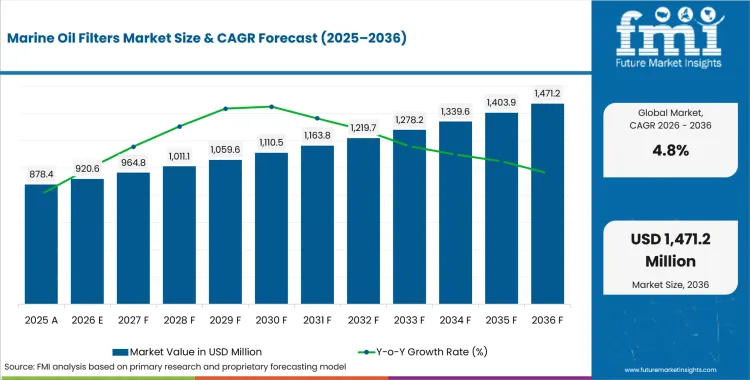
Key Takeaways of Marine Oil Filters Market
-
Scheduled engine servicing keeps marine oil filters in a recurring replacement cycle across recreational craft and high-hour commercial vessels.
- By Filter type, spin-on oil filters are estimated to hold 39.0% in 2026 owing to sealed construction that shortens routine change-out work.
- In 2026, cellulose media are expected to lead the type category with 36.0% share because established pleating economics suit high-volume replacement filters.
- Inboard diesel is set to lead the fuel type category with 31.0% share in 2026 due to recurring filtration needs on sustained-load engines.
- Engine-specific threads and bypass settings restrict substitution because a visually similar filter can carry different lubrication-circuit requirements.
- Some of the key players in this market include MANN+HUMMEL, Atmus Filtration Technologies (Fleetguard), Parker Hannifin(Racor), MAHLE, Quicksilver / Mercury Marine, Yanmar, Volvo Penta, and Suzuki Marine.
Analyst Perspective
“Marine oil filters earn value at the service event because a technician must confirm thread, bypass behavior and engine fitment before returning the vessel to operation. The stronger offer pairs verified cross-references with local stock so downtime risk is weighed alongside filtration efficiency and lubrication-system protection.”
- Nikhil Kaitwade, Principal Consultant, Future Market Insights
How is the Marine Oil Filters Market segmented?
The marine oil filters market is segmented by Filter type, type, fuel type, sales channel, boat type and region.
Filter type covers spin-on, cartridge, bypass, high-efficiency and heavy-duty marine filters. Type includes cellulose, synthetic, microglass and blended media. Fuel type covers inboard diesel, outboard engines, inboard gasoline, marine generators and auxiliary engines. Sales channels include aftermarket replacement, OEM engine supply, marine dealers and fleet service. Boat types cover recreational boats, commercial vessels, fishing craft, workboats and yachts.
What makes Spin-on Oil filters central to the Filter Type category?
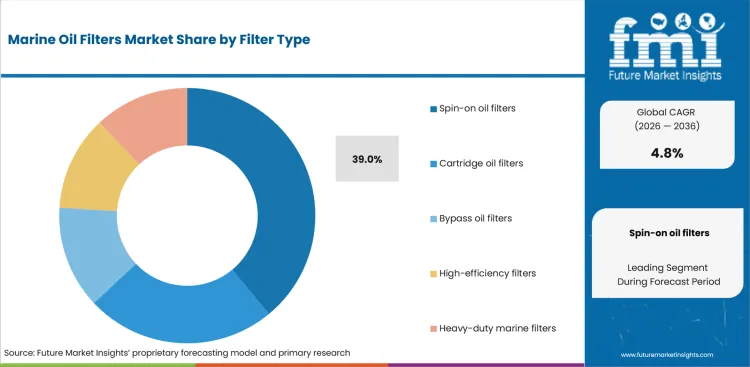
Spin-on filters suit routine marine service because the element and housing leave the engine as one sealed assembly. That layout limits workshop handling and makes change-out speed valuable on engines serviced away from major parts hubs.
- Based on Filter type, spin-on oil filters are projected to account for 39.0% in 2026 due to sealed construction that shortens change-out work and avoids cleaning a reusable housing.
- Honda presented the BF300 outboard in January 2025 with a revised oil-filter structure designed for easier attachment and removal, linking maintenance access directly to replaceable filter handling on marine engines.
Why does Cellulose Media lead the Type category?
Cellulose media remain practical for high-volume oil filters because pleated structures provide contaminant capacity without forcing a costly material platform. Resin treatment can strengthen the cellulose media while retaining familiar converting equipment for stable, repeatable high-volume filter production without extensive tooling changes.
- By type, cellulose media are estimated to hold 36.0% in 2026 owing to established pleating economics and compatibility with high-volume replacement designs used across recurring marine engine service.
- MANN+HUMMEL reported in March 2025 that lignin partly replaced fossil phenolic resin in selected cellulose-based oil filters while the company retained intended performance at series-production scale.
How does Inboard Diesel Shape the Fuel Type category?
Inboard diesel engines concentrate filter value as propulsion hours accumulate under sustained load on workboats and commercial vessels. Commercial operators treat oil service as an uptime requirement within the broader marine propulsion market across long asset lives.
- In 2026, inboard diesel is expected to lead fuel type with 31.0% share because sustained-load engines return to scheduled lubricant service more often than lower-hour recreational engines across asset lives.
- Yanmar introduced the 12AYEM commercial marine engine in January 2025 with a stated 500-hour oil-change interval, requiring model-specific filter support across recurring commercial maintenance schedules in dealer and fleet workshops.
What supports Aftermarket Replacement in the Sales Channel category?
Aftermarket demand repeats long after factory installation because engine lubricants and filters are replaced at planned oil-service intervals across long-lived marine engine families. The commercial task is matching each engine to a verified replacement filter part without delaying scheduled maintenance.
- By sales channel, aftermarket replacement is forecast to represent 43.0% in 2026 driven by repeat oil-service transactions that continue after engines leave their original warranty periods.
- Suzuki Marine partnered with West Marine in May 2025 to sell genuine parts and maintenance kits beside outboards, placing model-matched service parts closer to owners during maintenance and workshop visits.
What are the drivers, restraints and opportunities in the Marine Oil Filters Market?
Recurring engine service supports replacement demand, fitment complexity constrains substitution and higher-capacity media supports better service economics.
- Driver: Long-lived marine engines generate repeat filter purchases whenever operating hours or seasonal schedules trigger an oil-service event.
- Restraint: Thread geometry and bypass calibration can make apparently similar filters unsuitable for the same lubrication circuit.
- Opportunity: Better media and model-specific service programs can reduce downtime while increasing the value captured during routine maintenance.
Recurring Service Supports Replacement Demand
Replacement demand expands as active engines return for marine engine service across recreational and commercial fleets. NMMA reported in July 2026 that USA recreational marine spending reached USD 54 billion during 2025 and included maintenance in its boat-use spending category. That service economy also supports marine fuel filtration and lubricant parts because owners must keep existing engines operational across repeated seasons.
Fitment Verification Restricts Substitution
Fitment friction begins with the engine interface because thread geometry and bypass behavior must suit the lubrication circuit before media performance matters. Honda’s February 2025 refresh of seven large outboards introduced an oil-filter-change mechanism that prevents oil from leaking into the engine cover during service. The redesign shows why filter access and mounting details can restrict substitution even when two replacement filters appear comparable on basic dimensions.
Higher-Capacity Media Supports Service Economics
Premium media has commercial value when higher contaminant capacity solves a documented service constraint without upsetting required oil flow. Atmus launched NanoNet N3 in January 2025 and said its higher contaminant capacity can extend service intervals or reduce filter size in markets that include marine equipment. Filter manufacturers can charge for that improvement after an engine OEM or fleet validates the media against the lubrication system’s protection limits.
Which country CAGRs are profiled in the Marine Oil Filters Market?
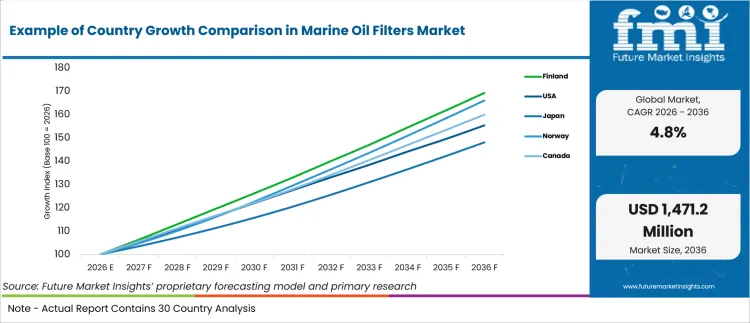
| Country | CAGR |
|---|---|
| Finland | 6.1% |
| Norway | 5.8% |
| Brazil | 5.4% |
| Canada | 5.1% |
| USA | 4.7% |
How do country-level CAGRs compare in the Marine Oil Filters Market?
The country CAGRs form a 1.4-point band from Finland at 6.1% to the USA at 4.7%. Finland and Norway occupy the upper tier because dispersed service locations reward dependable marine inventory. Brazil forms the transition market, while Canada and the USA rely more heavily on established replacement channels.
- Finland rewards seasonal inventory that reaches both inland and coastal service locations.
- Norway favors distributors that cover demanding coastal fleets along a long shoreline.
- Brazilian port utilization raises engine hours while national distance complicates stocking economics.
- Canadian seasonal windows favor regional stock positioned near remote recreational and public fleets.
- USA scale rewards cross-reference breadth across a large and fragmented replacement channel.
Similar growth rates can therefore produce materially different inventory risks and channel economics. The full report provides country-level CAGR analysis across North America, Latin America, Europe, East Asia, South Asia, Oceania and the Middle East and Africa.
Country-wise Analysis
- Finland’s marine service market spans inland lakes and coastal operating areas, causing spring commissioning to concentrate parts demand before a short boating season. Marine oil filter demand in Finland is forecast to expand at 6.1% CAGR through 2036, driven by dealers planning engine-family stock around concentrated launch schedules and maintenance windows. Traficom reported in May 2026 that its Register of Ships dataset contained 2,278 records dated March 31; scattered inland and coastal workshops add inventory carrying costs, making verified fitment staging near technicians a stronger differentiator before seasonal service volumes peak across mixed recreational and commercial engine families.
- Norwegian commercial operators run fishing, passenger and offshore vessels from ports spread along a long coastline, leaving little tolerance for unplanned engine downtime. Statistics Norway reported in January 2026 that the 2025 merchant fleet contained 1,498 vessels, giving marine service companies a defined base for planned engine-family stock beyond the largest hubs. Norway is projected to record 5.8% CAGR over the assessment period, attributable to specialist distributors positioning parts near active fleets. Remote calls nevertheless raise delivery costs and strengthen the case for emergency replenishment routes reaching smaller ports during peak fishing and transport seasons.
- Brazilian replacement demand concentrates around major ports and coastal trade corridors, where commercial engines accumulate operating hours and short service windows depend on local parts availability. Marine oil filter sales in Brazil are anticipated to advance at 5.4% CAGR by 2036, supported by regional distributors placing engine-specific inventory near high-use vessel corridors. The Ministry of Ports and Airports reported 101.0 million tonnes of port and waterway movement in February 2026. Long distances between operating clusters lift freight expense and favor distributors that balance national coverage with local stock for marine vessel service at remote coastal repair points during short maintenance windows.
- Canadian marine service spans recreational boats and public craft operating within short seasonal windows across widely separated Atlantic ports and inland waterways. Fisheries and Oceans Canada reported in February 2025 that the final two 44-foot vessels arrived under a four-vessel patrol replacement program, adding a defined fleet with recurring maintenance needs for regional service networks. Canada is estimated to post 5.1% CAGR during the forecast period, with growth linked to dealers packaging verified filters with scheduled parts. Remote ports still increase freight cost, so reliable first-time replenishment becomes critical for fisheries and public-service craft working within narrow maintenance windows.
- United States purchasing is fragmented across OEM dealers, independent workshops and owner-performed service because broad engine generations make cross-reference confidence central to routine seasonal maintenance. Marine oil filter demand in the USA is forecast to rise at 4.7% CAGR through 2036, underpinned by broad stocked coverage that gives technicians more same-day replacement choices across mature boating regions. NMMA reported in June 2026 that 867,059 pre-owned boats changed hands during 2025, while the large used fleet keeps model-specific marine diesel engine service active; crowded catalogs, however, increase lookup risk for dealers serving older engines across regional boating centers during peak months nationwide.
Who are the notable companies in the Marine Oil Filters Market?
MANN+HUMMEL, Atmus Filtration Technologies (Fleetguard), Parker Hannifin(Racor), MAHLE, Quicksilver / Mercury Marine, Yanmar, Volvo Penta, and Suzuki Marine are the notable companies serving this market.
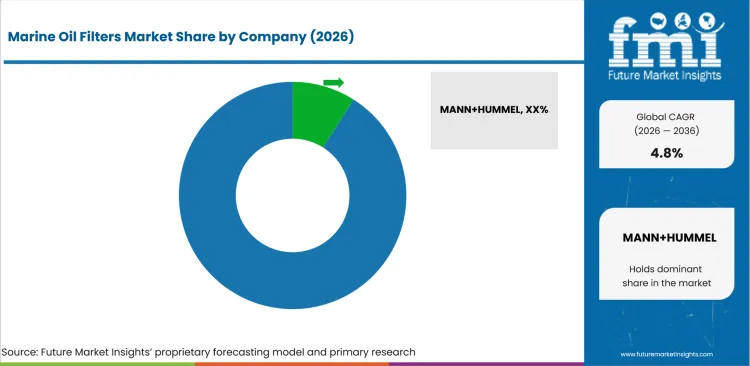
Filtration specialists and marine engine OEMs reach marine maintenance demand through different replacement routes. MANN+HUMMEL and Atmus compete on media engineering while Mercury Marine and Yanmar control genuine-parts fitment. Yacht service penalizes wrong fitment because vessel downtime quickly raises maintenance costs for operators. Marine bearing maintenance rewards regional distributors that provide vessel-specific technical support during scheduled repairs. Entry barriers depend on documented applications and stocked service coverage across active marine regions.
- MANN+HUMMEL, Atmus Filtration Technologies and Parker Hannifin(Racor) bring broad filtration engineering plus multi-market aftermarket coverage.
- Mercury Marine, Yanmar, Volvo Penta and Suzuki Marine use genuine-parts and authorized-service routes close to engine owners.
- MAHLE competes through broad engine filtration and aftermarket operations where its filter expertise overlaps marine service applications.
Competitive Benchmarking: Marine Oil Filters Market
| Company | Marine Fitment Authority | Lube Filtration Engineering | Service-Channel Integration | Geographic Reach |
|---|---|---|---|---|
| MANN+HUMMEL | Medium | High | High | Global |
| Atmus Filtration Technologies (Fleetguard) | Medium | High | High | Six continents |
| Parker Hannifin(Racor) | High | High | High | Global |
| MAHLE | Medium | High | High | Europe, Americas and Asia-Pacific |
| Quicksilver / Mercury Marine | High | Medium | High | Global |
| Yanmar | High | Medium | High | Global |
| Volvo Penta | High | Medium | High | Global |
| Suzuki Marine | High | Medium | High | Global with strong North American dealer coverage |
Scoring basis: High marine fitment authority requires direct engine or marine-system ownership with documented service responsibility. Medium fitment authority identifies verified marine participation without full platform control or engine ownership. High lube filtration engineering requires documented oil-filter or advanced-media development, while Medium identifies genuine-part specification. High service-channel integration requires a documented multi-region dealer or aftermarket route, while Medium identifies narrower regional coverage. Geographic reach records verified operating coverage instead of applying a score to market presence.
Key Developments in the Marine Oil Filters Market
- In December 2025, Yanmar obtained ClassNK NOx certification for its hydrogen marine engine, following type approval in October 2025, highlighting the shift toward alternative-fuel propulsion.
- In July 2025, Mercury Marine launched the 425hp V10 Verado outboard and an enhanced 350hp version, expanding the engine population requiring future model-specific service parts.
- In January 2025, Volvo Penta introduced a global three-year marine warranty covering branded engines, transmissions, control systems and accessories via its authorized service network.
Key Players in the Marine Oil Filters Market
Filtration Engineering and Marine Filter Specialists
- MANN+HUMMEL
- Atmus Filtration Technologies (Fleetguard)
- Parker Hannifin(Racor)
- MAHLE
Marine Engine OEM and Genuine-Parts Networks
- Quicksilver / Mercury Marine
- Yanmar
- Volvo Penta
- Suzuki Marine
Marine Oil Filters Market - Report Scope
| Coverage field | Report scope |
|---|---|
| Market breakdown | By filter type, type, fuel type, sales channel, boat type and region. |
| Quantitative Units | USD million. |
| Market Definition | Commercial oil filters supplied for marine propulsion and auxiliary engines across OEM and recurring replacement channels. |
| Regions Covered | North America, Latin America, Europe, East Asia, South Asia and Pacific and Middle East and Africa. |
| Countries Covered | Finland, Norway, Brazil, Canada, USA, and 20+ countries included in the full report. |
| Key Companies Profiled | MANN+HUMMEL, Atmus Filtration Technologies (Fleetguard), Parker Hannifin(Racor), MAHLE, Quicksilver / Mercury Marine, Yanmar, Volvo Penta, Suzuki Marine. |
| Forecast Period | 2026 to 2036. |
| Approach | Primary and secondary research with market triangulation. |
Marine Oil Filters Market - Research Methodology
| Method | Approach |
|---|---|
| Primary Research | FMI analysts gathered input from manufacturers, service providers, technology developers, distributors, end users, procurement teams, and subject-matter experts. Interviews examined purchasing decisions, product or service evaluation, adoption barriers, approval requirements, pricing considerations, and expectations for technical or commercial support. Respondents were also asked what evidence is required before a trial, pilot, or initial order develops into regular purchasing. |
| Desk Research | Desk research covered government statistics, regulatory publications, trade data, industry associations, technical literature, standards, company filings, product information, and official corporate announcements. Sources were reviewed for relevance, publication date, geographic coverage, and consistency with the defined market scope. Claims relating to performance, applications, approvals, capacity, investment, and commercial activity were retained only when supported by credible public evidence. |
| Market Sizing and Forecasting | The market model combined the baseline value with historical performance, segment structure, pricing and volume indicators, adoption levels, company participation, and country-level demand conditions. Forecast assumptions considered economic activity, investment trends, regulatory developments, technology adoption, purchasing cycles, supply availability, and barriers to wider market use. Segment and regional estimates were reconciled before the final market total was calculated. |
| Data Validation | Estimates were checked against multiple independent indicators, including public data, company activity, trade patterns, industry developments, and findings from primary interviews. Validation also tested whether products, services, applications, and company revenues fell within the defined market boundaries. Adjacent categories, unsupported claims, overlapping revenues, and activities without direct market relevance were excluded to reduce double counting and maintain consistency across segments and countries. |
Marine Oil Filters Market by Segments
Marine Oil Filters Market segmented by Filter Type:
- Spin-on oil filters
- Cartridge oil filters
- Bypass oil filters
- High-efficiency filters
- Heavy-duty marine filters
Marine Oil Filters Market segmented by Type:
- Cellulose media
- Synthetic media
- Microglass media
- Blended media
Marine Oil Filters Market segmented by Fuel Type:
- Inboard diesel
- Outboard engines
- Inboard gasoline
- Marine generators
- Auxiliary engines
Marine Oil Filters Market segmented by Sales Channel:
- Aftermarket replacement
- OEM engine supply
- Marine dealers
- Fleet / commercial service
Marine Oil Filters Market segmented by Boat Type:
- Recreational boats
- Commercial vessels
- Fishing craft
- Workboats
- Yachts
Marine Oil Filters Market by Region:
- North America
- United States
- Canada
- Latin America
- Brazil
- Mexico
- Chile
- Rest of Latin America
- Western Europe
- Germany
- United Kingdom
- Italy
- Spain
- France
- Nordics
- Benelux
- Rest of Western Europe
- Eastern Europe
- Russia
- Poland
- Hungary
- Balkan and Baltic States
- Rest of Eastern Europe
- East Asia
- China
- Japan
- South Korea
- South Asia and Pacific
- India
- ASEAN
- Australia and New Zealand
- Rest of South Asia and Pacific
- Middle East and Africa
- Kingdom of Saudi Arabia
- Other GCC Countries
- Türkiye
- South Africa
- Other African Union Countries
- Rest of Middle East and Africa
Research Sources and Bibliography
- USA Coast Guard. (2025, June 24). Recreational Boating Statistics 2024.
- Agência Nacional de Transportes Aquaviários. (2026, February 10). Setor aquaviário brasileiro movimentou, em 2025, 1,4 bi de toneladas.
- Honda Motor Co., Ltd. (2025, January 18). Honda presents the world premier of BF300 large-size outboard motor at the Dusseldorf Boat Show 2025.
- MANN+HUMMEL. (2025, March 24). Filtration of the future - inspired by nature.
- Yanmar. (2025, January 29). Yanmar’s new 12AYEM marine engine: Power and precision for commercial vessels.
- Suzuki Marine USA. (2025, May 19). Suzuki Marine partners with West Marine to bring Suzuki outboards, Suzuki-powered boats to customers nationwide.
- National Marine Manufacturers Association. (2026, July 6). USA recreational marine spending reached $54 billion in 2025.
- Honda Motor Co., Ltd. (2025, February 13). Honda presents world premiere of seven refreshed large-size outboard motors at the Miami International Boat Show 2025.
- Atmus Filtration Technologies. (2025, January 16). Atmus launches advanced NanoNet N3 filter media technology.
- Finnish Transport and Communications Agency Traficom. (2026, May 12). Open data: Vessels.
- Statistics Norway. (2026, January 23). The Norwegian Merchant Fleet.
- Ministry of Ports and Airports of Brazil. (2026, April 13). Navegação brasileira cresce em fevereiro, aquecendo o comércio e a economia.
- Fisheries and Oceans Canada. (2025, February 20). New patrol vessels arrive to support the Conservation and Protection program.
- National Marine Manufacturers Association. (2026, June 17). New NMMA report provides insight into 2025 pre-owned boat market.
- MANN+HUMMEL. (2025, January 19). New filter guide for industrial engines.
- MANN+HUMMEL. (2025, March 26). MANN+HUMMEL opens South African production facility.
- Atmus Filtration Technologies. (2026, March 31). Atmus opens expanded testing laboratory at Quimper, France site.
- Parker-Hannifin Corporation. (2025, November 11). Parker to acquire Filtration Group Corporation, significantly expanding filtration offering and aftermarket business.
- MAHLE Aftermarket. (2026, July 7). MAHLE strengthens UK aftermarket presence.
- Yanmar. (2026, January 27). Yanmar obtains ship classification certification for hydrogen four-stroke high-speed engine.
- Brunswick Corporation. (2025, July 22). Mercury Marine expands V10 Verado lineup with all-new 425hp outboard and enhanced 350hp model.
- Volvo Penta. (2025, January 14). Volvo Penta launches all-inclusive 3 year marine warranty.
- Brunswick Corporation. (2025, December 2). Mercury Marine announces new five-year exclusive supply agreement with Axopar Boats.
- Yanmar. (2026, February 16). Yanmar takes a major step toward a low-carbon marine future.
- Volvo Penta. (2025, May 28). Volvo Penta unveils electric IPS marine propulsion range.
- Suzuki Marine USA. (2026, January 29). Suzuki Marine adds two new models to growing Stealth Line family of outboards.
- Cummins Inc. (2026, March 23). Cummins Asia Pacific to showcase market-ready K50 marine engine at Asia Pacific Maritime.
- Rolls-Royce. (2025, May 20). Rolls-Royce and Sanlorenzo extend contract for mtu yacht propulsion systems.
- Rolls-Royce. (2025, May 27). New mtu 2000 engine from Rolls-Royce with more power for fast vessels and yachts.
- Caterpillar Inc. (2025, December 5). Cat C2.2B genset delivers seamless integration engineered for sportfishing and yachting.
- Scania North America. (2025, November 24). Scania introduces next generation 13-liter marine engine to the North American market.
- Rolls-Royce. (2025, August 26). Rolls-Royce mtu Series 4000 engines to power new Catalina Express ferry in California.
This bibliography is provided for reader reference and is not exhaustive. The full report contains the complete reference list and detailed citations
This Report Answers
- How does marine oil filter value change between 2026 and 2036?
- What CAGR is projected for marine oil filters through 2036?
- Which Filter type, media type and fuel type hold the largest 2026 shares?
- Why does recurring engine maintenance sustain replacement demand across marine service channels?
- Which fitment factors restrict substitution between competing marine oil filter brands?
- How do Finland, Norway, Brazil, Canada and the USA compare on forecast CAGR?
- Which companies compete using filtration engineering and marine genuine-parts networks?
- Which segment and regional structures define the full market taxonomy?
Frequently Asked Questions
How big is the marine oil filters market in 2026?
The marine oil filters market is valued at USD 920.6 million in 2026 and is projected to reach USD 1,471.2 million by 2036. Growth is driven by recurring oil-service intervals across long-lived recreational and commercial marine engine fleets.
What is the CAGR of the marine oil filters market from 2026 to 2036?
The marine oil filters market is projected to grow at a CAGR of 4.8% between 2026 and 2036. Expansion is supported by recurring engine maintenance and continued demand for model-specific replacement filtration programs.
Which product type leads the marine oil filters market?
The spin-on oil filters segment is expected to hold 39.0% of the marine oil filters market in 2026, driven by sealed handling and faster change-out during routine engine service. That format reduces reusable-housing cleaning during scheduled oil changes across high-volume marine dealer service workshops.
Which sales channel leads the marine oil filters market?
The aftermarket replacement segment is anticipated to hold 43.0% of the marine oil filters market in 2026, supported by repeated oil-change transactions after the original engine sale. Long engine service lives give dealers and independent brands repeated opportunities to serve the installed base.
Which companies are active in the marine oil filters market?
Key companies operating in the market include MANN+HUMMEL, Atmus Filtration Technologies (Fleetguard), Parker Hannifin, MAHLE, Quicksilver / Mercury Marine, Yanmar, Volvo Penta, and Suzuki Marine. Competition centers on filtration engineering and engine fitment authority while dealer access and replacement support determine service reach.
Preview the report firsthand - request a free sample
Get SampleGet the brochure for pricing and purchase details.
Get PDFTable of Content
- Key Takeaways
- Market Size and CAGR
- Top Growth Driver
- Fastest Growing Segment
- Leading Region
- Key Companies
- Emerging Opportunities
- Executive Summary
- Global Market Outlook
- Demand-side Trends
- Supply-side Trends
- Technology Roadmap Analysis
- Analysis and Recommendations
- Analyst Perspective (What is happening? Why now? What should investors know?)
- Key Questions Answered
- How large is the market?
- What is the CAGR?
- What are key trends?
- Which region dominates?
- Who are the leaders?
- Market Overview
- Market Coverage / Taxonomy
- Market Definition / Scope / Limitations
- Research Methodology
- Chapter Orientation
- Analytical Lens and Working Hypotheses
- Market Structure, Signals, and Trend Drivers
- Benchmarking and Cross-market Comparability
- Market Sizing, Forecasting, and Opportunity Mapping
- Research Design and Evidence Framework
- Desk Research Programme (Secondary Evidence)
- Expert Input and Fieldwork (Primary Evidence)
- Tooling, Models, and Reference Databases
- Data Engineering and Model Build
- Quality Assurance and Audit Trail
- Market Background
- Market Dynamics (Drivers, Restraints, Opportunity, Trends)
- Scenario Forecast (Optimistic, Likely, Conservative)
- Impact Analysis
- AI Impact
- Sustainability Impact
- Regulatory Impact
- Technology Impact
- Consumer / Buyer Analysis
- Purchase Drivers
- Adoption Barriers
- Buyer Journey
- Opportunity Map Analysis
- Product Life Cycle Analysis
- Supply Chain Analysis
- Investment Feasibility Matrix
- Value Chain Analysis
- PESTLE and Porter's Analysis
- Regulatory Landscape
- Regional Parent Market Outlook
- Production and Consumption Statistics
- Import and Export Statistics
- Global Market Analysis and Forecast, 2021 to 2036
- Historical Market Size Value (USD Million) Analysis, 2021 to 2025
- Current and Future Market Size Value (USD Million) Projections, 2026 to 2036
- Y-o-Y Growth Trend Analysis
- Absolute $ Opportunity Analysis
- Global Market Pricing Analysis, 2021 to 2036
- Global Market Analysis and Forecast, By Filter Type, 2021 to 2036
- Introduction / Key Findings
- Historical Market Size Value (USD Million) Analysis By Filter Type, 2021 to 2025
- Current and Future Market Size Value (USD Million) Analysis and Forecast By Filter Type, 2026 to 2036
- Spin-on oil filters
- Cartridge oil filters
- Bypass oil filters
- High-efficiency filters
- Heavy-duty marine filters
- Spin-on oil filters
- Y-o-Y Growth Trend Analysis By Filter Type, 2021 to 2025
- Absolute $ Opportunity Analysis By Filter Type, 2026 to 2036
- Global Market Analysis and Forecast, By Media, 2021 to 2036
- Introduction / Key Findings
- Historical Market Size Value (USD Million) Analysis By Media, 2021 to 2025
- Current and Future Market Size Value (USD Million) Analysis and Forecast By Media, 2026 to 2036
- Cellulose media
- Synthetic media
- Microglass media
- Blended media
- Cellulose media
- Y-o-Y Growth Trend Analysis By Media, 2021 to 2025
- Absolute $ Opportunity Analysis By Media, 2026 to 2036
- Global Market Analysis and Forecast, By Engine Type, 2021 to 2036
- Introduction / Key Findings
- Historical Market Size Value (USD Million) Analysis By Engine Type, 2021 to 2025
- Current and Future Market Size Value (USD Million) Analysis and Forecast By Engine Type, 2026 to 2036
- Outboard engines
- Inboard diesel
- Inboard gasoline
- Marine generators
- Auxiliary engines
- Outboard engines
- Y-o-Y Growth Trend Analysis By Engine Type, 2021 to 2025
- Absolute $ Opportunity Analysis By Engine Type, 2026 to 2036
- Global Market Analysis and Forecast, By Sales Channel, 2021 to 2036
- Introduction / Key Findings
- Historical Market Size Value (USD Million) Analysis By Sales Channel, 2021 to 2025
- Current and Future Market Size Value (USD Million) Analysis and Forecast By Sales Channel, 2026 to 2036
- Aftermarket replacement
- OEM engine supply
- Marine dealers
- Fleet / commercial service
- Aftermarket replacement
- Y-o-Y Growth Trend Analysis By Sales Channel, 2021 to 2025
- Absolute $ Opportunity Analysis By Sales Channel, 2026 to 2036
- Global Market Analysis and Forecast, By End Use, 2021 to 2036
- Introduction / Key Findings
- Historical Market Size Value (USD Million) Analysis By End Use, 2021 to 2025
- Current and Future Market Size Value (USD Million) Analysis and Forecast By End Use, 2026 to 2036
- Recreational boats
- Commercial vessels
- Fishing craft
- Workboats
- Yachts
- Recreational boats
- Y-o-Y Growth Trend Analysis By End Use, 2021 to 2025
- Absolute $ Opportunity Analysis By End Use, 2026 to 2036
- Global Market Analysis and Forecast, By Region, 2021 to 2036
- Introduction
- Historical Market Size Value (USD Million) Analysis By Region, 2021 to 2025
- Current Market Size Value (USD Million) Analysis and Forecast By Region, 2026 to 2036
- North America
- Latin America
- Western Europe
- Eastern Europe
- East Asia
- South Asia and Pacific
- Middle East & Africa
- Market Attractiveness Analysis By Region
- North America Market Analysis and Forecast, By Country, 2021 to 2036
- Historical Market Size Value (USD Million) Trend Analysis By Market Taxonomy, 2021 to 2025
- Market Size Value (USD Million) Forecast By Market Taxonomy, 2026 to 2036
- By Country
- USA
- Canada
- By Filter Type
- By Media
- By Engine Type
- By Sales Channel
- By End Use
- By Country
- Market Attractiveness Analysis
- By Country
- By Filter Type
- By Media
- By Engine Type
- By Sales Channel
- By End Use
- Key Takeaways
- Latin America Market Analysis and Forecast, By Country
- Historical Market Size Value (USD Million) Trend Analysis By Market Taxonomy, 2021 to 2025
- Market Size Value (USD Million) Forecast By Market Taxonomy, 2026 to 2036
- By Country
- Brazil
- Mexico
- Chile
- Rest of Latin America
- By Filter Type
- By Media
- By Engine Type
- By Sales Channel
- By End Use
- By Country
- Market Attractiveness Analysis
- By Country
- By Filter Type
- By Media
- By Engine Type
- By Sales Channel
- By End Use
- Key Takeaways
- Western Europe Market Analysis and Forecast, By Country
- Historical Market Size Value (USD Million) Trend Analysis By Market Taxonomy, 2021 to 2025
- Market Size Value (USD Million) Forecast By Market Taxonomy, 2026 to 2036
- By Country
- Germany
- UK
- Italy
- Spain
- France
- Nordic
- BENELUX
- Rest of Western Europe
- By Filter Type
- By Media
- By Engine Type
- By Sales Channel
- By End Use
- By Country
- Market Attractiveness Analysis
- By Country
- By Filter Type
- By Media
- By Engine Type
- By Sales Channel
- By End Use
- Key Takeaways
- Eastern Europe Market Analysis and Forecast, By Country
- Historical Market Size Value (USD Million) Trend Analysis By Market Taxonomy, 2021 to 2025
- Market Size Value (USD Million) Forecast By Market Taxonomy, 2026 to 2036
- By Country
- Russia
- Poland
- Hungary
- Balkan & Baltic
- Rest of Eastern Europe
- By Filter Type
- By Media
- By Engine Type
- By Sales Channel
- By End Use
- By Country
- Market Attractiveness Analysis
- By Country
- By Filter Type
- By Media
- By Engine Type
- By Sales Channel
- By End Use
- Key Takeaways
- East Asia Market Analysis and Forecast, By Country
- Historical Market Size Value (USD Million) Trend Analysis By Market Taxonomy, 2021 to 2025
- Market Size Value (USD Million) Forecast By Market Taxonomy, 2026 to 2036
- By Country
- China
- Japan
- South Korea
- By Filter Type
- By Media
- By Engine Type
- By Sales Channel
- By End Use
- By Country
- Market Attractiveness Analysis
- By Country
- By Filter Type
- By Media
- By Engine Type
- By Sales Channel
- By End Use
- Key Takeaways
- South Asia and Pacific Market Analysis and Forecast, By Country
- Historical Market Size Value (USD Million) Trend Analysis By Market Taxonomy, 2021 to 2025
- Market Size Value (USD Million) Forecast By Market Taxonomy, 2026 to 2036
- By Country
- India
- ASEAN
- Australia & New Zealand
- Rest of South Asia and Pacific
- By Filter Type
- By Media
- By Engine Type
- By Sales Channel
- By End Use
- By Country
- Market Attractiveness Analysis
- By Country
- By Filter Type
- By Media
- By Engine Type
- By Sales Channel
- By End Use
- Key Takeaways
- Middle East & Africa Market Analysis and Forecast, By Country
- Historical Market Size Value (USD Million) Trend Analysis By Market Taxonomy, 2021 to 2025
- Market Size Value (USD Million) Forecast By Market Taxonomy, 2026 to 2036
- By Country
- Kingdom of Saudi Arabia
- Other GCC Countries
- Türkiye
- South Africa
- Other African Union
- Rest of Middle East & Africa
- By Filter Type
- By Media
- By Engine Type
- By Sales Channel
- By End Use
- By Country
- Market Attractiveness Analysis
- By Country
- By Filter Type
- By Media
- By Engine Type
- By Sales Channel
- By End Use
- Key Takeaways
- Key Countries Market Analysis
- USA
- Pricing Analysis
- Market Share Analysis, 2025
- By Filter Type
- By Media
- By Engine Type
- By Sales Channel
- By End Use
- Canada
- Pricing Analysis
- Market Share Analysis, 2025
- By Filter Type
- By Media
- By Engine Type
- By Sales Channel
- By End Use
- Mexico
- Pricing Analysis
- Market Share Analysis, 2025
- By Filter Type
- By Media
- By Engine Type
- By Sales Channel
- By End Use
- Brazil
- Pricing Analysis
- Market Share Analysis, 2025
- By Filter Type
- By Media
- By Engine Type
- By Sales Channel
- By End Use
- Chile
- Pricing Analysis
- Market Share Analysis, 2025
- By Filter Type
- By Media
- By Engine Type
- By Sales Channel
- By End Use
- Germany
- Pricing Analysis
- Market Share Analysis, 2025
- By Filter Type
- By Media
- By Engine Type
- By Sales Channel
- By End Use
- UK
- Pricing Analysis
- Market Share Analysis, 2025
- By Filter Type
- By Media
- By Engine Type
- By Sales Channel
- By End Use
- Italy
- Pricing Analysis
- Market Share Analysis, 2025
- By Filter Type
- By Media
- By Engine Type
- By Sales Channel
- By End Use
- Spain
- Pricing Analysis
- Market Share Analysis, 2025
- By Filter Type
- By Media
- By Engine Type
- By Sales Channel
- By End Use
- France
- Pricing Analysis
- Market Share Analysis, 2025
- By Filter Type
- By Media
- By Engine Type
- By Sales Channel
- By End Use
- India
- Pricing Analysis
- Market Share Analysis, 2025
- By Filter Type
- By Media
- By Engine Type
- By Sales Channel
- By End Use
- ASEAN
- Pricing Analysis
- Market Share Analysis, 2025
- By Filter Type
- By Media
- By Engine Type
- By Sales Channel
- By End Use
- Australia & New Zealand
- Pricing Analysis
- Market Share Analysis, 2025
- By Filter Type
- By Media
- By Engine Type
- By Sales Channel
- By End Use
- China
- Pricing Analysis
- Market Share Analysis, 2025
- By Filter Type
- By Media
- By Engine Type
- By Sales Channel
- By End Use
- Japan
- Pricing Analysis
- Market Share Analysis, 2025
- By Filter Type
- By Media
- By Engine Type
- By Sales Channel
- By End Use
- South Korea
- Pricing Analysis
- Market Share Analysis, 2025
- By Filter Type
- By Media
- By Engine Type
- By Sales Channel
- By End Use
- Russia
- Pricing Analysis
- Market Share Analysis, 2025
- By Filter Type
- By Media
- By Engine Type
- By Sales Channel
- By End Use
- Poland
- Pricing Analysis
- Market Share Analysis, 2025
- By Filter Type
- By Media
- By Engine Type
- By Sales Channel
- By End Use
- Hungary
- Pricing Analysis
- Market Share Analysis, 2025
- By Filter Type
- By Media
- By Engine Type
- By Sales Channel
- By End Use
- Kingdom of Saudi Arabia
- Pricing Analysis
- Market Share Analysis, 2025
- By Filter Type
- By Media
- By Engine Type
- By Sales Channel
- By End Use
- Türkiye
- Pricing Analysis
- Market Share Analysis, 2025
- By Filter Type
- By Media
- By Engine Type
- By Sales Channel
- By End Use
- South Africa
- Pricing Analysis
- Market Share Analysis, 2025
- By Filter Type
- By Media
- By Engine Type
- By Sales Channel
- By End Use
- USA
- Market Structure Analysis
- Competition Dashboard
- Competition Benchmarking
- Market Share Analysis of Top Players
- By Regional
- By Filter Type
- By Media
- By Engine Type
- By Sales Channel
- By End Use
- Emerging Startups
- Innovation Benchmarking
- Competition Analysis
- Competition Deep Dive
- MANN+HUMMEL
- Overview
- Product Portfolio
- Profitability by Market Segments
- Sales Footprint
- Strategy Overview
- Marketing Strategy
- Product Strategy
- Channel Strategy
- Donaldson
- Fleetguard / Cummins
- MAHLE
- WIX Filters
- Baldwin Filters
- Sierra International
- Quicksilver / Mercury Marine
- Yanmar
- MANN+HUMMEL
- Case Studies
- Success Stories
- Recent Developments
- Competition Deep Dive
- Assumptions & Acronyms Used


