

- Market Size (2026)
- USD 8.2 Bn
- Forecast (2036)
- USD 11.1 Bn
- CAGR (2026 to 2036)
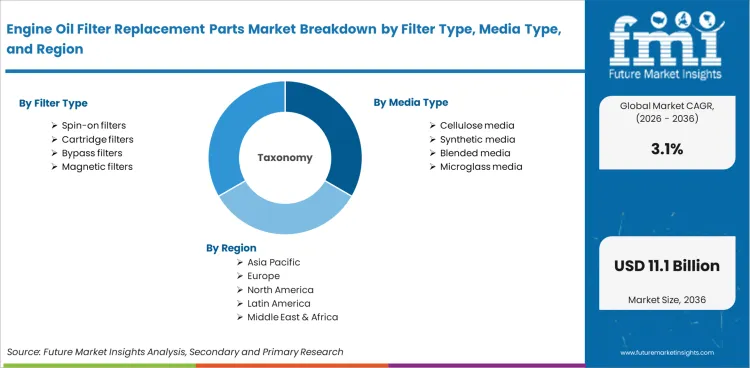
- 3.1%
Engine Oil Filter Replacement Parts Market Size, Market Forecast and Outlook By FMI
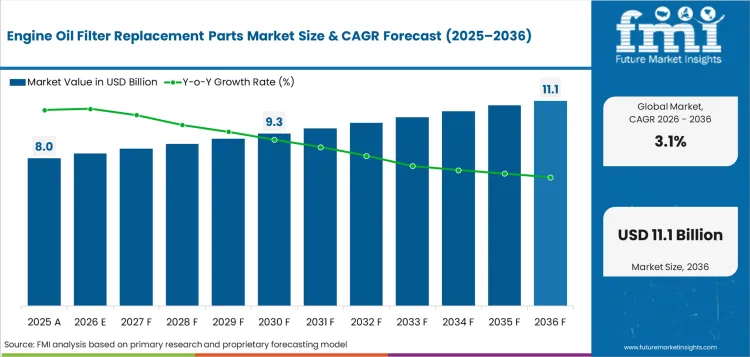
Engine oil filter replacement parts market was valued at USD 8.0 billion in 2025 and is estimated to reach USD 8.2 billion in 2026. Demand is forecast to reach USD 11.1 billion by 2036 at 3.1% CAGR over the ten-year period. Routine oil service is expected to hold 61.0% share in 2026. Independent aftermarket is forecast to account for 58.0% of sales channel demand in 2026.
Summary of the Engine Oil Filter Replacement Parts Market
- Demand and Growth Drivers
- Engine oil filter demand comes from regular oil changes in ICE and hybrid vehicles. A clean filter keeps engine oil moving properly and reduces wear inside the engine.
- Workshops replace oil filters during scheduled service because old filters can collect dirt and metal particles. Regular service keeps replacement demand active across garages and dealer networks.
- Longer oil service intervals are changing filter selection. Service centers now need filters with better media so engines can stay protected for a longer time.
- Product and Segment View
- Spin-on filters support fast oil service because technicians can remove and replace the full unit quickly. The format works well for busy workshops handling many vehicles each day.
- Cartridge filters are used in newer engines because the housing stays fixed during service. Only the filter element is replaced, which supports cleaner handling and reduces metal waste.
- Cellulose media supports standard oil service because it offers reliable filtration at practical prices. Synthetic and blended media are used more in newer engines with longer oil intervals.
- Geography and Competitive Outlook
- India and China support filter replacement demand through large vehicle fleets and expanding service networks. Local garages need affordable filters with simple fitment.
- The United States keeps steady demand through high vehicle use and quick-service oil change centers. Germany and Japan need exact-fit filters for premium and hybrid vehicles.
- Suppliers with wide catalog coverage are better placed in this market. Garages and distributors prefer brands that reduce fitment errors and keep common parts available.
- Analyst Opinion
- Nikhil Kaitwade, Principal Consultant at FMI says, “Engine oil filter replacement demand follows the rhythm of workshop service. Filters move through quick-service lanes, dealer bays and fleet garages. Suppliers with broad catalog coverage and simple fitment data will be preferred by distributors and repair centers.”
- Engine Oil Filter Replacement Parts Market Value Analysis
- The engine oil filter replacement parts market is moving from basic service replacement into a more quality-focused aftermarket space.
- Regular oil changes keep demand active because ICE and hybrid vehicles still need clean oil flow to protect the engine.
- Workshops are choosing filters with better media and exact fitment because newer engines need cleaner service and fewer installation errors.
- Market value is supported by the need for parts that protect engines and reduce service errors during routine oil changes.
Key Takeaways, Market Size, and Forecast
- Engine oil filter replacement parts market stood at USD 8.0 billion in 2025.
- By 2036, industry revenue is forecast to reach USD 11.1 billion.
- Market value is forecast at 3.1% CAGR from 2026 to 2036.
- Market revenue is expected to add USD 2.9 billion in incremental opportunity from 2026 to 2036.
- Routine oil service is expected to hold 61.0% share in 2026.
- Independent aftermarket is forecast to represent 58.0% of sales channel demand in 2026.
- India at 4.2% CAGR and China at 3.8% CAGR are forecast to expand at significant rate compared to the global pace.
Service planning is becoming more important for engine oil filter replacement as fleets face tighter inspection schedules and wider vehicle coverage. California Air Resources Board stated that Clean Truck Check emissions testing became effective on October 1, 2024, with testing deadlines beginning January 1, 2025. Almost all covered vehicles need semiannual testing, so fleet operators have a stronger reason to align oil filter replacement with inspection windows and repair planning. Filter coverage is also becoming a catalog-led competition point.
In February 2024, MANN-FILTER stated that its 2024 to 2026 catalogs added more than 125 new filter types for passenger car and off-highway models. This gives distributors and workshops a clearer route to match parts across mixed vehicle fleets. Scale is strengthening around commercial filtration suppliers. In February 2025, Atmus reported full-year 2024 net sales of USD 1,670 million and said it serves truck and construction equipment markets with aftermarket support. This keeps heavy-duty service channels important for oil filter replacement parts.
Engine Oil Filter Replacement Parts Market Definition
Engine oil filter replacement parts market covers aftermarket oil filters and related service parts used during engine oil changes.
Engine Oil Filter Replacement Parts Market Inclusions
Scope includes replacement engine oil filters sold through independent distributors, authorized service centers, online parts stores, fleet supply contracts, cellulose media, synthetic media, blended media, and microglass media. Key participants include filter manufacturers, media suppliers, parts distributors, workshops, fleet service providers, and vehicle owners.
Engine Oil Filter Replacement Parts Market Exclusions
Scope excludes factory-installed oil filters shipped with new engines, fuel filters, cabin filters unless sold in a bundled oil service kit, hydraulic filters, transmission filters unless specified for engine lubrication service.
Engine Oil Filter Replacement Parts Market Research Methodology
- Primary Research: FMI analysts reviewed aftermarket distributors and workshop purchasing behavior across major service markets.
- Desk Research: Public vehicle production and travel data were checked against official transport sources.
- Market Sizing and Forecasting: Market size was built from replacement intervals and vehicle parc estimates.
- Data Validation: Forecast checks compared vehicle use, filter media upgrades and supplier activity across seven countries.
Why is the Engine Oil Filter Replacement Parts Market Growing?
- Routine oil service keeps replacement demand steady because every oil change usually needs a fresh filter.
- Hybrid vehicles protect service demand because their gasoline engines still need clean oil flow.
- Longer oil intervals are shifting workshops toward better media because filters must work for a longer service cycle.
Engine oil filter replacement demand follows regular service activity. Workshops replace filters with oil because old filters can hold soot and metal particles. International Organization of Motor Vehicle Manufacturers reported global vehicle production of 96.4 million units and vehicle sales of 99.8 million units in 2025. A large vehicle parc keeps service lanes active across dealer workshops and independent garages. Filter suppliers benefit most from products with simple fitment and trusted media performance.
Electrification is changing the service mix, but hybrid vehicles still need engine oil filters. International Energy Agency recorded more than 20.0 million electric car sales in 2025. Battery electric vehicles reduce future oil filter use, but hybrid vehicles keep engine service inside the maintenance cycle. Suppliers need to serve ICE and hybrid models with accurate catalogs. Replacement demand will stay tied to active vehicles that still carry engine lubrication systems.
Market Segmentation Analysis
- Spin-on filters are expected to hold 43.0% share in 2026.
- Cellulose media is likley to account for 45.0% share in 2026.
- Passenger cars are anticipated to represent 52.0% share in 2026.
- Independent aftermarket is expected to account for 58.0% share in 2026.
- Routine oil service is forecast to lead service type demand with 61.0% share in 2026.
The market is divided into five primary segment groups based on filter type and media type. Vehicle type, sales channel and service type complete the structure. Filter type covers spin-on filters and cartridge filters. Bypass filters and magnetic filters complete the group. Media type covers cellulose media and synthetic media. Blended media and microglass media are included. Vehicle type covers passenger cars and light trucks. Heavy trucks and off-highway engines complete the vehicle scope. Sales channel covers independent aftermarket and authorized service. Online retail and fleet contracts complete the channel scope. Service type covers routine oil service and fleet maintenance. Heavy-duty service and performance service complete the service scope.
Insights into Engine Oil Filter Replacement Parts Market by Filter Type
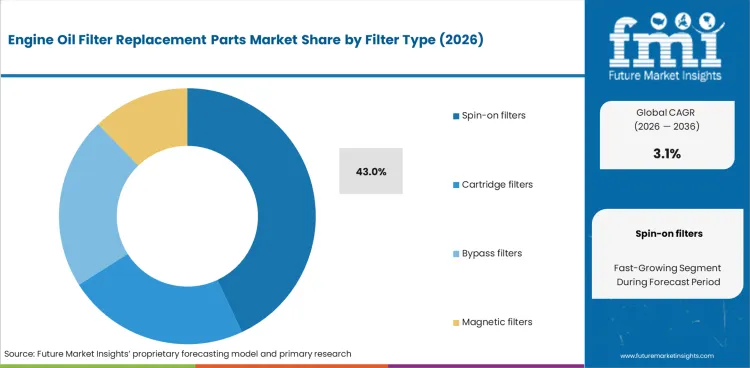
- Spin-on filters are forecast to hold 43.0% share in 2026 as workshops can replace the full unit quickly during oil service, which reduces bay time and lowers sealing mistakes for technicians.
- Cartridge filters are expected to move steadily in newer engines as fixed housings let technicians replace only the element, reducing metal waste and supporting compact engine layouts in modern vehicles.
Insights into Engine Oil Filter Replacement Parts Market by Media Type
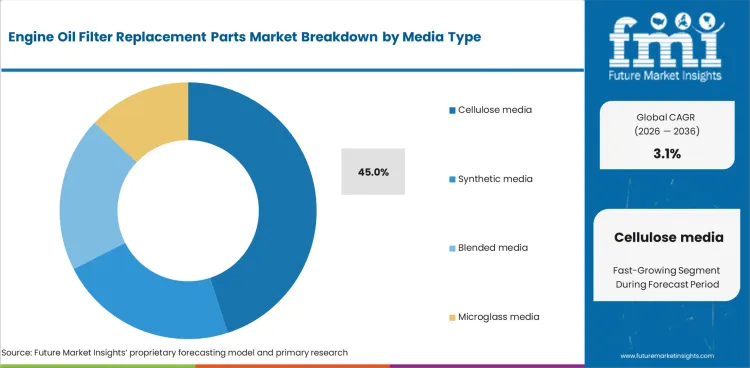
- Cellulose media is expected to account for 45.0% share in 2026. Standard oil changes need reliable filtration at practical prices across daily-use passenger cars and light trucks.
- Synthetic and blended media are forecast to expand in longer oil intervals as newer engines need better dirt holding and stable oil flow, especially in vehicles using higher-grade lubricant additives.
Insights into Engine Oil Filter Replacement Parts Market by Vehicle Type
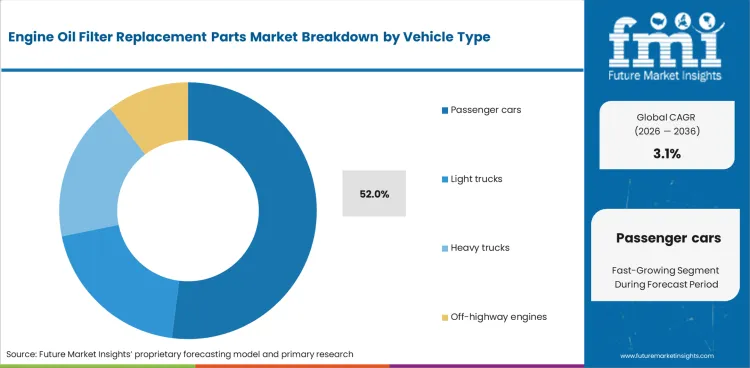
- Passenger cars are anticipated to represent 52.0% share in 2026 with personal vehicles creating repeat oil change demand across dealer workshops, quick-service centers and local garages.
- Heavy trucks need filters built for longer duty cycles as soot load and engine stress are higher in fleet use, which makes dependable filter supply important for planned maintenance.
Insights into Engine Oil Filter Replacement Parts Market by Sales Channel
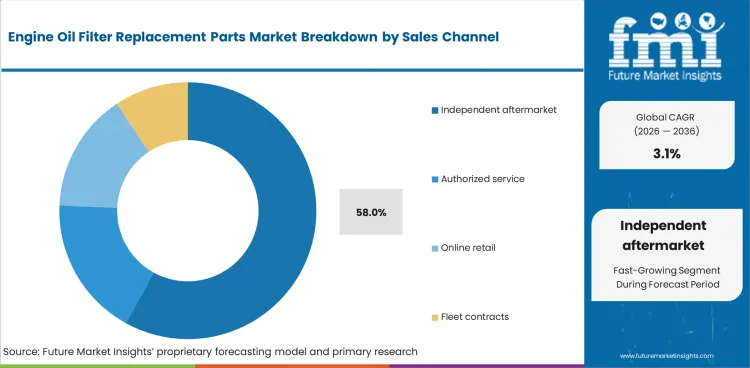
- Independent aftermarket is likely to hold 58.0% share in 2026 as local garages need quick access to fast-moving filter parts through distributors and parts retailers.
- Authorized service centers are expected to support OE-quality filter kits as newer vehicles need exact seals and housings during scheduled maintenance, which reduces service errors.
Insights into Engine Oil Filter Replacement Parts Market by Service Type
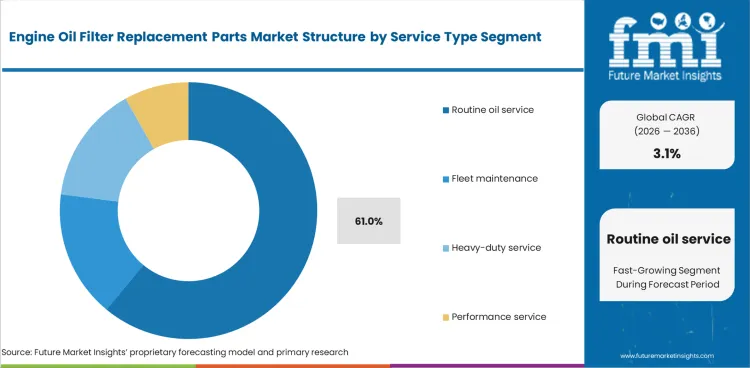
- Routine oil service is forecast to carry 61.0% share in 2026. Filters are usually changed with scheduled oil service across cars and light commercial vehicles.
- Fleet maintenance is expected to create repeat orders as vans and light trucks cover longer daily routes, which increases the need for planned service parts and reliable stock.
Engine Oil Filter Replacement Parts Market Drivers, Restraints, and Opportunities
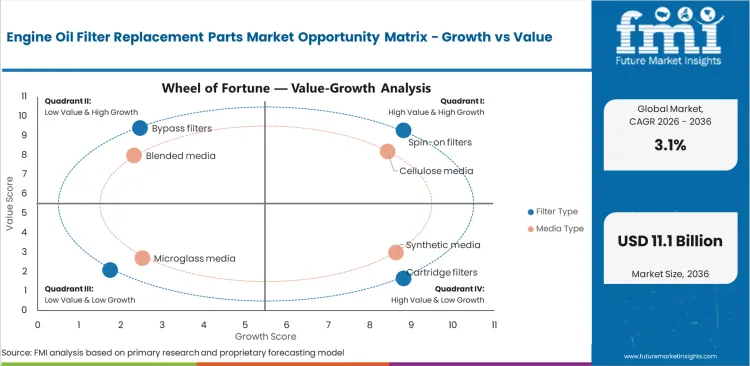
- Routine oil service keeps filter replacement active because workshops usually change the filter with engine oil.
- Longer drain intervals can reduce filter change frequency, so suppliers need better media and stronger fitment proof.
- Fleet service accounts create repeat orders because high-mileage vehicles need planned maintenance and steady stock.
Oil Service Discipline Supports Replacement
Engine oil filters are part of a regular service job, not an occasional repair item. Workshops replace filters during oil changes because contaminated oil can increase engine wear. MANN-FILTER introduced the HU 9006 z oil filter for Fendt 700 Vario GEN 7 tractors in October 2025, with independent aftermarket availability from the same month. The product uses a bayonet fitting that locks the filter into place during service. Cleaner installation reduces fitment errors and supports faster workshop handling.
Longer Drain Intervals Pressure Unit Volume
Longer oil intervals can reduce the number of filter changes per vehicle. Better lubricants and newer engines allow some vehicles to stay in service longer before maintenance. MANN-FILTER said its ZR 9008 z oil centrifuge rotor can reach up to 11,000 revolutions per minute and create more than 2,000 times the force of gravity. The rotor separates fine impurities from engine oil, which supports longer service intervals in commercial vehicles. Filter suppliers need better media and cleaner service design to protect replacement value.
Fleet Service Contracts Create Repeat Demand
Fleet operators need filters that match planned service schedules. Delivery vans and commercial vehicles cover high daily mileage, so filter supply must be steady. Lubricant additives and filter quality both affect engine protection in heavy-use vehicles. Suppliers with reliable stock can support large service accounts better. Fleet contracts give manufacturers a clearer route to repeat sales across the forecast period.
Analysis of Engine Oil Filter Replacement Parts Market by Key Countries
.webp "Top Country Growth Comparison Engine Oil Filter Replacement Parts Market Cagr (2026 2036)")
| Country | CAGR |
|---|---|
| India | 4.2% CAGR |
| China | 3.8% CAGR |
| Brazil | 3.5% CAGR |
| United States | 2.7% CAGR |
| United Kingdom | 2.6% CAGR |
| Germany | 2.4% CAGR |
| Japan | 2.1% CAGR |
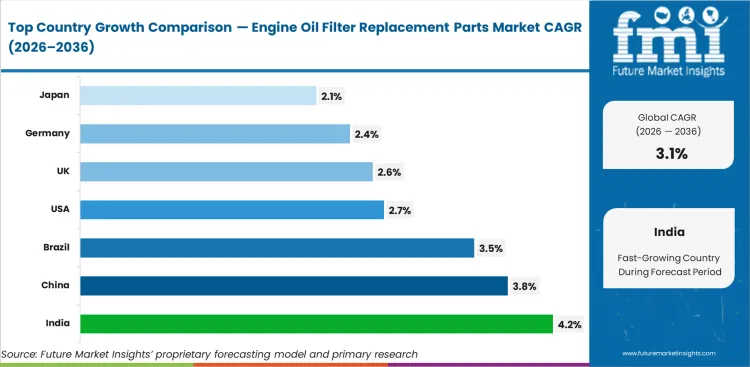
Source: Future Market Insights, 2026.
Engine Oil Filter Replacement Parts Market CAGR Analysis by Country
- India is expected to record 4.2% CAGR through 2036.
- A 3.8% CAGR is forecast for China from 2026 to 2036.
- Brazil is expected to advance at 3.5% CAGR by 2036.
- The United States is forecast at 2.7% CAGR through 2036.
- United Kingdom demand is anticipated to move ahead at 2.6% CAGR during the forecast period.
- Germany is expected to post 2.4% CAGR between 2026 and 2036.
- Japan is forecast to register 2.1% CAGR through 2036.
Demand Outlook for Engine Oil Filter Replacement Parts Market in India
India is expected to record 4.2% CAGR through 2036 as service networks expand beyond large cities. International Energy Agency reported 165,000 electric car sales in India in 2025 and a 75.0% year-over-year rise. ICE and hybrid vehicles still form the main service pool. Oil filter suppliers benefit from higher workshop coverage and wider parts availability. Local garages need affordable filters with simple fitment across popular cars and light commercial vehicles.
- Independent garages support replacement demand as vehicle ownership spreads into smaller cities.
- Fleet workshops need steady filter supply because vans and light trucks cover long daily routes.
- Premium filters can grow in newer engines because longer service intervals need cleaner oil control.
Sales Analysis of Engine Oil Filter Replacement Parts Market in China
China has a large serviceable vehicle parc, which is one of the factors behind steady adoption outlook. The market is forecast to rise at 3.8% CAGR through 2036. IEA reported more than 13.0 million electric car sales in China in 2025. BEV sales reduce long-term oil filter demand, but the existing ICE and hybrid fleet keeps workshops active. Suppliers need broad catalog coverage for domestic and imported engine platforms. Independent distributors need better cross-reference data as vehicle models expand.
- Large ICE parc keeps oil filter replacement active in independent garages.
- Hybrid vehicles support service demand because gasoline engines still need oil filtration.
- Domestic brands create demand for wider filter coverage across newer engine families.
Opportunity Analysis of Engine Oil Filter Replacement Parts Market in Brazil
Brazil’s used vehicle parc supports regular oil service through independent repair channels. The market is expected to advance at 3.5% CAGR through 2036. IEA recorded 180,000 electric car sales in Brazil in 2025, equal to 9.0% of new car sales. Conventional engines still support most workshop service. Repair shops will keep demand active for affordable filters and exact-fit replacement kits.
- Flexible-fuel engines need regular oil service because fuel mix and driving conditions can affect oil quality.
- Used vehicle maintenance supports lower-cost filters through independent parts stores.
- Premium imported cars create demand for cartridge filters because exact sealing is important in newer engines.
Demand Outlook for Engine Oil Filter Replacement Parts Market in the United States
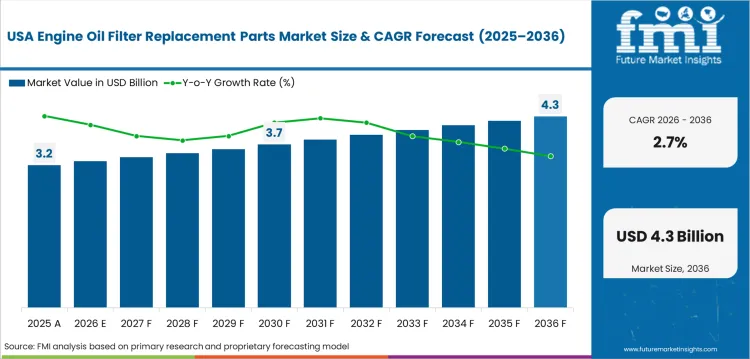
High mileage keeps oil service active in the United States. The market is forecast at 2.7% CAGR through 2036 as quick-service outlets and garages handle regular filter replacement. Vehicle miles traveled reached 245.0 billion miles in February 2026 according to USA transport data. High road use keeps filters inside routine service planning. Suppliers need fast-moving SKUs for cars and light trucks.
- Quick-lube operators need common spin-on and cartridge filters because service speed affects bay use.
- Pickup and light truck use supports filters built for towing and heavier engine load.
- Online retail supports home service users because fitment search often starts with model and engine code.
In-depth Analysis of Engine Oil Filter Replacement Parts Market in the United Kingdom
United Kingdom demand is anticipated to move ahead at 2.6% CAGR through 2036 as hybrid and ICE vehicles keep workshops active. IEA reported nearly 500,000 battery electric cars sold in 2025, and BEVs represented 23.0% of new car sales. Conventional and hybrid vehicles still need oil service. Repairers need exact-fit filters for mixed European and Asian vehicle fleets. Online lookup tools are important because small fitment errors can delay service.
- Hybrid service supports filter demand because gasoline engines stay part of the powertrain.
- MOT-related repair visits create chances to bundle oil service with other maintenance.
- Online parts sellers need accurate registration-based fitment because wrong filters create returns.
Sales Analysis of Engine Oil Filter Replacement Parts Market in Germany
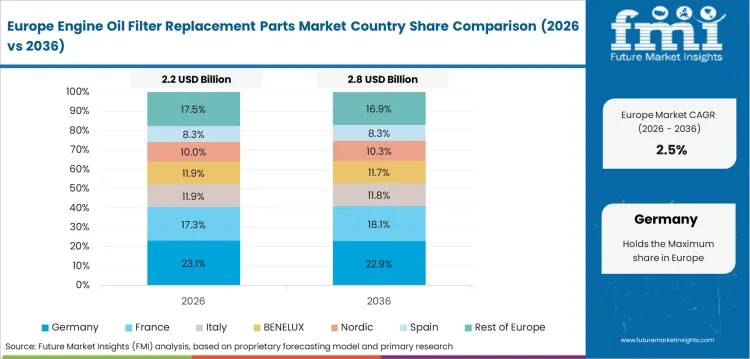
Germany’s premium vehicle parc supports demand for higher-grade oil filters. A 2.4% CAGR is expected through 2036 as workshops handle long-drain lubricants and exact-fit cartridge filters. IEA reported 850,000 electric car sales in Germany in 2025, with around 30.0% EV share. ICE and hybrid fleets still require oil service for many years. Suppliers need OE-quality kits that match engine specifications and service schedules.
- Premium passenger cars support cartridge filters because long-drain oils need stable media.
- Dealer service programs prefer filter kits with seals included in the pack.
- Independent repairers need precise catalog data because German and imported vehicles use different filter designs.
Future Outlook for Engine Oil Filter Replacement Parts Market in Japan
Hybrid vehicles keep Japan’s oil filter demand steady despite slower service expansion. Japan is forecast to grow at 2.1% CAGR by 2036. IEA noted electric car sales were just above 100,000 in 2025, and conventional hybrids made up around one-third of car sales. Hybrid fleets still need engine oil filters. Workshops in Japan prefer proven parts with consistent media quality and exact fitment.
- Hybrid cars need filters suited to intermittent engine use because oil can age differently in low-engine-use driving.
- Compact vehicles support smaller cartridge elements and exact sealing parts.
- Quality-focused workshops prefer trusted brands because poor fitment can affect engine protection.
Competitive Landscape and Strategic Positioning
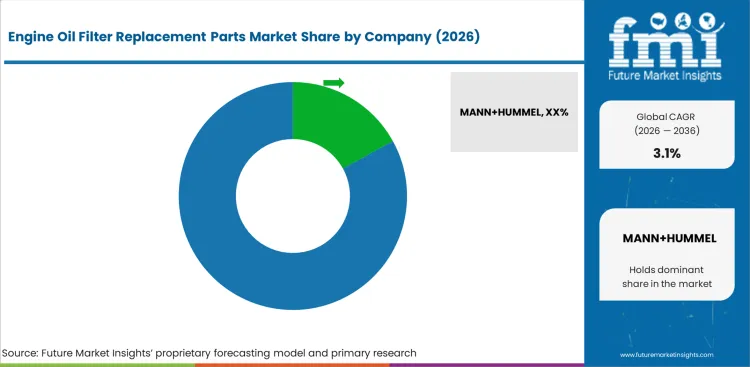
- Competition centers on catalog depth because workshops need the correct filter without service delay.
- Premium suppliers stand out by pairing OE fitment with broad aftermarket supply.
- Distribution reach affects repeat orders because garages need common filters on the same service day.
Competitive positioning depends on how well suppliers support daily workshop needs. MANN+HUMMEL and MAHLE have broad OE and aftermarket filter portfolios. Atmus supports heavy-duty and off-highway accounts through Fleetguard. Purflux Group adds European aftermarket depth through Purflux and FRAM. Service shops prefer brands that reduce fitment errors and keep common parts in stock.
Smaller suppliers often rely on price and local availability. Larger brands have an edge with tested media and wider vehicle coverage. Bosch states oil filters remove soot and metal particles from engine oil. Automotive air filter replacement and oil filter demand often move through the same parts distributors. Suppliers that combine product proof with reliable stock can secure repeat orders from garages and fleet service accounts.
Key Companies in the Engine Oil Filter Replacement Parts Market
- Global Filtration Specialists: MANN+HUMMEL and MAHLE GmbH hold broad positions across OE and replacement filters.
- Heavy-duty and Industrial Filter Suppliers: Atmus Filtration Technologies and Donaldson Company serve engine and equipment operators needing heavy-duty replacement parts.
- Aftermarket and Component Groups: Bosch Mobility Aftermarket, Purflux Group and Parker Hannifin support filter catalogs across cars and light trucks.
Competitive Benchmarking: Engine Oil Filter Replacement Parts Market
| Company | Catalog Coverage | Media Validation | Workshop Channel Depth | Geographic Footprint |
|---|---|---|---|---|
| MANN+HUMMEL | High | High | High | Global with European depth |
| MAHLE GmbH | High | High | Medium | Global with German strength |
| Atmus Filtration Technologies | Medium | High | High | Global heavy-duty focus |
| Donaldson Company | Medium | High | Medium | North America and global industrial reach |
| Bosch Mobility Aftermarket | High | Medium | High | Global aftermarket network |
| Purflux Group | Medium | Medium | High | Europe-centered filter network |
| Parker Hannifin | Medium | High | Medium | Global filtration platform |
Source: Future Market Insights competitive analysis, 2026.
Key Developments in Engine Oil Filter Replacement Parts Market
- In March 2025, MANN+HUMMEL introduced lignin-treated MANN-FILTER oil filters for aftermarket use across almost 17.6 million vehicles in Europe.
- In May 2026, MANN-FILTER expanded its lignin-based aftermarket oil filter portfolio to cover approximately 35 million vehicles across Europe.
Key Players in the Engine Oil Filter Replacement Parts Market
Global Filtration Specialists
- MANN+HUMMEL
- MAHLE GmbH
- Bosch Mobility Aftermarket
Heavy-duty and Industrial Filter Suppliers
- Atmus Filtration Technologies
- Donaldson Company
- Parker Hannifin
Aftermarket and Component Groups
- Purflux Group
Report Scope and Coverage
| Parameter | Details |
|---|---|
| Quantitative Units | USD 8.2 billion to USD 11.1 billion at 3.1% CAGR |
| Market Definition | Aftermarket engine oil filters and related replacement parts used during oil service |
| Regions Covered | North America, Latin America, Western Europe, Eastern Europe, East Asia, South Asia Pacific, Middle East and Africa |
| Countries Covered | United States, China, India, Germany, Japan, Brazil, United Kingdom |
| Key Companies Profiled | MANN+HUMMEL, MAHLE GmbH, Atmus Filtration Technologies, Donaldson Company, Bosch Mobility Aftermarket, Purflux Group, Parker Hannifin |
| Forecast Period | 2026 to 2036 |
| Approach | Hybrid methodology using service intervals and vehicle use. Average filter pricing and channel mix were checked separately |
Engine Oil Filter Replacement Parts Market Breakdown by Filter Type, Media Type, Vehicle Type, Sales Channel, Service Type, and Region
Engine Oil Filter Replacement Parts Market Segmented by Filter Type
- Spin-on filters
- Cartridge filters
- Bypass filters
- Magnetic filters
Engine Oil Filter Replacement Parts Market Segmented by Media Type
- Cellulose media
- Synthetic media
- Blended media
- Microglass media
Engine Oil Filter Replacement Parts Market Segmented by Vehicle Type
- Passenger cars
- Light trucks
- Heavy trucks
- Off-highway engines
Engine Oil Filter Replacement Parts Market Segmented by Sales Channel
- Independent aftermarket
- Authorized service
- Online retail
- Fleet contracts
Engine Oil Filter Replacement Parts Market Segmented by Service Type
- Routine oil service
- Fleet maintenance
- Heavy-duty service
- Performance service
Engine Oil Filter Replacement Parts Market Segmented by Region
- North America
- Latin America
- Western Europe
- Eastern Europe
- East Asia
- South Asia and Pacific
- Middle East and Africa
Research Sources and Bibliography
- Atmus Filtration Technologies. (2024, March 18). Atmus becomes a fully independent company following final separation from Cummins.
- Atmus Filtration Technologies. (2025, November 24). Atmus Filtration Technologies to acquire Koch Filter Corporation.
- Atmus Filtration Technologies. (2026, January 7). Atmus Filtration Technologies completes acquisition of Koch Filter Corporation.
- Donaldson Company, Inc. (2026, May 4). Donaldson completes acquisition of Facet Filtration.
- Federal Reserve Bank of St. Louis. (2026, May 1). Vehicle miles traveled.
- International Energy Agency. (2026, May). Global EV Outlook 2026: Trends in electric cars.
- International Organization of Motor Vehicle Manufacturers. (2026, April 23). Auto industry growth shifted east in 2025 amid global repositioning.
- MANN+HUMMEL. (2024, November 20). Forming new partnerships.
- MANN+HUMMEL. (2025, March 24). Future filtration inspired by nature.
- MANN+HUMMEL. (2026, May 12). MANN-FILTER expands portfolio with plant-based raw material.
- Pacific Avenue Capital Partners. (2024, June 4). Pacific Avenue Capital Partners completes the acquisition of the filtration business of Sogefi S.p.A.
- Parker Hannifin Corporation. (2025, November 11). Parker to acquire Filtration Group Corporation.
- Sogefi S.p.A. (2024, May 31). Completed the sale of the filtration business unit to Pacific Avenue Capital Partners.
- California Air Resources Board. (2024, March 13). Clean Truck Check periodic testing requirements.
- MANN-FILTER. (2024, February 6). New MANN-FILTER catalogs 2024 - 2026.
- Atmus Filtration Technologies. (2025, February 21). Atmus Filtration Technologies reports fourth quarter and full year 2024 results.
This Report Answers
- How big is the engine oil filter replacement parts market in 2026?
- What value is the market forecast to reach by 2036?
- What CAGR is expected from 2026 to 2036?
- Which filter type is expected to lead demand in 2026?
- Which sales channel is expected to hold a strong share in 2026?
- Which countries are expected to move ahead faster during the forecast period?
- How does electrification affect engine oil filter replacement demand?
- Which companies are active and valid for the report scope?
- How were market values and segment shares estimated?
Frequently Asked Questions
What is the engine oil filter replacement parts market value in 2026?
The market is estimated at USD 8.2 billion in 2026. Service demand comes from routine oil changes across ICE and hybrid vehicles.
How large will the market be by 2036?
Industry revenue is forecast to reach USD 11.1 billion by 2036. The increase reflects recurring workshop service demand and premium filter media use.
What CAGR is expected from 2026 to 2036?
Demand is forecast at 3.1% CAGR from 2026 to 2036. Mature service cycles keep the pace steady and gradual.
Which filter type leads the market?
Spin-on filters are expected to account for 43.0% share in 2026. Quick replacement and broad model coverage support their lead.
Which channel holds the main share?
Independent aftermarket is forecast to hold 58.0% share in 2026. Local garages and quick-lube outlets rely on distributor stock for daily service work.
How does a filter protect the engine?
An oil filter removes soot and metal particles from the lubricant. Cleaner oil reduces abrasive wear and supports stable lubrication under heat and load.
Are premium oil filters worth the higher price?
Premium filters are important for longer drain intervals and high-load vehicles. Better media can hold more dirt and maintain flow for a longer service cycle.
How does EV expansion affect replacement demand?
Battery electric vehicles reduce long-term oil filter demand. Hybrid and ICE vehicles still need oil service, which keeps replacement demand active through 2036.
Which companies are valid for the report scope?
MANN+HUMMEL, MAHLE, Atmus, Donaldson, Bosch, Purflux Group and Parker Hannifin are active suppliers in filtration or oil filter replacement channels.
Preview the report firsthand - request a free sample
Get SampleGet the brochure for pricing and purchase details.
Get PDFTable of Content
- Key Takeaways
- Market Size and CAGR
- Top Growth Driver
- Fastest Growing Segment
- Leading Region
- Key Companies
- Emerging Opportunities
- Executive Summary
- Global Market Outlook
- Demand-side Trends
- Supply-side Trends
- Technology Roadmap Analysis
- Analysis and Recommendations
- Analyst Perspective (What is happening? Why now? What should investors know?)
- Key Questions Answered
- How large is the market?
- What is the CAGR?
- What are key trends?
- Which region dominates?
- Who are the leaders?
- Market Overview
- Market Coverage / Taxonomy
- Market Definition / Scope / Limitations
- Research Methodology
- Chapter Orientation
- Analytical Lens and Working Hypotheses
- Market Structure, Signals, and Trend Drivers
- Benchmarking and Cross-market Comparability
- Market Sizing, Forecasting, and Opportunity Mapping
- Research Design and Evidence Framework
- Desk Research Programme (Secondary Evidence)
- Expert Input and Fieldwork (Primary Evidence)
- Tooling, Models, and Reference Databases
- Data Engineering and Model Build
- Quality Assurance and Audit Trail
- Market Background
- Market Dynamics (Drivers, Restraints, Opportunity, Trends)
- Scenario Forecast (Optimistic, Likely, Conservative)
- Impact Analysis
- AI Impact
- Sustainability Impact
- Regulatory Impact
- Technology Impact
- Consumer / Buyer Analysis
- Purchase Drivers
- Adoption Barriers
- Buyer Journey
- Opportunity Map Analysis
- Product Life Cycle Analysis
- Supply Chain Analysis
- Investment Feasibility Matrix
- Value Chain Analysis
- PESTLE and Porter's Analysis
- Regulatory Landscape
- Regional Parent Market Outlook
- Production and Consumption Statistics
- Import and Export Statistics
- Global Market Analysis and Forecast, 2021 to 2036
- Historical Market Size Value (USD Billion) & Volume (Unit) Analysis, 2021 to 2025
- Current and Future Market Size Value (USD Billion) & Volume (Unit) Projections, 2026 to 2036
- Y-o-Y Growth Trend Analysis
- Absolute $ Opportunity Analysis
- Global Market Pricing Analysis, 2021 to 2036
- Global Market Analysis and Forecast, By Filter Type, 2021 to 2036
- Introduction / Key Findings
- Historical Market Size Value (USD Billion) & Volume (Unit) Analysis By Filter Type, 2021 to 2025
- Current and Future Market Size Value (USD Billion) & Volume (Unit) Analysis and Forecast By Filter Type, 2026 to 2036
- Spin-on filters
- Cartridge filters
- Bypass filters
- Magnetic filters
- Spin-on filters
- Y-o-Y Growth Trend Analysis By Filter Type, 2021 to 2025
- Absolute $ Opportunity Analysis By Filter Type, 2026 to 2036
- Global Market Analysis and Forecast, By Media Type, 2021 to 2036
- Introduction / Key Findings
- Historical Market Size Value (USD Billion) & Volume (Unit) Analysis By Media Type, 2021 to 2025
- Current and Future Market Size Value (USD Billion) & Volume (Unit) Analysis and Forecast By Media Type, 2026 to 2036
- Cellulose media
- Synthetic media
- Blended media
- Microglass media
- Cellulose media
- Y-o-Y Growth Trend Analysis By Media Type, 2021 to 2025
- Absolute $ Opportunity Analysis By Media Type, 2026 to 2036
- Global Market Analysis and Forecast, By Vehicle Type, 2021 to 2036
- Introduction / Key Findings
- Historical Market Size Value (USD Billion) & Volume (Unit) Analysis By Vehicle Type, 2021 to 2025
- Current and Future Market Size Value (USD Billion) & Volume (Unit) Analysis and Forecast By Vehicle Type, 2026 to 2036
- Passenger cars
- Light trucks
- Heavy trucks
- Off-highway engines
- Passenger cars
- Y-o-Y Growth Trend Analysis By Vehicle Type, 2021 to 2025
- Absolute $ Opportunity Analysis By Vehicle Type, 2026 to 2036
- Global Market Analysis and Forecast, By Sales Channel, 2021 to 2036
- Introduction / Key Findings
- Historical Market Size Value (USD Billion) & Volume (Unit) Analysis By Sales Channel, 2021 to 2025
- Current and Future Market Size Value (USD Billion) & Volume (Unit) Analysis and Forecast By Sales Channel, 2026 to 2036
- Independent aftermarket
- Authorized service
- Online retail
- Fleet contracts
- Independent aftermarket
- Y-o-Y Growth Trend Analysis By Sales Channel, 2021 to 2025
- Absolute $ Opportunity Analysis By Sales Channel, 2026 to 2036
- Global Market Analysis and Forecast, By Service Type, 2021 to 2036
- Introduction / Key Findings
- Historical Market Size Value (USD Billion) & Volume (Unit) Analysis By Service Type, 2021 to 2025
- Current and Future Market Size Value (USD Billion) & Volume (Unit) Analysis and Forecast By Service Type, 2026 to 2036
- Routine oil service
- Fleet maintenance
- Heavy-duty service
- Performance service
- Routine oil service
- Y-o-Y Growth Trend Analysis By Service Type, 2021 to 2025
- Absolute $ Opportunity Analysis By Service Type, 2026 to 2036
- Global Market Analysis and Forecast, By Region, 2021 to 2036
- Introduction
- Historical Market Size Value (USD Billion) & Volume (Unit) Analysis By Region, 2021 to 2025
- Current Market Size Value (USD Billion) & Volume (Unit) Analysis and Forecast By Region, 2026 to 2036
- North America
- Latin America
- Western Europe
- Eastern Europe
- East Asia
- South Asia and Pacific
- Middle East & Africa
- Market Attractiveness Analysis By Region
- North America Market Analysis and Forecast, By Country, 2021 to 2036
- Historical Market Size Value (USD Billion) & Volume (Unit) Trend Analysis By Market Taxonomy, 2021 to 2025
- Market Size Value (USD Billion) & Volume (Unit) Forecast By Market Taxonomy, 2026 to 2036
- By Country
- USA
- Canada
- Mexico
- By Filter Type
- By Media Type
- By Vehicle Type
- By Sales Channel
- By Service Type
- By Country
- Market Attractiveness Analysis
- By Country
- By Filter Type
- By Media Type
- By Vehicle Type
- By Sales Channel
- By Service Type
- Key Takeaways
- Latin America Market Analysis and Forecast, By Country
- Historical Market Size Value (USD Billion) & Volume (Unit) Trend Analysis By Market Taxonomy, 2021 to 2025
- Market Size Value (USD Billion) & Volume (Unit) Forecast By Market Taxonomy, 2026 to 2036
- By Country
- Brazil
- Chile
- Rest of Latin America
- By Filter Type
- By Media Type
- By Vehicle Type
- By Sales Channel
- By Service Type
- By Country
- Market Attractiveness Analysis
- By Country
- By Filter Type
- By Media Type
- By Vehicle Type
- By Sales Channel
- By Service Type
- Key Takeaways
- Western Europe Market Analysis and Forecast, By Country
- Historical Market Size Value (USD Billion) & Volume (Unit) Trend Analysis By Market Taxonomy, 2021 to 2025
- Market Size Value (USD Billion) & Volume (Unit) Forecast By Market Taxonomy, 2026 to 2036
- By Country
- Germany
- UK
- Italy
- Spain
- France
- Nordic
- BENELUX
- Rest of Western Europe
- By Filter Type
- By Media Type
- By Vehicle Type
- By Sales Channel
- By Service Type
- By Country
- Market Attractiveness Analysis
- By Country
- By Filter Type
- By Media Type
- By Vehicle Type
- By Sales Channel
- By Service Type
- Key Takeaways
- Eastern Europe Market Analysis and Forecast, By Country
- Historical Market Size Value (USD Billion) & Volume (Unit) Trend Analysis By Market Taxonomy, 2021 to 2025
- Market Size Value (USD Billion) & Volume (Unit) Forecast By Market Taxonomy, 2026 to 2036
- By Country
- Russia
- Poland
- Hungary
- Balkan & Baltic
- Rest of Eastern Europe
- By Filter Type
- By Media Type
- By Vehicle Type
- By Sales Channel
- By Service Type
- By Country
- Market Attractiveness Analysis
- By Country
- By Filter Type
- By Media Type
- By Vehicle Type
- By Sales Channel
- By Service Type
- Key Takeaways
- East Asia Market Analysis and Forecast, By Country
- Historical Market Size Value (USD Billion) & Volume (Unit) Trend Analysis By Market Taxonomy, 2021 to 2025
- Market Size Value (USD Billion) & Volume (Unit) Forecast By Market Taxonomy, 2026 to 2036
- By Country
- China
- Japan
- South Korea
- By Filter Type
- By Media Type
- By Vehicle Type
- By Sales Channel
- By Service Type
- By Country
- Market Attractiveness Analysis
- By Country
- By Filter Type
- By Media Type
- By Vehicle Type
- By Sales Channel
- By Service Type
- Key Takeaways
- South Asia and Pacific Market Analysis and Forecast, By Country
- Historical Market Size Value (USD Billion) & Volume (Unit) Trend Analysis By Market Taxonomy, 2021 to 2025
- Market Size Value (USD Billion) & Volume (Unit) Forecast By Market Taxonomy, 2026 to 2036
- By Country
- India
- ASEAN
- Australia & New Zealand
- Rest of South Asia and Pacific
- By Filter Type
- By Media Type
- By Vehicle Type
- By Sales Channel
- By Service Type
- By Country
- Market Attractiveness Analysis
- By Country
- By Filter Type
- By Media Type
- By Vehicle Type
- By Sales Channel
- By Service Type
- Key Takeaways
- Middle East & Africa Market Analysis and Forecast, By Country
- Historical Market Size Value (USD Billion) & Volume (Unit) Trend Analysis By Market Taxonomy, 2021 to 2025
- Market Size Value (USD Billion) & Volume (Unit) Forecast By Market Taxonomy, 2026 to 2036
- By Country
- Kingdom of Saudi Arabia
- Other GCC Countries
- Türkiye
- South Africa
- Other African Union
- Rest of Middle East & Africa
- By Filter Type
- By Media Type
- By Vehicle Type
- By Sales Channel
- By Service Type
- By Country
- Market Attractiveness Analysis
- By Country
- By Filter Type
- By Media Type
- By Vehicle Type
- By Sales Channel
- By Service Type
- Key Takeaways
- Key Countries Market Analysis
- USA
- Pricing Analysis
- Market Share Analysis, 2025
- By Filter Type
- By Media Type
- By Vehicle Type
- By Sales Channel
- By Service Type
- Canada
- Pricing Analysis
- Market Share Analysis, 2025
- By Filter Type
- By Media Type
- By Vehicle Type
- By Sales Channel
- By Service Type
- Mexico
- Pricing Analysis
- Market Share Analysis, 2025
- By Filter Type
- By Media Type
- By Vehicle Type
- By Sales Channel
- By Service Type
- Brazil
- Pricing Analysis
- Market Share Analysis, 2025
- By Filter Type
- By Media Type
- By Vehicle Type
- By Sales Channel
- By Service Type
- Chile
- Pricing Analysis
- Market Share Analysis, 2025
- By Filter Type
- By Media Type
- By Vehicle Type
- By Sales Channel
- By Service Type
- Germany
- Pricing Analysis
- Market Share Analysis, 2025
- By Filter Type
- By Media Type
- By Vehicle Type
- By Sales Channel
- By Service Type
- UK
- Pricing Analysis
- Market Share Analysis, 2025
- By Filter Type
- By Media Type
- By Vehicle Type
- By Sales Channel
- By Service Type
- Italy
- Pricing Analysis
- Market Share Analysis, 2025
- By Filter Type
- By Media Type
- By Vehicle Type
- By Sales Channel
- By Service Type
- Spain
- Pricing Analysis
- Market Share Analysis, 2025
- By Filter Type
- By Media Type
- By Vehicle Type
- By Sales Channel
- By Service Type
- France
- Pricing Analysis
- Market Share Analysis, 2025
- By Filter Type
- By Media Type
- By Vehicle Type
- By Sales Channel
- By Service Type
- India
- Pricing Analysis
- Market Share Analysis, 2025
- By Filter Type
- By Media Type
- By Vehicle Type
- By Sales Channel
- By Service Type
- ASEAN
- Pricing Analysis
- Market Share Analysis, 2025
- By Filter Type
- By Media Type
- By Vehicle Type
- By Sales Channel
- By Service Type
- Australia & New Zealand
- Pricing Analysis
- Market Share Analysis, 2025
- By Filter Type
- By Media Type
- By Vehicle Type
- By Sales Channel
- By Service Type
- China
- Pricing Analysis
- Market Share Analysis, 2025
- By Filter Type
- By Media Type
- By Vehicle Type
- By Sales Channel
- By Service Type
- Japan
- Pricing Analysis
- Market Share Analysis, 2025
- By Filter Type
- By Media Type
- By Vehicle Type
- By Sales Channel
- By Service Type
- South Korea
- Pricing Analysis
- Market Share Analysis, 2025
- By Filter Type
- By Media Type
- By Vehicle Type
- By Sales Channel
- By Service Type
- Russia
- Pricing Analysis
- Market Share Analysis, 2025
- By Filter Type
- By Media Type
- By Vehicle Type
- By Sales Channel
- By Service Type
- Poland
- Pricing Analysis
- Market Share Analysis, 2025
- By Filter Type
- By Media Type
- By Vehicle Type
- By Sales Channel
- By Service Type
- Hungary
- Pricing Analysis
- Market Share Analysis, 2025
- By Filter Type
- By Media Type
- By Vehicle Type
- By Sales Channel
- By Service Type
- Kingdom of Saudi Arabia
- Pricing Analysis
- Market Share Analysis, 2025
- By Filter Type
- By Media Type
- By Vehicle Type
- By Sales Channel
- By Service Type
- Türkiye
- Pricing Analysis
- Market Share Analysis, 2025
- By Filter Type
- By Media Type
- By Vehicle Type
- By Sales Channel
- By Service Type
- South Africa
- Pricing Analysis
- Market Share Analysis, 2025
- By Filter Type
- By Media Type
- By Vehicle Type
- By Sales Channel
- By Service Type
- USA
- Market Structure Analysis
- Competition Dashboard
- Competition Benchmarking
- Market Share Analysis of Top Players
- By Regional
- By Filter Type
- By Media Type
- By Vehicle Type
- By Sales Channel
- By Service Type
- Emerging Startups
- Innovation Benchmarking
- Competition Analysis
- Competition Deep Dive
- MANN+HUMMEL
- Overview
- Product Portfolio
- Profitability by Market Segments (Product/Region/Sales Channel)
- Sales Footprint
- Strategy Overview
- Marketing Strategy
- Product Strategy
- Channel Strategy
- MAHLE GmbH
- Bosch Mobility Aftermarket
- Atmus Filtration Technologies
- Donaldson Company
- Parker Hannifin
- Purflux Group
- MANN+HUMMEL
- Case Studies
- Success Stories
- Recent Developments
- Competition Deep Dive
- Assumptions & Acronyms Used


