

- Market Size (2026)
- USD 6.1 Bn
- Forecast (2036)
- USD 8.4 Bn
- CAGR (2026 to 2036)
- 3.2%
Heavy-Duty Truck Air Suspension Replacement Parts Market Size, Forecast and Outlook By FMI
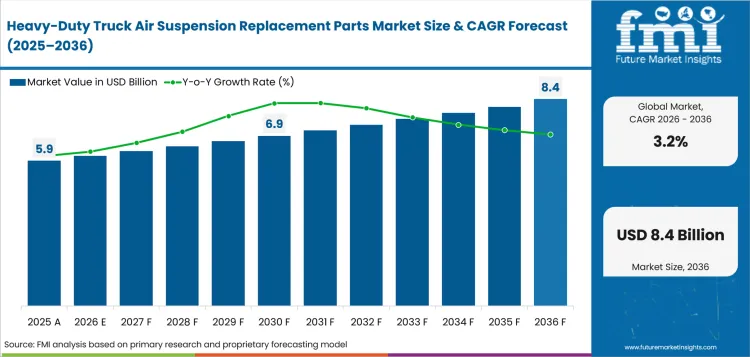
The heavy-duty truck air suspension replacement parts market stood at USD 5.9 billion in 2025 and is projected to reach USD 6.1 billion by the end of 2026. With demand expected to grow at a CAGR of 3.2% from 2026 to 2036, the market is forecast to reach USD 8.4 billion by 2036. Air springs are expected to command with a 38.0% component share and trucks are poised to lead the vehicle segment with a 56.0% share.
Key Takeaways, Market Size and Forecast
- The heavy-duty truck air suspension replacement parts market was valued at USD 5.9 billion in 2025.
- By 2036, the heavy-duty truck air suspension replacement parts market is expected to be worth USD 8.4 billion.
- From 2026 to 2036, demand is projected to expand at a CAGR of 3.2%.
- The market is projected to create an incremental opportunity of USD 2.3 billion between 2026 and 2036.
- In 2026, air springs are expected to account for 38.0% of component demand.
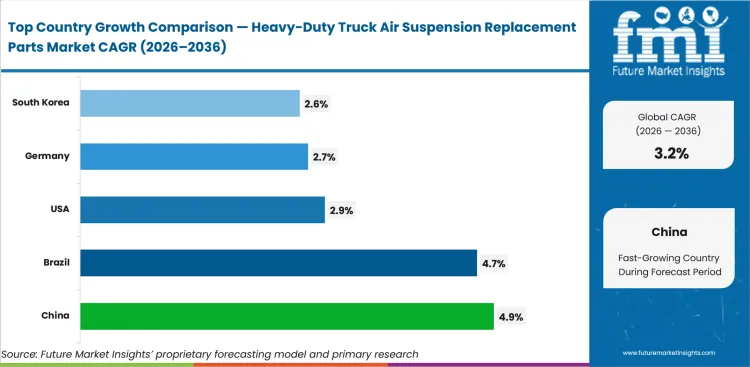
- China and Brazil are projected to record CAGRs of 4.9% and 4.7%, respectively, through 2036.
Summary of the Heavy-Duty Truck Air Suspension Replacement Parts Market
- Demand and Growth Drivers
- Fleet repair cycles lift demand for replacement parts as high-mileage trucks need air spring and valve service.
- Axle load compliance increases demand for air suspension parts as fleets need ride height control.
- Uptime planning supports preventive replacement as workshops try to avoid roadside failures and cargo delays.
- Product and Segment View
- Air springs are expected to stay the leading component segment, driven by regular replacement needs across load-bearing suspension systems.
- Trucks are likely to lead vehicle type demand, supported by heavy mileage exposure across long-haul and vocational fleets.
- Aftermarket sales are expected to retain value importance as fleets require faster access to stocked replacement parts.
- Geography and Competitive Outlook
- China is expected to record a CAGR of 4.9% through 2036 as freight activity expands replacement needs.
- Brazil is projected to expand at 4.7% CAGR through 2036 as road conditions raise suspension wear.
- Companies combining fitment coverage with service channel access are strengthening their market position during the forecast period.
- Analyst Opinion
- Nikhil Kaitwade, Principal Consultant for the Automotive domain at FMI, says, “Heavy-duty truck air suspension replacement is becoming planned service work for fleets seeking lower downtime risk. Fleet workshops need air springs matched to chassis fitment. Cross-reference accuracy and stocked replacement ranges reduce repair time while rubber quality shapes long-term planning.”
- Heavy-Duty Truck Air Suspension Replacement Parts Market Value Analysis
- Fleet maintenance staff are replacing air suspension parts through planned service schedules before failure occurs.
- Replacement activity is driven by the need to keep axle loads balanced and maintain stable ride height in heavy-duty truck fleets.
- The market is benefiting from deeper use of heavy-duty air suspension components market outlook across replacement programs.
- Service records and maintenance planning are increasing demand as fleets focus on vehicle downtime.
- These records help protect vehicle availability and improve parts planning for high-use truck fleets.
Truck fleets replace air suspension parts to avoid downtime and repeated workshop visits. Heavy-duty applications need parts with verified load ratings, especially in construction and vocational trucks. Hendrickson’s ROADMAAX Z has a 46,000 lb capacity rating and approval for up to 25% off-highway operation, which makes it relevant for fleets running in harsher service conditions.
Air spring replacement needs correct fitment, since mismatched parts can delay repairs and raise warranty risk. Continental’s N7 air spring can replace Tough RuNR air springs one-to-one, and Continental states its OEM range covers over 90% of European commercial vehicle replacement air spring needs. Electronic air suspension service is becoming more technical. ZF’s fifth-generation OptiRide ECAS integrates valves and sensors into a Smart Pneumatic Actuator, which means workshops need stronger diagnostic and control-module replacement skills.
Heavy-Duty Truck Air Suspension Replacement Parts Market Definition
The heavy-duty truck air suspension replacement parts market includes spare parts used to repair air suspension systems in heavy-duty trucks. These products include air springs and shock absorbers for axle-level suspension repair. Height control valves and air line systems are included across service channel demand. New vehicle suspension systems and passenger car suspension parts are outside the defined scope.
Heavy-Duty Truck Air Suspension Replacement Parts Market Inclusions
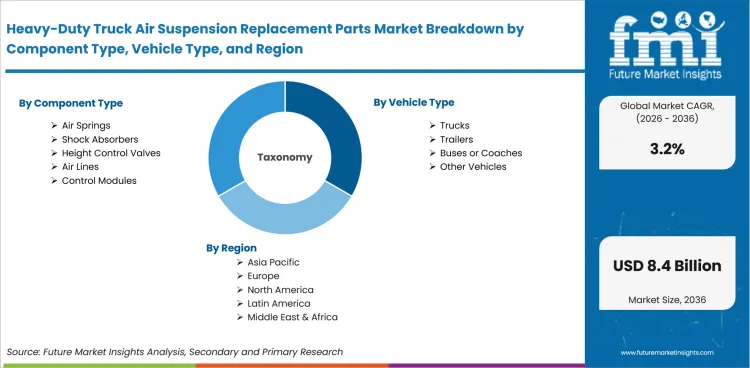
Market scope covers all commercially traded heavy-duty truck air suspension replacement parts categorized by component type, including air springs, shock absorbers, height control valves, air lines, and control modules, vehicle type, including trucks, trailers, buses or coaches, and other heavy-duty vehicles, suspension type, including full air suspension, air-assist systems, electronic air suspension, and other systems, and sales channels, including aftermarket, dealer or OES, OEM service, and fleet supply networks.
Revenue scope covers 2026 to 2036, with replacement demand connected to scheduled rebuild activity covered under commercial vehicle suspension overhaul services market outlook and parts ordering shifts reflected in automotive e-tailing market outlook. The key stakeholders include air suspension component manufacturers, rubber and metal part suppliers, pneumatic system providers, sensor and actuator suppliers, heavy-duty truck OEMs, fleet operators, repair workshops, parts distributors, dealer service networks, logistics companies, construction fleet owners, regulatory bodies, and certification agencies.
Heavy-Duty Truck Air Suspension Replacement Parts Market Exclusions
Scope does not include new truck line-fit systems, passenger car suspension parts, trailer brake repair parts, tire service, or complete chassis rebuilds.
Heavy-Duty Truck Air Suspension Replacement Parts Market Research Methodology
- Primary Research: FMI analysts spoke to fleet maintenance teams, parts distributors, service workshops, and truck suspension component suppliers in important markets.
- Desk Research: Combined data from supplier product portfolios, component service catalogs, vehicle production records, and suspension system references.
- Market sizing and forecasting: Added component use across heavy truck fleets and replacement channels from the bottom up.
- Data validation: Cross-checked every three months against vehicle use patterns and company service coverage.
Why is the Heavy-Duty Truck Air Suspension Replacement Parts Market Growing?
- Fleets are replacing air springs earlier to reduce roadside failure risk during freight movement.
- Service centers are becoming important as air leaks and valve faults need faster diagnosis.
- Manufacturers are expanding replacement ranges as direct-fit parts reduce workshop time.
Heavy-duty trucks need air suspension parts with predictable service life as payloads place steady stress on bellows and valves. OICA production data for 2024 listed 4,260,835 commercial vehicles in China, creating a large service base for suspension repair. This volume holds importance for air springs as repeated load cycles raise fatigue risk across long-use trucks. Suppliers with air suspension height control valve components market outlook expertise gain service relevance during height control checks.
Repair economics favor replacement parts with fast fitment and known durability across high-use fleets. The Federal Highway Administration listed 189,754,931 trucks registered in the United States during 2024. A broad truck population creates aftermarket touchpoints for service centers and distributor networks. Fitment databases and stocked parts help workshops reduce downtime during air spring and valve replacement. Demand for air suspension hose and line systems revenue grows as leak repair often follows suspension inspection.
Market Segmentation Analysis
- Air springs are projected to represent 38.0% of component demand in 2026, as axle suspension repair often starts with worn bellows and pressure-loss issues.
- Trucks are expected to hold a 56.0% share of vehicle type revenue in 2026, reflecting heavier exposure across long-haul tractors and vocational fleets.
- Full air suspension is anticipated to capture 54.0% of the suspension type segment in 2026, as complete systems involve springs, valves, and airline replacement.
- Aftermarket sales are forecast to account for 64.0% of channel revenue in 2026, driven by service center access and locally stocked parts.
- Direct replacement is projected to contribute 68.0% of replacement type sales in 2026, as repair teams prefer parts matching original mounting and pressure specifications.
The market for heavy-duty truck air suspension replacement parts is divided into groups based on component type, vehicle type, suspension type, sales channel, replacement type, and region. There are air springs, shock absorbers, height control valves, air lines, and control modules under component type. By vehicle type, the market includes trucks, trailers, buses or coaches, and other heavy-duty vehicles, with replacement activity related to commercial vehicle market outlook across fleet service channels. Based on suspension type, it includes full air suspension, air-assist systems, electronic air suspension, and other systems. By sales channel, the market covers aftermarket, dealer or OES, OEM service, and fleet supply networks. Replacement type includes direct replacement, retrofit replacement, preventive replacement, and emergency replacement, with service demand influenced by trucks market outlook across high-mileage vehicle fleets.
Insights into Heavy-Duty Truck Air Suspension Replacement Parts Market by Component Type
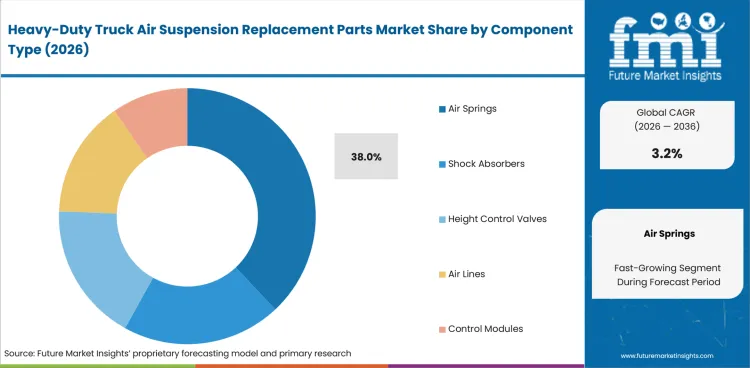
- In 2026, air springs are expected to make up 38.0% of the component type segment. Air springs carry axle load and absorb road shock, so they are often replaced first during suspension repair.
- Shock absorbers and height control valves address related service needs across heavy-duty truck suspension systems. Their replacement value improves during combined inspection work after air spring wear or ride height issues appear.
Insights into Heavy-Duty Truck Air Suspension Replacement Parts Market by Vehicle Type
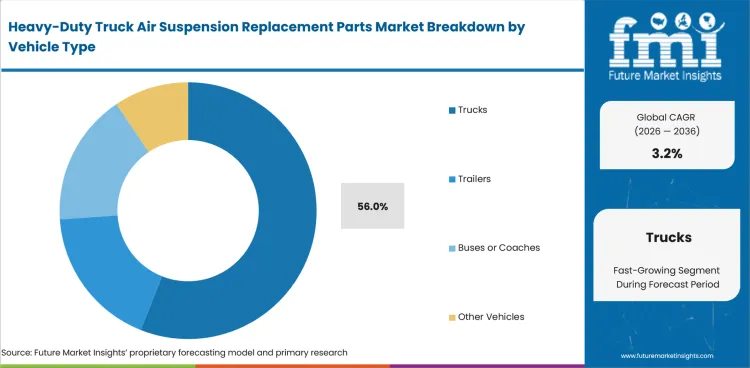
- Trucks are projected to account for 56.0% of the vehicle type segment in 2026. Long-haul tractors and vocational trucks run under heavy loads, which increases wear across air suspension parts.
- Trailers and buses create selected replacement demand through ride stability and passenger comfort needs. Their service cycles differ from trucks because duty profile and operating routes affect part wear.
Insights into Heavy-Duty Truck Air Suspension Replacement Parts Market by Suspension Type
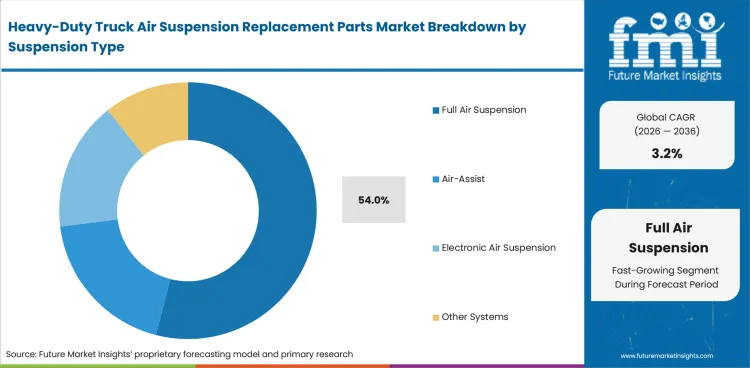
- Full air suspension is forecast to account for 54.0% share in 2026. Complete air suspension systems use several serviceable parts, including air springs and height control valves.
- Air-assist and electronic air suspension systems serve fleet needs linked to comfort and load control. Their value improves as diagnostics and control modules become more important in service work.
Insights into Heavy-Duty Truck Air Suspension Replacement Parts Market by Sales Channel
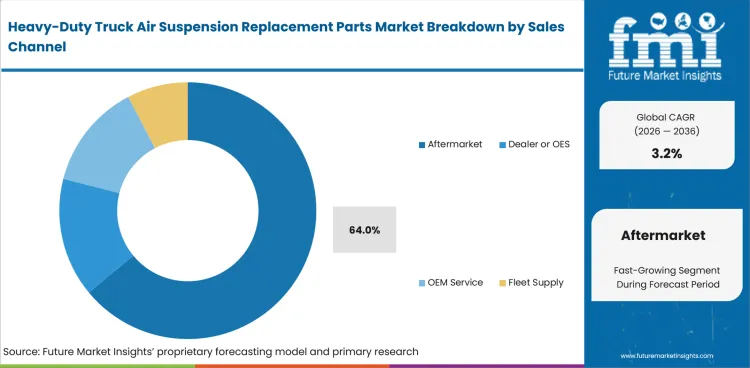
- Aftermarket sales are expected to represent 64.0% share in 2026. Distributors and independent workshops handle urgent replacement needs as fleets require faster access to stocked parts.
- Dealer or OES channels support fleets that need verified fitment and warranty-backed parts. Fleet supply programs serve operators seeking stable pricing and planned maintenance coverage.
Insights into Heavy-Duty Truck Air Suspension Replacement Parts Market by Replacement Type
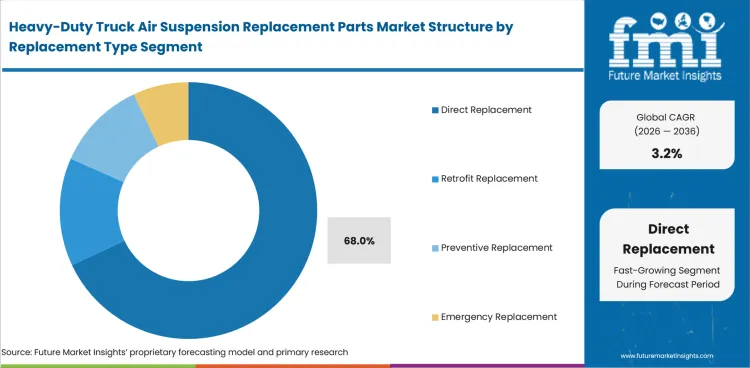
- Direct replacement is projected to hold 68.0% share in 2026. Direct-fit parts reduce installation risk because mechanics can match mounting points and pressure ratings during repair.
- Preventive and emergency replacement demand reflects different fleet service habits. Preventive replacement protects uptime during scheduled maintenance, while emergency replacement responds to sudden air leaks or suspension failure.
Heavy-Duty Truck Air Suspension Replacement Parts Market Drivers, Restraints and Opportunities
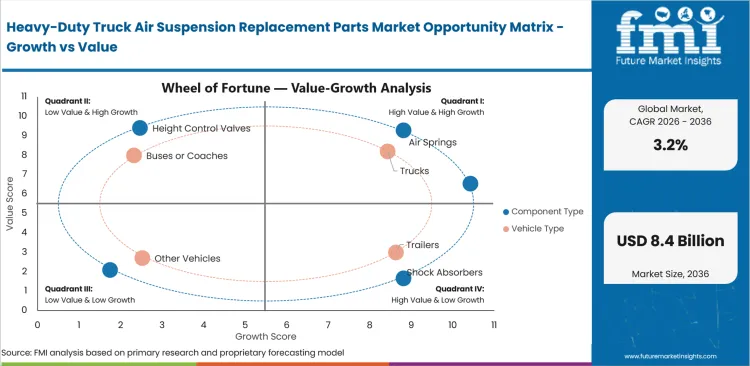
- Driver: Mileage-related suspension wear keeps replacement demand active as fleets must repair air springs and bushings before downtime increases.
- Restraint: Lower maintenance cost reduce supplier pricing power as fleets push for better warranty terms and service discounts.
- Opportunity: Uneven parts price movement gives suppliers to differentiate through longer service intervals and downtime-reduction claims.
Heavy-duty truck air suspension replacement demand is supported by fleet service needs related to mileage and vehicle age. ATRI reported in July 2025 that repair and maintenance costs for motor carriers decreased 2.0% in 2024, and average truck operating cost eased to US$2.26 per mile from US$2.27 in 2023. Lower maintenance pressure does not remove replacement need, but it changes how fleets approve part quotes. Suppliers of air springs and height-control valves now need clearer proof of service life and downtime reduction. Vendors with credible warranty terms and fleet-level pricing can protect repeat orders.
Replacement Parts Pricing and Service Cost Analysis
Part pricing is moving unevenly across the heavy-duty truck repair base. TMC and Decisiv reported in March 2026 that Q4 2025 combined parts and labor costs fell 1.3% quarter over quarter, with parts costs down 0.4% and labor costs down 2.6%. The same source reported year-over-year parts costs rose 3.7%, while labor costs declined 0.4%. This pattern is important for air bags and mounting kits. Fleets may see lower workshop bills while facing higher component quotes. Suppliers must separate part value from labor relief before setting price.
Fleet Purchasing and Supplier Positioning Analysis
Fleet purchasing is becoming more selective as operators compare replacement cost with uptime protection. Lower repair and maintenance costs in 2024 reduced the tolerance for blanket price increases across suspension hardware. Air suspension suppliers must show how a higher-priced air spring or valve can reduce repeat workshop visits. Service providers can gain share by packaging parts with inspection guidance and warranty clarity. Distributors need better quote discipline as buyers compare component-level pricing across multiple service networks. Stronger proof of durability can turn price pressure into a repeat-order advantage.
Analysis of Heavy-Duty Truck Air Suspension Replacement Parts Market By Key Countries
.webp "Top Country Growth Comparison Heavy Duty Truck Air Suspension Replacement Parts Market Cagr (2026 2036)")
| Country | CAGR |
|---|---|
| China | 4.9% |
| Brazil | 4.7% |
| USA | 2.9% |
| Germany | 2.7% |
| South Korea | 2.6% |
Source: Future Market Insights, 2026.
Sales Analysis of Heavy-Duty Truck Air Suspension Replacement Parts Market in China
Fastest-rising country market · 2026-2036
China Market Outlook
Heavy-duty truck air suspension replacement parts industry in China leads the covered country group, with demand projected at USD 1,350.0 million in 2026 and USD 2,178.2 million by 2036. The 4.9% CAGR is due to large commercial vehicle output and active service demand across freight corridors.
Repair activity is concentrated around coastal logistics belts and inland industrial freight lanes. Local parts availability helps workshops handle air spring replacement and related suspension repairs with shorter sourcing time.
Key Demand Drivers
- OICA reported China produced 4,260,835 commercial vehicles in 2025, reinforcing a large future service base for air springs.
- Coastal logistics belts create recurring replacement demand as high-use tractors need frequent suspension inspection.
- Domestic parts makers keep replacement products accessible across several price bands and service networks.
- Fleet workshops prefer direct replacement parts as faster repair helps protect delivery schedules.
Key Restraints
- CAAM reported first-nine-month commercial vehicle sales of 3,122,000 units in 2025 with a year-on-year decline of 3.4%, limiting near-term order visibility.
- Intense local price competition can reduce premium air spring margins across distributor channels.
- Smaller repair shops may choose low-cost parts with weaker warranty depth and shorter service life.
What Makes China Unique
China has a dense domestic parts ecosystem and a large freight base, which shortens sourcing cycles for repair shops.
Key Companies
- Hendrickson Commercial Vehicle Systems China
- Continental
- ZF
- SAF-Holland
- Firestone Industrial Products
Sales & Marketing Channels
- Dealer service networks
- Independent truck repair workshops
- Fleet maintenance centers
- Regional parts distributors
- B2B parts platforms
Market Taxonomy & Sub-Regions Covered
| Segment | Sub-Segments |
|---|---|
| By Component Type | Air Springs · Shock Absorbers · Height Control Valves · Air Lines · Control Modules |
| By Vehicle Type | Trucks · Trailers · Buses or Coaches · Other Vehicles |
| By Suspension Type | Full Air Suspension · Air-Assist · Electronic Air Suspension · Other Systems |
| By Sales Channel | Aftermarket · Dealer or OES · OEM Service · Fleet Supply |
| By Replacement Type | Direct Replacement · Retrofit Replacement · Preventive Replacement · Emergency Replacement |
| Key Sub-Regions Covered | Guangdong · Jiangsu · Zhejiang · Shandong · Beijing · Shanghai · Sichuan · Hubei |
Frequently Asked Questions
How fast is China’s heavy-duty truck air suspension replacement parts market expanding?
China is projected to expand at a 4.9% CAGR from 2026 to 2036, ranking first among the covered markets.
Who competes in China’s heavy-duty truck air suspension replacement parts market?
Hendrickson Commercial Vehicle Systems China, Continental, ZF, SAF-Holland, and Firestone Industrial Products compete across service channels.
What is driving demand in China?
Demand is led by large commercial vehicle output, coastal freight activity, and broad access to domestic replacement parts.
Sales Analysis of Heavy-Duty Truck Air Suspension Replacement Parts Market in Brazil
High-expansion country market · 2026-2036
Brazil Market Outlook
Brazil heavy-duty truck air suspension replacement parts sector holds a key Latin American value base, with demand forecast at USD 328.0 million in 2026 and USD 519.2 million by 2036. The 4.7% CAGR reflects heavy road freight use and repeated suspension wear in long-distance operations.
Demand is higher across agribusiness corridors and industrial freight routes. Fleet operators need durable air springs and reliable parts access near major service hubs.
Key Demand Drivers
- OICA reported Brazil commercial vehicle sales of 692,370 units in 2025, reinforcing a broad service base for truck suspension parts.
- Agribusiness freight from Mato Grosso raises air spring wear across loaded inland truck movement.
- Mining and construction transport creates service demand for tougher bellows and leak-resistant air lines.
- São Paulo service clusters improve access to replacement parts for long-distance haulage fleets.
Key Restraints
- OICA reported Brazil commercial vehicle production reached 813,272 units in 2025, creating local parts competition and distributor pricing pressure.
- Long inland freight distances raise inventory cost for air suspension parts outside major service hubs.
- Price-sensitive truck operators may delay preventive replacement until air leaks affect ride height.
What Makes Brazil Unique
Brazil combines road-heavy freight movement with demanding terrain, making durability central to replacement decisions.
Key Companies
- SAF-Holland Brazil
- Haldex
- Continental
- ZF
- Hendrickson
Sales & Marketing Channels
- Truck service workshops
- Regional parts distributors
- Fleet maintenance contracts
- Dealer or OES channels
- Agribusiness fleet service networks
Market Taxonomy & Sub-Regions Covered
| Segment | Sub-Segments |
|---|---|
| By Component Type | Air Springs · Shock Absorbers · Height Control Valves · Air Lines · Control Modules |
| By Vehicle Type | Trucks · Trailers · Buses or Coaches · Other Vehicles |
| By Suspension Type | Full Air Suspension · Air-Assist · Electronic Air Suspension · Other Systems |
| By Sales Channel | Aftermarket · Dealer or OES · OEM Service · Fleet Supply |
| By Replacement Type | Direct Replacement · Retrofit Replacement · Preventive Replacement · Emergency Replacement |
Key Sub-Regions Covered: São Paulo · Minas Gerais · Paraná · Rio Grande do Sul · Mato Grosso · Goiás · Bahia · Santa Catarina
Frequently Asked Questions
How fast is Brazil’s heavy-duty truck air suspension replacement parts market expanding?
Brazil is projected to expand at a 4.7% CAGR from 2026 to 2036, ranking second among the covered markets.
Who competes in Brazil’s heavy-duty truck air suspension replacement parts market?
SAF-Holland Brazil, Haldex, Continental, ZF, and Hendrickson compete through service networks and replacement part availability.
What is driving demand in Brazil?
Demand is led by agribusiness freight, mining transport, and long-distance road movement across inland corridors.
Sales Analysis of Heavy-Duty Truck Air Suspension Replacement Parts Market in the USA
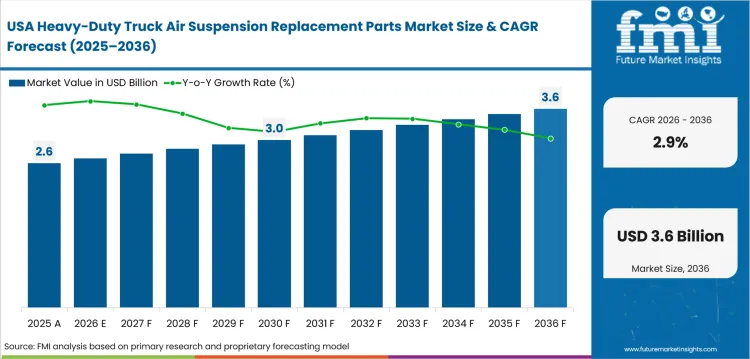
Established high-value country market · 2026-2036
USA Market Outlook
The USA heavy-duty truck air suspension replacement parts industry has a large replacement base, with demand expected to reach USD 1,115.0 million in 2026 and USD 1,484.0 million by 2036. The 2.9% CAGR reflects mature fleet maintenance practices and strong aftermarket coverage.
Service demand is supported by interstate freight movement and high truck utilization. National distributors and independent workshops help fleets source air suspension parts during scheduled service and urgent repairs.
Key Demand Drivers
- FHWA reported single-unit and combination trucks traveled 329,600 million vehicle-miles in 2024, backing recurring suspension wear across freight fleets.
- Interstate freight movement keeps air spring replacement active across long-haul tractor fleets.
- National distributor networks help service centers source direct replacement parts with shorter downtime.
- Fleet maintenance programs prioritize ride height control as axle balance affects tire and suspension wear.
Key Restraints
- FHWA reported 3,482,896 combination trucks registered in 2024, concentrating premium demand within a narrower heavy truck base.
- Mature service networks limit sharp expansion as many fleets already follow planned replacement routines.
- Warranty scrutiny can slow switching toward lower-cost parts without proven service records.
What Makes the USA Unique
The USA has deep aftermarket coverage and strong fleet maintenance discipline, which favors direct-fit replacement parts.
Key Companies
- Hendrickson
- SAF-Holland
- Continental
- Firestone Industrial Products
- ZF
- Cummins-Meritor
- Dayton Parts
- Ridewell Suspensions
Sales & Marketing Channels
- Independent heavy truck workshops
- National parts distributors
- Fleet maintenance programs
- Dealer or OES service channels
- Online heavy-duty parts platforms
Market Taxonomy & Sub-Regions Covered
| Segment | Sub-Segments |
|---|---|
| By Component Type | Air Springs · Shock Absorbers · Height Control Valves · Air Lines · Control Modules |
| By Vehicle Type | Trucks · Trailers · Buses or Coaches · Other Vehicles |
| By Suspension Type | Full Air Suspension · Air-Assist · Electronic Air Suspension · Other Systems |
| By Sales Channel | Aftermarket · Dealer or OES · OEM Service · Fleet Supply |
| By Replacement Type | Direct Replacement · Retrofit Replacement · Preventive Replacement · Emergency Replacement |
Key Sub-Regions Covered: Texas · California · Illinois · Ohio · Pennsylvania · Georgia · Florida · North Carolina
Frequently Asked Questions
How fast is the USA heavy-duty truck air suspension replacement parts market expanding?
The USA is projected to expand at a 2.9% CAGR from 2026 to 2036, reflecting mature service demand.
Who competes in the USA heavy-duty truck air suspension replacement parts market?
Hendrickson, SAF-Holland, Continental, Firestone Industrial Products, ZF, Cummins-Meritor, Dayton Parts, and Dorman Products compete across channels.
What is driving demand in the USA?
Demand is led by interstate freight mileage, planned fleet maintenance, and strong access to aftermarket distribution.
Sales Analysis of Heavy-Duty Truck Air Suspension Replacement Parts Market in Germany
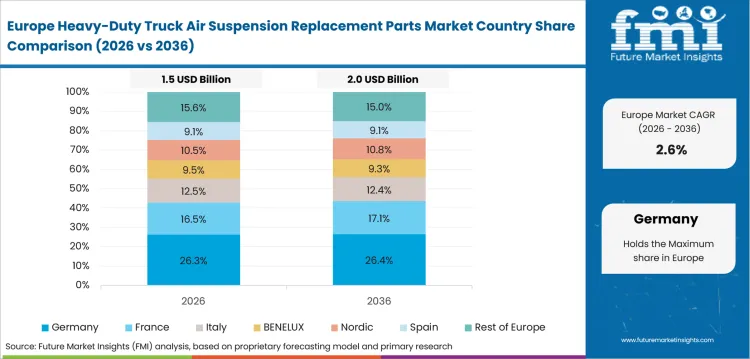
Established European service market · 2026-2036
Germany Market Outlook
Heavy-duty truck air suspension replacement parts demand in Germany is forecast at USD 410.0 million in 2026 and projected to reach USD 535.2 million by 2036. The 2.7% CAGR reveals disciplined fleet maintenance and fitment-sensitive replacement purchasing.
Service demand is concentrated across manufacturing regions and highway freight corridors. Workshops often prefer verified OE references and documented part compatibility before approving replacement orders.
Key Demand Drivers
- VDA reported truck ownership transfers of 439,869 in 2025, reinforcing service demand across used truck maintenance.
- Autobahn freight use sustains replacement demand for air springs with stable ride height performance.
- Manufacturing logistics around Bavaria and Baden-Württemberg create routine service needs for heavy trucks.
- OE-reference purchasing favors suppliers with verified catalogs and workshop-ready technical data.
Key Restraints
- ACEA reported EU truck registrations fell 6.3% in 2024, limiting near-term fleet replenishment across service markets.
- Strict component documentation raises entry barriers for low-cost replacement parts without proven conformity.
- Mature workshop practices reduce emergency replacement frequency as fleets inspect parts on schedule.
What Makes Germany Unique
Germany is a fitment-sensitive service market, with high value placed on approved parts and technical documentation.
Key Companies
- Continental
- ZF
- SAF-Holland
- Hendrickson
- Firestone Industrial Products
Sales & Marketing Channels
- Dealer or OES service networks
- Independent commercial vehicle workshops
- Fleet maintenance contracts
- Technical parts distributors
- Aftermarket catalog platforms
Market Taxonomy & Sub-Regions Covered
| Segment | Sub-Segments |
|---|---|
| By Component Type | Air Springs · Shock Absorbers · Height Control Valves · Air Lines · Control Modules |
| By Vehicle Type | Trucks · Trailers · Buses or Coaches · Other Vehicles |
| By Suspension Type | Full Air Suspension · Air-Assist · Electronic Air Suspension · Other Systems |
| By Sales Channel | Aftermarket · Dealer or OES · OEM Service · Fleet Supply |
| By Replacement Type | Direct Replacement · Retrofit Replacement · Preventive Replacement · Emergency Replacement |
Key Sub-Regions Covered: Bavaria · Baden-Württemberg · North Rhine-Westphalia · Lower Saxony · Hesse · Saxony · Hamburg · Bremen
Frequently Asked Questions
How fast is Germany’s heavy-duty truck air suspension replacement parts market expanding?
Germany is projected to expand at a 2.7% CAGR from 2026 to 2036, reflecting controlled replacement demand.
Who competes in Germany’s heavy-duty truck air suspension replacement parts market?
Continental, ZF, SAF-Holland, Haldex, Hendrickson, and Firestone Industrial Products compete across service channels.
What is driving demand in Germany?
Demand is led by highway freight use, manufacturing logistics, and preference for verified OE-reference replacement parts.
Sales Analysis of Heavy-Duty Truck Air Suspension Replacement Parts Market in South Korea
Compact technology-oriented country market · 2026-2036
South Korea Market Outlook
South Korea heavy-duty truck air suspension replacement parts industry is projected at USD 195.0 million in 2026 and projected to reach USD 252.1 million by 2036. The 2.6% CAGR reflects compact freight lanes and technology-driven commercial vehicle service needs.
Replacement demand is concentrated near ports and manufacturing centers. Electronic air suspension service has higher relevance as vehicle platforms use more integrated control and leveling systems.
Key Demand Drivers
- OICA reported South Korea commercial vehicle sales of 192,978 units in 2024, backing a defined but compact service pool.
- Busan port logistics creates regular suspension service demand across regional freight fleets.
- Ulsan manufacturing activity sustains truck movement for industrial supply and component transport.
- Electronic air suspension use raises service interest in control modules and diagnostic-linked replacement.
Key Restraints
- OICA reported South Korea commercial vehicle sales fell 25.9% in 2024, lowering near-term demand from new fleet entries.
- Compact freight distances reduce extreme wear exposure compared with larger road freight markets.
- Imported premium parts can face price resistance across smaller operators and independent repair shops.
What Makes South Korea Unique
South Korea combines compact freight lanes with advanced vehicle platforms, making electronic control service especially relevant.
Key Companies
- ZF
- Continental
- Hendrickson
- SAF-Holland
Sales & Marketing Channels
- OEM service channels
- Independent truck workshops
- Fleet maintenance centers
- Imported parts distributors
- Port logistics service networks
Market Taxonomy & Sub-Regions Covered
| Segment | Sub-Segments |
|---|---|
| By Component Type | Air Springs · Shock Absorbers · Height Control Valves · Air Lines · Control Modules |
| By Vehicle Type | Trucks · Trailers · Buses or Coaches · Other Vehicles |
| By Suspension Type | Full Air Suspension · Air-Assist · Electronic Air Suspension · Other Systems |
| By Sales Channel | Aftermarket · Dealer or OES · OEM Service · Fleet Supply |
| By Replacement Type | Direct Replacement · Retrofit Replacement · Preventive Replacement · Emergency Replacement |
Key Sub-Regions Covered: Seoul · Busan · Ulsan · Gyeonggi · Incheon · Daegu · Daejeon · South Gyeongsang
Frequently Asked Questions
How fast is South Korea’s heavy-duty truck air suspension replacement parts market expanding?
South Korea is projected to expand at a 2.6% CAGR from 2026 to 2036, reflecting compact but specialized demand.
Who competes in South Korea’s heavy-duty truck air suspension replacement parts market?
ZF, Hyundai Motor Company service network, Continental, Hendrickson, and SAF-Holland serve the country’s replacement base.
What is driving demand in South Korea?
Demand is led by port logistics, industrial freight movement, and rising electronic control service needs.
Competitive Landscape and Strategic Positioning
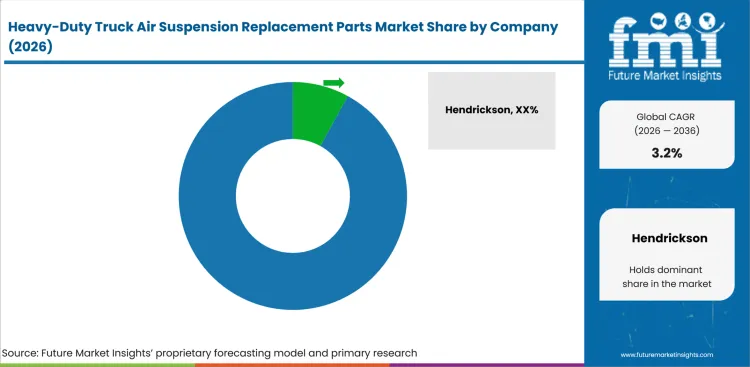
- Heavy-duty truck air suspension replacement parts competition is supported by fitment accuracy and aftermarket coverage across truck service networks.
- Hendrickson competes from an integrated suspension base, with replacement coverage across heavy-duty truck platforms in major service channels.
- Continental and Firestone Industrial Products compete on air spring depth and OE-equivalent aftermarket part coverage.
- Specialist suppliers focus on valves and electronic controls for system-level repair across modern air suspension assemblies.
Hendrickson holds a strong position through integrated truck suspension systems and replacement product coverage. Continental serves commercial vehicle air spring demand with aftermarket identity and counterfeit protection. Firestone Industrial Products focuses on air spring experience and commercial vehicle application coverage. ZF adds electronic control strength through OptiRide ECAS and related chassis technology. SAF-Holland brings suspension depth across truck and trailer systems. Suppliers aligned with HCV Suspension System market outlook gain relevance across broader heavy commercial vehicle service.
High validation needs and strict fitment accuracy create entry barriers across truck platforms. Catalog depth and faster distributor reporting are now central competitive priorities. Buyers prefer suppliers with air spring fitment records and valve compatibility to reduce order uncertainty. Companies with Heavy-Duty Truck Axle Locking Actuator Components revenue exposure can serve broader chassis repair programs. Suppliers best positioned to win will combine verified part coverage and dependable technical documentation.
Competitive Benchmarking: Heavy-Duty Truck Air Suspension Replacement Parts Market
| Company | Air Spring Fitment Depth | Valve Coverage | Aftermarket Reach | Geographic Footprint |
|---|---|---|---|---|
| Hendrickson | High | High | Strong | North America, Europe, China, India, and Australia |
| SAF-Holland | High | Medium | Strong | North America, Europe, Brazil, China, and Australia |
| ZF | Medium | High | Strong | North America, Europe, China, India, South Korea, and Japan |
| Continental | High | Medium | Strong | Europe, North America, China, Brazil, and India |
| Firestone Industrial Products | High | Medium | Strong | North America, Europe, Latin America, and Asia Pacific |
| Knorr-Bremse | Medium | High | Strong | Europe, North America, China, India, and South Korea |
| Haldex | Medium | High | Moderate | Europe, North America, Brazil, and selected Asia Pacific markets |
| Cummins-Meritor | Medium | Medium | Strong | North America, Europe, China, India, and Latin America |
| Dayton Parts | Medium | Low | Strong | North America |
| Dorman Products | Medium | Low | Strong | North America |
Source: Future Market Insights, 2026.
Key Developments in Heavy-Duty Truck Air Suspension Replacement Parts Market
- In October 2025, Tenneco announced that Monroe introduced a comprehensive Monroe Magnum air spring range for commercial vehicles. The line covers trucks, buses, and other applications from manufacturers such as Mercedes-Benz, IVECO, DAF, Renault Trucks, MAN, and Volvo.
- In August 2024, Continental introduced the N7 air spring model variant for commercial vehicle applications and positioned it as an original-equivalent spare part which can replace factory-fitted Tough RuNR air springs one-to-one. The company stated that the N7 was developed for aftermarket, fleet, haulage, and workshop customers.
Key Players in the Heavy-Duty Truck Air Suspension Replacement Parts Market
Major Global Players:
- Hendrickson
- SAF-Holland
- ZF
- Continental
- Firestone Industrial Products
- Knorr-Bremse
- Cummins-Meritor
Specialist Players:
- Haldex
- Dayton Parts
- Dorman Products
Report Scope and Coverage
| Parameter | Details |
|---|---|
| Quantitative Units | USD 6.1 billion to USD 8.4 billion, at a CAGR of 3.2% |
| Market Definition | Replacement parts used to repair heavy-duty truck air suspension systems during fleet service |
| Regions Covered | North America; Latin America; Europe; East Asia; South Asia and Pacific; Middle East and Africa |
| Countries Covered | USA; China; Brazil; Germany; South Korea; Japan; India; and 30 plus countries |
| Key Companies Profiled | Hendrickson; SAF-Holland; ZF; Continental; Firestone Industrial Products; Knorr-Bremse; Haldex; Cummins-Meritor; Dayton Parts; Dorman Products |
| Forecast Period | 2026 to 2036 |
| Approach | Hybrid bottom-up and top-down methodology starting with replacement demand and verified service patterns |
Heavy-Duty Truck Air Suspension Replacement Parts Market by Segments
Heavy-Duty Truck Air Suspension Replacement Parts Market Segmented by Component Type:
- Air Springs
- Shock Absorbers
- Height Control Valves
- Air Lines
- Control Modules
Heavy-Duty Truck Air Suspension Replacement Parts Market Segmented by Vehicle Type:
- Trucks
- Trailers
- Buses or Coaches
- Other Vehicles
Heavy-Duty Truck Air Suspension Replacement Parts Market Segmented by Suspension Type:
- Full Air Suspension
- Air-Assist
- Electronic Air Suspension
- Other Systems
Heavy-Duty Truck Air Suspension Replacement Parts Market Segmented by Sales Channel:
- Aftermarket
- Dealer or OES
- OEM Service
- Fleet Supply
Heavy-Duty Truck Air Suspension Replacement Parts Market Segmented by Replacement Type:
- Direct Replacement
- Retrofit Replacement
- Preventive Replacement
- Emergency Replacement
Heavy-Duty Truck Air Suspension Replacement Parts Market by Region:
- North America
- USA
- Canada
- Mexico
- Latin America
- Brazil
- Chile
- Rest of Latin America
- Europe
- Germany
- UK
- Italy
- Spain
- France
- Rest of Europe
- East Asia
- China
- Japan
- South Korea
- South Asia and Pacific
- India
- ASEAN
- Australia and New Zealand
- Rest of South Asia and Pacific
- Middle East and Africa
- Saudi Arabia
- Other GCC Countries
- South Africa
- Rest of Middle East and Africa
Research Sources and Bibliography
- International Organization of Motor Vehicle Manufacturers. (2025, October). Production statistics 2024. OICA.
- International Organization of Motor Vehicle Manufacturers. (n.d.). Commercial vehicle sales 2024 and 2025. OICA.
- Federal Highway Administration. (2026, February). Highway Statistics 2024: Table MV-1. USA Department of Transportation.
- Hendrickson. (2024, March). ROADMAAX Z introduced. Hendrickson.
- Continental AG. (2024, August 2). Dubai or Svalbard: Commercial vehicle air spring from Continental can withstand range of temperatures. Continental.
- Kongsberg Automotive ASA. (2024, December 17). Kongsberg Automotive wins a new contract worth over EUR 25.5 million in estimated lifetime revenue for air suspension lines. Kongsberg Automotive.
- ZF Friedrichshafen AG. (2025, June 5). ZF delivers electronically controlled air suspension OptiRide to bus manufacturer Hyundai. ZF.
This Report Answers
- What is the current and future size of the heavy-duty truck air suspension replacement parts market?
- How fast is the heavy-duty truck air suspension replacement parts market expected to expand between 2026 and 2036?
- Which component type is expected to lead the market by 2026?
- Which vehicle type is expected to account for the leading demand by 2026?
- What factors are driving demand for heavy-duty truck air suspension replacement parts globally?
- How are air spring replacement cycles influencing aftermarket demand?
- Why are trucks the main demand base for air suspension replacement parts?
- How are electronic suspension controls creating demand for specialized service parts?
- Which countries are projected to record faster expansion through 2036?
- What is driving market expansion in China and Brazil?
- Who are the key companies active in the heavy-duty truck air suspension replacement parts market?
- How does FMI estimate and validate the market forecast?
Frequently Asked Questions
What is the global market demand for Heavy-Duty Truck Air Suspension Replacement Parts in 2026?
In 2026, the global market for heavy-duty truck air suspension replacement parts is expected to be worth USD 6.1 billion.
How big will the market for Heavy-Duty Truck Air Suspension Replacement Parts be in 2036?
By 2036, the market for heavy-duty truck air suspension replacement parts is expected to be worth USD 8.4 billion.
How much is demand for Heavy-Duty Truck Air Suspension Replacement Parts expected to expand between 2026 and 2036?
Between 2026 and 2036, demand for heavy-duty truck air suspension replacement parts is expected to expand at a CAGR of 3.2%.
Which component type segment is likely to be the leading seller globally by 2026?
Air springs will make up 38.0% of the component type segment in 2026.
What is causing demand to rise in China?
The China heavy-duty truck air suspension replacement parts market is projected to record 4.9% CAGR through 2036, backed by freight activity and commercial vehicle production.
What is causing demand to rise in Brazil?
The Brazil heavy-duty truck air suspension replacement parts market is projected to expand at 4.7% CAGR through 2036, backed by long-distance haulage and road stress.
What does this report mean by Heavy-Duty Truck Air Suspension Replacement Parts Market definition?
The heavy-duty truck air suspension replacement parts market includes parts used to repair air suspension systems in heavy-duty trucks.
How does FMI make the Heavy-Duty Truck Air Suspension Replacement Parts forecast and check it?
Forecasting models use a hybrid bottom-up and top-down approach, starting with replacement demand and checking it against service patterns.
Preview the report firsthand - request a free sample
Get SampleGet the brochure for pricing and purchase details.
Get PDFTable of Content
- Key Takeaways
- Market Size and CAGR
- Top Growth Driver
- Fastest Growing Segment
- Leading Region
- Key Companies
- Emerging Opportunities
- Executive Summary
- Global Market Outlook
- Demand-side Trends
- Supply-side Trends
- Technology Roadmap Analysis
- Analysis and Recommendations
- Analyst Perspective (What is happening? Why now? What should investors know?)
- Key Questions Answered
- How large is the market?
- What is the CAGR?
- What are key trends?
- Which region dominates?
- Who are the leaders?
- Market Overview
- Market Coverage / Taxonomy
- Market Definition / Scope / Limitations
- Research Methodology
- Chapter Orientation
- Analytical Lens and Working Hypotheses
- Market Structure, Signals, and Trend Drivers
- Benchmarking and Cross-market Comparability
- Market Sizing, Forecasting, and Opportunity Mapping
- Research Design and Evidence Framework
- Desk Research Programme (Secondary Evidence)
- Expert Input and Fieldwork (Primary Evidence)
- Tooling, Models, and Reference Databases
- Data Engineering and Model Build
- Quality Assurance and Audit Trail
- Market Background
- Market Dynamics (Drivers, Restraints, Opportunity, Trends)
- Scenario Forecast (Optimistic, Likely, Conservative)
- Impact Analysis
- AI Impact
- Sustainability Impact
- Regulatory Impact
- Technology Impact
- Consumer / Buyer Analysis
- Purchase Drivers
- Adoption Barriers
- Buyer Journey
- Opportunity Map Analysis
- Product Life Cycle Analysis
- Supply Chain Analysis
- Investment Feasibility Matrix
- Value Chain Analysis
- PESTLE and Porter's Analysis
- Regulatory Landscape
- Regional Parent Market Outlook
- Production and Consumption Statistics
- Import and Export Statistics
- Global Market Analysis and Forecast, 2021 to 2036
- Historical Market Size Value (USD Billion) & Volume (Unit) Analysis, 2021 to 2025
- Current and Future Market Size Value (USD Billion) & Volume (Unit) Projections, 2026 to 2036
- Y-o-Y Growth Trend Analysis
- Absolute $ Opportunity Analysis
- Global Market Pricing Analysis, 2021 to 2036
- Global Market Analysis and Forecast, By Component Type, 2021 to 2036
- Introduction / Key Findings
- Historical Market Size Value (USD Billion) & Volume (Unit) Analysis By Component Type, 2021 to 2025
- Current and Future Market Size Value (USD Billion) & Volume (Unit) Analysis and Forecast By Component Type, 2026 to 2036
- Air Springs
- Shock Absorbers
- Height Control Valves
- Air Lines
- Control Modules
- Air Springs
- Y-o-Y Growth Trend Analysis By Component Type, 2021 to 2025
- Absolute $ Opportunity Analysis By Component Type, 2026 to 2036
- Global Market Analysis and Forecast, By Vehicle Type, 2021 to 2036
- Introduction / Key Findings
- Historical Market Size Value (USD Billion) & Volume (Unit) Analysis By Vehicle Type, 2021 to 2025
- Current and Future Market Size Value (USD Billion) & Volume (Unit) Analysis and Forecast By Vehicle Type, 2026 to 2036
- Trucks
- Trailers
- Buses or Coaches
- Other Vehicles
- Trucks
- Y-o-Y Growth Trend Analysis By Vehicle Type, 2021 to 2025
- Absolute $ Opportunity Analysis By Vehicle Type, 2026 to 2036
- Global Market Analysis and Forecast, By Suspension Type, 2021 to 2036
- Introduction / Key Findings
- Historical Market Size Value (USD Billion) & Volume (Unit) Analysis By Suspension Type, 2021 to 2025
- Current and Future Market Size Value (USD Billion) & Volume (Unit) Analysis and Forecast By Suspension Type, 2026 to 2036
- Full Air Suspension
- Air-Assist
- Electronic Air Suspension
- Other Systems
- Full Air Suspension
- Y-o-Y Growth Trend Analysis By Suspension Type, 2021 to 2025
- Absolute $ Opportunity Analysis By Suspension Type, 2026 to 2036
- Global Market Analysis and Forecast, By Sales Channel, 2021 to 2036
- Introduction / Key Findings
- Historical Market Size Value (USD Billion) & Volume (Unit) Analysis By Sales Channel, 2021 to 2025
- Current and Future Market Size Value (USD Billion) & Volume (Unit) Analysis and Forecast By Sales Channel, 2026 to 2036
- Aftermarket
- Dealer or OES
- OEM Service
- Fleet Supply
- Aftermarket
- Y-o-Y Growth Trend Analysis By Sales Channel, 2021 to 2025
- Absolute $ Opportunity Analysis By Sales Channel, 2026 to 2036
- Global Market Analysis and Forecast, By Replacement Type, 2021 to 2036
- Introduction / Key Findings
- Historical Market Size Value (USD Billion) & Volume (Unit) Analysis By Replacement Type, 2021 to 2025
- Current and Future Market Size Value (USD Billion) & Volume (Unit) Analysis and Forecast By Replacement Type, 2026 to 2036
- Direct Replacement
- Retrofit Replacement
- Preventive Replacement
- Emergency Replacement
- Direct Replacement
- Y-o-Y Growth Trend Analysis By Replacement Type, 2021 to 2025
- Absolute $ Opportunity Analysis By Replacement Type, 2026 to 2036
- Global Market Analysis and Forecast, By Region, 2021 to 2036
- Introduction
- Historical Market Size Value (USD Billion) & Volume (Unit) Analysis By Region, 2021 to 2025
- Current Market Size Value (USD Billion) & Volume (Unit) Analysis and Forecast By Region, 2026 to 2036
- North America
- Latin America
- Western Europe
- Eastern Europe
- East Asia
- South Asia and Pacific
- Middle East & Africa
- Market Attractiveness Analysis By Region
- North America Market Analysis and Forecast, By Country, 2021 to 2036
- Historical Market Size Value (USD Billion) & Volume (Unit) Trend Analysis By Market Taxonomy, 2021 to 2025
- Market Size Value (USD Billion) & Volume (Unit) Forecast By Market Taxonomy, 2026 to 2036
- By Country
- USA
- Canada
- Mexico
- By Component Type
- By Vehicle Type
- By Suspension Type
- By Sales Channel
- By Replacement Type
- By Country
- Market Attractiveness Analysis
- By Country
- By Component Type
- By Vehicle Type
- By Suspension Type
- By Sales Channel
- By Replacement Type
- Key Takeaways
- Latin America Market Analysis and Forecast, By Country
- Historical Market Size Value (USD Billion) & Volume (Unit) Trend Analysis By Market Taxonomy, 2021 to 2025
- Market Size Value (USD Billion) & Volume (Unit) Forecast By Market Taxonomy, 2026 to 2036
- By Country
- Brazil
- Chile
- Rest of Latin America
- By Component Type
- By Vehicle Type
- By Suspension Type
- By Sales Channel
- By Replacement Type
- By Country
- Market Attractiveness Analysis
- By Country
- By Component Type
- By Vehicle Type
- By Suspension Type
- By Sales Channel
- By Replacement Type
- Key Takeaways
- Western Europe Market Analysis and Forecast, By Country
- Historical Market Size Value (USD Billion) & Volume (Unit) Trend Analysis By Market Taxonomy, 2021 to 2025
- Market Size Value (USD Billion) & Volume (Unit) Forecast By Market Taxonomy, 2026 to 2036
- By Country
- Germany
- UK
- Italy
- Spain
- France
- Nordic
- BENELUX
- Rest of Western Europe
- By Component Type
- By Vehicle Type
- By Suspension Type
- By Sales Channel
- By Replacement Type
- By Country
- Market Attractiveness Analysis
- By Country
- By Component Type
- By Vehicle Type
- By Suspension Type
- By Sales Channel
- By Replacement Type
- Key Takeaways
- Eastern Europe Market Analysis and Forecast, By Country
- Historical Market Size Value (USD Billion) & Volume (Unit) Trend Analysis By Market Taxonomy, 2021 to 2025
- Market Size Value (USD Billion) & Volume (Unit) Forecast By Market Taxonomy, 2026 to 2036
- By Country
- Russia
- Poland
- Hungary
- Balkan & Baltic
- Rest of Eastern Europe
- By Component Type
- By Vehicle Type
- By Suspension Type
- By Sales Channel
- By Replacement Type
- By Country
- Market Attractiveness Analysis
- By Country
- By Component Type
- By Vehicle Type
- By Suspension Type
- By Sales Channel
- By Replacement Type
- Key Takeaways
- East Asia Market Analysis and Forecast, By Country
- Historical Market Size Value (USD Billion) & Volume (Unit) Trend Analysis By Market Taxonomy, 2021 to 2025
- Market Size Value (USD Billion) & Volume (Unit) Forecast By Market Taxonomy, 2026 to 2036
- By Country
- China
- Japan
- South Korea
- By Component Type
- By Vehicle Type
- By Suspension Type
- By Sales Channel
- By Replacement Type
- By Country
- Market Attractiveness Analysis
- By Country
- By Component Type
- By Vehicle Type
- By Suspension Type
- By Sales Channel
- By Replacement Type
- Key Takeaways
- South Asia and Pacific Market Analysis and Forecast, By Country
- Historical Market Size Value (USD Billion) & Volume (Unit) Trend Analysis By Market Taxonomy, 2021 to 2025
- Market Size Value (USD Billion) & Volume (Unit) Forecast By Market Taxonomy, 2026 to 2036
- By Country
- India
- ASEAN
- Australia & New Zealand
- Rest of South Asia and Pacific
- By Component Type
- By Vehicle Type
- By Suspension Type
- By Sales Channel
- By Replacement Type
- By Country
- Market Attractiveness Analysis
- By Country
- By Component Type
- By Vehicle Type
- By Suspension Type
- By Sales Channel
- By Replacement Type
- Key Takeaways
- Middle East & Africa Market Analysis and Forecast, By Country
- Historical Market Size Value (USD Billion) & Volume (Unit) Trend Analysis By Market Taxonomy, 2021 to 2025
- Market Size Value (USD Billion) & Volume (Unit) Forecast By Market Taxonomy, 2026 to 2036
- By Country
- Kingdom of Saudi Arabia
- Other GCC Countries
- Türkiye
- South Africa
- Other African Union
- Rest of Middle East & Africa
- By Component Type
- By Vehicle Type
- By Suspension Type
- By Sales Channel
- By Replacement Type
- By Country
- Market Attractiveness Analysis
- By Country
- By Component Type
- By Vehicle Type
- By Suspension Type
- By Sales Channel
- By Replacement Type
- Key Takeaways
- Key Countries Market Analysis
- USA
- Pricing Analysis
- Market Share Analysis, 2025
- By Component Type
- By Vehicle Type
- By Suspension Type
- By Sales Channel
- By Replacement Type
- Canada
- Pricing Analysis
- Market Share Analysis, 2025
- By Component Type
- By Vehicle Type
- By Suspension Type
- By Sales Channel
- By Replacement Type
- Mexico
- Pricing Analysis
- Market Share Analysis, 2025
- By Component Type
- By Vehicle Type
- By Suspension Type
- By Sales Channel
- By Replacement Type
- Brazil
- Pricing Analysis
- Market Share Analysis, 2025
- By Component Type
- By Vehicle Type
- By Suspension Type
- By Sales Channel
- By Replacement Type
- Chile
- Pricing Analysis
- Market Share Analysis, 2025
- By Component Type
- By Vehicle Type
- By Suspension Type
- By Sales Channel
- By Replacement Type
- Germany
- Pricing Analysis
- Market Share Analysis, 2025
- By Component Type
- By Vehicle Type
- By Suspension Type
- By Sales Channel
- By Replacement Type
- UK
- Pricing Analysis
- Market Share Analysis, 2025
- By Component Type
- By Vehicle Type
- By Suspension Type
- By Sales Channel
- By Replacement Type
- Italy
- Pricing Analysis
- Market Share Analysis, 2025
- By Component Type
- By Vehicle Type
- By Suspension Type
- By Sales Channel
- By Replacement Type
- Spain
- Pricing Analysis
- Market Share Analysis, 2025
- By Component Type
- By Vehicle Type
- By Suspension Type
- By Sales Channel
- By Replacement Type
- France
- Pricing Analysis
- Market Share Analysis, 2025
- By Component Type
- By Vehicle Type
- By Suspension Type
- By Sales Channel
- By Replacement Type
- India
- Pricing Analysis
- Market Share Analysis, 2025
- By Component Type
- By Vehicle Type
- By Suspension Type
- By Sales Channel
- By Replacement Type
- ASEAN
- Pricing Analysis
- Market Share Analysis, 2025
- By Component Type
- By Vehicle Type
- By Suspension Type
- By Sales Channel
- By Replacement Type
- Australia & New Zealand
- Pricing Analysis
- Market Share Analysis, 2025
- By Component Type
- By Vehicle Type
- By Suspension Type
- By Sales Channel
- By Replacement Type
- China
- Pricing Analysis
- Market Share Analysis, 2025
- By Component Type
- By Vehicle Type
- By Suspension Type
- By Sales Channel
- By Replacement Type
- Japan
- Pricing Analysis
- Market Share Analysis, 2025
- By Component Type
- By Vehicle Type
- By Suspension Type
- By Sales Channel
- By Replacement Type
- South Korea
- Pricing Analysis
- Market Share Analysis, 2025
- By Component Type
- By Vehicle Type
- By Suspension Type
- By Sales Channel
- By Replacement Type
- Russia
- Pricing Analysis
- Market Share Analysis, 2025
- By Component Type
- By Vehicle Type
- By Suspension Type
- By Sales Channel
- By Replacement Type
- Poland
- Pricing Analysis
- Market Share Analysis, 2025
- By Component Type
- By Vehicle Type
- By Suspension Type
- By Sales Channel
- By Replacement Type
- Hungary
- Pricing Analysis
- Market Share Analysis, 2025
- By Component Type
- By Vehicle Type
- By Suspension Type
- By Sales Channel
- By Replacement Type
- Kingdom of Saudi Arabia
- Pricing Analysis
- Market Share Analysis, 2025
- By Component Type
- By Vehicle Type
- By Suspension Type
- By Sales Channel
- By Replacement Type
- Türkiye
- Pricing Analysis
- Market Share Analysis, 2025
- By Component Type
- By Vehicle Type
- By Suspension Type
- By Sales Channel
- By Replacement Type
- South Africa
- Pricing Analysis
- Market Share Analysis, 2025
- By Component Type
- By Vehicle Type
- By Suspension Type
- By Sales Channel
- By Replacement Type
- USA
- Market Structure Analysis
- Competition Dashboard
- Competition Benchmarking
- Market Share Analysis of Top Players
- By Regional
- By Component Type
- By Vehicle Type
- By Suspension Type
- By Sales Channel
- By Replacement Type
- Emerging Startups
- Innovation Benchmarking
- Competition Analysis
- Competition Deep Dive
- Hendrickson
- Overview
- Product Portfolio
- Profitability by Market Segments (Product/Region/Sales Channel)
- Sales Footprint
- Strategy Overview
- Marketing Strategy
- Product Strategy
- Channel Strategy
- SAF-Holland
- ZF
- Continental
- Firestone Industrial Products
- Knorr-Bremse
- Cummins-Meritor
- Haldex
- Dayton Parts
- Dorman Products
- Hendrickson
- Case Studies
- Success Stories
- Recent Developments
- Competition Deep Dive
- Assumptions & Acronyms Used


