

- Market Size (2026)
- USD 4.9 Bn
- Forecast (2036)
- USD 9.6 Bn
- CAGR (2026 to 2036)
- 7.0%
How big is Sonar Systems Market in 2026?
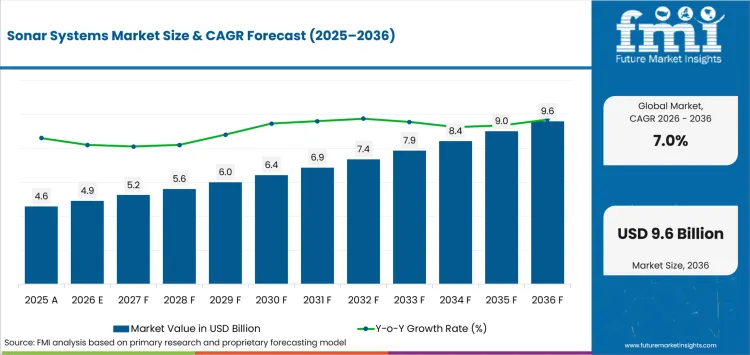
USD 4.9 billion in 2026 and USD 9.6 billion by 2036 at a 7.0% CAGR.
Sales of sonar systems are projected to expand from USD 4.9 billion in 2026 to USD 9.6 billion by 2036, growing at a CAGR of 7.0% through the forecast period. Growth is rooted in naval programs that connect underwater acoustic communication and marine electronics with arrays and processing, where sensor integration must be validated through sea trials before acceptance rather than assumed from spec sheets alone, a pattern reflected in Ultra Maritime's May 2026 report that River-class awards include dedicated sea-trial and acceptance support. Multinational shipbuilding programs are adding complexity to this qualification work, since shared hull designs increasingly carry different sensors and different acceptance routes depending on the operating nation, as seen in the Royal Navy's April 2026 disclosure that four nations plan 34 Global Combat Ships fitted with different combat systems on a common platform. Commercial vessels are following a parallel path, aligning echo sounders and marine radar ahead of trials in ways that are shifting qualification demand toward integrated testing rather than component level sign off.
Restraints include the cost and schedule risk of coordinating sea trials across multiple sensor suites and the difficulty of standardizing acceptance criteria when combat systems vary by nation. Opportunity lies in modular sonar architectures and integrated test platforms that can validate multiple sensor configurations against a shared hull baseline. Segment level activity spans array hardware, signal processing systems, and integration or acceptance testing services. Regionally, North America and Europe lead on active naval procurement, while Asia Pacific adoption tracks fleet modernization programs.
Key Takeaways of Sonar Systems Market
- Naval modernization and commercial survey programs require integrated acoustic sensing across defined platform and water conditions.
- Hull-mounted systems are projected to represent 51.0% share in 2026 as continuous shipboard availability supports routine detection.
- Defense applications are estimated at 66.0% share in 2026 owing to anti-submarine and mine-countermeasure requirements.
- Ship-type platforms are forecast at 64.0% share in 2026 because vessels carry the principal organic acoustic suite.
- Water-column variation and vessel self-noise extend calibration during installation and delay operational acceptance on each platform.
- Kongsberg Gruppen ASA, Thales Group, L3Harris Technologies, Inc., Teledyne Technologies Incorporated, Ultra Maritime, TKMS ATLAS ELEKTRONIK GmbH, Furuno Electric Co., Ltd. and Kraken Robotics Inc. form the profiled company set.
Analyst Perspective
"Sonar offers should be compared on platform evidence and local acoustic conditions rather than headline range. Commercial value comes from controlling interfaces, proving results during sea trials and accepting responsibility for readiness after upgrades."
- Nikhil Kaitwade, Principal Consultant, Future Market Insights
How is the Sonar Systems Market segmented?
The sonar systems market is segmented by product type, application, platform, solution, end user and region.
The sonar systems market is segmented by product type, application, platform, solution, end user and region. Product types cover hull-mounted, stern-mounted, sonobuoy and deployable directional systems while applications separate defense from commercial use. Platforms include ships, aircraft and unmanned underwater vehicles. Solutions separate hardware from software and line-fit installations from retrofits.
Why does defense lead demand within the application category?
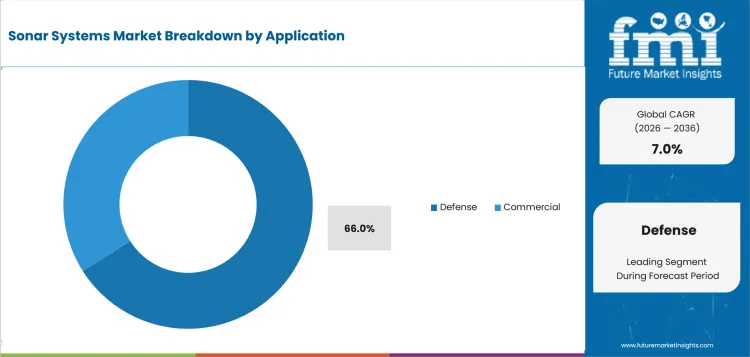
Defense applications require detection and tracking under operational rules that commercial survey systems do not face. Australia completed factory acceptance testing for Hunter-class Sonar 2087 handling equipment in November 2025, which verified deployment machinery ahead of later ship integration.
- By application, defense is estimated to hold 66.0% in 2026 owing to fleet-level detection, classification and torpedo-warning requirements.
- Naval acceptance depends on representative trials across the array and combat system. Maritime satellite communication coordinates units above water but cannot replace underwater acoustic evidence on the platform.
Why do hull-mounted systems lead demand within the product type category?
Hull-mounted sonar gives surface ships continuous sensing without deploying a separate body during routine operations. Canada's June 2026 River-class fact sheet pairs S2150 hull sonar with S2087 towed sonar across fifteen destroyers. The fixed array supports routine coverage, and the towed system extends low-frequency search.
- The product type category is forecast to be led by hull-mounted systems at 51.0% share in 2026 due to continuous availability during routine vessel operations.
- New-build teams reserve hull penetrations and cabling during design, whereas retrofit work across marine vessels requires fresh noise surveys to repeat expected detection performance.
Why do ship-type platforms lead the platform category?
Surface ships and submarines support larger arrays with sustained power, dedicated consoles and controlled cooling. The Royal Navy named HMS Glasgow in May 2025 as the first of eight Type 26 frigates, whose design reserves sensor space and interfaces during initial platform construction.
- In 2026, ship-type platforms are expected to lead the platform category with 64.0% share because vessels carry the principal organic sonar suite.
- Unmanned surface vehicles and aircraft distribute sensors beyond the host vessel, although common track formats determine whether remote contacts enter one shipborne operational picture.
Why does hardware lead demand within the solution category?
Hardware determines acoustic aperture and transmitted power, and software then interprets returned energy.
- By solution, hardware is forecast to represent 78.0% in 2026 driven by installed arrays, power electronics, receivers and operator displays.
- Software upgrades improve classification without replacing every array element, and Marine electronics testing verifies interfaces so failures do not increase sea-trial rework or delay platform acceptance.
What are the drivers, restraints and opportunities in the Sonar Systems Market?
Fleet modernization supports integrated sonar demand while acoustic variability extends qualification and distributed sensing widens coverage.
- Driver: New naval platforms combine hull-mounted, towed and airborne sensors within one combat-system architecture.
- Restraint: Water conditions and vessel self-noise require installation-specific calibration that lengthens operational acceptance for each vessel.
- Opportunity: Distributed sonobuoys and uncrewed platforms widen coverage as common processing preserves track continuity across the force.
New Platforms Expand Integrated Acoustic Requirements
Germany received the first of eight P-8A Poseidon aircraft in November 2025 for maritime surveillance and anti-submarine warfare. Airborne sensors must exchange tracks with shipboard sonar so fleets can use one operational picture.
Operating Conditions Extend Qualification Work
Temperature, salinity and depth alter sound propagation between a target and an array. NCEI archived thirteen underwater acoustic parameters from World Ocean Atlas 2023 data in March 2024, requiring local recalibration for each operating area.
Distributed Sensors Create Wider Coverage Routes
The USA Department of Defense funded multistatic sonobuoy localization and continuous active sonar work in June 2025 through July 2030. Distributed sensors widen search coverage, but revenue depends on processing that connects unmanned marine vehicles with crewed platforms.
Which country CAGRs are profiled in the Sonar Systems Market?
| Country | CAGR |
|---|---|
| South Korea | 7.5% |
| Canada | 6.9% |
| United States | 6.8% |
| Germany | 6.7% |
| Australia | 6.7% |
How do country-level CAGRs compare in the Sonar Systems Market?
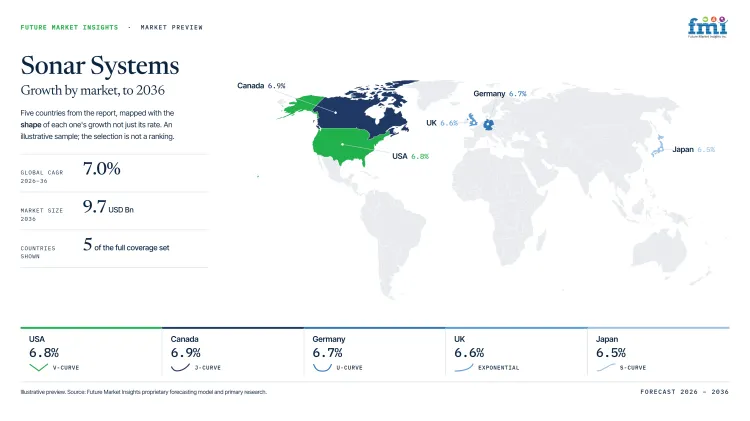
The country comparison spans 0.8 percentage points and reveals three distinct growth groups across the sonar systems market. South Korea leads at 7.5%, followed by Canada and the United States at 6.9% and 6.8%, while Germany and Australia form the lower group at 6.7%.
- South Korea leads the comparison at a 7.5% CAGR through 2036, supported by naval modernization, maritime surveillance requirements and continued investment in advanced sensing systems.
- Canada follows at a 6.9% CAGR, remaining 0.6 percentage points below South Korea. Naval procurement, offshore activities and maritime monitoring requirements support steady sonar systems demand.
- The United States records a 6.8% CAGR, 0.1 percentage points below Canada. Defense modernization, underwater surveillance and advanced naval platforms provide a stable base for market expansion.
- Germany grows at a 6.7% CAGR, remaining 0.1 percentage points below the United States. Naval upgrades, maritime security requirements and advanced engineering capabilities support continued sonar systems adoption.
- Australia records a 6.7% CAGR, matching Germany and remaining 0.8 percentage points below South Korea. Maritime surveillance, naval modernization and offshore operations support sustained demand.
Comparable CAGRs can still produce different market-entry conditions. Differences in defense spending, naval modernization programs, maritime security priorities, offshore activity and technology requirements influence sonar systems demand across countries. The full report provides country-level CAGR analysis across major regions and individual markets within the sonar systems market.
Country-wise Analysis
- South Korea links submarine construction with research on acoustic processing, and sonar adoption is estimated to expand at 7.5% CAGR through 2036. DAPA's April 2025 seminar brought together 200 participants. Domestic engineering aligns sensors with national hull designs, but export security review and destination-specific integration delay repeat orders.
- Canada is integrating sonar within a fifteen-ship River-class program. The Canadian sonar systems sector is projected to record 6.9% CAGR during the assessment period, supported by a March 2025 contract for three destroyers. Local construction expands sustainment work, but design changes can shift testing and revenue timing.
- The United States combines long naval production runs with classified combat-system integration. Sonar systems demand is predicted to advance at 6.8% CAGR through 2036, reinforced by a January 2025 engineering contract extending toward December 2029. Established laboratories sustain repeat development orders, but security clearances and domestic sourcing requirements limit entry.
- Germany combines submarine engineering with maritime patrol modernization and autonomous underwater testing. Germany is estimated to post 6.7% CAGR over the forecast period, supported by TKMS's February 2026 BlueWhale handover for acoustic intelligence and mine detection. Domestic expertise supports integration, but naval acceptance and NATO interoperability requirements lengthen qualification.
- Australia is building Hunter-class frigates and coordinating Type 26 engineering with partner navies. Sonar systems sales in Australia are forecast to expand at 6.7% CAGR by 2036, aided by Global Combat Ship coordination reported in May 2025. Local engineering supports service, but long construction schedules defer revenue across acceptance stages.
Who are the notable companies in the Sonar Systems Market?
Kongsberg Gruppen ASA, Thales Group, L3Harris Technologies, Inc., Teledyne Technologies Incorporated, Ultra Maritime, TKMS ATLAS ELEKTRONIK GmbH, Furuno Electric Co., Ltd. and Kraken Robotics Inc. are the notable companies serving this market.
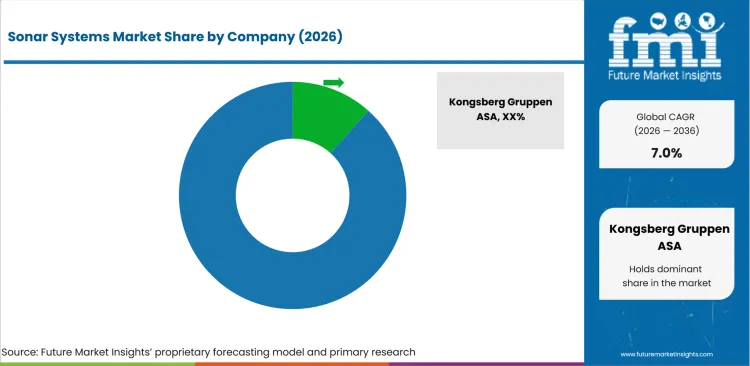
The competitive field combines naval integrators with acoustic specialists. Naval tenders compare qualification history, platform integration and lifecycle support. Commercial systems face lower security barriers but require dependable interfaces and broad service coverage. Entry remains difficult without installed references or compatible sonar-absorbing materials.
- Kongsberg Gruppen ASA, Thales Group and L3Harris Technologies, Inc. combine broad naval sonar portfolios with platform integration.
- Ultra Maritime and TKMS ATLAS ELEKTRONIK GmbH concentrate on arrays, sonobuoys, mine warfare and undersea integration.
- Teledyne Technologies, Furuno Electric and Kraken Robotics address survey, fisheries, positioning and autonomous underwater sensing.
Competitive Benchmarking: Sonar Systems Market
| Company | Naval Sonar Breadth | Commercial and Survey Coverage | Platform Integration | Geographic Reach |
|---|---|---|---|---|
| Kongsberg Gruppen ASA | High | High | High | Global |
| Thales Group | High | Medium | High | Global |
| L3Harris Technologies, Inc. | High | Low | High | North America and allied markets |
| Teledyne Technologies Incorporated | Medium | High | High | Global |
| Ultra Maritime | High | Low | High | Five Eyes and allied markets |
| TKMS ATLAS ELEKTRONIK GmbH | High | Low | High | Europe and global naval programs |
| Furuno Electric Co., Ltd. | Low | High | Medium | Global |
| Kraken Robotics Inc. (including Sonardyne International Ltd.) |
Medium | High | High | Global |
Key Developments in the Sonar Systems Market
- In June 2026, Ultra Maritime completed the first in-water deployment of its multistatic active receive sonobuoy in Scotland, advancing qualification under representative maritime conditions.
- In April 2026, L3Harris Technologies, Inc. secured USA Navy awards continuing TB-29C and TB-34A towed-array production through 2029, protecting manufacturing continuity.
- In August 2025, Thales Group and HII completed sea trials combining SAMDIS 600 sonar with a REMUS 620 vehicle, establishing an autonomous mine-detection route.
Key Players in the Sonar Systems Market
Integrated Naval Sonar Providers
- Kongsberg Gruppen ASA
- Thales Group
- L3Harris Technologies, Inc.
Undersea Warfare System Specialists
- Ultra Maritime
- TKMS ATLAS ELEKTRONIK GmbH
Commercial and Subsea Acoustic Specialists
- Teledyne Technologies Incorporated
- Furuno Electric Co., Ltd.
- Kraken Robotics Inc. (including Sonardyne International Ltd.)
Sonar Systems Market - Report Scope
| Coverage field | Report scope |
|---|---|
| Market breakdown | By product type, application, platform, solution, end user and region. |
| Quantitative Units | Revenue in USD billion and CAGR in %. |
| Market Definition | Active and passive sonar hardware, processing software and integration services for naval, commercial, airborne and underwater platforms. |
| Regions Covered | North America, Latin America, Western Europe, Eastern Europe, East Asia, South Asia and Pacific, and Middle East and Africa. |
| Countries Covered | South Korea, Canada, United States, Germany, Australia, and 20+ countries in the full report. |
| Key Companies Profiled | Kongsberg Gruppen ASA, Thales Group, L3Harris Technologies, Inc., Teledyne Technologies Incorporated, Ultra Maritime, TKMS ATLAS ELEKTRONIK GmbH, Furuno Electric Co., Ltd., and Kraken Robotics Inc. |
| Forecast Period | 2026 to 2036. |
| Approach | Primary and secondary research with market triangulation. |
Sonar Systems Market - Research Methodology
| Method | Approach |
|---|---|
| Primary Research | FMI analysts gathered input from manufacturers, service providers, technology developers, distributors, end users, procurement teams, and subject-matter experts. Interviews examined purchasing decisions, product or service evaluation, adoption barriers, approval requirements, pricing considerations, and expectations for technical or commercial support. Respondents were also asked what evidence is required before a trial, pilot, or initial order develops into regular purchasing. |
| Desk Research | Desk research covered government statistics, regulatory publications, trade data, industry associations, technical literature, standards, company filings, product information, and official corporate announcements. Sources were reviewed for relevance, publication date, geographic coverage, and consistency with the defined market scope. Claims relating to performance, applications, approvals, capacity, investment, and commercial activity were retained only when supported by credible public evidence. |
| Market Sizing and Forecasting | The market model combined the baseline value with historical performance, segment structure, pricing and volume indicators, adoption levels, company participation, and country-level demand conditions. Forecast assumptions considered economic activity, investment trends, regulatory developments, technology adoption, purchasing cycles, supply availability, and barriers to wider market use. Segment and regional estimates were reconciled before the final market total was calculated. |
| Data Validation | Estimates were checked against multiple independent indicators, including public data, company activity, trade patterns, industry developments, and findings from primary interviews. Validation also tested whether products, services, applications, and company revenues fell within the defined market boundaries. Adjacent categories, unsupported claims, overlapping revenues, and activities without direct market relevance were excluded to reduce double counting and maintain consistency across segments and countries. |
Sonar Systems Market by Segments
Sonar Systems Market segmented by Product Type:
- Hull-Mounted
- Active Hull-Mounted Sonar
- Passive Hull-Mounted Sonar
- Stern-Mounted
- Stern-Mounted Active Sonar
- Stern-Mounted Passive Sonar
- Sonobuoy
- Active Sonobuoys
- Passive Sonobuoys
- Deployable Directional Sonar (DDS)
- Active DDS
- Passive DDS
Sonar Systems Market segmented by Application:
- Defense
- Anti-Submarine Warfare
- Mine Detection & Countermeasures
- Commercial
- Fisheries & Fish Finding
- Seabed Mapping & Marine Survey
Sonar Systems Market segmented by Platform:
- Ship Type
- Surface Ships
- Submarines
- Airborne
- Maritime Patrol Aircraft
- Helicopters
- Unmanned Underwater Vehicles
- Autonomous Underwater Vehicles
- Remotely Operated Vehicles
Sonar Systems Market segmented by Solution:
- Hardware
- Transmitters & Receivers
- Sensors & Displays
- Software
- Sonar Signal Processing Software
- Analysis & Target Recognition Software
Sonar Systems Market segmented by End User:
- Line Fit
- New Naval Platforms
- New Commercial Vessels
- Retrofit
- Existing Naval Platforms
- Existing Commercial Vessels
Sonar Systems Market by Region:
- North America
- United States
- Canada
- Mexico
- Latin America
- Brazil
- Chile
- Rest of Latin America
- Western Europe
- Germany
- United Kingdom
- Italy
- Spain
- France
- Nordics
- Benelux
- Rest of Western Europe
- Eastern Europe
- Russia
- Poland
- Hungary
- Balkan and Baltic States
- Rest of Eastern Europe
- East Asia
- China
- Japan
- South Korea
- South Asia and Pacific
- India
- ASEAN
- Australia and New Zealand
- Rest of South Asia and Pacific
- Middle East and Africa
- Kingdom of Saudi Arabia
- Other GCC Countries
- Türkiye
- South Africa
- Other African Union Countries
- Rest of Middle East and Africa
Research Sources and Bibliography
- Ultra Maritime. (2026, May 27). Ultra Maritime deepens commitment to Royal Canadian Navy with River-class lifecycle support.
- Royal Navy. (2026, April 27). Future frigate programme bolstered as Norway joins UK, Canada and Australia.
- Government of Canada. (2026, June 1). River-Class Destroyer Fact Sheet.
- Australian Department of Defence. (2025, November 20). Hunter hits milestone on sonar suite.
- Royal Navy. (2025, May 22). Royal blessing for new frigate as HRH The Princess of Wales names HMS Glasgow.
- USA Department of Defense. (2024, December 18). Contracts for Dec. 18, 2024.
- Bundeswehr. (2025, November 7). P-8A Poseidon: Erster neuer Seefernaufklärer in Deutschland gelandet.
- National Centers for Environmental Information. (2024). Global climatology of 13 underwater acoustic parameters derived from WOA-2023.
- USA Department of Defense. (2025, June 17). Contracts for Jun. 17, 2025.
- Defense Acquisition Program Administration. (2025, April 24).
- National Defence. (2025, March 8). Government of Canada announces contract award for the construction of the River-class destroyers for the Royal Canadian Navy.
- USA Department of Defense. (2025, January 24). Contracts for Jan. 24, 2025.
- TKMS. (2026, February 25). Autonomous underwater vehicle BlueWhale handed over to German Navy.
- Australian Department of Defence. (2025, May 8). Navy strengthens Global Combat Ship links.
- Ultra Maritime. (2026, June 10). Ultra Maritime Successfully Completes First Deployment of Next Generation Multistatic Active Receive Sonobuoy in the UK.
- L3Harris Technologies. (2026, April 16). Maintaining America's Undersea Edge: L3Harris Secures Towed Array Production Through 2029.
- Thales Group. (2025, September 9). DSEI 2025: Thales and HII partner to develop autonomous underwater mine warfare capabilities.
The bibliography accompanies the sonar systems analysis and research for the full market report.
This Report Answers
- How large is the sonar systems market in 2026 and 2036?
- Which operating conditions support recurring sonar demand?
- Why do hull-mounted systems account for 51.0% in 2026?
- How do defense requirements shape sonar qualification decisions?
- Why do ship-type platforms retain the largest platform share?
- How do country growth rates reflect different integration routes?
- Which companies cover naval and commercial acoustic applications?
- What limits deployment across water conditions and platform interfaces?
Frequently Asked Questions
How big is the Sonar Systems Market in 2026?
The Sonar Systems Market is estimated at USD 4.9 billion in 2026 and is projected to reach USD 9.6 billion by 2036. Naval fleet programs and commercial survey requirements support expansion as platform integration and acoustic qualification control order timing.
What is the CAGR of the Sonar Systems Market from 2026 to 2036?
The Sonar Systems Market is projected to expand at 7.0% CAGR between 2026 and 2036. New vessels, retrofit programs and distributed sensors support demand, although installation-specific trials determine whether equipment progresses from delivery to operational acceptance across national fleets worldwide.
Which product type segment leads the Sonar Systems Market?
Hull-mounted systems are estimated to account for 51.0% of the Sonar Systems Market product type category in 2026. Their continuous availability and direct connection with shipboard processing support routine detection without deploying a separate acoustic body during routine patrol missions.
How much will the Sonar Systems Market add between 2026 and 2036?
The Sonar Systems Market is calculated to add USD 4.78 billion between 2026 and 2036. New-platform integration and selected retrofits contribute to the increase, and each program follows different construction, interface and sea-trial schedules across fleets and delivery stages worldwide.
Which companies are active in the Sonar Systems Market?
Key players in the sonar systems market register across naval, survey and fisheries applications. Kongsberg, Thales, L3Harris, Teledyne, Ultra Maritime, TKMS ATLAS ELEKTRONIK, Furuno and Kraken Robotics cover arrays, processing, platform integration and support across global and allied programs.
Preview the report firsthand - request a free sample
Get SampleGet the brochure for pricing and purchase details.
Get PDFTable of Content
- Key Takeaways
- Market Size and CAGR
- Top Growth Driver
- Fastest Growing Segment
- Leading Region
- Key Companies
- Emerging Opportunities
- Executive Summary
- Global Market Outlook
- Demand-side Trends
- Supply-side Trends
- Technology Roadmap Analysis
- Analysis and Recommendations
- Analyst Perspective (What is happening? Why now? What should investors know?)
- Key Questions Answered
- How large is the market?
- What is the CAGR?
- What are key trends?
- Which region dominates?
- Who are the leaders?
- Market Overview
- Market Coverage / Taxonomy
- Market Definition / Scope / Limitations
- Research Methodology
- Chapter Orientation
- Analytical Lens and Working Hypotheses
- Market Structure, Signals, and Trend Drivers
- Benchmarking and Cross-market Comparability
- Market Sizing, Forecasting, and Opportunity Mapping
- Research Design and Evidence Framework
- Desk Research Programme (Secondary Evidence)
- Expert Input and Fieldwork (Primary Evidence)
- Tooling, Models, and Reference Databases
- Data Engineering and Model Build
- Quality Assurance and Audit Trail
- Market Background
- Market Dynamics (Drivers, Restraints, Opportunity, Trends)
- Scenario Forecast (Optimistic, Likely, Conservative)
- Impact Analysis
- AI Impact
- Sustainability Impact
- Regulatory Impact
- Technology Impact
- Consumer / Buyer Analysis
- Purchase Drivers
- Adoption Barriers
- Buyer Journey
- Opportunity Map Analysis
- Product Life Cycle Analysis
- Supply Chain Analysis
- Investment Feasibility Matrix
- Value Chain Analysis
- PESTLE and Porter's Analysis
- Regulatory Landscape
- Regional Parent Market Outlook
- Production and Consumption Statistics
- Import and Export Statistics
- Global Market Analysis and Forecast, 2021 to 2036
- Historical Market Size Value (USD Billion) Analysis, 2021 to 2025
- Current and Future Market Size Value (USD Billion) Projections, 2026 to 2036
- Y-o-Y Growth Trend Analysis
- Absolute $ Opportunity Analysis
- Global Market Pricing Analysis, 2021 to 2036
- Global Market Analysis and Forecast, By Product Type, 2021 to 2036
- Introduction / Key Findings
- Historical Market Size Value (USD Billion) Analysis By Product Type, 2021 to 2025
- Current and Future Market Size Value (USD Billion) Analysis and Forecast By Product Type, 2026 to 2036
- Hull-Mounted
- Active Hull-Mounted Sonar
- Passive Hull-Mounted Sonar
- Stern-Mounted
- Stern-Mounted Active Sonar
- Stern-Mounted Passive Sonar
- Sonobuoy
- Active Sonobuoys
- Passive Sonobuoys
- Deployable Directional Sonar (DDS)
- Active DDS
- Passive DDS
- Hull-Mounted
- Y-o-Y Growth Trend Analysis By Product Type, 2021 to 2025
- Absolute $ Opportunity Analysis By Product Type, 2026 to 2036
- Global Market Analysis and Forecast, By Application, 2021 to 2036
- Introduction / Key Findings
- Historical Market Size Value (USD Billion) Analysis By Application, 2021 to 2025
- Current and Future Market Size Value (USD Billion) Analysis and Forecast By Application, 2026 to 2036
- Defense
- Anti-Submarine Warfare
- Mine Detection & Countermeasures
- Commercial
- Fisheries & Fish Finding
- Seabed Mapping & Marine Survey
- Defense
- Y-o-Y Growth Trend Analysis By Application, 2021 to 2025
- Absolute $ Opportunity Analysis By Application, 2026 to 2036
- Global Market Analysis and Forecast, By Platform, 2021 to 2036
- Introduction / Key Findings
- Historical Market Size Value (USD Billion) Analysis By Platform, 2021 to 2025
- Current and Future Market Size Value (USD Billion) Analysis and Forecast By Platform, 2026 to 2036
- Ship Type
- Surface Ships
- Submarines
- Airborne
- Maritime Patrol Aircraft
- Helicopters
- Unmanned Underwater Vehicles
- Autonomous Underwater Vehicles
- Remotely Operated Vehicles
- Ship Type
- Y-o-Y Growth Trend Analysis By Platform, 2021 to 2025
- Absolute $ Opportunity Analysis By Platform, 2026 to 2036
- Global Market Analysis and Forecast, By Solution, 2021 to 2036
- Introduction / Key Findings
- Historical Market Size Value (USD Billion) Analysis By Solution, 2021 to 2025
- Current and Future Market Size Value (USD Billion) Analysis and Forecast By Solution, 2026 to 2036
- Hardware
- Transmitters & Receivers
- Sensors & Displays
- Software
- Sonar Signal Processing Software
- Analysis & Target Recognition Software
- Hardware
- Y-o-Y Growth Trend Analysis By Solution, 2021 to 2025
- Absolute $ Opportunity Analysis By Solution, 2026 to 2036
- Global Market Analysis and Forecast, By End User, 2021 to 2036
- Introduction / Key Findings
- Historical Market Size Value (USD Billion) Analysis By End User, 2021 to 2025
- Current and Future Market Size Value (USD Billion) Analysis and Forecast By End User, 2026 to 2036
- Line Fit
- New Naval Platforms
- New Commercial Vessels
- Retrofit
- Existing Naval Platforms
- Existing Commercial Vessels
- Line Fit
- Y-o-Y Growth Trend Analysis By End User, 2021 to 2025
- Absolute $ Opportunity Analysis By End User, 2026 to 2036
- Global Market Analysis and Forecast, By Region, 2021 to 2036
- Introduction
- Historical Market Size Value (USD Billion) Analysis By Region, 2021 to 2025
- Current Market Size Value (USD Billion) Analysis and Forecast By Region, 2026 to 2036
- North America
- Latin America
- Western Europe
- Eastern Europe
- East Asia
- South Asia and Pacific
- Middle East & Africa
- Market Attractiveness Analysis By Region
- North America Market Analysis and Forecast, By Country, 2021 to 2036
- Historical Market Size Value (USD Billion) Trend Analysis By Market Taxonomy, 2021 to 2025
- Market Size Value (USD Billion) Forecast By Market Taxonomy, 2026 to 2036
- By Country
- USA
- Canada
- By Product Type
- By Application
- By Platform
- By Solution
- By End User
- By Country
- Market Attractiveness Analysis
- By Country
- By Product Type
- By Application
- By Platform
- By Solution
- By End User
- Key Takeaways
- Latin America Market Analysis and Forecast, By Country
- Historical Market Size Value (USD Billion) Trend Analysis By Market Taxonomy, 2021 to 2025
- Market Size Value (USD Billion) Forecast By Market Taxonomy, 2026 to 2036
- By Country
- Brazil
- Mexico
- Chile
- Rest of Latin America
- By Product Type
- By Application
- By Platform
- By Solution
- By End User
- By Country
- Market Attractiveness Analysis
- By Country
- By Product Type
- By Application
- By Platform
- By Solution
- By End User
- Key Takeaways
- Western Europe Market Analysis and Forecast, By Country
- Historical Market Size Value (USD Billion) Trend Analysis By Market Taxonomy, 2021 to 2025
- Market Size Value (USD Billion) Forecast By Market Taxonomy, 2026 to 2036
- By Country
- Germany
- UK
- Italy
- Spain
- France
- Nordic
- BENELUX
- Rest of Western Europe
- By Product Type
- By Application
- By Platform
- By Solution
- By End User
- By Country
- Market Attractiveness Analysis
- By Country
- By Product Type
- By Application
- By Platform
- By Solution
- By End User
- Key Takeaways
- Eastern Europe Market Analysis and Forecast, By Country
- Historical Market Size Value (USD Billion) Trend Analysis By Market Taxonomy, 2021 to 2025
- Market Size Value (USD Billion) Forecast By Market Taxonomy, 2026 to 2036
- By Country
- Russia
- Poland
- Hungary
- Balkan & Baltic
- Rest of Eastern Europe
- By Product Type
- By Application
- By Platform
- By Solution
- By End User
- By Country
- Market Attractiveness Analysis
- By Country
- By Product Type
- By Application
- By Platform
- By Solution
- By End User
- Key Takeaways
- East Asia Market Analysis and Forecast, By Country
- Historical Market Size Value (USD Billion) Trend Analysis By Market Taxonomy, 2021 to 2025
- Market Size Value (USD Billion) Forecast By Market Taxonomy, 2026 to 2036
- By Country
- China
- Japan
- South Korea
- By Product Type
- By Application
- By Platform
- By Solution
- By End User
- By Country
- Market Attractiveness Analysis
- By Country
- By Product Type
- By Application
- By Platform
- By Solution
- By End User
- Key Takeaways
- South Asia and Pacific Market Analysis and Forecast, By Country
- Historical Market Size Value (USD Billion) Trend Analysis By Market Taxonomy, 2021 to 2025
- Market Size Value (USD Billion) Forecast By Market Taxonomy, 2026 to 2036
- By Country
- India
- ASEAN
- Australia & New Zealand
- Rest of South Asia and Pacific
- By Product Type
- By Application
- By Platform
- By Solution
- By End User
- By Country
- Market Attractiveness Analysis
- By Country
- By Product Type
- By Application
- By Platform
- By Solution
- By End User
- Key Takeaways
- Middle East & Africa Market Analysis and Forecast, By Country
- Historical Market Size Value (USD Billion) Trend Analysis By Market Taxonomy, 2021 to 2025
- Market Size Value (USD Billion) Forecast By Market Taxonomy, 2026 to 2036
- By Country
- Kingdom of Saudi Arabia
- Other GCC Countries
- Türkiye
- South Africa
- Other African Union
- Rest of Middle East & Africa
- By Product Type
- By Application
- By Platform
- By Solution
- By End User
- By Country
- Market Attractiveness Analysis
- By Country
- By Product Type
- By Application
- By Platform
- By Solution
- By End User
- Key Takeaways
- Key Countries Market Analysis
- USA
- Pricing Analysis
- Market Share Analysis, 2025
- By Product Type
- By Application
- By Platform
- By Solution
- By End User
- Canada
- Pricing Analysis
- Market Share Analysis, 2025
- By Product Type
- By Application
- By Platform
- By Solution
- By End User
- Mexico
- Pricing Analysis
- Market Share Analysis, 2025
- By Product Type
- By Application
- By Platform
- By Solution
- By End User
- Brazil
- Pricing Analysis
- Market Share Analysis, 2025
- By Product Type
- By Application
- By Platform
- By Solution
- By End User
- Chile
- Pricing Analysis
- Market Share Analysis, 2025
- By Product Type
- By Application
- By Platform
- By Solution
- By End User
- Germany
- Pricing Analysis
- Market Share Analysis, 2025
- By Product Type
- By Application
- By Platform
- By Solution
- By End User
- UK
- Pricing Analysis
- Market Share Analysis, 2025
- By Product Type
- By Application
- By Platform
- By Solution
- By End User
- Italy
- Pricing Analysis
- Market Share Analysis, 2025
- By Product Type
- By Application
- By Platform
- By Solution
- By End User
- Spain
- Pricing Analysis
- Market Share Analysis, 2025
- By Product Type
- By Application
- By Platform
- By Solution
- By End User
- France
- Pricing Analysis
- Market Share Analysis, 2025
- By Product Type
- By Application
- By Platform
- By Solution
- By End User
- India
- Pricing Analysis
- Market Share Analysis, 2025
- By Product Type
- By Application
- By Platform
- By Solution
- By End User
- ASEAN
- Pricing Analysis
- Market Share Analysis, 2025
- By Product Type
- By Application
- By Platform
- By Solution
- By End User
- Australia & New Zealand
- Pricing Analysis
- Market Share Analysis, 2025
- By Product Type
- By Application
- By Platform
- By Solution
- By End User
- China
- Pricing Analysis
- Market Share Analysis, 2025
- By Product Type
- By Application
- By Platform
- By Solution
- By End User
- Japan
- Pricing Analysis
- Market Share Analysis, 2025
- By Product Type
- By Application
- By Platform
- By Solution
- By End User
- South Korea
- Pricing Analysis
- Market Share Analysis, 2025
- By Product Type
- By Application
- By Platform
- By Solution
- By End User
- Russia
- Pricing Analysis
- Market Share Analysis, 2025
- By Product Type
- By Application
- By Platform
- By Solution
- By End User
- Poland
- Pricing Analysis
- Market Share Analysis, 2025
- By Product Type
- By Application
- By Platform
- By Solution
- By End User
- Hungary
- Pricing Analysis
- Market Share Analysis, 2025
- By Product Type
- By Application
- By Platform
- By Solution
- By End User
- Kingdom of Saudi Arabia
- Pricing Analysis
- Market Share Analysis, 2025
- By Product Type
- By Application
- By Platform
- By Solution
- By End User
- Türkiye
- Pricing Analysis
- Market Share Analysis, 2025
- By Product Type
- By Application
- By Platform
- By Solution
- By End User
- South Africa
- Pricing Analysis
- Market Share Analysis, 2025
- By Product Type
- By Application
- By Platform
- By Solution
- By End User
- USA
- Market Structure Analysis
- Competition Dashboard
- Competition Benchmarking
- Market Share Analysis of Top Players
- By Regional
- By Product Type
- By Application
- By Platform
- By Solution
- By End User
- Emerging Startups
- Innovation Benchmarking
- Competition Analysis
- Competition Deep Dive
- Kongsberg Gruppen ASA
- Overview
- Product Portfolio
- Profitability by Market Segments
- Sales Footprint
- Strategy Overview
- Marketing Strategy
- Product Strategy
- Channel Strategy
- Thales Group
- L3Harris Technologies, Inc.
- Teledyne Technologies Incorporated
- Lockheed Martin Corporation
- Ultra Electronics Holdings plc
- Atlas Elektronik GmbH
- Furuno Electric Co., Ltd.
- General Dynamics Mission Systems
- Sonardyne International Ltd.
- Others
- Kongsberg Gruppen ASA
- Case Studies
- Success Stories
- Recent Developments
- Competition Deep Dive
- Assumptions & Acronyms Used


