

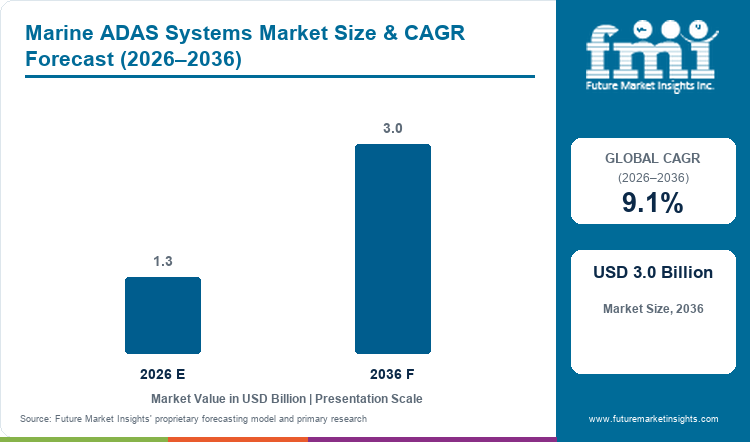
- Market Size (2026)
- USD 1.3 Bn
- Forecast (2036)
- USD 3.0 Bn
- CAGR (2026 to 2036)
- 9.1%
How big is Marine ADAS Systems Market in 2026?
USD 1.3 billion in 2026 and USD 3.0 billion by 2036 at a 9.1% CAGR.
Demand for marine ADAS systems is projected to expand at 9.1% CAGR between 2026 and 2036, increasing valuation from USD 1.3 billion to USD 3.0 billion. Vessel operators are moving from isolated alarms toward integrated marine electronics that identify hazards before a crew commits to a maneuver. The IMO adopted its MASS Code in May 2026 with dedicated requirements for navigation and alert management plus remote operations. Those requirements make it more important to prove how sensing and control functions behave under defined operating conditions.
Country demand differs according to navigation infrastructure and the approval route for assisted control. Norway will discontinue a 12-station DGPS correction service in January 2026 because modern receivers reduced its original positioning role. That change places more emphasis on resilient marine GNSS modules and independent sensor cross-checks during degraded positioning. Commercial autonomy programs require more formal verification than most recreational installations before a system enters service.
Key Takeaways
- Marine ADAS spending is supported by operators seeking earlier hazard recognition and more controlled maneuvering while keeping human crews responsible for navigation decisions.
- By system type, collision avoidance is projected to account for 29.0% in 2026 because crews need early warning before deciding whether to change course or speed.
- Camera-based systems are estimated to hold 22.0% of the sensor suite category in 2026 attributable to visual confirmation during close-quarters navigation.
- Recreational boats are anticipated to represent 32.0% of vessel type demand in 2026 due to a broad installed fleet and frequent docking use.
- Integration cost and validation effort can delay systems that take more control because vessel networks and control interfaces vary substantially between installed platforms.
- Some of the key players in this market include Garmin, Raymarine / Teledyne FLIR, Furuno, Navico Group, Kongsberg Maritime, Wärtsilä, Brunswick Corporation, Avikus / HD Hyundai, Sea Machines Robotics, and Orca AI.
Analyst Perspective
"Marine ADAS offers should be judged on how reliably they recognize hazards and return control to crews under real operating conditions. Commercial value increases when the same electronics work with existing vessel systems and can support more direct assistance later without requiring a complete bridge replacement."
- Nikhil Kaitwade, Principal Consultant, Future Market Insights
How is the marine ADAS systems market segmented?
The market is analyzed by system type, sensor suite, vessel type, autonomy level, sales channel, and region.
System type covers collision avoidance, docking assistance, situational awareness, autopilot assistance, and crew alerting systems for operator-facing functions. Sensor suite includes camera-based, radar-based, AIS-integrated, GNSS/IMU fused, and LiDAR-assisted configurations used to perceive vessel surroundings. Vessel type covers recreational boats, yachts, workboats, ferries, and patrol - rescue craft, while autonomy ranges from advisory only to remote monitored operation. Sales channels include navigation OEMs, boat OEMs, retrofit integrators, and marine electronics dealers that carry installation responsibility.
What makes collision avoidance central to the system type category?
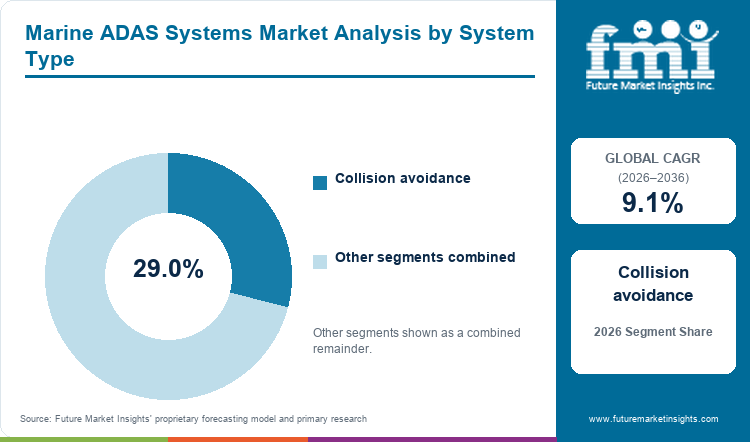
Collision avoidance turns target tracks into a course-or-speed decision before a close encounter becomes hazardous for the bridge team. Marine radar and AIS show relative motion while cameras confirm what the crew is seeing. These functions can work through existing helm electronics without requiring a separate automated propulsion-control system.
- By system type, collision avoidance is estimated to hold 29.0% in 2026 because the same hazard-warning function remains useful from advisory systems through assisted control.
- Garmin added AIS warning messages to selected chartplotters in April 2025 so third-party hazard broadcasts can appear beside collision alerts during navigation.
Why does camera-based sensing lead the sensor suite category?
Camera systems give crews visual context for small craft and dock geometry that radar or AIS may not identify clearly. Thermal or low-light imaging extends visibility in darkness while classification software helps autonomous marine navigation distinguish hazards that need attention.
- Camera-based sensing is forecast to represent 22.0% in 2026 attributable to direct visual confirmation during docking and close-quarters object recognition.
- Orca AI launched a 360-degree vessel awareness configuration in March 2026 using three RGB and thermal camera units to remove major line-of-sight gaps.
How do recreational boats shape the vessel type category?
Recreational boating owners repeatedly dock in confined water but usually want assistance that works with electronics already installed at the helm. Retrofit packages let owners add sensing and assistance to older boats without replacing factory control systems. Navigation OEMs can then offer upgrades through software and compatible sensors instead of requiring a complete helm replacement.
- Recreational boats are expected to account for 32.0% of vessel type demand in 2026 due to frequent close-quarters use and modular electronics upgrades.
- NMMA reported in October 2025 that registered and documented US boats totaled 11.8 million in 2024, confirming a substantial installed fleet for electronics replacement.
What supports advisory only within the autonomy level category?
Advisory systems improve navigation decisions without transferring throttle or steering authority from the operator during normal vessel operation. Keeping command with the operator reduces the number of control interfaces that need formal approval. It also lets crews build confidence before moving to marine steering systems that take a more active role.
- Advisory only is expected to account for 36.0% in 2026 because keeping the operator in command reduces the approval work required for direct vessel control.
- Simrad introduced AutoTrack in July 2025 to detect and prioritize moving radar targets so crews can review them during navigation.
What drives navigation OEMs in the sales channel category?
Navigation OEMs already supply the helm displays that bring radar and AIS targets together with position or video data. Software updates and compatible sensors let these companies extend assistance without forcing boat builders to redesign control systems or yacht systems owners to replace the helm.
- In 2026, navigation OEMs are expected to hold 34.0% of sales channel demand owing to control of the helm interface and installed electronics networks.
- Raymarine launched Axiom 2 in March 2026 on its LightHouse platform with chartplotter and radar functions plus autopilot video and high-speed networking support.
What are the drivers, restraints and opportunities in the Marine ADAS Systems Market?
Safety-driven hazard recognition supports spending, degraded positioning and vessel integration slow direct control, and modular assistance lets owners move from alerts toward assisted maneuvering.
- Driver: Bridge teams need earlier hazard recognition as navigation systems take on more alerting and decision-support functions.
- Restraint: Positioning interference and mixed vessel interfaces increase the evidence required before operators approve assisted control.
- Opportunity: Modular perception and advisory functions let owners test system behavior before they authorize direct steering or propulsion control.
New regulatory requirements make navigation assurance a direct engineering task as automation takes on more vessel functions. The IMO adopted the MASS Code in May 2026 with dedicated provisions for navigation and alert management plus remote operations. Suppliers therefore need marine IMU sensors and perception systems whose behavior can be tested and documented when a primary navigation input fails.
A weak or disrupted position signal can affect several bridge functions at the same time. Traficom recorded 392 vessels experiencing satellite-navigation interference in Finland by the end of August 2026 under its revised reporting method. Integrators need navigation satellite systems backed by radar or inertial references so crews can identify an unreliable position source before it affects decisions.
Retrofit opportunities improve when assistance works with existing vessel controls instead of requiring a full redesign. Sea Machines appointed Shintoa as its Japanese value-added reseller in April 2026 to sell and support autonomy products through a local service channel. The same positioning systems and perception modules can enter retrofit programs first and give owners operating evidence before they authorize direct control.
Which country CAGRs are profiled in the Marine ADAS Systems Market?
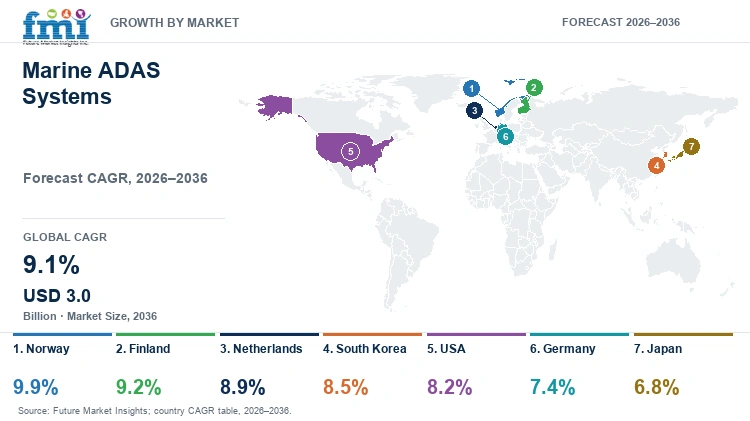
| Country | CAGR |
|---|---|
| Norway | 9.9% |
| Finland | 9.2% |
| Netherlands | 8.9% |
| South Korea | 8.5% |
| USA | 8.2% |
| Germany | 7.4% |
| Japan | 6.8% |
How do country-level CAGRs compare in the Marine ADAS Systems Market?
The CAGRs span 3.1 percentage points from Norway at 9.9% to Japan at 6.8%. Norway and Finland form the upper group because remote operation and navigation resilience are active commercial issues in both countries. The remaining markets depend more on automation programs or installed fleets and formal inspection routes.
- Norway offshore service fleets make remote supervision commercially relevant because vessels operate in demanding coastal waters with little tolerance for navigation failure.
- Finland baltic routes place unusual weight on radar and inertial cross-checks because satellite interference can disrupt several bridge functions at once.
- Netherland’s dense inland traffic gives automated maneuvering a practical labor case under national permissions for unmanned and remotely operated vessels.
- South Korea large shipyards can move verified navigation software from demonstration vessels into repeat newbuild specifications once testing requirements are satisfied.
- USA recreational fleet gives chartplotter and sensor upgrades a large aftermarket route separate from commercial autonomy programs.
- Germany public digital-waterway testbeds let developers evaluate automated control in real traffic before commercial operators approve wider deployment.
- Japan vessel-inspection route ties autonomous navigation to documented safety standards before operators can expand approved operating conditions.
Similar CAGRs can still lead to different buying conditions because vessel mix and approval routes vary by country. The full report covers North America, Latin America, Western Europe, Eastern Europe, East Asia, South Asia and Pacific, and Middle East and Africa.
Country-wise Analysis
- Norwegian coastal operators are adjusting to the loss of a legacy positioning aid while offshore service fleets continue using remote vessel control in demanding waters. Marine ADAS systems demand in Norway is forecast to rise at 9.9% CAGR over the forecast period, supported by resilient navigation and remote-operation requirements. The Norwegian Coastal Administration stated in November 2025 that its 12-station DGPS service would end on January 27 2026 because modern GNSS receivers reduced its original role. Radar and inertial cross-checks give working-vessel crews independent references when satellite positioning becomes unreliable near Norway. Retrofit downtime remains costly, so integrators must prove that new assistance works with the existing bridge before installation.
- Finnish merchant shipping faces persistent satellite-navigation interference that can degrade several connected bridge functions simultaneously. Adoption of marine ADAS systems in Finland is estimated to expand at 9.2% CAGR through 2036, driven by resilient situational awareness in the Gulf of Finland. Fintraffic reported in April 2026 that its vessel traffic centers prevented eight potential merchant-vessel groundings during 2025 while GNSS disruption remained high. National VTS coverage provides bridge teams with an independent navigation reference during disrupted positioning near Finnish fairways. Operators favor radar and inertial cross-checks over assistance that depends on one satellite-derived input during poor visibility or winter operations.
- Dutch inland shipping operates on waterways where automation can reduce crew workload once authorities accept defined operating conditions. The Netherlands marine ADAS systems sector is projected to record 8.9% CAGR during the assessment period, attributable to smart-shipping trials and clarified remote-operation rules. The Ministry of Infrastructure and Water Management reported that a 2025 regulatory exemption permits unmanned operation of small vessels up to 20 meters on many inland waterways. National permissions give developers a defined route for assisted-navigation trials within busy Dutch inland traffic. Insurance and liability remain material concerns because operators need clear evidence of who retains control before they accept wider automated maneuvering.
- South Korea pairs major shipbuilding capacity with a legal route for autonomous-ship testing and performance verification. In South Korea, marine ADAS systems demand is predicted to advance at 8.5% CAGR through 2036 due to shipyard integration and structured demonstration procedures. The Ministry of Oceans and Fisheries stated in January 2025 that the Autonomous Ships Act took effect with rules for performance verification and designated demonstration areas. Shipyards can carry verified navigation software into repeat newbuild programs without the retrofit constraints faced by existing vessels. Because regulatory exceptions depend on safety assessment, shipyards need documented perception and control performance before a demonstration system becomes part of regular vessel specifications.
- US recreational boating gives marine ADAS suppliers a large installed base that buys electronics through boat builders and dealer networks. Marine ADAS systems demand in the USA is forecast to rise at 8.2% CAGR over the forecast period, supported by collision-prevention use cases and modular helm upgrades. The US Coast Guard reported in June 2025 that 3,887 recreational boating incidents occurred during 2024 with collisions and groundings representing a substantial share. Dealer networks make aftermarket installation practical for electronics packages serving older vessels through local service channels. Systems that fit familiar chartplotters are easier for dealers to install than products requiring extensive propulsion changes.
- German maritime technology programs give navigation developers access to public test environments before commercial operators accept autonomous functions. Germany is estimated to post 7.4% CAGR over the forecast period, supported by digital-waterway programs and a domestic base of navigation and vessel-engineering companies. The Federal Ministry of Transport stated in June 2026 that its Digital Waterway Test Fields program had supported 17 projects under real operating conditions. Those projects let developers evaluate sensor fusion and automated avoidance with real traffic before commercial deployment. Baltic signal interference raises the validation burden because shipping companies need fallback-navigation evidence before they authorize systems that reach steering or propulsion.
- Japan is moving autonomous navigation from research into inspected vessel operation under a national safety standard. Marine ADAS systems sales in Japan are forecast to expand at 6.8% CAGR by 2036, supported by a defined inspection route for perception and collision-avoidance functions. MLIT announced in December 2025 that it issued Japan's first vessel inspection certificate for a ship carrying an autonomous navigation system under national safety standards. Domestic shipbuilders now have a clearer national approval target for qualifying autonomous navigation systems. Higher-autonomy functions still require detailed test records and explicit human oversight before inspectors or operators accept wider commercial use.
Who are the notable companies in the Marine ADAS Systems Market?
Garmin, Raymarine / Teledyne FLIR, Furuno, Navico Group, Kongsberg Maritime, Wärtsilä, Brunswick Corporation, Avikus / HD Hyundai, Sea Machines Robotics, and Orca AI are notable companies serving this market.
The competitive field divides between recreational helm electronics and commercial bridge automation or autonomous-control specialists serving different vessel classes. Garmin and Raymarine / Teledyne FLIR focus on helm electronics while Kongsberg Maritime and Wärtsilä supply integrated commercial navigation and automation systems. Avikus / HD Hyundai, Sea Machines Robotics, Orca AI, and Brunswick-owned Navico Group compete in autonomous control or AI-supported perception.
- Garmin, Raymarine / Teledyne FLIR, Furuno, and Navico Group compete through installed helm electronics with radar and sensor integration.
- Kongsberg Maritime and Wärtsilä serve commercial vessels with integrated navigation and automation plus remote-operation systems.
- Brunswick Corporation, Avikus / HD Hyundai, Sea Machines Robotics, and Orca AI compete in autonomous maneuvering and AI-based perception.
Competitive Benchmarking: Marine ADAS Systems Market
| Company | Multi-Sensor Perception | Assisted / Autonomous Control | OEM / Retrofit Integration | Geographic Reach |
|---|---|---|---|---|
| Garmin | High | Medium | High | Global |
| Raymarine / Teledyne FLIR | High | Medium | High | Global |
| Furuno | High | High | High | Global |
| Navico Group | High | High | High | Global |
| Kongsberg Maritime | High | High | High | Global |
| Wärtsilä | High | High | High | Global |
| Brunswick Corporation | High | High | High | North America and international |
| Avikus / HD Hyundai | Medium | High | High | Asia and international |
| Sea Machines Robotics | Medium | High | Medium | North America, Asia and Europe |
| Orca AI | High | Medium | Medium | Global commercial shipping |
Scoring basis: High perception breadth requires three verified sensing inputs compared with two for Medium and one for Low. High control depth includes direct maneuvering compared with advisory functions for Medium and alerts for Low. High integration covers factory and retrofit routes compared with one route for Medium and limited documented integration for Low.
Key Developments in the Marine ADAS Systems Market
- In April 2026, Orca AI and Samsung Heavy Industries signed an agreement to integrate Orca AI perception into autonomous-navigation systems for new vessel construction programs.
- In June 2025, Avikus received DNV Type Approval Design Certification for HiNAS Control covering decision support, collision avoidance, and navigation functions.
- In May 2025, Sea Machines Robotics supplied its SM300 autonomous command-and-control system for the US Marine Corps Autonomous Low-Profile Vessel program.
Key Players in the Marine ADAS Systems Market
Recreational Navigation and Helm Electronics
- Garmin
- Raymarine / Teledyne FLIR
- Furuno
- Navico Group
Integrated Commercial Navigation and Automation
- Kongsberg Maritime
- Wärtsilä
- Brunswick Corporation
Autonomous Navigation and AI Perception Specialists
- Avikus / HD Hyundai
- Sea Machines Robotics
- Orca AI
Marine ADAS Systems Market - Report Scope
| Coverage field | Report scope |
|---|---|
| Market breakdown | By system type, sensor suite, vessel type, autonomy level, sales channel, and region. |
| Quantitative Units | USD billion. |
| Market Definition | Revenue covers integrated marine assistance systems that use perception, navigation data, alerting, decision support, or assisted vessel control within the defined market boundary. |
| Regions Covered | North America, Latin America, Western Europe, Eastern Europe, East Asia, South Asia and Pacific, and Middle East and Africa. |
| Countries Covered | Norway, Finland, Netherlands, South Korea, USA, Germany, Japan, and more than 25 additional countries included in the full report. |
| Key Companies Profiled | Garmin, Raymarine / Teledyne FLIR, Furuno, Navico Group, Kongsberg Maritime, Wärtsilä, Brunswick Corporation, Avikus / HD Hyundai, Sea Machines Robotics, and Orca AI. |
| Forecast Period | 2026 to 2036. |
| Approach | Primary and secondary research checked against multiple market indicators. |
Marine ADAS Systems Market - Research Methodology
| Method | Approach |
|---|---|
| Primary Research | FMI analysts gathered input from manufacturers, service providers, technology developers, distributors, end users, procurement teams, and subject-matter experts. Interviews examined purchasing decisions, product or service evaluation, adoption barriers, approval requirements, pricing considerations, and expectations for technical or commercial support. Respondents were also asked what evidence is required before a trial, pilot, or initial order develops into regular purchasing. |
| Desk Research | Desk research covered government statistics, regulatory publications, trade data, industry associations, technical literature, standards, company filings, product information, and official corporate announcements. Sources were reviewed for relevance, publication date, geographic coverage, and consistency with the defined market scope. Claims relating to performance, applications, approvals, capacity, investment, and commercial activity were retained only when supported by credible public evidence. |
| Market Sizing and Forecasting | The market model combined the baseline value with historical performance, segment structure, pricing and volume indicators, adoption levels, company participation, and country-level demand conditions. Forecast assumptions considered economic activity, investment trends, regulatory developments, technology adoption, purchasing cycles, supply availability, and barriers to wider market use. Segment and regional estimates were reconciled before the final market total was calculated. |
| Data Validation | Estimates were checked against multiple independent indicators, including public data, company activity, trade patterns, industry developments, and findings from primary interviews. Validation also tested whether products, services, applications, and company revenues fell within the defined market boundaries. Adjacent categories, unsupported claims, overlapping revenues, and activities without direct market relevance were excluded to reduce double counting and maintain consistency across segments and countries. |
Marine ADAS Systems Market by Segments
Marine ADAS Systems Market segmented by System Type:
- Collision avoidance
- Docking assistance
- Situational awareness
- Autopilot assistance
- Crew alerting systems
Marine ADAS Systems Market segmented by Sensor Suite:
- Camera-based
- Radar-based
- AIS-integrated
- GNSS/IMU fused
- LiDAR-assisted
Marine ADAS Systems Market segmented by Vessel Type:
- Recreational boats
- Yachts
- Workboats
- Ferries
- Patrol - rescue craft
Marine ADAS Systems Market segmented by Autonomy Level:
- Advisory only
- Assisted control
- Semi-autonomous
- Remote monitored
Marine ADAS Systems Market segmented by Sales Channel:
- Navigation OEMs
- Boat OEMs
- Retrofit integrators
- Marine electronics dealers
Marine ADAS Systems Market by Region:
- North America
- United States
- Canada
- Latin America
- Brazil
- Mexico
- Argentina
- Chile
- Western Europe
- Germany
- France
- United Kingdom
- Italy
- Spain
- Benelux
- Nordics
- Eastern Europe
- Poland
- Czech Republic
- Romania
- Hungary
- East Asia
- China
- Japan
- South Korea
- South Asia and Pacific
- India
- ASEAN
- Australia and New Zealand
- Middle East and Africa
- GCC Countries
- South Africa
- Türkiye
- Israel
Research Sources and Bibliography
- International Maritime Organization. (2026, May 22). IMO adopts first global Code for autonomous ships.
- Norwegian Coastal Administration. (2025, November 20). Discontinuation of DGPS Service in January.
- National Marine Manufacturers Association. (2025, October 17). Boat Registrations Report Details Shifts Across Fleet and Regions in 2024.
- Garmin. (2025, April 3). Garmin expands boater warning capabilities with new AIS warning messaging feature.
- Orca AI. (2026, March 4). Orca AI extends situational awareness to full 360° Field of View.
- Navico Group. (2025, July 7). Simrad Yachting Introduces AutoTrack feature for Simrad HALO 2000 and HALO 3000 Radars.
- Raymarine. (2026, March 24). Raymarine Unveils Axiom 2 Chartplotter and Next-Generation LightHouse Charts.
- Finnish Transport and Communications Agency Traficom. (2026). Satellite navigation service interferences in Finland.
- Fintraffic. (2026, April 20). Traffic’s Vessel Traffic Services prevented eight merchant shipping vessels from potentially running aground last year.
- Ministry of Infrastructure and Water Management, Netherlands. (2026, May 20). Jaarverslag en Slotwet Ministerie van Infrastructuur en Waterstaat 2025.
- Ministry of Oceans and Fisheries, Republic of Korea. (2025, January 10). Enactment of the Enforcement Decree of the Act on the Promotion of Development and Commercialization of Autonomous Ships.
- Federal Ministry of Transport, Germany. (2026, June 17). Autonome Schifffahrt im Praxiseinsatz - Fachkonferenz Neue Technologien und Testfelder für Wasserstraßen und Häfen in Rostock.
- Ministry of Land, Infrastructure, Transport and Tourism, Japan. (2025, December 10). Japan’s First Autonomous Ship Passes Vessel Inspection.
- USA Coast Guard. (2025, June 24). Recreational Boating Statistics 2024.
- Avikus. (2025, June 5). Avikus Achieves DNV Type Approval Design Certification for HiNAS Control.
- Sea Machines Robotics. (2025, May 7). Sea Machines Provides Autonomy for USA Marine Corps’ Autonomous Low-Profile Vessel Program.
- Orca AI. (2026, April 29). Orca AI joins forces with Samsung Heavy Industries to accelerate autonomous vessel technology.
- Orca AI. (2026, April 23). Lloyd’s Register assesses AI navigation technology in live vessel trial with Orca AI.
- Teledyne Raymarine. (2026, July 23). Teledyne Raymarine Announce Strategic Five-Year Partnership with Royal National Lifeboat Institution (RNLI).
- Garmin. (2026, May 27). Never miss a word on the water with Garmin Signal VHF marine radios.
- Navico Group. (2025, February 12). Simrad Yachting Debuts New NSS 4, Delivering a Sleeker, Faster and Smarter Multifunction Display.
- Avikus. (2026, July 6). KMTC Expands Deployment of Avikus’ AI-Powered HiNAS Control with Additional Three-Vessel Agreement.
- Sea Machines Robotics. (2026, September 8). Sea Machines secures IDIQ Contract with US Special Operations Forces (SOF) for Universal Autonomy Systems.
- Garmin. (2026, September 1). Garmin launches innovative SmartDrive autopilot for sailboats and catamarans.
- Furuno Electric Co., Ltd. (2026, March 31). World’s first commercial operation of autonomous container ship with level 4 capability.
- Kongsberg Maritime. (2025). Kongsberg Maritime to deliver two more uncrewed vessels to Reach Subsea.
- Wärtsilä ANCS. (2025, April 7). Wärtsilä ANCS installs first NACOS Connect Remote Mimics application on Princess Cruises’ newest ship Sun Princess.
- Brunswick Corporation. (2026, January 5). Brunswick Corporation unveils its largest-ever showcase of ACES technology at CES 2026.
- Avikus. (2026, January 16). HMM to Deploy Avikus AI Navigation Solution on 40 Vessels.
- Sea Machines Robotics. (2026, April 8). Sea Machines and Shintoa Corporation form trading agreement to serve the Japanese market, Expanding APAC Presence.
- Orca AI. (2026, March 31). Orca AI Receives ClassNK Technology Qualification for Autonomous Ship Perception Capabilities.
This bibliography is provided for reader reference and is not exhaustive. The full report contains the complete reference list and detailed citations.
This Report Answers
- What is the marine ADAS systems market size in 2026 and 2036?
- Which operating conditions increase demand for marine assistance systems?
- Why does collision avoidance hold 29.0% of system type demand?
- Why does camera-based sensing hold 22.0% of sensor suite demand?
- Why do recreational boats account for 32.0% of vessel type demand?
- How do the seven country CAGRs compare?
- Which companies serve helm electronics, bridge automation, autonomy, and AI perception?
- Which constraints delay higher-autonomy control on installed vessels?
Frequently Asked Questions
How big is the marine ADAS systems market in 2026?
The marine ADAS systems market is valued at USD 1.3 billion in 2026 and is projected to reach USD 3.0 billion by 2036. Growth comes from vessel operators adding integrated sensing and assisted maneuvering to bridge and helm electronics they already use.
What is the CAGR of the marine ADAS systems market from 2026 to 2036?
The marine ADAS systems market is projected to grow at a CAGR of 9.1% between 2026 and 2036. Growth is tied to integrated sensing that helps crews make safer decisions when satellite positioning or visibility becomes unreliable.
Which system type leads the marine ADAS systems market?
The collision avoidance segment is expected to hold 29.0% of the marine ADAS systems market in 2026, driven by direct hazard recognition. Operators can deploy collision assistance before authorizing automation that can directly influence steering or propulsion.
Which vessel type holds a significant share in the marine ADAS systems market?
The recreational boats segment is expected to hold 32.0% of the marine ADAS systems market in 2026, attributable to frequent docking use and a large installed fleet. Modular helm upgrades let owners add assistance without replacing the entire vessel-control system already fitted to the boat.
Which companies are active in the marine ADAS systems market?
Key companies operating in the marine ADAS systems market include Garmin, Raymarine / Teledyne FLIR, Furuno, Navico Group, Kongsberg Maritime, Wärtsilä, Brunswick Corporation, Avikus / HD Hyundai, Sea Machines Robotics, and Orca AI. Together they cover helm electronics, commercial bridge automation, autonomous vessel control, and AI-based watchkeeping systems.
Preview the report firsthand - request a free sample
Get SampleGet the brochure for pricing and purchase details.
Get PDFTable of Content
- Key Takeaways
- Market Size and CAGR
- Top Growth Driver
- Fastest Growing Segment
- Leading Region
- Key Companies
- Emerging Opportunities
- Executive Summary
- Global Market Outlook
- Demand-side Trends
- Supply-side Trends
- Technology Roadmap Analysis
- Analysis and Recommendations
- Analyst Perspective (What is happening? Why now? What should investors know?)
- Key Questions Answered
- How large is the market?
- What is the CAGR?
- What are key trends?
- Which region dominates?
- Who are the leaders?
- Market Overview
- Market Coverage / Taxonomy
- Market Definition / Scope / Limitations
- Research Methodology
- Chapter Orientation
- Analytical Lens and Working Hypotheses
- Market Structure, Signals, and Trend Drivers
- Benchmarking and Cross-market Comparability
- Market Sizing, Forecasting, and Opportunity Mapping
- Research Design and Evidence Framework
- Desk Research Programme (Secondary Evidence)
- Expert Input and Fieldwork (Primary Evidence)
- Tooling, Models, and Reference Databases
- Data Engineering and Model Build
- Quality Assurance and Audit Trail
- Market Background
- Market Dynamics (Drivers, Restraints, Opportunity, Trends)
- Scenario Forecast (Optimistic, Likely, Conservative)
- Impact Analysis
- AI Impact
- Sustainability Impact
- Regulatory Impact
- Technology Impact
- Consumer / Buyer Analysis
- Purchase Drivers
- Adoption Barriers
- Buyer Journey
- Opportunity Map Analysis
- Product Life Cycle Analysis
- Supply Chain Analysis
- Investment Feasibility Matrix
- Value Chain Analysis
- PESTLE and Porter's Analysis
- Regulatory Landscape
- Regional Parent Market Outlook
- Production and Consumption Statistics
- Import and Export Statistics
- Global Market Analysis and Forecast, 2021 to 2036
- Historical Market Size Value (USD Billion) Analysis, 2021 to 2025
- Current and Future Market Size Value (USD Billion) Projections, 2026 to 2036
- Y-o-Y Growth Trend Analysis
- Absolute $ Opportunity Analysis
- Global Market Pricing Analysis, 2021 to 2036
- Global Market Analysis and Forecast, By System Type, 2021 to 2036
- Introduction / Key Findings
- Historical Market Size Value (USD Billion) Analysis By System Type, 2021 to 2025
- Current and Future Market Size Value (USD Billion) Analysis and Forecast By System Type, 2026 to 2036
- Collision avoidance
- Docking assistance
- Situational awareness
- Autopilot assistance
- Crew alerting systems
- Y-o-Y Growth Trend Analysis By System Type, 2021 to 2025
- Absolute $ Opportunity Analysis By System Type, 2026 to 2036
- Global Market Analysis and Forecast, By Sensor Suite, 2021 to 2036
- Introduction / Key Findings
- Historical Market Size Value (USD Billion) Analysis By Sensor Suite, 2021 to 2025
- Current and Future Market Size Value (USD Billion) Analysis and Forecast By Sensor Suite, 2026 to 2036
- Camera-based
- Radar-based
- AIS-integrated
- GNSS/IMU fused
- LiDAR-assisted
- Y-o-Y Growth Trend Analysis By Sensor Suite, 2021 to 2025
- Absolute $ Opportunity Analysis By Sensor Suite, 2026 to 2036
- Global Market Analysis and Forecast, By Vessel Type, 2021 to 2036
- Introduction / Key Findings
- Historical Market Size Value (USD Billion) Analysis By Vessel Type, 2021 to 2025
- Current and Future Market Size Value (USD Billion) Analysis and Forecast By Vessel Type, 2026 to 2036
- Recreational boats
- Yachts
- Workboats
- Ferries
- Patrol - rescue craft
- Y-o-Y Growth Trend Analysis By Vessel Type, 2021 to 2025
- Absolute $ Opportunity Analysis By Vessel Type, 2026 to 2036
- Global Market Analysis and Forecast, By Autonomy Level, 2021 to 2036
- Introduction / Key Findings
- Historical Market Size Value (USD Billion) Analysis By Autonomy Level, 2021 to 2025
- Current and Future Market Size Value (USD Billion) Analysis and Forecast By Autonomy Level, 2026 to 2036
- Advisory only
- Assisted control
- Semi-autonomous
- Remote monitored
- Y-o-Y Growth Trend Analysis By Autonomy Level, 2021 to 2025
- Absolute $ Opportunity Analysis By Autonomy Level, 2026 to 2036
- Global Market Analysis and Forecast, By Sales Channel, 2021 to 2036
- Introduction / Key Findings
- Historical Market Size Value (USD Billion) Analysis By Sales Channel, 2021 to 2025
- Current and Future Market Size Value (USD Billion) Analysis and Forecast By Sales Channel, 2026 to 2036
- Navigation OEMs
- Boat OEMs
- Retrofit integrators
- Marine electronics dealers
- Y-o-Y Growth Trend Analysis By Sales Channel, 2021 to 2025
- Absolute $ Opportunity Analysis By Sales Channel, 2026 to 2036
- Global Market Analysis and Forecast, By Region, 2021 to 2036
- Introduction
- Historical Market Size Value (USD Billion) Analysis By Region, 2021 to 2025
- Current Market Size Value (USD Billion) Analysis and Forecast By Region, 2026 to 2036
- North America
- Latin America
- Western Europe
- Eastern Europe
- East Asia
- South Asia and Pacific
- Middle East and Africa
- Market Attractiveness Analysis By Region
- North America Market Analysis and Forecast, By Country, 2021 to 2036
- Historical Market Size Value (USD Billion) Trend Analysis By Market Taxonomy, 2021 to 2025
- Market Size Value (USD Billion) Forecast By Market Taxonomy, 2026 to 2036
- By Country
- United States
- Canada
- By System Type
- By Sensor Suite
- By Vessel Type
- By Autonomy Level
- By Sales Channel
- By Country
- Market Attractiveness Analysis
- By Country
- By System Type
- By Sensor Suite
- By Vessel Type
- By Autonomy Level
- By Sales Channel
- Key Takeaways
- Latin America Market Analysis and Forecast, By Country
- Historical Market Size Value (USD Billion) Trend Analysis By Market Taxonomy, 2021 to 2025
- Market Size Value (USD Billion) Forecast By Market Taxonomy, 2026 to 2036
- By Country
- Brazil
- Mexico
- Argentina
- Chile
- By System Type
- By Sensor Suite
- By Vessel Type
- By Autonomy Level
- By Sales Channel
- By Country
- Market Attractiveness Analysis
- By Country
- By System Type
- By Sensor Suite
- By Vessel Type
- By Autonomy Level
- By Sales Channel
- Key Takeaways
- Western Europe Market Analysis and Forecast, By Country
- Historical Market Size Value (USD Billion) Trend Analysis By Market Taxonomy, 2021 to 2025
- Market Size Value (USD Billion) Forecast By Market Taxonomy, 2026 to 2036
- By Country
- Germany
- France
- United Kingdom
- Italy
- Spain
- Benelux
- Nordics
- By System Type
- By Sensor Suite
- By Vessel Type
- By Autonomy Level
- By Sales Channel
- By Country
- Market Attractiveness Analysis
- By Country
- By System Type
- By Sensor Suite
- By Vessel Type
- By Autonomy Level
- By Sales Channel
- Key Takeaways
- Eastern Europe Market Analysis and Forecast, By Country
- Historical Market Size Value (USD Billion) Trend Analysis By Market Taxonomy, 2021 to 2025
- Market Size Value (USD Billion) Forecast By Market Taxonomy, 2026 to 2036
- By Country
- Poland
- Czech Republic
- Romania
- Hungary
- By System Type
- By Sensor Suite
- By Vessel Type
- By Autonomy Level
- By Sales Channel
- By Country
- Market Attractiveness Analysis
- By Country
- By System Type
- By Sensor Suite
- By Vessel Type
- By Autonomy Level
- By Sales Channel
- Key Takeaways
- East Asia Market Analysis and Forecast, By Country
- Historical Market Size Value (USD Billion) Trend Analysis By Market Taxonomy, 2021 to 2025
- Market Size Value (USD Billion) Forecast By Market Taxonomy, 2026 to 2036
- By Country
- China
- Japan
- South Korea
- By System Type
- By Sensor Suite
- By Vessel Type
- By Autonomy Level
- By Sales Channel
- By Country
- Market Attractiveness Analysis
- By Country
- By System Type
- By Sensor Suite
- By Vessel Type
- By Autonomy Level
- By Sales Channel
- Key Takeaways
- South Asia and Pacific Market Analysis and Forecast, By Country
- Historical Market Size Value (USD Billion) Trend Analysis By Market Taxonomy, 2021 to 2025
- Market Size Value (USD Billion) Forecast By Market Taxonomy, 2026 to 2036
- By Country
- India
- ASEAN
- Australia and New Zealand
- By System Type
- By Sensor Suite
- By Vessel Type
- By Autonomy Level
- By Sales Channel
- By Country
- Market Attractiveness Analysis
- By Country
- By System Type
- By Sensor Suite
- By Vessel Type
- By Autonomy Level
- By Sales Channel
- Key Takeaways
- Middle East and Africa Market Analysis and Forecast, By Country
- Historical Market Size Value (USD Billion) Trend Analysis By Market Taxonomy, 2021 to 2025
- Market Size Value (USD Billion) Forecast By Market Taxonomy, 2026 to 2036
- By Country
- GCC Countries
- South Africa
- Türkiye
- Israel
- By System Type
- By Sensor Suite
- By Vessel Type
- By Autonomy Level
- By Sales Channel
- By Country
- Market Attractiveness Analysis
- By Country
- By System Type
- By Sensor Suite
- By Vessel Type
- By Autonomy Level
- By Sales Channel
- Key Takeaways
- Key Countries Market Analysis
- United States
- Pricing Analysis
- Market Share Analysis, 2025
- By System Type
- By Sensor Suite
- By Vessel Type
- By Autonomy Level
- By Sales Channel
- Canada
- Pricing Analysis
- Market Share Analysis, 2025
- By System Type
- By Sensor Suite
- By Vessel Type
- By Autonomy Level
- By Sales Channel
- Mexico
- Pricing Analysis
- Market Share Analysis, 2025
- By System Type
- By Sensor Suite
- By Vessel Type
- By Autonomy Level
- By Sales Channel
- Brazil
- Pricing Analysis
- Market Share Analysis, 2025
- By System Type
- By Sensor Suite
- By Vessel Type
- By Autonomy Level
- By Sales Channel
- Chile
- Pricing Analysis
- Market Share Analysis, 2025
- By System Type
- By Sensor Suite
- By Vessel Type
- By Autonomy Level
- By Sales Channel
- Germany
- Pricing Analysis
- Market Share Analysis, 2025
- By System Type
- By Sensor Suite
- By Vessel Type
- By Autonomy Level
- By Sales Channel
- United Kingdom
- Pricing Analysis
- Market Share Analysis, 2025
- By System Type
- By Sensor Suite
- By Vessel Type
- By Autonomy Level
- By Sales Channel
- Italy
- Pricing Analysis
- Market Share Analysis, 2025
- By System Type
- By Sensor Suite
- By Vessel Type
- By Autonomy Level
- By Sales Channel
- Spain
- Pricing Analysis
- Market Share Analysis, 2025
- By System Type
- By Sensor Suite
- By Vessel Type
- By Autonomy Level
- By Sales Channel
- France
- Pricing Analysis
- Market Share Analysis, 2025
- By System Type
- By Sensor Suite
- By Vessel Type
- By Autonomy Level
- By Sales Channel
- India
- Pricing Analysis
- Market Share Analysis, 2025
- By System Type
- By Sensor Suite
- By Vessel Type
- By Autonomy Level
- By Sales Channel
- ASEAN
- Pricing Analysis
- Market Share Analysis, 2025
- By System Type
- By Sensor Suite
- By Vessel Type
- By Autonomy Level
- By Sales Channel
- Australia and New Zealand
- Pricing Analysis
- Market Share Analysis, 2025
- By System Type
- By Sensor Suite
- By Vessel Type
- By Autonomy Level
- By Sales Channel
- China
- Pricing Analysis
- Market Share Analysis, 2025
- By System Type
- By Sensor Suite
- By Vessel Type
- By Autonomy Level
- By Sales Channel
- Japan
- Pricing Analysis
- Market Share Analysis, 2025
- By System Type
- By Sensor Suite
- By Vessel Type
- By Autonomy Level
- By Sales Channel
- South Korea
- Pricing Analysis
- Market Share Analysis, 2025
- By System Type
- By Sensor Suite
- By Vessel Type
- By Autonomy Level
- By Sales Channel
- Poland
- Pricing Analysis
- Market Share Analysis, 2025
- By System Type
- By Sensor Suite
- By Vessel Type
- By Autonomy Level
- By Sales Channel
- Hungary
- Pricing Analysis
- Market Share Analysis, 2025
- By System Type
- By Sensor Suite
- By Vessel Type
- By Autonomy Level
- By Sales Channel
- Türkiye
- Pricing Analysis
- Market Share Analysis, 2025
- By System Type
- By Sensor Suite
- By Vessel Type
- By Autonomy Level
- By Sales Channel
- South Africa
- Pricing Analysis
- Market Share Analysis, 2025
- By System Type
- By Sensor Suite
- By Vessel Type
- By Autonomy Level
- By Sales Channel
- Norway
- Pricing Analysis
- Market Share Analysis, 2025
- By System Type
- By Sensor Suite
- By Vessel Type
- By Autonomy Level
- By Sales Channel
- Finland
- Pricing Analysis
- Market Share Analysis, 2025
- By System Type
- By Sensor Suite
- By Vessel Type
- By Autonomy Level
- By Sales Channel
- Netherlands
- Pricing Analysis
- Market Share Analysis, 2025
- By System Type
- By Sensor Suite
- By Vessel Type
- By Autonomy Level
- By Sales Channel
- United States
- Market Structure Analysis
- Competition Dashboard
- Competition Benchmarking
- Market Share Analysis of Top Players
- By Regional
- By System Type
- By Sensor Suite
- By Vessel Type
- By Autonomy Level
- By Sales Channel
- Emerging Startups
- Innovation Benchmarking
- Competition Analysis
- Competition Deep Dive
- Garmin
- Overview
- Product Portfolio
- Profitability by Market Segments
- Sales Footprint
- Strategy Overview
- Marketing Strategy
- Product Strategy
- Channel Strategy
- Raymarine / Teledyne FLIR
- Furuno
- Navico Group
- Kongsberg Maritime
- Wärtsilä
- Brunswick Corporation
- Avikus / HD Hyundai
- Sea Machines Robotics
- Orca AI
- Garmin
- Case Studies
- Success Stories
- Recent Developments
- Competition Deep Dive
- Assumptions & Acronyms Used


