

- Market Size (2026)
- USD 920.7 Mn
- Forecast (2036)
- USD 1951.2 Mn
- CAGR (2026 to 2036)
- 7.8%
How big is Marine GNSS Modules Market in 2026?
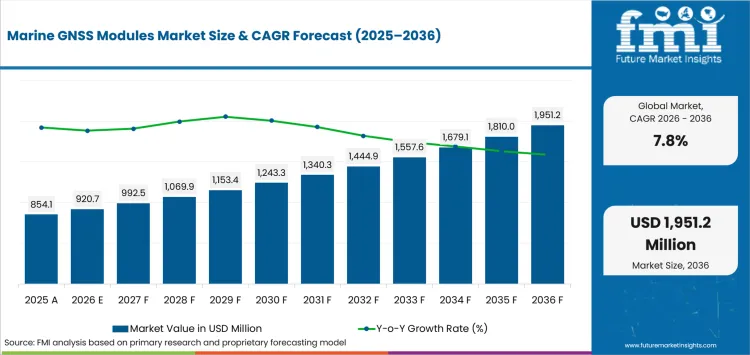
USD 920.7 million in 2026 and USD 1951.2 million by 2036 at a 7.8% CAGR.
Demand for marine GNSS modules is projected to rise from USD 920.7 million in 2026 to USD 1951.2 million by 2036, at a 7.8% CAGR as vessel builders give position integrity more weight in digital and autonomous navigation. The IMO warned in March 2025 that GNSS jamming and spoofing were increasing. Frequency diversity and interference diagnostics therefore carry more weight in receiver selection.
National vessel mix changes the value of each receiver installation. In June 2025 the USA Coast Guard reported about 11.7 million registered recreational vessels for 2024. The installed fleet gives the USA a large replacement base for standard marine electronics. France and Norway place more demand in survey or resilient positioning through public hydrography and navigation-service change. Vessel mix therefore changes module value despite similar forecast growth rates.
Key Takeaways
- Marine navigation is assigning greater operational weight to GNSS integrity as digital bridge functions and autonomous survey systems depend on consistent position inputs.
- By module type, standard GNSS modules are estimated to hold 28.0% in 2026 owing to mature interfaces and manageable integration cost.
- GPS only is projected to account for 16.0% of the constellation category in 2026 attributable to legacy compatibility in less demanding equipment.
- In 2026, chartplotters are expected to lead application demand with 28.0% share supported by continuous use of position data in the helm workflow.
- Jamming and spoofing increase validation work because a receiver upgrade cannot remove every antenna or signal-path failure mode.
- Key players in the marine GNSS modules market include u-blox, Garmin, Trimble, Septentrio, Quectel, Thales, Furuno, Hexagon / NovAtel, Telit Cinterion, and Topcon Positioning.
Analyst Perspective
"Marine OEMs should compare receiver integrity and migration effort before treating unit price as the deciding variable. The stronger commercial position belongs to modules that fit installed interfaces and provide a credible upgrade path when accuracy or resilience requirements rise."
- Nikhil Kaitwade, Principal Consultant, Future Market Insights
How is the marine GNSS modules market segmented?
The marine GNSS modules market is segmented by module type, constellation, application, vessel type, sales channel and region.
Module type covers standard GNSS modules, RTK GNSS modules, multi-band GNSS modules, GNSS/INS modules and rugged marine receivers. Constellation covers GPS only, multi-GNSS, GNSS + SBAS and dual-frequency GNSS. Applications include chartplotters, autopilot systems, fleet tracking, survey - hydrography and USV navigation. Vessel type covers recreational boats, commercial vessels, fishing vessels, USVs and yachts. Sales channels include marine electronics OEMs, navigation integrators, module distributors and aftermarket receivers.
How do chartplotters shape demand within the application category?
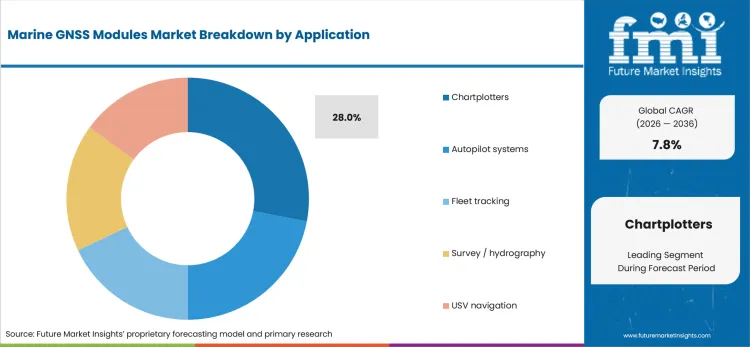
Chartplotters use GNSS continuously because route progress and own-vessel position are visible at the helm. Receiver faults therefore affect a core navigation display. Garmin added AIS warning messages to selected GPSMAP and ECHOMAP chartplotters in April 2025. The same screen now carries position data beside marine radar and collision information.
- Chartplotters are set to lead the application category with 28.0% share in 2026 supported by continuous position use during route monitoring.
- Compatible NMEA interfaces and antenna arrangements let OEMs upgrade receiver performance without replacing the full display platform.
What makes standard GNSS modules central to the module type category?
Standard modules suit products that need compact positioning without survey-grade correction workflows. Chartplotter and tracking engineers often value stable interfaces more than centimetre accuracy in navigation and positioning solutions. Telit Cinterion launched the SL871K2 multi-constellation module in March 2025 for compact cost-conscious embedded designs.
- By module type, standard GNSS modules are estimated to hold 28.0% in 2026 driven by familiar electrical interfaces and lower qualification effort.
- Product engineers can preserve board space and power budgets with mainstream modules before adding RTK or inertial functions for more demanding missions.
What keeps GPS only relevant within the constellation category?
GPS-only designs remain viable where existing antennas and firmware already meet the vessel's navigation requirement. Multi-constellation reception becomes more valuable under poor sky visibility or interference. Garmin launched Force Pro in March 2025 with multi-band GPS to improve anchor-lock positioning on recreational boats.
- GPS only is projected to hold 16.0% share in 2026 attributable to installed compatibility and lower validation cost in basic navigation equipment.
- The upgrade path is visible in recreational products that adopt multi-band reception without replacing the whole helm electronics stack.
What supports recreational boats within the vessel type category?
Recreational boats provide a large installed base with faster electronics replacement than regulated commercial bridge systems. Garmin introduced the GPSMAP 15x3 chartplotter in June 2025 for boaters and sailors. Its OEM and aftermarket mounting options show how marine electronics replacement can bring new GNSS hardware into an existing helm.
- Recreational boats are forecast to represent 31.0% share in 2026 driven by recurring chartplotter and navigation-electronics replacement.
- Dealer access lowers installation friction for owners but price and power consumption still limit the specification of high-precision receivers.
Why do marine electronics OEMs lead the sales channel category?
Marine electronics OEMs decide receiver footprint and interfaces before a downstream product reaches the vessel. The receiver choice can persist through several production years. Septentrio launched the mosaic-G5 P8 in May 2026 for marine vessels needing compact multi-frequency GNSS with anti-jamming and anti-spoofing features. The launch gives module makers a route into autonomous marine navigation programs through OEM qualification.
- Marine electronics OEMs are projected to capture 39.0% share in 2026 owing to their control over board design and product qualification.
- A stable form factor reduces redesign work during an OEM upgrade from standard positioning toward higher resilience.
What are the drivers, restraints and opportunities in the Marine GNSS Modules Market?
Hydrographic automation increases demand for dependable positioning while interference raises validation cost and authenticated multi-GNSS designs expand the available upgrade path.
- Driver: Hydrographic survey and supervised autonomous vessels require position data that remains usable during long data-collection missions.
- Restraint: GNSS interference forces vessel integrators to test antennas and alarm behaviour before approving a receiver change.
- Opportunity: Authenticated multi-GNSS reception can raise spoofing resistance when the vessel architecture also addresses jamming and inertial fallback.
Hydrographic automation raises the consequence of receiver performance
NOAA said in February 2025 that NOAA Ship Thomas Jefferson would carry two DriX uncrewed systems during the survey season. Position and heading therefore become active inputs to survey control and sensor georeferencing. The same requirement supports receiver demand in the unmanned surface vehicle field where survey payloads need repeatable positioning. Receiver stability therefore becomes a mission-control requirement instead of a display convenience.
Interference lengthens the qualification path
Traficom warned in June 2025 that GNSS disruptions had increased significantly for vessels in the Gulf of Finland. A stronger receiver cannot restore a blocked satellite signal. Integrators must test antenna placement and sensor fallback before approving a change. Alarm behaviour also needs to remain clear during degraded reception. Vessel-level verification shifts more work into marine electronics testing and raises the cost of a poor design match.
Authentication gives multi-GNSS designs a defined resilience upgrade
EUSPA launched Galileo OSNMA in July 2025 so compatible receivers can authenticate navigation-message data. Authentication reduces exposure to spoofed data but it does not prevent jamming. Modules with multiple frequencies and inertial navigation systems therefore address a broader failure set. Host software must also expose authentication status clearly to the bridge operator. Revenue is more likely where those functions fit existing vessel interfaces without forcing a full bridge replacement.
Which country CAGRs are profiled in the Marine GNSS Modules Market?
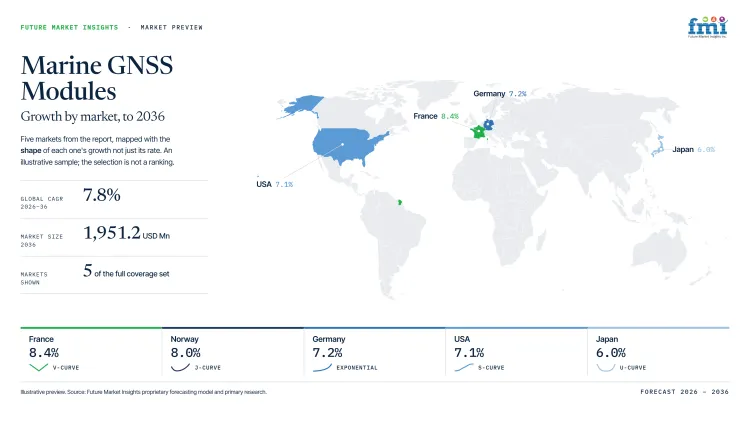
| Country | CAGR |
|---|---|
| France | 8.4% |
| Norway | 8.0% |
| Finland | 7.8% |
| Canada | 7.4% |
| Germany | 7.2% |
| USA | 7.1% |
| Japan | 6.0% |
How do country-level CAGRs compare in the Marine GNSS Modules Market?
The 2.4-point spread separates a faster northern European group from positive but slower growth elsewhere. France and Norway sit at the top because higher-value professional navigation work raises receiver specifications. Finland follows through resilience spending. Canada and Germany form the middle band. USA and Japan grow from mature installed bases that temper the rate.
- France carries more survey-grade demand than peers.
- Norway's working fleets raise retrofit value per installation.
- Finland assigns more value to receiver resilience.
- Canada spreads demand across several vessel classes.
- Germany concentrates precision demand in professional marine work.
- USA pairs mass replacement with specialist survey demand.
- Japan's mature channel lengthens receiver replacement cycles.
Similar CAGRs can yield different revenue because vessel mix changes each design-in's value. The full report provides country-level CAGR analysis across North America, Latin America, Western Europe, Eastern Europe, East Asia, South Asia and Pacific and the Middle East and Africa.
Country-wise Analysis
- France is modernising hydrographic acquisition with autonomous surface craft that need precise position data for survey control and payload georeferencing. Marine GNSS module demand in France is forecast to rise at 8.4% CAGR over the forecast period, supported by public survey modernisation. Shom confirmed in January 2026 that it ordered a DriX H-9 at the end of December 2025 for coastal hydrographic work. The programme gives receiver makers a direct route into survey platforms through navigation and sensor integration. Hydrographic crews must validate heading and position performance against the vessel's other survey sensors before accepting a new receiver. Required sensor cross-checks can limit quick substitution between competing module providers.
- Norwegian coastal operations are preparing for the loss of a correction service that has supported ship positioning for decades. The Norwegian Coastal Administration said in November 2025 that its 12-station DGPS service would end on January 27 2026. Norway's marine GNSS modules outlook is anticipated to advance at 8.0% CAGR over the assessment period, attributable to receiver renewal and wider use of Galileo or EGNOS on suitable ships. Marine communication systems share bridge interfaces with the replacement receiver. Compatibility therefore has to cover existing alarms and network links. The main commercial friction is retrofit downtime on vessels that must remain operational. Installers that can prove compatibility without reopening the whole navigation stack have a clearer replacement route.
- Professional mariners in Finland now treat GNSS disruption as a routine operating condition in the eastern Gulf of Finland. Traficom recorded 231 professional maritime interference reports in 2025 under the reporting method used that year. Marine GNSS module sales in Finland are forecast to expand at 7.8% CAGR by 2036, driven by multi-frequency reception and integrity-alarm demand. A receiver upgrade alone cannot remove jamming across the vessel's complete signal path. Vessels therefore need antenna guidance and operating procedures that help crews recognise degraded satellite inputs. Resilience features earn more attention here than in markets with occasional interference. Marine integrators also have to verify alarm behaviour during repeat disruptions.
- Canadian navigation services are shifting toward S-100 digital products on routes that also cover long and remote coastlines. The Canadian Hydrographic Service launched S-100 Sea Trials on the St. Lawrence River in June 2025 to validate layered digital navigation data. Canada is projected to post 7.4% CAGR over the forecast period, supported by digital-chart modernisation and replacement of mixed legacy bridge electronics. Maritime satellite communication can carry other bridge data on remote routes but GNSS receivers still need local interface compatibility. Service distance and installer coverage can delay refits outside major ports. Companies with rugged modules and broad integration support are better placed to handle that geography.
- Germany is extending federal precision positioning into hydrographic work in the North Sea and Baltic Sea. Adoption of marine GNSS modules in Germany is predicted to expand at 7.2% CAGR through 2036, driven by survey accuracy needs and resilience work. BKG's 2025 annual review recorded a GNSS receiver installation on a BSH vessel to improve GEPOS and monitor seabed changes. The installation gives public survey operators another correction path in German waters. Offshore work cannot accept unexplained position drift during seabed measurement, so verified performance under interference becomes the commercial gate. Receiver makers need evidence from the installed vessel system instead of bench accuracy alone.
- The United States has a very large recreational electronics base. Specialist hydrographic work also demands higher positioning accuracy over extended survey missions. NOAA Coast Survey documented 68,090 linear nautical miles of hydrographic surveying during 2025. Marine GNSS module demand in USA is forecast to rise at 7.1% CAGR over the forecast period, driven by vessel refits and survey systems that depend on stable position data. GPS tracking devices provide an adjacent embedded channel but marine installations face corrosion and antenna-placement constraints. The broad customer base favours companies that can support standard receivers for recreational equipment and higher-precision designs for survey platforms without forcing one architecture onto every vessel.
- Japan has a domestic satellite-augmentation service that can raise precision without a local base station near every vessel. Japan's marine GNSS modules outlook is anticipated to advance at 6.0% CAGR over the assessment period, supported by QZSS correction capability and a mature marine electronics base. The Cabinet Office began distributing MADOCA-PPP messages with more augmented signals and satellites on July 7 2025. Compatible receivers can use the correction service offshore if firmware and signal support are ready. The main integration constraint is L6 support inside compact legacy designs. Pin-compatible migration and firmware support therefore carry more weight than receiver accuracy alone.
Who are the notable companies in the Marine GNSS Modules Market?
u-blox, Garmin, Trimble, Septentrio, Quectel, Thales, Furuno, Hexagon / NovAtel, Telit Cinterion and Topcon Positioning are notable companies serving the marine GNSS modules market.
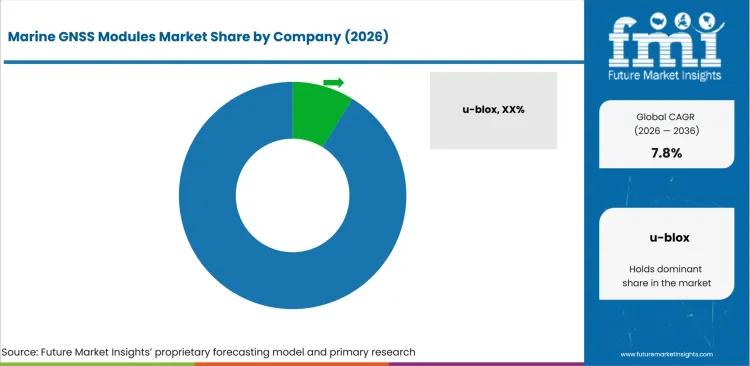
Competition separates into embedded module makers and precision-positioning specialists. Marine-native electronics companies carry vessel integration and service channels. Trimble documents GNSS/INS use in hydrographic survey. Furuno's 2025 integrated report describes marine service and replacement activity. Receiver makers face a higher entry barrier once a design needs vessel-level interference and interface checks.
- u-blox, Quectel and Telit Cinterion provide compact OEM GNSS modules with migration paths for embedded electronics.
- Trimble and Septentrio address high-precision positioning. Hexagon / NovAtel and Topcon Positioning extend that role into corrections or inertial integration.
- Garmin and Furuno provide marine electronics channels. Thales targets resilient navigation for higher-consequence applications.
Competitive Benchmarking: Marine GNSS Modules Market
| Company | OEM Module Depth | Precision & Resilience | Marine Integration | Geographic Reach |
|---|---|---|---|---|
| u-blox | High | High | Medium | Global |
| Garmin | Medium | Medium | High | Global |
| Trimble | Medium | High | High | Global |
| Septentrio | High | High | High | Global |
| Quectel | High | High | Low | Global |
| Thales | Medium | High | High | Global |
| Furuno | Medium | Medium | High | Global |
| Hexagon / NovAtel | High | High | High | Global |
| Telit Cinterion | High | Medium | Low | Global |
| Topcon Positioning | High | High | Low | Global |
Scoring basis: High OEM module depth requires multiple current receiver or board routes. Medium reflects a narrower line and Low identifies limited embedded-module breadth. High precision and resilience requires multi-frequency or correction functions plus documented interference or inertial support. Marine integration is High for multiple documented marine applications. Medium requires one clear marine route. Low applies where current public evidence remains concentrated in adjacent OEM uses.
Key Developments in the Marine GNSS Modules Market
- In June 2025, Thales announced an industrial ramp-up that would quadruple production capacity at Châtellerault and start serial production of TopStar-M GNSS receivers in Valence.
- In March 2025, Hexagon completed the acquisition of Septentrio to extend resilient high-accuracy GNSS for mission-critical navigation and autonomy applications.
- In March 2025, u-blox launched the ZED-X20P all-band GNSS module with centimetre-level positioning and global multi-frequency support.
Key Players in the Marine GNSS Modules Market
Embedded OEM GNSS Module Providers
- u-blox
- Quectel
- Telit Cinterion
Precision GNSS and GNSS/INS Specialists
- Trimble
- Septentrio
- Hexagon / NovAtel
- Topcon Positioning
Marine-Native and Resilient Navigation Providers
- Garmin
- Furuno
- Thales
Marine GNSS Modules Market - Report Scope
| Coverage field | Report scope |
|---|---|
| Market breakdown | By module type, constellation, application, vessel type, sales channel and region. |
| Quantitative Units | USD million. |
| Market Definition | Revenue includes discrete GNSS receiver modules, embedded OEM receiver boards, GNSS/INS modules and rugged marine GNSS receiver units sold for integration into listed marine applications. It excludes complete downstream chartplotters, autopilots, fleet systems and vessels. |
| Regions Covered | North America, Latin America, Western Europe, Eastern Europe, East Asia, South Asia and Pacific and Middle East and Africa. |
| Countries Covered | France, Norway, Finland, Canada, Germany, USA, Japan, and 20+ countries included in the full report. |
| Key Companies Profiled | u-blox, Garmin, Trimble, Septentrio, Quectel, Thales, Furuno, Hexagon / NovAtel, Telit Cinterion, Topcon Positioning. |
| Forecast Period | 2026 to 2036. |
| Approach | Primary and secondary research with market triangulation. |
Marine GNSS Modules Market - Research Methodology
| Method | Approach |
|---|---|
| Primary Research | FMI analysts gathered input from manufacturers, service providers, technology developers, distributors, end users, procurement teams, and subject-matter experts. Interviews examined purchasing decisions, product or service evaluation, adoption barriers, approval requirements, pricing considerations, and expectations for technical or commercial support. Respondents were also asked what evidence is required before a trial, pilot, or initial order develops into regular purchasing. |
| Desk Research | Desk research covered government statistics, regulatory publications, trade data, industry associations, technical literature, standards, company filings, product information, and official corporate announcements. Sources were reviewed for relevance, publication date, geographic coverage, and consistency with the defined market scope. Claims relating to performance, applications, approvals, capacity, investment, and commercial activity were retained only when supported by credible public evidence. |
| Market Sizing and Forecasting | The market model combined the baseline value with historical performance, segment structure, pricing and volume indicators, adoption levels, company participation, and country-level demand conditions. Forecast assumptions considered economic activity, investment trends, regulatory developments, technology adoption, purchasing cycles, supply availability, and barriers to wider market use. Segment and regional estimates were reconciled before the final market total was calculated. |
| Data Validation | Estimates were checked against multiple independent indicators, including public data, company activity, trade patterns, industry developments, and findings from primary interviews. Validation also tested whether products, services, applications, and company revenues fell within the defined market boundaries. Adjacent categories, unsupported claims, overlapping revenues, and activities without direct market relevance were excluded to reduce double counting and maintain consistency across segments and countries. |
Marine GNSS Modules Market by Segments
Marine GNSS Modules Market segmented by Module Type:
- Standard GNSS modules
- RTK GNSS modules
- Multi-band GNSS modules
- GNSS/INS modules
- Rugged marine receivers
Marine GNSS Modules Market segmented by Constellation:
- GPS only
- Multi-GNSS
- GNSS + SBAS
- Dual-frequency GNSS
Marine GNSS Modules Market segmented by Application:
- Chartplotters
- Autopilot systems
- Fleet tracking
- Survey - hydrography
- USV navigation
Marine GNSS Modules Market segmented by Vessel Type:
- Recreational boats
- Commercial vessels
- Fishing vessels
- USVs
- Yachts
Marine GNSS Modules Market segmented by Sales Channel:
- Marine electronics OEMs
- Navigation integrators
- Module distributors
- Aftermarket receivers
Marine GNSS Modules Market by Region:
- North America
- United States
- Canada
- Latin America
- Brazil
- Mexico
- Argentina
- Chile
- Western Europe
- Germany
- France
- United Kingdom
- Italy
- Spain
- Benelux
- Nordics
- Eastern Europe
- Poland
- Czech Republic
- Romania
- Hungary
- East Asia
- China
- Japan
- South Korea
- South Asia and Pacific
- India
- ASEAN
- Australia and New Zealand
- Middle East and Africa
- GCC Countries
- South Africa
- Türkiye
- Israel
Research Sources and Bibliography
- International Maritime Organization. (2025, March 25). Protect satellite navigation from interference, UN agencies urge.
- USA Coast Guard. (2025, June 24). 2024 Recreational Boating Statistics.
- Telit Cinterion. (2025, March 10). Telit Cinterion Launches New Modules: The LE310 and SL871K2 for Affordable, Low-Power LTE Cat. 1 bis and Multi-Constellation GNSS.
- Garmin. (2025, March 5). Garmin introduces new Force Pro trolling motor.
- Garmin. (2025, April 3). Garmin expands boater warning capabilities with new AIS warning messaging feature.
- Garmin. (2025, June 12). Garmin debuts the GPSMAP 15x3 chartplotter with a 15-inch ultrawide premium display.
- Septentrio. (2026, May 18). Septentrio unveils mosaic-G5 P8, ultra-resilient GNSS module.
- NOAA Office of Coast Survey. (2025, February 11). NOAA's 2025 hydrographic survey season is gearing up and will be underway soon.
- Finnish Transport and Communications Agency Traficom. (2025, June 13). Finland and Estonia warn vessels in the Gulf of Finland of an increase in GNSS disruptions.
- European Union Agency for the Space Programme. (2025, July 22). Galileo to be the first GNSS to offer authentication service worldwide with launch of OSNMA.
- Shom. (2026, January 7). LE SHOM PASSE COMMANDE DE DEUX NOUVEAUX DRONES MARITIMES.
- Norwegian Coastal Administration. (2025, November 20). Discontinuation of DGPS Service in January.
- Finnish Transport and Communications Agency Traficom. (2026). Satellite navigation service interferences in Finland.
- Fisheries and Oceans Canada. (2025, June 17). Canada Leads the Way in Innovation for Safer Maritime Navigation.
- Federal Agency for Cartography and Geodesy. (2026, April 29). Jahresbericht 2025.
- NOAA Office of Coast Survey. (2026). Office of Coast Survey: 2025 Year in Review.
- National Space Policy Secretariat, Cabinet Office of Japan. (2025, July 8). Start of the message distribution with improved number of augmented signals and satellites in MADOCA-PPP.
- u-blox. (2025, March 6). u-blox ZED-X20P all-band GNSS receiver enables affordable global cm-level precision, customer sampling started.
- Hexagon. (2025, March 19). Hexagon completes acquisition of Septentrio expanding the reach of mission critical navigation and autonomy applications.
- Thales. (2025, June 12). Thales invests €55 million euros to anchor next-generation resilient navigation in France.
- Trimble. (2025, January 9). Surveying the depths: The impact of real-time GNSS data.
- FURUNO ELECTRIC CO., LTD. (2025, September). Integrated Report 2025.
- Quectel Wireless Solutions Co., Ltd. (2025, December 12).
- Topcon Positioning Systems. (2026, February 16). Topcon and Fixposition announce collaboration agreement.
- Septentrio. (2025, October 2). Septentrio starts mass production of mosaic-G5 modules.
- Telit Cinterion. (2026, May 13). Telit Cinterion Bundles Swift Navigation's Skylark into an Integrated IoT Positioning Solution.
- Garmin. (2026, May 27). Never miss a word on the water with Garmin Signal VHF marine radios.
- Septentrio. (2026, March 26). Septentrio extends its boxed receiver range with AsteRx EB.
- Hexagon. (2026, August 26). Hexagon to acquire Guidance Marine, strengthening maritime positioning portfolio.
- Telit Cinterion. (2026, March 9). Telit Cinterion Expands Next-Generation GNSS Portfolio with New Dual-Band Modules for Scalable IoT Positioning.
- Trimble. (2025, March 3). Trimble Works with STMicroelectronics to Deliver Precise Positioning Solution for the Automotive and IoT Industries.
- FURUNO ELECTRIC CO., LTD. (2026, July 28). Furuno to launch the RCB-100 GNSS timing receiver, making dual-band high precision accessible through easy integration into low-volume equipment.
This bibliography is provided for reader reference and is not exhaustive. The full report contains the complete reference list and detailed citations
This Report Answers
- How large is the marine GNSS modules market in 2026 and what value is projected by 2036?
- Which vessel-electronics changes are increasing the consequence of GNSS receiver performance?
- Why do standard GNSS modules retain the largest module-type share?
- How are multi-GNSS and multi-band designs changing receiver selection?
- Why do chartplotters and recreational boats remain important demand routes?
- What makes marine electronics OEMs the leading sales channel?
- How do GNSS interference and qualification affect adoption economics?
- Why do France and Norway post higher growth than Japan in the profiled country set?
- Which companies compete in embedded modules and precision marine positioning?
- Which recent company actions are changing resilient and high-precision GNSS supply?
Frequently Asked Questions
How big is the marine GNSS modules market in 2026?
The marine GNSS modules market is valued at USD 920.7 million in 2026 and is projected to reach USD 1,951.2 million by 2036. Growth is driven by digital navigation and higher receiver-integrity requirements.
What is the CAGR of the marine GNSS modules market from 2026 to 2036?
The marine GNSS modules market is projected to grow at a CAGR of 7.8% between 2026 and 2036. Expansion is supported by vessel-electronics replacement and precision positioning in survey or autonomous applications.
Which module type leads the marine GNSS modules market?
The standard GNSS modules segment is expected to hold 28.0% of the marine GNSS modules market in 2026, attributable to mature interfaces and lower integration cost. Higher-precision designs serve narrower missions that justify extra qualification.
Which sales channel leads the marine GNSS modules market?
The marine electronics OEMs segment is expected to hold 39.0% of the marine GNSS modules market in 2026, driven by early control over receiver footprint and interface selection. OEM design-ins can persist through several product generations.
Which companies are active in the marine GNSS modules market?
Key companies operating in the market include u-blox, Garmin, Trimble, Septentrio, Quectel, Thales, Furuno, Hexagon / NovAtel, Telit Cinterion, and Topcon Positioning. Their roles differ between embedded modules and precision or marine-native navigation systems.
Preview the report firsthand - request a free sample
Get SampleGet the brochure for pricing and purchase details.
Get PDFTable of Content
- Key Takeaways
- Market Size and CAGR
- Top Growth Driver
- Fastest Growing Segment
- Leading Region
- Key Companies
- Emerging Opportunities
- Executive Summary
- Global Market Outlook
- Demand-side Trends
- Supply-side Trends
- Technology Roadmap Analysis
- Analysis and Recommendations
- Analyst Perspective (What is happening? Why now? What should investors know?)
- Key Questions Answered
- How large is the market?
- What is the CAGR?
- What are key trends?
- Which region dominates?
- Who are the leaders?
- Market Overview
- Market Coverage / Taxonomy
- Market Definition / Scope / Limitations
- Research Methodology
- Chapter Orientation
- Analytical Lens and Working Hypotheses
- Market Structure, Signals, and Trend Drivers
- Benchmarking and Cross-market Comparability
- Market Sizing, Forecasting, and Opportunity Mapping
- Research Design and Evidence Framework
- Desk Research Programme (Secondary Evidence)
- Expert Input and Fieldwork (Primary Evidence)
- Tooling, Models, and Reference Databases
- Data Engineering and Model Build
- Quality Assurance and Audit Trail
- Market Background
- Market Dynamics (Drivers, Restraints, Opportunity, Trends)
- Scenario Forecast (Optimistic, Likely, Conservative)
- Impact Analysis
- AI Impact
- Sustainability Impact
- Regulatory Impact
- Technology Impact
- Consumer / Buyer Analysis
- Purchase Drivers
- Adoption Barriers
- Buyer Journey
- Opportunity Map Analysis
- Product Life Cycle Analysis
- Supply Chain Analysis
- Investment Feasibility Matrix
- Value Chain Analysis
- PESTLE and Porter's Analysis
- Regulatory Landscape
- Regional Parent Market Outlook
- Production and Consumption Statistics
- Import and Export Statistics
- Global Market Analysis and Forecast, 2021 to 2036
- Historical Market Size Value (USD Million) Analysis, 2021 to 2025
- Current and Future Market Size Value (USD Million) Projections, 2026 to 2036
- Y-o-Y Growth Trend Analysis
- Absolute $ Opportunity Analysis
- Global Market Pricing Analysis, 2021 to 2036
- Global Market Analysis and Forecast, By Module Type, 2021 to 2036
- Introduction / Key Findings
- Historical Market Size Value (USD Million) Analysis By Module Type, 2021 to 2025
- Current and Future Market Size Value (USD Million) Analysis and Forecast By Module Type, 2026 to 2036
- Standard GNSS modules
- RTK GNSS modules
- Multi-band GNSS modules
- GNSS/INS modules
- Rugged marine receivers
- Standard GNSS modules
- Y-o-Y Growth Trend Analysis By Module Type, 2021 to 2025
- Absolute $ Opportunity Analysis By Module Type, 2026 to 2036
- Global Market Analysis and Forecast, By Constellation, 2021 to 2036
- Introduction / Key Findings
- Historical Market Size Value (USD Million) Analysis By Constellation, 2021 to 2025
- Current and Future Market Size Value (USD Million) Analysis and Forecast By Constellation, 2026 to 2036
- GPS only
- Multi-GNSS
- GNSS + SBAS
- Dual-frequency GNSS
- GPS only
- Y-o-Y Growth Trend Analysis By Constellation, 2021 to 2025
- Absolute $ Opportunity Analysis By Constellation, 2026 to 2036
- Global Market Analysis and Forecast, By Application, 2021 to 2036
- Introduction / Key Findings
- Historical Market Size Value (USD Million) Analysis By Application, 2021 to 2025
- Current and Future Market Size Value (USD Million) Analysis and Forecast By Application, 2026 to 2036
- Chartplotters
- Autopilot systems
- Fleet tracking
- Survey / hydrography
- USV navigation
- Chartplotters
- Y-o-Y Growth Trend Analysis By Application, 2021 to 2025
- Absolute $ Opportunity Analysis By Application, 2026 to 2036
- Global Market Analysis and Forecast, By Vessel Type, 2021 to 2036
- Introduction / Key Findings
- Historical Market Size Value (USD Million) Analysis By Vessel Type, 2021 to 2025
- Current and Future Market Size Value (USD Million) Analysis and Forecast By Vessel Type, 2026 to 2036
- Recreational boats
- Commercial vessels
- Fishing vessels
- USVs
- Yachts
- Recreational boats
- Y-o-Y Growth Trend Analysis By Vessel Type, 2021 to 2025
- Absolute $ Opportunity Analysis By Vessel Type, 2026 to 2036
- Global Market Analysis and Forecast, By Sales Channel, 2021 to 2036
- Introduction / Key Findings
- Historical Market Size Value (USD Million) Analysis By Sales Channel, 2021 to 2025
- Current and Future Market Size Value (USD Million) Analysis and Forecast By Sales Channel, 2026 to 2036
- Marine electronics OEMs
- Navigation integrators
- Module distributors
- Aftermarket receivers
- Marine electronics OEMs
- Y-o-Y Growth Trend Analysis By Sales Channel, 2021 to 2025
- Absolute $ Opportunity Analysis By Sales Channel, 2026 to 2036
- Global Market Analysis and Forecast, By Region, 2021 to 2036
- Introduction
- Historical Market Size Value (USD Million) Analysis By Region, 2021 to 2025
- Current Market Size Value (USD Million) Analysis and Forecast By Region, 2026 to 2036
- North America
- Latin America
- Western Europe
- Eastern Europe
- East Asia
- South Asia and Pacific
- Middle East & Africa
- Market Attractiveness Analysis By Region
- North America Market Analysis and Forecast, By Country, 2021 to 2036
- Historical Market Size Value (USD Million) Trend Analysis By Market Taxonomy, 2021 to 2025
- Market Size Value (USD Million) Forecast By Market Taxonomy, 2026 to 2036
- By Country
- USA
- Canada
- By Module Type
- By Constellation
- By Application
- By Vessel Type
- By Sales Channel
- By Country
- Market Attractiveness Analysis
- By Country
- By Module Type
- By Constellation
- By Application
- By Vessel Type
- By Sales Channel
- Key Takeaways
- Latin America Market Analysis and Forecast, By Country
- Historical Market Size Value (USD Million) Trend Analysis By Market Taxonomy, 2021 to 2025
- Market Size Value (USD Million) Forecast By Market Taxonomy, 2026 to 2036
- By Country
- Brazil
- Mexico
- Chile
- Rest of Latin America
- By Module Type
- By Constellation
- By Application
- By Vessel Type
- By Sales Channel
- By Country
- Market Attractiveness Analysis
- By Country
- By Module Type
- By Constellation
- By Application
- By Vessel Type
- By Sales Channel
- Key Takeaways
- Western Europe Market Analysis and Forecast, By Country
- Historical Market Size Value (USD Million) Trend Analysis By Market Taxonomy, 2021 to 2025
- Market Size Value (USD Million) Forecast By Market Taxonomy, 2026 to 2036
- By Country
- Germany
- UK
- Italy
- Spain
- France
- Nordic
- BENELUX
- Rest of Western Europe
- By Module Type
- By Constellation
- By Application
- By Vessel Type
- By Sales Channel
- By Country
- Market Attractiveness Analysis
- By Country
- By Module Type
- By Constellation
- By Application
- By Vessel Type
- By Sales Channel
- Key Takeaways
- Eastern Europe Market Analysis and Forecast, By Country
- Historical Market Size Value (USD Million) Trend Analysis By Market Taxonomy, 2021 to 2025
- Market Size Value (USD Million) Forecast By Market Taxonomy, 2026 to 2036
- By Country
- Russia
- Poland
- Hungary
- Balkan & Baltic
- Rest of Eastern Europe
- By Module Type
- By Constellation
- By Application
- By Vessel Type
- By Sales Channel
- By Country
- Market Attractiveness Analysis
- By Country
- By Module Type
- By Constellation
- By Application
- By Vessel Type
- By Sales Channel
- Key Takeaways
- East Asia Market Analysis and Forecast, By Country
- Historical Market Size Value (USD Million) Trend Analysis By Market Taxonomy, 2021 to 2025
- Market Size Value (USD Million) Forecast By Market Taxonomy, 2026 to 2036
- By Country
- China
- Japan
- South Korea
- By Module Type
- By Constellation
- By Application
- By Vessel Type
- By Sales Channel
- By Country
- Market Attractiveness Analysis
- By Country
- By Module Type
- By Constellation
- By Application
- By Vessel Type
- By Sales Channel
- Key Takeaways
- South Asia and Pacific Market Analysis and Forecast, By Country
- Historical Market Size Value (USD Million) Trend Analysis By Market Taxonomy, 2021 to 2025
- Market Size Value (USD Million) Forecast By Market Taxonomy, 2026 to 2036
- By Country
- India
- ASEAN
- Australia & New Zealand
- Rest of South Asia and Pacific
- By Module Type
- By Constellation
- By Application
- By Vessel Type
- By Sales Channel
- By Country
- Market Attractiveness Analysis
- By Country
- By Module Type
- By Constellation
- By Application
- By Vessel Type
- By Sales Channel
- Key Takeaways
- Middle East & Africa Market Analysis and Forecast, By Country
- Historical Market Size Value (USD Million) Trend Analysis By Market Taxonomy, 2021 to 2025
- Market Size Value (USD Million) Forecast By Market Taxonomy, 2026 to 2036
- By Country
- Kingdom of Saudi Arabia
- Other GCC Countries
- Türkiye
- South Africa
- Other African Union
- Rest of Middle East & Africa
- By Module Type
- By Constellation
- By Application
- By Vessel Type
- By Sales Channel
- By Country
- Market Attractiveness Analysis
- By Country
- By Module Type
- By Constellation
- By Application
- By Vessel Type
- By Sales Channel
- Key Takeaways
- Key Countries Market Analysis
- USA
- Pricing Analysis
- Market Share Analysis, 2025
- By Module Type
- By Constellation
- By Application
- By Vessel Type
- By Sales Channel
- Canada
- Pricing Analysis
- Market Share Analysis, 2025
- By Module Type
- By Constellation
- By Application
- By Vessel Type
- By Sales Channel
- Mexico
- Pricing Analysis
- Market Share Analysis, 2025
- By Module Type
- By Constellation
- By Application
- By Vessel Type
- By Sales Channel
- Brazil
- Pricing Analysis
- Market Share Analysis, 2025
- By Module Type
- By Constellation
- By Application
- By Vessel Type
- By Sales Channel
- Chile
- Pricing Analysis
- Market Share Analysis, 2025
- By Module Type
- By Constellation
- By Application
- By Vessel Type
- By Sales Channel
- Germany
- Pricing Analysis
- Market Share Analysis, 2025
- By Module Type
- By Constellation
- By Application
- By Vessel Type
- By Sales Channel
- UK
- Pricing Analysis
- Market Share Analysis, 2025
- By Module Type
- By Constellation
- By Application
- By Vessel Type
- By Sales Channel
- Italy
- Pricing Analysis
- Market Share Analysis, 2025
- By Module Type
- By Constellation
- By Application
- By Vessel Type
- By Sales Channel
- Spain
- Pricing Analysis
- Market Share Analysis, 2025
- By Module Type
- By Constellation
- By Application
- By Vessel Type
- By Sales Channel
- France
- Pricing Analysis
- Market Share Analysis, 2025
- By Module Type
- By Constellation
- By Application
- By Vessel Type
- By Sales Channel
- India
- Pricing Analysis
- Market Share Analysis, 2025
- By Module Type
- By Constellation
- By Application
- By Vessel Type
- By Sales Channel
- ASEAN
- Pricing Analysis
- Market Share Analysis, 2025
- By Module Type
- By Constellation
- By Application
- By Vessel Type
- By Sales Channel
- Australia & New Zealand
- Pricing Analysis
- Market Share Analysis, 2025
- By Module Type
- By Constellation
- By Application
- By Vessel Type
- By Sales Channel
- China
- Pricing Analysis
- Market Share Analysis, 2025
- By Module Type
- By Constellation
- By Application
- By Vessel Type
- By Sales Channel
- Japan
- Pricing Analysis
- Market Share Analysis, 2025
- By Module Type
- By Constellation
- By Application
- By Vessel Type
- By Sales Channel
- South Korea
- Pricing Analysis
- Market Share Analysis, 2025
- By Module Type
- By Constellation
- By Application
- By Vessel Type
- By Sales Channel
- Russia
- Pricing Analysis
- Market Share Analysis, 2025
- By Module Type
- By Constellation
- By Application
- By Vessel Type
- By Sales Channel
- Poland
- Pricing Analysis
- Market Share Analysis, 2025
- By Module Type
- By Constellation
- By Application
- By Vessel Type
- By Sales Channel
- Hungary
- Pricing Analysis
- Market Share Analysis, 2025
- By Module Type
- By Constellation
- By Application
- By Vessel Type
- By Sales Channel
- Kingdom of Saudi Arabia
- Pricing Analysis
- Market Share Analysis, 2025
- By Module Type
- By Constellation
- By Application
- By Vessel Type
- By Sales Channel
- Türkiye
- Pricing Analysis
- Market Share Analysis, 2025
- By Module Type
- By Constellation
- By Application
- By Vessel Type
- By Sales Channel
- South Africa
- Pricing Analysis
- Market Share Analysis, 2025
- By Module Type
- By Constellation
- By Application
- By Vessel Type
- By Sales Channel
- USA
- Market Structure Analysis
- Competition Dashboard
- Competition Benchmarking
- Market Share Analysis of Top Players
- By Regional
- By Module Type
- By Constellation
- By Application
- By Vessel Type
- By Sales Channel
- Emerging Startups
- Innovation Benchmarking
- Competition Analysis
- Competition Deep Dive
- u-blox
- Overview
- Product Portfolio
- Profitability by Market Segments
- Sales Footprint
- Strategy Overview
- Marketing Strategy
- Product Strategy
- Channel Strategy
- Garmin
- Trimble
- Septentrio
- Quectel
- Thales
- Furuno
- Hexagon / NovAtel
- Telit Cinterion
- Topcon Positioning
- u-blox
- Case Studies
- Success Stories
- Recent Developments
- Competition Deep Dive
- Assumptions & Acronyms Used


