

- Market Size (2026)
- USD 956.0 Mn
- Forecast (2036)
- USD 10853.0 Mn
- CAGR (2026 to 2036)
- 27.5%
How big is Autonomous Marine Navigation (AI Ship Autopilot) Market in 2026?
USD 956.0 million in 2026 and USD 10,853.0 million by 2036 at a 27.5% CAGR.
Demand for autonomous marine navigation is projected to expand at 27.5% CAGR between 2026 and 2036, increasing valuation from USD 956.0 million in 2026 to USD 10,853.0 million by 2036. This growth is supported by a large addressable vessel base, as UNCTAD reported in September 2025 that the global fleet comprised about 112,500 commercial vessels of at least 100 gross tons at the start of 2025. That installed base gives retrofit systems an addressable fleet with service that often span many years. Electronic chart safety systems supply route data that supervised autopilots can use for course control. Fleets are expected to favor systems with clear alarms and a direct return to manual control during faults.
South Korea offers a faster route from trial approval to shipyard installation than markets with less direct policy support. The Ministry of Oceans and Fisheries stated in January 2025 that the autonomous ships law took effect on January 3, 2025. Approved trials can use regulatory exceptions inside designated areas and produce clearer evidence for commercial approval. Japan takes a stricter approach near crowded ports and gives bridge officers direct control in Tokyo Bay. Japan Coast Guard guidance issued in March 2025 directs vessels in Tokyo Bay to use manual steering instead of autopilot. These rules shape training and the marine communication systems used for shore supervision across each approved route. Developers therefore need local proof that control returns to the bridge without delay or confusion.
-market-value-analysis.webp "Autonomous Marine Navigation (ai Ship Autopilot) Market Value Analysis")
Key Takeaways of Autonomous Marine Navigation (AI Ship Autopilot) Market
- Demand for autonomous marine navigation is driven by fleet adoption shifting from short demonstrations to supervised control on working ships, with commercial value tied to better route execution without extra bridge workload.
- By technology, AI navigation autopilot is expected to lead with 40.0% share in 2026, driven by active course and speed control.
- Ocean-going transit assist is the dominant application segment, projected to hold 38.0% share in 2026, reflecting repeatable operating conditions in open water.
- Software is estimated to lead the component category with 48.0% share in 2026, as controlled updates can improve route decisions without replacing installed bridge hardware.
- Retrofit programs remain a key adoption pathway, reaching existing fleets faster than vessel replacement, while a direct return to manual control remains the deciding safety test during sensor faults or lost communication.
- South Korea, the European Union, and Japan are expected to form the higher-growth country tier, advancing at 30.0%, 26.0%, and 25.0% CAGR respectively through 2036, shaped by shipyard-carrier links, multi-port software demand, and coastal-route manual control priorities.
- Competition centers on Avikus, Kongsberg Maritime, Orca AI, and Sea Machines Robotics, with vendors differentiating through shipyard-linked course control, offshore station-keeping integration, camera-based watchkeeping, and retrofit service for workboats and uncrewed vessels.
Analyst Perspective
"Autonomous vessel adoption will be determined by operational trust rather than navigation autonomy alone. Shipowners and maritime authorities are looking for systems that provide predictable human-machine interaction, transparent decision logic, and well-defined procedures for manual intervention during abnormal operating conditions. While integrated vessel platforms can accelerate initial deployment, long-term fleet strategies will favor solutions that preserve upgrade flexibility, generate auditable voyage records, and support safe operation across diverse vessel classes and operating environments."
- Nikhil Kaitwade, Principal Analyst, Future Market Insights
How is the Autonomous Marine Navigation (AI Ship Autopilot) Market segmented?
technology, application, component, end use, fit type, and region
Technology separates active course control from tools that warn bridge officers without changing the vessel’s path. Application compares ocean passages with port approaches and workboat or offshore missions that need different control limits. Component separates software from onboard equipment and from services used for installation or long-term system upkeep. End Use separates merchant shipping and offshore energy from passenger vessels and defense or patrol craft. Fit Type distinguishes newbuild integration from retrofit work on ships that already carry radar and steering equipment. Regional rules can change the approved control level for the same product across commercial routes. Remote supervision makes maritime cybersecurity part of every design and service decision across the fleet. Autonomy therefore functions as an operating capability that needs support throughout each vessel’s service life.
How does AI navigation autopilot shape the technology category?
-market-analysis-by-technology.webp "Autonomous Marine Navigation (ai Ship Autopilot) Market Analysis By Technology")
AI navigation autopilot can change course or speed within limits approved by the crew and class society. Avikus announced in June 2025 that DNV granted Type Approval Design Certification to HiNAS Control. DNV reviewed decision support and collision avoidance under DNV-CG-0264 and gave shipyards a clear design basis for active navigation on large commercial vessels. The approval reduces uncertainty about the evidence needed during vessel integration and later classification review.
- AI navigation autopilot is set to lead the Technology category with 40.0% share in 2026 due to direct route and speed control under bridge supervision. Newbuild programs can connect the software to steering equipment and alarms during construction of each vessel. This approach reduces installation work and supports consistent updates across sister ships built on the same platform.
- Deep-sea operators are expected to favor AI navigation autopilot over advisory systems due to direct control on repeated ocean passages. Marine radar systems maintain target awareness during darkness and poor visibility across long ocean passages at sea. Camera feeds add visual context during close or uncertain encounters that radar may not show clearly. Combining both inputs can give officers one clear maneuver option instead of several disconnected alerts.
What supports ocean-going transit assist within the application category?
-market-analysis-by-application.webp "Autonomous Marine Navigation (ai Ship Autopilot) Market Analysis By Application")
Ocean-going transit assist gives fleets a lower-risk starting point for supervised navigation between port maneuvers. Orca AI reported in March 2025 that Seaspan would install SeaPod on 100 additional ships. Its fleet review for 2023 and 2024 recorded a 35% increase in minimum passing distance. The same review found a 37% decline in close encounters during normal fleet operations worldwide. Those results show why voyage data carries more weight than a short trial during fleet approval.
- In 2026, ocean-going transit assist is expected to lead the Application category with 38.0% share because long passages provide repeatable conditions for supervised route decisions. Vessel traffic management data add local traffic information near busy coastal areas during the approach to port. Voyage records let safety teams compare results without giving the system full control of the vessel.
- Ocean-going transit assist is drawing demand from deep-sea fleets owing to lower routine course work on stable routes. Berthing safety systems address a different task near terminals and crowded harbors during final approach. Docking needs shorter reaction times and more detailed sensing around fixed structures close to the vessel. Open-water performance does not prove that the same controls are ready for close-quarters docking in busy ports.
Why does software lead the component category?
-market-analysis-by-component.webp "Autonomous Marine Navigation (ai Ship Autopilot) Market Analysis By Component")
Software combines radar and camera inputs with chart data and vessel motion to produce one navigation recommendation. Orca AI launched Co-Captain in November 2025 across a network of more than 1,000 installed vessels. The service shares verified hazard reports and adds weather or local traffic information in real time. Shared data can improve fleet awareness without replacing the bridge equipment already installed on each ship.
- By Component, software is forecast to represent 48.0% in 2026 driven by decision rules that connect sensor inputs with course and speed control. Marine electronics supply raw data from different vessel types and bridge layouts to navigation software onboard each ship. Each software update needs alarm testing against the equipment fitted on every affected ship in service.
- Retrofit operators are expected to favor software over new bridge hardware for its compatibility with existing instruments and lower installation work. Satellite vessel tracking can extend voyage awareness to shore staff and improve route context during long commercial voyages. Local controls must remain available aboard every vessel during a communication failure or network fault at sea. Network testing belongs in every software approval plan before commercial service begins on a working vessel.
What are the drivers, restraints, and opportunities in the Autonomous Marine Navigation (AI Ship Autopilot) Market?
Active control advances daily operations, while approval depends on proving safe manual takeover and shore supervision scales through staged fleet trials.
- Driver: Fleets need consistent course and speed decisions during changing traffic and weather conditions at sea.
- Restraint: A sensor fault or lost connection can create confusion over who controls the ship during a maneuver.
- Opportunity: Staged shore-control trials can produce evidence on working vessels with full crews retained onboard throughout the program.
Voyage plans lose value if route and speed decisions change without a clear operating reason at sea. Avikus announced in June 2025 that it formed a partnership with ZeroNorth to connect active navigation with live voyage planning. The partnership covers more than 350 Avikus-equipped ships and more than 5,500 ZeroNorth users worldwide. This shared operating base can compare route performance across vessel classes during routine commercial voyages at sea. Commercial value comes from carrying an approved plan into daily operations under direct bridge command.
Safety approval becomes harder for software that can change course or speed aboard a vessel. IMO adopted the non-mandatory International Code of Safety for Maritime Autonomous Surface Ships in May 2026, and the Code took effect on July 1, 2026, leaving the master responsible for the ship at all times. Developers must show how control returns during a sensor fault or lost communication. Products with unclear failure responses face longer tests and higher approval costs.
Shore supervision provides a practical step between onboard assistance and remote operation on working vessels. Kongsberg Maritime announced a remote Dynamic Positioning (DP) operations pilot in June 2025 involving Solstad's Normand Sentinel and Østensjø's Edda Freya. The first phase retains full onboard DP teams aboard both vessels while a shore-based DP operator works from a Remote Operations Centre.Marine steering systems must respond to those commands without delay or confusion under real operating pressure. Results from normal offshore work should help operators judge the investment more confidently than a short demonstration.
Which country CAGRs are profiled in the Autonomous Marine Navigation (AI Ship Autopilot) Market?
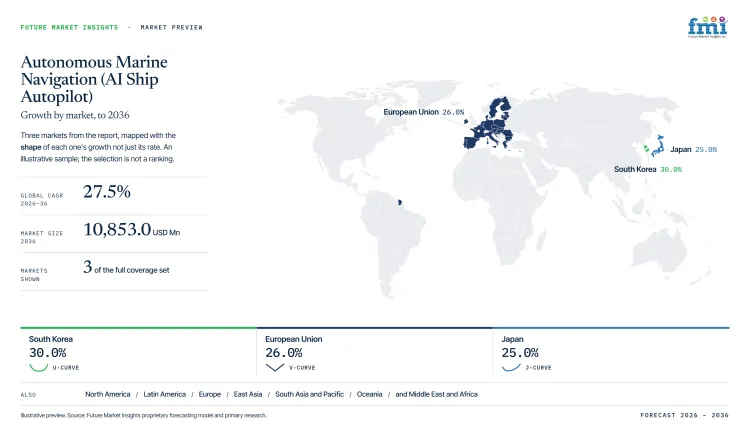
| Country | CAGR |
|---|---|
| South Korea | 30.0% |
| European Union | 26.0% |
| Japan | 25.0% |
Source: FMI's proprietary forecasting model and primary research
How do country-level CAGRs compare in the Autonomous Marine Navigation (AI Ship Autopilot) Market?
The comparison spans 5.0 percentage points across the autonomous marine navigation (AI ship autopilot) market. South Korea records the highest CAGR at 30.0%, followed by the European Union at 26.0% and Japan at 25.0%. The distribution reflects different levels of investment in maritime digitalization, autonomous vessel technologies and intelligent navigation systems.
- South Korea leads with a CAGR of 30.0%. Shipbuilders and maritime technology companies are advancing AI-enabled navigation platforms that improve voyage planning, vessel control and operational efficiency while supporting the transition toward higher levels of ship autonomy.
- The European Union follows at 26.0%, 4.0 percentage points below South Korea. Maritime operators and technology developers are incorporating autonomous navigation capabilities into commercial shipping and marine operations, with implementation varying across member states because fleet composition, port infrastructure and regulatory priorities are not uniform.
- Japan records a CAGR of 25.0%, 1.0 percentage point behind the European Union. The market reflects continued investment in intelligent ship navigation systems that combine AI, onboard sensing and automated control to improve navigation accuracy and support more efficient vessel operations.
Comparable CAGRs do not indicate identical market conditions. Differences in shipbuilding activity, maritime automation strategies, fleet modernization programs and investment priorities influence technology deployment and long-term commercial opportunities. The full report provides country-level CAGR analysis across North America, Latin America, Europe, East Asia, South Asia, Oceania and the Middle East and Africa.
Country-wise Analysis
Country growth depends on the route from a successful vessel trial to a repeat fleet order. South Korean developers can coordinate testing with local shipyards and carriers inside one national program. European projects must work across port systems and service networks governed by different operating rules. Japan offers a large retrofit base but gives greater weight to manual control near crowded routes. These differences affect installation schedules and training plans across each profiled national or regional market. They raise the need for local support during vessel approval and later service across commercial fleets. A control package approved in one region may need different alarms and service coverage in another.
- South Korea links autonomous navigation software with large shipyards and national carriers inside one domestic program. South Korea is estimated to post 30.0% CAGR over the forecast period, supported by coordinated trials and access to commercial voyage data. The Ministry of Oceans and Fisheries reported in January 2025 that Korean ports handled 31.73 million TEUs during 2024. Container volume rose 5.3% from 2023 and gives developers regular commercial voyages for supervised trials. Avikus can pair HD Hyundai shipyard access with HMM voyage data during commercial rollout programs. This structure shortens the route from software testing to vessel installation across related ship classes.
- European adoption depends on software that works across several port authorities and national service networks. The European Union autonomous navigation sector is projected to record 26.0% CAGR during the assessment period, supported by software that can operate across national port systems. Data from Eurostat released in November 2025 showed 2.2 million vessels entered main EU ports during 2024. The number rose 2.4% from 2023 and gives developers a broad base for testing route alerts across coastal systems. The European Commission launched its Industrial Maritime Strategy in March 2026 to support shipping technology and shipbuilding capacity across the region. Commercial success needs service coverage across national port systems because one demonstration site cannot prove that reach.
- Japan offers a large commercial fleet but allows little room for unclear control near crowded ports. Autonomous navigation demand in Japan is forecast to rise at 25.0% CAGR by 2036, shaped by a large retrofit base and strict manual-control expectations near crowded ports. Official data from UNCTAD published in December 2025 placed Japanese-owned carrying capacity at 241 million deadweight tons at the start of 2025. The ownership base includes vessels with long service lives and established bridge equipment across several classes. NYK announced in November 2025 that a new car carrier would test autonomous navigation during commercial voyages following delivery in March 2026. Documented takeover performance and nearby maintenance are expected to carry as much weight as navigation accuracy during fleet approval.
Who are the notable companies in the Autonomous Marine Navigation (AI Ship Autopilot) Market?
Avikus, Kongsberg Maritime, Orca AI, and Sea Machines Robotics are notable companies across active navigation control, remote operations, AI watchkeeping, and retrofit autonomy.
-market-analysis-by-company.webp "Autonomous Marine Navigation (ai Ship Autopilot) Market Analysis By Company")
Competition in the industry is influenced by two decisions: how much control the system receives and how it reaches the vessel. Avikus links active course control with HD Hyundai shipyards for merchant newbuilds and retrofit programs. Kongsberg Maritime combines bridge equipment with shore control for offshore vessels that use integrated steering and station-keeping. Orca AI begins with camera-based watchkeeping and extends into speed control through formal shipyard agreements. Sea Machines Robotics uses local installation partners for workboats and purpose-built unmanned marine vehicles in several regions. These installation routes create different approval costs and service needs across vessel types and operating areas. Fleet operators therefore need a control level that crews can understand and local teams can maintain throughout the vessel’s service life.
- Avikus: Active commercial control centers on route and speed changes for large merchant ships under bridge supervision. HD Hyundai links software design with shipyard installation across newbuild and retrofit vessel programs worldwide. This model suits carriers that can provide repeated voyage data from similar vessel classes during normal operations.
- Kongsberg Maritime combines bridge equipment with station-keeping control and shore operation for offshore work. The broad offer reduces gaps between separate onboard systems but expands the safety review for each vessel. Operators can use one provider for functions that must respond together during offshore missions under remote supervision.
- Orca AI uses cameras and fleet data to support collision avoidance during normal commercial voyages. This approach gives fleets measurable safety evidence without extensive changes to the bridge equipment already installed onboard. The same data can support deeper control through later shipyard integration or future software updates.
- Sea Machines Robotics supplies control packages for workboats and purpose-built unmanned craft. Commercial programs depend on local installation and field service across shipping and defense missions in each region. Regional partners extend the company’s reach beyond large shipyard programs and provide support throughout vessel operation.
Competitive Benchmarking: Autonomous Marine Navigation (AI Ship Autopilot) Market
| Company | Active Navigation Control | Remote Operations Readiness | Installation Route | Geographic Reach |
|---|---|---|---|---|
| Avikus | High | Medium | Large-vessel newbuild and retrofit programs | Asia and global shipping |
| Kongsberg Maritime | High | High | Integrated newbuild and offshore remote operations | Global |
| Orca AI | Medium | Medium | Software retrofit and shipyard integration | Global |
| Sea Machines Robotics | High | High | Workboat retrofit and purpose-built uncrewed vessels | North America, Europe, and Asia |
Scoring basis: High indicates direct evidence of active control or remote operation across commercial vessel programs. Medium indicates relevant capability supported by a smaller body of public evidence in the assessed area.
Source: Future Market Insights - analysis driven by proprietary forecasting model and primary research
Key Developments in the Autonomous Marine Navigation (AI Ship Autopilot) Market
- In January 2026, Avikus signed an agreement with HMM to install HiNAS Control on 40 vessels and brought its cumulative retrofit supply above 100 units for large commercial vessels. HMM provides voyage data and HD Korea Shipbuilding & Offshore Engineering handles integration across several vessel classes, showing how a first fleet order can expand into a repeat retrofit program for active navigation at commercial scale.
- In April 2026, Orca AI formed a partnership with Samsung Heavy Industries for integrated navigation and berthing systems that add speed control across newbuild and retrofit vessels. Orca AI reported more than 1,200 deployed vessels and over 500 more in its global pipeline and gives Samsung a tested software base for wider use across commercial vessel types and operating regions worldwide.
- In January 2025, Kongsberg Maritime delivered the first 24-meter REACH REMOTE uncrewed surface vessel to Reach Subsea following sea trials overseen by DNV and the Norwegian Maritime Authority. The first operating stage uses shore control and later stages add autonomous functions, giving offshore operators a measured route to test uncrewed survey work under defined safety limits during real commercial offshore missions.
- In April 2026, Sea Machines Robotics entered a formal partnership with Shintoa Corporation and appointed it as the authorized value-added reseller for commercial and defense programs in Japan. Shintoa will market and support autonomy products through offices in Tokyo and Osaka, with teams in Nagoya and Fukuoka providing nationwide coverage during commissioning, vessel trials, and ongoing commercial service.
Key Players in the Autonomous Marine Navigation (AI Ship Autopilot) Market
Active Navigation Control
- Avikus
Integrated Remote Operations
- Kongsberg Maritime
AI Watchkeeping and Hazard Detection
- Orca AI
Retrofit Autonomy and Uncrewed Vessels
- Sea Machines Robotics
Autonomous Marine Navigation (AI Ship Autopilot) Market - Report Scope
-market-breakdown-by-technology,-application,-and-region.webp "Autonomous Marine Navigation (ai Ship Autopilot) Market Breakdown By Technology, Application, And Region")
| Report Attribute | Coverage |
|---|---|
| Market Breakdown | Technology, Application, Component, End Use, Fit Type, and Region |
| Quantitative Units | Revenue in USD Million, CAGR in %. |
| Market Definition | Systems that combine sensor data and software to support route decisions or direct navigation control onboard ships |
| Regions Covered | North America, Latin America, Western Europe, Eastern Europe, East Asia, South Asia and Pacific, and Middle East and Africa |
| Countries Covered | South Korea and Japan, with the European Union profiled as a regional market |
| Key Companies Profiled | Avikus, Kongsberg Maritime, Orca AI, and Sea Machines Robotics |
| Approach | The forecast combines vessel counts and system values with newbuild schedules and retrofit cycles and applies local approval timing by country. |
Source: Future Market Insights - analysis driven by proprietary forecasting model and primary research
Autonomous Marine Navigation (AI Ship Autopilot) Market - Research Methodology
| Method | Application |
|---|---|
| Primary Research | FMI interviewed fleet technical managers and ship operators across East Asia and Europe to compare installation and service needs. Interviews in North America added direct evidence on retrofit programs and bridge-control practices used by commercial fleets. Shipyard integration staff and ship classification specialists provided evidence on bridge workload and control transfer during faults. Interviews compared installation time and service needs for newbuild and retrofit vessel programs already in operation. The research separated fleets ready for active course control from fleets that need advisory navigation support. |
| Desk Research | FMI reviewed merchant fleet records and port traffic data together with autonomous vessel laws and classification rules. Official shipyard programs and company news releases provided evidence on commercial installations and product scope. Sources were grouped by control level and vessel type, separating active autopilot systems from route advice and collision warning tools. |
| Market Sizing and Forecasting | The model estimated the number of vessels eligible for each installation route and applied the average value of the relevant system package. Forecasts combined newbuild schedules and retrofit cycles with local approval timing in each country market. Country assumptions reflected fleet ownership and port activity together with shipyard capacity in each operating region. |
| Data Validation | Country forecasts were checked against fleet ownership and port activity together with local trial rules. Company positions were confirmed through documented commercial installations and class approvals across the assessed regions. Segment shares were reconciled across vessel type and installation route to align software revenue with hardware and service revenue. |
Autonomous Marine Navigation (AI Ship Autopilot) Market by Segments
Autonomous Marine Navigation (AI Ship Autopilot) Market segmented by Technology:
- AI navigation autopilot
- Situational awareness through vision systems
- Collision avoidance
- Remote monitoring
Autonomous Marine Navigation (AI Ship Autopilot) Market segmented by Application:
- Ocean-going transit assist
- Harbor maneuvering and docking
- Fishing and workboats
- Offshore support
Autonomous Marine Navigation (AI Ship Autopilot) Market segmented by Component:
- Software
- Sensors and hardware
- Services
Autonomous Marine Navigation (AI Ship Autopilot) Market segmented by End Use:
- Merchant shipping
- Offshore and energy
- Passenger vessels
- Defense and patrol craft
Autonomous Marine Navigation (AI Ship Autopilot) Market segmented by Fit Type:
- Newbuild OEM-fit
- Retrofit
- Subscription
- Pilot programs
Autonomous Marine Navigation (AI Ship Autopilot) Market by Region:
- North America
- United States
- Canada
- Latin America
- Brazil
- Mexico
- Other Latin American Countries
- Europe
- Germany
- United Kingdom
- France
- Italy
- Spain
- Other European Countries
- East Asia
- Japan
- China
- South Korea
- South Asia and Pacific
- India
- ASEAN Countries
- Other South Asian and Pacific Countries
- Oceania
- Australia
- New Zealand
- Middle East and Africa
- Gulf Cooperation Council Countries
- South Africa
- Israel
- Other Middle Eastern and African Countries
Research Sources and Bibliography
- International Maritime Organization. (2026, May 22). IMO adopts first global Code for autonomous ships.
- United Nations Conference on Trade and Development. (2025, September 24). Review of maritime transport 2025: Staying the course in turbulent waters.
- United Nations Conference on Trade and Development. (2025, December 8). Handbook of statistics 2025.
- Ministry of Oceans and Fisheries, Republic of Korea. (2025, January 24). Korea’s ports handle record-high container volume of 31.73 million TEUs in 2024.
- Ministry of Oceans and Fisheries, Republic of Korea. (2025, January 10). Enactment of the Enforcement Decree of the Act on the Promotion of Development and Commercialization of Autonomous Ships.
- European Commission. (2026, March 4). Commission launches Industrial Maritime Strategy for a competitive, sustainable and resilient EU maritime sector.
- Eurostat. (2025, November). Maritime vessels statistics.
- Japan Coast Guard. (2025, March). Navigation safety guidance: 38th revised edition
- Nippon Yusen Kabushiki Kaisha. (2025, November 5). NYK orders next-generation marine DX equipped car carrier.
- Avikus. (2025, June 5). Avikus achieves DNV Type Approval Design Certification for HiNAS Control.
- Avikus. (2025, June 4). Avikus and ZeroNorth enter partnership to accelerate autonomous and optimised shipping.
- Avikus. (2026, January 16). HD Hyundai’s Avikus secures contract to supply autonomous navigation to 40 HMM vessels.
- Orca AI. (2025, March 24). Seaspan expands AI adoption with 100 more ships equipped with Orca AI.
- Orca AI. (2025, November 6). Orca AI releases Co-Captain for real-time vessel data sharing.
- Orca AI. (2026, April 29). Orca AI joins forces with Samsung Heavy Industries to accelerate autonomous vessel technology.
- Kongsberg Maritime. (2025, June 4). Kongsberg Maritime and offshore leaders launch Remote DP Operations pilot.
- Kongsberg Maritime. (2025, January 16). Kongsberg Maritime delivers first REACH REMOTE uncrewed vessel.
- Sea Machines Robotics. (2026, April 8). Sea Machines and Shintoa Corporation form trading agreement to serve the Japanese market.
This bibliography is provided for reader reference. It uses primary government and standards-body sources together with official trade body and company sources.
This Report Answers
- How large is the Autonomous Marine Navigation (AI Ship Autopilot) Market in 2026?
- What CAGR is projected for the Autonomous Marine Navigation (AI Ship Autopilot) Market from 2026 to 2036?
- Which technology holds the leading share of the Autonomous Marine Navigation (AI Ship Autopilot) Market?
- Why does ocean-going transit assist lead the application category?
- Why does software remain central to autonomous navigation systems?
- Which safety and approval issues can delay fleet adoption?
- How do adoption patterns differ across South Korea and the European Union compared with Japan?
- Which companies are shaping active control and remote operations?
- Which 2025 and 2026 company actions show commercial progress?
- Which fit routes offer the clearest opening for existing vessels?
Frequently Asked Questions
What is driving growth in the Autonomous Marine Navigation (AI Ship Autopilot) Market?
Growth comes from supervised navigation that reduces routine bridge work and carries approved route decisions into daily operations. Retrofit options let existing fleets add these functions during long service cycles without waiting for vessel replacement.
Who are the key players in the Autonomous Marine Navigation (AI Ship Autopilot) Market?
Avikus and Kongsberg Maritime compete through active control on commercial and offshore vessels across large fleet programs. Orca AI and Sea Machines Robotics focus on camera-based watchkeeping or retrofit autonomy for working ships.
What is a notable restraint in the Autonomous Marine Navigation (AI Ship Autopilot) Market?
Safety approval must show who controls the ship during sensor faults or lost communication at sea. Testing becomes more expensive for software that gains authority over course and speed decisions aboard the vessel.
Why should executives track the Autonomous Marine Navigation (AI Ship Autopilot) Market?
Autonomous functions are entering fleet contracts and shipyard packages instead of remaining limited to trials. These choices can influence bridge equipment across vessel replacement cycles that often last for decades.
What business problem does the Autonomous Marine Navigation (AI Ship Autopilot) Market address?
Autonomous navigation systems help bridge officers rank traffic and weather information during demanding voyages at sea. Active systems can carry an approved voyage plan into consistent route and speed decisions during each voyage.
What should procurement leaders evaluate before selecting suppliers?
Fleet technical staff should test sensor integration and alarm clarity under realistic operating fault conditions. They should confirm that manual control returns cleanly during software or communication failure on every vessel.
What limits return on investment for purchasers?
Returns fall if installation needs extensive bridge changes or unreliable vessel-to-shore links during fleet rollout. Value drops further if software updates trigger repeated approval without better route execution or safety results.
How do suppliers build long-term account confidence?
Companies build trust through repeatable performance on normal voyages and clear limits near crowded ports. Local service and readable decision records support wider use across the same fleet over time.
Preview the report firsthand - request a free sample
Get SampleGet the brochure for pricing and purchase details.
Get PDFTable of Content
- Key Takeaways
- Market Size and CAGR
- Top Growth Driver
- Fastest Growing Segment
- Leading Region
- Key Companies
- Emerging Opportunities
- Executive Summary
- Global Market Outlook
- Demand-side Trends
- Supply-side Trends
- Technology Roadmap Analysis
- Analysis and Recommendations
- Analyst Perspective (What is happening? Why now? What should investors know?)
- Key Questions Answered
- How large is the market?
- What is the CAGR?
- What are key trends?
- Which region dominates?
- Who are the leaders?
- Market Overview
- Market Coverage / Taxonomy
- Market Definition / Scope / Limitations
- Research Methodology
- Chapter Orientation
- Analytical Lens and Working Hypotheses
- Market Structure, Signals, and Trend Drivers
- Benchmarking and Cross-market Comparability
- Market Sizing, Forecasting, and Opportunity Mapping
- Research Design and Evidence Framework
- Desk Research Programme (Secondary Evidence)
- Expert Input and Fieldwork (Primary Evidence)
- Tooling, Models, and Reference Databases
- Data Engineering and Model Build
- Quality Assurance and Audit Trail
- Market Background
- Market Dynamics (Drivers, Restraints, Opportunity, Trends)
- Scenario Forecast (Optimistic, Likely, Conservative)
- Impact Analysis
- AI Impact
- Sustainability Impact
- Regulatory Impact
- Technology Impact
- Consumer / Buyer Analysis
- Purchase Drivers
- Adoption Barriers
- Buyer Journey
- Opportunity Map Analysis
- Product Life Cycle Analysis
- Supply Chain Analysis
- Investment Feasibility Matrix
- Value Chain Analysis
- PESTLE and Porter's Analysis
- Regulatory Landscape
- Regional Parent Market Outlook
- Production and Consumption Statistics
- Import and Export Statistics
- Global Market Analysis and Forecast, 2021 to 2036
- Historical Market Size Value (USD Mn) Analysis, 2021 to 2025
- Current and Future Market Size Value (USD Mn) Projections, 2026 to 2036
- Y-o-Y Growth Trend Analysis
- Absolute $ Opportunity Analysis
- Global Market Pricing Analysis, 2021 to 2036
- Global Market Analysis and Forecast, By Technology, 2021 to 2036
- Introduction / Key Findings
- Historical Market Size Value (USD Mn) Analysis By Technology, 2021 to 2025
- Current and Future Market Size Value (USD Mn) Analysis and Forecast By Technology, 2026 to 2036
- AI navigation autopilot
- Situational awareness - vision
- Collision avoidance
- Remote monitoring
- AI navigation autopilot
- Y-o-Y Growth Trend Analysis By Technology, 2021 to 2025
- Absolute $ Opportunity Analysis By Technology, 2026 to 2036
- Global Market Analysis and Forecast, By Application, 2021 to 2036
- Introduction / Key Findings
- Historical Market Size Value (USD Mn) Analysis By Application, 2021 to 2025
- Current and Future Market Size Value (USD Mn) Analysis and Forecast By Application, 2026 to 2036
- Ocean-going transit assist
- Harbor maneuvering - docking
- Fishing & workboats
- Offshore support
- Ocean-going transit assist
- Y-o-Y Growth Trend Analysis By Application, 2021 to 2025
- Absolute $ Opportunity Analysis By Application, 2026 to 2036
- Global Market Analysis and Forecast, By Component, 2021 to 2036
- Introduction / Key Findings
- Historical Market Size Value (USD Mn) Analysis By Component, 2021 to 2025
- Current and Future Market Size Value (USD Mn) Analysis and Forecast By Component, 2026 to 2036
- Software
- Sensors & hardware
- Services
- Software
- Y-o-Y Growth Trend Analysis By Component, 2021 to 2025
- Absolute $ Opportunity Analysis By Component, 2026 to 2036
- Global Market Analysis and Forecast, By End-use, 2021 to 2036
- Introduction / Key Findings
- Historical Market Size Value (USD Mn) Analysis By End-use, 2021 to 2025
- Current and Future Market Size Value (USD Mn) Analysis and Forecast By End-use, 2026 to 2036
- Merchant shipping
- Offshore & energy
- Passenger vessels
- Defense - patrol
- Merchant shipping
- Y-o-Y Growth Trend Analysis By End-use, 2021 to 2025
- Absolute $ Opportunity Analysis By End-use, 2026 to 2036
- Global Market Analysis and Forecast, By Fit Type, 2021 to 2036
- Introduction / Key Findings
- Historical Market Size Value (USD Mn) Analysis By Fit Type, 2021 to 2025
- Current and Future Market Size Value (USD Mn) Analysis and Forecast By Fit Type, 2026 to 2036
- Newbuild OEM-fit
- Retrofit
- Subscription
- Pilot programs
- Newbuild OEM-fit
- Y-o-Y Growth Trend Analysis By Fit Type, 2021 to 2025
- Absolute $ Opportunity Analysis By Fit Type, 2026 to 2036
- Global Market Analysis and Forecast, By Region, 2021 to 2036
- Introduction
- Historical Market Size Value (USD Mn) Analysis By Region, 2021 to 2025
- Current Market Size Value (USD Mn) Analysis and Forecast By Region, 2026 to 2036
- North America
- Latin America
- Western Europe
- Eastern Europe
- East Asia
- South Asia and Pacific
- Middle East & Africa
- Market Attractiveness Analysis By Region
- North America Market Analysis and Forecast, By Country, 2021 to 2036
- Historical Market Size Value (USD Mn) Trend Analysis By Market Taxonomy, 2021 to 2025
- Market Size Value (USD Mn) Forecast By Market Taxonomy, 2026 to 2036
- By Country
- USA
- Canada
- By Technology
- By Application
- By Component
- By End-use
- By Fit Type
- By Country
- Market Attractiveness Analysis
- By Country
- By Technology
- By Application
- By Component
- By End-use
- By Fit Type
- Key Takeaways
- Latin America Market Analysis and Forecast, By Country
- Historical Market Size Value (USD Mn) Trend Analysis By Market Taxonomy, 2021 to 2025
- Market Size Value (USD Mn) Forecast By Market Taxonomy, 2026 to 2036
- By Country
- Brazil
- Mexico
- Chile
- Rest of Latin America
- By Technology
- By Application
- By Component
- By End-use
- By Fit Type
- By Country
- Market Attractiveness Analysis
- By Country
- By Technology
- By Application
- By Component
- By End-use
- By Fit Type
- Key Takeaways
- Western Europe Market Analysis and Forecast, By Country
- Historical Market Size Value (USD Mn) Trend Analysis By Market Taxonomy, 2021 to 2025
- Market Size Value (USD Mn) Forecast By Market Taxonomy, 2026 to 2036
- By Country
- Germany
- UK
- Italy
- Spain
- France
- Nordic
- BENELUX
- Rest of Western Europe
- By Technology
- By Application
- By Component
- By End-use
- By Fit Type
- By Country
- Market Attractiveness Analysis
- By Country
- By Technology
- By Application
- By Component
- By End-use
- By Fit Type
- Key Takeaways
- Eastern Europe Market Analysis and Forecast, By Country
- Historical Market Size Value (USD Mn) Trend Analysis By Market Taxonomy, 2021 to 2025
- Market Size Value (USD Mn) Forecast By Market Taxonomy, 2026 to 2036
- By Country
- Russia
- Poland
- Hungary
- Balkan & Baltic
- Rest of Eastern Europe
- By Technology
- By Application
- By Component
- By End-use
- By Fit Type
- By Country
- Market Attractiveness Analysis
- By Country
- By Technology
- By Application
- By Component
- By End-use
- By Fit Type
- Key Takeaways
- East Asia Market Analysis and Forecast, By Country
- Historical Market Size Value (USD Mn) Trend Analysis By Market Taxonomy, 2021 to 2025
- Market Size Value (USD Mn) Forecast By Market Taxonomy, 2026 to 2036
- By Country
- China
- Japan
- South Korea
- By Technology
- By Application
- By Component
- By End-use
- By Fit Type
- By Country
- Market Attractiveness Analysis
- By Country
- By Technology
- By Application
- By Component
- By End-use
- By Fit Type
- Key Takeaways
- South Asia and Pacific Market Analysis and Forecast, By Country
- Historical Market Size Value (USD Mn) Trend Analysis By Market Taxonomy, 2021 to 2025
- Market Size Value (USD Mn) Forecast By Market Taxonomy, 2026 to 2036
- By Country
- India
- ASEAN
- Australia & New Zealand
- Rest of South Asia and Pacific
- By Technology
- By Application
- By Component
- By End-use
- By Fit Type
- By Country
- Market Attractiveness Analysis
- By Country
- By Technology
- By Application
- By Component
- By End-use
- By Fit Type
- Key Takeaways
- Middle East & Africa Market Analysis and Forecast, By Country
- Historical Market Size Value (USD Mn) Trend Analysis By Market Taxonomy, 2021 to 2025
- Market Size Value (USD Mn) Forecast By Market Taxonomy, 2026 to 2036
- By Country
- Kingdom of Saudi Arabia
- Other GCC Countries
- Türkiye
- South Africa
- Other African Union
- Rest of Middle East & Africa
- By Technology
- By Application
- By Component
- By End-use
- By Fit Type
- By Country
- Market Attractiveness Analysis
- By Country
- By Technology
- By Application
- By Component
- By End-use
- By Fit Type
- Key Takeaways
- Key Countries Market Analysis
- USA
- Pricing Analysis
- Market Share Analysis, 2025
- By Technology
- By Application
- By Component
- By End-use
- By Fit Type
- Canada
- Pricing Analysis
- Market Share Analysis, 2025
- By Technology
- By Application
- By Component
- By End-use
- By Fit Type
- Mexico
- Pricing Analysis
- Market Share Analysis, 2025
- By Technology
- By Application
- By Component
- By End-use
- By Fit Type
- Brazil
- Pricing Analysis
- Market Share Analysis, 2025
- By Technology
- By Application
- By Component
- By End-use
- By Fit Type
- Chile
- Pricing Analysis
- Market Share Analysis, 2025
- By Technology
- By Application
- By Component
- By End-use
- By Fit Type
- Germany
- Pricing Analysis
- Market Share Analysis, 2025
- By Technology
- By Application
- By Component
- By End-use
- By Fit Type
- UK
- Pricing Analysis
- Market Share Analysis, 2025
- By Technology
- By Application
- By Component
- By End-use
- By Fit Type
- Italy
- Pricing Analysis
- Market Share Analysis, 2025
- By Technology
- By Application
- By Component
- By End-use
- By Fit Type
- Spain
- Pricing Analysis
- Market Share Analysis, 2025
- By Technology
- By Application
- By Component
- By End-use
- By Fit Type
- France
- Pricing Analysis
- Market Share Analysis, 2025
- By Technology
- By Application
- By Component
- By End-use
- By Fit Type
- India
- Pricing Analysis
- Market Share Analysis, 2025
- By Technology
- By Application
- By Component
- By End-use
- By Fit Type
- ASEAN
- Pricing Analysis
- Market Share Analysis, 2025
- By Technology
- By Application
- By Component
- By End-use
- By Fit Type
- Australia & New Zealand
- Pricing Analysis
- Market Share Analysis, 2025
- By Technology
- By Application
- By Component
- By End-use
- By Fit Type
- China
- Pricing Analysis
- Market Share Analysis, 2025
- By Technology
- By Application
- By Component
- By End-use
- By Fit Type
- Japan
- Pricing Analysis
- Market Share Analysis, 2025
- By Technology
- By Application
- By Component
- By End-use
- By Fit Type
- South Korea
- Pricing Analysis
- Market Share Analysis, 2025
- By Technology
- By Application
- By Component
- By End-use
- By Fit Type
- Russia
- Pricing Analysis
- Market Share Analysis, 2025
- By Technology
- By Application
- By Component
- By End-use
- By Fit Type
- Poland
- Pricing Analysis
- Market Share Analysis, 2025
- By Technology
- By Application
- By Component
- By End-use
- By Fit Type
- Hungary
- Pricing Analysis
- Market Share Analysis, 2025
- By Technology
- By Application
- By Component
- By End-use
- By Fit Type
- Kingdom of Saudi Arabia
- Pricing Analysis
- Market Share Analysis, 2025
- By Technology
- By Application
- By Component
- By End-use
- By Fit Type
- Türkiye
- Pricing Analysis
- Market Share Analysis, 2025
- By Technology
- By Application
- By Component
- By End-use
- By Fit Type
- South Africa
- Pricing Analysis
- Market Share Analysis, 2025
- By Technology
- By Application
- By Component
- By End-use
- By Fit Type
- USA
- Market Structure Analysis
- Competition Dashboard
- Competition Benchmarking
- Market Share Analysis of Top Players
- By Regional
- By Technology
- By Application
- By Component
- By End-use
- By Fit Type
- Emerging Startups
- Innovation Benchmarking
- Competition Analysis
- Competition Deep Dive
- Avikus - HD Hyundai (KR)
- Overview
- Product Portfolio
- Profitability by Market Segments
- Sales Footprint
- Strategy Overview
- Marketing Strategy
- Product Strategy
- Channel Strategy
- Kongsberg (NO)
- Orca AI (IL)
- Sea Machines (US)
- Avikus - HD Hyundai (KR)
- Case Studies
- Success Stories
- Recent Developments
- Competition Deep Dive
- Assumptions & Acronyms Used


