

- Market Size (2026)
- USD 840.6 Mn
- Forecast (2036)
- USD 1953.8 Mn
- CAGR (2026 to 2036)
- 8.8%
How big is the Berthing Safety System Market in 2026?
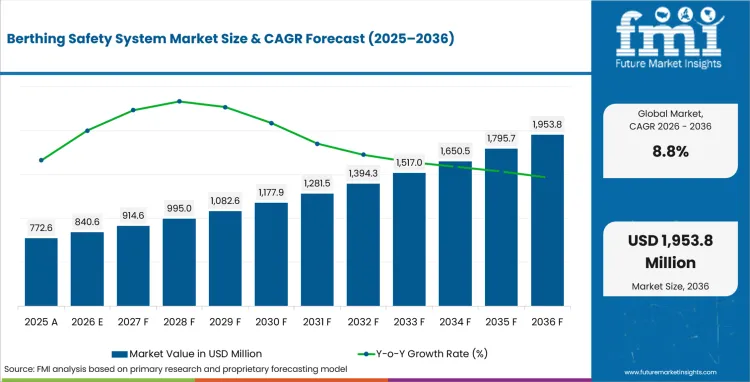
USD 840.6 million in 2026 and USD 1,953.8 million by 2036 at an 8.8% CAGR.
Berthing safety system industry value is anticipated to rise from USD 772.6 million in 2025 to USD 1,953.8 million by 2036 at 8.8% CAGR, led by ports convert docking visibility into measured operating control. Retrofit / modernization is projected to secure 56.0% share in 2026, guided by live-berth upgrades that avoid complete quay rebuilds. Port integrators are expected to hold 44.0% share in 2026, supported by control-room integration and terminal automation work.
| Metric | Value |
|---|---|
| 2026 Market Size | USD 840.6 million |
| 2036 Market Size | USD 1,953.8 million |
| Forecast CAGR (2026-2036) | 8.8% |
| Leading Installation | Retrofit / Modernization |
| Retrofit / Modernization Share (2026) | 56.0% |
| Leading Sales Channel | Port Integrators |
| Port Integrators Share (2026) | 44.0% |
| Fastest-growing Country | China |
| China CAGR by 2036 | 10.3% |
Summary of the Berthing Safety System Market
| Market Signal | Commercial Impact |
|---|---|
| Demand and Growth Drivers | Demand for berthing safety systems is expected to grow steadily through 2036 as ports modernize berths, improve operational visibility, and strengthen vessel approach safety.
|
| Product and Segment View | Retrofit projects, port integrators, and sensor technologies continue to lead their respective market segments.
|
| Geography and Growth Outlook | Asia continues to lead market expansion through large-scale port modernization and automation investments.
|
| Competitive Landscape | Competition increasingly focuses on integrated berth management, automation capabilities, and terminal-specific engineering expertise.
|
| Analyst Perspective | Berthing safety systems are evolving into essential port infrastructure as operators prioritize operational safety, digital integration, and real-time berth management.
- Nikhil Kaitwade, Principal Consultant for Industrial Automation at Future Market Insights |
Market outlook is shaped by container throughput and mooring automation. UN Trade and Development reported 920 million TEUs handled at ports worldwide in 2024, up 6.9% from 2023. Bureau of Transportation Statistics reported USA ports accounted for 41% of all imports and exports in 2024, totaling over USD 2.1 trillion. Cavotec signed a multi-million-euro MoorMaster NxG order for Port of Dublin in February 2025, with deliveries planned mainly for Q3 2026, showing how automated mooring projects can raise confidence in adjacent berth safety systems.
Which factors support expansion in the Berthing Safety System Market?
Berth productivity and control-room data needs support market value across ports and terminals.
- Market value rises as container terminals need real-time distance and approach-speed data during final vessel alignment.
- Retrofit packages support adoption as ports can automate one berth before expanding across full terminal areas.
- LNG and oil berths influence steady demand through emergency release context and auditable operating records.
- Port integrators promote demand for systems suited to terminal operating software and asset management tools.
Why is the Berthing Safety System Market growing?
High-value berth operations increase system demand as ports need measured vessel approach and reliable event records.
Berthing safety system buyers spend more on integrated platforms as berth windows tighten and approach mistakes can damage fenders and vessels. UN Trade and Development’s 2025 maritime review reported seaborne trade rose 2.2% in 2024, then was projected to slow to 0.5% in 2025 before averaging 2% annually during 2026 to 2030. Moderate trade expansion adds pressure on port productivity as larger vessels and tighter schedules leave limited room for docking delays. Suppliers that combine approach monitoring and operator training gain stronger acceptance in terminal investment decisions.
How is the Berthing Safety System Market segmented?
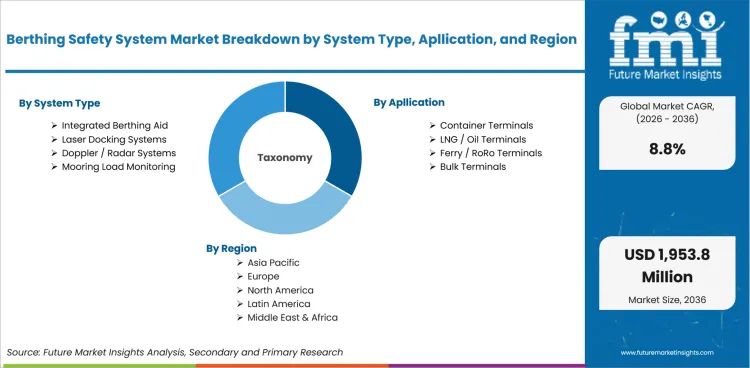
Berthing Safety System Market is segmented by system type, application, component, installation, and sales channel.
- Integrated berthing aid is projected to account for 38.0% share in 2026, influenced by ports combining approach and mooring data.
- Container terminals are expected to hold 39.0% share in 2026, shaped by crane productivity and vessel-position stability needs.
- Sensors are anticipated to account for 41.5% share in 2026, led by distance and line-load measurement.
- Retrofit / modernization is projected to hold 56.0% share in 2026, guided by phased upgrades across live terminals.
- Port integrators are expected to represent 44.0% share in 2026, supported by control-room connection and project packaging.
Why does Integrated Berthing Aid dominate the Berthing Safety System Market by system type?
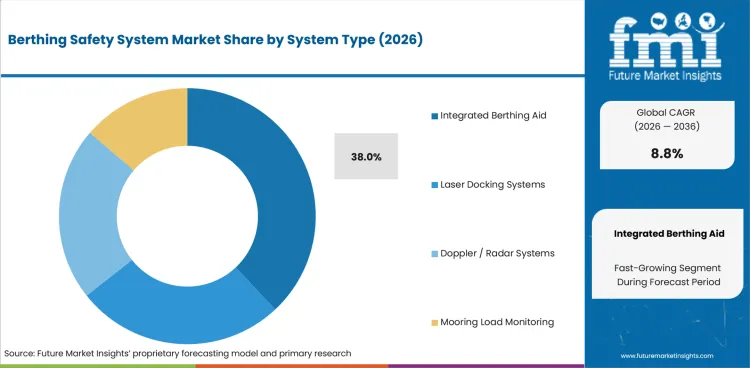
- Integrated berthing aid is projected to account for 38.0% share in 2026, driven by buyer preference for one platform combining distance and mooring-load records.
- Laser docking systems remain active as berth operators need precise distance and velocity data for routine container and ferry approaches.
Which application leads the Berthing Safety System Market?
- Container terminals are expected to hold 39.0% share in 2026, shaped by berth-window pressure and crane productivity requirements during vessel operations.
- LNG / oil terminals gain demand as transfer operations require emergency release context and dependable operator displays.
Which component leads the Berthing Safety System Market?
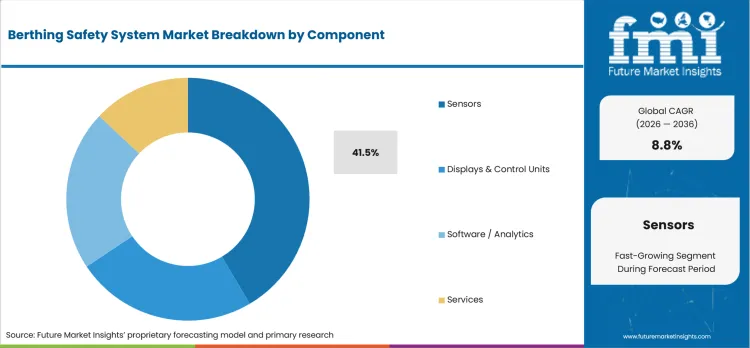
- Sensors are anticipated to account for 41.5% share in 2026, led by the need to measure vessel distance, approach velocity and line loads.
- Software / analytics gain attention as terminals request event replay and performance comparisons across berths.
Which installation type leads the Berthing Safety System Market?
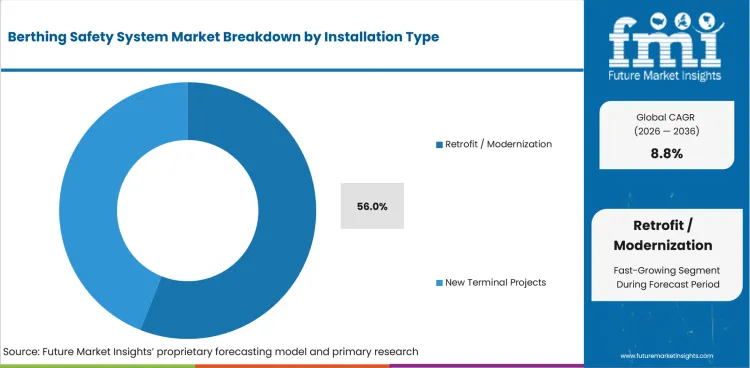
- Retrofit / modernization is projected to hold 56.0% share in 2026, reflected by active ports adding berth safety systems without rebuilding full marine structures.
- New terminal projects remain important as LNG jetties and automated terminals can specify berthing safety systems during engineering design.
Which sales channel leads the Berthing Safety System Market?
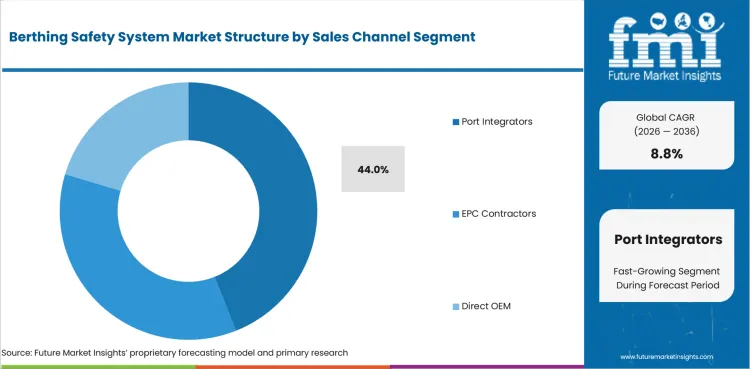
- Port integrators are expected to represent 44.0% share in 2026, guided by buyer preference for connected packages covering sensors and software interfaces.
- Direct OEM sales remain active for single-berth upgrades needing factory calibration and application-specific technical support.
What are the drivers, restraints, and opportunities in the Berthing Safety System Market?
Port automation and data-led terminal management are shaping berthing safety system buying decisions.
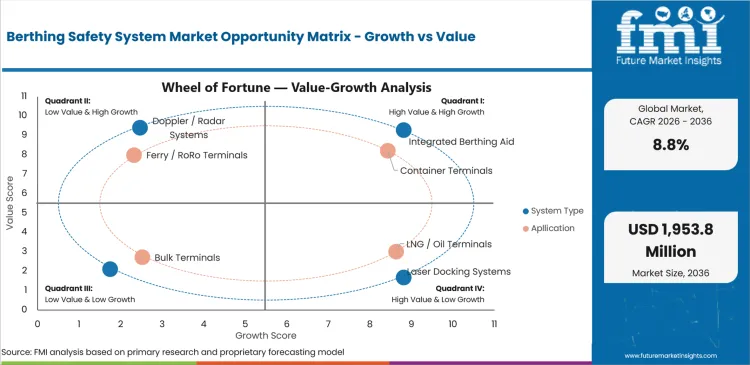
- Driver: High-throughput container and energy berths need shared approach data before safe and repeatable docking can be achieved.
- Restraint: Integration complexity can slow upgrades at older quays with limited cabling routes and mixed control-room systems.
- Opportunity: Sensor-linked berth records can improve renewal prospects as buyers request documented safety and uptime gains.
Berth Data Records Strengthen Safety Investment
Berth safety investment gains support as ports convert each vessel approach into a measurable operating event. IAPH reported in May 2025 that 69% of surveyed ports carried out physical infrastructure projects as planned, while another 22% experienced only minor delays. Such execution discipline supports berth technology upgrades that can be installed as part of wider terminal programs. Berthing safety vendors benefit as project teams view approach monitoring as part of terminal resilience rather than an optional pilot tool.
Control-Room Integration Raises Retrofit Barriers
Retrofit projects can face delays if older berths lack power access or display space. IAPH found that only 33% of surveyed ports had operational LNG rules and procedures for future fuel activity, while biofuels reached 24% operational status. Energy-transition work adds new terminal requirements and can compete for engineering resources. Berthing safety suppliers must simplify installation and operator handover to reduce delays in live-port environments.
Automated Mooring Creates Premium Upside
Automated mooring references create a stronger opening for integrated berth safety systems. Cavotec reported in August 2024 that its MoorMaster system at APM Terminals MedPort Tangier covered an 800-meter quay segment using 45 units after phase-three expansion. Such projects show how automated mooring and terminal productivity can be linked in buyer evaluation. Suppliers able to connect safety data with mooring hardware can defend premium bids against sensor-only alternatives.
Which countries are growing in the Berthing Safety System Market?
China 10.3% CAGR, India 9.6% CAGR, United States 8.7% CAGR, South Korea 8.5% CAGR, United Kingdom 8.2% CAGR, Germany 8.0% CAGR, France 7.8% CAGR, and Japan 7.6% CAGR through 2036.
.webp "Top Country Growth Comparison Berthing Safety System Market Cagr (2026 2036)")
| Country | CAGR |
|---|---|
| China | 10.3% |
| India | 9.6% |
| United States | 8.7% |
| South Korea | 8.5% |
| United Kingdom | 8.2% |
| Germany | 8.0% |
| France | 7.8% |
| Japan | 7.6% |
Source: Future Market Insights, 2026.
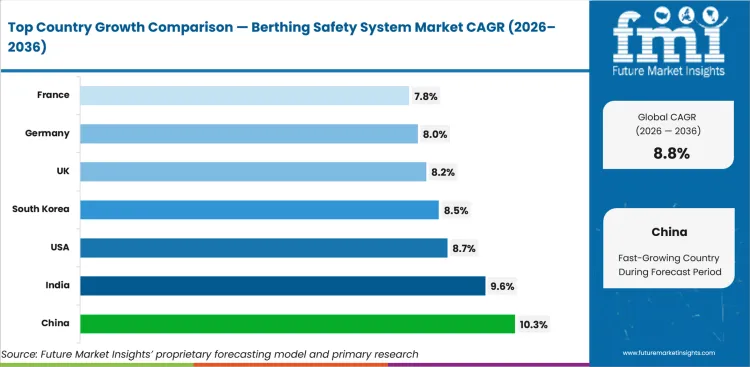
How do country-level CAGRs compare in the Berthing Safety System Market?
China leads country expansion while Japan records the most cautious pace among profiled markets.
- China is projected to record 10.3% CAGR by 2036, supported by mega-port scale and port automation programs.
- India is projected to record 9.6% CAGR by 2036, led by major-port capacity and PPP terminal upgrades.
- United States is projected to record 8.7% CAGR by 2036, reflected by trade value exposure and port performance reporting.
- South Korea is projected to record 8.5% CAGR by 2036, guided by container density and transshipment reliability needs.
- United Kingdom is projected to record 8.2% CAGR by 2036, influenced by private ports and energy terminals.
- Germany is projected to record 8.0% CAGR by 2036, supported by industrial logistics and precision engineering expectations.
- France is projected to record 7.8% CAGR by 2036, driven by container recovery and industrial port renewal.
- Japan is projected to record 7.6% CAGR by 2036, backed by reliability-led upgrades in a mature port network.
How fast is the Berthing Safety System Market growing in China?
An 10.3% CAGR through 2036 reflects china is differentiated by very large port scale and state-backed digital terminal programs.
Country Market Snapshot Table
| Parameter | Value |
|---|---|
| Market Size in 2025 (Value) | USD 190.6 million |
| Market Size in 2026 (Value) | USD 210.2 million |
| Market Forecast in 2036 (Value) | USD 560.3 million |
| CAGR (2026 to 2036) | 10.3% |
| Years Considered | 2021 to 2036 |
| Base Year | 2025 |
| Forecast Period | 2026 to 2036 |
| Units Considered | Value (USD million) |
| Leading Sub-Region | Yangtze River Delta, Pearl River Delta, Bohai Rim, Fujian, Shandong |
China Berthing Safety System Market Outlook
China berthing safety system industry is shaped by mega-port scale and terminal automation pilots. Buyers favor integrated berth control packages that connect approach speed and operating records.
Buyers are expected to favor suppliers combining port-equipment engineering and multi-berth support. State port groups will remain influential as terminals compare system reliability and integration with terminal automation.
Key Growth Drivers
- Mega-port throughput supports berth approach control, as the National Bureau of Statistics reported 2025 port freight of 18.3 billion tons and 354.47 million standard containers.
- Asian container concentration strengthens terminal automation spending, as UN Trade and Development reported developing Asian economies handled 61% of world port container traffic in 2023.
- State-owned port groups prefer berth systems that can connect pilots and after-event reviews.
- Energy and bulk berths need load alarms across large exposed terminals handling high-volume cargo flows.
Key Restraints
- Local price competition can compress margins for foreign docking aid suppliers selling without service partnerships.
- Large state tenders may extend validation steps before multi-berth deployment approvals.
- Cybersecurity screening adds technical hurdles, as IAPH found 62% of surveyed ports considered cyberattacks a high-risk factor in 2025.
What makes China unique
China is differentiated by very large port scale and state-backed digital terminal programs.
Key Companies
- Shanghai Zhenhua Heavy Industries
- Wuhan Marine Machinery Plant
- Nanjing High Accurate Marine Equipment
- Qingdao Haixi Heavy-Duty Machinery
- Jiangsu OUCO Heavy Industry
- Shandong Nanhai Airbag Engineering
- Hengtong Marine Cable Systems
Sales & Marketing Channels
- Direct technical proposals to port authorities
- Terminal operator engineering tenders
- Integrator-led automation programs
- EPC contractor packages for LNG, oil, and container berths
- Marine equipment distributor and service routes
- Pilot-trial selling for active berths
Country Segment Breakdown Table
| Segment | Sub-Segments |
|---|---|
| By System Type | Laser Docking Systems · Doppler / Radar Systems · Mooring Load Monitoring · Integrated Berthing Aid |
| By Application | Container Terminals · LNG / Oil Terminals · Ferry / RoRo Terminals · Bulk Terminals |
| By Component | Sensors · Displays & Control Units · Software / Analytics · Services |
| By Installation | New Terminal Projects · Retrofit / Modernization |
| By Sales Channel | Direct OEM · Port Integrators · EPC Contractors |
| Key Sub-Regions Covered, Port Corridors | Yangtze River Delta, Pearl River Delta, Bohai Rim, Fujian, Shandong |
Frequently Asked Questions
How fast is China Berthing Safety System Market growing?
China is expected to record an estimated 10.3% CAGR, supported by port modernization and berth safety priorities.
Who leads China Berthing Safety System Market?
Shanghai Zhenhua Heavy Industries is a key local port-equipment supplier, supported by Wuhan Marine Machinery Plant and Nanjing High Accurate Marine Equipment.
What is driving adoption in China Berthing Safety System Market?
Berth approach control and live-terminal retrofit needs are moving buyers toward integrated monitoring platforms.
How fast is the Berthing Safety System Market growing in India?
An 9.6% CAGR through 2036 reflects India combines cargo expansion and local marine equipment fabrication across west and east coast corridors.
Country Market Snapshot Table
| Parameter | Value |
|---|---|
| Market Size in 2025 (Value) | USD 76.7 million |
| Market Size in 2026 (Value) | USD 84.1 million |
| Market Forecast in 2036 (Value) | USD 210.3 million |
| CAGR (2026 to 2036) | 9.6% |
| Years Considered | 2021 to 2036 |
| Base Year | 2025 |
| Forecast Period | 2026 to 2036 |
| Units Considered | Value (USD million) |
| Leading Sub-Region | Gujarat, Maharashtra, Tamil Nadu, Andhra Pradesh, Odisha, Kerala |
India Berthing Safety System Market Outlook
India berthing safety system industry is shaped by major-port modernization and public-private terminal expansion. Buyers value phased retrofit packages that can operate inside active ports without lengthy berth shutdowns.
Buyers are expected to favor modular systems supported by local service teams and EPC partners. Port authorities and PPP operators will compare lifecycle support and fit with existing control rooms.
Key Growth Drivers
- Major port cargo expansion supports safer berth operations, as the Ministry of Ports, Shipping and Waterways reported roughly 855 million tonnes handled in FY 2024-25.
- Regional connectivity improved for Indian liner services, as IAPH reported India recorded a 5% Liner Shipping Connectivity Index gain in Q4 2024 against Q4 2023.
- PPP terminal upgrades create a route for berthing aid systems packed into automation and safety programs.
- Local marine fabrication and service teams improve confidence in maintenance-sensitive mooring hardware.
Key Restraints
- Public tender timelines can delay awards for berth safety systems not tied to mandatory civil packages.
- Price sensitivity can push buyers toward staged laser units before full integrated platforms.
- Capital discipline can slow private upgrades at active ports if berth safety is evaluated against berth capacity and equipment expansion, shown through Ministry data reporting cargo at Major Ports rising from 854.86 MMT in FY 2024-25 to 914.73 MMT in FY 2025-26, a 7.00% increase.
What makes India unique
India combines cargo expansion and local marine equipment fabrication across west and east coast corridors.
Key Companies
- Lion Rubber Industries
- IRM Offshore & Marine Engineers
- Hi-Tech Elastomers
- Marine Electricals India
- Larsen & Toubro
- Aeromarine Private Limited
- Nautilus Engineering & Construction
Sales & Marketing Channels
- Direct technical proposals to port authorities
- Terminal operator engineering tenders
- Integrator-led automation programs
- EPC contractor packages for LNG, oil, and container berths
- Marine equipment distributor and service routes
- Pilot-trial selling for active berths
Country Segment Breakdown Table
| Segment | Sub-Segments |
|---|---|
| By System Type | Laser Docking Systems · Doppler / Radar Systems · Mooring Load Monitoring · Integrated Berthing Aid |
| By Application | Container Terminals · LNG / Oil Terminals · Ferry / RoRo Terminals · Bulk Terminals |
| By Component | Sensors · Displays & Control Units · Software / Analytics · Services |
| By Installation | New Terminal Projects · Retrofit / Modernization |
| By Sales Channel | Direct OEM · Port Integrators · EPC Contractors |
| Key Sub-Regions Covered, Port Corridors | Gujarat, Maharashtra, Tamil Nadu, Andhra Pradesh, Odisha, Kerala |
Frequently Asked Questions
How fast is India Berthing Safety System Market growing?
India is expected to record an estimated 9.6% CAGR, supported by port modernization and berth safety priorities.
Who leads India Berthing Safety System Market?
Lion Rubber Industries is among India’s local marine equipment suppliers, supported by IRM Offshore & Marine Engineers and Hi-Tech Elastomers.
What is driving adoption in India Berthing Safety System Market?
Berth approach control and live-terminal retrofit needs are moving buyers toward integrated monitoring platforms.
How fast is the Berthing Safety System Market growing in United States?
An 8.7% CAGR through 2036 reflects united states demand is tied to waterborne trade value, vessel-call measurement, and diverse berth applications from containers to energy terminals.
Country Market Snapshot Table
| Parameter | Value |
|---|---|
| Market Size in 2025 (Value) | USD 139.2 million |
| Market Size in 2026 (Value) | USD 151.3 million |
| Market Forecast in 2036 (Value) | USD 348.4 million |
| CAGR (2026 to 2036) | 8.7% |
| Years Considered | 2021 to 2036 |
| Base Year | 2025 |
| Forecast Period | 2026 to 2036 |
| Units Considered | Value (USD million) |
| Leading Sub-Region | Gulf Coast, Pacific Coast, Atlantic Coast, Great Lakes |
United States Berthing Safety System Market Outlook
United States berthing safety system industry is shaped by high-value trade exposure and formal port performance reporting. Terminal operators ask for reliable records that connect vessel calls, berth safety, and incident review.
Buyers are expected to favor systems that can document vessel approaches and support risk reviews. Energy and bulk terminals will apply different evaluation criteria, so modular platform design remains important.
Key Growth Drivers
- Trade value supports berth-risk investment, as Bureau of Transportation Statistics reported USA ports accounted for 41% of all imports and exports in 2024, worth over USD 2.1 trillion.
- Port work creates a service case, as the same annual report recorded 164,900 people employed in waterborne transportation and support activities in 2024.
- Container gateways need approach records during dense berth windows at Pacific, Gulf, and Atlantic terminals.
- Energy terminals value measured line loads during wind and emergency-release planning.
Key Restraints
- Federal and port authority funding cycles can delay non-mandatory berth technology upgrades.
- Legacy quays may need additional electrical work before sensor mounting and display installation.
- Infrastructure budgets face competing demands, as ASCE’s 2025 Ports Report Card assigned the national ports sector a B grade while noting large investment needs.
What makes United States unique
United States demand is tied to waterborne trade value and diverse berth applications from containers to energy terminals.
Key Companies
- Glen Engineering
- Marine Fenders International
- Interface Inc.
- FenderTec
- Markey Machine
- Samson Rope Technologies
- Datrex
Sales & Marketing Channels
- Direct technical proposals to port authorities
- Terminal operator engineering tenders
- Integrator-led automation programs
- EPC contractor packages for LNG, oil, and container berths
- Marine equipment distributor and service routes
- Pilot-trial selling for active berths
Country Segment Breakdown Table
| Segment | Sub-Segments |
|---|---|
| By System Type | Laser Docking Systems · Doppler / Radar Systems · Mooring Load Monitoring · Integrated Berthing Aid |
| By Application | Container Terminals · LNG / Oil Terminals · Ferry / RoRo Terminals · Bulk Terminals |
| By Component | Sensors · Displays & Control Units · Software / Analytics · Services |
| By Installation | New Terminal Projects · Retrofit / Modernization |
| By Sales Channel | Direct OEM · Port Integrators · EPC Contractors |
| Key Sub-Regions Covered, Port Corridors | Gulf Coast, Pacific Coast, Atlantic Coast, Great Lakes |
Frequently Asked Questions
How fast is United States Berthing Safety System Market growing?
United States is expected to record an estimated 8.7% CAGR, supported by port modernization and berth safety priorities.
Who leads United States Berthing Safety System Market?
Glen Engineering is among United States mooring safety suppliers, supported by Marine Fenders International and Interface Inc.
What is driving adoption in United States Berthing Safety System Market?
Berth approach control and live-terminal retrofit needs are moving buyers toward integrated monitoring platforms.
How fast is the Berthing Safety System Market growing in South Korea?
An 8.5% CAGR through 2036 reflects South Korea links transshipment density and engineering validation across a compact port network.
Country Market Snapshot Table
| Parameter | Value |
|---|---|
| Market Size in 2025 (Value) | USD 46.5 million |
| Market Size in 2026 (Value) | USD 50.4 million |
| Market Forecast in 2036 (Value) | USD 114.0 million |
| CAGR (2026 to 2036) | 8.5% |
| Years Considered | 2021 to 2036 |
| Base Year | 2025 |
| Forecast Period | 2026 to 2036 |
| Units Considered | Value (USD million) |
| Leading Sub-Region | Busan, Incheon, Gwangyang, Ulsan, Pyeongtaek-Dangjin |
South Korea Berthing Safety System Market Outlook
South Korea berthing safety system industry is shaped by dense container operations and high technical validation. Busan’s transshipment role makes berth reliability a daily productivity issue.
Buyers are expected to favor validated systems that support transshipment schedules and documented safety checks. Local partners will shape integration and operator training across high-utilization terminals.
Key Growth Drivers
- National container density supports berth monitoring, as the Ministry of Oceans and Fisheries reported record Korean port volume of 31.73 million TEUs in 2024.
- Busan creates a strong terminal pull, as the city’s port data showed 24.402 million TEUs in 2024 and a 55.3% transshipment share.
- LNG and petrochemical berths encourage measured mooring loads during exposed transfer operations.
- Terminal operators prefer data logs that support crane planning and after-event safety reviews.
Key Restraints
- Local service expectations raise entry barriers for small overseas suppliers without Korean partners.
- High technical standards can extend pilot trials before multi-berth rollouts.
- Digital-port programs raise cybersecurity expectations, as IAPH found 62% of surveyed ports ranked cyberattacks as a high-risk factor in 2025.
What makes South Korea unique
South Korea links transshipment density and engineering validation across a compact port network.
Key Companies
- Hyundai Heavy Industries marine systems
- Daeyang Electric
- Dongkang M-Tech
- Kumho Marine Technology
- Sambo Marine Engineering
- Panasia
- NK Co.
Sales & Marketing Channels
- Direct technical proposals to port authorities
- Terminal operator engineering tenders
- Integrator-led automation programs
- EPC contractor packages for LNG, oil, and container berths
- Marine equipment distributor and service routes
- Pilot-trial selling for active berths
Country Segment Breakdown Table
| Segment | Sub-Segments |
|---|---|
| By System Type | Laser Docking Systems · Doppler / Radar Systems · Mooring Load Monitoring · Integrated Berthing Aid |
| By Application | Container Terminals · LNG / Oil Terminals · Ferry / RoRo Terminals · Bulk Terminals |
| By Component | Sensors · Displays & Control Units · Software / Analytics · Services |
| By Installation | New Terminal Projects · Retrofit / Modernization |
| By Sales Channel | Direct OEM · Port Integrators · EPC Contractors |
| Key Sub-Regions Covered, Port Corridors | Busan, Incheon, Gwangyang, Ulsan, Pyeongtaek-Dangjin |
Frequently Asked Questions
How fast is South Korea Berthing Safety System Market growing?
South Korea is expected to record an estimated 8.5% CAGR, supported by port modernization and berth safety priorities.
Who leads South Korea Berthing Safety System Market?
Hyundai Heavy Industries marine systems is among South Korea’s local marine suppliers, supported by Daeyang Electric and Dongkang M-Tech.
What is driving adoption in South Korea Berthing Safety System Market?
Berth approach control and live-terminal retrofit needs are moving buyers toward integrated monitoring platforms.
How fast is the Berthing Safety System Market growing in United Kingdom?
An 8.2% CAGR through 2036 reflects United Kingdom demand combines private port ownership and energy terminal risk management.
Country Market Snapshot Table
| Parameter | Value |
|---|---|
| Market Size in 2025 (Value) | USD 54.3 million |
| Market Size in 2026 (Value) | USD 58.8 million |
| Market Forecast in 2036 (Value) | USD 129.3 million |
| CAGR (2026 to 2036) | 8.2% |
| Years Considered | 2021 to 2036 |
| Base Year | 2025 |
| Forecast Period | 2026 to 2036 |
| Units Considered | Value (USD million) |
| Leading Sub-Region | Humber, Felixstowe, Southampton, Liverpool, London Gateway, Dover |
United Kingdom Berthing Safety System Market Outlook
United Kingdom berthing safety system industry is shaped by private port groups, ferry routes, and energy terminals. Buyers often favor practical retrofit systems that improve approach control without major civil works.
Buyers are expected to favor retrofit-ready systems that suit private port capital planning. Ferry operators and container gateways will prioritize service reliability and clear operator displays.
Key Growth Drivers
- Freight scale supports selected upgrades, as Department for Transport reported UK ports handled 429.7 million tonnes in 2024.
- Major ports concentrate buying activity, as Department for Transport recorded 421.0 million tonnes handled by major ports during 2024.
- Ferry and RoRo routes create repeated berthing cycles that benefit from clear approach displays.
- Energy terminals need better mooring visibility during tide and wind changes.
Key Restraints
- Mature freight volumes make buyers selective about non-essential technology spending.
- Harsh coastal sites raise service expectations for laser, radar, and display hardware.
- Volume pressure can delay discretionary projects, as UK port freight tonnage declined 1% in 2024 after a 5% decline in 2023.
What makes United Kingdom unique
United Kingdom demand combines private port ownership and energy terminal risk management.
Key Companies
- Fendercare Marine
- James Fisher Fendercare
- MacTaggart Scott
- Tidal Marine Electronics
- Balmoral Comtec
- Marine Specialised Technology
- North Sea Winches
Sales & Marketing Channels
- Direct technical proposals to port authorities
- Terminal operator engineering tenders
- Integrator-led automation programs
- EPC contractor packages for LNG, oil, and container berths
- Marine equipment distributor and service routes
- Pilot-trial selling for active berths
Country Segment Breakdown Table
| Segment | Sub-Segments |
|---|---|
| By System Type | Laser Docking Systems · Doppler / Radar Systems · Mooring Load Monitoring · Integrated Berthing Aid |
| By Application | Container Terminals · LNG / Oil Terminals · Ferry / RoRo Terminals · Bulk Terminals |
| By Component | Sensors · Displays & Control Units · Software / Analytics · Services |
| By Installation | New Terminal Projects · Retrofit / Modernization |
| By Sales Channel | Direct OEM · Port Integrators · EPC Contractors |
| Key Sub-Regions Covered, Port Corridors | Humber, Felixstowe, Southampton, Liverpool, London Gateway, Dover |
Frequently Asked Questions
How fast is United Kingdom Berthing Safety System Market growing?
United Kingdom is expected to record an estimated 8.2% CAGR, supported by port modernization and berth safety priorities.
Who leads United Kingdom Berthing Safety System Market?
Fendercare Marine is among United Kingdom marine equipment suppliers, supported by James Fisher Fendercare and MacTaggart Scott.
What is driving adoption in United Kingdom Berthing Safety System Market?
Berth approach control, mooring safety, and live-terminal retrofit needs are moving buyers toward integrated monitoring platforms.
How fast is the Berthing Safety System Market growing in Germany?
An 8.0% CAGR through 2036 reflects germany pairs industrial cargo density with precise engineering expectations and limited port expansion space.
Country Market Snapshot Table
| Parameter | Value |
|---|---|
| Market Size in 2025 (Value) | USD 62.2 million |
| Market Size in 2026 (Value) | USD 67.2 million |
| Market Forecast in 2036 (Value) | USD 145.1 million |
| CAGR (2026 to 2036) | 8.0% |
| Years Considered | 2021 to 2036 |
| Base Year | 2025 |
| Forecast Period | 2026 to 2036 |
| Units Considered | Value (USD million) |
| Leading Sub-Region | Hamburg, Bremerhaven, Wilhelmshaven, Rostock, Kiel |
Germany Berthing Safety System Market Outlook
Germany berthing safety system industry is shaped by industrial logistics and restrained quay footprints. Terminal buyers favor precise data and engineering support around brownfield installation.
Buyers are expected to favor engineered packages that suit constrained quays and high-utilization container berths. Service documentation and integration discipline will influence award decisions.
Key Growth Drivers
- Port activity supports berth control, as the Federal Statistical Office recorded 269.753 million tonnes of sea goods transport in 2024.
- Containerized freight creates a targeted demand base, as Eurostat placed Germany among Europe’s top container countries with 109 million tonnes in 2024.
- Space-constrained terminals value systems that improve berth use without quay expansion.
- Industrial and automotive flows require predictable vessel alignment and equipment protection.
Key Restraints
- Brownfield quays can require tailored mounting, cabling, and control-room integration work.
- Conservative buyer validation can extend approval cycles for unfamiliar sensor packages.
- European connectivity pressure can affect investment timing, as IAPH reported Q4 2024 LSCI declines across most top-connected European locations.
What makes Germany unique
Germany pairs industrial cargo density with precise engineering expectations and limited port expansion space.
Key Companies
- Kloska Group
- Jastram Engineering
- Becker Marine Systems
- SAM Electronics marine service partners
- Fritz Heitmann marine equipment
- Hatecke Service
- Liebherr-MCCtec Rostock
Sales & Marketing Channels
- Direct technical proposals to port authorities
- Terminal operator engineering tenders
- Integrator-led automation programs
- EPC contractor packages for LNG, oil, and container berths
- Marine equipment distributor and service routes
- Pilot-trial selling for active berths
Country Segment Breakdown Table
| Segment | Sub-Segments |
|---|---|
| By System Type | Laser Docking Systems · Doppler / Radar Systems · Mooring Load Monitoring · Integrated Berthing Aid |
| By Application | Container Terminals · LNG / Oil Terminals · Ferry / RoRo Terminals · Bulk Terminals |
| By Component | Sensors · Displays & Control Units · Software / Analytics · Services |
| By Installation | New Terminal Projects · Retrofit / Modernization |
| By Sales Channel | Direct OEM · Port Integrators · EPC Contractors |
| Key Sub-Regions Covered, Port Corridors | Hamburg, Bremerhaven, Wilhelmshaven, Rostock, Kiel |
Frequently Asked Questions
How fast is Germany Berthing Safety System Market growing?
Germany is expected to record an estimated 8.0% CAGR, supported by port modernization and berth safety priorities.
Who leads Germany Berthing Safety System Market?
Kloska Group is among Germany’s marine equipment suppliers, supported by Jastram Engineering and Becker Marine Systems.
What is driving adoption in Germany Berthing Safety System Market?
Berth approach control and live-terminal retrofit needs are moving buyers toward integrated monitoring platforms.
How fast is the Berthing Safety System Market growing in France?
An 7.8% CAGR through 2036 reflects france combines container recovery, energy terminal renewal, and a small group of high-impact gateways.
Country Market Snapshot Table
| Parameter | Value |
|---|---|
| Market Size in 2025 (Value) | USD 50.6 million |
| Market Size in 2026 (Value) | USD 54.6 million |
| Market Forecast in 2036 (Value) | USD 115.7 million |
| CAGR (2026 to 2036) | 7.8% |
| Years Considered | 2021 to 2036 |
| Base Year | 2025 |
| Forecast Period | 2026 to 2036 |
| Units Considered | Value (USD million) |
| Leading Sub-Region | Le Havre, Marseille-Fos, Dunkirk, Rouen, Nantes-Saint-Nazaire |
France Berthing Safety System Market Outlook
France berthing safety system industry is shaped by container rebound, industrial port renewal, and concentrated gateway ownership. Project demand is most active around Le Havre, Marseille-Fos, and Dunkirk corridors.
Buyers are expected to favor projects linked to container and energy-port renewal. Integration with local port systems and engineering contractors will influence timing and supplier selection.
Key Growth Drivers
- National freight scale supports selective upgrades, as official French transport statistics reported 325.5 million tonnes of maritime freight in 2024.
- Seine-corridor container demand adds retrofit urgency, as HAROPA PORT recorded 39.9 million tonnes in first-half 2025 and 1.51 million TEUs in containers.
- Industrial port renewal raises demand for safer berth operations near energy and bulk projects.
- Concentrated port ownership allows larger technology programs after strategy approval.
Key Restraints
- Competition from Northern European hubs can pressure capital allocation for non-core berth upgrades.
- Operating disruption risk can delay sensor installation at busy container berths.
- Traffic softness affects timing, as HAROPA PORT first-half 2025 maritime traffic was down 4.9% despite container gains.
What makes France unique
France combines container recovery and a small group of high-impact gateways.
Key Companies
- ETPO maritime works
- Soget port systems
- Eiffage Génie Civil Marine
- Clemessy marine automation
- Actemium Port Solutions France
- Sirehna naval systems
- Piriou marine engineering
Sales & Marketing Channels
- Direct technical proposals to port authorities
- Terminal operator engineering tenders
- Integrator-led automation programs
- EPC contractor packages for LNG, oil, and container berths
- Marine equipment distributor and service routes
- Pilot-trial selling for active berths
Country Segment Breakdown Table
| Segment | Sub-Segments |
|---|---|
| By System Type | Laser Docking Systems · Doppler / Radar Systems · Mooring Load Monitoring · Integrated Berthing Aid |
| By Application | Container Terminals · LNG / Oil Terminals · Ferry / RoRo Terminals · Bulk Terminals |
| By Component | Sensors · Displays & Control Units · Software / Analytics · Services |
| By Installation | New Terminal Projects · Retrofit / Modernization |
| By Sales Channel | Direct OEM · Port Integrators · EPC Contractors |
| Key Sub-Regions Covered, Port Corridors | Le Havre, Marseille-Fos, Dunkirk, Rouen, Nantes-Saint-Nazaire |
Frequently Asked Questions
How fast is France Berthing Safety System Market growing?
France is expected to record an estimated 7.8% CAGR, supported by port modernization and berth safety priorities.
Who leads France Berthing Safety System Market?
ETPO maritime works is among France’s maritime engineering suppliers, supported by Soget port systems and Eiffage Génie Civil Marine.
What is driving adoption in France Berthing Safety System Market?
Berth approach control, mooring safety, and live-terminal retrofit needs are moving buyers toward integrated monitoring platforms.
How fast is the Berthing Safety System Market growing in Japan?
An 7.6% CAGR through 2036 reflects Japan stands out for local marine electronics capability and reliability-led buying criteria.
Country Market Snapshot Table
| Parameter | Value |
|---|---|
| Market Size in 2025 (Value) | USD 54.6 million |
| Market Size in 2026 (Value) | USD 58.8 million |
| Market Forecast in 2036 (Value) | USD 122.3 million |
| CAGR (2026 to 2036) | 7.6% |
| Years Considered | 2021 to 2036 |
| Base Year | 2025 |
| Forecast Period | 2026 to 2036 |
| Units Considered | Value (USD million) |
| Leading Sub-Region | Tokyo Bay, Yokohama, Nagoya, Osaka, Kobe, Hakata |
Japan Berthing Safety System Market Outlook
Japan berthing safety system industry is shaped by mature ports and premium marine engineering. Buyers prioritize proven operation during frequent ferry and container calls.
Buyers are expected to favor proven systems from suppliers able to satisfy service and operational reliability expectations. Local electronics and marine engineering relationships will influence deployments.
Key Growth Drivers
- Container activity supports reliability-led upgrades, as MLIT reported Japan’s domestic port container handling at 21.98 million TEUs in 2024, up 0.9% year over year.
- Digital mooring demonstrations strengthen local confidence in berth monitoring. Kawasaki and NS United Kaiun launched a 2026 mooring-management demonstration on the bulk carrier SAKURA BRIGHT, a 99,623-deadweight-ton vessel, using a tension monitoring system.
- Ferry and RoRo operators need predictable berth alignment during repeated daily calls.
- LNG terminals value measured mooring conditions around transfer safety and weather windows.
Key Restraints
- Conservative replacement cycles can slow adoption across stable ports.
- Local service and certification expectations can limit smaller foreign vendors.
- Cargo softness can slow payback decisions, as Port of Nagoya reported 157 million tons in 2024, down 0.7% year over year.
What makes Japan unique
Japan stands out for local marine electronics capability and reliability-led buying criteria.
Key Companies
- Kawasaki Heavy Industries
- Yokohama Rubber marine products
- Furuno Electric
- Japan Radio Co.
- Mitsui E&S
- Tokyo Keiki
- Mitsubishi Heavy Industries Marine Machinery
Sales & Marketing Channels
- Direct technical proposals to port authorities
- Terminal operator engineering tenders
- Integrator-led automation programs
- EPC contractor packages for LNG, oil, and container berths
- Marine equipment distributor and service routes
- Pilot-trial selling for active berths
Country Segment Breakdown Table
| Segment | Sub-Segments |
|---|---|
| By System Type | Laser Docking Systems · Doppler / Radar Systems · Mooring Load Monitoring · Integrated Berthing Aid |
| By Application | Container Terminals · LNG / Oil Terminals · Ferry / RoRo Terminals · Bulk Terminals |
| By Component | Sensors · Displays & Control Units · Software / Analytics · Services |
| By Installation | New Terminal Projects · Retrofit / Modernization |
| By Sales Channel | Direct OEM · Port Integrators · EPC Contractors |
| Key Sub-Regions Covered, Port Corridors | Tokyo Bay, Yokohama, Nagoya, Osaka, Kobe, Hakata |
Frequently Asked Questions
How fast is Japan Berthing Safety System Market growing?
Japan is expected to record an estimated 7.6% CAGR, supported by port modernization and berth safety priorities.
Who leads Japan Berthing Safety System Market?
Kawasaki Heavy Industries is among Japan’s local marine technology suppliers, supported by Yokohama Rubber marine products and Furuno Electric.
What is driving adoption in Japan Berthing Safety System Market?
Berth approach control and live-terminal retrofit needs are moving buyers toward integrated monitoring platforms.
Who are the leading companies in the Berthing Safety System Market?
Trelleborg Marine & Infrastructure, Cavotec, Straatman Mooring Systems, Prosertek and Glen Engineering.
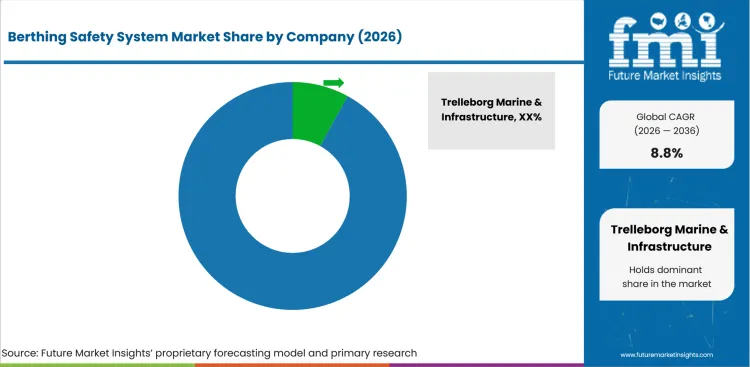
- Established marine infrastructure companies hold an advantage led by fender engineering and service programs.
- System-linked suppliers gain stronger acceptance by combining berth approach monitoring and operator training.
- Regional marine equipment suppliers win in country markets depending on installation support and port engineering relationships.
- Service-ready suppliers improve renewal chances through live-berth trials and control-room troubleshooting.
Marine safety system companies compete by combining berthing aid systems and service programs. Trelleborg Marine & Infrastructure has a strong position through docking aid and SmartDAS capabilities. Cavotec competes through MoorMaster automated mooring and terminal electrification systems. Straatman Mooring Systems and Prosertek hold value across quick release hooks, mooring load monitoring, and berth-specific engineering.
Manufacturing and technical service depth have become stronger competitive separators as ports move beyond basic approach displays. Glen Engineering competes through quick release hooks and mooring load monitoring. Kawasaki Heavy Industries strengthens competition based on mooring-line tension monitoring and marine engineering support. Buyers compare supplier performance through alarm clarity, sensor reliability and local service response.
Smaller and regional suppliers can win through local port knowledge and faster field support. China, India, and South Korea create opportunities for suppliers operating marine equipment service networks and integrator partnerships. United States and Europe create stronger demand for flexible systems suited to retrofit projects and energy terminals. Companies proving safer vessel approach and lower installation disruption should gain more durable port relationships.
How do top Berthing Safety System companies compare?
Trelleborg Marine & Infrastructure and Cavotec score on system depth while Straatman Mooring Systems and Prosertek lead through mooring safety capability.
| Company | Relevance to Market Title | System Portfolio Depth | Mooring Safety Strength | Automation Support | Channel Reach | Geographic Footprint |
|---|---|---|---|---|---|---|
| Trelleborg Marine & Infrastructure | Very High | Very Strong | Strong | Strong | Very Strong | Global |
| Cavotec | Very High | Strong | Very Strong | Very Strong | Strong | Global |
| Straatman Mooring Systems | Very High | Strong | Very Strong | Strong | Strong | Europe and global terminals |
| Prosertek | Very High | Strong | Very Strong | Strong | Moderate | Europe and global terminals |
| Glen Engineering | High | Moderate | Strong | Moderate | Moderate | United States and selected export markets |
| Kawasaki Heavy Industries | High | Moderate | Strong | Strong | Strong | Japan and Asian terminals |
| SETI Equipos | High | Strong | Moderate | Moderate | Moderate | Europe and selected export markets |
| United Marine Technology | Moderate to High | Moderate | Moderate | Moderate | Moderate | Asia and selected export markets |
Source: Future Market Insights competitive analysis, 2026.
Who are the key players in the Berthing Safety System Market?
Trelleborg Marine & Infrastructure, Cavotec and Straatman Mooring Systems are listed with Prosertek and Glen Engineering among other suppliers.
Key global companies leading the Berthing Safety System Market include:
- Trelleborg Marine & Infrastructure
- Cavotec
- Straatman Mooring Systems
- Prosertek
- Glen Engineering
- Kawasaki Heavy Industries
- SETI Equipos
- United Marine Technology
- Fendercare Marine
- James Fisher Fendercare
Key Developments in Berthing Safety System Market
- In July 2025, Trelleborg Marine & Infrastructure introduced SmartDAS as a compact laser-based docking aid system for vessel distance, velocity, and approach-angle monitoring.
- In February 2025, Cavotec signed a multi-million-euro MoorMaster NxG order for Port of Dublin, marking Ireland’s first MoorMaster technology deployment.
- In April 2024, Kawasaki Heavy Industries released a mooring-line tension monitoring system for safe berthing and unberthing support.
Key Players in the Berthing Safety System Market
Integrated Berthing and Docking Specialists
- Trelleborg Marine & Infrastructure
- Prosertek
- United Marine Technology
- SETI Equipos
Automated Mooring and Load Monitoring Providers
- Cavotec
- Straatman Mooring Systems
- Glen Engineering
- Kawasaki Heavy Industries
Marine Equipment and Service Suppliers
- Fendercare Marine
- James Fisher Fendercare
- Interface Force Measurements
- Yokohama Rubber marine products
Berthing Safety System Market - Report Scope
| Parameter | Details |
|---|---|
| Forecast period | 2026 to 2036 |
| Historical period | 2021 to 2025 |
| Quantitative unit | Revenue in USD million |
| By system type | Laser Docking Systems, Doppler / Radar Systems, Mooring Load Monitoring, Integrated Berthing Aid |
| By application | Container Terminals, LNG / Oil Terminals, Ferry / RoRo Terminals, Bulk Terminals |
| By component | Sensors, Displays & Control Units, Software / Analytics, Services |
| By installation | New Terminal Projects, Retrofit / Modernization |
| By sales channel | Direct OEM, Port Integrators, EPC Contractors |
| Regions covered | North America, Latin America, Europe, East Asia, South Asia and Pacific, Middle East and Africa |
| Countries covered | China, India, United States, South Korea, United Kingdom, Germany, France, Japan |
| Key companies profiled | Trelleborg Marine & Infrastructure, Cavotec, Straatman Mooring Systems, Prosertek, Glen Engineering, Kawasaki Heavy Industries, Fendercare Marine, James Fisher Fendercare |
| Approach | Bottom-up equipment revenue approach using berth counts, system pricing, application mix, retrofit rates, supplier portfolios, and country-level port activity |
Source: Future Market Insights competitive analysis, 2026.
Berthing Safety System Market - Scope & Definition
| Attribute | Detail |
|---|---|
| Market Definition | Berth-side systems used to measure, display, alarm, record, and improve vessel approach and mooring safety at ports and terminals |
| Functions Covered | Vessel distance measurement, approach-speed monitoring, angle tracking, mooring-load monitoring, alarm management, operator displays, data logging, and safety review |
| Applications Covered | Container berth docking, LNG berth docking, oil terminal mooring, ferry berth alignment, RoRo berth operations, bulk berth safety, and control-room berth monitoring |
| End-Use Industries | Port authorities, terminal operators, LNG terminals, oil terminals, container terminals, ferry operators, bulk terminals, EPC contractors, and port integrators |
| Grades Covered | Laser docking systems, Doppler / radar systems, mooring load monitoring systems, integrated berthing aid platforms, control displays, and analytics services |
| Inclusions | All commercially supplied berthing safety systems across system type, application, component, installation, sales channel, and selected country coverage |
| Exclusions | Standalone marine fenders, shipboard radar, vessel navigation suites, tug services, conventional mooring ropes, port civil works, and terminal software without berth safety functions |
Berthing Safety System Market - Research Methodology
| Method | Description |
|---|---|
| Primary Research | FMI analyst interviews with port authorities, terminal operators, pilots, EPC contractors, port integrators, marine infrastructure suppliers, and safety-system service providers |
| Desk Research | Review of official port statistics, maritime agency data, port safety guidance, company product information, and verified supplier publications |
| Market Sizing & Forecasting | Bottom-up equipment revenue approach using berth counts, application mix, system price bands, retrofit rates, and country-level port activity |
| Data Validation | Cross-verification using supplier portfolios, public port throughput, vessel-call indicators, cargo trends, automated mooring references, and port modernization signals |
Berthing Safety System Market Breakdown by System Type, Application, Component, Installation, Sales Channel, and Region
Berthing Safety System Market Segmented by System Type
- Laser Docking Systems
- Doppler / Radar Systems
- Mooring Load Monitoring
- Integrated Berthing Aid
Berthing Safety System Market Segmented by Application
- Container Terminals
- LNG / Oil Terminals
- Ferry / RoRo Terminals
- Bulk Terminals
Berthing Safety System Market Segmented by Component
- Sensors
- Displays & Control Units
- Software / Analytics
- Services
Berthing Safety System Market Segmented by Installation
- New Terminal Projects
- Retrofit / Modernization
Berthing Safety System Market Segmented by Sales Channel
- Direct OEM
- Port Integrators
- EPC Contractors
Berthing Safety System Market by Region
- North America
- Latin America
- Europe
- East Asia
- South Asia and Pacific
- Middle East and Africa
Research Sources and Bibliography
- American Society of Civil Engineers. (2025, March). 2025 infrastructure report card: Ports.
- Bureau of Transportation Statistics. (2026, January). Port performance freight statistics: 2026 annual report. USA Department of Transportation.
- Busan Metropolitan City. (2025). Container processing: Status of Busan Port.
- Cavotec. (2024, August 21). Cavotec commissions MoorMaster system in APM Terminals MedPort Tangier’s 800 m expansion.
- Cavotec. (2025, February 10). Cavotec signs order for automated mooring system for Port of Dublin.
- Department for Transport. (2025, July 30). Port freight annual statistics 2024.
- Eurostat. (2025, September). Maritime transport of goods - annual data.
- Federal Statistical Office of Germany. (2026). Maritime transport values.
- HAROPA PORT. (2025, July 18). 2025 half-year traffic: HAROPA PORT maintains strong momentum in container traffic.
- International Association of Ports and Harbors. (2025, May 23). World Ports Tracker identifies sustainability and market trends.
- International Association of Ports and Harbors. (2026, April 23). World Ports Tracker 2026 reveals state of global port sustainability.
- International Maritime Organization. (2024, January 31). Maritime Single Window: Advancing digitalization in shipping.
- Kawasaki Heavy Industries. (2024, April 8). Kawasaki releases a tension monitoring system for mooring line for its safe berthing and unberthing assist system.
- Kawasaki Heavy Industries. (2026, May 14). Successful demonstration of the safe berthing and unberthing assist system.
- Ministry of Land, Infrastructure, Transport and Tourism. (2025, August). Domestic port container cargo handling volume in 2024: Preliminary figures.
- Ministry of Oceans and Fisheries, Republic of Korea. (2025, January 24). Korea’s ports handle record-high container volume of 31.73 million TEUs in 2024.
- Ministry of Ports, Shipping and Waterways. (2025, May 13). India’s major ports achieve historic milestones in FY 2024-25.
- Ministry of Ports, Shipping and Waterways. (2026). Transport Research Wing: Cargo handled at Major Ports during April-March 2025-26.
- Ministry of Trade, Industry and Resources, Republic of Korea. (2026, January 2). Korea’s annual exports reach new highs in 2025.
- National Bureau of Statistics of China. (2026, February 28). Statistical communiqué of the People’s Republic of China on the 2025 national economic and social development.
- Port of Nagoya Authority. (2025). Statistics 2025.
- Prosertek. (2024, July 26). Berthing Aid System: Benefits and operation of Prosertek’s BAS system.
- Trelleborg Marine & Infrastructure. (2025, July 21). Trelleborg transforms port operations through data-led decision-making.
- UN Trade and Development. (2025, March 24). Maritime and other transport: Data insights.
- UN Trade and Development. (2025, September 24). Review of Maritime Transport 2025: Staying the course in turbulent waters.
- World Trade Organization. (2026, March 10). Global trade outlook and statistics.
This bibliography is provided for reader reference and is not exhaustive. The full report contains the complete reference list and detailed citations.
This Report Answers
- Market size estimates for 2026 and forecasts through 2036 for the Berthing Safety System Market.
- Insights across regional and country-level berth safety and port automation markets.
- Analysis of demand drivers and purchasing behavior.
- Evaluation of system types, applications, components, installations, and sales channels.
- Assessment of container terminal and bulk terminal needs.
- Identification of opportunities across integrated berthing aid and retrofit modernization.
- Evaluation of port integrator models and direct OEM machinery channels.
- Country-level analysis covering China, India, United States, South Korea, United Kingdom, Germany, France, and Japan.
- Assessment of competition, including docking aid and mooring load monitoring suppliers.
- Analysis of terminal-level decision drivers and service criteria.
- Regional outlooks across North America, Europe, East Asia, South Asia and Pacific, Latin America, and Middle East and Africa.
- Delivery of market data, forecasts, and supporting analysis in report-ready format.
Frequently Asked Questions
What is the growth prospect for berthing safety systems?
Demand for berthing safety systems is expected to rise at a strong pace as ports add approach monitoring and event records.
Which companies are expected to shape the Berthing Safety System Market?
Trelleborg Marine & Infrastructure, Cavotec, Straatman Mooring Systems, Prosertek, Glen Engineering, and Kawasaki Heavy Industries are expected to shape competition through system depth and service support.
Why are ports investing in berthing safety systems?
Ports are investing in berthing safety systems to protect quay assets and document berth events for safety review.
Why are port integrators important in the Berthing Safety System Market?
Port integrators are important since buyers often need sensors and terminal-control connections delivered as one package.
Which system formats are gaining attention in berthing safety systems?
Integrated berthing aid systems and mooring load monitoring systems are gaining attention as terminals target safer vessel approach and reliable alongside operations.
How does terminal automation influence berthing safety system demand?
Terminal automation influences demand through control-room visibility and stronger need for operating records.
Why is application type important for berthing safety systems?
Application type is important since container and bulk terminals need different sensor layouts and alarm priorities.
What role does retrofit modernization play in berthing safety system adoption?
Retrofit modernization supports adoption by allowing active ports to add berth safety systems without rebuilding full marine structures.
Preview the report firsthand - request a free sample
Get SampleGet the brochure for pricing and purchase details.
Get PDFTable of Content
- Key Takeaways
- Market Size and CAGR
- Top Growth Driver
- Fastest Growing Segment
- Leading Region
- Key Companies
- Emerging Opportunities
- Executive Summary
- Global Market Outlook
- Demand-side Trends
- Supply-side Trends
- Technology Roadmap Analysis
- Analysis and Recommendations
- Analyst Perspective (What is happening? Why now? What should investors know?)
- Key Questions Answered
- How large is the market?
- What is the CAGR?
- What are key trends?
- Which region dominates?
- Who are the leaders?
- Market Overview
- Market Coverage / Taxonomy
- Market Definition / Scope / Limitations
- Research Methodology
- Chapter Orientation
- Analytical Lens and Working Hypotheses
- Market Structure, Signals, and Trend Drivers
- Benchmarking and Cross-market Comparability
- Market Sizing, Forecasting, and Opportunity Mapping
- Research Design and Evidence Framework
- Desk Research Programme (Secondary Evidence)
- Expert Input and Fieldwork (Primary Evidence)
- Tooling, Models, and Reference Databases
- Data Engineering and Model Build
- Quality Assurance and Audit Trail
- Market Background
- Market Dynamics (Drivers, Restraints, Opportunity, Trends)
- Scenario Forecast (Optimistic, Likely, Conservative)
- Impact Analysis
- AI Impact
- Sustainability Impact
- Regulatory Impact
- Technology Impact
- Consumer / Buyer Analysis
- Purchase Drivers
- Adoption Barriers
- Buyer Journey
- Opportunity Map Analysis
- Product Life Cycle Analysis
- Supply Chain Analysis
- Investment Feasibility Matrix
- Value Chain Analysis
- PESTLE and Porter's Analysis
- Regulatory Landscape
- Regional Parent Market Outlook
- Production and Consumption Statistics
- Import and Export Statistics
- Global Market Analysis and Forecast, 2021 to 2036
- Historical Market Size Value (USD Million) & Volume (Unit) Analysis, 2021 to 2025
- Current and Future Market Size Value (USD Million) & Volume (Unit) Projections, 2026 to 2036
- Y-o-Y Growth Trend Analysis
- Absolute $ Opportunity Analysis
- Global Market Pricing Analysis, 2021 to 2036
- Global Market Analysis and Forecast, By System Type, 2021 to 2036
- Introduction / Key Findings
- Historical Market Size Value (USD Million) & Volume (Unit) Analysis By System Type, 2021 to 2025
- Current and Future Market Size Value (USD Million) & Volume (Unit) Analysis and Forecast By System Type, 2026 to 2036
- Integrated Berthing Aid
- Laser Docking Systems
- Doppler / Radar Systems
- Mooring Load Monitoring
- Integrated Berthing Aid
- Y-o-Y Growth Trend Analysis By System Type, 2021 to 2025
- Absolute $ Opportunity Analysis By System Type, 2026 to 2036
- Global Market Analysis and Forecast, By Apllication, 2021 to 2036
- Introduction / Key Findings
- Historical Market Size Value (USD Million) & Volume (Unit) Analysis By Apllication, 2021 to 2025
- Current and Future Market Size Value (USD Million) & Volume (Unit) Analysis and Forecast By Apllication, 2026 to 2036
- Container Terminals
- LNG / Oil Terminals
- Ferry / RoRo Terminals
- Bulk Terminals
- Container Terminals
- Y-o-Y Growth Trend Analysis By Apllication, 2021 to 2025
- Absolute $ Opportunity Analysis By Apllication, 2026 to 2036
- Global Market Analysis and Forecast, By Component, 2021 to 2036
- Introduction / Key Findings
- Historical Market Size Value (USD Million) & Volume (Unit) Analysis By Component, 2021 to 2025
- Current and Future Market Size Value (USD Million) & Volume (Unit) Analysis and Forecast By Component, 2026 to 2036
- Sensors
- Displays & Control Value (USD Million) & Volume (Unit)s
- Software / Analytics
- Services
- Sensors
- Y-o-Y Growth Trend Analysis By Component, 2021 to 2025
- Absolute $ Opportunity Analysis By Component, 2026 to 2036
- Global Market Analysis and Forecast, By Installation Type, 2021 to 2036
- Introduction / Key Findings
- Historical Market Size Value (USD Million) & Volume (Unit) Analysis By Installation Type, 2021 to 2025
- Current and Future Market Size Value (USD Million) & Volume (Unit) Analysis and Forecast By Installation Type, 2026 to 2036
- Retrofit / Modernization
- New Terminal Projects
- Retrofit / Modernization
- Y-o-Y Growth Trend Analysis By Installation Type, 2021 to 2025
- Absolute $ Opportunity Analysis By Installation Type, 2026 to 2036
- Global Market Analysis and Forecast, By Sales Channel, 2021 to 2036
- Introduction / Key Findings
- Historical Market Size Value (USD Million) & Volume (Unit) Analysis By Sales Channel, 2021 to 2025
- Current and Future Market Size Value (USD Million) & Volume (Unit) Analysis and Forecast By Sales Channel, 2026 to 2036
- Port Integrators
- EPC Contractors
- Direct OEM
- Port Integrators
- Y-o-Y Growth Trend Analysis By Sales Channel, 2021 to 2025
- Absolute $ Opportunity Analysis By Sales Channel, 2026 to 2036
- Global Market Analysis and Forecast, By Region, 2021 to 2036
- Introduction
- Historical Market Size Value (USD Million) & Volume (Unit) Analysis By Region, 2021 to 2025
- Current Market Size Value (USD Million) & Volume (Unit) Analysis and Forecast By Region, 2026 to 2036
- North America
- Latin America
- Western Europe
- Eastern Europe
- East Asia
- South Asia and Pacific
- Middle East & Africa
- Market Attractiveness Analysis By Region
- North America Market Analysis and Forecast, By Country, 2021 to 2036
- Historical Market Size Value (USD Million) & Volume (Unit) Trend Analysis By Market Taxonomy, 2021 to 2025
- Market Size Value (USD Million) & Volume (Unit) Forecast By Market Taxonomy, 2026 to 2036
- By Country
- USA
- Canada
- Mexico
- By System Type
- By Apllication
- By Component
- By Installation Type
- By Sales Channel
- By Country
- Market Attractiveness Analysis
- By Country
- By System Type
- By Apllication
- By Component
- By Installation Type
- By Sales Channel
- Key Takeaways
- Latin America Market Analysis and Forecast, By Country
- Historical Market Size Value (USD Million) & Volume (Unit) Trend Analysis By Market Taxonomy, 2021 to 2025
- Market Size Value (USD Million) & Volume (Unit) Forecast By Market Taxonomy, 2026 to 2036
- By Country
- Brazil
- Chile
- Rest of Latin America
- By System Type
- By Apllication
- By Component
- By Installation Type
- By Sales Channel
- By Country
- Market Attractiveness Analysis
- By Country
- By System Type
- By Apllication
- By Component
- By Installation Type
- By Sales Channel
- Key Takeaways
- Western Europe Market Analysis and Forecast, By Country
- Historical Market Size Value (USD Million) & Volume (Unit) Trend Analysis By Market Taxonomy, 2021 to 2025
- Market Size Value (USD Million) & Volume (Unit) Forecast By Market Taxonomy, 2026 to 2036
- By Country
- Germany
- UK
- Italy
- Spain
- France
- Nordic
- BENELUX
- Rest of Western Europe
- By System Type
- By Apllication
- By Component
- By Installation Type
- By Sales Channel
- By Country
- Market Attractiveness Analysis
- By Country
- By System Type
- By Apllication
- By Component
- By Installation Type
- By Sales Channel
- Key Takeaways
- Eastern Europe Market Analysis and Forecast, By Country
- Historical Market Size Value (USD Million) & Volume (Unit) Trend Analysis By Market Taxonomy, 2021 to 2025
- Market Size Value (USD Million) & Volume (Unit) Forecast By Market Taxonomy, 2026 to 2036
- By Country
- Russia
- Poland
- Hungary
- Balkan & Baltic
- Rest of Eastern Europe
- By System Type
- By Apllication
- By Component
- By Installation Type
- By Sales Channel
- By Country
- Market Attractiveness Analysis
- By Country
- By System Type
- By Apllication
- By Component
- By Installation Type
- By Sales Channel
- Key Takeaways
- East Asia Market Analysis and Forecast, By Country
- Historical Market Size Value (USD Million) & Volume (Unit) Trend Analysis By Market Taxonomy, 2021 to 2025
- Market Size Value (USD Million) & Volume (Unit) Forecast By Market Taxonomy, 2026 to 2036
- By Country
- China
- Japan
- South Korea
- By System Type
- By Apllication
- By Component
- By Installation Type
- By Sales Channel
- By Country
- Market Attractiveness Analysis
- By Country
- By System Type
- By Apllication
- By Component
- By Installation Type
- By Sales Channel
- Key Takeaways
- South Asia and Pacific Market Analysis and Forecast, By Country
- Historical Market Size Value (USD Million) & Volume (Unit) Trend Analysis By Market Taxonomy, 2021 to 2025
- Market Size Value (USD Million) & Volume (Unit) Forecast By Market Taxonomy, 2026 to 2036
- By Country
- India
- ASEAN
- Australia & New Zealand
- Rest of South Asia and Pacific
- By System Type
- By Apllication
- By Component
- By Installation Type
- By Sales Channel
- By Country
- Market Attractiveness Analysis
- By Country
- By System Type
- By Apllication
- By Component
- By Installation Type
- By Sales Channel
- Key Takeaways
- Middle East & Africa Market Analysis and Forecast, By Country
- Historical Market Size Value (USD Million) & Volume (Unit) Trend Analysis By Market Taxonomy, 2021 to 2025
- Market Size Value (USD Million) & Volume (Unit) Forecast By Market Taxonomy, 2026 to 2036
- By Country
- Kingdom of Saudi Arabia
- Other GCC Countries
- Türkiye
- South Africa
- Other African Union
- Rest of Middle East & Africa
- By System Type
- By Apllication
- By Component
- By Installation Type
- By Sales Channel
- By Country
- Market Attractiveness Analysis
- By Country
- By System Type
- By Apllication
- By Component
- By Installation Type
- By Sales Channel
- Key Takeaways
- Key Countries Market Analysis
- USA
- Pricing Analysis
- Market Share Analysis, 2025
- By System Type
- By Apllication
- By Component
- By Installation Type
- By Sales Channel
- Canada
- Pricing Analysis
- Market Share Analysis, 2025
- By System Type
- By Apllication
- By Component
- By Installation Type
- By Sales Channel
- Mexico
- Pricing Analysis
- Market Share Analysis, 2025
- By System Type
- By Apllication
- By Component
- By Installation Type
- By Sales Channel
- Brazil
- Pricing Analysis
- Market Share Analysis, 2025
- By System Type
- By Apllication
- By Component
- By Installation Type
- By Sales Channel
- Chile
- Pricing Analysis
- Market Share Analysis, 2025
- By System Type
- By Apllication
- By Component
- By Installation Type
- By Sales Channel
- Germany
- Pricing Analysis
- Market Share Analysis, 2025
- By System Type
- By Apllication
- By Component
- By Installation Type
- By Sales Channel
- UK
- Pricing Analysis
- Market Share Analysis, 2025
- By System Type
- By Apllication
- By Component
- By Installation Type
- By Sales Channel
- Italy
- Pricing Analysis
- Market Share Analysis, 2025
- By System Type
- By Apllication
- By Component
- By Installation Type
- By Sales Channel
- Spain
- Pricing Analysis
- Market Share Analysis, 2025
- By System Type
- By Apllication
- By Component
- By Installation Type
- By Sales Channel
- France
- Pricing Analysis
- Market Share Analysis, 2025
- By System Type
- By Apllication
- By Component
- By Installation Type
- By Sales Channel
- India
- Pricing Analysis
- Market Share Analysis, 2025
- By System Type
- By Apllication
- By Component
- By Installation Type
- By Sales Channel
- ASEAN
- Pricing Analysis
- Market Share Analysis, 2025
- By System Type
- By Apllication
- By Component
- By Installation Type
- By Sales Channel
- Australia & New Zealand
- Pricing Analysis
- Market Share Analysis, 2025
- By System Type
- By Apllication
- By Component
- By Installation Type
- By Sales Channel
- China
- Pricing Analysis
- Market Share Analysis, 2025
- By System Type
- By Apllication
- By Component
- By Installation Type
- By Sales Channel
- Japan
- Pricing Analysis
- Market Share Analysis, 2025
- By System Type
- By Apllication
- By Component
- By Installation Type
- By Sales Channel
- South Korea
- Pricing Analysis
- Market Share Analysis, 2025
- By System Type
- By Apllication
- By Component
- By Installation Type
- By Sales Channel
- Russia
- Pricing Analysis
- Market Share Analysis, 2025
- By System Type
- By Apllication
- By Component
- By Installation Type
- By Sales Channel
- Poland
- Pricing Analysis
- Market Share Analysis, 2025
- By System Type
- By Apllication
- By Component
- By Installation Type
- By Sales Channel
- Hungary
- Pricing Analysis
- Market Share Analysis, 2025
- By System Type
- By Apllication
- By Component
- By Installation Type
- By Sales Channel
- Kingdom of Saudi Arabia
- Pricing Analysis
- Market Share Analysis, 2025
- By System Type
- By Apllication
- By Component
- By Installation Type
- By Sales Channel
- Türkiye
- Pricing Analysis
- Market Share Analysis, 2025
- By System Type
- By Apllication
- By Component
- By Installation Type
- By Sales Channel
- South Africa
- Pricing Analysis
- Market Share Analysis, 2025
- By System Type
- By Apllication
- By Component
- By Installation Type
- By Sales Channel
- USA
- Market Structure Analysis
- Competition Dashboard
- Competition Benchmarking
- Market Share Analysis of Top Players
- By Regional
- By System Type
- By Apllication
- By Component
- By Installation Type
- By Sales Channel
- Emerging Startups
- Innovation Benchmarking
- Competition Analysis
- Competition Deep Dive
- Trelleborg Marine & Infrastructure
- Overview
- Product Portfolio
- Profitability by Market Segments (Product/Region/Sales Channel)
- Sales Footprint
- Strategy Overview
- Marketing Strategy
- Product Strategy
- Channel Strategy
- Cavotec
- Straatman Mooring Systems
- Prosertek
- Glen Engineering
- Kawasaki Heavy Industries
- SETI Equipos
- Value (USD Million) & Volume (Unit)ed Marine Technology
- Trelleborg Marine & Infrastructure
- Case Studies
- Success Stories
- Recent Developments
- Competition Deep Dive
- Assumptions & Acronyms Used


