

- Market Size (2026)
- USD 1.1 Bn
- Forecast (2036)
- USD 2.3 Bn
- CAGR (2026 to 2036)
- 7.4%
How big is Boat Camera Systems Market in 2026?
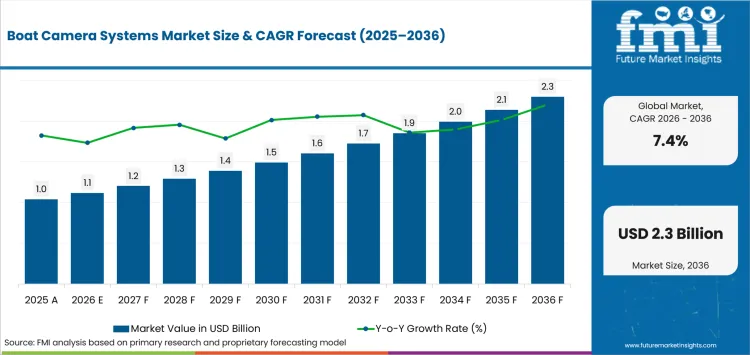
USD 1.1 billion in 2026 and USD 2.3 billion by 2036 at a 7.4% CAGR.
Demand for boat camera systems is projected to expand at a 7.4% CAGR between 2026 and 2036, increasing valuation from USD 1.1 billion in 2026 to USD 2.3 billion by 2036. Boat owners and operators are more likely to add cameras when video can be viewed through electronics already installed at the helm. Garmin's October 2025 GPSMAP 9000xsv release connected chartplotters with cameras and other onboard sensors. Integration means a camera can be added as an extension of an existing navigation system rather than as a separate electronics purchase.
Country demand separates where marina density gives installers regular access to yacht service and scheduled refit work. Dubai Media Office reported in September 2026 that 8,415 marine craft were registered with the Dubai Maritime Authority. The registered fleet gives local installers repeated access to yacht owners and operators during berth-side electronics work.
Key Takeaways of Boat Camera Systems Market
- Boat camera demand rises as vessel operators place visible and thermal feeds beside chart data during docking and poor-visibility navigation.
- By camera type, navigation cameras are estimated to hold 26.0% in 2026 owing to their direct role during approach and docking decisions.
- In 2026, HD is expected to represent 18.0% of the resolution category because it balances usable detail with installed display compatibility.
- By vessel type, recreational boats are forecast to represent 37.0% in 2026 driven by broad ownership and repeated electronics replacement.
- Retrofit wiring and protocol mismatches can raise installed cost because older vessels often carry displays from several electronics generations.
- Some of the key players in this market include Teledyne FLIR, Garmin, Raymarine / Teledyne FLIR, Furuno, Navico Group, Hikvision, Axis Communications, Dometic, Aqualuma, and OceanLED.
Analyst Perspective
"Boat camera proposals should be judged by helm image quality and the installation work behind it. Existing displays and power paths improve upgrade economics by avoiding a wider electronics rebuild."
- Nikhil Kaitwade, Principal Consultant, Future Market Insights
How is the Boat Camera Systems Market segmented?
The boat camera systems market is segmented by camera type, resolution, vessel type, installation and sales channel.
Camera types include navigation cameras, docking cameras, thermal cameras, underwater cameras, and surround-view camera systems while resolutions cover HD, Full HD, 4K, thermal - IR, and multi-sensor formats. Vessel types include recreational boats, yachts, fishing vessels, workboats, and patrol craft while installation covers fixed mount, pan-tilt-zoom, flush mount, and wireless camera kits. Sales channels include marine electronics dealers, boat OEMs, aftermarket retail, and security integrators that influence product selection and installation.
What makes navigation cameras central to the camera type category?
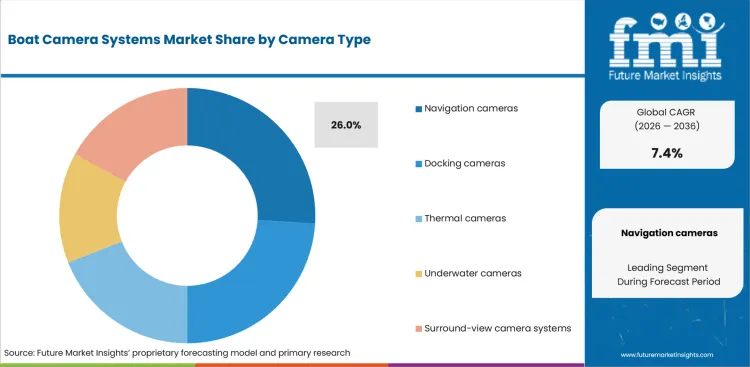
Navigation cameras serve approach and close-quarters maneuvering because the operator can confirm objects without leaving the primary helm display. Thermal imaging components extend the same viewing task into darkness or haze provided the feed stays easy to interpret beside chart data.
- By camera type, the navigation cameras segment is estimated to hold 26.0% in 2026 owing to direct use during approach and docking decisions.
- Teledyne FLIR's October 2025 M460 and M560 launch connects to navigation-camera demand because thermal sensing and 4K low-light video help operators interpret approach, docking, and professional marine visibility conditions from the helm.
Why does HD hold the stated share in the resolution category?
HD works well for engine-room checks and deck monitoring because many installed marine displays can show useful detail without 4K processing. Higher-resolution feeds can increase network load in video surveillance systems, so retrofit value depends on the display and data path already aboard.
- In 2026, HD is expected to represent 18.0% of the resolution category because it balances image detail with installed display compatibility.
- Garmin's July 2025 ECHOMAP Ultra 2 launch supports the resolution discussion because its Full HD display shows how boaters are adopting higher-resolution screens that remain within the installed display compatibility range without immediately requiring 4K systems.
How do recreational boats shape the vessel type category?
Recreational owners often add cameras during chartplotter renewals that already require access to helm power and network cabling. The scale of recreational boating gives dealers more retrofit occasions than narrow professional fleets although each owner still weighs installed cost against annual use.
- By vessel type, recreational boats are forecast to represent 37.0% in 2026 driven by broad ownership and repeated electronics replacement.
- NMMA's October 2025 report on 11.8 million registered and documented recreational boats in the United States reinforces the vessel-type share because a large installed base creates repeated opportunities for camera upgrades during routine electronics replacement.
What supports fixed mount demand in the installation category?
Fixed cameras suit engine rooms and aft decks where the observed area does not change during normal vessel operation. Watercraft accessories retrofits also favor stationary hardware for owners seeking useful monitoring without pan-tilt mechanics or extra control steps.
- Fixed mount is likely to capture 31.0% of the installation category in 2026 because stationary viewing positions reduce mechanical complexity.
- Furuno's March 2025 Refreshin' Rebate included the FIP-460 IP camera, showing how fixed-camera demand can be supported when owners combine camera purchases with broader helm-electronics upgrades.
Why do marine electronics dealers hold the stated sales channel share?
Camera purchases usually need protocol checks and mounting advice before an owner knows whether the existing display accepts the video feed. Marine communication systems and camera networks share onboard power and data paths which makes dealer integration knowledge relevant during specification.
- Marine electronics dealers are projected to hold 39.0% of the sales channel category in 2026 owing to local commissioning and compatibility support.
- Furuno's February 2026 TZtouchE release points boaters toward authorized dealers, reinforcing why this channel matters when networked displays, camera compatibility, and installation choices must be checked before commissioning.
What are the drivers, restraints and opportunities in the Boat Camera Systems Market?
Integrated helm visibility supports demand, retrofit complexity limits conversion, and lower-burden multi-sensor designs offer a practical route to wider adoption.
- Driver: Operators increasingly want camera views beside navigation data during docking and poor-visibility maneuvering without shifting attention to a separate screen.
- Restraint: Mixed network generations and marine installation requirements can raise labor cost enough to delay useful camera upgrades on older vessels.
- Opportunity: Camera makers can widen adoption by reducing hull work and interpretation effort while preserving compatibility with existing multifunction displays.
Operators need camera views that can be controlled without leaving the normal helm workflow. Teledyne FLIR launched the JCU-4 in March 2025 with direct control for M-series marine thermal and visible cameras. Marine radar systems and camera controls provide different situational inputs, so easier camera control makes visual confirmation more useful during maneuvering.
Installation cost rises once a camera upgrade must cross several power and data standards already present on the same vessel. Furuno documented a January 2026 pilot-boat installation that paired its networked displays with a third-party FLIR M332 thermal camera. Mixed-vendor marine electronics installations can work well provided the installer confirms interfaces before commissioning.
New product value increases as installation point performs more than one useful onboard function. OceanLED demonstrated its Sport Colours Camera Edition at FLIBS in October 2025 as a surface-mounted light with an integrated underwater camera. The shared hull opening can reduce added installation work during refits that already include underwater lighting.
Which country CAGRs are covered in the Boat Camera Systems Market?
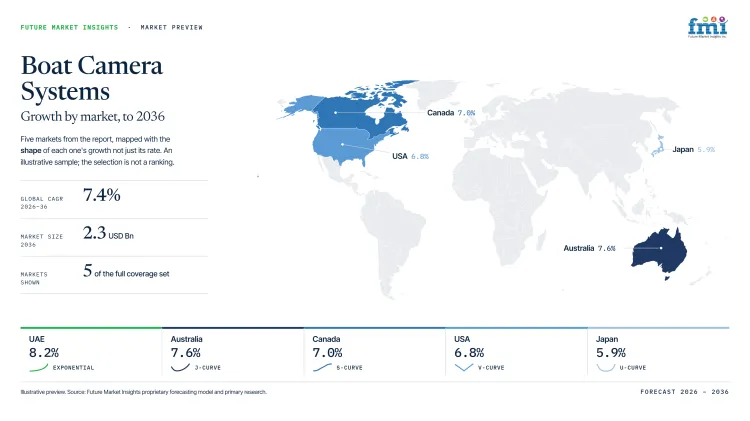
| Country | CAGR |
|---|---|
| UAE | 8.2% |
| Australia | 7.6% |
| Norway | 7.4% |
| Canada | 7.0% |
| USA | 6.8% |
| Italy | 6.5% |
| Japan | 5.9% |
How do country-level CAGRs compare in the Boat Camera Systems Market?
The 2.3 percentage-point spread places UAE and Australia above a compact middle group formed by Norway and Canada. USA and Italy are close enough that retrofit compatibility may matter more than the headline CAGR gap. Japan grows more slowly because replacement cycles are selective rather than because marine-safety demand disappears.
- UAE's marina network gives yacht installers berth-side access to premium vessels during scheduled service.
- Australia's long coastline favors products that local dealers can commission during one coastal service visit.
- Norwegian operators value low-light performance because darkness and reduced visibility directly affect coastal camera use.
- Canada's seasonal boating cycle makes fixed-camera packages easier to justify for owners with limited use.
- USA's aftermarket includes mixed display generations that make protocol compatibility central to retrofit conversion decisions.
- Italian yacht yards coordinate hull access with electronics work which makes installer relationships important during refits.
- Japanese small-craft layouts favor compact hardware that fits existing helms without extensive electronics changes.
Similar growth rates can produce different serviceable markets because vessel mix and replacement timing differ. The full report provides country-level CAGR analysis across North America, Latin America, Western Europe, Eastern Europe, East Asia, South Asia and Pacific, and the Middle East and Africa.
Country-wise Analysis
- Dubai yacht owners and marina operators work within a concentrated service network that supports camera installation during scheduled refits. Boat camera systems demand in UAE is forecast to rise at 8.2% CAGR through 2036 supported by premium yacht activity and regular berth-side service access. Dubai Maritime Authority stated in October 2025 that it oversaw 20 marinas with capacity for more than 4,200 vessels through the Marsa platform. Heat and salt exposure raise housing and connector requirements during installation on exposed yacht decks. Companies entering UAE need yacht upgrades backed by technicians who can limit berth downtime without compromising display integration.
- Australian camera demand spans leisure craft and domestic commercial vessels that operate over long coastal service distances and isolated ports. Adoption of boat camera systems in Australia is estimated to expand at 7.6% CAGR through 2036 owing to safety-sensitive coastal operations. AMSA recorded 344 domestic commercial vessel incidents in the fourth quarter of 2025 including 54 serious incidents. Remote service geography raises downtime cost after a failed installation and makes corrosion-resistant housings important beyond metropolitan marinas. Local installers can differentiate by carrying spare components and resolving network faults during one service visit inside seasonal operating windows at remote coastal locations.
- Norwegian operators plan for variable light and cold coastal conditions that increase the practical value of low-light imaging. Norway is projected to record 7.4% CAGR during the assessment period attributable to safety use and replacement of older marine electronics. The Norwegian Maritime Authority stated in June 2026 that 35% of fatal recreational boating accidents recorded from 2001 to 2025 occurred in darkness or reduced visibility. Salt exposure and a short boating season make downtime especially costly for operators working from smaller coastal harbors. Night vision devices can complement thermal or fixed cameras where crews need broader visibility without adding unnecessary display complexity.
- Canadian recreational boaters operate through a seasonal ownership cycle that concentrates electronics work before and during the boating months. Sales of boat camera systems in Canada are forecast to expand at 7.0% CAGR by 2036 driven by retrofit activity and a boating population. Transport Canada reported in January 2026 that approximately 12 million boaters navigate Canadian waterways. Short annual usage can make premium camera packages harder to justify for occasional owners during a limited operating season. Dealers can improve conversion with fixed cameras and clear installed pricing while service partners need hardware that tolerates cold storage without spring commissioning work.
- American owners support a deep aftermarket where cameras may be replaced separately from chartplotters and other helm electronics. In USA, boat camera systems demand is predicted to advance at 6.8% CAGR through 2036 owing to frequent used-boat turnover and dealer-led upgrades. NMMA reported in June 2026 that pre-owned boat sales totaled 867,059 units during 2025. Mixed network generations can make camera compatibility less predictable and increase quoting risk on older vessels with uncertain interface support. Marine steering systems and camera feeds are often assessed together during larger helm refits that already require wiring access during planned yard service windows.
- Italian yards and marinas serve a Mediterranean leisure fleet that produces electronics work during yacht maintenance and refits. The Italy boat camera systems sector is projected to record 6.5% CAGR during the assessment period supported by marina infrastructure and yard capability. The Ministry of Infrastructure and Transport published its 2024 boating yearbook in September 2025 and recorded 162,745 berths along Italian coasts. Vessel layouts can complicate cable routing for flush or underwater cameras, so entry works better through yards coordinating hull access with electronics work. Installers can reduce rework after relaunches by documenting cable paths and connector access before handover.
- Japanese owners often favor compact marine electronics that fit established small-craft layouts and conservative replacement schedules. Boat camera systems sales in Japan are forecast to expand at 5.9% CAGR by 2036 attributable to safety awareness and selective display upgrades. Japan Coast Guard reported in May 2026 that 46 vessels were involved in marine-leisure accidents during the Golden Week period. Limited helm space can restrict multi-camera additions, so manufacturers need compact housings with clear compatibility for local display platforms. Technical support becomes important because owners may favor dependable integration before paying for higher sensor counts or automation during scheduled electronics upgrades.
Who are the notable companies in the Boat Camera Systems Market?
Teledyne FLIR, Garmin, Raymarine / Teledyne FLIR, Furuno, Navico Group, Hikvision, Axis Communications, Dometic, Aqualuma and OceanLED are the notable companies in this market.
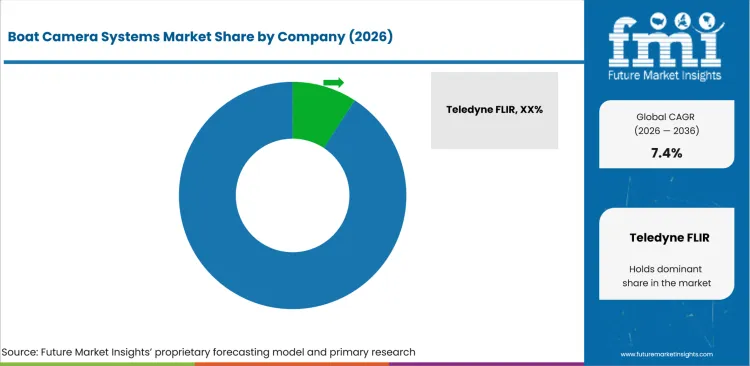
Competition separates marine-native imaging platforms from broader video companies that must prove marine fit before vessel installation. Network compatibility and environmental hardening remain entry barriers because the existing helm must display and control the camera feed reliably.
- Teledyne FLIR, Garmin, Raymarine / Teledyne FLIR, Furuno and Navico Group position camera feeds inside established navigation platforms.
- Hikvision and Axis Communications contribute network-video engineering for harsh environments after vessel-specific requirements are confirmed.
- OceanLED and Aqualuma address underwater applications while Dometic occupies an edge-of-scope position through marine-equipment activity.
Competitive Benchmarking: Boat Camera Systems Market
| Company | Marine Camera Breadth | Helm and Network Integration | Marine Environmental Evidence | Geographic Reach |
|---|---|---|---|---|
| Teledyne FLIR | High | High | High | Global |
| Garmin | High | High | High | Global |
| Raymarine / Teledyne FLIR | High | High | High | Global |
| Furuno | Medium | High | High | Global |
| Navico Group | Low | High | High | Global |
| Hikvision | Medium | Medium | High | Global |
| Axis Communications | Medium | Medium | High | Global |
| Dometic | Low | Low | Medium | Global |
| Aqualuma | Low | Low | High | Australia and international marine channels |
| OceanLED | Low | Medium | High | Europe, North America and international marine channels |
Key Developments in the Boat Camera Systems Market
- In February 2026, Raymarine documented a fishing-electronics refit that installed two CAM300 cameras with AR200 augmented-reality support on the same vessel.
- In November 2025, Axis Communications announced the Q3839-SPVE panoramic camera in stainless steel for corrosive marine environments including ships and harbors.
- In August 2025, OceanLED launched the Sport Colours Camera Edition as a surface-mounted underwater light with an integrated underwater camera.
Key Players in the Boat Camera Systems Market
Integrated Marine Imaging and Navigation Platforms
- Teledyne FLIR
- Garmin
- Raymarine / Teledyne FLIR
- Furuno
- Navico Group
Network Video Manufacturers
- Hikvision
- Axis Communications
Underwater and Adjacent Mobile-Electronics Companies
- Dometic
- Aqualuma
- OceanLED
Boat Camera Systems Market - Report Scope
| Coverage field | Report scope |
|---|---|
| Market breakdown | By camera type, resolution, vessel type, installation, sales channel and region. |
| Quantitative Units | Revenue inn USD billion and CAGR in %. |
| Market Definition | Boat-installed visible, thermal, networked and underwater camera systems used for navigation, docking, monitoring and situational awareness. |
| Regions Covered | North America, Latin America, Western Europe, Eastern Europe, East Asia, South Asia and Pacific, and Middle East and Africa. |
| Countries Covered | UAE, Australia, Norway, Canada, USA, Italy, Japan, and 20+ countries included in the full report. |
| Key Companies | Teledyne FLIR, Garmin, Raymarine / Teledyne FLIR, Furuno, Navico Group, Hikvision, Axis Communications, Dometic, Aqualuma, OceanLED. |
| Forecast Period | 2026 to 2036. |
| Approach | Primary and secondary research with market triangulation. |
Boat Camera Systems Market - Research Methodology
| Method | Approach |
|---|---|
| Primary Research | FMI analysts gathered input from manufacturers, service providers, technology developers, distributors, end users, procurement teams, and subject-matter experts. Interviews examined purchasing decisions, product or service evaluation, adoption barriers, approval requirements, pricing considerations, and expectations for technical or commercial support. Respondents were also asked what evidence is required before a trial, pilot, or initial order develops into regular purchasing. |
| Desk Research | Desk research covered government statistics, regulatory publications, trade data, industry associations, technical literature, standards, company filings, product information, and official corporate announcements. Sources were reviewed for relevance, publication date, geographic coverage, and consistency with the defined market scope. Claims relating to performance, applications, approvals, capacity, investment, and commercial activity were retained only when supported by credible public evidence. |
| Market Sizing and Forecasting | The market model combined the baseline value with historical performance, segment structure, pricing and volume indicators, adoption levels, company participation, and country-level demand conditions. Forecast assumptions considered economic activity, investment trends, regulatory developments, technology adoption, purchasing cycles, supply availability, and barriers to wider market use. Segment and regional estimates were reconciled before the final market total was calculated. |
| Data Validation | Estimates were checked against multiple independent indicators, including public data, company activity, trade patterns, industry developments, and findings from primary interviews. Validation also tested whether products, services, applications, and company revenues fell within the defined market boundaries. Adjacent categories, unsupported claims, overlapping revenues, and activities without direct market relevance were excluded to reduce double counting and maintain consistency across segments and countries. |
Boat Camera Systems Market by Segments
Boat Camera Systems Market segmented by Camera Type:
- Navigation cameras
- Docking cameras
- Thermal cameras
- Underwater cameras
- Surround-view camera systems
Boat Camera Systems Market segmented by Resolution:
- HD
- Full HD
- 4K
- Thermal - IR
- Multi-sensor
Boat Camera Systems Market segmented by Vessel Type:
- Recreational boats
- Yachts
- Fishing vessels
- Workboats
- Patrol craft
Boat Camera Systems Market segmented by Installation:
- Fixed mount
- Pan-tilt-zoom
- Flush mount
- Wireless camera kit
Boat Camera Systems Market segmented by Sales Channel:
- Marine electronics dealers
- Boat OEMs
- Aftermarket retail
- Security integrators
Boat Camera Systems Market by Region:
- North America
- United States
- Canada
- Latin America
- Brazil
- Mexico
- Chile
- Rest of Latin America
- Western Europe
- Germany
- United Kingdom
- Italy
- Spain
- France
- Nordics
- Benelux
- Rest of Western Europe
- Eastern Europe
- Russia
- Poland
- Hungary
- Balkan and Baltic States
- Rest of Eastern Europe
- East Asia
- China
- Japan
- South Korea
- South Asia and Pacific
- India
- ASEAN
- Australia and New Zealand
- Rest of South Asia and Pacific
- Middle East and Africa
- Kingdom of Saudi Arabia
- Other GCC Countries
- Türkiye
- South Africa
- Other African Union Countries
- Rest of Middle East and Africa
Research Sources and Bibliography
- Garmin International, Inc. (2025, October 28). Garmin expands flagship chartplotter lineup with premium GPSMAP 9000xsv for the ultimate experience at the helm.
- Government of Dubai Media Office. (2026, September 7). Dubai maritime sector attracts visitors from 116 nationalities.
- Teledyne FLIR Marine. (2025, October 28). FLIR Launches AI-Powered M460 and M560 Cameras.
- Garmin International, Inc. (2025, July 8). Garmin expands ECHOMAP Ultra 2 series with larger 16-inch chartplotters.
- National Marine Manufacturers Association. (2025, October 17). Boat Registrations Report Details Shifts Across Fleet and Regions in 2024.
- Furuno USA. (2025, March 12). Refresh Your Marine Electronics And Soak In Savings With Furuno's Refreshin' Rebate Sales Event!.
- Furuno USA. (2026, February 11). Bringing Big-Boat Technology To Every Vessel: Introducing Furuno's TZtouchE.
- Teledyne FLIR Marine. (2025, March 18). FLIR Launches JCU-4.
- Furuno USA. (2026, January 30). Furuno Electronics Outfit New Baltimore Class Pilot Boat for Maryland Pilots.
- OceanLED. (2025, October 9). Experience the Sport Colours - Camera Edition Live at FLIBS 2025.
- Government of Dubai Media Office. (2025, October 15). DMA Launches “Marsa” as the First Unified Digital Platform for Marina Leasing Management.
- Australian Maritime Safety Authority. (2026, March 16). 2025 quarterly domestic commercial vessel incident reports.
- Norwegian Maritime Authority. (2026, June 25). Løft blikket 2026: “I believe he might still be alive today if he had been wearing a lifejacket”.
- Transport Canada. (2026, January 6). Minister of Transport and Leader of the Government in the House of Commons announces changes to make boating safer for Canadians.
- National Marine Manufacturers Association. (2026, June 17). New NMMA Report Provides Insight Into 2025 Pre-Owned Boat Market.
- Ministero delle Infrastrutture e dei Trasporti. (2025, September 18). Il Diporto Nautico in Italia - Anno 2024.
- Japan Coast Guard. (2026, May 19). Golden Week marine-leisure accident occurrence status, preliminary figures.
- Raymarine. (2026, February 23). Refitting with Raymarine Fishing Electronics: A New Era.
- Axis Communications. (2025, November 5). AI-powered multisensor camera delivers ultra-clear overviews in harsh environments.
- OceanLED. (2025, August 21). The World-First Underwater Light with Integrated Underwater Camera: The Sport Colours - Camera Edition.
- Teledyne FLIR Marine. (2025, October 31). Welcome FLIR TransponderTech.
- Garmin International, Inc. (2025, October 16). New Garmin OnBoard System redefines boating safety.
- Raymarine. (2026, July 23). Teledyne Raymarine Announce Strategic Five-Year Partnership with Royal National Lifeboat Institution (RNLI).
- Furuno USA. (2026, February 11). Small Footprint. Serious Power. Furuno Launches TZMAP Stand-Alone MFDs.
- Teledyne FLIR Marine. (2026, August 26). Teledyne FLIR Marine Introduces FLIR M364C-USV Camera for Autonomous and Uncrewed Vessels.
- Garmin International, Inc. (2025, June 12). Garmin debuts the GPSMAP 15x3 chartplotter with a 15-inch ultrawide premium display.
- Raymarine. (2026, March 24). Raymarine Unveils Axiom 2 Chartplotter and Next-Generation LightHouse Charts.
- Furuno USA. (2025, March 10).Furuno’s Major TZtouchXL Software Update Delivers CSH10 Sonar Integration, Dynamic Mooring, New Weather Options, And Much More!
- Simrad Marine Electronics. (2026, February). Simrad Marine Electronics Debuts New NSO 4.
- Hikvision. (2025, December 31).重点船舶视频智能监管场景方案
- Axis Communications. (2026, March 25). AI-powered fisheye cameras offer 360° view and high-quality image resolution 24/7.
- Dometic Group. (2025, October 7).Flush-Mount Innovation: Dometic’s Optimus Compact Helm Redefines Dash Design Without Compromising Performance
- Australian Marine Export Group. (2026, May 21). AIMEX Garden - Sanctuary Cove International Boat Show.
- OceanLED. (2025, November 17). OceanLED Unveils Revolutionary Hybrid Upgrade Kits at METSTRADE 2025.
This bibliography is provided for reader reference and is not exhaustive. The full report contains the complete reference list and detailed citations.
This Report Answers
- How will the boat camera systems market valuation change between 2026 and the end of the 2036 forecast period?
- Which operating conditions are making boat cameras more useful inside networked helm electronics packages?
- Why do navigation cameras hold the stated 2026 share within the camera type category for vessel installations?
- How does HD resolution balance image detail with display compatibility and network load during boat camera retrofits?
- Why do recreational boats account for the stated vessel type share within the boat camera systems market?
- Which installation constraints can raise total installed cost for fixed, flush, thermal, or multi-camera systems on older vessels?
- How do country growth rates differ among UAE, Australia, Norway, Canada, USA, Italy, and Japan through 2036?
- Which companies have meaningful positions in marine cameras, onboard video integration, underwater imaging, or adjacent rugged video systems?
Frequently Asked Questions
How big is the Boat Camera Systems Market in 2026?
The boat camera systems market is valued at USD 1.1 billion in 2026 and is projected to reach USD 2.3 billion by 2036. Wider use of camera feeds inside navigation and docking workflows supports continued spending on networked marine displays.
What is the CAGR of the Boat Camera Systems Market from 2026 to 2036?
The boat camera systems market is projected to grow at a CAGR of 7.4% between 2026 and 2036. Retrofit activity and closer integration between cameras and multifunction displays support expansion during scheduled electronics upgrades.
Which camera type leads the Boat Camera Systems Market?
The navigation cameras segment is expected to hold 26.0% of the boat camera systems market in 2026, attributable to direct use during approach and docking decisions. Navigation cameras also fit routine helm integration more broadly than specialist imaging formats used for narrower tasks.
Which installation segment holds a stated share in the Boat Camera Systems Market?
The fixed mount segment is expected to hold 31.0% of the boat camera systems market in 2026, supported by simpler mechanics and predictable viewing zones. Fixed cameras also reduce service burden in engine-room and deck positions that rarely require repositioning.
Which countries are projected to record the country growth comparison in the Boat Camera Systems Market?
UAE is projected to grow at 8.2% CAGR through 2036 and Australia follows at 7.6% with Norway at 7.4%. Marina activity and coastal operating conditions distinguish this upper country group from markets with more selective retrofit cycles.
Which companies are active in the Boat Camera Systems Market?
Key companies operating in the boat camera systems market include Teledyne FLIR, Garmin, Raymarine / Teledyne FLIR, Furuno, Navico Group, Hikvision, Axis Communications, Dometic, Aqualuma, and OceanLED. Their positions differ by marine imaging depth, display integration, environmental hardening, and underwater specialization.
Preview the report firsthand - request a free sample
Get SampleGet the brochure for pricing and purchase details.
Get PDFTable of Content
- Key Takeaways
- Market Size and CAGR
- Top Growth Driver
- Fastest Growing Segment
- Leading Region
- Key Companies
- Emerging Opportunities
- Executive Summary
- Global Market Outlook
- Demand-side Trends
- Supply-side Trends
- Technology Roadmap Analysis
- Analysis and Recommendations
- Analyst Perspective (What is happening? Why now? What should investors know?)
- Key Questions Answered
- How large is the market?
- What is the CAGR?
- What are key trends?
- Which region dominates?
- Who are the leaders?
- Market Overview
- Market Coverage / Taxonomy
- Market Definition / Scope / Limitations
- Research Methodology
- Chapter Orientation
- Analytical Lens and Working Hypotheses
- Market Structure, Signals, and Trend Drivers
- Benchmarking and Cross-market Comparability
- Market Sizing, Forecasting, and Opportunity Mapping
- Research Design and Evidence Framework
- Desk Research Programme (Secondary Evidence)
- Expert Input and Fieldwork (Primary Evidence)
- Tooling, Models, and Reference Databases
- Data Engineering and Model Build
- Quality Assurance and Audit Trail
- Market Background
- Market Dynamics (Drivers, Restraints, Opportunity, Trends)
- Scenario Forecast (Optimistic, Likely, Conservative)
- Impact Analysis
- AI Impact
- Sustainability Impact
- Regulatory Impact
- Technology Impact
- Consumer / Buyer Analysis
- Purchase Drivers
- Adoption Barriers
- Buyer Journey
- Opportunity Map Analysis
- Product Life Cycle Analysis
- Supply Chain Analysis
- Investment Feasibility Matrix
- Value Chain Analysis
- PESTLE and Porter's Analysis
- Regulatory Landscape
- Regional Parent Market Outlook
- Production and Consumption Statistics
- Import and Export Statistics
- Global Market Analysis and Forecast, 2021 to 2036
- Historical Market Size Value (USD Billion) Analysis, 2021 to 2025
- Current and Future Market Size Value (USD Billion) Projections, 2026 to 2036
- Y-o-Y Growth Trend Analysis
- Absolute $ Opportunity Analysis
- Global Market Pricing Analysis, 2021 to 2036
- Global Market Analysis and Forecast, By Camera Type, 2021 to 2036
- Introduction / Key Findings
- Historical Market Size Value (USD Billion) Analysis By Camera Type, 2021 to 2025
- Current and Future Market Size Value (USD Billion) Analysis and Forecast By Camera Type, 2026 to 2036
- Navigation cameras
- Docking cameras
- Thermal cameras
- Underwater cameras
- Surround-view camera systems
- Navigation cameras
- Y-o-Y Growth Trend Analysis By Camera Type, 2021 to 2025
- Absolute $ Opportunity Analysis By Camera Type, 2026 to 2036
- Global Market Analysis and Forecast, By Resolution, 2021 to 2036
- Introduction / Key Findings
- Historical Market Size Value (USD Billion) Analysis By Resolution, 2021 to 2025
- Current and Future Market Size Value (USD Billion) Analysis and Forecast By Resolution, 2026 to 2036
- HD
- Full HD
- 4K
- Thermal / IR
- Multi-sensor
- HD
- Y-o-Y Growth Trend Analysis By Resolution, 2021 to 2025
- Absolute $ Opportunity Analysis By Resolution, 2026 to 2036
- Global Market Analysis and Forecast, By Vessel Type, 2021 to 2036
- Introduction / Key Findings
- Historical Market Size Value (USD Billion) Analysis By Vessel Type, 2021 to 2025
- Current and Future Market Size Value (USD Billion) Analysis and Forecast By Vessel Type, 2026 to 2036
- Recreational boats
- Yachts
- Fishing vessels
- Workboats
- Patrol craft
- Recreational boats
- Y-o-Y Growth Trend Analysis By Vessel Type, 2021 to 2025
- Absolute $ Opportunity Analysis By Vessel Type, 2026 to 2036
- Global Market Analysis and Forecast, By Installation, 2021 to 2036
- Introduction / Key Findings
- Historical Market Size Value (USD Billion) Analysis By Installation, 2021 to 2025
- Current and Future Market Size Value (USD Billion) Analysis and Forecast By Installation, 2026 to 2036
- Fixed mount
- Pan-tilt-zoom
- Flush mount
- Wireless camera kit
- Fixed mount
- Y-o-Y Growth Trend Analysis By Installation, 2021 to 2025
- Absolute $ Opportunity Analysis By Installation, 2026 to 2036
- Global Market Analysis and Forecast, By Sales Channel, 2021 to 2036
- Introduction / Key Findings
- Historical Market Size Value (USD Billion) Analysis By Sales Channel, 2021 to 2025
- Current and Future Market Size Value (USD Billion) Analysis and Forecast By Sales Channel, 2026 to 2036
- Marine electronics dealers
- Boat OEMs
- Aftermarket retail
- Security integrators
- Marine electronics dealers
- Y-o-Y Growth Trend Analysis By Sales Channel, 2021 to 2025
- Absolute $ Opportunity Analysis By Sales Channel, 2026 to 2036
- Global Market Analysis and Forecast, By Region, 2021 to 2036
- Introduction
- Historical Market Size Value (USD Billion) Analysis By Region, 2021 to 2025
- Current Market Size Value (USD Billion) Analysis and Forecast By Region, 2026 to 2036
- North America
- Latin America
- Western Europe
- Eastern Europe
- East Asia
- South Asia and Pacific
- Middle East & Africa
- Market Attractiveness Analysis By Region
- North America Market Analysis and Forecast, By Country, 2021 to 2036
- Historical Market Size Value (USD Billion) Trend Analysis By Market Taxonomy, 2021 to 2025
- Market Size Value (USD Billion) Forecast By Market Taxonomy, 2026 to 2036
- By Country
- USA
- Canada
- By Camera Type
- By Resolution
- By Vessel Type
- By Installation
- By Sales Channel
- By Country
- Market Attractiveness Analysis
- By Country
- By Camera Type
- By Resolution
- By Vessel Type
- By Installation
- By Sales Channel
- Key Takeaways
- Latin America Market Analysis and Forecast, By Country
- Historical Market Size Value (USD Billion) Trend Analysis By Market Taxonomy, 2021 to 2025
- Market Size Value (USD Billion) Forecast By Market Taxonomy, 2026 to 2036
- By Country
- Brazil
- Mexico
- Chile
- Rest of Latin America
- By Camera Type
- By Resolution
- By Vessel Type
- By Installation
- By Sales Channel
- By Country
- Market Attractiveness Analysis
- By Country
- By Camera Type
- By Resolution
- By Vessel Type
- By Installation
- By Sales Channel
- Key Takeaways
- Western Europe Market Analysis and Forecast, By Country
- Historical Market Size Value (USD Billion) Trend Analysis By Market Taxonomy, 2021 to 2025
- Market Size Value (USD Billion) Forecast By Market Taxonomy, 2026 to 2036
- By Country
- Germany
- UK
- Italy
- Spain
- France
- Nordic
- BENELUX
- Rest of Western Europe
- By Camera Type
- By Resolution
- By Vessel Type
- By Installation
- By Sales Channel
- By Country
- Market Attractiveness Analysis
- By Country
- By Camera Type
- By Resolution
- By Vessel Type
- By Installation
- By Sales Channel
- Key Takeaways
- Eastern Europe Market Analysis and Forecast, By Country
- Historical Market Size Value (USD Billion) Trend Analysis By Market Taxonomy, 2021 to 2025
- Market Size Value (USD Billion) Forecast By Market Taxonomy, 2026 to 2036
- By Country
- Russia
- Poland
- Hungary
- Balkan & Baltic
- Rest of Eastern Europe
- By Camera Type
- By Resolution
- By Vessel Type
- By Installation
- By Sales Channel
- By Country
- Market Attractiveness Analysis
- By Country
- By Camera Type
- By Resolution
- By Vessel Type
- By Installation
- By Sales Channel
- Key Takeaways
- East Asia Market Analysis and Forecast, By Country
- Historical Market Size Value (USD Billion) Trend Analysis By Market Taxonomy, 2021 to 2025
- Market Size Value (USD Billion) Forecast By Market Taxonomy, 2026 to 2036
- By Country
- China
- Japan
- South Korea
- By Camera Type
- By Resolution
- By Vessel Type
- By Installation
- By Sales Channel
- By Country
- Market Attractiveness Analysis
- By Country
- By Camera Type
- By Resolution
- By Vessel Type
- By Installation
- By Sales Channel
- Key Takeaways
- South Asia and Pacific Market Analysis and Forecast, By Country
- Historical Market Size Value (USD Billion) Trend Analysis By Market Taxonomy, 2021 to 2025
- Market Size Value (USD Billion) Forecast By Market Taxonomy, 2026 to 2036
- By Country
- India
- ASEAN
- Australia & New Zealand
- Rest of South Asia and Pacific
- By Camera Type
- By Resolution
- By Vessel Type
- By Installation
- By Sales Channel
- By Country
- Market Attractiveness Analysis
- By Country
- By Camera Type
- By Resolution
- By Vessel Type
- By Installation
- By Sales Channel
- Key Takeaways
- Middle East & Africa Market Analysis and Forecast, By Country
- Historical Market Size Value (USD Billion) Trend Analysis By Market Taxonomy, 2021 to 2025
- Market Size Value (USD Billion) Forecast By Market Taxonomy, 2026 to 2036
- By Country
- Kingdom of Saudi Arabia
- Other GCC Countries
- Türkiye
- South Africa
- Other African Union
- Rest of Middle East & Africa
- By Camera Type
- By Resolution
- By Vessel Type
- By Installation
- By Sales Channel
- By Country
- Market Attractiveness Analysis
- By Country
- By Camera Type
- By Resolution
- By Vessel Type
- By Installation
- By Sales Channel
- Key Takeaways
- Key Countries Market Analysis
- USA
- Pricing Analysis
- Market Share Analysis, 2025
- By Camera Type
- By Resolution
- By Vessel Type
- By Installation
- By Sales Channel
- Canada
- Pricing Analysis
- Market Share Analysis, 2025
- By Camera Type
- By Resolution
- By Vessel Type
- By Installation
- By Sales Channel
- Mexico
- Pricing Analysis
- Market Share Analysis, 2025
- By Camera Type
- By Resolution
- By Vessel Type
- By Installation
- By Sales Channel
- Brazil
- Pricing Analysis
- Market Share Analysis, 2025
- By Camera Type
- By Resolution
- By Vessel Type
- By Installation
- By Sales Channel
- Chile
- Pricing Analysis
- Market Share Analysis, 2025
- By Camera Type
- By Resolution
- By Vessel Type
- By Installation
- By Sales Channel
- Germany
- Pricing Analysis
- Market Share Analysis, 2025
- By Camera Type
- By Resolution
- By Vessel Type
- By Installation
- By Sales Channel
- UK
- Pricing Analysis
- Market Share Analysis, 2025
- By Camera Type
- By Resolution
- By Vessel Type
- By Installation
- By Sales Channel
- Italy
- Pricing Analysis
- Market Share Analysis, 2025
- By Camera Type
- By Resolution
- By Vessel Type
- By Installation
- By Sales Channel
- Spain
- Pricing Analysis
- Market Share Analysis, 2025
- By Camera Type
- By Resolution
- By Vessel Type
- By Installation
- By Sales Channel
- France
- Pricing Analysis
- Market Share Analysis, 2025
- By Camera Type
- By Resolution
- By Vessel Type
- By Installation
- By Sales Channel
- India
- Pricing Analysis
- Market Share Analysis, 2025
- By Camera Type
- By Resolution
- By Vessel Type
- By Installation
- By Sales Channel
- ASEAN
- Pricing Analysis
- Market Share Analysis, 2025
- By Camera Type
- By Resolution
- By Vessel Type
- By Installation
- By Sales Channel
- Australia & New Zealand
- Pricing Analysis
- Market Share Analysis, 2025
- By Camera Type
- By Resolution
- By Vessel Type
- By Installation
- By Sales Channel
- China
- Pricing Analysis
- Market Share Analysis, 2025
- By Camera Type
- By Resolution
- By Vessel Type
- By Installation
- By Sales Channel
- Japan
- Pricing Analysis
- Market Share Analysis, 2025
- By Camera Type
- By Resolution
- By Vessel Type
- By Installation
- By Sales Channel
- South Korea
- Pricing Analysis
- Market Share Analysis, 2025
- By Camera Type
- By Resolution
- By Vessel Type
- By Installation
- By Sales Channel
- Russia
- Pricing Analysis
- Market Share Analysis, 2025
- By Camera Type
- By Resolution
- By Vessel Type
- By Installation
- By Sales Channel
- Poland
- Pricing Analysis
- Market Share Analysis, 2025
- By Camera Type
- By Resolution
- By Vessel Type
- By Installation
- By Sales Channel
- Hungary
- Pricing Analysis
- Market Share Analysis, 2025
- By Camera Type
- By Resolution
- By Vessel Type
- By Installation
- By Sales Channel
- Kingdom of Saudi Arabia
- Pricing Analysis
- Market Share Analysis, 2025
- By Camera Type
- By Resolution
- By Vessel Type
- By Installation
- By Sales Channel
- Türkiye
- Pricing Analysis
- Market Share Analysis, 2025
- By Camera Type
- By Resolution
- By Vessel Type
- By Installation
- By Sales Channel
- South Africa
- Pricing Analysis
- Market Share Analysis, 2025
- By Camera Type
- By Resolution
- By Vessel Type
- By Installation
- By Sales Channel
- USA
- Market Structure Analysis
- Competition Dashboard
- Competition Benchmarking
- Market Share Analysis of Top Players
- By Regional
- By Camera Type
- By Resolution
- By Vessel Type
- By Installation
- By Sales Channel
- Emerging Startups
- Innovation Benchmarking
- Competition Analysis
- Competition Deep Dive
- Teledyne FLIR
- Overview
- Product Portfolio
- Profitability by Market Segments
- Sales Footprint
- Strategy Overview
- Marketing Strategy
- Product Strategy
- Channel Strategy
- Garmin
- Raymarine / Teledyne FLIR
- Furuno
- Navico Group
- Hikvision
- Axis Communications
- Dometic
- Aqualuma
- OceanLED
- Teledyne FLIR
- Case Studies
- Success Stories
- Recent Developments
- Competition Deep Dive
- Assumptions & Acronyms Used


