

- Industry Size (2026)
- USD 1.16 Bn
- Forecast (2036)
- USD 1.88 Bn
- CAGR (2026 to 2036)
- 5%
Marine Waste Handling Equipment Market Size, Market Forecast and Outlook By FMI
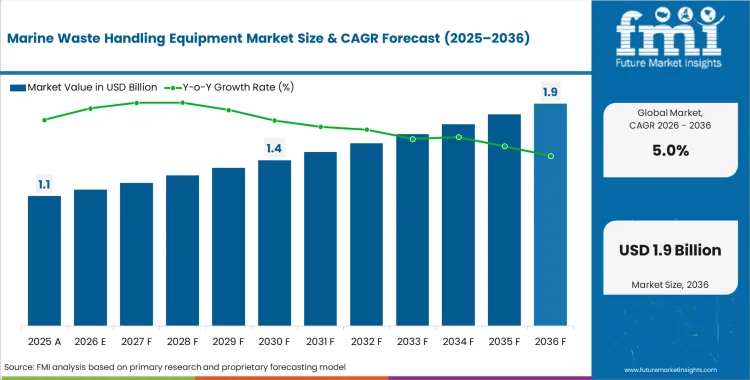
The marine waste handling equipment market was valued at USD 1.10 billion in 2025, projected to reach USD 1.16 billion in 2026, and is forecast to expand to USD 1.88 billion by 2036 at a 5% CAGR. Tightening MARPOL regulations on vessel waste discharge and the expansion of cruise and offshore fleets are sustaining procurement of onboard waste handling systems. Port state control inspections enforce compliance, making waste compactors, incinerators, and food waste treatment units a mandatory capital expenditure line item for vessel operators.
Summary of Marine Waste Handling Equipment Market
- Market Snapshot
- The marine waste handling equipment market is valued at USD 1.10 billion in 2025 and is projected to reach USD 1.88 billion by 2036.
- The industry is expected to grow at a 5% CAGR from 2026 to 2036, creating an incremental opportunity of USD 0.72 billion.
- The market is a regulation-driven marine equipment category where procurement is mandated by MARPOL Annex V waste discharge compliance, vessel class certification requirements, and port state control inspection standards.
- Demand and Growth Drivers
- MARPOL Annex V regulations mandate onboard waste treatment and storage capability for all international voyage vessels, making waste handling equipment a mandatory capital expenditure.
- Cruise fleet expansion generates the highest per-vessel waste volumes, driving procurement of integrated compaction, incineration, and food waste treatment systems.
- Zero-discharge zone expansion in coastal waters and enclosed seas is increasing the specification frequency for advanced food waste processing and dry waste incineration units.
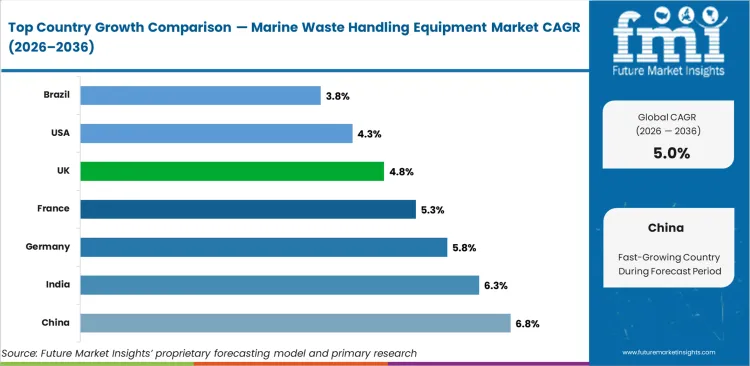
- Among key countries, China leads at 6.8% CAGR, followed by India at 6.3%, Germany at 5.8%, the United States at 4.3%, and United Kingdom at 4.8%.
- Product and Segment View
- The market covers onboard waste handling equipment including compactors, incinerators, shredders, pulpers, and crushers designed for shipboard installation and waste type classification.
- Applications span garbage handling, food waste treatment, dry solid waste processing, and auxiliary waste management across commercial, naval, and offshore vessels.
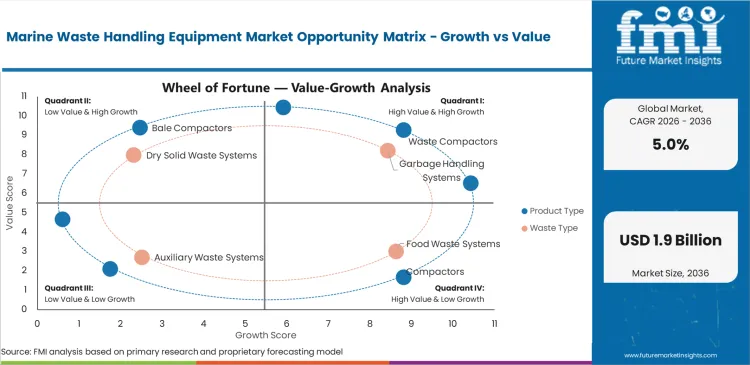
- Waste Compactors lead by Product Type with 42.6% share in 2026, as volume reduction capability is the primary operational need for long-haul commercial vessel waste storage.
- Garbage Handling Systems account for 39.8% of the Waste Type segment in 2026, covering the broadest category of shipboard solid waste requiring compaction and storage.
- The scope includes onboard waste handling equipment certified for marine installation; it excludes port-side waste reception facilities, ballast water treatment systems, and sewage treatment plants.
- Geography and Competitive Outlook
- China and India lead growth at 6.8% and 6.3% CAGR, driven by newbuild vessel delivery volume and fleet modernization equipment installations.
- Europe represents a regulation-driven market where EU maritime waste directives and cruise ship construction activity sustain equipment demand at premium specification levels.
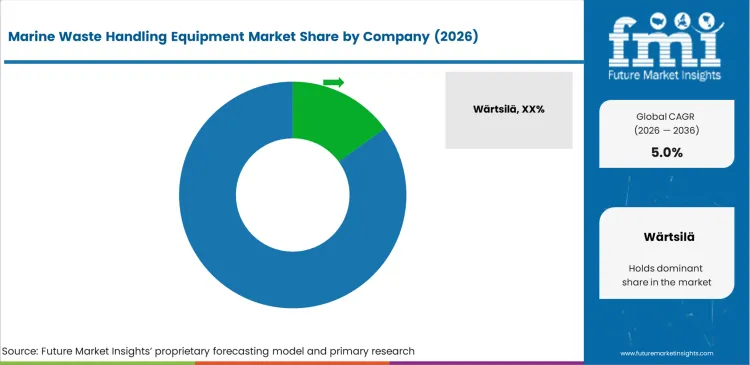
- Competition is defined by equipment certification breadth, vessel class compatibility, and aftermarket service network, with key players including Wartsila, Delitek AS, Norinco Private Limited, Evac, RILTA Environmental.
Marine Waste Handling Equipment Market Key Takeaways
| Metric | Details |
|---|---|
| Industry Size (2026) | USD 1.16 Billion |
| Industry Value (2036) | USD 1.88 Billion |
| CAGR (2026-2036) | 5% |
Source: Future Market Insights, 2026
FMI is of the opinion that the marine waste handling equipment market is shaped by the regulatory framework under MARPOL Annex V, which governs the discharge and treatment of shipboard waste at sea. Waste compactors lead the product type segment because they enable volume reduction of dry solid waste for storage between port discharge cycles, meeting the operational needs of long-haul commercial routes. FMI analysts note that cruise vessel fleets generate the highest per-vessel waste volumes, making passenger vessels the leading procurement channel for integrated waste management systems. The growing offshore support vessel fleet, combined with zero-discharge zone expansion in coastal waters, is increasing the specification frequency for advanced food waste treatment and incineration systems across vessel classes.
Country-level demand tracks fleet size, vessel delivery schedules, and regulatory enforcement intensity. China leads at 6.8% CAGR, driven by its position as the global leader in newbuild vessel deliveries, each requiring onboard waste handling equipment installation. India follows at 6.3%, supported by naval fleet expansion and coastal shipping fleet modernization. Germany registers 5.8%, reflecting cruise ship construction activity and stringent EU waste discharge regulations. United States advances at 4.3%, tied to offshore vessel fleet servicing and USCG compliance enforcement. United Kingdom maintains 4.8% and Brazil tracks 3.8% through 2036.
Marine Waste Handling Equipment Market Definition
Marine waste handling equipment encompasses onboard systems designed to compact, incinerate, shred, pulp, and crush shipboard waste in compliance with MARPOL Annex V discharge regulations. Equipment categories include waste compactors, incinerators, comminuters, pulpers, shredders, and crushers, specified by waste type handling capability and vessel class certification. The primary function is to enable vessels to process and store waste generated during voyages for compliant discharge or port-side reception.
Marine Waste Handling Equipment Market Inclusions
Market scope includes waste compactors, incinerators, comminuters, pulpers, shredders, and crushers certified for marine installation. Coverage spans all vessel classes and waste type categories. Global and regional market sizing covers the forecast period from 2026 to 2036 with segment breakdowns by Product Type, Waste Type, and Vessel.
Marine Waste Handling Equipment Market Exclusions
The scope excludes port-side waste reception facilities, ballast water treatment systems, sewage (blackwater) treatment plants, oily water separators, and exhaust gas cleaning systems. Waste handling equipment for inland waterway vessels is also excluded.
Marine Waste Handling Equipment Market Research Methodology
- Primary Research: Analysts engaged with vessel outfitting engineers, cruise line environmental compliance officers, and offshore vessel fleet managers to map procurement decision gates and technical qualification criteria shaping marine waste handling equipment purchasing cycles.
- Desk Research: Data collection aggregated MARPOL compliance inspection records, cruise fleet waste management audits, and vessel classification equipment lists from public and institutional sources covering the 2021 to 2025 historical period.
- Market-Sizing and Forecasting: Baseline values derive from a bottom-up aggregation of equipment unit counts per vessel class and weighted average system pricing across product categories, applying region-specific adoption curves to project demand through 2036.
- Data Validation and Update Cycle: Projections are tested against publicly reported expenditure guidance from marine equipment OEM revenue segments and cruise line capital expenditure filings and reconciled quarterly.
Why is the Marine Waste Handling Equipment Market Growing?
The Marine Waste Handling Equipment market is witnessing consistent growth, driven by increasing regulatory pressures on maritime pollution control and the growing emphasis on sustainable operations within the shipping industry. Enhanced focus on environmental compliance and the adoption of advanced waste management technologies are reshaping the market landscape. Rising global maritime traffic, expansion of passenger and cargo vessel fleets, and the need to maintain operational efficiency have amplified demand for sophisticated marine waste handling systems.
Equipment that allows automated collection, compaction, and processing of waste onboard has been preferred due to its ability to minimize storage requirements, reduce environmental impact, and streamline operational workflows. Technological advancements in compactors, incinerators, and segregation systems are enabling vessels to handle diverse waste types efficiently.
The market is also benefiting from increasing investment in eco-friendly and energy-efficient solutions, particularly on passenger vessels and cruise ships As environmental awareness rises and maritime operators prioritize compliance with international waste management standards, the market is expected to maintain steady expansion, with opportunities for further innovation in equipment design and integration with shipboard operations.
Segmental Analysis
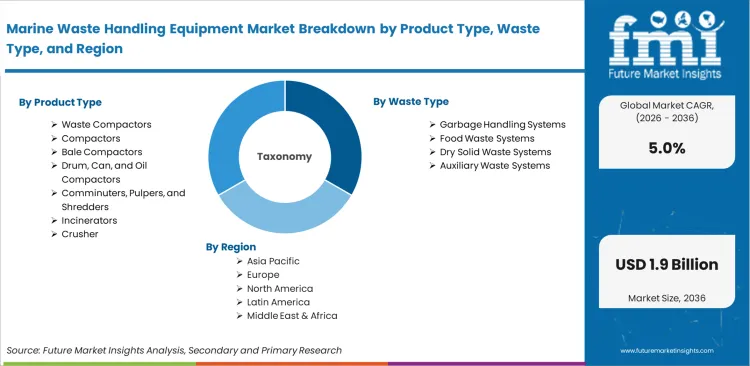
The marine waste handling equipment market is segmented by product type, waste type, vessel, and geographic regions. By product type, marine waste handling equipment market is divided into Waste Compactors, Compactors, Bale Compactors, Drum, Can, and Oil Compactors, Comminuters, Pulpers, and Shredders, Incinerators, and Crusher. In terms of waste type, marine waste handling equipment market is classified into Garbage Handling Systems, Food Waste Systems, Dry Solid Waste Systems, and Auxiliary Waste Systems. Based on vessel, marine waste handling equipment market is segmented into Passenger Vessels, Offshore and Special Vessel, Naval Ships, Bulk Containers and Oil Tankers, General Cargo and Container Ships, and Yachts and Other Ships. Regionally, the marine waste handling equipment industry is classified into North America, Latin America, Western Europe, Eastern Europe, Balkan & Baltic Countries, Russia & Belarus, Central Asia, East Asia, South Asia & Pacific, and the Middle East & Africa.
Insights into the Waste Compactors Segment
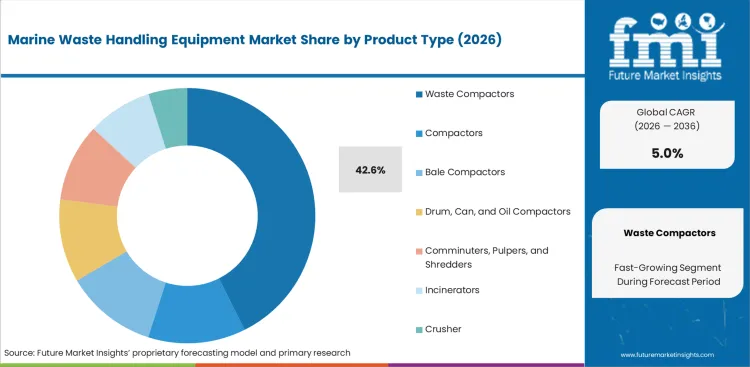
The Waste Compactors product type is projected to hold 42.60% of the Marine Waste Handling Equipment market revenue share in 2026, establishing it as the leading segment. This leadership is being attributed to the ability of compactors to reduce waste volume significantly, allowing ships to store and manage larger quantities of waste with limited onboard space.
Adoption has been driven by the operational efficiency offered through automated compression systems and the reduction in labor requirements for waste handling. The segment’s growth has been supported by regulatory mandates that emphasize proper waste segregation and treatment prior to discharge or transfer at port facilities.
Additionally, integration of compactors with onboard monitoring systems enables real-time waste management tracking, further increasing adoption across passenger and cargo vessels The versatility of compactors in handling various waste forms, coupled with their reliability and low maintenance requirements, has solidified their position as the preferred product type in marine waste management, with continued growth expected as maritime fleets expand globally.
Insights into the Garbage Handling Systems Segment
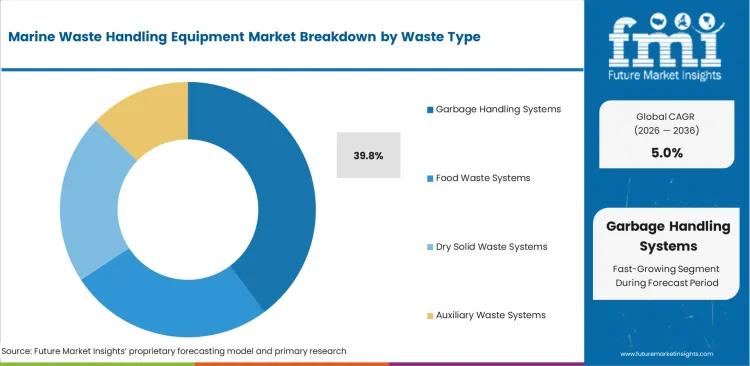
The Garbage Handling Systems waste type segment is estimated to capture 39.80% of market revenue in 2026, making it the dominant category within the Marine Waste Handling Equipment market. This prominence is being driven by increasing compliance with international maritime pollution regulations and the need for comprehensive onboard waste treatment solutions.
Adoption has been facilitated by the ability of these systems to manage mixed waste streams effectively, including food, plastics, and packaging materials, which are commonly generated on passenger vessels and commercial ships. Growth has been accelerated by the rising preference for fully automated systems that reduce manual handling, improve crew safety, and ensure adherence to environmental standards.
The integration of waste handling systems with monitoring and reporting technologies further enhances operational efficiency and enables regulatory audits As vessels increasingly aim to meet sustainability targets and reduce environmental footprints, the demand for advanced garbage handling systems is expected to remain robust, positioning this segment as a core driver of market expansion.
Insights into the Passenger Vessels Segment
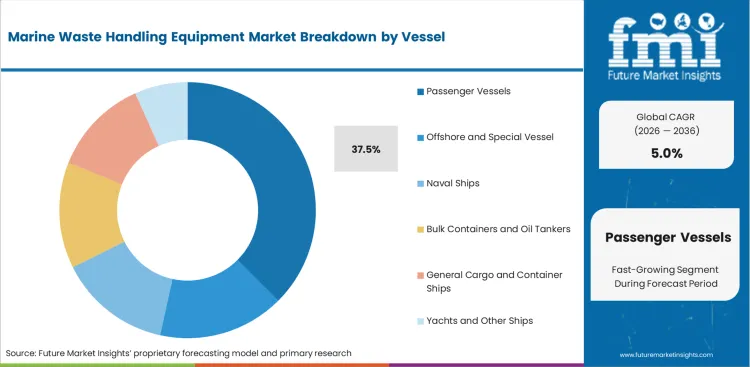
The Passenger Vessels vessel segment is projected to hold 37.50% of the Marine Waste Handling Equipment market revenue in 2026, representing the leading end-use category. This dominance is being influenced by the higher volume and diversity of waste generated onboard passenger ships, necessitating more sophisticated and efficient waste management solutions.
The growth of the segment has been supported by the expansion of the cruise and ferry industry, coupled with the increasing implementation of environmental regulations for passenger operations. Waste handling equipment adoption is being accelerated by the need to maintain operational efficiency, reduce storage constraints, and ensure compliance with international maritime waste management standards.
Passenger vessels benefit from integrated systems that combine compaction, segregation, and treatment processes to handle diverse waste types effectively As the tourism and passenger shipping sector continues to grow globally, the demand for advanced marine waste handling solutions on these vessels is expected to increase, reinforcing the segment’s leadership and providing opportunities for innovation in eco-friendly and automated waste management technologies.
Market Overview
Marine Waste Handling Equipment Market Overview
Marine waste handling equipment, manufactured from stainless steel can be found on all kinds and sizes of vessels & rigs around the world. Marine waste handling equipment have traditionally been used for baling of large amounts of cardboard or soft plastic waste.
Besides marine waste equipment, such as glass crushers have a task to crush glass and bottles. Further, shredders, one of the vital marine waste handling equipment’s main task is to tear apart and reduce density of particular types of waste that is otherwise hard to compact efficiently. Examples are: PET Bottles, metal tins and cans, plastic containers, wood packaging materials etc.
Moving ahead, the production of marine waste is a huge concern for environment and therefore, the need for marine waste handling equipment is indispensable. From an economic point of view, based on average per capita GDP in various countries coupled with rising ship tourism provide a strong base for the marine waste handling equipment market.
Subsequently, the aim of the study is to analyze the most recent trends and dynamics in the global marine waste handling equipment market.
Global Marine Waste Handling Equipment Market: Dynamics
In marine waste handling equipment market, the rapid growth of cruise ship industry and need for luxurious hospitality reinforce the growth outlook of the market. By 2025, number of passengers are projected to increase to more than 25 million worldwide. Consequently, a large amount of waste generation is estimated, thereby proliferating a healthy demand for marine waste handling equipment.
Moreover, cruise tourism consumes millions of tons of fuel and produces more than a million tons of sewage and other waste each year which necessitates the need for marine waste handling equipment. Additionally, ship industry, especially cruise industry can also accelerate local economic development and increase the level of employment scale. Subsequently, squarely mirroring with the growth of marine waste handling equipment market.
Global Marine Waste Handling Equipment Market: Regional Outlook
The USA and Europe are the prominent regions to offer lucrative opportunities in the marine waste handling equipment market owing to growing tourism industry and surge in travelers. Nonetheless, it has been estimated that every cruise ship passenger produces approximately 3.5 kilograms of marine waste which is a way higher than waste generated by people on-shore.
Besides federal governmental policies are foreseen to promulgate the ship tourism industry; thereby, impacting the marine waste handling equipment market, notably in ASEAN and China. In northern part of Western Europe, substantial demand for marine waste handling equipment is anticipated due to presence of a large fleet.
In the Asian region, Singapore and Hong Kong are expected to witness a hefty growth in marine waste handling equipment market.
Global Marine Waste Handling Equipment Market: Key Participants
List of some of the prominent market participants in the global marine waste handling Equipment market discerned across the value chain include:
- Delitek AS
- Norinco Private Limited
- Delitek As
- Evac
- RILTA Environmental
- NorSea Group
- Rolls-Royce
- Wärtsilä
The research report - Marine Waste Handling Equipment presents a comprehensive assessment of the market and contains thoughtful insights, facts, historical data, and statistically supported and industry-validated market data. The study on marine waste handling equipment market also contains projections using a suitable set of assumptions and methodologies. The research report provides analysis and information according to marine waste handling equipment market segments such as geographies, application, and industry.
The report covers exhaustive analysis on
- Market Segments
- Market Dynamics
- Market Size
- Supply & Demand
- Current Trends/Issues/Challenges
- Competition & Companies involved
- Technology
- Value Chain
Regional analysis includes
- North America (USA, Canada)
- Latin America (Mexico, Brazil)
- Western Europe (Germany, Italy, France, UK, Spain)
- Eastern Europe (Poland, Russia)
- Asia Pacific (China, India, ASEAN, Australia & New Zealand)
- Japan
- Middle East and Africa (GCC Countries, S. Africa, Northern Africa)
The report is a compilation of first-hand information, qualitative and quantitative assessment by industry analysts, inputs from industry experts and industry participants across the value chain in the marine waste handling equipment market. The report provides in-depth analysis of marine waste handling equipment market trends, macro-economic indicators and governing factors along with marine waste handling equipment market attractiveness as per segments. The report titled - marine waste handling equipment market also maps the qualitative impact of various market factors on marine waste handling equipment market segments and geographies.
Analysis of Marine Waste Handling Equipment Market By Key Countries
.webp "Top Country Growth Comparison Marine Waste Handling Equipment Market Cagr (2026 2036)")
| Country | CAGR |
|---|---|
| China | 6.8% |
| India | 6.3% |
| Germany | 5.8% |
| France | 5.3% |
| UK | 4.8% |
| USA | 4.3% |
| Brazil | 3.8% |
Country-wise Analysis
The Marine Waste Handling Equipment Market is expected to register a CAGR of 5.0% during the forecast period, exhibiting varied country level momentum. China leads with the highest CAGR of 6.8%, followed by India at 6.3%. Developed markets such as Germany, France, and the UK continue to expand steadily, while the USA is likely to grow at consistent rates. Brazil posts the lowest CAGR at 3.8%, yet still underscores a broadly positive trajectory for the global Marine Waste Handling Equipment Market. In 2026, Germany held a dominant revenue in the Western Europe market and is expected to grow with a CAGR of 5.8%. The USA Marine Waste Handling Equipment Market is estimated to be valued at USD 392.3 million in 2026 and is anticipated to reach a valuation of USD 594.9 million by 2036. Sales are projected to rise at a CAGR of 4.3% over the forecast period between 2026 and 2036. While Japan and South Korea markets are estimated to be valued at USD 59.3 million and USD 33.8 million respectively in 2026.
Key Players in the Marine Waste Handling Equipment Market
- Wärtsilä
- Delitek AS
- Norinco Private Limited
- Delitek As
- Evac
- RILTA Environmental
- NorSea Group
- Rolls-Royce
Scope of the Report
| Metric | Value |
|---|---|
| Quantitative Units | USD 1.16 Billion to USD 1.88 Billion, at a CAGR of 5% |
| Market Definition | Marine waste handling equipment encompasses onboard systems designed to compact, incinerate, shred, pulp, and crush shipboard waste in compliance with MARPOL Annex V discharge regulations. Equipment categories include waste compactors, incinerators, comminuters, pulpers, shredders, and crushers, specified by waste type handling capability and vessel class certification. |
| Segmentation | Product Type: Waste Compactors, Comminuters, Pulpers, and Shredders, Incinerators, Crusher; Waste Type: Garbage Handling Systems, Food Waste Systems, Dry Solid Waste Systems, Auxiliary Waste Systems; Vessel: Passenger Vessels, Offshore and Special Vessel, Naval Ships, Bulk Containers and Oil Tankers, General Cargo and Container Ships, Yachts and Other Ships |
| Regions Covered | North America, Latin America, Europe, East Asia, South Asia, Oceania, Middle East & Africa |
| Countries Covered | China, India, Germany, France, United Kingdom, United States, Brazil, and 40 plus countries |
| Key Companies Profiled | Wartsila, Delitek AS, Norinco Private Limited, Evac, RILTA Environmental, NorSea Group, Rolls-Royce |
| Forecast Period | 2026 to 2036 |
| Approach | Forecasting models apply a bottom-up methodology starting with installed base metrics and cross-validate projections against reported industry expenditure volumes. |
Marine Waste Handling Equipment Market by Segments
Product Type:
- Waste Compactors
- Compactors
- Bale Compactors
- Drum, Can, and Oil Compactors
- Comminuters, Pulpers, and Shredders
- Incinerators
- Crusher
Waste Type:
- Garbage Handling Systems
- Food Waste Systems
- Dry Solid Waste Systems
- Auxiliary Waste Systems
Vessel:
- Passenger Vessels
- Offshore and Special Vessel
- Naval Ships
- Bulk Containers and Oil Tankers
- General Cargo and Container Ships
- Yachts and Other Ships
Region:
- North America
- USA
- Canada
- Mexico
- Latin America
- Brazil
- Chile
- Rest of Latin America
- Western Europe
- Germany
- UK
- Italy
- Spain
- France
- Nordic
- BENELUX
- Rest of Western Europe
- Eastern Europe
- Russia
- Poland
- Hungary
- Balkan & Baltic
- Rest of Eastern Europe
- East Asia
- China
- Japan
- South Korea
- South Asia and Pacific
- India
- ASEAN
- Australia & New Zealand
- Rest of South Asia and Pacific
- Middle East & Africa
- Kingdom of Saudi Arabia
- Other GCC Countries
- Turkiye
- South Africa
- Other African Union
- Rest of Middle East & Africa
Bibliography
- 1. International Maritime Organization. (2025). MARPOL Annex V: Prevention of Pollution by Garbage from Ships, Revised Guidelines. IMO.
- 2. European Maritime Safety Agency. (2025). EMSA Overview of EU Port Reception Facility Directive Implementation. EMSA.
- 3. Organisation for Economic Co-operation and Development. (2025). Environmental Performance of Shipping: Waste Management Update. OECD.
- 4. Wartsila Corporation. (2025). Wartsila Annual Report 2025: Marine Equipment Division. Wartsila.
- 5. Lloyd's Register. (2025). Rules for the Classification of Ships: Environmental Protection Equipment. Lloyd's Register.
- 6. USA Coast Guard. (2025). Marine Pollution Prevention: Vessel Waste Management Compliance Guide. USCG.
This bibliography is provided for reader reference. The full Future Market Insights report contains the complete reference list with primary research documentation.
Frequently Asked Questions
How large is the demand for Marine Waste Handling Equipment in the global market in 2026?
Demand for Marine Waste Handling Equipment in the global market is estimated to be valued at USD 1.16 Billion in 2026.
What will be the market size of Marine Waste Handling Equipment in the global market by 2036?
Market size for Marine Waste Handling Equipment is projected to reach USD 1.88 Billion by 2036.
What is the expected demand growth for Marine Waste Handling Equipment in the global market between 2026 and 2036?
Demand for Marine Waste Handling Equipment is expected to grow at a CAGR of 5% between 2026 and 2036.
Which Product Type is poised to lead global sales by 2026?
Waste Compactors accounts for 42.6% share in 2026.
How is the Waste Type segment structured in this market?
Garbage Handling Systems leads the Waste Type segment with 39.8% share in 2026.
What is driving demand in China?
China leads growth at 6.8% CAGR through 2036, driven by its position as the global leader in newbuild vessel deliveries requiring onboard waste equipment installation.
What is India's growth outlook in this report?
India is projected to grow at a CAGR of 6.3% during 2026 to 2036.
What is Marine Waste Handling Equipment and what is it mainly used for?
Marine waste handling equipment includes compactors, incinerators, shredders, and crushers designed for onboard waste processing on vessels. These systems are mandated by MARPOL Annex V for managing garbage, food waste, and solid waste generated during voyages.
Preview the report firsthand - request a free sample
Get SampleGet the brochure for pricing and purchase details.
Get PDFTable of Content
- Executive Summary
- Global Market Outlook
- Demand-side Trends
- Supply-side Trends
- Technology Roadmap Analysis
- Analysis and Recommendations
- Market Overview
- Market Coverage / Taxonomy
- Market Definition / Scope / Limitations
- Research Methodology
- Chapter Orientation
- Analytical Lens and Working Hypotheses
- Market Structure, Signals, and Trend Drivers
- Benchmarking and Cross-market Comparability
- Market Sizing, Forecasting, and Opportunity Mapping
- Research Design and Evidence Framework
- Desk Research Programme (Secondary Evidence)
- Company Annual and Sustainability Reports
- Peer-reviewed Journals and Academic Literature
- Corporate Websites, Product Literature, and Technical Notes
- Earnings Decks and Investor Briefings
- Statutory Filings and Regulatory Disclosures
- Technical White Papers and Standards Notes
- Trade Journals, Industry Magazines, and Analyst Briefs
- Conference Proceedings, Webinars, and Seminar Materials
- Government Statistics Portals and Public Data Releases
- Press Releases and Reputable Media Coverage
- Specialist Newsletters and Curated Briefings
- Sector Databases and Reference Repositories
- FMI Internal Proprietary Databases and Historical Market Datasets
- Subscription Datasets and Paid Sources
- Social Channels, Communities, and Digital Listening Inputs
- Additional Desk Sources
- Expert Input and Fieldwork (Primary Evidence)
- Primary Modes
- Qualitative Interviews and Expert Elicitation
- Quantitative Surveys and Structured Data Capture
- Blended Approach
- Why Primary Evidence is Used
- Field Techniques
- Interviews
- Surveys
- Focus Groups
- Observational and In-context Research
- Social and Community Interactions
- Stakeholder Universe Engaged
- C-suite Leaders
- Board Members
- Presidents and Vice Presidents
- R&D and Innovation Heads
- Technical Specialists
- Domain Subject-matter Experts
- Scientists
- Physicians and Other Healthcare Professionals
- Governance, Ethics, and Data Stewardship
- Research Ethics
- Data Integrity and Handling
- Primary Modes
- Tooling, Models, and Reference Databases
- Desk Research Programme (Secondary Evidence)
- Data Engineering and Model Build
- Data Acquisition and Ingestion
- Cleaning, Normalisation, and Verification
- Synthesis, Triangulation, and Analysis
- Quality Assurance and Audit Trail
- Market Background
- Market Dynamics
- Drivers
- Restraints
- Opportunity
- Trends
- Scenario Forecast
- Demand in Optimistic Scenario
- Demand in Likely Scenario
- Demand in Conservative Scenario
- Opportunity Map Analysis
- Product Life Cycle Analysis
- Supply Chain Analysis
- Investment Feasibility Matrix
- Value Chain Analysis
- PESTLE and Porter’s Analysis
- Regulatory Landscape
- Regional Parent Market Outlook
- Production and Consumption Statistics
- Import and Export Statistics
- Market Dynamics
- Global Market Analysis 2021 to 2025 and Forecast, 2026 to 2036
- Historical Market Size Value (USD Million) Analysis, 2021 to 2025
- Current and Future Market Size Value (USD Million) Projections, 2026 to 2036
- Y-o-Y Growth Trend Analysis
- Absolute $ Opportunity Analysis
- Global Market Pricing Analysis 2021 to 2025 and Forecast 2026 to 2036
- Global Market Analysis 2021 to 2025 and Forecast 2026 to 2036, By Product Type
- Introduction / Key Findings
- Historical Market Size Value (USD Million) Analysis By Product Type , 2021 to 2025
- Current and Future Market Size Value (USD Million) Analysis and Forecast By Product Type , 2026 to 2036
- Waste Compactors
- Compactors
- Bale Compactors
- Drum, Can, and Oil Compactors
- Comminuters, Pulpers, and Shredders
- Incinerators
- Crusher
- Waste Compactors
- Y-o-Y Growth Trend Analysis By Product Type , 2021 to 2025
- Absolute $ Opportunity Analysis By Product Type , 2026 to 2036
- Global Market Analysis 2021 to 2025 and Forecast 2026 to 2036, By Waste Type
- Introduction / Key Findings
- Historical Market Size Value (USD Million) Analysis By Waste Type, 2021 to 2025
- Current and Future Market Size Value (USD Million) Analysis and Forecast By Waste Type, 2026 to 2036
- Garbage Handling Systems
- Food Waste Systems
- Dry Solid Waste Systems
- Auxiliary Waste Systems
- Garbage Handling Systems
- Y-o-Y Growth Trend Analysis By Waste Type, 2021 to 2025
- Absolute $ Opportunity Analysis By Waste Type, 2026 to 2036
- Global Market Analysis 2021 to 2025 and Forecast 2026 to 2036, By Vessel
- Introduction / Key Findings
- Historical Market Size Value (USD Million) Analysis By Vessel, 2021 to 2025
- Current and Future Market Size Value (USD Million) Analysis and Forecast By Vessel, 2026 to 2036
- Passenger Vessels
- Offshore and Special Vessel
- Naval Ships
- Bulk Containers and Oil Tankers
- General Cargo and Container Ships
- Yachts and Other Ships
- Passenger Vessels
- Y-o-Y Growth Trend Analysis By Vessel, 2021 to 2025
- Absolute $ Opportunity Analysis By Vessel, 2026 to 2036
- Global Market Analysis 2021 to 2025 and Forecast 2026 to 2036, By Region
- Introduction
- Historical Market Size Value (USD Million) Analysis By Region, 2021 to 2025
- Current Market Size Value (USD Million) Analysis and Forecast By Region, 2026 to 2036
- North America
- Latin America
- Western Europe
- Eastern Europe
- East Asia
- South Asia and Pacific
- Middle East & Africa
- Market Attractiveness Analysis By Region
- North America Market Analysis 2021 to 2025 and Forecast 2026 to 2036, By Country
- Historical Market Size Value (USD Million) Trend Analysis By Market Taxonomy, 2021 to 2025
- Market Size Value (USD Million) Forecast By Market Taxonomy, 2026 to 2036
- By Country
- USA
- Canada
- Mexico
- By Product Type
- By Waste Type
- By Vessel
- By Country
- Market Attractiveness Analysis
- By Country
- By Product Type
- By Waste Type
- By Vessel
- Key Takeaways
- Latin America Market Analysis 2021 to 2025 and Forecast 2026 to 2036, By Country
- Historical Market Size Value (USD Million) Trend Analysis By Market Taxonomy, 2021 to 2025
- Market Size Value (USD Million) Forecast By Market Taxonomy, 2026 to 2036
- By Country
- Brazil
- Chile
- Rest of Latin America
- By Product Type
- By Waste Type
- By Vessel
- By Country
- Market Attractiveness Analysis
- By Country
- By Product Type
- By Waste Type
- By Vessel
- Key Takeaways
- Western Europe Market Analysis 2021 to 2025 and Forecast 2026 to 2036, By Country
- Historical Market Size Value (USD Million) Trend Analysis By Market Taxonomy, 2021 to 2025
- Market Size Value (USD Million) Forecast By Market Taxonomy, 2026 to 2036
- By Country
- Germany
- UK
- Italy
- Spain
- France
- Nordic
- BENELUX
- Rest of Western Europe
- By Product Type
- By Waste Type
- By Vessel
- By Country
- Market Attractiveness Analysis
- By Country
- By Product Type
- By Waste Type
- By Vessel
- Key Takeaways
- Eastern Europe Market Analysis 2021 to 2025 and Forecast 2026 to 2036, By Country
- Historical Market Size Value (USD Million) Trend Analysis By Market Taxonomy, 2021 to 2025
- Market Size Value (USD Million) Forecast By Market Taxonomy, 2026 to 2036
- By Country
- Russia
- Poland
- Hungary
- Balkan & Baltic
- Rest of Eastern Europe
- By Product Type
- By Waste Type
- By Vessel
- By Country
- Market Attractiveness Analysis
- By Country
- By Product Type
- By Waste Type
- By Vessel
- Key Takeaways
- East Asia Market Analysis 2021 to 2025 and Forecast 2026 to 2036, By Country
- Historical Market Size Value (USD Million) Trend Analysis By Market Taxonomy, 2021 to 2025
- Market Size Value (USD Million) Forecast By Market Taxonomy, 2026 to 2036
- By Country
- China
- Japan
- South Korea
- By Product Type
- By Waste Type
- By Vessel
- By Country
- Market Attractiveness Analysis
- By Country
- By Product Type
- By Waste Type
- By Vessel
- Key Takeaways
- South Asia and Pacific Market Analysis 2021 to 2025 and Forecast 2026 to 2036, By Country
- Historical Market Size Value (USD Million) Trend Analysis By Market Taxonomy, 2021 to 2025
- Market Size Value (USD Million) Forecast By Market Taxonomy, 2026 to 2036
- By Country
- India
- ASEAN
- Australia & New Zealand
- Rest of South Asia and Pacific
- By Product Type
- By Waste Type
- By Vessel
- By Country
- Market Attractiveness Analysis
- By Country
- By Product Type
- By Waste Type
- By Vessel
- Key Takeaways
- Middle East & Africa Market Analysis 2021 to 2025 and Forecast 2026 to 2036, By Country
- Historical Market Size Value (USD Million) Trend Analysis By Market Taxonomy, 2021 to 2025
- Market Size Value (USD Million) Forecast By Market Taxonomy, 2026 to 2036
- By Country
- Kingdom of Saudi Arabia
- Other GCC Countries
- Turkiye
- South Africa
- Other African Union
- Rest of Middle East & Africa
- By Product Type
- By Waste Type
- By Vessel
- By Country
- Market Attractiveness Analysis
- By Country
- By Product Type
- By Waste Type
- By Vessel
- Key Takeaways
- Key Countries Market Analysis
- USA
- Pricing Analysis
- Market Share Analysis, 2025
- By Product Type
- By Waste Type
- By Vessel
- Canada
- Pricing Analysis
- Market Share Analysis, 2025
- By Product Type
- By Waste Type
- By Vessel
- Mexico
- Pricing Analysis
- Market Share Analysis, 2025
- By Product Type
- By Waste Type
- By Vessel
- Brazil
- Pricing Analysis
- Market Share Analysis, 2025
- By Product Type
- By Waste Type
- By Vessel
- Chile
- Pricing Analysis
- Market Share Analysis, 2025
- By Product Type
- By Waste Type
- By Vessel
- Germany
- Pricing Analysis
- Market Share Analysis, 2025
- By Product Type
- By Waste Type
- By Vessel
- UK
- Pricing Analysis
- Market Share Analysis, 2025
- By Product Type
- By Waste Type
- By Vessel
- Italy
- Pricing Analysis
- Market Share Analysis, 2025
- By Product Type
- By Waste Type
- By Vessel
- Spain
- Pricing Analysis
- Market Share Analysis, 2025
- By Product Type
- By Waste Type
- By Vessel
- France
- Pricing Analysis
- Market Share Analysis, 2025
- By Product Type
- By Waste Type
- By Vessel
- India
- Pricing Analysis
- Market Share Analysis, 2025
- By Product Type
- By Waste Type
- By Vessel
- ASEAN
- Pricing Analysis
- Market Share Analysis, 2025
- By Product Type
- By Waste Type
- By Vessel
- Australia & New Zealand
- Pricing Analysis
- Market Share Analysis, 2025
- By Product Type
- By Waste Type
- By Vessel
- China
- Pricing Analysis
- Market Share Analysis, 2025
- By Product Type
- By Waste Type
- By Vessel
- Japan
- Pricing Analysis
- Market Share Analysis, 2025
- By Product Type
- By Waste Type
- By Vessel
- South Korea
- Pricing Analysis
- Market Share Analysis, 2025
- By Product Type
- By Waste Type
- By Vessel
- Russia
- Pricing Analysis
- Market Share Analysis, 2025
- By Product Type
- By Waste Type
- By Vessel
- Poland
- Pricing Analysis
- Market Share Analysis, 2025
- By Product Type
- By Waste Type
- By Vessel
- Hungary
- Pricing Analysis
- Market Share Analysis, 2025
- By Product Type
- By Waste Type
- By Vessel
- Kingdom of Saudi Arabia
- Pricing Analysis
- Market Share Analysis, 2025
- By Product Type
- By Waste Type
- By Vessel
- Turkiye
- Pricing Analysis
- Market Share Analysis, 2025
- By Product Type
- By Waste Type
- By Vessel
- South Africa
- Pricing Analysis
- Market Share Analysis, 2025
- By Product Type
- By Waste Type
- By Vessel
- USA
- Market Structure Analysis
- Competition Dashboard
- Competition Benchmarking
- Market Share Analysis of Top Players
- By Regional
- By Product Type
- By Waste Type
- By Vessel
- Competition Analysis
- Competition Deep Dive
- Wärtsilä
- Overview
- Product Portfolio
- Profitability by Market Segments (Product/Age /Sales Channel/Region)
- Sales Footprint
- Strategy Overview
- Marketing Strategy
- Product Strategy
- Channel Strategy
- Delitek AS
- Norinco Private Limited
- Delitek As
- Evac
- RILTA Environmental
- NorSea Group
- Rolls-Royce
- Wärtsilä
- Competition Deep Dive
- Assumptions & Acronyms Used


