

- Industry Size (2026)
- USD 1.9 Bn
- Forecast (2036)
- USD 2.9 Bn
- CAGR (2026 to 2036)
- 4.4%
Steel Coil Handling Equipment Market Size, Market Forecast and Outlook By FMI
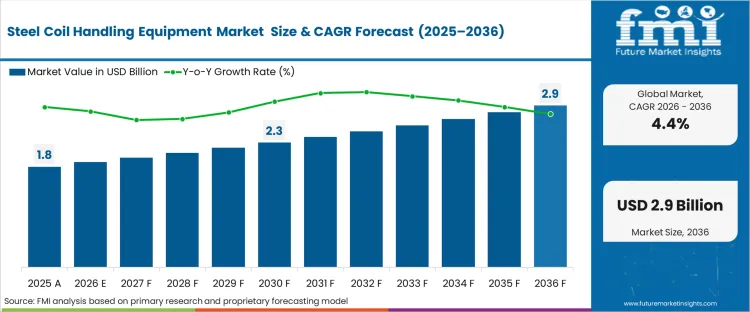
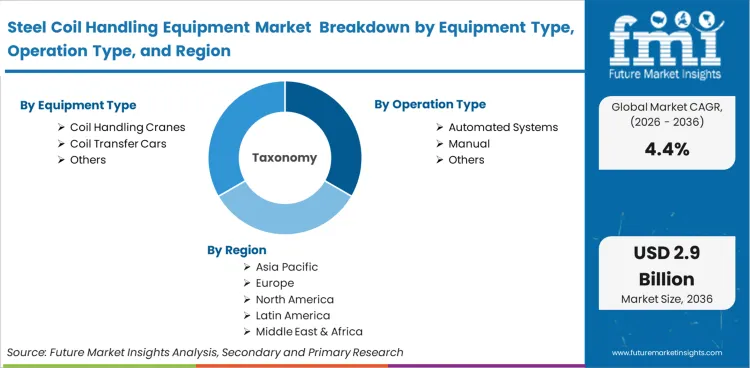
The steel coil handling equipment market was valued at USD 1.8 billion in 2025. The market is projected to reach USD 1.9 billion in 2026 and USD 2.9 billion by 2036, expanding at a CAGR of 4.4% during the forecast period. Coil handling cranes are expected to lead equipment type with a 29.8% share in 2026. Automated systems are projected to account for 41.6% of market revenue in 2026 as mills and service centers invest in safer, faster, and more traceable movement of heavy coils. Steel mills are expected to remain the leading end user with a 46.9% share in 2026. Demand is being supported by the sheer scale of steel output, the need to reduce damage and worker exposure during heavy-material movement, and a steady shift toward automated storage, transport, and warehouse-management systems for coils. World Steel Association data shows global crude steel production remained above 1.8 billion tonnes in 2024, while Konecranes and SMS group continue to market coil-specific lifting, storage, and logistics systems for metals operations.
Summary of Steel Coil Handling Equipment Market
- Key Drivers
- Mill throughput pressure is pushing operators to remove bottlenecks around coil transfer, storage, and dispatch
- The business case for better lifting devices, automated storage, and controlled transport systems increasingly rests on risk reduction as much as labor productivity. Konecranes’ 2025 delivery of a new 42-ton coil handling crane to Welser Profile underlines that coil-specific lifting capability remains an active investment area in metal processing operations.
- SMS group states that AMOVA supplies complete logistics systems for the metals industry, including automated high-bay storage for heavy loads up to 50 tons and warehouse-management functions. The commercial logic is straightforward: fewer manual touches, better material tracking, faster access to stored coils, and lower damage rates.
- Key Segments Analyzed in the Report
- Equipment type: coil handling cranes, coil transfer cars, upenders and tilters, coil storage and retrieval systems, coil packaging and strapping equipment, and others
- Operation type: manual, semi-automated, automated
- End use: steel mills, service centers, automotive stamping and processing facilities, ports and warehouses
- Region: North America, Latin America, Western Europe, Eastern Europe, East Asia, South Asia & Pacific, and Middle East & Africa
- Analyst Opinion
- Nikhil Kaitwade, Principal Consultant at Future Market Insights, says the value pool in this market is moving away from basic lift-and-shift hardware alone. Suppliers gain pricing power where they combine safe coil motion, storage density, transport logic, and software visibility into one operating system for metals facilities.
Steel Coil Handling Equipment Market Definition
The steel coil handling equipment market includes mechanical and automated systems used to lift, transfer, tilt, store, retrieve, package, and manage steel coils across production and logistics environments. It covers cranes, transfer cars, coil upenders, automated storage and retrieval systems, warehouse-management software linked to coil flow, and related handling subsystems used in mills, service centers, stamping plants, and industrial warehouses. This scope reflects the way leading vendors position coil logistics as an integrated heavy-material handling function rather than a standalone crane sale.
Steel Coil Handling Equipment Market Inclusions
- Revenue generated from coil-specific lifting, transfer, storage, retrieval, packaging, and motion-control systems
- Engineering, commissioning, retrofit, and service income associated with steel coil handling installations
- Warehouse-management and transport-order software directly tied to coil movement and storage operations
Steel Coil Handling Equipment Market Exclusions
- Generic material handling equipment without coil-specific application
- Standard warehouse shelving and forklifts sold without dedicated coil-handling function
- Metal processing machinery not directly involved in coil movement, storage, or handling
Steel Coil Handling Equipment Market Research Methodology
This study evaluates the steel coil handling equipment market across equipment type, operation type, end use, and region, using 2025 as the base year and 2026 to 2036 as the forecast period. Market value is expressed in USD billion. Evidence inputs include world steel production data, supplier product literature, company press releases, and first-party documentation on coil cranes, automated logistics systems, and warehouse-management platforms. Market sizing is built through triangulation across steel production volumes, installed handling intensity in mills and service centers, automation penetration, and replacement demand for aging lifting and storage systems.
Key Drivers, Restraints, and Trends in Steel Coil Handling Equipment Market
Drivers
Global steel volume keeps the installed base large. World Steel in Figures 2025 shows that steel production has been stable since 2020 and that 2024 crude steel production remained above 1.8 billion tonnes. That scale matters because coils move repeatedly across rolling, finishing, storage, dispatch, and downstream processing environments. As facilities push for higher throughput and fewer manual interventions, coil handling equipment becomes tied to operating efficiency, not just plant maintenance.
Restraints
Capital intensity is the main restraint. Automated coil storage, stacker cranes, transfer cars, and software layers require meaningful upfront investment, site redesign, and shutdown planning. Brownfield plants can face layout constraints that make retrofits harder than the sales brochure suggests. There is also a systems-integration issue. Once transport logic, storage, and order management are linked together, the buyer is no longer comparing one crane vendor with another. The buyer is committing to a broader operating architecture.
Trends
The clear trend is toward integrated coil logistics. Vendors are selling the combination of transport systems, high-bay storage, material tracking, and control software. SMS group notes that AMOVA’s systems cover everything from automatic coil transporters to warehouse-management systems. In December 2025, SMS group said AMOVA would supply a high-bay warehouse for aluminum coils with integrated coil transport systems that reduce handling by 30% to 60%. While that project is in aluminum, the logic applies directly to heavy coil logistics more broadly and signals where buyer demand is moving.
Segmental Analysis
Steel Coil Handling Equipment Market Analysis by Equipment Type
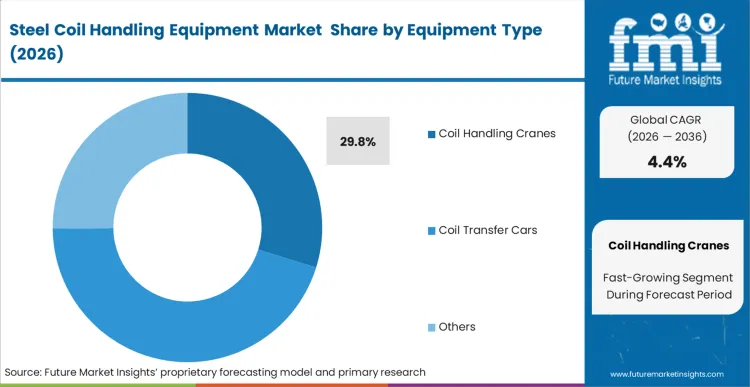
Coil handling cranes are expected to hold the leading 29.8% share in 2026. They remain the anchor product because every steel coil movement chain starts with reliable lifting and positioning. Even when plants add automated storage and transfer systems, crane performance still determines speed, safety, and uptime in rolling mills, machining zones, and dispatch areas. Konecranes explicitly markets coil, bar, and plate handling cranes as equipment used to transport material between machines in rolling mills and related metal-production settings.
Steel Coil Handling Equipment Market Analysis by Operation Type
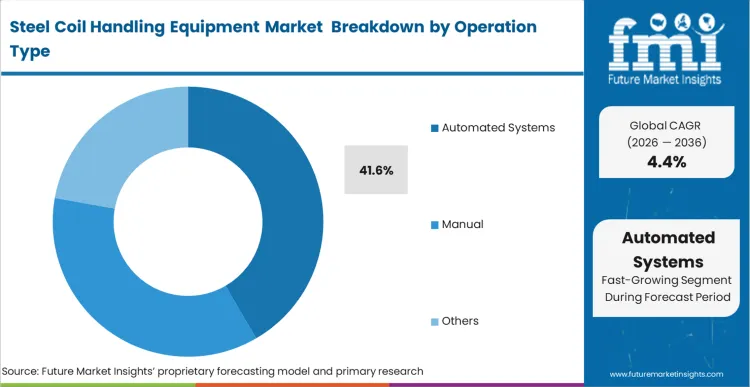
Automated systems are projected to account for 41.6% of revenue in 2026 and are likely to widen their share through the forecast period. The reason is practical rather than fashionable. Automation cuts repeat handling, improves coil traceability, raises storage density, and reduces dependence on skilled manual motion in high-risk environments. AMOVA’s positioning around automated high-bay storage and Konecranes’ warehouse-management system for coil storage both point to the same shift: buyers increasingly want coordinated material flow rather than isolated machines.
Competitive Aligners for Market Players
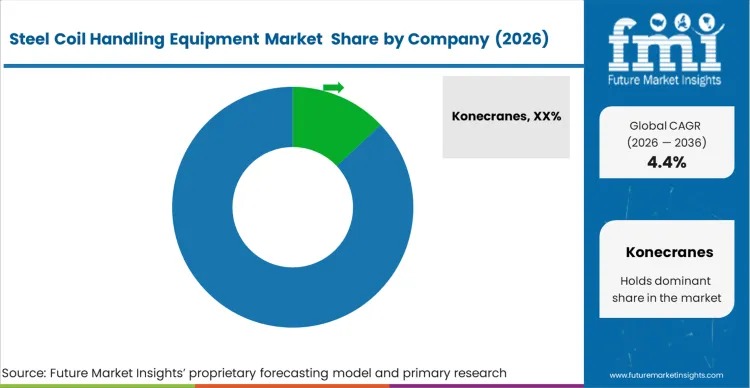
Winning suppliers in this market do three things well. First, they prove safe heavy-load handling with application-specific lifting geometry and motion control. Second, they connect equipment with software that manages transport orders, storage logic, and product visibility. Third, they handle brownfield constraints without turning modernization into a multi-year disruption. Konecranes continues to emphasize coil-specific cranes for metals production, while SMS group’s AMOVA platform pushes an integrated logistics proposition across transporters, storage systems, and warehouse software. That means competition is moving from standalone hardware specifications toward full coil-flow architecture.
Key Players in Steel Coil Handling Equipment Market
- Konecranes
- SMS group GmbH / AMOVA
- ANDRITZ AG
- Fives Group
- Primetals Technologies
- Toyota Industries Corporation
- Columbia/Okura LLC
- Bushman Equipment, Inc.
- Henan Weihua Heavy Machinery Co., Ltd.
- EMH, Inc.
Strategic Outlook by FMI on Steel Coil Handling Equipment Market
The steel coil handling equipment market should grow steadily rather than explosively. This is not a hype market. It is an operations market tied to the physical realities of steel flow, plant safety, and warehouse logic. Growth will come from automation upgrades, service-center modernization, and replacement demand in aging metals facilities. The strongest suppliers will be those that can connect coil lifting, movement, storage, and software into a system that clearly improves throughput and lowers handling risk.
Scope of the Report
| Metric | Value |
|---|---|
| Market Value | USD 1.8 billion in 2025 to USD 2.9 billion by 2036 |
| CAGR | 4.4% from 2026 to 2036 |
| Base Year | 2025 |
| Forecast Period | 2026 to 2036 |
| Equipment Type Segmentation | Coil Handling Cranes, Coil Transfer Cars, Upenders & Tilters, Coil Storage & Retrieval Systems, Coil Packaging & Strapping Equipment, Others |
| Operation Type Segmentation | Manual, Semi-automated, Automated |
| End Use Segmentation | Steel Mills, Service Centers, Automotive Stamping & Processing Facilities, Ports & Warehouses |
| Regions Covered | North America, Latin America, Western Europe, Eastern Europe, East Asia, South Asia & Pacific, and Middle East & Africa |
Bibliography
- World Steel Association. 2025. World Steel in Figures 2025.
- Konecranes. Current. Coil and Plate Handling Cranes.
- Konecranes. Current. Coil, Bar and Plate Handling Cranes.
- Konecranes. 2025. Konecranes Delivers New Coil Handling Crane to Welser Profile in Austria.
- SMS group GmbH. Current. Logistics Systems for the Metals Industry.
- SMS group GmbH. Current. AMOVA.
- AMOVA. Current. Metals Industry.
Frequently Asked Questions
What is driving growth in the steel coil handling equipment market?
Growth in the steel coil handling equipment market is being driven by mill modernization, safety requirements, warehouse automation, and the need to move heavy coils faster with less damage and lower labor risk.
Which equipment type leads the steel coil handling equipment market?
Coil handling cranes lead the steel coil handling equipment market because they remain central to lifting, positioning, and transferring coils across rolling, storage, and dispatch operations.
Why are automated systems gaining share in the steel coil handling equipment market?
Automated systems are gaining share in the steel coil handling equipment market because buyers want better traceability, higher storage density, lower repeat handling, and improved operating safety.
How do steel mills influence the steel coil handling equipment market?
Steel mills influence the steel coil handling equipment market by representing the largest installed base for heavy coil movement across production, finishing, storage, and outbound logistics.
What challenges affect the steel coil handling equipment market?
The steel coil handling equipment market faces challenges such as high capital cost, brownfield retrofit complexity, long shutdown planning cycles, and integration issues between equipment and warehouse software.
Which regions are important in the steel coil handling equipment market?
North America, Latin America, Western Europe, Eastern Europe, East Asia, South Asia & Pacific, and Middle East & Africa all contribute to the steel coil handling equipment market, with East Asia especially important because of its steel production scale.
What is the outlook for the steel coil handling equipment market through 2036?
The outlook for the steel coil handling equipment market through 2036 is steady, supported by replacement demand, automation upgrades, and the ongoing need for safer and more efficient heavy-coil logistics.
Preview the report firsthand - request a free sample
Get SampleGet the brochure for pricing and purchase details.
Get PDFTable of Content
- Executive Summary
- Global Market Outlook
- Demand-side Trends
- Supply-side Trends
- Technology Roadmap Analysis
- Analysis and Recommendations
- Market Overview
- Market Coverage / Taxonomy
- Market Definition / Scope / Limitations
- Research Methodology
- Chapter Orientation
- Analytical Lens and Working Hypotheses
- Market Structure, Signals, and Trend Drivers
- Benchmarking and Cross-market Comparability
- Market Sizing, Forecasting, and Opportunity Mapping
- Research Design and Evidence Framework
- Desk Research Programme (Secondary Evidence)
- Company Annual and Sustainability Reports
- Peer-reviewed Journals and Academic Literature
- Corporate Websites, Product Literature, and Technical Notes
- Earnings Decks and Investor Briefings
- Statutory Filings and Regulatory Disclosures
- Technical White Papers and Standards Notes
- Trade Journals, Industry Magazines, and Analyst Briefs
- Conference Proceedings, Webinars, and Seminar Materials
- Government Statistics Portals and Public Data Releases
- Press Releases and Reputable Media Coverage
- Specialist Newsletters and Curated Briefings
- Sector Databases and Reference Repositories
- FMI Internal Proprietary Databases and Historical Market Datasets
- Subscription Datasets and Paid Sources
- Social Channels, Communities, and Digital Listening Inputs
- Additional Desk Sources
- Expert Input and Fieldwork (Primary Evidence)
- Primary Modes
- Qualitative Interviews and Expert Elicitation
- Quantitative Surveys and Structured Data Capture
- Blended Approach
- Why Primary Evidence is Used
- Field Techniques
- Interviews
- Surveys
- Focus Groups
- Observational and In-context Research
- Social and Community Interactions
- Stakeholder Universe Engaged
- C-suite Leaders
- Board Members
- Presidents and Vice Presidents
- R&D and Innovation Heads
- Technical Specialists
- Domain Subject-matter Experts
- Scientists
- Physicians and Other Healthcare Professionals
- Governance, Ethics, and Data Stewardship
- Research Ethics
- Data Integrity and Handling
- Primary Modes
- Tooling, Models, and Reference Databases
- Desk Research Programme (Secondary Evidence)
- Data Engineering and Model Build
- Data Acquisition and Ingestion
- Cleaning, Normalisation, and Verification
- Synthesis, Triangulation, and Analysis
- Quality Assurance and Audit Trail
- Market Background
- Market Dynamics
- Drivers
- Restraints
- Opportunity
- Trends
- Scenario Forecast
- Demand in Optimistic Scenario
- Demand in Likely Scenario
- Demand in Conservative Scenario
- Opportunity Map Analysis
- Product Life Cycle Analysis
- Supply Chain Analysis
- Investment Feasibility Matrix
- Value Chain Analysis
- PESTLE and Porter’s Analysis
- Regulatory Landscape
- Regional Parent Market Outlook
- Production and Consumption Statistics
- Import and Export Statistics
- Market Dynamics
- Global Market Analysis 2021 to 2025 and Forecast, 2026 to 2036
- Historical Market Size Value (USD Million) Analysis, 2021 to 2025
- Current and Future Market Size Value (USD Million) Projections, 2026 to 2036
- Y-o-Y Growth Trend Analysis
- Absolute $ Opportunity Analysis
- Global Market Pricing Analysis 2021 to 2025 and Forecast 2026 to 2036
- Global Market Analysis 2021 to 2025 and Forecast 2026 to 2036, By Equipment Type
- Introduction / Key Findings
- Historical Market Size Value (USD Million) Analysis By Equipment Type , 2021 to 2025
- Current and Future Market Size Value (USD Million) Analysis and Forecast By Equipment Type , 2026 to 2036
- Coil Handling Cranes
- Coil Transfer Cars
- Others
- Coil Handling Cranes
- Y-o-Y Growth Trend Analysis By Equipment Type , 2021 to 2025
- Absolute $ Opportunity Analysis By Equipment Type , 2026 to 2036
- Global Market Analysis 2021 to 2025 and Forecast 2026 to 2036, By Operation Type
- Introduction / Key Findings
- Historical Market Size Value (USD Million) Analysis By Operation Type, 2021 to 2025
- Current and Future Market Size Value (USD Million) Analysis and Forecast By Operation Type, 2026 to 2036
- Automated Systems
- Manual
- Others
- Automated Systems
- Y-o-Y Growth Trend Analysis By Operation Type, 2021 to 2025
- Absolute $ Opportunity Analysis By Operation Type, 2026 to 2036
- Global Market Analysis 2021 to 2025 and Forecast 2026 to 2036, By Region
- Introduction
- Historical Market Size Value (USD Million) Analysis By Region, 2021 to 2025
- Current Market Size Value (USD Million) Analysis and Forecast By Region, 2026 to 2036
- North America
- Latin America
- Western Europe
- Eastern Europe
- East Asia
- South Asia and Pacific
- Middle East & Africa
- Market Attractiveness Analysis By Region
- North America Market Analysis 2021 to 2025 and Forecast 2026 to 2036, By Country
- Historical Market Size Value (USD Million) Trend Analysis By Market Taxonomy, 2021 to 2025
- Market Size Value (USD Million) Forecast By Market Taxonomy, 2026 to 2036
- By Country
- USA
- Canada
- Mexico
- By Equipment Type
- By Operation Type
- By Country
- Market Attractiveness Analysis
- By Country
- By Equipment Type
- By Operation Type
- Key Takeaways
- Latin America Market Analysis 2021 to 2025 and Forecast 2026 to 2036, By Country
- Historical Market Size Value (USD Million) Trend Analysis By Market Taxonomy, 2021 to 2025
- Market Size Value (USD Million) Forecast By Market Taxonomy, 2026 to 2036
- By Country
- Brazil
- Chile
- Rest of Latin America
- By Equipment Type
- By Operation Type
- By Country
- Market Attractiveness Analysis
- By Country
- By Equipment Type
- By Operation Type
- Key Takeaways
- Western Europe Market Analysis 2021 to 2025 and Forecast 2026 to 2036, By Country
- Historical Market Size Value (USD Million) Trend Analysis By Market Taxonomy, 2021 to 2025
- Market Size Value (USD Million) Forecast By Market Taxonomy, 2026 to 2036
- By Country
- Germany
- UK
- Italy
- Spain
- France
- Nordic
- BENELUX
- Rest of Western Europe
- By Equipment Type
- By Operation Type
- By Country
- Market Attractiveness Analysis
- By Country
- By Equipment Type
- By Operation Type
- Key Takeaways
- Eastern Europe Market Analysis 2021 to 2025 and Forecast 2026 to 2036, By Country
- Historical Market Size Value (USD Million) Trend Analysis By Market Taxonomy, 2021 to 2025
- Market Size Value (USD Million) Forecast By Market Taxonomy, 2026 to 2036
- By Country
- Russia
- Poland
- Hungary
- Balkan & Baltic
- Rest of Eastern Europe
- By Equipment Type
- By Operation Type
- By Country
- Market Attractiveness Analysis
- By Country
- By Equipment Type
- By Operation Type
- Key Takeaways
- East Asia Market Analysis 2021 to 2025 and Forecast 2026 to 2036, By Country
- Historical Market Size Value (USD Million) Trend Analysis By Market Taxonomy, 2021 to 2025
- Market Size Value (USD Million) Forecast By Market Taxonomy, 2026 to 2036
- By Country
- China
- Japan
- South Korea
- By Equipment Type
- By Operation Type
- By Country
- Market Attractiveness Analysis
- By Country
- By Equipment Type
- By Operation Type
- Key Takeaways
- South Asia and Pacific Market Analysis 2021 to 2025 and Forecast 2026 to 2036, By Country
- Historical Market Size Value (USD Million) Trend Analysis By Market Taxonomy, 2021 to 2025
- Market Size Value (USD Million) Forecast By Market Taxonomy, 2026 to 2036
- By Country
- India
- ASEAN
- Australia & New Zealand
- Rest of South Asia and Pacific
- By Equipment Type
- By Operation Type
- By Country
- Market Attractiveness Analysis
- By Country
- By Equipment Type
- By Operation Type
- Key Takeaways
- Middle East & Africa Market Analysis 2021 to 2025 and Forecast 2026 to 2036, By Country
- Historical Market Size Value (USD Million) Trend Analysis By Market Taxonomy, 2021 to 2025
- Market Size Value (USD Million) Forecast By Market Taxonomy, 2026 to 2036
- By Country
- Kingdom of Saudi Arabia
- Other GCC Countries
- Turkiye
- South Africa
- Other African Union
- Rest of Middle East & Africa
- By Equipment Type
- By Operation Type
- By Country
- Market Attractiveness Analysis
- By Country
- By Equipment Type
- By Operation Type
- Key Takeaways
- Key Countries Market Analysis
- USA
- Pricing Analysis
- Market Share Analysis, 2025
- By Equipment Type
- By Operation Type
- Canada
- Pricing Analysis
- Market Share Analysis, 2025
- By Equipment Type
- By Operation Type
- Mexico
- Pricing Analysis
- Market Share Analysis, 2025
- By Equipment Type
- By Operation Type
- Brazil
- Pricing Analysis
- Market Share Analysis, 2025
- By Equipment Type
- By Operation Type
- Chile
- Pricing Analysis
- Market Share Analysis, 2025
- By Equipment Type
- By Operation Type
- Germany
- Pricing Analysis
- Market Share Analysis, 2025
- By Equipment Type
- By Operation Type
- UK
- Pricing Analysis
- Market Share Analysis, 2025
- By Equipment Type
- By Operation Type
- Italy
- Pricing Analysis
- Market Share Analysis, 2025
- By Equipment Type
- By Operation Type
- Spain
- Pricing Analysis
- Market Share Analysis, 2025
- By Equipment Type
- By Operation Type
- France
- Pricing Analysis
- Market Share Analysis, 2025
- By Equipment Type
- By Operation Type
- India
- Pricing Analysis
- Market Share Analysis, 2025
- By Equipment Type
- By Operation Type
- ASEAN
- Pricing Analysis
- Market Share Analysis, 2025
- By Equipment Type
- By Operation Type
- Australia & New Zealand
- Pricing Analysis
- Market Share Analysis, 2025
- By Equipment Type
- By Operation Type
- China
- Pricing Analysis
- Market Share Analysis, 2025
- By Equipment Type
- By Operation Type
- Japan
- Pricing Analysis
- Market Share Analysis, 2025
- By Equipment Type
- By Operation Type
- South Korea
- Pricing Analysis
- Market Share Analysis, 2025
- By Equipment Type
- By Operation Type
- Russia
- Pricing Analysis
- Market Share Analysis, 2025
- By Equipment Type
- By Operation Type
- Poland
- Pricing Analysis
- Market Share Analysis, 2025
- By Equipment Type
- By Operation Type
- Hungary
- Pricing Analysis
- Market Share Analysis, 2025
- By Equipment Type
- By Operation Type
- Kingdom of Saudi Arabia
- Pricing Analysis
- Market Share Analysis, 2025
- By Equipment Type
- By Operation Type
- Turkiye
- Pricing Analysis
- Market Share Analysis, 2025
- By Equipment Type
- By Operation Type
- South Africa
- Pricing Analysis
- Market Share Analysis, 2025
- By Equipment Type
- By Operation Type
- USA
- Market Structure Analysis
- Competition Dashboard
- Competition Benchmarking
- Market Share Analysis of Top Players
- By Regional
- By Equipment Type
- By Operation Type
- Competition Analysis
- Competition Deep Dive
- Konecranes
- Overview
- Product Portfolio
- Profitability by Market Segments (Product/Age /Sales Channel/Region)
- Sales Footprint
- Strategy Overview
- Marketing Strategy
- Product Strategy
- Channel Strategy
- SMS group GmbH / AMOVA
- ANDRITZ AG
- Fives Group
- Primetals Technologies
- Toyota Industries Corporation
- Konecranes
- Competition Deep Dive
- Assumptions & Acronyms Used


