

- Market Size (2026)
- USD 1.2 Bn
- Forecast (2036)
- USD 29.0 Bn
- CAGR (2026 to 2036)
- 37.5%
How big is the Autonomous Long-Haul Trucking Market in 2026?
USD 1.2 billion in 2026 and USD 29.0 billion by 2036 at a 37.5% CAGR.
Revenue from sales of autonomous long-haul trucking is projected to increase from USD 1.2 billion in 2026 to USD 29.0 billion by 2036 at a 37.5% CAGR between 2026 and 2036 supported by driver-out service on repeatable interstate lanes. Aurora Innovation reported in May 2025 that its Dallas-to-Houston operation had completed more than 6,000 driverless miles under commercial conditions. The result moves autonomous trucks beyond demonstration mileage and gives freight carriers a practical basis for comparing route economics. Commercial value depends on coordinated fleet management that covers dispatch and remote assistance without weakening maintenance planning or terminal reliability during regular freight service.
Deployment conditions differ sharply between the United States and Germany due to different commercial and approval pathways for heavy autonomous trucks. American developers can build commercial service around long interstate corridors, whereas German programs place greater weight on type approval and evidence gathered through coordinated research. Transfer hubs remain the main operating detail in both markets since they separate highway autonomy from local pickup and delivery.
Waabi reported in January 2026 that it closed a USD 750 million Series C round to accelerate autonomous trucking commercialization. The investment signals that capital is moving toward software validation and vehicle integration rather than demonstrations. Reliable connected vehicle technology becomes commercially important for exchanging route status and exception data with the operating center. Freight networks gain value once corridor expansion follows documented performance across several operating cycles and varied service conditions.
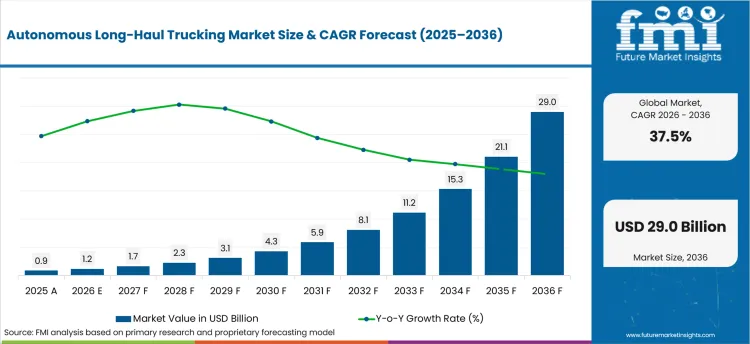
| Metric | Value |
|---|---|
| 2025 Market Size | USD 0.9 billion |
| 2026 Market Size | USD 1.2 billion |
| 2036 Market Size | USD 29.0 billion |
| Forecast CAGR (2026-2036) | 37.5% |
| Automation Level Focus | Level 4 Full-Stack Autonomy |
| Level 4 Full-Stack Autonomy Share (2026) | 44.0% |
| Route Type Focus | Hub-to-Hub Highway Corridors |
| Hub-to-Hub Highway Corridors Share (2026) | 52.0% |
| Business Model Focus | Per-Mile Autonomous Freight Service |
| Per-Mile Autonomous Freight Service Share (2026) | 46.0% |
Summary of the Autonomous Long-Haul Trucking Market
| Market Signal | Commercial Impact |
|---|---|
| Demand and Growth Drivers | Long-haul freight lanes create a clear commercial case for driver-out operation once route conditions remain repeatable and daily freight schedules remain stable.
|
| Product and Segment View | Level 4 systems and hub-to-hub routes form the practical starting point for commercial autonomous freight.
|
| Geography and Growth Outlook | Country growth reflects the relationship between road approval, freight density, and local vehicle manufacturing support across each national freight system.
|
| Competitive Landscape | Competition depends on which company can combine driving software, redundant trucks, and dependable freight operations under one accountable commercial model.
|
| Analyst Perspective | Commercial success depends on repeatable freight service rather than a single driverless demonstration on one controlled route over time.
|
Source: FMI's proprietary forecasting model and primary research
How is the autonomous long-haul trucking market segmented?
The autonomous long-haul trucking industry is segmented by automation level, solution type, route type, business model, application, and region.
The market structure reflects how autonomous freight systems are built and sold across technical and operating models. Automation level separates Level 4 full-stack systems from Level 2 and Level 3 driver-assist platforms. Solution type separates hardware and sensor systems from automotive software and fleet orchestration used during daily service. Route analysis compares hub-to-hub highway corridors with point-to-point operations that include terminal and local road exposure.
Business models distinguish per-mile freight service from vehicle and technology sales that transfer more ownership responsibility. Application coverage includes general freight and energy logistics alongside retail distribution with different route timing and payload needs. Regional analysis captures different approval systems and truck-manufacturing bases that influence how quickly commercial programs can expand. The framework helps readers compare technical readiness with commercial responsibility attached to each operating model.
How does Level 4 full-stack autonomy shape demand within the automation level category?
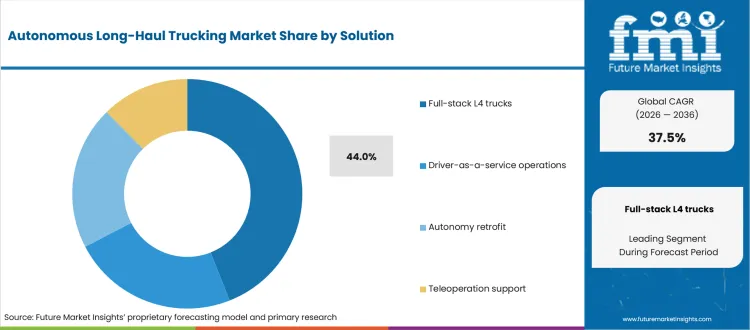
Level 4 systems take responsibility for the driving task inside a defined operating domain, so commercial evaluation focuses on safe fallback behavior and route boundaries. PlusAI reported in April 2025 that it completed driverless safety-maneuver testing without a person inside the cab or remote intervention. The development matters because autonomous vehicles need evidence that the truck can reach a safe condition during a system exception. Long-haul programs gain credibility once safety behavior is demonstrated under realistic vehicle dynamics across repeated commercial freight lanes.
- Based on automation level, Level 4 full-stack autonomy is projected to account for 44.0% share during 2026, driven by the ability to limit early commercial service to mapped highway lanes. The segment keeps software and fallback logic within one operating design, which reduces integration ambiguity during safety review and customer acceptance.
- Long-haul carriers are evaluating Level 4 systems for scheduled middle-mile freight because highway hours represent a large share of route time. Commercial acceptance depends on documented fallback behavior and a clear incident-response process that remains usable throughout regular freight service. Documented safety requirements favor programs that connect the virtual driver with redundant braking and steering systems before regular freight service begins.
What supports demand for hub-to-hub highway corridors within the route type category?
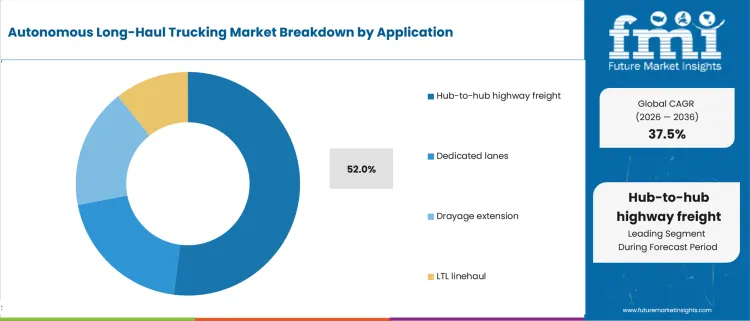
Hub-to-hub routes isolate the interstate middle mile and leave local collection work with conventional tractors. Torc Robotics reported in April 2025 that its autonomous-ready Freightliner Cascadia platform incorporated more than 1,500 engineering requirements and entered testing on the Laredo-to-Dallas lane. The development shows why Class 8 trucks need factory-level redundancy before highway software can support paid freight. Transfer hubs then become operating assets that protect route consistency and simplify vehicle inspection between runs.
- By route type, hub-to-hub highway corridors are forecast to represent 52.0% share by 2026, supported by repeatable interstate geometry and controlled terminal handoffs. The model avoids many urban conflicts during initial service and gives operations teams a stable location for inspections and planned freight transfer between autonomous and human-driven tractors.
- Freight carriers are purchasing corridor capacity for lanes with consistent volumes and predictable terminal schedules. Hub placement matters because poor transfer timing can erase the utilization benefit gained on the highway. Operators therefore compare yard access and maintenance coverage with lane distance before assigning recurring freight to an autonomous service.
How is per-mile autonomous freight service positioned within the business model category?
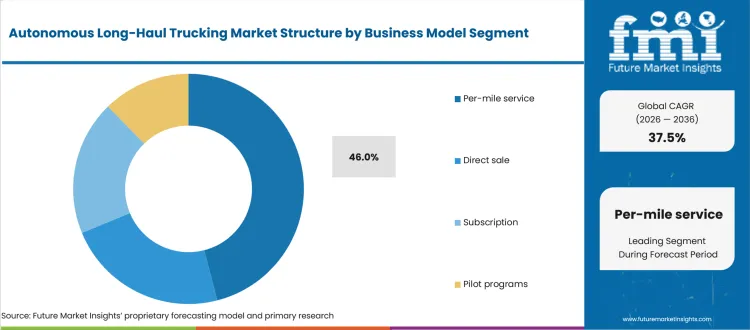
Per-mile service allows a freight customer to buy transport capacity without owning the autonomous system or managing its software updates. Kodiak AI reported in June 2025 that Vay remote-driving technology supported assisted autonomy for long-haul truck launch and landing at customer facilities. The partnership shows how smart fleet management can bridge low-speed situations outside the highway operating domain. Service contracts gain value when responsibility for remote support and truck availability remains clearly assigned.
- By business model, per-mile autonomous freight service is estimated to hold 46.0% share during 2026, attributable to lower integration burden for carriers that prefer capacity over technology ownership. The developer retains responsibility for software performance and remote support, whereas the customer can compare service cost with conventional line-haul options on the same lane.
- Shippers and dedicated carriers are drawing attention to per-mile contracts that include vehicle availability and incident response. Contract value depends on transparent service levels rather than a headline mileage rate alone during commercial service negotiations. Commercial terms should define terminal delays and recovery responsibility so operating risk does not move back to the freight customer without compensation.
What are the drivers, restraints, and opportunities in the autonomous long-haul trucking market?
Repeatable interstate freight supports adoption; route-specific approval slows network expansion; managed freight contracts reduce integration burden for commercial operators.
- Driver: Driver-out highway operations support higher truck utilization on freight lanes with stable schedules and terminal control.
- Restraint: Separate vehicle and road approvals extend deployment schedules across states and national markets with different safety requirements.
- Opportunity: Factory-built trucks and managed freight contracts create a commercial opening for carriers that cannot integrate autonomous systems internally.
Industry growth is expected to rise due to the ability to operate repeatable highway freight beyond conventional driver schedules. Aurora Innovation reported in August 2025 that supervised freight operations had delivered more than 3,000 nighttime loads across 700,000 commercial miles since 2023. The record matters across freight schedules because the trucks market depends on round-the-clock asset use. Freight operators gain a clearer economic case once driverless service covers planned night departures without creating a separate operating process for every shift.
A factor limiting demand is the staged approval required for heavy autonomous vehicles on public roads. The California Department of Motor Vehicles reported in April 2026 that adopted rules allowed manufacturers to apply for permits covering heavy-duty autonomous vehicles. The rules open a permit path for freight operations, yet each program still needs documented oversight and operating controls. Automotive radar sensors and other safety components must support evidence that remains valid throughout route expansion.
Integrating autonomous capacity into transportation management systems already used by freight carriers is one emerging opportunity in the sector. Aurora Innovation reported in September 2025 that McLeod Software served more than 1,200 customers and that Russell Transport planned to access Aurora trucks through the platform. The integration allows carriers to tender and track autonomous loads without adding a separate operating interface. Service providers can capture recurring revenue once scheduling, shipment visibility, and exception handling work inside familiar freight-management processes.
Which country CAGRs are profiled in the autonomous long-haul trucking market?
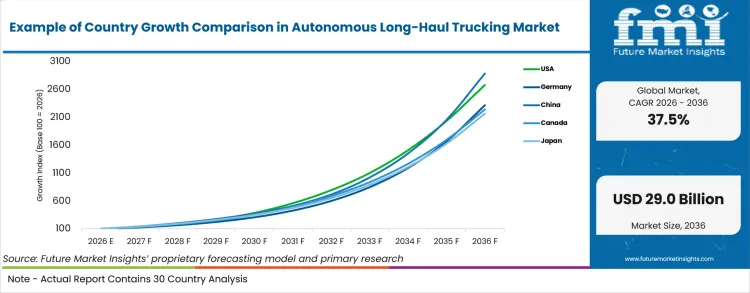
| Country | CAGR |
|---|---|
| United States | 39.0% |
| China | 40.0% |
| Germany | 37.0% |
| Canada | 36.5% |
| Japan | 36.0% |
| South Korea | 38.5% |
| United Kingdom | 35.5% |
Source: FMI's proprietary forecasting model and primary research
How do country-level CAGRs compare in the autonomous long-haul trucking market?
The country comparison spans 4.5 percentage points and shows two closely spaced market groups. China, the United States and South Korea sit within a narrow range that indicates comparable momentum for autonomous line-haul operations. Germany, Canada and Japan form another compact group with moderate differences in projected expansion. The United Kingdom remains close to this second group rather than standing apart from the wider comparison. The overall pattern suggests that market development will differ through route approval and fleet integration rather than demand direction alone.
- China shows notable momentum as large freight networks are expected to support repeated autonomous operations across defined logistics corridors.
- The United States remains close to China while commercial expansion depends on aligning federal safety requirements with separate state road-access rules.
- South Korea occupies a similar position as technology-led fleet programs are anticipated to support hub-to-hub operations across concentrated industrial routes.
- Germany reflects considerable development through motorway testing and route-specific safety cases that connect vehicle approval with terminal readiness.
- Canada remains closely aligned with Germany as long intercity routes support the use case while winter validation shapes operating requirements.
- Japan shows a comparable outlook as labor constraints and expressway-focused freight models encourage relay operations with remote supervision.
- The United Kingdom sits near the second cluster as deployment is expected to progress through defined motorway corridors and approved commercial safety cases.
Markets with similar CAGRs are expected to follow different commercialization paths as road access and remote-support rules vary. These differences influence corridor selection and fleet economics as well as the timing of unattended freight operations. The full report provides country-level CAGR analysis across North America, Latin America, Europe, East Asia, South Asia, Oceania and the Middle East and Africa.
- Interstate freight corridors give the United States a direct path from driverless testing to scheduled line-haul service. The United States is estimated to post 39.0% CAGR from 2026 to 2036, supported by state-level operating pathways and dense Sun Belt freight lanes. The National Highway Traffic Safety Administration reported in September 2025 that three rulemakings were proposed for automated vehicles without manual controls. Federal vehicle standards remain relevant to heavy trucks even though road-operation permissions still vary by state. Aurora Innovation and Kodiak AI give freight networks domestic reference points for driver-out service under defined route and operating conditions. Carriers should compare route permits and recovery coverage before assigning recurring customer freight to a new corridor.
- China combines high freight volumes with truck manufacturing and large commercial datasets from partially automated operations. Autonomous long-haul trucking demand in China is forecast to rise at 40.0% CAGR through 2036, driven by domestic platform development and cross-provincial logistics routes. Pony AI reported in January 2025 that its robotrucks had travelled more than five million kilometres and transported over 860 million freight ton-kilometres by December 2024. The operating record gives developers practical data for platooning and full-stack validation across heavily used cross-provincial freight corridors.
- Germany treats autonomous trucking as an engineering and approval program that must work across vehicle and motorway systems. Adoption of autonomous long-haul trucks in Germany is estimated to expand at 37.0% CAGR over the forecast period, underpinned by coordinated research and a legal framework for Level 4 road use. TÜV SÜD reported in May 2025 that around 150 engineers completed three years of work on the ATLAS-L4 hub-to-hub project. The program created operating evidence for autonomous trucks on motorways rather than a stand-alone software demonstration. Torc Robotics and MAN-related engineering programs increase the need for production-ready safety cases that remain valid across truck configurations. Commercial expansion depends on approval evidence that can be reused across freight corridors and vehicle configurations.
- Canada contributes autonomous-driving software and engineering talent to a North American freight network centered on cross-border corridors. The Canadian autonomous long-haul trucking sector is projected to record 36.5% CAGR between 2026 and 2036, aided by domestic software development and access to United States truck platforms. Waabi reported in February 2025 that its Volvo partnership targeted a North American freight industry valued at USD 1 trillion. The partnership ties Canadian software development to a production vehicle rather than a retrofit-only program. Waabi gives Canadian investors a direct route into autonomous freight commercialization through a software company linked to production truck engineering. Supplier selection should test whether the software can handle border-area operating conditions and integrate with service networks on both sides of the border.
- Japan is using autonomous trucks to protect trunk-line freight capacity as logistics companies face structural labor constraints. In Japan, autonomous long-haul trucking demand is predicted to advance at 36.0% CAGR by 2036, shaped by government interest and domestic logistics programs. PlusAI reported in January 2026 that T2 was supported by more than 20 companies and had started commercial Level 2 trunk-line operations in July 2025. The operating base gives T2 a practical route for progressing toward Level 4 service with PlusAI. Japanese freight companies need systems that fit local road rules and terminal practices without disrupting established trunk-line operating schedules. Commercial confidence depends on a measured transition that protects service continuity during the move from assisted driving to driver-out operation.
- South Korea can combine commercial-vehicle manufacturing with autonomous software partnerships that support long-distance freight applications and domestic service networks. Autonomous long-haul trucking sales in South Korea are forecast to expand at 38.5% CAGR during the forecast period, reinforced by domestic vehicle engineering and export-oriented freight technology. PlusAI reported in October 2025 that Hyundai’s XCIENT platform had logged nearly 10 million miles across ten countries before its integration with the Level 4 SuperDrive system. The platform links autonomous freight with a production heavy-truck base and established service capabilities across domestic and export markets. Hyundai Motor and PlusAI provide a clear development pair for hub-to-hub operation on factory-engineered heavy-truck platforms. Fleet investment should examine whether local maintenance support and energy infrastructure can match the utilization required by autonomous routes.
- The United Kingdom is defining legal responsibility for self-driving vehicles before wider commercial freight deployment enters public roads. Autonomous long-haul trucking demand in the United Kingdom is anticipated to advance at 35.5% CAGR through 2036, attributable to a formal safety framework and an established logistics services sector. The Department for Transport reported in July 2025 that GB-registered HGVs moved 168 billion tonne-kilometres of freight during 2024. The freight base creates a sizable pool of articulated routes that could support hub-to-hub automation after vehicle authorization is established. The Automated Vehicles Act gives logistics companies a framework for evaluating future services with clearer liability boundaries. Market entry still depends on heavy-vehicle approval and route evidence that supports freight operations rather than passenger-only pilots.
Who are the notable companies in the autonomous long-haul trucking market?
Aurora Innovation, Kodiak AI, Torc Robotics, Waabi, PlusAI, Pony AI, Inceptio Technology, and Volvo Autonomous Solutions are the notable companies shaping this market.
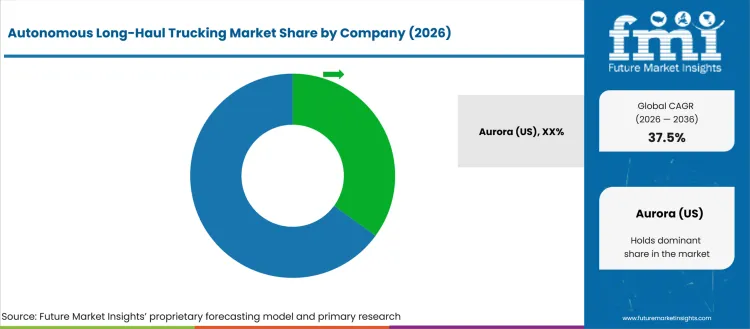
Competition spans virtual-driver developers, truck manufacturers, and freight-service operators that share responsibility during commercial deployment programs. Aurora Innovation and Kodiak AI differentiate through driver-out commercial activity on defined interstate freight routes. Torc Robotics and PlusAI rely on production truck integration, whereas Waabi combines its driving system with Volvo vehicle engineering.
Pony AI contributes commercial robotruck operating data from China that supports validation across high-volume logistics routes. Inceptio Technology reported in November 2025 that more than 4,000 Level 2 and Level 3 trucks had accumulated over 400 million kilometres of commercial operation. Durable advantage depends on vehicle software operations that control updates and incident records throughout service life. Customers gain clearer accountability through contracts that assign software performance and roadside response duties prior to freight operations.
- Aurora Innovation competes through a self-driving system integrated with heavy-truck platforms and commercial freight service in the United States. Its position depends on converting lane performance into repeatable operations with logistics partners and vehicle manufacturers across several scheduled operating cycles.
- Kodiak AI combines a modular autonomous system with driverless freight operations and remote assisted-autonomy support. The company appeals to customers that need commercial service on defined routes without developing a separate autonomy engineering team or dedicated remote-support platform for routine operations.
- Torc Robotics benefits from Daimler Truck ownership and direct access to the autonomous-ready Freightliner Cascadia. Its commercial case rests on factory-level redundancy and testing that can support series production for United States highway freight across defined interstate routes and customer programs.
- Waabi integrates its virtual driver with the Volvo VNL Autonomous and uses simulation to reduce dependence on road-only testing. The company connects Canadian software development with North American truck production and freight deployment plans across scheduled line-haul routes and customer networks.
- PlusAI works with International Motors and other truck manufacturers on factory-built autonomous platforms designed for repeatable highway freight service. Its broad partnership model can shorten vehicle integration work, although commercial responsibility must remain clear across the technology and operating parties.
- Pony AI connects full-stack autonomous driving with robotruck platooning and commercial freight operations in China. Its operating data supports route validation across the Beijing-Tianjin-Hebei logistics region, although wider driverless deployment still depends on production vehicles and repeatable approval across freight corridors.
- Inceptio Technology uses large commercial datasets from Level 2 and Level 3 line-haul trucks to develop Level 4 systems. Its domestic operating base covers express freight and full-truckload services, which gives the company route data across several recurring logistics categories.
Competitive Benchmarking: Autonomous Long-Haul Trucking Market
| Company | Full-Stack Autonomy | OEM Integration | Commercial Operations | Geographic Reach |
|---|---|---|---|---|
| Aurora Innovation | High | High | High | United States |
| Kodiak AI | High | Medium | High | United States |
| Torc Robotics | High | High | Medium | United States and Germany |
| Waabi | High | High | Medium | Canada and United States |
| PlusAI | High | High | Medium | United States, Europe, and Asia |
| Pony AI | High | Medium | High | China |
| Inceptio Technology | Medium | High | High | China |
| Volvo Autonomous Solutions | Medium | High | Medium | North America and Europe |
Scoring basis: High indicates public evidence of direct market capability and commercial readiness across defined autonomous freight programs. Medium indicates verified capability with deployment evidence that remains limited to selected routes or partnerships. Low indicates a supporting role without direct responsibility for the full autonomous system or daily freight operations.
Source: Official company announcements and product documentation dated through July 2026.
Key Developments in the Autonomous Long-Haul Trucking Market
- In May 2025, Aurora Innovation began driverless commercial freight service between Dallas and Houston under a defined interstate operating design. The launch placed the Aurora Driver in regular paid operation without a safety driver inside the truck. Commercial significance came from assigning customer freight to a repeatable interstate lane rather than limiting the system to demonstration runs. The program gave carriers a reference point for evaluating driver-out service economics and daily operating responsibility.
- In September 2025, International Motors and PlusAI started customer fleet trials on the Interstate 35 corridor in Texas. International supplied factory-built LT Series trucks with installed sensors and computing hardware, whereas PlusAI provided the SuperDrive virtual driver. The trial connected production vehicle engineering with customer freight activity under the conditions used during regular fleet operations. Commercial evaluation could therefore focus on route performance and fleet integration instead of a one-off retrofit process.
- In October 2025, Waabi and Volvo Autonomous Solutions completed integration of the Waabi Driver with the Volvo VNL Autonomous. The combined platform used a purpose-built truck with redundant safety systems and an end-to-end driving model. Completed integration moved the partnership from a development agreement toward one shared autonomous freight product for commercial validation. The milestone matters because customers need software and vehicle responsibility to remain aligned during validation and commercial deployment.
- In December 2025, Kodiak AI reported that ten driverless trucks were operating by the end of September 2025. The fleet had delivered more than 5,200 hours of paid driverless service and exceeded three million autonomous miles. The operating record showed a move from development activity into recurring commercial work supported by measurable service hours and mileage. Freight customers gained measurable evidence for uptime and service planning under a driver-out model operating across repeated work cycles.
Key Players in the Autonomous Long-Haul Trucking Market
Full-Stack Autonomous Freight Developers
- Aurora Innovation
- Kodiak AI
- Waabi
- Inceptio Technology
OEM-Integrated Autonomy Developers
- Torc Robotics
- PlusAI
Autonomous Freight Platforms and Vehicle Partners
- Pony AI
- Volvo Autonomous Solutions
Autonomous Long-Haul Trucking Market - Report Scope
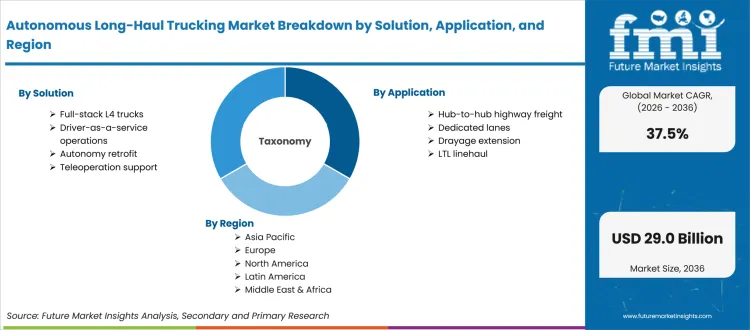
| Coverage field | Report scope |
|---|---|
| Market breakdown | Automation level, solution type, route type, business model, application, and region. |
| Quantitative Units | Revenue in USD Billion, CAGR in %. |
| Market Definition | Driver-out and highly automated heavy-truck systems designed for long-distance freight movement on defined highway or line-haul routes. |
| Regions Covered | North America, Latin America, Europe, East Asia, South Asia, Oceania, and Middle East and Africa. |
| Countries Covered | United States, China, Germany, Canada, Japan, South Korea, United Kingdom, and 7+ countries within the regional model. |
| Key Companies Profiled | Aurora Innovation, Kodiak AI, Torc Robotics, Waabi, PlusAI, Pony AI, Inceptio Technology, and Volvo Autonomous Solutions. |
| Forecast Period | 2026 to 2036. |
| Approach | Hybrid bottom-up and top-down market sizing supported by primary interviews and official desk research. |
Autonomous Long-Haul Trucking Market - Research Methodology
| Method | Approach |
|---|---|
| Primary Research | FMI analysts gathered input from manufacturers, service providers, technology developers, distributors, end users, procurement teams, and subject-matter experts. Interviews examined purchasing decisions, product or service evaluation, adoption barriers, approval requirements, pricing considerations, and expectations for technical or commercial support. Respondents were also asked what evidence is required before a trial, pilot, or initial order develops into regular purchasing. |
| Desk Research | Desk research covered government statistics, regulatory publications, trade data, industry associations, technical literature, standards, company filings, product information, and official corporate announcements. Sources were reviewed for relevance, publication date, geographic coverage, and consistency with the defined market scope. Claims relating to performance, applications, approvals, capacity, investment, and commercial activity were retained only when supported by credible public evidence. |
| Market Sizing and Forecasting | The market model combined the baseline value with historical performance, segment structure, pricing and volume indicators, adoption levels, company participation, and country-level demand conditions. Forecast assumptions considered economic activity, investment trends, regulatory developments, technology adoption, purchasing cycles, supply availability, and barriers to wider market use. Segment and regional estimates were reconciled before the final market total was calculated. |
| Data Validation | Estimates were checked against multiple independent indicators, including public data, company activity, trade patterns, industry developments, and findings from primary interviews. Validation also tested whether products, services, applications, and company revenues fell within the defined market boundaries. Adjacent categories, unsupported claims, overlapping revenues, and activities without direct market relevance were excluded to reduce double counting and maintain consistency across segments and countries. |
Autonomous Long-Haul Trucking Market by Segments
Autonomous Long-Haul Trucking Market segmented bySolution:
- Full-stack L4 trucks
- Driver-as-a-service operations
- Autonomy retrofit
- Teleoperation support
Autonomous Long-Haul Trucking Market segmented byApplication:
- Hub-to-hub highway freight
- Dedicated lanes
- Drayage extension
- LTLlinehaul
Autonomous Long-Haul Trucking Market segmented byComponent:
- Vehicles
- Autonomy software
- Fleet services
- Parcel networks
Autonomous Long-Haul Trucking Market segmented byEnd-use:
- Carriers & 3PL
- Shippers – private fleets
- OEM programs
- Pilot programs
Autonomous Long-Haul Trucking Market segmented byBusiness Model:
- Per-mile service
- Directsale
- Subscription
Autonomous Long-Haul Trucking Market by Region:
- North America
- United States
- Canada
- Latin America
- Brazil
- Mexico
- Europe
- Germany
- United Kingdom
- France
- Italy
- Spain
- East Asia
- China
- Japan
- South Korea
- South Asia
- India
- Thailand
- Indonesia
- Oceania
- Australia
- New Zealand
- Middle East and Africa
- GCC Countries
- South Africa
- Türkiye
Research Sources and Bibliography
- Aurora Innovation. (2025, May). Updating Our Driverless Operations. Aurora Innovation.
- Waabi. (2026, January). Waabi secures $1 Billion in new funding to lead Physical AI revolution. Waabi.
- PlusAI. (2025, April). Autonomous Trucking Leader Plus Achieves Milestone With Driverless Safety Maneuver Testing. PlusAI.
- Torc Robotics. (2025, April). Daimler Truck’s Autonomous-Ready Fifth Generation Freightliner Cascadia Hits Texas Roads With Torc. Torc Robotics.
- Kodiak AI. (2025, June). Vay and Kodiak Partner to Incorporate Assisted Autonomy Technology into Kodiak’s Fully Autonomous Technology Stack. Kodiak AI.
- Aurora Innovation. (2025, August). The road never sleeps: Aurora’s trucks go driverless day and night. Aurora Innovation.
- California Department of Motor Vehicles. (2026, April). New Autonomous Vehicle Regulations Strengthen Oversight and Enforcement, Authorize Trucks and Transit. State of California.
- Aurora Innovation. (2025, September). Setting the standard: How Aurora and McLeod are simplifying self-driving truck adoption. Aurora Innovation.
- National Highway Traffic Safety Administration. (2025, September). Trump’s Transportation Secretary Sean P. Duffy Advances AV Framework with Plans to Modernize Safety Standards. USA Department of Transportation.
- Pony AI Inc. (2025, January). Pony AI Inc. Becomes the First Company in China Approved for Autonomous Truck Platooning Tests. Pony AI Inc.
- TÜV SÜD. (2025, May). Goal achieved: the driverless truck on the road becomes reality. TÜV SÜD.
- Waabi. (2025, February). Waabi and Volvo Autonomous Solutions partner to jointly develop and deploy autonomous transportation solutions. Waabi.
- PlusAI. (2026, January). T2 and PlusAI Team Up to Accelerate the Deployment of Level 4 Autonomous Trucks in Japan. PlusAI.
- PlusAI. (2025, October). Hyundai Motor and PlusAI Recognized in TIME’s Best Inventions 2025 for Autonomous Hydrogen Fuel Cell Truck. PlusAI.
- Department for Transport. (2025, July). Domestic road freight statistics, United Kingdom: 2024. Government of the United Kingdom.
- Aurora Innovation. (2025, May). Aurora Begins Commercial Driverless Trucking in Texas, Ushering in a New Era of Freight. Aurora Innovation.
- PlusAI. (2025, September). International Begins Autonomous Fleet Trials, Takes the Next Step in Self-Driving Freight Transport. PlusAI.
- Waabi. (2025, October). Waabi and Volvo demonstrate the future of autonomous trucking at NVIDIA GTC. Waabi.
- Kodiak AI. (2025, December). 2025: From Development to Deployment. Kodiak AI.
- Inceptio Technology. (2025, November). Inceptio Technology Outlines Commercial Roadmap for Scalable L4 Autonomous Trucks at Next Truck 2025 Conference. Inceptio Technology.
This bibliography is provided for reader reference and uses primary government, standards-body, official trade body, and company sources.
This Report Answers
- What market value is estimated for 2026 and 2036?
- What CAGR is projected from 2026 to 2036?
- How do automation level and route type shape commercial deployment?
- Why do per-mile service contracts attract freight carriers?
- Which operating constraints delay driver-out corridor expansion?
- How do country CAGRs differ across the seven profiled markets?
- Which companies combine autonomous software with production truck platforms?
- What evidence should freight networks review before recurring service begins?
- How do remote assistance and terminal operations affect route economics?
- Which regulatory and vehicle requirements influence commercial timing?
Frequently Asked Questions
What is driving growth in the Autonomous Long-Haul Trucking Market?
Repeatable interstate lanes allow autonomous developers to validate driver-out freight under stable road and terminal conditions. Paid operations give freight carriers route-level cost and reliability evidence before broader commercial service begins.
Who are the key players in the Autonomous Long-Haul Trucking Market?
Aurora Innovation and Kodiak AI operate paid driverless freight services across defined commercial routes in the United States. Torc Robotics, Waabi, PlusAI, Pony AI, Inceptio Technology, and Volvo Autonomous Solutions support vehicle-integrated commercial deployment.
What is a notable restraint in the Autonomous Long-Haul Trucking Market?
Differing vehicle standards and road permits create approval friction across autonomous long-haul trucking jurisdictions worldwide. Each commercial corridor needs route-specific safety evidence and operating controls that remain valid during network expansion.
Why should executives track the Autonomous Long-Haul Trucking Market?
Autonomous long-haul trucking can materially reshape line-haul capacity planning and accountability across repeatable freight networks. Corridor economics show whether per-mile driverless freight can compete with conventional transport during routine commercial operations.
What business problem does the Autonomous Long-Haul Trucking Market address?
Driver-out systems reduce dependence on onboard labor across long highway segments with predictable operating conditions. The service model can protect scheduled freight capacity through repeatable lanes and controlled terminal handoffs.
What should freight network planners evaluate in the Autonomous Long-Haul Trucking Market?
Freight network planners should compare lane density and terminal readiness before selecting an autonomous trucking service. Commercial contracts must define remote assistance and roadside recovery responsibilities throughout routine driver-out freight operations.
What limits return on investment in the Autonomous Long-Haul Trucking Market?
Low route volume and weak terminal coordination can leave expensive autonomous trucks underused during commercial operations. Approval delays and limited vehicle supply can postpone revenue even after software validation reaches operational readiness.
What supports long-term commercial confidence in the Autonomous Long-Haul Trucking Market?
Repeated paid freight service provides performance evidence across changing traffic conditions and extended operating schedules. Factory-built redundancy and clear accountability support corridor expansion with lower integration costs and operating risk exposure.
Preview the report firsthand - request a free sample
Get SampleGet the brochure for pricing and purchase details.
Get PDFTable of Content
- Key Takeaways
- Market Size and CAGR
- Top Growth Driver
- Fastest Growing Segment
- Leading Region
- Key Companies
- Emerging Opportunities
- Executive Summary
- Global Market Outlook
- Demand-side Trends
- Supply-side Trends
- Technology Roadmap Analysis
- Analysis and Recommendations
- Analyst Perspective (What is happening? Why now? What should investors know?)
- Key Questions Answered
- How large is the market?
- What is the CAGR?
- What are key trends?
- Which region dominates?
- Who are the leaders?
- Market Overview
- Market Coverage / Taxonomy
- Market Definition / Scope / Limitations
- Research Methodology
- Chapter Orientation
- Analytical Lens and Working Hypotheses
- Market Structure, Signals, and Trend Drivers
- Benchmarking and Cross-market Comparability
- Market Sizing, Forecasting, and Opportunity Mapping
- Research Design and Evidence Framework
- Desk Research Programme (Secondary Evidence)
- Expert Input and Fieldwork (Primary Evidence)
- Tooling, Models, and Reference Databases
- Data Engineering and Model Build
- Quality Assurance and Audit Trail
- Market Background
- Market Dynamics (Drivers, Restraints, Opportunity, Trends)
- Scenario Forecast (Optimistic, Likely, Conservative)
- Impact Analysis
- AI Impact
- Sustainability Impact
- Regulatory Impact
- Technology Impact
- Consumer / Buyer Analysis
- Purchase Drivers
- Adoption Barriers
- Buyer Journey
- Opportunity Map Analysis
- Product Life Cycle Analysis
- Supply Chain Analysis
- Investment Feasibility Matrix
- Value Chain Analysis
- PESTLE and Porter's Analysis
- Regulatory Landscape
- Regional Parent Market Outlook
- Production and Consumption Statistics
- Import and Export Statistics
- Global Market Analysis and Forecast, 2021 to 2036
- Historical Market Size Value (USD Billion) Analysis, 2021 to 2025
- Current and Future Market Size Value (USD Billion) Projections, 2026 to 2036
- Y-o-Y Growth Trend Analysis
- Absolute $ Opportunity Analysis
- Global Market Pricing Analysis, 2021 to 2036
- Global Market Analysis and Forecast, By Solution, 2021 to 2036
- Introduction / Key Findings
- Historical Market Size Value (USD Billion) Analysis By Solution, 2021 to 2025
- Current and Future Market Size Value (USD Billion) Analysis and Forecast By Solution, 2026 to 2036
- Full-stack L4 trucks
- Driver-as-a-service operations
- Autonomy retrofit
- Teleoperation support
- Full-stack L4 trucks
- Y-o-Y Growth Trend Analysis By Solution, 2021 to 2025
- Absolute $ Opportunity Analysis By Solution, 2026 to 2036
- Global Market Analysis and Forecast, By Application, 2021 to 2036
- Introduction / Key Findings
- Historical Market Size Value (USD Billion) Analysis By Application, 2021 to 2025
- Current and Future Market Size Value (USD Billion) Analysis and Forecast By Application, 2026 to 2036
- Hub-to-hub highway freight
- Dedicated lanes
- Drayage extension
- LTL linehaul
- Hub-to-hub highway freight
- Y-o-Y Growth Trend Analysis By Application, 2021 to 2025
- Absolute $ Opportunity Analysis By Application, 2026 to 2036
- Global Market Analysis and Forecast, By Component, 2021 to 2036
- Introduction / Key Findings
- Historical Market Size Value (USD Billion) Analysis By Component, 2021 to 2025
- Current and Future Market Size Value (USD Billion) Analysis and Forecast By Component, 2026 to 2036
- Vehicles
- Autonomy software
- Fleet services
- Parcel networks
- Vehicles
- Y-o-Y Growth Trend Analysis By Component, 2021 to 2025
- Absolute $ Opportunity Analysis By Component, 2026 to 2036
- Global Market Analysis and Forecast, By End-use, 2021 to 2036
- Introduction / Key Findings
- Historical Market Size Value (USD Billion) Analysis By End-use, 2021 to 2025
- Current and Future Market Size Value (USD Billion) Analysis and Forecast By End-use, 2026 to 2036
- Carriers & 3PL
- Shippers - private fleets
- OEM programs
- Pilot programs
- Carriers & 3PL
- Y-o-Y Growth Trend Analysis By End-use, 2021 to 2025
- Absolute $ Opportunity Analysis By End-use, 2026 to 2036
- Global Market Analysis and Forecast, By Business Model, 2021 to 2036
- Introduction / Key Findings
- Historical Market Size Value (USD Billion) Analysis By Business Model, 2021 to 2025
- Current and Future Market Size Value (USD Billion) Analysis and Forecast By Business Model, 2026 to 2036
- Per-mile service
- Direct sale
- Subscription
- Per-mile service
- Y-o-Y Growth Trend Analysis By Business Model, 2021 to 2025
- Absolute $ Opportunity Analysis By Business Model, 2026 to 2036
- Global Market Analysis and Forecast, By Region, 2021 to 2036
- Introduction
- Historical Market Size Value (USD Billion) Analysis By Region, 2021 to 2025
- Current Market Size Value (USD Billion) Analysis and Forecast By Region, 2026 to 2036
- North America
- Latin America
- Western Europe
- Eastern Europe
- East Asia
- South Asia and Pacific
- Middle East & Africa
- Market Attractiveness Analysis By Region
- North America Market Analysis and Forecast, By Country, 2021 to 2036
- Historical Market Size Value (USD Billion) Trend Analysis By Market Taxonomy, 2021 to 2025
- Market Size Value (USD Billion) Forecast By Market Taxonomy, 2026 to 2036
- By Country
- USA
- Canada
- By Solution
- By Application
- By Component
- By End-use
- By Business Model
- By Country
- Market Attractiveness Analysis
- By Country
- By Solution
- By Application
- By Component
- By End-use
- By Business Model
- Key Takeaways
- Latin America Market Analysis and Forecast, By Country
- Historical Market Size Value (USD Billion) Trend Analysis By Market Taxonomy, 2021 to 2025
- Market Size Value (USD Billion) Forecast By Market Taxonomy, 2026 to 2036
- By Country
- Brazil
- Mexico
- Chile
- Rest of Latin America
- By Solution
- By Application
- By Component
- By End-use
- By Business Model
- By Country
- Market Attractiveness Analysis
- By Country
- By Solution
- By Application
- By Component
- By End-use
- By Business Model
- Key Takeaways
- Western Europe Market Analysis and Forecast, By Country
- Historical Market Size Value (USD Billion) Trend Analysis By Market Taxonomy, 2021 to 2025
- Market Size Value (USD Billion) Forecast By Market Taxonomy, 2026 to 2036
- By Country
- Germany
- UK
- Italy
- Spain
- France
- Nordic
- BENELUX
- Rest of Western Europe
- By Solution
- By Application
- By Component
- By End-use
- By Business Model
- By Country
- Market Attractiveness Analysis
- By Country
- By Solution
- By Application
- By Component
- By End-use
- By Business Model
- Key Takeaways
- Eastern Europe Market Analysis and Forecast, By Country
- Historical Market Size Value (USD Billion) Trend Analysis By Market Taxonomy, 2021 to 2025
- Market Size Value (USD Billion) Forecast By Market Taxonomy, 2026 to 2036
- By Country
- Russia
- Poland
- Hungary
- Balkan & Baltic
- Rest of Eastern Europe
- By Solution
- By Application
- By Component
- By End-use
- By Business Model
- By Country
- Market Attractiveness Analysis
- By Country
- By Solution
- By Application
- By Component
- By End-use
- By Business Model
- Key Takeaways
- East Asia Market Analysis and Forecast, By Country
- Historical Market Size Value (USD Billion) Trend Analysis By Market Taxonomy, 2021 to 2025
- Market Size Value (USD Billion) Forecast By Market Taxonomy, 2026 to 2036
- By Country
- China
- Japan
- South Korea
- By Solution
- By Application
- By Component
- By End-use
- By Business Model
- By Country
- Market Attractiveness Analysis
- By Country
- By Solution
- By Application
- By Component
- By End-use
- By Business Model
- Key Takeaways
- South Asia and Pacific Market Analysis and Forecast, By Country
- Historical Market Size Value (USD Billion) Trend Analysis By Market Taxonomy, 2021 to 2025
- Market Size Value (USD Billion) Forecast By Market Taxonomy, 2026 to 2036
- By Country
- India
- ASEAN
- Australia & New Zealand
- Rest of South Asia and Pacific
- By Solution
- By Application
- By Component
- By End-use
- By Business Model
- By Country
- Market Attractiveness Analysis
- By Country
- By Solution
- By Application
- By Component
- By End-use
- By Business Model
- Key Takeaways
- Middle East & Africa Market Analysis and Forecast, By Country
- Historical Market Size Value (USD Billion) Trend Analysis By Market Taxonomy, 2021 to 2025
- Market Size Value (USD Billion) Forecast By Market Taxonomy, 2026 to 2036
- By Country
- Kingdom of Saudi Arabia
- Other GCC Countries
- Türkiye
- South Africa
- Other African Union
- Rest of Middle East & Africa
- By Solution
- By Application
- By Component
- By End-use
- By Business Model
- By Country
- Market Attractiveness Analysis
- By Country
- By Solution
- By Application
- By Component
- By End-use
- By Business Model
- Key Takeaways
- Key Countries Market Analysis
- USA
- Pricing Analysis
- Market Share Analysis, 2025
- By Solution
- By Application
- By Component
- By End-use
- By Business Model
- Canada
- Pricing Analysis
- Market Share Analysis, 2025
- By Solution
- By Application
- By Component
- By End-use
- By Business Model
- Mexico
- Pricing Analysis
- Market Share Analysis, 2025
- By Solution
- By Application
- By Component
- By End-use
- By Business Model
- Brazil
- Pricing Analysis
- Market Share Analysis, 2025
- By Solution
- By Application
- By Component
- By End-use
- By Business Model
- Chile
- Pricing Analysis
- Market Share Analysis, 2025
- By Solution
- By Application
- By Component
- By End-use
- By Business Model
- Germany
- Pricing Analysis
- Market Share Analysis, 2025
- By Solution
- By Application
- By Component
- By End-use
- By Business Model
- UK
- Pricing Analysis
- Market Share Analysis, 2025
- By Solution
- By Application
- By Component
- By End-use
- By Business Model
- Italy
- Pricing Analysis
- Market Share Analysis, 2025
- By Solution
- By Application
- By Component
- By End-use
- By Business Model
- Spain
- Pricing Analysis
- Market Share Analysis, 2025
- By Solution
- By Application
- By Component
- By End-use
- By Business Model
- France
- Pricing Analysis
- Market Share Analysis, 2025
- By Solution
- By Application
- By Component
- By End-use
- By Business Model
- India
- Pricing Analysis
- Market Share Analysis, 2025
- By Solution
- By Application
- By Component
- By End-use
- By Business Model
- ASEAN
- Pricing Analysis
- Market Share Analysis, 2025
- By Solution
- By Application
- By Component
- By End-use
- By Business Model
- Australia & New Zealand
- Pricing Analysis
- Market Share Analysis, 2025
- By Solution
- By Application
- By Component
- By End-use
- By Business Model
- China
- Pricing Analysis
- Market Share Analysis, 2025
- By Solution
- By Application
- By Component
- By End-use
- By Business Model
- Japan
- Pricing Analysis
- Market Share Analysis, 2025
- By Solution
- By Application
- By Component
- By End-use
- By Business Model
- South Korea
- Pricing Analysis
- Market Share Analysis, 2025
- By Solution
- By Application
- By Component
- By End-use
- By Business Model
- Russia
- Pricing Analysis
- Market Share Analysis, 2025
- By Solution
- By Application
- By Component
- By End-use
- By Business Model
- Poland
- Pricing Analysis
- Market Share Analysis, 2025
- By Solution
- By Application
- By Component
- By End-use
- By Business Model
- Hungary
- Pricing Analysis
- Market Share Analysis, 2025
- By Solution
- By Application
- By Component
- By End-use
- By Business Model
- Kingdom of Saudi Arabia
- Pricing Analysis
- Market Share Analysis, 2025
- By Solution
- By Application
- By Component
- By End-use
- By Business Model
- Türkiye
- Pricing Analysis
- Market Share Analysis, 2025
- By Solution
- By Application
- By Component
- By End-use
- By Business Model
- South Africa
- Pricing Analysis
- Market Share Analysis, 2025
- By Solution
- By Application
- By Component
- By End-use
- By Business Model
- USA
- Market Structure Analysis
- Competition Dashboard
- Competition Benchmarking
- Market Share Analysis of Top Players
- By Regional
- By Solution
- By Application
- By Component
- By End-use
- By Business Model
- Emerging Startups
- Innovation Benchmarking
- Competition Analysis
- Competition Deep Dive
- Aurora (US)
- Overview
- Product Portfolio
- Profitability by Market Segments
- Sales Footprint
- Strategy Overview
- Marketing Strategy
- Product Strategy
- Channel Strategy
- Kodiak (US)
- Einride (SE)
- Torc - Daimler (US-DE)
- Aurora (US)
- Case Studies
- Success Stories
- Recent Developments
- Competition Deep Dive
- Assumptions & Acronyms Used


