

- Industry Size (2026)
- USD 3.8 Bn
- Forecast (2036)
- USD 13.8 Bn
- CAGR (2026 to 2036)
- 13.8%
Autonomous Quarry Off-Highway Trucks Market Forecast and Outlook 2026 to 2036
The autonomous quarry off-highway trucks market is projected to reach USD 13.8 billion by 2036, growing at a CAGR of 13.8% from its 2026 valuation of USD 3.8 billion. These figures signal a shift in the industry towards increasing automation and efficiency, reflecting a growing confidence in the long-term viability of autonomous technologies. Rising demand suggests a significant change in purchasing behavior, with buyers likely prioritizing operational efficiency and safety over initial capital costs. This trend is driven by the growing need for cost-effective, 24/7 operations in challenging quarry environments. Supplier confidence is also on the rise, as the market's robust growth points to sustained investments in research and development. The projected expansion indicates that suppliers are positioning themselves for a long-term commitment to innovation and scalability, preparing for a future where autonomous trucks are a standard solution in the quarry industry.
Quick Stats for the Autonomous Quarry Off-Highway Trucks Market
- Autonomous Quarry Off-Highway Trucks Market Value (2026): USD 3.8 billion
- Autonomous Quarry Off-Highway Trucks Market Forecast Value (2036): USD 13.8 billion
- Autonomous Quarry Off-Highway Trucks Market Global Forecast CAGR (2026 to 2036): 13.8%
- Autonomous Quarry Off-Highway Trucks Market Leading Segment: Quarry Operations (41%)
- Key Growth Regions in Autonomous Quarry Off-Highway Trucks Market: China
- Top Players in Autonomous Quarry Off-Highway Trucks Market: Komatsu Ltd. (Autonomous Solutions), Caterpillar Inc. (Cat® Command), Volvo Construction Equipment, Hexagon AB (Autonomy Systems), Hitachi Construction Machinery
What is the Growth Momentum Analysis for the Autonomous Quarry Off-Highway Trucks Market through 2036?
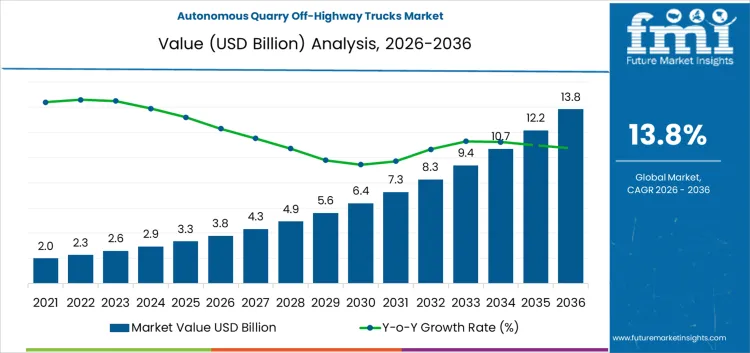
The autonomous quarry off-highway trucks market is expected to experience steady growth momentum over the forecast period, driven by the continued technological advancements in autonomous systems and increasing demand for efficiency in mining operations. Initially, the market will see gradual growth, with increases from USD 3.8 billion in 2026 to USD 4.9 billion in 2028, reflecting an early phase of adoption. As autonomous technology matures and more operators embrace these trucks for large-scale operations, the market will enter a period of accelerated growth.
The growth momentum is projected to intensify after 2029, with the market expanding to USD 7.2 billion in 2030, USD 8.3 billion in 2031, and USD 9.5 billion in 2032. This acceleration is expected to be driven by further developments in autonomous systems, increasing fleet adoption in quarries, and growing interest from mining operators looking for cost-effective and scalable solutions. By 2036, the market will reach USD 13.8 billion, representing a culmination of the rising demand for autonomous quarry off-highway trucks. The overall momentum reflects the significant role of technological innovations and operational efficiency in driving the growth of this market.
Autonomous Quarry Off-Highway Trucks Market Key Takeaways
| Metric | Value |
|---|---|
| Industry Sales Value (2026) | USD 3.8 billion |
| Industry Forecast Value (2036) | USD 13.8 billion |
| Industry Forecast CAGR 2026 to 2036 | 13.8% |
What Is Driving the Autonomous Quarry Off-Highway Trucks Market?
Historically, the autonomous quarry off-highway trucks market evolved from gradual integration of automation and driver-assistance features into conventional haul trucks used in quarry operations. Traditional off-highway trucks relied on manual operation, with human drivers responsible for navigation, braking, and material handling. Early automation efforts focused on simple assist systems such as grade control, proximity alerts, and stability management, which incrementally improved safety and reduced operator fatigue. Quarry operators began exploring autonomous haulage in controlled environments where repetitive loading and dumping cycles offered clear work patterns.
Pilot projects and limited deployments were primarily conducted by large mining and quarry firms with technical resources to test integrated sensors, GPS guidance, and remote-control systems. These initiatives provided data on route precision, obstacle detection, and system reliability under heavy-dust, variable terrain conditions typical of quarries. Early adoption highlighted potential improvements in cycle times, reduction in operating costs from lower labor dependency, and enhanced consistency in truck movements. This phase laid the groundwork for broader interest in autonomy, but challenges around safety certification, system interoperability with existing dispatch platforms, and variable site conditions tempered immediate widespread uptake.
Future demand for autonomous quarry off-highway trucks is expected to be shaped by quarry operators’ focus on productivity gains, tighter safety standards, and the integration of digital quarry management systems. Growth drivers include demonstrated improvements in operational efficiency, as autonomous trucks can sustain longer operating hours, optimize haul routes, and reduce idle time compared with human-driven fleets. As sensor technologies, AI-based perception systems, and vehicle-to-infrastructure connectivity mature, reliability in complex quarry environments will improve, fostering greater confidence among equipment buyers.
Regulatory emphasis on workplace safety and reduction of on-site accidents is likely to incentivize adoption of autonomy that minimizes human exposure to hazardous zones and heavy loads. Expansion of real-time fleet telematics and centralized dispatching platforms will enable smoother integration of autonomous trucks into mixed fleets. Barriers include high upfront investment, the need for skilled technicians to maintain automation systems, and the challenge of adapting autonomy to highly variable terrain and dynamic worksite changes. Long-term market expansion will depend on proven return on investment, industry standards for autonomous operations, and alignment between OEM solutions and quarry operator requirements for reliability, performance, and safety.
What are the Key Segments in the Autonomous Quarry Off-Highway Trucks Market?
The Autonomous Quarry Off-Highway Trucks market is segmented into applications and payload capacities. Application segments include quarry operations, open-pit mining, construction aggregates, and specialty earthworks, with quarry operations holding the largest share at 41%. Payload capacities are categorized into 50-100 tons, <50 tons, 100-150 tons, and >150 tons, with the 50-100 tons segment representing 37% of the market share. The market growth is driven by the increasing demand for automation in mining and quarrying operations, particularly for improving operational efficiency, safety, and reducing labor costs. Autonomous trucks are gaining popularity for their ability to operate continuously, enhance productivity, and optimize fuel consumption. Key regions driving this market include North America, Europe, and Asia Pacific, where the mining and construction industries are rapidly adopting autonomous technologies.
What is Driving Growth in the Quarry Operations Application?

Quarry operations account for the largest share in the Autonomous Quarry Off-Highway Trucks market, with 41% of the market share. This growth is largely driven by the need for increased operational efficiency and safety in the quarrying industry. Autonomous trucks are particularly well-suited for quarry operations due to their ability to handle repetitive tasks, such as transporting materials within the quarry site, without the need for human intervention. The ability of autonomous trucks to operate 24/7, optimize routes, and minimize downtime significantly enhances productivity in quarry operations. Moreover, these trucks are equipped with advanced technologies, such as GPS, LiDAR, and machine learning, enabling them to navigate complex terrain and avoid obstacles safely.
The growing focus on minimizing labor costs, improving worker safety, and adhering to stringent environmental regulations are key factors driving the adoption of autonomous trucks in quarry operations. Additionally, as the demand for construction materials, such as aggregates and crushed stone, continues to grow globally, especially in rapidly urbanizing regions, the need for more efficient quarry operations is increasing. This trend is expected to drive continued growth in the autonomous quarry truck segment, particularly in North America and Asia Pacific, where quarrying activities are expanding.
What is Driving the Demand for 50-100 Ton Payload Capacity Trucks?

The 50-100 ton payload capacity segment is the largest in the Autonomous Quarry Off-Highway Trucks market, accounting for 37% of the share. This growth is driven by the versatility and cost-effectiveness of trucks in this range, which are well-suited for a wide variety of applications, including both quarry operations and open-pit mining. Trucks in the 50-100 ton payload capacity range are capable of carrying substantial loads while offering a balance of performance, fuel efficiency, and operational costs. These trucks are typically preferred by quarry operators for their ability to handle heavy materials, such as rocks and aggregates, while navigating the often rugged terrain of quarries and mine sites.
The increased adoption of automation in this payload range is largely due to its ability to optimize productivity without significantly increasing operational costs. As the demand for aggregates and construction materials continues to rise globally, especially in infrastructure-driven regions like North America and Asia Pacific, the need for autonomous trucks with a 50-100 ton payload capacity is expected to continue growing. Additionally, the trend toward automation in the mining and quarrying sectors, driven by the desire to enhance safety and reduce labor costs, further supports the growth of this segment.
What are the Key Dynamics in the Autonomous Quarry Off-Highway Trucks Market?
The autonomous quarry off-highway trucks market is gaining momentum due to the increasing demand for automation in mining and quarry operations. These trucks, equipped with autonomous driving technology, are designed to transport materials in quarry environments without human intervention, improving safety, operational efficiency, and cost-effectiveness. The market is driven by advancements in autonomous vehicle technologies, such as GPS, sensors, LiDAR, and machine learning, which enable these trucks to navigate complex terrain, optimize routes, and reduce the need for manual labor. The growing focus on improving safety standards and reducing accidents in hazardous quarry environments also contributes to the adoption of autonomous trucks. Additionally, the push for higher productivity and lower operational costs, especially in remote quarries with difficult access, further supports market growth.
What are the Key Drivers of Growth in the Autonomous Quarry Off-Highway Trucks Market?
The primary drivers of growth in the autonomous quarry off-highway trucks market include the demand for higher operational efficiency and the need to reduce labor costs in mining and quarrying. Autonomous trucks can operate continuously without rest, leading to improved productivity and faster material transport, which is essential for large-scale quarry operations. The reduction in human labor also decreases the risk of accidents and injuries, making the technology highly attractive from a safety perspective.
Moreover, the growing focus on sustainability and reducing the environmental footprint in mining and quarrying operations is driving the adoption of autonomous vehicles, as they can be optimized for fuel efficiency and lower emissions. Technological advancements in artificial intelligence (AI), machine learning, and real-time data analytics have enhanced the reliability and capability of autonomous trucks, enabling them to handle challenging terrain and weather conditions more effectively. Regulatory pressures on safety and emissions are also pushing the market toward automation, as autonomous trucks can help companies meet these requirements more efficiently.
What are the Key Restraints in the Autonomous Quarry Off-Highway Trucks Market?
Despite the potential benefits, several challenges limit the growth of the autonomous quarry off-highway trucks market. One major restraint is the high initial investment required for autonomous truck technology. The upfront costs of purchasing autonomous vehicles, along with the need for significant investment in infrastructure such as charging stations, sensors, and communication networks, can be prohibitive for smaller quarry operators. Additionally, the integration of autonomous trucks into existing operations can require significant changes in workflows and processes, leading to potential disruptions during the transition phase. There are also concerns related to the reliability and safety of autonomous vehicles in extreme or unpredictable quarry conditions, such as difficult terrain, weather changes, and obstacles. Regulatory hurdles regarding the use of autonomous vehicles in certain regions or jurisdictions may also slow adoption, as governments may need to develop new frameworks and safety standards to accommodate these technologies. Finally, the potential for job displacement due to automation could lead to resistance from labor unions and workforce stakeholders.
What are the Key Trends in the Autonomous Quarry Off-Highway Trucks Market?
Several key trends are shaping the autonomous quarry off-highway trucks market. One notable trend is the integration of artificial intelligence and machine learning algorithms that enable autonomous trucks to improve decision-making, optimize routes, and enhance safety features over time. As AI technologies evolve, these trucks are becoming more efficient and capable of handling complex tasks such as obstacle detection, load management, and collision avoidance in real-time. Another trend is the increasing use of hybrid and electric powertrains in autonomous trucks, driven by the industry's focus on reducing fuel consumption and emissions. Electrification of autonomous trucks is particularly attractive in reducing operational costs and improving sustainability in quarry operations.
Additionally, the use of remote monitoring and fleet management software is becoming more prevalent, allowing operators to oversee multiple autonomous vehicles from a central location, optimizing fleet operations and ensuring efficient management of resources. The growing adoption of 5G and advanced communication networks is also expected to play a key role in enabling real-time data transmission, enhancing the performance and reliability of autonomous trucks. As these technologies continue to advance, the market is expected to see further innovation, making autonomous trucks more cost-effective and adaptable to diverse quarrying environments.
What is the Country-Wise Analysis of the Autonomous Quarry Off-Highway Trucks Market?
The autonomous quarry off-highway trucks market is experiencing significant growth as the mining and construction industries increasingly adopt automation for improved safety, efficiency, and cost-effectiveness. These trucks are essential in transporting materials in quarries and mining sites, and their autonomous capabilities reduce human error, improve operational efficiency, and enhance safety in hazardous environments. Countries such as the USA, China, Germany, Japan, and India are at the forefront of this technological transition, with each market being shaped by local demand for advanced mining technologies, government regulations, and industry requirements for automation in heavy-duty transport.
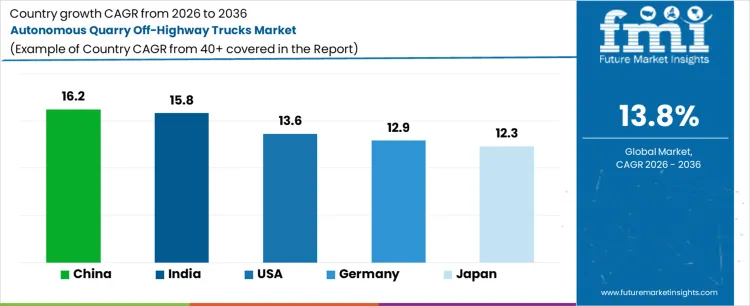
| Country | CAGR (%) |
|---|---|
| USA | 13.6 |
| China | 16.2 |
| Germany | 12.9 |
| Japan | 12.3 |
| India | 15.8 |
What is Driving the Growth of the Autonomous Quarry Off-Highway Trucks Market in the USA?
The autonomous quarry off-highway trucks market in the USA is growing at a CAGR of 13.6%. This growth is primarily driven by the increasing adoption of automation technologies in the mining and construction sectors. Autonomous trucks are being deployed to enhance productivity, reduce labor costs, and improve safety by minimizing human presence in hazardous areas. The USA’s strong mining industry, coupled with significant investments in autonomous technologies by leading manufacturers, is fueling the demand for autonomous quarry trucks. Additionally, regulatory pressures for safer working environments and the push for operational efficiency in mining operations are further driving the adoption of autonomous vehicles. As automation continues to transform the heavy-duty transport sector, the market for autonomous quarry off-highway trucks in the USA is expected to continue growing.
How is the Autonomous Quarry Off-Highway Trucks Market Evolving in China?
China’s autonomous quarry off-highway trucks market is growing at a CAGR of 16.2%, the highest among the countries analyzed. China’s mining and construction industries are rapidly adopting automation technologies, particularly in remote and high-risk environments, where autonomous trucks can significantly enhance operational safety and efficiency. The government’s commitment to technological advancements in the mining sector, along with the country’s ongoing investments in autonomous vehicle technology, is boosting market growth. Additionally, as China continues to lead in the production of heavy equipment and mining vehicles, there is a strong focus on integrating automation to improve productivity and reduce environmental impact. The combination of strong industrial growth, supportive policies, and technological development makes China a key market for autonomous quarry off-highway trucks.
What Factors are Shaping the Autonomous Quarry Off-Highway Trucks Market in Germany?
Germany’s autonomous quarry off-highway trucks market is growing at a CAGR of 12.9%. Germany’s mining and heavy-duty equipment sectors are increasingly focused on automation, driven by the need to improve safety standards, reduce operational costs, and enhance the efficiency of material transport in quarries. The German government has long supported the development and deployment of autonomous technologies in various industries, including mining, which is helping to accelerate the adoption of autonomous quarry trucks. The country’s mining operations, particularly in the extraction of raw materials for industrial use, are relying more on automation for tasks such as haulage and transportation. With continued investments in R&D and a robust industrial base, Germany’s market for autonomous quarry off-highway trucks is expected to grow steadily.
How is the Autonomous Quarry Off-Highway Trucks Market Performing in Japan?
Japan’s autonomous quarry off-highway trucks market is growing at a CAGR of 12.3%. Japan has been at the forefront of automation in various industrial sectors, and the mining industry is increasingly following suit. The adoption of autonomous quarry trucks is seen as a key solution to improving efficiency and safety in mining and construction projects, particularly in remote locations where labor shortages are common. Japan’s focus on technological innovation, combined with regulatory pressures for safer and more efficient mining practices, is driving the market for autonomous trucks. As Japanese mining companies continue to integrate automation into their operations, the demand for autonomous quarry off-highway trucks is expected to increase.
What is Contributing to the Growth of the Autonomous Quarry Off-Highway Trucks Market in India?
India’s autonomous quarry off-highway trucks market is growing at a CAGR of 15.8%. The rapid expansion of India’s mining and construction sectors is driving the demand for more efficient, cost-effective, and safer material transport solutions. Autonomous trucks are being increasingly adopted to improve operational efficiency, reduce labor costs, and minimize safety risks in hazardous mining environments. The Indian government’s focus on modernizing the mining sector and encouraging the use of advanced technologies is also contributing to the market growth. As India continues to develop its mining infrastructure and embrace automation, the demand for autonomous quarry off-highway trucks is expected to rise significantly.
What is the Competitive Landscape for the Autonomous Quarry Off-Highway Trucks Market?
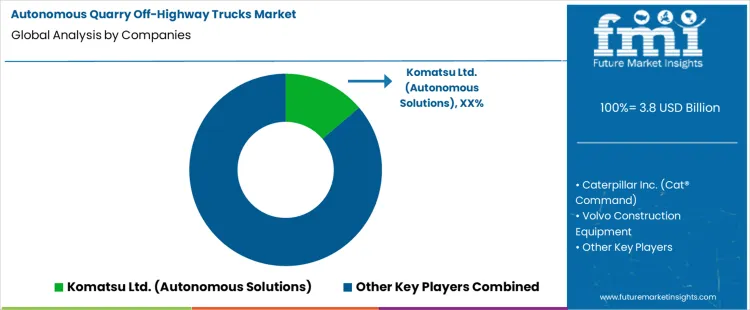
The autonomous quarry off-highway trucks market is growing rapidly as mining and construction industries increasingly seek automation to improve safety, efficiency, and operational costs. Komatsu Ltd. is a market leader in autonomous solutions, offering advanced autonomous haulage systems that enhance productivity in quarry and mining operations. Komatsu’s autonomous trucks are designed to handle harsh quarry environments, focusing on reducing human error, improving fuel efficiency, and optimizing fleet management. Caterpillar Inc. follows closely with its Cat® Command system, an advanced autonomous haulage solution that allows for remote monitoring and control of off-highway trucks in challenging environments.
The company’s autonomous systems are deployed in large-scale mining operations, further enhancing the safety and efficiency of its machinery. Volvo Construction Equipment is also making strides in this market with its autonomous haulage solutions, aimed at improving operational efficiency and reducing the environmental impact of quarry operations. Hexagon AB, known for its autonomy systems, brings a high level of technological integration to the market, offering precise control and real-time data analysis to enhance autonomous operations. Hitachi Construction Machinery rounds out the competitive field, offering autonomous solutions that integrate with advanced fleet management systems to enhance the safety and productivity of quarry trucks.
In this competitive market, companies focus on technological advancements, strategic partnerships, and scalability to remain ahead. Komatsu Ltd. continues to innovate with its autonomous haulage systems, enhancing machine learning and navigation capabilities to improve operational performance. Caterpillar Inc. is expanding its autonomous technology with integration into more complex quarry operations, ensuring adaptability across diverse environments. Volvo Construction Equipment is investing in automation technologies that improve the user experience and operational management of its autonomous trucks. Hexagon AB focuses on providing autonomous systems that integrate seamlessly with other mining technologies, delivering precise control and real-time feedback. Hitachi Construction Machinery is developing autonomous solutions that prioritize fleet management integration, helping mining operators optimize truck usage and reduce downtime. These strategies, along with the increasing demand for automation in the quarrying industry, position these companies as key players in the growing autonomous quarry off-highway trucks market.
Key Players of the Autonomous Quarry Off-Highway Trucks Market
- Komatsu Ltd. (Autonomous Solutions)
- Caterpillar Inc. (Cat® Command)
- Volvo Construction Equipment
- Hexagon AB (Autonomy Systems)
- Hitachi Construction Machinery
- Others
Scope of the Report
| Items | Values |
|---|---|
| Quantitative Units (2026) | USD Billion |
| Payload Capacity | <50 tons, 50-100 tons, 100-150 tons, >150 tons |
| Autonomy Level | L2 - Assisted Autonomy, L3 - Conditional Autonomy, L4 - High Autonomy, L5 - Full Autonomy |
| Application | Quarry Operations, Open-Pit Mining, Construction Aggregates, Specialty Earthworks |
| Companies | Komatsu Ltd. (Autonomous Solutions), Caterpillar Inc. (Cat® Command), Volvo Construction Equipment, Hexagon AB (Autonomy Systems), Hitachi Construction Machinery, Others |
| Regions Covered | North America, Latin America, Western Europe, Eastern Europe, South Asia and Pacific, East Asia, Middle East & Africa |
| Countries Covered | United States, Canada, Mexico, Brazil, Argentina, Germany, France, United Kingdom, Italy, Spain, Netherlands, China, India, Japan, South Korea, ANZ, GCC Countries, South Africa |
| Additional Attributes | Dollar by sales by payload capacity, autonomy level, application, and region. Includes market trends towards autonomous vehicle technologies in construction, cost-effectiveness, energy efficiency, regulatory compliance, and the role of autonomous trucks in optimizing quarry and mining operations. |
Autonomous Quarry Off-Highway Trucks Market Segmentation
Payload Capacity
- <50 tons
- 50-100 tons
- 100-150 tons
- 150 tons
Autonomy Level
- L2 - Assisted Autonomy
- L3 - Conditional Autonomy
- L4 - High Autonomy
- L5 - Full Autonomy
Application
- Quarry Operations
- Open-Pit Mining
- Construction Aggregates
- Specialty Earthworks
Region
- Asia Pacific
- China
- Japan
- India
- Australia & New Zealand
- ASEAN
- Rest of Asia Pacific
- Europe
- Germany
- United Kingdom
- France
- Italy
- Spain
- Nordic
- BENELUX
- Rest of Europe
- North America
- United States
- Canada
- Mexico
- Latin America
- Brazil
- Argentina
- Rest of Latin America
- Middle East & Africa
- Kingdom of Saudi Arabia
- Other GCC Countries
- South Africa
- Rest of Middle East & Africa
Bibliography
International Council on Mining and Metals (ICMM). (2023). Innovation for cleaner, safer vehicles in mining. ICMM.
World Economic Forum. (2023). Mining and metals in a sustainable world 2050: Digital transformation and automation pathways. World Economic Forum, Mining and Metals Platform.
Komatsu Ltd. (2023). Autonomous Haulage System (AHS): Performance, safety, and operational deployment in large-scale mining. Komatsu Mining Corp.
Caterpillar Inc. (2023). MineStar Command for hauling: Autonomous truck systems and safety performance. Caterpillar Surface Mining.
International Organization for Standardization (ISO). (2023). ISO 17757: Earth-moving machinery and mining. Autonomous and semi-autonomous machine system safety. ISO.
Frequently Asked Questions
How big is the autonomous quarry off-highway trucks market in 2026?
The global autonomous quarry off-highway trucks market is estimated to be valued at USD 3.8 billion in 2026.
What will be the size of autonomous quarry off-highway trucks market in 2036?
The market size for the autonomous quarry off-highway trucks market is projected to reach USD 13.8 billion by 2036.
How much will be the autonomous quarry off-highway trucks market growth between 2026 and 2036?
The autonomous quarry off-highway trucks market is expected to grow at a 13.8% CAGR between 2026 and 2036.
What are the key product types in the autonomous quarry off-highway trucks market?
The key product types in autonomous quarry off-highway trucks market are 50–100 tons, <50 tons, 100–150 tons and >150 tons.
Which autonomy level segment to contribute significant share in the autonomous quarry off-highway trucks market in 2026?
In terms of autonomy level, l3 – conditional autonomy segment to command 32.0% share in the autonomous quarry off-highway trucks market in 2026.
Preview the report firsthand - request a free sample
Get SampleGet the brochure for pricing and purchase details.
Get PDFTable of Content
- Executive Summary
- Global Market Outlook
- Demand-side Trends
- Supply-side Trends
- Technology Roadmap Analysis
- Analysis and Recommendations
- Market Overview
- Market Coverage / Taxonomy
- Market Definition / Scope / Limitations
- Market Background
- Market Dynamics
- Drivers
- Restraints
- Opportunity
- Trends
- Scenario Forecast
- Demand in Optimistic Scenario
- Demand in Likely Scenario
- Demand in Conservative Scenario
- Opportunity Map Analysis
- Product Life Cycle Analysis
- Supply Chain Analysis
- Investment Feasibility Matrix
- Value Chain Analysis
- PESTLE and Porter’s Analysis
- Regulatory Landscape
- Regional Parent Market Outlook
- Production and Consumption Statistics
- Import and Export Statistics
- Market Dynamics
- Global Market Analysis 2021 to 2025 and Forecast, 2026 to 2036
- Historical Market Size Value (USD Million) Analysis, 2021 to 2025
- Current and Future Market Size Value (USD Million) Projections, 2026 to 2036
- Y-o-Y Growth Trend Analysis
- Absolute $ Opportunity Analysis
- Global Market Pricing Analysis 2021 to 2025 and Forecast 2026 to 2036
- Global Market Analysis 2021 to 2025 and Forecast 2026 to 2036, By Payload Capacity
- Introduction / Key Findings
- Historical Market Size Value (USD Million) Analysis By Payload Capacity , 2021 to 2025
- Current and Future Market Size Value (USD Million) Analysis and Forecast By Payload Capacity , 2026 to 2036
- 50-100 tons
- <50 tons
- 100-150 tons
- >150 tons
- 50-100 tons
- Y-o-Y Growth Trend Analysis By Payload Capacity , 2021 to 2025
- Absolute $ Opportunity Analysis By Payload Capacity , 2026 to 2036
- Global Market Analysis 2021 to 2025 and Forecast 2026 to 2036, By Autonomy Level
- Introduction / Key Findings
- Historical Market Size Value (USD Million) Analysis By Autonomy Level, 2021 to 2025
- Current and Future Market Size Value (USD Million) Analysis and Forecast By Autonomy Level, 2026 to 2036
- L3 - Conditional Autonomy
- L2 - Assisted Autonomy
- L4 - High Autonomy
- L5 - Full Autonomy
- L3 - Conditional Autonomy
- Y-o-Y Growth Trend Analysis By Autonomy Level, 2021 to 2025
- Absolute $ Opportunity Analysis By Autonomy Level, 2026 to 2036
- Global Market Analysis 2021 to 2025 and Forecast 2026 to 2036, By Application
- Introduction / Key Findings
- Historical Market Size Value (USD Million) Analysis By Application, 2021 to 2025
- Current and Future Market Size Value (USD Million) Analysis and Forecast By Application, 2026 to 2036
- Quarry Operations
- Open-Pit Mining
- Construction Aggregates
- Specialty Earthworks
- Quarry Operations
- Y-o-Y Growth Trend Analysis By Application, 2021 to 2025
- Absolute $ Opportunity Analysis By Application, 2026 to 2036
- Global Market Analysis 2021 to 2025 and Forecast 2026 to 2036, By Region
- Introduction
- Historical Market Size Value (USD Million) Analysis By Region, 2021 to 2025
- Current Market Size Value (USD Million) Analysis and Forecast By Region, 2026 to 2036
- North America
- Latin America
- Western Europe
- Eastern Europe
- East Asia
- South Asia and Pacific
- Middle East & Africa
- Market Attractiveness Analysis By Region
- North America Market Analysis 2021 to 2025 and Forecast 2026 to 2036, By Country
- Historical Market Size Value (USD Million) Trend Analysis By Market Taxonomy, 2021 to 2025
- Market Size Value (USD Million) Forecast By Market Taxonomy, 2026 to 2036
- By Country
- USA
- Canada
- Mexico
- By Payload Capacity
- By Autonomy Level
- By Application
- By Country
- Market Attractiveness Analysis
- By Country
- By Payload Capacity
- By Autonomy Level
- By Application
- Key Takeaways
- Latin America Market Analysis 2021 to 2025 and Forecast 2026 to 2036, By Country
- Historical Market Size Value (USD Million) Trend Analysis By Market Taxonomy, 2021 to 2025
- Market Size Value (USD Million) Forecast By Market Taxonomy, 2026 to 2036
- By Country
- Brazil
- Chile
- Rest of Latin America
- By Payload Capacity
- By Autonomy Level
- By Application
- By Country
- Market Attractiveness Analysis
- By Country
- By Payload Capacity
- By Autonomy Level
- By Application
- Key Takeaways
- Western Europe Market Analysis 2021 to 2025 and Forecast 2026 to 2036, By Country
- Historical Market Size Value (USD Million) Trend Analysis By Market Taxonomy, 2021 to 2025
- Market Size Value (USD Million) Forecast By Market Taxonomy, 2026 to 2036
- By Country
- Germany
- UK
- Italy
- Spain
- France
- Nordic
- BENELUX
- Rest of Western Europe
- By Payload Capacity
- By Autonomy Level
- By Application
- By Country
- Market Attractiveness Analysis
- By Country
- By Payload Capacity
- By Autonomy Level
- By Application
- Key Takeaways
- Eastern Europe Market Analysis 2021 to 2025 and Forecast 2026 to 2036, By Country
- Historical Market Size Value (USD Million) Trend Analysis By Market Taxonomy, 2021 to 2025
- Market Size Value (USD Million) Forecast By Market Taxonomy, 2026 to 2036
- By Country
- Russia
- Poland
- Hungary
- Balkan & Baltic
- Rest of Eastern Europe
- By Payload Capacity
- By Autonomy Level
- By Application
- By Country
- Market Attractiveness Analysis
- By Country
- By Payload Capacity
- By Autonomy Level
- By Application
- Key Takeaways
- East Asia Market Analysis 2021 to 2025 and Forecast 2026 to 2036, By Country
- Historical Market Size Value (USD Million) Trend Analysis By Market Taxonomy, 2021 to 2025
- Market Size Value (USD Million) Forecast By Market Taxonomy, 2026 to 2036
- By Country
- China
- Japan
- South Korea
- By Payload Capacity
- By Autonomy Level
- By Application
- By Country
- Market Attractiveness Analysis
- By Country
- By Payload Capacity
- By Autonomy Level
- By Application
- Key Takeaways
- South Asia and Pacific Market Analysis 2021 to 2025 and Forecast 2026 to 2036, By Country
- Historical Market Size Value (USD Million) Trend Analysis By Market Taxonomy, 2021 to 2025
- Market Size Value (USD Million) Forecast By Market Taxonomy, 2026 to 2036
- By Country
- India
- ASEAN
- Australia & New Zealand
- Rest of South Asia and Pacific
- By Payload Capacity
- By Autonomy Level
- By Application
- By Country
- Market Attractiveness Analysis
- By Country
- By Payload Capacity
- By Autonomy Level
- By Application
- Key Takeaways
- Middle East & Africa Market Analysis 2021 to 2025 and Forecast 2026 to 2036, By Country
- Historical Market Size Value (USD Million) Trend Analysis By Market Taxonomy, 2021 to 2025
- Market Size Value (USD Million) Forecast By Market Taxonomy, 2026 to 2036
- By Country
- Kingdom of Saudi Arabia
- Other GCC Countries
- Turkiye
- South Africa
- Other African Union
- Rest of Middle East & Africa
- By Payload Capacity
- By Autonomy Level
- By Application
- By Country
- Market Attractiveness Analysis
- By Country
- By Payload Capacity
- By Autonomy Level
- By Application
- Key Takeaways
- Key Countries Market Analysis
- USA
- Pricing Analysis
- Market Share Analysis, 2025
- By Payload Capacity
- By Autonomy Level
- By Application
- Canada
- Pricing Analysis
- Market Share Analysis, 2025
- By Payload Capacity
- By Autonomy Level
- By Application
- Mexico
- Pricing Analysis
- Market Share Analysis, 2025
- By Payload Capacity
- By Autonomy Level
- By Application
- Brazil
- Pricing Analysis
- Market Share Analysis, 2025
- By Payload Capacity
- By Autonomy Level
- By Application
- Chile
- Pricing Analysis
- Market Share Analysis, 2025
- By Payload Capacity
- By Autonomy Level
- By Application
- Germany
- Pricing Analysis
- Market Share Analysis, 2025
- By Payload Capacity
- By Autonomy Level
- By Application
- UK
- Pricing Analysis
- Market Share Analysis, 2025
- By Payload Capacity
- By Autonomy Level
- By Application
- Italy
- Pricing Analysis
- Market Share Analysis, 2025
- By Payload Capacity
- By Autonomy Level
- By Application
- Spain
- Pricing Analysis
- Market Share Analysis, 2025
- By Payload Capacity
- By Autonomy Level
- By Application
- France
- Pricing Analysis
- Market Share Analysis, 2025
- By Payload Capacity
- By Autonomy Level
- By Application
- India
- Pricing Analysis
- Market Share Analysis, 2025
- By Payload Capacity
- By Autonomy Level
- By Application
- ASEAN
- Pricing Analysis
- Market Share Analysis, 2025
- By Payload Capacity
- By Autonomy Level
- By Application
- Australia & New Zealand
- Pricing Analysis
- Market Share Analysis, 2025
- By Payload Capacity
- By Autonomy Level
- By Application
- China
- Pricing Analysis
- Market Share Analysis, 2025
- By Payload Capacity
- By Autonomy Level
- By Application
- Japan
- Pricing Analysis
- Market Share Analysis, 2025
- By Payload Capacity
- By Autonomy Level
- By Application
- South Korea
- Pricing Analysis
- Market Share Analysis, 2025
- By Payload Capacity
- By Autonomy Level
- By Application
- Russia
- Pricing Analysis
- Market Share Analysis, 2025
- By Payload Capacity
- By Autonomy Level
- By Application
- Poland
- Pricing Analysis
- Market Share Analysis, 2025
- By Payload Capacity
- By Autonomy Level
- By Application
- Hungary
- Pricing Analysis
- Market Share Analysis, 2025
- By Payload Capacity
- By Autonomy Level
- By Application
- Kingdom of Saudi Arabia
- Pricing Analysis
- Market Share Analysis, 2025
- By Payload Capacity
- By Autonomy Level
- By Application
- Turkiye
- Pricing Analysis
- Market Share Analysis, 2025
- By Payload Capacity
- By Autonomy Level
- By Application
- South Africa
- Pricing Analysis
- Market Share Analysis, 2025
- By Payload Capacity
- By Autonomy Level
- By Application
- USA
- Market Structure Analysis
- Competition Dashboard
- Competition Benchmarking
- Market Share Analysis of Top Players
- By Regional
- By Payload Capacity
- By Autonomy Level
- By Application
- Competition Analysis
- Competition Deep Dive
- Komatsu Ltd. (Autonomous Solutions)
- Overview
- Product Portfolio
- Profitability by Market Segments (Product/Age /Sales Channel/Region)
- Sales Footprint
- Strategy Overview
- Marketing Strategy
- Product Strategy
- Channel Strategy
- Caterpillar Inc. (Cat® Command)
- Volvo Construction Equipment
- Hexagon AB (Autonomy Systems)
- Hitachi Construction Machinery
- Others
- Komatsu Ltd. (Autonomous Solutions)
- Competition Deep Dive
- Assumptions & Acronyms Used
- Research Methodology


