

- Market Size (2026)
- USD 620.6 Mn
- Forecast (2036)
- USD 1482.7 Mn
- CAGR (2026 to 2036)
- 9.1%
How big is Marine E-Axles Market in 2026?
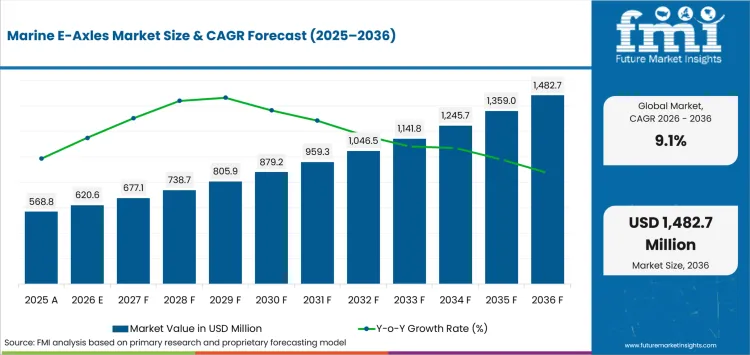
USD 620.6 million in 2026 and USD 1,482.7 million by 2036 at a 9.1% CAGR.
Demand for marine e-axles is projected to expand at 9.1% CAGR from 2026 to 2036 and rise from USD 620.6 million in 2026 to USD 1,482.7 million by 2036. Shipyards need propulsion power, route energy and installation space aligned before mechanical interfaces are frozen. In April 2025, the International Maritime Organization approved draft net-zero measures pairing a marine fuel standard with greenhouse-gas pricing for large ocean-going ships. The draft raises pressure for electric and hybrid packages that cut fuel use without complete vessel redesign.
Conversion is strongest where operators already face emissions costs or route-specific electrification rules. Traficom recorded about 1,740,850 tonnes of CO2 from Finland-administered shipping in October 2025. The figure equaled 10.7% of Finland's total in the Union Registry and puts propulsion efficiency into fleet budgeting before full-electric operation fits every route.
Key Takeaways
- Ferry electrification and emissions compliance are moving propulsion decisions into funded vessel programs with defined route-energy and installation requirements.
- Integrated motor-axle units are projected to account for 29.0% of axle type demand in 2026 because tighter packaging reduces propulsion interfaces.
- By power rating, below 50 kW systems are estimated to hold 26.0% in 2026 owing to the large pool of small craft and auxiliary duties.
- In 2026, workboats are forecast to represent 28.0% of vessel type demand because repeatable routes simplify charging and duty-cycle validation.
- Battery size, shore charging and vessel integration can delay orders even after an electric motor meets the required shaft power.
- Some of the key players in this market include ABB Marine & Ports, Kongsberg Maritime, Wärtsilä, ZF Marine, Danfoss Editron, Transfluid, Torqeedo, Evoy, Molabo, and Veth Propulsion.
Analyst Perspective
"Marine e-axles should be evaluated at vessel level because motor efficiency loses value if charging or shaftline redesign cuts operating availability. Strong offers reduce commissioning work and let shipyards reuse qualified propulsion architecture on the next vessel in a series."
- Nikhil Kaitwade, Principal Consultant, Future Market Insights
How is the marine e-axles market segmented?
By Axle Type, Power Rating, Vessel Type, Integration and Sales Channel
The marine e-axles market is segmented by axle type, power rating, vessel type, integration and sales channel. Axle types include integrated motor-axle units, electric shaftline axle units, compact e-drive axle modules, hybrid assist e-axles and high-torque commercial e-axles. Power ratings cover below 50 kW, 50-200 kW, 200-1,000 kW and above 1 MW. Vessel types include workboats, ferries, patrol craft, inland cargo vessels and specialty marine vehicles. Integration covers motor only, motor with gearbox, motor-inverter axle and full propulsion axle packages. Sales channels include propulsion system OEMs, shipyards, retrofit integrators and fleet electrification projects.
How do integrated motor-axle units shape demand within the axle type category?
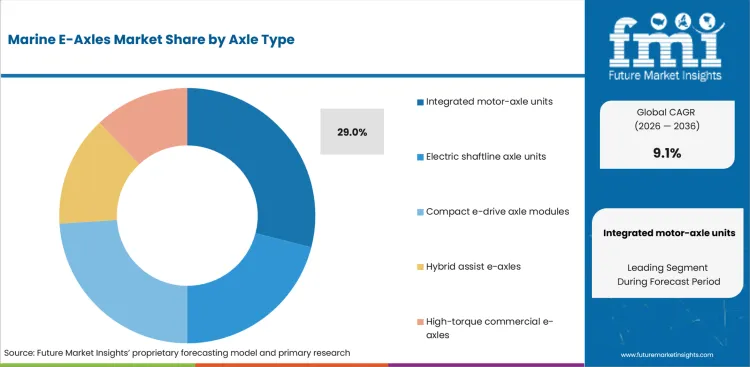
Integrated motor-axle units reduce the propulsion interfaces a shipyard must engineer during conversion or newbuild work. The same packaging constraint shapes adjacent electric marine motors demand because motor length and controls compete for limited machinery-space volume.
- Integrated motor-axle units are projected to hold 29.0% of axle type demand in 2026 because tighter packaging reduces propulsion interfaces.
- Kongsberg Maritime secured the MF Hamlet hybrid conversion in March 2025 with permanent-magnet motors for its azimuth thrusters. The project shows integrated electric propulsion can fit an operating ferry without replacing every propulsion interface during repeat conversion work.
What supports demand for below 50 kW systems within the power rating category?
Lower-power systems fit tenders, workboats and service craft that need modest shaft power without large cooling or battery systems. Adjacent electric inboard motors demand follows the same requirement for compact installation and accessible local service during routine maintenance.
- By power rating, below 50 kW systems are estimated at 26.0% in 2026 because small craft need less cooling and electrical infrastructure.
- Torqeedo expanded selected electric outboards through Yamaha dealers in eight European countries in January 2025. The 1-25 hp range gives small-vessel operators a service route well below 50 kW through an established dealer network.
How do workboats influence selection within the vessel type category?
Workboats provide a measurable electric-propulsion duty cycle because operators know daily hours, payload and charging windows. The electric boats category is most relevant on short coastal routes that return to the same berth for charging and scheduled service.
- Workboats are forecast to represent 28.0% of vessel type demand in 2026 because repeatable routes simplify energy and charging validation.
- Maine Ocean Farms took delivery of an Evoy Vita-powered electric aquaculture landing craft in 2025. By October it had logged over 100 hours and 1,000 nautical miles in commercial work, giving operators direct duty-cycle evidence.
What role does motor only play within the integration category?
Motor-only configurations suit retrofits that can retain a serviceable gearbox, shaftline and control architecture. Growth in marine power battery systems increases the value of motors that fit existing drivetrains without forcing a complete mechanical redesign during vessel conversion.
- Motor only is expected to lead integration with 24.0% share in 2026 because retrofits can retain serviceable gearboxes and shaftlines.
- ABB launched the AMXE Marine Motor in June 2025 for compact high-power electric propulsion. The motor lets integrators retain downstream mechanical components that already meet vessel requirements during repeat commercial shipyard conversions without reopening shaftline design reviews.
What makes propulsion system OEMs central to the sales channel category?
Propulsion system OEMs win projects by taking responsibility for electrical and mechanical interfaces through commissioning. The marine propulsion engine category follows the same purchasing logic because shipyards prefer one engineering path for power conversion, controls and service during vessel acceptance.
- Propulsion system OEMs are set to capture 36.0% of sales channel demand in 2026 because one engineering path reduces interface coordination.
- Danfoss supplied drivetrain components and shore-charging equipment for the battery ferry Nerthus in June 2025. The project shows why OEM-led packages gain scope when vessel and terminal power must operate together under one commissioning plan.
What are the drivers, restraints and opportunities in the Marine E-Axles Market?
Public-ferry electrification is moving electric propulsion into funded programs, while battery-safety and charging constraints slow conversion. Retrofit support can widen the addressable vessel base.
- Driver: Zero-emission ferry procurement turns propulsion choice into a contract requirement on routes where charging can be planned.
- Restraint: Battery safety, class approval and shore-power constraints can delay a technically suitable electric drivetrain.
- Opportunity: Retrofit funding can convert serviceable hulls by replacing propulsion stages without waiting for complete fleet renewal.
Public ferry tenders convert emissions policy into propulsion specifications tied to route energy and operating availability. Norway made zero-emission performance mandatory in public ferry tenders from January 2025. That contract route also supports electric ships demand because charging and reserve power can be defined before award.
Battery-electric propulsion needs a documented safety route before motor selection is commercially complete. EMSA updated battery-energy-storage guidance in November 2025 and noted continued reliance on class rules, standards and codes. ship repair and maintenance services gain recurring work because inspections and later system changes must preserve that documentation.
Existing inland vessels offer a conversion route because operators can retain a serviceable hull and replace the propulsion stage. The Netherlands Enterprise Agency confirmed in December 2025 that its inland-vessel program covered electric drivelines on propeller shafts. marine electronics and propulsion integrators gain a clearer revenue path when commissioning and certification are sold with the retrofit.
Which country CAGRs are profiled in the Marine E-Axles Market?
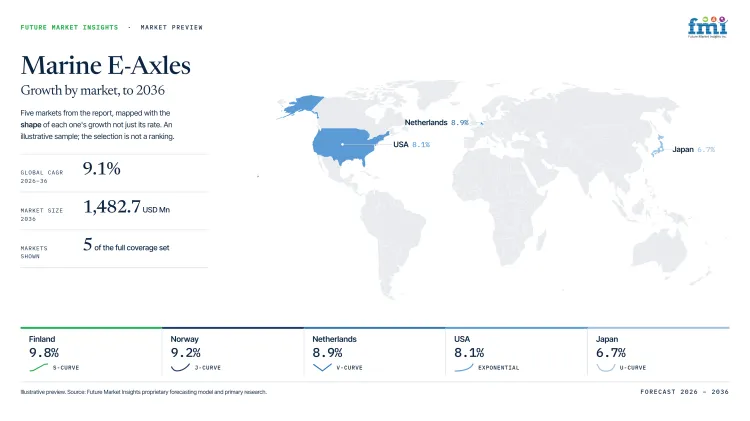
| Country | CAGR |
|---|---|
| Finland | 9.8% |
| Norway | 9.2% |
| Netherlands | 8.9% |
| South Korea | 8.4% |
| USA | 8.1% |
| Germany | 7.6% |
| Japan | 6.7% |
How do country-level CAGRs compare in the Marine E-Axles Market?
The 3.1-point spread separates a policy-led upper group from markets where qualification and project timing carry more weight. Finland and Norway sit above 9.0%, with the Netherlands and South Korea forming the middle tier. USA, Germany and Japan remain below 8.5%. The ranking measures forecast pace, not current market size or installed-base depth.
- Finland archipelago routes keep charging distances bounded.
- Norway's operating fleet provides deep electric-service experience.
- Dutch waterways concentrate repeatable short-haul vessel cycles.
- South Korean marine clusters shorten component logistics.
- US state programs create uneven service requirements.
- Germany's older inland fleet broadens replacement timing.
- Japanese yards favor suppliers proven in series production.
Comparable CAGRs can therefore produce different qualification, service and infrastructure burdens for manufacturers entering each country. The full report provides country-level CAGR analysis across North America, Latin America, Western Europe, Eastern Europe, East Asia, South Asia and Pacific, and Middle East and Africa.
Country-wise Analysis
- Finnish ferry operators must size electric propulsion for Baltic routes where ice loading reduces usable battery margin and winter reserve power cannot be treated as spare capacity. Traficom stated in April 2025 that IMO implementation guidance should account for safe passage in ice-covered areas, which keeps cold-weather performance and redundant auxiliaries inside propulsion qualification. Marine e-axle demand in Finland is forecast to rise at 9.8% CAGR through 2036 owing to ferry electrification and domestic marine engineering depth, but commercial orders still depend on local class support and route evidence that proves laboratory efficiency can survive harsh Baltic winter service.
- Operators of Norwegian passenger ferries procure propulsion against fixed timetables with frequent charging and rough coastal weather plus rapid turnaround at terminals familiar with electric vessel service. Norway is projected to expand at 9.2% CAGR through 2036 tied to mature ferry electrification and a deep electrical service base, though route-specific charging capacity still limits which vessels can convert without schedule penalties. In April 2025 the Ministry of Climate and Environment confirmed zero-emission requirements from January 2026 for passenger ships under 10,000 gross tonnage in World Heritage fjords and gave integrators a direct procurement route for qualified propulsion and charging packages.
- Dutch inland operators often need to electrify vessels without sacrificing cargo space or rebuilding an otherwise serviceable hull, so shore-to-ship power supply and shaftline geometry shape retrofit economics before motor selection. In April 2026 the Dutch government said a new support scheme was expected to convert 150 to 160 inland vessels by 2032, giving integrators a defined pipeline for electric or hybrid driveline work. The Netherlands marine e-axles sector is anticipated to record 8.9% CAGR during the assessment period attributable to its large inland fleet and active retrofit funding, although downtime and certification costs still favor packages that preserve existing mechanical interfaces.
- South Korean shipyards can integrate electric propulsion inside domestic newbuild programs where hull design, controls and machinery installation are coordinated by the same industrial base. Marine e-axle demand in South Korea is projected to grow at 8.4% CAGR over the forecast period given domestic shipbuilding depth, while smaller coastal operators remain capital-sensitive and therefore favor modular packages with proven local service coverage over bespoke high-voltage engineering. The Ministry of Oceans and Fisheries set a 2025 plan covering 81 environmentally friendly vessel builds or conversions including 34 public electric or hybrid ships, giving propulsion manufacturers a clear qualification pipeline.
- US ferry electrification is project-led because federal awards often bind vessel procurement to terminal upgrades, local construction schedules and domestic-content requirements before propulsion equipment is released. The USA is estimated to post 8.1% CAGR over the forecast period driven by funded ferry replacement and state fleet programs, yet long procurement cycles reward companies that support design reviews early enough to resolve interfaces before equipment contracts are fixed. The Federal Transit Administration announced five Low or No Emitting Ferry projects in five states in August 2026, giving propulsion companies a pipeline where shipyard engineering and charging infrastructure must progress together.
- German inland fleets present a retrofit-heavy opportunity because operators need lower-emission propulsion without replacing serviceable vessels, and many current projects must coordinate driveline changes with shore-side infrastructure. Germany's marine e-axles outlook is expected to maintain 7.6% CAGR through 2036 aided by inland modernization and specialist-yard depth, but fragmented vessel ownership often favors standardized retrofit interfaces that can be repeated on sister vessels without fresh engineering for every hull. In August 2026 the Federal Ministry of Transport opened a program for zero- and low-emission inland ships with supporting infrastructure, giving shipyards a public route for paired propulsion and charging work.
- Japanese marine electrification is tied to shipbuilding investment because propulsion adoption must fit production systems for new vessel classes while yards compare several low-emission technology routes. In December 2025 the Ministry of Land, Infrastructure, Transport and Tourism selected six projects under its zero-emission ship construction promotion program, strengthening domestic equipment capability without making battery-electric propulsion the default choice. Japan is forecast to grow at 6.7% CAGR between 2026 and 2036 because next-generation ship programs keep several propulsion options in contention, so electric-drive manufacturers need route evidence that charging access and energy use outperform competing choices within existing yard schedules.
Who are the notable companies in the Marine E-Axles Market?
ABB Marine & Ports, Kongsberg Maritime, Wärtsilä, ZF Marine, Danfoss Editron, Transfluid, Torqeedo, Evoy, Molabo, and Veth Propulsion
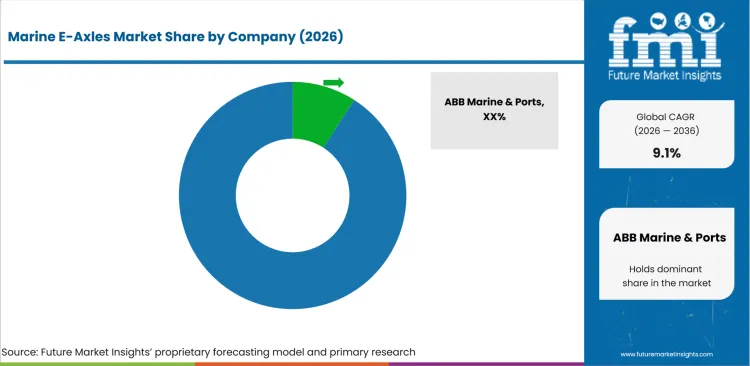
Competition separates companies by the vessel interfaces they control during design and commissioning. ABB Marine & Ports, Kongsberg Maritime and Wärtsilä cover broader ferry systems. ZF Marine, Transfluid and Veth Propulsion focus on drivetrain or thruster interfaces. Danfoss Editron centers on power electronics, while Torqeedo, Evoy and Molabo serve smaller power classes.
- Integrated propulsion and vessel-system groups: ABB Marine & Ports, Kongsberg Maritime, Wärtsilä and Danfoss Editron.
- Transmission and thruster specialists: ZF Marine, Transfluid and Veth Propulsion.
- Compact electric drive specialists: Torqeedo, Evoy and Molabo.
Competitive Benchmarking: Marine E-Axles Market
| Company | Integrated E-Drive Scope | Commercial Power Breadth | Retrofit and Shipyard Fit | Geographic Reach |
|---|---|---|---|---|
| ABB Marine & Ports | High | High | High | Global marine network |
| Kongsberg Maritime | High | High | High | Global support network |
| Wärtsilä | High | High | High | Global marine network |
| ZF Marine | Medium | High | High | Global aftermarket reach |
| Danfoss Editron | High | High | Medium | Global industrial and marine reach |
| Transfluid | Medium | Medium | High | Europe and selected international markets |
| Torqeedo | Medium | Medium | High | Europe, North America and dealer markets |
| Evoy | Medium | Medium | High | Europe and selected international markets |
| Molabo | Medium | Low | Medium | Europe and selected project markets |
| Veth Propulsion | Medium | Medium | High | Europe with Twin Disc global reach |
Scoring basis: High integrated e-drive scope requires a current project covering several propulsion interfaces. Medium covers a narrower motor, transmission or thruster role. High commercial power breadth requires large commercial-vessel evidence. Medium covers narrower duties and Low indicates small-power concentration. High retrofit and shipyard fit requires current conversion or repeated shipyard evidence. Medium indicates narrower installation history. Geographic reach follows current corporate service evidence.
Key Developments in the Marine E-Axles Market
- In January 2026, Molabo introduced the ARIES Jet Drive with Kaiser Bootsmanufaktur as a 50 kW low-voltage propulsion package for compact commercial and leisure craft.
- In September 2025, Wärtsilä was selected to equip two battery-electric Danish high-speed ferries with integrated electric propulsion systems and waterjets for the Molslinjen program.
- In June 2025, ZF Marine presented the ENC transmission series for all-electric commercial vessels with published coverage from 650 kW to 3,900 kW.
Key Players in the Marine E-Axles Market
Integrated Propulsion and Vessel Systems
- ABB Marine & Ports
- Kongsberg Maritime
- Wärtsilä
- Danfoss Editron
Transmission and Thruster Integration Specialists
- ZF Marine
- Transfluid
- Veth Propulsion
Compact Electric Drive Specialists
- Torqeedo
- Evoy
- Molabo
Marine E-Axles Market - Report Scope
| Coverage field | Report scope |
|---|---|
| Market breakdown | By axle type, power rating, vessel type, integration and sales channel. |
| Quantitative Units | USD million. |
| Market Definition | Revenue includes marine e-axle drive units and module packages sold within the defined segmentation universe. Complete-vessel revenue is excluded. Standalone batteries, chargers and adjacent propulsion products sold outside the e-axle package are also excluded. |
| Regions Covered | North America, Latin America, Western Europe, Eastern Europe, East Asia, South Asia and Pacific, and Middle East and Africa. |
| Countries Covered | Finland, Norway, Netherlands, South Korea, USA, Germany, Japan, and 20+ countries included in the full report. |
| Key Companies Profiled | ABB Marine & Ports; Kongsberg Maritime; Wärtsilä; ZF Marine; Danfoss Editron; Transfluid; Torqeedo; Evoy; Molabo; Veth Propulsion |
| Forecast Period | 2026 to 2036. |
| Approach | Primary and secondary research with market triangulation. |
Marine E-Axles Market - Research Methodology
| Method | Approach |
|---|---|
| Primary Research | FMI analysts gathered input from manufacturers, service providers, technology developers, distributors, end users, procurement teams, and subject-matter experts. Interviews examined purchasing decisions, product or service evaluation, adoption barriers, approval requirements, pricing considerations, and expectations for technical or commercial support. Respondents were also asked what evidence is required before a trial, pilot, or initial order develops into regular purchasing. |
| Desk Research | Desk research covered government statistics, regulatory publications, trade data, industry associations, technical literature, standards, company filings, product information, and official corporate announcements. Sources were reviewed for relevance, publication date, geographic coverage, and consistency with the defined market scope. Claims relating to performance, applications, approvals, capacity, investment, and commercial activity were retained only when supported by credible public evidence. |
| Market Sizing and Forecasting | The market model combined the baseline value with historical performance, segment structure, pricing and volume indicators, adoption levels, company participation, and country-level demand conditions. Forecast assumptions considered economic activity, investment trends, regulatory developments, technology adoption, purchasing cycles, supply availability, and barriers to wider market use. Segment and regional estimates were reconciled before the final market total was calculated. |
| Data Validation | Estimates were checked against multiple independent indicators, including public data, company activity, trade patterns, industry developments, and findings from primary interviews. Validation also tested whether products, services, applications, and company revenues fell within the defined market boundaries. Adjacent categories, unsupported claims, overlapping revenues, and activities without direct market relevance were excluded to reduce double counting and maintain consistency across segments and countries. |
Marine E-Axles Market by Segments
Marine E-Axles Market segmented by Axle Type:
- Integrated motor-axle units
- Electric shaftline axle units
- Compact e-drive axle modules
- Hybrid assist e-axles
- High-torque commercial e-axles
Marine E-Axles Market segmented by Power Rating:
- Below 50 kW
- 50-200 kW
- 200-1,000 kW
- Above 1 MW
Marine E-Axles Market segmented by Vessel Type:
- Workboats
- Ferries
- Patrol craft
- Inland cargo vessels
- Specialty marine vehicles
Marine E-Axles Market segmented by Integration:
- Motor only
- Motor with gearbox
- Motor-inverter axle
- Full propulsion axle package
Marine E-Axles Market segmented by Sales Channel:
- Propulsion system OEMs
- Shipyards
- Retrofit integrators
- Fleet electrification projects
Marine E-Axles Market by Region:
- North America
- United States
- Canada
- Latin America
- Brazil
- Mexico
- Argentina
- Chile
- Western Europe
- Germany
- France
- United Kingdom
- Italy
- Spain
- Benelux
- Nordics
- Eastern Europe
- Poland
- Czech Republic
- Romania
- Hungary
- East Asia
- China
- Japan
- South Korea
- South Asia and Pacific
- India
- ASEAN
- Australia and New Zealand
- Middle East and Africa
- GCC Countries
- South Africa
- Türkiye
- Israel
Research Sources and Bibliography
- International Maritime Organization. (2025, April 11). IMO approves net-zero regulations for global shipping.
- Finnish Transport and Communications Agency Traficom. (2025, October 28). Maritime transport’s first year in the EU Emissions Trading System achieved its goals.
- Kongsberg Maritime. (2025, March 6). Kongsberg Maritime to be key player in hybrid conversion of MF Hamlet for Öresundlinjen.
- Torqeedo. (2025, January 10). Torqeedo electric outboards available from January 2025 through selected Yamaha dealers in Europe.
- Evoy Vita. (2025, October 30). Electric Innovation Hits the Working Waterfront in Maine.
- ABB. (2025, June 2). ABB launches AMXE Marine Motor to enhance vessel efficiency.
- Danfoss. (2025, June 20). Danfoss iC7 Series Powers New Electric Ferry 'Nerthus'.
- Norwegian Ministry of Transport. (2025, May 16). Rapport: Anslag på fylkeskommunale merkostnader som følge av nullutslippskrav til ferger.
- European Maritime Safety Agency. (2025, November 11). Guidance on the Safety of Battery Energy Storage Systems (BESS).
- Netherlands Enterprise Agency. (2025, December 19). Subsidieregeling Verduurzaming Binnenvaartschepen.
- Finnish Transport and Communications Agency Traficom. (2025, April 16). International Maritime Organization reached provisional agreement on measures to reduce greenhouse gas emissions in maritime transport.
- Norwegian Ministry of Climate and Environment. (2025, April 14). Nullutslippskrav til passasjerskip i verdensarvfjordene.
- Government of the Netherlands. (2026, April 22). Subsidie voor verduurzaming binnenvaart na zomer van start.
- Ministry of Oceans and Fisheries, Republic of Korea. (2025, January 30). 친환경선박 보급으로 온실가스 제대로 잡는다.
- Federal Transit Administration. (2026, August 21). FTA Ferry Programs.
- Federal Ministry of Transport, Germany. (2026, August 10). Bilger: 70 Millionen Euro für grüne Binnenschifffahrtskorridore.
- Ministry of Land, Infrastructure, Transport and Tourism, Japan. (2025, December 18). 次世代船舶の世界トップシェア獲得に向け、更なる設備投資を促進~令和7年度ゼロエミッション船等の建造促進事業について、6件の事業を採択しました~.
- MOLABO GmbH. (2026, January 18). Molabo Introduces ARIES Jet Drive in Partnership with Kaiser Bootsmanufaktur.
- Wärtsilä. (2025, September 10). Wärtsilä to equip two high-speed fully battery-electric Danish ferries with integrated electric propulsion system and waterjets.
- ZF. (2025, June 2). Quiet, Clean, Flexible: ZF Presents New ENC Transmission Series for All-Electric Vessels.
- ABB. (2025, October 28). Caledonian Maritime Assets relies on ABB to power multiple all-electric ferries on board and ashore.
- Wärtsilä. (2025, August 27). Wärtsilä and Wasaline’s close cooperation continues with world’s largest marine battery hybrid system project.
- Veth Propulsion by Twin Disc. (2026, June 3). Veth Propulsion by Twin Disc Unveiled New Streamline-CRP™ at Maritime Industry.
- Transfluid. (2026, March 2). ELECTRIFYING PASSENGER CRAFT.
- Evoy Vita. (2025, November 18). Evoy Vita launches next-generation Breeze 120+ hp inboard.
- MOLABO GmbH. (2025, November 13). New Serial Hybrid System Featuring Integrated Fischer Panda Generators.
- ABB. (2025, December 1). Washington State Ferries selects ABB to power their first hybrid-electric newbuild vessels.
- Wärtsilä. (2026, January 29). Wärtsilä electric propulsion solution selected for third Molslinjen high-speed ferry.
- Torqeedo. (2025, May 26). Autonomous and Electric: Research Vessel “NOVA” sets course with Torqeedo Drive for New Paths in Inland Shipping.
- Evoy Vita. (2025, March 6). Frauscher and Evoy Vita Strengthen Partnership.
- MOLABO GmbH. (2026, February 18). Electric Innovation at Sea.
- Veth Propulsion by Twin Disc. (2025, April 29). Veth Propulsion Achieves ISO 9001 Recertification.
This bibliography is provided for reader reference and is not exhaustive. The full report contains the complete reference list and detailed citations.
This Report Answers
- How large is the marine e-axles market in 2026 and 2036?
- Which operating conditions turn ferry electrification policy into marine e-axle orders?
- Why do integrated motor-axle units lead axle type in 2026?
- How do below 50 kW systems and workboats shape demand?
- Which safety and shore-power constraints can delay marine e-axle adoption?
- How do profiled country CAGRs differ through 2036?
- Which companies compete through integrated or compact electric propulsion?
- How are companies benchmarked on e-drive scope and shipyard fit?
Frequently Asked Questions
How big is the marine e-axles market in 2026?
The marine e-axles market is valued at USD 620.6 million in 2026 and is projected to reach USD 1,482.7 million by 2036. Growth follows funded vessel electrification and tighter route-level energy planning for operators.
What is the CAGR of the marine e-axles market from 2026 to 2036?
The marine e-axles market is projected to grow at a CAGR of 9.1% between 2026 and 2036. Expansion depends on ferry replacement, electric retrofits and propulsion packages that reduce shipyard integration work.
Which axle type leads the marine e-axles market?
The integrated motor-axle units segment is expected to hold 29.0% of the marine e-axles market by axle type in 2026. Tighter packaging reduces the motor and mechanical interfaces shipyards must engineer during installation.
Which vessel type holds the leading share in the marine e-axles market?
The workboats segment is forecast to represent 28.0% of the marine e-axles market by vessel type in 2026. Repeatable duty cycles let operators validate route energy, charging time and daily availability before conversion.
Which countries are projected to record the highest growth in the marine e-axles market?
Finland is projected to grow at 9.8% CAGR, followed by Norway at 9.2% and the Netherlands at 8.9% through 2036. Their higher growth comes from ferry electrification, inland conversion programs and public procurement.
Which companies are active in the marine e-axles market?
Key companies operating in the marine e-axles market include ABB Marine & Ports, Kongsberg Maritime, Wärtsilä, ZF Marine, Danfoss Editron, Transfluid, Torqeedo, Evoy, Molabo, and Veth Propulsion. Their positions differ by integration scope, commercial power range and shipyard support.
Preview the report firsthand - request a free sample
Get SampleGet the brochure for pricing and purchase details.
Get PDFTable of Content
- Key Takeaways
- Market Size and CAGR
- Top Growth Driver
- Fastest Growing Segment
- Leading Region
- Key Companies
- Emerging Opportunities
- Executive Summary
- Global Market Outlook
- Demand-side Trends
- Supply-side Trends
- Technology Roadmap Analysis
- Analysis and Recommendations
- Analyst Perspective (What is happening? Why now? What should investors know?)
- Key Questions Answered
- How large is the market?
- What is the CAGR?
- What are key trends?
- Which region dominates?
- Who are the leaders?
- Market Overview
- Market Coverage / Taxonomy
- Market Definition / Scope / Limitations
- Research Methodology
- Chapter Orientation
- Analytical Lens and Working Hypotheses
- Market Structure, Signals, and Trend Drivers
- Benchmarking and Cross-market Comparability
- Market Sizing, Forecasting, and Opportunity Mapping
- Research Design and Evidence Framework
- Desk Research Programme (Secondary Evidence)
- Expert Input and Fieldwork (Primary Evidence)
- Tooling, Models, and Reference Databases
- Data Engineering and Model Build
- Quality Assurance and Audit Trail
- Market Background
- Market Dynamics (Drivers, Restraints, Opportunity, Trends)
- Scenario Forecast (Optimistic, Likely, Conservative)
- Impact Analysis
- AI Impact
- Sustainability Impact
- Regulatory Impact
- Technology Impact
- Consumer / Buyer Analysis
- Purchase Drivers
- Adoption Barriers
- Buyer Journey
- Opportunity Map Analysis
- Product Life Cycle Analysis
- Supply Chain Analysis
- Investment Feasibility Matrix
- Value Chain Analysis
- PESTLE and Porter's Analysis
- Regulatory Landscape
- Regional Parent Market Outlook
- Production and Consumption Statistics
- Import and Export Statistics
- Global Market Analysis and Forecast, 2021 to 2036
- Historical Market Size Value (USD Million) Analysis, 2021 to 2025
- Current and Future Market Size Value (USD Million) Projections, 2026 to 2036
- Y-o-Y Growth Trend Analysis
- Absolute $ Opportunity Analysis
- Global Market Pricing Analysis, 2021 to 2036
- Global Market Analysis and Forecast, By Axle Type, 2021 to 2036
- Introduction / Key Findings
- Historical Market Size Value (USD Million) Analysis By Axle Type, 2021 to 2025
- Current and Future Market Size Value (USD Million) Analysis and Forecast By Axle Type, 2026 to 2036
- Integrated motor-axle units
- Electric shaftline axle units
- Compact e-drive axle modules
- Hybrid assist e-axles
- High-torque commercial e-axles
- Integrated motor-axle units
- Y-o-Y Growth Trend Analysis By Axle Type, 2021 to 2025
- Absolute $ Opportunity Analysis By Axle Type, 2026 to 2036
- Global Market Analysis and Forecast, By Power Rating, 2021 to 2036
- Introduction / Key Findings
- Historical Market Size Value (USD Million) Analysis By Power Rating, 2021 to 2025
- Current and Future Market Size Value (USD Million) Analysis and Forecast By Power Rating, 2026 to 2036
- Below 50 kW
- 50-200 kW
- 200-1,000 kW
- Above 1 MW
- Below 50 kW
- Y-o-Y Growth Trend Analysis By Power Rating, 2021 to 2025
- Absolute $ Opportunity Analysis By Power Rating, 2026 to 2036
- Global Market Analysis and Forecast, By Vessel Type, 2021 to 2036
- Introduction / Key Findings
- Historical Market Size Value (USD Million) Analysis By Vessel Type, 2021 to 2025
- Current and Future Market Size Value (USD Million) Analysis and Forecast By Vessel Type, 2026 to 2036
- Workboats
- Ferries
- Patrol craft
- Inland cargo vessels
- Specialty marine vehicles
- Workboats
- Y-o-Y Growth Trend Analysis By Vessel Type, 2021 to 2025
- Absolute $ Opportunity Analysis By Vessel Type, 2026 to 2036
- Global Market Analysis and Forecast, By Integration, 2021 to 2036
- Introduction / Key Findings
- Historical Market Size Value (USD Million) Analysis By Integration, 2021 to 2025
- Current and Future Market Size Value (USD Million) Analysis and Forecast By Integration, 2026 to 2036
- Motor only
- Motor with gearbox
- Motor-inverter axle
- Full propulsion axle package
- Motor only
- Y-o-Y Growth Trend Analysis By Integration, 2021 to 2025
- Absolute $ Opportunity Analysis By Integration, 2026 to 2036
- Global Market Analysis and Forecast, By Sales Channel, 2021 to 2036
- Introduction / Key Findings
- Historical Market Size Value (USD Million) Analysis By Sales Channel, 2021 to 2025
- Current and Future Market Size Value (USD Million) Analysis and Forecast By Sales Channel, 2026 to 2036
- Propulsion system OEMs
- Shipyards
- Retrofit integrators
- Fleet electrification projects
- Propulsion system OEMs
- Y-o-Y Growth Trend Analysis By Sales Channel, 2021 to 2025
- Absolute $ Opportunity Analysis By Sales Channel, 2026 to 2036
- Global Market Analysis and Forecast, By Region, 2021 to 2036
- Introduction
- Historical Market Size Value (USD Million) Analysis By Region, 2021 to 2025
- Current Market Size Value (USD Million) Analysis and Forecast By Region, 2026 to 2036
- North America
- Latin America
- Western Europe
- Eastern Europe
- East Asia
- South Asia and Pacific
- Middle East & Africa
- Market Attractiveness Analysis By Region
- North America Market Analysis and Forecast, By Country, 2021 to 2036
- Historical Market Size Value (USD Million) Trend Analysis By Market Taxonomy, 2021 to 2025
- Market Size Value (USD Million) Forecast By Market Taxonomy, 2026 to 2036
- By Country
- USA
- Canada
- By Axle Type
- By Power Rating
- By Vessel Type
- By Integration
- By Sales Channel
- By Country
- Market Attractiveness Analysis
- By Country
- By Axle Type
- By Power Rating
- By Vessel Type
- By Integration
- By Sales Channel
- Key Takeaways
- Latin America Market Analysis and Forecast, By Country
- Historical Market Size Value (USD Million) Trend Analysis By Market Taxonomy, 2021 to 2025
- Market Size Value (USD Million) Forecast By Market Taxonomy, 2026 to 2036
- By Country
- Brazil
- Mexico
- Chile
- Rest of Latin America
- By Axle Type
- By Power Rating
- By Vessel Type
- By Integration
- By Sales Channel
- By Country
- Market Attractiveness Analysis
- By Country
- By Axle Type
- By Power Rating
- By Vessel Type
- By Integration
- By Sales Channel
- Key Takeaways
- Western Europe Market Analysis and Forecast, By Country
- Historical Market Size Value (USD Million) Trend Analysis By Market Taxonomy, 2021 to 2025
- Market Size Value (USD Million) Forecast By Market Taxonomy, 2026 to 2036
- By Country
- Germany
- UK
- Italy
- Spain
- France
- Nordic
- BENELUX
- Rest of Western Europe
- By Axle Type
- By Power Rating
- By Vessel Type
- By Integration
- By Sales Channel
- By Country
- Market Attractiveness Analysis
- By Country
- By Axle Type
- By Power Rating
- By Vessel Type
- By Integration
- By Sales Channel
- Key Takeaways
- Eastern Europe Market Analysis and Forecast, By Country
- Historical Market Size Value (USD Million) Trend Analysis By Market Taxonomy, 2021 to 2025
- Market Size Value (USD Million) Forecast By Market Taxonomy, 2026 to 2036
- By Country
- Russia
- Poland
- Hungary
- Balkan & Baltic
- Rest of Eastern Europe
- By Axle Type
- By Power Rating
- By Vessel Type
- By Integration
- By Sales Channel
- By Country
- Market Attractiveness Analysis
- By Country
- By Axle Type
- By Power Rating
- By Vessel Type
- By Integration
- By Sales Channel
- Key Takeaways
- East Asia Market Analysis and Forecast, By Country
- Historical Market Size Value (USD Million) Trend Analysis By Market Taxonomy, 2021 to 2025
- Market Size Value (USD Million) Forecast By Market Taxonomy, 2026 to 2036
- By Country
- China
- Japan
- South Korea
- By Axle Type
- By Power Rating
- By Vessel Type
- By Integration
- By Sales Channel
- By Country
- Market Attractiveness Analysis
- By Country
- By Axle Type
- By Power Rating
- By Vessel Type
- By Integration
- By Sales Channel
- Key Takeaways
- South Asia and Pacific Market Analysis and Forecast, By Country
- Historical Market Size Value (USD Million) Trend Analysis By Market Taxonomy, 2021 to 2025
- Market Size Value (USD Million) Forecast By Market Taxonomy, 2026 to 2036
- By Country
- India
- ASEAN
- Australia & New Zealand
- Rest of South Asia and Pacific
- By Axle Type
- By Power Rating
- By Vessel Type
- By Integration
- By Sales Channel
- By Country
- Market Attractiveness Analysis
- By Country
- By Axle Type
- By Power Rating
- By Vessel Type
- By Integration
- By Sales Channel
- Key Takeaways
- Middle East & Africa Market Analysis and Forecast, By Country
- Historical Market Size Value (USD Million) Trend Analysis By Market Taxonomy, 2021 to 2025
- Market Size Value (USD Million) Forecast By Market Taxonomy, 2026 to 2036
- By Country
- Kingdom of Saudi Arabia
- Other GCC Countries
- Türkiye
- South Africa
- Other African Union
- Rest of Middle East & Africa
- By Axle Type
- By Power Rating
- By Vessel Type
- By Integration
- By Sales Channel
- By Country
- Market Attractiveness Analysis
- By Country
- By Axle Type
- By Power Rating
- By Vessel Type
- By Integration
- By Sales Channel
- Key Takeaways
- Key Countries Market Analysis
- USA
- Pricing Analysis
- Market Share Analysis, 2025
- By Axle Type
- By Power Rating
- By Vessel Type
- By Integration
- By Sales Channel
- Canada
- Pricing Analysis
- Market Share Analysis, 2025
- By Axle Type
- By Power Rating
- By Vessel Type
- By Integration
- By Sales Channel
- Mexico
- Pricing Analysis
- Market Share Analysis, 2025
- By Axle Type
- By Power Rating
- By Vessel Type
- By Integration
- By Sales Channel
- Brazil
- Pricing Analysis
- Market Share Analysis, 2025
- By Axle Type
- By Power Rating
- By Vessel Type
- By Integration
- By Sales Channel
- Chile
- Pricing Analysis
- Market Share Analysis, 2025
- By Axle Type
- By Power Rating
- By Vessel Type
- By Integration
- By Sales Channel
- Germany
- Pricing Analysis
- Market Share Analysis, 2025
- By Axle Type
- By Power Rating
- By Vessel Type
- By Integration
- By Sales Channel
- UK
- Pricing Analysis
- Market Share Analysis, 2025
- By Axle Type
- By Power Rating
- By Vessel Type
- By Integration
- By Sales Channel
- Italy
- Pricing Analysis
- Market Share Analysis, 2025
- By Axle Type
- By Power Rating
- By Vessel Type
- By Integration
- By Sales Channel
- Spain
- Pricing Analysis
- Market Share Analysis, 2025
- By Axle Type
- By Power Rating
- By Vessel Type
- By Integration
- By Sales Channel
- France
- Pricing Analysis
- Market Share Analysis, 2025
- By Axle Type
- By Power Rating
- By Vessel Type
- By Integration
- By Sales Channel
- India
- Pricing Analysis
- Market Share Analysis, 2025
- By Axle Type
- By Power Rating
- By Vessel Type
- By Integration
- By Sales Channel
- ASEAN
- Pricing Analysis
- Market Share Analysis, 2025
- By Axle Type
- By Power Rating
- By Vessel Type
- By Integration
- By Sales Channel
- Australia & New Zealand
- Pricing Analysis
- Market Share Analysis, 2025
- By Axle Type
- By Power Rating
- By Vessel Type
- By Integration
- By Sales Channel
- China
- Pricing Analysis
- Market Share Analysis, 2025
- By Axle Type
- By Power Rating
- By Vessel Type
- By Integration
- By Sales Channel
- Japan
- Pricing Analysis
- Market Share Analysis, 2025
- By Axle Type
- By Power Rating
- By Vessel Type
- By Integration
- By Sales Channel
- South Korea
- Pricing Analysis
- Market Share Analysis, 2025
- By Axle Type
- By Power Rating
- By Vessel Type
- By Integration
- By Sales Channel
- Russia
- Pricing Analysis
- Market Share Analysis, 2025
- By Axle Type
- By Power Rating
- By Vessel Type
- By Integration
- By Sales Channel
- Poland
- Pricing Analysis
- Market Share Analysis, 2025
- By Axle Type
- By Power Rating
- By Vessel Type
- By Integration
- By Sales Channel
- Hungary
- Pricing Analysis
- Market Share Analysis, 2025
- By Axle Type
- By Power Rating
- By Vessel Type
- By Integration
- By Sales Channel
- Kingdom of Saudi Arabia
- Pricing Analysis
- Market Share Analysis, 2025
- By Axle Type
- By Power Rating
- By Vessel Type
- By Integration
- By Sales Channel
- Türkiye
- Pricing Analysis
- Market Share Analysis, 2025
- By Axle Type
- By Power Rating
- By Vessel Type
- By Integration
- By Sales Channel
- South Africa
- Pricing Analysis
- Market Share Analysis, 2025
- By Axle Type
- By Power Rating
- By Vessel Type
- By Integration
- By Sales Channel
- USA
- Market Structure Analysis
- Competition Dashboard
- Competition Benchmarking
- Market Share Analysis of Top Players
- By Regional
- By Axle Type
- By Power Rating
- By Vessel Type
- By Integration
- By Sales Channel
- Emerging Startups
- Innovation Benchmarking
- Competition Analysis
- Competition Deep Dive
- ABB Marine & Ports
- Overview
- Product Portfolio
- Profitability by Market Segments
- Sales Footprint
- Strategy Overview
- Marketing Strategy
- Product Strategy
- Channel Strategy
- Kongsberg Maritime
- Wärtsilä
- ZF Marine
- Danfoss Editron
- Transfluid
- Torqeedo
- Evoy
- Molabo
- Veth Propulsion
- ABB Marine & Ports
- Case Studies
- Success Stories
- Recent Developments
- Competition Deep Dive
- Assumptions & Acronyms Used


