

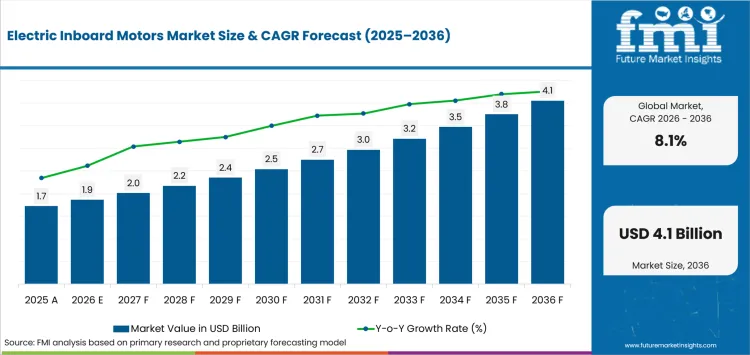
- Market Size (2026)
- USD 1.9 Bn
- Forecast (2036)
- USD 4.1 Bn
- CAGR (2026 to 2036)
- 8.1%
How big is Electric Inboard Motors Market in 2026?
USD 1.9 billion in 2026 and USD 4.1 billion by 2036 at an 8.1% CAGR.
Demand for electric inboard motors is expected to drive industry valuation from USD 1.9 billion in 2026 to USD 4.1 billion by 2036 at an 8.1% CAGR. Fleet replacement becomes a motor-order trigger once an operator fixes propulsion requirements for a funded vessel class. In August 2025, Eastern Shipbuilding Group said it received notice to proceed from Washington State Ferries for two 160-vehicle hybrid-electric ferries with an option for a third. Multi-vessel programs favor marine propulsion systems providers that can match continuous output, controls and charging plans to a repeatable route.
Charging access determines whether an approved motor specification can support routine vessel use. In June 2025, Voies navigables de France said its Borne & Eau network would reach 110 electricity-and-water points in 2026 for freight and cruise boats on the Seine system. Shore power reduces generator use at berth and gives operators clearer charging windows. That infrastructure changes marine power battery systems sizing, so battery capacity, charge time and motor load must be reconciled during repower planning.
Key Takeaways
- Operating-access rules and planned fleet replacements are pushing electric inboard systems into formal propulsion specifications for new vessels and repower programs.
- By motor configuration, direct-drive inboard motors are forecast to represent 28.0% in 2026 driven by fewer mechanical interfaces that suit shaft-line repowers.
- Below 20 kW is projected to hold 24.0% share in 2026 owing to smaller displacement craft with moderate continuous loads.
- In 2026, sailboats are expected to lead vessel type with 31.0% share because intermittent motoring lowers continuous energy demand.
- Battery reserve, charging access and installation work can delay conversion even if an electric motor meets the vessel's torque requirement.
- Some of the key players in this market include Oceanvolt, Torqeedo, VETUS, MOLABO GmbH, ePropulsion, ABB, Wärtsilä, and Danfoss Editron.
Analyst Perspective
"Electric inboard projects are won or lost on shaft fit, battery reserve and the time available to recharge between trips. A motor that meets the power target still loses the order if the yard must redesign the machinery space or the operator cannot charge ahead of the next duty cycle."
- Nikhil Kaitwade, Principal Consultant, Future Market Insights
How is the electric inboard motors market segmented?
The electric inboard motors market is segmented by motor configuration, power rating, vessel type, system voltage, sales channel and region.
Motor configuration includes direct-drive inboard motors, saildrive electric motors, hybrid-ready inboard motors, high-torque displacement motors and integrated inboard propulsion modules. Power rating covers below 20 kW, 20-100 kW, 100-500 kW and above 500 kW. Vessel type includes sailboats, yachts, workboats, ferries and canal or inland boats. System voltage covers below 48 V, 48-96 V, 96-400 V and above 400 V. Sales channels comprise boat OEMs, repower or retrofit yards, propulsion integrators and marine distributors.
Why does below 20 kW lead the power rating category?
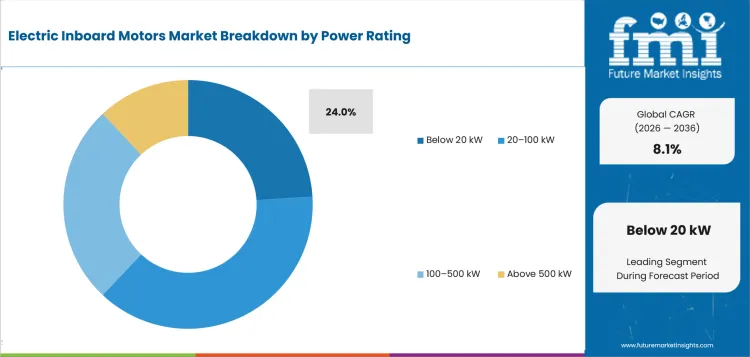
Smaller displacement craft need sustained low-speed thrust without the battery mass of larger commercial vessels, reducing cable and cooling pressure within the wider electric motor market during routine operation.
- By power rating, below 20 kW is estimated to hold 24.0% in 2026 owing to moderate continuous loads on sailboats and canal craft.
- VETUS said in January 2025 that its E-LINE range included 6 kW, 8 kW and 11 kW models. Multiple sub-20 kW ratings let installers match propulsion output to moderate loads without enlarging the battery solely to support motor capacity the vessel will rarely use.
What makes sailboats central to the vessel type category?
Sailboats use inboard propulsion mainly for harbor maneuvers and calms, so efficient displacement hulls keep loads compatible with recreational boating batteries. Yacht design can limit battery space and machinery access on retrofit projects for older vessels.
- Sailboats are set to lead the vessel type category with 31.0% share in 2026 due to intermittent motor use that reduces continuous energy reserve.
- In May 2025, MOLABO GmbH announced that Team Malizia installed its ARIES i50 electric inboard motor on the IMOCA 60 Malizia-Seaexplorer. Solar panels and hydrogenerators charge the 48 V system during sailing and offshore racing.
How does below 48 V influence system voltage selection?
Below 48 V systems suit lower-output boats that prioritize familiar service practices and simpler electrical segregation during retrofit work. In March 2025, MOLABO GmbH disclosed that its ARIES i30 delivers up to 29.9 kW at 48 V.
- The below 48 V segment is likely to capture 21.0% share in 2026 attributable to smaller inboard applications that avoid higher-voltage service requirements.
- At higher output, power electronics and conductor sizing must manage greater current without forcing the vessel into a higher service-voltage class. Thermal performance then becomes part of the yard's installation test before the low-voltage architecture can be approved.
What drives boat OEMs within the sales channel category?
Boat OEMs choose propulsion before machinery space and battery layouts are fixed, which reduces installation rework. In February 2026, MOLABO GmbH documented Baltic Yachts' use of 48 V motors for propulsion, hydraulic functions and energy generation on several boats.
- In 2026, boat OEMs are expected to lead the sales channel category with 34.0% share because early specification reduces integration changes once hull design is frozen.
- Builder-level integration requires marine electronics and propulsion interfaces during pre-production engineering at the yard. A validated package lets a motor maker reuse controls and wiring on related hulls instead of redesigning each boat after production starts.
What are the drivers, restraints and opportunities in the Electric Inboard Motors Market?
Operating rules and fleet investment strengthen demand, battery and integration requirements slow adoption, and repeatable control packages widen installation routes.
- Driver: Emission-free access rules and funded fleet projects convert propulsion policy into motor, battery and control-system purchasing decisions.
- Restraint: Battery endurance, electrical safety and charging access can raise project cost or narrow the vessel duty cycles that suit electric inboards.
- Opportunity: Standardized controls and installation interfaces reduce engineering work for boatbuilders and repower yards that need repeatable electric propulsion packages.
Operating rules convert policy into propulsion specifications
Zero-emission rules affect demand most directly once they determine vessel access or scheduled service. In April 2025, Norway's Ministry of Climate and Environment confirmed January 2026 zero-emission requirements for covered passenger ships below 10,000 gross tons and shore-power use where available. Marine engines that cannot satisfy the route rule face earlier replacement scrutiny on affected services, forcing operators to test propulsion output against route and shore-power constraints.
Battery-system requirements raise the qualification burden
Battery approval can extend vessel engineering once an electric motor already meets its propulsion requirement. In February 2026, the Norwegian Maritime Authority reopened consultation on rules for ships using lithium-ion battery systems of at least 20 kWh. The proposal places battery documentation inside vessel-safety review, so repower yards must schedule battery evidence and ship repair services ahead of a fixed conversion date.
Standardized helm controls make installations easier to repeat
Common helm interfaces reduce custom engineering on twin-motor installations by standardizing low-speed thrust commands. In October 2025, ePropulsion launched its Smart Control Joystick with dual-inboard differential thrust and EP-CAN plug-and-play installation. Boatbuilders can reuse that control architecture on related hulls provided that marine propulsion engines and steering functions pass vessel-level validation.
Which country CAGRs are profiled in the Electric Inboard Motors Market?
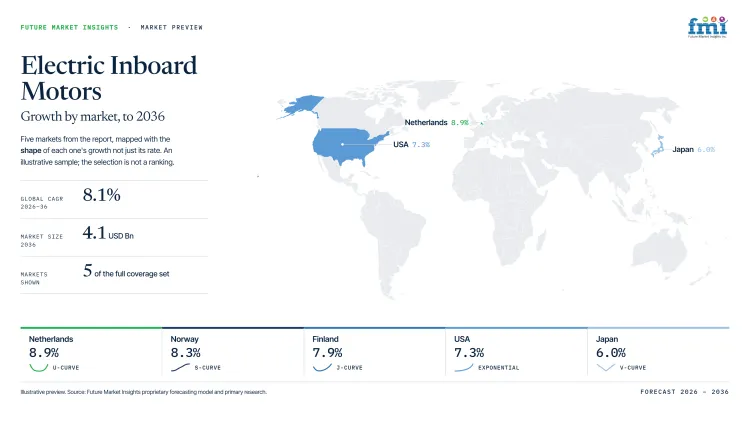
| Country | CAGR |
|---|---|
| Netherlands | 8.9% |
| Norway | 8.3% |
| Finland | 7.9% |
| France | 7.4% |
| USA | 7.3% |
How do country-level CAGRs compare in the Electric Inboard Motors Market?
The profiled countries span 1.6 percentage points, but their purchase routes separate into three operating groups. Urban access rules and passenger-ferry renewal place the Netherlands and Norway in the upper band. Finland's boatbuilding base and early propulsion integration place it in the middle. France and the USA differ by just 0.1 point despite distinct inland-waterway and public-fleet procurement models.
- The Netherlands benefits from short urban waterway routes that help minimize daily energy consumption for canal-based operations.
- Norway’s growing ferry electrification programs encourage the use of standardized electrical system packages.
- Finland leverages its marine automation and control expertise to support efficient vessel integration.
- France sees broader demand for commercial vessels due to its combination of inland freight and passenger transport activity.
- The USA remains a project-driven market, with regional policies shaping adoption more than a unified national framework.
Similar CAGRs therefore produce different entry conditions for propulsion companies and shipyards. The full report provides country-level CAGR analysis for North America, Latin America, Western Europe, Eastern Europe, East Asia, South Asia and Pacific, and Middle East and Africa.
Country-wise Analysis
- Amsterdam canal operators face a zero-emission zone in the city center, with transition access for qualifying combustion pleasure craft ending in 2028 or 2030. Electric inboard motor demand in the Netherlands is forecast to rise at 8.9% CAGR over the forecast period, attributable to urban waterways that concentrate repower decisions. Amsterdam's July 2026 enforcement campaign checked boating vignettes and explained zone rules, tying propulsion choice to a permit that determines access. Compact retrofit packages suit constrained machinery spaces, although limited yard windows and charging access can postpone conversion until the next seasonal maintenance slot. Installers gain an advantage if one motor package fits several canal-boat layouts without extensive structural work.
- Scheduled passenger services make route reliability a harder purchase test in Norway than seasonal leisure operation since each missed sailing affects the timetable and crew planning. Statistics Norway counted 11.126 million scheduled boat passengers in 2025, 5.3% more than in 2024. By 2036, Norway is projected to grow at 8.3% CAGR, given zero-emission requirements and frequent passenger use on covered routes. High daily utilization raises battery reserve and shore-power requirements, so service teams must resolve control or battery faults ahead of the next sailing. Companies with technicians near ferry routes can defend winter uptime better than firms relying on distant support hubs.
- Finnish boatbuilding is concentrated near export production clusters, which gives propulsion companies early access to OEM design work. Finland's electric inboard motors market outlook is anticipated to advance at 7.9% CAGR over the assessment period, tied to boatbuilding capability despite cold-weather reserve requirements. Statistics Finland counted 604 vessels in the regular merchant fleet and 1,041 in the total fleet during the second quarter of 2026. The broad vessel mix makes engineering support relevant beyond leisure builds, but winter battery performance limits how widely one standardized propulsion package can be specified. Entry stays constrained if local service capacity cannot cover both production yards and working-vessel operators during the coldest months.
- Inland operators between Lyon and Fos can treat scheduled lock waits as charging windows, changing battery sizing on repeat routes. VNF documented in May 2026 that boats cross 13 locks on the corridor and that E-Cluse studies rapid charging during those waits. Electric inboard motor sales in France are forecast to expand at 7.4% CAGR by 2036, aided by infrastructure-linked electrification on inland routes. Short charging stops work best on routes whose timetable already includes lock waits, leaving fragmented ownership and retrofit downtime as practical limits. Yards can win more conversion work by fitting projects to route schedules instead of offering technically suitable packages that require long seasonal outages.
- State fleet programs make public procurement a major USA route for electric marine propulsion by funding vessel replacement, terminal charging and propulsion contracts within one capital plan. In the USA, electric inboard motor demand is predicted to advance at 7.3% CAGR through 2036, since multi-vessel ferry programs can reuse a validated propulsion architecture. Eastern Shipbuilding Group documented the start of construction on three 160-vehicle hybrid-electric ferries in August 2026 after Washington accepted the third-vessel option. Long delivery schedules make revenue timing uneven, so integrators involved during design review and commissioning are better placed to secure follow-on work over several budget cycles.
Who are the notable companies in the Electric Inboard Motors Market?
Oceanvolt, Torqeedo, VETUS, MOLABO GmbH, ePropulsion, ABB, Wärtsilä and Danfoss Editron are notable companies serving the electric inboard motors market.
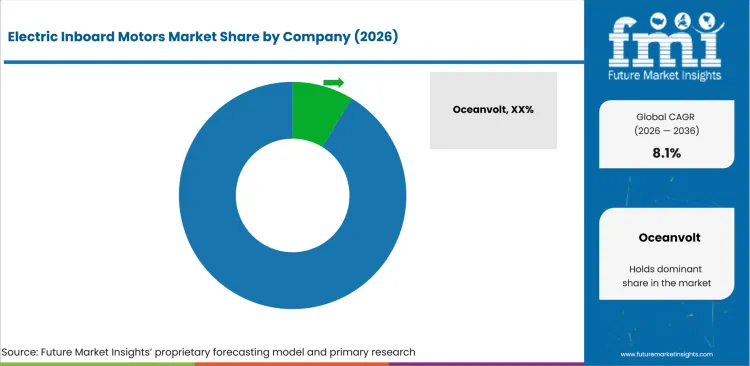
Vessel class, electrical architecture and integration depth divide the competitive field more clearly than motor efficiency alone. Oceanvolt, Torqeedo, VETUS, MOLABO GmbH and ePropulsion sell dedicated electric propulsion for recreational or light-commercial boats. ABB, Wärtsilä and Danfoss Editron participate in larger marine electrification programs that specify motors with power conversion and controls. Vessel validation, installation support and local service coverage decide entry more than nameplate efficiency, which cannot establish route fit by itself.
- Dedicated electric propulsion specialists: Oceanvolt, Torqeedo, VETUS, MOLABO GmbH and ePropulsion cover smaller-vessel applications with different power ranges, voltage choices and installation routes.
- Integrated marine electrification groups: ABB, Wärtsilä and Danfoss Editron supply electric machines with power conversion, controls or energy-management equipment for larger commercial-vessel programs.
Competitive Benchmarking: Electric Inboard Motors Market
| Company | Vessel Application Breadth | System Integration Depth | Installation Route Breadth | Geographic Reach |
|---|---|---|---|---|
| Oceanvolt | Low | Medium | Medium | Europe and international sailboat projects |
| Torqeedo | High | High | High | Europe, North America and worldwide boatbuilder network |
| VETUS | Medium | High | High | Europe, North America and worldwide dealer and service network |
| MOLABO GmbH | High | High | Medium | Europe with international yacht and boatbuilder projects |
| ePropulsion | High | High | Medium | Europe, North America and Asia-Pacific boatbuilder projects |
| ABB | Medium | High | Medium | Global marine markets |
| Wärtsilä | Medium | High | Medium | Global commercial marine markets |
| Danfoss Editron | Medium | High | Medium | Europe, Asia and North America through marine electrification projects |
Scoring basis: High vessel breadth requires evidence in at least three vessel classes, compared with two for Medium and one for Low. High integration requires a motor plus controls and power or energy interfaces. Medium covers one added integration layer, and Low is limited to motor-only evidence. High installation breadth requires both new-build and repower evidence, whereas Medium covers one repeatable supported route and Low identifies a single project route. Geographic reach records documented operating and service regions for each company and does not infer coverage from corporate size.
Key Developments in the Electric Inboard Motors Market
- In January 2026, Wärtsilä was selected to supply integrated electric propulsion, power conversion, controls and eight propulsion motors for a third Molslinjen battery-electric high-speed ferry.
- In June 2025, Torqeedo presented the Deep Blue 200i integrated inboard motor for electric and hybrid propulsion at the Electric & Hybrid Marine Expo Europe.
- In June 2025, ABB launched the AMXE Marine Motor for small to midsize electric and hybrid vessels, extending its compact propulsion-motor offer for marine applications.
Key Players in the Electric Inboard Motors Market
Dedicated Electric Boat-Propulsion Specialists
- Oceanvolt
- Torqeedo
- VETUS
- MOLABO GmbH
- ePropulsion
Integrated Marine Electrification Groups
- ABB
- Wärtsilä
- Danfoss Editron
Electric Inboard Motors Market - Report Scope
| Coverage field | Report scope |
|---|---|
| Market breakdown | By motor configuration, power rating, vessel type, system voltage, sales channel and region. |
| Quantitative Units | USD billion. |
| Market Definition | Electric inboard motor systems used as primary or auxiliary propulsion inside recreational, inland-waterway and commercial vessels. |
| Regions Covered | North America, Latin America, Western Europe, Eastern Europe, East Asia, South Asia and Pacific, and Middle East and Africa. |
| Countries Covered | Netherlands, Norway, Finland, France, USA, and 20+ countries included in the full report. |
| Key Companies Profiled | Oceanvolt, Torqeedo, VETUS, MOLABO GmbH, ePropulsion, ABB, Wärtsilä, Danfoss Editron. |
| Forecast Period | 2026 to 2036. |
| Approach | Primary and secondary research with market triangulation. |
Electric Inboard Motors Market - Research Methodology
| Method | Approach |
|---|---|
| Primary Research | FMI analysts gathered input from manufacturers, service providers, technology developers, distributors, end users, procurement teams, and subject-matter experts. Interviews examined purchasing decisions, product or service evaluation, adoption barriers, approval requirements, pricing considerations, and expectations for technical or commercial support. Respondents were also asked what evidence is required before a trial, pilot, or initial order develops into regular purchasing. |
| Desk Research | Desk research covered government statistics, regulatory publications, trade data, industry associations, technical literature, standards, company filings, product information, and official corporate announcements. Sources were reviewed for relevance, publication date, geographic coverage, and consistency with the defined market scope. Claims relating to performance, applications, approvals, capacity, investment, and commercial activity were retained only when supported by credible public evidence. |
| Market Sizing and Forecasting | The market model combined the baseline value with historical performance, segment structure, pricing and volume indicators, adoption levels, company participation, and country-level demand conditions. Forecast assumptions considered economic activity, investment trends, regulatory developments, technology adoption, purchasing cycles, supply availability, and barriers to wider market use. Segment and regional estimates were reconciled before the final market total was calculated. |
| Data Validation | Estimates were checked against multiple independent indicators, including public data, company activity, trade patterns, industry developments, and findings from primary interviews. Validation also tested whether products, services, applications, and company revenues fell within the defined market boundaries. Adjacent categories, unsupported claims, overlapping revenues, and activities without direct market relevance were excluded to reduce double counting and maintain consistency across segments and countries. |
Electric Inboard Motors Market by Segments
Electric Inboard Motors Market segmented by Motor Configuration:
- Direct-drive inboard motors
- Saildrive electric motors
- Hybrid-ready inboard motors
- High-torque displacement motors
- Integrated inboard propulsion modules
Electric Inboard Motors Market segmented by Power Rating:
- Below 20 kW
- 20-100 kW
- 100-500 kW
- Above 500 kW
Electric Inboard Motors Market segmented by Vessel Type:
- Sailboats
- Yachts
- Workboats
- Ferries
- Canal / inland boats
Electric Inboard Motors Market segmented by System Voltage:
- Below 48 V
- 48-96 V
- 96-400 V
- Above 400 V
Electric Inboard Motors Market segmented by Sales Channel:
- Boat OEMs
- Repower / retrofit yards
- Propulsion integrators
- Marine distributors
Electric Inboard Motors Market by Region:
- North America
- United States
- Canada
- Mexico
- Latin America
- Brazil
- Chile
- Rest of Latin America
- Western Europe
- Germany
- United Kingdom
- Italy
- Spain
- France
- Nordics
- Benelux
- Rest of Western Europe
- Eastern Europe
- Russia
- Poland
- Hungary
- Balkan and Baltic States
- Rest of Eastern Europe
- East Asia
- China
- Japan
- South Korea
- South Asia and Pacific
- India
- ASEAN
- Australia and New Zealand
- Rest of South Asia and Pacific
- Middle East and Africa
- Kingdom of Saudi Arabia
- Other GCC Countries
- Türkiye
- South Africa
- Other African Union Countries
- Rest of Middle East and Africa
Research Sources and Bibliography
- Eastern Shipbuilding Group, Inc. (2025, August 15). Eastern Shipbuilding Group Receives Notice To Proceed From Washington State Ferries To Construct Three New Hybrid-Electric Vessels.
- Voies navigables de France. (2025, June 4). La décarbonation du secteur fluvial s’accélère avec le déploiement du réseau Borne & Eau.
- VETUS. (2025, January 14). Press Release - VETUS previews its latest Electric Propulsion Solutions at Boot Düsseldorf 2025.
- MOLABO GmbH. (2025, May 9). Molabo and Team Malizia Launch New Era of Ocean Racing with 48 V Hybrid Propulsion System.
- MOLABO GmbH. (2025, March 11). Molabo presents innovative drive technologies and new collaborations.
- MOLABO GmbH. (2026, February 18). Electric Innovation at Sea: Baltic Yachts and Molabo Show What’s Possible at 48 Volts.
- Norwegian Ministry of Climate and Environment. (2025, April 22). Zero-Emission Requirements for Passenger Ships in World Heritage Fjords.
- Norwegian Maritime Authority. (2026, February 18). Høring - nytt forslag til § 3 i forslag til forskrift om skip som bruker batterisystem med litium-ion-celler som har en samlet kapasitet på 20 kWh eller mer.
- ePropulsion. (2025, October 8). ePropulsion Redefines Helm Control with Debut of All-New Smart Control Joystick.
- City of Amsterdam. (2026, July 15). Controle en uitleg voor schippers bij de Amstelsluis.
- Statistics Norway. (2026, June 16). Public transport.
- Statistics Finland. (2026, July 9). Vessels in the regular merchant fleet numbered 604 in the second quarter of 2026.
- Voies navigables de France. (2026, May 26). Sur le Rhône, un projet de recharge électrique rapide aux sites éclusiers.
- Eastern Shipbuilding Group, Inc. (2026, August 6). Eastern Shipbuilding Group and Washington State Celebrate Steel Cutting of New Hybrid-Electric Ferry WSF Announces agreement on Third Boat.
- Wärtsilä. (2026, January 29). Wärtsilä electric propulsion solution selected for third Molslinjen high-speed ferry.
- Torqeedo. (2025, June 24). Torqeedo presents new Deep Blue 200i motor and other innovations for the first time at the Electric & Hybrid Marine Expo Europe.
- ABB. (2025, June 2). ABB launches AMXE Marine Motor to enhance vessel efficiency.
- Danfoss. (2025, June 30). Danfoss Drives enables the green transition, one EV tugboat at a time.
- MOLABO GmbH. (2026, January 18). Molabo Introduces ARIES Jet Drive in Partnership with Kaiser Bootsmanufaktur.
- ePropulsion. (2026, January 19). ePropulsion showcases next-generation electric boating at boot Düsseldorf.
- ABB. (2025, October 28). Caledonian Maritime Assets relies on ABB to power multiple all-electric ferries on board and ashore.
- Wärtsilä. (2025, May 28). Wärtsilä to supply the electric propulsion system for USA’s first battery-electric, zero-emission high-speed passenger ferries.
- Transfluid. (2026, March 2). Electrifying Passenger Craft.
- ZF. (2025, June 2). Quiet, Clean, Flexible: ZF Presents New ENC Transmission Series for All-Electric Vessels.
- Wärtsilä. (2025, September 10). Wärtsilä to equip two high-speed fully battery-electric Danish ferries with integrated electric propulsion system and waterjets.
- Danfoss. (2025, June 20). Danfoss iC7 Series Powers New Electric Ferry 'Nerthus'.
- Torqeedo. (2025, May 27). Autonomous and Electric: Research Vessel "NOVA" sets course with Torqeedo Drive for New Paths in Inland Shipping.
- MOLABO GmbH. (2026, July 6). Team Malizia’s New IMOCA Launches with Molabo Hybrid System.
- ePropulsion. (2026, July 30). ePropulsion Powers Innovation at the 2026 Monaco Energy Boat Challenge.
- VETUS. (2026, January 5). Press release - Power, Precision and Planet-Friendly Performance; the New VETUS E-LINE 22 kW.
- VETUS. (n.d.). Quality Statement. Retrieved September 1, 2026.
- Danfoss. (n.d.). AC drives marine type approvals. Retrieved September 1, 2026.
- Oceanvolt. (2025, May 12).Oceanvolt powers McConaghy Eco Panther Series.
- ABB. (2026, January 12).ABB chosen to supply technology for BC Ferries’ New Major Vessels.
This bibliography is provided for reader reference and is not exhaustive. The full report contains the complete reference list and detailed citations.
This Report Answers
- What is the 2026 market size and 2036 forecast?
- Which rules and fleet programs shape electric inboard specifications?
- Why does below 20 kW lead power rating in 2026?
- Why do sailboats lead vessel type in 2026?
- Why do below 48 V systems remain relevant?
- Why do boat OEMs lead the sales channel?
- How do growth conditions differ among the five profiled countries?
- Which companies shape competitive positioning?
Frequently Asked Questions
How big is the electric inboard motors market in 2026?
The electric inboard motors market is valued at USD 1.9 billion in 2026 and is projected to reach USD 4.1 billion by 2036. Growth follows access rules, funded fleet replacement programs and wider boatbuilder integration of electric propulsion systems.
What is the CAGR of the electric inboard motors market from 2026 to 2036?
The electric inboard motors market is projected to grow at a CAGR of 8.1% between 2026 and 2036. Expansion is supported by fleet electrification, charging investment and repeatable new-build or repower specifications.
Which motor configuration leads the electric inboard motors market?
The direct-drive inboard motors segment is expected to hold 28.0% within the motor configuration category in 2026, driven by familiar shaft-line architecture and fewer mechanical interfaces. Its advantage is strongest on repowers that retain the existing shaft line.
Which countries are projected to record the highest growth in the electric inboard motors market?
The Netherlands is projected to grow at 8.9% CAGR, followed by Norway at 8.3% and Finland at 7.9% through 2036. Their growth routes differ between canal repowers, high-frequency passenger service and export-oriented boatbuilding.
Which companies are active in the electric inboard motors market?
Key companies operating in the electric inboard motors market include Oceanvolt, Torqeedo, VETUS, MOLABO GmbH, ePropulsion, ABB, Wärtsilä, and Danfoss Editron. Their positions differ by vessel fit, control integration, installation support and regional service coverage.
Preview the report firsthand - request a free sample
Get SampleGet the brochure for pricing and purchase details.
Get PDFTable of Content
- Key Takeaways
- Market Size and CAGR
- Top Growth Driver
- Fastest Growing Segment
- Leading Region
- Key Companies
- Emerging Opportunities
- Executive Summary
- Global Market Outlook
- Demand-side Trends
- Supply-side Trends
- Technology Roadmap Analysis
- Analysis and Recommendations
- Analyst Perspective (What is happening? Why now? What should investors know?)
- Key Questions Answered
- How large is the market?
- What is the CAGR?
- What are key trends?
- Which region dominates?
- Who are the leaders?
- Market Overview
- Market Coverage / Taxonomy
- Market Definition / Scope / Limitations
- Research Methodology
- Chapter Orientation
- Analytical Lens and Working Hypotheses
- Market Structure, Signals, and Trend Drivers
- Benchmarking and Cross-market Comparability
- Market Sizing, Forecasting, and Opportunity Mapping
- Research Design and Evidence Framework
- Desk Research Programme (Secondary Evidence)
- Expert Input and Fieldwork (Primary Evidence)
- Tooling, Models, and Reference Databases
- Data Engineering and Model Build
- Quality Assurance and Audit Trail
- Market Background
- Market Dynamics (Drivers, Restraints, Opportunity, Trends)
- Scenario Forecast (Optimistic, Likely, Conservative)
- Impact Analysis
- AI Impact
- Sustainability Impact
- Regulatory Impact
- Technology Impact
- Consumer / Buyer Analysis
- Purchase Drivers
- Adoption Barriers
- Buyer Journey
- Opportunity Map Analysis
- Product Life Cycle Analysis
- Supply Chain Analysis
- Investment Feasibility Matrix
- Value Chain Analysis
- PESTLE and Porter's Analysis
- Regulatory Landscape
- Regional Parent Market Outlook
- Production and Consumption Statistics
- Import and Export Statistics
- Global Market Analysis and Forecast, 2021 to 2036
- Historical Market Size Value (USD Billion) Analysis, 2021 to 2025
- Current and Future Market Size Value (USD Billion) Projections, 2026 to 2036
- Y-o-Y Growth Trend Analysis
- Absolute $ Opportunity Analysis
- Global Market Pricing Analysis, 2021 to 2036
- Global Market Analysis and Forecast, By Motor Configuration, 2021 to 2036
- Introduction / Key Findings
- Historical Market Size Value (USD Billion) Analysis By Motor Configuration, 2021 to 2025
- Current and Future Market Size Value (USD Billion) Analysis and Forecast By Motor Configuration, 2026 to 2036
- Direct-drive inboard motors
- Saildrive electric motors
- Hybrid-ready inboard motors
- High-torque displacement motors
- Integrated inboard propulsion modules
- Direct-drive inboard motors
- Y-o-Y Growth Trend Analysis By Motor Configuration, 2021 to 2025
- Absolute $ Opportunity Analysis By Motor Configuration, 2026 to 2036
- Global Market Analysis and Forecast, By Power Rating, 2021 to 2036
- Introduction / Key Findings
- Historical Market Size Value (USD Billion) Analysis By Power Rating, 2021 to 2025
- Current and Future Market Size Value (USD Billion) Analysis and Forecast By Power Rating, 2026 to 2036
- Below 20 kW
- 20–100 kW
- 100–500 kW
- Above 500 kW
- Below 20 kW
- Y-o-Y Growth Trend Analysis By Power Rating, 2021 to 2025
- Absolute $ Opportunity Analysis By Power Rating, 2026 to 2036
- Global Market Analysis and Forecast, By Vessel Type, 2021 to 2036
- Introduction / Key Findings
- Historical Market Size Value (USD Billion) Analysis By Vessel Type, 2021 to 2025
- Current and Future Market Size Value (USD Billion) Analysis and Forecast By Vessel Type, 2026 to 2036
- Sailboats
- Yachts
- Workboats
- Ferries
- Canal / inland boats
- Sailboats
- Y-o-Y Growth Trend Analysis By Vessel Type, 2021 to 2025
- Absolute $ Opportunity Analysis By Vessel Type, 2026 to 2036
- Global Market Analysis and Forecast, By System Voltage, 2021 to 2036
- Introduction / Key Findings
- Historical Market Size Value (USD Billion) Analysis By System Voltage, 2021 to 2025
- Current and Future Market Size Value (USD Billion) Analysis and Forecast By System Voltage, 2026 to 2036
- Below 48 V
- 48–96 V
- 96–400 V
- Above 400 V
- Below 48 V
- Y-o-Y Growth Trend Analysis By System Voltage, 2021 to 2025
- Absolute $ Opportunity Analysis By System Voltage, 2026 to 2036
- Global Market Analysis and Forecast, By Sales Channel, 2021 to 2036
- Introduction / Key Findings
- Historical Market Size Value (USD Billion) Analysis By Sales Channel, 2021 to 2025
- Current and Future Market Size Value (USD Billion) Analysis and Forecast By Sales Channel, 2026 to 2036
- Boat OEMs
- Repower / retrofit yards
- Propulsion integrators
- Marine distributors
- Boat OEMs
- Y-o-Y Growth Trend Analysis By Sales Channel, 2021 to 2025
- Absolute $ Opportunity Analysis By Sales Channel, 2026 to 2036
- Global Market Analysis and Forecast, By Region, 2021 to 2036
- Introduction
- Historical Market Size Value (USD Billion) Analysis By Region, 2021 to 2025
- Current Market Size Value (USD Billion) Analysis and Forecast By Region, 2026 to 2036
- North America
- Latin America
- Western Europe
- Eastern Europe
- East Asia
- South Asia and Pacific
- Middle East & Africa
- Market Attractiveness Analysis By Region
- North America Market Analysis and Forecast, By Country, 2021 to 2036
- Historical Market Size Value (USD Billion) Trend Analysis By Market Taxonomy, 2021 to 2025
- Market Size Value (USD Billion) Forecast By Market Taxonomy, 2026 to 2036
- By Country
- USA
- Canada
- By Motor Configuration
- By Power Rating
- By Vessel Type
- By System Voltage
- By Sales Channel
- By Country
- Market Attractiveness Analysis
- By Country
- By Motor Configuration
- By Power Rating
- By Vessel Type
- By System Voltage
- By Sales Channel
- Key Takeaways
- Latin America Market Analysis and Forecast, By Country
- Historical Market Size Value (USD Billion) Trend Analysis By Market Taxonomy, 2021 to 2025
- Market Size Value (USD Billion) Forecast By Market Taxonomy, 2026 to 2036
- By Country
- Brazil
- Mexico
- Chile
- Rest of Latin America
- By Motor Configuration
- By Power Rating
- By Vessel Type
- By System Voltage
- By Sales Channel
- By Country
- Market Attractiveness Analysis
- By Country
- By Motor Configuration
- By Power Rating
- By Vessel Type
- By System Voltage
- By Sales Channel
- Key Takeaways
- Western Europe Market Analysis and Forecast, By Country
- Historical Market Size Value (USD Billion) Trend Analysis By Market Taxonomy, 2021 to 2025
- Market Size Value (USD Billion) Forecast By Market Taxonomy, 2026 to 2036
- By Country
- Germany
- UK
- Italy
- Spain
- France
- Nordic
- BENELUX
- Rest of Western Europe
- By Motor Configuration
- By Power Rating
- By Vessel Type
- By System Voltage
- By Sales Channel
- By Country
- Market Attractiveness Analysis
- By Country
- By Motor Configuration
- By Power Rating
- By Vessel Type
- By System Voltage
- By Sales Channel
- Key Takeaways
- Eastern Europe Market Analysis and Forecast, By Country
- Historical Market Size Value (USD Billion) Trend Analysis By Market Taxonomy, 2021 to 2025
- Market Size Value (USD Billion) Forecast By Market Taxonomy, 2026 to 2036
- By Country
- Russia
- Poland
- Hungary
- Balkan & Baltic
- Rest of Eastern Europe
- By Motor Configuration
- By Power Rating
- By Vessel Type
- By System Voltage
- By Sales Channel
- By Country
- Market Attractiveness Analysis
- By Country
- By Motor Configuration
- By Power Rating
- By Vessel Type
- By System Voltage
- By Sales Channel
- Key Takeaways
- East Asia Market Analysis and Forecast, By Country
- Historical Market Size Value (USD Billion) Trend Analysis By Market Taxonomy, 2021 to 2025
- Market Size Value (USD Billion) Forecast By Market Taxonomy, 2026 to 2036
- By Country
- China
- Japan
- South Korea
- By Motor Configuration
- By Power Rating
- By Vessel Type
- By System Voltage
- By Sales Channel
- By Country
- Market Attractiveness Analysis
- By Country
- By Motor Configuration
- By Power Rating
- By Vessel Type
- By System Voltage
- By Sales Channel
- Key Takeaways
- South Asia and Pacific Market Analysis and Forecast, By Country
- Historical Market Size Value (USD Billion) Trend Analysis By Market Taxonomy, 2021 to 2025
- Market Size Value (USD Billion) Forecast By Market Taxonomy, 2026 to 2036
- By Country
- India
- ASEAN
- Australia & New Zealand
- Rest of South Asia and Pacific
- By Motor Configuration
- By Power Rating
- By Vessel Type
- By System Voltage
- By Sales Channel
- By Country
- Market Attractiveness Analysis
- By Country
- By Motor Configuration
- By Power Rating
- By Vessel Type
- By System Voltage
- By Sales Channel
- Key Takeaways
- Middle East & Africa Market Analysis and Forecast, By Country
- Historical Market Size Value (USD Billion) Trend Analysis By Market Taxonomy, 2021 to 2025
- Market Size Value (USD Billion) Forecast By Market Taxonomy, 2026 to 2036
- By Country
- Kingdom of Saudi Arabia
- Other GCC Countries
- Türkiye
- South Africa
- Other African Union
- Rest of Middle East & Africa
- By Motor Configuration
- By Power Rating
- By Vessel Type
- By System Voltage
- By Sales Channel
- By Country
- Market Attractiveness Analysis
- By Country
- By Motor Configuration
- By Power Rating
- By Vessel Type
- By System Voltage
- By Sales Channel
- Key Takeaways
- Key Countries Market Analysis
- USA
- Pricing Analysis
- Market Share Analysis, 2025
- By Motor Configuration
- By Power Rating
- By Vessel Type
- By System Voltage
- By Sales Channel
- Canada
- Pricing Analysis
- Market Share Analysis, 2025
- By Motor Configuration
- By Power Rating
- By Vessel Type
- By System Voltage
- By Sales Channel
- Mexico
- Pricing Analysis
- Market Share Analysis, 2025
- By Motor Configuration
- By Power Rating
- By Vessel Type
- By System Voltage
- By Sales Channel
- Brazil
- Pricing Analysis
- Market Share Analysis, 2025
- By Motor Configuration
- By Power Rating
- By Vessel Type
- By System Voltage
- By Sales Channel
- Chile
- Pricing Analysis
- Market Share Analysis, 2025
- By Motor Configuration
- By Power Rating
- By Vessel Type
- By System Voltage
- By Sales Channel
- Germany
- Pricing Analysis
- Market Share Analysis, 2025
- By Motor Configuration
- By Power Rating
- By Vessel Type
- By System Voltage
- By Sales Channel
- UK
- Pricing Analysis
- Market Share Analysis, 2025
- By Motor Configuration
- By Power Rating
- By Vessel Type
- By System Voltage
- By Sales Channel
- Italy
- Pricing Analysis
- Market Share Analysis, 2025
- By Motor Configuration
- By Power Rating
- By Vessel Type
- By System Voltage
- By Sales Channel
- Spain
- Pricing Analysis
- Market Share Analysis, 2025
- By Motor Configuration
- By Power Rating
- By Vessel Type
- By System Voltage
- By Sales Channel
- France
- Pricing Analysis
- Market Share Analysis, 2025
- By Motor Configuration
- By Power Rating
- By Vessel Type
- By System Voltage
- By Sales Channel
- India
- Pricing Analysis
- Market Share Analysis, 2025
- By Motor Configuration
- By Power Rating
- By Vessel Type
- By System Voltage
- By Sales Channel
- ASEAN
- Pricing Analysis
- Market Share Analysis, 2025
- By Motor Configuration
- By Power Rating
- By Vessel Type
- By System Voltage
- By Sales Channel
- Australia & New Zealand
- Pricing Analysis
- Market Share Analysis, 2025
- By Motor Configuration
- By Power Rating
- By Vessel Type
- By System Voltage
- By Sales Channel
- China
- Pricing Analysis
- Market Share Analysis, 2025
- By Motor Configuration
- By Power Rating
- By Vessel Type
- By System Voltage
- By Sales Channel
- Japan
- Pricing Analysis
- Market Share Analysis, 2025
- By Motor Configuration
- By Power Rating
- By Vessel Type
- By System Voltage
- By Sales Channel
- South Korea
- Pricing Analysis
- Market Share Analysis, 2025
- By Motor Configuration
- By Power Rating
- By Vessel Type
- By System Voltage
- By Sales Channel
- Russia
- Pricing Analysis
- Market Share Analysis, 2025
- By Motor Configuration
- By Power Rating
- By Vessel Type
- By System Voltage
- By Sales Channel
- Poland
- Pricing Analysis
- Market Share Analysis, 2025
- By Motor Configuration
- By Power Rating
- By Vessel Type
- By System Voltage
- By Sales Channel
- Hungary
- Pricing Analysis
- Market Share Analysis, 2025
- By Motor Configuration
- By Power Rating
- By Vessel Type
- By System Voltage
- By Sales Channel
- Kingdom of Saudi Arabia
- Pricing Analysis
- Market Share Analysis, 2025
- By Motor Configuration
- By Power Rating
- By Vessel Type
- By System Voltage
- By Sales Channel
- Türkiye
- Pricing Analysis
- Market Share Analysis, 2025
- By Motor Configuration
- By Power Rating
- By Vessel Type
- By System Voltage
- By Sales Channel
- South Africa
- Pricing Analysis
- Market Share Analysis, 2025
- By Motor Configuration
- By Power Rating
- By Vessel Type
- By System Voltage
- By Sales Channel
- USA
- Market Structure Analysis
- Competition Dashboard
- Competition Benchmarking
- Market Share Analysis of Top Players
- By Regional
- By Motor Configuration
- By Power Rating
- By Vessel Type
- By System Voltage
- By Sales Channel
- Emerging Startups
- Innovation Benchmarking
- Competition Analysis
- Competition Deep Dive
- Oceanvolt
- Overview
- Product Portfolio
- Profitability by Market Segments
- Sales Footprint
- Strategy Overview
- Marketing Strategy
- Product Strategy
- Channel Strategy
- Torqeedo
- Kräutler Elektromaschinen
- Elco Motor Yachts
- WaterWorld Electronics
- Aquamot
- Bellmarine / Transfluid
- Evoy
- Molabo
- Vetus
- Oceanvolt
- Case Studies
- Success Stories
- Recent Developments
- Competition Deep Dive
- Assumptions & Acronyms Used


