

- Market Size (2026)
- USD 4860.7 Mn
- Forecast (2036)
- USD 9742.0 Mn
- CAGR (2026 to 2036)
- 7.2%
How big is the EPS Motors Market in 2026?
USD 4,860.7 million in 2026 and USD 9,742.0 million by 2036 at a 7.2% CAGR.
The EPS motor demand is moving from simple steering assist toward platform-level steering control. Vehicle makers now assess motor torque and steering redundancy during chassis planning. IEA reported nearly 22 million electric cars produced globally in 2025, more than 25% above 2024, raising engineering pressure on efficient electric steering hardware.
ADAS-ready steering adds another demand layer for EPS motor suppliers. Lane support and emergency steering functions need stable assist output and predictable failure behavior. Bosch stated in September 2025 reporting brake-by-wire and steer-by-wire systems could generate more than EUR 7 billion in cumulative sales by 2032, signaling rising buyer interest in electronic steering control.
Buyers compare EPS motors through torque density and ECU compatibility. Argonne National Laboratory reported plug-in electric vehicles at 9.1% of annual USA passenger vehicle sales in 2025, down from 9.9% in 2024, giving suppliers a measurable signal of electrified-platform exposure and demand volatility together.
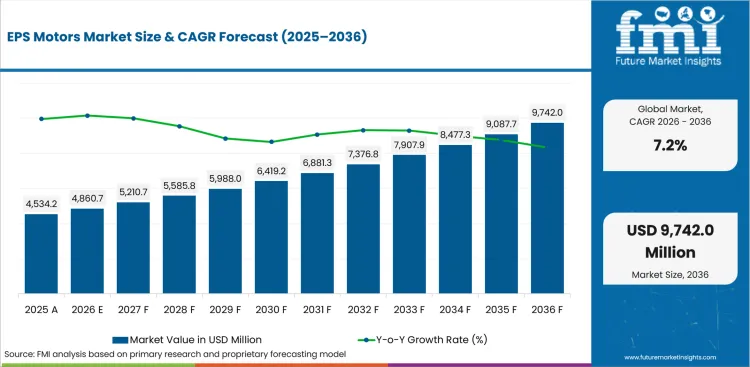
| Metric | Value |
|---|---|
| 2025 Market Size | USD 4,534.2 million |
| 2026 Market Size | USD 4,860.7 million |
| 2036 Market Size | USD 9,742.0 million |
| Forecast CAGR (2026-2036) | 7.2% |
| Sales Channel Focus | OEM |
| OEM Share (2026) | 92.0% |
| Voltage Focus | 12V Systems |
| 12V Systems Share (2026) | 74.0% |
| Vehicle Type Focus | Passenger Cars |
| Passenger Cars Share (2026) | 70.0% |
| Fastest-growing Country | India |
| India CAGR by 2036 | 8.5% |
Summary of the EPS Motors Market
| Market Signal | Commercial Impact |
|---|---|
| Demand and Growth Drivers | Demand for EPS motors is increasing as OEMs shift steering assist toward efficient electric systems across passenger cars and EV platforms.
|
| Product and Segment View | Segment demand is led by established 12V architecture and passenger car programs requiring validated EPS motor performance.
|
| Geography and Growth Outlook | Regional demand is strongest across countries with EV platform activity and export-linked steering system programs.
|
| Competitive Landscape | Competition focuses on motor-control depth and validation support for vehicle platform approvals.
|
| Analyst Perspective | EPS motors are becoming a chassis-control component as OEMs connect steering assist and efficient vehicle architecture.
- Nikhil Kaitwade, Principal Consultant for Automotive at Future Market Insights |
How is the EPS motors market segmented?
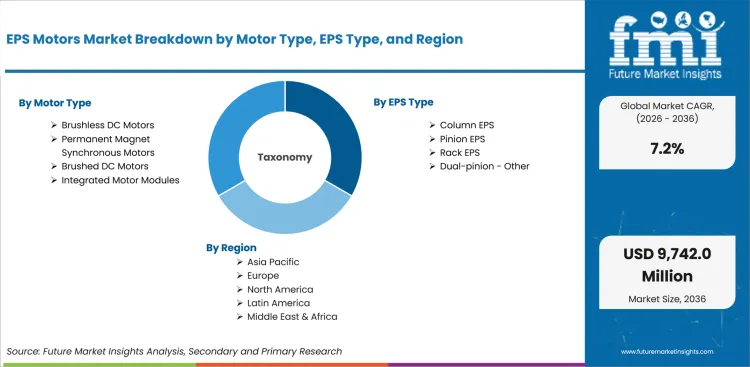
The EPS motors industry is segmented by motor type, EPS type, vehicle type, voltage, sales channel and region.
The EPS Motors market is segmented by motor type, EPS type, vehicle type, voltage, sales channel and region. By motor type, coverage includes Brushless DC Motors, Permanent Magnet Synchronous Motors, Brushed DC Motors and Integrated Motor Modules. By EPS type, coverage includes Column EPS, Pinion EPS, Rack EPS and Dual-pinion / Other. By vehicle type, coverage includes Passenger Cars, Light Commercial Vehicles, EVs / Hybrids and Commercial Vehicles. By voltage, coverage includes 12V, 24V and 48V and Above. By sales channel, coverage includes OEM and Aftermarket / Service, with regional coverage across North America, Latin America, Western Europe, Eastern Europe, East Asia, South Asia and Pacific and Middle East and Africa.
Why do Brushless DC Motors lead within the motor type segment?
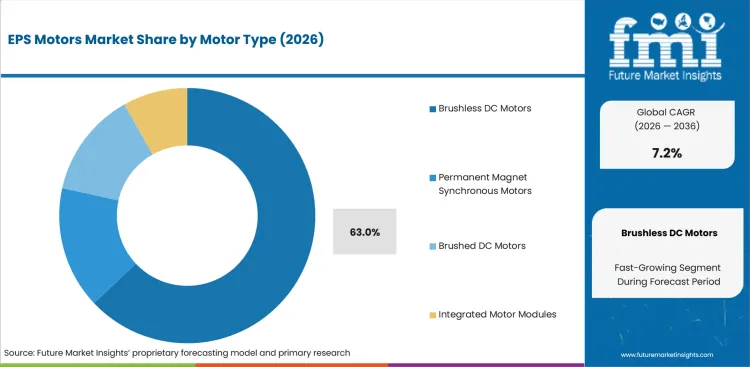
Brushless DC motors lead through quiet torque response and sealed steering-duty performance. EPS systems need motors that maintain assist accuracy across repeated steering inputs and changing cabin temperatures. Nidec reported automotive product net sales of USD 664,623 million for fiscal year ended March 2025, up 14.4% from fiscal 2024, with electric power steering motors named among demand drivers.
- Brushless DC motors are expected to account for 63.0% share in 2026, driven by low-noise torque delivery and longer service life than brushed designs. OEM engineers prefer such motors for sealed steering modules exposed to repeated duty cycles.
- Permanent magnet synchronous motors remain useful in selected higher-performance steering systems. Brushless DC motors keep selection strength once buyers compare torque smoothness and established manufacturing depth across high-volume light vehicles.
What supports demand for Column EPS applications?
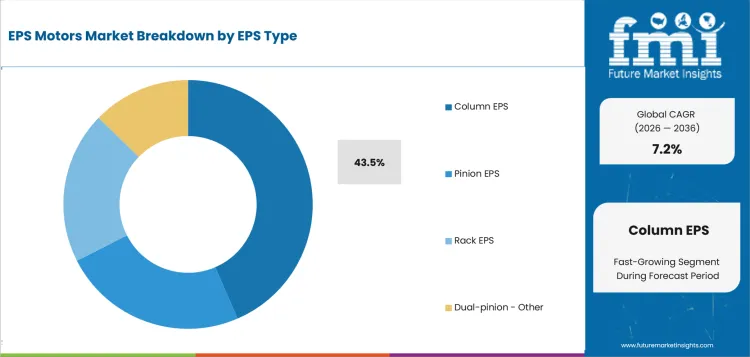
Column EPS creates a lower-cost steering route for compact cars and many EV derivatives. Cabin-side packaging reduces exposure to under-hood heat and simplifies steering unit installation. Nexteer’s April 2025 high-output column-assist EPS launch expanded assist capacity from a standard 40 Nm to 95 Nm range to as much as 110 Nm, giving smaller architectures more reach into SUVs and entry EVs.
- Column EPS is projected to hold 43.5% share in 2026, reflected by compact vehicle programs needing cost-controlled assist hardware. Cabin-side placement helps OEMs manage packaging and assembly work in smaller models.
- Pinion EPS and rack EPS remain important for heavier vehicles and higher steering loads. Column EPS gains stronger consideration once high-output designs extend usable assist range in small SUVs and entry EV platforms.
How do Passenger Cars shape the vehicle type segment?
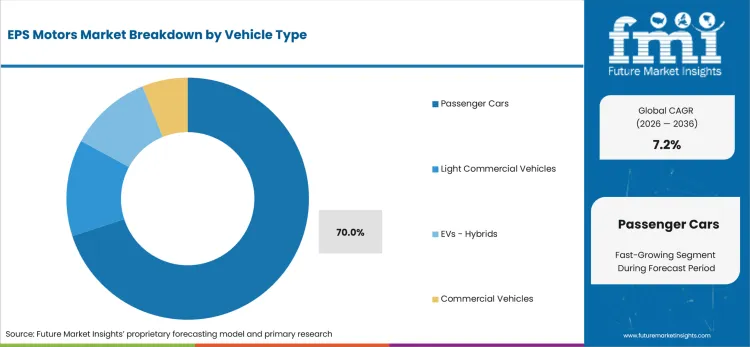
Passenger cars form the main EPS motor demand pool through high steering-system penetration across small cars and EV platforms. Steering assist is now a standard light-vehicle expectation, while ADAS features increase motor-control value. SMMT’s 2026 outlook expects UK new car demand to reach 2.093 million units, which gives steering suppliers a passenger-car signal for factory-installed EPS content.
- Passenger cars are anticipated to represent 70.0% share in 2026, supported by widespread EPS adoption across compact cars and SUVs. Supplier approval depends on steering feel and repeatable control performance across model families.
- Light commercial vehicles and commercial vehicles add value through higher steering loads. Passenger cars remain the main volume base, while larger vehicles increase demand for rack EPS and high-output column assist.
What market factors influence the 12V voltage range?
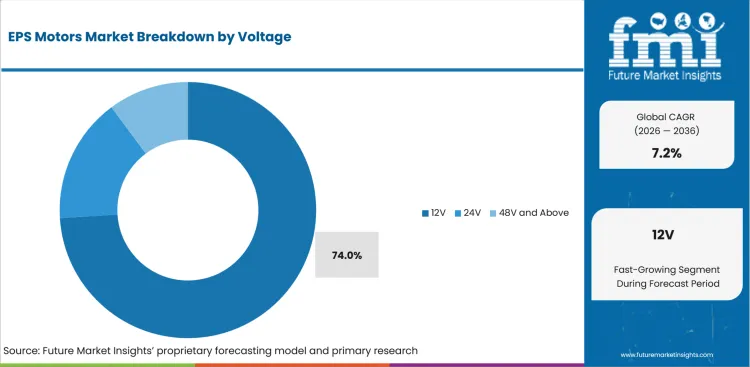
12V EPS systems give OEMs a practical balance between cost and proven electrical architecture. Most light vehicles still use 12V auxiliary systems for steering controls and support electronics. Infineon’s March 2025 automotive power release introduced 24V/48V switch variants with 3.0 mΩ and 1.5 mΩ on-resistance, showing why higher-voltage steering designs need stronger power-device validation before wider vehicle use.
- 12V systems are set to secure 74.0% share in 2026, driven by mainstream passenger vehicle architecture and established supplier validation. OEMs prefer familiar low-voltage steering systems for cost-sensitive programs.
- 48V and above systems can support higher power density in selected EVs and heavier vehicles. Wider adoption needs stronger proof around redundancy and serviceability before buyers move away from 12V norms.
How is OEM positioned within the sales-model segment?
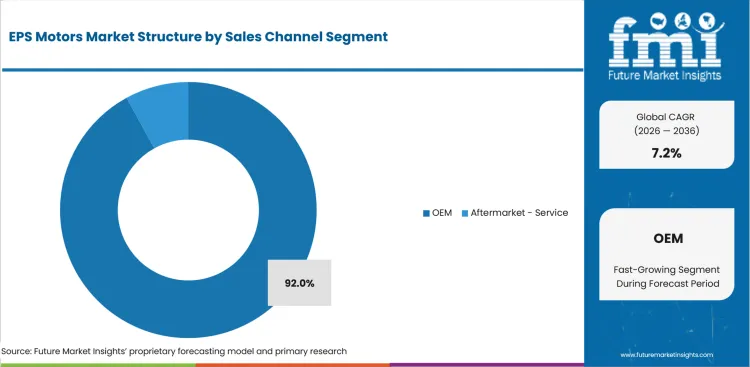
OEM sourcing is central to EPS motor demand since steering motors are validated with steering gear and safety software during platform development. Buyer teams need traceable performance data before steering assemblies reach series production. ACEA reported global car manufacturing at 75.5 million units in 2024, giving EPS suppliers a large factory-fit base for steering motor approvals.
- OEM is expected to capture 92.0% share in 2026, driven by platform engineering decisions made before launch. Suppliers gain commercial value by supporting validation and functional-safety work.
- Aftermarket / service remains useful for replacement assemblies and remanufactured steering units. Stand-alone motor replacement stays limited since many EPS motors are integrated inside steering modules.
What are the drivers, restraints, and opportunities in the EPS Motors Market?
Near-term purchases are shaped by steering electrification and cost pressure outlined below.
- Driver: ADAS-ready steering increases EPS motor value as lane support and automated parking need controlled torque response.
- Restraint: EV launch volatility can delay steering motor nominations and tooling orders.
- Opportunity: By-wire steering expands the value of motor actuation and software-linked steering feel.
Steering electrification supports EPS motor demand as OEMs combine efficiency targets with driver-assistance functions. EPS removes hydraulic pumps and supports electronic control. SMMT reported fleet registrations accounted for 61.2% of January 2026 UK new car registrations, showing how fleet buyers can speed adoption of modern EPS-equipped vehicles. Suppliers with compact motors and proven ECUs can protect pricing in platforms requiring both fuel-efficiency improvement and precise steering response.
Validation cost remains a restraint for smaller suppliers. EPS motors are aligned to steering feel and warranty exposure. UK vehicle production fell 15.5% in 2025 to 764,715 cars and commercial vehicles, reflecting how local production weakness can reduce direct component sourcing opportunities. Buyers need failure-mode evidence and control software support before new motor designs enter production drawings. Suppliers lacking ECU capability may face longer approval cycles.
By-wire steering gives EPS motor suppliers a higher-value route beyond basic assist hardware. Redundant actuation packages need motor-control precision and software calibration. VDA reported electric cars reached 40% of German passenger car production in 2025, giving steering suppliers a production base for higher-value actuation programs. Companies with steering-system depth can convert chassis electronics investment into longer platform relationships.
Which country CAGRs are profiled in the EPS motors market?
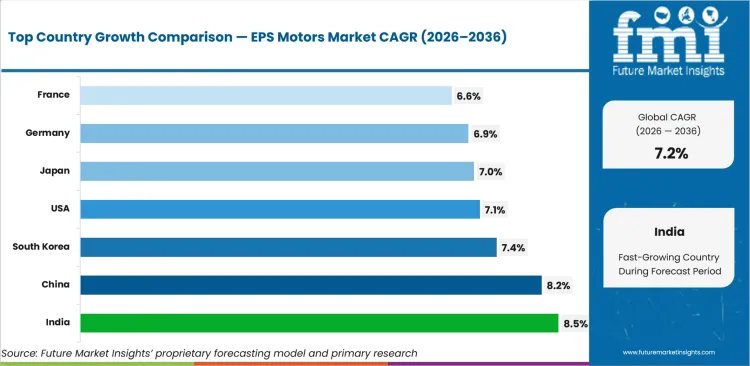
| Country | CAGR |
|---|---|
| India | 8.5% |
| China | 8.2% |
| South Korea | 7.4% |
| United States | 7.1% |
| Japan | 7.0% |
| Germany | 6.9% |
| France | 6.6% |
| United Kingdom | 6.4% |
Source: Future Market Insights analysis, 2026.
How do country-level CAGRs compare in the EPS motors market?
Country growth in EPS motors is expected to be led by passenger vehicle scale and steering-control qualification intensity. India, China and South Korea connect motor demand with vehicle output and export-grade steering programs. The United States, Japan, Germany, France and the United Kingdom connect adoption with EV platforms, ADAS-ready steering and service-channel replacement. For senior buyers, the commercial question is which market can connect validated motor output with steering architecture and repeatable platform support.
- India is estimated at 8.5% CAGR through 2036, supported by passenger vehicle scale and electric passenger car gains requiring factory-installed steering assist. SIAM reported total vehicle sales of 2.83 crore units in FY2025-26, giving EPS suppliers a larger vehicle base for steering content expansion.
- China is projected at 8.2% CAGR by 2036, helped by NEV output and local OEM steering programs able to convert platform approvals into high motor volumes. China Association of Automobile Manufacturers data cited by the State Council Information Office placed total auto output at 34.531 million vehicles in 2025, making EPS motor approval a production-scale decision.
- South Korea is forecast to record 7.4% CAGR through 2036, reinforced by export vehicle programs needing stable motor-control performance across global platforms. Ministry of Trade, Industry and Energy reporting showed automobile export volumes rose 23.4% year-on-year in January 2026, supporting EPS demand linked to overseas platform supply.
- United States is expected to expand at 7.1% CAGR through 2036, backed by pickup, SUV and EV platform depth requiring higher steering assist and software-ready motor control. Argonne National Laboratory reported plug-in electric vehicles represented 9.1% of annual passenger vehicle sales in 2025, keeping steering efficiency tied to electrified models.
- Japan is set to post 7.0% CAGR by 2036, aided by compact vehicle engineering and close supplier-OEM coordination on steering systems. JAMA reported motor vehicle production totals of 8.23 million units in 2024, supporting local EPS motor and control-module activity.
- Germany is forecast to grow at 6.9% CAGR by 2036, underpinned by EV production and high-load steering programs requiring rack EPS and redundant control capability. VDA reported BEV production expanded 15% to 1.22 million vehicles in 2025, raising demand for higher-value steering actuation.
- France is projected to rise at 6.6% CAGR through 2036, supported by passenger cars and service demand from commercial fleets. ACEA recorded 6.5 million vans in operation in France within its 2026 fleet report, helping EPS replacement channels beyond passenger cars.
- United Kingdom is projected to rise at 6.4% CAGR through 2036, shaped by fleet purchasing and imported platform mix requiring validated electric steering systems. SMMT reported January 2026 new car registrations at 144,127 units, giving EPS suppliers a fleet-led demand signal.
Who are the notable companies in the EPS Motors Market?
Nidec, Bosch, Denso, JTEKT, Mitsubishi Electric Mobility, Astemo, HL Mando, Nexteer Automotive, ZF and NSK are the notable companies shaping EPS motors and electric steering systems.
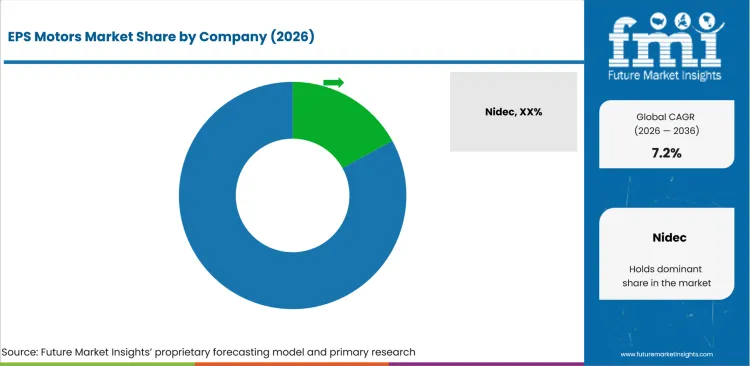
Competition in EPS motors is grouped by buyer expectations around motor reliability and steering-system validation. Nidec and Denso bring motor and control electronics depth. Bosch, JTEKT, Astemo, Nexteer and ZF compete depending on steering system integration and by-wire pathways. HL Mando along with NSK and JTEKT India support regional vehicle programs and service demand.
- Nidec and Denso compete based on motor design and compact module experience. OEMs review such suppliers for mass-production discipline and controller compatibility.
- Bosch, JTEKT, Astemo, Nexteer and ZF strengthen competition led by complete EPS architectures. Vehicle makers use such suppliers for steering systems combining motor output and software calibration.
- Mitsubishi Electric Mobility supports steering actuator and motor-control needs linked to automated vehicle programs. Buyer interest increases once steering hardware must interact with driver-assistance systems.
- HL Mando, NSK and JTEKT India compete depending on regional vehicle platforms and service networks. Local engineering and aftermarket channel support remain useful for replacement assemblies and platform-specific sourcing.
Competitive Benchmarking: EPS Motors Market
| Company | EPS Motor Integration Depth | Redundant Steering Control | Vehicle Platform Coverage | Geographic Reach |
|---|---|---|---|---|
| Nidec | High | Strong | Strong | Global |
| Bosch | High | High | Strong | Global |
| Denso | High | Strong | Strong | Global |
| JTEKT | High | Strong | Strong | Global |
| Mitsubishi Electric Mobility | Medium | Strong | Moderate | Japan and Asia |
| Astemo | High | High | Strong | Global |
| HL Mando | Medium | Strong | Strong | South Korea and global OEMs |
| Nexteer Automotive | High | High | Strong | Global |
| ZF | Medium | High | Strong | Global |
| NSK | Medium | Medium | Moderate | Japan and global |
Source: Future Market Insights competitive analysis, 2026.
Key Developments in the EPS Motors Market
- In February 2025, ZF started series production of steer-by-wire steering for NIO ET9. Supply scope covered redundant steering gear actuator and software, proving production readiness for electronic steering packages.
- In August 2025, Nexteer reported USD 1.5 billion in first-half customer program bookings, with EPS programs forming 69% of bookings. Program mix gave steering suppliers clearer visibility into platform awards.
- In October 2025, JTEKT announced its steer-by-wire system and Libuddy backup power supply were installed in Lexus RZ. Update supported redundant steering power architecture for BEV steering control.
Key Players in the EPS Motors Market
Motor and Module Specialists
- Nidec
- Denso
- Mitsubishi Electric Mobility
Steering System Integrators
- Bosch
- JTEKT
- Astemo
- Nexteer Automotive
- ZF
Regional and Vehicle Platform Specialists
- HL Mando
- NSK
- JTEKT India
EPS Motors Market - Report Scope
| Coverage field | Report scope |
|---|---|
| Market breakdown | EPS Motors Market Breakdown By Motor Type, EPS Type, Vehicle Type, Voltage, Sales Channel and Region |
| Market Definition | Electric motors used inside electronic power steering systems for passenger vehicles and commercial vehicles |
| Regions Covered | North America, Latin America, Western Europe, Eastern Europe, East Asia, South Asia and Pacific, Middle East and Africa |
| Countries Covered | United States, United Kingdom, Germany, France, Japan, China, South Korea, India and 30+ countries |
| Key Companies Profiled | Nidec, Bosch, Denso, JTEKT, Mitsubishi Electric Mobility, Astemo, HL Mando, Nexteer Automotive, ZF, NSK |
| Forecast Period | 2026 to 2036 |
| Approach | Hybrid bottom-up and top-down methodology using vehicle output, EPS penetration, motor pricing, steering architecture mix and country-level adoption signals |
Source: Future Market Insights analysis, 2026.
EPS Motors Market - Research Methodology
| Method | Approach |
|---|---|
| Primary Research | FMI analysts reviewed inputs from steering system suppliers, motor designers, vehicle platform engineers, automotive component distributors and aftermarket service specialists. Discussions focused on torque requirements, motor-control integration, service replacement and buyer acceptance. |
| Desk Research | Desk research covered vehicle production data, electric vehicle adoption signals, steering product information, company launch updates, automotive association reports and official vehicle statistics. Product coverage was checked against motor type, EPS type, voltage route and commercial application. |
| Market Sizing and Forecasting | Model design combined vehicle output, EPS penetration, motor price bands, steering architecture mix, sales channel structure and country-level electrification signals. Forecast assumptions were adjusted for OEM approval, passenger vehicle scale and ADAS-ready steering content. |
| Data Validation | Forecasts were checked against vehicle output signals, steering system launches, company product activity and supplier qualification patterns. Company portfolios were reviewed to avoid counting adjacent motor products without EPS motor use. |
EPS Motors Market by Segments
EPS Motors Market segmented by Motor Type:
- Brushless DC Motors
- Permanent Magnet Synchronous Motors
- Brushed DC Motors
- Integrated Motor Modules
EPS Motors Market segmented by EPS Type:
- Column EPS
- Pinion EPS
- Rack EPS
- Dual-pinion / Other
EPS Motors Market segmented by Vehicle Type:
- Passenger Cars
- Light Commercial Vehicles
- EVs / Hybrids
- Commercial Vehicles
EPS Motors Market segmented by Voltage:
- 12V
- 24V
- 48V and Above
EPS Motors Market segmented by Sales Channel:
- OEM
- Aftermarket / Service
EPS Motors Market by Region:
- North America
- United States
- Canada
- Mexico
- Latin America
- Brazil
- Chile
- Rest of Latin America
- Western Europe
- Germany
- UK
- Italy
- Spain
- France
- Nordic
- BENELUX
- Rest of Western Europe
- Eastern Europe
- Russia
- Poland
- Hungary
- Balkan & Baltic
- Rest of Eastern Europe
- East Asia
- China
- Japan
- South Korea
- South Asia and Pacific
- India
- ASEAN
- Australia & New Zealand
- Rest of South Asia and Pacific
- Middle East & Africa
- Kingdom of Saudi Arabia
- Other GCC Countries
- Turkiye
- South Africa
- Other African Union
- Rest of Middle East & Africa
Research Sources and Bibliography
- Argonne National Laboratory. (2026, May). Light duty electric drive vehicles monthly sales updates. Argonne National Laboratory.
- Bosch Media Service. (2025, September 8). IAA Mobility 2025: Bosch is shaping the new vehicle world with intelligent hardware and software solutions. Bosch Media Service.
- European Automobile Manufacturers’ Association. (2025, March 13). Economic and market report: Global and EU auto industry - Full year 2024. European Automobile Manufacturers’ Association.
- European Automobile Manufacturers’ Association. (2026, January 15). Report: Vehicles on European roads 2026. European Automobile Manufacturers’ Association.
- German Association of the Automotive Industry. (2026, February 3). 40% electric share of passenger car production in 2025. German Association of the Automotive Industry.
- Infineon Technologies AG. (2025, March 31). Power PROFET™ + 24/48V smart power switch family with lowest ohmic resistance optimizes automotive power distribution. Infineon Technologies AG.
- International Energy Agency. (2026, May 20). Manufacturing and trade - Global EV Outlook 2026. International Energy Agency.
- Japan Automobile Manufacturers Association. (2025, September 26). The Motor Industry of Japan 2025. Japan Automobile Manufacturers Association.
- JTEKT Corporation. (2025, October 1). Steer-by-wire system and backup power supply Libuddy are installed in Lexus RZ. JTEKT Corporation.
- Korea Trade-Investment Promotion Agency. (2026, March 4). January auto exports hit USD 6.1 billion, up 21.7 percent. Korea Trade-Investment Promotion Agency.
- Nidec Corporation. (2025, April 24). Financial statements summary for the year ended March 31, 2025. Nidec Corporation.
- Nexteer Automotive. (2025, April 8). Nexteer expands portfolio with High Output Column-Assist Electric Power Steering. Nexteer Automotive.
- Nexteer Automotive. (2025, August 13). Nexteer reports strong first-half 2025 results. Nexteer Automotive.
- Society of Indian Automobile Manufacturers. (2026, April 14). Auto Industry Performance of Q4 January-March 2026 and FY 2025-26. Society of Indian Automobile Manufacturers.
- Society of Motor Manufacturers and Traders. (2026, January 29). Tough year for auto but new models and Industrial Strategy can deliver growth. Society of Motor Manufacturers and Traders.
- Society of Motor Manufacturers and Traders. (2026, February 5). New car market starts year with growth but EV share falls. Society of Motor Manufacturers and Traders.
- Society of Motor Manufacturers and Traders. (2026, April). UK new car and van outlook. Society of Motor Manufacturers and Traders.
- State Council Information Office of the People’s Republic of China. (2026, January 15). China’s auto output, sales reach new highs in 2025. State Council Information Office.
- ZF Friedrichshafen AG. (2025, February 17). Start of series production for Steer-by-Wire steering at Chinese car manufacturer NIO. ZF Friedrichshafen AG.
This bibliography is provided for reader reference and is not exhaustive. The full report contains the complete reference list and detailed citations.
This Report Answers
- What is the expected global value of the EPS motors market in 2026 and 2036?
- What CAGR is forecast for EPS motors during the 2026 to 2036 period?
- Which motor type segment is used to assess brushless dc motors demand in 2026?
- Why do OEMs buy EPS motors with validated torque and control performance?
- How do column EPS and rack EPS shape electric steering choices?
- Which countries are compared in the EPS motors market forecast?
- Which companies compete across EPS motors and by-wire actuation pathways?
- What EPS motor systems and applications are included within the EPS motors market definition?
- How does FMI size and forecast EPS motor demand across segments and countries?
- What implementation and supplier-selection factors should executives assess?
Frequently Asked Questions
What is driving growth in the EPS motors market?
Growth is driven by electric steering adoption and OEM preference for compact motor and ECU combinations.
Why should executives track the EPS motors market?
Executives should track EPS motor demand since steering architecture affects service exposure and driver-assistance readiness.
What business problem does the EPS motors market address?
EPS motors help vehicle makers replace hydraulic assist with electrically controlled steering supporting efficiency and automated steering functions.
What should sourcing leaders evaluate before selecting suppliers?
Sourcing leaders should compare torque output and launch-support capability before supplier approval.
What can limit return on investment for buyers?
Return on investment can be delayed if steering motors fail validation or cannot be serviced separately inside integrated steering units.
How can suppliers build executive confidence?
Suppliers build confidence through verified motor-control performance and engineering accountability during vehicle platform launch.
Preview the report firsthand - request a free sample
Get SampleGet the brochure for pricing and purchase details.
Get PDFTable of Content
- Key Takeaways
- Market Size and CAGR
- Top Growth Driver
- Fastest Growing Segment
- Leading Region
- Key Companies
- Emerging Opportunities
- Executive Summary
- Global Market Outlook
- Demand-side Trends
- Supply-side Trends
- Technology Roadmap Analysis
- Analysis and Recommendations
- Analyst Perspective (What is happening? Why now? What should investors know?)
- Key Questions Answered
- How large is the market?
- What is the CAGR?
- What are key trends?
- Which region dominates?
- Who are the leaders?
- Market Overview
- Market Coverage / Taxonomy
- Market Definition / Scope / Limitations
- Research Methodology
- Chapter Orientation
- Analytical Lens and Working Hypotheses
- Market Structure, Signals, and Trend Drivers
- Benchmarking and Cross-market Comparability
- Market Sizing, Forecasting, and Opportunity Mapping
- Research Design and Evidence Framework
- Desk Research Programme (Secondary Evidence)
- Expert Input and Fieldwork (Primary Evidence)
- Tooling, Models, and Reference Databases
- Data Engineering and Model Build
- Quality Assurance and Audit Trail
- Market Background
- Market Dynamics (Drivers, Restraints, Opportunity, Trends)
- Scenario Forecast (Optimistic, Likely, Conservative)
- Impact Analysis
- AI Impact
- Sustainability Impact
- Regulatory Impact
- Technology Impact
- Consumer / Buyer Analysis
- Purchase Drivers
- Adoption Barriers
- Buyer Journey
- Opportunity Map Analysis
- Product Life Cycle Analysis
- Supply Chain Analysis
- Investment Feasibility Matrix
- Value Chain Analysis
- PESTLE and Porter's Analysis
- Regulatory Landscape
- Regional Parent Market Outlook
- Production and Consumption Statistics
- Import and Export Statistics
- Global Market Analysis and Forecast, 2021 to 2036
- Historical Market Size Value (USD Million) & Volume (Unit) Analysis, 2021 to 2025
- Current and Future Market Size Value (USD Million) & Volume (Unit) Projections, 2026 to 2036
- Y-o-Y Growth Trend Analysis
- Absolute $ Opportunity Analysis
- Global Market Pricing Analysis, 2021 to 2036
- Global Market Analysis and Forecast, By Motor Type, 2021 to 2036
- Introduction / Key Findings
- Historical Market Size Value (USD Million) & Volume (Unit) Analysis By Motor Type, 2021 to 2025
- Current and Future Market Size Value (USD Million) & Volume (Unit) Analysis and Forecast By Motor Type, 2026 to 2036
- Brushless DC Motors
- Permanent Magnet Synchronous Motors
- Brushed DC Motors
- Integrated Motor Modules
- Brushless DC Motors
- Y-o-Y Growth Trend Analysis By Motor Type, 2021 to 2025
- Absolute $ Opportunity Analysis By Motor Type, 2026 to 2036
- Global Market Analysis and Forecast, By EPS Type, 2021 to 2036
- Introduction / Key Findings
- Historical Market Size Value (USD Million) & Volume (Unit) Analysis By EPS Type, 2021 to 2025
- Current and Future Market Size Value (USD Million) & Volume (Unit) Analysis and Forecast By EPS Type, 2026 to 2036
- Column EPS
- Pinion EPS
- Rack EPS
- Dual-pinion - Other
- Column EPS
- Y-o-Y Growth Trend Analysis By EPS Type, 2021 to 2025
- Absolute $ Opportunity Analysis By EPS Type, 2026 to 2036
- Global Market Analysis and Forecast, By Vehicle Type, 2021 to 2036
- Introduction / Key Findings
- Historical Market Size Value (USD Million) & Volume (Unit) Analysis By Vehicle Type, 2021 to 2025
- Current and Future Market Size Value (USD Million) & Volume (Unit) Analysis and Forecast By Vehicle Type, 2026 to 2036
- Passenger Cars
- Light Commercial Vehicles
- EVs - Hybrids
- Commercial Vehicles
- Passenger Cars
- Y-o-Y Growth Trend Analysis By Vehicle Type, 2021 to 2025
- Absolute $ Opportunity Analysis By Vehicle Type, 2026 to 2036
- Global Market Analysis and Forecast, By Voltage, 2021 to 2036
- Introduction / Key Findings
- Historical Market Size Value (USD Million) & Volume (Unit) Analysis By Voltage, 2021 to 2025
- Current and Future Market Size Value (USD Million) & Volume (Unit) Analysis and Forecast By Voltage, 2026 to 2036
- 12V
- 24V
- 48V and Above
- 12V
- Y-o-Y Growth Trend Analysis By Voltage, 2021 to 2025
- Absolute $ Opportunity Analysis By Voltage, 2026 to 2036
- Global Market Analysis and Forecast, By Sales Channel, 2021 to 2036
- Introduction / Key Findings
- Historical Market Size Value (USD Million) & Volume (Unit) Analysis By Sales Channel, 2021 to 2025
- Current and Future Market Size Value (USD Million) & Volume (Unit) Analysis and Forecast By Sales Channel, 2026 to 2036
- OEM
- Aftermarket - Service
- OEM
- Y-o-Y Growth Trend Analysis By Sales Channel, 2021 to 2025
- Absolute $ Opportunity Analysis By Sales Channel, 2026 to 2036
- Global Market Analysis and Forecast, By Region, 2021 to 2036
- Introduction
- Historical Market Size Value (USD Million) & Volume (Unit) Analysis By Region, 2021 to 2025
- Current Market Size Value (USD Million) & Volume (Unit) Analysis and Forecast By Region, 2026 to 2036
- North America
- Latin America
- Western Europe
- Eastern Europe
- East Asia
- South Asia and Pacific
- Middle East & Africa
- Market Attractiveness Analysis By Region
- North America Market Analysis and Forecast, By Country, 2021 to 2036
- Historical Market Size Value (USD Million) & Volume (Unit) Trend Analysis By Market Taxonomy, 2021 to 2025
- Market Size Value (USD Million) & Volume (Unit) Forecast By Market Taxonomy, 2026 to 2036
- By Country
- USA
- Canada
- Mexico
- By Motor Type
- By EPS Type
- By Vehicle Type
- By Voltage
- By Sales Channel
- By Country
- Market Attractiveness Analysis
- By Country
- By Motor Type
- By EPS Type
- By Vehicle Type
- By Voltage
- By Sales Channel
- Key Takeaways
- Latin America Market Analysis and Forecast, By Country
- Historical Market Size Value (USD Million) & Volume (Unit) Trend Analysis By Market Taxonomy, 2021 to 2025
- Market Size Value (USD Million) & Volume (Unit) Forecast By Market Taxonomy, 2026 to 2036
- By Country
- Brazil
- Chile
- Rest of Latin America
- By Motor Type
- By EPS Type
- By Vehicle Type
- By Voltage
- By Sales Channel
- By Country
- Market Attractiveness Analysis
- By Country
- By Motor Type
- By EPS Type
- By Vehicle Type
- By Voltage
- By Sales Channel
- Key Takeaways
- Western Europe Market Analysis and Forecast, By Country
- Historical Market Size Value (USD Million) & Volume (Unit) Trend Analysis By Market Taxonomy, 2021 to 2025
- Market Size Value (USD Million) & Volume (Unit) Forecast By Market Taxonomy, 2026 to 2036
- By Country
- Germany
- UK
- Italy
- Spain
- France
- Nordic
- BENELUX
- Rest of Western Europe
- By Motor Type
- By EPS Type
- By Vehicle Type
- By Voltage
- By Sales Channel
- By Country
- Market Attractiveness Analysis
- By Country
- By Motor Type
- By EPS Type
- By Vehicle Type
- By Voltage
- By Sales Channel
- Key Takeaways
- Eastern Europe Market Analysis and Forecast, By Country
- Historical Market Size Value (USD Million) & Volume (Unit) Trend Analysis By Market Taxonomy, 2021 to 2025
- Market Size Value (USD Million) & Volume (Unit) Forecast By Market Taxonomy, 2026 to 2036
- By Country
- Russia
- Poland
- Hungary
- Balkan & Baltic
- Rest of Eastern Europe
- By Motor Type
- By EPS Type
- By Vehicle Type
- By Voltage
- By Sales Channel
- By Country
- Market Attractiveness Analysis
- By Country
- By Motor Type
- By EPS Type
- By Vehicle Type
- By Voltage
- By Sales Channel
- Key Takeaways
- East Asia Market Analysis and Forecast, By Country
- Historical Market Size Value (USD Million) & Volume (Unit) Trend Analysis By Market Taxonomy, 2021 to 2025
- Market Size Value (USD Million) & Volume (Unit) Forecast By Market Taxonomy, 2026 to 2036
- By Country
- China
- Japan
- South Korea
- By Motor Type
- By EPS Type
- By Vehicle Type
- By Voltage
- By Sales Channel
- By Country
- Market Attractiveness Analysis
- By Country
- By Motor Type
- By EPS Type
- By Vehicle Type
- By Voltage
- By Sales Channel
- Key Takeaways
- South Asia and Pacific Market Analysis and Forecast, By Country
- Historical Market Size Value (USD Million) & Volume (Unit) Trend Analysis By Market Taxonomy, 2021 to 2025
- Market Size Value (USD Million) & Volume (Unit) Forecast By Market Taxonomy, 2026 to 2036
- By Country
- India
- ASEAN
- Australia & New Zealand
- Rest of South Asia and Pacific
- By Motor Type
- By EPS Type
- By Vehicle Type
- By Voltage
- By Sales Channel
- By Country
- Market Attractiveness Analysis
- By Country
- By Motor Type
- By EPS Type
- By Vehicle Type
- By Voltage
- By Sales Channel
- Key Takeaways
- Middle East & Africa Market Analysis and Forecast, By Country
- Historical Market Size Value (USD Million) & Volume (Unit) Trend Analysis By Market Taxonomy, 2021 to 2025
- Market Size Value (USD Million) & Volume (Unit) Forecast By Market Taxonomy, 2026 to 2036
- By Country
- Kingdom of Saudi Arabia
- Other GCC Countries
- Türkiye
- South Africa
- Other African Union
- Rest of Middle East & Africa
- By Motor Type
- By EPS Type
- By Vehicle Type
- By Voltage
- By Sales Channel
- By Country
- Market Attractiveness Analysis
- By Country
- By Motor Type
- By EPS Type
- By Vehicle Type
- By Voltage
- By Sales Channel
- Key Takeaways
- Key Countries Market Analysis
- USA
- Pricing Analysis
- Market Share Analysis, 2025
- By Motor Type
- By EPS Type
- By Vehicle Type
- By Voltage
- By Sales Channel
- Canada
- Pricing Analysis
- Market Share Analysis, 2025
- By Motor Type
- By EPS Type
- By Vehicle Type
- By Voltage
- By Sales Channel
- Mexico
- Pricing Analysis
- Market Share Analysis, 2025
- By Motor Type
- By EPS Type
- By Vehicle Type
- By Voltage
- By Sales Channel
- Brazil
- Pricing Analysis
- Market Share Analysis, 2025
- By Motor Type
- By EPS Type
- By Vehicle Type
- By Voltage
- By Sales Channel
- Chile
- Pricing Analysis
- Market Share Analysis, 2025
- By Motor Type
- By EPS Type
- By Vehicle Type
- By Voltage
- By Sales Channel
- Germany
- Pricing Analysis
- Market Share Analysis, 2025
- By Motor Type
- By EPS Type
- By Vehicle Type
- By Voltage
- By Sales Channel
- UK
- Pricing Analysis
- Market Share Analysis, 2025
- By Motor Type
- By EPS Type
- By Vehicle Type
- By Voltage
- By Sales Channel
- Italy
- Pricing Analysis
- Market Share Analysis, 2025
- By Motor Type
- By EPS Type
- By Vehicle Type
- By Voltage
- By Sales Channel
- Spain
- Pricing Analysis
- Market Share Analysis, 2025
- By Motor Type
- By EPS Type
- By Vehicle Type
- By Voltage
- By Sales Channel
- France
- Pricing Analysis
- Market Share Analysis, 2025
- By Motor Type
- By EPS Type
- By Vehicle Type
- By Voltage
- By Sales Channel
- India
- Pricing Analysis
- Market Share Analysis, 2025
- By Motor Type
- By EPS Type
- By Vehicle Type
- By Voltage
- By Sales Channel
- ASEAN
- Pricing Analysis
- Market Share Analysis, 2025
- By Motor Type
- By EPS Type
- By Vehicle Type
- By Voltage
- By Sales Channel
- Australia & New Zealand
- Pricing Analysis
- Market Share Analysis, 2025
- By Motor Type
- By EPS Type
- By Vehicle Type
- By Voltage
- By Sales Channel
- China
- Pricing Analysis
- Market Share Analysis, 2025
- By Motor Type
- By EPS Type
- By Vehicle Type
- By Voltage
- By Sales Channel
- Japan
- Pricing Analysis
- Market Share Analysis, 2025
- By Motor Type
- By EPS Type
- By Vehicle Type
- By Voltage
- By Sales Channel
- South Korea
- Pricing Analysis
- Market Share Analysis, 2025
- By Motor Type
- By EPS Type
- By Vehicle Type
- By Voltage
- By Sales Channel
- Russia
- Pricing Analysis
- Market Share Analysis, 2025
- By Motor Type
- By EPS Type
- By Vehicle Type
- By Voltage
- By Sales Channel
- Poland
- Pricing Analysis
- Market Share Analysis, 2025
- By Motor Type
- By EPS Type
- By Vehicle Type
- By Voltage
- By Sales Channel
- Hungary
- Pricing Analysis
- Market Share Analysis, 2025
- By Motor Type
- By EPS Type
- By Vehicle Type
- By Voltage
- By Sales Channel
- Kingdom of Saudi Arabia
- Pricing Analysis
- Market Share Analysis, 2025
- By Motor Type
- By EPS Type
- By Vehicle Type
- By Voltage
- By Sales Channel
- Türkiye
- Pricing Analysis
- Market Share Analysis, 2025
- By Motor Type
- By EPS Type
- By Vehicle Type
- By Voltage
- By Sales Channel
- South Africa
- Pricing Analysis
- Market Share Analysis, 2025
- By Motor Type
- By EPS Type
- By Vehicle Type
- By Voltage
- By Sales Channel
- USA
- Market Structure Analysis
- Competition Dashboard
- Competition Benchmarking
- Market Share Analysis of Top Players
- By Regional
- By Motor Type
- By EPS Type
- By Vehicle Type
- By Voltage
- By Sales Channel
- Emerging Startups
- Innovation Benchmarking
- Competition Analysis
- Competition Deep Dive
- Nidec
- Overview
- Product Portfolio
- Profitability by Market Segments (Product/Region/Sales Channel)
- Sales Footprint
- Strategy Overview
- Marketing Strategy
- Product Strategy
- Channel Strategy
- Denso
- Mitsubishi Electric Mobility
- Bosch
- JTEKT
- Astemo
- Nexteer Automotive
- ZF
- Nidec
- Case Studies
- Success Stories
- Recent Developments
- Competition Deep Dive
- Assumptions & Acronyms Used


