

- Market Size (2026)
- USD 680.7 Mn
- Forecast (2036)
- USD 1539.1 Mn
- CAGR (2026 to 2036)
- 8.5%
How big is Marine IMU Sensors Market in 2026?
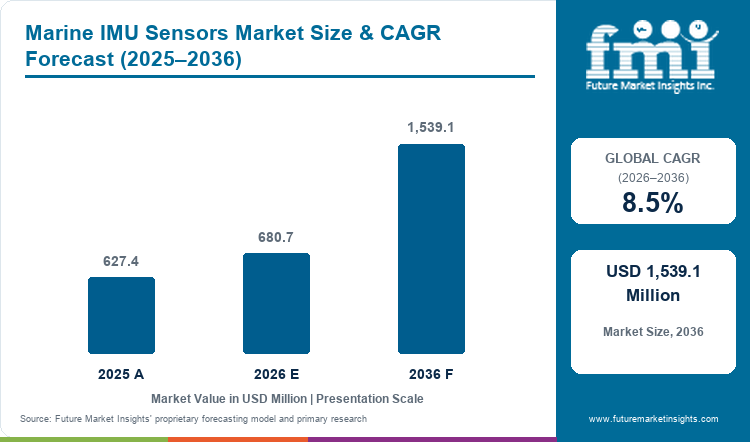
USD 680.7 million in 2026 and USD 1539.1 million by 2036 at an 8.5% CAGR.
Demand for marine IMU sensors is projected to rise from USD 680.7 million in 2026 to USD 1539.1 million by 2036 at an 8.5% CAGR. Vessel-control software increasingly depends on continuous inertial outputs between external navigation updates. The USA Navy documented underway launches of several GARCs in March 2025 in an August 2025 fact-file update. Underway testing raises the value of repeatable bias behavior during real vessel motion and intermittent external aiding.
Country adoption depends on how quickly uncrewed systems move from experiments into repeat operations with defined approval evidence. NOAA's June 2025 update recorded more than 70 funded projects and 10 capabilities moved to operational or operations-ready status. Germany and South Korea require formal verification earlier in the development cycle. Dutch and US hydrographic programs provide operating evidence that can shorten later integration decisions.
Key Takeaways of Marine IMU Sensors Market
- Marine IMU sensor demand rises because autonomy software requires continuous motion data during active vessel control and stabilization.
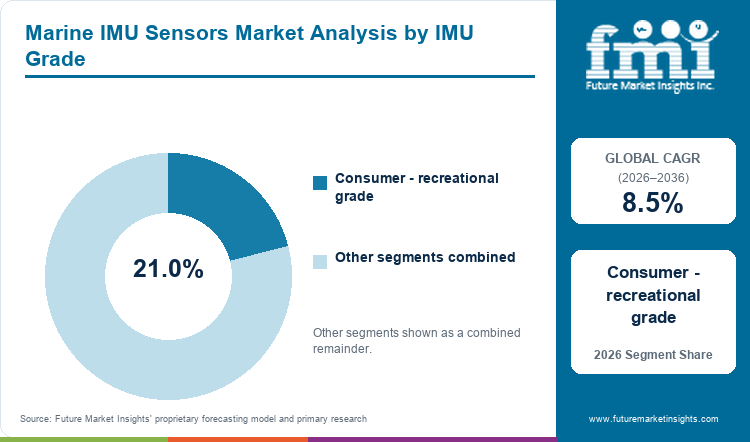
- By IMU grade, consumer - recreational grade is estimated to hold 21.0% in 2026 owing to compact MEMS economics in recreational control electronics.
- In 2026, 6-axis IMU is expected to lead the axis category with 29.0% share because six inertial degrees cover common stabilization requirements.
- By application, autopilot stabilization is forecast to represent 26.0% in 2026 driven by continuous motion feedback during steering corrections.
- Vessel vibration and degraded satellite navigation lengthen qualification by forcing integrators to document alignment plus drift behavior under representative operating conditions.
- Key players in the marine IMU sensors market include VectorNav Technologies, Advanced Navigation, Xsens / Movella, Honeywell, Bosch Sensortec, Analog Devices, STMicroelectronics, SBG Systems, and LORD MicroStrain.
Analyst Perspective
"Marine IMU selection turns on how error growth behaves between external fixes during vessel motion and vibration. A low component price loses meaning if sea trials expose drift or interface faults that force another integration cycle."
- Nikhil Kaitwade, Principal Consultant, Future Market Insights
How is the Marine IMU Sensors Market segmented?
The market is analyzed by IMU grade, axis, application, vessel type, sales channel, and region.
IMU grade covers consumer - recreational, industrial, tactical, navigation, and MEMS high-performance grades, while axis includes 6-axis IMU, 9-axis IMU, 10-axis fused sensor, and GNSS/INS integrated units. Applications cover autopilot stabilization, navigation, dynamic positioning, USV control, and motion compensation, while vessel types and sales channels distinguish the supplied boat classes and distribution routes.
Why does consumer - recreational grade hold the current share within the IMU grade category?
Recreational control electronics can use compact MEMS units where GNSS or magnetic aiding carries part of the heading burden. Designers therefore balance drift performance against package size and installation effort in helm systems that already have external navigation inputs.
- By IMU grade, the consumer - recreational grade segment is estimated to hold 21.0% in 2026 owing to broad fit with compact recreational control electronics.
- Retrofit work is easier if motion functions use the installed marine electronics network without a full helm redesign. Raymarine announced in February 2025 that YachtSense could remotely activate Seakeeper stabilization on compatible factory-equipped boats.
Why does 6-axis IMU hold the current share within the axis category?
A 6-axis unit measures three-axis angular rate and three-axis acceleration without placing heading or position aiding inside the same package. This gives integrators direct control over inertial measurement and lets the vessel navigation filter own external aiding behavior.
- 6-axis IMU is set to lead the axis category with 29.0% share in 2026 due to six inertial degrees covering common stabilization requirements.
- Compact control boards still need motion data before higher-level position aiding enters the navigation filter. STMicroelectronics introduced the LSM6DSV320X in May 2025 with synchronized dual accelerometers and a gyroscope for high-impact motion sensing.
Why does autopilot stabilization hold the current share within the application category?
Autopilot stabilization consumes attitude and angular-rate data during every steering correction, so sensor latency enters control quality directly. Refit programs also depend on interfaces that fit installed vessel networks and steering hardware without another system replacement.
- By application, autopilot stabilization is forecast to represent 26.0% in 2026 driven by continuous motion feedback during steering corrections.
- Network compatibility decides whether an autopilot control upgrade can reuse existing electronics and commissioning procedures on refit boats. Garmin launched the APK 10 Autopilot Keypad in January 2025 with single-cable NMEA 2000 integration for Reactor 40 systems.
What supports recreational boats within the vessel type category?
Recreational boats offer a wide retrofit base because owners replace navigation and steering electronics without waiting for a new hull. Sensor value per boat is usually lower than on survey vessels, but frequent electronics upgrades keep design opportunities active.
- Recreational boats are projected to hold 22.0% share in 2026 owing to aftermarket access and continued autopilot replacement within installed fleets.
- Complete steering packages can place inertial sensors into a refit without a separate component decision. Garmin launched SmartDrive in September 2026 for sailboats and catamarans up to 45 feet with a Reactor 40 corepack containing solid-state MEMS sensor designs for 9-axis attitude sensing.
What drives sensor OEMs within the sales channel category?
Sensor OEMs control calibration and firmware closest to the inertial hardware, so they remain accountable for repeatability before module acceptance. Marine integrators can keep vessel-level fusion separate while relying on one source for calibration records and interface support.
- Based on sales channel, sensor OEMs are projected to account for 36.0% in 2026 due to calibrated modules and direct software support for integration teams.
- Software support shortens the path from calibrated hardware into a navigation stack during OEM integration. Xsens released MT Software Suite 2025.2.0 in July 2025 with Python 3.11 support for MTi plus Sirius and Avior inertial sensing products.
What are the drivers, restraints and opportunities in the Marine IMU Sensors Market?
Closed-loop automation raises inertial demand, vessel qualification lengthens integration work, and resilient multi-source navigation supports higher-value designs.
- Driver: Autonomous and stabilized marine platforms require continuous inertial inputs as control software updates steering and mission geometry during operation.
- Restraint: GNSS interference and vessel vibration increase validation work by exposing alignment or calibration errors during degraded satellite coverage.
- Opportunity: Resilient PNT architectures can raise sensor value by pairing inertial measurement with independent aiding sources and documented navigation diagnostics.
Autonomous control raises inertial requirements
Autonomous vessel programs place inertial data inside the control chain before software steers or maintains mission geometry. The IMO adopted its non-mandatory MASS Code in May 2026 and included navigation among design areas for autonomous cargo ships. The code gives unmanned surface vehicles a clearer approval route for documenting motion-data integrity before commercial operation.
GNSS interference complicates qualification
GNSS interference increases qualification work because an IMU must limit drift without masking calibration or alignment errors. IMO joined ICAO and ITU in March 2025 to warn that jamming and spoofing incidents were increasing. Vessel integrators therefore need evidence showing how satellite aiding fails and how inertial estimates recover under representative vessel motion.
Resilient PNT raises sensor value
Resilient PNT extends the commercial role of inertial navigation beyond stand-alone IMUs if navigation continuity depends on independent aiding inputs. Advanced Navigation introduced an electronic-protection range in October 2025 for Boreas and Certus Evo systems operating under GNSS jamming or spoofing. Marine integrators can sell verified aiding behavior with hardware and engineering support after the complete navigation chain has passed vessel-level tests.
Which country CAGRs are profiled in the Marine IMU Sensors Market?
| Country | CAGR |
|---|---|
| Germany | 9.1% |
| Norway | 8.6% |
| Netherlands | 8.2% |
| South Korea | 8.0% |
| USA | 7.8% |
| France | 7.5% |
| Japan | 6.8% |
How do country-level CAGRs compare in the Marine IMU Sensors Market?
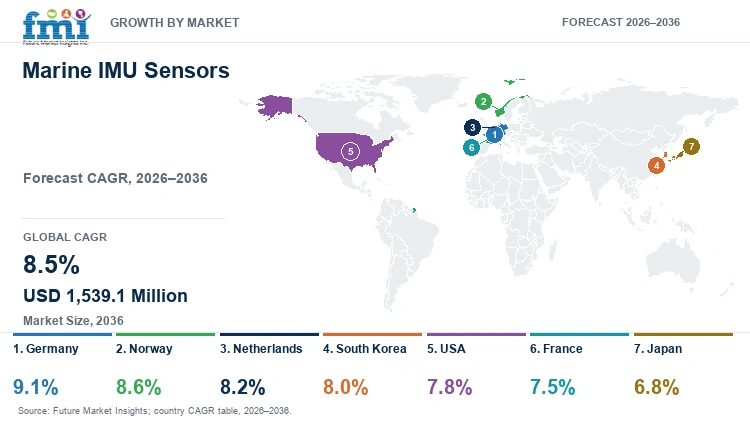
The seven profiled CAGRs form a narrow band from Germany at 9.1% to Japan at 6.8%. Germany and Norway sit above 8.5%, while the Netherlands and South Korea cluster near 8.0%. The USA and France follow before Japan, so growth rates change the pace of local investment without ranking absolute market size.
- Germany's marine engineering base supports earlier specification work for higher-grade inertial systems and control integration.
- Norway's offshore fleet concentrates demand in specialist survey and autonomy projects with project-level engineering support.
- Dutch waterway density shortens field feedback for compact survey platforms and motion-compensation integration teams.
- South Korea's shipbuilding scale favors early OEM design engagement before navigation electronics enter production schedules.
- US demand spans recreational electronics and federal surveying programs with different reliability and contracting requirements.
- France supports commercial marine electronics and high-specification government programs through a technically capable integration base.
- Japan's mature shipbuilding base favors deliberate design cycles and stable vendor relationships for inspected systems.
Growth rates alone do not identify the revenue scale or sensor grade that each national market can support. The full report provides country-level CAGR analysis across North America, Latin America, Western Europe, Eastern Europe, East Asia, South Asia and Pacific, and the Middle East and Africa.
Country-wise Analysis
- German marine integrators work inside a shipbuilding and hydrographic base that expects traceable calibration before inertial sensors enter vessel control systems. Germany's marine IMU sensor outlook is anticipated to advance at 9.1% CAGR over the assessment period, reflecting navigation-resilience work in interference-prone European waters. In January 2026, Germany's Federal Ministry of Transport warned that GNSS interference was growing in European waters and particularly the Baltic Sea. Local engineering depth supports complex integration, but smaller firms still face costly vessel alignment and sea trials before repeat service. Testing against degraded global positioning systems inputs requires documented inertial error behavior under actual vessel motion.
- US demand spans recreational autopilots and federal hydrography plus private uncrewed programs with different reliability thresholds. A broad service network gives integrators several routes for trials and replacement support. Marine IMU sensor demand in the USA is forecast to rise at 7.8% CAGR over the forecast period, underpinned by automated survey and control equipment. NOAA reported in May 2026 that its DriX vehicle would use supervised autonomy during Great Lakes surveys and could operate more than four days before routine servicing. Open sensor platforms and field diagnostics become decisive because prototype results must transfer into repeat deployments under different commercial and government operating requirements.
- Japanese shipbuilders are moving autonomy programs toward inspected commercial operation where system responsibilities must be documented before approval. Domestic engineering groups give sensor makers capable integration partners and disciplined test programs. Adoption of marine IMU sensors in Japan is estimated to expand at 6.8% CAGR through 2036, shaped by formal engineering review for autonomous vessels. Japan's transport ministry convened its fourth autonomous-ship study meeting in April 2025 to discuss safety standards and inspection methods. Approval work raises documentation effort and favors sensors with clear failure behavior plus long-term support through inspection and later vessel service.
- Norwegian offshore and survey operators use inertial equipment in northern missions where long service distances make field failures expensive. Norway's marine IMU sensor outlook is anticipated to advance at 8.6% CAGR over the assessment period, supported by maritime uncrewed systems serving demanding operations. The Ministry of Defence's December 2025 drone strategy prioritizes maritime uncrewed systems and calls for operation under challenging Nordic conditions. Local maritime engineering supports platform trials and specialist maintenance. Small project volumes still make spare availability important, so calibrated replacements and responsive technical support can protect survey schedules far from a service base.
- Dutch hydrographic teams use compact vessels in shallow waterways, so motion compensation must coexist with sonar and current profilers in limited space. Close access to specialist integrators shortens feedback during commissioning. Marine IMU sensor demand in the Netherlands is forecast to rise at 8.2% CAGR over the forecast period due to public-waterway automation and compact survey requirements. Rijkswaterstaat introduced REMO 1 in February 2026 as a fully electric USV for hydrographic and infrastructure work. Public operators still need synchronized inertial outputs before accepting the complete measurement chain. Compact marine microsensors gain an advantage only if timing data stays stable beside the vessel's survey payloads.
- South Korean shipyards tie autonomy adoption to vessel production schedules and formal commercialization rules. The South Korean marine IMU sensor sector is projected to record 8.0% CAGR during the assessment period due to autonomous-ship integration work. The Ministry of Oceans and Fisheries detailed the enforcement decree in January 2025 with procedures for performance verification and designated operating areas. Large shipbuilding programs give sensor makers direct access to OEM engineering teams. Approval evidence must reach system engineers early enough for inertial hardware to enter vessel-level verification packages before production milestones become difficult to change.
- French marine programs span commercial electronics and defense-grade control systems, so sensor makers face different qualification thresholds inside one national market. Naval engineering depth gives manufacturers access to capable integration partners. Marine IMU sensor sales in France are forecast to expand at 7.5% CAGR by 2036 due to investment in unmanned maritime control and navigation resilience. The Ministry for the Armed Forces reported in April 2025 that the French Navy tested an uncrewed surface vessel against a decommissioned target off Toulon. Long service lives raise support obligations because resilient PNT systems still need documentation and maintenance continuity for high-consequence platforms.
Who are the notable companies in the Marine IMU Sensors Market?
VectorNav Technologies, Advanced Navigation, Xsens / Movella, Honeywell, Bosch Sensortec, Analog Devices, STMicroelectronics, SBG Systems, and LORD MicroStrain are the notable companies profiled in this market.
Competition separates inertial-navigation specialists from diversified sensing groups and high-volume MEMS manufacturers serving different marine integration routes. Vessel programs test timing and vibration before accepting an IMU into operational control hardware.
- VectorNav Technologies and Advanced Navigation focus on integrated inertial navigation for marine control programs, while Xsens / Movella serves a similar OEM integration role.
- Honeywell and Bosch Sensortec span diversified sensing positions, while Analog Devices and STMicroelectronics contribute embedded inertial components through broader semiconductor portfolios.
- SBG Systems supplies dedicated marine navigation systems while exited the marine IMU market following its 2022 divestiture of marine navigation assets and is not profiled as an active participant in this report. LORD MicroStrain provides compact embedded navigation technology through the MicroStrain by HBK portfolio.
Competitive Benchmarking: Marine IMU Sensors Market
| Company | Marine Inertial Scope | Environmental Qualification Evidence | OEM Integration Support | Geographic Reach |
|---|---|---|---|---|
| VectorNav Technologies | High | High | High | Global |
| Advanced Navigation | High | High | High | Global |
| Xsens / Movella | Medium | Medium | High | Global |
| Honeywell | Medium | High | Medium | Global |
| Bosch Sensortec | Low | Low | High | Global |
| Analog Devices | Medium | Medium | High | Global |
| STMicroelectronics | Low | Low | High | Global |
| SBG Systems | High | High | High | Global |
| LORD MicroStrain | Medium | Medium | High | North America and international OEM programs |
Scoring basis: High marine inertial scope requires current navigation routes with direct integration support and documented market fit. Medium identifies narrower participation while Low marks adjacent or legacy scope with documented limitations. Environmental qualification evidence and OEM integration support use the same scale against ruggedization plus software and interface records.
Key Developments in the Marine IMU Sensors Market
- In July 2026, SBG Systems launched the Pulse-40 OEM IMU with vibration monitoring and a ±4000°/s gyroscope range. Its onboard diagnostics give marine stabilization engineers more evidence for qualification under fast vessel motion and sustained vibration.
- In June 2026, VectorNav Technologies added LEO satellite aiding to its VN-210E development kit for degraded GNSS conditions. The kit lets marine autonomy engineers test inertial continuity against an independent satellite-derived aiding source.
- In March 2026, Advanced Navigation announced USD 110 million in Series C funding for resilient PNT and autonomous systems. The funding expands engineering capacity for marine programs that need application support before production commitments are locked.
Key Players in the Marine IMU Sensors Market
Specialist Inertial Navigation Platforms
- VectorNav Technologies
- Advanced Navigation
- Xsens / Movella
Diversified and Embedded Sensing Platforms
- Honeywell
- Bosch Sensortec
- Analog Devices
- STMicroelectronics
Marine Specialists and Adjacent Positions
- SBG Systems
- LORD MicroStrain
Marine IMU Sensors Market - Report Scope
| Coverage field | Report scope |
|---|---|
| Market breakdown | By IMU grade, axis, application, vessel type, sales channel, and region. |
| Quantitative Units | USD million. |
| Market Definition | Commercial marine inertial measurement units, AHRS-class motion sensors, and integrated GNSS/INS devices used for vessel stabilization, navigation, positioning, survey motion compensation, and uncrewed control. |
| Regions Covered | North America, Latin America, Western Europe, Eastern Europe, East Asia, South Asia and Pacific, and Middle East and Africa. |
| Countries Covered | Germany, Norway, Netherlands, South Korea, USA, France, Japan, and 25+ countries included in the full report. |
| Key Companies Profiled | VectorNav Technologies, Advanced Navigation, Xsens / Movella, Honeywell, Bosch Sensortec, Analog Devices, STMicroelectronics, SBG Systems, LORD MicroStrain. |
| Forecast Period | 2026 to 2036. |
| Approach | Primary and secondary research with market triangulation. |
Marine IMU Sensors Market - Research Methodology
| Method | Approach |
|---|---|
| Primary Research | FMI analysts gathered input from manufacturers, service providers, technology developers, distributors, end users, procurement teams, and subject-matter experts. Interviews examined purchasing decisions, product or service evaluation, adoption barriers, approval requirements, pricing considerations, and expectations for technical or commercial support. Respondents were also asked what evidence is required before a trial, pilot, or initial order develops into regular purchasing. |
| Desk Research | Desk research covered government statistics, regulatory publications, trade data, industry associations, technical literature, standards, company filings, product information, and official corporate announcements. Sources were reviewed for relevance, publication date, geographic coverage, and consistency with the defined market scope. Claims relating to performance, applications, approvals, capacity, investment, and commercial activity were retained only when supported by credible public evidence. |
| Market Sizing and Forecasting | The market model combined the baseline value with historical performance, segment structure, pricing and volume indicators, adoption levels, company participation, and country-level demand conditions. Forecast assumptions considered economic activity, investment trends, regulatory developments, technology adoption, purchasing cycles, supply availability, and barriers to wider market use. Segment and regional estimates were reconciled before the final market total was calculated. |
| Data Validation | Estimates were checked against multiple independent indicators, including public data, company activity, trade patterns, industry developments, and findings from primary interviews. Validation also tested whether products, services, applications, and company revenues fell within the defined market boundaries. Adjacent categories, unsupported claims, overlapping revenues, and activities without direct market relevance were excluded to reduce double counting and maintain consistency across segments and countries. |
Marine IMU Sensors Market by Segments
Marine IMU Sensors Market segmented by IMU Grade:
- Consumer - recreational grade
- Industrial grade
- Tactical grade
- Navigation grade
- MEMS high-performance grade
Marine IMU Sensors Market segmented by Axis:
- 6-axis IMU
- 9-axis IMU
- 10-axis fused sensor
- GNSS/INS integrated
Marine IMU Sensors Market segmented by Application:
- Autopilot stabilization
- Navigation
- Dynamic positioning
- USV control
- Motion compensation
Marine IMU Sensors Market segmented by Vessel Type:
- Recreational boats
- Survey vessels
- USVs
- Workboats
- Ferries
Marine IMU Sensors Market segmented by Sales Channel:
- Sensor OEMs
- Navigation system integrators
- Autonomy platforms
- Marine electronics distributors
Marine IMU Sensors Market by Region:
- North America
- United States
- Canada
- Latin America
- Brazil
- Mexico
- Argentina
- Chile
- Western Europe
- Germany
- France
- United Kingdom
- Italy
- Spain
- Benelux
- Nordics
- Eastern Europe
- Poland
- Czech Republic
- Romania
- Hungary
- East Asia
- China
- Japan
- South Korea
- South Asia and Pacific
- India
- ASEAN
- Australia and New Zealand
- Middle East and Africa
- GCC Countries
- South Africa
- Türkiye
- Israel
Research Sources and Bibliography
- U.S. Navy. (2025, August 28). Small Unmanned Surface Vehicles (sUSV) Family of Systems (FoS).
- National Oceanic and Atmospheric Administration. (2025, June 23). NOAA leads the way with uncrewed systems.
- Raymarine. (2025, February 27). New Raymarine-Seakeeper integration lets boaters skip the wait.
- STMicroelectronics. (2025, May 13). STMicroelectronics combines activity tracking and high-impact sensing in miniature AI-enabled sensor for personal electronics and IoT.
- Garmin. (2025, January 16). Garmin introduces the APK 10 Autopilot Keypad for simplified control.
- Garmin. (2026, September 1). Garmin launches innovative SmartDrive autopilot for sailboats and catamarans.
- Xsens. (2025, July 1). Xsens releases new firmware and MT Software Suite (2025.2.0).
- International Maritime Organization. (2026, May 22). IMO adopts first global Code for autonomous ships.
- International Maritime Organization. (2025, March 25). Protect satellite navigation from interference, UN agencies urge.
- Advanced Navigation. (2025, October 21). Fortifying the frontline: Electronic Protection range for defense operations.
- Federal Ministry of Transport. (2026, January 26). Open Letter by the Coastal States of the Baltic Sea and the North Sea with Iceland.
- National Oceanic and Atmospheric Administration. (2026, May 6). NOAA Ship Thomas Jefferson returns to the Great Lakes.
- Ministry of Land, Infrastructure, Transport and Tourism. (2025, April 11).
- Norwegian Ministry of Defence. (2025, December 1). Drone Strategy for the Defence Sector.
- Rijkswaterstaat. (2026, February 24). A new survey vessel accelerates innovation and safety.
- Ministry of Oceans and Fisheries. (2025, January 10). Enactment of the Enforcement Decree of the Act on the Promotion of Development and Commercialization of Autonomous Ships.
- French Ministry for the Armed Forces. (2025, April 29). French Navy tests an offensive drone on a real target at sea.
- SBG Systems. (2026, July 8). Introducing Pulse-40 OEM IMU: high-performance & integrated vibration intelligence.
- VectorNav Technologies. (2026, June 2). VectorNav expands APNT capability with LEO satellite aiding for inertial navigation systems.
- Advanced Navigation. (2026, March 17). Advanced Navigation secures US$110M Series C to catalyze the next era of autonomous systems.
- VectorNav Technologies. (2025, April 30). NAL Research and VectorNav Technologies collaborate to develop a solution for GNSS/GPS-denied environments.
- Advanced Navigation. (2025, December 3). KONGSBERG taps Advanced Navigation in multi-million deal for major capability boost in precision pointing.
- Xsens. (2026, September 3). Xsens expands industrial navigation portfolio with Dual Antenna RTK GNSS/INS.
- Honeywell. (2025, May 20). Honeywell Expands Navigation Portfolio with New Single-Card Resilient Navigation System.
- SBG Systems. (2026, March 23). SBG Systems unveils Stellar-40, its tactical-grade resilient INS.
- VectorNav Technologies. (2025, June 24). VectorNav Technologies acquires new 100,000 sq ft facility.
- Advanced Navigation. (2025, September 9). Advanced Navigation expands across US and Europe to meet surging demand for PNT technology.
- Xsens. (2026, July 3). Xsens Avior (RTK) GNSS/INS brings high-performance OEM navigation to compact embedded systems.
- Honeywell. (2025, November 20). Honeywell achieves U.S. government authorization for M-Code military navigation solution.
- Bosch Sensortec. (2026, January 5). Bosch sensor platform turns robots into real movement talents.
- Analog Devices. (2026, July 8). IMU for Advanced Robotics: Unicycle Robot Balancing.
- STMicroelectronics. (2026, February 2). STMicroelectronics expands sensors capabilities with closing of acquisition of NXP’s MEMS business.
- SBG Systems. (2025, September 30). Introducing our new branch in Japan.
- Hottinger Brüel & Kjær. (2025, June). HBK shrinks tactical-grade navigation into a 15g powerhouse.
- Honeywell. (2026, March 9). Honeywell introduces new commercially available inertial measurement unit.
This Report Answers
- How large is the marine IMU sensors market by 2036?
- Why does vessel automation increase inertial demand?
- Which segments hold the stated 2026 shares?
- Why does autopilot stabilization hold its 2026 share?
- How does GNSS interference change IMU qualification?
- How do profiled country CAGRs compare through 2036?
- Which companies serve specialist and embedded inertial roles?
- What should engineers compare beyond IMU unit price?
Frequently Asked Questions
How big is the Marine IMU Sensors Market in 2026?
The marine IMU sensors market is valued at USD 680.7 million in 2026 and is projected to reach USD 1539.1 million by 2036. Continuous inertial inputs for stabilization and autonomous control support the forecast by moving IMUs deeper into vessel control loops.
What is the CAGR of the Marine IMU Sensors Market from 2026 to 2036?
The marine IMU sensors market is projected to grow at a CAGR of 8.5% between 2026 and 2036. Autonomous vessel control and navigation resilience during degraded GNSS operation account for the main expansion mechanisms.
Which IMU grade segment leads the Marine IMU Sensors Market?
The consumer - recreational grade segment is expected to hold 21.0% of the marine IMU sensors market in 2026, driven by compact MEMS economics. GNSS or magnetic aiding reduces navigation-grade drift requirements in recreational installations that already receive external navigation data.
Which axis segment holds the stated 2026 share in the Marine IMU Sensors Market?
The 6-axis IMU segment is expected to hold 29.0% of the marine IMU sensors market in 2026, supported by common stabilization requirements. Separate aiding lets marine integrators retain control over heading and position fusion elsewhere on the vessel.
Which countries are included in the country growth comparison for the Marine IMU Sensors Market?
Germany is projected to grow at 9.1% CAGR followed by Norway at 8.6% and the Netherlands at 8.2% through 2036. Navigation resilience and hydrographic automation impose different integration requirements within the profiled national comparison.
Which companies are active in the Marine IMU Sensors Market?
Key companies operating in the market include VectorNav Technologies, Advanced Navigation, Xsens / Movella, Honeywell, Bosch Sensortec, Analog Devices, STMicroelectronics, SBG Systems, KVH Industries, and LORD MicroStrain. Their roles span dedicated inertial navigation and embedded MEMS supply plus adjacent maritime participation through different integration routes.
Preview the report firsthand - request a free sample
Get SampleGet the brochure for pricing and purchase details.
Get PDFTable of Content
- Key Takeaways
- Market Size and CAGR
- Top Growth Driver
- Fastest Growing Segment
- Leading Region
- Key Companies
- Emerging Opportunities
- Executive Summary
- Global Market Outlook
- Demand-side Trends
- Supply-side Trends
- Technology Roadmap Analysis
- Analysis and Recommendations
- Analyst Perspective (What is happening? Why now? What should investors know?)
- Key Questions Answered
- How large is the market?
- What is the CAGR?
- What are key trends?
- Which region dominates?
- Who are the leaders?
- Market Overview
- Market Coverage / Taxonomy
- Market Definition / Scope / Limitations
- Research Methodology
- Chapter Orientation
- Analytical Lens and Working Hypotheses
- Market Structure, Signals, and Trend Drivers
- Benchmarking and Cross-market Comparability
- Market Sizing, Forecasting, and Opportunity Mapping
- Research Design and Evidence Framework
- Desk Research Programme (Secondary Evidence)
- Expert Input and Fieldwork (Primary Evidence)
- Tooling, Models, and Reference Databases
- Data Engineering and Model Build
- Quality Assurance and Audit Trail
- Market Background
- Market Dynamics (Drivers, Restraints, Opportunity, Trends)
- Scenario Forecast (Optimistic, Likely, Conservative)
- Impact Analysis
- AI Impact
- Sustainability Impact
- Regulatory Impact
- Technology Impact
- Consumer / Buyer Analysis
- Purchase Drivers
- Adoption Barriers
- Buyer Journey
- Opportunity Map Analysis
- Product Life Cycle Analysis
- Supply Chain Analysis
- Investment Feasibility Matrix
- Value Chain Analysis
- PESTLE and Porter's Analysis
- Regulatory Landscape
- Regional Parent Market Outlook
- Production and Consumption Statistics
- Import and Export Statistics
- Global Market Analysis and Forecast, 2021 to 2036
- Historical Market Size Value (USD Million) Analysis, 2021 to 2025
- Current and Future Market Size Value (USD Million) Projections, 2026 to 2036
- Y-o-Y Growth Trend Analysis
- Absolute $ Opportunity Analysis
- Global Market Pricing Analysis, 2021 to 2036
- Global Market Analysis and Forecast, By IMU Grade, 2021 to 2036
- Introduction / Key Findings
- Historical Market Size Value (USD Million) Analysis By IMU Grade, 2021 to 2025
- Current and Future Market Size Value (USD Million) Analysis and Forecast By IMU Grade, 2026 to 2036
- Consumer - recreational grade
- Industrial grade
- Tactical grade
- Navigation grade
- MEMS high-performance grade
- Y-o-Y Growth Trend Analysis By IMU Grade, 2021 to 2025
- Absolute $ Opportunity Analysis By IMU Grade, 2026 to 2036
- Global Market Analysis and Forecast, By Axis, 2021 to 2036
- Introduction / Key Findings
- Historical Market Size Value (USD Million) Analysis By Axis, 2021 to 2025
- Current and Future Market Size Value (USD Million) Analysis and Forecast By Axis, 2026 to 2036
- 6-axis IMU
- 9-axis IMU
- 10-axis fused sensor
- GNSS/INS integrated
- Y-o-Y Growth Trend Analysis By Axis, 2021 to 2025
- Absolute $ Opportunity Analysis By Axis, 2026 to 2036
- Global Market Analysis and Forecast, By Application, 2021 to 2036
- Introduction / Key Findings
- Historical Market Size Value (USD Million) Analysis By Application, 2021 to 2025
- Current and Future Market Size Value (USD Million) Analysis and Forecast By Application, 2026 to 2036
- Autopilot stabilization
- Navigation
- Dynamic positioning
- USV control
- Motion compensation
- Y-o-Y Growth Trend Analysis By Application, 2021 to 2025
- Absolute $ Opportunity Analysis By Application, 2026 to 2036
- Global Market Analysis and Forecast, By Vessel Type, 2021 to 2036
- Introduction / Key Findings
- Historical Market Size Value (USD Million) Analysis By Vessel Type, 2021 to 2025
- Current and Future Market Size Value (USD Million) Analysis and Forecast By Vessel Type, 2026 to 2036
- Recreational boats
- Survey vessels
- USVs
- Workboats
- Ferries
- Y-o-Y Growth Trend Analysis By Vessel Type, 2021 to 2025
- Absolute $ Opportunity Analysis By Vessel Type, 2026 to 2036
- Global Market Analysis and Forecast, By Sales Channel, 2021 to 2036
- Introduction / Key Findings
- Historical Market Size Value (USD Million) Analysis By Sales Channel, 2021 to 2025
- Current and Future Market Size Value (USD Million) Analysis and Forecast By Sales Channel, 2026 to 2036
- Sensor OEMs
- Navigation system integrators
- Autonomy platforms
- Marine electronics distributors
- Y-o-Y Growth Trend Analysis By Sales Channel, 2021 to 2025
- Absolute $ Opportunity Analysis By Sales Channel, 2026 to 2036
- Global Market Analysis and Forecast, By Region, 2021 to 2036
- Introduction
- Historical Market Size Value (USD Million) Analysis By Region, 2021 to 2025
- Current Market Size Value (USD Million) Analysis and Forecast By Region, 2026 to 2036
- North America
- Latin America
- Western Europe
- Eastern Europe
- East Asia
- South Asia and Pacific
- Middle East and Africa
- Market Attractiveness Analysis By Region
- North America Market Analysis and Forecast, By Country, 2021 to 2036
- Historical Market Size Value (USD Million) Trend Analysis By Market Taxonomy, 2021 to 2025
- Market Size Value (USD Million) Forecast By Market Taxonomy, 2026 to 2036
- By Country
- United States
- Canada
- By IMU Grade
- By Axis
- By Application
- By Vessel Type
- By Sales Channel
- By Country
- Market Attractiveness Analysis
- By Country
- By IMU Grade
- By Axis
- By Application
- By Vessel Type
- By Sales Channel
- Key Takeaways
- Latin America Market Analysis and Forecast, By Country
- Historical Market Size Value (USD Million) Trend Analysis By Market Taxonomy, 2021 to 2025
- Market Size Value (USD Million) Forecast By Market Taxonomy, 2026 to 2036
- By Country
- Brazil
- Mexico
- Argentina
- Chile
- By IMU Grade
- By Axis
- By Application
- By Vessel Type
- By Sales Channel
- By Country
- Market Attractiveness Analysis
- By Country
- By IMU Grade
- By Axis
- By Application
- By Vessel Type
- By Sales Channel
- Key Takeaways
- Western Europe Market Analysis and Forecast, By Country
- Historical Market Size Value (USD Million) Trend Analysis By Market Taxonomy, 2021 to 2025
- Market Size Value (USD Million) Forecast By Market Taxonomy, 2026 to 2036
- By Country
- Germany
- France
- United Kingdom
- Italy
- Spain
- Benelux
- Nordics
- By IMU Grade
- By Axis
- By Application
- By Vessel Type
- By Sales Channel
- By Country
- Market Attractiveness Analysis
- By Country
- By IMU Grade
- By Axis
- By Application
- By Vessel Type
- By Sales Channel
- Key Takeaways
- Eastern Europe Market Analysis and Forecast, By Country
- Historical Market Size Value (USD Million) Trend Analysis By Market Taxonomy, 2021 to 2025
- Market Size Value (USD Million) Forecast By Market Taxonomy, 2026 to 2036
- By Country
- Poland
- Czech Republic
- Romania
- Hungary
- By IMU Grade
- By Axis
- By Application
- By Vessel Type
- By Sales Channel
- By Country
- Market Attractiveness Analysis
- By Country
- By IMU Grade
- By Axis
- By Application
- By Vessel Type
- By Sales Channel
- Key Takeaways
- East Asia Market Analysis and Forecast, By Country
- Historical Market Size Value (USD Million) Trend Analysis By Market Taxonomy, 2021 to 2025
- Market Size Value (USD Million) Forecast By Market Taxonomy, 2026 to 2036
- By Country
- China
- Japan
- South Korea
- By IMU Grade
- By Axis
- By Application
- By Vessel Type
- By Sales Channel
- By Country
- Market Attractiveness Analysis
- By Country
- By IMU Grade
- By Axis
- By Application
- By Vessel Type
- By Sales Channel
- Key Takeaways
- South Asia and Pacific Market Analysis and Forecast, By Country
- Historical Market Size Value (USD Million) Trend Analysis By Market Taxonomy, 2021 to 2025
- Market Size Value (USD Million) Forecast By Market Taxonomy, 2026 to 2036
- By Country
- India
- ASEAN
- Australia and New Zealand
- By IMU Grade
- By Axis
- By Application
- By Vessel Type
- By Sales Channel
- By Country
- Market Attractiveness Analysis
- By Country
- By IMU Grade
- By Axis
- By Application
- By Vessel Type
- By Sales Channel
- Key Takeaways
- Middle East and Africa Market Analysis and Forecast, By Country
- Historical Market Size Value (USD Million) Trend Analysis By Market Taxonomy, 2021 to 2025
- Market Size Value (USD Million) Forecast By Market Taxonomy, 2026 to 2036
- By Country
- GCC Countries
- South Africa
- Türkiye
- Israel
- By IMU Grade
- By Axis
- By Application
- By Vessel Type
- By Sales Channel
- By Country
- Market Attractiveness Analysis
- By Country
- By IMU Grade
- By Axis
- By Application
- By Vessel Type
- By Sales Channel
- Key Takeaways
- Key Countries Market Analysis
- United States
- Pricing Analysis
- Market Share Analysis, 2025
- By IMU Grade
- By Axis
- By Application
- By Vessel Type
- By Sales Channel
- Canada
- Pricing Analysis
- Market Share Analysis, 2025
- By IMU Grade
- By Axis
- By Application
- By Vessel Type
- By Sales Channel
- Mexico
- Pricing Analysis
- Market Share Analysis, 2025
- By IMU Grade
- By Axis
- By Application
- By Vessel Type
- By Sales Channel
- Brazil
- Pricing Analysis
- Market Share Analysis, 2025
- By IMU Grade
- By Axis
- By Application
- By Vessel Type
- By Sales Channel
- Chile
- Pricing Analysis
- Market Share Analysis, 2025
- By IMU Grade
- By Axis
- By Application
- By Vessel Type
- By Sales Channel
- Germany
- Pricing Analysis
- Market Share Analysis, 2025
- By IMU Grade
- By Axis
- By Application
- By Vessel Type
- By Sales Channel
- United Kingdom
- Pricing Analysis
- Market Share Analysis, 2025
- By IMU Grade
- By Axis
- By Application
- By Vessel Type
- By Sales Channel
- Italy
- Pricing Analysis
- Market Share Analysis, 2025
- By IMU Grade
- By Axis
- By Application
- By Vessel Type
- By Sales Channel
- Spain
- Pricing Analysis
- Market Share Analysis, 2025
- By IMU Grade
- By Axis
- By Application
- By Vessel Type
- By Sales Channel
- France
- Pricing Analysis
- Market Share Analysis, 2025
- By IMU Grade
- By Axis
- By Application
- By Vessel Type
- By Sales Channel
- India
- Pricing Analysis
- Market Share Analysis, 2025
- By IMU Grade
- By Axis
- By Application
- By Vessel Type
- By Sales Channel
- ASEAN
- Pricing Analysis
- Market Share Analysis, 2025
- By IMU Grade
- By Axis
- By Application
- By Vessel Type
- By Sales Channel
- Australia and New Zealand
- Pricing Analysis
- Market Share Analysis, 2025
- By IMU Grade
- By Axis
- By Application
- By Vessel Type
- By Sales Channel
- China
- Pricing Analysis
- Market Share Analysis, 2025
- By IMU Grade
- By Axis
- By Application
- By Vessel Type
- By Sales Channel
- Japan
- Pricing Analysis
- Market Share Analysis, 2025
- By IMU Grade
- By Axis
- By Application
- By Vessel Type
- By Sales Channel
- South Korea
- Pricing Analysis
- Market Share Analysis, 2025
- By IMU Grade
- By Axis
- By Application
- By Vessel Type
- By Sales Channel
- Poland
- Pricing Analysis
- Market Share Analysis, 2025
- By IMU Grade
- By Axis
- By Application
- By Vessel Type
- By Sales Channel
- Hungary
- Pricing Analysis
- Market Share Analysis, 2025
- By IMU Grade
- By Axis
- By Application
- By Vessel Type
- By Sales Channel
- Türkiye
- Pricing Analysis
- Market Share Analysis, 2025
- By IMU Grade
- By Axis
- By Application
- By Vessel Type
- By Sales Channel
- South Africa
- Pricing Analysis
- Market Share Analysis, 2025
- By IMU Grade
- By Axis
- By Application
- By Vessel Type
- By Sales Channel
- Norway
- Pricing Analysis
- Market Share Analysis, 2025
- By IMU Grade
- By Axis
- By Application
- By Vessel Type
- By Sales Channel
- Netherlands
- Pricing Analysis
- Market Share Analysis, 2025
- By IMU Grade
- By Axis
- By Application
- By Vessel Type
- By Sales Channel
- United States
- Market Structure Analysis
- Competition Dashboard
- Competition Benchmarking
- Market Share Analysis of Top Players
- By Regional
- By IMU Grade
- By Axis
- By Application
- By Vessel Type
- By Sales Channel
- Emerging Startups
- Innovation Benchmarking
- Competition Analysis
- Competition Deep Dive
- VectorNav Technologies
- Overview
- Product Portfolio
- Profitability by Market Segments
- Sales Footprint
- Strategy Overview
- Marketing Strategy
- Product Strategy
- Channel Strategy
- Advanced Navigation
- Xsens / Movella
- Honeywell
- Bosch Sensortec
- Analog Devices
- STMicroelectronics
- SBG Systems
- LORD MicroStrain
- VectorNav Technologies
- Case Studies
- Success Stories
- Recent Developments
- Competition Deep Dive
- Assumptions & Acronyms Used


