

- Market Size (2026)
- USD 720.6 Mn
- Forecast (2036)
- USD 1340.0 Mn
- CAGR (2026 to 2036)
- 6.4%
How big is Marine Pressure Sensors Market in 2026?
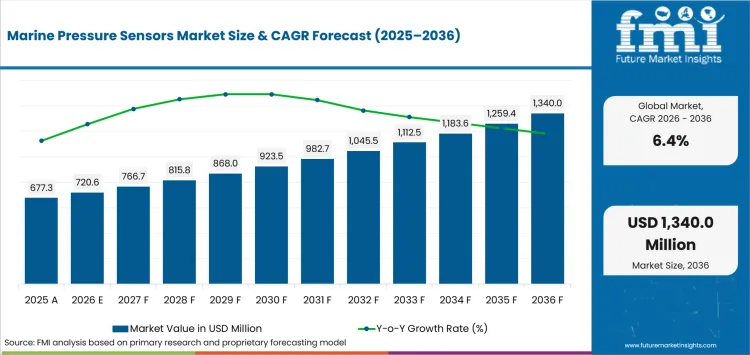
USD 720.6 million in 2026 and USD 1340.0 million by 2036 at a 6.4% CAGR.
Demand for marine pressure sensors is projected to expand at a 6.4% CAGR between 2026 and 2036, increasing valuation from USD 720.6 million to USD 1340.0 million. Shipyards specify pressure points during design while fleet engineers replace failed devices during maintenance windows. DNV documented in June 2025 that machinery failure represented 60% of casualty incidents during 2024. Qualified marine electronics provide machinery condition data without forcing changes to approved vessel interfaces during scheduled maintenance.
Newbuild programs lock many pressure-sensor requirements into approved drawings before each vessel enters service. IMO identified 51 safety-regulatory gaps and barriers for alternative fuels and new technologies at MSC 110 in June 2025. New fuel and treatment architectures can change materials plus pressure ranges and hazardous-area requirements onboard. Qualified sensing within new marine vessels must be resolved before late-stage construction narrows component substitution.
Key Takeaways of Marine Pressure Sensors Market
- New-vessel specification and installed-fleet replacement generate marine pressure sensor purchases where machinery condition determines maintenance decisions.
- By sensor type, gauge pressure sensors are estimated to hold 31.0% in 2026 owing to common atmospheric-reference machinery measurements.
- By pressure range, below 10 bar is forecast to represent 24.0% in 2026 due to stable low-pressure response requirements.
- In 2026, engine systems are expected to lead application with 26.0% share because propulsion packages contain repeated pressure points.
- Marine qualification slows switching because media compatibility and electrical fit must match shock plus vibration and class requirements.
- Key players in the marine pressure sensors market include WIKA, TE Connectivity, KELLER Pressure, Danfoss, Honeywell Technologies, Sensata Technologies, ifm electronic, BD|SENSORS, Parker Hannifin, and Emerson.
Analyst Perspective
"Marine pressure sensor selection starts with vessel approval and installed-interface fit before small accuracy differences affect the commercial choice. Replacement economics deteriorate quickly if a lower-priced device forces new wiring or another approval cycle during a planned refit."
- Nikhil Kaitwade, Principal Consultant, Future Market Insights
How is the Marine Pressure Sensors Market segmented?
The marine pressure sensors market is segmented by sensor type, pressure range, application, vessel type, sales channel, and region.
Sensor types include gauge, absolute, differential, submersible, and ruggedized formats while pressure ranges extend from below 10 bar to above 500 bar. Applications cover engines, hydraulics, ballast - bilge, fuel systems, and depth - level monitoring. Vessel types include commercial vessels, workboats, yachts, fishing vessels, and offshore vessels while sales channels cover sensor OEMs, marine engine OEMs, industrial distributors, and MRO - replacement channels.
Why do gauge pressure sensors hold the sensor type position?
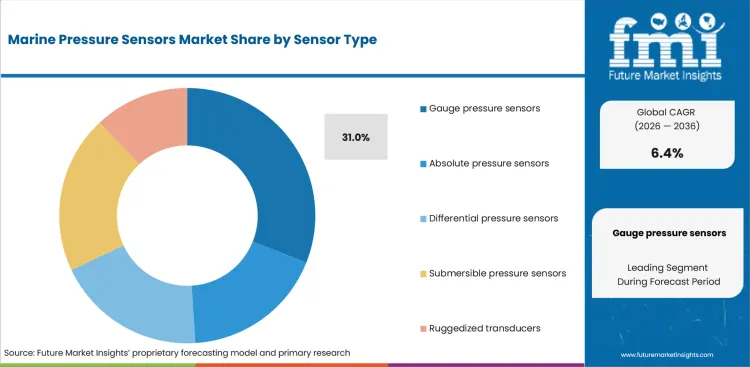
Gauge sensors fit machinery duties that reference pressure to local atmosphere during oil-circuit and hydraulic monitoring. At Nor-Shipping in June 2025 ifm electronic presented ship-automation pressure sensors and pressure transmitters. The presentation tied pressure measurement to vessel automation packages where vibration resistance and signal compatibility influence specification.
- By sensor type, gauge pressure sensors are estimated to hold 31.0% in 2026 owing to common atmospheric-reference machinery measurements.
- Ship integrators can reuse familiar gauge conventions at several machinery points and reduce interpretation changes during later replacement work.
Why does below 10 bar hold the pressure range position?
Tank head and filter-condition duties depend on small pressure changes that higher ranges can mask during routine monitoring. In March 2026 BD|SENSORS introduced the digital DCL 531i submersible probe for high-precision pressure-based level sensors applications. The launch illustrates the sensitivity requirement behind hydrostatic tank measurement and similar low-pressure vessel duties.
- In 2026, below 10 bar is expected to lead pressure range with 24.0% share because tank and auxiliary duties need stable low-pressure response.
- Lower ranges preserve sensitivity to gradual tank or filter changes without overspecifying span beyond the actual operating requirement.
Why do engine systems hold the application position?
Propulsion packages use pressure feedback in lubricating oil plus fuel and cooling circuits throughout routine engine operation. Danfoss presented marine pressure and temperature sensing at KORMARINE in October 2025 for harsh vessel environments. The event kept pressure monitoring close to marine propulsion engines where stable signals support machinery control and fault diagnosis.
- By application, engine systems are forecast to represent 26.0% in 2026 driven by repeated pressure points within propulsion and auxiliary machinery.
- Engine-room replacements favor devices whose media compatibility and electrical signals match installed controls without reopening the machinery integration package.
Why do commercial vessels hold the vessel type position?
Commercial vessels operate propulsion plus fuel and ballast equipment through long duty cycles that accumulate many pressure measurement points. UN Trade and Development counted 112,500 vessels in the global seaborne fleet as of January 1 2025 in its September 2025 review. Fleet operators increasingly pair pressure data with marine IMU sensors while drydock timing limits redesign work during replacement.
- Commercial vessels are set to lead vessel type with 27.0% share in 2026 due to operating intensity and repeated machinery measurement points.
- Fleet operators favor repeatable spares and documentation because one approved sensor family may require support through several maintenance cycles.
Why do sensor OEMs hold the sales channel position?
Sensor manufacturers control drawings plus calibration data and approval records needed before pressure devices enter engineered vessel packages. Broader sensors portfolios carry more weight when the original manufacturer can document the exact device and service environment.
- Sensor OEMs are projected to hold 35.0% share in 2026 owing to documentation and application support during design-in and replacement decisions.
- Industrial distributors remain important for availability while the original manufacturer usually carries the technical record needed to resolve qualification questions quickly.
What are the drivers, restraints and opportunities in the Marine Pressure Sensors Market?
Fleet renewal and machinery reliability increase measurement demand while qualification slows substitution and alternative-fuel systems introduce new pressure-sensing duties.
- Driver: Shipbuilding orderbooks and installed-fleet maintenance sustain design-in demand plus replacement purchases for qualified marine pressure devices.
- Restraint: Environmental and hazardous-area requirements can extend approval work even if two sensors share the same nominal pressure range.
- Opportunity: Alternative-fuel systems introduce new storage and transfer duties that require compatible pressure measurement plus safety documentation.
Shipbuilders add pressure points as propulsion and auxiliary systems become more instrumented during new vessel construction. OECD documented a 169 million CGT global shipbuilding orderbook in 2025 equal to 16% of the existing fleet. The orderbook gives sensor manufacturers a visible design-in pipeline and expands Condition monitoring systems installed beside new machinery packages.
Replacement becomes expensive if a substitute device changes environmental evidence already accepted by the shipyard. KELLER Pressure released ATEX Zone 2 transmitter variants in February 2026 for potentially explosive gas atmospheres. Vessel service can also require shock and vibration testing plus ingress and class documentation before a substitute sensor is approved.
Ammonia-fuel systems add pressure-monitoring duties because storage and transfer arrangements place toxic fuel under controlled operating conditions. IMO Circular MSC.1/Circ.1687 dated February 2025 requires fuel-pressure monitoring within ammonia-fuel systems. Manufacturers with corrosion-resistant pressure designs can address these fuel-transfer duties and adjacent ballast water treatment systems once material evidence matches each service.
Which country CAGRs are profiled in the Marine Pressure Sensors Market?
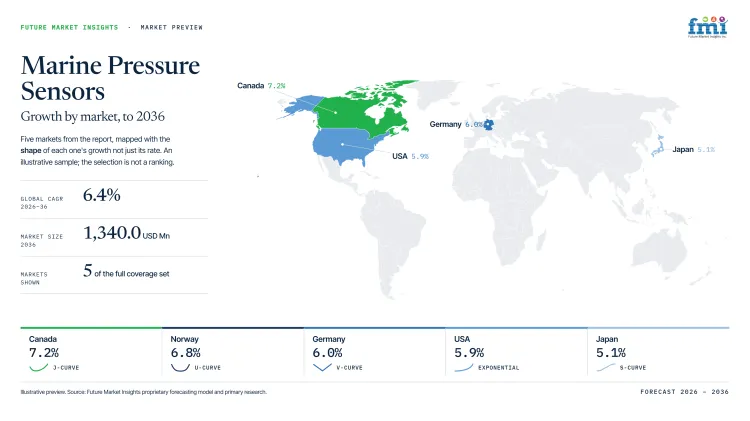
| Country | CAGR |
|---|---|
| Canada | 7.2% |
| Norway | 6.8% |
| Australia | 6.5% |
| Brazil | 6.3% |
| Germany | 6.0% |
| USA | 5.9% |
| Japan | 5.1% |
How do country-level CAGRs compare in the Marine Pressure Sensors Market?
The forecasts form a compact middle band despite a 2.1 percentage-point spread between Canada and Japan. Norway and Australia remain close to Canada while Brazil sits above Germany and the USA. The narrow spacing means fleet composition and channel structure matter before CAGR is treated as a measure of revenue potential.
- Canada links coastal public-service fleets with shipyard demand for cold-weather instrumentation and long-term support.
- Norway's offshore operating profile keeps corrosion resistance and fuel-system measurement central during equipment selection.
- Australia's dispersed coastal routes make distributor coverage and stocked replacements important for vessel uptime.
- Brazil's offshore program pipeline ties sensor specification closely to shipyard schedules and vessel commissioning.
- Germany's maritime equipment cluster gives retrofit projects engineering support for older commercial vessel systems.
- USA shipyard fragmentation favors cross-reference capability because replacement specifications vary between independent repair facilities.
- Japan's integrated shipbuilding model places interface discipline ahead of quick supplier substitution during design.
Country-wise Analysis
- Canadian public fleets are renewing small vessels through domestic shipyards that must support long operating lives in difficult coastal conditions. Marine pressure sensor demand in Canada is forecast to rise at 7.2% CAGR through 2036, supported by fleet renewal and maintenance work. In August 2026, the Canadian Coast Guard confirmed delivery of all 20 Bay Class search-and-rescue lifeboats under the National Shipbuilding Strategy. Domestic construction gives manufacturers direct engineering access while government documentation and cold-weather service can lengthen qualification. Manufacturers that preserve approved configurations and replacement availability can reduce engineering work during later fleet maintenance cycles and cold-season refit programs.
- USA marine pressure sensor purchases pass through independent shipyards and repair facilities that maintain many legacy vessel interfaces in regional fleets. MARAD selected 17 Small Shipyard Grant recipients in 12 states during July 2025 for infrastructure and technology improvements at domestic yards. The USA is projected to record 5.9% CAGR during the assessment period, supported by repair activity and yard modernization. Distributor access is broad while interface differences can complicate like-for-like replacement during urgent drydock work. Manufacturers with cross-reference data and short MRO lead times can win replacement work without forcing yards to redesign existing measurement points during scheduled vessel refits.
- Japanese shipbuilders resolve equipment interfaces early to protect disciplined integration and long supplier relationships during vessel design. MLIT launched Japan-USA joint research on AI shipbuilding technologies in July 2026 covering robotics and simulation platforms. Digital production tools can improve design coordination while component changes still require careful control inside tightly specified vessel systems. Marine pressure sensor demand in Japan is forecast to expand at 5.1% CAGR over the forecast period, supported by advanced shipbuilding engineering. Pressure-sensor manufacturers need complete technical data and local application support before automated workflows can shorten design cycles without reopening approved interfaces during production planning.
- Norwegian operators run offshore vessels and fuel-transfer systems that expose instrumentation to vibration and corrosive media during long operating seasons. Norway is anticipated to advance at 6.8% CAGR through 2036, driven by safety-focused maintenance and offshore vessel requirements. The Norwegian Maritime Authority documented fuel-transfer spills in June 2025 that included excessive tank pressure and possible gauge faults. Strong maritime engineering supports local service access while marine qualification narrows the devices accepted for onboard use. Sensors for hydraulic pumps and fuel circuits need stable low-pressure response plus documentation maintenance teams can use during planned offshore service in remote coastal ports.
- German fleet owners can source instrumentation from a mature maritime supply base while older merchant ships continue generating replacement work. The Federal Ministry of Transport reported in August 2025 that German owners held 1,675 merchant ships above 100 gross tonnage at the end of 2024. Germany is forecast to grow at 6.0% CAGR from 2026 to 2036, supported by its installed commercial fleet and marine engineering base. Retrofit access is broad while international safety requirements increase documentation work for fleet owners during refits. Standard interfaces and serviceable product families reduce re-engineering during planned vessel modernization and scheduled refit programs.
- Brazilian marine equipment demand follows offshore investment programs that feed domestic shipbuilding and later maintenance requirements for working vessels. In March 2026 the Ministry of Ports and Airports reported 612 vessel-construction projects within the national Merchant Marine Fund portfolio. Domestic yards provide a specification route while long offshore service distances can complicate replacement support following commissioning. Marine pressure sensor sales in Brazil are predicted to advance at 6.3% CAGR through 2036, supported by vessel construction and offshore activity. Manufacturers with local engineering relationships and service coverage can compete for initial fit plus later maintenance orders on vessels operating nationwide.
- Australian domestic commercial vessels operate over long coastlines that make maintenance planning and service reach important parts of equipment selection. Australia is estimated to post 6.5% CAGR over the forecast period, supported by formal vessel-safety management requirements. AMSA introduced new safety management system requirements for all domestic commercial vessels on June 1 2025 including updated maintenance obligations. National rules keep maintenance records visible while distance between service centers can extend replacement lead times. Regional distributors that stock common configurations can reduce downtime without asking operators to change established control interfaces during scheduled vessel service in remote coastal ports.
Who are the notable companies in the Marine Pressure Sensors Market?
WIKA, TE Connectivity, KELLER Pressure, Danfoss, Honeywell Technologies, Sensata Technologies, ifm electronic, BD|SENSORS, Parker Hannifin, and Emerson are notable companies serving this market.
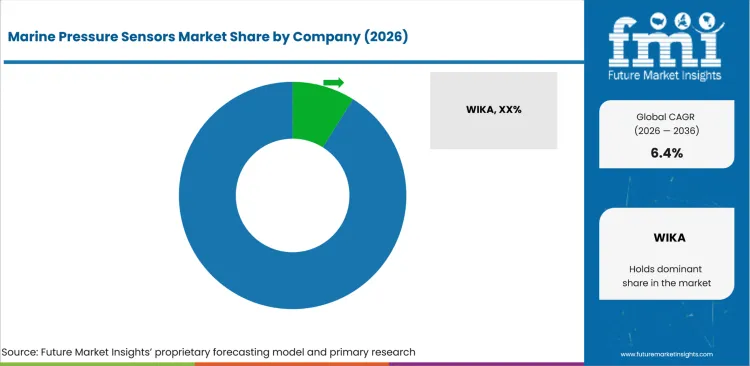
Competition divides between pressure specialists plus diversified sensor manufacturers and automation groups that place pressure measurement inside larger vessel systems. Marine approvals and long-term support for installed interfaces raise entry barriers because company scale alone does not determine specification fit.
- WIKA, KELLER Pressure, Danfoss, ifm electronic, and BD|SENSORS concentrate on pressure or level instrumentation with documented marine or harsh-service applications.
- TE Connectivity, Honeywell Technologies, and Sensata Technologies contribute sensor-platform scale plus OEM engineering resources that extend beyond marine applications.
- Parker Hannifin and Emerson participate through pressure measurement plus hydraulic and process-control technologies used in demanding fluid systems.
Competitive Benchmarking: Marine Pressure Sensors Market
| Company | Marine Qualification Coverage | Pressure Portfolio Breadth | Vessel-System Integration Support | Geographic Reach |
|---|---|---|---|---|
| WIKA | Medium | High | Medium | Global |
| TE Connectivity | Medium | High | Medium | Global OEM channels |
| KELLER Pressure | Medium | High | High | Europe and international |
| Danfoss | High | High | High | Global marine channels |
| Honeywell Technologies | High | High | High | Global |
| Sensata Technologies | Medium | High | Medium | Americas, Europe and Asia-Pacific |
| ifm electronic | High | High | High | Global automation channels |
| BD|SENSORS | Medium | High | Medium | Europe and international |
| Parker Hannifin | Medium | High | High | Global |
| Emerson | High | High | High | Global |
Key Developments in the Marine Pressure Sensors Market
- In March 2026, WIKA added Ex approvals to the LS-1000 submersible pressure sensor for hazardous liquid measurement. The approval extends a pressure-based level device into duties where explosion protection forms part of qualification.
- In July 2025, KELLER Pressure introduced the 25SXio front-flushed pressure transmitter with IO-Link and automatic parameter restoration. Faster parameter recovery can reduce service time once the selected configuration has passed vessel qualification.
Key Players in the Marine Pressure Sensors Market
Marine Pressure and Level Instrumentation
- WIKA
- KELLER Pressure
- Danfoss
- ifm electronic
- BD|SENSORS
Broad Sensor and OEM Platforms
- TE Connectivity
- Honeywell Technologies
- Sensata Technologies
Fluid-System and Automation Platforms
- Parker Hannifin
- Emerson
Marine Pressure Sensors Market - Report Scope
| Coverage field | Report scope |
|---|---|
| Market breakdown | By sensor type, pressure range, application, vessel type, sales channel and region. |
| Quantitative Units | Revenue in USD million and CAGR in %. |
| Market Definition | Revenue includes marine pressure sensors, pressure transmitters, pressure transducers and submersible or hydrostatic pressure-sensing devices sold for vessel applications within the stated segmentation. It excludes downstream finished-vessel revenue and adjacent sensing categories outside pressure measurement. |
| Regions Covered | North America; Latin America; Western Europe; Eastern Europe; East Asia; South Asia and Pacific; Middle East and Africa. |
| Countries Covered | Canada; Norway; Australia; Brazil; Germany; USA; Japan; and 20+ countries included in the full report. |
| Key Companies Profiled | WIKA; TE Connectivity; KELLER Pressure; Danfoss; Honeywell Technologies; Sensata Technologies; ifm electronic; BD|SENSORS; Parker Hannifin; Emerson. |
| Forecast Period | 2026 to 2036. |
| Approach | Primary and secondary research with market triangulation. |
Marine Pressure Sensors Market - Research Methodology
| Method | Approach |
|---|---|
| Primary Research | FMI analysts gathered input from manufacturers, service providers, technology developers, distributors, end users, procurement teams, and subject-matter experts. Interviews examined purchasing decisions, product or service evaluation, adoption barriers, approval requirements, pricing considerations, and expectations for technical or commercial support. Respondents were also asked what evidence is required before a trial, pilot, or initial order develops into regular purchasing. |
| Desk Research | Desk research covered government statistics, regulatory publications, trade data, industry associations, technical literature, standards, company filings, product information, and official corporate announcements. Sources were reviewed for relevance, publication date, geographic coverage, and consistency with the defined market scope. Claims relating to performance, applications, approvals, capacity, investment, and commercial activity were retained only when supported by credible public evidence. |
| Market Sizing and Forecasting | The market model combined the baseline value with historical performance, segment structure, pricing and volume indicators, adoption levels, company participation, and country-level demand conditions. Forecast assumptions considered economic activity, investment trends, regulatory developments, technology adoption, purchasing cycles, supply availability, and barriers to wider market use. Segment and regional estimates were reconciled before the final market total was calculated. |
| Data Validation | Estimates were checked against multiple independent indicators, including public data, company activity, trade patterns, industry developments, and findings from primary interviews. Validation also tested whether products, services, applications, and company revenues fell within the defined market boundaries. Adjacent categories, unsupported claims, overlapping revenues, and activities without direct market relevance were excluded to reduce double counting and maintain consistency across segments and countries. |
Marine Pressure Sensors Market by Segments
Marine Pressure Sensors Market segmented by Sensor Type:
- Gauge pressure sensors
- Absolute pressure sensors
- Differential pressure sensors
- Submersible pressure sensors
- Ruggedized transducers
Marine Pressure Sensors Market segmented by Pressure Range:
- Below 10 bar
- 10-100 bar
- 100-500 bar
- Above 500 bar
Marine Pressure Sensors Market segmented by Application:
- Engine systems
- Hydraulics
- Ballast - bilge
- Fuel systems
- Depth - level monitoring
Marine Pressure Sensors Market segmented by Vessel Type:
- Commercial vessels
- Workboats
- Yachts
- Fishing vessels
- Offshore vessels
Marine Pressure Sensors Market segmented by Sales Channel:
- Sensor OEMs
- Marine engine OEMs
- Industrial distributors
- MRO - replacement
Marine Pressure Sensors Market by Region:
- North America
- United States
- Canada
- Latin America
- Brazil
- Mexico
- Argentina
- Chile
- Western Europe
- Germany
- France
- United Kingdom
- Italy
- Spain
- Benelux
- Nordics
- Eastern Europe
- Poland
- Czech Republic
- Romania
- Hungary
- East Asia
- China
- Japan
- South Korea
- South Asia and Pacific
- India
- ASEAN
- Australia and New Zealand
- Middle East and Africa
- GCC Countries
- South Africa
- Türkiye
- Israel
Research Sources and Bibliography
- DNV. (2025, June 3). Ageing fleet drives surge in maritime incidents.
- International Maritime Organization. (2025, June 27). Maritime Safety Committee - 110th session (MSC 110), 18-27 June 2025.
- ifm electronic. (2025, June 3-6). Nor-Shipping 2025.
- BD|SENSORS. (2026, March 12). With the DCL 531i, BD|SENSORS is extending its range of submersible probes with a high-precision version featuring a digital interface.
- Danfoss. (2025, October 21-24). KORMARINE 2025.
- UN Trade and Development. (2025, September 24). Review of Maritime Transport 2025: Staying the course in turbulent waters.
- KELLER Pressure. (2025, February 6). KELLER 20SX - Pressure Transmitter Heads for OEM Applications.
- OECD. (2026). Shipbuilding.
- KELLER Pressure. (2026, February 25). KELLER Pressure Transmitter With ATEX Approval for Zone 2 (3G/Ex ec).
- International Maritime Organization. (2025, February 26). Interim Guidelines for Safety of Ships Using Ammonia as Fuel (MSC.1/Circ.1687).
- Canadian Coast Guard. (2026, August 13). Canadian Coast Guard officially welcomes CCGS Mira Bay into service in Sydney.
- USA Maritime Administration. (2025, July 21). President Trump’s Transportation Secretary Sean P. Duffy Announces $8.75 Million in Grants to Revitalize USA Shipyards, Support Maritime Dominance.
- Ministry of Land, Infrastructure, Transport and Tourism. (2026, July 17). Japan-USA Joint R&D on AI Shipbuilding Technologies Launches.
- Norwegian Maritime Authority. (2025, June 25). Discharges during bunkering and internal transfer of fuel.
- Federal Ministry of Transport. (2025, August 6). Schifffahrtsstandort Deutschland.
- Ministry of Ports and Airports. (2026, March 24). Fundo da Marinha Mercante alcança carteira recorde de projetos e amplia investimentos na indústria naval.
- Australian Maritime Safety Authority. (2025, May 30). New safety management system requirements now in effect.
- WIKA. (2026, March 11). Submersible pressure sensor LS-1000 from WIKA now with Ex approvals.
- Emerson. (2025, October 23). Emerson’s New Pressure Transmitter Delivers Increased Performance, Flexibility and Operational Insights.
- KELLER Pressure. (2025, July 22). KELLER 25SXio - High-Precision, Front-Flushed Pressure Transmitters With IO-Link Interface.
- Sensata Technologies. (2026, September 2). Sensata Technologies Launches R290 Pressure + Temperature Sensor to Enable Adoption of Low-GWP and PFAS-free Refrigerants in EV Thermal Management Systems.
- Honeywell. (2025, September 29). Honeywell’s New Sensing Technology Strengthens Semiconductor Manufacturing Processes.
- BD|SENSORS. (2026, June 18). BD|SENSORS expands its USA presence with dedicated subsidiary.
- Sensata Technologies. (2025, December 3). Product Notification: Country of Origin Change for Sensata Pressure Sensor Components PCN-251203-OFM-COO.
- ifm electronic. (2025, July 24). ifm prover USA opens new Manufacturing and Technology Center in PA.
- WIKA. (2025, August 28). New subsidiary: SINI is now part of the WIKA Group.
- TE Connectivity. (2025, June 18). TE Connectivity unveils MULTIGIG Transceiver (TRX) platform for improved data transmission.
- KELLER Pressure. (2025, May 20). KELLER 21C - Piezoresistive Pressure Transmitters in a Compact Design.
- Danfoss. (2025, December 16). DST P070 pressure sensor - a compact, reliable solution for the HVAC industry.
- Honeywell. (2025, June 9). Honeywell Completes Acquisition of Sundyne to Expand Process Industry Capabilities.
- Honeywell Technologies. (2026, June 29). Honeywell Technologies Launches As Independent, Pure-Play Automation Company Following Completion of Honeywell Aerospace Spin-Off.
- Sensata Technologies. (2025, June 25). Sensata Technologies opens new R&D facility in Newtownabbey.
- BD|SENSORS. (2026, March 4). Annual review of 2025 - Preview of the 2026 fiscal year.
- Parker Hannifin. (2025, April). Parker SensoControl launches the SCP09 pressure sensor with special OEM pin configuration.
- Emerson. (2025, November). Rosemount 4051S Pressure Transmitter.
This bibliography is provided for reader reference and is not exhaustive. The full report contains the complete reference list and detailed citations.
This Report Answers
- What are the market values in 2026 and 2036?
- What sustains newbuild and replacement purchases?
- Why do gauge pressure sensors hold 31.0%?
- Why does below 10 bar hold 24.0%?
- Why do engine systems represent 26.0%?
- How do the seven country CAGRs compare?
- Which companies supply marine pressure sensing?
- How does qualification affect supplier switching?
Frequently Asked Questions
How big is the Marine Pressure Sensors Market in 2026?
The marine pressure sensors market is valued at USD 720.6 million in 2026 and is projected to reach USD 1340.0 million by 2036. Installed-fleet replacement and new-vessel specification keep pressure measurement tied to repeated maintenance and engineering work.
What is the CAGR of the Marine Pressure Sensors Market from 2026 to 2036?
The marine pressure sensors market is projected to grow at a CAGR of 6.4% between 2026 and 2036. Machinery reliability work and vessel renewal sustain repeat purchases while new systems require additional qualified measurement points.
Which sensor type leads the Marine Pressure Sensors Market?
The gauge pressure sensors segment is expected to hold 31.0% of the marine pressure sensors market in 2026, supported by common atmospheric-reference measurements. Engine and hydraulic duties use the same measurement convention at several machinery points within one vessel.
Which pressure range holds the stated 24.0% share in the Marine Pressure Sensors Market?
The below 10 bar segment is expected to hold 24.0% of the marine pressure sensors market in 2026, attributable to tank and auxiliary measurement duties. Small pressure changes can indicate tank level or filter condition where wider spans would reduce useful sensitivity.
Which companies are active in the Marine Pressure Sensors Market?
Key companies operating in the marine pressure sensors market include WIKA, TE Connectivity, KELLER Pressure, Danfoss, Honeywell Technologies, Sensata Technologies, ifm electronic, BD|SENSORS, Parker Hannifin, and Emerson. Selection depends on qualification evidence plus pressure coverage and integration support during vessel maintenance.
Preview the report firsthand - request a free sample
Get SampleGet the brochure for pricing and purchase details.
Get PDFTable of Content
- Key Takeaways
- Market Size and CAGR
- Top Growth Driver
- Fastest Growing Segment
- Leading Region
- Key Companies
- Emerging Opportunities
- Executive Summary
- Global Market Outlook
- Demand-side Trends
- Supply-side Trends
- Technology Roadmap Analysis
- Analysis and Recommendations
- Analyst Perspective (What is happening? Why now? What should investors know?)
- Key Questions Answered
- How large is the market?
- What is the CAGR?
- What are key trends?
- Which region dominates?
- Who are the leaders?
- Market Overview
- Market Coverage / Taxonomy
- Market Definition / Scope / Limitations
- Research Methodology
- Chapter Orientation
- Analytical Lens and Working Hypotheses
- Market Structure, Signals, and Trend Drivers
- Benchmarking and Cross-market Comparability
- Market Sizing, Forecasting, and Opportunity Mapping
- Research Design and Evidence Framework
- Desk Research Programme (Secondary Evidence)
- Expert Input and Fieldwork (Primary Evidence)
- Tooling, Models, and Reference Databases
- Data Engineering and Model Build
- Quality Assurance and Audit Trail
- Market Background
- Market Dynamics (Drivers, Restraints, Opportunity, Trends)
- Scenario Forecast (Optimistic, Likely, Conservative)
- Impact Analysis
- AI Impact
- Sustainability Impact
- Regulatory Impact
- Technology Impact
- Consumer / Buyer Analysis
- Purchase Drivers
- Adoption Barriers
- Buyer Journey
- Opportunity Map Analysis
- Product Life Cycle Analysis
- Supply Chain Analysis
- Investment Feasibility Matrix
- Value Chain Analysis
- PESTLE and Porter's Analysis
- Regulatory Landscape
- Regional Parent Market Outlook
- Production and Consumption Statistics
- Import and Export Statistics
- Global Market Analysis and Forecast, 2021 to 2036
- Historical Market Size Value (USD Million) Analysis, 2021 to 2025
- Current and Future Market Size Value (USD Million) Projections, 2026 to 2036
- Y-o-Y Growth Trend Analysis
- Absolute $ Opportunity Analysis
- Global Market Pricing Analysis, 2021 to 2036
- Global Market Analysis and Forecast, By Sensor Type, 2021 to 2036
- Introduction / Key Findings
- Historical Market Size Value (USD Million) Analysis By Sensor Type, 2021 to 2025
- Current and Future Market Size Value (USD Million) Analysis and Forecast By Sensor Type, 2026 to 2036
- Gauge pressure sensors
- Absolute pressure sensors
- Differential pressure sensors
- Submersible pressure sensors
- Ruggedized transducers
- Gauge pressure sensors
- Y-o-Y Growth Trend Analysis By Sensor Type, 2021 to 2025
- Absolute $ Opportunity Analysis By Sensor Type, 2026 to 2036
- Global Market Analysis and Forecast, By Pressure Range, 2021 to 2036
- Introduction / Key Findings
- Historical Market Size Value (USD Million) Analysis By Pressure Range, 2021 to 2025
- Current and Future Market Size Value (USD Million) Analysis and Forecast By Pressure Range, 2026 to 2036
- Below 10 bar
- 10-100 bar
- 100-500 bar
- Above 500 bar
- Below 10 bar
- Y-o-Y Growth Trend Analysis By Pressure Range, 2021 to 2025
- Absolute $ Opportunity Analysis By Pressure Range, 2026 to 2036
- Global Market Analysis and Forecast, By Application, 2021 to 2036
- Introduction / Key Findings
- Historical Market Size Value (USD Million) Analysis By Application, 2021 to 2025
- Current and Future Market Size Value (USD Million) Analysis and Forecast By Application, 2026 to 2036
- Engine systems
- Hydraulics
- Ballast / bilge
- Fuel systems
- Depth / level monitoring
- Engine systems
- Y-o-Y Growth Trend Analysis By Application, 2021 to 2025
- Absolute $ Opportunity Analysis By Application, 2026 to 2036
- Global Market Analysis and Forecast, By Vessel Type, 2021 to 2036
- Introduction / Key Findings
- Historical Market Size Value (USD Million) Analysis By Vessel Type, 2021 to 2025
- Current and Future Market Size Value (USD Million) Analysis and Forecast By Vessel Type, 2026 to 2036
- Commercial vessels
- Workboats
- Yachts
- Fishing vessels
- Offshore vessels
- Commercial vessels
- Y-o-Y Growth Trend Analysis By Vessel Type, 2021 to 2025
- Absolute $ Opportunity Analysis By Vessel Type, 2026 to 2036
- Global Market Analysis and Forecast, By Sales Channel, 2021 to 2036
- Introduction / Key Findings
- Historical Market Size Value (USD Million) Analysis By Sales Channel, 2021 to 2025
- Current and Future Market Size Value (USD Million) Analysis and Forecast By Sales Channel, 2026 to 2036
- Sensor OEMs
- Marine engine OEMs
- Industrial distributors
- MRO / replacement
- Sensor OEMs
- Y-o-Y Growth Trend Analysis By Sales Channel, 2021 to 2025
- Absolute $ Opportunity Analysis By Sales Channel, 2026 to 2036
- Global Market Analysis and Forecast, By Region, 2021 to 2036
- Introduction
- Historical Market Size Value (USD Million) Analysis By Region, 2021 to 2025
- Current Market Size Value (USD Million) Analysis and Forecast By Region, 2026 to 2036
- North America
- Latin America
- Western Europe
- Eastern Europe
- East Asia
- South Asia and Pacific
- Middle East & Africa
- Market Attractiveness Analysis By Region
- North America Market Analysis and Forecast, By Country, 2021 to 2036
- Historical Market Size Value (USD Million) Trend Analysis By Market Taxonomy, 2021 to 2025
- Market Size Value (USD Million) Forecast By Market Taxonomy, 2026 to 2036
- By Country
- USA
- Canada
- By Sensor Type
- By Pressure Range
- By Application
- By Vessel Type
- By Sales Channel
- By Country
- Market Attractiveness Analysis
- By Country
- By Sensor Type
- By Pressure Range
- By Application
- By Vessel Type
- By Sales Channel
- Key Takeaways
- Latin America Market Analysis and Forecast, By Country
- Historical Market Size Value (USD Million) Trend Analysis By Market Taxonomy, 2021 to 2025
- Market Size Value (USD Million) Forecast By Market Taxonomy, 2026 to 2036
- By Country
- Brazil
- Mexico
- Chile
- Rest of Latin America
- By Sensor Type
- By Pressure Range
- By Application
- By Vessel Type
- By Sales Channel
- By Country
- Market Attractiveness Analysis
- By Country
- By Sensor Type
- By Pressure Range
- By Application
- By Vessel Type
- By Sales Channel
- Key Takeaways
- Western Europe Market Analysis and Forecast, By Country
- Historical Market Size Value (USD Million) Trend Analysis By Market Taxonomy, 2021 to 2025
- Market Size Value (USD Million) Forecast By Market Taxonomy, 2026 to 2036
- By Country
- Germany
- UK
- Italy
- Spain
- France
- Nordic
- BENELUX
- Rest of Western Europe
- By Sensor Type
- By Pressure Range
- By Application
- By Vessel Type
- By Sales Channel
- By Country
- Market Attractiveness Analysis
- By Country
- By Sensor Type
- By Pressure Range
- By Application
- By Vessel Type
- By Sales Channel
- Key Takeaways
- Eastern Europe Market Analysis and Forecast, By Country
- Historical Market Size Value (USD Million) Trend Analysis By Market Taxonomy, 2021 to 2025
- Market Size Value (USD Million) Forecast By Market Taxonomy, 2026 to 2036
- By Country
- Russia
- Poland
- Hungary
- Balkan & Baltic
- Rest of Eastern Europe
- By Sensor Type
- By Pressure Range
- By Application
- By Vessel Type
- By Sales Channel
- By Country
- Market Attractiveness Analysis
- By Country
- By Sensor Type
- By Pressure Range
- By Application
- By Vessel Type
- By Sales Channel
- Key Takeaways
- East Asia Market Analysis and Forecast, By Country
- Historical Market Size Value (USD Million) Trend Analysis By Market Taxonomy, 2021 to 2025
- Market Size Value (USD Million) Forecast By Market Taxonomy, 2026 to 2036
- By Country
- China
- Japan
- South Korea
- By Sensor Type
- By Pressure Range
- By Application
- By Vessel Type
- By Sales Channel
- By Country
- Market Attractiveness Analysis
- By Country
- By Sensor Type
- By Pressure Range
- By Application
- By Vessel Type
- By Sales Channel
- Key Takeaways
- South Asia and Pacific Market Analysis and Forecast, By Country
- Historical Market Size Value (USD Million) Trend Analysis By Market Taxonomy, 2021 to 2025
- Market Size Value (USD Million) Forecast By Market Taxonomy, 2026 to 2036
- By Country
- India
- ASEAN
- Australia & New Zealand
- Rest of South Asia and Pacific
- By Sensor Type
- By Pressure Range
- By Application
- By Vessel Type
- By Sales Channel
- By Country
- Market Attractiveness Analysis
- By Country
- By Sensor Type
- By Pressure Range
- By Application
- By Vessel Type
- By Sales Channel
- Key Takeaways
- Middle East & Africa Market Analysis and Forecast, By Country
- Historical Market Size Value (USD Million) Trend Analysis By Market Taxonomy, 2021 to 2025
- Market Size Value (USD Million) Forecast By Market Taxonomy, 2026 to 2036
- By Country
- Kingdom of Saudi Arabia
- Other GCC Countries
- Türkiye
- South Africa
- Other African Union
- Rest of Middle East & Africa
- By Sensor Type
- By Pressure Range
- By Application
- By Vessel Type
- By Sales Channel
- By Country
- Market Attractiveness Analysis
- By Country
- By Sensor Type
- By Pressure Range
- By Application
- By Vessel Type
- By Sales Channel
- Key Takeaways
- Key Countries Market Analysis
- USA
- Pricing Analysis
- Market Share Analysis, 2025
- By Sensor Type
- By Pressure Range
- By Application
- By Vessel Type
- By Sales Channel
- Canada
- Pricing Analysis
- Market Share Analysis, 2025
- By Sensor Type
- By Pressure Range
- By Application
- By Vessel Type
- By Sales Channel
- Mexico
- Pricing Analysis
- Market Share Analysis, 2025
- By Sensor Type
- By Pressure Range
- By Application
- By Vessel Type
- By Sales Channel
- Brazil
- Pricing Analysis
- Market Share Analysis, 2025
- By Sensor Type
- By Pressure Range
- By Application
- By Vessel Type
- By Sales Channel
- Chile
- Pricing Analysis
- Market Share Analysis, 2025
- By Sensor Type
- By Pressure Range
- By Application
- By Vessel Type
- By Sales Channel
- Germany
- Pricing Analysis
- Market Share Analysis, 2025
- By Sensor Type
- By Pressure Range
- By Application
- By Vessel Type
- By Sales Channel
- UK
- Pricing Analysis
- Market Share Analysis, 2025
- By Sensor Type
- By Pressure Range
- By Application
- By Vessel Type
- By Sales Channel
- Italy
- Pricing Analysis
- Market Share Analysis, 2025
- By Sensor Type
- By Pressure Range
- By Application
- By Vessel Type
- By Sales Channel
- Spain
- Pricing Analysis
- Market Share Analysis, 2025
- By Sensor Type
- By Pressure Range
- By Application
- By Vessel Type
- By Sales Channel
- France
- Pricing Analysis
- Market Share Analysis, 2025
- By Sensor Type
- By Pressure Range
- By Application
- By Vessel Type
- By Sales Channel
- India
- Pricing Analysis
- Market Share Analysis, 2025
- By Sensor Type
- By Pressure Range
- By Application
- By Vessel Type
- By Sales Channel
- ASEAN
- Pricing Analysis
- Market Share Analysis, 2025
- By Sensor Type
- By Pressure Range
- By Application
- By Vessel Type
- By Sales Channel
- Australia & New Zealand
- Pricing Analysis
- Market Share Analysis, 2025
- By Sensor Type
- By Pressure Range
- By Application
- By Vessel Type
- By Sales Channel
- China
- Pricing Analysis
- Market Share Analysis, 2025
- By Sensor Type
- By Pressure Range
- By Application
- By Vessel Type
- By Sales Channel
- Japan
- Pricing Analysis
- Market Share Analysis, 2025
- By Sensor Type
- By Pressure Range
- By Application
- By Vessel Type
- By Sales Channel
- South Korea
- Pricing Analysis
- Market Share Analysis, 2025
- By Sensor Type
- By Pressure Range
- By Application
- By Vessel Type
- By Sales Channel
- Russia
- Pricing Analysis
- Market Share Analysis, 2025
- By Sensor Type
- By Pressure Range
- By Application
- By Vessel Type
- By Sales Channel
- Poland
- Pricing Analysis
- Market Share Analysis, 2025
- By Sensor Type
- By Pressure Range
- By Application
- By Vessel Type
- By Sales Channel
- Hungary
- Pricing Analysis
- Market Share Analysis, 2025
- By Sensor Type
- By Pressure Range
- By Application
- By Vessel Type
- By Sales Channel
- Kingdom of Saudi Arabia
- Pricing Analysis
- Market Share Analysis, 2025
- By Sensor Type
- By Pressure Range
- By Application
- By Vessel Type
- By Sales Channel
- Türkiye
- Pricing Analysis
- Market Share Analysis, 2025
- By Sensor Type
- By Pressure Range
- By Application
- By Vessel Type
- By Sales Channel
- South Africa
- Pricing Analysis
- Market Share Analysis, 2025
- By Sensor Type
- By Pressure Range
- By Application
- By Vessel Type
- By Sales Channel
- USA
- Market Structure Analysis
- Competition Dashboard
- Competition Benchmarking
- Market Share Analysis of Top Players
- By Regional
- By Sensor Type
- By Pressure Range
- By Application
- By Vessel Type
- By Sales Channel
- Emerging Startups
- Innovation Benchmarking
- Competition Analysis
- Competition Deep Dive
- WIKA
- Overview
- Product Portfolio
- Profitability by Market Segments
- Sales Footprint
- Strategy Overview
- Marketing Strategy
- Product Strategy
- Channel Strategy
- TE Connectivity
- Keller
- Danfoss
- Honeywell
- Sensata Technologies
- ifm electronic
- BD Sensors
- Parker Hannifin
- Emerson
- WIKA
- Case Studies
- Success Stories
- Recent Developments
- Competition Deep Dive
- Assumptions & Acronyms Used


