

- Industry Size (2026)
- USD 575.1 Mn
- Forecast (2036)
- USD 1010.6 Mn
- CAGR (2026 to 2036)
- 5.8%
Marine Loading Arms Market Forecast and Outlook 2026 to 2036
In 2026, the marine loading arms market is likely to be valued at USD 575.1 million and is expected to reach USD 1,010.6 million by 2036, implying a CAGR of 5.8%. At terminal level, the economic importance of these systems lies in berth availability and transfer window reliability rather than in simple equipment count. A single unplanned outage can disrupt vessel schedules, demurrage exposure, and downstream supply chains. Operators therefore treat loading arms as critical path assets, especially in LNG, chemicals, and refined products terminals where transfer operations are tightly choreographed and tolerance for delay is low.
Replacement and upgrade decisions are often triggered by inspection findings, incident reviews, or changes in product slate rather than by age alone. Corrosion, seal integrity, and articulation fatigue drive lifecycle planning more than nominal throughput ratings. Engineering teams place weight on maintainability, access for inspection, and retrofit compatibility with existing berths. For suppliers, value creation increasingly comes from inspection services, refurbishment programs, and life extension packages rather than from new build supply alone. Market growth follows tighter safety enforcement and higher berth utilization pressure, not simple expansion in port counts or cargo volumes.
Quick Stats for Marine Loading Arms Market
- Marine Loading Arms Market Value (2026): USD 575.1 million
- Marine Loading Arms Market Forecast Value (2036): USD 1,010.6 million
- Marine Loading Arms Market Forecast CAGR 2026 to 2036: 5.8%
- Leading Product Type in Marine Loading Arms Market: Top-mounted loading arms
- Leading Fluid Type in Marine Loading Arms Market: Petroleum and crude oil
- Key Growth Regions in Marine Loading Arms Market: Asia Pacific, North America, Europe
- Top Players in Marine Loading Arms Market: John Zink Hamworthy Combustion, TechnipFMC, Miller Fluid Power, Schmid Rhein Mobility, Beka Associates
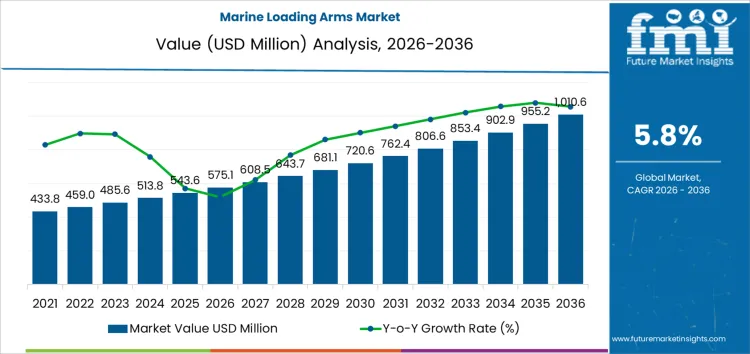
What is the Growth Forecast for the Marine Loading Arms Market through 2036?
The marine loading arms industry evolves alongside seaborne trade in crude oil, refined products, chemicals, and liquefied gases, as well as with stricter safety and environmental standards at ports and terminals. In the early stage of the period, demand is largely linked to routine terminal maintenance, selective berth upgrades, and a limited number of new jetty developments. As investment increases over time, spending shifts toward replacing aging loading arms, meeting compliance requirements, and upgrading terminals to handle a wider range of cargoes, including hazardous chemicals and cryogenic products.
Procurement decisions increasingly depend on certification, operational performance, and long-term service support rather than simply initial cost. In later years, growth is shaped more by terminal modernization and changing cargo mix than by expansion in the number of ports. Liquefied gas and chemical trade flows strengthen demand for specialized, high-specification systems, while automation, condition monitoring, and remote operation features become more common in both new installations and retrofits. Overall, the industry continues to expand through higher technical complexity per berth and sustained reinvestment in terminal infrastructure, with safety compliance and serviceability remaining key purchasing priorities.
Marine Loading Arms Market Key Takeaways
| Metric | Value |
|---|---|
| Market Value (2026) | USD 575.1 million |
| Forecast Value (2036) | USD 1,010.6 million |
| Forecast CAGR 2026 to 2036 | 5.8% |
How Are Marine Loading Arms Helping Terminals Enhance Operational Efficiency and Safety?
Marine loading arms are critical for controlled transfer of bulk liquids such as crude oil, chemicals, and liquefied gases at port terminals. Older transfer methods, including flexible hoses, often caused operational delays, increased spillage risk, and required frequent maintenance. Modern loading arms feature articulated swivel joints, ergonomic design, and corrosion-resistant alloys to allow precise alignment with vessels, absorb motion due to tides or ship movement, and maintain uninterrupted flow.
Terminal operators, shipping companies, and chemical producers focus on durability, throughput capacity, and compliance with international safety standards. Early deployments centered on large-scale crude terminals, while current usage spans chemical and LNG ports, specialty cargo facilities, and multiproduct docks, driven by the need for faster loading cycles, minimal downtime, and risk mitigation. Arm flexibility, material compatibility, and ease of maintenance guide supplier evaluation.
Reducing operational bottlenecks and minimizing safety incidents is reshaping procurement and investment strategies. Unlike conventional hoses, modern loading arms provide consistent flow rates, reduced mechanical stress, and integrated monitoring for preventive maintenance. Investment decisions weigh material performance, automation features, and lifecycle support, creating opportunities for suppliers offering turnkey solutions with service agreements. Terminals implement these systems to increase vessel turnaround, maintain compliance with environmental regulations, and optimize workforce utilization. Looking forward, marine loading arms are expected to enable higher-frequency transfers, improved reliability, and reduced operational hazards, positioning ports and operators for safer, more cost-effective bulk liquid handling.
What Factors Are Shaping Segment-Wise Demand for Marine Loading Arms in 2026?
The Marine Loading Arms Market is governed primarily by terminal design lock-in, safety certification regimes, and the high cost of retrofitting waterfront infrastructure. Once a berth is designed and approved, the loading arm configuration typically remains fixed for decades. This makes the Marine Loading Arms Market heavily driven by greenfield terminal construction, major expansion projects, and infrequent but high-value retrofit programs. By product type, the Marine Loading Arms Market includes top-mounted loading arms, bottom-load arms, cryogenic loading arms, and submerged loading arms. By fluid type, the Marine Loading Arms Market serves petroleum and crude oil, chemical and petrochemical fluids, LNG and LPG, and vegetable oils and food-grade liquids. Each segment is governed by different safety codes, inspection regimes, and operating risk profiles.
Why Does Terminal Geometry, Not Throughput, Determine Product Type Demand in the Marine Loading Arms Market?
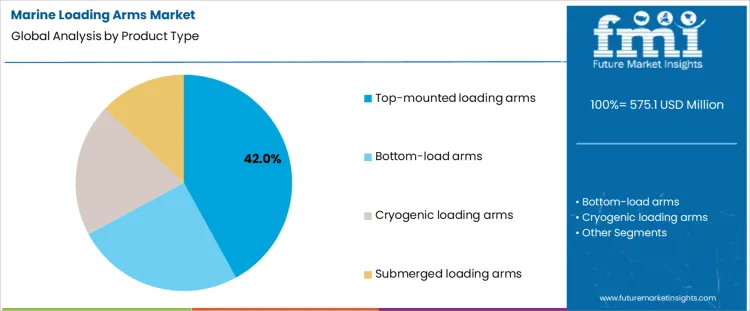
Top-mounted loading arms account for approximately 42% of demand in the Marine Loading Arms Market because they are compatible with the largest installed base of conventional tanker and jetty designs. Many existing ports were built around top-loading geometries, and replacing these systems often requires structural modification of the jetty, not just equipment substitution. As a result, product selection is driven more by civil engineering constraints and permitting than by marginal operational efficiency gains.
Cryogenic loading arms represent a smaller share by unit count but a disproportionate share by project value because LNG terminals require highly specialized materials, articulation systems, and safety interlocks. Bottom-loading and submerged arms are used where emissions control, spill risk, or berth layout requires them, but these configurations are typically specified only in new terminals or in major redevelopments. For suppliers, the Marine Loading Arms Market is therefore not a high-frequency replacement market. It is a project-timed, specification-driven market where early involvement in terminal design decisions determines competitive position.
Why Does Petroleum and Crude Oil Continue to Anchor Volume Demand in the Marine Loading Arms Market?
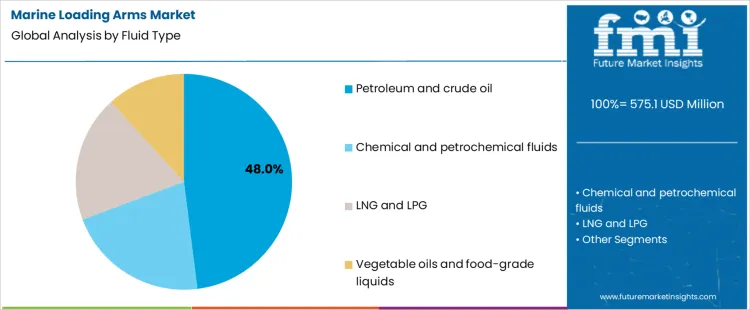
Petroleum and crude oil account for approximately 48% of demand in the Marine Loading Arms Market because they dominate global seaborne liquid bulk trade volumes and are handled in a very large number of ports. Even though LNG projects attract more attention, the sheer number of oil terminals, export jetties, and import berths ensures continuous baseline demand for conventional loading arm systems through expansion, life-extension, and compliance-driven upgrades.
Chemical terminals and food-grade liquid facilities operate under stricter contamination and segregation requirements, which increases specification complexity but limits the number of installations. LNG and LPG terminals involve very high capital intensity per site, but project counts are small and irregular. From a supplier perspective, the Marine Loading Arms Market therefore consists of two parallel businesses: a high-volume, specification-driven oil terminal business and a low-volume, high-complexity cryogenic and specialty fluids business. Commercial strategy, engineering capability, and sales timing differ fundamentally between these two demand centers.
How Are the Key Dynamics Reshaping the Marine Loading Arms Market?
This market is governed by consequence, not convenience. A loading arm is touched for minutes and judged for decades. Decisions are shaped by spill risk, berth availability, and how terminals choreograph ship turnaround. Demand does not arrive as steady replacement; it appears with new jetties, product shifts, and post incident redesigns. In some ports, arms are treated as passive steel. In others, they are the critical safety boundary. The marine loading arms market advances when operators rethink transfer philosophy, not when a catalog updates. Scale follows project programs and operating doctrines more than routine maintenance cycles.
Why the Marine Loading Arms Market Is Spill Anxiety Driven?
Transfers concentrate risk into short, exposed windows. A single seal failure or misalignment can shut a terminal and dominate headlines. After notable incidents, specifications tighten: faster emergency release, better swivel monitoring, clearer interlocks. Budgets suddenly exist. Where risk reviews carry authority, arms are upgraded as part of berth hardening. Where reviews are procedural, equipment stays untouched. This creates bursty demand tied to audits, insurance pressure, and public scrutiny. The buying trigger is rarely corrosion. It is fear of the next uncontrolled discharge and the operational and reputational cost that follows.
Why the Marine Loading Arms Market Changes So Slowly?
Once installed, an arm becomes part of the pier geometry, piping stress model, and operating routine. Replacing it means shutting a berth, revalidating loads, retraining crews, and rewriting procedures. Many terminals prefer to nurse aging systems rather than reopen that entire stack of dependencies. Product compatibility, temperature ranges, and ship mix also lock designs in place. Even when better joints or monitoring exist, the hurdle is not performance. It is disruption. As a result, most innovation enters with new berths or major reconfigurations, not through incremental swaps.
Why the Marine Loading Arms Market Follows Terminal Choreography?
Some ports optimize for speed, others for simplicity, others for redundancy. That philosophy decides arm count, reach, automation, and quick release strategy. As terminals standardize berth templates and replicate them across expansions, arm selection becomes programmatic. Suppliers that fit the template scale. Where traffic mixes change, arms change with them. The equipment is therefore a consequence of how a terminal wants ships to arrive, connect, and leave. The marine loading arms market follows operating choreography and expansion patterns, not the global tally of existing arms.
What is the Demand for Marine Loading Arms by Country?
| Country | CAGR (%) |
|---|---|
| USA | 5.5% |
| UK | 5.2% |
| China | 6.5% |
| India | 6.8% |
| Brazil | 5.7% |
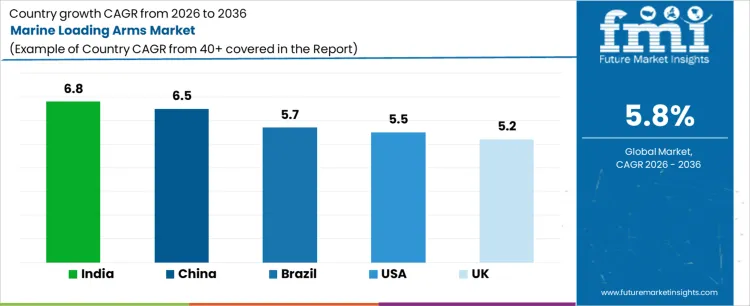
Demand for marine loading arms is rising as port operators, oil and gas terminals, and chemical handling facilities adopt equipment for safe, efficient, and reliable transfer of liquids and gases. India leads with a 6.8% CAGR, driven by expansion of port infrastructure, rising petroleum and chemical throughput, and adoption of modern loading solutions
. China follows at 6.5%, supported by large-scale industrial and energy terminal operations. Brazil records 5.7% growth, shaped by investments in port modernization and handling capacity. The USA grows at 5.5%, influenced by replacement demand and upgrades in marine loading systems. The UK shows 5.2% CAGR, reflecting steady adoption in commercial and industrial terminals.
Where does supplier leverage concentrate in the United States marine loading arms business?
Spending in United States terminal equipment follows port upgrade cycles and energy logistics investment plans, with marine loading arms demand advancing at a 5.5% CAGR under current programs. Order flow comes from refinery jetties, chemical terminals, and LNG export facilities rather than greenfield port construction alone. EPC contractors and terminal operators control specification setting and vendor shortlisting. Retrofit and capacity debottlenecking projects generate a large share of volume.
Installed base compatibility influences repeat orders more than new feature releases. Fabrication capacity, welding certification, and delivery slot availability shape award decisions. Domestic manufacturing keeps lead times competitive. Documentation quality affects acceptance during inspection phases. Revenue timing follows shutdown windows and berth modification schedules. Commercial position depends on framework inclusion and long term terminal service relationships rather than single project bidding.
How do terminal modernization programs shape sales channels in the United Kingdom?
Investment release in United Kingdom remains tied to port modernization and energy import infrastructure, with marine loading arms demand expanding at a 5.2% CAGR. Most orders originate from chemical terminals, fuel import jetties, and bulk liquid handling facilities. New terminal construction plays a limited role compared with berth upgrades and safety driven replacements. Contractor frameworks and port authority approval lists govern access.
Engineering consultants influence early technical definitions. Fabrication standards, corrosion protection systems, and documentation packages shape supplier selection. A large share of packages moves through EPC contractors. Installation windows depend on port traffic scheduling. Service access near coastal hubs affects long term positioning. Revenue visibility follows multi-year port investment plans and compliance programs rather than spot project releases.
What determines scale advantages for suppliers in China?
Centralized port expansion plans and energy logistics investment keep China on a 6.5% growth path for marine loading arms procurement. Volume concentrates in crude oil terminals, chemical ports, and LNG import facilities. State owned port groups and EPC firms control most sourcing decisions. Domestic manufacturers dominate standard arm configurations through pricing and fabrication capacity. International suppliers retain roles in cryogenic and complex transfer systems.
Order timing follows multi-year port development budgets rather than single berth projects. Qualification lists and reference installations carry strong weight. Fabrication slot availability affects delivery awards. Margin structure depends on mix between standard arms and engineered systems. Commercial success depends on placement inside approved port development ecosystems rather than repeated pursuit of isolated tenders.
Why does project access strategy matter more than order count in India?
Port expansion, refinery logistics upgrades, and LNG terminal programs keep India on a 6.8% growth track for marine loading arms demand. Most award flow passes through public port authorities and their nominated EPC partners. Entry barriers sit in qualification, fabrication approval, and documentation readiness. Import suppliers serve high specification cryogenic and hazardous chemical duties while domestic fabricators cover conventional liquid transfer arms. A large share of revenue moves through bundled terminal packages. Execution capability and delivery reliability influence supplier choice. Project pipelines operate on long approval cycles. Sales performance depends on panel inclusion and framework positioning. Installation timing follows berth shutdown schedules. Expansion follows national port infrastructure programs rather than short cycle commodity price movements or isolated terminal projects.
How do offshore support and export terminals shape demand patterns in Brazil?
Offshore export programs and terminal upgrade schedules shape Brazil demand, with marine loading arms purchases expanding at a 5.7% CAGR under current investment plans. Contract value concentrates in crude export jetties, chemical terminals, and multipurpose liquid berths. Operator approval lists and local content rules define access routes. EPC contractors control package sourcing and fabrication coordination. Import dependence affects delivery planning and inspection sequencing. Retrofit and safety compliance projects generate recurring order flow. Commercial risk centers on certification acceptance and port authority approvals. Berth traffic planning influences installation timing. Revenue visibility depends on positioning inside multi-year port development and offshore logistics programs rather than single terminal tenders or short term capacity additions.
What Distinguishes Key Players in the Marine Loading Arms Market in Terms of Technology and Application?
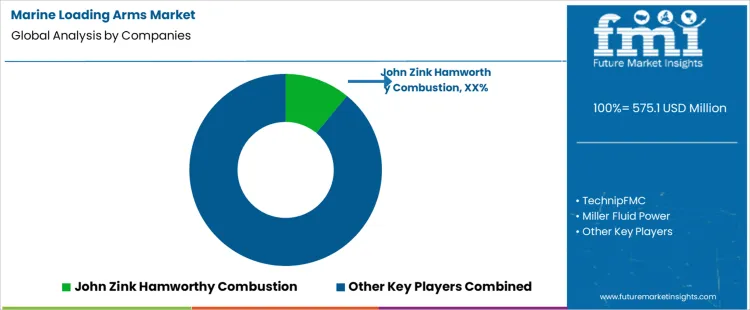
John Zink Hamworthy Combustion supplies marine loading arms engineered for precise fluid transfer and safety in ship to shore operations, with designs that address vapour recovery and minimal emissions during hydrocarbon handling. TechnipFMC offers articulated loading systems that integrate motion compensation and real time monitoring, supporting rapid and secure connections across crude, refined products, and chemical transfer services. Miller Fluid Power delivers loading arms focused on modularity and reliability, with emphasis on pressure rated performance and compatibility with varied vessel sizes and terminal layouts. Schmid Rhein Mobility provides articulated arms with ergonomic design features that support efficient operator control and integration with marine terminal automation frameworks. Beka Associates supplies custom engineered loading solutions tailored to specific site requirements, often addressing niche configurations and retrofit applications.
Other regional and specialty suppliers contribute loading arm assemblies optimized for specific product types such as LPG, LNG, and chemical cargos where corrosion resistance and precise flow control are critical. Differentiation across manufacturers arises from dynamic motion compensation capabilities, materials selected for ambient and product conditions, integration with vapour recovery systems, and ease of maintenance in high use port environments. Suppliers with robust engineering support, global service networks, and adherence to international safety standards attract terminal operators seeking predictable performance, reduced downtime, and compliance with environmental regulations. Buyers also weigh factors such as flange compatibility, swivel design durability, and the ability to support automated leak detection and emergency shut off functions when specifying marine loading arm systems for varied maritime logistics scenarios.
Key Players in the Marine Loading Arms Market
- John Zink Hamworthy Combustion
- TechnipFMC
- Miller Fluid Power
- Schmid Rhein Mobility
- Beka Associates
Scope of the Report
| Items | Values |
|---|---|
| Quantitative Units (2026) | USD million |
| Product Type | Top-mounted loading arms, Bottom-load arms, Cryogenic loading arms, Submerged loading arms |
| Fluid Type | Petroleum and crude oil, Chemical and petrochemical fluids, LNG and LPG, Vegetable oils and food-grade liquids |
| Region | Asia Pacific, Europe, North America, Latin America, Middle East & Africa |
| Countries Covered | China, Japan, South Korea, India, Australia & New Zealand, ASEAN, Germany, United Kingdom, France, Italy, Spain, Nordic, BENELUX, United States, Canada, Mexico, Brazil, Chile, Saudi Arabia, Turkey, South Africa, and other regional markets |
| Key Companies Profiled | John Zink Hamworthy Combustion, TechnipFMC, Miller Fluid Power, Schmid Rhein Mobility, Beka Associates |
| Additional Attributes | Dollar sales by product type and fluid type; demand driven by terminal upgrades, safety compliance, and berth utilization pressure; growth led by LNG, chemical, and high-specification terminals; aftermarket services and refurbishment support recurring revenue; purchasing shaped by certification, reliability, corrosion resistance, and long-term serviceability rather than unit price. |
Marine Loading Arms Market Segmentation
Product Type:
- Top-mounted loading arms
- Bottom-load arms
- Cryogenic loading arms
- Submerged loading arms
Fluid Type:
- Petroleum and crude oil
- Chemical and petrochemical fluids
- LNG and LPG
- Vegetable oils and food-grade liquids
Region
- Asia Pacific
- China
- Japan
- South Korea
- India
- Australia & New Zealand
- ASEAN
- Rest of Asia Pacific
- Europe
- Germany
- United Kingdom
- France
- Italy
- Spain
- Nordic
- BENELUX
- Rest of Europe
- North America
- United States
- Canada
- Mexico
- Latin America
- Brazil
- Chile
- Rest of Latin America
- Middle East & Africa
- Kingdom of Saudi Arabia
- Other GCC Countries
- Turkey
- South Africa
- Other African Union
- Rest of Middle East & Africa
References
- United Nations Conference on Trade and Development. (2024). Review of maritime transport 2024. United Nations.
- United States Coast Guard. (2024). Marine transportation system and port infrastructure assessment. U.S. Department of Homeland Security.
- European Commission. (2024). EU ports and energy infrastructure policy framework. European Union.
- International Maritime Organization. (2024). Safety standards for bulk liquid transfer operations at marine terminals. IMO.
Frequently Asked Questions
How big is the marine loading arms market in 2026?
The global marine loading arms market is estimated to be valued at USD 575.1 million in 2026.
What will be the size of marine loading arms market in 2036?
The market size for the marine loading arms market is projected to reach USD 1,010.6 million by 2036.
How much will be the marine loading arms market growth between 2026 and 2036?
The marine loading arms market is expected to grow at a 5.8% CAGR between 2026 and 2036.
What are the key product types in the marine loading arms market?
The key product types in marine loading arms market are top‑mounted loading arms , bottom‑load arms, cryogenic loading arms and submerged loading arms.
Which fluid type segment to contribute significant share in the marine loading arms market in 2026?
In terms of fluid type, petroleum and crude oil segment to command 48.0% share in the marine loading arms market in 2026.
Preview the report firsthand - request a free sample
Get SampleGet the brochure for pricing and purchase details.
Get PDFTable of Content
- Executive Summary
- Global Market Outlook
- Demand-side Trends
- Supply-side Trends
- Technology Roadmap Analysis
- Analysis and Recommendations
- Market Overview
- Market Coverage / Taxonomy
- Market Definition / Scope / Limitations
- Market Background
- Market Dynamics
- Drivers
- Restraints
- Opportunity
- Trends
- Scenario Forecast
- Demand in Optimistic Scenario
- Demand in Likely Scenario
- Demand in Conservative Scenario
- Opportunity Map Analysis
- Product Life Cycle Analysis
- Supply Chain Analysis
- Investment Feasibility Matrix
- Value Chain Analysis
- PESTLE and Porter’s Analysis
- Regulatory Landscape
- Regional Parent Market Outlook
- Production and Consumption Statistics
- Import and Export Statistics
- Market Dynamics
- Global Market Analysis 2021 to 2025 and Forecast, 2026 to 2036
- Historical Market Size Value (USD Million) Analysis, 2021 to 2025
- Current and Future Market Size Value (USD Million) Projections, 2026 to 2036
- Y-o-Y Growth Trend Analysis
- Absolute $ Opportunity Analysis
- Global Market Pricing Analysis 2021 to 2025 and Forecast 2026 to 2036
- Global Market Analysis 2021 to 2025 and Forecast 2026 to 2036, By Product Type
- Introduction / Key Findings
- Historical Market Size Value (USD Million) Analysis By Product Type , 2021 to 2025
- Current and Future Market Size Value (USD Million) Analysis and Forecast By Product Type , 2026 to 2036
- Top‑mounted loading arms
- Bottom‑load arms
- Cryogenic loading arms
- Submerged loading arms
- Top‑mounted loading arms
- Y-o-Y Growth Trend Analysis By Product Type , 2021 to 2025
- Absolute $ Opportunity Analysis By Product Type , 2026 to 2036
- Global Market Analysis 2021 to 2025 and Forecast 2026 to 2036, By Fluid Type
- Introduction / Key Findings
- Historical Market Size Value (USD Million) Analysis By Fluid Type, 2021 to 2025
- Current and Future Market Size Value (USD Million) Analysis and Forecast By Fluid Type, 2026 to 2036
- Petroleum and crude oil
- Chemical and petrochemical fluids
- LNG and LPG
- Vegetable oils and food‑grade liquids
- Petroleum and crude oil
- Y-o-Y Growth Trend Analysis By Fluid Type, 2021 to 2025
- Absolute $ Opportunity Analysis By Fluid Type, 2026 to 2036
- Global Market Analysis 2021 to 2025 and Forecast 2026 to 2036, By Region
- Introduction
- Historical Market Size Value (USD Million) Analysis By Region, 2021 to 2025
- Current Market Size Value (USD Million) Analysis and Forecast By Region, 2026 to 2036
- North America
- Latin America
- Western Europe
- Eastern Europe
- East Asia
- South Asia and Pacific
- Middle East & Africa
- Market Attractiveness Analysis By Region
- North America Market Analysis 2021 to 2025 and Forecast 2026 to 2036, By Country
- Historical Market Size Value (USD Million) Trend Analysis By Market Taxonomy, 2021 to 2025
- Market Size Value (USD Million) Forecast By Market Taxonomy, 2026 to 2036
- By Country
- USA
- Canada
- Mexico
- By Product Type
- By Fluid Type
- By Country
- Market Attractiveness Analysis
- By Country
- By Product Type
- By Fluid Type
- Key Takeaways
- Latin America Market Analysis 2021 to 2025 and Forecast 2026 to 2036, By Country
- Historical Market Size Value (USD Million) Trend Analysis By Market Taxonomy, 2021 to 2025
- Market Size Value (USD Million) Forecast By Market Taxonomy, 2026 to 2036
- By Country
- Brazil
- Chile
- Rest of Latin America
- By Product Type
- By Fluid Type
- By Country
- Market Attractiveness Analysis
- By Country
- By Product Type
- By Fluid Type
- Key Takeaways
- Western Europe Market Analysis 2021 to 2025 and Forecast 2026 to 2036, By Country
- Historical Market Size Value (USD Million) Trend Analysis By Market Taxonomy, 2021 to 2025
- Market Size Value (USD Million) Forecast By Market Taxonomy, 2026 to 2036
- By Country
- Germany
- UK
- Italy
- Spain
- France
- Nordic
- BENELUX
- Rest of Western Europe
- By Product Type
- By Fluid Type
- By Country
- Market Attractiveness Analysis
- By Country
- By Product Type
- By Fluid Type
- Key Takeaways
- Eastern Europe Market Analysis 2021 to 2025 and Forecast 2026 to 2036, By Country
- Historical Market Size Value (USD Million) Trend Analysis By Market Taxonomy, 2021 to 2025
- Market Size Value (USD Million) Forecast By Market Taxonomy, 2026 to 2036
- By Country
- Russia
- Poland
- Hungary
- Balkan & Baltic
- Rest of Eastern Europe
- By Product Type
- By Fluid Type
- By Country
- Market Attractiveness Analysis
- By Country
- By Product Type
- By Fluid Type
- Key Takeaways
- East Asia Market Analysis 2021 to 2025 and Forecast 2026 to 2036, By Country
- Historical Market Size Value (USD Million) Trend Analysis By Market Taxonomy, 2021 to 2025
- Market Size Value (USD Million) Forecast By Market Taxonomy, 2026 to 2036
- By Country
- China
- Japan
- South Korea
- By Product Type
- By Fluid Type
- By Country
- Market Attractiveness Analysis
- By Country
- By Product Type
- By Fluid Type
- Key Takeaways
- South Asia and Pacific Market Analysis 2021 to 2025 and Forecast 2026 to 2036, By Country
- Historical Market Size Value (USD Million) Trend Analysis By Market Taxonomy, 2021 to 2025
- Market Size Value (USD Million) Forecast By Market Taxonomy, 2026 to 2036
- By Country
- India
- ASEAN
- Australia & New Zealand
- Rest of South Asia and Pacific
- By Product Type
- By Fluid Type
- By Country
- Market Attractiveness Analysis
- By Country
- By Product Type
- By Fluid Type
- Key Takeaways
- Middle East & Africa Market Analysis 2021 to 2025 and Forecast 2026 to 2036, By Country
- Historical Market Size Value (USD Million) Trend Analysis By Market Taxonomy, 2021 to 2025
- Market Size Value (USD Million) Forecast By Market Taxonomy, 2026 to 2036
- By Country
- Kingdom of Saudi Arabia
- Other GCC Countries
- Turkiye
- South Africa
- Other African Union
- Rest of Middle East & Africa
- By Product Type
- By Fluid Type
- By Country
- Market Attractiveness Analysis
- By Country
- By Product Type
- By Fluid Type
- Key Takeaways
- Key Countries Market Analysis
- USA
- Pricing Analysis
- Market Share Analysis, 2025
- By Product Type
- By Fluid Type
- Canada
- Pricing Analysis
- Market Share Analysis, 2025
- By Product Type
- By Fluid Type
- Mexico
- Pricing Analysis
- Market Share Analysis, 2025
- By Product Type
- By Fluid Type
- Brazil
- Pricing Analysis
- Market Share Analysis, 2025
- By Product Type
- By Fluid Type
- Chile
- Pricing Analysis
- Market Share Analysis, 2025
- By Product Type
- By Fluid Type
- Germany
- Pricing Analysis
- Market Share Analysis, 2025
- By Product Type
- By Fluid Type
- UK
- Pricing Analysis
- Market Share Analysis, 2025
- By Product Type
- By Fluid Type
- Italy
- Pricing Analysis
- Market Share Analysis, 2025
- By Product Type
- By Fluid Type
- Spain
- Pricing Analysis
- Market Share Analysis, 2025
- By Product Type
- By Fluid Type
- France
- Pricing Analysis
- Market Share Analysis, 2025
- By Product Type
- By Fluid Type
- India
- Pricing Analysis
- Market Share Analysis, 2025
- By Product Type
- By Fluid Type
- ASEAN
- Pricing Analysis
- Market Share Analysis, 2025
- By Product Type
- By Fluid Type
- Australia & New Zealand
- Pricing Analysis
- Market Share Analysis, 2025
- By Product Type
- By Fluid Type
- China
- Pricing Analysis
- Market Share Analysis, 2025
- By Product Type
- By Fluid Type
- Japan
- Pricing Analysis
- Market Share Analysis, 2025
- By Product Type
- By Fluid Type
- South Korea
- Pricing Analysis
- Market Share Analysis, 2025
- By Product Type
- By Fluid Type
- Russia
- Pricing Analysis
- Market Share Analysis, 2025
- By Product Type
- By Fluid Type
- Poland
- Pricing Analysis
- Market Share Analysis, 2025
- By Product Type
- By Fluid Type
- Hungary
- Pricing Analysis
- Market Share Analysis, 2025
- By Product Type
- By Fluid Type
- Kingdom of Saudi Arabia
- Pricing Analysis
- Market Share Analysis, 2025
- By Product Type
- By Fluid Type
- Turkiye
- Pricing Analysis
- Market Share Analysis, 2025
- By Product Type
- By Fluid Type
- South Africa
- Pricing Analysis
- Market Share Analysis, 2025
- By Product Type
- By Fluid Type
- USA
- Market Structure Analysis
- Competition Dashboard
- Competition Benchmarking
- Market Share Analysis of Top Players
- By Regional
- By Product Type
- By Fluid Type
- Competition Analysis
- Competition Deep Dive
- John Zink Hamworthy Combustion
- Overview
- Product Portfolio
- Profitability by Market Segments (Product/Age /Sales Channel/Region)
- Sales Footprint
- Strategy Overview
- Marketing Strategy
- Product Strategy
- Channel Strategy
- TechnipFMC
- Miller Fluid Power
- Schmid Rhein Mobility
- Beka Associates
- John Zink Hamworthy Combustion
- Competition Deep Dive
- Assumptions & Acronyms Used
- Research Methodology


