

- Industry Size (2026)
- USD 1.57 Bn
- Forecast (2036)
- USD 2.46 Bn
- CAGR (2026 to 2036)
- 4.6%
Sunflower Seed Market Size, Market Forecast and Outlook By FMI
In 2025, the Sunflower Seed market was valued at USD 1.43 billion. Based on Future Market Insights' analysis, demand for Sunflower Seed is estimated to grow to USD 1.57 billion in 2026 and USD 2.46 billion by 2036. FMI projects a CAGR of 4.6% during the forecast period.
The absolute dollar expansion from 2026 to 2036 amounts to approximately USD 0.89 billion, reflecting steady global edible oil demand and growing snack food consumption. Growth is moderated by geopolitical supply disruption risk concentrated in the Black Sea region, where Ukraine and Russia collectively account for a dominant share of global sunflower seed and oil exports. Crop yield variability driven by drought and weather pattern shifts in Eastern Europe introduces year-on-year supply uncertainty that affects price and procurement planning for downstream processors.
Summary of Sunflower Seed Market
- Sunflower Seed Market Definition:
- The Sunflower Seed Market is estimated to be valued at USD 1.5 billion in 2026 and is projected to reach USD 2.4 billion by 2036, registering a compound annual growth rate (CAGR) of 4.6% over the forecast period. Quick Stats for Sunflower Seed Market Sunflower Seed Market Value (2025): USD 1.5 billion Sunflower Seed Market Forecast Value (2035): USD 2.4 billion Sunflower Seed Market Forecast CAGR: 4.6% Leading Segment in Sunflower Seed Market in 2026: Oilseeds (52.6%) Key Growth Regions in Sunflower Seed Market: North America, Asia-Pacific, Europe Top Key Players in Sunflower Seed Market: Monsanto Company (acquired by Bayer AG), Syngenta AG (acquired by ChemChina), Corteva Agriscience, BASF SE, Advanta Seeds (acquired by UPL Limited), Nuseed Pty Ltd (a subsidiary of Nufarm Limited), Groupe Limagrain Holding SA, Land O'Lakes, Inc., Sakata Seed Corporation, Agrofy Seeds
- Demand Drivers in the Market:
- Rising demand for sunflower seed across food processing and industrial applications accelerates procurement volumes among large-scale manufacturers targeting cost efficiency.
- Expanding oilseeds adoption within China and adjacent high-growth economies drives volume commitments that justify dedicated supply chain investments.
- Regulatory and sustainability mandates compel formulation teams to source certified sunflower seed inputs, shifting purchasing decisions toward verified, compliant suppliers.
- Key Segments Analyzed in the FMI Report:
- Oilseeds: 52.6% share in 2026, representing the dominant category as buyers prioritize established oilseeds configurations that align with existing processing and formulation infrastructure.
- Black: 27.4% share in 2026, driven by end-use applications where black characteristics deliver measurable performance advantages over alternative product forms.
- China: 6.2% compound growth anchored by expanding manufacturing capacity and government-supported industrial development programs targeting sunflower seed production and processing.
- Analyst Opinion at FMI:
- Nandini Roy Choudhury, Principal Consultant for Food & Beverage, opines: 'In my analysis of the Sunflower Seed Market, I observe that the central procurement challenge is not product availability but supplier qualification and traceability. Buyers consolidating volumes around oilseeds face concentration risk when Tier-1 suppliers cannot demonstrate regulatory compliance documentation at scale. China and comparable high-growth markets at 6.2% CAGR signal structural demand expansion, yet the absence of standardized procurement frameworks creates margin compression for distributors operating without certified channel agreements. Executives who delay formalizing supplier diversification strategies will find their cost structures exposed once regulatory enforcement cycles intensify across major importing economies.'
- Strategic Implications / Executive Takeaways:
- Suppliers must establish verified certification pathways for sunflower seed to qualify for procurement tenders issued by large food, health, and industrial buyers.
- Investment priorities should target capacity expansion in high-CAGR geographies to capture incremental demand before supply concentration shifts pricing power.
- Product development teams should align sunflower seed formulations with evolving regulatory thresholds in the European Union, United States, and Asia Pacific to maintain market access.
- Methodology:
- Primary Research: FMI conducted detailed technical interviews with procurement directors, formulation specialists, and supply chain engineers across 40 countries to validate adoption timelines and demand assumptions.
- Desk Research: Analysts aggregated public regulatory filings, trade association publications, government statistical releases, and company annual reports to establish verifiable baseline data.
- Market-Sizing and Forecasting: Forecasting models apply a bottom-up methodology starting with verified production capacity and consumption volume data, applying region-specific growth assumptions to project adoption trajectories.
- Data Validation and Update Cycle: Segment forecasts undergo cross-validation against publicly reported revenue volumes from leading industry participants and are updated on a rolling quarterly basis.
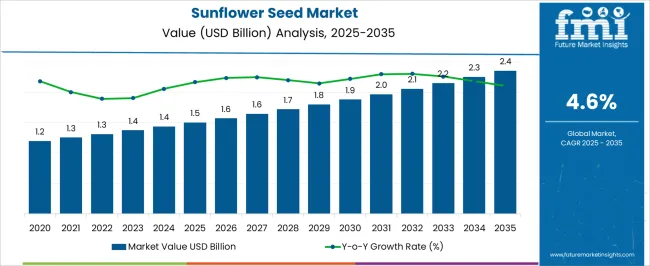
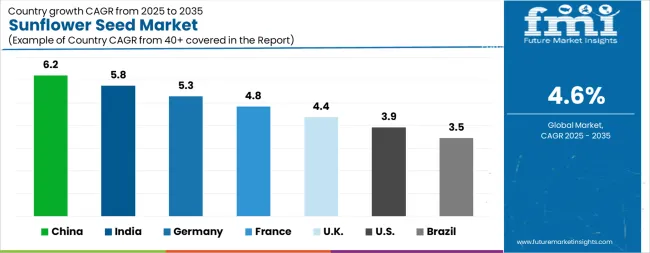
As per FMI, growing global edible oil consumption in food manufacturing, expanding plant-based snack and bakery product categories, and rising consumer awareness of sunflower seed nutritional benefits including unsaturated fatty acids and micronutrient content support consistent demand growth across all major end-use applications. China leads country-level growth at 6.2% CAGR, driven by expanding domestic sunflower cultivation in Inner Mongolia and Xinjiang, combined with growing demand for healthy snack formats and high-oleic sunflower oil in food processing. India follows at 5.8%, with rising edible oil demand and government import diversification policies supporting procurement of sunflower oil-derived products.
Germany records 5.3% CAGR, with food manufacturing demand for high-oleic sunflower oil as a stable frying medium and clean-label ingredient in premium bakery applications. France advances at 4.8%, supported by domestic sunflower cultivation and food-grade oil demand from the prepared meals and condiments sector. The United Kingdom grows at 4.4%, with snack food manufacturing and health-positioned seed ingredient procurement as primary demand channels. The United States expands at 3.9%, with Corteva Agriscience and Nuseed supplying high-oleic sunflower seed varieties to contracted oilseed processors. Brazil posts 3.5%, underpinned by growing domestic snack food and confectionery manufacturing. For detailed regional intelligence, refer to FMI's Sunflower Seed Market report.
Sunflower Seed Market Key Takeaways
| Metric | Details |
|---|---|
| Industry Size (2026) | USD 1.57 billion |
| Industry Value (2036) | USD 2.46 billion |
| CAGR (2026 to 2036) | 4.6% |
| Source | Future Market Insights (FMI) |
Sunflower Seed Market Definition
The Sunflower Seed market encompasses the commercial production and trade of Helianthus annuus seed varieties, principally oilseed types cultivated for edible oil extraction and confectionery types (non-oilseed) grown for direct human consumption as snacks and food ingredients. Sunflower seeds supply high-oleic and linoleic oils for food and industrial applications, and serve as a nutrient-dense ingredient in bakery, snack, and confectionery product categories.
Sunflower Seed Market Inclusions
The report covers global and regional market sizes for sunflower seeds across all commercial types, colour categories, and application segments, forecast data from 2026 to 2036, and country-level CAGR analysis across more than 40 countries including major producing nations in Eastern Europe, the Black Sea region, and North America.
Sunflower Seed Market Exclusions
The scope excludes sunflower oil as a refined finished product, sunflower meal and cake by-products from oil extraction, ornamental sunflower varieties without commercial seed production value, and sunflower seed-based finished consumer products such as packaged snack foods and confectionery items.
Sunflower Seed Market Research Methodology
- Primary Research: Analysts conducted structured interviews with procurement specialists, formulation technologists, and regulatory affairs professionals across key producing and consuming countries to validate adoption timelines and commercial driver assessments.
- Desk Research: Data aggregation covered trade body publications, government statistical releases, multilateral agency reports, peer-reviewed research, and primary company disclosures relevant to the Sunflower Seed market.
- Market-Sizing and Forecasting: Baseline values derive from a bottom-up aggregation model applying region-specific adoption curves and segment penetration rates, cross-referenced against observable trade and production benchmarks from primary and public sources.
- Data Validation and Update Cycle: Segment forecasts are cross-validated against publicly reported financial results from leading market participants and reviewed on a rolling 12-month basis to incorporate material regulatory or commercial developments.
Why is the Sunflower Seed Market Growing?
The Sunflower Seed market is experiencing steady growth, driven by rising demand for healthy edible oils and plant-based products across global markets. Increasing awareness of the nutritional benefits of sunflower seeds, including their high content of unsaturated fatty acids, vitamins, and antioxidants, is boosting consumption. Expanding applications in edible oil, snacks, and processed foods are supporting market adoption, particularly in regions emphasizing cardiovascular health and wellness.
Technological advancements in seed processing, storage, and extraction are enhancing product quality and shelf life, encouraging wider utilization. Growing investments in sustainable agriculture, improved cultivation practices, and high-yield varieties are further contributing to market expansion. Urbanization and changing dietary preferences are creating new opportunities for sunflower-based products in both retail and industrial applications.
Additionally, supportive government policies, subsidies, and initiatives promoting oilseed cultivation are stimulating production As consumer preference shifts toward plant-based and health-focused products, the sunflower seed market is expected to witness sustained growth, driven by both nutritional demand and industrial applications.
Segmental Analysis
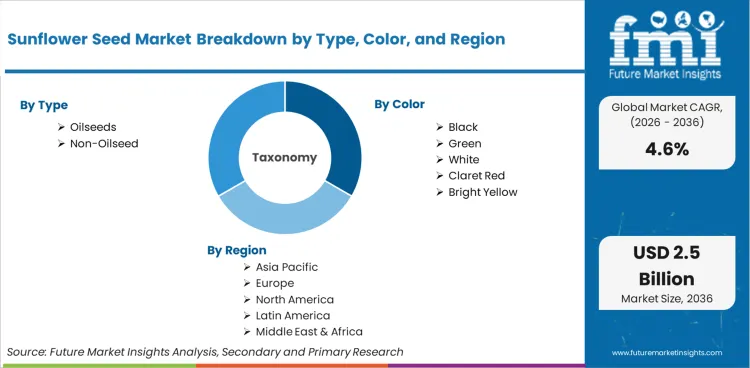
The sunflower seed market is segmented by type, color, application, and geographic regions. By type, sunflower seed market is divided into Oilseeds and Non-Oilseed. In terms of color, sunflower seed market is classified into Black, Green, White, Claret Red, and Bright Yellow. Based on application, sunflower seed market is segmented into Edible Oil, Snacks, Confectionary, Bakery Products, and Others. Regionally, the sunflower seed industry is classified into North America, Latin America, Western Europe, Eastern Europe, Balkan & Baltic Countries, Russia & Belarus, Central Asia, East Asia, South Asia & Pacific, and the Middle East & Africa.
Insights into the Oilseeds Type Segment
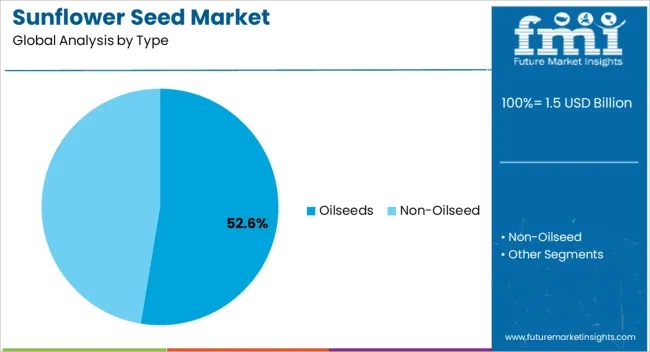
The oilseeds type segment is projected to hold 52.6% of the market revenue in 2026, establishing it as the leading product type. Its growth is being driven by the high demand for sunflower seeds as a raw material for edible oil extraction, which is a major application worldwide. Oilseeds are preferred for their superior oil content, consistent quality, and suitability for large-scale processing.
Technological improvements in mechanical pressing, solvent extraction, and refining processes have enhanced oil yield, purity, and stability, encouraging adoption by manufacturers. The segment benefits from established supply chains, scalability of production, and increasing cultivation in high-yield regions, which ensures a steady raw material flow.
Additionally, oilseeds support multiple downstream applications beyond edible oil, including animal feed and cosmetic formulations As demand for healthy edible oils continues to grow and manufacturers seek reliable high-oil-yield varieties, the oilseeds type segment is expected to maintain its leading position in the sunflower seed market.
Insights into the Black Color Segment
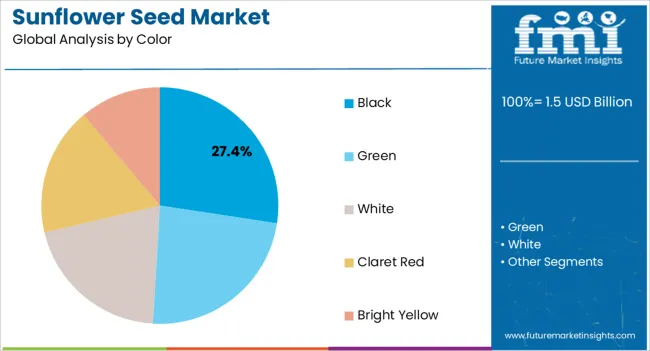
The black color segment is anticipated to account for 27.4% of the market revenue in 2026, making it the leading color category. Growth in this segment is driven by its popularity among consumers and processors due to higher kernel yield, better oil content, and suitability for specific food and oil extraction applications. Black sunflower seeds are favored for producing high-quality edible oil and are widely used in both industrial and household settings.
Improved agricultural practices, selective breeding, and pest-resistant varieties have increased the yield and quality of black sunflower seeds, strengthening adoption. Consumer preference for black seeds in snacks and culinary applications further supports market expansion.
The segment also benefits from established distribution networks and processing infrastructure, enabling cost-effective procurement and consistent quality for manufacturers As demand for high-quality edible oils and versatile sunflower seed varieties grows, the black color segment is expected to sustain its leadership in the market, driven by both consumer preference and industrial utility.
Insights into the Edible Oil Application Segment
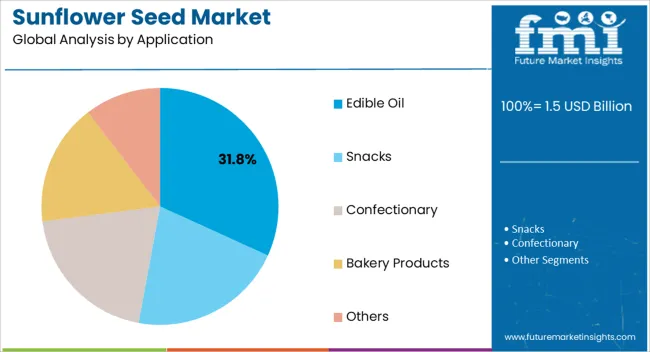
The edible oil application segment is projected to hold 31.8% of the market revenue in 2026, making it the leading application category. Growth is being driven by increasing consumer preference for sunflower oil due to its health benefits, including low saturated fat content, high unsaturated fatty acids, and antioxidant properties. The segment is supported by rising demand from households, restaurants, and food processing industries, where sunflower oil is valued for cooking, frying, and salad applications.
Technological advancements in oil extraction, refining, and packaging are enhancing oil quality, shelf life, and safety, encouraging adoption. Additionally, regulatory emphasis on healthier edible oils and growing awareness of cardiovascular health are boosting consumption.
The segment benefits from consistent supply chains and scalable production infrastructure, ensuring reliable availability for manufacturers and retailers As the demand for plant-based, nutritious oils continues to rise globally, the edible oil application segment is expected to remain the primary driver of growth in the sunflower seed market.
Sunflower Seed Market Drivers, Restraints, and Opportunities
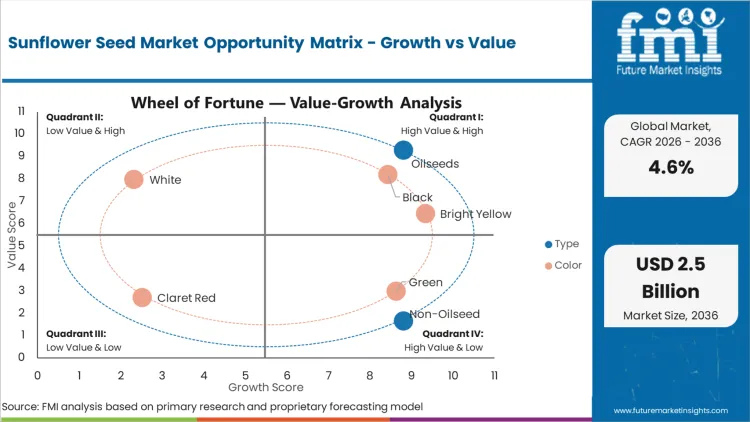
Future Market Insights analysis of the Sunflower Seed market shows that demand is structured around specific procurement requirements across industrial, retail, and regulated product categories. FMI analysts observe that growth performance varies across application and regional segments, with premium and specialty demand tiers delivering above-average revenue per unit relative to standard commodity-grade supply.
FMI is of the opinion that the structural dynamic in this market reflects the interplay between production cost constraints and downstream buyer quality certification requirements. Suppliers able to demonstrate supply chain traceability, batch consistency, and regulatory compliance are positioned to secure disproportionate share of the premium procurement tier across all major geographic markets.
High-Oleic Sunflower Oil Demand in Food Manufacturing: Food manufacturers seeking stable, trans-fat-free frying and cooking oils with extended shelf life have accelerated procurement of high-oleic sunflower oil derived from purpose-bred high-oleic sunflower seed varieties. Corteva Agriscience's Nexera and Nuseed's NuSun high-oleic programmes supply contracted oilseed processors in North America and Western Europe, with demand driven by EU regulation requiring the elimination of partially hydrogenated oils and retailer specifications mandating trans-fat-free ingredient declarations on packaged food products.
Confectionery Non-Oilseed Snack Segment Growth: Non-oilseed confectionery sunflower seed varieties are gaining commercial traction in snack food, bakery topping, and trail mix applications as consumers shift toward plant-based, nutrient-dense snack alternatives. Groupe Limagrain and Sakata Seed Corporation supply confectionery-type sunflower seed genetics to growers in Southern Europe, North America, and Argentina, with demand from snack manufacturers requiring large-kernel, thin-shell varieties with consistent flavour profiles and microbiological safety certification for direct-to-consumer packaging.
Supply Chain Diversification Following Black Sea Disruption: Geopolitical disruption to Ukrainian and Russian sunflower seed and oil exports following the 2022 conflict has accelerated procurement diversification by European and Asian edible oil importers toward alternative supply origins including Argentina, France, Hungary, and the United States. Bayer AG's seed genetics division and BASF SE's agricultural solutions portfolio are supporting yield improvement in alternative producing regions, with sunflower cultivation expansion programs in Central Asia and South America reducing buyer dependence on Black Sea supply concentration.
Analysis of Sunflower Seed Market By Key Countries
.webp "Top Country Growth Comparison Sunflower Seed Market Cagr (2026 2036)")
| Country | CAGR |
|---|---|
| China | 6.2% |
| India | 5.8% |
| Germany | 5.3% |
| France | 4.8% |
| UK | 4.4% |
| USA | 3.9% |
| Brazil | 3.5% |
Country-wise Analysis
The Sunflower Seed Market is expected to register a CAGR of 4.6% during the forecast period, exhibiting varied country level momentum. China leads with the highest CAGR of 6.2%, followed by India at 5.8%. Developed markets such as Germany, France, and the UK continue to expand steadily, while the USA is likely to grow at consistent rates. Brazil posts the lowest CAGR at 3.5%, yet still underscores a broadly positive trajectory for the global Sunflower Seed Market. In 2025, Germany held a dominant revenue in the Western Europe market and is expected to grow with a CAGR of 5.3%. The USA Sunflower Seed Market is estimated to be valued at USD 552.8 million in 2026 and is anticipated to reach a valuation of USD 811.3 million by 2036. Sales are projected to rise at a CAGR of 3.9% over the forecast period between 2026 and 2036. While Japan and South Korea markets are estimated to be valued at USD 76.7 million and USD 46.5 million respectively in 2026.
Key Players in the Sunflower Seed Market
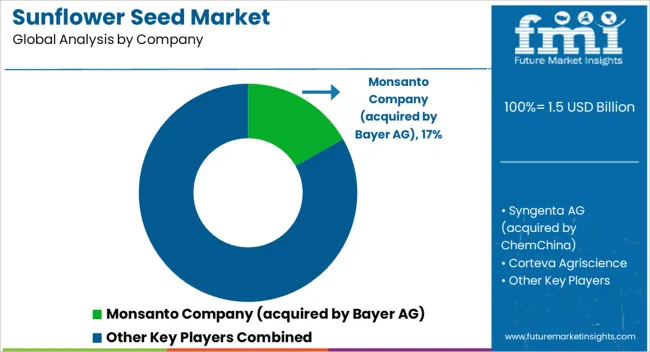
- Monsanto Company (acquired by Bayer AG)
- Syngenta AG (acquired by ChemChina)
- Corteva Agriscience
- BASF SE
- Advanta Seeds (acquired by UPL Limited)
- Nuseed Pty Ltd (a subsidiary of Nufarm Limited)
- Groupe Limagrain Holding SA
- Land O'Lakes, Inc.
- Sakata Seed Corporation
- Agrofy Seeds
Scope of the Report
| Metric | Value |
|---|---|
| Quantitative Units | USD 1.57 billion to USD 2.46 billion, at a CAGR of 4.6% |
| Market Definition | The Sunflower Seed market encompasses the commercial production and trade of Helianthus annuus seed varieties, principally oilseed types cultivated for edible oil extraction and confectionery types (non-oilseed) grown for direct human consumption as snacks and food ingredients. Sunflower seeds supply high-oleic and linoleic oils for food and industrial applications, and serve as a nutrient-dense ingredient in bakery, snack, and confectionery product categories. |
| Type Segmentation | Oilseeds, Non-Oilseed |
| Color Segmentation | Black, Green, White, Claret Red, Bright Yellow |
| Application Segmentation | Edible Oil, Snacks, Confectionary, Bakery Products, Others |
| Regions Covered | North America, Latin America, Western Europe, Eastern Europe, East Asia, South Asia and Pacific, Middle East and Africa |
| Countries Covered | United States, Canada, Germany, France, United Kingdom, China, Japan, India, Brazil, South Africa, and 40 plus countries |
| Forecast Period | 2026 to 2036 |
| Key Companies Profiled | Monsanto Company (acquired by Bayer AG), Syngenta AG (acquired by ChemChina), Corteva Agriscience, BASF SE, Advanta Seeds (acquired by UPL Limited), Nuseed Pty Ltd (a subsidiary of Nufarm Limited), Groupe Limagrain Holding SA, Land O'Lakes Inc., Sakata Seed Corporation, Agrofy Seeds |
| Approach | Hybrid bottom-up and top-down forecasting model, cross-validated against primary interview findings and public benchmark data |
Sunflower Seed Market by Segments
Type:
- Oilseeds
- Non-Oilseed
Color:
- Black
- Green
- White
- Claret Red
- Bright Yellow
Application:
- Edible Oil
- Snacks
- Confectionary
- Bakery Products
- Others
Region:
- North America
- USA
- Canada
- Mexico
- Latin America
- Brazil
- Chile
- Rest of Latin America
- Western Europe
- Germany
- UK
- Italy
- Spain
- France
- Nordic
- BENELUX
- Rest of Western Europe
- Eastern Europe
- Russia
- Poland
- Hungary
- Balkan & Baltic
- Rest of Eastern Europe
- East Asia
- China
- Japan
- South Korea
- South Asia and Pacific
- India
- ASEAN
- Australia & New Zealand
- Rest of South Asia and Pacific
- Middle East & Africa
- Kingdom of Saudi Arabia
- Other GCC Countries
- Turkiye
- South Africa
- Other African Union
- Rest of Middle East & Africa
Bibliography
- 1. Food and Agriculture Organization of the United Nations (FAO). (2024, March). Oil crops market outlook: Sunflower supply and demand balance 2023-24. FAO. https://www.fao.org/markets-and-trade/
- 2. United States Department of Agriculture (USDA), Foreign Agricultural Service. (2024, February). Oilseeds: World markets and trade. USDA FAS. https://www.fas.usda.gov/
- 3. European Commission, Directorate-General for Agriculture and Rural Development. (2024, January). EU oilseeds and protein crops sector market situation. European Commission. https://agriculture.ec.europa.eu/
- 4. International Grains Council (IGC). (2024, March). Grain market report: Sunflower seed supply and trade update. IGC. https://www.igc.int/
- 5. India Ministry of Agriculture and Farmers Welfare. (2024, April). Agricultural statistics at a glance 2023-24: Oilseed crops. Government of India. https://agricoop.nic.in/
- 6. Ukraine Ministry of Agrarian Policy and Food. (2024, February). Sunflower production and export statistics 2023. Government of Ukraine. https://minagro.gov.ua/
This bibliography is provided for reader reference and is not exhaustive. The full report contains the complete reference list and detailed citations.
This Report Addresses
- Market sizing and quantitative forecast metrics detailing the precise enterprise software expenditure dedicated to packaging void-fill reduction across major retail sectors through 2036.
- Segmentation analysis mapping the adoption velocity of specific cartonization algorithms and evaluating the technical limitations driving cloud platform migrations.
- Regional deployment intelligence comparing the aggressive greenfield fulfillment strategies in Asia Pacific against the complex brownfield software integration requirements prevalent in European logistics hubs.
- Regulatory compliance assessment analyzing how stringent secondary packaging waste directives and Extended Producer Responsibility mandates force the adoption of precision volumetric software.
- Competitive posture evaluation tracking the mandatory shift toward hardware-agnostic API integration and the resulting commoditization of standalone dimensional calculators.
- Capital project strategic guidance defining the exact procurement specifications and processing latencies required to support next-generation automated right-sizing machinery.
- Supply chain vulnerability analysis identifying the specific data synchronization bottlenecks that extend warehouse execution system commissioning timelines.
- Custom data delivery formats encompassing interactive dashboards, raw Excel datasets, and comprehensive PDF narrative reports.
Frequently Asked Questions
How large is the demand for Sunflower Seeds in the global market in 2026?
Demand for Sunflower Seeds in the global market is estimated to be valued at USD 1.57 billion in 2026.
What will the market size of the Sunflower Seed market be by 2036?
The Sunflower Seed market is projected to reach USD 2.46 billion by 2036.
What is the expected CAGR for the Sunflower Seed market between 2026 and 2036?
Demand for Sunflower Seeds is expected to grow at a CAGR of 4.6% between 2026 and 2036.
Which type segment leads the Sunflower Seed market in 2026?
Oilseeds account for approximately 52.6% type share in 2026, reflecting the dominant commercial role of sunflower seed as a global edible oil feedstock processed by large-scale crushing facilities across Eastern Europe, Argentina, and North America.
Which application segment holds the largest share in the Sunflower Seed market in 2026?
Edible Oil holds approximately 31.8% application share in 2026, supported by sustained global demand for sunflower oil as a versatile food-grade cooking and frying medium across both consumer and food manufacturing procurement channels.
What is driving Sunflower Seed demand in China?
Expanding domestic sunflower cultivation in Inner Mongolia and Xinjiang, combined with growing food manufacturing demand for high-oleic sunflower oil and confectionery snack ingredient procurement, drives China to the fastest country-level growth rate of 6.2% CAGR through 2036.
How has Black Sea supply disruption affected the Sunflower Seed market?
Geopolitical disruption to Ukrainian and Russian sunflower exports following the 2022 conflict accelerated supply chain diversification by European and Asian importers toward alternative origins including Argentina, France, Hungary, and the United States, supporting cultivation expansion programmes in these regions and reducing buyer concentration risk in procurement planning.
Preview the report firsthand - request a free sample
Get SampleGet the brochure for pricing and purchase details.
Get PDFTable of Content
- Executive Summary
- Global Market Outlook
- Demand-side Trends
- Supply-side Trends
- Technology Roadmap Analysis
- Analysis and Recommendations
- Market Overview
- Market Coverage / Taxonomy
- Market Definition / Scope / Limitations
- Research Methodology
- Chapter Orientation
- Analytical Lens and Working Hypotheses
- Market Structure, Signals, and Trend Drivers
- Benchmarking and Cross-market Comparability
- Market Sizing, Forecasting, and Opportunity Mapping
- Research Design and Evidence Framework
- Desk Research Programme (Secondary Evidence)
- Company Annual and Sustainability Reports
- Peer-reviewed Journals and Academic Literature
- Corporate Websites, Product Literature, and Technical Notes
- Earnings Decks and Investor Briefings
- Statutory Filings and Regulatory Disclosures
- Technical White Papers and Standards Notes
- Trade Journals, Industry Magazines, and Analyst Briefs
- Conference Proceedings, Webinars, and Seminar Materials
- Government Statistics Portals and Public Data Releases
- Press Releases and Reputable Media Coverage
- Specialist Newsletters and Curated Briefings
- Sector Databases and Reference Repositories
- FMI Internal Proprietary Databases and Historical Market Datasets
- Subscription Datasets and Paid Sources
- Social Channels, Communities, and Digital Listening Inputs
- Additional Desk Sources
- Expert Input and Fieldwork (Primary Evidence)
- Primary Modes
- Qualitative Interviews and Expert Elicitation
- Quantitative Surveys and Structured Data Capture
- Blended Approach
- Why Primary Evidence is Used
- Field Techniques
- Interviews
- Surveys
- Focus Groups
- Observational and In-context Research
- Social and Community Interactions
- Stakeholder Universe Engaged
- C-suite Leaders
- Board Members
- Presidents and Vice Presidents
- R&D and Innovation Heads
- Technical Specialists
- Domain Subject-matter Experts
- Scientists
- Physicians and Other Healthcare Professionals
- Governance, Ethics, and Data Stewardship
- Research Ethics
- Data Integrity and Handling
- Primary Modes
- Tooling, Models, and Reference Databases
- Desk Research Programme (Secondary Evidence)
- Data Engineering and Model Build
- Data Acquisition and Ingestion
- Cleaning, Normalisation, and Verification
- Synthesis, Triangulation, and Analysis
- Quality Assurance and Audit Trail
- Market Background
- Market Dynamics
- Drivers
- Restraints
- Opportunity
- Trends
- Scenario Forecast
- Demand in Optimistic Scenario
- Demand in Likely Scenario
- Demand in Conservative Scenario
- Opportunity Map Analysis
- Product Life Cycle Analysis
- Supply Chain Analysis
- Investment Feasibility Matrix
- Value Chain Analysis
- PESTLE and Porter’s Analysis
- Regulatory Landscape
- Regional Parent Market Outlook
- Production and Consumption Statistics
- Import and Export Statistics
- Market Dynamics
- Global Market Analysis 2021 to 2025 and Forecast, 2026 to 2036
- Historical Market Size Value (USD Million) Analysis, 2021 to 2025
- Current and Future Market Size Value (USD Million) Projections, 2026 to 2036
- Y-o-Y Growth Trend Analysis
- Absolute $ Opportunity Analysis
- Global Market Pricing Analysis 2021 to 2025 and Forecast 2026 to 2036
- Global Market Analysis 2021 to 2025 and Forecast 2026 to 2036, By Type
- Introduction / Key Findings
- Historical Market Size Value (USD Million) Analysis By Type , 2021 to 2025
- Current and Future Market Size Value (USD Million) Analysis and Forecast By Type , 2026 to 2036
- Oilseeds
- Non-Oilseed
- Oilseeds
- Y-o-Y Growth Trend Analysis By Type , 2021 to 2025
- Absolute $ Opportunity Analysis By Type , 2026 to 2036
- Global Market Analysis 2021 to 2025 and Forecast 2026 to 2036, By Color
- Introduction / Key Findings
- Historical Market Size Value (USD Million) Analysis By Color, 2021 to 2025
- Current and Future Market Size Value (USD Million) Analysis and Forecast By Color, 2026 to 2036
- Black
- Green
- White
- Claret Red
- Bright Yellow
- Black
- Y-o-Y Growth Trend Analysis By Color, 2021 to 2025
- Absolute $ Opportunity Analysis By Color, 2026 to 2036
- Global Market Analysis 2021 to 2025 and Forecast 2026 to 2036, By Application
- Introduction / Key Findings
- Historical Market Size Value (USD Million) Analysis By Application, 2021 to 2025
- Current and Future Market Size Value (USD Million) Analysis and Forecast By Application, 2026 to 2036
- Edible Oil
- Snacks
- Confectionary
- Bakery Products
- Others
- Edible Oil
- Y-o-Y Growth Trend Analysis By Application, 2021 to 2025
- Absolute $ Opportunity Analysis By Application, 2026 to 2036
- Global Market Analysis 2021 to 2025 and Forecast 2026 to 2036, By Region
- Introduction
- Historical Market Size Value (USD Million) Analysis By Region, 2021 to 2025
- Current Market Size Value (USD Million) Analysis and Forecast By Region, 2026 to 2036
- North America
- Latin America
- Western Europe
- Eastern Europe
- East Asia
- South Asia and Pacific
- Middle East & Africa
- Market Attractiveness Analysis By Region
- North America Market Analysis 2021 to 2025 and Forecast 2026 to 2036, By Country
- Historical Market Size Value (USD Million) Trend Analysis By Market Taxonomy, 2021 to 2025
- Market Size Value (USD Million) Forecast By Market Taxonomy, 2026 to 2036
- By Country
- USA
- Canada
- Mexico
- By Type
- By Color
- By Application
- By Country
- Market Attractiveness Analysis
- By Country
- By Type
- By Color
- By Application
- Key Takeaways
- Latin America Market Analysis 2021 to 2025 and Forecast 2026 to 2036, By Country
- Historical Market Size Value (USD Million) Trend Analysis By Market Taxonomy, 2021 to 2025
- Market Size Value (USD Million) Forecast By Market Taxonomy, 2026 to 2036
- By Country
- Brazil
- Chile
- Rest of Latin America
- By Type
- By Color
- By Application
- By Country
- Market Attractiveness Analysis
- By Country
- By Type
- By Color
- By Application
- Key Takeaways
- Western Europe Market Analysis 2021 to 2025 and Forecast 2026 to 2036, By Country
- Historical Market Size Value (USD Million) Trend Analysis By Market Taxonomy, 2021 to 2025
- Market Size Value (USD Million) Forecast By Market Taxonomy, 2026 to 2036
- By Country
- Germany
- UK
- Italy
- Spain
- France
- Nordic
- BENELUX
- Rest of Western Europe
- By Type
- By Color
- By Application
- By Country
- Market Attractiveness Analysis
- By Country
- By Type
- By Color
- By Application
- Key Takeaways
- Eastern Europe Market Analysis 2021 to 2025 and Forecast 2026 to 2036, By Country
- Historical Market Size Value (USD Million) Trend Analysis By Market Taxonomy, 2021 to 2025
- Market Size Value (USD Million) Forecast By Market Taxonomy, 2026 to 2036
- By Country
- Russia
- Poland
- Hungary
- Balkan & Baltic
- Rest of Eastern Europe
- By Type
- By Color
- By Application
- By Country
- Market Attractiveness Analysis
- By Country
- By Type
- By Color
- By Application
- Key Takeaways
- East Asia Market Analysis 2021 to 2025 and Forecast 2026 to 2036, By Country
- Historical Market Size Value (USD Million) Trend Analysis By Market Taxonomy, 2021 to 2025
- Market Size Value (USD Million) Forecast By Market Taxonomy, 2026 to 2036
- By Country
- China
- Japan
- South Korea
- By Type
- By Color
- By Application
- By Country
- Market Attractiveness Analysis
- By Country
- By Type
- By Color
- By Application
- Key Takeaways
- South Asia and Pacific Market Analysis 2021 to 2025 and Forecast 2026 to 2036, By Country
- Historical Market Size Value (USD Million) Trend Analysis By Market Taxonomy, 2021 to 2025
- Market Size Value (USD Million) Forecast By Market Taxonomy, 2026 to 2036
- By Country
- India
- ASEAN
- Australia & New Zealand
- Rest of South Asia and Pacific
- By Type
- By Color
- By Application
- By Country
- Market Attractiveness Analysis
- By Country
- By Type
- By Color
- By Application
- Key Takeaways
- Middle East & Africa Market Analysis 2021 to 2025 and Forecast 2026 to 2036, By Country
- Historical Market Size Value (USD Million) Trend Analysis By Market Taxonomy, 2021 to 2025
- Market Size Value (USD Million) Forecast By Market Taxonomy, 2026 to 2036
- By Country
- Kingdom of Saudi Arabia
- Other GCC Countries
- Turkiye
- South Africa
- Other African Union
- Rest of Middle East & Africa
- By Type
- By Color
- By Application
- By Country
- Market Attractiveness Analysis
- By Country
- By Type
- By Color
- By Application
- Key Takeaways
- Key Countries Market Analysis
- USA
- Pricing Analysis
- Market Share Analysis, 2025
- By Type
- By Color
- By Application
- Canada
- Pricing Analysis
- Market Share Analysis, 2025
- By Type
- By Color
- By Application
- Mexico
- Pricing Analysis
- Market Share Analysis, 2025
- By Type
- By Color
- By Application
- Brazil
- Pricing Analysis
- Market Share Analysis, 2025
- By Type
- By Color
- By Application
- Chile
- Pricing Analysis
- Market Share Analysis, 2025
- By Type
- By Color
- By Application
- Germany
- Pricing Analysis
- Market Share Analysis, 2025
- By Type
- By Color
- By Application
- UK
- Pricing Analysis
- Market Share Analysis, 2025
- By Type
- By Color
- By Application
- Italy
- Pricing Analysis
- Market Share Analysis, 2025
- By Type
- By Color
- By Application
- Spain
- Pricing Analysis
- Market Share Analysis, 2025
- By Type
- By Color
- By Application
- France
- Pricing Analysis
- Market Share Analysis, 2025
- By Type
- By Color
- By Application
- India
- Pricing Analysis
- Market Share Analysis, 2025
- By Type
- By Color
- By Application
- ASEAN
- Pricing Analysis
- Market Share Analysis, 2025
- By Type
- By Color
- By Application
- Australia & New Zealand
- Pricing Analysis
- Market Share Analysis, 2025
- By Type
- By Color
- By Application
- China
- Pricing Analysis
- Market Share Analysis, 2025
- By Type
- By Color
- By Application
- Japan
- Pricing Analysis
- Market Share Analysis, 2025
- By Type
- By Color
- By Application
- South Korea
- Pricing Analysis
- Market Share Analysis, 2025
- By Type
- By Color
- By Application
- Russia
- Pricing Analysis
- Market Share Analysis, 2025
- By Type
- By Color
- By Application
- Poland
- Pricing Analysis
- Market Share Analysis, 2025
- By Type
- By Color
- By Application
- Hungary
- Pricing Analysis
- Market Share Analysis, 2025
- By Type
- By Color
- By Application
- Kingdom of Saudi Arabia
- Pricing Analysis
- Market Share Analysis, 2025
- By Type
- By Color
- By Application
- Turkiye
- Pricing Analysis
- Market Share Analysis, 2025
- By Type
- By Color
- By Application
- South Africa
- Pricing Analysis
- Market Share Analysis, 2025
- By Type
- By Color
- By Application
- USA
- Market Structure Analysis
- Competition Dashboard
- Competition Benchmarking
- Market Share Analysis of Top Players
- By Regional
- By Type
- By Color
- By Application
- Competition Analysis
- Competition Deep Dive
- Monsanto Company (acquired by Bayer AG)
- Overview
- Product Portfolio
- Profitability by Market Segments (Product/Age /Sales Channel/Region)
- Sales Footprint
- Strategy Overview
- Marketing Strategy
- Product Strategy
- Channel Strategy
- Syngenta AG (acquired by ChemChina)
- Corteva Agriscience
- BASF SE
- Advanta Seeds (acquired by UPL Limited)
- Nuseed Pty Ltd (a subsidiary of Nufarm Limited)
- Groupe Limagrain Holding SA
- Land O'Lakes, Inc.
- Sakata Seed Corporation
- Agrofy Seeds
- Monsanto Company (acquired by Bayer AG)
- Competition Deep Dive
- Assumptions & Acronyms Used


