

- Market Size (2026)
- USD 284.6 Mn
- Forecast (2036)
- USD 836.8 Mn
- CAGR (2026 to 2036)
- 11.4%
Precision Agriculture Soil Nutrient and Microbiome Field Test Devices Market Size, Market Forecast and Outlook By FMI
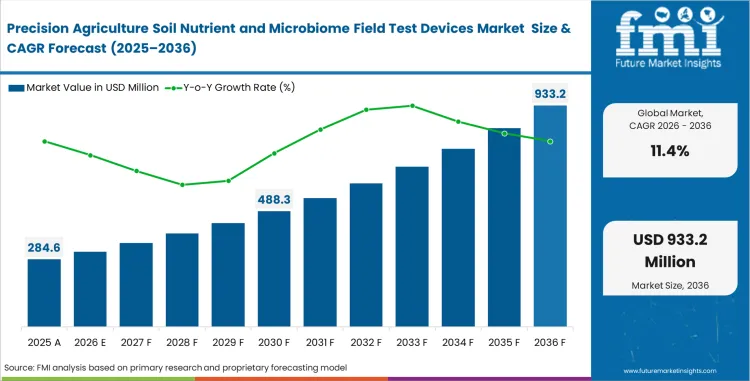
Precision agriculture soil nutrient and microbiome field test devices market was valued at USD 255.5 million in 2025. Industry outlook is expected to reach USD 284.6 million in 2026 at a 11.4% CAGR during the forecast period. Valuation is projected to reach USD 836.8 million by 2036 as field testing becomes more important in nutrient planning, soil variability tracking, and faster agronomy decisions.
Precision Agriculture Soil Nutrient and Microbiome Field Test Devices Market Summary
- The market is valued at USD 284.6 million in 2026, rising from USD 255.5 million in 2025, and is projected to reach USD 836.8 million by 2036.
- At 11.4% CAGR through 2036, the sector is advancing as field-based testing becomes part of routine nutrient planning, soil variability tracking, and in-season agronomy decisions.
- Farm operators and agronomy teams are placing stronger emphasis on reducing the delay between sampling and action, especially where fertilizer timing and zone-level adjustments carry direct cost impact.
- Device selection is influenced by calibration reliability, ease of field use, interpretation clarity, and availability of dealer-led support rather than laboratory-level precision alone.
- Handheld meters are expected to account for 34% share in 2026, reflecting preference for tools that can be used repeatedly across multiple field points with minimal setup.
- Crop farms are projected to contribute 41% share, as they remain closest to fertilizer decisions and field variability management.
- Field testing workflows are moving toward repeated use models where portable readings guide sampling depth, follow-up testing, and input application timing.
Key Takeaways, Market Size, and Forecast
- Precision Agriculture Soil Nutrient and Microbiome Field Test Devices Market is projected to increase from USD 284.6 million in 2026 to USD 836.8 million by 2036, at a CAGR of 11.4%.
- The precision agriculture soil nutrient and microbiome field test devices market was valued at USD 255.5 million in 2025.
- By 2036, the Precision Agriculture Soil Nutrient and Microbiome Field Test Devices Market is expected to be worth USD 836.8 million.
- From 2026 through 2036, the market is likely to progress at a CAGR of 11.4%.
- The market is projected to create an incremental opportunity of USD 552.2 million during the study period.
- In 2026, Handheld meters are expected to account for 34.0% of the product type segment.
- India (13.4%) and Brazil (12.6%) are two of the fastest growing markets.
Precision Agriculture Soil Nutrient and Microbiome Field Test Devices Market Key Takeaways
| Parameter | Details |
|---|---|
| Market value (2026) | USD 284.6 million |
| Forecast value (2036) | USD 836.8 million |
| CAGR (2026 to 2036) | 11.4% |
| Estimated market value (2025) | USD 255.5 million |
| Incremental opportunity | USD 552.2 million |
| Leading product type | Handheld meters |
| Leading parameter | Macronutrients |
| Leading technology | Electrochemical |
| Leading sample mode | Direct soil |
| Leading user | Crop farms |
| Leading sales channel | Distributor dealers |
| Leading region | North America |
| Fastest-growing country | India |
| India CAGR | 13.4% |
| Key supplier brands referenced in market landscape | HORIBA, Hanna Instruments, LaMotte |
| Brands referenced in market landscape | HORIBA, Hanna Instruments, LaMotte, Sentek Technologies, Teralytic, Prolific Earth Sciences |
Source: Future Market Insights (FMI) analysis, based on proprietary forecasting model and primary research
Farm managers and agronomy teams now need faster soil readings that can be used during the crop cycle, not only after a lab report arrives. Portable field devices fit that requirement because they shorten the gap between sampling and action, especially where fertilizer timing, zone management, and repeated field checks matter. Nearby categories such as soil-testing equipment and smart agriculture support the same commercial direction by reinforcing the use of field-based decision tools. Portable devices are not being adopted only to replace laboratories. Many users first adopt them to decide where deeper testing is actually needed.
Wider adoption becomes easier once field teams trust device readings enough to use them regularly rather than as occasional checks. Agronomists, cooperatives, and growers create that change when nutrient meters, salinity probes, and microbiome kits begin to influence fertilizer timing, sample selection, and follow-up testing in one connected workflow. Once that habit is in place, repeat kit use, device replacement, and software-linked interpretation become easier to justify.
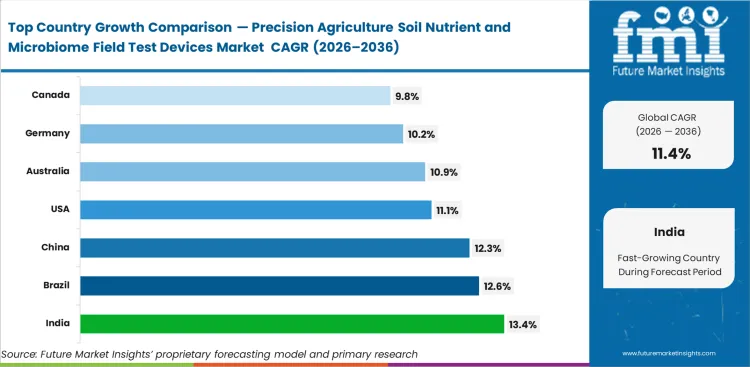
India is projected to register 13.4% CAGR through 2036, followed by Brazil at 12.6%, China at 12.3%, and the United States at 11.1%. Australia is set to record 10.9%, Germany 10.2%, and Canada 9.8% during the same period. Variation across this country set comes from differences in fertilizer-efficiency pressure, farm-scale variability, dealer support, and the pace at which field testing becomes part of routine agronomy work.
Microbiome Testing Must Prove Agronomic Relevance in Precision Agriculture Soil Nutrient and Microbiome Field Test Devices Market
Microbiome measurement is attracting attention, but the commercial hurdle is moving from scientific curiosity to field actionability. USDA ARS’s 2025 annual report states that soil microbiome and ecosystem research is needed to understand soil community members and the functions they serve, reflecting how much value still depends on translating biological signals into management choices. NIFA’s FY2026 AFRI call, published in 2025, also groups microbiome data with soil health indicators and soil metrics, which suggests microbiome testing is being pulled into broader soil-health analytics rather than treated as a stand-alone niche.
Segmental Analysis
Key Facts About Segments
- Handheld meters are projected to account for 34% share in 2026, supported by their portability, faster startup, and better fit with repeated field sampling routines.
- Macronutrients are expected to hold 29% share in 2026 because nitrogen, phosphorus, and potassium remain closest to practical fertilizer decisions and visible crop response.
- Electrochemical technology is likely to contribute 31% share in 2026, reflecting its balance of usable accuracy, portability, and field practicality.
- Direct soil methods are forecast to represent 38% share in 2026, as fewer handling steps keep testing closer to actual field conditions and same-day decisions.
- Crop farms are projected to lead with 41% share in 2026 because they sit closest to fertilizer timing, field variability, and the cost of weak nutrient placement.
- Distributor dealers are expected to account for 37% share in 2026, supported by stronger demand for local guidance on device fit, calibration habits, and repeat use.
- North America is likely to represent 32% share in 2026, supported by established precision-agriculture workflows, advisory depth, and stronger acceptance of field-level data tools.
Precision Agriculture Soil Nutrient and Microbiome Field Test Devices Market Analysis by Product Type
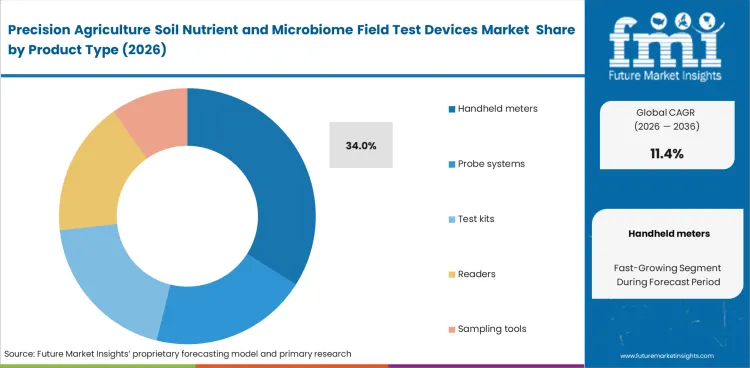
Field teams usually buy portability before they buy sophistication because a device that stays in the truck rarely becomes part of routine agronomy work. Handheld meters are expected to account for 34% share in 2026 within Product Type for that reason. Carrying them across multiple sampling points is easier, training burden is lighter, and reading turnaround fits same-day field decisions better than larger systems. Probe systems and reader-linked kits still matter where repeat depth or broader parameter coverage is needed, yet first adoption often starts with tools that make daily field use practical. Nearby categories such as soil-testing kit and soil-field testing equipment point in the same direction. Weak portability often leads to weak usage frequency, and that limits the value users get after purchase.
- Carry ease: Lightweight devices fit routine sampling rounds more naturally. Bulky equipment often gets reserved for selective visits instead of regular field use.
- Setup burden: Faster startup keeps readings closer to the decision moment. Longer preparation time can push users back toward delayed testing habits.
- Adoption path: Simpler tools lower the barrier for first-time users. Overly involved equipment can narrow usage to specialist staff and reduce repeat use.
Precision Agriculture Soil Nutrient and Microbiome Field Test Devices Market Analysis by Parameter
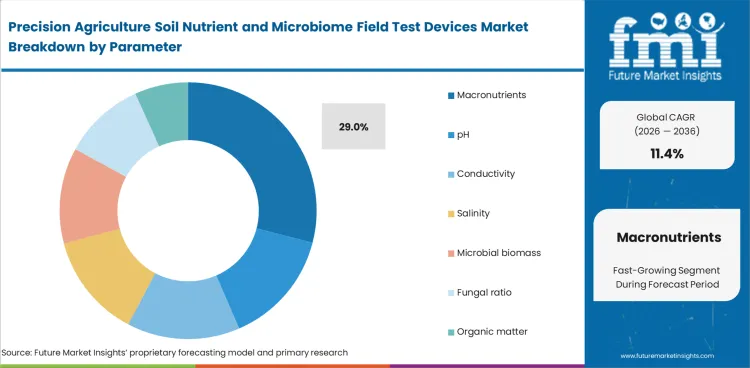
Fertilizer decisions still center most directly on nitrogen, phosphorus, and potassium, which keeps macronutrients at the front of field-testing priorities. Market estimates place macronutrients at 29% share in 2026 within the Parameter segment because growers usually want readings that connect quickly with input planning and visible crop response. pH, salinity, and conductivity remain important, while microbiome and organic matter indicators are drawing more attention where soil-health programs become more disciplined. Buyer logic here is practical. Devices tied to immediate crop nutrition earn earlier approval because the agronomic effect of delay is easier to see and easier to discuss on-farm. Broader biological indicators may deepen over time, but nutrient-focused testing still anchors most first purchases.
- Input relevance: Macronutrient readings sit closest to fertilizer timing and rate decisions. Parameters with a looser link to action often get treated as secondary checks.
- Advisory clarity: Agronomists can translate nutrient readings into practical recommendations faster. Less direct parameters may need more explanation before they influence field action.
- Trial conversion: Clear connection to crop feeding improves first-use credibility. Weak connection to immediate practice can slow repeat testing.
Precision Agriculture Soil Nutrient and Microbiome Field Test Devices Market Analysis by Technology
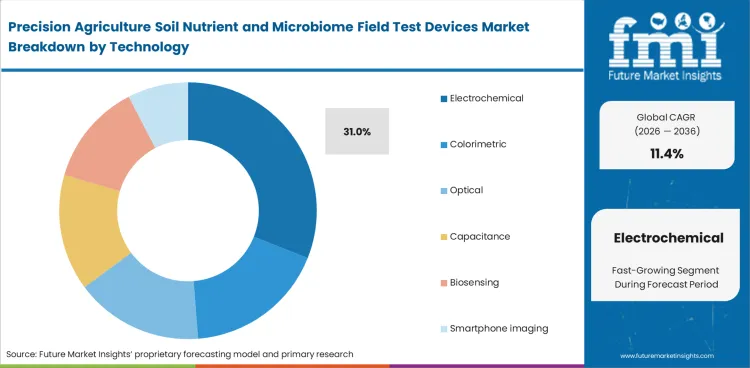
Buyers stay with technologies they can trust in field conditions, and that keeps electrochemical devices in the lead. Electrochemical tools are likely to represent 31% of the Technology segment in 2026 because they balance usable accuracy, portability, and field practicality better than more involved options in many farm settings. Optical, colorimetric, and biosensing methods continue to widen the category, especially in microbiome and soil-health work, yet electrochemical platforms remain easier to embed in day-to-day nutrient and salinity checks.
- Reading discipline: Electrochemical methods suit repeated field checks with simpler operating routines. More demanding technologies can narrow who is willing to use them consistently.
- Cost balance: Users often accept moderate sophistication when field usability stays high. Advanced methods lose appeal if everyday operation becomes harder to justify.
- Service practicality: Easier maintenance improves uptime in farm conditions. Delicate systems can create repair delays and idle equipment.
Precision Agriculture Soil Nutrient and Microbiome Field Test Devices Market Analysis by Sample Mode
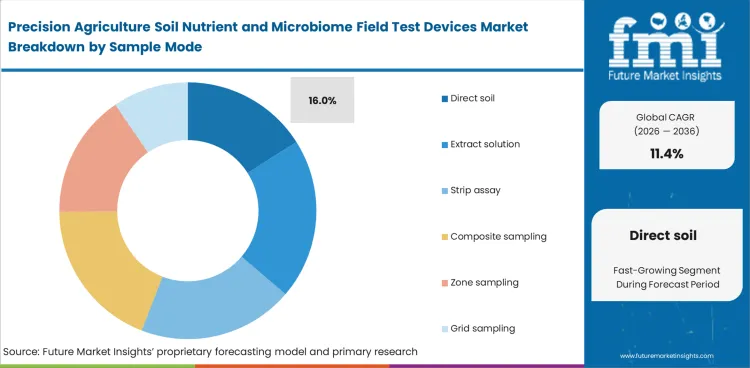
Handling time matters almost as much as measurement quality when field teams decide which testing approach will actually be used. Direct soil methods are projected to contribute 38% share in 2026 within Sample Mode because they reduce extra preparation and keep readings closer to the condition growers are trying to manage. Extract solutions and strip assays still offer support where a more controlled reading is preferred, but each added handling step increases the chance that routine use falls away. Agronomy work rewards methods that fit pace and practicality. Devices tied to direct soil contact therefore remain attractive where growers need enough insight to act without turning every test into a mini lab exercise.
- Field pace: Fewer handling steps keep testing practical during active farm schedules. Slower methods are easier to postpone.
- Sampling discipline: Direct contact makes repeated checks more realistic across larger fields. Multi-step preparation can reduce coverage density.
- Decision timing: Faster reading keeps corrective action closer to the sampling event. Delayed interpretation weakens in-season usefulness.
Precision Agriculture Soil Nutrient and Microbiome Field Test Devices Market Analysis by User
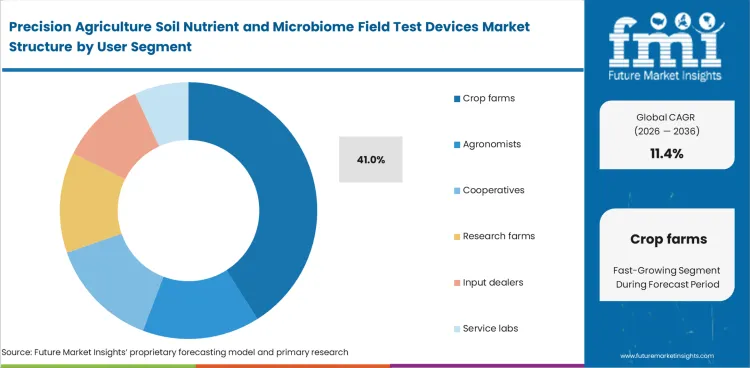
Operational value is highest where soil readings can be turned into immediate field action, which is why crop farms remain the leading user group. By 2026, crop farms are likely to contribute 41% of total User share because they sit closest to fertilizer timing, field variability, and the cost of getting nutrient placement wrong. Agronomists, cooperatives, research farms, and service labs all influence adoption, yet growers themselves still carry the strongest reason to use portable devices more often once testing becomes practical. Support also comes from adjacent categories such as precision planting and smart agriculture, where field-level decision tools become more common when they tie back to daily farm management rather than one-time evaluation.
- Action proximity: Crop farms can move from reading to field decision quickly. Indirect users may need more time before results influence practice.
- Cost exposure: Growers feel the effect of poor nutrient timing more directly. Clearer ownership usually strengthens device use frequency.
- Use continuity: Repeated in-field use builds practical confidence. Sporadic testing by outside parties may not create the same habit.
Precision Agriculture Soil Nutrient and Microbiome Field Test Devices Market Analysis by Sales Channel
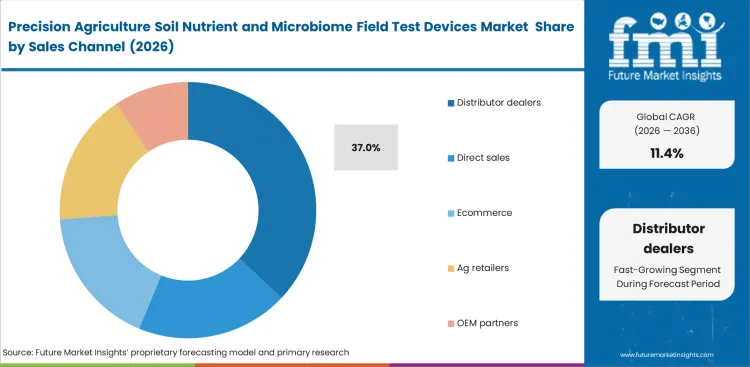
Advice still sells a large share of these devices, which keeps distributor dealers ahead of other channels. A 37% share is expected for distributor dealers in 2026 within Sales Channel because many users want guidance on device fit, calibration habits, and the difference between a useful field aid and an underused gadget. Direct sales and ecommerce are rising, especially where users already understand the category, but advisory support remains important during early adoption and product comparison. Channel strength here comes from local familiarity, not just inventory reach. Dealer-led sales also tend to support consumable replenishment and follow-on device use more effectively than low-touch channels.
- Selection support: Dealer guidance helps match tools to real farm use cases. Weak advice can lead to a purchase that does not fit field practice.
- Training carryover: Local sellers often help users build early testing discipline. Thin post-sale support can reduce repeat use.
- Consumable pull-through: Recurring kits and accessories move more smoothly through trusted channels. Pure price-led selling may not sustain long-term usage.
Precision Agriculture Soil Nutrient and Microbiome Field Test Devices Market Analysis by Region
Established precision-agriculture habits give North America the broadest regional base in this category. North America is anticipated to emerge with 32% market share in 2026 because large-scale cropping systems, stronger agronomic advisory networks, and wider acceptance of field-level digital tools support portable testing uptake. Europe remains relevant where nutrient discipline and soil stewardship are well developed, while Asia Pacific brings the stronger expansion profile through farm modernization and fertilizer-efficiency pressure. Regional leadership here does not depend on one single product class. It comes from a wider base of users who already see field data as a normal part of agronomy work.
- Practice maturity: Established precision-agriculture use helps portable testing fit existing workflows. Regions with weaker digital field habits may move more slowly.
- Channel depth: Dealer and advisory networks help devices convert from trial to repeat use. Thin local support can leave equipment underused.
- Data culture: Users already familiar with field-level decisions adopt testing tools more easily. Low comfort with interpreted farm data can hold back wider use.
Precision Agriculture Soil Nutrient and Microbiome Field Test Devices Market Drivers, Restraints, and Opportunities
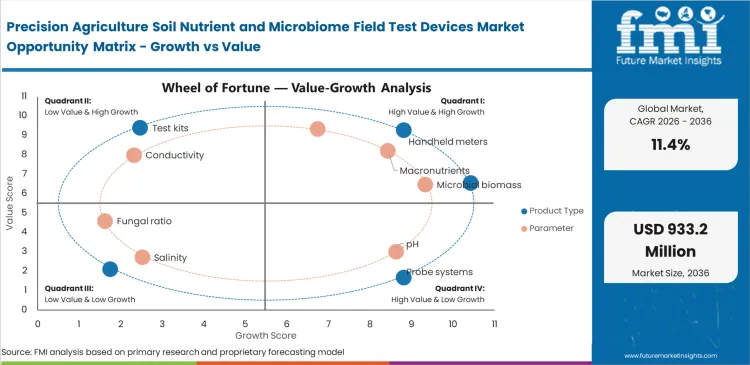
Fertilizer-use discipline is becoming harder to manage through delayed testing alone, and that is pushing more growers and agronomy teams toward field-ready devices. Nutrient timing, localized soil variation, and pressure to avoid unnecessary application all favor faster readings that can support same-season action. Portable devices are on a positive trend because they compress the gap between sampling and response, especially where variable-rate work or repeated field checks are becoming more common.
Internal use discipline still limits wider adoption more than pure product availability. Device users often like the idea of field testing, yet repeat use falls when calibration habits are weak, interpretation feels uncertain, or field staff are not sure how much confidence to place in one reading. Lab services remain familiar, which means portable tools must prove they improve decision timing without creating false certainty. Better software, easier interfaces, and stronger advisory support can reduce that problem, but none of them fully solve poor sampling habits or inconsistent use in the field.
Opportunities in the Precision Agriculture Soil Nutrient and Microbiome Field Test Devices Market
- Microbiome screening: Soil-health programs create room for portable kits that make biological indicators easier to read in the field. Suppliers that reduce interpretation burden can widen use beyond research-led users.
- Dealer-led advisory: Local agronomy channels can turn first purchases into repeat testing routines when device training and replenishment stay close to the point of sale.
- Workflow pairing: Products that connect nutrient readings with mapping, recordkeeping, or follow-up lab decisions can gain ground when growers want faster action without abandoning deeper analysis.
Regional Analysis
Key Facts About Country
- India is identified as the fastest-growing market in this set, with a projected 13.4% CAGR through 2036, supported by fertilizer-efficiency pressure and broad room for field-testing adoption.
- Brazil follows at 12.6%, where large cultivated areas and uneven soil conditions strengthen the commercial case for portable nutrient and microbiome testing tools.
- China is expected to expand at 12.3%, supported by ongoing precision-agriculture modernization and the need for practical field tools that fit daily agronomy work.
- The United States records 11.1%, where adoption is supported by stronger precision-agriculture habits, field mapping use, and advisory-led nutrient planning.
- Australia stands at 10.9%, with salinity exposure, field variability, and large operating areas sustaining demand for quicker field-based soil decisions.
- Germany is projected to grow at 10.2%, where soil documentation discipline and advisory-backed interpretation support more repeatable portable testing use.
- Canada posts 9.8%, remaining relevant where large field operations and variable growing conditions make quicker soil checks useful before deeper lab validation.
Based on the regional analysis, the Precision Agriculture Soil Nutrient and Microbiome Field Test Devices Market is segmented into North America, Latin America, Europe, Asia Pacific, and the Middle East & Africa across 40 plus countries.
.webp "Top Country Growth Comparison Precision Agriculture Soil Nutrient And Microbiome Field Test Devices Market Cagr (2026 2036)")
| Country | CAGR (2026 to 2036) |
|---|---|
| India | 13.4% |
| Brazil | 12.6% |
| China | 12.3% |
| United States | 11.1% |
| Australia | 10.9% |
| Germany | 10.2% |
| Canada | 9.8% |
Source: Future Market Insights (FMI) analysis, based on proprietary forecasting model and primary research
Americas Precision Agriculture Soil Nutrient and Microbiome Field Test Devices Market Analysis
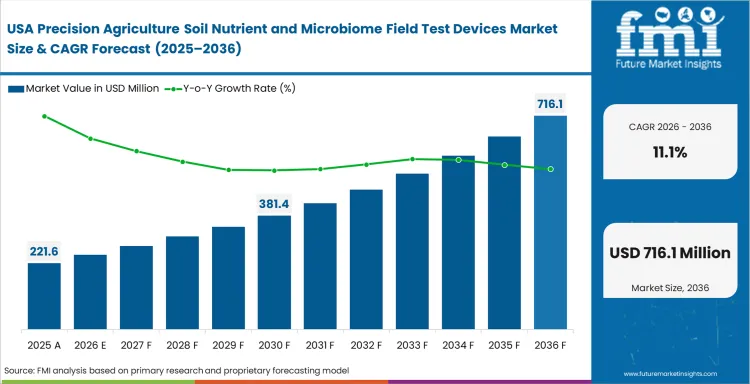
Large-scale cropping, fertilizer cost exposure, and the need to act on field variability keep the Americas commercially important in this category. Brazil adds the faster expansion profile, while the United States and Canada provide a broader installed base for repeat device use, channel depth, and recurring kit consumption. Portable soil devices fit this region best when they shorten the gap between sampling and nutrient action, especially across wider acreages where waiting for every decision to follow a lab cycle can slow field response. Field-level testing gains traction here when growers can connect readings directly with application planning rather than treating them as occasional technical checks.
- Brazil: Uneven soil conditions across large cultivated areas make Brazil one of the clearest use cases for portable nutrient and microbiome testing devices. Agronomy teams need tools that help separate high-priority zones from lower-risk areas without turning every field check into a delayed laboratory exercise. That operating need is strongest in systems where fertilizer planning has a direct bearing on margin protection and field correction has to happen fast. Industry outlook in Brazil is expected to expand at a CAGR of 12.6% from 2026 to 2036. Adoption is likely to remain strongest where dealer support, agronomy interpretation, and repeated field sampling stay connected rather than being treated as separate decisions.
- United States: A CAGR of 11.1% is expected for the market in the United States through 2036. Precision-agriculture practice is already better established there than in many faster-rising countries, which gives this market a more mature commercial base. Users tend to evaluate these devices by repeatability, ease of use, and how well they fit existing nutrient management routines rather than by novelty alone. Field maps, zone management, and advisory-led soil interpretation make portable tools more relevant when they can support same-season action. Pace is more measured than in Brazil or India, yet device use is likely to remain steady because growers are more accustomed to linking field readings with broader farm data rather than using them in isolation.
- Canada: Large field operations and variable growing conditions give Canada a practical reason to keep soil testing close to field decisions. Canada is likely to post 9.8% CAGR in this market through 2036. Portable devices gain relevance where growers want quicker checks on nutrient condition without losing the option to validate selected samples through deeper lab work. Advisory input still matters because users need confidence in how to interpret a field reading before it influences nutrient placement. Rate is lower than in the faster-moving countries, but repeat use can stay healthy where local support keeps testing tied to routine agronomy instead of occasional seasonal review.
FMI's report includes Mexico, Argentina, and other countries across the wider Americas. Commercial depth outside the named countries depends largely on cropping intensity, agronomy-channel maturity, and how closely soil testing is tied to fertilizer-efficiency decisions at field level.
Europe Precision Agriculture Soil Nutrient and Microbiome Field Test Devices Market Analysis
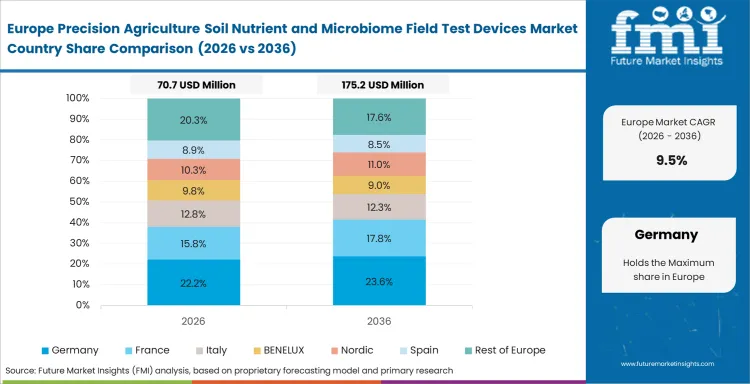
Closer attention to soil condition and more disciplined nutrient planning keep Europe relevant even when expansion remains more measured than in higher-catch-up regions. Germany stands out because commercial farming there is more likely to absorb portable tools that help narrow nutrient uncertainty before application decisions are finalized. Device adoption in this region tends to rise where field documentation already carries weight in crop management and where advisory-led interpretation reduces the risk of underusing the equipment. Commercial value remains tied to practical agronomy use, not occasional testing activity.
- Germany: Documented field management gives Germany a stronger base for this category than many neighboring countries. Growers and agronomy teams are more likely to adopt portable devices when they can use them to refine nutrient decisions before committing to application plans or selecting samples for fuller laboratory review. Industry outlook in Germany points to 10.2% CAGR through 2036. Readings become more useful when they fit an existing discipline around soil condition rather than being treated as occasional checks. Expansion is not the fastest in the country set, yet category relevance remains solid because buyers place value on repeatable field evidence and practical interpretation instead of short-term experimentation.
FMI's report includes Benelux and Nordic regions. Farming systems in these areas follow a similar pattern, with closer attention placed on field documentation, input efficiency, and advisory-led interpretation rather than impulse equipment buying.
Asia Pacific Precision Agriculture Soil Nutrient and Microbiome Field Test Devices Market Analysis
Wide variation in farming conditions gives Asia Pacific the strongest expansion profile in this market. India and China carry the largest forward momentum, while Australia provides a steadier base where salinity, field variability, and practical agronomy tools remain commercially relevant. Portable testing devices work well in this region when they reduce the delay between field sampling and nutrient action without making routine use too difficult for local farm teams. Commercial uptake improves most where quick field interpretation can be built into normal crop-management practice.
- India: Industry outlook in India is set to advance at a CAGR of 13.4% through 2036. Fertilizer efficiency, broad cultivation spread, and uneven field conditions place India at the front of the country set. Portable devices attract interest because they can shorten the lag between sampling and nutrient advice in a setting where faster interpretation can materially improve field planning. Dealer guidance and practical training will matter because first-time adoption does not always convert into repeat use unless the reading is easy to trust and act on. Room for wider penetration remains high, which keeps India ahead of the rest of the country group.
- China: Scale gives China a large addressable base, but lasting device use depends more on fit with farm management routines than on acreage alone. Portable tools gain ground when they can support broader precision-agriculture practice and when local service support helps users build confidence in regular field interpretation. Industry outlook in China is forecast to register 12.3% CAGR through 2036. Adoption is likely to deepen where devices can move beyond trial use and become part of day-to-day agronomy work. Strong pace reflects the category’s relevance in a market where modernization still needs practical tools that field teams can use consistently.
- Australia: By 2036, Australia is projected to record a CAGR of 10.9% in this market. Salinity exposure, field variability, and large operating areas give the country a practical case for keeping soil testing close to crop decisions. Distance and time often make repeated dependence on lab-only workflows less convenient, which improves the appeal of field-ready devices that can provide quicker readings. Users in this market often place more value on reliability and direct agronomic usefulness than on added feature depth that slows routine use. Momentum is steadier than in India or China, yet the operating case remains strong because the tools answer a clear field-management need.
FMI's report includes Japan, South Korea, Southeast Asia, and other countries across Asia Pacific. Regional variation remains wide because farm scale, advisory depth, and digital agronomy habits do not mature at the same pace across the region.
Competitive Aligners for Market Players
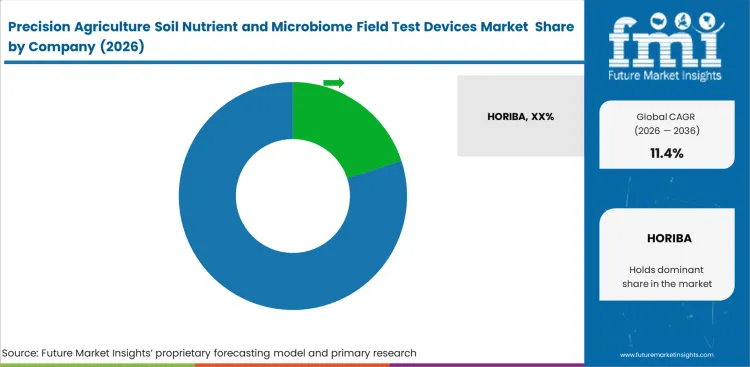
Buyer choice in this market usually begins with repeatability, ease of field use, and confidence in how readings can be turned into agronomic action. HORIBA, Hanna Instruments, LaMotte, Sentek Technologies, Teralytic, and Prolific Earth Sciences remain visible participants, but competitive separation does not come from brand visibility alone. Crop advisors and growers compare how quickly a device can be used, how much preparation it needs, how easily results can be explained, and whether support is available once field use begins. Fragmentation remains because no single supplier covers every need across nutrient testing, salinity sensing, and microbiome screening.
Incumbents benefit from advisory familiarity, product range, and channel relationships that keep the device close to the field user after the first sale. Challengers can still win where they make a narrower use case easier, especially in microbiome kits, software-linked interpretation, or lighter portable formats. Adjacent support also comes from soil-health nano sensors and agricultural microbials, where users already accept closer measurement of biological soil condition. Competitive strength therefore rests less on broad claims and more on whether the product becomes part of a repeat field routine.
Large users are unlikely to remain tied to tools that add reading complexity without improving decision timing. Vendors that keep training, calibration discipline, and result interpretation manageable are better placed to remain active in farm use through 2036. Category concentration is expected to stay moderate to fragmented because the market still spans several product classes, user types, and advisory channels rather than converging around one dominant equipment format.
Key Players in Precision Agriculture Soil Nutrient and Microbiome Field Test Devices Market
- HORIBA
- Hanna Instruments
- LaMotte
- Sentek Technologies
- Teralytic
- Prolific Earth Sciences
Scope of the Report
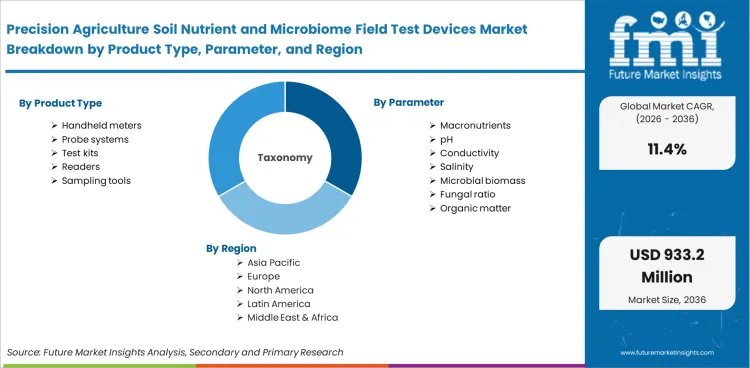
| Metric | Value |
|---|---|
| Quantitative Units | USD 284.6 million to USD 836.8 million, at a CAGR of 11.4% |
| Market Definition | Precision Agriculture Soil Nutrient and Microbiome Field Test Devices Market covers portable and field-deployable tools used to assess soil nutrients, pH, conductivity, salinity, and biological soil indicators directly at field level. Scope is limited to products that support on-site agronomic decisions and repeated commercial farm use. |
| Product Type Segmentation | Handheld meters, Probe systems, Test kits, Readers, Sampling tools |
| Parameter Segmentation | Macronutrients, pH, Conductivity, Salinity, Microbial biomass, Fungal ratio, Organic matter |
| Technology Segmentation | Electrochemical, Colorimetric, Optical, Capacitance, Biosensing, Smartphone imaging |
| Sample Mode Segmentation | Direct soil, Extract solution, Strip assay, Composite sampling, Zone sampling, Grid sampling |
| User Segmentation | Crop farms, Agronomists, Cooperatives, Research farms, Input dealers, Service labs |
| Sales Channel Segmentation | Distributor dealers, Direct sales, Ecommerce, Ag retailers, OEM partners |
| Regions Covered | North America, Latin America, Europe, Asia Pacific, Middle East & Africa |
| Countries Covered | India, Brazil, China, United States, Australia, Germany, Canada, and 40 plus countries |
| Key Companies Profiled | HORIBA, Hanna Instruments, LaMotte, Sentek Technologies, Teralytic, Prolific Earth Sciences |
| Forecast Period | 2026 to 2036 |
| Approach | Future Market Insights combined primary interviews with agronomy and channel participants, product-level desk review, and adoption-led market sizing. Baseline demand was tied to portable field-testing use in nutrient management and soil-health workflows. Forecast validation considered channel reach, farm technology habits, and repeat consumable demand. |
Source: Future Market Insights (FMI) analysis, based on proprietary forecasting model and primary research
Precision Agriculture Soil Nutrient and Microbiome Field Test Devices Market Analysis by Segments
Product Type
- Handheld meters
- Probe systems
- Test kits
- Readers
- Sampling tools
Parameter
- Macronutrients
- pH
- Conductivity
- Salinity
- Microbial biomass
- Fungal ratio
- Organic matter
Technology
- Electrochemical
- Colorimetric
- Optical
- Capacitance
- Biosensing
- Smartphone imaging
Sample Mode
- Direct soil
- Extract solution
- Strip assay
- Composite sampling
- Zone sampling
- Grid sampling
User
- Crop farms
- Agronomists
- Cooperatives
- Research farms
- Input dealers
- Service labs
Sales Channel
- Distributor dealers
- Direct sales
- Ecommerce
- Ag retailers
- OEM partners
Region
- North America
- United States
- Canada
- Latin America
- Brazil
- Europe
- Germany
- Asia Pacific
- India
- China
- Australia
- Middle East & Africa
Bibliography
- U.S. Department of Agriculture, Agricultural Research Service. (2025, February 19). National Program 212: Soil and Air national program retrospective report 2020–2024.
- U.S. Department of Agriculture, National Institute of Food and Agriculture. (2025). Request for applications: Agriculture and Food Research Initiative competitive grants program, Foundational and Applied Science Program, funding year: Fiscal Year (FY) 2026.
- Food and Agriculture Organization of the United Nations. (2024). World Soil Day 2024 underlines vital importance of accurate soil data and information for food security.
- United States Department of Agriculture, Economic Research Service. (2024). Precision agriculture use increases with farm size and varies widely by technology.
- McFadden, J., & Lim, K. (2024). Global Adoption of Precision Agriculture: An Update on Trends and Emerging Technologies
This bibliography is provided for reader reference. The full FMI report contains the complete reference list with primary source documentation.
This Report Addresses
- Market intelligence for handheld nutrient meters, probe systems, field readers, microbiome kits, and direct soil testing tools.
- Market size estimation and 10-year revenue forecasts from 2026 to 2036 using adoption-led field testing logic.
- Opportunity mapping across product type, parameter, technology, sample mode, user, sales channel, and region.
- Segment and regional forecasts covering handheld meters, macronutrients, electrochemical tools, direct soil methods, and crop farms.
- Competition analysis across advisory support, usability, calibration discipline, portability, interpretation ease, and repeat consumable potential.
- Product tracking across nutrient analyzers, salinity and conductivity devices, microbiome kits, field readers, and device-linked sampling tools.
- Market access analysis covering dealer channels, agronomy networks, cooperative participation, and field interpretation support.
- Report delivery in PDF, Excel, PPT, and interactive dashboard formats for executive planning, agronomy review, and benchmarking use.
Frequently Asked Questions
How large is the market in 2026?
It is valued at USD 284.6 million in 2026, showing a specialized but steadily expanding field-testing category.
What will the market be worth by 2036?
It is projected to reach USD 836.8 million by 2036 as field testing becomes more routine.
What CAGR is expected from 2026 to 2036?
Future Market Insights expects a 11.4% CAGR for 2026 to 2036 in this market.
Which Product Type segment leads?
Handheld meters lead Product Type and are expected to account for 34% share in 2026.
Which Parameter segment leads?
Macronutrients lead the Parameter segment with an expected 29% share in 2026.
Which Technology segment leads?
Electrochemical devices lead Technology and are projected to hold 31% share in 2026.
What is pushing this market forward?
Faster soil decisions, better fertilizer timing, and repeated field checks are making portable tools more useful.
What is the main restraint?
Weak calibration habits and uncertain interpretation can reduce repeat use after early device trials.
Which country is rising fastest?
India leads the country set with a projected 13.4% CAGR through 2036.
Why is India ahead of Brazil?
India has wider room for field-testing adoption across a large cultivation base and rising nutrient-efficiency pressure.
Why do handheld meters lead this market?
They are easier to carry, easier to learn, and better suited to repeated field use.
Why does direct soil testing lead Sample Mode?
It cuts handling steps and keeps readings closer to actual field conditions.
Why do crop farms lead the User segment?
Crop farms can act quickly on soil readings, especially for fertilizer timing and field variability.
Why do distributor dealers lead Sales Channel?
Users still rely on local guidance for device selection, setup, and repeat use.
Do these devices fully replace laboratory testing?
No. Many users employ them first for quicker field decisions and selective follow-up testing.
What is included in this market?
Portable nutrient meters, salinity and pH devices, microbiome kits, field readers, and sampling tools are included.
What is excluded from this market?
Lab-only services, remote-sensing-only platforms, hobby kits, and large fixed systems are excluded.
Lab-only services, remote-sensing-only platforms, hobby kits, and large fixed systems are excluded.
Soil-health programs are expanding, and users want faster biological indicators at field level.
Why does North America lead by share?
Precision-agriculture habits are stronger there, and field data is already part of routine farm decisions.
Why does Europe still matter here?
Europe remains relevant because soil documentation and nutrient discipline are already well established.
What do users compare when choosing suppliers?
They compare repeatability, ease of use, result clarity, support, and everyday field practicality.
Will this market stay fragmented through 2036?
Yes. Multiple product types and user groups keep room open for several specialist suppliers.
Preview the report firsthand - request a free sample
Get SampleGet the brochure for pricing and purchase details.
Get PDFTable of Content
- Executive Summary
- Global Market Outlook
- Demand-side Trends
- Supply-side Trends
- Technology Roadmap Analysis
- Analysis and Recommendations
- Market Overview
- Market Coverage / Taxonomy
- Market Definition / Scope / Limitations
- Research Methodology
- Chapter Orientation
- Analytical Lens and Working Hypotheses
- Market Structure, Signals, and Trend Drivers
- Benchmarking and Cross-market Comparability
- Market Sizing, Forecasting, and Opportunity Mapping
- Research Design and Evidence Framework
- Desk Research Programme (Secondary Evidence)
- Company Annual and Sustainability Reports
- Peer-reviewed Journals and Academic Literature
- Corporate Websites, Product Literature, and Technical Notes
- Earnings Decks and Investor Briefings
- Statutory Filings and Regulatory Disclosures
- Technical White Papers and Standards Notes
- Trade Journals, Industry Magazines, and Analyst Briefs
- Conference Proceedings, Webinars, and Seminar Materials
- Government Statistics Portals and Public Data Releases
- Press Releases and Reputable Media Coverage
- Specialist Newsletters and Curated Briefings
- Sector Databases and Reference Repositories
- FMI Internal Proprietary Databases and Historical Market Datasets
- Subscription Datasets and Paid Sources
- Social Channels, Communities, and Digital Listening Inputs
- Additional Desk Sources
- Expert Input and Fieldwork (Primary Evidence)
- Primary Modes
- Qualitative Interviews and Expert Elicitation
- Quantitative Surveys and Structured Data Capture
- Blended Approach
- Why Primary Evidence is Used
- Field Techniques
- Interviews
- Surveys
- Focus Groups
- Observational and In-context Research
- Social and Community Interactions
- Stakeholder Universe Engaged
- C-suite Leaders
- Board Members
- Presidents and Vice Presidents
- R&D and Innovation Heads
- Technical Specialists
- Domain Subject-matter Experts
- Scientists
- Physicians and Other Healthcare Professionals
- Governance, Ethics, and Data Stewardship
- Research Ethics
- Data Integrity and Handling
- Primary Modes
- Tooling, Models, and Reference Databases
- Desk Research Programme (Secondary Evidence)
- Data Engineering and Model Build
- Data Acquisition and Ingestion
- Cleaning, Normalisation, and Verification
- Synthesis, Triangulation, and Analysis
- Quality Assurance and Audit Trail
- Market Background
- Market Dynamics
- Drivers
- Restraints
- Opportunity
- Trends
- Scenario Forecast
- Demand in Optimistic Scenario
- Demand in Likely Scenario
- Demand in Conservative Scenario
- Opportunity Map Analysis
- Product Life Cycle Analysis
- Supply Chain Analysis
- Investment Feasibility Matrix
- Value Chain Analysis
- PESTLE and Porter’s Analysis
- Regulatory Landscape
- Regional Parent Market Outlook
- Production and Consumption Statistics
- Import and Export Statistics
- Market Dynamics
- Global Market Analysis 2021 to 2025 and Forecast, 2026 to 2036
- Historical Market Size Value (USD Million) Analysis, 2021 to 2025
- Current and Future Market Size Value (USD Million) Projections, 2026 to 2036
- Y-o-Y Growth Trend Analysis
- Absolute $ Opportunity Analysis
- Global Market Pricing Analysis 2021 to 2025 and Forecast 2026 to 2036
- Global Market Analysis 2021 to 2025 and Forecast 2026 to 2036, By Product Type
- Introduction / Key Findings
- Historical Market Size Value (USD Million) Analysis By Product Type , 2021 to 2025
- Current and Future Market Size Value (USD Million) Analysis and Forecast By Product Type , 2026 to 2036
- Handheld meters
- Probe systems
- Test kits
- Readers
- Sampling tools
- Handheld meters
- Y-o-Y Growth Trend Analysis By Product Type , 2021 to 2025
- Absolute $ Opportunity Analysis By Product Type , 2026 to 2036
- Global Market Analysis 2021 to 2025 and Forecast 2026 to 2036, By Parameter
- Introduction / Key Findings
- Historical Market Size Value (USD Million) Analysis By Parameter, 2021 to 2025
- Current and Future Market Size Value (USD Million) Analysis and Forecast By Parameter, 2026 to 2036
- Macronutrients
- pH
- Conductivity
- Salinity
- Microbial biomass
- Fungal ratio
- Organic matter
- Macronutrients
- Y-o-Y Growth Trend Analysis By Parameter, 2021 to 2025
- Absolute $ Opportunity Analysis By Parameter, 2026 to 2036
- Global Market Analysis 2021 to 2025 and Forecast 2026 to 2036, By Technology
- Introduction / Key Findings
- Historical Market Size Value (USD Million) Analysis By Technology, 2021 to 2025
- Current and Future Market Size Value (USD Million) Analysis and Forecast By Technology, 2026 to 2036
- Electrochemical
- Colorimetric
- Optical
- Capacitance
- Biosensing
- Smartphone imaging
- Electrochemical
- Y-o-Y Growth Trend Analysis By Technology, 2021 to 2025
- Absolute $ Opportunity Analysis By Technology, 2026 to 2036
- Global Market Analysis 2021 to 2025 and Forecast 2026 to 2036, By Sample Mode
- Introduction / Key Findings
- Historical Market Size Value (USD Million) Analysis By Sample Mode, 2021 to 2025
- Current and Future Market Size Value (USD Million) Analysis and Forecast By Sample Mode, 2026 to 2036
- Direct soil
- Extract solution
- Strip assay
- Composite sampling
- Zone sampling
- Grid sampling
- Direct soil
- Y-o-Y Growth Trend Analysis By Sample Mode, 2021 to 2025
- Absolute $ Opportunity Analysis By Sample Mode, 2026 to 2036
- Global Market Analysis 2021 to 2025 and Forecast 2026 to 2036, By User
- Introduction / Key Findings
- Historical Market Size Value (USD Million) Analysis By User, 2021 to 2025
- Current and Future Market Size Value (USD Million) Analysis and Forecast By User, 2026 to 2036
- Crop farms
- Agronomists
- Cooperatives
- Research farms
- Input dealers
- Service labs
- Crop farms
- Y-o-Y Growth Trend Analysis By User, 2021 to 2025
- Absolute $ Opportunity Analysis By User, 2026 to 2036
- Global Market Analysis 2021 to 2025 and Forecast 2026 to 2036, By Sales Channel
- Introduction / Key Findings
- Historical Market Size Value (USD Million) Analysis By Sales Channel, 2021 to 2025
- Current and Future Market Size Value (USD Million) Analysis and Forecast By Sales Channel, 2026 to 2036
- Distributor dealers
- Direct sales
- Ecommerce
- Ag retailers
- OEM partners
- Distributor dealers
- Y-o-Y Growth Trend Analysis By Sales Channel, 2021 to 2025
- Absolute $ Opportunity Analysis By Sales Channel, 2026 to 2036
- Global Market Analysis 2021 to 2025 and Forecast 2026 to 2036, By Sample Mode
- Introduction / Key Findings
- Historical Market Size Value (USD Million) Analysis By Sample Mode, 2021 to 2025
- Current and Future Market Size Value (USD Million) Analysis and Forecast By Sample Mode, 2026 to 2036
- Direct soil methods
- Direct soil methods
- Y-o-Y Growth Trend Analysis By Sample Mode, 2021 to 2025
- Absolute $ Opportunity Analysis By Sample Mode, 2026 to 2036
- Global Market Analysis 2021 to 2025 and Forecast 2026 to 2036, By Region
- Introduction
- Historical Market Size Value (USD Million) Analysis By Region, 2021 to 2025
- Current Market Size Value (USD Million) Analysis and Forecast By Region, 2026 to 2036
- North America
- Latin America
- Western Europe
- Eastern Europe
- East Asia
- South Asia and Pacific
- Middle East & Africa
- Market Attractiveness Analysis By Region
- North America Market Analysis 2021 to 2025 and Forecast 2026 to 2036, By Country
- Historical Market Size Value (USD Million) Trend Analysis By Market Taxonomy, 2021 to 2025
- Market Size Value (USD Million) Forecast By Market Taxonomy, 2026 to 2036
- By Country
- USA
- Canada
- Mexico
- By Product Type
- By Parameter
- By Technology
- By Sample Mode
- By User
- By Sales Channel
- By Sample Mode
- By Country
- Market Attractiveness Analysis
- By Country
- By Product Type
- By Parameter
- By Technology
- By Sample Mode
- By User
- By Sales Channel
- By Sample Mode
- Key Takeaways
- Latin America Market Analysis 2021 to 2025 and Forecast 2026 to 2036, By Country
- Historical Market Size Value (USD Million) Trend Analysis By Market Taxonomy, 2021 to 2025
- Market Size Value (USD Million) Forecast By Market Taxonomy, 2026 to 2036
- By Country
- Brazil
- Chile
- Rest of Latin America
- By Product Type
- By Parameter
- By Technology
- By Sample Mode
- By User
- By Sales Channel
- By Sample Mode
- By Country
- Market Attractiveness Analysis
- By Country
- By Product Type
- By Parameter
- By Technology
- By Sample Mode
- By User
- By Sales Channel
- By Sample Mode
- Key Takeaways
- Western Europe Market Analysis 2021 to 2025 and Forecast 2026 to 2036, By Country
- Historical Market Size Value (USD Million) Trend Analysis By Market Taxonomy, 2021 to 2025
- Market Size Value (USD Million) Forecast By Market Taxonomy, 2026 to 2036
- By Country
- Germany
- UK
- Italy
- Spain
- France
- Nordic
- BENELUX
- Rest of Western Europe
- By Product Type
- By Parameter
- By Technology
- By Sample Mode
- By User
- By Sales Channel
- By Sample Mode
- By Country
- Market Attractiveness Analysis
- By Country
- By Product Type
- By Parameter
- By Technology
- By Sample Mode
- By User
- By Sales Channel
- By Sample Mode
- Key Takeaways
- Eastern Europe Market Analysis 2021 to 2025 and Forecast 2026 to 2036, By Country
- Historical Market Size Value (USD Million) Trend Analysis By Market Taxonomy, 2021 to 2025
- Market Size Value (USD Million) Forecast By Market Taxonomy, 2026 to 2036
- By Country
- Russia
- Poland
- Hungary
- Balkan & Baltic
- Rest of Eastern Europe
- By Product Type
- By Parameter
- By Technology
- By Sample Mode
- By User
- By Sales Channel
- By Sample Mode
- By Country
- Market Attractiveness Analysis
- By Country
- By Product Type
- By Parameter
- By Technology
- By Sample Mode
- By User
- By Sales Channel
- By Sample Mode
- Key Takeaways
- East Asia Market Analysis 2021 to 2025 and Forecast 2026 to 2036, By Country
- Historical Market Size Value (USD Million) Trend Analysis By Market Taxonomy, 2021 to 2025
- Market Size Value (USD Million) Forecast By Market Taxonomy, 2026 to 2036
- By Country
- China
- Japan
- South Korea
- By Product Type
- By Parameter
- By Technology
- By Sample Mode
- By User
- By Sales Channel
- By Sample Mode
- By Country
- Market Attractiveness Analysis
- By Country
- By Product Type
- By Parameter
- By Technology
- By Sample Mode
- By User
- By Sales Channel
- By Sample Mode
- Key Takeaways
- South Asia and Pacific Market Analysis 2021 to 2025 and Forecast 2026 to 2036, By Country
- Historical Market Size Value (USD Million) Trend Analysis By Market Taxonomy, 2021 to 2025
- Market Size Value (USD Million) Forecast By Market Taxonomy, 2026 to 2036
- By Country
- India
- ASEAN
- Australia & New Zealand
- Rest of South Asia and Pacific
- By Product Type
- By Parameter
- By Technology
- By Sample Mode
- By User
- By Sales Channel
- By Sample Mode
- By Country
- Market Attractiveness Analysis
- By Country
- By Product Type
- By Parameter
- By Technology
- By Sample Mode
- By User
- By Sales Channel
- By Sample Mode
- Key Takeaways
- Middle East & Africa Market Analysis 2021 to 2025 and Forecast 2026 to 2036, By Country
- Historical Market Size Value (USD Million) Trend Analysis By Market Taxonomy, 2021 to 2025
- Market Size Value (USD Million) Forecast By Market Taxonomy, 2026 to 2036
- By Country
- Kingdom of Saudi Arabia
- Other GCC Countries
- Turkiye
- South Africa
- Other African Union
- Rest of Middle East & Africa
- By Product Type
- By Parameter
- By Technology
- By Sample Mode
- By User
- By Sales Channel
- By Sample Mode
- By Country
- Market Attractiveness Analysis
- By Country
- By Product Type
- By Parameter
- By Technology
- By Sample Mode
- By User
- By Sales Channel
- By Sample Mode
- Key Takeaways
- Key Countries Market Analysis
- USA
- Pricing Analysis
- Market Share Analysis, 2025
- By Product Type
- By Parameter
- By Technology
- By Sample Mode
- By User
- By Sales Channel
- By Sample Mode
- Canada
- Pricing Analysis
- Market Share Analysis, 2025
- By Product Type
- By Parameter
- By Technology
- By Sample Mode
- By User
- By Sales Channel
- By Sample Mode
- Mexico
- Pricing Analysis
- Market Share Analysis, 2025
- By Product Type
- By Parameter
- By Technology
- By Sample Mode
- By User
- By Sales Channel
- By Sample Mode
- Brazil
- Pricing Analysis
- Market Share Analysis, 2025
- By Product Type
- By Parameter
- By Technology
- By Sample Mode
- By User
- By Sales Channel
- By Sample Mode
- Chile
- Pricing Analysis
- Market Share Analysis, 2025
- By Product Type
- By Parameter
- By Technology
- By Sample Mode
- By User
- By Sales Channel
- By Sample Mode
- Germany
- Pricing Analysis
- Market Share Analysis, 2025
- By Product Type
- By Parameter
- By Technology
- By Sample Mode
- By User
- By Sales Channel
- By Sample Mode
- UK
- Pricing Analysis
- Market Share Analysis, 2025
- By Product Type
- By Parameter
- By Technology
- By Sample Mode
- By User
- By Sales Channel
- By Sample Mode
- Italy
- Pricing Analysis
- Market Share Analysis, 2025
- By Product Type
- By Parameter
- By Technology
- By Sample Mode
- By User
- By Sales Channel
- By Sample Mode
- Spain
- Pricing Analysis
- Market Share Analysis, 2025
- By Product Type
- By Parameter
- By Technology
- By Sample Mode
- By User
- By Sales Channel
- By Sample Mode
- France
- Pricing Analysis
- Market Share Analysis, 2025
- By Product Type
- By Parameter
- By Technology
- By Sample Mode
- By User
- By Sales Channel
- By Sample Mode
- India
- Pricing Analysis
- Market Share Analysis, 2025
- By Product Type
- By Parameter
- By Technology
- By Sample Mode
- By User
- By Sales Channel
- By Sample Mode
- ASEAN
- Pricing Analysis
- Market Share Analysis, 2025
- By Product Type
- By Parameter
- By Technology
- By Sample Mode
- By User
- By Sales Channel
- By Sample Mode
- Australia & New Zealand
- Pricing Analysis
- Market Share Analysis, 2025
- By Product Type
- By Parameter
- By Technology
- By Sample Mode
- By User
- By Sales Channel
- By Sample Mode
- China
- Pricing Analysis
- Market Share Analysis, 2025
- By Product Type
- By Parameter
- By Technology
- By Sample Mode
- By User
- By Sales Channel
- By Sample Mode
- Japan
- Pricing Analysis
- Market Share Analysis, 2025
- By Product Type
- By Parameter
- By Technology
- By Sample Mode
- By User
- By Sales Channel
- By Sample Mode
- South Korea
- Pricing Analysis
- Market Share Analysis, 2025
- By Product Type
- By Parameter
- By Technology
- By Sample Mode
- By User
- By Sales Channel
- By Sample Mode
- Russia
- Pricing Analysis
- Market Share Analysis, 2025
- By Product Type
- By Parameter
- By Technology
- By Sample Mode
- By User
- By Sales Channel
- By Sample Mode
- Poland
- Pricing Analysis
- Market Share Analysis, 2025
- By Product Type
- By Parameter
- By Technology
- By Sample Mode
- By User
- By Sales Channel
- By Sample Mode
- Hungary
- Pricing Analysis
- Market Share Analysis, 2025
- By Product Type
- By Parameter
- By Technology
- By Sample Mode
- By User
- By Sales Channel
- By Sample Mode
- Kingdom of Saudi Arabia
- Pricing Analysis
- Market Share Analysis, 2025
- By Product Type
- By Parameter
- By Technology
- By Sample Mode
- By User
- By Sales Channel
- By Sample Mode
- Turkiye
- Pricing Analysis
- Market Share Analysis, 2025
- By Product Type
- By Parameter
- By Technology
- By Sample Mode
- By User
- By Sales Channel
- By Sample Mode
- South Africa
- Pricing Analysis
- Market Share Analysis, 2025
- By Product Type
- By Parameter
- By Technology
- By Sample Mode
- By User
- By Sales Channel
- By Sample Mode
- USA
- Market Structure Analysis
- Competition Dashboard
- Competition Benchmarking
- Market Share Analysis of Top Players
- By Regional
- By Product Type
- By Parameter
- By Technology
- By Sample Mode
- By User
- By Sales Channel
- By Sample Mode
- Competition Analysis
- Competition Deep Dive
- HORIBA
- Overview
- Product Portfolio
- Profitability by Market Segments (Product/Age /Sales Channel/Region)
- Sales Footprint
- Strategy Overview
- Marketing Strategy
- Product Strategy
- Channel Strategy
- Hanna Instruments
- LaMotte
- Sentek Technologies
- Teralytic
- Prolific Earth Sciences
- HORIBA
- Competition Deep Dive
- Assumptions & Acronyms Used


