

- Industry Size (2026)
- USD 335.5 Mn
- Forecast (2036)
- USD 1345.5 Mn
- CAGR (2026 to 2036)
- 14.9%
Precision Prebiotic Blends for Gut-Brain Axis Support Market Forecast and Outlook 2026 to 2036
The precision prebiotic blends for gut-brain axis support market is valued at USD 335.5 million in 2026 and is forecasted to reach USD 1,345.5 million by 2036, registering a CAGR of 14.9%. Expansion reflects shift from broad digestive fiber usage toward microbiome-targeted nutrition strategies informed by advances in neurogastroenterology and metabolomics.
Product development increasingly focuses on selective fermentation profiles that influence short-chain fatty acid production, neurotransmitter precursor availability, and inflammatory modulation linked to cognitive and emotional function. Commercial relevance concentrates around blends supported by human data, predictable dose-response behavior, and stability within everyday food formats rather than short-cycle supplement trends. Value accrues where scientific specificity and regulatory defensibility outweigh volume-led ingredient substitution.
Growth patterns favor incorporation into habitual consumption formats where sustained intake supports long-term microbiota modulation. Dairy-based matrices dominate adoption due to fermentation compatibility, sensory neutrality, and established consumer association with gut-health positioning. Uptake strengthens in regions combining strong research ecosystems with disciplined health-claim oversight, supporting transition from generic wellness messaging to mechanism-aligned formulation strategies.
Procurement priorities emphasize reproducibility, tolerance management, and alignment with evolving claim substantiation standards, particularly as scrutiny around gut-brain communication intensifies. Between 2026 and 2036, demand momentum remains anchored in evidence depth, formulation precision, and integration into mainstream nutrition categories, rather than rapid portfolio expansion. Long-term scalability depends on continued validation of microbiome-neurological pathways, cost control for high-purity substrates, and avoidance of gastrointestinal side effects that constrain effective dosing ranges.
Quick Stats for Precision Prebiotic Blends for Gut-Brain Axis Support Market
- Precision Prebiotic Blends for Gut-Brain Axis Support Market Value (2026): USD 335.5 million
- Precision Prebiotic Blends for Gut-Brain Axis Support Market Forecast Value (2036): USD 1,345.5 million
- Precision Prebiotic Blends for Gut-Brain Axis Support Market Forecast CAGR (2026 to 2036): 14.9%
- Leading Application Segment in Global Demand: Dairy
- Fastest-Growing Countries: China, Netherlands, USA, Germany
- Key Players in Global Demand: DSM-Firmenich, IFF, Kerry, ADM, Tate & Lyle, Yakult Honsha
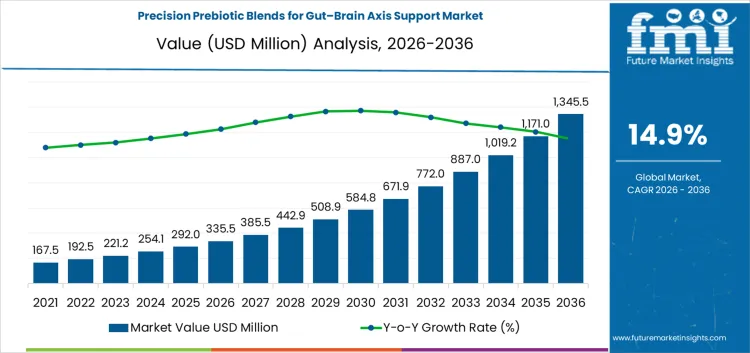
Precision Prebiotic Blends for Gut–Brain Axis Support Market Key Takeaways
| Metric | Value |
|---|---|
| Market Value (2026) | USD 335.5 million |
| Market Forecast Value (2036) | USD 1,345.5 million |
| Forecast CAGR (2026 to 2036) | 14.9% |
Why is the Demand for Precision Prebiotic Blends for Gut–Brain Axis Support Market Growing Globally?
Demand for precision prebiotic blends for gut–brain axis support is growing globally due to heightened scientific understanding of the interaction between gut microbiota and neurological function, along with rising consumer interest in holistic health solutions.
Precision prebiotic blends are formulated to selectively nourish specific beneficial gut microorganisms that influence metabolic pathways linked to cognitive function, mood regulation, and stress response. Growth in functional food, supplement, and wellness categories drives procurement of targeted blends that extend beyond general digestive support to address integrated physiological outcomes. Regulatory frameworks in multiple regions emphasize ingredient safety, substantiation of functional claims, and transparent labeling, which strengthens formulation and marketing of prebiotic systems backed by clinical evidence.
Advances in microbiome research and high-throughput sequencing enable developers to refine prebiotic combinations tailored to support specific microbial taxa associated with gut–brain communication pathways. Expansion of personalized nutrition and digital health platforms encourages adoption of products aligned with individual health profiles and lifestyle goals.
Retail and e-commerce channels increase accessibility to precision prebiotic formulations for diverse demographics. Public awareness of mental wellness, immune connection, and diet-related health outcomes reinforces demand for scientifically informed nutrition solutions. Continued investment in human studies and mechanism-based product development supports ongoing uptake of precision prebiotic blends in global health and nutrition portfolios.
How Is the Global Precision Prebiotic Blends for Gut–Brain Axis Support Market Structured?
The global precision prebiotic blends for gut–brain axis support market reflects growing scientific focus on microbiota-mediated cognitive, mood, and neurological health outcomes. Prebiotic ingredients are increasingly formulated not only for digestive benefits but also for targeted modulation of microbial metabolites linked to neurotransmitter signaling and inflammation control. Demand is supported by expansion of functional foods positioned around mental wellness, stress management, and cognitive resilience. Food and beverage manufacturers prioritize precision blends that deliver reproducible microbiome responses while maintaining formulation stability, sensory neutrality, and regulatory compliance across diverse product matrices.
Which Application Segment Accounts for the Largest Share of Global Demand?
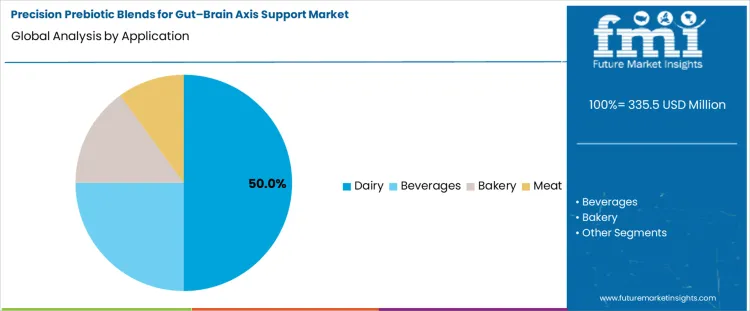
Dairy applications account for the largest share at 50.0%, driven by widespread use of prebiotic blends in yogurts, fermented dairy alternatives, cultured products, and functional dairy beverages positioned for mental wellness support. Dairy matrices provide favorable conditions for prebiotic stability, fermentation synergy, and consumer acceptance of gut-health positioning.
Beverages represent 25.0% of global demand, reflecting strong uptake in functional drinks, nutritional beverages, and mood-support formulations where liquid formats enable precise dosing and rapid microbiome interaction. Bakery applications hold a 15.0% share, using prebiotic blends to support digestive and cognitive claims while contributing fiber enrichment and texture modulation. Meat applications account for 10.0%, reflecting limited but emerging use in functional processed meats and hybrid protein products where gut-health positioning is selectively applied.
Key Takeaways
- Dairy leads due to compatibility with fermentation and gut-health positioning
- Beverages support precision dosing for cognitive wellness claims
- Bakery and meat applications remain targeted and formulation-dependent
Which Prebiotic Type Leads Precision Gut–Brain Axis Formulations Globally?
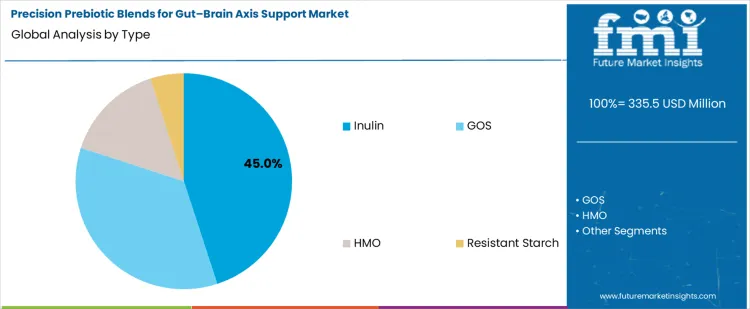
Inulin-based blends dominate with a 45.0% share, supported by extensive clinical research, broad regulatory acceptance, and strong bifidogenic effects linked to gut–brain signaling pathways. Inulin offers predictable fermentation profiles and is widely incorporated into dairy and beverage systems without major sensory disruption. Galacto-oligosaccharides (GOS) account for 35.0%, valued for selective microbiota modulation and demonstrated associations with stress response and cognitive function, particularly in sensitive populations. Human milk oligosaccharides (HMO) represent 15.0% of demand, driven by advanced formulations targeting early-life nutrition and premium cognitive health positioning, although cost and regulatory constraints limit wider adoption. Resistant starch contributes 5.0%, reflecting niche use where slow fermentation and glycemic modulation are prioritized over direct neuromodulatory effects.
Key Takeaways
- Inulin leads due to evidence depth and formulation versatility
- GOS supports targeted stress and cognitive modulation
- HMO adoption remains premium and application-specific
Which Distribution Channel Dominates Global Supply of Precision Prebiotic Blends?
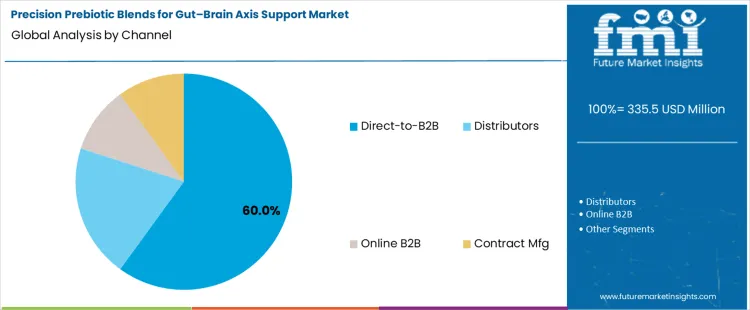
Direct-to-B2B channels account for 60.0% of global distribution, reflecting the need for formulation-specific customization, clinical substantiation alignment, and controlled inclusion strategies in gut–brain axis products. Manufacturers rely on direct supplier collaboration to optimize blend ratios, fermentation kinetics, and compatibility with active compounds such as vitamins or nootropics. Distributors hold a 20.0% share, supplying standardized prebiotic blends to mid-sized producers and regional functional food brands. Online B2B platforms represent 10.0%, primarily serving early-stage innovation, pilot trials, and rapid sourcing for emerging wellness brands. Contract manufacturing accounts for 10.0%, where precision prebiotic blends are embedded into finished premixes or turnkey functional ingredient systems developed under co-manufacturing arrangements.
Key Takeaways
- Direct B2B dominates due to technical and clinical integration needs
- Distributors enable scale for standardized formulations
- Contract manufacturing supports bundled functional systems
What are the Key Dynamics in the Precision Prebiotic Blends for Gut–Brain Axis Support Market?
Global demand rises as food, beverage, supplement, and functional nutrition manufacturers adopt precision prebiotic blends formulated to support gut–brain axis health through targeted modulation of the microbiome. Precision prebiotic blends include specific oligosaccharides, resistant starches, and fermentable fibers selected for their effects on short-chain fatty acid production, neural signaling pathways, and microbial diversity. Adoption aligns with growing consumer interest in holistic wellness, scientific evidence linking gut health to cognitive and mood outcomes, and expansion of personalized nutrition frameworks across North America, Europe, Asia-Pacific, and Latin America. Usage spans functional beverages, nutritional bars, clinical nutrition products, and dietary supplements positioned for daily cognitive and digestive support.
How do scientific evidence trends and consumer health priorities shape adoption?
Consumers increasingly seek nutrition solutions that move beyond basic macronutrient profiles to support gut health and cognitive function. Precision prebiotic blends are designed using microbiome research to target specific bacterial taxa and metabolic pathways associated with gut–brain axis signaling. Manufacturers integrate these blends into products that emphasize evidence-based benefits, clean label positioning, and targeted wellness outcomes. Healthcare practitioners, dietitians, and wellness influencers contribute to awareness by communicating links between microbiota modulation and stress resilience, memory support, and digestive comfort. Retailers highlight scientific substantiation and clear usage guidance to reassure informed consumers. Performance criteria include tolerability, fermentation profile, and demonstrated impact on biomarkers related to microbiome composition and neuroactive metabolite production.
How does formulation complexity, cost pressures, and regulatory frameworks influence market scalability?
Precision prebiotic blends require careful selection, combination, and dosage control of multiple fiber types to achieve targeted microbiome responses while minimizing gastrointestinal discomfort. Development costs are elevated due to research, clinical validation, and raw material sourcing of high-purity prebiotic compounds. Ingredient cost variability and supply chain reliability affect pricing of finished products and margin planning for manufacturers. Regulatory frameworks governing prebiotic claims, structure-function statements, and allowable ingredients differ across jurisdictions, shaping compliance and labeling strategies for global distribution. Integration with existing product matrices requires expertise to maintain stability, taste, and consumer acceptance. Long-term market growth depends on continued innovation in evidence-based prebiotic systems, harmonization of regulatory criteria for gut–brain health claims, and broader education of consumers and professionals about microbiome-targeted nutrition.
How Is Demand for Precision Prebiotic Blends for Gut–Brain Axis Support Evolving Globally?
Demand for precision prebiotic blends for gut–brain axis support is increasing globally due to rising interest in mental wellness, microbiome science advances, and demand for evidence-backed functional nutrition. China leads with a 15.9% CAGR, supported by rapid expansion of cognitive health supplements and microbiome-focused R&D. Netherlands follows at 15.4%, driven by leadership in prebiotic research and formulation precision. USA records a 14.8% CAGR, shaped by consumer adoption of mood, focus, and stress-support products. Germany posts 14.2%, reflecting strong regulatory discipline and clinical validation standards. Growth reflects transition from generic fibers toward targeted prebiotic blends designed to modulate microbial pathways influencing neurological and psychological function.
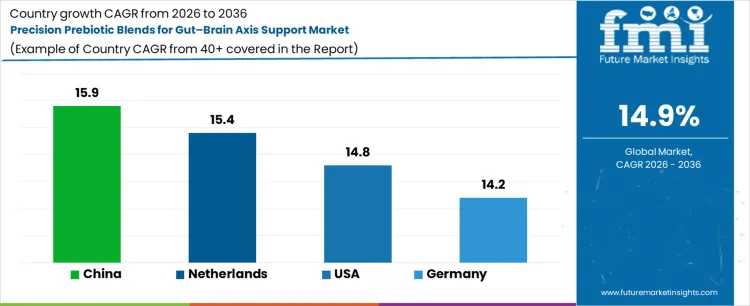
| Country | CAGR (%) |
|---|---|
| China | 15.9% |
| Netherlands | 15.4% |
| USA | 14.8% |
| Germany | 14.2% |
What is driving rapid adoption of precision prebiotic blends for gut–brain support in China?
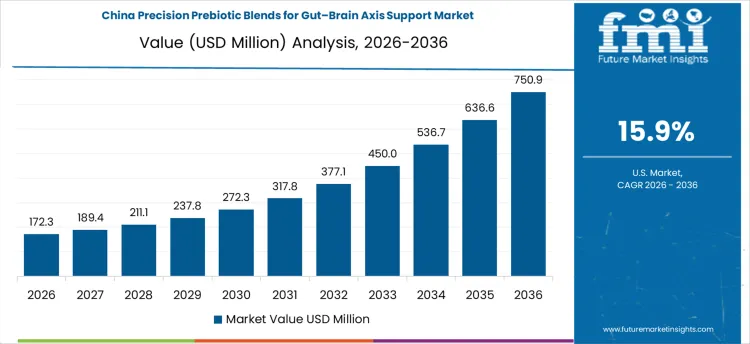
China demand is driven by increasing awareness of mental health, stress management, and cognitive performance across working-age populations. CAGR of 15.9% reflects adoption of precision prebiotic blends formulated to influence microbial metabolites associated with neurotransmitter regulation. Functional foods, beverages, and supplements integrate gut–brain positioning. Domestic brands invest in microbiome research and clinical substantiation. Digital health platforms accelerate consumer education. Regulatory acceptance of functional claims supports product launches. Ingredient suppliers scale production of targeted oligosaccharides and fiber blends. Growth remains science-led and consumption-driven, aligned with wellness prioritization and rapid functional nutrition commercialization.
- Rising focus on cognitive and emotional wellness
- Integration into supplements and functional foods
- Investment in microbiome and clinical research
- Expansion of targeted prebiotic ingredient supply
How is the Netherlands sustaining strong growth in precision gut–brain prebiotic demand?
Netherlands demand reflects global leadership in microbiome science, fermentation technology, and precision nutrition. CAGR of 15.4% is supported by development of prebiotic blends targeting specific bacterial strains linked to gut–brain signaling. Research institutions collaborate with ingredient suppliers to validate mechanisms of action. Export-oriented formulation activity reinforces demand for advanced blends. Manufacturers emphasize reproducibility, dose precision, and clinical backing. Strong intellectual property frameworks support innovation. Growth remains innovation-led and research-driven, aligned with Netherlands’ role as a hub for advanced prebiotic development.
- Leadership in microbiome and prebiotic research
- Development of strain-targeted prebiotic blends
- Strong research and industry collaboration
- Export-driven formulation and innovation activity
What factors are shaping demand growth in the USA for gut–brain axis prebiotic blends?
USA demand is shaped by consumer interest in mental wellness, stress resilience, and non-pharmacological cognitive support. CAGR of 14.8% reflects increased adoption of precision prebiotics in dietary supplements, functional beverages, and medical nutrition products. Brands emphasize clinically supported claims and transparency. Healthcare practitioners increasingly recognize microbiome influence on mental health. Regulatory clarity supports innovation within defined structure–function frameworks. Ingredient suppliers offer customized blends for mood, focus, and sleep positioning. Growth remains brand-led and evidence-focused, aligned with wellness-oriented consumption and functional nutrition maturity.
- High consumer interest in mental wellness solutions
- Adoption across supplements and functional beverages
- Emphasis on clinical evidence and transparency
- Availability of application-specific prebiotic blends
Why is Germany showing steady expansion in precision prebiotic adoption for gut–brain support?
Germany demand reflects strong regulatory oversight, scientific rigor, and consumer trust in clinically validated nutrition. CAGR of 14.2% is supported by adoption of precision prebiotic blends within medical nutrition and pharmacy-distributed supplements. Manufacturers prioritize documented efficacy and safety. Collaboration with academic institutions supports evidence generation. Clean-label expectations influence ingredient selection. Healthcare-led recommendation channels reinforce adoption. Growth remains quality-driven and regulation-aligned, supported by disciplined product development and high acceptance of science-backed functional nutrition.
- Strong regulatory and clinical validation standards
- Adoption in medical nutrition and pharmacy channels
- Emphasis on documented efficacy and safety
- High consumer trust in science-backed products
What is the competitive landscape of demand for precision prebiotic blends for gut–brain axis support globally?
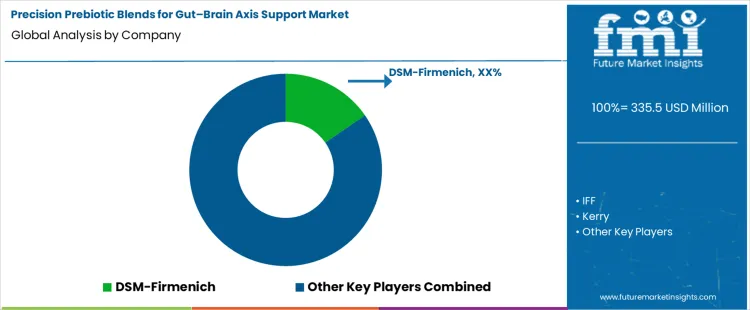
Demand for precision prebiotic blends for gut-brain axis support is driven by growing scientific evidence linking gut microbiota modulation with cognitive, mood, and stress-related outcomes. These blends are formulated to selectively stimulate beneficial microbial strains associated with neurotransmitter signaling, short-chain fatty acid production, and inflammatory regulation.
Buyers evaluate fermentability profiles, strain specificity, clinical substantiation, digestive tolerance, and stability in functional foods, beverages, and dietary supplements. Procurement teams prioritize suppliers with human clinical data, regulatory compliance for health claims, and ability to tailor blends for targeted cognitive and emotional benefits. Trend in the global market reflects convergence of neuroscience, microbiome research, and personalized nutrition strategies.
DSM-Firmenich holds leading positioning through clinically validated prebiotic ingredients and gut–brain research platforms integrated with nutritional science expertise. IFF supports demand with microbiome-focused ingredient systems and sensory-optimized prebiotic solutions for functional applications.
Kerry contributes precision nutrition platforms combining prebiotics with functional benefits aligned to mental wellness positioning. ADM supplies fiber-based prebiotics and formulation support serving global food and supplement manufacturers. Tate & Lyle participates through specialty fibers and prebiotic ingredients backed by digestive health research. Competitive differentiation depends on clinical validation strength, microbiome targeting accuracy, formulation flexibility, and ability to support evidence-based gut–brain health claims.
Key Players in the Precision Prebiotic Blends for Gut-Brain Axis Support Market
- DSM-Firmenich
- IFF
- Kerry
- ADM
- Tate & Lyle
- Yakult Honsha
Scope of the Report
| Items | Values |
|---|---|
| Quantitative Units | USD million |
| Application | Dairy; Beverages; Bakery; Meat |
| Type | Inulin; GOS; HMO; Resistant Starch |
| Channel | Direct-to-B2B; Distributors; Online B2B; Contract Mfg |
| Regions Covered | Asia Pacific, Europe, North America, Latin America, Middle East & Africa |
| Countries Covered | China, Netherlands, USA, Germany, and 40+ countries |
| Key Companies Profiled | DSM-Firmenich; IFF; Kerry; ADM; Tate & Lyle; Yakult Honsha |
| Additional Attributes | Dollar sales by application and type; adoption trends for precision prebiotic formulations targeting gut–brain signaling pathways; fermentability profiles, SCFA production, and microbiota selectivity metrics; compatibility with dairy, beverage, bakery, and meat matrices under thermal processing; sensory neutrality, dose efficiency, and stability considerations; regulatory compliance, health-claim substantiation, and labeling standards influencing precision prebiotic blend selection. |
Precision Prebiotic Blends for Gut–Brain Axis Support Market by Segment
By Application:
- Dairy
- Beverages
- Bakery
- Meat
By Type:
- Inulin
- GOS
- HMO
- Resistant Starch
By Channel:
- Direct-to-B2B
- Distributors
- Online B2B
- Contract Mfg
By Region:
- Asia Pacific
- China
- Japan
- South Korea
- India
- Australia & New Zealand
- ASEAN
- Rest of Asia Pacific
- Europe
- Germany
- United Kingdom
- France
- Italy
- Spain
- Nordic
- BENELUX
- Rest of Europe
- North America
- United States
- Canada
- Mexico
- Latin America
- Brazil
- Chile
- Rest of Latin America
- Middle East & Africa
- Kingdom of Saudi Arabia
- Other GCC Countries
- Turkey
- South Africa
- Other African Union
- Rest of Middle East & Africa
Frequently Asked Questions
What is the market size of the Precision Prebiotic Blends for Gut–Brain Axis Support Market in 2026 and 2036?
The market is valued at USD 335.5 million in 2026 and is projected to reach USD 1,345.5 million by 2036.
Which application segment dominates the Precision Prebiotic Blends for Gut–Brain Axis Support Market?
Dairy-based applications dominate global demand, accounting for 50% share due to formulation compatibility and strong gut-health positioning.
Which prebiotic type holds the largest share in precision gut–brain axis formulations?
Inulin-based blends lead the market with 45% share, supported by extensive clinical validation and broad regulatory acceptance.
Which countries are witnessing the fastest growth in demand for precision prebiotic blends for gut–brain axis support?
China, the Netherlands, the United States, and Germany are the fastest-growing countries, driven by microbiome research, functional nutrition adoption, and evidence-based wellness demand.
Who are the key players in the Precision Prebiotic Blends for Gut–Brain Axis Support Market?
Key players include DSM-Firmenich, IFF, Kerry, ADM, Tate & Lyle, and Yakult Honsha.
Preview the report firsthand - request a free sample
Get SampleGet the brochure for pricing and purchase details.
Get PDFTable of Content
- Executive Summary
- Global Market Outlook
- Demand-side Trends
- Supply-side Trends
- Technology Roadmap Analysis
- Analysis and Recommendations
- Market Overview
- Market Coverage / Taxonomy
- Market Definition / Scope / Limitations
- Market Background
- Market Dynamics
- Drivers
- Restraints
- Opportunity
- Trends
- Scenario Forecast
- Demand in Optimistic Scenario
- Demand in Likely Scenario
- Demand in Conservative Scenario
- Opportunity Map Analysis
- Product Life Cycle Analysis
- Supply Chain Analysis
- Investment Feasibility Matrix
- Value Chain Analysis
- PESTLE and Porter’s Analysis
- Regulatory Landscape
- Regional Parent Market Outlook
- Production and Consumption Statistics
- Import and Export Statistics
- Market Dynamics
- Global Market Analysis 2021 to 2025 and Forecast, 2026 to 2036
- Historical Market Size Value (USD Million) Analysis, 2021 to 2025
- Current and Future Market Size Value (USD Million) Projections, 2026 to 2036
- Y-o-Y Growth Trend Analysis
- Absolute $ Opportunity Analysis
- Global Market Pricing Analysis 2021 to 2025 and Forecast 2026 to 2036
- Global Market Analysis 2021 to 2025 and Forecast 2026 to 2036, By Application
- Introduction / Key Findings
- Historical Market Size Value (USD Million) Analysis By Application , 2021 to 2025
- Current and Future Market Size Value (USD Million) Analysis and Forecast By Application , 2026 to 2036
- Dairy
- Beverages
- Bakery
- Meat
- Dairy
- Y-o-Y Growth Trend Analysis By Application , 2021 to 2025
- Absolute $ Opportunity Analysis By Application , 2026 to 2036
- Global Market Analysis 2021 to 2025 and Forecast 2026 to 2036, By Type
- Introduction / Key Findings
- Historical Market Size Value (USD Million) Analysis By Type, 2021 to 2025
- Current and Future Market Size Value (USD Million) Analysis and Forecast By Type, 2026 to 2036
- Inulin
- GOS
- HMO
- Resistant Starch
- Inulin
- Y-o-Y Growth Trend Analysis By Type, 2021 to 2025
- Absolute $ Opportunity Analysis By Type, 2026 to 2036
- Global Market Analysis 2021 to 2025 and Forecast 2026 to 2036, By Channel
- Introduction / Key Findings
- Historical Market Size Value (USD Million) Analysis By Channel, 2021 to 2025
- Current and Future Market Size Value (USD Million) Analysis and Forecast By Channel, 2026 to 2036
- Direct-to-B2B
- Distributors
- Online B2B
- Contract Mfg
- Direct-to-B2B
- Y-o-Y Growth Trend Analysis By Channel, 2021 to 2025
- Absolute $ Opportunity Analysis By Channel, 2026 to 2036
- Global Market Analysis 2021 to 2025 and Forecast 2026 to 2036, By Region
- Introduction
- Historical Market Size Value (USD Million) Analysis By Region, 2021 to 2025
- Current Market Size Value (USD Million) Analysis and Forecast By Region, 2026 to 2036
- North America
- Latin America
- Western Europe
- Eastern Europe
- East Asia
- South Asia and Pacific
- Middle East & Africa
- Market Attractiveness Analysis By Region
- North America Market Analysis 2021 to 2025 and Forecast 2026 to 2036, By Country
- Historical Market Size Value (USD Million) Trend Analysis By Market Taxonomy, 2021 to 2025
- Market Size Value (USD Million) Forecast By Market Taxonomy, 2026 to 2036
- By Country
- USA
- Canada
- Mexico
- By Application
- By Type
- By Channel
- By Country
- Market Attractiveness Analysis
- By Country
- By Application
- By Type
- By Channel
- Key Takeaways
- Latin America Market Analysis 2021 to 2025 and Forecast 2026 to 2036, By Country
- Historical Market Size Value (USD Million) Trend Analysis By Market Taxonomy, 2021 to 2025
- Market Size Value (USD Million) Forecast By Market Taxonomy, 2026 to 2036
- By Country
- Brazil
- Chile
- Rest of Latin America
- By Application
- By Type
- By Channel
- By Country
- Market Attractiveness Analysis
- By Country
- By Application
- By Type
- By Channel
- Key Takeaways
- Western Europe Market Analysis 2021 to 2025 and Forecast 2026 to 2036, By Country
- Historical Market Size Value (USD Million) Trend Analysis By Market Taxonomy, 2021 to 2025
- Market Size Value (USD Million) Forecast By Market Taxonomy, 2026 to 2036
- By Country
- Germany
- UK
- Italy
- Spain
- France
- Nordic
- BENELUX
- Rest of Western Europe
- By Application
- By Type
- By Channel
- By Country
- Market Attractiveness Analysis
- By Country
- By Application
- By Type
- By Channel
- Key Takeaways
- Eastern Europe Market Analysis 2021 to 2025 and Forecast 2026 to 2036, By Country
- Historical Market Size Value (USD Million) Trend Analysis By Market Taxonomy, 2021 to 2025
- Market Size Value (USD Million) Forecast By Market Taxonomy, 2026 to 2036
- By Country
- Russia
- Poland
- Hungary
- Balkan & Baltic
- Rest of Eastern Europe
- By Application
- By Type
- By Channel
- By Country
- Market Attractiveness Analysis
- By Country
- By Application
- By Type
- By Channel
- Key Takeaways
- East Asia Market Analysis 2021 to 2025 and Forecast 2026 to 2036, By Country
- Historical Market Size Value (USD Million) Trend Analysis By Market Taxonomy, 2021 to 2025
- Market Size Value (USD Million) Forecast By Market Taxonomy, 2026 to 2036
- By Country
- China
- Japan
- South Korea
- By Application
- By Type
- By Channel
- By Country
- Market Attractiveness Analysis
- By Country
- By Application
- By Type
- By Channel
- Key Takeaways
- South Asia and Pacific Market Analysis 2021 to 2025 and Forecast 2026 to 2036, By Country
- Historical Market Size Value (USD Million) Trend Analysis By Market Taxonomy, 2021 to 2025
- Market Size Value (USD Million) Forecast By Market Taxonomy, 2026 to 2036
- By Country
- India
- ASEAN
- Australia & New Zealand
- Rest of South Asia and Pacific
- By Application
- By Type
- By Channel
- By Country
- Market Attractiveness Analysis
- By Country
- By Application
- By Type
- By Channel
- Key Takeaways
- Middle East & Africa Market Analysis 2021 to 2025 and Forecast 2026 to 2036, By Country
- Historical Market Size Value (USD Million) Trend Analysis By Market Taxonomy, 2021 to 2025
- Market Size Value (USD Million) Forecast By Market Taxonomy, 2026 to 2036
- By Country
- Kingdom of Saudi Arabia
- Other GCC Countries
- Turkiye
- South Africa
- Other African Union
- Rest of Middle East & Africa
- By Application
- By Type
- By Channel
- By Country
- Market Attractiveness Analysis
- By Country
- By Application
- By Type
- By Channel
- Key Takeaways
- Key Countries Market Analysis
- USA
- Pricing Analysis
- Market Share Analysis, 2025
- By Application
- By Type
- By Channel
- Canada
- Pricing Analysis
- Market Share Analysis, 2025
- By Application
- By Type
- By Channel
- Mexico
- Pricing Analysis
- Market Share Analysis, 2025
- By Application
- By Type
- By Channel
- Brazil
- Pricing Analysis
- Market Share Analysis, 2025
- By Application
- By Type
- By Channel
- Chile
- Pricing Analysis
- Market Share Analysis, 2025
- By Application
- By Type
- By Channel
- Germany
- Pricing Analysis
- Market Share Analysis, 2025
- By Application
- By Type
- By Channel
- UK
- Pricing Analysis
- Market Share Analysis, 2025
- By Application
- By Type
- By Channel
- Italy
- Pricing Analysis
- Market Share Analysis, 2025
- By Application
- By Type
- By Channel
- Spain
- Pricing Analysis
- Market Share Analysis, 2025
- By Application
- By Type
- By Channel
- France
- Pricing Analysis
- Market Share Analysis, 2025
- By Application
- By Type
- By Channel
- India
- Pricing Analysis
- Market Share Analysis, 2025
- By Application
- By Type
- By Channel
- ASEAN
- Pricing Analysis
- Market Share Analysis, 2025
- By Application
- By Type
- By Channel
- Australia & New Zealand
- Pricing Analysis
- Market Share Analysis, 2025
- By Application
- By Type
- By Channel
- China
- Pricing Analysis
- Market Share Analysis, 2025
- By Application
- By Type
- By Channel
- Japan
- Pricing Analysis
- Market Share Analysis, 2025
- By Application
- By Type
- By Channel
- South Korea
- Pricing Analysis
- Market Share Analysis, 2025
- By Application
- By Type
- By Channel
- Russia
- Pricing Analysis
- Market Share Analysis, 2025
- By Application
- By Type
- By Channel
- Poland
- Pricing Analysis
- Market Share Analysis, 2025
- By Application
- By Type
- By Channel
- Hungary
- Pricing Analysis
- Market Share Analysis, 2025
- By Application
- By Type
- By Channel
- Kingdom of Saudi Arabia
- Pricing Analysis
- Market Share Analysis, 2025
- By Application
- By Type
- By Channel
- Turkiye
- Pricing Analysis
- Market Share Analysis, 2025
- By Application
- By Type
- By Channel
- South Africa
- Pricing Analysis
- Market Share Analysis, 2025
- By Application
- By Type
- By Channel
- USA
- Market Structure Analysis
- Competition Dashboard
- Competition Benchmarking
- Market Share Analysis of Top Players
- By Regional
- By Application
- By Type
- By Channel
- Competition Analysis
- Competition Deep Dive
- DSM-Firmenich
- Overview
- Product Portfolio
- Profitability by Market Segments (Product/Age /Sales Channel/Region)
- Sales Footprint
- Strategy Overview
- Marketing Strategy
- Product Strategy
- Channel Strategy
- IFF
- Kerry
- ADM
- Tate & Lyle
- Yakult Honsha
- DSM-Firmenich
- Competition Deep Dive
- Assumptions & Acronyms Used
- Research Methodology


