

- Industry Size (2026)
- USD 4.5 Mn
- Forecast (2036)
- USD 8.4 Mn
- CAGR (2026 to 2036)
- 6.4%
Demand for Ultra Short Base Line (USBL) Positioning Systems in South Korea Forecast and Outlook 2026 to 2036
The demand for ultra short base line (USBL) positioning systems in South Korea is forecasted to reach USD 8.4 million by 2036, growing at a CAGR of 6.4% from USD 4.5 million in 2026. Regulatory oversight in this market is stringent, particularly in sectors like maritime and offshore, where positioning systems must meet specific safety and operational standards. Compliance costs are a significant factor, as vendors must invest in ongoing certification processes and adhere to evolving regulations.
These costs often influence product pricing and can limit market entry for new players, thus strengthening the position of established vendors who have already navigated these regulatory challenges. Certification complexity is another critical element; obtaining the necessary approvals can be time-consuming and costly, affecting the speed at which products are brought to market. As the regulatory landscape becomes more intricate, vendors that can efficiently navigate compliance demands will maintain a competitive advantage in securing contracts.
Quick Stats for the Demand for Ultra Short Base Line (USBL) Positioning Systems in South Korea:
- Ultra Short Base Line (USBL) Positioning Systems in South Korea Value (2026): USD 4.5 million
- Ultra Short Base Line (USBL) Positioning Systems in South Korea Forecast Value (2036): USD 8.4 million
- Ultra Short Base Line (USBL) Positioning Systems in South Korea Forecast CAGR (2026 to 2036): 6.4%
- Ultra Short Base Line (USBL) Positioning Systems in South Korea Leading Segment: 100 Degree Antenna Aperture (45%)
- Key Growth Regions of Ultra Short Base Line (USBL) Positioning Systems in South Korea: Jeju (leading CAGR ~7.6%)
- Top Players of Ultra Short Base Line (USBL) Positioning Systems in South Korea: Kongsberg Marine, Teledyne Marine, iXblue, Sonardyne Holdings, Tritech International Limited
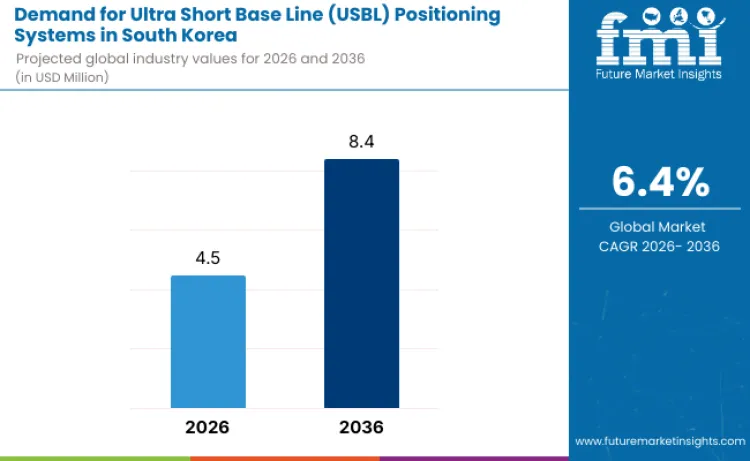
What is the Growth Forecast for the Ultra Short Base Line (USBL) Positioning System Market in South Korea through 2036?
The ultra short base line (USBL) positioning system industry in South Korea is expected to grow steadily through the forecast period, supported by increasing activity in offshore operations, subsea inspection, and marine research. As the country strengthens its capabilities in maritime security, underwater infrastructure monitoring, and offshore energy-related work, demand for accurate underwater tracking and positioning technologies is rising. USBL systems are gaining preference because they offer reliable real-time positioning for remotely operated vehicles (ROVs), divers, and subsea assets in complex marine environments.
Growth will also be reinforced by technological progress in acoustic communication, signal processing, and integration with autonomous underwater platforms. South Korean maritime organizations and offshore contractors are increasingly upgrading navigation and subsea monitoring systems to improve operational safety, reduce mission risk, and enhance efficiency. Wider adoption is expected across applications such as subsea cable inspection, port and harbor surveys, offshore construction support, and oceanographic exploration. Overall, the outlook remains positive, with demand driven by expanding marine technology programs and the need for precise subsea positioning solutions across defense, research, and commercial offshore sectors.
Key Takeaways for Demand for Ultra Short Base Line (USBL) Positioning Systems in South Korea
| Metric | Value |
|---|---|
| Industry Sales Value (2026) | USD 4.5 million |
| Industry Forecast Value (2036) | USD 8.4 million |
| Industry Forecast CAGR (2026 to 2036) | 6.4% |
Why is the Demand for Ultra Short Base Line (USBL) Positioning Systems Growing in South Korea?
The demand for Ultra Short Base Line (USBL) positioning systems in South Korea has been on the rise, driven by their increasing application in marine and underwater operations. Historically, USBL systems have been vital for positioning and tracking subsea assets in industries such as oil and gas, maritime, and marine research. South Korea, with its strong maritime industry and large shipping sector, has seen growing adoption of USBL systems, which offer high-precision tracking of remotely operated vehicles (ROVs), autonomous underwater vehicles (AUVs), and other underwater equipment. The need for these systems has been amplified by the expansion of offshore energy exploration, underwater construction, and maritime safety operations, where accurate positioning of equipment is crucial. Additionally, South Korea’s focus on developing smart port technologies and enhancing its maritime surveillance capabilities has further spurred demand for USBL systems that can ensure accurate data collection and real-time positioning in complex underwater environments.
Looking forward, the demand for USBL positioning systems in South Korea is expected to grow as technological advancements and increasing demand for subsea operations further integrate these systems into daily operations. The country’s push toward renewable energy sources, such as offshore wind power, will drive the need for more advanced positioning and navigation systems to monitor and maintain subsea installations. The continued growth of marine research activities, including environmental monitoring and data collection, is also likely to increase the use of USBL systems for accurate tracking of underwater sensors and data-gathering devices. Moreover, advancements in USBL system technology, such as improved data transmission rates and greater depth capability, are expected to enhance their appeal across various sectors, including military and defense. As such, the South Korean market for USBL positioning systems is poised for expansion, driven by the growth of subsea operations and technological innovation.
What Are the Key Segments in Demand for Ultra Short Base Line (USBL) Positioning Systems in South Korea?
Demand for Ultra Short Base Line (USBL) positioning systems in South Korea is segmented by antenna aperture and end-use industry. The primary antenna aperture sizes are 100°, 70°, and 200°, with 100° aperture leading the industry at 45%. In terms of end-use industries, offshore equipment positioning is the dominant sector at 25%, followed by applications in remotely operated vehicles (ROVs), autonomous underwater vehicle (AUV) vessel positioning, and other specialized marine sectors. As marine technologies evolve, the demand for precise positioning in various underwater applications is expected to grow across multiple industries.
How Does Antenna Aperture Impact Demand for USBL Positioning Systems in South Korea?
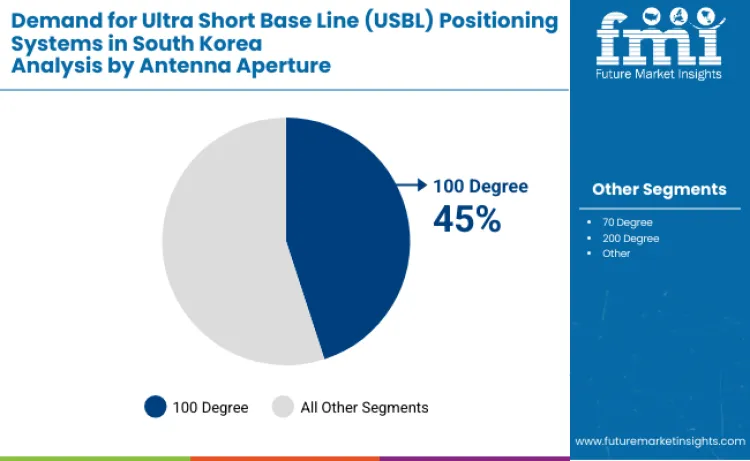
The demand for USBL positioning systems in South Korea is significantly influenced by the type of antenna aperture used. The 100° aperture is the most commonly employed, accounting for 45% of the industry share. This aperture size is suitable for a variety of underwater applications where precision and broad coverage are necessary, such as offshore equipment positioning and ROV operations. With a 100° aperture, the positioning system provides an effective balance between range and accuracy, allowing for reliable tracking in complex marine environments. Systems with a 70° aperture are also in demand, though they typically serve more specialized applications where narrower coverage areas are required.
This makes them ideal for tasks such as underwater surveying and equipment placement in confined areas. In contrast, the 200° aperture is favored in scenarios that require extensive coverage and monitoring over large areas, such as AUV vessel positioning and underwater photography. The choice of aperture impacts the cost, functionality, and suitability of USBL systems for different end users, including offshore operators, marine research institutions, and diving companies. As marine industries in South Korea focus on expanding their underwater capabilities, the demand for USBL systems with various aperture sizes will continue to evolve to meet industry-specific needs.
What Are the Key End-Use Industries Driving Demand for USBL Positioning Systems in South Korea?
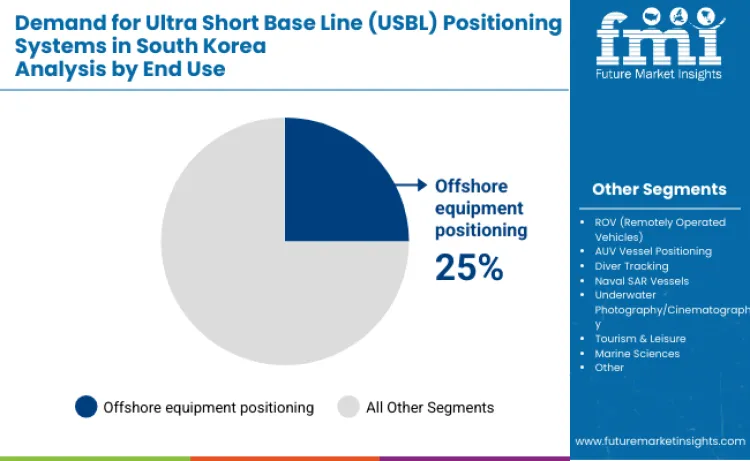
End-use industries represent a critical driver in the demand for USBL positioning systems in South Korea. Offshore equipment positioning is one of the leading sectors, with a 25% share of the industry. Offshore oil and gas operators rely on USBL systems for precise positioning of subsea equipment during installation, maintenance, and operations. The high accuracy and real-time data offered by USBL systems are essential for maintaining safety standards and operational efficiency in challenging underwater environments.
The ROV market follows closely behind, where USBL systems are used to guide and track ROVs during underwater inspections and repairs. These vehicles are essential in many sectors, including offshore drilling, environmental monitoring, and underwater exploration, all of which require precise navigation capabilities. USBL systems also serve key roles in AUV vessel positioning, used predominantly in scientific research, hydrographic surveying, and military applications. In addition to these industries, USBL technology is vital for diver tracking, naval SAR (Search and Rescue) operations, underwater photography/cinematography, and even leisure activities such as diving tourism. As demand for underwater research and exploration increases, industries in South Korea will likely invest in more advanced USBL systems capable of handling a variety of marine challenges. USBL systems’ ability to provide real-time positioning and reliable tracking will continue to be indispensable across these industries, ensuring operational efficiency and safety in complex underwater environments.
What are the Key Dynamics in the Demand for Ultra Short Base Line (USBL) Positioning Systems in South Korea?
Demand for Ultra Short Base Line (USBL) positioning systems in South Korea is anchored in maritime, offshore energy, and defence sectors where underwater navigation accuracy and asset tracking are critical. USBL systems facilitate real time acoustic positioning of subsea vehicles, autonomous underwater vehicles (AUVs), and remotely operated vehicles (ROVs). South Korea’s shipbuilding industry, which includes construction of commercial vessels and offshore support vessels, contributes to positioning system uptake. Expansion of offshore wind farms and subsea pipeline inspection activities further supports investment in underwater positioning technologies. Procurement decisions by port authorities and marine research institutes also influence annual demand volumes.
What are the Drivers of Demand for USBL Positioning Systems in South Korea?
Primary drivers include the need for precise subsea navigation in offshore construction projects and deep water survey operations. The offshore energy sector, with increasing focus on subsea infrastructure for wind, oil, and gas, requires positioning systems that reduce survey time and improve operational safety. South Korea’s advanced shipbuilding and marine technology ecosystem prioritises integration of high performance sensors and navigation systems, encouraging adoption of USBL equipment. Defence applications, including submarine tracking, mine countermeasure operations, and harbour security, further elevate demand. Government support for maritime research and underwater exploration initiatives provides additional impetus for procurement of USBL hardware and software suites.
What are the Restraints on Demand for USBL Positioning Systems in South Korea?
Constraints on demand stem primarily from high technology costs and integration challenges with existing marine systems. USBL solutions involve significant capital expenditure, particularly when paired with data processing and control software, which can delay purchase decisions by smaller operators. Subsea communication limitations and acoustic interference in shallow or noisy waters can affect system performance, influencing perceived utility for some applications. Skilled technical personnel are required to calibrate and maintain these systems, which adds to operational expense. Extended project lead times for custom configurations and certification requirements for defence and offshore use can further lengthen sales cycles for suppliers.
What Key Trends Affect Demand for USBL Positioning Systems in South Korea?
Emerging trends include increased integration of USBL systems with multi sensor platforms, combining inertial navigation systems and Doppler velocity logs for enhanced positional accuracy. Suppliers are developing modular architectures that allow easier upgrades and compatibility with third party subsea equipment. Industry adoption of real time data analytics and digital twin modelling in offshore construction and inspection workflows is driving specification of higher resolution positioning solutions. Growth in offshore wind development, particularly in large scale projects beyond coastal waters, is creating new use cases for underwater positioning. Collaboration between Korean marine technology firms and global USBL vendors is intensifying, enabling knowledge transfer and localized support networks that reduce operational risk for system users.
What is the Regional Analysis of Demand for Ultra Short Base Line (USBL) Positioning Systems in South Korea?
The demand for Ultra Short Base Line (USBL) positioning systems in South Korea varies by region, influenced by local industries such as marine, research, and defense. South Gyeongsang, with a projected CAGR of 6.7%, shows strong demand, driven by its maritime and industrial sectors. North Jeolla, with a growth rate of 5.1%, reflects moderate demand, driven by emerging maritime and research applications. South Jeolla, with a CAGR of 6%, shows steady demand growth, supported by its growing marine industry. Jeju, with the highest growth rate of 7.6%, reflects strong demand driven by its focus on marine research and tourism industries. The demand trends reflect the increasing use of USBL systems for navigation, communication, and data collection in marine and industrial applications.
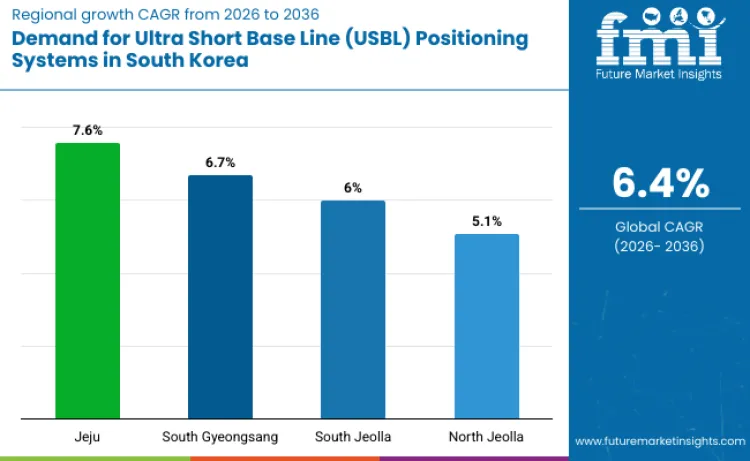
| Region | CAGR (2026 to 2036) |
|---|---|
| South Gyeongsang | 6.7% |
| North Jeolla | 5.1% |
| South Jeolla | 6.0% |
| Jeju | 7.6% |
What is the Demand for USBL Positioning Systems in South Gyeongsang?
South Gyeongsang is expected to experience strong demand for Ultra Short Base Line (USBL) positioning systems, with a projected CAGR of 6.7%. The region is home to significant maritime and industrial activities, including shipbuilding and marine engineering, which rely on precise positioning systems for navigation and data collection. USBL systems are increasingly used in South Gyeongsang’s marine industries for underwater navigation and communication. The region's robust maritime infrastructure, combined with growing demand for accurate positioning systems in defense and industrial applications, positions South Gyeongsang as a key player in the USBL systems market in South Korea.
What is the Demand for USBL Positioning Systems in North Jeolla?
North Jeolla, with a CAGR of 5.1%, shows moderate demand growth for Ultra Short Base Line (USBL) positioning systems. While the region's industrial and maritime sectors are growing, particularly in shipbuilding and offshore exploration, the demand for positioning systems is slower compared to regions with more established maritime industries like South Gyeongsang and Jeju. North Jeolla is investing in expanding its marine and research sectors, which will likely lead to an increase in the adoption of USBL systems in the coming years. As demand for accurate navigation and positioning systems in marine applications increases, North Jeolla’s growth in this sector is expected to accelerate gradually.
How is the Demand for USBL Positioning Systems Expected to Evolve in South Jeolla?
South Jeolla, with a projected CAGR of 6%, is seeing steady demand growth for Ultra Short Base Line (USBL) positioning systems. The region’s growing marine industry, supported by its strong presence in shipbuilding, offshore exploration, and fisheries, drives the need for advanced positioning technologies. USBL systems are increasingly used in South Jeolla for underwater navigation, survey data collection, and communication in marine environments. As the region continues to expand its maritime and industrial capabilities, the demand for USBL systems is expected to rise steadily. The region’s emphasis on expanding its marine sector and improving technological capabilities will further enhance the adoption of USBL systems.
What is the Demand for USBL Positioning Systems in Jeju?
Jeju is projected to experience the highest growth in demand for Ultra Short Base Line (USBL) positioning systems, with a CAGR of 7.6%. The region’s emphasis on marine research, tourism, and underwater exploration contributes significantly to this demand. Jeju’s focus on marine ecosystems and tourism-related underwater activities drives the need for accurate positioning systems, particularly in navigation and communication. As Jeju continues to invest in marine research and underwater tourism, the demand for USBL systems is expected to grow at an accelerated pace. The region's unique geographic characteristics and growing tourism industry ensure a strong future demand for these technologies.
What is the Competitive Landscape for USBL Positioning Systems in South Korea?
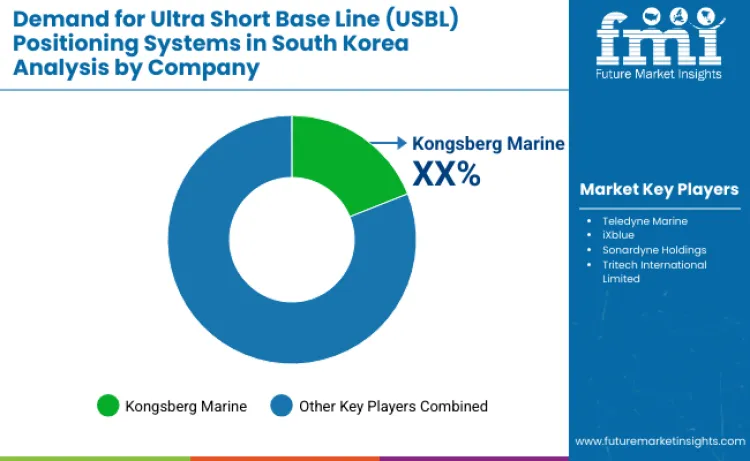
The demand for Ultra Short Base Line (USBL) positioning systems in South Korea is driven by the country’s robust maritime and offshore industries. With major ports like Busan and Ulsan, as well as an active offshore energy sector, accurate subsea positioning technology is essential for various applications, including remotely operated vehicles (ROVs), autonomous underwater vehicles (AUVs), and subsea asset management. USBL systems are increasingly used in navigation, survey, and inspection tasks, particularly for projects in deepwater, oil and gas exploration, and offshore construction. The demand for high-precision, real-time tracking capabilities in these industries is fueling the industry for USBL systems. As offshore activities and subsea engineering projects in South Korea grow, the need for more reliable and efficient positioning systems increases. This is particularly true as operations require consistent performance in challenging environments, such as strong currents, deep depths, and confined spaces.
The competitive landscape in South Korea’s USBL market is led by several key players, each bringing unique strengths to the table. Kongsberg Marine, a leader in the sector, focuses on advanced signal processing technology and underwater positioning solutions. Its systems are designed for integration into large-scale offshore projects, offering high accuracy and reliability for a range of subsea activities. Teledyne Marine offers USBL solutions with an emphasis on flexibility and scalability, catering to both commercial and defense applications.
Their systems are designed for ease of integration with other marine sensors, making them suitable for complex subsea operations. iXblue positions itself with advanced inertial navigation systems combined with USBL technology, appealing to companies needing high-precision data for offshore exploration. Sonardyne Holdings delivers USBL solutions that are known for their deepwater capability and long-range accuracy, ideal for large subsea projects. Tritech International Limited offers compact and lightweight USBL systems, making them a preferred choice for ROV operators and survey teams. These companies are continuously innovating to offer products that meet the growing demands for efficiency, accuracy, and versatility in South Korea’s subsea industries.
Key Players of the Demand for Ultra Short Base Line (USBL) Positioning Systems in South Korea
- Kongsberg Marine
- Teledyne Marine
- iXblue
- Sonardyne Holdings
- Tritech International Limited
Scope of the Report
| Items | Values |
|---|---|
| Quantitative Units (2026) | USD Million |
| Antenna Aperture | 100 Degree, 70 Degree, 200 Degree |
| End-Use Industry | Offshore Equipment Positioning, ROV, AUV Vessel Positioning, Diver Tracking, Naval SAR Vessels, Underwater Photography/Cinematography, Tourism & Leisure, Marine Sciences |
| Companies | Kongsberg Marine, Teledyne Marine, iXblue, Sonardyne Holdings, Tritech International Limited |
| Region Covered | South Korea |
| Provinces Covered | South Gyeongsang, North Jeolla, South Jeolla, Jeju |
| Additional Attributes | Dollar sales by antenna aperture and end-use industry. Demand is supported by offshore infrastructure inspection, increasing ROV/AUV deployment, and expanded use in marine research, naval rescue missions, and underwater filming. |
Key Segments of Demand for Ultra Short Base Line (USBL) Positioning Systems in South Korea
Antenna Aperture
- 100 Degree
- 70 Degree
- 200 Degree
- Other
End-Use Industry
- Offshore Equipment Positioning
- ROV (Remotely Operated Vehicles)
- AUV Vessel Positioning
- Diver Tracking
- Naval SAR Vessels
- Underwater Photography/Cinematography
- Tourism & Leisure
- Marine Sciences
- Other
Provinces
- South Gyeongsang
- North Jeolla
- South Jeolla
- Jeju
Bibliography
- Korea Institute of Ocean Science and Technology. (2025). Advances in subsea navigation and acoustic positioning technologies. Government of the Republic of Korea.
- International Hydrographic Organization. (2024). Standards for hydrographic surveys (S-44, 6th ed.). IHO.
- International Organization for Standardization. (2025). Underwater acoustics-Positioning systems-Performance test methods (ISO 23731:2025). ISO.
Frequently Asked Questions
How big is the demand for ultra short base line (usbl) positioning systems in south korea in 2026?
The demand for ultra short base line (usbl) positioning systems in south korea is estimated to be valued at USD 4.5 million in 2026.
What will be the size of ultra short base line (usbl) positioning systems in south korea in 2036?
The market size for the ultra short base line (usbl) positioning systems in south korea is projected to reach USD 8.4 million by 2036.
How much will be the demand for ultra short base line (usbl) positioning systems in south korea growth between 2026 and 2036?
The demand for ultra short base line (usbl) positioning systems in south korea is expected to grow at a 6.4% CAGR between 2026 and 2036.
What are the key product types in the ultra short base line (usbl) positioning systems in south korea?
The key product types in ultra short base line (usbl) positioning systems in south korea are 100 degree, 70 degree and 200 degree.
Which end-use industry segment is expected to contribute significant share in the ultra short base line (usbl) positioning systems in south korea in 2026?
In terms of end-use industry, offshore equipment positioning segment is expected to command 25.0% share in the ultra short base line (usbl) positioning systems in south korea in 2026.
Preview the report firsthand - request a free sample
Get SampleGet the brochure for pricing and purchase details.
Get PDFTable of Content
- Executive Summary
- South Korea Market Outlook
- Demand-side Trends
- Supply-side Trends
- Technology Roadmap Analysis
- Analysis and Recommendations
- Market Overview
- Market Coverage / Taxonomy
- Market Definition / Scope / Limitations
- Market Background
- Market Dynamics
- Drivers
- Restraints
- Opportunity
- Trends
- Scenario Forecast
- Demand in Optimistic Scenario
- Demand in Likely Scenario
- Demand in Conservative Scenario
- Opportunity Map Analysis
- Product Life Cycle Analysis
- Supply Chain Analysis
- Investment Feasibility Matrix
- Value Chain Analysis
- PESTLE and Porter’s Analysis
- Regulatory Landscape
- Regional Parent Market Outlook
- Production and Consumption Statistics
- Import and Export Statistics
- Market Dynamics
- South Korea Market Analysis 2021 to 2025 and Forecast, 2026 to 2036
- Historical Market Size Value (USD Million) Analysis, 2021 to 2025
- Current and Future Market Size Value (USD Million) Projections, 2026 to 2036
- Y-o-Y Growth Trend Analysis
- Absolute $ Opportunity Analysis
- South Korea Market Pricing Analysis 2021 to 2025 and Forecast 2026 to 2036
- South Korea Market Analysis 2021 to 2025 and Forecast 2026 to 2036, By Antenna Aperture
- Introduction / Key Findings
- Historical Market Size Value (USD Million) Analysis By Antenna Aperture, 2021 to 2025
- Current and Future Market Size Value (USD Million) Analysis and Forecast By Antenna Aperture, 2026 to 2036
- 100 Degree
- 70 Degree
- 200 Degree
- 100 Degree
- Y-o-Y Growth Trend Analysis By Antenna Aperture, 2021 to 2025
- Absolute $ Opportunity Analysis By Antenna Aperture, 2026 to 2036
- South Korea Market Analysis 2021 to 2025 and Forecast 2026 to 2036, By End-Use Industry
- Introduction / Key Findings
- Historical Market Size Value (USD Million) Analysis By End-Use Industry, 2021 to 2025
- Current and Future Market Size Value (USD Million) Analysis and Forecast By End-Use Industry, 2026 to 2036
- Offshore Equipment Positioning
- ROV
- AUV Vessel Positioning
- Diver Tracking
- Naval SAR Vessels
- Underwater Photography/Cinematography
- Tourism & Leisure
- Marine Sciences
- Offshore Equipment Positioning
- Y-o-Y Growth Trend Analysis By End-Use Industry, 2021 to 2025
- Absolute $ Opportunity Analysis By End-Use Industry, 2026 to 2036
- Market Structure Analysis
- Competition Dashboard
- Competition Benchmarking
- Market Share Analysis of Top Players
- By Regional
- By Antenna Aperture
- By End-Use Industry
- Competition Analysis
- Competition Deep Dive
- Kongsberg Marine
- Overview
- Product Portfolio
- Profitability by Market Segments (Product/Age /Sales Channel/Region)
- Sales Footprint
- Strategy Overview
- Marketing Strategy
- Product Strategy
- Channel Strategy
- Teledyne Marine
- iXblue
- Sonardyne Holdings
- Tritech International Limited
- Kongsberg Marine
- Competition Deep Dive
- Assumptions & Acronyms Used
- Research Methodology


