

- Market Size (2026)
- USD 13.4 Bn
- Forecast (2036)
- USD 20.9 Bn
- CAGR (2026 to 2036)
- 4.6%
Axle Housing and Carrier Assembly Components Market Size, Forecast, and Outlook By FMI
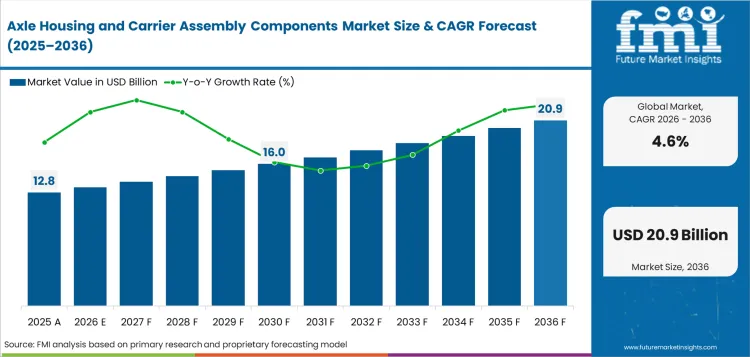
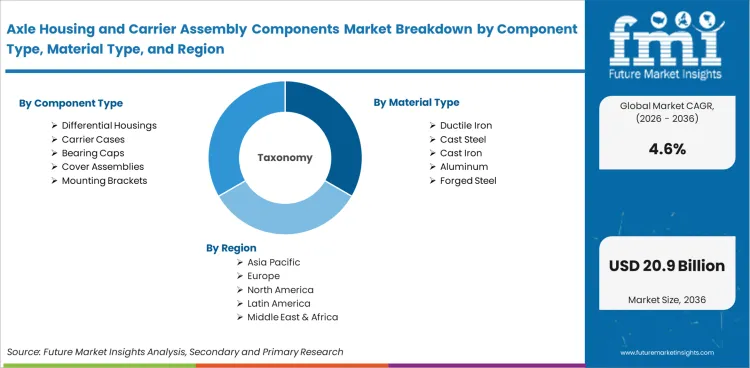
The axle housing and carrier assembly components market stood at USD 12.8 billion in 2025. It is expected to reach USD 13.4 billion by the end of 2026. With demand projected to expand at a 4.6% CAGR from 2026 to 2036, the market is forecast to reach USD 20.9 billion by 2036.
Summary of the Axle Housing and Carrier Assembly Components Market
- Demand and Growth Drivers
- Higher axle load requirements favor demand for stronger housings as light trucks and commercial platforms carry heavier driveline loads.
- Carrier machining depth boosts supplier value as bearing alignment and gear mesh control affect noise and warranty exposure.
- Electric axle packaging increases design work as compact drive units place gear sets and motor housings closer together.
- Aftermarket service demand continues as fleet operators replace damaged covers and carrier assemblies during axle overhaul cycles.
- Product and Segment View
- Differential housings are projected to account for 35.0% of the component type segment in 2026 as axle designs need rigid cast structures to protect gear alignment.
- With a 46.0% share in 2026, ductile iron is expected to be the preferred material for housings needing strength and practical machining cost.
- Light trucks are forecast to hold 38.0% of vehicle type demand in 2026 as towing use and payload ratings increase axle structure requirements.
- ICE axles continue to represent the main drivetrain demand base as commercial vehicles rely on proven mechanical layouts across long service cycles.
- Geography and Competitive Outlook
- China is expected to record a CAGR of 5.4% through 2036 as vehicle output and axle sourcing depth expand.
- India is projected to expand at 5.2% CAGR by 2036, supported by utility vehicle production and commercial axle demand.
- Companies combining casting control with carrier machining capacity are strengthening their position during the forecast period.
- Analyst Opinion
- Nikhil Kaitwade, Principal Consultant for the Automotive domain at FMI, says, “Axle housing and carrier assembly components now require precision beyond basic cast parts. OEM programs need bore accuracy with dependable foundry quality. Higher axle torque and material discipline raise pressure, while casting yield and machining depth reduce rework.”
- Axle Housing and Carrier Assembly Components Market Value Analysis
- The axle housing and carrier assembly components market is moving from basic cast component supply into a more controlled structural driveline component base.
- Axle housing and carrier case use is increasing as buyers need better load handling and more accurate gear positioning.
- Validated axle component programs are gaining importance across pickup trucks and commercial vehicles with higher duty-cycle requirements.
- Countries with large light truck and commercial vehicle assembly bases create a stronger production base for housing and carrier demand.
Key Takeaways, Market Size, and Forecast
- The axle housing and carrier assembly components market is expected to be worth USD 13.4 billion in 2026.
- By 2036, the axle housing and carrier assembly components market is expected to be worth USD 20.9 billion.
- From 2026 to 2036, the market is projected to expand at a CAGR of 4.6%.
- The market is projected to create an incremental opportunity of USD 7.5 billion between 2026 and 2036.
- In 2026, differential housings are expected to account for 35.0% of component type demand.
- Ductile iron is expected to account for 46.0% of material type demand in 2026.
- China at 5.4% CAGR and India at 5.2% CAGR are expected to outpace other key country markets through 2036.
Carrier quality is becoming a bigger decision point for axle housing and carrier assembly component buyers. Cummins announced a USD 55 million rear axle investment in October 2024 to add 50,000 units per year in North America. The investment includes carrier assembly and carrier casting machining, which directly strengthens truck axle supply capacity.
Aftermarket confidence is also becoming more important. Dana extended the Spicer service carrier warranty in December 2024 to three years with unlimited mileage for service carriers purchased from June 1, 2024. This gives fleets and distributors a stronger reason to choose branded carrier assemblies instead of lower-priced alternatives.
Electric axle programs are adding another demand area. ZF announced in April 2025 a nomination to supply several thousand AxTrax 2 electric axle units in India, and the axle delivers 210 kW of continuous power. This points to future demand for compact housings and carrier interfaces built for electric commercial vehicles.
Axle Housing and Carrier Assembly Components Market Definition
The axle housing and carrier assembly components market includes structural parts used to hold and protect axle gear sets. These parts include differential housings, carrier cases, bearing caps, cover assemblies, and mounting brackets. They serve passenger cars, light trucks, heavy trucks, buses, and off-highway vehicles. Complete axle assemblies, driveshafts, brake systems, and electronic traction control units are outside the scope.
Axle Housing and Carrier Assembly Components Market Inclusions
Market scope covers all commercially traded axle housing and carrier assembly components categorized by component type, including differential housings, carrier cases, bearing caps, cover assemblies, and mounting brackets; material type, including ductile iron, cast steel, cast iron, aluminum, and forged steel; vehicle type, including light trucks, passenger cars, heavy trucks, off-highway vehicles, and buses; drivetrain type, including ICE axles, hybrid axles, electric drive axles, rear axles, and front axles; and sales channel, including OEM fitment, aftermarket replacement, OES service, remanufactured components, and fleet supply. Revenue scope covers 2026 to 2036. The key stakeholders include axle component manufacturers, foundry operators, machining service providers, vehicle OEMs, tier-1 axle system suppliers, aftermarket distributors, fleet maintenance providers, remanufacturing companies, material suppliers, testing service providers, and regulatory bodies.
Axle Housing and Carrier Assembly Components Market Exclusions
Scope does not include complete axle assemblies, axle shafts, driveshafts, wheel hubs, brake modules, electronic control units, or vehicle suspension systems sold as complete assemblies.
Axle Housing and Carrier Assembly Components Market Research Methodology
- Primary Research: Industry discussions with axle system suppliers, foundry operators, machining specialists, vehicle OEM teams, and aftermarket channel participants shaped FMI’s primary research.
- Desk Research: The study combined vehicle production data, axle component references, supplier product portfolios, and technical information on axle case machining.
- Market sizing and forecasting: The model added axle fitment rates, component value, vehicle output, replacement demand, and country-level sourcing differences from the bottom up.
- Data validation: Forecasts were cross-checked against vehicle production data, foundry cost indicators, active supplier portfolios, and recent axle capacity investments.
Why is the Axle Housing and Carrier Assembly Components Market Growing?
- Vehicle programs are using stronger housings as axle torque and payload needs increase across light trucks.
- OEMs need carrier assemblies with tighter machining tolerance to reduce gear noise and warranty risk.
- Electric drive axles create demand for compact housings around gear sets and motor interfaces.
- Fleet repair channels need exact-fit replacement covers and carrier parts during axle overhaul work.
Axle component demand is tied to commercial vehicle build and service intensity across truck and bus platforms. In March 2025, ACEA reported North America recorded 4 million commercial vehicle sales in 2024 with a 30% market share. World bus production reached 362,005 units in 2024, marking a 10.3% increase from 2023. These figures point to continued need for housings and carrier assemblies in heavy-duty axle programs and service channels.
Input cost pressure is also changing how axle component contracts are evaluated. FRED reported the Producer Price Index for iron and steel at 353.916 in April 2026, up from 323.978 in December 2025. This price movement increases focus on casting yield and scrap control across housing programs. Machining efficiency is also becoming a stronger cost priority for axle component suppliers. Buyers are likely to favor suppliers able to reduce rejection rates without weakening component performance.
Market Segmentation Analysis
- Differential housings are projected to hold 35.0% of component type sales in 2026 as rear axle programs need stable structures around gear sets.
- Ductile iron is expected to capture a 46.0% material type share in 2026, reflecting its balance of load strength and machining cost.
- Light trucks are expected to account for 38.0% of vehicle type use in 2026 as towing needs raise axle durability requirements.
- ICE axles are forecast to account for 58.0% of drivetrain type demand as commercial vehicles continue using mechanical driveline systems.
- OEM fitment is projected to lead the sales channel segment with 72.0% share in 2026 as housing approvals begin during platform sourcing.
The market for axle housing and carrier assembly components is divided into five primary segment groups based on component type, material type, vehicle type, drivetrain type, and sales channel. Component type includes differential housings, carrier cases, bearing caps, cover assemblies, and mounting brackets. Material type includes ductile iron, cast steel, cast iron, aluminum, and forged steel. Vehicle type includes Light trucks, passenger cars, heavy trucks, off-highway vehicles, and buses. Drivetrain type includes ICE axles, hybrid axles, electric drive axles, rear axles, and front axles. Sales channel includes OEM fitment, aftermarket replacement, OES service, remanufactured components, and fleet supply.
Insights into Axle Housing and Carrier Assembly Components Market by Component Type
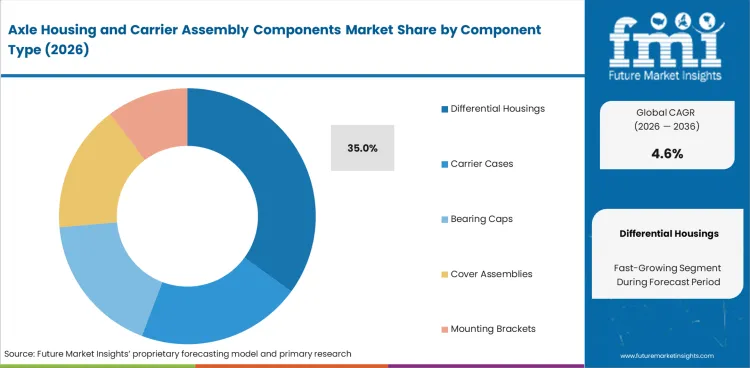
- In 2026, differential housings are expected to account for 35.0% of the component type segment. These parts form the main structural base for gear alignment and sealing across pickup and commercial axle programs.
- Carrier cases and bearing caps address precision areas inside axle assemblies. Their value improves in applications needing tighter bearing control and lower gear noise.
Insights into Axle Housing and Carrier Assembly Components Market by Material Type
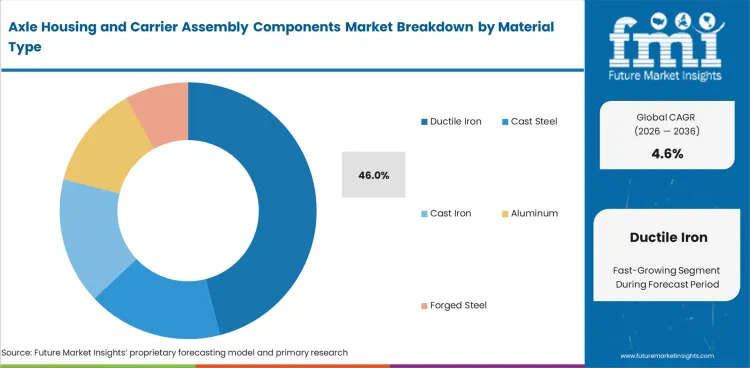
- Ductile iron is projected to account for 46.0% of the material type segment in 2026. Its strength and machining balance make it practical for housings exposed to axle load and road shock.
- Cast steel and aluminum options serve selected vehicle programs. Their use improves in heavy-duty applications and weight-sensitive driveline designs.
Insights into Axle Housing and Carrier Assembly Components Market by Vehicle Type
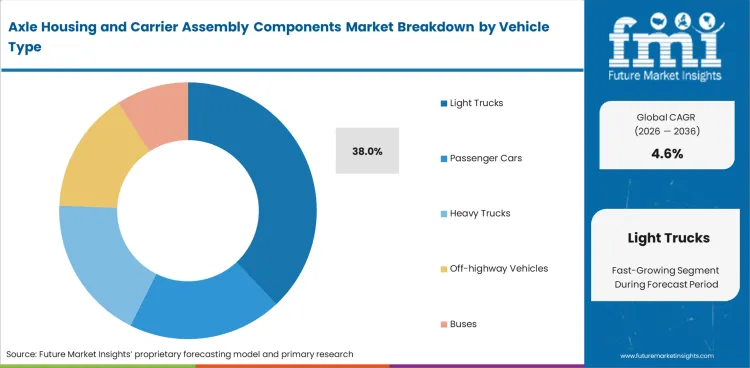
- Light trucks are forecast to hold 38.0% of the vehicle type segment in 2026. Towing needs and payload ratings raise higher-value demand for stronger housings and carrier cases.
- Passenger cars and heavy trucks enhance different sourcing needs across axle programs. Passenger cars favor cost control, and heavy trucks require higher load durability.
Insights into Axle Housing and Carrier Assembly Components Market by Drivetrain Type
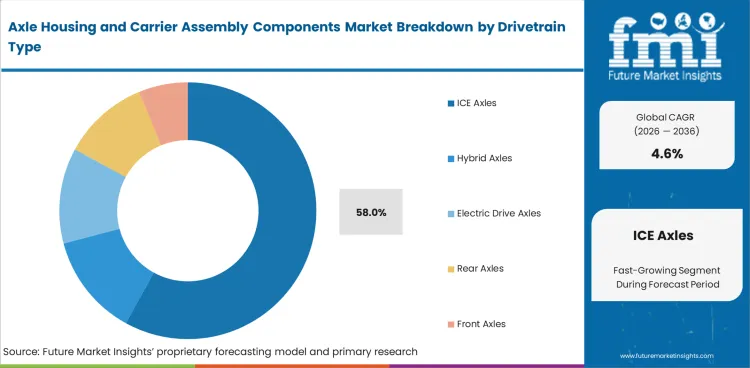
- ICE axles are expected to account for a 58.0% share in 2026. Commercial vehicles and fleet platforms continue using mechanical driveline layouts across high-mileage operating cycles.
- Hybrid and electric axle formats create new design needs around compact housings. Their value improves as gear sets and motor interfaces move closer together.
Insights into Axle Housing and Carrier Assembly Components Market by Sales Channel
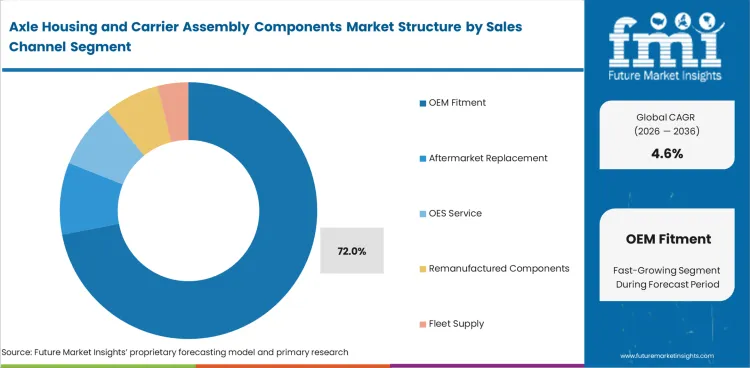
- OEM fitment is expected to hold 72.0% share in 2026. Vehicle manufacturers prefer early sourcing approval for housing and carrier parts across platform launch cycles.
- Aftermarket replacement serves repair demand across older axle assemblies. OES service channels address exact-fit component needs for warranty and fleet maintenance work.
Axle Housing and Carrier Assembly Components Market Drivers, Restraints, and Opportunities
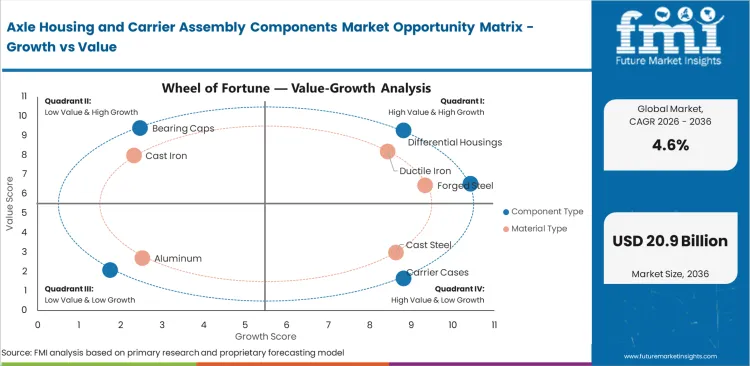
- Higher axle torque is creating structured demand for stronger housings across pickup and commercial vehicle programs.
- Foundry input costs increase pricing pressure for smaller suppliers with weaker casting yield control.
- Electric axle packaging improves opportunity for compact carrier designs and integrated housing formats.
Axle housing and carrier assembly components keep advancing as trucks and utility vehicles need stronger housings and precise carrier alignment for higher load conditions. Cost pressure from casting inputs and machining tolerances can slow broader use of high-specification components. Market expansion continues through OEM axle programs and replacement demand. Electric drive axle applications add demand as compact layouts need stronger structural parts.
Imported Auto-Part Duties Are Repricing Carrier Assemblies
Axle housing and carrier assembly component pricing is being reshaped by landed-cost exposure instead of factory conversion cost alone. In June 2025, the USA Department of Commerce stated that 25% tariffs on imports of automobile parts went into effect on May 3, 2025, with an offset process available for auto manufacturers producing vehicles in the United States. For axle housings and differential carriers this creates a clear price separator across sourcing options. The separation appears between USMCA qualified supply and domestic machining programs under current pricing conditions. A further gap exists for imported assemblies with tariff exposure affecting overall component cost structures. Buyers should isolate duty and machining elements in supplier quotes instead of benchmarking only the finished component price. They should separate casting and logistics costs to improve clarity in total pricing comparisons.
Steel and Aluminum Tariffs Lift Surcharge Risk
Material linked price escalation is becoming more visible in axle housing and carrier assembly contracts. This visibility is increasing because these components depend heavily on cast inputs and forged metal materials. It grows as machined metal inputs continue to influence overall component cost structures. In June 2025, the White House said tariffs on steel rose from 25% ad valorem to 50% ad valorem effective June 4, 2025. The same increase applied to aluminum and derivative articles. For suppliers importing steel intensive housings or aluminum covers the tariff change increases pass-through surcharge risk. This risk can arise even before machining or heat treatment costs are added to components. It may appear before coating or freight expenses are included in total pricing structures. Sourcing teams should separate metal-content exposure from value-added processing charges while negotiating annual axle component agreements.
Analysis of Axle Housing and Carrier Assembly Components Market By Key Countries
.webp "Top Country Growth Comparison Axle Housing And Carrier Assembly Components Market Cagr (2026 2036)")
| Country | CAGR |
|---|---|
| China | 5.4% |
| India | 5.2% |
| Mexico | 4.9% |
| USA | 4.0% |
| Germany | 3.3% |
Source: Future Market Insights, 2026.
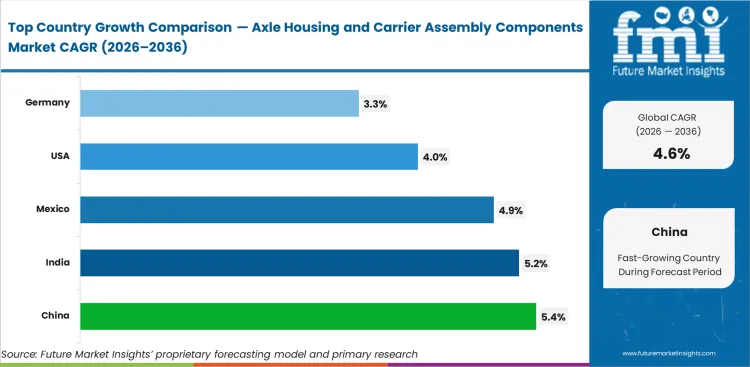
Axle Housing and Carrier Assembly Components Market CAGR Analysis By Country
- China is projected to record the fastest country expansion at 5.4% CAGR through 2036, driven by large vehicle output and deeper axle component sourcing.
- India’s 5.2% CAGR is linked to utility vehicle production and commercial axle programs moving through local supplier networks.
- Mexico is expected to advance at 4.9% CAGR as export assembly activity strengthens its role in North American axle supply chains.
- Pickup production and heavy-duty truck requirements place the USA at a 4.0% CAGR during the forecast period.
- Germany is forecast at 3.3% CAGR as mature vehicle output keeps demand measured, with precision component needs adding value.
Demand for axle housing and carrier assembly components is forecast to rise at 4.6% CAGR from 2026 to 2036. Country-level analysis covers the major markets contributing to this forecast, with the key markets listed below.
Demand Outlook for Axle Housing and Carrier Assembly Components Market in China
China’s axle housing and carrier assembly components industry is projected to record a CAGR of 5.4% through 2036. OICA recorded China vehicle production at 31,281,592 units in 2024. This manufacturing base boosts demand for China axle housing and carrier assembly components. Local suppliers can gain from OEMs seeking cast and machined axle parts near assembly plants.
- Large vehicle output favors demand for differential housings and carrier cases across domestic platforms.
- Electric axle programs increase the need for compact carrier structures and validated housing surfaces.
- Local OEM sourcing favors suppliers with casting depth and high-volume machining discipline.
Sales Analysis of Axle Housing and Carrier Assembly Components Market in India
The axle housing and carrier assembly components sector in India is expected to expand at a CAGR of 5.2% during the assessment period. OICA recorded India vehicle production at 6,014,691 units in 2024. The local utility vehicle and commercial vehicle base lifts the demand for India axle housing and carrier assembly components. Suppliers benefit from OEMs seeking local machining and assembly support.
- Utility vehicle output increases demand for rear axle housings and carrier assemblies.
- Commercial vehicle platforms need durable cast parts for repeated load exposure.
- Local sourcing gives Indian suppliers room to build deeper axle component portfolios.
Demand Outlook for Axle Housing and Carrier Assembly Components Market in Mexico
The Mexico axle housing and carrier assembly components industry is forecast to grow at a CAGR of 4.9% by 2036. OICA recorded Mexico vehicle production at 4,202,642 units in 2024. Export-oriented assembly creates steady demand for housings and carrier cases linked to North American vehicle programs. Suppliers with consistent delivery and machining capacity can serve cross-border axle supply chains.
- Export assembly improves demand for OEM-fit axle housing and carrier components.
- North American truck programs enhance repeat demand for carrier machining and bracket welding.
- Supplier location near assembly hubs reduces logistics risk for axle component programs.
Opportunity Analysis of Axle Housing and Carrier Assembly Components Market in the United States
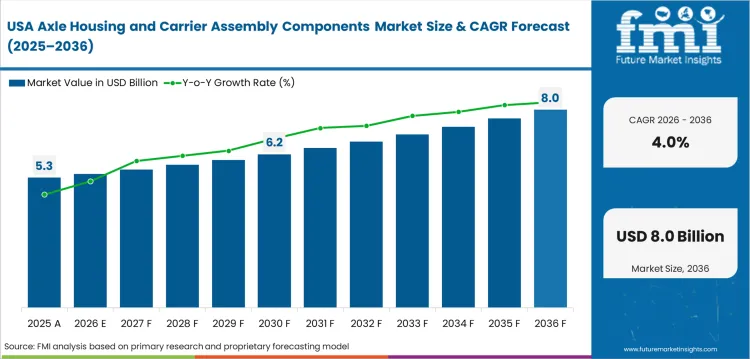
The axle housing and carrier assembly components segment in the USA is poised to advance at 4.0% CAGR over the forecast years. USA pickup and commercial vehicle production creates steady demand for axle housing and carrier assembly components. Work vehicle platforms need durable housings and carrier cases designed for higher load conditions. Demand is strongest for high-load applications requiring precise carrier alignment.
- Pickup production raises demand for durable axle housings and cover assemblies.
- Heavy-duty truck programs raise demand for carrier cases and differential component machining.
- Cummins’ 2024 rear axle investment strengthens the local capacity base for axle programs.
Future Outlook for Axle Housing and Carrier Assembly Components Market in Germany
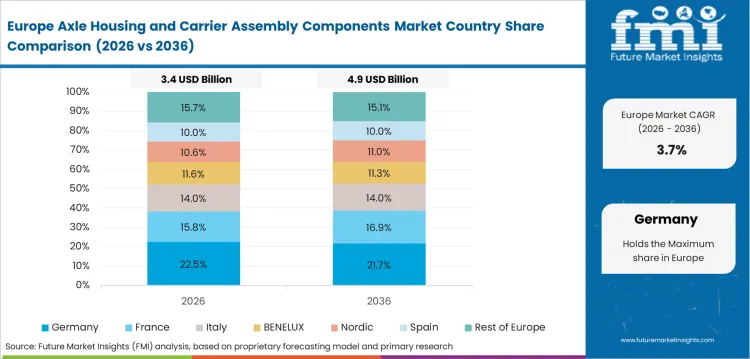
The Germany axle housing and carrier assembly components industry is expected to post 3.3% CAGR through 2036. Germany’s established vehicle production base creates steady demand for axle housing and carrier assembly components. Premium vehicle platforms need precise driveline structures with strong machining quality and reliable component fit. Component producers with strong validation and machining quality can serve higher-value axle programs.
- Premium vehicle platforms enhance demand for accurate housings and low-noise carrier assemblies.
- Electric driveline development increases interest in compact carrier formats and integrated structures.
- Mature production keeps volume expansion measured, but component precision is important.
Competitive Landscape and Strategic Positioning
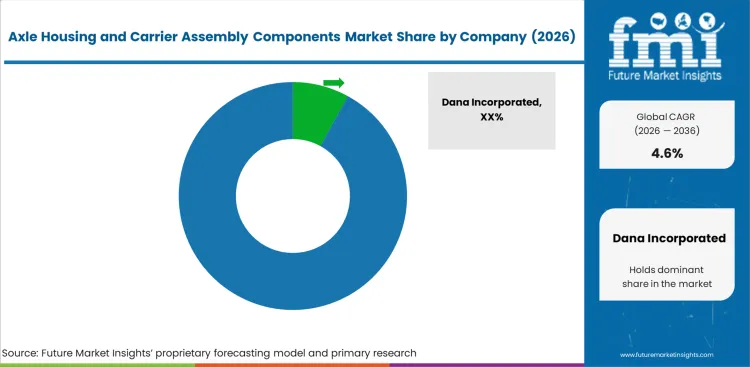
- Dana Incorporated uses axle system depth and Spicer carrier coverage across OEM and service channels.
- Cummins Inc. (Meritor) brings heavy-duty axle experience and added machining capacity for carrier assembly programs across large truck platforms.
- Regional suppliers focus on cast housing work and carrier machining for vehicle programs needing shorter lead times.
Competition in this market is based on casting quality and repeat machining accuracy across long vehicle programs. Dana Incorporated has an advantage through axle system knowledge and established Spicer carrier availability. Cummins Inc. (Meritor) adds value through heavy-duty axle coverage and recent capacity tied to carrier assembly work.
Cost swings in foundry inputs and tight bore accuracy standards make supplier approval difficult. OEMs prefer companies able to deliver stable housings and carrier parts across full production cycles. Strong competitors will be those with controlled casting output and reliable machining records. Suppliers with proven axle program access can help manufacturers reduce sourcing risk across major platforms.
Key Companies in the Axle Housing and Carrier Assembly Components Market
Key global companies leading the axle housing and carrier assembly components market include:
- Dana Incorporated and Cummins Inc. (Meritor) have strong axle component infrastructure for OEM programs and replacement channels.
- ZF Friedrichshafen, Bharat Forge, and Press Kogyo serve manufacturers through driveline engineering, forged components, and axle case production depth.
- Automotive Axles Limited, Aisin Corporation, and Hyundai WIA hold specialist positions across regional axle programs and vehicle component supply.
Competitive Benchmarking: Axle Housing and Carrier Assembly Components Market
| Company | Housing Casting Depth | Carrier Machining Strength | OEM Axle Program Reach | Geographic Footprint |
|---|---|---|---|---|
| Dana Incorporated | High | High | Strong | Global footprint across North America, South America, Europe, Middle East, Africa, and Asia Pacific. |
| Cummins Inc. (Meritor) | High | High | Strong | Strong presence across North America, South America, Europe, and Asia Pacific commercial vehicle markets. |
| ZF Friedrichshafen | Medium | High | Strong | Global operations through 162 production locations across 29 countries. |
| Press Kogyo Co. Ltd. | High | Medium | Strong | Japan-centered footprint with overseas affiliates serving truck and axle customers. |
| Automotive Axles Limited | Medium | Medium | Moderate | India-focused footprint with plants in Mysuru, Rudrapur, and Jamshedpur. |
| Aisin Corporation | Medium | Medium | Strong | Global automotive parts footprint with strong operations in Japan, North America, China, and India. |
| Hyundai WIA | Medium | Medium | Moderate | South Korea-centered footprint with production and sales presence in China, India, Mexico, Slovakia, and the USA. |
Source: Future Market Insights, 2026.
Key Developments in Axle Housing and Carrier Assembly Components Market
- In April, 2026, Cummins launched the Meritor® RT-160 HE tandem drive axle family for heavy linehaul applications at Truck World 2026. The development is highly relevant because the axle uses Meritor Lube Management System in both forward and rear carriers. The rear-rear carrier is also redesigned with an integrated bearing cage, reducing weight by 35 lb while maintaining durability.
- In December, 2024, Dana launched the Spicer AdvanTEK® 40 Pro axle system for commercial vehicles. The system adds 18 axle ratios, a 2.05 ratio for downspeeding, a high-capacity bearing system, improved inter-axle differential protection, and differential locking in either forward or rear axle. This improves demand for stronger axle housings, bearing support structures, and carrier-side components in heavy-duty applications.
Key Players in the Axle Housing and Carrier Assembly Components Market
Major Global Players:
- Dana Incorporated
- Cummins Inc. (Meritor)
- ZF Friedrichshafen
- Press Kogyo Co. Ltd.
- Aisin Corporation
Specialist Players:
- Automotive Axles Limited
- Hyundai WIA
- Musashi Seimitsu Industry
Report Scope and Coverage
| Parameter | Details |
|---|---|
| Quantitative Units | USD 13.4 billion to USD 20.9 billion, at a CAGR of 4.6% |
| Market Definition | The axle housing and carrier assembly components market includes structural and machined parts used to hold axle gear sets and carrier assemblies. |
| Regions Covered | North America, Latin America, Europe, East Asia, South Asia and Pacific, Middle East and Africa |
| Countries Covered | USA, Germany, China, India, Mexico, Japan, South Korea, and 30 plus countries |
| Key Companies Profiled | Dana Incorporated,Cummins Inc. (Meritor), ZF Friedrichshafen, Press Kogyo Co. Ltd., Automotive Axles Limited, Aisin Corporation, Hyundai WIA |
| Forecast Period | 2026 to 2036 |
| Approach | Hybrid bottom-up and top-down methodology starting with axle component demand and verified vehicle production patterns. |
Axle Housing and Carrier Assembly Components Market by Segments
Axle Housing and Carrier Assembly Components Market Segmented by Component Type:
- Differential Housings
- Carrier Cases
- Bearing Caps
- Cover Assemblies
- Mounting Brackets
Axle Housing and Carrier Assembly Components Market Segmented by Material Type:
- Ductile Iron
- Cast Steel
- Cast Iron
- Aluminum
- Forged Steel
Axle Housing and Carrier Assembly Components Market Segmented by Vehicle Type:
- Light Trucks
- Passenger Cars
- Heavy Trucks
- Off-highway Vehicles
- Buses
Axle Housing and Carrier Assembly Components Market Segmented by Drivetrain Type:
- ICE Axles
- Hybrid Axles
- Electric Drive Axles
- Rear Axles
- Front Axles
Axle Housing and Carrier Assembly Components Market Segmented by Sales Channel:
- OEM Fitment
- Aftermarket Replacement
- OES Service
- Remanufactured Components
- Fleet Supply
Axle Housing and Carrier Assembly Components Market by Region:
- North America
- USA
- Canada
- Mexico
- Latin America
- Brazil
- Chile
- Rest of Latin America
- Europe
- Germany
- UK
- Italy
- Spain
- France
- Rest of Europe
- East Asia
- China
- Japan
- South Korea
- South Asia and Pacific
- India
- ASEAN
- Australia & New Zealand
- Rest of South Asia and Pacific
- Middle East and Africa
- Saudi Arabia
- Other GCC Countries
- South Africa
- Rest of Middle East and Africa
Research Sources and Bibliography
- Cummins Inc. (2024, October 3). Cummins Drivetrain and Braking Systems invests to boost production capacity.
Cummins Drivetrain and Braking Systems invests to boost production capacity | Cummins Inc. - Dana Incorporated. (2024, December 11). Dana implements enhanced service carrier warranty policy.
Dana Implements Enhanced Service Carrier Warranty Policy |Spicer Parts - ZF Friedrichshafen AG. (2025, April 16). India Business Win: ZF secures significant order for AxTrax 2 Electric Axle for commercial vehicles.
India Business Win: ZF secures significant order for AxTrax 2 Electric Axle for commercial vehicles - ZF - International Organization of Motor Vehicle Manufacturers. (2025). World motor vehicle production by country/region and type 2024.
- Federal Reserve Bank of St. Louis. (2026, May 13). Producer Price Index by Commodity: Metals and Metal Products: Iron and Steel. FRED.
- Federal Reserve Bank of St. Louis. (2026, May 13). Producer Price Index by Industry: Steel Foundries, Except Investment. FRED.
- Press Kogyo Co. Ltd. (n.d.). Axle.
- Cummins Inc. (2024, October 3). Cummins Drivetrain and Braking Systems invests to boost production capacity.
- Cummins Inc. (2026, April 15). Cummins launches new RT-160 HE high-efficiency tandem drive axle at Truck World 2026. Cummins Inc.
Cummins launches new RT-160 HE high-efficiency tandem drive axle at Truck World 2026 | Cummins Inc. - Dana Incorporated. (2024, December 18). Dana launches Spicer AdvanTEK® 40 Pro axle system for improved durability and optimized fleet performance; 2.05 axle ratio offers extreme downspeeding coverage. Dana Incorporated.
Dana Launches Spicer AdvanTEK® 40 Pro Axle System for Improved Durability and Optimized Fleet Performance; 2.05 Axle Ratio Offers Extreme Downspeeding Coverage - The White House. (2025, June 3). Adjusting imports of aluminum and steel into the United States. The White House. Adjusting Imports of Aluminum and Steel into the United States - The White House
- International Trade Administration. (2025, June 12). The Department of Commerce announces new auto tariff offset process. USA Department of Commerce. The Department of Commerce Announces New Auto Tariff Offset Process
- ACEA. (2025, March 13). Economic and market report: Global and EU auto industry - Full year 2024. European Automobile Manufacturers’ Association.
This Report Answers
- What is the current and future size of the axle housing and carrier assembly components market?
- How fast is the axle housing and carrier assembly components market expected to expand between 2026 and 2036?
- Which component type is expected to lead the market by 2026?
- Which material type is expected to account for the highest demand by 2026?
- What factors are driving demand for axle housing and carrier assembly components globally?
- How are axle load requirements influencing OEM sourcing decisions?
- Why are differential housings the main component demand base?
- How are electric drive axles creating demand for compact housing designs?
- Which countries are projected to record faster expansion through 2036?
- What is driving market expansion in China and India?
- Who are the key companies active in the axle housing and carrier assembly components market?
- How does FMI estimate and validate the market forecast?
Frequently Asked Questions
What is the global market demand for Axle Housing and Carrier Assembly Components in 2026?
In 2026, the global market for axle housing and carrier assembly components is expected to be worth USD 13.4 billion.
How big will the market for Axle Housing and Carrier Assembly Components be in 2036?
By 2036, the market for axle housing and carrier assembly components is expected to be worth USD 20.9 billion.
How much is demand for Axle Housing and Carrier Assembly Components expected to expand between 2026 and 2036?
Between 2026 and 2036, demand for axle housing and carrier assembly components is expected to expand at a CAGR of 4.6%.
Which component type segment is likely to be the best seller globally by 2026?
Differential housings are expected to account for 35.0% of the component type segment in 2026.
What is causing demand to rise in China?
The China axle housing and carrier assembly components market is projected to record 5.4% CAGR through 2036, supported by large vehicle output and axle component sourcing depth.
What is causing demand to rise in India?
The India axle housing and carrier assembly components market is projected to expand at 5.2% CAGR through 2036, supported by utility vehicle and commercial vehicle output.
What does this report mean by Axle Housing and Carrier Assembly Components Market definition?
The axle housing and carrier assembly components market includes structural and machined axle parts used to hold carrier assemblies and protect gear sets.
How does FMI make the Axle Housing and Carrier Assembly Components forecast and check it?
Forecasting models use a hybrid bottom-up and top-down approach, starting with axle component demand and checking it against vehicle production patterns.
Preview the report firsthand - request a free sample
Get SampleGet the brochure for pricing and purchase details.
Get PDFTable of Content
- Executive Summary
- Global Market Outlook
- Demand-side Trends
- Supply-side Trends
- Technology Roadmap Analysis
- Analysis and Recommendations
- Market Overview
- Market Coverage / Taxonomy
- Market Definition / Scope / Limitations
- Research Methodology
- Chapter Orientation
- Analytical Lens and Working Hypotheses
- Market Structure, Signals, and Trend Drivers
- Benchmarking and Cross-market Comparability
- Market Sizing, Forecasting, and Opportunity Mapping
- Research Design and Evidence Framework
- Desk Research Programme (Secondary Evidence)
- Company Annual and Sustainability Reports
- Peer-reviewed Journals and Academic Literature
- Corporate Websites, Product Literature, and Technical Notes
- Earnings Decks and Investor Briefings
- Statutory Filings and Regulatory Disclosures
- Technical White Papers and Standards Notes
- Trade Journals, Industry Magazines, and Analyst Briefs
- Conference Proceedings, Webinars, and Seminar Materials
- Government Statistics Portals and Public Data Releases
- Press Releases and Reputable Media Coverage
- Specialist Newsletters and Curated Briefings
- Sector Databases and Reference Repositories
- FMI Internal Proprietary Databases and Historical Market Datasets
- Subscription Datasets and Paid Sources
- Social Channels, Communities, and Digital Listening Inputs
- Additional Desk Sources
- Expert Input and Fieldwork (Primary Evidence)
- Primary Modes
- Qualitative Interviews and Expert Elicitation
- Quantitative Surveys and Structured Data Capture
- Blended Approach
- Why Primary Evidence is Used
- Field Techniques
- Interviews
- Surveys
- Focus Groups
- Observational and In-context Research
- Social and Community Interactions
- Stakeholder Universe Engaged
- C-suite Leaders
- Board Members
- Presidents and Vice Presidents
- R&D and Innovation Heads
- Technical Specialists
- Domain Subject-matter Experts
- Scientists
- Physicians and Other Healthcare Professionals
- Governance, Ethics, and Data Stewardship
- Research Ethics
- Data Integrity and Handling
- Primary Modes
- Tooling, Models, and Reference Databases
- Desk Research Programme (Secondary Evidence)
- Data Engineering and Model Build
- Data Acquisition and Ingestion
- Cleaning, Normalisation, and Verification
- Synthesis, Triangulation, and Analysis
- Quality Assurance and Audit Trail
- Market Background
- Market Dynamics
- Drivers
- Restraints
- Opportunity
- Trends
- Scenario Forecast
- Demand in Optimistic Scenario
- Demand in Likely Scenario
- Demand in Conservative Scenario
- Opportunity Map Analysis
- Product Life Cycle Analysis
- Supply Chain Analysis
- Investment Feasibility Matrix
- Value Chain Analysis
- PESTLE and Porter’s Analysis
- Regulatory Landscape
- Regional Parent Market Outlook
- Production and Consumption Statistics
- Import and Export Statistics
- Market Dynamics
- Global Market Analysis 2021 to 2025 and Forecast, 2026 to 2036
- Historical Market Size Value (USD Million) Analysis, 2021 to 2025
- Current and Future Market Size Value (USD Million) Projections, 2026 to 2036
- Y-o-Y Growth Trend Analysis
- Absolute $ Opportunity Analysis
- Global Market Pricing Analysis 2021 to 2025 and Forecast 2026 to 2036
- Global Market Analysis 2021 to 2025 and Forecast 2026 to 2036, By Component Type
- Introduction / Key Findings
- Historical Market Size Value (USD Million) Analysis By Component Type , 2021 to 2025
- Current and Future Market Size Value (USD Million) Analysis and Forecast By Component Type , 2026 to 2036
- Differential Housings
- Carrier Cases
- Bearing Caps
- Cover Assemblies
- Mounting Brackets
- Differential Housings
- Y-o-Y Growth Trend Analysis By Component Type , 2021 to 2025
- Absolute $ Opportunity Analysis By Component Type , 2026 to 2036
- Global Market Analysis 2021 to 2025 and Forecast 2026 to 2036, By Material Type
- Introduction / Key Findings
- Historical Market Size Value (USD Million) Analysis By Material Type, 2021 to 2025
- Current and Future Market Size Value (USD Million) Analysis and Forecast By Material Type, 2026 to 2036
- Ductile Iron
- Cast Steel
- Cast Iron
- Aluminum
- Forged Steel
- Ductile Iron
- Y-o-Y Growth Trend Analysis By Material Type, 2021 to 2025
- Absolute $ Opportunity Analysis By Material Type, 2026 to 2036
- Global Market Analysis 2021 to 2025 and Forecast 2026 to 2036, By Vehicle Type
- Introduction / Key Findings
- Historical Market Size Value (USD Million) Analysis By Vehicle Type, 2021 to 2025
- Current and Future Market Size Value (USD Million) Analysis and Forecast By Vehicle Type, 2026 to 2036
- Light Trucks
- Passenger Cars
- Heavy Trucks
- Off-highway Vehicles
- Buses
- Light Trucks
- Y-o-Y Growth Trend Analysis By Vehicle Type, 2021 to 2025
- Absolute $ Opportunity Analysis By Vehicle Type, 2026 to 2036
- Global Market Analysis 2021 to 2025 and Forecast 2026 to 2036, By Drivetrain Type
- Introduction / Key Findings
- Historical Market Size Value (USD Million) Analysis By Drivetrain Type, 2021 to 2025
- Current and Future Market Size Value (USD Million) Analysis and Forecast By Drivetrain Type, 2026 to 2036
- ICE Axles
- Hybrid Axles
- Electric Drive Axles
- Rear Axles
- Front Axles
- ICE Axles
- Y-o-Y Growth Trend Analysis By Drivetrain Type, 2021 to 2025
- Absolute $ Opportunity Analysis By Drivetrain Type, 2026 to 2036
- Global Market Analysis 2021 to 2025 and Forecast 2026 to 2036, By Sales Channel
- Introduction / Key Findings
- Historical Market Size Value (USD Million) Analysis By Sales Channel, 2021 to 2025
- Current and Future Market Size Value (USD Million) Analysis and Forecast By Sales Channel, 2026 to 2036
- OEM Fitment
- Aftermarket Replacement
- OES Service
- Remanufactured Components
- Fleet Supply
- OEM Fitment
- Y-o-Y Growth Trend Analysis By Sales Channel, 2021 to 2025
- Absolute $ Opportunity Analysis By Sales Channel, 2026 to 2036
- Global Market Analysis 2021 to 2025 and Forecast 2026 to 2036, By Region
- Introduction
- Historical Market Size Value (USD Million) Analysis By Region, 2021 to 2025
- Current Market Size Value (USD Million) Analysis and Forecast By Region, 2026 to 2036
- North America
- Latin America
- Western Europe
- Eastern Europe
- East Asia
- South Asia and Pacific
- Middle East & Africa
- Market Attractiveness Analysis By Region
- North America Market Analysis 2021 to 2025 and Forecast 2026 to 2036, By Country
- Historical Market Size Value (USD Million) Trend Analysis By Market Taxonomy, 2021 to 2025
- Market Size Value (USD Million) Forecast By Market Taxonomy, 2026 to 2036
- By Country
- USA
- Canada
- Mexico
- By Component Type
- By Material Type
- By Vehicle Type
- By Drivetrain Type
- By Sales Channel
- By Country
- Market Attractiveness Analysis
- By Country
- By Component Type
- By Material Type
- By Vehicle Type
- By Drivetrain Type
- By Sales Channel
- Key Takeaways
- Latin America Market Analysis 2021 to 2025 and Forecast 2026 to 2036, By Country
- Historical Market Size Value (USD Million) Trend Analysis By Market Taxonomy, 2021 to 2025
- Market Size Value (USD Million) Forecast By Market Taxonomy, 2026 to 2036
- By Country
- Brazil
- Chile
- Rest of Latin America
- By Component Type
- By Material Type
- By Vehicle Type
- By Drivetrain Type
- By Sales Channel
- By Country
- Market Attractiveness Analysis
- By Country
- By Component Type
- By Material Type
- By Vehicle Type
- By Drivetrain Type
- By Sales Channel
- Key Takeaways
- Western Europe Market Analysis 2021 to 2025 and Forecast 2026 to 2036, By Country
- Historical Market Size Value (USD Million) Trend Analysis By Market Taxonomy, 2021 to 2025
- Market Size Value (USD Million) Forecast By Market Taxonomy, 2026 to 2036
- By Country
- Germany
- UK
- Italy
- Spain
- France
- Nordic
- BENELUX
- Rest of Western Europe
- By Component Type
- By Material Type
- By Vehicle Type
- By Drivetrain Type
- By Sales Channel
- By Country
- Market Attractiveness Analysis
- By Country
- By Component Type
- By Material Type
- By Vehicle Type
- By Drivetrain Type
- By Sales Channel
- Key Takeaways
- Eastern Europe Market Analysis 2021 to 2025 and Forecast 2026 to 2036, By Country
- Historical Market Size Value (USD Million) Trend Analysis By Market Taxonomy, 2021 to 2025
- Market Size Value (USD Million) Forecast By Market Taxonomy, 2026 to 2036
- By Country
- Russia
- Poland
- Hungary
- Balkan & Baltic
- Rest of Eastern Europe
- By Component Type
- By Material Type
- By Vehicle Type
- By Drivetrain Type
- By Sales Channel
- By Country
- Market Attractiveness Analysis
- By Country
- By Component Type
- By Material Type
- By Vehicle Type
- By Drivetrain Type
- By Sales Channel
- Key Takeaways
- East Asia Market Analysis 2021 to 2025 and Forecast 2026 to 2036, By Country
- Historical Market Size Value (USD Million) Trend Analysis By Market Taxonomy, 2021 to 2025
- Market Size Value (USD Million) Forecast By Market Taxonomy, 2026 to 2036
- By Country
- China
- Japan
- South Korea
- By Component Type
- By Material Type
- By Vehicle Type
- By Drivetrain Type
- By Sales Channel
- By Country
- Market Attractiveness Analysis
- By Country
- By Component Type
- By Material Type
- By Vehicle Type
- By Drivetrain Type
- By Sales Channel
- Key Takeaways
- South Asia and Pacific Market Analysis 2021 to 2025 and Forecast 2026 to 2036, By Country
- Historical Market Size Value (USD Million) Trend Analysis By Market Taxonomy, 2021 to 2025
- Market Size Value (USD Million) Forecast By Market Taxonomy, 2026 to 2036
- By Country
- India
- ASEAN
- Australia & New Zealand
- Rest of South Asia and Pacific
- By Component Type
- By Material Type
- By Vehicle Type
- By Drivetrain Type
- By Sales Channel
- By Country
- Market Attractiveness Analysis
- By Country
- By Component Type
- By Material Type
- By Vehicle Type
- By Drivetrain Type
- By Sales Channel
- Key Takeaways
- Middle East & Africa Market Analysis 2021 to 2025 and Forecast 2026 to 2036, By Country
- Historical Market Size Value (USD Million) Trend Analysis By Market Taxonomy, 2021 to 2025
- Market Size Value (USD Million) Forecast By Market Taxonomy, 2026 to 2036
- By Country
- Kingdom of Saudi Arabia
- Other GCC Countries
- Turkiye
- South Africa
- Other African Union
- Rest of Middle East & Africa
- By Component Type
- By Material Type
- By Vehicle Type
- By Drivetrain Type
- By Sales Channel
- By Country
- Market Attractiveness Analysis
- By Country
- By Component Type
- By Material Type
- By Vehicle Type
- By Drivetrain Type
- By Sales Channel
- Key Takeaways
- Key Countries Market Analysis
- USA
- Pricing Analysis
- Market Share Analysis, 2025
- By Component Type
- By Material Type
- By Vehicle Type
- By Drivetrain Type
- By Sales Channel
- Canada
- Pricing Analysis
- Market Share Analysis, 2025
- By Component Type
- By Material Type
- By Vehicle Type
- By Drivetrain Type
- By Sales Channel
- Mexico
- Pricing Analysis
- Market Share Analysis, 2025
- By Component Type
- By Material Type
- By Vehicle Type
- By Drivetrain Type
- By Sales Channel
- Brazil
- Pricing Analysis
- Market Share Analysis, 2025
- By Component Type
- By Material Type
- By Vehicle Type
- By Drivetrain Type
- By Sales Channel
- Chile
- Pricing Analysis
- Market Share Analysis, 2025
- By Component Type
- By Material Type
- By Vehicle Type
- By Drivetrain Type
- By Sales Channel
- Germany
- Pricing Analysis
- Market Share Analysis, 2025
- By Component Type
- By Material Type
- By Vehicle Type
- By Drivetrain Type
- By Sales Channel
- UK
- Pricing Analysis
- Market Share Analysis, 2025
- By Component Type
- By Material Type
- By Vehicle Type
- By Drivetrain Type
- By Sales Channel
- Italy
- Pricing Analysis
- Market Share Analysis, 2025
- By Component Type
- By Material Type
- By Vehicle Type
- By Drivetrain Type
- By Sales Channel
- Spain
- Pricing Analysis
- Market Share Analysis, 2025
- By Component Type
- By Material Type
- By Vehicle Type
- By Drivetrain Type
- By Sales Channel
- France
- Pricing Analysis
- Market Share Analysis, 2025
- By Component Type
- By Material Type
- By Vehicle Type
- By Drivetrain Type
- By Sales Channel
- India
- Pricing Analysis
- Market Share Analysis, 2025
- By Component Type
- By Material Type
- By Vehicle Type
- By Drivetrain Type
- By Sales Channel
- ASEAN
- Pricing Analysis
- Market Share Analysis, 2025
- By Component Type
- By Material Type
- By Vehicle Type
- By Drivetrain Type
- By Sales Channel
- Australia & New Zealand
- Pricing Analysis
- Market Share Analysis, 2025
- By Component Type
- By Material Type
- By Vehicle Type
- By Drivetrain Type
- By Sales Channel
- China
- Pricing Analysis
- Market Share Analysis, 2025
- By Component Type
- By Material Type
- By Vehicle Type
- By Drivetrain Type
- By Sales Channel
- Japan
- Pricing Analysis
- Market Share Analysis, 2025
- By Component Type
- By Material Type
- By Vehicle Type
- By Drivetrain Type
- By Sales Channel
- South Korea
- Pricing Analysis
- Market Share Analysis, 2025
- By Component Type
- By Material Type
- By Vehicle Type
- By Drivetrain Type
- By Sales Channel
- Russia
- Pricing Analysis
- Market Share Analysis, 2025
- By Component Type
- By Material Type
- By Vehicle Type
- By Drivetrain Type
- By Sales Channel
- Poland
- Pricing Analysis
- Market Share Analysis, 2025
- By Component Type
- By Material Type
- By Vehicle Type
- By Drivetrain Type
- By Sales Channel
- Hungary
- Pricing Analysis
- Market Share Analysis, 2025
- By Component Type
- By Material Type
- By Vehicle Type
- By Drivetrain Type
- By Sales Channel
- Kingdom of Saudi Arabia
- Pricing Analysis
- Market Share Analysis, 2025
- By Component Type
- By Material Type
- By Vehicle Type
- By Drivetrain Type
- By Sales Channel
- Turkiye
- Pricing Analysis
- Market Share Analysis, 2025
- By Component Type
- By Material Type
- By Vehicle Type
- By Drivetrain Type
- By Sales Channel
- South Africa
- Pricing Analysis
- Market Share Analysis, 2025
- By Component Type
- By Material Type
- By Vehicle Type
- By Drivetrain Type
- By Sales Channel
- USA
- Market Structure Analysis
- Competition Dashboard
- Competition Benchmarking
- Market Share Analysis of Top Players
- By Regional
- By Component Type
- By Material Type
- By Vehicle Type
- By Drivetrain Type
- By Sales Channel
- Competition Analysis
- Competition Deep Dive
- Dana Incorporated
- Overview
- Product Portfolio
- Profitability by Market Segments (Product/Age /Sales Channel/Region)
- Sales Footprint
- Strategy Overview
- Marketing Strategy
- Product Strategy
- Channel Strategy
- Cummins Inc. (Meritor)
- ZF Friedrichshafen
- Press Kogyo Co. Ltd.
- Automotive Axles Limited
- Aisin Corporation
- Hyundai WIA
- Dana Incorporated
- Competition Deep Dive
- Assumptions & Acronyms Used


