

- Market Size (2026)
- USD 0.9 Bn
- Forecast (2036)
- USD 2.9 Bn
- CAGR (2026 to 2036)
- 12.4%
E-Axle Integrated Cooling Hose Module Market Size, Market Forecast and Outlook By FMI
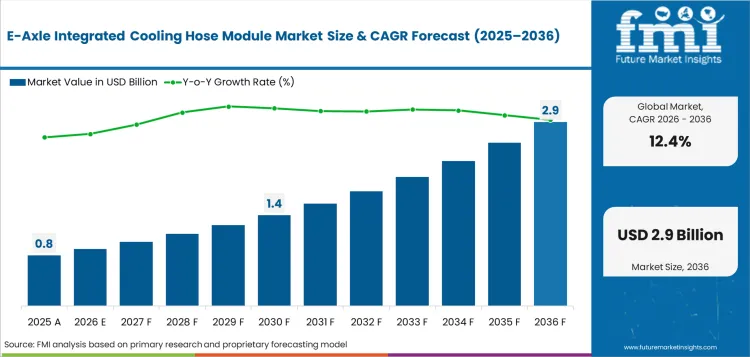
E-axle integrated cooling hose module market was valued at USD 0.8 billion in 2025 and is forecast to reach USD 0.9 billion in 2026. Demand is projected to reach USD 2.9 billion by 2036 at 12.4% CAGR during the assessment period. OEM line installation is likely to represent 82.0% in 2026. Passenger BEVs are forecast to account for 64.0% of vehicle type demand in the forecast period.
Summary of the E-Axle Integrated Cooling Hose Module Market
- Demand and Growth Drivers
- EV makers need integrated cooling hose modules as e-axles place motors and inverters in compact spaces.
- Liquid-cooled electric drive units are increasing the need for leak-tested hose assemblies and stable coolant routing.
- Preassembled hose modules reduce assembly work for OEMs and improve routing accuracy near high-voltage drivetrain parts.
- Product and Segment View
- EPDM-rubber modules are important as they offer coolant resistance and cost stability for high-volume EV platforms.
- E-axle loop modules are gaining use as motor and inverter cooling must work inside a tighter drive unit layout.
- Preassembled modules are preferred by OEMs since they reduce hose joints and lower fitting errors during vehicle assembly.
- Geography and Competitive Outlook
- China and India show significant adoption potential as EV production and electric bus programs increase demand for cooling hose modules.
- Germany and Japan support steady demand through precision drivetrain engineering and long-life hose validation needs.
- Suppliers with molded hose design and connector integration experience can secure earlier access to electric vehicle platform programs.
- Analyst Opinion
- Nikhil Kaitwade, Principal Consultant at FMI says, “E-axle cooling hose modules are now a packaging decision for EV makers. A well-designed module lowers joints and supports repeatable coolant flow near the drive unit. Suppliers with leak-tested assemblies and early design support will be preferred on new electric platforms.”
- E-Axle Integrated Cooling Hose Module Market Value Analysis
- E-axle integrated cooling hose modules now form part of EV drivetrain thermal control.
- Demand rises as compact electric drive units need stable coolant flow after the vehicle enters regular use.
- Vehicle makers assign more value to automotive hoses and assemblies that reduce leak points and support cleaner routing around e-axles.
- Market value is increasing as qualified hose modules can reduce assembly rework and improve coolant circuit reliability during EV platform validation.
Key Takeaways, Market Size, and Forecast
- E-axle integrated cooling hose module market stood at USD 0.8 billion in 2025.
- By 2036, the industry is forecast to reach USD 2.9 billion.
- Industry value is expected to advance at 12.4% CAGR during the assessment period.
- The market is predicted to add USD 2.0 billion in incremental opportunity over 2026 to 2036.
- OEM line installation is projected to represent 82.0% of sales channel demand in 2026.
- Passenger BEVs are forecast to account for 64.0% of vehicle type demand in 2026.
- India at 15.1% CAGR and China at 14.8% CAGR are expected to witness steady expansion during the forecast period.
Compact electric axles place more heat near motors and inverters. Cooling hose modules need tighter routing and better leak control in these zones. Companies such as ZF’s AxTrax 2 LF uses advanced oil cooling and delivers up to 360 kW continuous power. High-power axle packaging points to higher module requirements for hose modules built around compact drive units. In July 2024, Cooper Standard debuted its eCoFlow Switch Pump with Saleri Group. The module combines an electric water pump and electrically driven valve in one coolant control unit. Pre-integrated hose and coolant control assemblies can reduce fitting work at vehicle plants. In October 2024, Sumitomo Riko presented its BEV cooling resin tube with a polypropylene inner layer and laser welded fastening. The company said the design reduces parts count and pressure loss against conventional press fit fastening. Suppliers with proven leak validation and material control will be better placed for e-axle cooling programs.
E-Axle Integrated Cooling Hose Module Market Definition
E-Axle Integrated Cooling Hose Module Market covers preassembled hose systems used to carry coolant around electric axle units in electric vehicles. These modules connect the motor and reducer cooling paths within the electric drivetrain.
E-Axle Integrated Cooling Hose Module Market Inclusions
Scope includes EPDM-rubber hose modules and thermoplastic hose modules. Hybrid hose modules are included. Scope covers e-axle loop modules and motor cooling loops. Inverter loop and reducer loop are included in the coolant circuit view. Stakeholders include electric drive unit suppliers and EV OEMs.
E-Axle Integrated Cooling Hose Module Market Exclusions
Scope excludes standalone engine radiator hoses and cabin HVAC hoses. Battery pack plates sold outside e-axle loops are excluded. General coolant reservoirs are excluded unless supplied as part of an integrated e-axle hose module. Power electronics sensors such as automotive rotor position sensor for e-axle are excluded unless packaged with coolant routing parts. Conventional axle seals and brake hoses are outside scope.
E-Axle Integrated Cooling Hose Module Market Research Methodology
- Primary Research: FMI analysts reviewed EV thermal suppliers and hose module makers. Electric drive unit integration needs were checked across major vehicle platforms.
- Desk Research: Public data from IEA and OICA were used for market checks. NITI Aayog and official company releases supported country and supplier validation.
- Market Sizing and Forecasting: Market size was estimated through EV output and e-axle adoption. Average module value per vehicle was used as the main pricing check.
- Data Validation: Forecast checks compared EV sales and vehicle production. Supplier activity was reviewed across major EV-producing countries.
Why is the E-Axle Integrated Cooling Hose Module Market Growing?
- Compact e-axles need stable coolant routing as motors and inverters sit closer inside electric drive units.
- EV makers need preassembled hose modules to reduce leak points and shorten assembly work on vehicle lines.
- Fast charging raises heat around power electronics, which increases the need for cleaner coolant flow paths.
- Liquid-cooled electric drive units need molded hose routing that can handle vibration and repeated heat cycles.
- Supplier selection now favors hose modules that combine connector reliability with proven thermal validation for EV platforms.
Global vehicle production reached around 96.4 million units in 2025, creating a wide volume base for EV drivetrain parts. Electric vehicles are adding more thermal content because e-axles combine power delivery and heat control in a compact space. Cooling hose modules support EV drivetrain thermal needs by carrying coolant to the motor and inverter with fewer loose connections. Demand is rising for battery thermal plates as EV makers design cooling circuits across the full drivetrain system. This keeps hose modules important for platform safety and repeatable vehicle assembly.
Electric car sales topped 17.0 million units worldwide in 2024, which shows how quickly EV thermal systems are moving into high-volume production. More than 1.3 million public charging points were added to the global stock in 2024, raising the use of faster charging in several markets. Faster charging increases thermal stress across power electronics and coolant circuits. Higher thermal stress supports demand for automotive coolant distribution manifold for EV battery components and e-axle cooling hose modules that keep coolant flow stable. Suppliers with tested hoses and connector assemblies can gain stronger access to OEM programs.
Market Segmentation Analysis
- OEM line installation is forecast to account for 82.0% share in 2026.
- In 2026, preassembled modules are expected to capture 57.0% share.
- Between 2026 and 2036, EPDM-rubber modules are forecast to hold 49.0% share.
- Passenger BEVs are expected to represent 64.0% share in 2026.
- E-axle loop modules are forecast to account for 42.0% share by 2036.
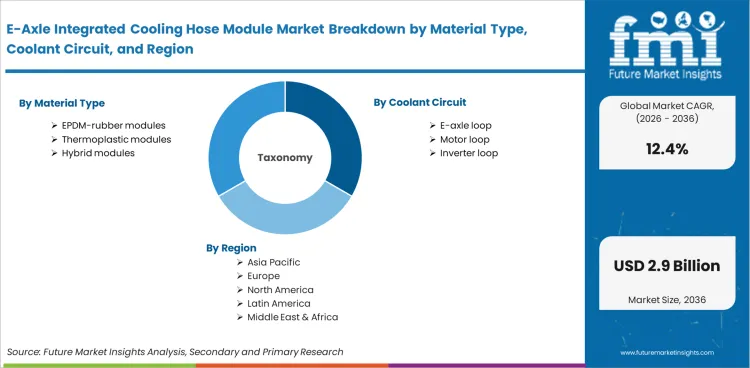
E-axle integrated cooling hose module demand is divided into five primary segment groups. Material type and coolant circuit form the product view. Vehicle type and module design complete the commercial view. Sales channel explains how modules enter vehicle programs. Material type covers EPDM-rubber modules, thermoplastic modules, and hybrid modules. Coolant circuit includes e-axle loop and motor loop. Inverter loop and reducer loop complete the circuit view. Vehicle type covers passenger BEVs and plug-in hybrids. Electric vans and electric buses complete the vehicle view. Module design separates preassembled modules and molded hose sets. Connector assemblies complete the design view.
Insights into E-Axle Integrated Cooling Hose Module Market by Material Type
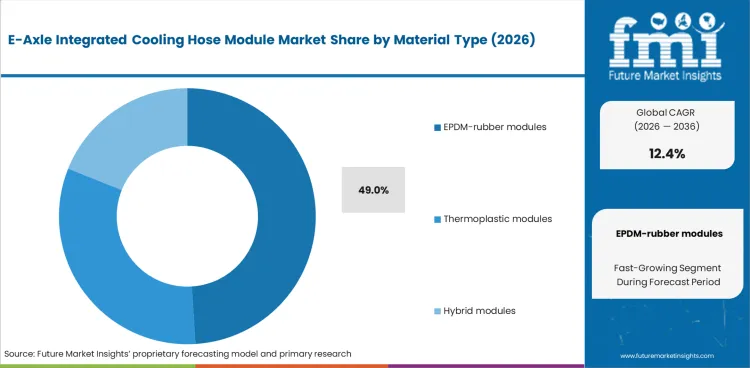
- EPDM-rubber modules are projected to account for 49.0% share in 2026 as coolant resistance and cost stability suit high-volume EV programs.
- Thermoplastic modules are expected to gain wider use as lighter hose routing supports tighter e-axle packaging.
Insights into E-Axle Integrated Cooling Hose Module Market by Coolant Circuit
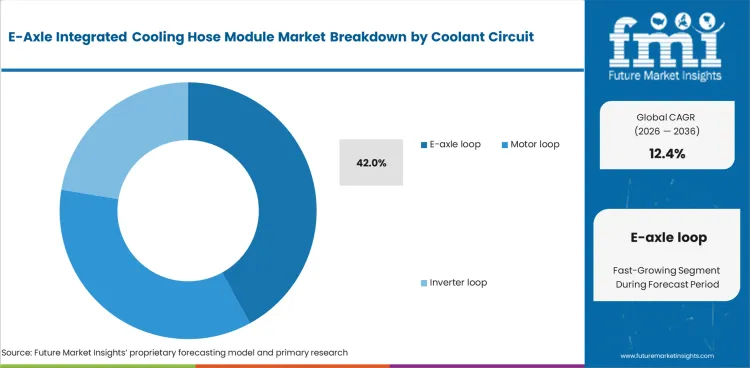
- In 2026, e-axle loop modules are forecast to hold 42.0% share since motor and inverter cooling need stable routing in a compact drive unit area.
- Through 2036, motor loop and inverter loop modules gain value as higher power density raises heat around electric drive parts.
Insights into E-Axle Integrated Cooling Hose Module Market by Vehicle Type
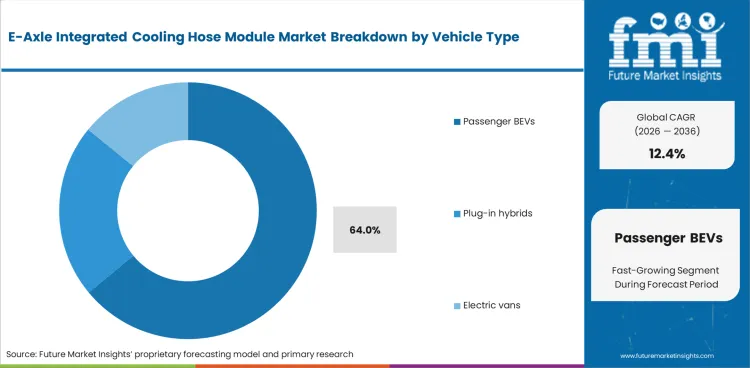
- Passenger BEVs are projected to represent 64.0% share in 2026 since high-volume EV platforms use liquid cooling around e-axles.
- Electric vans and buses are expected to create steady demand through 2036 as heavier duty cycles need durable hose modules and larger coolant paths.
Insights into E-Axle Integrated Cooling Hose Module Market by Module Design
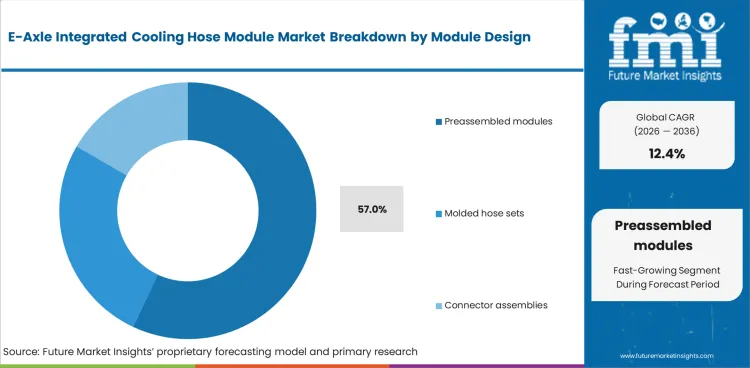
- Preassembled modules are expected to capture 57.0% share in 2026 because OEMs need tested hose sets that reduce line-side fitting errors.
- Through 2036, molded hose sets are forecast to influence adoption in automotive hoses and assemblies as compact bends support cleaner underbody routing.
Insights into E-Axle Integrated Cooling Hose Module Market by Sales Channel
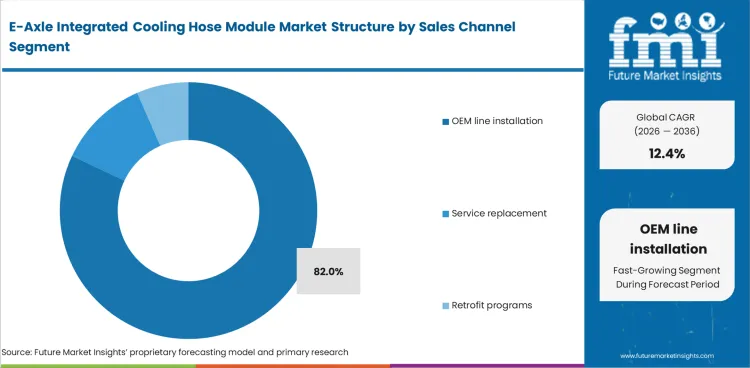
- OEM line installation is forecast to account for 82.0% share in 2026 as hose shape and connector angle must match the platform design early.
- Service replacement demand is expected to rise through 2036 as connectors and molded sections face heat cycles during regular EV use.
E-Axle Integrated Cooling Hose Module Market Drivers, Restraints, and Opportunities
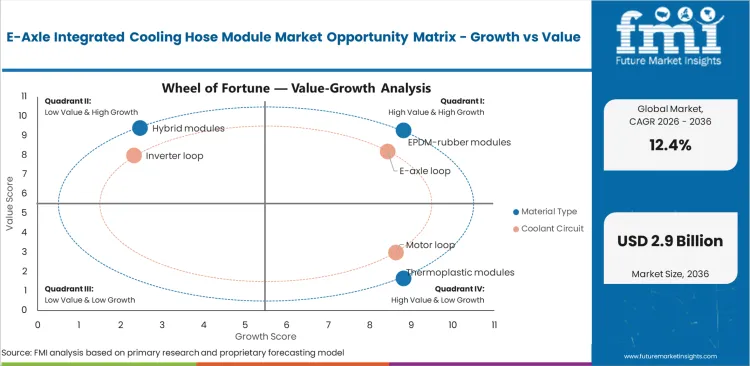
- Compact drive unit design is raising demand for molded hose modules that route coolant through tight e-axle spaces.
- Validation cost can slow supplier entry as hose modules must pass leak checks and thermal cycle tests before OEM approval.
- Active coolant control creates a higher-value path for suppliers that can combine hose routing with flow control.
Compact E-Axles Need Cleaner Coolant Routing
Electric drive units are becoming strict as OEMs place motors and reduction gears in one compact package. Power electronics add heat inside the same area. Hose routing must handle vibration and heat without adding too many joints. Cooper Standard highlighted eCoFlow coolant control products in June 2024 for glycol thermal management in EV systems. This supports hose module demand as coolant parts move closer to the drive unit. Suppliers with tested routing can gain stronger access to early platform work.
Validation Cost Limits Smaller Suppliers
Cooling hose modules need proof across pressure and temperature cycles before OEM release. Smaller suppliers can lose large programs if testing capacity or documentation depth is weak. Hose compounds must match coolant chemistry over long vehicle life. EV coolants and automotive coolant choices influence material selection. Approved suppliers can earn value from engineering support and hose assembly supply.
Active Coolant Control Raises Module Value
Thermal modules shift from passive hose routing toward active fluid control. BorgWarner presented integrated thermal modules and eCoolers at IAA Mobility 2025. BorgWarner designs its thermal products to manage operating temperature across propulsion systems. This supports the value of automotive electric coolant valve parts near e-axles. Module suppliers can gain margin by linking coolant routing with controlled fluid flow.
Analysis of E-Axle Integrated Cooling Hose Module Market by Key Countries
.webp "Top Country Growth Comparison E Axle Integrated Cooling Hose Module Market Cagr (2026 2036)")
| Country | CAGR |
|---|---|
| China | 14.8% |
| United States | 12.6% |
| India | 15.1% |
| Germany | 11.5% |
| Japan | 9.7% |
| South Korea | 12.2% |
| United Kingdom | 10.8% |
| Global | 12.4% |
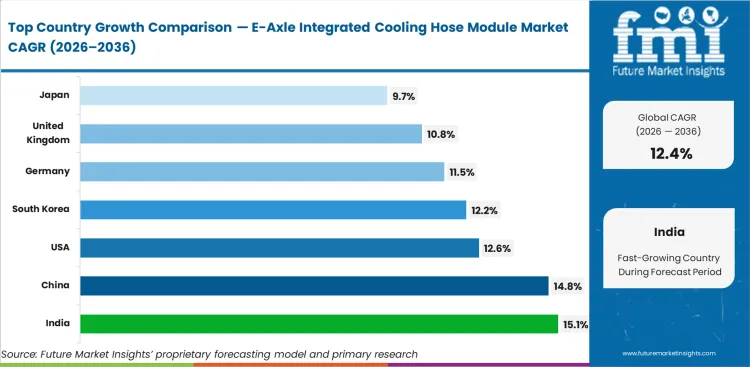
E-Axle Integrated Cooling Hose Module Market CAGR Analysis by Country
- India is projected to record 15.1% CAGR by 2036 as EV and e-bus adoption lifts larger hose module demand.
- China demand is expected to expand at 14.8% CAGR with high EV output supporting molded hose assemblies.
- Through 2036, United States demand is forecast at 12.6% CAGR as new EV models need line installed thermal modules.
- South Korea is anticipated to rise at 12.2% CAGR as battery and EV platform work supports coolant routing.
- Germany is forecast to advance at 11.5% CAGR by 2036 with premium EVs needing validated hose modules.
- Between 2026 and 2036, United Kingdom indicates 10.8% CAGR as EV imports and assembly support OEM demand.
- Japan is forecast at 9.7% CAGR as hybrid and BEV platforms use compact cooling hose modules.
Demand Outlook for E-Axle Integrated Cooling Hose Module Market in China
China has a large EV production base, which gives cooling hose module suppliers a wide program pipeline. Local EV makers need molded hose assemblies that reduce leak points and fit compact e-axle layouts. Demand in China is expected to expand at 14.8% CAGR through 2036. Suppliers with local validation support and quick connector capability can gain better access to platform nominations.
- High EV output supports larger annual orders for molded hose assemblies.
- Local platform programs favor suppliers that can shorten design and testing cycles.
- Compact e-axle layouts increase the need for stable coolant routing near motors and inverters.
Sales Analysis of E-Axle Integrated Cooling Hose Module Market in India
The market in India is projected to record 15.1% CAGR by 2036. India is adding more electric buses and passenger EVs, which is raising demand for durable coolant hose routing. Electric bus e-axles need larger coolant paths because the drivetrain handles heavier daily duty cycles. Local assembly will favor suppliers that can offer cost-stable hose modules with reliable leak testing.
- Electric bus programs create demand for larger coolant hose paths and higher sealing reliability.
- Passenger EV launches support EPDM-rubber module use because the material suits cost-sensitive platforms.
- Local assembly favors suppliers that can deliver tested hose modules with shorter lead times.
Demand Outlook for E-Axle Integrated Cooling Hose Module Market in the United States
United States demand is tied to new EV model launches and light truck electrification. OEMs need line-installed hose modules that match underbody space and e-axle layout before platform approval. Between 2026 and 2036, United States demand is forecast at 12.6% CAGR. Suppliers with North American molding capacity can reduce launch risk for automakers.
- New EV models need hose routing that matches platform design from the start.
- Light truck electrification raises demand for durable coolant paths around larger drive units.
- Local molding capacity can support faster OEM approval and smoother production ramp-up.
Opportunity Analysis of E-Axle Integrated Cooling Hose Module Market in Germany
Germany favors validated hose modules because premium EV platforms use tighter drivetrain packaging. Germany is forecast to advance at 11.5% CAGR by 2036. Automakers need routing parts that can handle coolant chemistry and long warranty cycles. Engineering support and early thermal testing will shape supplier selection in this market.
- Premium EV platforms need precise hose geometry around compact e-axle housings.
- Long warranty cycles increase the focus on seal durability and coolant compatibility.
- Early thermal testing improves supplier approval chances during platform development.
Future Outlook for E-Axle Integrated Cooling Hose Module Market in South Korea
Through 2036, South Korea is anticipated to rise at 12.2% CAGR. Suppliers that work closely with battery and vehicle engineers can gain stronger program access. South Korea benefits from EV platform work and battery supply depth. Local programs need precise coolant routing around motors and power electronics because heat control affects drivetrain reliability.
- Battery supply depth supports advanced thermal system design for EV platforms.
- EV platform work increases demand for precise coolant routing around high-voltage parts.
- Export programs need hose modules that meet global OEM validation standards.
Sales Analysis of E-Axle Integrated Cooling Hose Module Market in the United Kingdom
United Kingdom demand is supported by EV imports and domestic assembly programs. Service channels will need replacement hose modules as older EVs move into higher mileage use. The industry outlook in the United Kingdom points to 10.8% CAGR through 2036. OEM-grade hose design and aftermarket reach can support steady supplier demand.
- EV imports increase the need for matching replacement hose modules.
- Domestic assembly supports OEM channel demand for platform-specific hose routing.
- Higher mileage EVs create service demand for connector checks and molded section replacement.
Future Outlook for E-Axle Integrated Cooling Hose Module Market in Japan
Japan is forecast at 9.7% CAGR as compact cooling hose modules gain adoption by 2036. The country values compact hose modules for hybrid and BEV drivetrain layouts. Local OEMs focus on durability because cooling parts must perform reliably across long vehicle life. Suppliers with proven sealing performance can support long-life vehicle programs.
- Hybrid platforms support demand for compact coolant routing near electric drive units.
- BEV programs need low-leak connector designs that protect motor and inverter cooling paths.
- Long-life vehicle programs favor suppliers with proven seal durability and stable material quality.
Competitive Landscape and Strategic Positioning
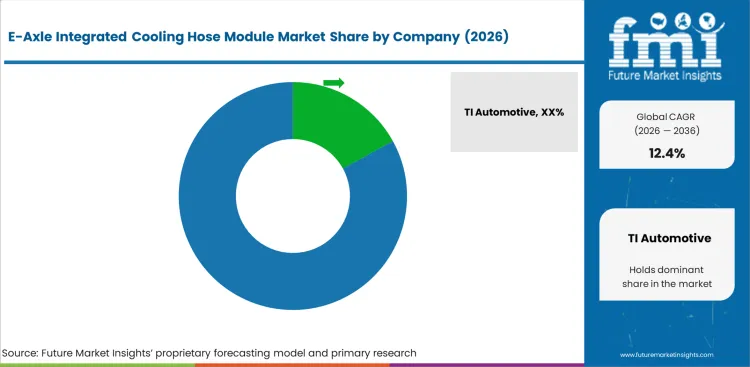
- Competition is centered on leak-tested hose assemblies and molded routing design that fit compact e-axle layouts.
- Fluid system suppliers gain an advantage when they support OEM design work before hose geometry is locked.
- Thermal module specialists can strengthen their position by linking coolant routing with active flow control.
- Entry barriers include validation capacity and platform-specific tooling, since each hose module must match the vehicle layout.
Competition in the e‑axle integrated cooling hose module market is shaped by early design collaboration and global manufacturing scale. Suppliers that secure involvement during the initial e‑axle platform development stage gain a clear advantage, as hose routing geometry and thermal integration are finalized early in the vehicle design process. Companies with strong co‑engineering capabilities and proven validation infrastructure are more likely to win long‑term OEM contracts.
The competitive landscape is led by established fluid system integrators such as TI Automotive (formerly TI Fluid Systems) and Cooper Standard, which leverage their global production footprint and established OEM relationships. The consolidation of ABC Technologies and TI Fluid Systems has further strengthened scale advantages in fluid handling systems, improving access to EV platform nominations and enabling broader integration of hose and thermal components. This shift toward system integration is increasing the value of hose modules as part of broader EV thermal management assemblies rather than standalone components. This place hose module suppliers close to EV coolant filters and strainers and other fluid control parts used inside EV thermal loops.
Key Companies in the E-Axle Integrated Cooling Hose Module Market
- Fluid System Integrators: TI Automotive and Cooper Standard hold positions through hose and connector portfolios.
- Thermal Module Specialists: Hutchinson and Continental AG compete through integrated cooling modules and rubber technology.
- EV Platform Adjacent Suppliers: Sumitomo Riko and BorgWarner support adjacent coolant routing and e-thermal control.
Competitive Benchmarking: E-Axle Integrated Cooling Hose Module Market
| Company | Hose Module Depth | Connector Integration | EV Thermal Support | Geographic Footprint |
|---|---|---|---|---|
| TI Automotive | High | High | High | Global with Europe and North America strength |
| Cooper Standard | High | High | High | Global with North America strength |
| Hutchinson | High | Medium | High | Europe centered with global OEM access |
| Gates Industrial Corporation | Medium | Medium | Medium | Global aftermarket and OE reach |
| Continental AG | Medium | High | High | Global with German engineering depth |
| Sumitomo Riko | Medium | Medium | Medium | Japan and Asia focused |
| BorgWarner Inc. | Low | Medium | High | Global propulsion and thermal systems reach |
Key Developments in the E-Axle Integrated Cooling Hose Module Market
- In April 2026, Sumitomo Riko announced products for China’s NEV sector, including a resin tube for BEV cooling piping.
- In June 2024, Cooper Standard presented EV thermal management capabilities and eCoFlow scalable coolant control products.
Key Players in the E-Axle Integrated Cooling Hose Module Market
Major Global Players
- TI Automotive
- Cooper Standard
- Hutchinson
- Gates Industrial Corporation
- Continental AG
Specialist and Regional Players
- Sumitomo Riko Company Limited
- BorgWarner Inc.
- Schaeffler AG
Report Scope and Coverage
| Parameter | Details |
|---|---|
| Quantitative Units | USD 0.9 billion to USD 2.9 billion at 12.4% CAGR |
| Market Definition | Integrated coolant hose modules used around electric axle assemblies and electric drive units |
| Regions Covered | North America, Latin America, Western Europe, Eastern Europe, East Asia, South Asia and Pacific, Middle East and Africa |
| Countries Covered | United States, China, India, Germany, Japan, South Korea, United Kingdom and more than thirty countries |
| Key Companies Profiled | TI Automotive, Cooper Standard, Hutchinson, Gates Industrial Corporation, Continental AG, Sumitomo Riko, BorgWarner Inc. |
| Forecast Period | 2026 to 2036 |
| Approach | Hybrid bottom-up and top-down methodology using EV output and e-axle adoption. Module content per vehicle and supplier activity were used for validation |
E-Axle Integrated Cooling Hose Module Market Breakdown by Material Type, Coolant Circuit, Vehicle Type, Module Design, Sales Channel, and Region
E-Axle Integrated Cooling Hose Module Market Segmented by Material Type
- EPDM-rubber modules
- Thermoplastic modules
- Hybrid modules
E-Axle Integrated Cooling Hose Module Market Segmented by Coolant Circuit
- E-axle loop
- Motor loop
- Inverter loop
- Reducer loop
E-Axle Integrated Cooling Hose Module Market Segmented by Vehicle Type
- Passenger BEVs
- Plug-in hybrids
- Electric vans
- Electric buses
E-Axle Integrated Cooling Hose Module Market Segmented by Module Design
- Preassembled modules
- Molded hose sets
- Connector assemblies
E-Axle Integrated Cooling Hose Module Market Segmented by Sales Channel
- OEM line installation
- Service replacement
- Retrofit programs
E-Axle Integrated Cooling Hose Module Market by Region
- North America
- United States
- Canada
- Mexico
- Latin America
- Brazil
- Chile
- Rest of Latin America
- Western Europe
- Germany
- United Kingdom
- Italy
- Spain
- France
- Nordic
- BENELUX
- Rest of Western Europe
- Eastern Europe
- Poland
- Hungary
- Balkan and Baltic
- Rest of Eastern Europe
- East Asia
- China
- Japan
- South Korea
- South Asia and Pacific
- India
- ASEAN
- Australia and New Zealand
- Rest of South Asia and Pacific
- Middle East and Africa
- Kingdom of Saudi Arabia
- Other GCC Countries
- Turkiye
- South Africa
- Other African Union
- Rest of Middle East and Africa
Research Sources and Bibliography
- International Organization of Motor Vehicle Manufacturers. (2026, April 23). Auto industry growth shifted east in 2025 amid global repositioning. OICA.
- International Energy Agency. (2025, May 14). Trends in electric car markets. In Global EV Outlook 2025. IEA.
- International Energy Agency. (2025, May 14). Electric vehicle charging. In Global EV Outlook 2025. IEA.
- ZF Friedrichshafen AG. (2026, February 16). AxTrax 2 LF: ZF secures major India city bus order. ZF.
- TI Fluid Systems. (2025, April 15). ABC Technologies completes acquisition of TI Fluid Systems; combined business will rebrand as TI Automotive. TI Fluid Systems.
- Cooper Standard. (2024, June 3). Cooper Standard showcases EV thermal management capabilities at ITB’s Thermal Management Conference. Cooper Standard.
- BorgWarner Inc. (2025, September 8). BorgWarner showcases products for propulsion system diversity at IAA Mobility 2025. BorgWarner.
- Gates Corporation. (2024). EMEA AR ThermalPro sell sheet. Gates.
- Sumitomo Riko Company Limited. (2026, April 27). Sumitomo Riko to exhibit products addressing China’s EV sector challenges at EVTF2026. Sumitomo Riko Company Limited.
Frequently Asked Questions
What is the current size of the e-axle integrated cooling hose module market?
Demand is forecast at USD 0.9 billion in 2026 and is projected to reach USD 2.9 billion by 2036.
What CAGR is expected for the market?
The market is expected to advance at 12.4% CAGR during the 2026 to 2036 forecast period.
Which vehicle type is projected to lead demand?
Passenger BEVs are forecast to account for 64.0% share in 2026 as high-volume EV platforms standardize liquid cooling around e-axles.
Which sales channel is projected to lead?
OEM line installation is projected to represent 82.0% share in 2026 as coolant hose geometry is approved during vehicle platform design.
Which countries are expected to show stronger pace?
India and China are expected to record higher country-level rates with 15.1% CAGR and 14.8% CAGR through 2036 respectively.
What limits supplier entry for e-axle cooling hose modules?
Supplier entry is limited by leak testing and burst testing. Thermal cycling proof and platform-specific tooling raise entry cost.
Which companies are active in the market?
TI Automotive and Cooper Standard are active suppliers. Hutchinson and Gates Industrial Corporation support hose module demand.
Preview the report firsthand - request a free sample
Get SampleGet the brochure for pricing and purchase details.
Get PDFTable of Content
- Executive Summary
- Global Market Outlook
- Demand-side Trends
- Supply-side Trends
- Technology Roadmap Analysis
- Analysis and Recommendations
- Market Overview
- Market Coverage / Taxonomy
- Market Definition / Scope / Limitations
- Research Methodology
- Chapter Orientation
- Analytical Lens and Working Hypotheses
- Market Structure, Signals, and Trend Drivers
- Benchmarking and Cross-market Comparability
- Market Sizing, Forecasting, and Opportunity Mapping
- Research Design and Evidence Framework
- Desk Research Programme (Secondary Evidence)
- Company Annual and Sustainability Reports
- Peer-reviewed Journals and Academic Literature
- Corporate Websites, Product Literature, and Technical Notes
- Earnings Decks and Investor Briefings
- Statutory Filings and Regulatory Disclosures
- Technical White Papers and Standards Notes
- Trade Journals, Industry Magazines, and Analyst Briefs
- Conference Proceedings, Webinars, and Seminar Materials
- Government Statistics Portals and Public Data Releases
- Press Releases and Reputable Media Coverage
- Specialist Newsletters and Curated Briefings
- Sector Databases and Reference Repositories
- FMI Internal Proprietary Databases and Historical Market Datasets
- Subscription Datasets and Paid Sources
- Social Channels, Communities, and Digital Listening Inputs
- Additional Desk Sources
- Expert Input and Fieldwork (Primary Evidence)
- Primary Modes
- Qualitative Interviews and Expert Elicitation
- Quantitative Surveys and Structured Data Capture
- Blended Approach
- Why Primary Evidence is Used
- Field Techniques
- Interviews
- Surveys
- Focus Groups
- Observational and In-context Research
- Social and Community Interactions
- Stakeholder Universe Engaged
- C-suite Leaders
- Board Members
- Presidents and Vice Presidents
- R&D and Innovation Heads
- Technical Specialists
- Domain Subject-matter Experts
- Scientists
- Physicians and Other Healthcare Professionals
- Governance, Ethics, and Data Stewardship
- Research Ethics
- Data Integrity and Handling
- Primary Modes
- Tooling, Models, and Reference Databases
- Desk Research Programme (Secondary Evidence)
- Data Engineering and Model Build
- Data Acquisition and Ingestion
- Cleaning, Normalisation, and Verification
- Synthesis, Triangulation, and Analysis
- Quality Assurance and Audit Trail
- Market Background
- Market Dynamics
- Drivers
- Restraints
- Opportunity
- Trends
- Scenario Forecast
- Demand in Optimistic Scenario
- Demand in Likely Scenario
- Demand in Conservative Scenario
- Opportunity Map Analysis
- Product Life Cycle Analysis
- Supply Chain Analysis
- Investment Feasibility Matrix
- Value Chain Analysis
- PESTLE and Porter’s Analysis
- Regulatory Landscape
- Regional Parent Market Outlook
- Production and Consumption Statistics
- Import and Export Statistics
- Market Dynamics
- Global Market Analysis 2021 to 2025 and Forecast, 2026 to 2036
- Historical Market Size Value (USD Million) Analysis, 2021 to 2025
- Current and Future Market Size Value (USD Million) Projections, 2026 to 2036
- Y-o-Y Growth Trend Analysis
- Absolute $ Opportunity Analysis
- Global Market Pricing Analysis 2021 to 2025 and Forecast 2026 to 2036
- Global Market Analysis 2021 to 2025 and Forecast 2026 to 2036, By Material Type
- Introduction / Key Findings
- Historical Market Size Value (USD Million) Analysis By Material Type , 2021 to 2025
- Current and Future Market Size Value (USD Million) Analysis and Forecast By Material Type , 2026 to 2036
- EPDM-rubber modules
- Thermoplastic modules
- Hybrid modules
- EPDM-rubber modules
- Y-o-Y Growth Trend Analysis By Material Type , 2021 to 2025
- Absolute $ Opportunity Analysis By Material Type , 2026 to 2036
- Global Market Analysis 2021 to 2025 and Forecast 2026 to 2036, By Coolant Circuit
- Introduction / Key Findings
- Historical Market Size Value (USD Million) Analysis By Coolant Circuit, 2021 to 2025
- Current and Future Market Size Value (USD Million) Analysis and Forecast By Coolant Circuit, 2026 to 2036
- E-axle loop
- Motor loop
- Inverter loop
- E-axle loop
- Y-o-Y Growth Trend Analysis By Coolant Circuit, 2021 to 2025
- Absolute $ Opportunity Analysis By Coolant Circuit, 2026 to 2036
- Global Market Analysis 2021 to 2025 and Forecast 2026 to 2036, By Vehicle Type
- Introduction / Key Findings
- Historical Market Size Value (USD Million) Analysis By Vehicle Type, 2021 to 2025
- Current and Future Market Size Value (USD Million) Analysis and Forecast By Vehicle Type, 2026 to 2036
- Passenger BEVs
- Plug-in hybrids
- Electric vans
- Passenger BEVs
- Y-o-Y Growth Trend Analysis By Vehicle Type, 2021 to 2025
- Absolute $ Opportunity Analysis By Vehicle Type, 2026 to 2036
- Global Market Analysis 2021 to 2025 and Forecast 2026 to 2036, By Module Design
- Introduction / Key Findings
- Historical Market Size Value (USD Million) Analysis By Module Design, 2021 to 2025
- Current and Future Market Size Value (USD Million) Analysis and Forecast By Module Design, 2026 to 2036
- Preassembled modules
- Molded hose sets
- Connector assemblies
- Preassembled modules
- Y-o-Y Growth Trend Analysis By Module Design, 2021 to 2025
- Absolute $ Opportunity Analysis By Module Design, 2026 to 2036
- Global Market Analysis 2021 to 2025 and Forecast 2026 to 2036, By Sales Channel
- Introduction / Key Findings
- Historical Market Size Value (USD Million) Analysis By Sales Channel, 2021 to 2025
- Current and Future Market Size Value (USD Million) Analysis and Forecast By Sales Channel, 2026 to 2036
- OEM line installation
- Service replacement
- Retrofit programs
- OEM line installation
- Y-o-Y Growth Trend Analysis By Sales Channel, 2021 to 2025
- Absolute $ Opportunity Analysis By Sales Channel, 2026 to 2036
- Global Market Analysis 2021 to 2025 and Forecast 2026 to 2036, By Region
- Introduction
- Historical Market Size Value (USD Million) Analysis By Region, 2021 to 2025
- Current Market Size Value (USD Million) Analysis and Forecast By Region, 2026 to 2036
- North America
- Latin America
- Western Europe
- Eastern Europe
- East Asia
- South Asia and Pacific
- Middle East & Africa
- Market Attractiveness Analysis By Region
- North America Market Analysis 2021 to 2025 and Forecast 2026 to 2036, By Country
- Historical Market Size Value (USD Million) Trend Analysis By Market Taxonomy, 2021 to 2025
- Market Size Value (USD Million) Forecast By Market Taxonomy, 2026 to 2036
- By Country
- USA
- Canada
- Mexico
- By Material Type
- By Coolant Circuit
- By Vehicle Type
- By Module Design
- By Sales Channel
- By Country
- Market Attractiveness Analysis
- By Country
- By Material Type
- By Coolant Circuit
- By Vehicle Type
- By Module Design
- By Sales Channel
- Key Takeaways
- Latin America Market Analysis 2021 to 2025 and Forecast 2026 to 2036, By Country
- Historical Market Size Value (USD Million) Trend Analysis By Market Taxonomy, 2021 to 2025
- Market Size Value (USD Million) Forecast By Market Taxonomy, 2026 to 2036
- By Country
- Brazil
- Chile
- Rest of Latin America
- By Material Type
- By Coolant Circuit
- By Vehicle Type
- By Module Design
- By Sales Channel
- By Country
- Market Attractiveness Analysis
- By Country
- By Material Type
- By Coolant Circuit
- By Vehicle Type
- By Module Design
- By Sales Channel
- Key Takeaways
- Western Europe Market Analysis 2021 to 2025 and Forecast 2026 to 2036, By Country
- Historical Market Size Value (USD Million) Trend Analysis By Market Taxonomy, 2021 to 2025
- Market Size Value (USD Million) Forecast By Market Taxonomy, 2026 to 2036
- By Country
- Germany
- UK
- Italy
- Spain
- France
- Nordic
- BENELUX
- Rest of Western Europe
- By Material Type
- By Coolant Circuit
- By Vehicle Type
- By Module Design
- By Sales Channel
- By Country
- Market Attractiveness Analysis
- By Country
- By Material Type
- By Coolant Circuit
- By Vehicle Type
- By Module Design
- By Sales Channel
- Key Takeaways
- Eastern Europe Market Analysis 2021 to 2025 and Forecast 2026 to 2036, By Country
- Historical Market Size Value (USD Million) Trend Analysis By Market Taxonomy, 2021 to 2025
- Market Size Value (USD Million) Forecast By Market Taxonomy, 2026 to 2036
- By Country
- Russia
- Poland
- Hungary
- Balkan & Baltic
- Rest of Eastern Europe
- By Material Type
- By Coolant Circuit
- By Vehicle Type
- By Module Design
- By Sales Channel
- By Country
- Market Attractiveness Analysis
- By Country
- By Material Type
- By Coolant Circuit
- By Vehicle Type
- By Module Design
- By Sales Channel
- Key Takeaways
- East Asia Market Analysis 2021 to 2025 and Forecast 2026 to 2036, By Country
- Historical Market Size Value (USD Million) Trend Analysis By Market Taxonomy, 2021 to 2025
- Market Size Value (USD Million) Forecast By Market Taxonomy, 2026 to 2036
- By Country
- China
- Japan
- South Korea
- By Material Type
- By Coolant Circuit
- By Vehicle Type
- By Module Design
- By Sales Channel
- By Country
- Market Attractiveness Analysis
- By Country
- By Material Type
- By Coolant Circuit
- By Vehicle Type
- By Module Design
- By Sales Channel
- Key Takeaways
- South Asia and Pacific Market Analysis 2021 to 2025 and Forecast 2026 to 2036, By Country
- Historical Market Size Value (USD Million) Trend Analysis By Market Taxonomy, 2021 to 2025
- Market Size Value (USD Million) Forecast By Market Taxonomy, 2026 to 2036
- By Country
- India
- ASEAN
- Australia & New Zealand
- Rest of South Asia and Pacific
- By Material Type
- By Coolant Circuit
- By Vehicle Type
- By Module Design
- By Sales Channel
- By Country
- Market Attractiveness Analysis
- By Country
- By Material Type
- By Coolant Circuit
- By Vehicle Type
- By Module Design
- By Sales Channel
- Key Takeaways
- Middle East & Africa Market Analysis 2021 to 2025 and Forecast 2026 to 2036, By Country
- Historical Market Size Value (USD Million) Trend Analysis By Market Taxonomy, 2021 to 2025
- Market Size Value (USD Million) Forecast By Market Taxonomy, 2026 to 2036
- By Country
- Kingdom of Saudi Arabia
- Other GCC Countries
- Turkiye
- South Africa
- Other African Union
- Rest of Middle East & Africa
- By Material Type
- By Coolant Circuit
- By Vehicle Type
- By Module Design
- By Sales Channel
- By Country
- Market Attractiveness Analysis
- By Country
- By Material Type
- By Coolant Circuit
- By Vehicle Type
- By Module Design
- By Sales Channel
- Key Takeaways
- Key Countries Market Analysis
- USA
- Pricing Analysis
- Market Share Analysis, 2025
- By Material Type
- By Coolant Circuit
- By Vehicle Type
- By Module Design
- By Sales Channel
- Canada
- Pricing Analysis
- Market Share Analysis, 2025
- By Material Type
- By Coolant Circuit
- By Vehicle Type
- By Module Design
- By Sales Channel
- Mexico
- Pricing Analysis
- Market Share Analysis, 2025
- By Material Type
- By Coolant Circuit
- By Vehicle Type
- By Module Design
- By Sales Channel
- Brazil
- Pricing Analysis
- Market Share Analysis, 2025
- By Material Type
- By Coolant Circuit
- By Vehicle Type
- By Module Design
- By Sales Channel
- Chile
- Pricing Analysis
- Market Share Analysis, 2025
- By Material Type
- By Coolant Circuit
- By Vehicle Type
- By Module Design
- By Sales Channel
- Germany
- Pricing Analysis
- Market Share Analysis, 2025
- By Material Type
- By Coolant Circuit
- By Vehicle Type
- By Module Design
- By Sales Channel
- UK
- Pricing Analysis
- Market Share Analysis, 2025
- By Material Type
- By Coolant Circuit
- By Vehicle Type
- By Module Design
- By Sales Channel
- Italy
- Pricing Analysis
- Market Share Analysis, 2025
- By Material Type
- By Coolant Circuit
- By Vehicle Type
- By Module Design
- By Sales Channel
- Spain
- Pricing Analysis
- Market Share Analysis, 2025
- By Material Type
- By Coolant Circuit
- By Vehicle Type
- By Module Design
- By Sales Channel
- France
- Pricing Analysis
- Market Share Analysis, 2025
- By Material Type
- By Coolant Circuit
- By Vehicle Type
- By Module Design
- By Sales Channel
- India
- Pricing Analysis
- Market Share Analysis, 2025
- By Material Type
- By Coolant Circuit
- By Vehicle Type
- By Module Design
- By Sales Channel
- ASEAN
- Pricing Analysis
- Market Share Analysis, 2025
- By Material Type
- By Coolant Circuit
- By Vehicle Type
- By Module Design
- By Sales Channel
- Australia & New Zealand
- Pricing Analysis
- Market Share Analysis, 2025
- By Material Type
- By Coolant Circuit
- By Vehicle Type
- By Module Design
- By Sales Channel
- China
- Pricing Analysis
- Market Share Analysis, 2025
- By Material Type
- By Coolant Circuit
- By Vehicle Type
- By Module Design
- By Sales Channel
- Japan
- Pricing Analysis
- Market Share Analysis, 2025
- By Material Type
- By Coolant Circuit
- By Vehicle Type
- By Module Design
- By Sales Channel
- South Korea
- Pricing Analysis
- Market Share Analysis, 2025
- By Material Type
- By Coolant Circuit
- By Vehicle Type
- By Module Design
- By Sales Channel
- Russia
- Pricing Analysis
- Market Share Analysis, 2025
- By Material Type
- By Coolant Circuit
- By Vehicle Type
- By Module Design
- By Sales Channel
- Poland
- Pricing Analysis
- Market Share Analysis, 2025
- By Material Type
- By Coolant Circuit
- By Vehicle Type
- By Module Design
- By Sales Channel
- Hungary
- Pricing Analysis
- Market Share Analysis, 2025
- By Material Type
- By Coolant Circuit
- By Vehicle Type
- By Module Design
- By Sales Channel
- Kingdom of Saudi Arabia
- Pricing Analysis
- Market Share Analysis, 2025
- By Material Type
- By Coolant Circuit
- By Vehicle Type
- By Module Design
- By Sales Channel
- Turkiye
- Pricing Analysis
- Market Share Analysis, 2025
- By Material Type
- By Coolant Circuit
- By Vehicle Type
- By Module Design
- By Sales Channel
- South Africa
- Pricing Analysis
- Market Share Analysis, 2025
- By Material Type
- By Coolant Circuit
- By Vehicle Type
- By Module Design
- By Sales Channel
- USA
- Market Structure Analysis
- Competition Dashboard
- Competition Benchmarking
- Market Share Analysis of Top Players
- By Regional
- By Material Type
- By Coolant Circuit
- By Vehicle Type
- By Module Design
- By Sales Channel
- Competition Analysis
- Competition Deep Dive
- TI Automotive
- Overview
- Product Portfolio
- Profitability by Market Segments (Product/Age /Sales Channel/Region)
- Sales Footprint
- Strategy Overview
- Marketing Strategy
- Product Strategy
- Channel Strategy
- Cooper Standard
- Hutchinson
- Gates Industrial Corporation
- Continental AG
- TI Automotive
- Competition Deep Dive
- Assumptions & Acronyms Used


