

- Market Size (2026)
- USD 2.3 Bn
- Forecast (2036)
- USD 4.7 Bn
- CAGR (2026 to 2036)
- 7.4%
Active Torque Vectoring Rear Axle Systems Market Size, Forecast, and Outlook By FMI
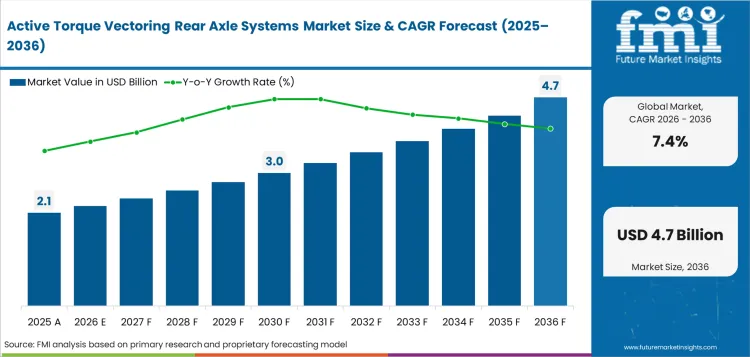
The active torque vectoring rear axle systems market stood at USD 2.1 billion in 2025 and is projected to reach USD 2.3 billion by 2026-end. The market is expected to grow at a 7.4% CAGR, reaching USD 4.7 billion by 2036.
Summary of the Active Torque Vectoring Rear Axle Systems Market
- Demand and Growth Drivers
- Electric rear axles are raising demand for direct wheel-torque control as BEVs deliver fast torque from low speed.
- Premium SUV programs are using active rear axle hardware to manage body weight and cornering stability.
- Central chassis control is improving the role of electronic differential control module systems across rear axle programs.
- Product and Segment View
- Twin-clutch module is projected to capture 42.0% share of the system architecture segment in 2026, driven by direct left-right wheel control across premium rear axles.
- Performance SUVs are anticipated to represent 36.0% of vehicle class demand in 2026 as high-torque models need stronger rear stability control.
- BEV platforms are estimated to account for 41.0% share of the powertrain segment in 2026, reflecting precise torque calibration needs across rear motor layouts.
- Chassis ECU integration is expected to hold high-value demand as axle control enters powertrain domain control unit platforms.
- Geography and Competitive Outlook
- China is expected to record a CAGR of 9.8% through 2036, backed by EV scale and local drivetrain sourcing.
- India is projected to expand at 9.3% CAGR by 2036, as premium SUV assembly and EV programs deepen.
- Companies combining rear axle hardware with software calibration are strengthening their position during the forecast period.
- Analyst Opinion
- Nikhil Kaitwade, Principal Consultant for the Automotive domain at FMI, says, “Active torque vectoring rear axles are becoming a chassis control layer for BEV and hybrid programs. Vehicle engineering teams need validated hardware with control software. Lower premium models face cost pressure while modular designs and repeatable calibration support platform rollout.”
- Active Torque Vectoring Rear Axle Systems Market Value Analysis
- The active torque vectoring rear axle systems market is moving from premium handling hardware into planned EV drivetrain content.
- Rear motor torque control needs are pushing demand across BEVs and high-output hybrid vehicles.
- The market is benefiting from deeper use of electric vehicle e-axle packages across premium vehicle platforms.
- Factory-calibrated documentation is needed to satisfy warranty checks and safety reviews before vehicle programs reach launch.
- These records help OEMs manage launch timing and reduce late-stage ride validation changes.
Key Takeaways, Market Size, and Forecast
- The active torque vectoring rear axle systems market was valued at USD 2.1 billion in 2025.
- By 2036, the active torque vectoring rear axle systems market is expected to be worth USD 4.7 billion.
- From 2026 to 2036, the market is projected to expand at a CAGR of 7.4%.
- The market is projected to create an incremental opportunity of USD 2.4 billion between 2026 and 2036.
- In 2026, OEM fitment is expected to account for 93.0% of sales channel demand.
- China at 9.8% and India at 9.3% are two of the faster-expanding country markets.
BEV rear axle design is becoming more complex as automakers try to manage instant motor torque within limited packaging space. BorgWarner’s May 2024 eTVD launch shows how suppliers are moving toward integrated rear axle systems that combine drive hardware, torque vectoring, differential replacement, and on-demand disconnect in one package. This helps OEMs reduce separate components and simplify validation work. Magna’s January 2024 eDrive release also shows rising demand for compact high-output axle units, with 250 kW peak power and 5,000 Nm peak axle torque for C, D, and E segment vehicles. Polestar’s 2024 use of two 180 kW rear motors with true torque vectoring shows how this technology is moving from engineering content to a visible performance feature. Suppliers with compact eDrive layouts, wheel-side torque control, and proven calibration capability are likely to gain stronger positions in premium BEV rear axle programs.
Active Torque Vectoring Rear Axle Systems Market Definition
The active torque vectoring rear axle systems market includes rear axle hardware and control systems used to vary torque between rear wheels. These systems improve traction and cornering response across BEVs, hybrids, and high-performance ICE vehicles. Scope includes twin-clutch modules, eTVD systems, eLSD units, axle actuators, sensors, and axle control software. Brake-only stability control, passive differentials, complete vehicles, and full vehicle ECUs are outside the scope.
Active Torque Vectoring Rear Axle Systems Market Inclusions
Market scope covers all commercially traded active torque vectoring rear axle systems categorized by system architecture; vehicle class; powertrain; control integration; and sales channel. Product scope includes twin-clutch modules, single-motor eTVD units, dual-motor axles, eLSD modules, and brake-assisted systems used across BEVs, hybrids, and ICE vehicles. Revenue scope covers 2026 to 2036 across OEM fitment, tier supply, and limited aftermarket demand. Key stakeholders include rear axle system manufacturers; eDrive and actuator suppliers; vehicle OEMs; chassis control software providers; drivetrain component firms; testing partners; distributors; and regulatory bodies.
Active Torque Vectoring Rear Axle Systems Market Exclusions
Scope does not include passive differential units, brake-only traction control, standard AWD couplings without wheel-side torque control, complete vehicles, or standalone vehicle control software.
Active Torque Vectoring Rear Axle Systems Market Research Methodology
- Primary Research: FMI analysts talked to axle suppliers, drivetrain engineers, vehicle platform teams, and automotive electronics specialists in important markets.
- Desk Research: Combined data from OICA production statistics, IEA EV data, company product portfolios, and rear axle technology references.
- Market sizing and forecasting: Added rear axle fitment, system pricing, vehicle class use, and powertrain mix from the bottom up.
- Data validation: Cross-checked every three months against EV production patterns, premium vehicle programs, and supplier product coverage.
Why is the Active Torque Vectoring Rear Axle Systems Market Growing?
- BEV rear axles need faster torque control as electric motors deliver instant wheel force during launch.
- Premium SUVs require rear axle control to manage weight transfer during cornering and low-grip driving.
- OEMs are reducing brake-based intervention as direct torque control can lower brake and tire wear.
- Software-defined chassis programs create stronger demand for automotive electric drivetrain components.
Electric vehicle platform planning is raising the value of rear axle control. IEA reported in May 2025 vehicle electric car sales topped 17 million worldwide in 2024 and accounted for over 20% of new cars sold. This vehicle base creates more rear motor and dual motor layouts which can use active torque vectoring. Rear axle suppliers gain stronger program access when hardware works with existing motor control software. OEM sourcing teams will keep favoring validated systems which reduce tuning time before launch.
Vehicle output keeps a large addressable base for advanced axle hardware. OICA reported in April 2026 global vehicle production moved from 92.7 million units in 2024 to 96.4 million units in 2025. This production scale makes space for active axle content even if total vehicle output grows slowly. The stronger opportunity lies in value per vehicle instead of simple unit expansion. Suppliers with modular axle layouts can serve multiple trim levels without redesigning the full driveline.
Market Segmentation Analysis
- Twin-Clutch Module is estimated to account for 42.0% of system architecture demand in 2026 with strong use across premium rear axles.
- Performance SUVs are expected to account for 36.0% of vehicle class demand in 2026 with direct use across high-torque models.
- BEV is expected to account for 41.0% of powertrain demand in 2026 with higher use across rear motor layouts.
- Chassis ECU is estimated to account for 48.0% of control integration demand in 2026 with broad use across centralized chassis systems.
- OEM Fitment is estimated to account for 93.0% of sales channel demand in 2026 with factory calibration as the main reason.
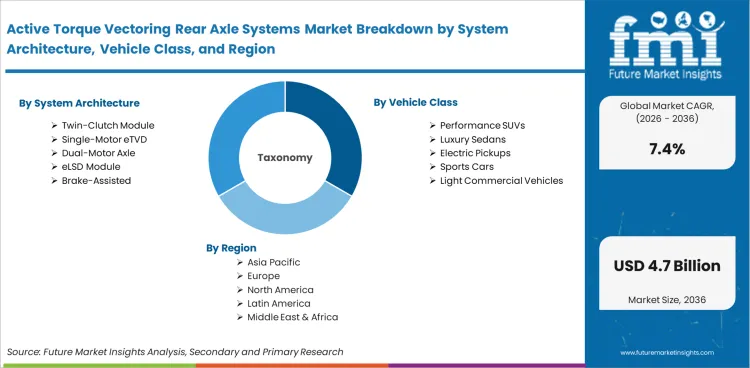
The market for active torque vectoring rear axle systems is divided into five primary segment groups based on system architecture, vehicle class, powertrain, control integration, and sales channel. System architecture includes twin-clutch module, single-motor etvd, dual-motor axle, eLSD module, and brake-assisted systems. Vehicle class includes performance SUVs, luxury sedans, electric pickups, sports cars, and light commercial vehicles. Powertrain includes BEV, hybrid, and ICE vehicles. Control integration includes chassis ECU, rear-axle ECU, powertrain ECU, and a standalone controller. Sales channel includes OEM fitment, tier supply, and aftermarket.
Insights into Active Torque Vectoring Rear Axle Systems Market by System Architecture
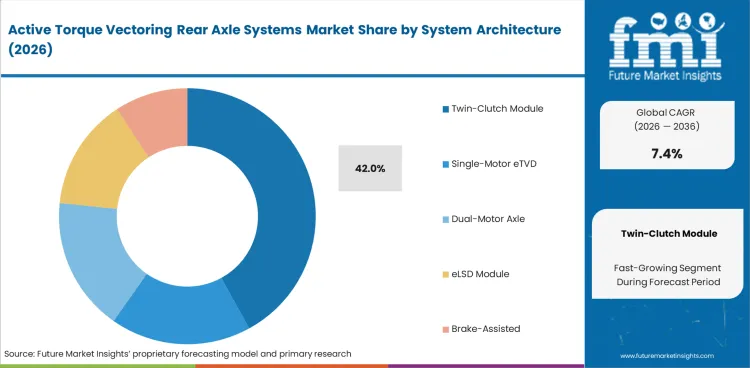
- In 2026, twin-clutch module systems are expected to make up 42.0% of the system architecture segment. This design supports direct left-right torque control across premium rear axle layouts with heavy torque loads.
- Single-motor eTVD and eLSD options serve selected electric platforms as their use improves in vehicles needing compact packaging and lower hardware weight.
Insights into Active Torque Vectoring Rear Axle Systems Market by Vehicle Class
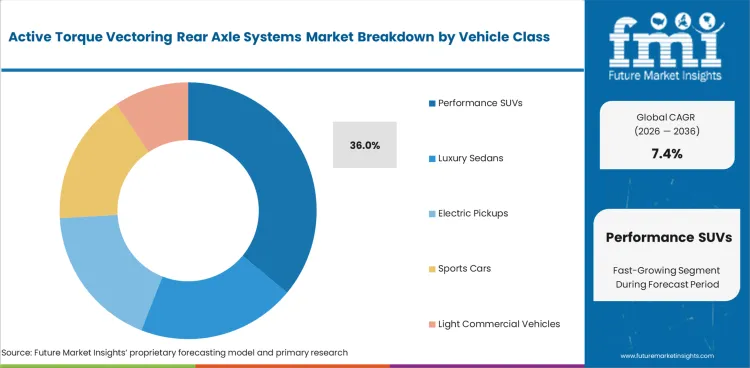
- Performance SUVs are projected to account for 36.0% of the vehicle class segment in 2026. Higher curb weight and stronger acceleration needs increase the value of rear axle vectoring.
- Luxury sedans and sports cars use active rear axle control for handling refinement across premium driving programs. SUV programs carry broader fitment potential across electric variants.
Insights into Active Torque Vectoring Rear Axle Systems Market by Powertrain
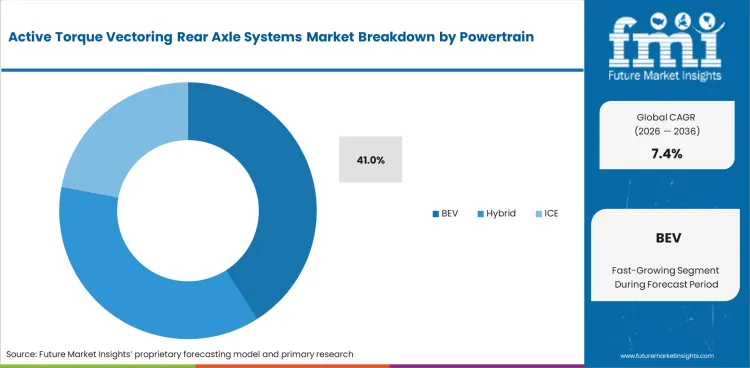
- BEV platforms are expected to represent 41.0% of the powertrain segment in 2026. Instant rear motor torque creates stronger need for calibrated wheel-side control.
- Hybrid and ICE platforms address selected performance needs across premium and sport-oriented models. Their demand improves in vehicles requiring traction support without full dual-motor layouts.
Insights into Active Torque Vectoring Rear Axle Systems Market by Control Integration
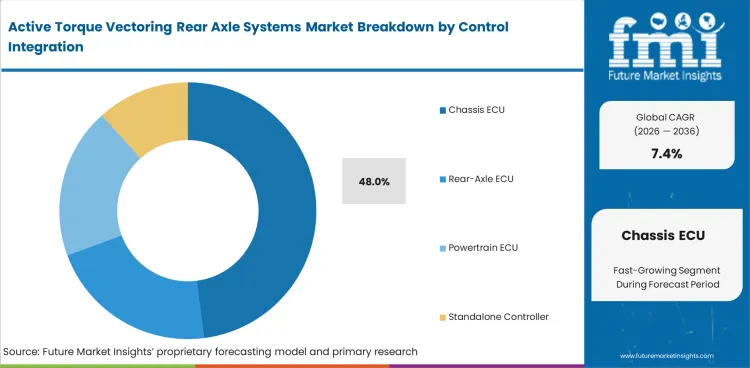
- Chassis ECU integration is estimated to account for 48.0% share in 2026. Centralized motion control helps combine rear axle response with braking and stability functions.
- Rear-axle ECU and standalone controller formats serve older platform designs. Their use continues in programs requiring separate control modules and limited software redesign.
Insights into Active Torque Vectoring Rear Axle Systems Market by Sales Channel
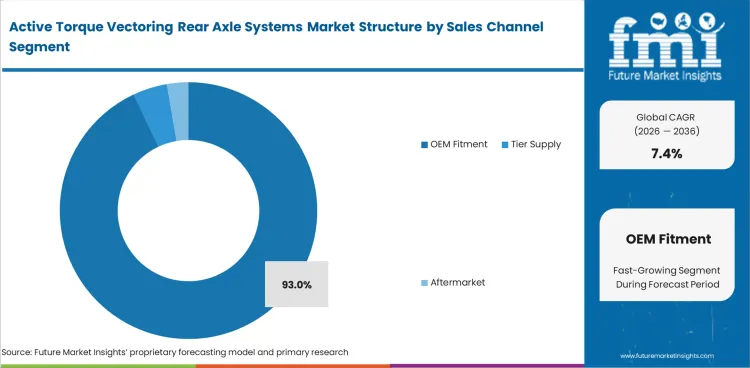
- OEM Fitment is projected to hold 93.0% share in 2026. Vehicle makers prefer factory installation for calibration control and safety validation before launch.
- Aftermarket demand is limited by sensor matching and software approval needs across active axle systems. Tier supply supports production programs requiring axle modules with verified documentation.
Active Torque Vectoring Rear Axle Systems Market Drivers, Restraints, and Opportunities
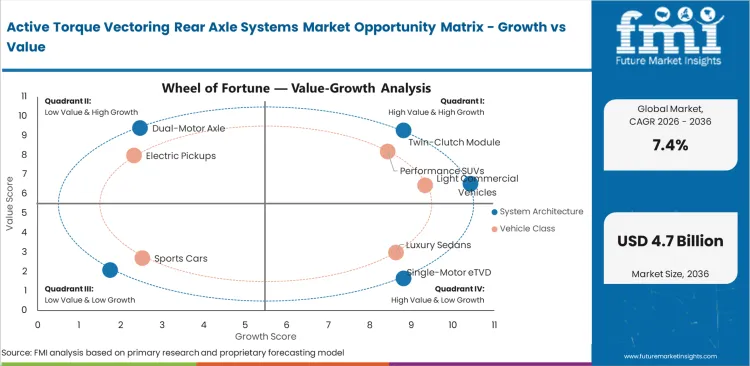
- Rear motor torque density is creating structured demand for wheel-side control across BEV platforms.
- High actuator and software validation cost creates pricing pressure for compact premium vehicles.
- Electric pickups create service opportunity through higher load control and axle durability needs.
The market for active torque vectoring rear axle systems expands as BEV platforms need controlled torque delivery. BorgWarner's May 2024 statement, its eTVD system entered production on Polestar 3 and included torque vectoring with on-demand disconnect. This confirms the combination of traction control with axle efficiency in one rear module. Brake-based intervention cannot offer the same direct torque path under repeated load. OEMs will prefer suppliers who can prove stable software behavior across weather and road conditions.
Battery Cost Deflation Is Pressuring Premium Axle Pricing
Active torque vectoring rear axle systems are being pulled into a tougher pricing environment as EV bill-of-materials economics reset. According to the May 2025 IEA report, lithium-ion battery pack prices fell 20% in 2024, the steepest decline since 2017. China saw nearly 30% declines, while Europe and the United States recorded 10% to 15% declines. For OEMs this change reduces the pricing cushion around performance AWD packages, and it also affects rear axle torque vectoring offerings. Suppliers must now justify premiums through software calibration and durability. They must also prove advantages in NVH performance as well as thermal behavior and platform integration. The near-30% cost advantage of LFP over NMC batteries further strengthens OEM pressure on e-axle-linked system pricing.
Electric Drive Cost Targets Are Resetting Supplier Quotes
Rear axle torque-vectoring systems used in electrified platforms are increasingly benchmarked against falling electric drive system cost targets instead of legacy performance-driveline pricing. The FY 2024 electric drive system cost target of US$7/kW was exceeded, with the current estimate below US$6.5/kW for systems above 12 kW/L, assuming production volumes of over 100,000 units per year, as per the USA Department of Energy’s January 2025 report. This is important as active rear axle suppliers face sharper cost-down requests once OEMs see scalable motor and drive-unit economics improving. Price movement is downward for high-volume programs, while low-volume performance variants still retain premiums for validation and integration complexity.
Analysis of Active Torque Vectoring Rear Axle Systems Market By Key Countries
.webp "Top Country Growth Comparison Active Torque Vectoring Rear Axle Systems Market Cagr (2026 2036)")
| Country | CAGR |
|---|---|
| China | 9.8% |
| India | 9.3% |
| South Korea | 8.2% |
| USA | 7.6% |
| Germany | 6.8% |
| Japan | 6.3% |
| Mexico | 6.1% |
Source: Future Market Insights, 2026.
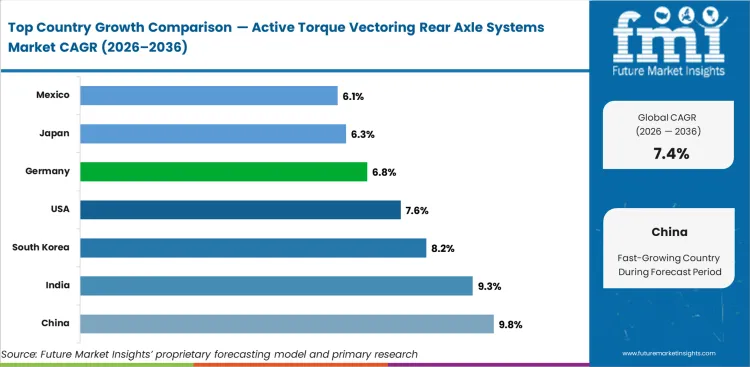
Active Torque Vectoring Rear Axle Systems Market CAGR Analysis By Country
- China is projected to record a 9.8% CAGR through 2036 as EV output deepens demand for locally sourced rear axle systems.
- India’s 9.3% CAGR is linked to premium SUV assembly and electric platform spending by domestic vehicle manufacturers.
- South Korea is forecast at 8.2% CAGR through 2036, helped by electric crossover programs and strong drivetrain engineering depth.
- USA demand is expected to advance at 7.6% CAGR as electric pickups require stronger rear axle torque-control capability.
- Germany at 6.8% points to premium engineering demand. Japan at 6.3% and Mexico at 6.1% indicate steady gains from mature supplier networks.
Demand for active torque vectoring rear axle systems is forecast to rise at 7.4% CAGR from 2026 to 2036. Country-level analysis covers the major markets contributing to this forecast, with the key markets listed below.
Demand Outlook for Active Torque Vectoring Rear Axle Systems Market in China
China’s active torque vectoring rear axle systems industry is projected to record a CAGR of 9.8% through 2036. China produced 34.531 million vehicles in 2025, and NEV production reached 16.626 million units in the same year. This manufacturing base strengthens demand for China active torque vectoring rear axle systems. Local suppliers can gain from EV makers who need rear axle control for premium BEV and SUV platforms.
- Shanghai and Guangdong EV production clusters create stronger demand for rear axle modules and control software.
- CAAM data confirms China’s NEV scale, which raises the addressable base for eTVD systems.
- Local OEMs need validated axle packages to reduce platform tuning time before domestic launch.
Sales Analysis of Active Torque Vectoring Rear Axle Systems Market in India
The active torque vectoring rear axle systems sector in India is expected to expand at a CAGR of 9.3% during the assessment period. OICA listed India’s 2024 vehicle production at 6.014 million units. This scale supports demand for India active torque vectoring rear axle systems as local premium SUV lines add higher drivetrain content. Suppliers with local engineering and service reach can gain from Mahindra, Tata Motors, and global OEM production programs.
- Maharashtra and Tamil Nadu vehicle hubs create practical demand for axle supply and platform calibration.
- SIAM production records underline India’s vehicle scale and strengthen local sourcing confidence.
- Domestic SUV platforms need rear axle packages to balance price control with validated handling.
Demand Outlook for Active Torque Vectoring Rear Axle Systems Market in South Korea
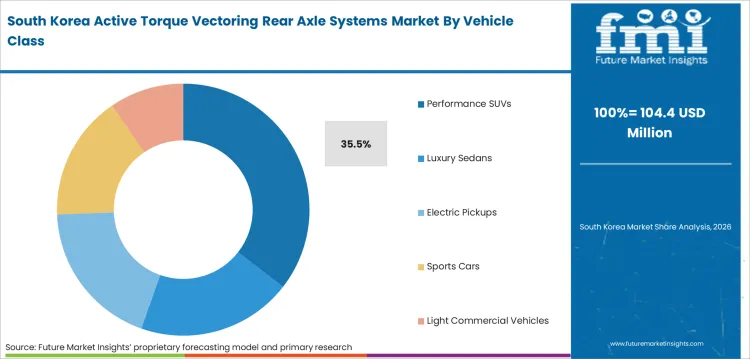
The South Korea active torque vectoring rear axle systems industry is forecast to grow at a CAGR of 8.2% by 2036. OICA reported South Korea’s 2024 vehicle production at 4.127 million units. This production base backs demand for rear axle systems across Hyundai Motor Group and export-focused EV programs. Local suppliers with control software depth can serve BEV electric drive unit needs across crossover and premium vehicle lines.
- Ulsan and Gwangmyeong production hubs create direct demand for EV driveline and rear axle engineering.
- KAMA-linked production records indicate South Korea’s export platform role across global vehicle programs.
- Battery electric crossovers need a rear axle response to match fast motor torque delivery.
Opportunity Analysis of Active Torque Vectoring Rear Axle Systems Market in the United States
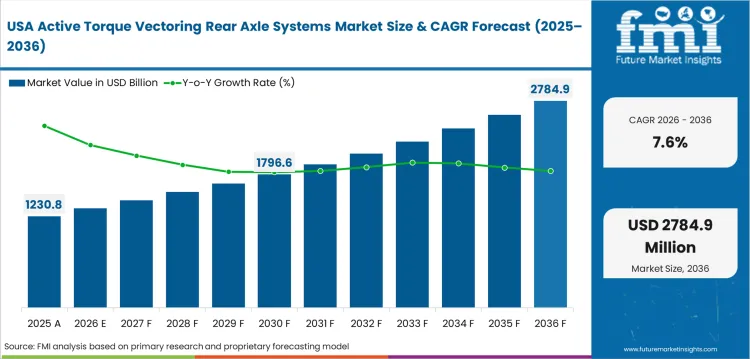
The USA active torque vectoring rear axle systems segment is poised to advance at 7.6% CAGR over the forecast years. IEA reported USA electric car sales at 1.6 million in 2024, with sales share above 10%. This reinforces demand for USA active torque vectoring rear axle systems across electric pickups and premium SUVs. Suppliers with North American validation capacity can reduce program risk for high-torque vehicle launches.
- Michigan and Tennessee EV manufacturing corridors create demand for rear drive modules and axle testing.
- Federal clean vehicle credits influenced EV buying patterns and helped several models scale during 2024.
- Electric pickups need rear axle systems to manage launch traction and towing-related torque load.
Future Outlook for Active Torque Vectoring Rear Axle Systems Market in Germany
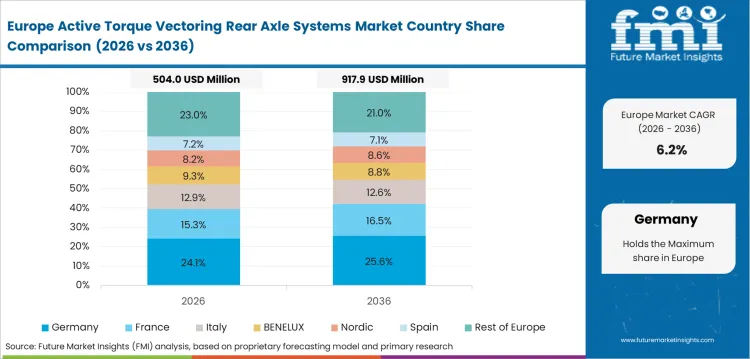
The Germany active torque vectoring rear axle systems industry is expected to post 6.8% CAGR over the forecast period. OICA listed Germany’s 2024 car production at 4.069 million units. This production base favors Germany active torque vectoring rear axle systems as premium OEMs specify EV powertrain content for higher-value models. German suppliers gain when axle systems reduce calibration burden across luxury BEV and hybrid programs.
- Bavaria and Baden-Württemberg premium vehicle clusters create demand for axle tuning and durability validation.
- VDA-linked production records confirm Germany’s scale across passenger car manufacturing.
- Luxury BEV programs need active rear axle hardware to improve handling without hurting efficiency.
Demand Outlook for Active Torque Vectoring Rear Axle Systems Market in Japan
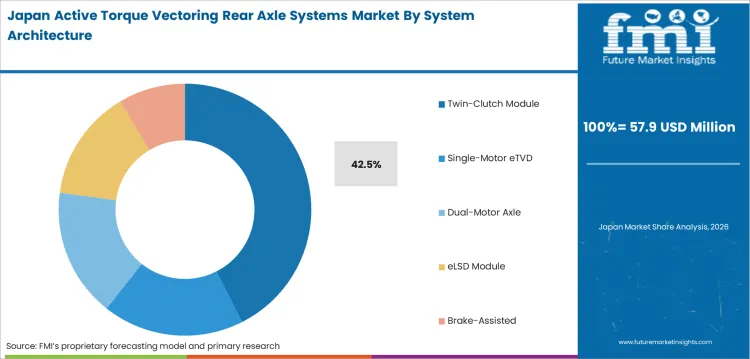
Active torque vectoring rear axle systems sector in Japan is forecast to expand at 6.3% CAGR between 2026 to 2036. OICA reported Japan’s 2024 vehicle production at 8.235 million units. This base supports demand for Japan active torque vectoring rear axle systems in hybrid and selective BEV platforms. Toyota and Subaru platforms can raise demand for calibrated rear axle control across premium and sport-oriented trims. Mazda can add similar demand in selected trims this need controlled rear axle response for sharper handling.
- Aichi and Gunma vehicle clusters create demand for hybrid drivetrain and rear axle engineering.
- JAMA-linked production data confirms Japan’s continued role across passenger vehicle output.
- Hybrid performance models need torque control packages to fit existing platform packaging limits.
In-depth Analysis of Active Torque Vectoring Rear Axle Systems Market in Mexico
Mexico’s active torque vectoring rear axle systems industry is expected to record 6.1% CAGR by 2036. OICA listed Mexico’s 2024 vehicle production at 4.203 million units. This manufacturing base supports demand for Mexico active torque vectoring rear axle systems as North American platforms add advanced axle content. Suppliers located near Nuevo León and Coahuila can serve OEM plants with shorter logistics cycles.
- Nuevo León and Coahuila supplier corridors create demand for axle modules serving North American programs.
- AMIA-linked production records confirm Mexico’s role as a major vehicle export base.
- Export-focused plants need rear axle systems to meet USA warranty and validation expectations.
Competitive Landscape and Strategic Positioning
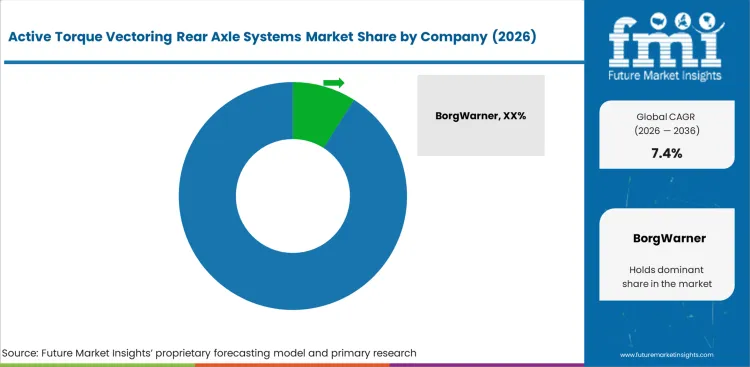
- BorgWarner leads supplier positioning through eTVD production and electric torque management across BEV rear axle programs.
- Magna and Dauch Corporation compete on electric drive systems and global driveline manufacturing reach across vehicle platforms.
- Specialist providers focus on eLSD units and torque-sensing differentials for programs needing selective axle control.
Competition in active torque vectoring rear axle systems centers on rear axle hardware and eDrive integration across OEM vehicle programs. BorgWarner holds a strong position through its electric torque vectoring and disconnect system for BEV SUVs. Magna adds compact eDrive systems designed for front or rear vehicle spaces across premium platforms. Dauch Corporation gained scale after acquiring Dowlais Group and its GKN Automotive subsidiaries in February 2026. ZF leverages rear axle eLSD systems with control-unit capability. Dana and JTEKT add focused strength across driveline components through selective torque-control hardware programs for OEMs.
Actuator cost and software validation create entry barriers for smaller suppliers in this market. OEM platform approval cycles add further pressure as rear axle systems need long testing before launch. Modular rear axle design and faster calibration are becoming key priorities across vehicle development programs. Automakers prefer suppliers offering torque control hardware with verified software records in one package. Suppliers with broader e-axle inverter and control unit systems coverage are placed to reduce coordination burden for OEM teams.
Key Companies in the Active Torque Vectoring Rear Axle Systems Market
Key global companies leading the active torque vectoring rear axle systems market include:
- BorgWarner, Magna, and Dauch Corporation have strong rear axle control and electric driveline infrastructure for global OEM programs.
- ZF, Dana, and Schaeffler serve manufacturers through axle systems, eDrive components, and chassis control capability.
- JTEKT holds specialist positioning across Torsen limited-slip differentials and torque distribution systems for performance vehicles.
Competitive Benchmarking: Active Torque Vectoring Rear Axle Systems Market
| Company | Rear Axle Control Depth | eDrive Integration | OEM Program Reach | Geographic Footprint |
|---|---|---|---|---|
| BorgWarner | High | High | Strong | North America Europe and Asia |
| Magna | High | High | Strong | North America Europe and Asia |
| Dauch Corporation | High | High | Strong | Europe North America and Asia |
| ZF | High | Medium | Strong | Europe North America and Asia |
| Dana | Medium | Medium | Strong | North America Europe and Asia |
| Schaeffler | Medium | High | Moderate | Europe Asia and North America |
| JTEKT | Medium | Medium | Moderate | Asia Europe and North America |
Source: Future Market Insights, 2026.
Key Developments in Active Torque Vectoring Rear Axle Systems Market
- In May 2024, BorgWarner supplied Polestar BEV SUVs with electric torque vectoring and disconnect systems. The eTVD system entered production on the Polestar 3 SUV and combined torque vectoring with on-demand disconnect functionality.
- In January 2024, Magna unveiled its next-generation eDrive at CES 2024. The system delivers 250 kW peak power and 5,000 Nm peak axle torque for C, D, and E segment vehicles.
- February 2026, Dauch Corporation completed the acquisition of Dowlais Group plc and its subsidiaries. The acquired portfolio includes GKN Automotive and GKN Powder Metallurgy.
Key Players in the Active Torque Vectoring Rear Axle Systems Market
Major Global Players
- BorgWarner
- Magna
- Dauch Corporation
- ZF
- Dana
Specialist Players
- Schaeffler
- JTEKT
Report Scope and Coverage
| Parameter | Details |
|---|---|
| Quantitative Units | USD 2.3 billion to USD 4.7 billion, at a CAGR of 7.4% |
| Market Definition | The market encompasses rear axle hardware and control systems used to vary torque between rear wheels. |
| Regions Covered | North America, Latin America, Europe, East Asia, South Asia and Pacific, Middle East and Africa |
| Countries Covered | USA, Germany, China, India, Japan, South Korea, Mexico, and 30 plus countries |
| Key Companies Profiled | BorgWarner, Magna, Dauch Corporation, ZF, Dana, Schaeffler, JTEKT |
| Forecast Period | 2026 to 2036 |
| Approach | Hybrid bottom-up and top-down methodology starting with vehicle production and verified rear axle fitment patterns. |
Active Torque Vectoring Rear Axle Systems Market by Segments<
Active Torque Vectoring Rear Axle Systems Market Segmented by System Architecture
- Twin-Clutch Module
- Single-Motor eTVD
- Dual-Motor Axle
- eLSD Module
- Brake-Assisted
Active Torque Vectoring Rear Axle Systems Market Segmented by Vehicle Class
- Performance SUVs
- Luxury Sedans
- Electric Pickups
- Sports Cars
- Light Commercial Vehicles
Active Torque Vectoring Rear Axle Systems Market Segmented by Powertrain
- BEV
- Hybrid
- ICE
Active Torque Vectoring Rear Axle Systems Market Segmented by Control Integration
- Chassis ECU
- Rear-Axle ECU
- Powertrain ECU
- Standalone Controller
Active Torque Vectoring Rear Axle Systems Market Segmented by Sales Channel
- OEM Fitment
- Tier Supply
- Aftermarket
Active Torque Vectoring Rear Axle Systems Market by Region:
- North America
- USA
- Canada
- Mexico
- Latin America
- Brazil
- Chile
- Rest of Latin America
- Europe
- Germany
- UK
- Italy
- Spain
- France
- Rest of Europe
- East Asia
- China
- Japan
- South Korea
- South Asia and Pacific
- India
- ASEAN
- Australia & New Zealand
- Rest of South Asia and Pacific
- Middle East and Africa
- Saudi Arabia
- Other GCC Countries
- South Africa
- Rest of Middle East and Africa
Research Sources and Bibliography
- International Energy Agency. (2025, May 14). Electric vehicle batteries. In Global EV Outlook 2025. Electric vehicle batteries - Global EV Outlook 2025 - Analysis - IEA
- USA Department of Energy. (2025, January). Fiscal Year 2024 Annual Performance Report. Fiscal Year 2024 Annual Performance Report
- International Energy Agency. (2025, May). Global EV Outlook 2025: Trends in electric car markets. Source hyperlink.
- International Organization of Motor Vehicle Manufacturers. (2026, April). Auto industry growth shifted east in 2025 amid global repositioning. Source hyperlink.
- International Organization of Motor Vehicle Manufacturers. (2025, October). World motor vehicle production by country/region and type 2024. Source hyperlink.
- Government of China. (2026, January). China’s auto output, sales reach new highs in 2025. Source hyperlink.
- BorgWarner Inc. (2024, May). BorgWarner supplies Polestar BEV SUVs with electric torque vectoring and disconnect systems. Source hyperlink.
- Magna International Inc. (2024, January). Magna unveils next generation eDrive at CES 2024. Source hyperlink.
- Dauch Corporation. (2026, February). Dauch Corporation completes acquisition of Dowlais Group plc. Source hyperlink.
- ZF Friedrichshafen AG. (2026). Rear axle drive eLSD. Source hyperlink
This Report Answers
- What is the current and future size of the active torque vectoring rear axle systems market?
- How fast is the active torque vectoring rear axle systems market expected to expand between 2026 and 2036?
- Which system architecture is expected to lead the market by 2026?
- Which vehicle class is expected to account for the top demand by 2026?
- What factors are driving demand for active torque vectoring rear axle systems globally?
- How are BEV platforms influencing adoption of active rear axle systems?
- Why is OEM fitment the main sales channel for active rear axle systems?
- How are electric drivetrains creating demand for torque vectoring hardware?
- Which countries are projected to record faster expansion through 2036?
- What is driving market expansion in China and India?
- Who are the key companies active in the active torque vectoring rear axle systems market?
- How does FMI estimate and validate the market forecast?
Frequently Asked Questions
What is the global market demand for Active Torque Vectoring Rear Axle Systems in 2026?
In 2026, the global market for active torque vectoring rear axle systems is expected to be worth USD 2.3 billion.
How big will the market for Active Torque Vectoring Rear Axle Systems be in 2036?
By 2036, the market for active torque vectoring rear axle systems is expected to be worth USD 4.7 billion.
How much is demand for Active Torque Vectoring Rear Axle Systems expected to expand between 2026 and 2036?
Between 2026 and 2036, demand for active torque vectoring rear axle systems is expected to expand at a CAGR of 7.4%.
Which system architecture segment is likely to be the leading seller globally by 2026?
Twin-Clutch Module will make up 42.0% of the system architecture segment in 2026.
What is causing demand to rise in China?
The China active torque vectoring rear axle systems market is projected to record 9.8% CAGR through 2036, backed by EV output and drivetrain localization.
What is causing demand to rise in India?
The India active torque vectoring rear axle systems market is projected to expand at 9.3% CAGR through 2036, backed by premium SUV assembly and EV platform investment.
What does this report mean by Active Torque Vectoring Rear Axle Systems Market definition?
The active torque vectoring rear axle systems market includes rear axle hardware and controls used to vary torque between rear wheels.
How does FMI make the Active Torque Vectoring Rear Axle Systems forecast and check it?
FMI estimates the market through vehicle production, rear axle fitment, system pricing, powertrain mix, supplier portfolios, and primary interview validation.
Preview the report firsthand - request a free sample
Get SampleGet the brochure for pricing and purchase details.
Get PDFTable of Content
- Executive Summary
- Global Market Outlook
- Demand-side Trends
- Supply-side Trends
- Technology Roadmap Analysis
- Analysis and Recommendations
- Market Overview
- Market Coverage / Taxonomy
- Market Definition / Scope / Limitations
- Research Methodology
- Chapter Orientation
- Analytical Lens and Working Hypotheses
- Market Structure, Signals, and Trend Drivers
- Benchmarking and Cross-market Comparability
- Market Sizing, Forecasting, and Opportunity Mapping
- Research Design and Evidence Framework
- Desk Research Programme (Secondary Evidence)
- Company Annual and Sustainability Reports
- Peer-reviewed Journals and Academic Literature
- Corporate Websites, Product Literature, and Technical Notes
- Earnings Decks and Investor Briefings
- Statutory Filings and Regulatory Disclosures
- Technical White Papers and Standards Notes
- Trade Journals, Industry Magazines, and Analyst Briefs
- Conference Proceedings, Webinars, and Seminar Materials
- Government Statistics Portals and Public Data Releases
- Press Releases and Reputable Media Coverage
- Specialist Newsletters and Curated Briefings
- Sector Databases and Reference Repositories
- FMI Internal Proprietary Databases and Historical Market Datasets
- Subscription Datasets and Paid Sources
- Social Channels, Communities, and Digital Listening Inputs
- Additional Desk Sources
- Expert Input and Fieldwork (Primary Evidence)
- Primary Modes
- Qualitative Interviews and Expert Elicitation
- Quantitative Surveys and Structured Data Capture
- Blended Approach
- Why Primary Evidence is Used
- Field Techniques
- Interviews
- Surveys
- Focus Groups
- Observational and In-context Research
- Social and Community Interactions
- Stakeholder Universe Engaged
- C-suite Leaders
- Board Members
- Presidents and Vice Presidents
- R&D and Innovation Heads
- Technical Specialists
- Domain Subject-matter Experts
- Scientists
- Physicians and Other Healthcare Professionals
- Governance, Ethics, and Data Stewardship
- Research Ethics
- Data Integrity and Handling
- Primary Modes
- Tooling, Models, and Reference Databases
- Desk Research Programme (Secondary Evidence)
- Data Engineering and Model Build
- Data Acquisition and Ingestion
- Cleaning, Normalisation, and Verification
- Synthesis, Triangulation, and Analysis
- Quality Assurance and Audit Trail
- Market Background
- Market Dynamics
- Drivers
- Restraints
- Opportunity
- Trends
- Scenario Forecast
- Demand in Optimistic Scenario
- Demand in Likely Scenario
- Demand in Conservative Scenario
- Opportunity Map Analysis
- Product Life Cycle Analysis
- Supply Chain Analysis
- Investment Feasibility Matrix
- Value Chain Analysis
- PESTLE and Porter’s Analysis
- Regulatory Landscape
- Regional Parent Market Outlook
- Production and Consumption Statistics
- Import and Export Statistics
- Market Dynamics
- Global Market Analysis 2021 to 2025 and Forecast, 2026 to 2036
- Historical Market Size Value (USD Million) Analysis, 2021 to 2025
- Current and Future Market Size Value (USD Million) Projections, 2026 to 2036
- Y-o-Y Growth Trend Analysis
- Absolute $ Opportunity Analysis
- Global Market Pricing Analysis 2021 to 2025 and Forecast 2026 to 2036
- Global Market Analysis 2021 to 2025 and Forecast 2026 to 2036, By System Architecture
- Introduction / Key Findings
- Historical Market Size Value (USD Million) Analysis By System Architecture , 2021 to 2025
- Current and Future Market Size Value (USD Million) Analysis and Forecast By System Architecture , 2026 to 2036
- Twin-Clutch Module
- Single-Motor eTVD
- Dual-Motor Axle
- eLSD Module
- Brake-Assisted
- Twin-Clutch Module
- Y-o-Y Growth Trend Analysis By System Architecture , 2021 to 2025
- Absolute $ Opportunity Analysis By System Architecture , 2026 to 2036
- Global Market Analysis 2021 to 2025 and Forecast 2026 to 2036, By Vehicle Class
- Introduction / Key Findings
- Historical Market Size Value (USD Million) Analysis By Vehicle Class, 2021 to 2025
- Current and Future Market Size Value (USD Million) Analysis and Forecast By Vehicle Class, 2026 to 2036
- Performance SUVs
- Luxury Sedans
- Electric Pickups
- Sports Cars
- Light Commercial Vehicles
- Performance SUVs
- Y-o-Y Growth Trend Analysis By Vehicle Class, 2021 to 2025
- Absolute $ Opportunity Analysis By Vehicle Class, 2026 to 2036
- Global Market Analysis 2021 to 2025 and Forecast 2026 to 2036, By Powertrain
- Introduction / Key Findings
- Historical Market Size Value (USD Million) Analysis By Powertrain, 2021 to 2025
- Current and Future Market Size Value (USD Million) Analysis and Forecast By Powertrain, 2026 to 2036
- BEV
- Hybrid
- ICE
- BEV
- Y-o-Y Growth Trend Analysis By Powertrain, 2021 to 2025
- Absolute $ Opportunity Analysis By Powertrain, 2026 to 2036
- Global Market Analysis 2021 to 2025 and Forecast 2026 to 2036, By Control Integration
- Introduction / Key Findings
- Historical Market Size Value (USD Million) Analysis By Control Integration, 2021 to 2025
- Current and Future Market Size Value (USD Million) Analysis and Forecast By Control Integration, 2026 to 2036
- Chassis ECU
- Rear-Axle ECU
- Powertrain ECU
- Standalone Controller
- Chassis ECU
- Y-o-Y Growth Trend Analysis By Control Integration, 2021 to 2025
- Absolute $ Opportunity Analysis By Control Integration, 2026 to 2036
- Global Market Analysis 2021 to 2025 and Forecast 2026 to 2036, By Sales Channel
- Introduction / Key Findings
- Historical Market Size Value (USD Million) Analysis By Sales Channel, 2021 to 2025
- Current and Future Market Size Value (USD Million) Analysis and Forecast By Sales Channel, 2026 to 2036
- OEM Fitment
- Tier Supply
- Aftermarket
- OEM Fitment
- Y-o-Y Growth Trend Analysis By Sales Channel, 2021 to 2025
- Absolute $ Opportunity Analysis By Sales Channel, 2026 to 2036
- Global Market Analysis 2021 to 2025 and Forecast 2026 to 2036, By Region
- Introduction
- Historical Market Size Value (USD Million) Analysis By Region, 2021 to 2025
- Current Market Size Value (USD Million) Analysis and Forecast By Region, 2026 to 2036
- North America
- Latin America
- Western Europe
- Eastern Europe
- East Asia
- South Asia and Pacific
- Middle East & Africa
- Market Attractiveness Analysis By Region
- North America Market Analysis 2021 to 2025 and Forecast 2026 to 2036, By Country
- Historical Market Size Value (USD Million) Trend Analysis By Market Taxonomy, 2021 to 2025
- Market Size Value (USD Million) Forecast By Market Taxonomy, 2026 to 2036
- By Country
- USA
- Canada
- Mexico
- By System Architecture
- By Vehicle Class
- By Powertrain
- By Control Integration
- By Sales Channel
- By Country
- Market Attractiveness Analysis
- By Country
- By System Architecture
- By Vehicle Class
- By Powertrain
- By Control Integration
- By Sales Channel
- Key Takeaways
- Latin America Market Analysis 2021 to 2025 and Forecast 2026 to 2036, By Country
- Historical Market Size Value (USD Million) Trend Analysis By Market Taxonomy, 2021 to 2025
- Market Size Value (USD Million) Forecast By Market Taxonomy, 2026 to 2036
- By Country
- Brazil
- Chile
- Rest of Latin America
- By System Architecture
- By Vehicle Class
- By Powertrain
- By Control Integration
- By Sales Channel
- By Country
- Market Attractiveness Analysis
- By Country
- By System Architecture
- By Vehicle Class
- By Powertrain
- By Control Integration
- By Sales Channel
- Key Takeaways
- Western Europe Market Analysis 2021 to 2025 and Forecast 2026 to 2036, By Country
- Historical Market Size Value (USD Million) Trend Analysis By Market Taxonomy, 2021 to 2025
- Market Size Value (USD Million) Forecast By Market Taxonomy, 2026 to 2036
- By Country
- Germany
- UK
- Italy
- Spain
- France
- Nordic
- BENELUX
- Rest of Western Europe
- By System Architecture
- By Vehicle Class
- By Powertrain
- By Control Integration
- By Sales Channel
- By Country
- Market Attractiveness Analysis
- By Country
- By System Architecture
- By Vehicle Class
- By Powertrain
- By Control Integration
- By Sales Channel
- Key Takeaways
- Eastern Europe Market Analysis 2021 to 2025 and Forecast 2026 to 2036, By Country
- Historical Market Size Value (USD Million) Trend Analysis By Market Taxonomy, 2021 to 2025
- Market Size Value (USD Million) Forecast By Market Taxonomy, 2026 to 2036
- By Country
- Russia
- Poland
- Hungary
- Balkan & Baltic
- Rest of Eastern Europe
- By System Architecture
- By Vehicle Class
- By Powertrain
- By Control Integration
- By Sales Channel
- By Country
- Market Attractiveness Analysis
- By Country
- By System Architecture
- By Vehicle Class
- By Powertrain
- By Control Integration
- By Sales Channel
- Key Takeaways
- East Asia Market Analysis 2021 to 2025 and Forecast 2026 to 2036, By Country
- Historical Market Size Value (USD Million) Trend Analysis By Market Taxonomy, 2021 to 2025
- Market Size Value (USD Million) Forecast By Market Taxonomy, 2026 to 2036
- By Country
- China
- Japan
- South Korea
- By System Architecture
- By Vehicle Class
- By Powertrain
- By Control Integration
- By Sales Channel
- By Country
- Market Attractiveness Analysis
- By Country
- By System Architecture
- By Vehicle Class
- By Powertrain
- By Control Integration
- By Sales Channel
- Key Takeaways
- South Asia and Pacific Market Analysis 2021 to 2025 and Forecast 2026 to 2036, By Country
- Historical Market Size Value (USD Million) Trend Analysis By Market Taxonomy, 2021 to 2025
- Market Size Value (USD Million) Forecast By Market Taxonomy, 2026 to 2036
- By Country
- India
- ASEAN
- Australia & New Zealand
- Rest of South Asia and Pacific
- By System Architecture
- By Vehicle Class
- By Powertrain
- By Control Integration
- By Sales Channel
- By Country
- Market Attractiveness Analysis
- By Country
- By System Architecture
- By Vehicle Class
- By Powertrain
- By Control Integration
- By Sales Channel
- Key Takeaways
- Middle East & Africa Market Analysis 2021 to 2025 and Forecast 2026 to 2036, By Country
- Historical Market Size Value (USD Million) Trend Analysis By Market Taxonomy, 2021 to 2025
- Market Size Value (USD Million) Forecast By Market Taxonomy, 2026 to 2036
- By Country
- Kingdom of Saudi Arabia
- Other GCC Countries
- Turkiye
- South Africa
- Other African Union
- Rest of Middle East & Africa
- By System Architecture
- By Vehicle Class
- By Powertrain
- By Control Integration
- By Sales Channel
- By Country
- Market Attractiveness Analysis
- By Country
- By System Architecture
- By Vehicle Class
- By Powertrain
- By Control Integration
- By Sales Channel
- Key Takeaways
- Key Countries Market Analysis
- USA
- Pricing Analysis
- Market Share Analysis, 2025
- By System Architecture
- By Vehicle Class
- By Powertrain
- By Control Integration
- By Sales Channel
- Canada
- Pricing Analysis
- Market Share Analysis, 2025
- By System Architecture
- By Vehicle Class
- By Powertrain
- By Control Integration
- By Sales Channel
- Mexico
- Pricing Analysis
- Market Share Analysis, 2025
- By System Architecture
- By Vehicle Class
- By Powertrain
- By Control Integration
- By Sales Channel
- Brazil
- Pricing Analysis
- Market Share Analysis, 2025
- By System Architecture
- By Vehicle Class
- By Powertrain
- By Control Integration
- By Sales Channel
- Chile
- Pricing Analysis
- Market Share Analysis, 2025
- By System Architecture
- By Vehicle Class
- By Powertrain
- By Control Integration
- By Sales Channel
- Germany
- Pricing Analysis
- Market Share Analysis, 2025
- By System Architecture
- By Vehicle Class
- By Powertrain
- By Control Integration
- By Sales Channel
- UK
- Pricing Analysis
- Market Share Analysis, 2025
- By System Architecture
- By Vehicle Class
- By Powertrain
- By Control Integration
- By Sales Channel
- Italy
- Pricing Analysis
- Market Share Analysis, 2025
- By System Architecture
- By Vehicle Class
- By Powertrain
- By Control Integration
- By Sales Channel
- Spain
- Pricing Analysis
- Market Share Analysis, 2025
- By System Architecture
- By Vehicle Class
- By Powertrain
- By Control Integration
- By Sales Channel
- France
- Pricing Analysis
- Market Share Analysis, 2025
- By System Architecture
- By Vehicle Class
- By Powertrain
- By Control Integration
- By Sales Channel
- India
- Pricing Analysis
- Market Share Analysis, 2025
- By System Architecture
- By Vehicle Class
- By Powertrain
- By Control Integration
- By Sales Channel
- ASEAN
- Pricing Analysis
- Market Share Analysis, 2025
- By System Architecture
- By Vehicle Class
- By Powertrain
- By Control Integration
- By Sales Channel
- Australia & New Zealand
- Pricing Analysis
- Market Share Analysis, 2025
- By System Architecture
- By Vehicle Class
- By Powertrain
- By Control Integration
- By Sales Channel
- China
- Pricing Analysis
- Market Share Analysis, 2025
- By System Architecture
- By Vehicle Class
- By Powertrain
- By Control Integration
- By Sales Channel
- Japan
- Pricing Analysis
- Market Share Analysis, 2025
- By System Architecture
- By Vehicle Class
- By Powertrain
- By Control Integration
- By Sales Channel
- South Korea
- Pricing Analysis
- Market Share Analysis, 2025
- By System Architecture
- By Vehicle Class
- By Powertrain
- By Control Integration
- By Sales Channel
- Russia
- Pricing Analysis
- Market Share Analysis, 2025
- By System Architecture
- By Vehicle Class
- By Powertrain
- By Control Integration
- By Sales Channel
- Poland
- Pricing Analysis
- Market Share Analysis, 2025
- By System Architecture
- By Vehicle Class
- By Powertrain
- By Control Integration
- By Sales Channel
- Hungary
- Pricing Analysis
- Market Share Analysis, 2025
- By System Architecture
- By Vehicle Class
- By Powertrain
- By Control Integration
- By Sales Channel
- Kingdom of Saudi Arabia
- Pricing Analysis
- Market Share Analysis, 2025
- By System Architecture
- By Vehicle Class
- By Powertrain
- By Control Integration
- By Sales Channel
- Turkiye
- Pricing Analysis
- Market Share Analysis, 2025
- By System Architecture
- By Vehicle Class
- By Powertrain
- By Control Integration
- By Sales Channel
- South Africa
- Pricing Analysis
- Market Share Analysis, 2025
- By System Architecture
- By Vehicle Class
- By Powertrain
- By Control Integration
- By Sales Channel
- USA
- Market Structure Analysis
- Competition Dashboard
- Competition Benchmarking
- Market Share Analysis of Top Players
- By Regional
- By System Architecture
- By Vehicle Class
- By Powertrain
- By Control Integration
- By Sales Channel
- Competition Analysis
- Competition Deep Dive
- BorgWarner
- Overview
- Product Portfolio
- Profitability by Market Segments (Product/Age /Sales Channel/Region)
- Sales Footprint
- Strategy Overview
- Marketing Strategy
- Product Strategy
- Channel Strategy
- Magna
- Dauch Corporation
- ZF
- Dana
- Schaeffler
- JTEKT
- BorgWarner
- Competition Deep Dive
- Assumptions & Acronyms Used


