

- Market Size (2026)
- USD 2.0 Bn
- Forecast (2036)
- USD 5.2 Bn
- CAGR (2026 to 2036)
- 9.4%
Rear-Seat Entertainment Display Platforms for SUVs Market Size, Market Forecast and Outlook By FMI
Summary of the Rear-Seat Entertainment Display Platforms for SUVs Market
- Demand and Growth Drivers
- Rear passenger comfort increasing the need for built-in display platforms across premium SUV trims. Family SUV use is supporting demand for screens that can handle long trips and daily passenger travel.
- Electric SUVs are creating a better cabin environment for video use as quiet interiors improve the viewing experience. Connected entertainment features are pushing demand for Wi-Fi enabled platforms with device pairing support.
- Product and Segment View
- Headrest displays lead display type demand because they fit many SUV seat layouts with lower cabin redesign needs.
- The 10 to 13 inch segment dominates screen size demand as it balances clear viewing with practical second-row placement.
- Full HD screens hold a leading position since they offer suitable image quality at a workable cost.
- OEM integrated platforms lead integration type demand as automakers prefer factory wiring and warranty control.
- Geography and Competitive Outlook
- China can record high growth as local SUV brands use large screens to improve cabin appeal. India is expected to expand steadily as premium SUV sales and dealer-installed accessories grow together.
- The USA holds a major revenue base due to high SUV ownership and family travel use. Panasonic Automotive Systems, HARMAN, LG Display, Samsung Display, Continental and Alps Alpine are active in this market.
- Analyst Opinion
- Nikhil Kaitwade, Principal Consultant at FMI says, “Rear-seat entertainment in SUVs is becoming a cabin planning decision rather than a simple add-on screen. I see the strongest opportunity in systems that work with vehicle software and audio zones. SUV buyers want a clean experience for children and adult passengers during long trips.”
- Rear-Seat Entertainment Display Platforms for SUVs Market Value Analysis
- Demand is driven by the need to improve rear passenger comfort in premium SUVs.
- Adoption is supported by stronger interest in connected entertainment across family and electric SUVs.
- Spending depends on display platforms that can support streaming, device pairing and vehicle software integration.
- Price pressure is high in dealer-installed systems where buyers compare branded kits with low-cost aftermarket screens.
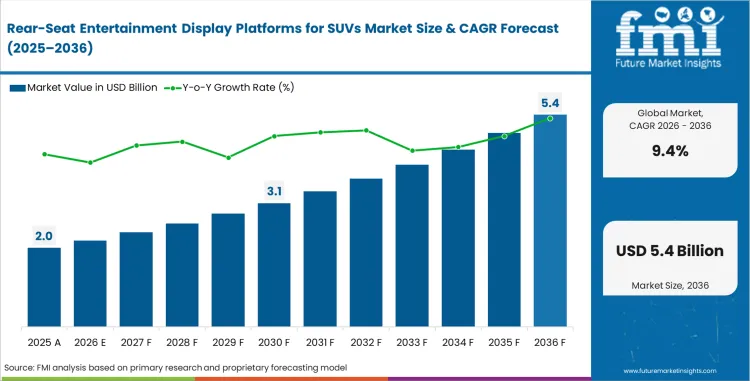
Key Takeaways, Market Size, and Forecast
- The rear-seat entertainment display platforms for SUVs market is valued at USD 1.92 billion in 2025.
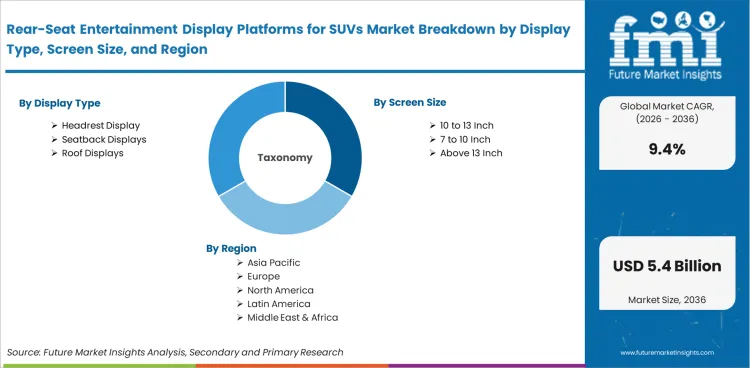
- By 2036, the rear-seat entertainment display platforms for SUVs market is expected to reach USD 5.4 billion.
- From 2026 to 2036, the market is projected to expand at a CAGR of 9.4%.
- The market is expected to create an incremental opportunity of USD 3 billion between 2026 and 2036.
- In 2026, headrest displays are forecasted to account for 38.5% of the display type segment.
- The 10 to 13 inch screen size segment is projected to hold 42.0% of total screen size demand in 2026.
- OEM integrated systems are expected to hold 61.0% of integration type demand in 2026.
- China (11.8%) and India (11.2%) are expected to rank among the faster-growing national markets through 2036.
Strategic Pointers: Rear-Seat Entertainment Display Platforms for SUVs Market
Rear seat entertainment display platforms for SUVs are shifting toward factory integrated cabin systems. Qualcomm’s Snapdragon Cockpit material supports rear displays and multi screen cockpit functions. Android Automotive’s display guidance points to a software gap because rear seat systems need separate user control and reliable touch handling. BMW’s Theater Screen sets a premium cabin benchmark with a 31 inch roof folding display. It supports multimedia playback up to 8K through Personal eSIM and rear touch controls.
Panasonic Automotive adds a work cabin use case with a 48 inch rear seat display connecting to laptops for video calls and document viewing. Patent publication WO2025128132A1 presents a virtual image display route. The system can create a perceived image size of 75 cm to 130 cm at 1 m to 3 m depth with system mass within 1.5 kg to 5.5 kg. SUV rear seat entertainment is moving toward large screens and independent software control. Cockpit compute and compact display design will shape supplier selection.
Rear-Seat Entertainment Display Platforms for SUVs Market Definition
The rear-seat entertainment display platforms for SUVs market includes display systems installed for second-row and third-row passengers in sport utility vehicles. The scope covers headrest displays, seatback displays, roof displays, console screens, removable tablet-based systems, connectivity modules, and control software.
Rear-Seat Entertainment Display Platforms for SUVs Market Inclusions
Market scope includes headrest displays, seatback displays, roof displays, removable tablets, console displays, Full HD screens, 4K panels, Wi-Fi enabled platforms, HDMI enabled systems, USB enabled platforms, streaming enabled systems, OEM integrated systems, dealer-installed systems, aftermarket kits, and SUV-specific passenger entertainment software.
Rear-Seat Entertainment Display Platforms for SUVs Market Exclusions
The scope excludes front dashboard infotainment, instrument clusters, head-up displays, windshield projection systems, generic tablets, vehicle audio systems without passenger screens, and display hardware used only in buses or commercial vans.
Rear-Seat Entertainment Display Platforms for SUVs Market Research Methodology
- Primary Research: FMI assessed supplier positioning across automotive display makers, infotainment integrators, SUV platform planners, and dealer accessory specialists active in this cabin technology space.
- Desk Research: The study used official supplier updates, public vehicle technology references, and product information tied to rear-seat entertainment systems and connected cabin platforms.
- Market Sizing and Forecasting: The market was sized through SUV production, display fitment rates, platform pricing, and regional adoption curves across OEM and aftermarket channels.
- Data Validation: Forecast assumptions were checked against SUV trim strategies, supplier participation, premium cabin technology trends and related automotive display demand.
Why is the Rear-Seat Entertainment Display Platforms for SUVs Market Growing?
- Family SUV users need better rear passenger engagement during long trips and daily travel.
- Premium SUV buyers expect cabin screens to match the display quality used in personal devices.
- Electric SUVs improve the viewing environment as quiet cabins make screen quality more noticeable.
- Streaming access and wireless pairing make rear-seat displays more useful than older DVD-based systems.
The market for rear-seat entertainment display platforms for SUVs is growing as SUVs become family media spaces during daily and long-distance travel. SUV owners compare rear displays with tablets, so screen size and viewing comfort affect purchase decisions. This is important because rear passengers watch content under daylight and night conditions. Suppliers that combine display brightness with stable software can secure stronger positions with SUV programs.
Luxury and electric SUVs are creating a higher-value path for entertainment displays. Quiet cabins make screen quality and audio zone control more noticeable for passengers. Panasonic Automotive Systems says rear-seat entertainment systems let passengers use dedicated displays and connect personal devices for video sources. It supports demand for platforms that link screens with phone pairing and content access. Systems that work smoothly with the wider infotainment stack will gain preference over stand-alone display kits.
Market Segmentation Analysis
- Headrest displays are expected to lead display type demand with 38.5% share in 2026.
- In 2026, the 10 to 13 inch screen size segment is projected to account for 42.0% share.
- Full HD displays are projected to lead the resolution segment with 46.0% share in 2026.
- OEM integrated platforms are expected to account for 61.0% of integration type demand in 2026.
- Wi-Fi enabled systems are forecasted to hold 52.0% share of connectivity demand in 2026.
- Luxury SUVs are projected to account for 36.0% of vehicle class demand in 2026.
The market is segmented by display type, screen size, resolution, integration type, connectivity, vehicle class, and region. Buyer decisions differ by trim level and passenger use. Luxury SUV programs focus on clean integration and larger screens. Mid-size SUV demand is more price-sensitive and often depends on dealer-installed packages. Full HD screens suit many mass-premium vehicles, while 4K displays gain use in upper trims. Connectivity has become a key filter as streaming platforms now drive repeat use.
Insights into the Headrest Display Type Segment
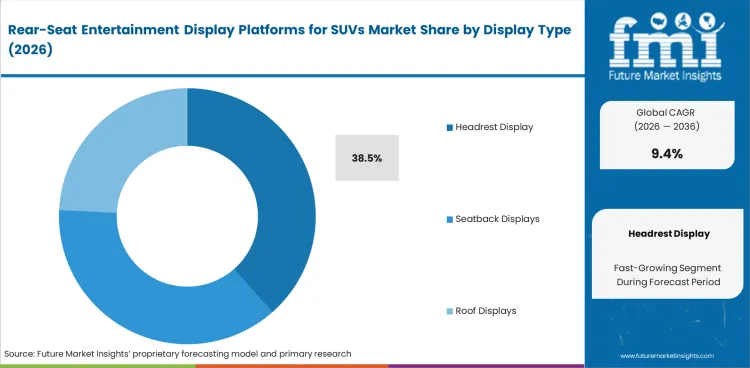
- Headrest displays are expected to account for 38.5% share in 2026. Their use suits many SUV seat structures with limited cabin redesign.
- Seatback displays are gaining use in luxury SUVs where rear passengers expect a cleaner built-in look and stronger connection with cabin control systems.
Insights into the 10 to 13 Inch Screen Size Segment
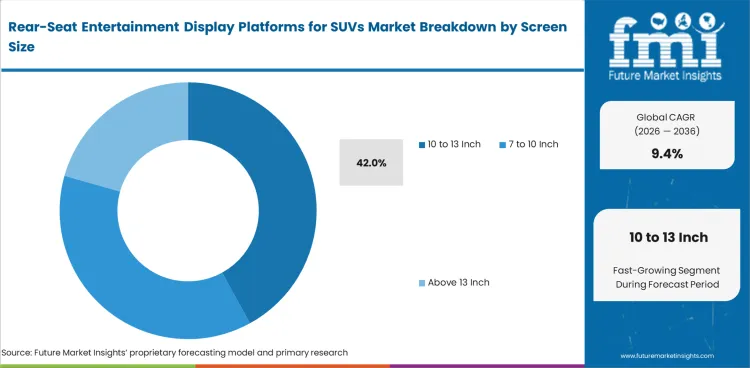
- The 10 to 13 inch segment is projected to represent 42.0% of the market in 2026. This segment leads because it gives rear passengers enough viewing area without blocking cabin movement.
- Above 13 inch screens are used more often in executive SUVs where second-row comfort packages support higher display cost.
Insights into the Full HD Resolution Segment
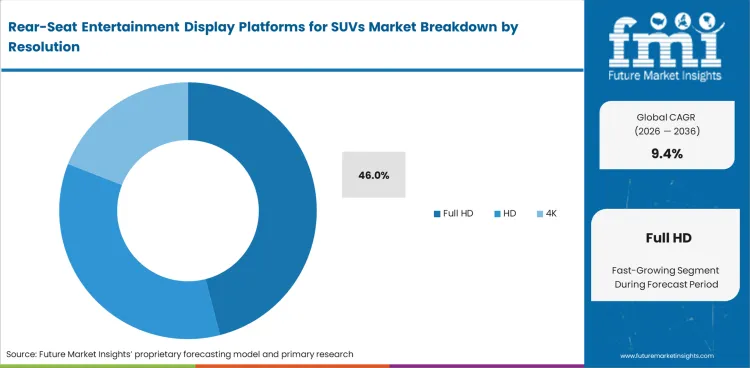
- Full HD displays are expected to contribute 46.0% share in 2026. Clear video quality and suitable cost support SUV fitment.
- 4K panels are gaining interest in premium trims where large screens need better pixel density for sharper passenger viewing.
Insights into the OEM Integrated Segment
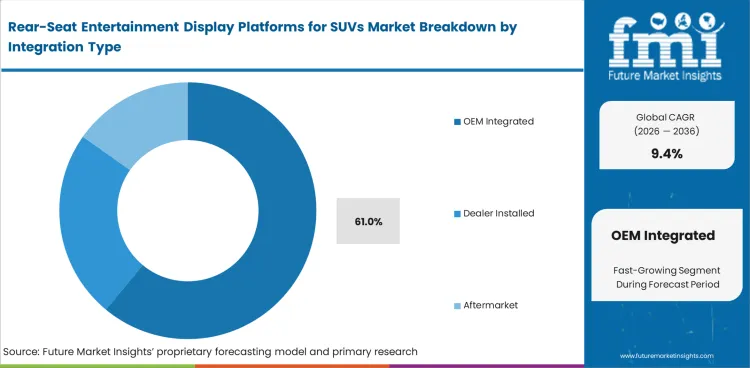
- OEM integrated systems are projected to hold
- 61.0% share in 2026. Automakers prefer factory control over screen placement and warranty coverage.
- Dealer-installed systems are stronger in India and Brazil where buyers often add comfort features after selecting the vehicle variant.
Insights into the Wi-Fi Enabled Connectivity Segment
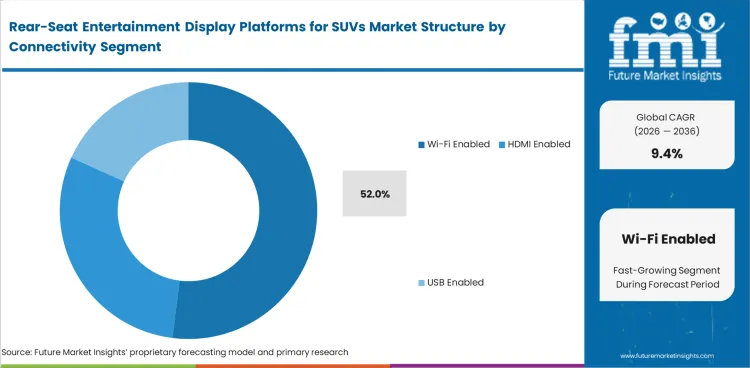
- Wi-Fi enabled platforms are expected to account for 52.0% share in 2026. Streaming and device pairing define passenger use.
- HDMI and USB enabled systems retain demand in price-sensitive packages where families use stored content during long-distance travel.
Insights into the Luxury SUV Vehicle Class Segment
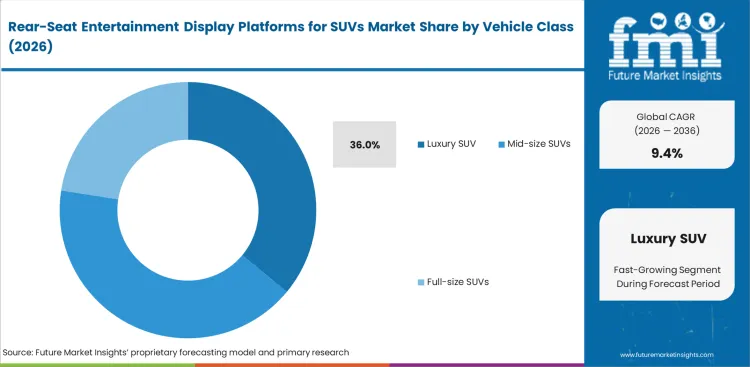
- Luxury SUVs are projected to account for 36.0% share in 2026. This segment leads because premium cabins use entertainment screens as comfort differentiators.
- Electric SUVs are becoming an important demand base as quiet cabins and connected cockpits increase attention on rear passenger experience.
Rear-Seat Entertainment Display Platforms for SUVs Market Drivers, Restraints, and Opportunities
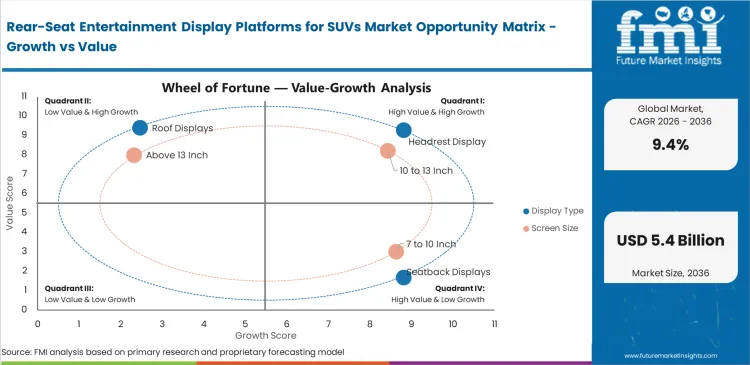
- SUV cabin comfort spending is increasing as automakers use rear passenger features to separate premium trims.
- Streaming use supports demand for Wi-Fi enabled platforms that work with personal devices and vehicle audio zones.
- Cost pressure limits factory fitment in lower SUV trims, which keeps dealer-installed systems important.
- Electric SUVs create an opportunity for integrated display platforms connected with software-defined cockpit systems.
Screen Cost and Fitment Limits
Cost is the main restraint for wider fitment across mass-market SUVs. Display modules validation and software integration increase vehicle cost. Lower trims often use tablet mounts or dealer kits instead of factory systems. This keeps demand split between premium factory packages and lower-cost accessory channels. Suppliers that offer scalable screen sizes and common control software can serve both routes with better cost control.
Streaming-Ready Passenger Experience
Streaming access has become a major reason for rear-seat entertainment upgrades. Older DVD systems are losing appeal as families use mobile content services and personal devices. The wider Asia Pacific in-car entertainment system trend supports this shift in connected passenger content. Wi-Fi enabled displays give passengers better control and reduce the need for physical media. Future growth will depend on smooth pairing and stable screen performance in moving vehicles.
Analysis of Rear-Seat Entertainment Display Platforms for SUVs Market By Key Countries
.webp "Top Country Growth Comparison Rear Seat Entertainment Display Platforms For Suvs Market Cagr (2026 2036)")
| Country | CAGR |
|---|---|
| China | 11.8% |
| India | 11.2% |
| Brazil | 10.4% |
| US | 9.8% |
| Japan | 8.9% |
| Germany | 8.4% |
| France | 8.1% |
| UK | 7.8% |
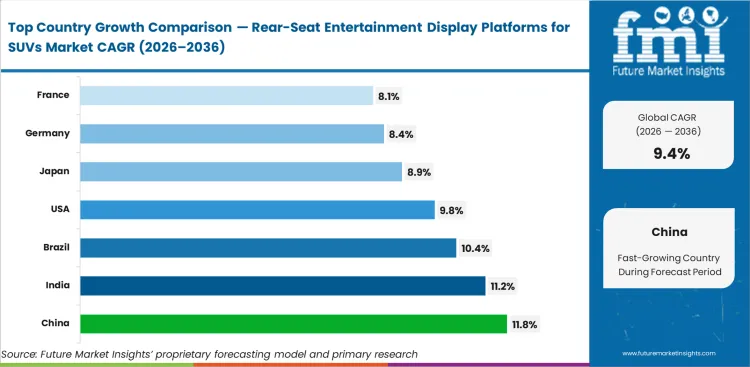
Source: FMI analysis based on primary research and proprietary forecasting model.
Rear-Seat Entertainment Display Platforms for SUVs Market CAGR Analysis By Country
- China is projected to record an 11.8% CAGR through 2036, supported by local SUV brands using larger cabin screens in premium trims.
- India is expected to expand at 11.2% CAGR through 2036, driven by premium SUV sales and dealer-fit accessory demand.
- Brazil is forecast to grow at 10.4% CAGR through 2036 as family SUV ownership supports rear passenger screen use.
- The USAQ is expected to advance at 9.8% CAGR through 2036, supported by high SUV ownership and long-distance family travel.
- Japan, Germany, France and the UK are expected to grow below the global 9.4% CAGR, with demand linked to premium SUV trims and factory-fitted cabin technology.
Sales Analysis of Rear-Seat Entertainment Display Platforms for SUVs Market in China
The China rear-seat entertainment display platforms for SUVs market is projected to grow at a CAGR of 11.8% through 2036. Demand is supported by electric SUV growth and strong use of digital cabin features by domestic brands. Local SUV makers are using larger screens to improve premium trim appeal. BYD, Li Auto, and NIO have made connected cabin features visible in their higher variants.
- Shanghai and Shenzhen support premium EV demand, which helps large-screen SUV cabins gain stronger buyer attention.
- Guangdong’s electronics supply base gives display suppliers better access to panels and integration partners.
- Domestic SUV brands in China use connected cockpit features to support higher trim pricing across family EV models.
In-depth Analysis of Rear-Seat Entertainment Display Platforms for SUVs Market in India
The India rear-seat entertainment display platforms for SUVs market is projected to grow at a CAGR of 11.2% through 2036. Demand is rising as premium SUV sales and dealer-installed accessories expand together. Many SUV owners add rear screens after choosing a lower or mid-level variant. This gives dealer-fit platforms a wider role across urban SUV demand.
- Delhi NCR supports demand for chauffeur-focused SUV upgrades in premium and large family vehicles.
- Mumbai and Pune create steady demand for dealer-installed entertainment kits through organized accessory channels.
- Mahindra and Tata Motors support stronger SUV attention, which expands the addressable base for cabin upgrades.
Opportunity Analysis of Rear-Seat Entertainment Display Platforms for SUVs Market in Brazil
Brazil is forecast to grow at 10.4% CAGR through 2036 as family SUV ownership increases rear passenger screen use. Demand in Brazil for the rear-seat entertainment display platforms for SUVs market is supported by family SUV use and long-distance road travel. São Paulo and Rio de Janeiro support demand for premium accessories and dealer upgrades. Cost sensitivity keeps aftermarket systems active across mid-range SUVs.
- São Paulo supports stronger accessory demand through large dealer networks and premium SUV ownership.
- Rio de Janeiro favors rear-seat screens in family SUVs used for weekend and holiday travel.
- Brazil’s price-sensitive vehicle market supports aftermarket kits with simple Wi-Fi and USB connectivity.
Demand Outlook for Rear-Seat Entertainment Display Platforms for SUVs Market in the USA
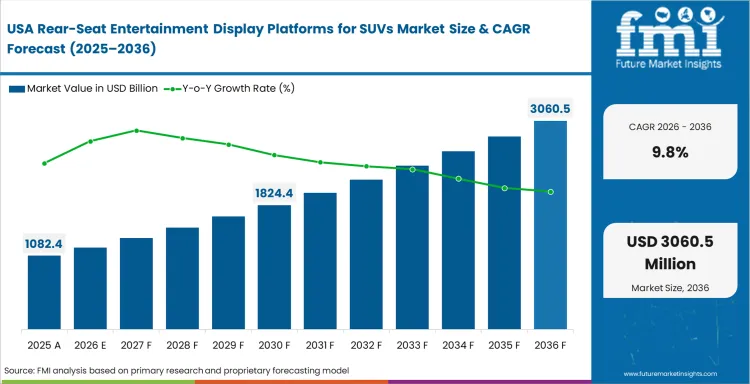
The USA is expected to advance at 9.8% CAGR through 2036, helped by high SUV ownership and long-distance family travel. Demand is supported by high SUV ownership and long-distance family travel. Larger SUVs support rear entertainment packages because second-row and third-row use is frequent. Factory systems are preferred in higher-end vehicles due to warranty and software integration matter.
- Texas supports demand for full-size SUVs where second-row and third-row passenger use is frequent.
- California strengthens connected cabin demand through higher EV ownership and premium technology preferences.
- Large SUV models from General Motors and Ford support rear entertainment demand in family travel use.
Future Outlook for Rear-Seat Entertainment Display Platforms for SUVs Market in Japan
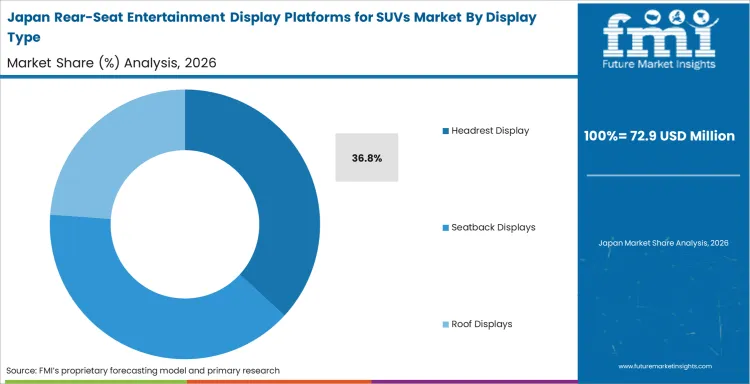
The market is projected to grow at a CAGR of 8.9% through 2036. Demand is supported by premium SUVs and compact cabin layouts that need clean integration. Tokyo and Osaka support demand for luxury imports and high-end domestic SUVs. Panasonic Automotive Systems has direct relevance in infotainment and passenger entertainment systems.
- Tokyo supports premium SUV demand where compact screen placement and clean cabin design carry high value.
- Osaka dealers support accessory packages for family vehicles with second-row passenger comfort needs.
- Toyota and Lexus programs influence supplier choices through strict integration and reliability needs.
Sales Outlook for Rear-Seat Entertainment Display Platforms for SUVs Market in Germany
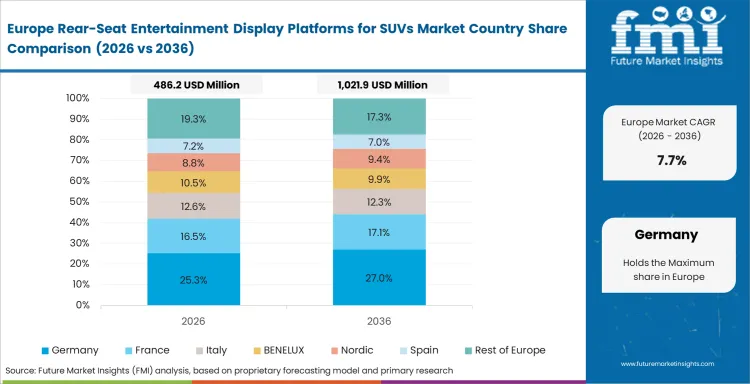
The Germany rear-seat entertainment display platforms for SUVs market is projected to grow at a CAGR of 8.4% through 2036. Demand is supported by premium SUV engineering and factory-fit cabin technology. Bavaria and Baden-Württemberg have strong automotive engineering and premium vehicle activity. SUV owners expect screens to work with audio and seat controls.
- Bavaria supports premium SUV technology through BMW’s high-end cabin programs and supplier networks.
- Baden-Württemberg strengthens demand through Mercedes-Benz SUV platforms and premium interior electronics.
- German buyers prefer factory-integrated systems that match cabin software and warranty expectations.
Demand Analysis of Rear-Seat Entertainment Display Platforms for SUVs Market in France
The France rear-seat entertainment display platforms for SUVs market is projected to grow at a CAGR of 8.1% through 2036. Demand is supported by connected cabin features in higher SUV trims. Paris and Lyon support demand for premium imported SUVs and electric family vehicles. Local automakers are more careful with cost in mainstream segments.
- Paris supports premium SUV sales where rear passenger comfort upgrades gain better acceptance.
- Lyon strengthens demand through family vehicle ownership and dealer accessory activity.
- French mainstream brands focus on cost control, which favors modular display platforms over high-cost custom systems.
Demand Outlook for Rear-Seat Entertainment Display Platforms for SUVs Market in the UK
The UK rear-seat entertainment display platforms for SUVs market is projected to grow at a CAGR of 7.8% through 2036. Demand is supported by premium SUV ownership and factory-fitted options. London and the South East support demand for chauffeur-driven and family SUVs. Growth is slower than China and India because fitment is more selective.
- London supports rear-seat entertainment demand in chauffeur-driven SUVs and premium family vehicles.
- The South East favors high-trim SUV purchases where factory cabin options are more common.
- UK buyers place greater value on warranty-backed systems than low-cost aftermarket screens.
Competitive Landscape and Strategic Positioning
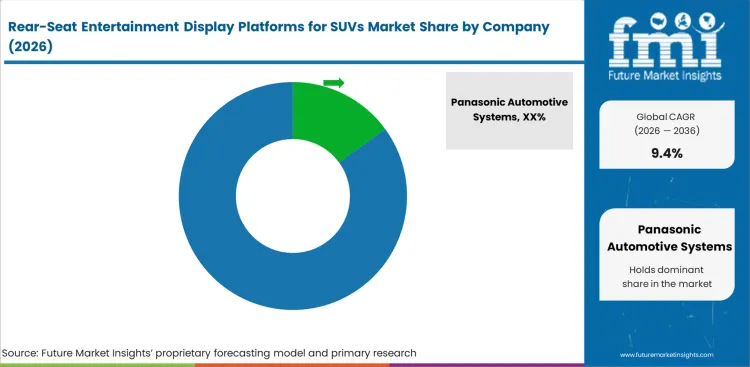
- The market is fragmented across display panel suppliers, infotainment integrators and automotive electronics companies.
- Leading companies compete on screen quality and the ability to fit displays into wider cockpit systems.
- Specialist accessory brands compete through retrofit kits and dealer relationships.
- Entry barriers include safety validation, vehicle wiring access, and long OEM approval cycles.
Competition depends on how well suppliers fit displays into the wider SUV cockpit. Automakers need systems that connect screens with audio and vehicle software. Visual quality is becoming a stronger supplier differentiator as rear displays move into premium cabin packages. Suppliers with panel quality and software depth can win larger OEM programs.
Panel suppliers hold an advantage when they can offer automotive-grade screens with stable supply. LG Display and Samsung Display are important because advanced display technologies are moving deeper into vehicle interiors. This widens the role of screens inside passenger cabins. Rear entertainment platforms can gain more value when displays support comfort and cabin monitoring features.
Automotive infotainment suppliers bring another advantage through software and integration capability. Panasonic Automotive Systems announced in March 2026 that its in-vehicle infotainment system debuted in Toyota’s 2026 RAV4. That points to the role of infotainment suppliers in SUV programs. Suppliers serving in-car entertainment systems can use existing platform knowledge to support rear-seat display demand.
Key Companies in the Rear-Seat Entertainment Display Platforms for SUVs Market
Key global companies leading the rear-seat entertainment display platforms for SUVs market include:
- Panasonic Automotive Systems, HARMAN, LG Display, Samsung Display, Continental Automotive, and Alps Alpine.
- Bosch, Valeo, Hyundai Mobis, and Visteon support connected cockpit programs through electronics integration and vehicle platform knowledge.
- VOXX Electronics, Rosen Automotive, and Echomaster compete through dealer-installed systems and branded rear entertainment kits.
Competitive Benchmarking: Rear-Seat Entertainment Display Platforms for SUVs Market
| Company | Display Integration Depth | Cabin Software Capability | Rear Passenger System Fit | Geographic Footprint |
|---|---|---|---|---|
| Panasonic Automotive Systems | High | High | Strong | Global |
| HARMAN | High | High | Strong | Global |
| LG Display | High | Medium | Strong | Global |
| Samsung Display | High | Medium | Strong | Global |
| Continental Automotive | High | High | Moderate | Global |
| Alps Alpine | Medium | High | Strong | Asia, Europe |
| Bosch | Medium | High | Moderate | Global |
| Valeo | Medium | Medium | Moderate | Europe, Asia |
| Hyundai Mobis | Medium | High | Moderate | Asia, Global |
| VOXX Electronics | Medium | Low | Strong | North America |
Source: Future Market Insights competitive analysis, 2026.
Key Developments in Rear-Seat Entertainment Display Platforms for SUVs Market
- In March 2026, Panasonic Automotive Systems announced that its in-vehicle infotainment system debuted in Toyota’s 2026 RAV4. The launch is relevant to SUV cabin platforms because infotainment systems support connected passenger entertainment and screen control.
- In November 2025, HARMAN Ready Display achieved HDR10+ Automotive certification. The development supports premium in-vehicle visual quality, which is important for rear-seat entertainment displays in SUVs.
Key Players in the Rear-Seat Entertainment Display Platforms for SUVs Market
Major Global Players
- Panasonic Automotive Systems
- HARMAN
- LG Display
- Samsung Display
- Continental Automotive
- Alps Alpine
- Bosch
- Valeo
- Hyundai Mobis
- Visteon
Emerging Players / Specialists
- VOXX Electronics
- Rosen Automotive
- Echomaster
- Regional dealer-fit brands
Report Scope and Coverage
| Parameter | Details |
|---|---|
| Market Definition | Display platforms installed for rear passengers in SUVs, including headrest screens, seatback displays, roof displays, removable tablet systems, and related control hardware. |
| Regions Covered | North America, Latin America, Europe, East Asia, South Asia and Pacific, Middle East and Africa |
| Countries Covered | UK, USA, Japan, China, India, Germany, France, Brazil, and 30+ countries |
| Key Companies Profiled | Panasonic Automotive Systems, HARMAN, LG Display, Samsung Display, Continental Automotive, Alps Alpine, Bosch, Valeo, Hyundai Mobis, VOXX Electronics |
| Forecast Period | 2026 to 2036 |
| Approach | Hybrid bottom-up and top-down methodology using SUV production, display fitment, platform pricing, and regional adoption curves |
Rear-Seat Entertainment Display Platforms for SUVs Market by Segments
Rear-Seat Entertainment Display Platforms for SUVs Market by Display Type
- Headrest Displays
- Seatback Displays
- Roof Displays
- Removable Tablets
- Console Displays
Rear-Seat Entertainment Display Platforms for SUVs Market by Screen Size
- 7 to 10 Inch
- 10 to 13 Inch
- Above 13 Inch
Rear-Seat Entertainment Display Platforms for SUVs Market by Resolution
- HD
- Full HD
- 4K
Rear-Seat Entertainment Display Platforms for SUVs Market by Integration Type
- OEM Integrated
- Dealer Installed
- Aftermarket
Rear-Seat Entertainment Display Platforms for SUVs Market by Connectivity
- Wi-Fi Enabled
- HDMI Enabled
- USB Enabled
- Streaming Enabled
Rear-Seat Entertainment Display Platforms for SUVs Market by Vehicle Class
- Mid-size SUVs
- Full-size SUVs
- Luxury SUVs
- Electric SUVs
Rear-Seat Entertainment Display Platforms for SUVs Market by Region
- North America
- USA
- Canada
- Mexico
- Latin America
- Brazil
- Chile
- Rest of Latin America
- Western Europe
- Germany
- UK
- Italy
- Spain
- France
- Nordic
- BENELUX
- Rest of Western Europe
- Eastern Europe
- Russia
- Poland
- Hungary
- Balkan & Baltic
- Rest of Eastern Europe
- East Asia
- China
- Japan
- South Korea
- South Asia and Pacific
- India
- ASEAN
- Australia & New Zealand
- Rest of South Asia and Pacific
- Middle East & Africa
- Kingdom of Saudi Arabia
- Other GCC Countries
- Turkiye
- South Africa
- Other African Union
- Rest of Middle East & Africa
Research Sources and Bibliography
- Panasonic Automotive Systems Co., Ltd. (2026, March 19). Toyota Motor Corporation adopts Panasonic Automotive Systems’ in-vehicle infotainment system in its new RAV4.
- Continental AG. (2024, November 20). Invisible biometrics sensing display monitors passengers’ vital parameters.
- HARMAN. (2025, November 12). HARMAN Ready Display achieves industry-first HDR10+ Automotive certification, setting new benchmark for in-vehicle visual quality.
- CES. (2025). Continental’s Invisible Biometrics Sensing Display.
- LG Display. (2025, February 24). LG Display begins mass production of ultra-large automotive display solutions to revolutionize driving experience.
- Samsung Display. (2026, January 4). Samsung Display showcases OLED innovations for the AI era at CES 2026.
This Report Answers
- What is the current and future size of the rear-seat entertainment display platforms for SUVs market?
- How fast is the market expected to grow between 2026 and 2036?
- Which display type is expected to lead demand by 2026?
- Which screen size segment is projected to account for the highest share?
- What makes OEM integrated systems important in SUV rear entertainment platforms?
- How are electric SUVs changing rear passenger entertainment needs?
- Which countries are projected to grow fastest through 2036?
- Which companies are active in rear-seat entertainment display platforms for SUVs?
- What products are included and excluded in this market definition?
- How does FMI estimate and validate the market forecast?
Frequently Asked Questions
What is the global market demand for rear-seat entertainment display platforms for SUVs in 2026?
In 2026, the global market is expected to be worth USD 2 billion, driven by premium SUV cabin upgrades.
How big will the rear-seat entertainment display platforms for SUVs market be in 2036?
By 2036, the market is projected to reach USD 5.2 billion, supported by factory-fitted screen platforms.
What CAGR is projected for rear-seat entertainment display platforms for SUVs from 2026 to 2036?
Demand is projected to grow at a 9.4% CAGR from 2026 to 2036.
Which display type is expected to lead the market by 2026?
Headrest displays are projected to account for 38.5% share in 2026 due to easier fitment across SUV cabins.
Which screen size segment is expected to lead by 2026?
The 10 to 13 inch segment is expected to hold 42.0% share in 2026 as it balances size and cabin packaging.
Why is China expected to grow fastest through 2036?
China is projected to record an 11.8% CAGR through 2036 as local SUV brands expand connected cabin features.
What does this report include under rear-seat entertainment display platforms for SUVs?
It includes rear passenger display systems, control hardware, connectivity modules, and software used in SUV entertainment platforms.
How does FMI estimate this market forecast?
FMI uses SUV production, fitment rates, platform pricing and regional adoption patterns to build and validate the forecast.
Preview the report firsthand - request a free sample
Get SampleGet the brochure for pricing and purchase details.
Get PDFTable of Content
- Executive Summary
- Global Market Outlook
- Demand-side Trends
- Supply-side Trends
- Technology Roadmap Analysis
- Analysis and Recommendations
- Market Overview
- Market Coverage / Taxonomy
- Market Definition / Scope / Limitations
- Research Methodology
- Chapter Orientation
- Analytical Lens and Working Hypotheses
- Market Structure, Signals, and Trend Drivers
- Benchmarking and Cross-market Comparability
- Market Sizing, Forecasting, and Opportunity Mapping
- Research Design and Evidence Framework
- Desk Research Programme (Secondary Evidence)
- Company Annual and Sustainability Reports
- Peer-reviewed Journals and Academic Literature
- Corporate Websites, Product Literature, and Technical Notes
- Earnings Decks and Investor Briefings
- Statutory Filings and Regulatory Disclosures
- Technical White Papers and Standards Notes
- Trade Journals, Industry Magazines, and Analyst Briefs
- Conference Proceedings, Webinars, and Seminar Materials
- Government Statistics Portals and Public Data Releases
- Press Releases and Reputable Media Coverage
- Specialist Newsletters and Curated Briefings
- Sector Databases and Reference Repositories
- FMI Internal Proprietary Databases and Historical Market Datasets
- Subscription Datasets and Paid Sources
- Social Channels, Communities, and Digital Listening Inputs
- Additional Desk Sources
- Expert Input and Fieldwork (Primary Evidence)
- Primary Modes
- Qualitative Interviews and Expert Elicitation
- Quantitative Surveys and Structured Data Capture
- Blended Approach
- Why Primary Evidence is Used
- Field Techniques
- Interviews
- Surveys
- Focus Groups
- Observational and In-context Research
- Social and Community Interactions
- Stakeholder Universe Engaged
- C-suite Leaders
- Board Members
- Presidents and Vice Presidents
- R&D and Innovation Heads
- Technical Specialists
- Domain Subject-matter Experts
- Scientists
- Physicians and Other Healthcare Professionals
- Governance, Ethics, and Data Stewardship
- Research Ethics
- Data Integrity and Handling
- Primary Modes
- Tooling, Models, and Reference Databases
- Desk Research Programme (Secondary Evidence)
- Data Engineering and Model Build
- Data Acquisition and Ingestion
- Cleaning, Normalisation, and Verification
- Synthesis, Triangulation, and Analysis
- Quality Assurance and Audit Trail
- Market Background
- Market Dynamics
- Drivers
- Restraints
- Opportunity
- Trends
- Scenario Forecast
- Demand in Optimistic Scenario
- Demand in Likely Scenario
- Demand in Conservative Scenario
- Opportunity Map Analysis
- Product Life Cycle Analysis
- Supply Chain Analysis
- Investment Feasibility Matrix
- Value Chain Analysis
- PESTLE and Porter’s Analysis
- Regulatory Landscape
- Regional Parent Market Outlook
- Production and Consumption Statistics
- Import and Export Statistics
- Market Dynamics
- Global Market Analysis 2021 to 2025 and Forecast, 2026 to 2036
- Historical Market Size Value (USD Million) Analysis, 2021 to 2025
- Current and Future Market Size Value (USD Million) Projections, 2026 to 2036
- Y-o-Y Growth Trend Analysis
- Absolute $ Opportunity Analysis
- Global Market Pricing Analysis 2021 to 2025 and Forecast 2026 to 2036
- Global Market Analysis 2021 to 2025 and Forecast 2026 to 2036, By Display Type
- Introduction / Key Findings
- Historical Market Size Value (USD Million) Analysis By Display Type , 2021 to 2025
- Current and Future Market Size Value (USD Million) Analysis and Forecast By Display Type , 2026 to 2036
- Headrest Display
- Seatback Displays
- Roof Displays
- Headrest Display
- Y-o-Y Growth Trend Analysis By Display Type , 2021 to 2025
- Absolute $ Opportunity Analysis By Display Type , 2026 to 2036
- Global Market Analysis 2021 to 2025 and Forecast 2026 to 2036, By Screen Size
- Introduction / Key Findings
- Historical Market Size Value (USD Million) Analysis By Screen Size, 2021 to 2025
- Current and Future Market Size Value (USD Million) Analysis and Forecast By Screen Size, 2026 to 2036
- 10 to 13 Inch
- 7 to 10 Inch
- Above 13 Inch
- 10 to 13 Inch
- Y-o-Y Growth Trend Analysis By Screen Size, 2021 to 2025
- Absolute $ Opportunity Analysis By Screen Size, 2026 to 2036
- Global Market Analysis 2021 to 2025 and Forecast 2026 to 2036, By Resolution
- Introduction / Key Findings
- Historical Market Size Value (USD Million) Analysis By Resolution, 2021 to 2025
- Current and Future Market Size Value (USD Million) Analysis and Forecast By Resolution, 2026 to 2036
- Full HD
- HD
- 4K
- Full HD
- Y-o-Y Growth Trend Analysis By Resolution, 2021 to 2025
- Absolute $ Opportunity Analysis By Resolution, 2026 to 2036
- Global Market Analysis 2021 to 2025 and Forecast 2026 to 2036, By Integration Type
- Introduction / Key Findings
- Historical Market Size Value (USD Million) Analysis By Integration Type, 2021 to 2025
- Current and Future Market Size Value (USD Million) Analysis and Forecast By Integration Type, 2026 to 2036
- OEM Integrated
- Dealer Installed
- Aftermarket
- OEM Integrated
- Y-o-Y Growth Trend Analysis By Integration Type, 2021 to 2025
- Absolute $ Opportunity Analysis By Integration Type, 2026 to 2036
- Global Market Analysis 2021 to 2025 and Forecast 2026 to 2036, By Connectivity
- Introduction / Key Findings
- Historical Market Size Value (USD Million) Analysis By Connectivity, 2021 to 2025
- Current and Future Market Size Value (USD Million) Analysis and Forecast By Connectivity, 2026 to 2036
- Wi-Fi Enabled
- HDMI Enabled
- USB Enabled
- Wi-Fi Enabled
- Y-o-Y Growth Trend Analysis By Connectivity, 2021 to 2025
- Absolute $ Opportunity Analysis By Connectivity, 2026 to 2036
- Global Market Analysis 2021 to 2025 and Forecast 2026 to 2036, By Vehicle Class
- Introduction / Key Findings
- Historical Market Size Value (USD Million) Analysis By Vehicle Class, 2021 to 2025
- Current and Future Market Size Value (USD Million) Analysis and Forecast By Vehicle Class, 2026 to 2036
- Luxury SUV
- Mid-size SUVs
- Full-size SUVs
- Luxury SUV
- Y-o-Y Growth Trend Analysis By Vehicle Class, 2021 to 2025
- Absolute $ Opportunity Analysis By Vehicle Class, 2026 to 2036
- Global Market Analysis 2021 to 2025 and Forecast 2026 to 2036, By Region
- Introduction
- Historical Market Size Value (USD Million) Analysis By Region, 2021 to 2025
- Current Market Size Value (USD Million) Analysis and Forecast By Region, 2026 to 2036
- North America
- Latin America
- Western Europe
- Eastern Europe
- East Asia
- South Asia and Pacific
- Middle East & Africa
- Market Attractiveness Analysis By Region
- North America Market Analysis 2021 to 2025 and Forecast 2026 to 2036, By Country
- Historical Market Size Value (USD Million) Trend Analysis By Market Taxonomy, 2021 to 2025
- Market Size Value (USD Million) Forecast By Market Taxonomy, 2026 to 2036
- By Country
- USA
- Canada
- Mexico
- By Display Type
- By Screen Size
- By Resolution
- By Integration Type
- By Connectivity
- By Vehicle Class
- By Country
- Market Attractiveness Analysis
- By Country
- By Display Type
- By Screen Size
- By Resolution
- By Integration Type
- By Connectivity
- By Vehicle Class
- Key Takeaways
- Latin America Market Analysis 2021 to 2025 and Forecast 2026 to 2036, By Country
- Historical Market Size Value (USD Million) Trend Analysis By Market Taxonomy, 2021 to 2025
- Market Size Value (USD Million) Forecast By Market Taxonomy, 2026 to 2036
- By Country
- Brazil
- Chile
- Rest of Latin America
- By Display Type
- By Screen Size
- By Resolution
- By Integration Type
- By Connectivity
- By Vehicle Class
- By Country
- Market Attractiveness Analysis
- By Country
- By Display Type
- By Screen Size
- By Resolution
- By Integration Type
- By Connectivity
- By Vehicle Class
- Key Takeaways
- Western Europe Market Analysis 2021 to 2025 and Forecast 2026 to 2036, By Country
- Historical Market Size Value (USD Million) Trend Analysis By Market Taxonomy, 2021 to 2025
- Market Size Value (USD Million) Forecast By Market Taxonomy, 2026 to 2036
- By Country
- Germany
- UK
- Italy
- Spain
- France
- Nordic
- BENELUX
- Rest of Western Europe
- By Display Type
- By Screen Size
- By Resolution
- By Integration Type
- By Connectivity
- By Vehicle Class
- By Country
- Market Attractiveness Analysis
- By Country
- By Display Type
- By Screen Size
- By Resolution
- By Integration Type
- By Connectivity
- By Vehicle Class
- Key Takeaways
- Eastern Europe Market Analysis 2021 to 2025 and Forecast 2026 to 2036, By Country
- Historical Market Size Value (USD Million) Trend Analysis By Market Taxonomy, 2021 to 2025
- Market Size Value (USD Million) Forecast By Market Taxonomy, 2026 to 2036
- By Country
- Russia
- Poland
- Hungary
- Balkan & Baltic
- Rest of Eastern Europe
- By Display Type
- By Screen Size
- By Resolution
- By Integration Type
- By Connectivity
- By Vehicle Class
- By Country
- Market Attractiveness Analysis
- By Country
- By Display Type
- By Screen Size
- By Resolution
- By Integration Type
- By Connectivity
- By Vehicle Class
- Key Takeaways
- East Asia Market Analysis 2021 to 2025 and Forecast 2026 to 2036, By Country
- Historical Market Size Value (USD Million) Trend Analysis By Market Taxonomy, 2021 to 2025
- Market Size Value (USD Million) Forecast By Market Taxonomy, 2026 to 2036
- By Country
- China
- Japan
- South Korea
- By Display Type
- By Screen Size
- By Resolution
- By Integration Type
- By Connectivity
- By Vehicle Class
- By Country
- Market Attractiveness Analysis
- By Country
- By Display Type
- By Screen Size
- By Resolution
- By Integration Type
- By Connectivity
- By Vehicle Class
- Key Takeaways
- South Asia and Pacific Market Analysis 2021 to 2025 and Forecast 2026 to 2036, By Country
- Historical Market Size Value (USD Million) Trend Analysis By Market Taxonomy, 2021 to 2025
- Market Size Value (USD Million) Forecast By Market Taxonomy, 2026 to 2036
- By Country
- India
- ASEAN
- Australia & New Zealand
- Rest of South Asia and Pacific
- By Display Type
- By Screen Size
- By Resolution
- By Integration Type
- By Connectivity
- By Vehicle Class
- By Country
- Market Attractiveness Analysis
- By Country
- By Display Type
- By Screen Size
- By Resolution
- By Integration Type
- By Connectivity
- By Vehicle Class
- Key Takeaways
- Middle East & Africa Market Analysis 2021 to 2025 and Forecast 2026 to 2036, By Country
- Historical Market Size Value (USD Million) Trend Analysis By Market Taxonomy, 2021 to 2025
- Market Size Value (USD Million) Forecast By Market Taxonomy, 2026 to 2036
- By Country
- Kingdom of Saudi Arabia
- Other GCC Countries
- Turkiye
- South Africa
- Other African Union
- Rest of Middle East & Africa
- By Display Type
- By Screen Size
- By Resolution
- By Integration Type
- By Connectivity
- By Vehicle Class
- By Country
- Market Attractiveness Analysis
- By Country
- By Display Type
- By Screen Size
- By Resolution
- By Integration Type
- By Connectivity
- By Vehicle Class
- Key Takeaways
- Key Countries Market Analysis
- USA
- Pricing Analysis
- Market Share Analysis, 2025
- By Display Type
- By Screen Size
- By Resolution
- By Integration Type
- By Connectivity
- By Vehicle Class
- Canada
- Pricing Analysis
- Market Share Analysis, 2025
- By Display Type
- By Screen Size
- By Resolution
- By Integration Type
- By Connectivity
- By Vehicle Class
- Mexico
- Pricing Analysis
- Market Share Analysis, 2025
- By Display Type
- By Screen Size
- By Resolution
- By Integration Type
- By Connectivity
- By Vehicle Class
- Brazil
- Pricing Analysis
- Market Share Analysis, 2025
- By Display Type
- By Screen Size
- By Resolution
- By Integration Type
- By Connectivity
- By Vehicle Class
- Chile
- Pricing Analysis
- Market Share Analysis, 2025
- By Display Type
- By Screen Size
- By Resolution
- By Integration Type
- By Connectivity
- By Vehicle Class
- Germany
- Pricing Analysis
- Market Share Analysis, 2025
- By Display Type
- By Screen Size
- By Resolution
- By Integration Type
- By Connectivity
- By Vehicle Class
- UK
- Pricing Analysis
- Market Share Analysis, 2025
- By Display Type
- By Screen Size
- By Resolution
- By Integration Type
- By Connectivity
- By Vehicle Class
- Italy
- Pricing Analysis
- Market Share Analysis, 2025
- By Display Type
- By Screen Size
- By Resolution
- By Integration Type
- By Connectivity
- By Vehicle Class
- Spain
- Pricing Analysis
- Market Share Analysis, 2025
- By Display Type
- By Screen Size
- By Resolution
- By Integration Type
- By Connectivity
- By Vehicle Class
- France
- Pricing Analysis
- Market Share Analysis, 2025
- By Display Type
- By Screen Size
- By Resolution
- By Integration Type
- By Connectivity
- By Vehicle Class
- India
- Pricing Analysis
- Market Share Analysis, 2025
- By Display Type
- By Screen Size
- By Resolution
- By Integration Type
- By Connectivity
- By Vehicle Class
- ASEAN
- Pricing Analysis
- Market Share Analysis, 2025
- By Display Type
- By Screen Size
- By Resolution
- By Integration Type
- By Connectivity
- By Vehicle Class
- Australia & New Zealand
- Pricing Analysis
- Market Share Analysis, 2025
- By Display Type
- By Screen Size
- By Resolution
- By Integration Type
- By Connectivity
- By Vehicle Class
- China
- Pricing Analysis
- Market Share Analysis, 2025
- By Display Type
- By Screen Size
- By Resolution
- By Integration Type
- By Connectivity
- By Vehicle Class
- Japan
- Pricing Analysis
- Market Share Analysis, 2025
- By Display Type
- By Screen Size
- By Resolution
- By Integration Type
- By Connectivity
- By Vehicle Class
- South Korea
- Pricing Analysis
- Market Share Analysis, 2025
- By Display Type
- By Screen Size
- By Resolution
- By Integration Type
- By Connectivity
- By Vehicle Class
- Russia
- Pricing Analysis
- Market Share Analysis, 2025
- By Display Type
- By Screen Size
- By Resolution
- By Integration Type
- By Connectivity
- By Vehicle Class
- Poland
- Pricing Analysis
- Market Share Analysis, 2025
- By Display Type
- By Screen Size
- By Resolution
- By Integration Type
- By Connectivity
- By Vehicle Class
- Hungary
- Pricing Analysis
- Market Share Analysis, 2025
- By Display Type
- By Screen Size
- By Resolution
- By Integration Type
- By Connectivity
- By Vehicle Class
- Kingdom of Saudi Arabia
- Pricing Analysis
- Market Share Analysis, 2025
- By Display Type
- By Screen Size
- By Resolution
- By Integration Type
- By Connectivity
- By Vehicle Class
- Turkiye
- Pricing Analysis
- Market Share Analysis, 2025
- By Display Type
- By Screen Size
- By Resolution
- By Integration Type
- By Connectivity
- By Vehicle Class
- South Africa
- Pricing Analysis
- Market Share Analysis, 2025
- By Display Type
- By Screen Size
- By Resolution
- By Integration Type
- By Connectivity
- By Vehicle Class
- USA
- Market Structure Analysis
- Competition Dashboard
- Competition Benchmarking
- Market Share Analysis of Top Players
- By Regional
- By Display Type
- By Screen Size
- By Resolution
- By Integration Type
- By Connectivity
- By Vehicle Class
- Competition Analysis
- Competition Deep Dive
- Panasonic Automotive Systems
- Overview
- Product Portfolio
- Profitability by Market Segments (Product/Age /Sales Channel/Region)
- Sales Footprint
- Strategy Overview
- Marketing Strategy
- Product Strategy
- Channel Strategy
- HARMAN
- LG Display
- Samsung Display
- Continental Automotive
- Alps Alpine
- Bosch
- Valeo
- Panasonic Automotive Systems
- Competition Deep Dive
- Assumptions & Acronyms Used


