

- Market Size (2026)
- USD 3.2 Bn
- Forecast (2036)
- USD 5.1 Bn
- CAGR (2026 to 2036)
- 4.1%
Articulated Loader Axle and Drivetrain Systems Market Size, Forecast, and Outlook By FMI
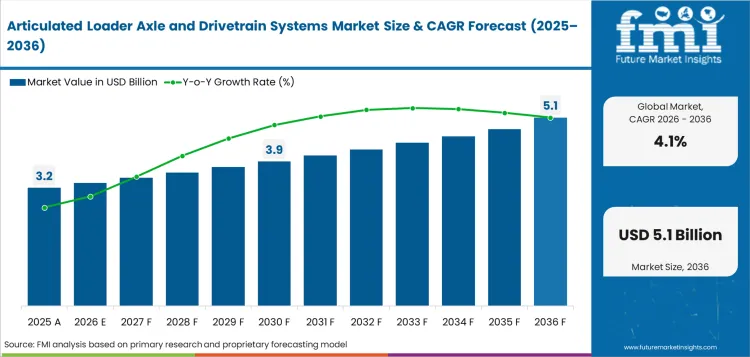
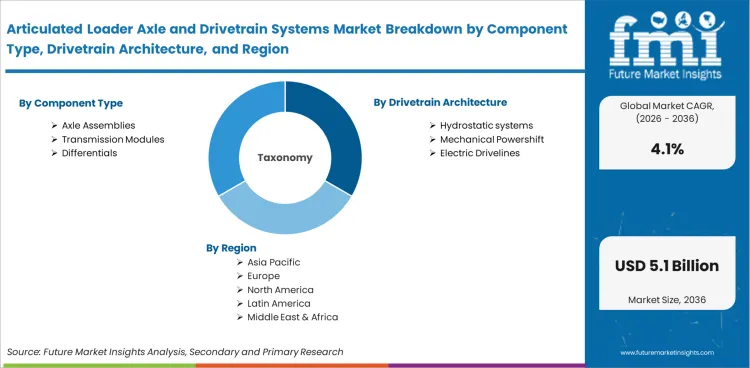
Articulated loader axle and drivetrain systems market crossed a valuation of USD 3.2 billion in 2025 and is expected to reach USD 3.4 billion by the end of 2026. The market is forecast to advance at a 4.1% CAGR from 2026 to 2036, bringing global market value to USD 5.1 billion by 2036.
Summary of the Articulated Loader Axle and Drivetrain Systems Market
- Demand and Growth Drivers
- Steering movement and payload transfer place concentrated stress on the center joint, which raises demand for stronger axle assemblies.
- Urban jobsite work and rental fleet use keep compact loaders dependent on drivetrains with smooth low-speed control.
- Electric loader programs create new drivetrain design work across off-highway ev component systems.
- Product and Segment View
- Axle assemblies are expected to hold 36.0% of component type value in 2026. Sealed wheel-end durability keeps this group central to OEM drivetrain selection.
- Hydrostatic systems are projected to capture a 44.0% share by 2026 within drivetrain architecture. Smoother low-speed control makes them important for compact loader work.
- OEM fitment is forecast to represent 73.0% of sales channel value during 2026. Axle ratios and brake layouts need factory-level approval before platform release.
- Geography and Competitive Outlook
- India is expected to record a CAGR of 6.4% through 2036, as local equipment output and infrastructure activity expand.
- China is projected to expand at 5.7% CAGR during the forecast period, as infrastructure investment and domestic driveline sourcing lift system demand.
- Companies combining axle load coverage with transmission integration are strengthening their market position during the forecast period.
- Analyst Opinion
- Nikhil Kaitwade, Principal Consultant for Automotive domain at FMI, says, “Articulated loader drivetrains are becoming durability decisions before price checks. Loader OEMs assess axle load rating and brake cooling before approval. Compact machines need hydrostatic response near workers. Electric loader programs raise packaging pressure while seal life affects rental uptime.”
- Articulated Loader Axle and Drivetrain Systems Market Value Analysis
- The articulated loader axle and drivetrain systems market is moving from basic mechanical sourcing into a platform-specific system supply base.
- Adoption is increased by the durability needs of wheel loader platforms used in repeated loading cycles.
- The market is benefiting from deeper use of compact construction equipment across tight worksites.
- Axle assemblies gain demand as articulated steering and repeated torque changes place higher stress on wheel-end systems.
- Price pressure affects smaller OEMs as premium driveline packages can raise finished loader cost.
Key Takeaways, Market Size, and Forecast
- The articulated loader axle and drivetrain systems market was valued at USD 3.2 billion in 2025.
- By 2036, the articulated loader axle and drivetrain systems market is expected to be worth USD 5.1 billion.
- From 2026 to 2036, the market is projected to expand at a CAGR of 4.1%.
- The market is projected to create an incremental opportunity of USD 1.67 billion between 2026 and 2036.
- In 2026, axle assemblies are expected to account for 36.0% of component type demand.
- Hydrostatic systems are expected to lead drivetrain architecture with 44.0% share in 2026.
- India is projected to record 6.4% CAGR, and China is expected to reach 5.7% CAGR through 2036.
Loader OEMs need drivetrain packages with stronger axles and better control inside compact machine frames. Carraro’s 2026 compact wheel loader driveline covers electric applications from 9 to 15 tons and lists 120 kW maximum input power with 9,000 rpm maximum input speed. This helps suppliers serve hydrostatic and electric loader layouts without building separate drivetrain platforms. Allison’s January 2026 acquisition of Dana’s Off-Highway Drive and Motion Systems business for about USD 2.7 billion expands its off-highway drivetrain scale across 29 countries. This makes electric loader programs more dependent on suppliers with motor packaging and control software capability. India adds a service opportunity as ICEMA reported construction equipment sales crossing 135,650 units in FY2023-24. Larger equipment fleets create stronger need for rebuild kits and wheel-end replacement parts.
Articulated Loader Axle and Drivetrain Systems Market Definition
The articulated loader axle and drivetrain systems market includes axle assemblies, transmissions, differentials, driveshafts, and final drives fitted to articulated loaders. These systems transfer engine or electric motor power to wheel ends across compact, mid-size, and heavy machines. Scope includes OEM fitment, replacement parts, and rebuild kits used for construction and municipal loader fleets. Complete machine sales and general road vehicle axle parts are outside the scope.
Articulated Loader Axle and Drivetrain Systems Market Inclusions
Market scope covers all commercially traded articulated loader axle and drivetrain systems categorized by component type, including axle assemblies, transmission modules, differentials, driveshafts, and final drives; drivetrain architecture, including hydrostatic systems, mechanical powershift systems, electric drivelines, and hybrid drivelines; loader class, including compact loaders, mid-size loaders, and heavy loaders; sales channel, including OEM fitment, replacement parts, and rebuild kits; and end use, including construction, agriculture, municipal, mining, and rental fleet applications. Revenue scope covers 2026 to 2036. The key stakeholders include articulated loader manufacturers, axle system suppliers, drivetrain integrators, transmission manufacturers, hydraulic system providers, electric driveline companies, construction equipment dealers, rental fleet operators, repair and rebuild service providers, component distributors, and regulatory bodies.
Articulated Loader Axle and Drivetrain Systems Market Exclusions
Scope does not include complete loader sales, passenger vehicle axle systems, road truck drivetrains, hydraulic attachments, tires, or unrelated construction machine electronics.
Articulated Loader Axle and Drivetrain Systems Market Research Methodology
- Primary Research: FMI analysts reviewed loader OEMs, axle manufacturers, drivetrain integrators, dealer service teams, and rental fleet maintenance managers in important markets.
- Desk Research: Combined data from construction equipment output, infrastructure indicators, company product portfolios, and official machinery statistics.
- Market sizing and forecasting: Added drivetrain content value across loader classes and checked replacement cycles across OEM and service demand.
- Data validation: Cross-checked forecasts every three months against equipment shipment signals and supplier portfolio coverage.
Why is the Articulated Loader Axle and Drivetrain Systems Market Growing?
- Loader OEMs are using stronger axle packages as articulated steering raises wheel-end and housing stress.
- Rental fleets are planning drivetrain rebuilds earlier as downtime can reduce daily fleet revenue.
- Electric drive programs are creating demand for compact e-axle layouts and calibrated torque control.
Construction activity keeps loader utilization high in markets with steady infrastructure spending. USA construction spending during March 2026 was estimated at a seasonally adjusted annual rate of USD 2,185.5 billion, with highway construction at USD 147.8 billion. This spending base supports loader use across site preparation and material movement. Drivetrain producers gain from machines working longer daily cycles and needing reliable wheel-end parts.
Equipment sales also create a larger service base for axle and drivetrain replacements. ICEMA’s FY2023-24 update points to a larger construction equipment base, with earthmoving machines forming the main demand pool for drivetrain service and replacement needs. This scale is important for articulated loader drivetrain demand as service parts follow machine placement over many years. Suppliers with rebuild kits and fast dealer access can protect repeat orders.
Market Segmentation Analysis
- Axle Assemblies are estimated to account for 36.0% of component type demand in 2026 with high use across articulated steering platforms.
- Hydrostatic Systems are expected to account for 44.0% of drivetrain architecture demand in 2026 with strong use in compact machines.
- Compact loaders are expected to account for 41.0% of loader class demand in 2026 with direct use across urban jobsites.
- OEM Fitment is estimated to account for 73.0% of sales channel demand in 2026 with drivetrain approval built into machine design.
- Construction is estimated to account for 46.0% of end-use demand in 2026 with higher use across site material movement.
The market for articulated loader axle and drivetrain systems is divided into five primary segment groups based on component type, drivetrain architecture, loader class, sales channel, and end use. Component type includes axle assemblies, transmission modules, differentials, driveshafts, and final drives. Drivetrain architecture includes hydrostatic systems, mechanical powershift, electric drivelines, and hybrid drivelines. Loader class includes compact loaders, mid-size loaders, and heavy loaders. Sales channel includes OEM fitment, replacement parts, and rebuild kits. End use includes construction, agriculture, municipal, mining, and rental fleets.
Insights into Articulated Loader Axle and Drivetrain Systems Market by Component Type
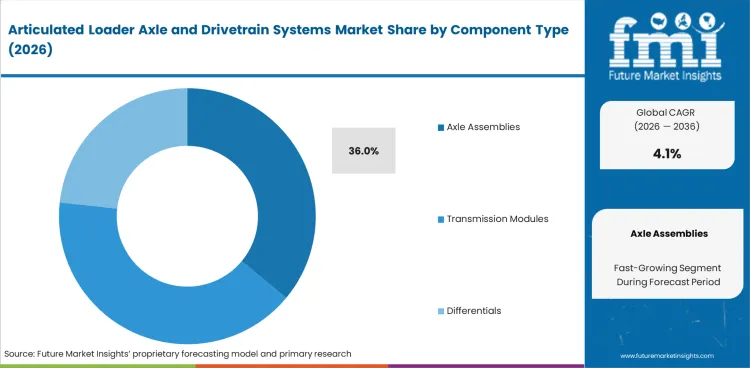
- Axle assemblies are expected to make up 36.0% of component type segment in 2026. Their leading position reflects the need for sealed housings and stronger wheel-end durability in articulated loader frames.
- Transmission modules and final drives address specific power transfer needs across loader platforms. Their value improves in machines requiring smoother torque delivery and better service access.
Insights into Articulated Loader Axle and Drivetrain Systems Market by Drivetrain Architecture
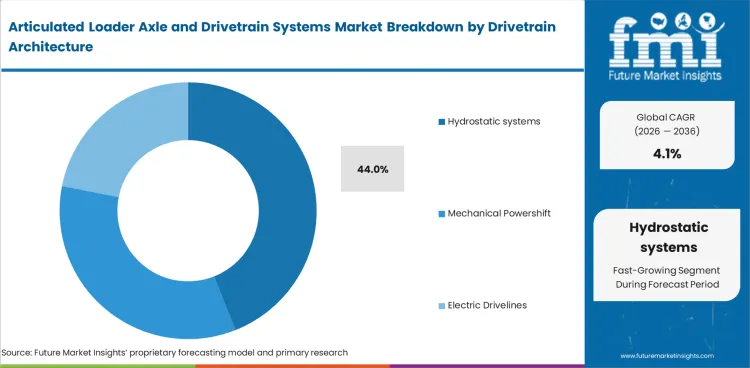
- Hydrostatic systems are projected to capture 44.0% of drivetrain architecture demand for 2026. Compact loader operators prefer this setup for controlled movement during short-cycle material handling work.
- Mechanical powershift systems serve heavier loader platforms with repeated load movement. Electric drivelines gain attention as compact machine programs move toward battery-powered designs.
Insights into Articulated Loader Axle and Drivetrain Systems Market by Loader Class
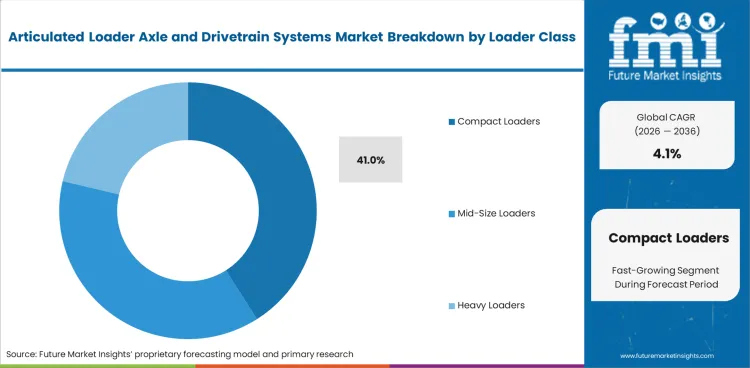
- In 2026, compact loaders are estimated to contribute 41.0% of loader class segment. Tight turning needs and small-site operation keep this class important for urban projects.
- Mid-size and heavy loaders serve higher payload work across quarries and larger material yards. These machines need drivetrain systems built for longer duty cycles.
Insights into Articulated Loader Axle and Drivetrain Systems Market by Sales Channel
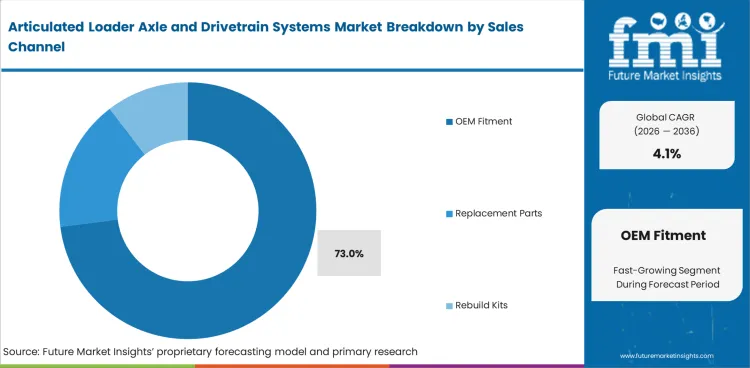
- OEM fitment is forecast to represent 73.0% of sales channel value in 2026. Loader manufacturers prefer factory-approved systems for axle ratio control and brake package validation.
- Replacement parts address service demand across older loader fleets. Rebuild kits gain value as axle wear and seal failure create planned maintenance needs.
Insights into Articulated Loader Axle and Drivetrain Systems Market by End Use
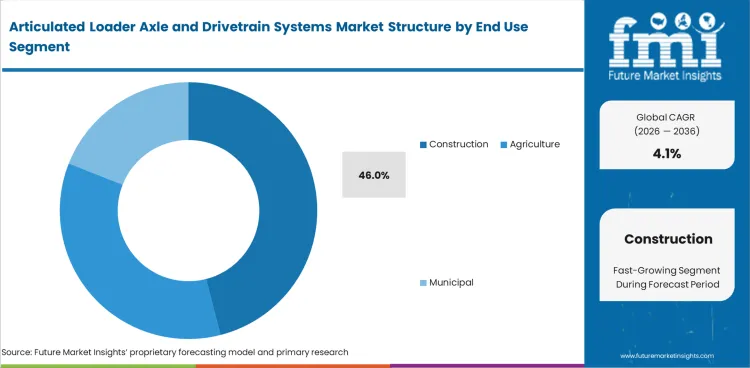
- Construction applications are projected to account for 46.0% of end-use segment during 2026. Jobsite loaders need drivetrains capable of repeated digging and short-haul material movement.
- Agriculture and municipal use create steady secondary demand for compact articulated machines. These applications favor reliable traction and simple service routines.
Articulated Loader Axle and Drivetrain Systems Market Drivers, Restraints, and Opportunities
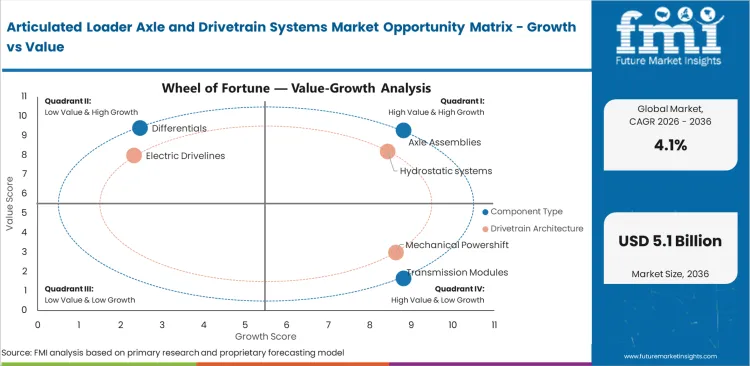
- Articulated frame stress is creating structured demand for sealed axle assemblies across compact and mid-size loaders.
- High drivetrain validation cost creates pricing pressure for smaller suppliers serving regional loader OEMs.
- Electric machines create service opportunity through traction motor packaging and software-calibrated driveline control.
Articulated loader axle and drivetrain systems keep growing as compact and mid-size loaders need durable power transfer and controlled movement during material handling work. High validation cost and service complexity can slow down the use of premium drivetrain packages. Growth continues through hydrostatic systems and electric driveline programs.
Steel Scrap Volatility Is Tightening Axle Quotes
For articulated loader axle and drivetrain systems, steel pricing is the clearest cost signal overall. Housings and shafts rely heavily on cast and forged steel materials for structural strength. Gears and hubs rely on machined steel inputs that ensure durability under demanding operating conditions. Differential carriers also use steel components designed to handle high loads and continuous mechanical stress. In February 2026, the USA Geological Survey reported that No. 1 heavy melting steel scrap prices in the first 11 months of 2025 ranged from US$366.26 per ton in March to US$303.46 per ton in November, and the estimated 2025 annual delivered average rose to US$319.00 per ton from US$314.85 per ton in 2024. This supports firmer surcharge language in drivetrain supply contracts, especially if the axle suppliers cannot quickly offset scrap foundry and machining costs.
Equipment Demand Is Repricing Supplier Risk
Articulated loader axle and drivetrain pricing is also being shaped by OEM demand discipline instead of only raw material costs. In May 2025, the Association of Equipment Manufacturers reported that 2024 construction equipment sales were down 5% year-over-year, and 8% above the five-year average; it also noted that used dozer and wheel loader inventories were coming down and selling prices were returning to healthier levels. For axle and drivetrain suppliers, the mixed signal supports selective price firmness across key programs. Replacement and premium drivetrain programs are defensible under current market and cost pressure conditions. High-volume build slots face tougher negotiations due to cost sensitivity and competitive supply dynamics. Buyers should separate commodity escalation from capacity reservation when structuring contracts for 2025. They should account for warranty exposure and tariff-related material risk in agreements.
Analysis of Articulated Loader Axle and Drivetrain Systems Market By Key Countries
.webp "Top Country Growth Comparison Articulated Loader Axle And Drivetrain Systems Market Cagr (2026 2036)")
| Country | CAGR |
|---|---|
| India | 6.4% |
| China | 5.7% |
| USA | 4.2% |
| Germany | 3.4% |
| UK | 3.1% |
Source: Future Market Insights, 2026.
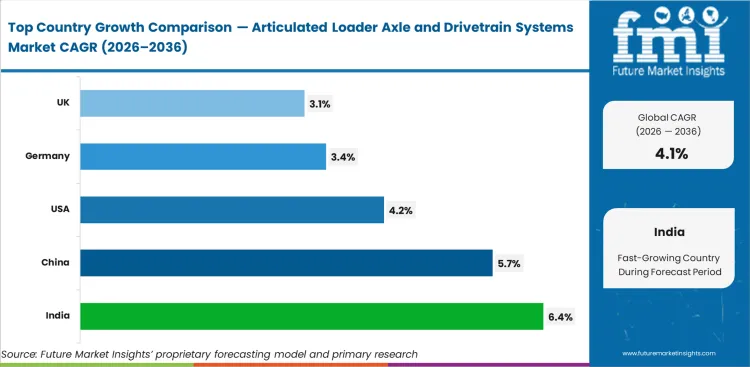
Articulated Loader Axle and Drivetrain Systems Market CAGR Analysis By Country
- India is forecast to record a 6.4% CAGR through 2036, helped by stronger equipment output and ongoing infrastructure activity.
- China is expected to reach 5.7% CAGR as infrastructure programs keep local construction machinery demand active.
- USA demand is projected to rise at 4.2% CAGR by 2036, with rental fleet servicing and steady construction work guiding replacement needs.
- Germany at 3.4% CAGR and the UK at 3.1% CAGR point to mature equipment bases, where replacement cycles drive controlled expansion.
Demand for articulated loader axle and drivetrain systems is forecast to rise at 4.1% CAGR from 2026 to 2036. Country-level analysis covers the major markets contributing to this forecast, with the key markets listed below.
Demand Outlook for Articulated Loader Axle and Drivetrain Systems Market in India
India’s articulated loader axle and drivetrain systems industry is projected to record a CAGR of 6.4% through 2036. ICEMA reported 135,650 construction equipment units sold in FY2023-24, with domestic sales up 24% and exports up 49%. This manufacturing and fleet base supports demand for India articulated loader axle and drivetrain systems. Local drivetrain suppliers can gain from loader makers seeking shorter supply lines and serviceable axle packages.
- Local equipment output supports demand for axle assemblies and hydrostatic systems.
- Earthmoving equipment sales reached 93,531 units in FY2023-24, supporting drivetrain service demand.
- Domestic manufacturers need drivetrain partners able to reduce machine downtime across high-use fleets.
Sales Analysis of Articulated Loader Axle and Drivetrain Systems Market in China
The articulated loader axle and drivetrain systems sector in China is expected to expand at a CAGR of 5.7% during the assessment period. China’s early-2026 fixed-asset investment trend points to active infrastructure spending, which supports construction machinery use and related drivetrain demand. Local suppliers benefit as wheel loader programs favor regional engineering and service access.
- Infrastructure spending supports loader use in road, waterway, and public facility work.
- General-purpose machinery investment increased 12.5% in the first quarter of 2026, which helps local parts capacity.
- Wheel loader OEMs need driveline systems with local service and engineering support.
Demand Outlook for Articulated Loader Axle and Drivetrain Systems Market in the United States
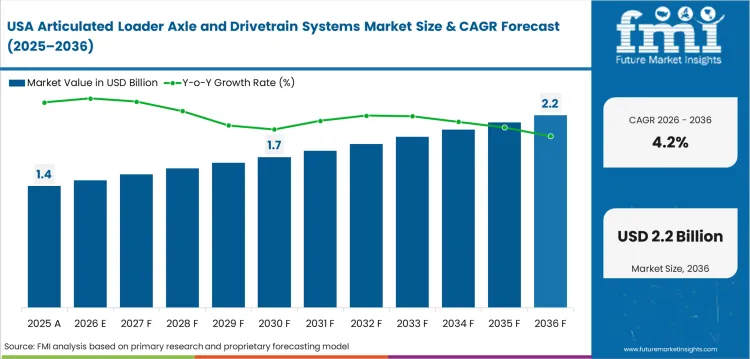
The USA articulated loader axle and drivetrain systems industry is forecast to grow at a CAGR of 4.2% by 2036. Construction spending during March 2026 reached USD 2,185.5 billion at a seasonally adjusted annual rate Loader fleet utilization improves during jobsite material handling through this activity. Component suppliers with service parts and authorized rebuild access can hold value across the USA replacement channel.
- Highway construction spending reached USD 147.8 billion in March 2026 on a seasonally adjusted annual basis.
- Rental fleets need axle seals and brake parts with predictable replacement timing.
- Construction equipment attachments raise drivetrain load variation through frequent tool changes.
Opportunity Analysis of Articulated Loader Axle and Drivetrain Systems Market in Germany
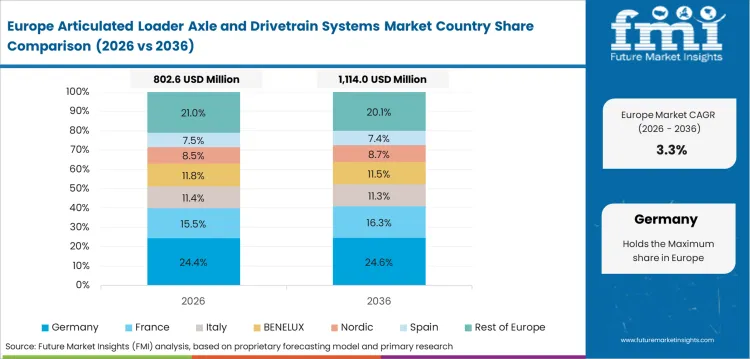
The articulated loader axle and drivetrain systems segment in Germany is forecast to advance at 3.4% CAGR over the forecast years. CECE reported Europe construction equipment sales up 4.6% in 2025 after a 19% drop in 2024. This stabilizing base supports demand for Germany articulated loader axle and drivetrain systems. Demand is strongest for service parts and premium drivetrain systems used across high-spec loader platforms.
- Mature OEM presence supports demand for transmission modules and heavy-duty axles.
- The industry in Germany moved down 2% in 2025, which keeps replacement work important.
- Advanced drivetrain work supports demand connected to off-highway vehicle engines and hybrid platforms.
Future Outlook for Articulated Loader Axle and Drivetrain Systems Market in the United Kingdom
The UK articulated loader axle and drivetrain systems industry is expected to post 3.1% CAGR through 2036. ONS estimated monthly construction output grew 1.5% in March 2026 after gains in February and January. This favors demand for UK articulated loader axle and drivetrain systems as repair activity and fleet utilization recover. Suppliers with fast parts distribution can serve smaller rental and municipal fleets.
- Repair and maintenance grew 3.4% in Quarter 1 2026, supporting drivetrain service demand.
- New work fell 1.9% in Quarter 1 2026, which keeps OEM demand controlled.
- Digital fleet planning supports service timing across construction equipment fleet management software use cases.
Competitive Landscape and Strategic Positioning
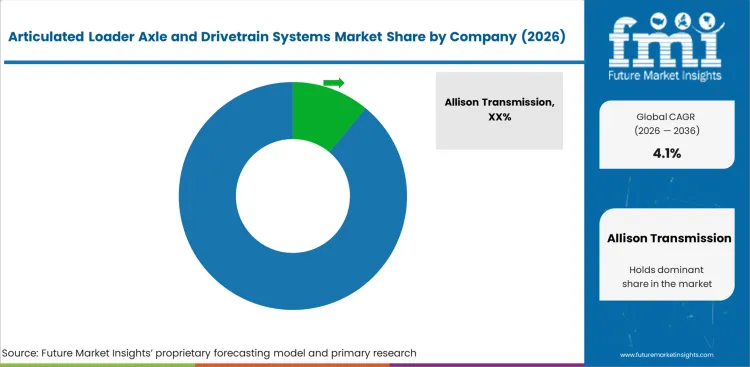
- Competition in this market is shaped by drivetrain durability and platform approval discipline across compact articulated loader programs.
- Allison Transmission carries stronger off-highway scale after the Dana Off-Highway transaction expanded its drivetrain base.
- ZF Friedrichshafen and Carraro leverage transmission design depth and axle systems suited to loader duty cycles.
- Electric drive specialists focus on compact modules and traction control packages for battery-powered loader designs.
Loader OEMs now compare suppliers through validated system packages and dependable field response across high-use machine programs. Allison Transmission strengthened its off-highway drivetrain position after completing the acquisition of Dana Incorporated’s Off-Highway Drive and Motion Systems business. The acquired operation expands Allison’s exposure across construction and agriculture applications. ZF Friedrichshafen retains relevance through wheel loader transmission programs and China engineering depth. Carraro keeps a strong role in compact wheel loader axle design.
Supplier entry is limited by validation cost and repeated duty-cycle testing across articulated loader platforms. Competitive focus now centers on axle load coverage and transmission integration across loader sizes. Manufacturers prefer partners with proven wheel-end durability and reliable replacement parts. Leading companies will combine application engineering with service reach across OEM and fleet channels.
Key Companies in the Articulated Loader Axle and Drivetrain Systems Market
Key global companies leading the articulated loader axle and drivetrain systems market include:
- Allison Transmission, ZF Friedrichshafen, and Carraro Group have strong drivetrain infrastructure for axle assemblies and transmission systems.
- Kessler + Co. serves manufacturers through electric drive depth and heavy-duty axle products.
- Cummins-Meritor and Dana legacy operations hold specialist positions across off-highway wheel-end and drivetrain systems.
Competitive Benchmarking: Articulated Loader Axle and Drivetrain Systems Market
| Company | Axle Load Coverage | Transmission Integration | Electric Drive Readiness | Geographic Footprint |
|---|---|---|---|---|
| Allison Transmission | High | High | Strong | Global presence with stronger off-highway reach after Dana Off-Highway acquisition |
| ZF Friedrichshafen | High | High | Strong | Global footprint across Europe, North America, South America, Asia-Pacific, India, Middle East, Australia, and Africa |
| Carraro Group | High | High | Strong | Europe-led manufacturing base with plants and service presence in India and China |
| Kessler + Co. | High | Medium | Strong | Germany-based manufacturing with sales and service reach in India, China, Turkey, South Africa, and export markets |
| Cummins-Meritor | High | Medium | Medium | North America-led Meritor axle and brake footprint with Cummins global service network |
| Dana legacy operations | High | High | Strong | Legacy global drivetrain footprint across North America, Europe, Asia-Pacific, and South America |
Source: Future Market Insights, 2026.
Key Developments in Articulated Loader Axle and Drivetrain Systems Market
- In April, 2025, Carraro presented a new driveline package for compact wheel loaders up to 14 tons at Bauma 2025. The system includes two new axles, models 48.47 and 48.57, paired with THE 260 transmission options for hydrostatic and electric drive layouts. This is highly relevant for articulated loader axle and drivetrain systems because compact wheel loaders use articulated steering layouts and require integrated axle, transmission, brake, and differential solutions.
- November, 2024, ZF showcased its eTRAC driveline systems for construction machinery at Bauma China 2024. The company highlighted the eTRAC eCD110-210 series for mid-sized wheel loaders, combining an electro-mechanical powershift transmission with traction e-motor, ePTO, inverter, and electric drive control unit. This development directly supports electrified drivetrain integration for articulated and wheel loader platforms.
Key Players in the Articulated Loader Axle and Drivetrain Systems Market
Major Global Players:
- Allison Transmission
- ZF Friedrichshafen
- Carraro Group
- Kessler + Co.
- Cummins-Meritor
Specialist Players:
- Dana legacy operations
- Comer Industries
Report Scope and Coverage
| Parameter | Details |
|---|---|
| Quantitative Units | USD 3.4 billion to USD 5.1 billion, at a CAGR of 4.1% |
| Market Definition | The articulated loader axle and drivetrain systems market encompasses power transfer assemblies used in articulated loader platforms. |
| Regions Covered | North America, Latin America, Europe, East Asia, South Asia and Pacific, Middle East and Africa |
| Countries Covered | USA, UK, Germany, China, India, Japan, Brazil, and 30 plus countries |
| Key Companies Profiled | Allison Transmission, ZF Friedrichshafen, Carraro Group, Kessler + Co., Cummins-Meritor |
| Forecast Period | 2026 to 2036 |
| Approach | Hybrid bottom-up and top-down methodology starting with loader output and verified drivetrain content values. |
Articulated Loader Axle and Drivetrain Systems Market by Segments
Articulated Loader Axle and Drivetrain Systems Market Segmented by Component Type:
- Axle Assemblies
- Transmission Modules
- Differentials
- Driveshafts
- Final Drives
Articulated Loader Axle and Drivetrain Systems Market Segmented by Drivetrain Architecture:
- Hydrostatic Systems
- Mechanical Powershift
- Electric Drivelines
- Hybrid Drivelines
Articulated Loader Axle and Drivetrain Systems Market Segmented by Loader Class:
- Compact Loaders
- Mid-Size Loaders
- Heavy Loaders
Articulated Loader Axle and Drivetrain Systems Market Segmented by Sales Channel:
- OEM Fitment
- Replacement Parts
- Rebuild Kits
Articulated Loader Axle and Drivetrain Systems Market Segmented by End Use:
- Construction
- Agriculture
- Municipal
- Mining
- Rental Fleets
Articulated Loader Axle and Drivetrain Systems Market Segmented by Region:
- North America
- USA
- Canada
- Mexico
- Latin America
- Brazil
- Chile
- Rest of Latin America
- Europe
- Germany
- UK
- Italy
- Spain
- France
- Rest of Europe
- East Asia
- China
- Japan
- South Korea
- South Asia and Pacific
- India
- ASEAN
- Australia & New Zealand
- Rest of South Asia and Pacific
- Middle East and Africa
- Saudi Arabia
- Other GCC Countries
- South Africa
- Rest of Middle East and Africa
Research Sources and Bibliography
- Carraro Group. (2026, May 11). Compact wheel loader. Carraro.
- Indian Construction Equipment Manufacturers’ Association. (2024, October). Indian construction equipment industry clocks record breaking 26% sales growth for second consecutive year.
- Allison Transmission. (2026, January 2). Allison Transmission completes acquisition of Dana Incorporated’s Off-Highway Drive and Motion Systems business.
- Association of Equipment Manufacturers. (2025, May 22). Sentiment Sinks as Tariffs Trip Up Ag, Construction Industries. Association of Equipment Manufacturers. Sentiment Sinks as Tariffs Trip Up Ag, Construction Industries - AEM | Association of Equipment Manufacturers
- USA Geological Survey. (2026, February). Iron and steel scrap. In Mineral Commodity Summaries 2026. USA Geological Survey. Mineral Commodity Summaries 2026
- Carraro. (2025, April 7). Carraro at Bauma 2025: Advanced technologies beyond the boundaries of mechanics. Carraro at Bauma 2025: Advanced Technologies Beyond the Boundaries of Mechanics
- ZF Group. (2024, November 26). The future of construction: ZF at Bauma China 2024 [Press release]. ZF Presseinformation
- USA Census Bureau. (2026, May 7). Monthly construction spending, March 2026.
- Committee for European Construction Equipment. (2026, February). CECE annual economic report 2026.
- Office for National Statistics. (2026, May 14). Construction output in Great Britain: March 2026, new orders and Construction Output Price Indices, January to March 2026.
- ZF Friedrichshafen. (2024, November 26). The future of construction: ZF at bauma China 2024.
This Report Answers
- What is the current and future size of the articulated loader axle and drivetrain systems market?
- How fast is the articulated loader axle and drivetrain systems market expected to expand between 2026 and 2036?
- Which component type is expected to lead the market by 2026?
- Which drivetrain architecture is expected to account for the highest demand by 2026?
- What factors are driving demand for articulated loader axle and drivetrain systems globally?
- How are compact loaders creating demand for hydrostatic systems and sealed axles?
- Why are OEM fitment channels the main demand base for drivetrain systems?
- How are electric loaders creating demand for compact driveline validation?
- Which countries are projected to record faster expansion through 2036?
- What is driving market expansion in India and China?
- Who are the key companies active in the articulated loader axle and drivetrain systems market?
- How does FMI estimate and validate the market forecast?
Frequently Asked Questions
What is the global market demand for Articulated Loader Axle and Drivetrain Systems in 2026?
In 2026, the global market for articulated loader axle and drivetrain systems is expected to be worth USD 3.4 billion.
How big will the market for Articulated Loader Axle and Drivetrain Systems be in 2036?
By 2036, the market for articulated loader axle and drivetrain systems is expected to be worth USD 5.1 billion.
How much is demand for Articulated Loader Axle and Drivetrain Systems expected to expand between 2026 and 2036?
Between 2026 and 2036, demand for articulated loader axle and drivetrain systems is expected to expand at a CAGR of 4.1%.
Which component type segment is likely to be the best seller globally by 2026?
Axle assemblies will make up 36.0% of the component type segment in 2026.
What is causing demand to rise in India?
The India articulated loader axle and drivetrain systems market is projected to record 6.4% CAGR through 2036, supported by construction equipment output and local drivetrain sourcing.
What is causing demand to rise in China?
The China articulated loader axle and drivetrain systems market is projected to expand at 5.7% CAGR through 2036, supported by infrastructure investment and local construction machinery production.
What does this report mean by articulated loader axle and drivetrain systems market definition?
The articulated loader axle and drivetrain systems market includes power transfer systems used in articulated loader platforms.
How does FMI make the articulated loader axle and drivetrain systems forecast and check it?
Forecasting models use a hybrid bottom-up and top-down approach, starting with loader output and checking it against drivetrain content values.
Preview the report firsthand - request a free sample
Get SampleGet the brochure for pricing and purchase details.
Get PDFTable of Content
- Key Takeaways
- Market Size and CAGR
- Top Growth Driver
- Fastest Growing Segment
- Leading Region
- Key Companies
- Emerging Opportunities
- Executive Summary
- Global Market Outlook
- Demand-side Trends
- Supply-side Trends
- Technology Roadmap Analysis
- Analysis and Recommendations
- Analyst Perspective (What is happening? Why now? What should investors know?)
- Key Questions Answered
- How large is the market?
- What is the CAGR?
- What are key trends?
- Which region dominates?
- Who are the leaders?
- Market Overview
- Market Coverage / Taxonomy
- Market Definition / Scope / Limitations
- Research Methodology
- Chapter Orientation
- Analytical Lens and Working Hypotheses
- Market Structure, Signals, and Trend Drivers
- Benchmarking and Cross-market Comparability
- Market Sizing, Forecasting, and Opportunity Mapping
- Research Design and Evidence Framework
- Desk Research Programme (Secondary Evidence)
- Expert Input and Fieldwork (Primary Evidence)
- Tooling, Models, and Reference Databases
- Data Engineering and Model Build
- Quality Assurance and Audit Trail
- Market Background
- Market Dynamics (Drivers, Restraints, Opportunity, Trends)
- Scenario Forecast (Optimistic, Likely, Conservative)
- Impact Analysis
- AI Impact
- Sustainability Impact
- Regulatory Impact
- Technology Impact
- Consumer / Buyer Analysis
- Purchase Drivers
- Adoption Barriers
- Buyer Journey
- Opportunity Map Analysis
- Product Life Cycle Analysis
- Supply Chain Analysis
- Investment Feasibility Matrix
- Value Chain Analysis
- PESTLE and Porter's Analysis
- Regulatory Landscape
- Regional Parent Market Outlook
- Production and Consumption Statistics
- Import and Export Statistics
- Global Market Analysis and Forecast, 2021 to 2036
- Historical Market Size Value (USD Billion) & Volume (Unit) Analysis, 2021 to 2025
- Current and Future Market Size Value (USD Billion) & Volume (Unit) Projections, 2026 to 2036
- Y-o-Y Growth Trend Analysis
- Absolute $ Opportunity Analysis
- Global Market Pricing Analysis, 2021 to 2036
- Global Market Analysis and Forecast, By Component Type, 2021 to 2036
- Introduction / Key Findings
- Historical Market Size Value (USD Billion) & Volume (Unit) Analysis By Component Type, 2021 to 2025
- Current and Future Market Size Value (USD Billion) & Volume (Unit) Analysis and Forecast By Component Type, 2026 to 2036
- Axle Assemblies
- Transmission Modules
- Differentials
- Driveshafts
- Final Drives
- Axle Assemblies
- Y-o-Y Growth Trend Analysis By Component Type, 2021 to 2025
- Absolute $ Opportunity Analysis By Component Type, 2026 to 2036
- Global Market Analysis and Forecast, By Drivetrain Architecture, 2021 to 2036
- Introduction / Key Findings
- Historical Market Size Value (USD Billion) & Volume (Unit) Analysis By Drivetrain Architecture, 2021 to 2025
- Current and Future Market Size Value (USD Billion) & Volume (Unit) Analysis and Forecast By Drivetrain Architecture, 2026 to 2036
- Hydrostatic Systems
- Mechanical Powershift
- Electric Drivelines
- Hybrid Drivelines
- Hydrostatic Systems
- Y-o-Y Growth Trend Analysis By Drivetrain Architecture, 2021 to 2025
- Absolute $ Opportunity Analysis By Drivetrain Architecture, 2026 to 2036
- Global Market Analysis and Forecast, By Loader Class, 2021 to 2036
- Introduction / Key Findings
- Historical Market Size Value (USD Billion) & Volume (Unit) Analysis By Loader Class, 2021 to 2025
- Current and Future Market Size Value (USD Billion) & Volume (Unit) Analysis and Forecast By Loader Class, 2026 to 2036
- Compact Loaders
- Mid-Size Loaders
- Heavy Loaders
- Compact Loaders
- Y-o-Y Growth Trend Analysis By Loader Class, 2021 to 2025
- Absolute $ Opportunity Analysis By Loader Class, 2026 to 2036
- Global Market Analysis and Forecast, By Sales Channel, 2021 to 2036
- Introduction / Key Findings
- Historical Market Size Value (USD Billion) & Volume (Unit) Analysis By Sales Channel, 2021 to 2025
- Current and Future Market Size Value (USD Billion) & Volume (Unit) Analysis and Forecast By Sales Channel, 2026 to 2036
- OEM Fitment
- Replacement Parts
- Rebuild Kits
- OEM Fitment
- Y-o-Y Growth Trend Analysis By Sales Channel, 2021 to 2025
- Absolute $ Opportunity Analysis By Sales Channel, 2026 to 2036
- Global Market Analysis and Forecast, By End Use, 2021 to 2036
- Introduction / Key Findings
- Historical Market Size Value (USD Billion) & Volume (Unit) Analysis By End Use, 2021 to 2025
- Current and Future Market Size Value (USD Billion) & Volume (Unit) Analysis and Forecast By End Use, 2026 to 2036
- Construction
- Agriculture
- Municipal
- Mining
- Rental Fleets
- Construction
- Y-o-Y Growth Trend Analysis By End Use, 2021 to 2025
- Absolute $ Opportunity Analysis By End Use, 2026 to 2036
- Global Market Analysis and Forecast, By Region, 2021 to 2036
- Introduction
- Historical Market Size Value (USD Billion) & Volume (Unit) Analysis By Region, 2021 to 2025
- Current Market Size Value (USD Billion) & Volume (Unit) Analysis and Forecast By Region, 2026 to 2036
- North America
- Latin America
- Western Europe
- Eastern Europe
- East Asia
- South Asia and Pacific
- Middle East & Africa
- Market Attractiveness Analysis By Region
- North America Market Analysis and Forecast, By Country, 2021 to 2036
- Historical Market Size Value (USD Billion) & Volume (Unit) Trend Analysis By Market Taxonomy, 2021 to 2025
- Market Size Value (USD Billion) & Volume (Unit) Forecast By Market Taxonomy, 2026 to 2036
- By Country
- USA
- Canada
- Mexico
- By Component Type
- By Drivetrain Architecture
- By Loader Class
- By Sales Channel
- By End Use
- By Country
- Market Attractiveness Analysis
- By Country
- By Component Type
- By Drivetrain Architecture
- By Loader Class
- By Sales Channel
- By End Use
- Key Takeaways
- Latin America Market Analysis and Forecast, By Country
- Historical Market Size Value (USD Billion) & Volume (Unit) Trend Analysis By Market Taxonomy, 2021 to 2025
- Market Size Value (USD Billion) & Volume (Unit) Forecast By Market Taxonomy, 2026 to 2036
- By Country
- Brazil
- Chile
- Rest of Latin America
- By Component Type
- By Drivetrain Architecture
- By Loader Class
- By Sales Channel
- By End Use
- By Country
- Market Attractiveness Analysis
- By Country
- By Component Type
- By Drivetrain Architecture
- By Loader Class
- By Sales Channel
- By End Use
- Key Takeaways
- Western Europe Market Analysis and Forecast, By Country
- Historical Market Size Value (USD Billion) & Volume (Unit) Trend Analysis By Market Taxonomy, 2021 to 2025
- Market Size Value (USD Billion) & Volume (Unit) Forecast By Market Taxonomy, 2026 to 2036
- By Country
- Germany
- UK
- Italy
- Spain
- France
- Nordic
- BENELUX
- Rest of Western Europe
- By Component Type
- By Drivetrain Architecture
- By Loader Class
- By Sales Channel
- By End Use
- By Country
- Market Attractiveness Analysis
- By Country
- By Component Type
- By Drivetrain Architecture
- By Loader Class
- By Sales Channel
- By End Use
- Key Takeaways
- Eastern Europe Market Analysis and Forecast, By Country
- Historical Market Size Value (USD Billion) & Volume (Unit) Trend Analysis By Market Taxonomy, 2021 to 2025
- Market Size Value (USD Billion) & Volume (Unit) Forecast By Market Taxonomy, 2026 to 2036
- By Country
- Russia
- Poland
- Hungary
- Balkan & Baltic
- Rest of Eastern Europe
- By Component Type
- By Drivetrain Architecture
- By Loader Class
- By Sales Channel
- By End Use
- By Country
- Market Attractiveness Analysis
- By Country
- By Component Type
- By Drivetrain Architecture
- By Loader Class
- By Sales Channel
- By End Use
- Key Takeaways
- East Asia Market Analysis and Forecast, By Country
- Historical Market Size Value (USD Billion) & Volume (Unit) Trend Analysis By Market Taxonomy, 2021 to 2025
- Market Size Value (USD Billion) & Volume (Unit) Forecast By Market Taxonomy, 2026 to 2036
- By Country
- China
- Japan
- South Korea
- By Component Type
- By Drivetrain Architecture
- By Loader Class
- By Sales Channel
- By End Use
- By Country
- Market Attractiveness Analysis
- By Country
- By Component Type
- By Drivetrain Architecture
- By Loader Class
- By Sales Channel
- By End Use
- Key Takeaways
- South Asia and Pacific Market Analysis and Forecast, By Country
- Historical Market Size Value (USD Billion) & Volume (Unit) Trend Analysis By Market Taxonomy, 2021 to 2025
- Market Size Value (USD Billion) & Volume (Unit) Forecast By Market Taxonomy, 2026 to 2036
- By Country
- India
- ASEAN
- Australia & New Zealand
- Rest of South Asia and Pacific
- By Component Type
- By Drivetrain Architecture
- By Loader Class
- By Sales Channel
- By End Use
- By Country
- Market Attractiveness Analysis
- By Country
- By Component Type
- By Drivetrain Architecture
- By Loader Class
- By Sales Channel
- By End Use
- Key Takeaways
- Middle East & Africa Market Analysis and Forecast, By Country
- Historical Market Size Value (USD Billion) & Volume (Unit) Trend Analysis By Market Taxonomy, 2021 to 2025
- Market Size Value (USD Billion) & Volume (Unit) Forecast By Market Taxonomy, 2026 to 2036
- By Country
- Kingdom of Saudi Arabia
- Other GCC Countries
- Türkiye
- South Africa
- Other African Union
- Rest of Middle East & Africa
- By Component Type
- By Drivetrain Architecture
- By Loader Class
- By Sales Channel
- By End Use
- By Country
- Market Attractiveness Analysis
- By Country
- By Component Type
- By Drivetrain Architecture
- By Loader Class
- By Sales Channel
- By End Use
- Key Takeaways
- Key Countries Market Analysis
- USA
- Pricing Analysis
- Market Share Analysis, 2025
- By Component Type
- By Drivetrain Architecture
- By Loader Class
- By Sales Channel
- By End Use
- Canada
- Pricing Analysis
- Market Share Analysis, 2025
- By Component Type
- By Drivetrain Architecture
- By Loader Class
- By Sales Channel
- By End Use
- Mexico
- Pricing Analysis
- Market Share Analysis, 2025
- By Component Type
- By Drivetrain Architecture
- By Loader Class
- By Sales Channel
- By End Use
- Brazil
- Pricing Analysis
- Market Share Analysis, 2025
- By Component Type
- By Drivetrain Architecture
- By Loader Class
- By Sales Channel
- By End Use
- Chile
- Pricing Analysis
- Market Share Analysis, 2025
- By Component Type
- By Drivetrain Architecture
- By Loader Class
- By Sales Channel
- By End Use
- Germany
- Pricing Analysis
- Market Share Analysis, 2025
- By Component Type
- By Drivetrain Architecture
- By Loader Class
- By Sales Channel
- By End Use
- UK
- Pricing Analysis
- Market Share Analysis, 2025
- By Component Type
- By Drivetrain Architecture
- By Loader Class
- By Sales Channel
- By End Use
- Italy
- Pricing Analysis
- Market Share Analysis, 2025
- By Component Type
- By Drivetrain Architecture
- By Loader Class
- By Sales Channel
- By End Use
- Spain
- Pricing Analysis
- Market Share Analysis, 2025
- By Component Type
- By Drivetrain Architecture
- By Loader Class
- By Sales Channel
- By End Use
- France
- Pricing Analysis
- Market Share Analysis, 2025
- By Component Type
- By Drivetrain Architecture
- By Loader Class
- By Sales Channel
- By End Use
- India
- Pricing Analysis
- Market Share Analysis, 2025
- By Component Type
- By Drivetrain Architecture
- By Loader Class
- By Sales Channel
- By End Use
- ASEAN
- Pricing Analysis
- Market Share Analysis, 2025
- By Component Type
- By Drivetrain Architecture
- By Loader Class
- By Sales Channel
- By End Use
- Australia & New Zealand
- Pricing Analysis
- Market Share Analysis, 2025
- By Component Type
- By Drivetrain Architecture
- By Loader Class
- By Sales Channel
- By End Use
- China
- Pricing Analysis
- Market Share Analysis, 2025
- By Component Type
- By Drivetrain Architecture
- By Loader Class
- By Sales Channel
- By End Use
- Japan
- Pricing Analysis
- Market Share Analysis, 2025
- By Component Type
- By Drivetrain Architecture
- By Loader Class
- By Sales Channel
- By End Use
- South Korea
- Pricing Analysis
- Market Share Analysis, 2025
- By Component Type
- By Drivetrain Architecture
- By Loader Class
- By Sales Channel
- By End Use
- Russia
- Pricing Analysis
- Market Share Analysis, 2025
- By Component Type
- By Drivetrain Architecture
- By Loader Class
- By Sales Channel
- By End Use
- Poland
- Pricing Analysis
- Market Share Analysis, 2025
- By Component Type
- By Drivetrain Architecture
- By Loader Class
- By Sales Channel
- By End Use
- Hungary
- Pricing Analysis
- Market Share Analysis, 2025
- By Component Type
- By Drivetrain Architecture
- By Loader Class
- By Sales Channel
- By End Use
- Kingdom of Saudi Arabia
- Pricing Analysis
- Market Share Analysis, 2025
- By Component Type
- By Drivetrain Architecture
- By Loader Class
- By Sales Channel
- By End Use
- Türkiye
- Pricing Analysis
- Market Share Analysis, 2025
- By Component Type
- By Drivetrain Architecture
- By Loader Class
- By Sales Channel
- By End Use
- South Africa
- Pricing Analysis
- Market Share Analysis, 2025
- By Component Type
- By Drivetrain Architecture
- By Loader Class
- By Sales Channel
- By End Use
- USA
- Market Structure Analysis
- Competition Dashboard
- Competition Benchmarking
- Market Share Analysis of Top Players
- By Regional
- By Component Type
- By Drivetrain Architecture
- By Loader Class
- By Sales Channel
- By End Use
- Emerging Startups
- Innovation Benchmarking
- Competition Analysis
- Competition Deep Dive
- Allison Transmission
- Overview
- Product Portfolio
- Profitability by Market Segments (Product/Region/Sales Channel)
- Sales Footprint
- Strategy Overview
- Marketing Strategy
- Product Strategy
- Channel Strategy
- ZF Friedrichshafen
- Carraro Group
- Kessler + Co.
- Cummins-Meritor
- Dana legacy operations
- Allison Transmission
- Case Studies
- Success Stories
- Recent Developments
- Competition Deep Dive
- Assumptions & Acronyms Used


