

- Market Size (2026)
- USD 1.0 Bn
- Forecast (2036)
- USD 2.2 Bn
- CAGR (2026 to 2036)
- 8.4%
Drivetrain Cybersecurity Protection Modules Market Size, Market Forecast and Outlook By FMI
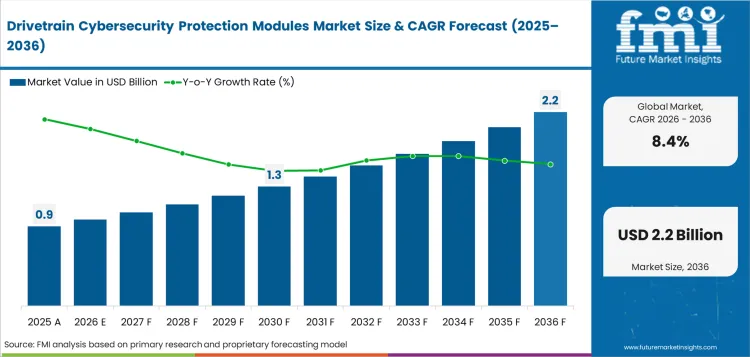
The drivetrain cybersecurity protection modules market was valued at USD 0.9 billion in 2025 and is estimated to reach USD 1.0 billion in 2026. Demand is projected to reach USD 2.2 billion by 2036 at 8.4% CAGR. OEM integration is expected to lead by integration channel with 62.0% share. Embedded HSM firmware is projected to hold 54.0% share in 2026.
Drivetrain cybersecurity protection modules are gaining priority as electric drivetrains use more control software for torque management and inverter diagnostics. Vehicle approval rules are raising pressure on OEMs to prove cybersecurity management across connected vehicle systems under UN Regulation No. 155. In May 2024, NXP listed its TJA1104 as a MACsec enabled 100BASE-T1 automotive Ethernet PHY for future vehicle networks.
Safer Ethernet links matter because zonal vehicle networks carry drivetrain data between controllers. In April 2024, Infineon said its AURIX TC4x microcontrollers use Cyber Security Realtime Module and Cyber Security Satellite functions for secured communication. Secure CAN transceivers and inverter control MCUs can protect drivetrain signals closer to the source. Suppliers that combine real-time control with verified security functions can gain wider access to future e-drive programs.
Summary of the Drivetrain Cybersecurity Protection Modules Market
- Demand and Growth Drivers
- Vehicle makers need dedicated security modules because software now controls torque delivery and drivetrain update paths.
- Cybersecurity approval work is increasing the need for secure boot and controlled key handling inside drivetrain controllers.
- Software defined vehicle platforms create repeat demand for reusable security blocks across future vehicle programs.
- Product and Segment View
- Embedded HSM firmware is becoming important because it protects sensitive data inside drivetrain controllers.
- Gateway authentication is gaining attention as automotive zonal gateway ECU systems filter torque commands before they reach inverter or transmission controllers.
- Electric drivetrains need added protection as automotive electric drivetrain components depend on trusted inverter and e-axle signals.
- Geography and Competitive Outlook
- China and the United States lead early demand because both markets have large vehicle production and rising connected vehicle security needs.
- Germany and Japan add steady demand as automakers build more software defined vehicle platforms.
- Suppliers with drivetrain knowledge and security firmware experience can gain better access to OEM programs.
- Analyst Opinion
- Nikhil Kaitwade, Principal Consultant at FMI, says, “Drivetrain cybersecurity is now part of drivetrain control design. Vehicle makers need to protect torque commands and software update routes before approval begins. Suppliers with proven HSM firmware and drivetrain security experience can gain stronger access to long term vehicle programs.”
- Drivetrain Cybersecurity Protection Modules Market Value Analysis
- Drivetrain cybersecurity protection modules are becoming a significant part of drivetrain control protection.
- Demand is rising because vehicle software needs regular security checks after the vehicle leaves the factory.
- Vehicle makers assign more value to automotive cybersecurity modules that protect torque requests and software update channels during the vehicle life.
- Market value is increasing because qualified security blocks can reduce rework during cybersecurity approval and drivetrain validation.
Key Takeaways, Market Size, and Forecast
- Drivetrain cybersecurity protection modules market value stood at USD 0.90 billion in 2025.
- By 2036, market value is expected to reach USD 2.2 billion as software controlled torque systems need protected command paths.
- Demand is projected to expand at 8.4% CAGR from 2026 to 2036.
- Market expansion is forecast to create USD 1.22 billion in incremental opportunity between 2026 and 2036.
- OEM integration is anticipated to represent 62.0% share in 2026 as vehicle makers prefer security modules qualified during platform design.
- From 2026 to 2036, embedded HSM firmware is projected to hold 54.0% share as drivetrain controllers need secure boot and protected key storage.
- China demand is expected to move ahead at 9.7% CAGR through 2036 with large vehicle output and software defined vehicle programs.
Drivetrain Cybersecurity Protection Modules Market Definition
Drivetrain cybersecurity protection modules include hardware and software that protect drivetrain control units from unsafe commands and software tampering.
Drivetrain Cybersecurity Protection Modules Market Inclusions
Scope includes embedded HSM firmware and secure gateway modules. Intrusion detection agents are included when they are sold with drivetrain controllers. Revenue scope covers 2026 to 2036 for modules and embedded software used in drivetrain ECUs and e-axle controllers. Transmission control units and inverter control units fall within the drivetrain security scope. Participants include vehicle OEMs and Tier-1 electronics suppliers. Semiconductor vendors and embedded software firms support security validation groups.
Drivetrain Cybersecurity Protection Modules Market Exclusions
Scope excludes enterprise IT security and fleet security operation centers. Consumer data privacy tools and general infotainment protection services are outside the scope. Standalone motors and batteries are excluded when the security module is not sold with a drivetrain control unit. Routine security consulting is outside revenue scope, except when bundled with module licensing or embedded integration work.
Drivetrain Cybersecurity Protection Modules Market Research Methodology
- Primary Research: Drivetrain controller portfolios and embedded security firmware releases were reviewed.
- Desk Research: Automotive association sources, the National Highway Traffic Safety Administration, the Bureau of Industry and Security and official company releases were used to check vehicle scale and cybersecurity evidence.
- Market Sizing and Forecasting: Market value was built using vehicle production data and drivetrain controller content per vehicle.
- Data Validation: Forecasts were checked against EV platform content and verified supplier activity.
Why is the Drivetrain Cybersecurity Protection Modules Market Expanding?
- Software controlled drivetrains need secure boot and safe key storage so controllers accept only trusted software at start-up.
- Connected vehicle rules raise the need for clear hardware and software source records across drivetrain control programs.
- High-voltage electric drivetrains need authenticated torque commands because inverter control depends more on software.
- Security validation supports demand for over-the-air update checks before drivetrain software enters production vehicles.
- Supplier selection now prioritizes modules that combine secure updates with documented cybersecurity records for drivetrain control programs.
High global vehicle production, estimated at around 96.4 million units in 2025, creates a solid volume foundation for drivetrain cybersecurity modules. Demand is rising as vehicles increasingly rely on connected control systems and update-ready software architectures. The importance of protection is greater in electric and hybrid drivetrains, where software-controlled torque delivery depends on secure and trusted communication.
Regulations in mature markets now require stricter verification of vehicle electronics supply chains, especially for connected systems. In January 2025, the United States Bureau of Industry and Security (BIS) finalized a rule restricting the use of certain connectivity hardware and software sourced from China and Russia in connected vehicles. The rule requires OEMs to document the origin of critical electronic components and verify cybersecurity safeguards before approval. Drivetrain module suppliers must provide traceable component sourcing and documented cybersecurity compliance to support OEM production programs.
Market Segmentation Analysis
- OEM integration is forecast to account for 62.0% share in 2026.
- Across the assessment period, embedded HSM firmware is expected to capture 54.0% share.
- Gateway authentication is forecast to hold 46.0% share during 2026.
- Passenger vehicles are forecast to represent 57.0% share.
- Electric drivetrains are forecast to account for 41.0% share by 2036.
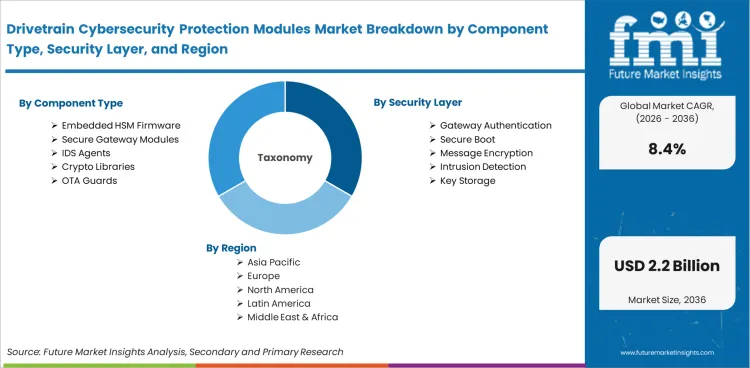
Drivetrain cybersecurity protection modules market is divided into five primary segment groups based on controller type and vehicle use. Component type includes embedded HSM firmware and secure gateway modules. IDS agents and OTA guards support monitoring and update control. Security layer includes gateway authentication and secure boot. Vehicle platform includes passenger vehicles and heavy trucks. Propulsion type covers electric drivetrains and hybrid drivetrains. Integration channel includes OEM integration and Tier-1 packages.
Insights into Drivetrain Cybersecurity Protection Modules Market by Component Type
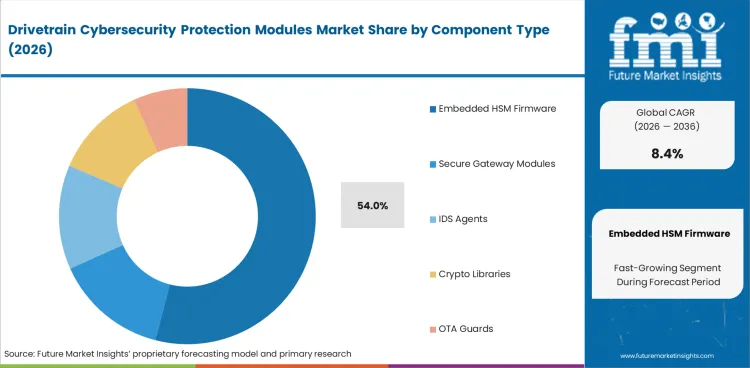
- In 2026, embedded HSM firmware is forecast to hold 54.0% share as drivetrain ECUs need protected security inside the control unit.
- Through 2036, secure gateway modules and IDS agents gain wider use as controllers need to filter unsafe network signals before they affect inverter commands or transmission shift control.
Insights into Drivetrain Cybersecurity Protection Modules Market by Security Layer
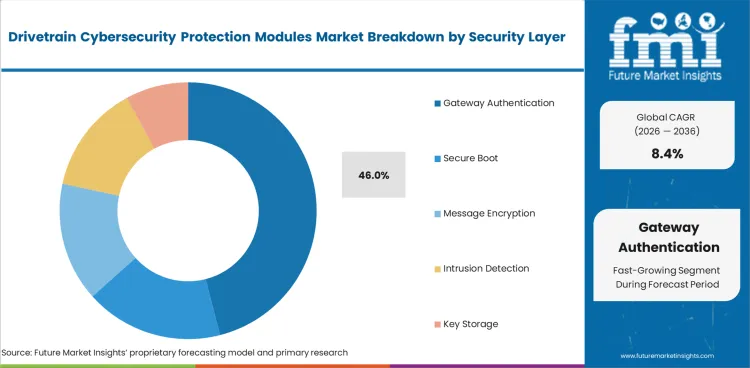
- Gateway authentication is forecast to hold 46.0% share by 2026 as drivetrain control signals pass through vehicle gateways before ECUs act on them.
- Secure boot and message encryption gain value as automotive over-the-air update security needs rise across update-ready vehicle platforms.
Insights into Drivetrain Cybersecurity Protection Modules Market by Vehicle Platform
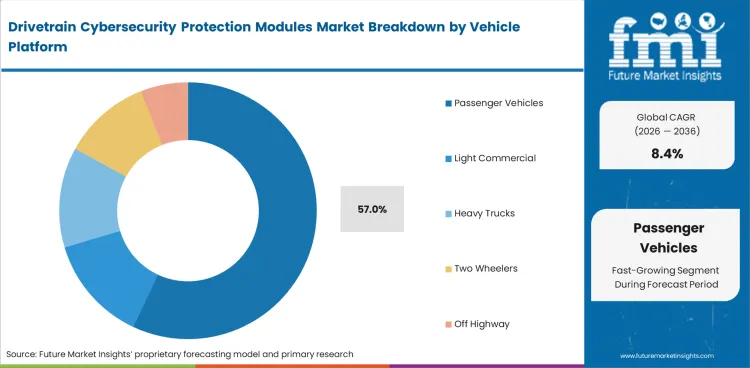
- In 2026, passenger vehicles are projected to represent 57.0% share because high production volume supports wider use of embedded security modules.
- Between 2026 and 2036, heavy trucks need stronger drivetrain security for uptime and remote diagnostics. Two wheelers need lower cost protection for connected control functions.
Insights into Drivetrain Cybersecurity Protection Modules Market by Propulsion Type
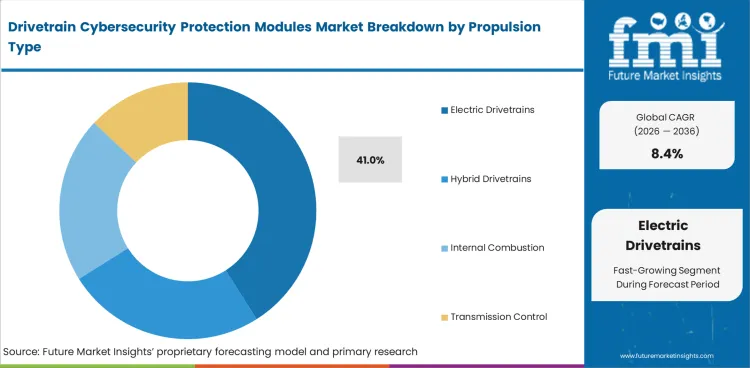
- Electric drivetrains are estimated to hold 41.0% share in the 2026 assessment as inverter commands and e-axle controls depend on trusted software signals.
- Through 2036, hybrid drivetrains create steady demand because engine and motor controls must coordinate torque delivery safely.
Insights into Drivetrain Cybersecurity Protection Modules Market by Integration Channel
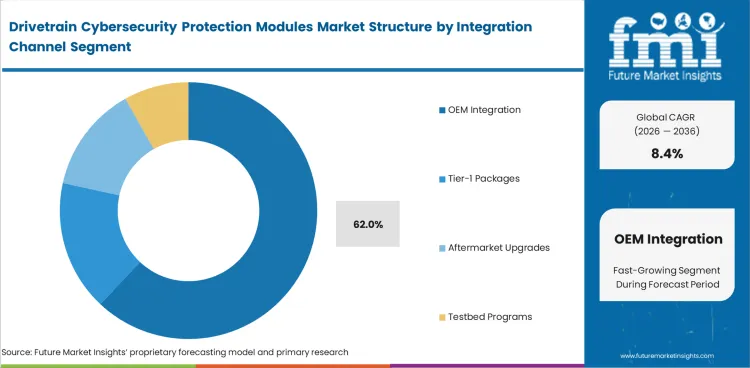
- OEM integration is expected to capture 62.0% share in 2026 as cybersecurity checks work best when built into platform design.
- Through 2036, Tier-1 packages support adoption as suppliers combine drivetrain controllers with embedded security software for easier vehicle validation.
Drivetrain Cybersecurity Protection Modules Market Drivers, Restraints, and Opportunities
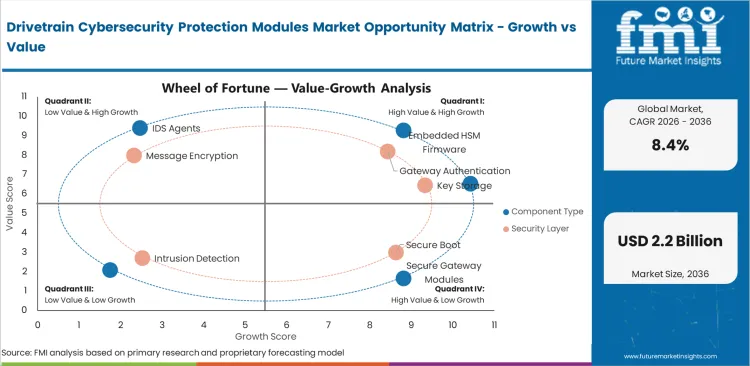
- Software defined drivetrain control raises the need for protected command paths in electric and hybrid vehicles.
- Cybersecurity approval can slow adoption because each controller design needs proof of safe update behavior.
- Hardware security engines can raise module value by protecting key storage and software updates inside drivetrain controllers.
- Automotive communication technology raises the need for safer data movement between drivetrain control units.
Drivetrain Command Protection
Torque control is now handled through software in electric axles and hybrid drive systems. A false command can affect propulsion response, so cybersecurity has become part of drivetrain safety. In May 2024, the UK Vehicle Certification Agency stated that UN Regulation No. 155 covers vehicle cybersecurity and cybersecurity management systems. The same guidance links UN Regulation No. 156 with software updates and continued vehicle safety. This supports the need for drivetrain protection modules that check commands before they reach inverter and torque control systems. Suppliers that prove secure boot and safe software update handling can reduce approval risk for OEM drivetrain teams.
Cybersecurity Approval Burden
Cybersecurity approval can slow adoption for smaller module suppliers. Vehicle approval processes now require clear proof that cybersecurity risks are checked during development. Module suppliers must show risk assessment records and secure update handling before drivetrain controllers enter production. Smaller firms may lose platform awards if they cannot prove that drivetrain controls stay protected from design through vehicle launch.
Reusable Security Stacks
Reusable security stacks give suppliers a clearer route into future drivetrain programs. In March 2024, NXP introduced its S32 CoreRide platform to simplify software defined vehicle development through pre-integrated processing and networking functions. A reusable stack reduces repeated engineering work across vehicle lines. Module suppliers with cybersecurity approval support can make drivetrain protection easier to carry into more OEM programs.
Analysis of Drivetrain Cybersecurity Protection Modules Market by Key Countries
.webp "Top Country Growth Comparison Drivetrain Cybersecurity Protection Modules Market Cagr (2026 2036)")
| Country | CAGR |
|---|---|
| China | 9.7% |
| United States | 9.2% |
| Germany | 8.8% |
| Japan | 8.5% |
| South Korea | 8.1% |
| India | 7.9% |
| France | 7.6% |
Source: Future Market Insights, 2026.
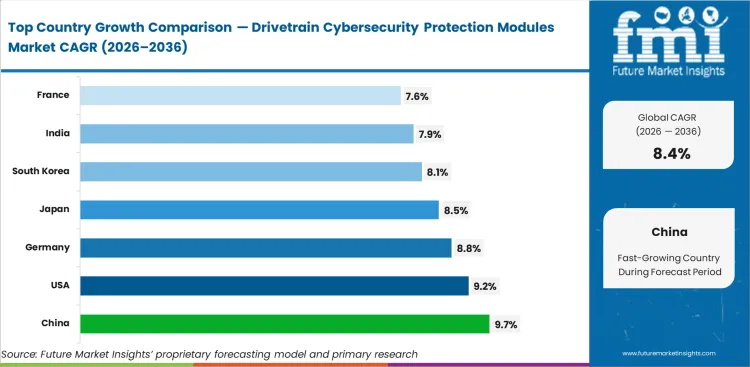
Drivetrain Cybersecurity Protection Modules Market CAGR Analysis by Country
- China is projected to record 9.7% CAGR by 2036 with large vehicle output and fast software defined vehicle work.
- Between 2026 and 2036, United States demand is expected to expand at 9.2% CAGR as connected vehicle supply rules raise security evidence needs.
- Germany is forecast to advance at 8.8% CAGR through 2036 as premium drivetrain software supports demand and Tier-1 electronics depth.
- Through 2036, Japan is anticipated to rise at 8.5% CAGR as supplier cybersecurity guidelines keep security checks in platform sourcing.
- South Korea demand is forecast at 8.1% CAGR with export-focused vehicle electronics and EV platform work.
- India is forecast at 7.9% CAGR through 2036 as vehicle scale increases demand for cost-aware security modules.
- By 2036, France is forecast at 7.6% CAGR with electric car registrations and European approval rules shaping demand.
Outlook for Drivetrain Cybersecurity Protection Modules Market in China
Between 2026 and 2036, China is predicted to expand at 9.7% CAGR because vehicle output and software content are rising together. China produced 34.531 million automobiles in 2025 and sold 34.4 million units according to State Council data. Large production scale gives security modules a large production route into drivetrain and gateway controllers. Local suppliers will need cost control and secure update capability for domestic and export EV platforms.
- High vehicle output gives drivetrain security modules a wide series production route.
- New energy vehicle scale raises demand for protected inverter and e-axle control.
- Export programs increase the need for security evidence that supports overseas approval checks.
Sales Analysis of Drivetrain Cybersecurity Protection Modules Market in the United States
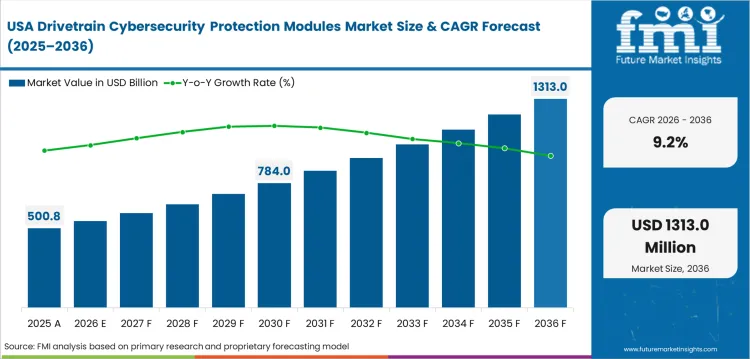
Connected vehicle rules are increasing security review across drivetrain controller sourcing. United States demand is projected at 9.2% CAGR during the forecast period because software origin and control safety are receiving closer attention. The United States Bureau of Industry and Security finalized its connected vehicle rule in January 2025. Drivetrain suppliers gain relevance when they can document software origin and safe controller behavior during OEM approval.
- Connected vehicle sourcing rules increase review of electronics content and software origin.
- Cybersecurity guidance is raising the need for safer control systems in connected vehicles.
- Software update needs support demand for secure boot and authenticated drivetrain firmware.
Future Outlook for Drivetrain Cybersecurity Protection Modules Market in Germany
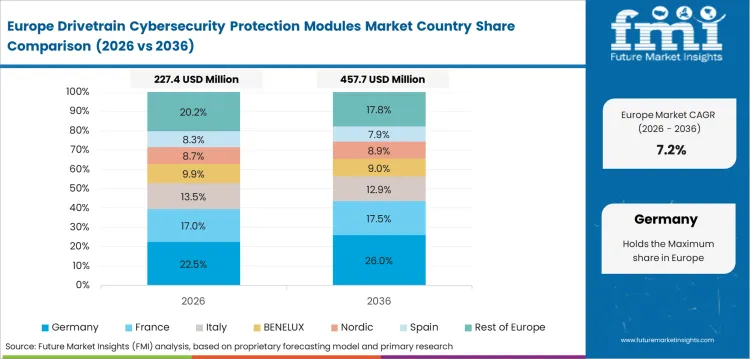
The Germany market is forecast to advance at 8.8% CAGR from 2026 to 2036 as premium vehicle engineering and deep Tier-1 electronics participation. European Automobile Manufacturers Association data show Germany produced 21.0% of cars sold in the European Union in 2025. Module vendors must support secure integration and documented controller protection for high-value vehicle programs.
- Premium vehicle programs need drivetrain security modules with detailed validation records.
- Tier-1 electronics depth supports secure gateway and controller integration work.
- European approval rules make cybersecurity evidence part of platform sourcing discussions.
Demand Outlook for Drivetrain Cybersecurity Protection Modules Market in Japan
Japan Automobile Manufacturers Association and Japan Auto Parts Industries Association published Cybersecurity Guidelines Ver. 2.3 in September 2025. Japan is forecast to record 8.5% CAGR in the assessment period. Cybersecurity guidance adds more detail across the auto supply chain. The Motor Industry of Japan 2025 report stated that Japan produced 8.23 million motor vehicles in 2024. Drivetrain module suppliers can gain access by proving secure development methods and controller-level protection evidence.
- Supplier cybersecurity guidelines strengthen common expectations across vehicle programs.
- Domestic vehicle output supports controller security demand across hybrid and electric platforms.
- Hybrid and electric drivetrain programs need trusted software updates for control stability.
Opportunity Analysis of Drivetrain Cybersecurity Protection Modules Market in South Korea
During the forecast period, South Korea is anticipated to grow at 8.1% CAGR as EV platforms increase drivetrain software content. The electronics base also supports local demand for controller security and embedded protection modules in vehicles. In February 2026, South Korea’s Ministry of Trade Industry and Resources reported that January automobile exports reached USD 6.1 billion. Export oriented vehicle programs need cybersecurity proof that works across approval systems and overseas platform requirements. Local platform groups are likely to favor modules that combine controller security with lower integration costs.
- Export-focused vehicle programs need security evidence that works across approval systems.
- EV platform work raises demand for protected inverter and torque command interfaces.
- Electronics supplier depth supports secure controller packaging for global OEM programs.
Sales Outlook for Drivetrain Cybersecurity Protection Modules Market in India
India is forecast to grow at 7.9% CAGR through 2036, supported by rising domestic vehicle production that expands the addressable base for cybersecurity modules. According to the Society of Indian Automobile Manufacturers, total vehicle production reached 33,191,967 units in 2025, creating strong volume demand for drivetrain controllers and embedded security solutions.
Passenger vehicles and two-wheelers create different cost and feature requirements for cybersecurity integration. Suppliers offering modular and scalable security functions can serve both export-oriented passenger vehicle programs and cost-sensitive domestic platforms more effectively.
- Large production scale supports security module demand across passenger vehicles and two-wheelers.
- Cost-aware controllers need compact security functions that limit bill of material pressure.
- Export programs can pull stricter cybersecurity evidence into local drivetrain electronics.
Outlook for Drivetrain Cybersecurity Protection Modules Market in France
European Automobile Manufacturers Association reported 12.5% battery electric car registration gains in France in 2025 among leading European Union electric car countries. Electrified drivetrain content raises the value of secure inverter commands and update guards. Adoption in France is forecast at 7.6% CAGR during the assessment period because electric vehicle registrations and European approval rules are increasing controller security needs.
- Electric car uptake increases demand for secure inverter and e-drive controller software.
- European cybersecurity approval rules strengthen documentation needs for vehicle electronics.
- Local engineering programs can use pre-qualified modules to reduce controller validation effort.
Competitive Landscape and Strategic Positioning
- Competition centers on secure firmware and close drivetrain controller integration.
- Suppliers with clear cybersecurity records gain access to platform programs that need secure software updates.
- OEM program selection favors companies that can protect controller identity and authenticated torque messages.
Competitive outlook in this market is driven by secure firmware and drivetrain controller experience. ETAS and Bosch are some of the key players in the industry followed by Infineon and NXP who are adding technical value through microcontroller security engines and secure update support. Continental and Aptiv bring experience in domain and zonal controller programs. HARMAN supports software defined vehicle security through validation tools and lifecycle update support.
Suppliers that reduce integration work and provide clear cybersecurity records can compete for long vehicle programs. In August 2025, Infineon completed the USD 2.5 billion purchase of Marvell’s Automotive Ethernet business. Infineon stated that the deal strengthens its software defined vehicle position and adds an automotive Ethernet design-win pipeline of about USD 4.0 billion by 2030. Secure in-vehicle networking gains priority for drivetrain controller design.
Key Companies in the Drivetrain Cybersecurity Protection Modules Market
- Embedded Security Leaders: ETAS, Bosch, and Infineon lead through HSM firmware and secure microcontrollers.
- Vehicle Architecture Suppliers: NXP, Continental, and Aptiv support domain controller programs with secure processing and integration depth.
- Software Validation Specialists: HARMAN supports secure software release work and connected vehicle lifecycle updates.
Competitive Benchmarking: Drivetrain Cybersecurity Protection Modules Market
| Company | Embedded Security Depth | Drivetrain Controller Access | Secure Update Capability | Geographic Footprint |
|---|---|---|---|---|
| ETAS GmbH and Bosch | High | High | High | Global automotive software and security depth |
| Infineon Technologies AG | High | Medium | High | Global semiconductor and automotive MCU reach |
| NXP Semiconductors N.V. | High | High | High | Global processor and vehicle networking footprint |
| Continental AG | Medium | High | Medium | European and global vehicle architecture reach |
| Aptiv PLC | Medium | High | Medium | Global vehicle electronics and integration presence |
| HARMAN International | Medium | Medium | High | Connected vehicle and SDV software presence |
| Vector Informatik GmbH | High | Medium | High | Embedded software and validation tool depth |
Source: Future Market Insights competitive analysis, 2026.
Recent Developments in the Drivetrain Cybersecurity Protection Modules Market
- In March 2025, NXP introduced the S32K5 automotive microcontroller family for zonal and electrification architectures. The launch adds secure processing options for electric drivetrain controller programs.
- In March 2025, Infineon achieved ISO/SAE 21434 certification for AURIX TC4Dx microcontrollers. The certification gives OEM groups stronger evidence for secure controller development.
Key Companies in the Drivetrain Cybersecurity Protection Modules Market
- ETAS GmbH
- Robert Bosch GmbH
- Infineon Technologies AG
- NXP Semiconductors N.V.
- Continental AG
- Aptiv PLC
- HARMAN International
- Vector Informatik GmbH
Report Scope and Coverage
| Parameter | Details |
|---|---|
| Quantitative Units | USD 1.0 billion to USD 2.2 billion at 8.4% CAGR |
| Market Definition | Embedded hardware and software modules used to protect drivetrain control units from unsafe commands and software tampering |
| Component Type | Embedded HSM Firmware, Secure Gateway Modules, IDS Agents, Crypto Libraries, OTA Guards |
| Security Layer | Gateway Authentication, Secure Boot, Message Encryption, Intrusion Detection, Key Storage |
| Vehicle Platform | Passenger Vehicles, Light Commercial, Heavy Trucks, Two Wheelers, Off Highway |
| Propulsion Type | Electric Drivetrains, Hybrid Drivetrains, Internal Combustion, Transmission Control |
| Integration Channel | OEM Integration, Tier-1 Packages, Aftermarket Upgrades, Testbed Programs |
| Countries Covered | China, United States, Germany, Japan, South Korea, India, France |
| Key Companies Profiled | ETAS GmbH, Bosch, Infineon, NXP, Continental, Aptiv, HARMAN, Vector Informatik |
| Forecast Period | 2026 to 2036 |
| Approach | Bottom-up model using vehicle production, controller content, and security module attach rates |
Drivetrain Cybersecurity Protection Modules Market by Component Type, Security Layer, Vehicle Platform, Propulsion Type, and Integration Channel
By Component Type:
- Embedded HSM Firmware
- Secure Gateway Modules
- IDS Agents
- Crypto Libraries
- OTA Guards
By Security Layer:
- Gateway Authentication
- Secure Boot
- Message Encryption
- Intrusion Detection
- Key Storage
By Vehicle Platform:
- Passenger Vehicles
- Light Commercial
- Heavy Trucks
- Two Wheelers
- Off Highway
By Propulsion Type:
- Electric Drivetrains
- Hybrid Drivetrains
- Internal Combustion
- Transmission Control
By Integration Channel:
- OEM Integration
- Tier-1 Packages
- Aftermarket Upgrades
- Testbed Programs
Research Sources and Bibliography
- Organisation Internationale des Constructeurs d’Automobiles. (2026, April 23). Auto industry growth shifted east in 2025 amid global repositioning. OICA.
- Bureau of Industry and Security. (2025, January 14). Commerce finalizes rule to secure connected vehicle supply chains from foreign adversary threats. USA Department of Commerce.
- Bureau of Industry and Security. (2025, January 16). Securing the information and communications technology and services supply chain: Connected vehicles. Federal Register.
- State Council of the People’s Republic of China. (2026, January 14). China’s auto output, sales reach new highs in 2025.
- European Automobile Manufacturers’ Association. (2026, April 2). Economic and market report: Global and EU auto industry, full year 2025. ACEA.
- European Automobile Manufacturers’ Association. (2026, January 27). New car registrations: +1.8% in 2025; battery-electric 17.4% market share. ACEA.
- Japan Automobile Manufacturers Association, Inc. (2025, September 26). The motor industry of Japan 2025. JAMA.
- Japan Automobile Manufacturers Association, Inc., & Japan Auto Parts Industries Association. (2025, September 1). JAMA/JAPIA cybersecurity guidelines: Further development of cybersecurity measures in the automobile industry, Ver. 2.3.
- Invest KOREA. (2026, March 4). January auto exports hit USD 6.1 bn, up 21.7 percent: 2nd highest for any January. KOTRA.
- Society of Indian Automobile Manufacturers. (2026, January 13). Auto industry performance of December 2025 and Q3 October to December 2025. SIAM.
- AUTOSAR. (2025, November 27). Requirements on MACsec: AUTOSAR FO R25-11.
- NXP Semiconductors N.V. (2024, March 28). NXP breaks through integration barriers for software-defined vehicle development with open S32 CoreRide platform.
- NXP Semiconductors N.V. (2025, March 11). New S32K5 microcontroller family advances zonal SDV architectures and extends the NXP CoreRide platform.
- Infineon Technologies AG. (2025, March 3). Infineon achieves ISO/SAE 21434 certification for AURIX.
- Infineon Technologies AG. (2025, August 14). Infineon successfully completes acquisition of Marvell’s Automotive Ethernet business.
Frequently Asked Questions
What is the size of the drivetrain cybersecurity protection modules market?
Drivetrain cybersecurity protection modules market is estimated at USD 1.0 billion in 2026 and is forecast to reach USD 2.2 billion by 2036.
What CAGR is projected for the drivetrain cybersecurity protection modules market?
From 2026 to 2036, demand is projected to expand at 8.4% CAGR as drivetrain controllers carry more software and secure update needs.
Which component type is projected to lead the market?
Embedded HSM firmware is projected to lead component type demand with 54.0% share in 2026 as secure key storage moves inside drivetrain controllers.
Which integration channel is projected to lead demand?
OEM integration is anticipated to represent 62.0% share in 2026 with vehicle makers preferring security modules qualified during platform design.
Which country is expected to record the fastest pace?
China is projected to record the highest listed country CAGR at 9.7% CAGR through 2036 with large vehicle output and software defined vehicle work.
Which companies are active in this market?
ETAS, Bosch, Infineon, NXP, Continental, Aptiv, HARMAN, and Vector Informatik are active in embedded security and controller software support.
What does the report exclude?
Scope excludes enterprise IT security and fleet security operation centers that are outside drivetrain control protection.
Preview the report firsthand - request a free sample
Get SampleGet the brochure for pricing and purchase details.
Get PDFTable of Content
- Executive Summary
- Global Market Outlook
- Demand-side Trends
- Supply-side Trends
- Technology Roadmap Analysis
- Analysis and Recommendations
- Market Overview
- Market Coverage / Taxonomy
- Market Definition / Scope / Limitations
- Research Methodology
- Chapter Orientation
- Analytical Lens and Working Hypotheses
- Market Structure, Signals, and Trend Drivers
- Benchmarking and Cross-market Comparability
- Market Sizing, Forecasting, and Opportunity Mapping
- Research Design and Evidence Framework
- Desk Research Programme (Secondary Evidence)
- Company Annual and Sustainability Reports
- Peer-reviewed Journals and Academic Literature
- Corporate Websites, Product Literature, and Technical Notes
- Earnings Decks and Investor Briefings
- Statutory Filings and Regulatory Disclosures
- Technical White Papers and Standards Notes
- Trade Journals, Industry Magazines, and Analyst Briefs
- Conference Proceedings, Webinars, and Seminar Materials
- Government Statistics Portals and Public Data Releases
- Press Releases and Reputable Media Coverage
- Specialist Newsletters and Curated Briefings
- Sector Databases and Reference Repositories
- FMI Internal Proprietary Databases and Historical Market Datasets
- Subscription Datasets and Paid Sources
- Social Channels, Communities, and Digital Listening Inputs
- Additional Desk Sources
- Expert Input and Fieldwork (Primary Evidence)
- Primary Modes
- Qualitative Interviews and Expert Elicitation
- Quantitative Surveys and Structured Data Capture
- Blended Approach
- Why Primary Evidence is Used
- Field Techniques
- Interviews
- Surveys
- Focus Groups
- Observational and In-context Research
- Social and Community Interactions
- Stakeholder Universe Engaged
- C-suite Leaders
- Board Members
- Presidents and Vice Presidents
- R&D and Innovation Heads
- Technical Specialists
- Domain Subject-matter Experts
- Scientists
- Physicians and Other Healthcare Professionals
- Governance, Ethics, and Data Stewardship
- Research Ethics
- Data Integrity and Handling
- Primary Modes
- Tooling, Models, and Reference Databases
- Desk Research Programme (Secondary Evidence)
- Data Engineering and Model Build
- Data Acquisition and Ingestion
- Cleaning, Normalisation, and Verification
- Synthesis, Triangulation, and Analysis
- Quality Assurance and Audit Trail
- Market Background
- Market Dynamics
- Drivers
- Restraints
- Opportunity
- Trends
- Scenario Forecast
- Demand in Optimistic Scenario
- Demand in Likely Scenario
- Demand in Conservative Scenario
- Opportunity Map Analysis
- Product Life Cycle Analysis
- Supply Chain Analysis
- Investment Feasibility Matrix
- Value Chain Analysis
- PESTLE and Porter’s Analysis
- Regulatory Landscape
- Regional Parent Market Outlook
- Production and Consumption Statistics
- Import and Export Statistics
- Market Dynamics
- Global Market Analysis 2021 to 2025 and Forecast, 2026 to 2036
- Historical Market Size Value (USD Million) Analysis, 2021 to 2025
- Current and Future Market Size Value (USD Million) Projections, 2026 to 2036
- Y-o-Y Growth Trend Analysis
- Absolute $ Opportunity Analysis
- Global Market Pricing Analysis 2021 to 2025 and Forecast 2026 to 2036
- Global Market Analysis 2021 to 2025 and Forecast 2026 to 2036, By Component Type
- Introduction / Key Findings
- Historical Market Size Value (USD Million) Analysis By Component Type , 2021 to 2025
- Current and Future Market Size Value (USD Million) Analysis and Forecast By Component Type , 2026 to 2036
- Embedded HSM Firmware
- Secure Gateway Modules
- IDS Agents
- Crypto Libraries
- OTA Guards
- Embedded HSM Firmware
- Y-o-Y Growth Trend Analysis By Component Type , 2021 to 2025
- Absolute $ Opportunity Analysis By Component Type , 2026 to 2036
- Global Market Analysis 2021 to 2025 and Forecast 2026 to 2036, By Security Layer
- Introduction / Key Findings
- Historical Market Size Value (USD Million) Analysis By Security Layer, 2021 to 2025
- Current and Future Market Size Value (USD Million) Analysis and Forecast By Security Layer, 2026 to 2036
- Gateway Authentication
- Secure Boot
- Message Encryption
- Intrusion Detection
- Key Storage
- Gateway Authentication
- Y-o-Y Growth Trend Analysis By Security Layer, 2021 to 2025
- Absolute $ Opportunity Analysis By Security Layer, 2026 to 2036
- Global Market Analysis 2021 to 2025 and Forecast 2026 to 2036, By Vehicle Platform
- Introduction / Key Findings
- Historical Market Size Value (USD Million) Analysis By Vehicle Platform, 2021 to 2025
- Current and Future Market Size Value (USD Million) Analysis and Forecast By Vehicle Platform, 2026 to 2036
- Passenger Vehicles
- Light Commercial
- Heavy Trucks
- Two Wheelers
- Off Highway
- Passenger Vehicles
- Y-o-Y Growth Trend Analysis By Vehicle Platform, 2021 to 2025
- Absolute $ Opportunity Analysis By Vehicle Platform, 2026 to 2036
- Global Market Analysis 2021 to 2025 and Forecast 2026 to 2036, By Propulsion Type
- Introduction / Key Findings
- Historical Market Size Value (USD Million) Analysis By Propulsion Type, 2021 to 2025
- Current and Future Market Size Value (USD Million) Analysis and Forecast By Propulsion Type, 2026 to 2036
- Electric Drivetrains
- Hybrid Drivetrains
- Internal Combustion
- Transmission Control
- Electric Drivetrains
- Y-o-Y Growth Trend Analysis By Propulsion Type, 2021 to 2025
- Absolute $ Opportunity Analysis By Propulsion Type, 2026 to 2036
- Global Market Analysis 2021 to 2025 and Forecast 2026 to 2036, By Integration Channel
- Introduction / Key Findings
- Historical Market Size Value (USD Million) Analysis By Integration Channel, 2021 to 2025
- Current and Future Market Size Value (USD Million) Analysis and Forecast By Integration Channel, 2026 to 2036
- OEM Integration
- Tier-1 Packages
- Aftermarket Upgrades
- Testbed Programs
- OEM Integration
- Y-o-Y Growth Trend Analysis By Integration Channel, 2021 to 2025
- Absolute $ Opportunity Analysis By Integration Channel, 2026 to 2036
- Global Market Analysis 2021 to 2025 and Forecast 2026 to 2036, By Region
- Introduction
- Historical Market Size Value (USD Million) Analysis By Region, 2021 to 2025
- Current Market Size Value (USD Million) Analysis and Forecast By Region, 2026 to 2036
- North America
- Latin America
- Western Europe
- Eastern Europe
- East Asia
- South Asia and Pacific
- Middle East & Africa
- Market Attractiveness Analysis By Region
- North America Market Analysis 2021 to 2025 and Forecast 2026 to 2036, By Country
- Historical Market Size Value (USD Million) Trend Analysis By Market Taxonomy, 2021 to 2025
- Market Size Value (USD Million) Forecast By Market Taxonomy, 2026 to 2036
- By Country
- USA
- Canada
- Mexico
- By Component Type
- By Security Layer
- By Vehicle Platform
- By Propulsion Type
- By Integration Channel
- By Country
- Market Attractiveness Analysis
- By Country
- By Component Type
- By Security Layer
- By Vehicle Platform
- By Propulsion Type
- By Integration Channel
- Key Takeaways
- Latin America Market Analysis 2021 to 2025 and Forecast 2026 to 2036, By Country
- Historical Market Size Value (USD Million) Trend Analysis By Market Taxonomy, 2021 to 2025
- Market Size Value (USD Million) Forecast By Market Taxonomy, 2026 to 2036
- By Country
- Brazil
- Chile
- Rest of Latin America
- By Component Type
- By Security Layer
- By Vehicle Platform
- By Propulsion Type
- By Integration Channel
- By Country
- Market Attractiveness Analysis
- By Country
- By Component Type
- By Security Layer
- By Vehicle Platform
- By Propulsion Type
- By Integration Channel
- Key Takeaways
- Western Europe Market Analysis 2021 to 2025 and Forecast 2026 to 2036, By Country
- Historical Market Size Value (USD Million) Trend Analysis By Market Taxonomy, 2021 to 2025
- Market Size Value (USD Million) Forecast By Market Taxonomy, 2026 to 2036
- By Country
- Germany
- UK
- Italy
- Spain
- France
- Nordic
- BENELUX
- Rest of Western Europe
- By Component Type
- By Security Layer
- By Vehicle Platform
- By Propulsion Type
- By Integration Channel
- By Country
- Market Attractiveness Analysis
- By Country
- By Component Type
- By Security Layer
- By Vehicle Platform
- By Propulsion Type
- By Integration Channel
- Key Takeaways
- Eastern Europe Market Analysis 2021 to 2025 and Forecast 2026 to 2036, By Country
- Historical Market Size Value (USD Million) Trend Analysis By Market Taxonomy, 2021 to 2025
- Market Size Value (USD Million) Forecast By Market Taxonomy, 2026 to 2036
- By Country
- Russia
- Poland
- Hungary
- Balkan & Baltic
- Rest of Eastern Europe
- By Component Type
- By Security Layer
- By Vehicle Platform
- By Propulsion Type
- By Integration Channel
- By Country
- Market Attractiveness Analysis
- By Country
- By Component Type
- By Security Layer
- By Vehicle Platform
- By Propulsion Type
- By Integration Channel
- Key Takeaways
- East Asia Market Analysis 2021 to 2025 and Forecast 2026 to 2036, By Country
- Historical Market Size Value (USD Million) Trend Analysis By Market Taxonomy, 2021 to 2025
- Market Size Value (USD Million) Forecast By Market Taxonomy, 2026 to 2036
- By Country
- China
- Japan
- South Korea
- By Component Type
- By Security Layer
- By Vehicle Platform
- By Propulsion Type
- By Integration Channel
- By Country
- Market Attractiveness Analysis
- By Country
- By Component Type
- By Security Layer
- By Vehicle Platform
- By Propulsion Type
- By Integration Channel
- Key Takeaways
- South Asia and Pacific Market Analysis 2021 to 2025 and Forecast 2026 to 2036, By Country
- Historical Market Size Value (USD Million) Trend Analysis By Market Taxonomy, 2021 to 2025
- Market Size Value (USD Million) Forecast By Market Taxonomy, 2026 to 2036
- By Country
- India
- ASEAN
- Australia & New Zealand
- Rest of South Asia and Pacific
- By Component Type
- By Security Layer
- By Vehicle Platform
- By Propulsion Type
- By Integration Channel
- By Country
- Market Attractiveness Analysis
- By Country
- By Component Type
- By Security Layer
- By Vehicle Platform
- By Propulsion Type
- By Integration Channel
- Key Takeaways
- Middle East & Africa Market Analysis 2021 to 2025 and Forecast 2026 to 2036, By Country
- Historical Market Size Value (USD Million) Trend Analysis By Market Taxonomy, 2021 to 2025
- Market Size Value (USD Million) Forecast By Market Taxonomy, 2026 to 2036
- By Country
- Kingdom of Saudi Arabia
- Other GCC Countries
- Turkiye
- South Africa
- Other African Union
- Rest of Middle East & Africa
- By Component Type
- By Security Layer
- By Vehicle Platform
- By Propulsion Type
- By Integration Channel
- By Country
- Market Attractiveness Analysis
- By Country
- By Component Type
- By Security Layer
- By Vehicle Platform
- By Propulsion Type
- By Integration Channel
- Key Takeaways
- Key Countries Market Analysis
- USA
- Pricing Analysis
- Market Share Analysis, 2025
- By Component Type
- By Security Layer
- By Vehicle Platform
- By Propulsion Type
- By Integration Channel
- Canada
- Pricing Analysis
- Market Share Analysis, 2025
- By Component Type
- By Security Layer
- By Vehicle Platform
- By Propulsion Type
- By Integration Channel
- Mexico
- Pricing Analysis
- Market Share Analysis, 2025
- By Component Type
- By Security Layer
- By Vehicle Platform
- By Propulsion Type
- By Integration Channel
- Brazil
- Pricing Analysis
- Market Share Analysis, 2025
- By Component Type
- By Security Layer
- By Vehicle Platform
- By Propulsion Type
- By Integration Channel
- Chile
- Pricing Analysis
- Market Share Analysis, 2025
- By Component Type
- By Security Layer
- By Vehicle Platform
- By Propulsion Type
- By Integration Channel
- Germany
- Pricing Analysis
- Market Share Analysis, 2025
- By Component Type
- By Security Layer
- By Vehicle Platform
- By Propulsion Type
- By Integration Channel
- UK
- Pricing Analysis
- Market Share Analysis, 2025
- By Component Type
- By Security Layer
- By Vehicle Platform
- By Propulsion Type
- By Integration Channel
- Italy
- Pricing Analysis
- Market Share Analysis, 2025
- By Component Type
- By Security Layer
- By Vehicle Platform
- By Propulsion Type
- By Integration Channel
- Spain
- Pricing Analysis
- Market Share Analysis, 2025
- By Component Type
- By Security Layer
- By Vehicle Platform
- By Propulsion Type
- By Integration Channel
- France
- Pricing Analysis
- Market Share Analysis, 2025
- By Component Type
- By Security Layer
- By Vehicle Platform
- By Propulsion Type
- By Integration Channel
- India
- Pricing Analysis
- Market Share Analysis, 2025
- By Component Type
- By Security Layer
- By Vehicle Platform
- By Propulsion Type
- By Integration Channel
- ASEAN
- Pricing Analysis
- Market Share Analysis, 2025
- By Component Type
- By Security Layer
- By Vehicle Platform
- By Propulsion Type
- By Integration Channel
- Australia & New Zealand
- Pricing Analysis
- Market Share Analysis, 2025
- By Component Type
- By Security Layer
- By Vehicle Platform
- By Propulsion Type
- By Integration Channel
- China
- Pricing Analysis
- Market Share Analysis, 2025
- By Component Type
- By Security Layer
- By Vehicle Platform
- By Propulsion Type
- By Integration Channel
- Japan
- Pricing Analysis
- Market Share Analysis, 2025
- By Component Type
- By Security Layer
- By Vehicle Platform
- By Propulsion Type
- By Integration Channel
- South Korea
- Pricing Analysis
- Market Share Analysis, 2025
- By Component Type
- By Security Layer
- By Vehicle Platform
- By Propulsion Type
- By Integration Channel
- Russia
- Pricing Analysis
- Market Share Analysis, 2025
- By Component Type
- By Security Layer
- By Vehicle Platform
- By Propulsion Type
- By Integration Channel
- Poland
- Pricing Analysis
- Market Share Analysis, 2025
- By Component Type
- By Security Layer
- By Vehicle Platform
- By Propulsion Type
- By Integration Channel
- Hungary
- Pricing Analysis
- Market Share Analysis, 2025
- By Component Type
- By Security Layer
- By Vehicle Platform
- By Propulsion Type
- By Integration Channel
- Kingdom of Saudi Arabia
- Pricing Analysis
- Market Share Analysis, 2025
- By Component Type
- By Security Layer
- By Vehicle Platform
- By Propulsion Type
- By Integration Channel
- Turkiye
- Pricing Analysis
- Market Share Analysis, 2025
- By Component Type
- By Security Layer
- By Vehicle Platform
- By Propulsion Type
- By Integration Channel
- South Africa
- Pricing Analysis
- Market Share Analysis, 2025
- By Component Type
- By Security Layer
- By Vehicle Platform
- By Propulsion Type
- By Integration Channel
- USA
- Market Structure Analysis
- Competition Dashboard
- Competition Benchmarking
- Market Share Analysis of Top Players
- By Regional
- By Component Type
- By Security Layer
- By Vehicle Platform
- By Propulsion Type
- By Integration Channel
- Competition Analysis
- Competition Deep Dive
- ETAS GmbH and Bosch
- Overview
- Product Portfolio
- Profitability by Market Segments (Product/Age /Sales Channel/Region)
- Sales Footprint
- Strategy Overview
- Marketing Strategy
- Product Strategy
- Channel Strategy
- Infineon Technologies AG
- NXP Semiconductors N.V.
- Continental AG
- Aptiv PLC
- HARMAN International
- Vector Informatik GmbH
- ETAS GmbH and Bosch
- Competition Deep Dive
- Assumptions & Acronyms Used


